



Abstract
Drawing on intergroup contact theory, this study examines whether intergroup anxiety and perceived discrimination mediate the relationship between intergroup contact and a dual sense of belonging: to mainstream society and to one’s ethnic ingroup. Data were collected through a paper-based survey of 513 Ethiopian Jews in Ethiopia (mean age = 24; the sample consisted primarily of single men with secondary education). Moderated mediation analyses indicate that intergroup contact is positively associated with belonging to mainstream society but unrelated to ingroup belonging. Intergroup anxiety shows a divergent pattern: higher anxiety is associated with lower belonging to mainstream society and stronger ingroup belonging. Contrary to expectations, intergroup contact is positively associated with perceived discrimination. Mediation analyses show that intergroup anxiety significantly mediates the relationship between contact and belonging, whereas perceived discrimination does not. These findings suggest that intergroup contact may foster integration but also heighten awareness of discrimination in stratified social contexts.
Introduction
This research is grounded in Allport’s (1954) intergroup contact theory, which posits that contact between groups, under optimal conditions, can substantially reduce prejudice and foster more positive intergroup attitudes (Halperin et al., 2012; Lim et al., 2024; Pettigrew, 2021). This has since received robust empirical support, most notably in Pettigrew and Tropp’s (2006) meta-analysis of over 500 studies, and has arguably now developed into an integrative theory (Hewstone, 2009; R. N. Turner et al., 2008). Nevertheless, the relationship between intergroup contact and its psychological outcomes is not always consistent. For example, recent meta-analyses of experimental contact research have shown that the average effects of intergroup contact are smaller than indicated by previous findings (Lowe, 2025). Importantly, contact is more effective at changing behaviors and attitudes toward specific outgroup members met than toward the outgroup as a whole (Lowe, 2025; Pettigrew & Tropp, 2006), and effects tend to be stronger at the individual level than at the broader group level (Forbes, 2004).
This complex and often inconsistent relationship has also been observed in the context of perceived discrimination (Dixon et al., 2010; Reimer & Sengupta, 2023; Schaeffer & Kas, 2024) and its association with belonging and social identification (Mummendey & Otten, 1998; Tajfel & Turner, 1979), with belonging being understood as the subjective feeling of deep connection with social groups, physical places, and individual or collective experiences (Allen et al., 2021). We extend this framework by examining the relationships between intergroup contact and dual senses of belonging, both to mainstream society and to one’s own ethnic group, among Ethiopian Jews, a community that has retained their distinct identity for millennia while living within mainstream Ethiopian society.
The interactions between Ethiopian Jews, also known as Beta Israel (House of Israel) and often referred to by outsiders as Falasha, meaning “landless,” “exile,” or “wanderer” (Salamon, 1999; Weinstein, 1985), and the dominant Ethiopian Christian Orthodox population have historically been asymmetrical, shaped by a framework of conditional acceptance and exclusion (Kessler, 1982, 1996; Pankhurst, 1992; Ridinger, 2020; Salamon, 1999). While Beta Israel were permitted to engage in structured cooperation with the broader society, they were simultaneously subjected to rigid social boundaries and exclusionary practices (Salamon, 1999; Wagaw, 1993).
These cooperative relations were largely instrumental, rooted in longstanding economic interdependence, particularly in skilled artisanal trades such as pottery, weaving, metalwork, construction of Christian churches, and scribal works (Pankhurst, 1992). At the same time, Beta Israel were exposed to stigmatization and derogatory labeling (Salamon, 1999; Zegeye, 2004). Such marginalization has been linked not only to economic positioning but also to enduring religiopolitical narratives, most notably the mythology of Judith (or Yodit, in Ge’ez-ጉዲት), a legendary queen associated with the destruction of Christian institutions in the 10th century (Quirin, 1988; Tamrat, 1973; Wagaw, 1993). These narratives have contributed to persistent patterns of social and economic exclusion and pressures toward religious and cultural assimilation (Cohen, 2011; Dege-Müller, 2018; Kessler, 1982).
More recent spatial shifts, including the relocation of many Ethiopian Jews to urban centers, have introduced new forms of intergroup contact and opportunities for cross-group interaction. However, the continued salience of distinct religious and cultural practices (e.g., Sabbath observance and dietary laws) continues to reinforce processes of social differentiation. At the same time, younger generations increasingly identify with mainstream Rabbinic Judaism, a development that may further shape both intragroup dynamics and relations with the broader society.
By focusing on the minority group perspectives of the contact hypothesis, this study positions itself as a distinct contribution to the existing literature on contact–effect relationships, addressing several underexplored aspects of intergroup encounters. First, prior research has predominantly concentrated on the origins and authenticity of Beta Israel identity (Haile, 2006; Kaplan, 1993; Kessler, 1996; Zegeye, 2004), the stigmatization and derogatory labels in Ethiopia (Dege-Müller, 2018; Jordan, 2016; Kaplan & Rosen, 1994; Salamon, 1999), and the racialized subjectivities and belonging within the Israel context (Abbink, 2002). In contrast, limited or no scholarly attention has been devoted to examining how interactions with outgroup members, whether positive or negative, influence the sense of belonging of Beta Israel both to the broader Ethiopian society and to their own ethnic group.
Second, while a substantial body of research emphasizes the role of optimal intergroup contact in reducing prejudice among majority group members (Allport, 1954; Dovidio et al., 2005; Pettigrew, 1998), far less is known about how such contact shapes the experiences of individuals with minority status (Rafiqi & Thomsen, 2021; Tropp & Pettigrew, 2005). This study addresses this gap by investigating how intergroup contact influences the sense of belonging among minority group members, and how emotional and evaluative reactions mediate this relationship. The concept of belonging captures whether minority individuals perceive themselves as accepted and legitimate members of the society. This distinction is especially important in contexts marked by structural inequality, where minority group members may not primarily struggle with prejudice toward the majority, but rather with questions of inclusion, recognition, and social acceptance.
Third, despite extensive empirical support for the contact hypothesis and its practical implications (Pettigrew, 1998), scholars have raised two key critical issues: (1) the universality of optimal contact conditions is limited in addressing the complexities of real-world intergroup dynamics; and (2) the scope of contact research has often been confined to a narrow range of group contexts (Dovidio et al., 2005; Lim et al., 2024; Pettigrew, 1998, 2021; Pettigrew & Tropp, 2006). By applying contact theory to the largely overlooked case of Ethiopian Jews within their country of origin, this study seeks to extend the theoretical boundaries of intergroup contact research and contribute to a more contextually grounded understanding of belonging within minority–majority dynamics.
Theoretical Framework
Belongingness Explained
The essence of belonging or belongingness is considered a cornerstone of social cohesion, particularly within multiethnic and multicultural societies. Contemporary scholarship conceptualizes belonging as a dynamic emotional and experiential state arising from four interrelated components, each shaped by the broader systems in which individuals are embedded: (1) competencies for belonging, (2) opportunities to belong, (3) motivations to belong, and (4) perceptions of belonging, which encompass both positive and negative experiences in social interactions (Allen et al., 2021). At its core, belonging broadly reflects the degree to which individuals identify with a particular group, community, society, or geographical region (Karim & Hue, 2022).
From a motivational perspective, belonging is not just a desire but a fundamental human need that constitutes a powerful and universal motivational force driving individuals to form and maintain at least a minimum number of lasting, positive, and significant interpersonal relationships (Baumeister & Leary, 1995; Maslow, 1943; Ryan & Deci, 2000). Fulfilling this need requires meeting two essential criteria: (1) frequent and pleasant interactions with a few others; and (2) ensuring a stable and enduring framework of mutual care and concern for each other’s welfare (Baumeister & Leary, 1995).
Social identity theory (SIT) further conceptualizes belonging as a psychological process through which individuals derive self-esteem and emotional security from membership in valued social groups, including their ethnic and/or national identities (Tajfel & Turner, 1979). Individuals often construct their identities in relation to social groups in order to preserve and promote their sense of self (G. Islam, 2014; Ryan & Deci, 2000). While belonging to valued social groups fosters emotional security and self-worth, experiences of exclusion or marginalization can lead to identity threats, alienation, intergroup conflict, and increased ingroup favoritism (Baumeister & Leary, 1995; Harwood, 2020; Tajfel & Turner, 1979).
In the case of Ethiopian Jews, belonging is not only a general psychological need but also a historically and collectively salient dimension of identity. As a community that has long defined itself through religious and ancestral ties to the broader Jewish people, questions of recognition, legitimacy, and societal inclusion have occupied a central place in its collective narrative. Processes of migration, recognition, and ongoing negotiations of social status have further intensified concerns surrounding acceptance and membership in the national community. Thus, for Ethiopian Jews, belonging reflects more than interpersonal inclusion; it captures the broader struggle for societal recognition and equal membership. Examining belonging in this context, therefore, provides a particularly meaningful lens through which to understand the psychological consequences of intergroup contact.
Acculturation theory (Berry, 1997) provides an important extension to SIT theory by proposing that minority groups simultaneously navigate identification with their heritage culture and develop attachment to the mainstream culture. Such dual belonging or dual identification becomes possible when cultural diversity is socially recognized and valued (Benet-Martínez & Haritatos, 2005; Berry, 1997). In contrast, struggles for belonging can be more pronounced among historically marginalized groups that frequently face structural barriers to societal inclusion (Allen et al., 2021; Phinney et al., 2001). Experiences of rejection and exclusion may strengthen identification with one’s own ethnic group and reinforce social categorization processes (Trepte & Loy, 2017; J. C. Turner et al., 1987). Conversely, when individuals perceive lower levels of inequality or discrimination, whether personally or collectively, intergroup contact is less likely to evoke threats to belonging, reducing the likelihood that individuals disentangle from their ingroup or from mainstream norms (Kende et al., 2021).
Importantly, increased interaction with members of the majority group does not necessarily weaken attachment to one’s ethnic group. Acculturation research suggests that individuals can maintain strong identification with their heritage culture while simultaneously developing attachment to the broader society. In this sense, intergroup contact may foster societal inclusion while coexisting with, rather than undermining, a sense of belonging to one’s ethnic group. Full societal recognition and acceptance of cultural diversity have been shown to foster attachment both to the broader society and to one’s ethnic group (Berry, 1997).
Building on this theoretical foundation, we hypothesize that intergroup contact is positively associated with a sense of belonging to both mainstream society and one’s own ethnic group.
Discrimination in Intergroup Contexts
Social Darwinism often portrayed interactions between groups as competitive struggles for dominance, with conflict viewed as an inevitable outcome of the competition for survival. This theory has partially influenced early formulations of intergroup contact theory (Dovidio et al., 2005). However, later scholarship shifted toward understanding the conditions under which intergroup relations can improve. Intergroup contact theory proposes that prejudice can be reduced when interactions between groups occur under optimal conditions, including equal status between groups, cooperation, shared goals, and institutional support (Allport, 1954).
Subsequent empirical research has provided substantial support for this framework. A comprehensive meta-analysis of more than 500 studies demonstrated that intergroup contact generally improves intergroup attitudes across a wide range of target groups, age groups, geographical contexts, and contact settings (Pettigrew & Tropp, 2006). More recent evidence confirms that these positive effects hold across diverse samples and methodological approaches (Lim et al., 2024). Experimental studies further highlight the transformative potential of intergroup contact, showing that both imagined (R. N. Turner et al., 2013) and real interactions (Halperin et al., 2012) can foster more favorable attitudes toward outgroup members. These effects are often explained by mechanisms such as increased outgroup trust, improved perceptions of the outgroup, and changes in both implicit and explicit emotional responses (Dovidio et al., 2002).
Within this classical framework, intergroup contact has also been associated with reduced perceptions of discrimination, particularly when contact occurs under favorable conditions (Van Assche et al., 2023). However, more recent scholarship has highlighted that this relationship is not uniform across social contexts (Dixon et al., 2010). Research on the integration paradox suggests that immigrants and their descendants who have greater access to mainstream institutions and middle-class environments may report higher levels of perceived discrimination (Schaeffer & Kas, 2024). Similarly, meta-analytic work highlights the possibility of “ironic” effects of intergroup contact, whereby increased contact may heighten perceptions of discrimination rather than reduce them (Reimer & Sengupta, 2023). Thus, greater interaction with majority-group members can increase awareness of social inequalities and heighten sensitivity to discriminatory experiences.
These divergent findings suggest that the consequences of intergroup contact depend strongly on broader structural conditions. Factors such as status inequality, perceived threat, and the quality of interactions shape whether contact reduces or reinforces perceptions of discrimination (Hayward et al., 2017; Mummendey & Otten, 1998; Tajfel & Turner, 1979). When contact occurs under conditions of unequal power, competition, or limited institutional support, it may intensify intergroup tensions and reinforce existing social hierarchies (Pratto et al., 2006; Saguy et al., 2008).
Drawing on SIT (Tajfel & Turner, 1979), such contexts may activate defensive identity processes. When contacts occur within unequal or competitive environments, intergroup interactions can strengthen ingroup identification and increase sensitivity to group-based disadvantage (Mummendey & Otten, 1998). Heightened awareness of discrimination may therefore emerge in settings where contact exposes existing inequalities between groups.
Despite these competing theoretical perspectives, the dominant empirical pattern in the intergroup contact literature suggests that contact, particularly under favorable conditions, tends to reduce negative intergroup perceptions. Following this classical expectation, we propose the following hypothesis:
Perceived discrimination, in turn, has important implications for individuals’ sense of belonging. To experience belonging within mainstream society, individuals must feel accepted and treated fairly by the dominant group. Experiences of discrimination can undermine this sense of acceptance while simultaneously strengthening identification with one’s own group as a psychological compensatory mechanism (Branscombe, et al.,1999). SIT suggests that when group-based rejection becomes salient, individuals may reinforce their identification with their ingroup in order to restore self-esteem and maintain a secure social identity (Tajfel & Turner, 1979). Accordingly, we hypothesize:
Intergroup Anxiety
Intergroup anxiety refers to the negative psychological or behavioral responses individuals may experience due to concerns about being negatively evaluated by both ingroup and outgroup members. First conceptualized within intergroup threat theory (Stephan & Stephan, 1985), intergroup anxiety arises when individuals perceive intergroup interactions as personally threatening or stressful, often involving anticipations of rejection, embarrassment, or conflict. This form of anxiety comprises three interrelated components: affective, cognitive, and physiological (Stephan & Stephan, 1985; Stephan et al., 1999). While the affective component is considered central, it typically co-occurs with cognitive and physiological reactions (Stephan, 2014).
Intergroup anxiety is commonly linked to negative expectations about intergroup interactions, such as limited prior contact, status inequalities, histories of conflict, and negative stereotypes, which contribute to negative anticipatory beliefs about cross-group interactions (Swart et al., 2011). These expectations can lead individuals to avoid intergroup contact (Paolini et al., 2010) and rely on cognitive simplifications, such as stereotype confirmation (R. N. Turner et al., 2008). At the same time, intergroup anxiety is not purely detrimental: it may heighten individuals’ motivation to carefully manage interactions, fostering more deliberate and potentially positive engagement with outgroup members (M. R. Islam & Hewstone, 1993; Stephan et al., 1999).
Importantly, the relationship between intergroup contact and anxiety is theoretically reciprocal rather than strictly unidirectional. Classical contact theory posits that contact under optimal conditions can reduce negative affect and improve outgroup attitudes. However, prior negative contact experiences can also provoke anticipatory anxiety, which in turn influences the quantity and quality of subsequent interactions (M. R. Islam & Hewstone, 1993; Paolini et al., 2010; Pettigrew, 1998). While reciprocal effects are possible, the present study focuses on the pathway from intergroup contact to anxiety, as contact experiences represent tangible opportunities for interaction that shape emotional responses. We acknowledge this temporal ambiguity in the discussion.
The consequences of intergroup anxiety extend beyond immediate emotional responses. Reduced anxiety can facilitate the psychological incorporation of both ingroup and outgroup norms into one’s broader social identity (R. N. Turner et al., 2008), whereas heightened anxiety often strengthens ingroup favoritism and leads to more polarized attitudes toward outgroups (Stephan & Stephan, 1985). By lowering anticipatory threat, intergroup contact may create conditions conducive to belonging, which depends on perceived social acceptance and positive evaluation within broader social contexts (Kende et al., 2021). When anxiety is high, people are more likely to notice signs of exclusion; when anxiety is reduced, intergroup interactions are more likely to be perceived as inclusive and rewarding, potentially promoting a stronger sense of belonging to mainstream society.
Based on this reasoning, we propose the following hypotheses:
Moderating Variables
Research has shown that the effects of intergroup contact are not uniform across individuals or contexts (Pettigrew & Tropp, 2006; Saguy et al., 2008). Instead, these effects may vary depending on individual characteristics that shape how intergroup interactions are experienced and interpreted. Such factors can moderate the strength of the relationship between intergroup contact and psychological outcomes such as intergroup anxiety or perceived discrimination (Tropp & Pettigrew, 2005). For example, status differences between groups may influence how contact affects attitudes, with individuals from higher-status groups sometimes maintaining stronger stereotypes and prejudice than lower-status groups (Crystal et al., 2010).
In the present study, we examine education, age, and income as potential moderators of the relationship between intergroup contact and the proposed mediators. These demographic characteristics may influence both the frequency of intergroup interactions and the interpretation of those interactions.
Higher levels of education are often associated with greater exposure to diverse perspectives and social environments, which may facilitate more positive cross-group engagement and reduce anxiety during intergroup encounters (Tropp, 2007). Individuals with higher educational attainment may, therefore, be better equipped for intergroup interactions, potentially strengthening the negative association between contact and anxiety.
Age may shape how individuals experience intergroup contact through accumulated social experiences and changing social roles across the life course. Older individuals may have had more opportunities for cross-group interaction, which could reduce uncertainty and anxiety in intergroup encounters (Lim et al., 2024). Consequently, the association between contact and intergroup anxiety may vary across age groups.
Likewise, income may influence the social contexts in which intergroup contact occurs. Minority individuals with higher income levels are more likely to participate in majority-dominated educational, occupational, and residential settings, which can increase opportunities for contact. However, increased exposure to majority contexts may also heighten awareness of subtle discrimination, a phenomenon described as the integration paradox (Schaeffer & Kas, 2024). As a result, income may moderate the relationship between intergroup contact and perceived discrimination.
These considerations suggest that demographic characteristics may shape the extent to which intergroup contact influences psychological responses to cross-group interaction. Specifically, these variables are expected to moderate the first-stage paths of the mediation model—that is, the associations between intergroup contact and the mediating variables (intergroup anxiety and perceived discrimination). By influencing these pathways, demographic characteristics may indirectly affect individuals’ sense of belonging to mainstream society and to their ethnic group.
Taken all theoretical ideas together, this study integrates research on intergroup contact, psychological mechanisms of intergroup relations, and minority belonging. While previous studies have shown that intergroup contact can reduce prejudice and improve intergroup attitudes, less attention has been paid to how contact shapes minority group members’ sense of belonging within mainstream society. By examining intergroup anxiety and perceived discrimination as mediating mechanisms, and demographic characteristics as moderating factors, the present study aims to clarify both how and under what conditions intergroup contact is associated with belonging among minority group members.
Figure 1 presents the theoretical framework tested in this study. Intergroup contact is expected to influence belonging to mainstream society and belonging to one’s own ethnic group both directly and indirectly through intergroup anxiety and perceived discrimination. Moreover, demographic variables are expected to moderate the relationships between intergroup contact and these mediating mechanisms.
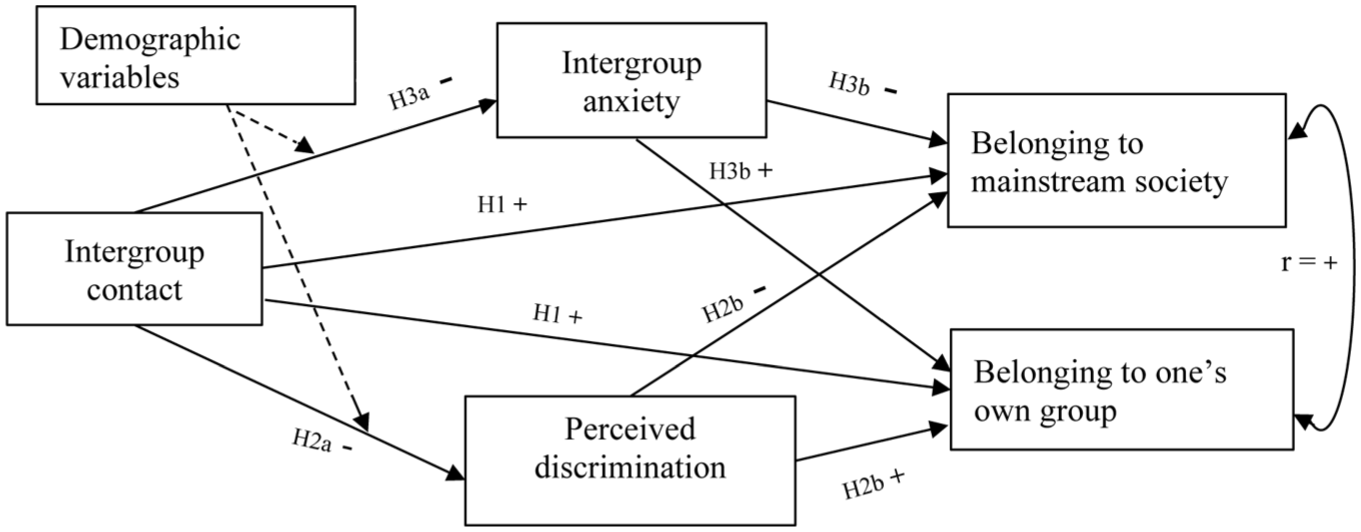
Theoretical framework.
Data and Methods
Sample
Data were collected between mid-July and mid-October 2024 through a paper-based survey of 513 members of the Ethiopian Jewish community. Prior to data collection, we aimed to obtain a sample of at least 500 respondents in order to ensure adequate statistical power for the planned mediation and moderated mediation analyses. Data collection continued until this target was reached and it was considered that, under reasonable recruitment efforts, most eligible participants at the two primary study locations had been approached.
Reliable information on the remaining Beta Israel community in Ethiopia is limited. Earlier estimates suggest that approximately 25,000 individuals who identified as Jewish lived in Ethiopia during the first decade of the millennium, with around 85% residing in the Gondar province (Judith, 2010). Due to continued emigration to Israel, more recent estimates suggest that between 6,000 and 9,000 Ethiopian Jews remained in the country as of 2021 (All Israel News, 2021). Population estimates vary across sources due to ongoing migration (Pogrebna, 2023) and differences in how community membership is defined.
Given the small size and dispersed nature of the remaining community, access to participants required collaboration with trusted community members who facilitated entry into the field. Through an established personal network in Gondar, a community gatekeeper was identified and briefed on the objectives of the study. The gatekeeper subsequently facilitated access to potential participants for data collection within the community. This approach also helped ensure that respondents belonged to the remaining practicing Jewish community in Ethiopia.
A convenience sampling approach was used (Etikan et al., 2016). Participants were eligible if they (1) identified as Jewish, (2) actively practiced Judaism, and (3) were at least 18 years old. Data were collected from a total of 513 community members using a paper-and-pencil questionnaire. In Addis Ababa, participants were recruited at a community synagogue with the assistance of a trained female research assistant with a background in psychology. In Gondar, where the Beta Israel community resides in an ethnic village within the Lideta sub-city, data were collected at the synagogue and during a summer school program organized for the community. Although Ethiopia experienced political conflicts and security challenges during this period, particularly in parts of the Amhara region, the cities of Gondar and Addis Ababa remained accessible, and data collection proceeded without disruption.
Given the limited and fluid nature of the remaining community, the sample cannot be considered statistically representative of all Ethiopian Jews in Ethiopia. Nevertheless, it provides rare empirical insights into a population that is difficult to access and rarely included in survey research. For the planned mediation and moderated mediation analyses, the sample size reaches general recommendations for models with multiple parallel mediators and provides sufficient statistical power (Caspi et al., 2025; Schoemann et al., 2017).
This study was not preregistered. We report sample size, predefined inclusion criteria, and all measures used in analyses.
Demographic Profile of Participants
A total of 513 participants completed the questionnaire, comprising 187 females (36.5%), 316 males (61.6%), and 10 individuals with missing gender data (Table 1). The average age of participants was 24 years (range: 18–65). The majority of participants (n = 360, 70.2%) were aged 18 to 24, followed by 70 (13.6%) aged 25 to 30, 48 (9.4%) aged 31 to 40, and 31 (6%) aged 41 to 65. Four participants did not report their age. Most participants were single (n = 304, 59.3%), followed by married (n = 134, 26.1%), cohabiting (n = 58, 11.3%), and separated or divorced (n = 16, 3.1%). One participant did not report their marital status.
Demographic Profile of Participants.
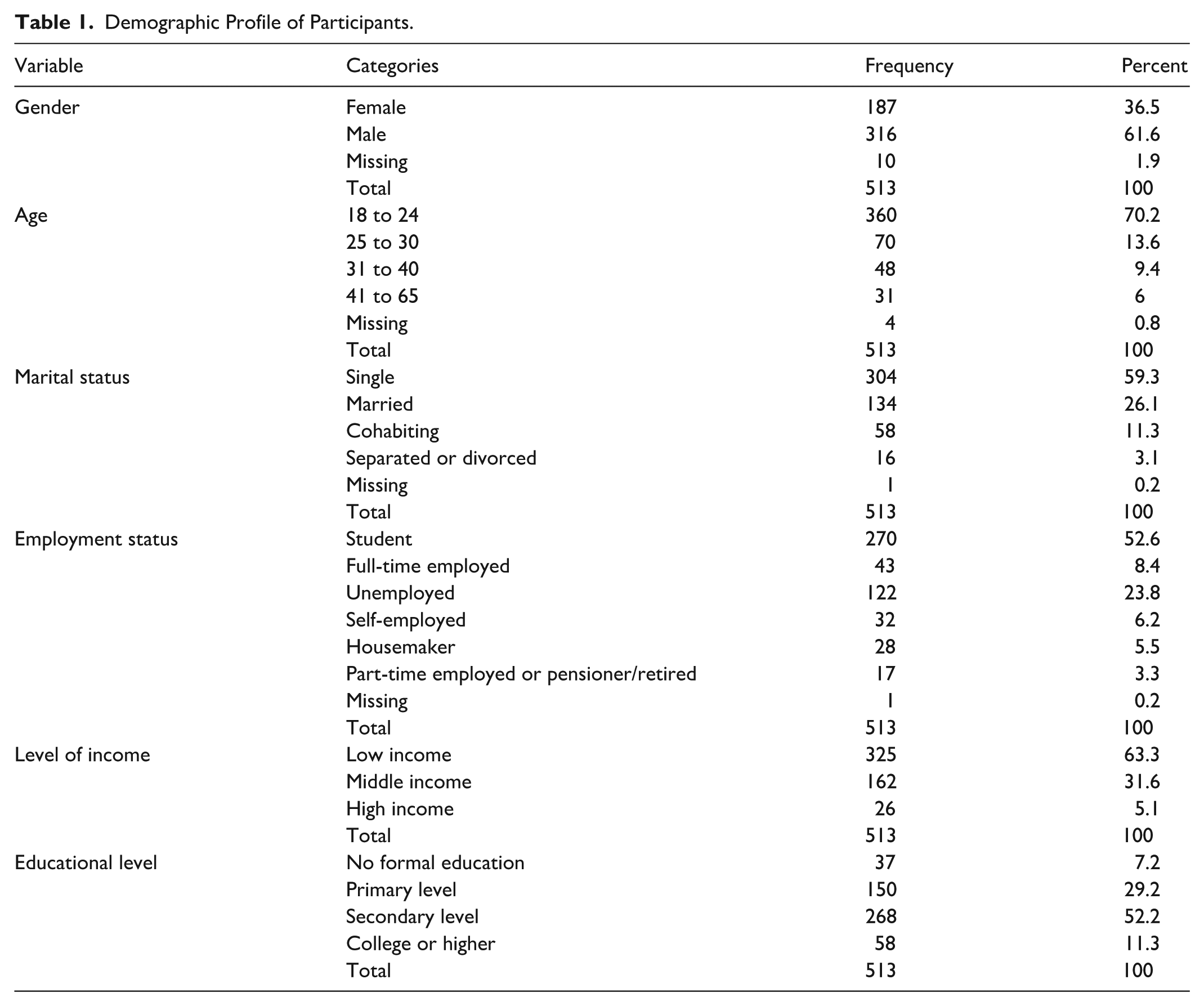
More than half of the participants were students (n = 270, 52.6%), followed by unemployed individuals (n = 122, 23.8%), full-time employees (n = 43, 8.4%), self-employed (n = 32, 6.2%), and homemakers (n = 28, 5.5%). The remaining participants (n = 17, 3.3%) identified as part-time employees or pensioners/retired. One participant did not report their employment status. Income was measured as a self-assessed subjective income position with values of 1 (low income), 2 (low-middle income or middle income), and 3 (middle-high income or high income). A substantial proportion reported low income (n = 325, 63.4%), followed by middle income (n = 162, 31.6%) and high income (n = 26, 5.1%). In terms of educational attainment, more than half had completed secondary education (n = 268, 52.2%), followed by primary education (n = 150, 29.2%), college or higher education (n = 58, 11.3%), and no formal education (n = 37, 7.2%).
Survey Instrument, Pilot Study, and Measurement Scales
Because the study was conducted with the Amharic-speaking Beta Israel community, a native Amharic speaker on the research team translated the original English items into Amharic. Two independent bilingual scholars at the University of Gondar, Ethiopia (a social psychologist and a specialist in English as a foreign language), reviewed the translation. Their feedback was incorporated to ensure semantic and conceptual equivalence between the original and translated versions of the questionnaire.
Due to limited accessibility to the Beta Israel community and to reduce the risk of social desirability and response bias as a result of prior exposure to the pilot (Thabane et al., 2010), it was not feasible to conduct the pilot study within the target population. However, because the primary aim of the pilot was to test reliability, clarity, and linguistic appropriateness of the Amharic survey instrument rather than group-specific content, it was conducted with other Amharic-speaking populations. For practical and linguistic reasons, the pilot study was carried out among 20 Amharic-speaking Ethiopian migrants in Bremen, Germany. This population provided a suitable context to evaluate the instrument’s usability in measuring intergroup dynamics while ensuring the linguistic and cultural validity of the Amharic version of the questionnaire.
All participants provided informed consent after receiving information about the study’s purpose and procedures. Participation was voluntary, with the option to withdraw at any time. Anonymity and confidentiality were maintained throughout the data collection process.
To ensure contextual relevance, the wording of items in the paper-and-pencil questionnaire was adapted to reflect the specific contexts of the pilot and main study settings. For example, an item from the intergroup contact scale in the main study, “How much contact do you have with other Ethiopians as neighbors?” was adapted in the pilot study to “How much contact do you have with Germans as neighbors?” Similarly, an item from the discrimination scale “I am treated with less respect than other Ethiopian people are,” was adapted in the pilot study to “I am treated with less respect than German people are.” This approach was applied consistently across the intergroup anxiety and belongingness scales.
To further refine the instrument, cognitive interviews were conducted with three Ethiopian migrants whose mother tongue is Amharic. Based on feedback from these interviews and an assessment of internal consistency, items demonstrating lower reliability were revised prior to data collection in Ethiopia.
Intergroup Contact Scale
This scale measures the frequency and extent of intergroup contact (M. R. Islam & Hewstone, 1993; Lolliot et al., 2015). In the original scale, contact is assessed across both quantitative (frequency) and qualitative dimensions. In the present study, we focused exclusively on the quantitative dimension and, therefore, included three items capturing the frequency of contact across the following domains: (a) at college/school, (b) in the neighborhood, and (c) as close friends. Two items reflecting qualitative aspects of contact (e.g., informal conversations and visits to an outgroup member’s home) were not included, as they capture a conceptually distinct dimension (Lolliot et al., 2015). Responses were rated on a 7-point Likert scale ranging from 1 (none at all) to 7 (a great deal). In the original scale, each item demonstrated strong factor loadings (≥0.76; M. R. Islam & Hewstone, 1993). In our study, the scale showed satisfactory internal consistency, with Cronbach’s alpha of α = .75 in the pilot study and α = .78 in the main study. Consistent with the analytical strategy described above, all included items were retained when computing scale means for descriptive and mean-level analyses, while scale refinement was addressed within the full structural equation modeling (SEM) model. Because the scale was restricted to the quantitative dimension of intergroup contact, no further item refinement was required.
Intergroup Anxiety Scale
The Intergroup Anxiety Scale, developed by Stephan and Stephan (1985), consists of six items. Participants were presented with the following scenario: “If you were the only member of Beta Israel and you were interacting with other Ethiopians (e.g., talking with them, working on a project with them), how would you feel compared to occasions when you interact with the Beta Israel community?” Respondents rated their feelings—happy, awkward, self-conscious, confident, relaxed, and defensive—on a scale ranging from 1 (not at all) to 5 (very much; Lolliot et al., 2015). Higher scores indicate greater intergroup anxiety (M. R. Islam & Hewstone, 1993), with positively worded items reverse-coded. The scale showed acceptable internal consistency, with Cronbach’s alpha values of α = .80 in the pilot study and α = .76 in the main study. Confirmatory factor analysis (CFA) indicated that two items had weaker factor loadings. These items were, therefore, excluded from the SEM measurement model to improve model fit (Byrne, 2016), while all items were retained when computing scale means for descriptive and mean-level analyses.
Perceived Discrimination Scale
Perceived discrimination was measured using a 10-item scale adopted from Williams et al. (1997). Participants indicated how often they experienced discriminatory behaviors, such as “I am treated with less courtesy than other Ethiopian people are.” Items were rated on a 6-point Likert scale from 1 (never) to 6 (almost every day), with higher scores reflecting higher levels of perceived discrimination. One item related to shoplifting was not included in the survey because it was considered contextually inappropriate in the Ethiopian setting. The scale, therefore, consisted of nine items in the present study. The scale demonstrated strong internal consistency, with Cronbach’s alpha values of α = .91 in the pilot study and α = .86 in the main study. CFA indicated that two items had comparatively weak factor loadings and were excluded from the SEM measurement model to improve model fit (Byrne, 2016). As a result, seven items were retained in the SEM analysis.
Sense of Belonging Scale
The scale was adapted from the German Socio-Economic Panel study (SOEP, 2023) to assess participants’ sense of belonging to both mainstream society and their own ethnic group. Participants rated their agreement with statements such as “I feel part of the Ethiopian society” and “I feel part of the Beta Israel community” on a 5-point Likert scale ranging from 1 (do not agree at all) to 5 (fully agree). Higher scores indicate a stronger sense of belonging.
The scale included two subdimensions: belonging to mainstream society (outgroup/mainstream belonging) and belonging to the Beta Israel community (ingroup belonging). In the pilot study, the scale showed moderate internal consistency, with Cronbach’s alpha values of α = .60 for outgroup belonging and α = .75 for ingroup belonging. In the main study, internal consistency was stronger, with α = .82 for outgroup belonging and α = .80 for ingroup belonging. CFA supported the scale’s construct validity, with all items showing acceptable factor loadings.
Analytical Strategy
A moderated mediation analysis was conducted using SEM (Byrne, 2016) in SPSS Amos 29 to examine the relationship between intergroup contact and both belonging to mainstream society and belonging to one’s own group, as mediated by intergroup anxiety and perceived discrimination.
An initial assessment of the measurement model indicated areas requiring improvement in model fit. The model including all items showed a borderline acceptable fit to the data, χ2(289) = 703.18, p < .001; CMIN/df = 2. 43; comparative fit index (CFI) = 0.91; Tucker–Lewis index (TLI) = .89; and root-mean-square error of approximation (RMSEA) = .053, indicating room for improvement.
Modifications to the measurement model were implemented within the SEM framework to improve model fit. These modifications were guided by theoretical considerations and prior literature, rather than only by statistical criteria (Hu & Bentler, 1999). Two items from the intergroup anxiety construct that exhibited relatively weak factor loadings were removed: Item 4 (λ = .45) and Item 6 (λ = .47). Similarly, two items from the perceived discrimination scale, Item 1 (λ = .55) and Item 8 (λ = .59), were excluded due to comparatively low factor loadings. Factor loadings for all study measures are available in the Online Supplemental Materials (Table S1).
The final hypothesized model showed a good fit to the data, χ2(199) = 297.810, p < .001; CMIN/df = 1.50; CFI = 0.97; TLI = 0.97; and RMSEA = 0.031. These values meet established criteria for good model fit, with CFI and TLI exceeding 0.95 and RMSEA below 0.05 (Hu & Bentler, 1999). Although the chi-square statistic was significant, this is common in larger samples. Taken together, the fit indices indicate that the model provides a good approximation of the observed covariance structure.
Results
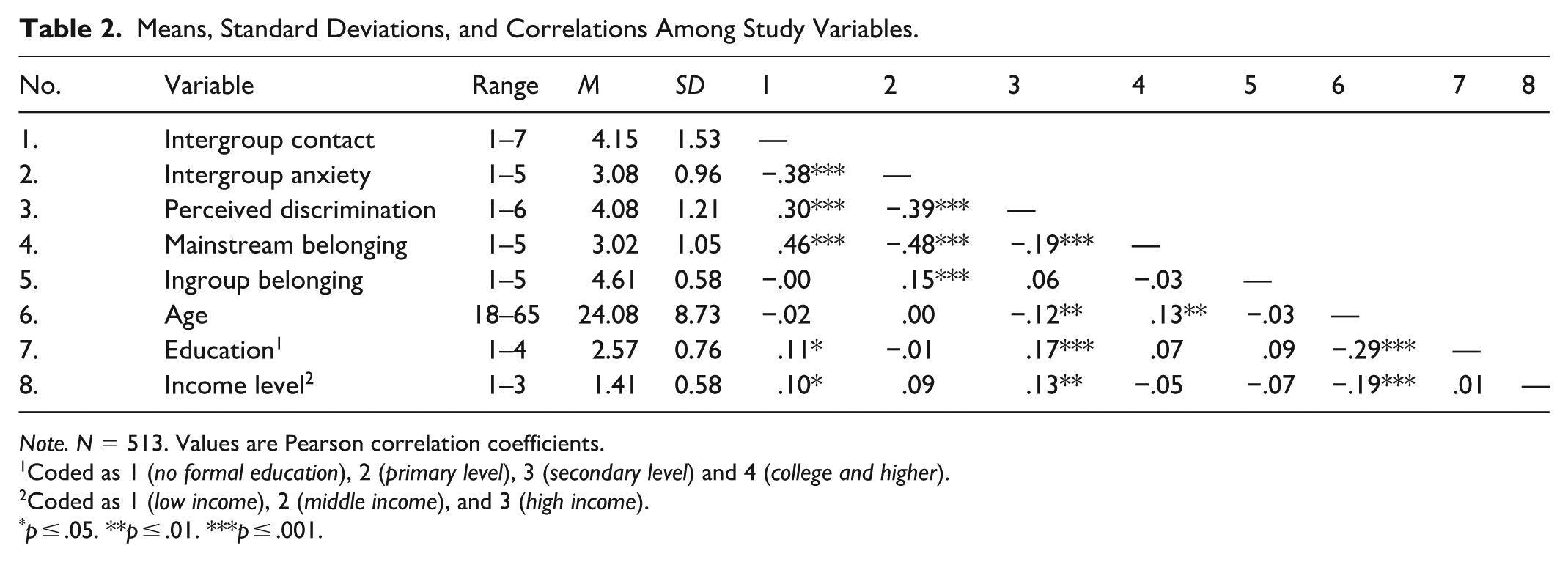
Pearson correlation analyses were conducted to examine the relationships among intergroup contact, intergroup anxiety, perceived discrimination, belonging to one’s ingroup and to mainstream society, and key sociodemographic variables (Table 2). Intergroup contact was significantly negatively correlated with intergroup anxiety (r = −.38, p ≤ .001) and positively correlated with perceived discrimination (r = .30, p ≤ .001) and belonging to mainstream society (r = .46, p ≤ .001). Small but significant positive correlations were also observed with educational attainment (r = .11, p ≤ .05) and income level (r = .10, p ≤ .05). No significant correlation was found between intergroup contact and ingroup belonging (r = .002, p > .05).
Means, Standard Deviations, and Correlations Among Study Variables.
Note. N = 513. Values are Pearson correlation coefficients.
Coded as 1 (no formal education), 2 (primary level), 3 (secondary level) and 4 (college and higher).
Coded as 1 (low income), 2 (middle income), and 3 (high income).
p ≤ .05. **p ≤ .01. ***p ≤ .001.
Intergroup anxiety was negatively correlated with perceived discrimination (r = −.39, p ≤ .001) and belonging to mainstream society (r = −.48, p ≤ .001), while showing a positive association with ingroup belonging (r = .15, p ≤ .001). Perceived discrimination was negatively associated with belonging to mainstream society (r = −.19, p ≤ .001) and age (r = −.12, p ≤ .01), and positively associated with educational attainment (r = .17, p ≤ .001) and income (r = .13, p ≤ .01).
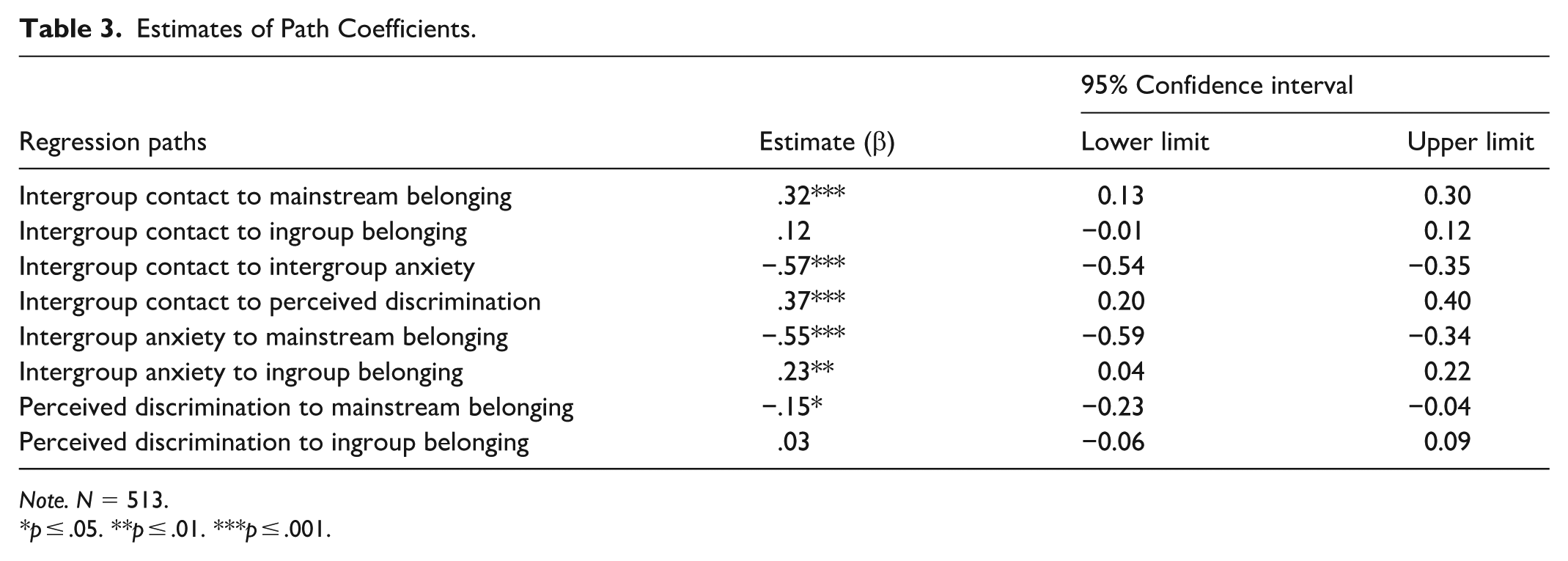
To further examine the relationships between intergroup contact and a sense of belonging to mainstream society and one’s ethnic ingroup, SEM was employed. Intergroup contact was expected to be associated with belonging both directly and indirectly through the mediating variables of intergroup anxiety and perceived discrimination. Consistent with our hypothesis, intergroup contact was positively associated with belonging to mainstream society (β = .32, 95% CI [0.13, 0.30], p ≤ .001. By contrast, the path from intergroup contact to ingroup belonging was not significant (β = .12 [−0.01, 0.12], p > .05), indicating that higher intergroup contact did not significantly enhance ingroup belonging in this sample (Figure 2).
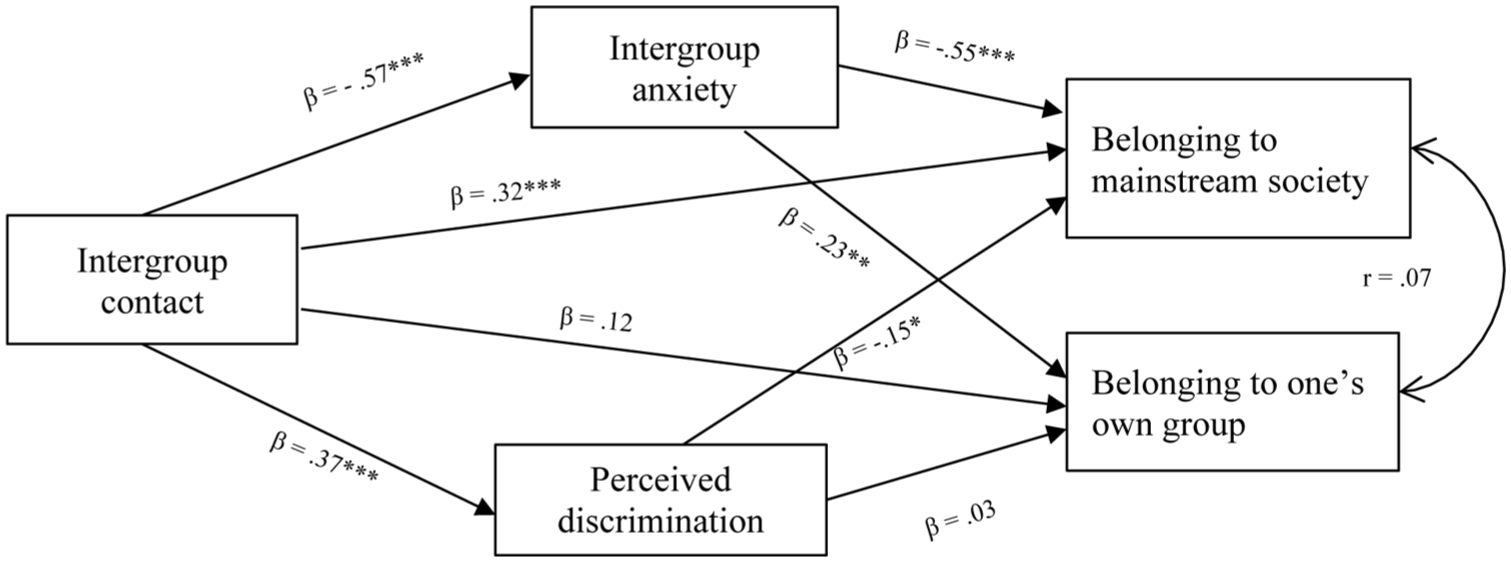
Structural equation model of intergroup contact and dual sense of belonging, with mediation by intergroup anxiety and perceived discrimination. Standardized coefficients are shown; curved paths indicate covariances.
As hypothesized, greater intergroup contact significantly predicted lower levels of intergroup anxiety (β = −.57, 95% CI [−0.54, −0.35], p ≤ .001), suggesting that emotional discomfort and fear in intergroup situations decrease with increased intergroup contact. Intergroup anxiety was negatively associated with belonging to mainstream society (β = −.55 [−0.59, −0.34], p ≤ .001), highlighting its role as a key emotional barrier to integration. Conversely, intergroup anxiety was positively associated with ingroup belonging (β = .23 [0.04, 0.22], p ≤ .01), indicating that higher anxiety may reinforce stronger ingroup affiliation.
Unexpectedly, intergroup contact was positively associated with perceived discrimination (β = .37, 95% CI [0.20, 0.40], p ≤ .001), contradicting the initial assumption that contact reduces perceptions of discrimination. This suggests that increased interaction may heighten individuals’ awareness of discriminatory experiences. While perceived discrimination showed a small negative association to belonging to mainstream society (β = −.15 [−0.23, −0.04], p ≤ .01), it was not significantly related to ingroup belonging (β = .03 [−0.06, 0.09], p > .05).
Intergroup anxiety and perceived discrimination were negatively correlated (ψ = −.36, p ≤ .001), consistent with the notion that they represent partially distinct pathways in the model: an affective pathway (intergroup anxiety) and a structural awareness pathway (perceived discrimination), each differently influenced by intergroup contact.
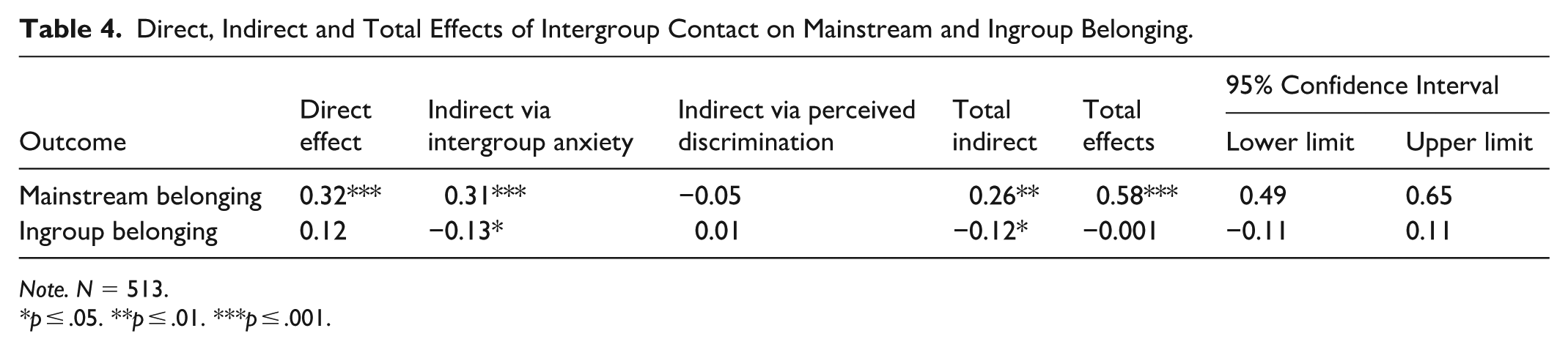
To test the indirect effects identified in the SEM analysis, we decomposed the effects of intergroup contact into direct, indirect, and total effects using a series of regression analyses with 5,000 bootstrap resamples. This approach provided robust estimates of the indirect and total effects (Tables 3 and 4).
Estimates of Path Coefficients.
Note. N = 513.
p ≤ .05. **p ≤ .01. ***p ≤ .001.
Direct, Indirect and Total Effects of Intergroup Contact on Mainstream and Ingroup Belonging.
Note. N = 513.
p ≤ .05. **p ≤ .01. ***p ≤ .001.
Intergroup contact had a significant direct effect on belonging to mainstream society (β = .32, 95% CI [0.13, 0.30], p ≤ .001). It also had significant standardized indirect effects on belonging to mainstream society via intergroup anxiety (β = .31, p ≤ .001) and perceived discrimination (β = −.05, p ≤ .05), resulting in a significant total indirect effect (β = .26 [0.17, 0.34], p ≤ .01). Together, these effects contributed to a substantial overall effect of intergroup contact on belonging to mainstream society (β = .58 [0.49, 0.65], p ≤ .001).
In contrast, the direct relationship between intergroup contact and ingroup belonging was not significant (β = .12, 95% CI [−0.01, 0.12], p > .05). The indirect effect via intergroup anxiety was marginally significant (β = −.13, p ≤ .05), whereas the pathway through perceived discrimination was not significant (β = .01, p > .05). Consequently, while the total standardized indirect effect was significant (β = −.12 [−0.22, −0.04], p > .01), the total effect of intergroup contact on ingroup belonging (β = −.001 [−0.11, 0.11], p > .05) was negligible.
Having established the main mediation model, we next examined whether key sociodemographic variables—gender, educational level, income, age, marital status, and occupational status—moderate these relationships. Group differences in study variables across demographic categories were examined using independent-samples t-tests for binary variables and one-way analyses of variance (ANOVA) for variables with more than two categories.
Independent-samples t-tests indicated no significant gender differences in perceived discrimination t(501) = 0.81, p > .05 or intergroup anxiety t(501) = 0.46, p > .05 (Table S2a in Online Supplemental Materials). Additional t-tests revealed no significant gender differences in intergroup contact, t(501) = 0.78, p > .05; ingroup belonging, t(501) = 1.09, p > .05; or belonging to mainstream society, t(501) = −0.30, p > .05 (Table S2b).
A one-way ANOVA revealed a statistically significant difference in perceived discrimination across levels of education: no formal education (M = 3.49, SD = 1.36), primary education (M = 3.95, SD = 1.18), secondary education (M = 4.18, SD = 1.17), and college education or higher (M = 4.35, SD = 1.24); F(3, 509) = 5.19, p ≤ .01. However, educational level did not yield a significant mean difference in intergroup anxiety.
Post hoc pairwise comparisons using Tukey’s Honestly Significant Difference (HSD) indicated that participants with secondary education or a college degree tended to report higher levels of perceived discrimination than those with no formal or only primary education; however, these pairwise differences were not statistically significant (p > .05 for both comparisons).
A similar pattern emerged for income. A one-way ANOVA revealed a statistically significant difference in perceived discrimination across income groups: low-income (M = 3.96, SD = 1.23), middle-income (M = 4.29, SD = 0.16), and high-income (M = 4.31, SD = 1.21); F(2, 510) = 4.63, p ≤ .01. However, Tukey’s HSD post hoc test did not reveal any statistically significant pairwise differences (p > .05), suggesting that although overall group differences were detected, no specific income groups differed significantly from one another. Income level also did not have a significant effect on intergroup anxiety.
Age was also associated with perceived discrimination, F(3, 505) = 3.21, p ≤ .05; however, post hoc comparisons did not reveal any significant pairwise differences (p > .05). Finally, neither marital status nor occupational status yielded statistically significant mean differences in perceived discrimination or intergroup anxiety (Table S2a in Online Supplemental Materials).
A one-way ANOVA was also conducted to examine whether intergroup contact, ingroup belonging, and belonging to mainstream society differed across key demographic factors. The results indicated that intergroup contact did not significantly differ across any of the demographic variables examined (Table S2b in Online Supplemental Materials).
Similarly, ingroup belonging did not differ significantly across most demographic variables, with the exception of educational level. Participants with secondary education (M = 4.67, SD = 0.51) reported significantly higher levels of ingroup belonging than those with no formal education (M = 4.59, SD = 0.60), primary education (M = 4.49, SD = 0.71), and college and higher (M = 4.65, SD = 0.51); F(3, 508) = 3.19; p ≤ .05. However, these differences were small in magnitude.
Belonging to mainstream society showed more variation across demographic groups. A significant difference was observed across age groups, F(3, 505) = 2.76, p ≤ .05, with participants aged 41 years and above (M = 3.35, SD = 1.03) reporting higher levels of belonging to mainstream society compared to younger groups. Occupational status also showed a significant variation across belonging to mainstream society, with housemakers (M = 3.56, SD = 1.13) reporting higher levels of belonging than employed (M = 3.17, SD = 1.12), self-employed (M = 3.38, SD = 1.14), students (M = 2.90, SD = 0.99), and unemployed or retired participants (M = 2.98, SD = 1.04); F(4, 507) = 4.13; p ≤ .01.
While the previous analyses focused on mean-level group differences, these do not necessarily indicate differences in the relationships between variables. To explore this, theoretically justified moderators (e.g., income, education, and age) were directly tested using interaction effects within the SEM framework. This method allows for the examination of differences in the strength of associations (i.e., slopes) rather than mean level differences.
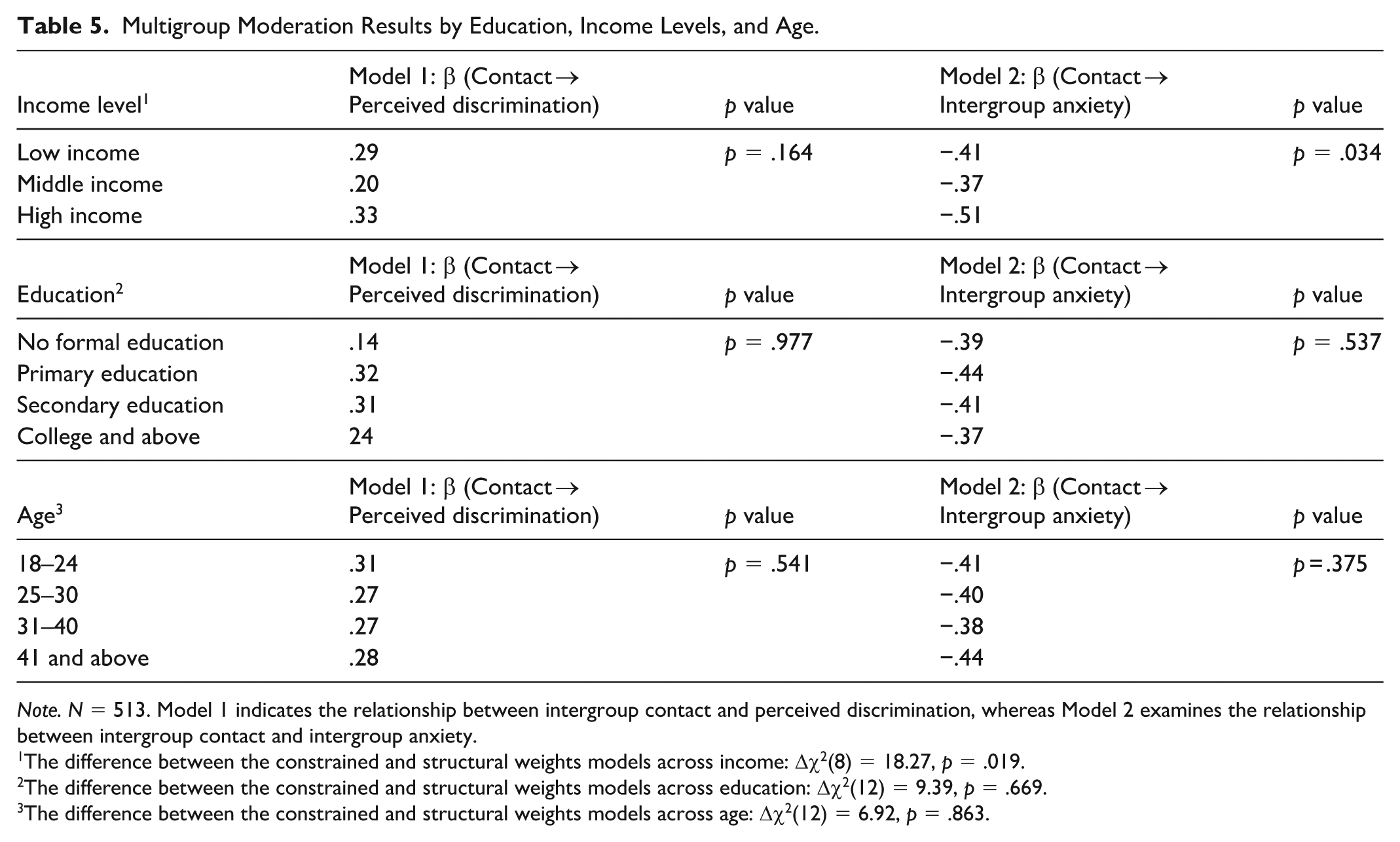
A multigroup SEM analysis was conducted using AMOS to examine whether income moderates the relationship between intergroup contact and the two mediators, intergroup anxiety and perceived discrimination (Table 5). First, moderation was tested by comparing whether structural paths were constrained to be equal across income groups with an unconstrained model.
Multigroup Moderation Results by Education, Income Levels, and Age.
Note. N = 513. Model 1 indicates the relationship between intergroup contact and perceived discrimination, whereas Model 2 examines the relationship between intergroup contact and intergroup anxiety.
The difference between the constrained and structural weights models across income: Δχ2(8) = 18.27, p = .019.
The difference between the constrained and structural weights models across education: Δχ2(12) = 9.39, p = .669.
The difference between the constrained and structural weights models across age: Δχ2(12) = 6.92, p = .863.
The chi-squared difference test revealed a significant deterioration in model fit when equality constraints were imposed, Δχ2(8) = 18.27, p = .019, indicating that at least one structural path differs across income groups. To further identify the specific moderated paths, separate models were estimated. We represent the path from intergroup contact to perceived discrimination in Model 1, while the path to intergroup anxiety is represented in Model 2. Model 1 showed no statistically significant moderation by income, Δχ2(2) = 3.62, p = .164. Although the differences were not statistically significant, the standardized estimates indicated a trend whereby the effect was slightly stronger among high-income participants (β = .33) compared to those with low (β = .29) and middle-level income (β = .28).
In contrast, income significantly moderates Model 2, which indicates that constraining this path significantly reduced model fit: Δχ2(2) = 6.74, p = .034. Standardized coefficients showed that the negative association between intergroup contact and intergroup anxiety was strongest among high-income participants (β = −.51), compared to middle-income (β = −.37) and low-income groups (β = −.41).
Educational level did not significantly moderate the relationship between intergroup contact and either perceived discrimination or intergroup anxiety. The comparison between the constrained and unconstrained models was not significant, Δχ2(12) = 9.39, p = .669, indicating that the structural paths were invariant across educational groups. Consistent with this finding, Model 1 showed no statistically significant moderation by education, Δχ2(3) = .20, p = .977. The standardized coefficients differed somewhat across educational groups, with the largest coefficients observed among participants with primary education (β = .32); however, these differences were not statistically significant.
Similarly, Model 2 indicated no statistically significant moderation by education, Δχ2(3) = 2.17, p = .537. Although not statistically significant, the negative association appeared stronger among participants with primary education (β = −.44) compared to other educational groups.
Finally, age did not significantly moderate the relationship between intergroup contact and the two mediators. The comparison between the constrained and unconstrained models was not significant, Δχ2(12) = 6.92, p = .863. After controlling for the structural paths of Model 2, this finding remained unchanged, Δχ2(3) = 2.15, p = .541. Nevertheless, standardized estimates suggested that the association was strongest among participants aged 18 to 24 years (β = .31), although this difference was not statistically significant.
Likewise, age did not significantly moderate Model 2 when controlling for Model 1 structural path, Δχ2(3) = 3.11, p = .375. Although not statistically significant, the negative association appeared descriptively stronger among participants aged 41 and above (β = −.44).
Discussion
This study explored how intergroup contact among Ethiopian Jews influences dual senses of belonging—both to mainstream Ethiopian society and to their own Beta Israel community—while examining the mediating roles of intergroup anxiety and perceived discrimination, and the moderating effects of demographic variables. The findings largely support the core tenets of the contact hypothesis (Allport, 1954), while also revealing complex pathways through which contact experiences shape social identification, emotional responses, and cognitive-evaluative intergroup processes.
Consistent with theoretical expectations and previous empirical research (Lim et al., 2024; Swart et al., 2011), intergroup contact was positively associated with a stronger sense of belonging to mainstream society. This suggests that, even among historically marginalized groups such as Ethiopian Jews, increased cross-group interaction can foster a greater sense of inclusion and integration into the societal majority. Importantly, this relationship was mediated by intergroup anxiety and, to a lesser extent, perceived discrimination, highlighting the emotional and evaluative processes through which contact promotes integration.
In contrast, intergroup contact did not directly influence ingroup belonging, reflecting the stability of minority group identification even in the context of broader societal inclusion (Phinney et al., 2001). This finding suggests that individuals can integrate into the majority society without diminishing their connection to their ethnic community. Emotional experiences, particularly intergroup anxiety, exhibited a nuanced role: higher anxiety was associated with lower mainstream belonging but higher ingroup belonging. These results align with prior research indicating that ingroup attachment can serve as a psychological buffer, enhancing self-esteem and emotional security when intergroup interactions are perceived as stressful or alienating (Baumeister & Leary, 1995; Paolini et al., 2010; Stephan & Stephan, 1985; Tajfel & Turner, 1979).
A notable and counterintuitive finding was that intergroup contact was positively associated with perceived discrimination. This contrasts with classical assumptions that contact reduces perceptions of exclusion. This pattern may reflect heightened awareness of discriminatory dynamics that emerge during increased engagement with majority group members (Reimer & Sengupta, 2023; Schaeffer & Kas, 2024). Prior research similarly cautions that contact can expose underlying inequalities that might otherwise remain unnoticed (Bobowik et al., 2024; Hayward et al., 2017; Van Assche et al., 2023). For Ethiopian Jews, greater engagement with mainstream society may offer inclusion opportunities while simultaneously increasing exposure to subtle or structural discrimination.
While perceived discrimination was negatively related to mainstream belonging, its effect was weaker than that of intergroup anxiety once both mediators were considered. This suggests that affective mechanisms, such as anxiety during intergroup interactions, may play a more immediate role in shaping feelings of belonging than cognitive appraisals of discriminatory treatment. Thus, individuals may feel attached to the broader society while simultaneously recognizing structural disadvantages, highlighting that belonging and perceived discrimination are not necessarily mutually exclusive in contexts of persistent social hierarchies.
These findings underscore that emotional and cognitive responses to intergroup contact can follow distinct trajectories. Contact can reduce intergroup anxiety as familiarity grows, but may simultaneously increase perceptions of discrimination when interactions occur in asymmetrical or unequal social contexts (Mummendey & Otten, 1998; Saguy et al., 2008). This distinction emphasizes the importance of differentiating mediators—emotional versus cognitive-evaluative—rather than assuming that they follow similar patterns, and it illustrates that contact is not uniformly positive in contexts of structural inequality.
Sociodemographic factors further clarified the conditional effects of intergroup contact. Income emerged as a relevant moderator of the association between intergroup contact and intergroup anxiety, with the negative association being strongest among high-income individuals. With regard to perceived discrimination, income did not significantly moderate the relationship with intergroup contact. However, the standardized coefficients varied somewhat across income groups, with larger estimates observed among higher-income participants. This finding aligns with Status Inconsistency Theory (Kimberly, 1967), which posits that minority individuals achieving higher status may experience tension between their achieved position and the stereotypes or discrimination they encounter in elite social contexts.
Overall, these findings highlight the importance of considering both the frequency and context of intergroup contact, as well as the characteristics of the individuals involved. While contact can promote integration and reduce anxiety, it may also reveal structural inequalities and heighten awareness of discrimination. This suggests that intergroup interactions and a sense of belonging may coexist with persistent structural barriers, even when contact is frequent. This underscores a limitation of the contact hypothesis when applied without adequate attention to power asymmetries and structural inequality. In contexts where systemic discrimination persists, contact alone may have limited capacity to transform intergroup relations within historically marginalized populations, unless accompanied by institutional reforms and societal change.
Limitations and Future Directions
This study offers a new perspective on how intergroup contact shapes a dual sense of belonging from the minority group perspective, emphasizing both emotional dynamics and cognitive-evaluative processes in mediating these relationships. By examining perceived inclusion and acceptance as key components of belonging within minority–majority group relations, the study contributes to the intergroup contact literature, which has predominantly focused on prejudice reduction and attitudinal change. Nevertheless, several limitations should be acknowledged.
First, intergroup contact theory was initially conceptualized as a causal mechanism for reducing prejudice and improving attitudes toward outgroup members (Allport, 1954). This was particularly evident in the post–World War II context, where cooperative interactions across racial groups were shown to foster more positive intergroup relations despite prior conflict (Pettigrew, 2021). However, as the present study relies on cross-sectional survey data, causal inferences cannot be drawn. Future research would benefit from employing experimental or longitudinal designs to more rigorously examine the causal mechanisms underlying these relationships.
Second, the temporal ordering of constructs in the proposed model reflects one theoretically informed interpretation rather than a definitive causal sequence. For example, lower levels of intergroup anxiety may promote greater engagement with outgroups, while a stronger sense of belonging to mainstream society may simultaneously increase opportunities for contact. Although the model is grounded in prior intergroup contact research, alternative causal pathways cannot be ruled out. Future research using experimental or longitudinal designs could more effectively test competing models and clarify the temporal dynamics of these complex intergroup processes.
Third, focusing on contact frequency allows us to capture structural opportunities for intergroup exposure, which may be more relevant for access to mainstream social spaces than the quality of contact. However, the omission of items reflecting more intimate forms of contact, such as informal conversations or outgroup home visits, shifts the measure toward more general forms of interaction. Furthermore, the study does not directly assess broader institutional or structural conditions. Future research should, therefore, incorporate multidimensional measures of contact alongside systemic factors that interact with individual-level experiences to better capture the forms of interaction most relevant for shaping belonging.
Fourth, the sampling strategy may limit the generalizability of the findings. Participants were primarily recruited from synagogue attendees and community-based programs, which may have resulted in an overrepresentation of individuals with stronger attachments to their faith or community. Furthermore, the sample is demographically skewed, with a large majority of respondents being young (70% aged 18–24) and 53% identifying as students. The observed “integration paradox,” where increased exposure to majority contexts may heighten awareness of subtle discrimination, may therefore be specific to this relatively young, upwardly mobile cohort. Future studies should adopt broader recruitment strategies to capture a more diverse range of demographic groups and social experiences, thereby enhancing the generalizability of the findings.
Fifth, although the findings are consistent with the hypothesized causal relationships, they are based on cross-sectional data, which limits the ability to draw causal inferences. Accordingly, terms such as “mediation,” “direct,” and “indirect” effects should be interpreted with caution. Although commonly used in SEM, these terms may imply causal mechanisms that cannot be established in a cross-sectional design. In the present study, they refer only to statistical associations among variables rather than to confirmed causal processes. The findings should, therefore, be understood as context-specific correlational relationships rather than evidence of causal mediation.
Sixth, the target sample size was determined primarily based on general recommendations for simple and complex mediation models (Caspi et al., 2025; Schoemann et al., 2017) and did not fully account for the additional complexity introduced by moderation analyses. As a result, the study may be underpowered to detect smaller interaction effects, particularly in multigroup comparisons. In addition, testing multiple moderators across several model paths increases the risk of inflated Type I error rates. The moderation results should, therefore, be interpreted with caution, and future research should employ larger samples to allow for more robust tests of moderation effects.
Conclusion
This study provides a deeper understanding of how intergroup contact affects social integration and identifications among minority group members, drawing on data from Ethiopian Jews in Ethiopia. By examining dual senses of belonging—both to mainstream society and one’s own ethnic group—and integrating emotional and evaluative mediators such as intergroup anxiety and perceived discrimination, the research advances the classic contact hypothesis into a more nuanced framework.
The findings confirm that intergroup contact is positively associated with belonging to mainstream society, and that this relationship is mediated by reduced intergroup anxiety. In contrast, contact did not affect feelings of belonging to the ethnic ingroup, suggesting that broader societal integration does not necessarily undermine ethnic identity. Rather, belonging to multiple social groups can coexist, with emotional factors like anxiety playing a crucial role in shaping the quality of this coexistence.
Importantly, the study challenges the common assumption that intergroup contact uniformly reduces perceived discrimination. Increased contact was associated with decreased intergroup anxiety but higher perceptions of discrimination. This highlights a more complex reality in which contact may increase awareness of subtle exclusion or bias. These findings call for a more critical and context-sensitive understanding of how intergroup contact operates, particularly within structurally unequal settings.
The moderating role of income underscores that social status shapes how intergroup experiences are processed and internalized. In particular, the association between intergroup contact and intergroup anxiety was strongest among high-income individuals, suggesting that contact may be especially effective in reducing affective barriers within this group. However, individuals who experience upward mobility while remaining members of a marginalized group may face tensions between their achieved status and their social identity. These tensions may heighten sensitivity to intergroup interactions, making reductions in anxiety through contact particularly pronounced. These findings point to the need for policies and interventions that not only promote intergroup contact but also consider how structural inequalities shape the emotional dynamics of such interactions.
Future research should examine how these dynamics operate in other minority–majority contexts and under which conditions intergroup contact fosters not only inclusion but also equitable and emotionally sustainable forms of belonging. Integrating psychological perspectives with structural analyses will be essential for developing more effective approaches to social cohesion in diverse societies.
In short, intergroup contact can foster a stronger sense of belonging to mainstream society without diminishing attachment to one’s ethnic group. However, contact does not uniformly reduce feelings of anxiety or perceptions of discrimination and may even heighten awareness of subtle biases. These findings highlight the need to consider emotional, cognitive, and structural factors together when designing policies to promote meaningful social integration.
Supplemental Material
sj-docx-1-psp-10.1177_01461672261454081 – Supplemental material for Intergroup Contact and Belonging Among Ethiopian Jews in Ethiopia
Supplemental material, sj-docx-1-psp-10.1177_01461672261454081 for Intergroup Contact and Belonging Among Ethiopian Jews in Ethiopia by Mastewal Bitew and Sonja Drobnič in Personality and Social Psychology Bulletin
Footnotes
Acknowledgements
We sincerely thank the survey participants and field assistants whose contributions made this research possible. We also thank Mandy Boehnke, Klaus Boehnke, Michael Weinstock, and participants in the research colloquia at the Bremen International Graduate School of Social Sciences for their helpful comments on earlier versions of this manuscript. We are grateful to the editor and two anonymous reviewers for their constructive feedback and suggestions.

Ethical Considerations
The study was approved by the Bremen International Graduate School of Social Sciences (BIGSSS) ethics committee at the University of Bremen and Constructor University on June 13, 2024.
Consent to Participate
Participants were informed about the purpose of the study and its procedures, and they had the right to withdraw at any time.
Author Contributions
Mastewal Bitew designed and executed the study, conducted data collection and analysis, and drafted the manuscript. Sonja Drobnič supervised the research process and data collection, provided critical feedback on the manuscript, and secured funding for the study.
Funding
The authors disclosed receipt of the following financial support for the research, authorship, and/or publication of this article: We gratefully acknowledge funding by Deutsche Forschungsgemeinschaft (DFG, German Research Foundation), grant number GRK 2513/404484063.
Declaration of Conflicting Interests
The authors declared no potential conflicts of interest with respect to the research, authorship, and/or publication of this article.
Data Availability Statement
The data supporting the findings of this study are available from the corresponding author upon reasonable request.
Supplemental Material
Supplemental material is available online with this article.
References
Supplementary Material
Please find the following supplemental material available below.
For Open Access articles published under a Creative Commons License, all supplemental material carries the same license as the article it is associated with.
For non-Open Access articles published, all supplemental material carries a non-exclusive license, and permission requests for re-use of supplemental material or any part of supplemental material shall be sent directly to the copyright owner as specified in the copyright notice associated with the article.
