




Abstract
We performed whole-genome sequencing (WGS) experiments using mice for several generations under the circumstances of radiation with low dose rates at Tokai University and the Institute for Environmental Sciences (IES) in Japan. The dose rates and total exposed periods were 0.05, 0.15, 1.0, and 20 mGy day−1 for 400, 400, 400, and 300 days, respectively. We performed a statistical analysis of the experimental results on the single-nucleotide variations (SNVs) for each mouse after four generations. The SNVs per generation were unchanged below the dose rate of 1 mGy day−1 within the 95% confidence level errors. The experimental results were reproduced by the Whack-a-Mole (WAM) model with the standard parameters obtained by the Russell mega-mouse experiments.
Keywords
WGS EXPERIMENTS WITH LOW DOSE RATES AND STATISTICAL ANALYSIS
Recently, we performed WGS experiments using mice with low dose rates for several generations at Tokai University and IES. The dose rates were 0.05, 0.15, 1.0, and 20 mGy day−1. The experimental methods and the results are reported by Gondo et al. (2023).
We provide first the results of the statistical analysis using the maximum likelihood method with the Poisson distribution on the numbers of single-nucleotide variations (SNVs) in various mouse experiments. The identification of de novo mutations (DNM) was conducted as reported by Gondo et al. (2023). Here, the DNMs are defined as newly detected variations in the G4 generation as compared to the DNA sequence in the G0 generation. We focus here on the SNVs identified in the WGS technology (see Uchimura, 2023).
We used the likelihood function (LL) with the Poisson distribution, where the maximum of the LL provides the average value of the SNVs, and the values of LLmax-2 provide the 95% confidence level of SNVs. We plot the experimental data on the SNVs for the control case with the error bars in Fig. 1. In the right figure, shown is the logarithm of the likelihood function LL as a function of the average value λ. We prefer the most likelihood method to determine the 95% confidence level since the error bars systematically decrease with the number of data points. The standard errors change statistically when the number of data points is small. The distribution of the data points approaches the Poisson distribution as the number of data points increases. Both methods then provide the same information at many data points.
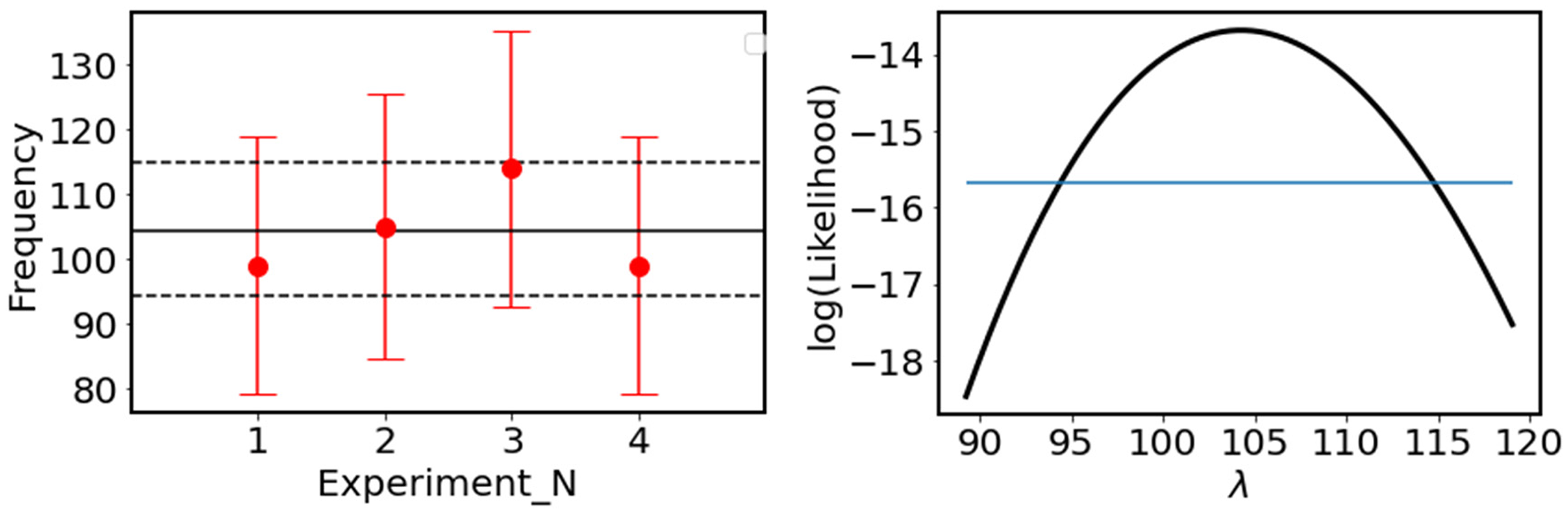
The experimental data points on the SNVs for the control case are shown in the left figure. The 95% error bars are shown for experimental data points. Using the most likelihood method, the average value and the 95% confidence level are shown by the solid line and the dashed lines. The log of the likelihood function LL(λ) is given for the control case in the right figure. The 95% confidence level is provided by the value LLmax-2 shown by the horizontal line.
In addition to the cases with d = 0.05 and 1 mGy day−1 for about 400 days with four generations, we have data on d = 20 mGy day−1 for about 300 days with three generations. We summarise the average values obtained using the most likelihood method on these SNVs in Fig. 2. In the left figure, the SNVs are shown as a function of the total dose. In this plot, it is obvious that the control value of d = 20 mGy day−1 case shown at the left-lowest corner is different from those values of the lower dose rate cases shown at the left-upper corner. Hence, we plot the SNVs per generation in the right figure of Fig. 2. This result is reasonable since the control values taken under various conditions agree with each other, and we take the dose rate as the horizontal axis. If we were to provide the total dose per generation, we should multiply 100 days by the dose rate. We see now that the SNVs per generation are unchanged until the dose rate of 1 mGy day−1 is within the 95% confidence level.
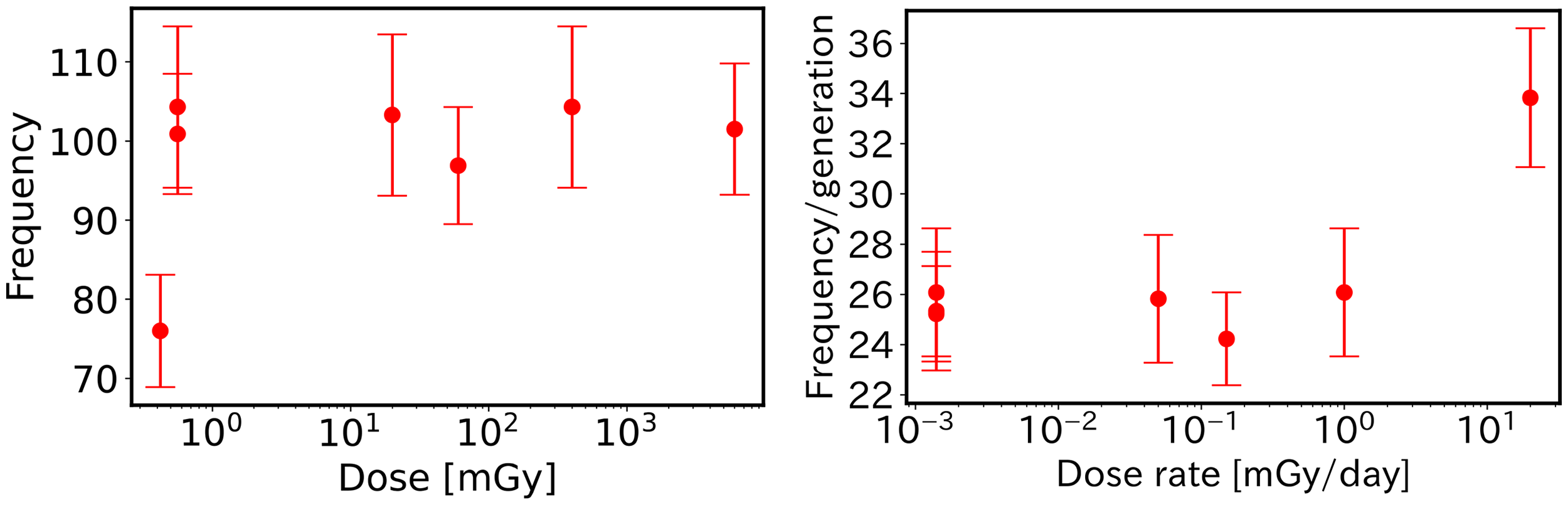
The SNVs for the control cases and the exposure cases are shown as a function of the total dose in the left figure. Here, we add the data points taken at 0.15 mGy day−1 for four generations obtained at Tokai University by Gondo et al. (2023). The SNVs per generation are plotted as a function of the dose rate in the right figure. The SNVs per generation are unchanged until 1 mGy day−1 within the 95% confidence level.
We have found that the SNVs per generation in all the control cases behave as expected by Mendel's law within ranges of the error bars. Hence, now it is important to extract the SNVs newly produced in each generation by comparing them with the average values with error bars obtained for the G4 mice. At and after the G2 generation, some SNVs were found in common, because their descendants inherited SNVs from the ancestors following Mendel's law, resulting in the total SNVs detected in the G4 mice. In this analysis, we use the sum rule of the Poisson distribution

This is an important relation of the Poisson distribution, using which we obtain the distribution of SNVs of the net results by calculating the sum of the average values.
We used the family structures of the mice and extracted the SNVs per generation for the control and the exposure cases. We write here the control case of the four generation experiments as a simple example of the sum rule. We calculate first the contribution of the SNVs that appeared at the G3 level in the parents to the G4 level. Suppose the male mouse at the G3 generation has SNVs of a Poisson distribution with an average value of x. According to Mendel's law, half of the SNVs appear at the G4 level. The same number of SNVs appear in the female mouse at the G3 generation, and half of the SNVs appear at the G4 level. Hence, the G3 contribution to the G4 mouse becomes a Poisson distribution with the average of
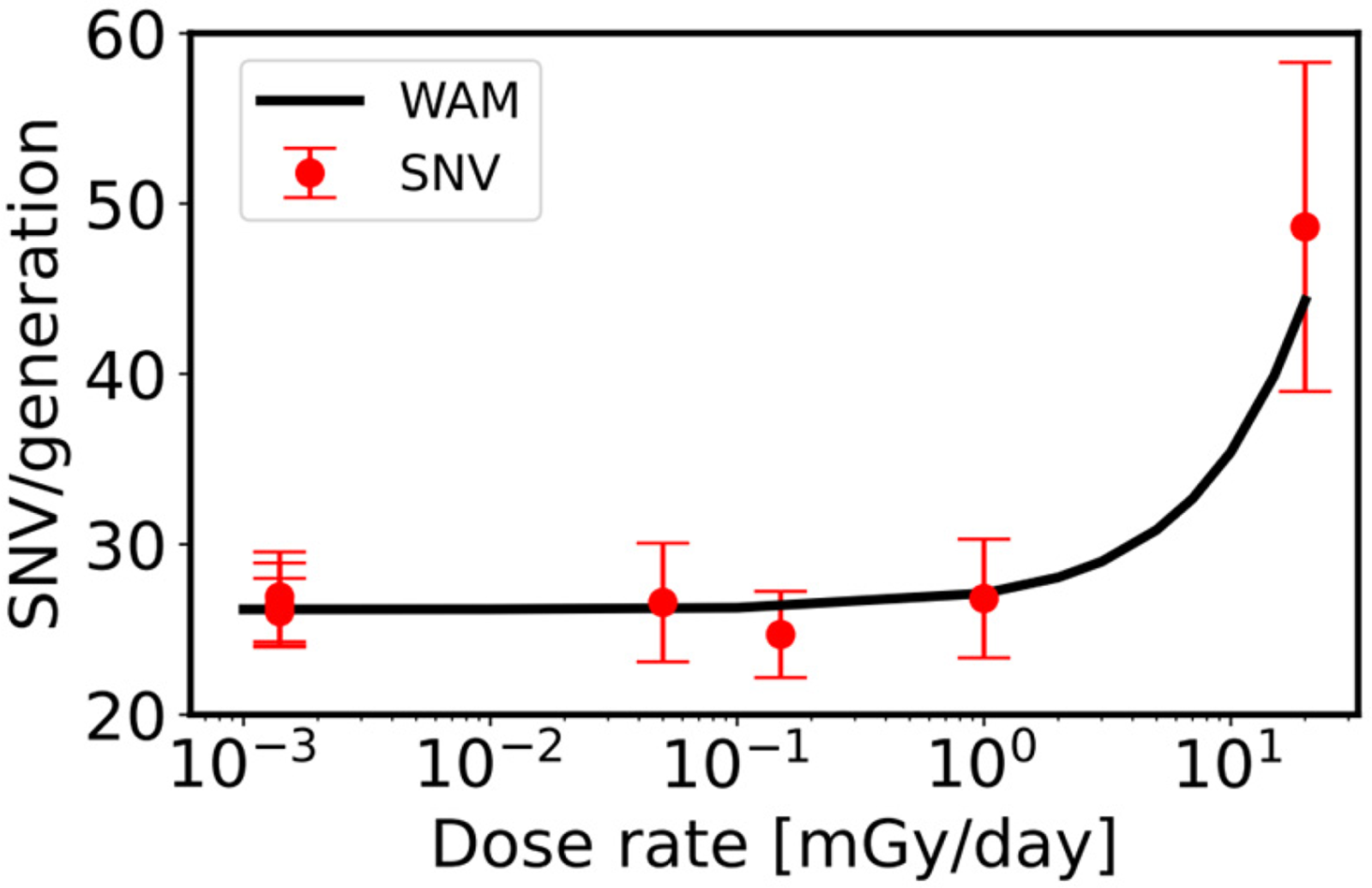
The obtained SNVs per generation are shown by the red circles with error bars as a function of the dose rate in units of mGy day−1 on a log scale. The WAM results with the standard parameter set are shown by the black solid curve.
We performed a theoretical calculation of the SNVs per generation using the WAM model, which was used for the analysis of the mega-mouse experiments of Russell and Kelly (1982). The WAM model is expressed by the differential equation for the mutation frequency F as follows:
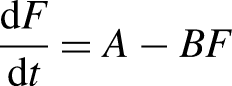


We call these parameters the standard parameter set of WAM. In the present long-exposure case, the mutation frequencies are expressed as F = A/B
We applied the WAM model to the new experimental results at low dose rates (Gondo et al., 2023). To compare the SNVs per generation with the prediction of the WAM model, we should first change the unit for the mega-mouse experiment of 1/locus/generation to 1/bp/generation. We use for this the relation 1 locus = 1650 bp. We then multiply the number of base pairs 20
CONCLUSION
We made a statistical analysis of the SNVs for the control cases and the exposure cases of our experiments (Gondo et al., 2023). We extracted the average values and the 95% confidence levels of the SNVs using the maximum likelihood method. We also found that the SNVs per generation behave as expected by Mendel's law for the control cases. The fact that the control results at different settings and different experimental places agreed with each other provided confidence in the experimental results. We then extracted the SNVs for each generation using the family structure. The SNVs per generation were almost constant within the 95% confidence level errors until d = 1 mGy day−1. Since in one generation, the duration is about 100 days, the amount of total dose in one generation is about 100 mGy. Hence in terms of the total dose, the SNVs per generation were unchanged until 100 mGy within the statistical errors.
We compared the WAM model with the experimental results taken at various dose rates. The comparison with the new data is almost perfect. It is interesting to point out that the natural dose rate in Japan is about 0.001 mGy day−1 and that of Kerala in India is about 0.01–0.2 mGy day−1 (https://www.env.go.jp/chemi/rhm/h28kisoshiryo/h28kiso-03-06-15.html). This is the range of dose rates taken in our experiment (Gondo et al., 2023). The WAM model should be the theory of the endogenous mutations in Kerala. The new experimental results show that the SNVs /generation (mutation rate) is almost unchanged from the endogenous SNVs.
Since the dose rate unit is difficult for society, we propose using the natural dose rate unit (NDR) for presentation. Namely, 1 NDR = 0.001 mGy day−1 = 1 μGy day−1. This choice of the correspondence of NDR to mGy day−1 unit is easy to memorise, and 0.001 mGy day−1 is close to natural dose rates in various countries except for special areas with higher dose rates. We show the present results and the WAM predictions in the NDR unit in Fig. 4. This figure should be much easier to understand for society.
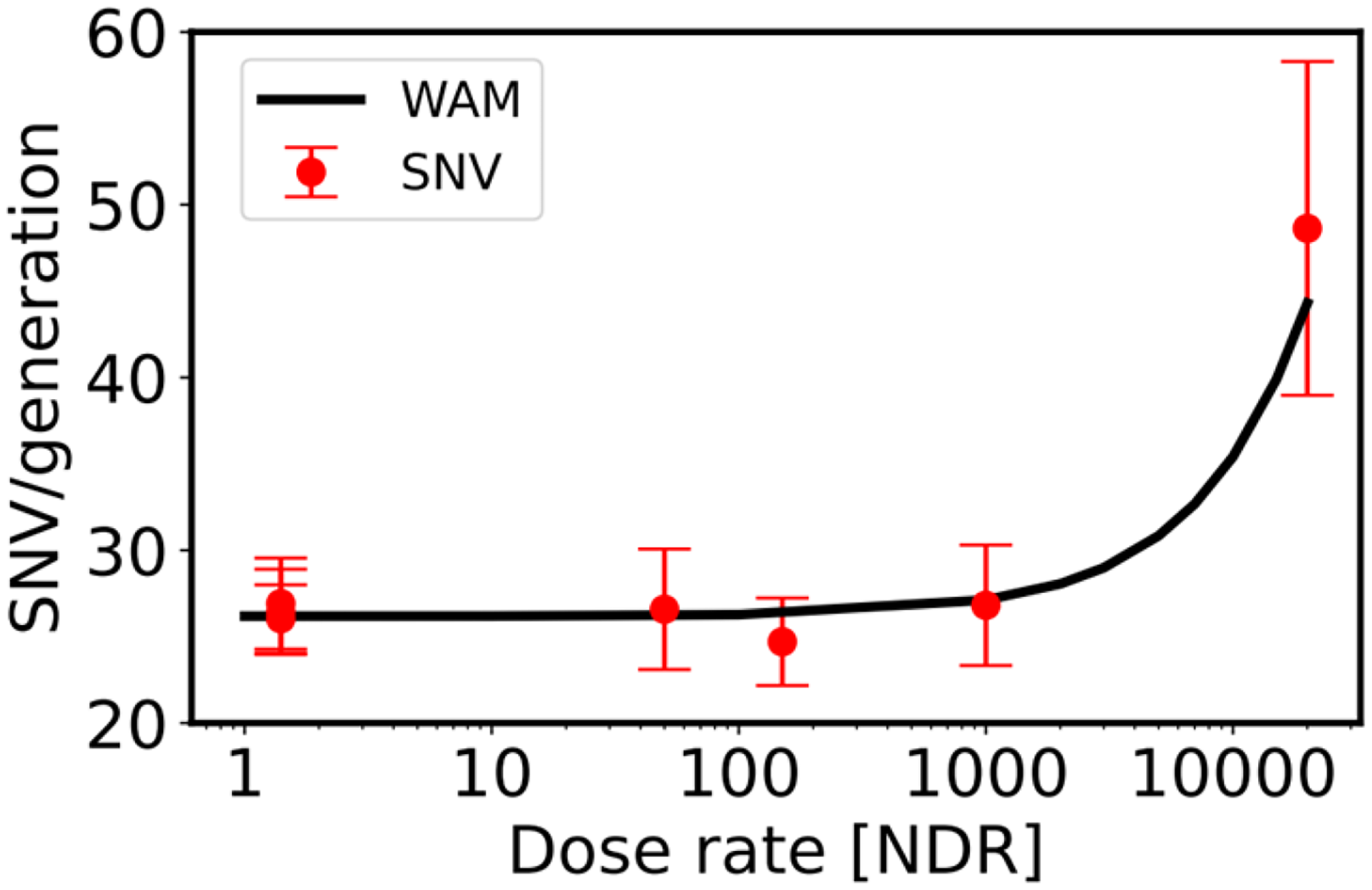
The SNVs per generation are shown by the red circles with error bars as a function of the dose rate in units of the natural dose rate unit (NDR) on a log scale. Here, the dose rate of Japan is 1NDR, and Kerala (India) is 10-200NDR. The WAM results with the standard parameter set are shown by the black solid curve.
Footnotes
ACKNOWLEDGEMENTS
This work was supported by the Research Project on the Health Effects of Radiation organised by the Ministry of the Environment, Japan.
CONFLICT OF INTEREST
The authors declare no conflicts of interest.