



Abstract
Henry Ward Beecher, the influential pastor of Plymouth Church in Brooklyn until his death in 1887, became an iconic figure in Puck magazine during its first decade. Beecher, who was involved in the Tilton marital scandal, was satirized in word and graphics by editor and cartoonist Joseph Keppler for both his womanizing and his politics. A study of Puck’s response to Beecher from 1877 to 1887 exemplifies the magazine’s crusade against dishonesty and attempt to safeguard public morals as it followed in the steps of its mascot Puck, proclaiming “What Fools These Mortals Be!”
I am here. And I don’t apologize for being here. … I have not come merely as a flippant playmate to amuse you in your idle moments, but rather as a pleasant confidential companion, who will be the best-natured fellow in the world—if you will only let him.
1
As an early study by Frank Weitenkampf, former head of the New York Public Library Art and Prints collection, points out, Joseph Keppler produced nearly all of the early graphic art in Puck, thereby endowing the magazine with “a noticeably foreign tone … a spirit, with a somewhat Gallic freedom of expression, born of his Viennese origin.” 3 That freedom is well documented in studies by Richard Samuel West, Robert Secor, and Frank Luther Mott. 4 Keppler had a varied background, including training at the Academy of Fine Arts in Vienna, scene designing and acting, editing, and drawing cartoons. His friend Adolph Schwartzman, who had been print shop foreman for the publisher Frank Leslie, joined in Keppler’s “audacious” spirit, and together they launched a German-language version of Puck on September 23, 1876. Its success prompted them, despite great odds, to establish an English-language version; the two German immigrants hoped to cater to pervasive nationalism by hiring Virginian Sydney Rosenfeld to be the editor. As West explains, the new Puck, which debuted on March 14, 1877, became known for Keppler’s fearless outspokenness against such incendiary topics as the “flawed jury system … life insurance fraud … conditions in the city schools, the psychic sham, additives in food” and others. Triggered by a lack of advertisers and a flood of complaints from readers, tensions rose. A particularly vicious attack came from Sydney Rosenfeld, who left to start his own magazine after accusing Keppler of prostituting his skill by being “vulgar where he might be witty” and by including “downright filth” in his drawings. The associate editor H. C. Bunner was eventually promoted to editor and by working “heart and soul” became a mainstay in the success of the magazine. 5 Puck, as Kahn and West say, became “the most influential humor magazine ever published,” serving as a “training ground and showcase” for innumerable cartoonists. 6
In the early years when Keppler was the leading cartoonist, one of his favorite targets was Henry Ward Beecher. To follow Puck’s response from its inception to Beecher’s death is to see a broadening concern for other public issues; it is, in effect, a way of tracing how the editorial focus changes from Keppler’s personal disquietude to the readership’s concerns during a decade of profound change that began with the end of Reconstruction and included the invention of the light bulb, the building of the Brooklyn Bridge, the creation of the Red Cross, the legalization of segregation, 7 and the Haymarket Riot.
Puck’s stance was straightforward. While it attacked Beecher for his womanizing and satirized his pudgy, self-satisfied expression, it appreciated his reformism. Beecher, as Debby Applegate’s prize-winning biography points out, was a leading abolitionist, supported women’s suffrage, and promoted freedom of speech. Much of his radicalism took place before Puck’s time; but at the end, when Beecher died on March 8, 1887, the magazine acknowledged his achievements. As Puck’s March 16, 1887, editorial tribute said, “Mr. Beecher was great in spite of his qualities—in spite of weaknesses and deficiencies of temper and character.” There was much to praise: the “enthusiasm” of his “tremendous personality,” for instance, that was “so forcible, so earnest, so cogent in its self-revelation.” Despite his “unguided excess of feeling,” he displayed “single-hearted courage … when he died we lost a great American.”
Why, then, did Puck choose to caricature this “great American” so persistently? On the one hand, he was immensely popular—his early reputation, idiosyncratic dress, and informal preaching style attracted enormous crowds to the Congregationalist Plymouth Church in Brooklyn. However, as Puck’s memorial column suggests, he was neither “profound” nor “logical”; “he was inconsistent; quick to speech and action; fond of deceptive generalizations. He was moved in all things by his emotions … he acted on his impulses.” He threw himself headfirst into popular arguments, from original sin to the election of a Mugwump; he advocated temperance and declared himself in favor of evolution. In addition to all that, he carried the weight of an adultery lawsuit and his own weakness for the fair sex until his death. Nonetheless, given the combination of fiery oratory and notoriety, thousands flocked to hear him preach and speak. As the authors of Religion in American Life put it, “Beecher reigned as king … People loved him. Most never seemed to notice that his views of Christ, miracles, and future punishment remained hopelessly fuzzy.” 8
In many ways, Puck incorporated implications of this mixed character into both its cartoons and comments until, in time, the name “Beecher” became a byword. What Keppler did was to tap into Beecher’s popularity by providing a satirical image of the darker deeds, discussions, and accusations that persisted in the latter part of his life. In the first year alone, Beecher was Puck’s leading character in covers, centerfolds, and end illustrations, forming what West calls the “core” of the graphic content: 9 that visual focus served to imprint a certain identity, so that in later issues, a simple sketch of an overweight pastor with unkempt white hair and plump physique needed no identification. As time went on, Beecher’s identity in Puck, defined by personal wrongdoings and liberal religious stance, also influenced the way he was depicted in political and other matters.
Other factors contributed to the shift in focus away from Beecher, including, as he aged, his waning flamboyance and increased political activity. In 1881, for instance, James A. Wales, one of Puck’s leading cartoonists, left after a disagreement with Keppler to found Judge; 10 and then, in 1883, Frederick Opper, Bernard Gillam, and Friedrich Graetz were in charge of the cartoons during Keppler’s six-month European trip. Beecher, of course, is not the only religious figure to appear in Puck: quips and cartoons about the Catholics, the Mormons, and others abound. One of the best examples of the variety of Puck’s attack on religious malfeasance appeared as a centerfold on Oct. 22, 1879, entitled “The Religious Vanity Fair” (Fig. 1), in which Beecher, lounging under “The Arcade of the True Faith,” is one of many professing to be the only road to salvation. Often, Beecher was juxtaposed to T. DeWitt Talmage, whose Presbyterian Brooklyn Tabernacle was the stage for the vehement and acrobatic sermonizing that both astonished and enthralled his listeners. Beecher’s approach was different, his evocative style attracting thousands to his sermons. But what Paxton Hibben calls the “backbone of Plymouth Church” was not entirely the Sunday services but rather the weekly prayer meetings, where Beecher opened himself to “a kind of cross-examination, with questions and answers flying back and forth and a great deal of jollity.” 11
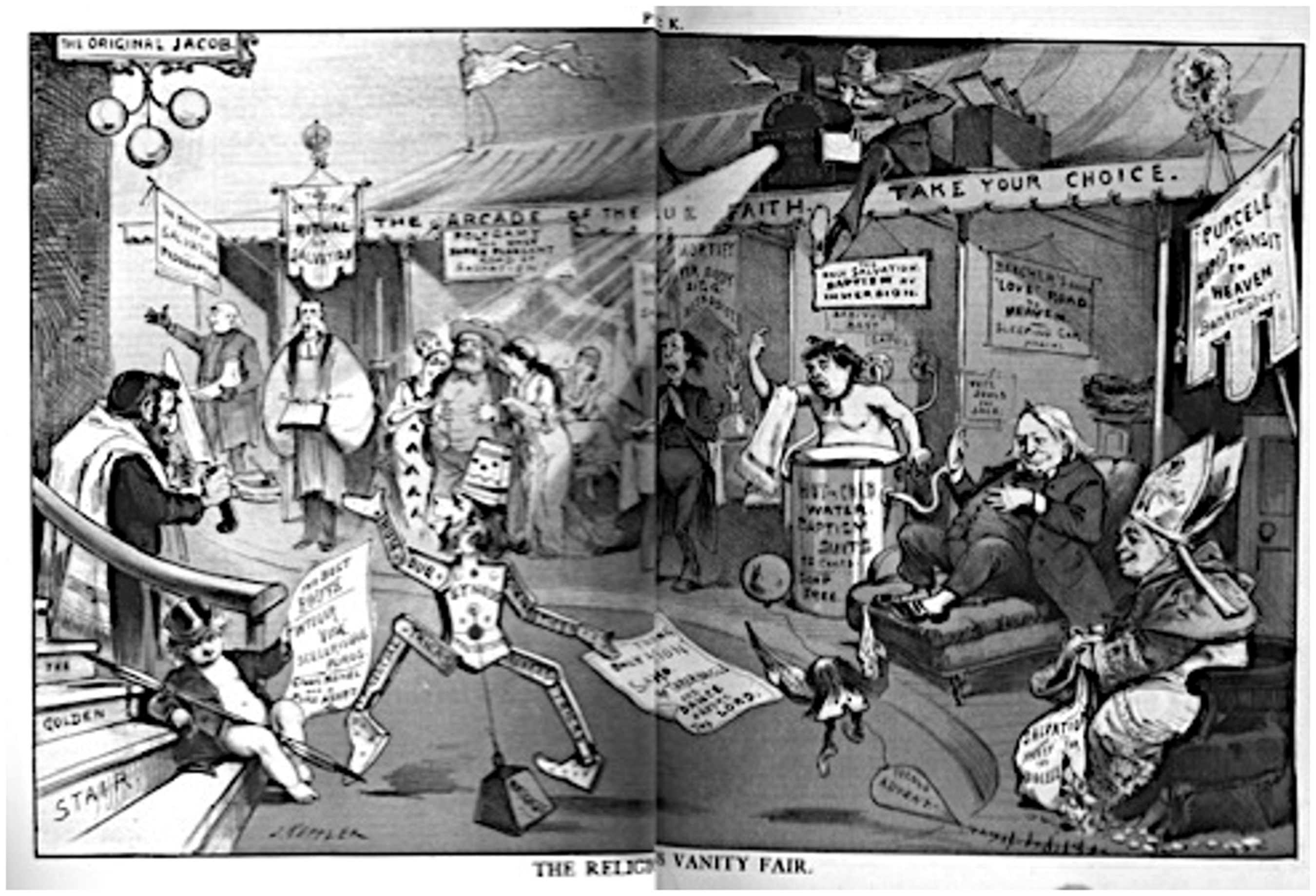
“The Religious Vanity Fair,” Puck, Oct. 22, 1879 (courtesy of HathiTrust).
The persistent attacks in Puck’s early issues on Beecher’s misuse of power was one effect of Keppler’s determination to tackle, as Richard West puts it, “the false gods of American culture.” Such a focus was a fulfillment of the magazine’s Shakespearean battle cry, but often the satire seemed to violate the readership’s common understanding of “good taste.” 12 Perhaps, given Beecher’s weakness for his female parishioners and the 1875 Beecher–Tilton adultery trial, that violation was inevitable. The story is documented in a number of sources, including studies by Debby Applegate, Thomas Werth, Richard Fox, and Robert Shaplen. 13 The editor and poet Theodore Tilton, who had served as Beecher’s assistant at Plymouth Church, left the position shortly after his wife Libby confessed that she had engaged in a relationship with Beecher. As history showed, she was not the only one: Beecher was accused of and known for his relationships with members of his congregation; Applegate, for instance, gives an account of his affair with Edna Dean Proctor in the mid-1850s. 14 The events leading up to Tilton’s lawsuit against Beecher for “criminal intimacy” included the imprisonment of Victoria Woodhull, who publicized the affair, and infighting in the Beecher family. The Plymouth Board exonerated Beecher and excommunicated Tilton, but when the civil jury could not reach a decision after almost a week’s deliberation, Beecher was exonerated a second time by his church.
Joseph Keppler’s crusade against Beecher began even before Puck’s 1877 debut. Assigned by Frank Leslie to draw for the Budget of Fun, Keppler’s 1874–75 cartoons express graphic disdain for one who combined adultery with holiness. As West explains, “this sordid carnival of accusations, betrayals, and lies provided the perfect opportunity for exposing religious sanctimony and hypocrisy”; in fact, that carnival included Leslie himself, who was also entangled in a newsworthy love triangle. 15 Once he was the prime cartoonist for Puck, Keppler lost no opportunity to combine Beecher’s philandering with other causes, including politics. One early example is the June 6, 1877, centerfold entitled “A Traitor to the Cause: Beecher Joins the Russians and Astounds the Turks” (Fig. 2). Commenting in part on the Russo–Turkish war, Keppler depicts Beecher running to embrace Alexander II, while Sultan Abdul Hamid II stands in open-mouthed astonishment. It is not just “the unqualified endorsement of the Czar’s policy by Saint Beecher” that is the point: as Puck slyly notes, the Sultan “always thought their notions regarding the softer sex were in accord,” hence the background sketch showing Beecher approaching a decorated “seraglio” in his Brooklyn chariot and the adorned and adoring women stretching out open hands. A gentler, although similarly pointed centerfold on July 18, 1877, shows Beecher in the guise of a pickled cucumber dozing with other well-known figures in, as Puck says, “a time when the summer is hot, / When ambition and energy slumber, / When exertion and action are not.” Curled in “listless repose” along with Beecher are Pope Pius IX; Republican stalwart Roscoe Conkling; Harper’s Weekly cartoonist Thomas Nast, with his “rather too-well-pointed crayon”; and Otto von Bismarck, the first chancellor of Germany. “Beecher slumbers,” says Puck, but “perchance ’twere not meet / To conjecture what images sweet / May be flitting though [sic] Henry Ward’s visions.” Its editorial comment is harsher, predicting that the “Plymouth Church pet” will awaken and “preach as hypocritically and earnestly as heretofore.” The next year, another summertime centerfold appeared on Aug. 6, 1879, entitled “Puck’s Picnic—Puck and his Contributors by the Sea”; included among the myriad of familiar faces in the crowded seaside cartoon is Beecher, sporting with Cady Stanton.

“A Traitor to the Cause: Beecher Joins the Russians and Astounds the Turks,” Puck, June 6, 1877 (courtesy of HathiTrust).
A highlight of the early years’ focus on religion, “with all its spectacle and dogma,” was, as West suggests, the outstanding reader response to Keppler’s graphics about Brigham Young’s death on August 29, 1877. 16 Bewailing the loss tongue-in-cheek, Puck recommends a new candidate to shepherd “the muchly-married community”: Henry Ward Beecher, who is “suaviter in mode” and “fortiter in re” (both suave and strong). While the “afflicted wives” will be delighted, Brooklynites will be “disconsolate”: on the Sept. 5th cover, “True Inwardness in Utah,” a host of weeping women try to detain Beecher as he strikes out for Salt Lake City (Fig. 3). A sly vignette in the centerfold gives a “Diagram of Beecher’s Misses,” showing the preacher aiming at a sign that reads, “$1 a Day,” while the back cover “In Memoriam Brigham Young” shows twelve heartbroken wives in bed with an empty pillow—the actual number was 27, according to Hal Shindler, whose study appeared in the Salt Lake Tribune on July 30, 1995. 17 Puck’s subtitle, “and the place which knew him once shall know him no more,” is a rephrasing of Job 18:17, which refers to the fate of the wicked. 18 Puck continues to weave the story in the following two issues. On Sept. 12, 1877, a Puck columnist “interviews” Beecher, who is playing croquet with a young woman in pink stockings. Beecher concedes Mormonism’s advantage in teaching “the value of one good sound man weighed in the scale with many weak women,” but criticizes Brigham Young for “flaunt[ing] his connubial plurality in so impolitic a way.” Beecher is reconciled to a possible 56 stepchildren when the reporter “paints delight in other quarters.” By the next week on September 19, however, Puck sadly announces that the Mormons had rejected Beecher, primarily because “it does not appear that the Brooklyn candidate ever committed bigamy however much he may have been inclined to.” Parishioners of the “female persuasion” are joyful, as the centerfold shows: to the left of the “Defeated Saint,” women wave flags and clap at the good news; to the right, grieving women weep in the Salt Lake City Tabernacle, crying, “He Cometh Not,” a parody of David’s nonappearance before the King in 1 Samuel 20:29.
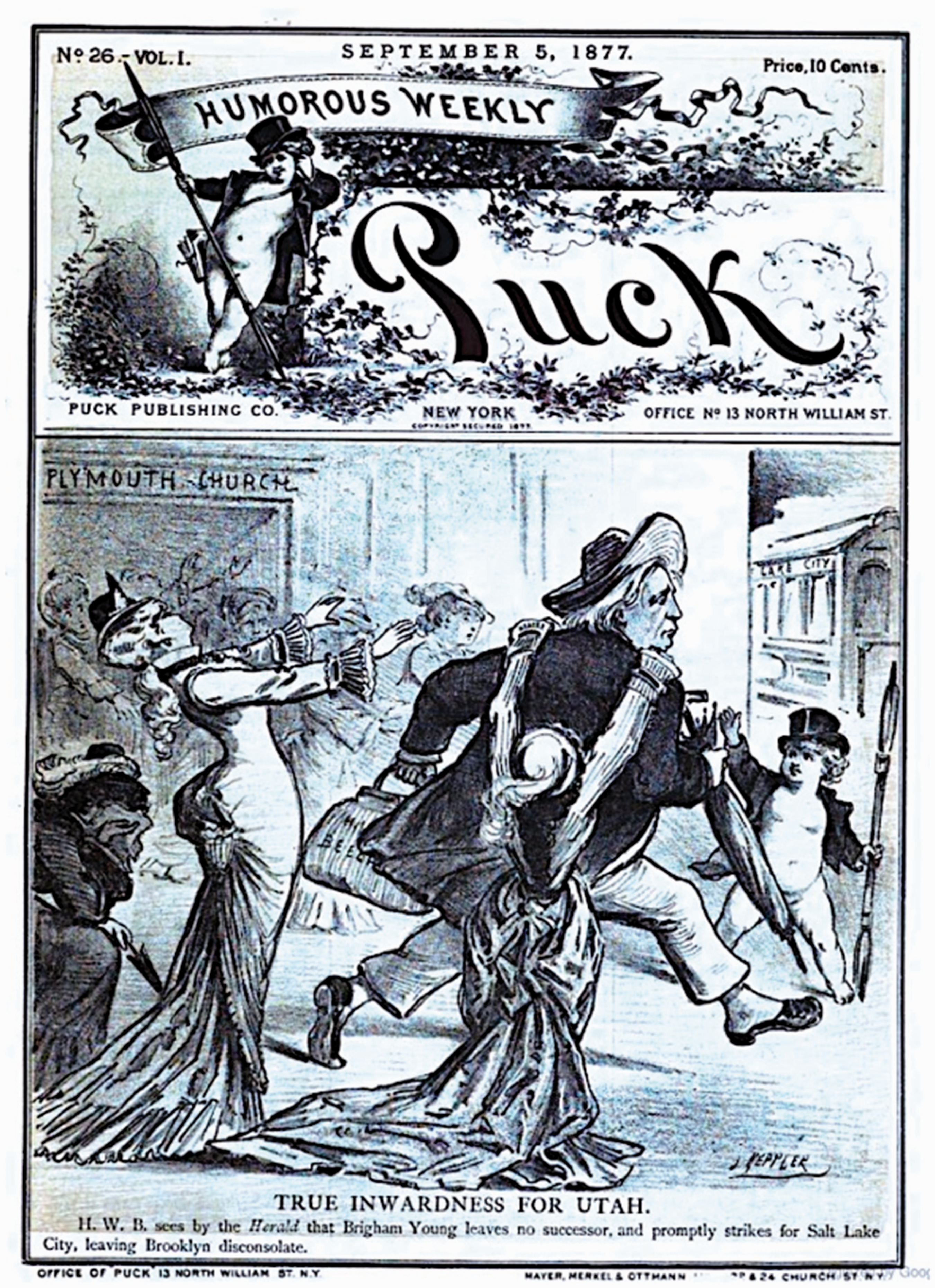
“True Inwardness in Utah,” Puck, Sept. 5, 1877 (courtesy of HathiTrust).
To some degree, Puck appeared to lay the Beecher trial and specific charge of adultery to rest with its April 17, 1878, cover entitled “Reconciled” (Fig. 4). A pencil-thin Tilton, arm-in-arm with his wife, heads for the depot to leave the country, while a corpulent Beecher laughs uncontrollably. Later, that kind of pointed reference to the trial devolved into more veiled comments and graphics about Beecher’s moral failings. Comments peppered the 1877 and 1878 issues, along with witticisms and puns like the following one that appeared on Sept. 25, 1877: “What is the difference between a person going to Plymouth Church and one about to ask a lady a favor? One is going to see Beecher and the other is going to beseech her.”
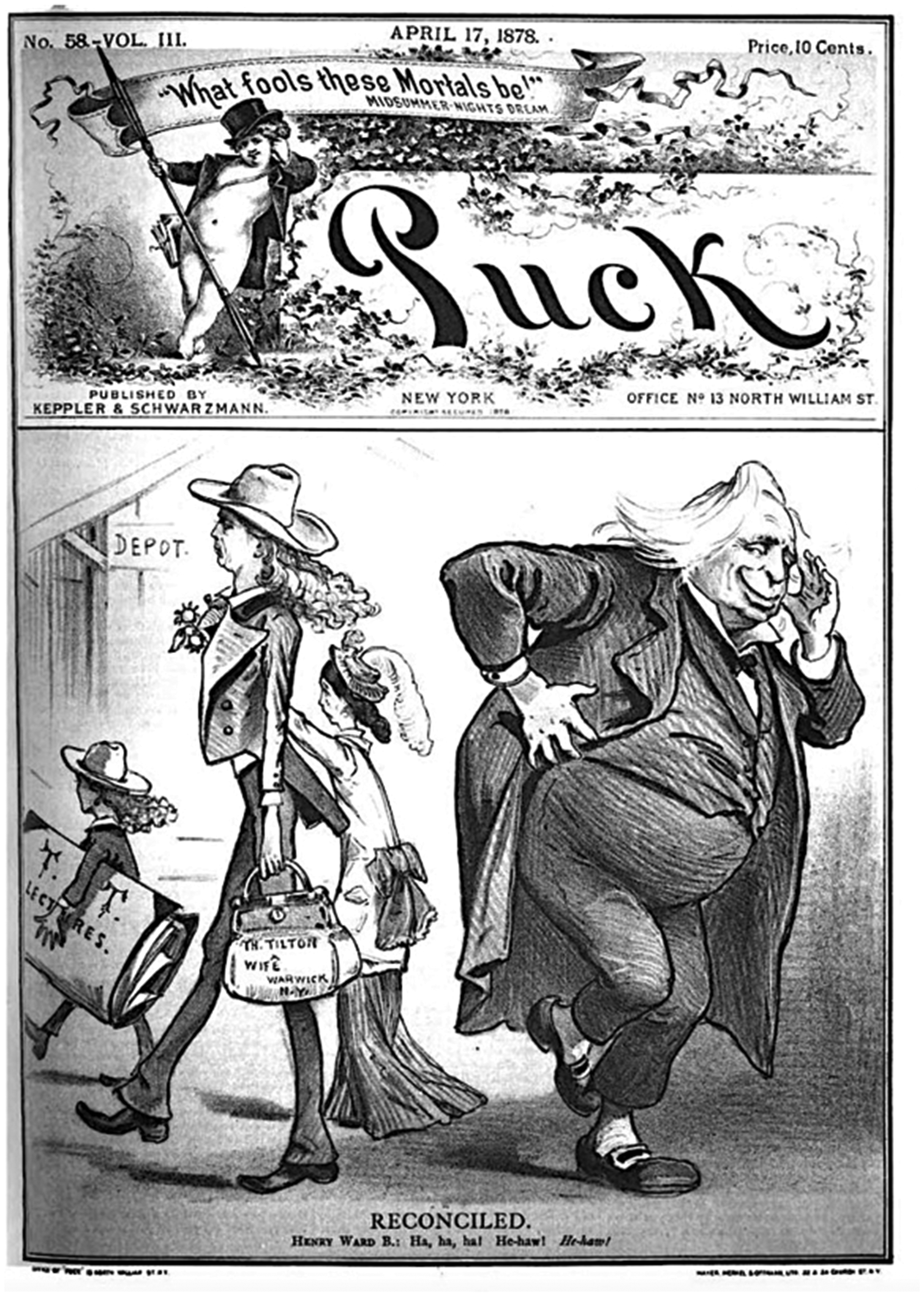
“Reconciled. Henry Ward B.: Ha, ha,! He-haw! He-haw!” Puck, April 17, 1878 (courtesy of HathiTrust).
Often, a quiet dig would be buried among other illustrations, as is the case with “The Life of Henry Ward” (Fig. 5), a March 31, 1878, back-cover graphic biography that illustrates a panoply of Puck’s complaints. He was a born “gas-bag”; came to “Plymouth Rock” for the salary, where he “sold the Gospel to the highest bidder”; in performing a wedding, “saw a woman … and he took her”; and instead of practicing what he preaches about fasting on bread and water, gorges himself at a table laden with food and wine. Every sketch is iconic, pointing to a larger story, including the central image of Beecher as a regimental chaplain, preaching from a mangy horse, his arms outstretched, hair flying and rear exposed. Puck’s quick-witted readers would have recognized subtle references to past events in the vignettes. The laden-table sketch, for instance, may refer obliquely to Beecher’s response to the July 1877 railway strike, which, fueled by a drastic reduction in laborers’ wages, turned violent as workers ransacked the railroads and the militia was called out. As Debby Applegate puts it, Beecher’s response was a “mishmash of abhorrence of disorder and sympathy for the underdog.” His assertion that a “foreign element” sought to overthrow “the natural laws of capitalism and evolution” was part of his mixed message. In a much-publicized sermon he proclaimed with fervor, “God has intended the great to be great and the little to be little,” at the same time maintaining that a dollar-a-day wage was insufficient only “if a man would insist on smoking and drinking beer … but the man who cannot live on bread and water is not fit to live.” 19 William McLoughlin’s insightful analysis of the furor the statement provoked notes that Beecher’s view about the danger of unions prevailed until the 1930s; countering that, however, was the belief that Beecher had proved himself not only a Social Darwinian but an early proponent of the Gospel of Wealth, a term used to describe Andrew Carnegie’s argument that the wealthy are called to be philanthropists. 20 Puck, ever a Gilded Age critic, joined the uproar, continuing its criticism through persistent cartoons of an overweight Beecher. The August 8, 1878, cover that followed the “Life of Henry Ward” end piece, for instance, is entitled “Beecher’s Theory and Practice,” with the “bread and water” quotation as the caption. Two church assistants approach the “smug, lizard-like” preacher 21 with “Lecture Receipts” and “Pickings”; his coat swings open to reveal pants and vest decorated with the words “$20,000 salary” (the equivalent of over $400,000 today) and pictures of “peacocks’ tails,” “ox tail” stew, “turtle steak,” “snails on toast,” bottles of champagne and schnapps, and other delicacies.
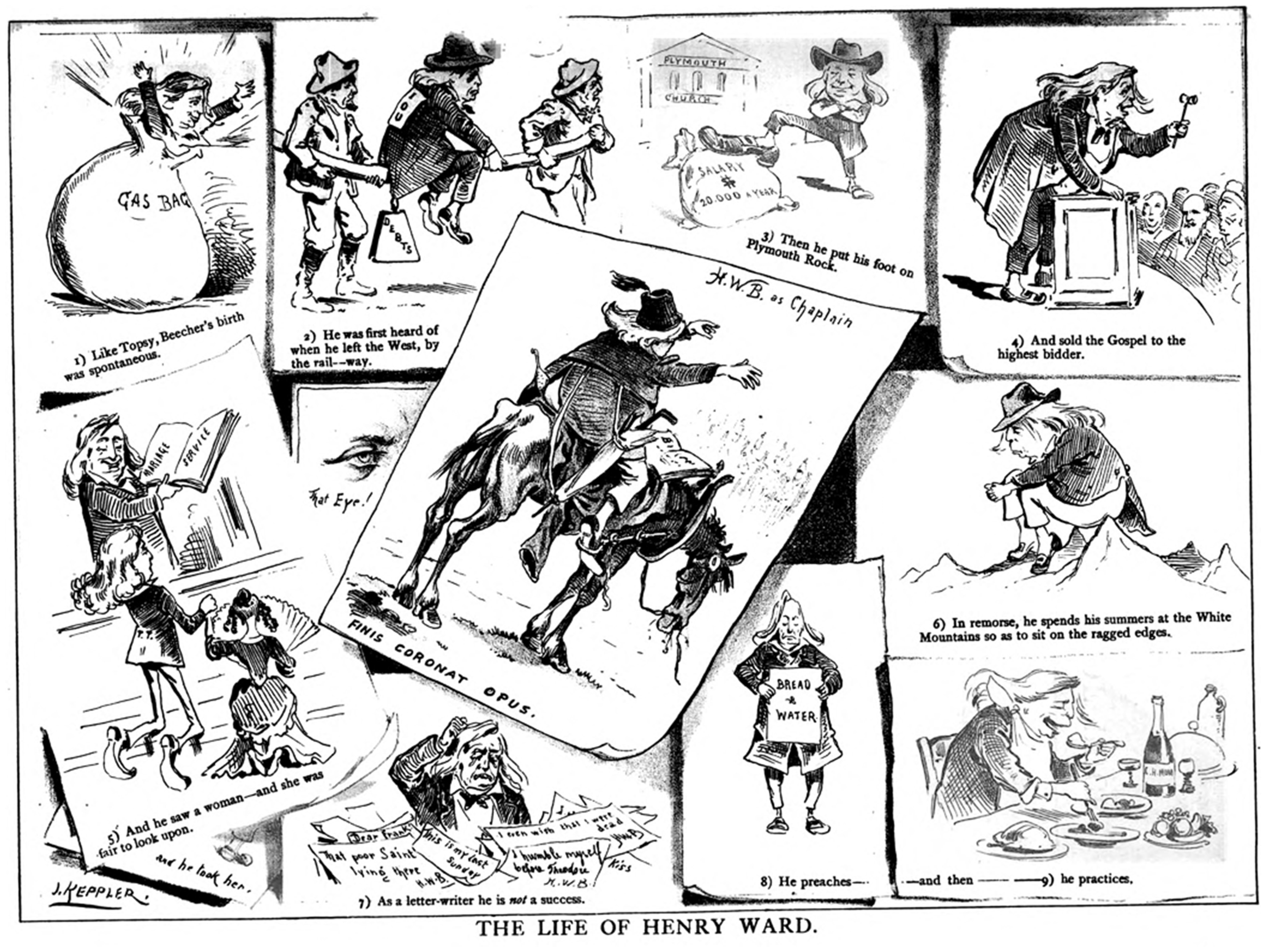
“The Life of Henry Ward,” Puck, January 30,1878 (courtesy of HathiTrust).
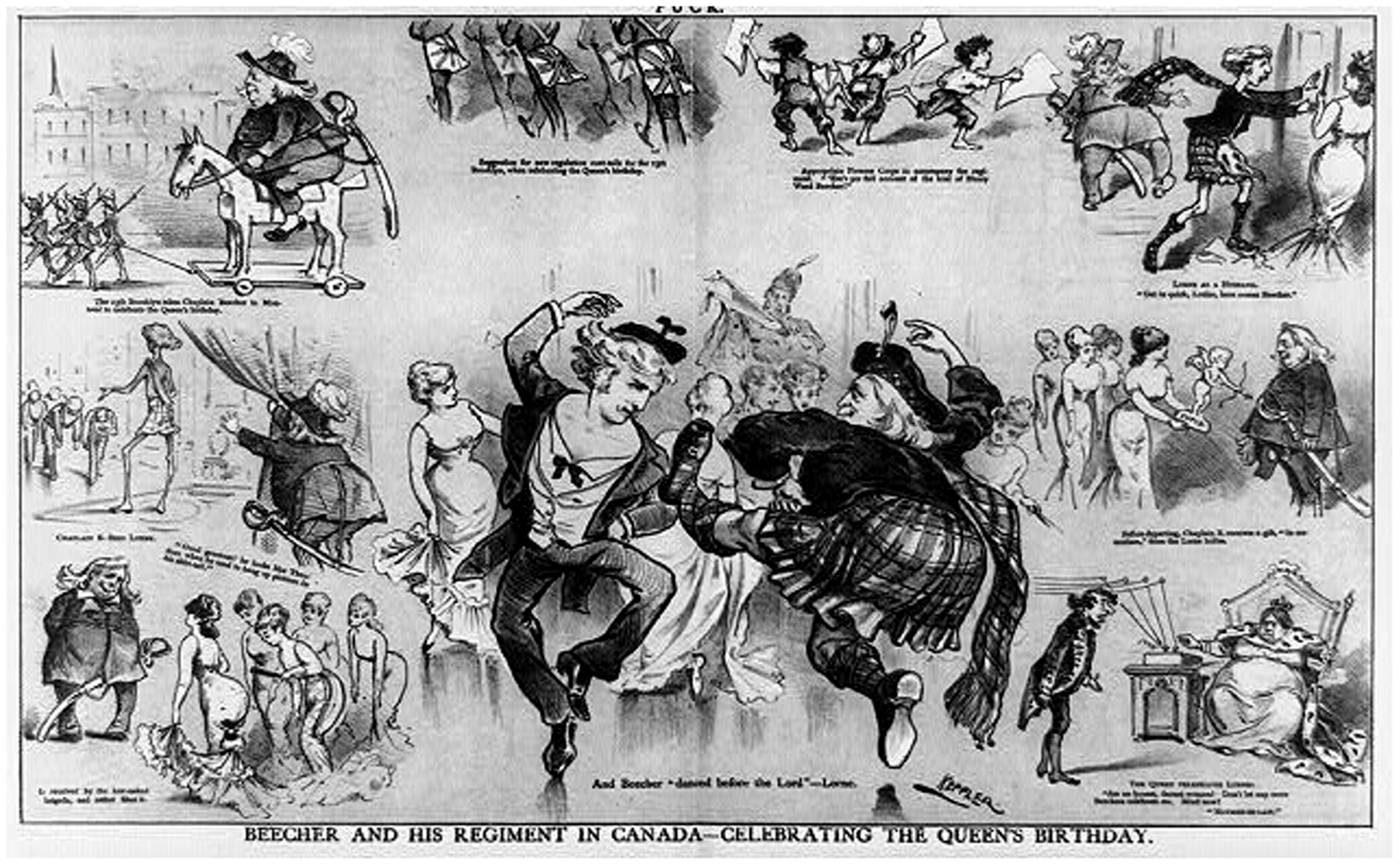
“Beecher and his Regiment in Canada—Celebrating the Queen’s Birthday,” Puck, May 21, 1879 (courtesy of HathiTrust).
Five years later the July 5, 1882, centerfold shows both Beecher and Talmage blown into the air by “Puck’s Pyrotechnics.—Fourth-of-July Fireworks Free for All.” Beecher is pictured with the body of an alligator, complete with forked tail; in the background, a woman resembling his wife looks on disapprovingly. Puck’s offering the fireworks for free can be taken as a sly commentary on the stance that many took against the railway freight handlers’ strikers who asked for better wages. As West explains, Puck’s position mirrors its view of the strike of 1877: the magazine supports the “thousands of sturdy men” who can only find irregular work to support their families but blames the “unscrupulous” who pervert the free market system. 22 It is the monopolists, Puck says, who are making money by falsely claiming exorbitant values for their railroads and telegraphs. As the detailed record of the strike’s effects in the New York Times suggests on July 18, 1882, there is “no prospect of settlement.” 23
Another image in the January 30, 1878, Beecher graphic “biography” had far-reaching roots. In that year, his sixty-fifth birthday, Beecher became Chaplain to the 13th Regiment of the New York National Guard, based in Brooklyn. Comments erupted as to whether the appointment was appropriate, given his age and lifestyle. At the dedication in Boston, for instance, he rode a spirited Kentucky thoroughbred, presenting, as one writer puts it, “a lamentable, unsoldierly figure, with his white hair flying.” 24 His defense for accepting the chaplaincy was that the young men needed guidance because they were in peril: “Is not a body of this kind, resembling in some respects a social club, unrestrained, and perhaps uncivilized, by the presence of women, fraught with great danger? Is it not liable to become a veritable maelstrom in which young men may be sucked down to destruction?” 25 Given his background, that stance was both lauded and questioned. For instance, on May 21, 1879, Puck announced that in lieu of contributing to the regiment’s Canadian trip to celebrate Queen Victoria’s birthday, it would publish a “jubilee” cartoon (Fig. 6). It blames the “snobs” who “foisted” Beecher on a group of respectable men, predicting that “Canadians will go out in hordes to see the hero of the Tilton scandal”; and it suggests that since the Queen “has always been a stickler for the sanctity and purity of the home, to be beslobbered by the defendant in the recent Brooklyn trial, will, we prophesy, bring a mother-in-lawish telegram to Lorne [Governor General and husband of Princess Louise] for allowing it, that will make the young man’s ears tingle way down to his toes.”
The editorial predicted a number of negative effects from Beecher’s Canadian excursion, including increased activity in the “revolver market” and sales of horse-whips and door-locks. It suggests that men will accompany their wives on shopping expeditions, thereby causing sales of low-cut, fashionable gowns to plummet; and it anticipates that hospitals and toy stores will expand infant care sections and that the legal profession will ready itself for divorce hearings. In the “jubilee” centerfold, Beecher, clad in a plaid kilt, dances exuberantly with Lorne—“Beecher” danced before the Lord,” Puck quips. One of the surrounding vignettes portrays him on a wooden horse pulled by the Regiment, a negative comment somewhat belied by a North American Review lauding his horsemanship, which excited “general admiration,” and by Beecher’s earlier equestrian training in Indiana. 26 Other vignettes refer to his womanizing. Lorne sequesters his wife from a lurking Beecher; the “Lorne ladies” present him with a Cupid statue entitled “in memoriam”; and as a number of ladies in décolleté bow before him, “he is received by the low-naked brigade, and rather likes it.” Throughout, the enormous sword that hangs in front, in back, and by his side is suggestive of why complaints were made about Keppler’s poor taste. The sword was again displayed prominently on June 4, 1879, in a small sketch depicting the return of the Regiment from Canada, with a corpulent Beecher following a slender regiment carrying rifles; Beecher’s nose seems to be stoppered with a champagne cork. Not surprisingly, as West says, “The 13th Regiment was so incensed … that they called for a boycott of Puck.” 27
Neither that boycott nor the proliferation of vocal complaints and letters tempered Puck’s staunch attack on those who “abused power and privilege”; in fact, Keppler’s cartoons seemed to be a factor in the magazine’s growing public support, especially after 1879.
28
Even before that, Puck’s insistence that popular religion was tainted by hypocrisy is evident in “Brooklyn: City of Churches and Scandals,” a June 26, 1878, centerfold: The Devil, that antique Tartarean moke, His apron full of scandals, sins and shames, And things which good society rarely names, Passed o’er a city as the morning broke. When, glancing down, he heard a preacher who spoke The holy word which Satan and sinner shames; Himself being privily up to various games Ill-calculated confidence to evoke. The Devil paused to listen. “What a joke!” But as he stopped, his apron-string gave way— Down went his cargo on the town below Accompanied by a smell of sulphurous smoke Which lingers about the place unto this day. That city wasn’t BROOKLYN—oh dear, no!
A similarly edgy poem entitled “Chaplain Beecher” was published several months later on Nov. 2: The bass-drums yield their basest sound, The trumpets all their brass, As Chaplain Beecher, so renowned, Heads Regimental Ass. The servant-girls rush out to see This reverend rider rare; Who smiles on them and wishes he Could have a gallop there. This man of peace looks rather queer In uniform and sword, And spurred—like other chanticleer That loves his Hen re Ward. He gives his horse and fancy rein, Nor heeds the loud commands, As he sits holding once again A brid(l)e in his hands. As he dismounts from off his nag, Whose back cuts like a wedge, A joke comes from this wicked wag About the “ragged edge.” His troubles make him heave a sigh And drop some tears of woe; For though he is a chaplain high, He is a chap lain low.
Puck’s exasperated complaint about Talmage in April 1877 is that the preacher presents a “variety show”: “Says he: ‘God knocked the blank verse out of me long ago.’ Why doesn’t somebody knock out all his blanked nonsense, and prevent the blanked mountebank from preaching any more of his blanked sermons?” Perhaps the magazine’s best-known response was an Oct. 23, 1878, centerfold that pitted the two “rival showmen” against one another. Talmage, a “double faced monkey” preaching at “the great museum of monstrosities terrible to behold,” is surrounded by illustrations that are an ironic jibe at his anti-evolution stance and that pinpoint his opposition to dancing, card-playing, and alcohol, the latter showing a young man being swallowed by “the champagne crocodile.” For his part, Puck says in its editorial, Beecher preaches “solid junks of Religion” with adoring women at his feet, but his acrobatics are all symbolic: his “great impaling feat, or striking at the heart of his friend” and his “great acrobatic feat, or climbing over the back of friendship” are both references to the Tilton affair. The commentary clarifies the difference between the two preachers. To Puck, Talmage is pure drama, rivaling the plays of the well-known actor and theater manager Lester Wallack; he is essentially a showman seeking money, “He defies all ‘hell and earth,’ and all the little fishes, to prevent him from preaching about what naughty young men do until he saves 10,000 souls—and—for certainly souls saved are cheap at $2.00 each.” It is Beecher’s immorality, the skeleton in the closet, that attracts more crowds and more money, Puck declares, as it ruminates over the fate of Sodom and Gomorrah and longs for “celestial electricity” to stop both showmen.
Other comparisons between the two followed, each one purportedly revealing a theological standpoint, but really referring to ongoing satirical perspectives. The controversy over the existence of Hell is one example. In November and December of 1877 the Rev. Frederick Farrar, Canon at Westminster Abbey, preached five sermons that repudiated the idea of eternal damnation. Beecher and Talmage both responded, and Keppler himself took on the question in a Feb. 6, 1878, centerfold entitled “Is There a Hell?” Again the Devil appears as an overseer for such places as “tenement house hell,” home to the impoverished, and for figures like Boss Tweed. On the upper left, Talmage rants open-mouthed, “Can’t you see hell before you?”; on the lower right, a despondent Beecher encounters a snake whose scales spell “Scandal.” The caption reads, “Mr. Beecher says he d-d-doesn’t believe in hell—(and then he shivers).” Puck remarks that the Tilton scandal must have made Beecher feel “that there is a terrestrial hell, if there isn’t an infernal one.” In examining Beecher’s modus operandi, Hibben concludes that Beecher agreed with Canon Farrar, even though he had excoriated Tilton “for believing precisely that.” Beecher argued most against those who held the view he was about to adopt; “his one infallible method of dealing with temptation was to denounce it roundly first—then yield.” Farrar’s publication Eternal Love was encapsulated in Beecher’s February 1879 sermon in which he unequivocally states that to worship a god that swept humans into hell was worse than worshipping a “medieval devil.” Ironically, given his trial, he insisted, “I will not worship cruelty. I will worship Love.” 31
Despite what seemed to be a focus on their differences, Puck drew a series of parallels between Beecher and Talmage, depicting them together on April 28, 1880, in “A Moving Day Fancy,” in which a cartload of Puck’s satirical targets is taken “To the Dumping Grounds.” Beecher holds the anti-slavery radical Anna Dickinson on his lap, while Talmage, as usual, has climbed the pole on the cart and is preaching away. More comparisons followed, especially when Talmage underwent a trial both for violating some of the mandates of the Presbytery and for financial misfeasance (in one case he declared the church a “free” church, which meant that attendees did not have to pay pew rents). Both were included in “Pictorial Puckerings for the Current Week” on June 2, 1880, because of their uneasy relationship with the law and politics. Not mentioned by name but recognizable by depiction, they were part of Puck’s unorthodox suggestion as to what should be done when “The Preachers propose to petition, ’tis said, / For a blessing of grace on each Candidate’s head,” the candidates being Republican James Garfield and Democrat Winfield Scott Hancock: We would not for the world be the least bit unkind, Yet he [sic] thought can’t be crowded quite out of our mind: That a few of our pastors would not be the worse It the system of praying were just the reverse. They’re a very bad lot, as we well understand, Who are seeking the contract to govern this land; Their corruption, their vice, their self-seeking have made Political science little more than a trade. But their sins undisguised—are they worthier of note Than many hid under a high-buttoned coat? The Temple of State is disgraced, it is true; But is your’s [sic] pure, O Preachers? Let them pray for you.
What never waned were cartoons that subtly commented either on Beecher’s scandalous trial or on his religious views, although not all of the graphics were specifically directed at him; Puck, in fact, lambasted any brand of religion that did not live up to what it preached. The Oct. 22, 1879, centerfold is a good example of this perspective. As Puck leans on the “Golden Stair,” he surveys the plethora of religious views, including “Pedobaptism” or “Baptism by Immersion,” the “Episcopal Ritual of Salvation,” “Polygamy, the Only Sure & Pleasant Road of Salvation,” “Mortify Yer Body & Sing Methodist,” and the Catholic “Rapid Transit to Heaven—Bankruptcy.” Beecher is shown lolling on a comfortable settee under a sign “Beecher’s Only ‘Love’ Road to Heaven—Sleeping Car”; in stark contrast is Talmage, a mechanical puppet wearing a clown’s hat. His wooden limbs carry messages—“Humbug,” “Gymnastics,” “Financial Tricks,” and “Monkey Tricks.” He is held down by a heavy weight of mortgages and carries a sign: “The Only lane to Salvation! Ho for the Tabernacle and Dance Before the Lord.” Puck’s simple question “Where Shall We Go for Salvation?” is really a cri de cour bewailing the confusion fermented by religious “guides” who maintain that the only “true route” to salvation is theirs. “All we can do,” Puck concludes, is “to obey the laws, be a good citizen, be kind to our neighbors, mind our own business, and do no man wrong.”
One of the most quietly incriminating cartoons was neither centerfold nor cover, but rather a black-and-white panel that appeared on July 21, 1880, before Beecher travelled to the White Mountains in New Hampshire for a summer retreat. That cartoon and the report in the New York Times on July 19, 1880, on “Mr. Beecher’s Last Sermon” 32 are at odds, each panel in the drawing containing a direct quotation from the sermon and a sketch depicting Beecher’s actual reputation as Puck sees it. In the first panel, for instance, the reference to how “men’s conduct” influences their future shows Beecher skewered by the devil; his disquisition about his “ministry of sympathy” shows an amorous Beecher; and his glorying in liberty has him leaning merrily against a lamppost after a night of drunken revelry. Other panels are just as condemnatory, including one showing Beecher planted firmly on the Bible, holding aloft a sack of money labeled $20,000.
Many of Beecher’s religious actions were criticized: in his defense, as he is quoted in “Just How Beecher Stands,” a New York Times article, 33 he says, “I have never expounded any theology but my own, and I have never represented any Church or creed, but simply my own views.” His determination to revive “religious themes and social intercourse” and to change the tone of revivals received wide coverage: on March 9, 1881, Puck pictures his endeavor in “The Rival Revivals in Brooklyn” as a grand parade, led by Beecher, arm-in-arm with a flirtatious lady dressed in red, white, and blue; his followers carry signs like “solid pew holders” and “he who giveth to Beecher lendeth to the Lord.” He is flanked by Talmage on stilts, his signs reading “The Standard of Acrobatic Religion Must be Raised,” “Talmage’s Circus,” and “Gymnastics and Religion Hand in Hand!!” To some degree, the revivals differed, with the New York Evening Express reporting that the situation was “more mixed than ever in the City of Churches,” since Beecher was somewhat distracted by his “regimental fair”; on the other hand, according to the New York Times, he had canceled other engagements in favor of a daily afternoon prayer-meeting. 34 Beecher also was dealing with church politics, including his unilateral decision to retire the well-liked organist Henry Eyre Browne, but, as the New York Times notes, he is “destitute of knowledge of music” and has “exceedingly eccentric” tastes (March 1, 1881). 35 Times articles appeared frequently, noting that revival attendance was affected by an incident in which a young man disputed Beecher’s concept of God and reached for what many thought was a gun; but by the second week, the sales of gospel songbooks were brisk, and Beecher, pleased with the increased activity, decided to continue both afternoons and evenings for another week. 36
Puck is less optimistic. A later cover on March 30, 1881, shows the “Distressing Failure of the Brooklyn Revival Business”: Beecher and Talmage hold a street sale of “revival material scarcely used.” Beecher’s sign proclaims 3% of souls saved, and Talmage seems hampered by a “patent baptism suit.” For Puck revivals are “back-country” and can scarcely compare to events by gospel singer Ira Sankey, the “sweet singer of Methodism,” and evangelist Dwight L. Moody. Later, Puck highlighted other competitors, the clergyman and self-proclaimed spiritualist Francis Monck, who was jailed for fraudulent activities. In an April 25, 1883, cover, Monck is shown as “Brooklyn’s New Champion,” having knocked out both Beecher and Talmage at the “Tournament of Sensationalism”; their “old and effete methods” are surpassed by Monck, who has made “Brooklyn medical men green with envy by his marvelous instantaneous prayer-cures.”
Once summer came, the illustrations became more light-hearted. On June 15, 1881, “Summer Wanderings—the Shepherds and the Sheep” shows Beecher in Europe in 1881 “doing as the Romans do” by flirting with someone’s wife and “Pursuing Spiritual Studies” at a London pub. Later, on July 6, 1881, in “Puck’s Fourth-of-July Picnic” he plays blind-man’s bluff with three attractive ladies, while the “clerical gymnast” Talmage escorts the sprite Puck himself. More summertime fancies appeared with “A Mid-Summer Day’s Dream” on Aug. 10 1881, in which Joseph Keppler dozes as his caricatures take pen and brush in hand to illustrate the way they think of themselves. Talmage, for instance, pictures himself as the “dignified divine,” while Beecher draws himself as the “modest ascetic.”
As time went on, the focus of Puck’s caricatures shifted from direct religious references to more pointed political barbs, as West delineates in his analysis of the magazine’s political stand during the 1880 presidential election; in addition, once Keppler left for his six-month European trip, returning in October 1883, direct religious references seemed muted.
37
Frederick Opper’s “National Dog-Show,” for instance, depicts Beecher as a poodle and Talmage hopping about as a “Toby” Dog, a character from a traditional Punch and Judy show, but the May 9, 1883, commentary declares that no comment is necessary. In fact, Beecher was linked to other popular figures as well, particularly as he became more involved in political questions. One of the lessons Puck tried to teach Beecher in its early years was that “it is much better to be a politician than a preacher,” particularly when the case of the Conkling–Sprague scandal hit the news. Roscoe Conkling, member of the House of Representatives and staunch supporter of a third term for Ulysses S. Grant, was, like Beecher, accused of having an affair. Puck’s Sept. 10, 1879, cover pictures “Two Effects from Similar Causes”: a cloaked and “abashed” Beecher huddling bereft near a building while Conkling, surrounded by prostrate women, is triumphantly riding the Republican elephant. Beecher was among those campaigning for a third term for Ulysses S. Grant, a stance that Puck railed against on April 21, 1880, as “in defiance of unwritten law and political morality” and parodied in a centerfold showing Beecher as one of those worshipping the Grant golden calf, with an angry Puck as Moses holding the ten commandments. The specific biblical reference to idolatrous worship is well delineated by Dan Backer, who comments that “the Stalwarts are likened to Biblical rabble, whose indecent behavior requires a Commandment THOU SHALT NOT COVET A THIRD TERM, in order to keep them in line.”
38
The party, too, was not all that happy, claims Puck: pictured on the June 23, 1880, cover as an elegant young woman, the Republican Party declines Beecher as an escort, saying, “My reputation is quite bad enough already.” The magazine’s further tongue-in-cheek comment is that since the church overlooked Beecher’s “trifling irregularities,” the party ought to overlook Grant’s “Whiskey Rings, Post Traderships and Crooked Election Returns.” Finally, when the Republican convention nominated James Garfield and Chester Arthur for president and vice-president in June 1880, both Beecher and Talmage were “In Line at Last,” marching along in a Salvation Army parade on Sept. 1, 1880, with Beecher carrying a bag labeled “Special Brooklyn Patronage.” The tune they are marching to is Bring the good old bugle, boys, and trumpet forth the news; ’Twas but a little while ago that we were in the blues; But now we are the Boys in Blue, and ready to enthuse— As we go Marching for Garfield.
Beecher’s changing political fidelities continued to interest Puck, especially during the campaign of 1884, as West says, when the Democrat Grover Cleveland won over Republican James Blaine. 39 As the political climate became more querulous, Beecher was increasingly included in caricatures that pictured him in subordinate positions or holding absurd views. He is “interviewed” on May 14, 1884, when the editorial suggests facetiously that given the indecisiveness of both Republican and Democratic parties, perhaps the Whig ticket of 1844—Henry Clay and Theodore Frelinghuysen—ought to be reinstated. Beecher pledges his vote for them, saying, “It will be a grand ticket, and will carry the country.” Beecher was among those Republicans who became Mugwumps, refusing to support Blaine because of his suspect financial dealings. As such Beecher appears in the Nov. 23, 1883, centerfold “‘Evacuation day’ March 4th, 1885—a Democratic Dream” by Bernard Gillam, standing unobtrusively in a mob of Republicans who are overwhelmed by victorious Democrats.
As the election approached, Puck, which came out firmly on the side of those who “claim the right of exercising their public rights according to their private conscience,” lambasts the Republican Party for expelling those who criticized Blaine’s candidacy. Puck maintains that the individual who “honestly and faithfully labors” for the party principles is a member, no matter what the party officials say. Beecher is pictured in a number of supportive caricatures. As West points out, Keppler drew the “first favorable portrayal” of Beecher when, in 1884, both were on the side of the Independents’ push for reform: entitled “Men May Come and Men May Go, But the Work of Reform Shall Go On Forever,” the Nov. 4, 1884, illustration shows Beecher hard at work on hoisting the Civil Service Reform Bill” along with “those who led the struggle for honesty and patriotism.”
40
That same year, in an exuberant mood, Beecher sings along on Christmas Eve in “Puck’s Christmas Carols for Assorted Celebrities”: I am Henritheward, Henry the Beecher of Brooklyn, I am the orator great who lays out Demosthenes hollow; I am the man whose bazoo, upraised in the village of Brooklyn, Clear as a trumpet tone and like to a fog-whistly fetching, Carried the County of Kings right into the fold of the mugwumps. Whoop-a-de-dooden-doo! Whoop-a-de-dooden-doodle! …
During Puck’s first decade, Henry Ward Beecher was for the most part a scapegoat. Joseph Keppler and other cartoonists and writers presented a panoramic display, with Beecher pictured as a plump, rumpled, and undignified leader, whether of the burgeoning Plymouth Church or the National Guard. Puck took umbrage at his penchant for the fair sex and his influence over the young men in the National Guard; it suggested time and time again that it was the Devil himself who ruled over the church. Yet eventually, the magazine solidified its reputation as a satirical commentator, not just on religion but on a wide variety of issues, including health, politics, and social changes. What also changed was how Puck portrayed Beecher. His reputation as a womanizer moved to the background, and his verve in confronting political issues came to the fore. The memorial that appeared in Puck on March 16, 1887, reflects that change, denominating him “among the great men whom America has produced.” His mid-life scandals, from the Tilton trial to various dalliances, that invoked Puck’s anger about the interface between religiosity and immorality, is passed over: “Of the misery into which his unguided excess of feeling led him it is not necessary to speak.” Rather, what the editorial comments upon is his humanity: on the one hand, his honesty, originality, courage, and sincerity; on the other, his inconsistency, impulsive behavior, and illogic. He was powerful, the memorial concludes, praising him for “loving his country” and seeking to serve her: “when he died we lost a great American.”
The study of the depiction of Henry Ward Beecher in the first decade of Puck’s existence, then, is indicative not just of Beecher’s personal history but of the development of the periodical. No longer primarily a project of one man—Joseph Keppler—and no longer a periodical with a restricted audience (by 1884 the readership had grown to 125,000), Puck became an outspoken critic, at the same time reflecting the changes that led to the twentieth century; it became, as Kahn and West say, “A lightning rod for criticism.” 43 Despite criticism and threats of lawsuits and boycotts, it fearlessly maintained its reputation as the Shakespearean sprite turned into a nineteenth-century critic, crying “What Fools These Mortals Be” in its cartoons and comments.