



Abstract
The fame of George Herbert’s “Easter-wings” is due not only to the complex theological meanings developed throughout the poem but also to how its form and shape function poetically: the words of the poem are arranged to create both a rhythmic pattern and the shape of wings. It may very well be the most recognized “shape poem” in English. This visual pattern of the poem affects the meanings inherent in the words and lines. How and why Herbert literally shaped this poem affects our understanding and enjoyment of it, though this how and why may have been misunderstood for centuries due to the way it was first and is usually printed: centered on the page.
Easter-wings
Lord, who createdst man in wealth and store,
Though foolishly he lost the same,
Decaying more and more,
Till he became
Most poore:
With thee
O let me rise
As larks, harmoniously,
And sing this day thy victories:
Then shall the fall further the flight in me.
My tender age in sorrow did beginne
And still with sicknesses and shame.
Thou didst so punish sinne,
That I became
Most thinne.
With thee
Let me combine,
And feel thy victorie:
For, if I imp my wing on thine,
Affliction shall advance the flight in me.
The fame of George Herbert’s “Easter-wings” is due not only to the complex theological meanings developed throughout the poem but also to how its form and shape function poetically: the words of the poem are arranged to create both a rhythmic pattern and the shape of wings. It may very well be the most recognized “shape poem” in English. This visual pattern of the poem affects the meanings inherent in the words and lines. How and why Herbert literally shaped this poem affects our understanding and enjoyment of it, though this how and why may have been misunderstood for centuries due to the way it was first and is usually printed: centered on the page.
In The Poetry of George Herbert, Helen Vendler complains that many earlier critical efforts had their faults but could “be seen as a cooperative venture in learning to read him with greater attention.” She notes that though Herbert had often been read superficially as a minor poet whose work remains in the shadow of John Donne’s superior verse, “Herbert’s apparent simplicity is deceptive.” She discerns that critics had discussed “relatively few poems in aesthetic as well as moral terms,” failing in “comprehensiveness of description” (Vendler 3). So it is ironic that even Vendler gives short shrift to Herbert’s poem “Easter-wings,” lending it only a cursory mention in her book, calling the first stanza “extremely conventional” rather than considering it in both aesthetic and moral terms (145). However, if we consider the relationships that Herbert creates among his poem’s shape, its context, its allusions, and the effects of its formal structure, there seems little conventional about it.
Published some fifteen years after Vendler’s book, Janis Lull’s The Poem in Time: Reading George Herbert’s Revisions of The Church, takes a closer look at the formal, literary, and textual choices that Herbert made in constructing his poems, and notably “Easter-wings.” In her chapter “The Shape of Time,” Lull states that Herbert’s poems dealing with time are forms whose beginnings in one way or another “touch their End” (Paradise). Chiastic form makes readers experience the flow of time not as a line or a circle but as a symmetrical narrowing and widening process that finally returns to its beginnings in timeless truth. The revised Easter-wings makes the most obvious use of this chiastic form because each stanza appears as a visual X. (Lull 75)
The shape of “Easter-wings” offers the reader more than just chiasmus. Robert Halli claims that the image of the stanzas in the Bodleian manuscript of “Easter-wings” makes a “triple hieroglyph” of crosses, wings, and hourglasses. One can see how each of these suggested images communicate theologically complex principles. The cross on which these stanzas (the shape of the words) are hung defines both a wider human history (indeed, the very crossroads of time according to our calendar) and the individual speaker’s personal story of salvation. The wings give visible shape to the various birds of the poem and emphasize flight and a movement upward. The image of the hourglass displays the downward fall of sand to measure time. Time running out is an image suggestive of death, though one might see the body of the sand altered from one life to another in a fullness and accretion below rather than just an emptiness above. Herbert’s poem “Church Monuments” contains the wonderful idea of a tapering human form related to the hourglass: “That flesh is but the glasse, which holds the dust/That measures all our time; which also shall/Be crumbled into dust” (20–22); here it is not the shape of the text but rather an image suggested to the mind. In “Easter-wings,” this visible shape of the text of the poem, of time, this memento mori, serves as a reminder of our time running out, our return to dust. Yet Christian theology professes that Jesus overcomes death on Easter, and like the famous Phoenix of mythology rises on metaphorical wings from this dust.
Later in the seventeenth century, John Dryden derided the kinds of graphic display we see in “Easter-wings” as something too easily achieved through the manipulation of type. In his poem, “Mac Flecknoe,” mocking fellow poet Thomas Shadwell, he writes this couplet, There thou may’st wings display and altars raise, And torture one poor word ten thousand ways.
Herbert’s shapely form strengthens already strong lines. The belief that we are made in God’s image, fallen, and then restored seems to be at the heart of the formal logic here. The linear contraction and expansion create a form twice mirrored. Both top and bottom of the two pages create mirrored triangular forms. And the manuscript version of the poem as well as its early printings present each stanza on a separate, facing page, such that the shapes on the pages mirror each other. These formal patterns are essential to our understanding of the poem’s content. The first stanza begins with a direct address to the “Lord” and ends with the word “me.” There is a representation of humility in that progression, yet both persons are connected by the one long sentence of the stanza. The extended syntax creates a unity between the Lord and the speaker. The Lord creates “man” in the first and longest line “in wealth and store.” The second line, shorter by a metrical foot, physically illustrates the loss of those riches, recalling to us the creation story in Genesis where all is lost rather quickly. The second line features the word “lost,” the third “decaying,” and the fourth “Most poore.” By the time we have arrived at the bottom of the funnel, man’s life has diminished both literally (in the content) and figuratively (in the form). And the diminishment is not just visual but aural. There is one fewer prosodic foot in each line as we move down the page.
Just as soon as we have arrived at the stanza’s point of greatest collapse, the expansion back out to fullness begins. Well, almost. The next line, “With thee,” is actually the shortest line. Here, we cross over the center of the chiasmus, or the cross, its most intense yet rarefied moment. This line can indicate both the incarnation and the crucifixion. The “thee” in the phrase “With thee” recalls Immanuel, “God with us,” who is laid below “Most poore” humankind. Both the baby Jesus and the crucified Christ are suggested in these words, but I tend to read it as primarily the latter due to the next line: “O let me rise.” Most Christians would argue that we can be raised from death only by the power of the resurrected Christ—not by the birth. The rest of the stanza’s expansion features the speaker lifting as, appropriately, birds: “larks, harmoniously” singing a song of praise of and from a fortunate fall.
To add to the complexity of the movement, there is a harmony of rhymes that occur, weaving the lines together: ababacdcdc. The three a rhymes brace the two b rhymes, and the three c rhymes brace the two d rhymes in both halves of the stanza (each wing), holding the halves together sonically and visually. The poem’s rhyme is an extension of its meaning, reflecting the embrace of Christ around humankind and suggesting that our story is interwoven with His. Indeed, though the “Man” in line one can be understood as Adam (and by extension, humankind in Paradise), this person could also be seen as the Incarnated Christ who loses all to become “Most poore”. Jesus is “Most poore” in that he gives up his omnipotence/omnipresence to live as a person, but also “Most poore” in the way that he suffers and dies on the cross.
Though “he” is not capitalized in the poem, Christ can be considered the subject as well. The second line of the poem mentions that “foolishly he lost the same.” Paul’s letter to the Corinthians states in its opening that “We preach Christ crucified, to the Jews a stumbling block and the Greeks foolishness, but to those who are called, both Jews and Greeks, Christ the power of God and the wisdom of God.” The idea of the resurrection from the dead may have seemed foolish or impossible to the Greeks and Jews of his day, but Paul understands this doctrine to be the cornerstone of his theology. Later in the same letter, in 1 Corinthians 15, Paul writes, “And if Christ is not risen, then our preaching is empty and your faith is also empty … you are still in your sins.” That we can read both the incarnation and crucifixion here into the same line—“Most poore”—is a fine ambiguity. Both are turning points in human history, one marking earthly time and the other marking spiritual time, one marking the earthly birth of the God-man and the other the spiritual re-birth.
A similar pattern, both visual and thematic, develops in the next stanza, though we begin not as in the first stanza with the creation of man, but now with the speaker of the poem. The last stanza ended with “me” and this following stanza begins “My tender age.” This reversal enacts the Christian concept of the last becoming first. In this stanza, we will have a more intimate picture of the fall—another beginning, but this time personal rather than abstract. Rather than “man,” we have the speaker, the I, moving from “sorrow” to “sicknesses and shame,” so we understand that he is confessing his “sinne.” And that sin must be punished to the point where the speaker becomes “Most thinne.” As in the prior stanza, we see that this is neither the “Most poore” or “Most thinne” line. The shortest line, again, is “With thee,” once more indicating that though a person might grow poor or thin or feel afflicted, God suffered more. Indeed, as Philippians 2:6–7 reports, Jesus emptied himself, becoming the least of men: “who, being in the form of God, did not consider it robbery to be equal with God, but made Himself of no reputation, taking the form of a bondservant, and coming in the likeness of men.” The white space encroaching on the words at the center of the page visually demonstrates this notion of desolation. Moreover, in the tenth chapter of Mark, Jesus tells the rich young ruler, “sell whatever you have and give to the poor, and you will have treasure in heaven; and come, take up the cross, and follow Me.” Jesus was asking this rich man to become “Most poore.” Not only must one become poor to enter the kingdom of God, but one must take up one’s own cross, becoming “Most thinne.” Herbert could very well have this story in mind when arriving at the center of each stanza: “With thee.” As in the previous stanza, right after this shortest line, the line lengths expand through the rest of the poem. To grow most thin with God is to be stretched out on our own crosses of sacrificial living and dying to self so that we ultimately might be renewed.
The form of the poem is significant at the level of the line and the stanza, and also as it resolves into the shape of the entire poem. Originally, though posthumously, the poem, “Easter Wings,” was printed sideways on the page, probably to show more clearly the formal design of outspread wings (see Figure 1). A reader might assume that this layout was Herbert’s wish, but due to a lack of manuscript or textual evidence, no one can be sure. We don’t have any of Herbert’s instructions as to his desired look or shape of the poem. Only two early manuscript versions of the poem survive, and each one has a distinct and similar shape, though these shapes are unlike the first and subsequent print versions. These manuscripts were written by secretaries or copyists, probably directly from Herbert’s versions. The two are sometimes called the Williams manuscript, otherwise known as W (from the Dr. Williams Library in London) and the Bodleian manuscript, otherwise known as B (in the Bodleian Library at Oxford). Figures 2 and 3 are of W and B, respectively.
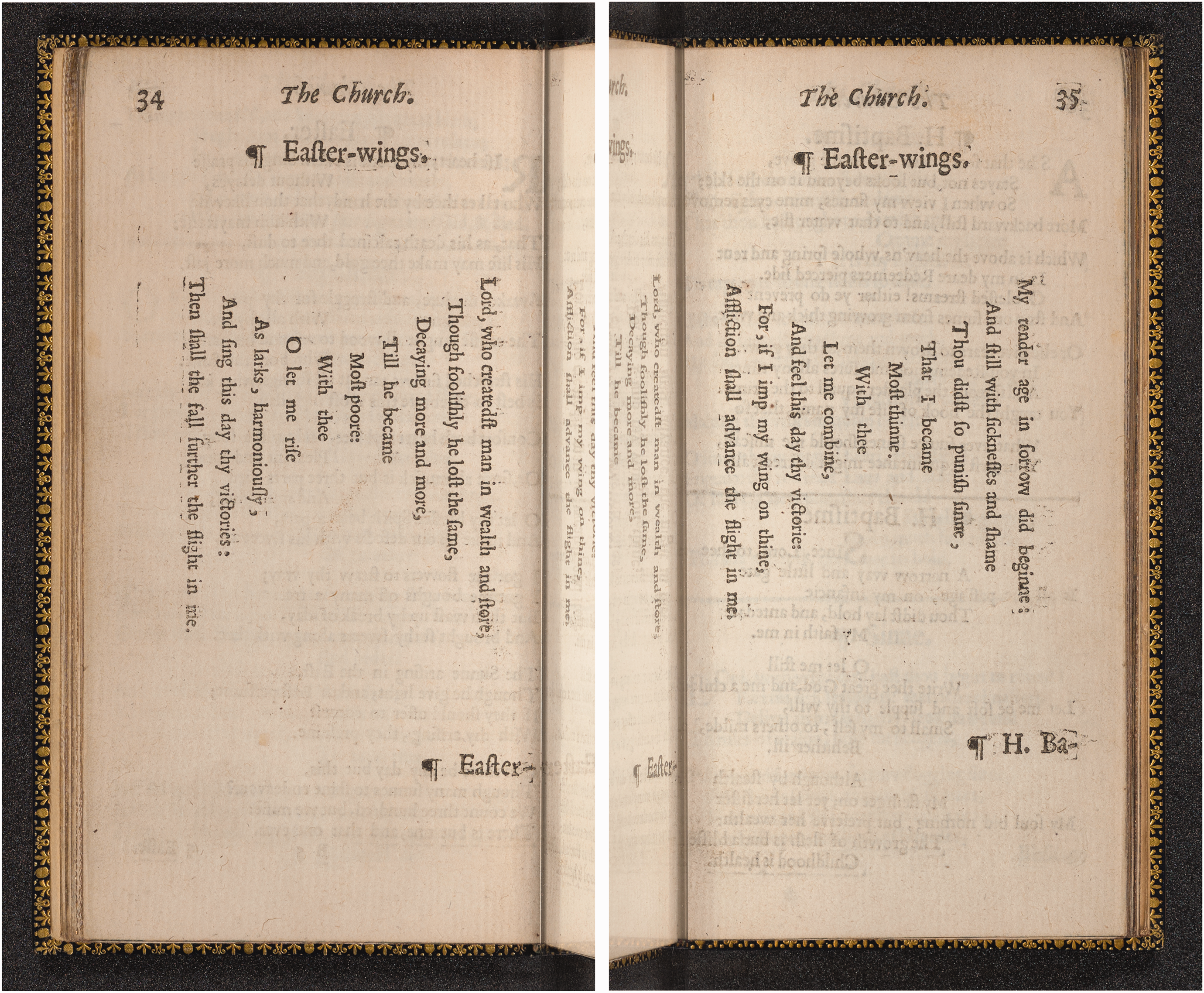
“Easter-wings” by George Herbert from The temple. Sacred poems and private ejaculations. By Mr. George Herbert, late oratour of the Universitie of Cambridge, p. 34v and 35, 1633 (courtesy Wrenn Library Collection of the Harry Ransom Center, Austin, TX)

“Easter-wings” from MS. Jones B-62 27v–28r (courtesy Dr. Williams Library, London)

“Easter-wings” from MS. Tanner 307 27v and 28r (courtesy the Bodleian Library, Oxford)
Scholars have suggested that the Williams manuscript (Figure 2, with corrections) should be considered a work in progress from the early 1610s into the 1620s. Amy Charles’s The Williams Manuscript of George Herbert’s Poems establishes that it was written by a secretary, and the corrections were done in Herbert’s own handwriting. This is important because the shape of it was, by virtue of Herbert’s own handwriting, accepted by him in some way: if Herbert wrote corrections on this page, he acknowledged the shape without amending it. The more neat and lovely hand of the Bodleian manuscript (Figure 3) was done by Little Gidding calligraphers shortly after Herbert’s death in 1633 under the direction of Herbert’s close friend, Nicholas Ferrar (Cesare xix, xxii). In each manuscript version, the intended shape is neither left-justified (as in most of Herbert’s other poems) nor centered.
C.C. Brown and W.P. Ingoldsby notice some extraordinary aspects of the poem having to do with the shape and whence Herbert may have borrowed it. Specifically, they keenly identify some literary allusions, including one to a Greek poet, Simmias of Rhodes. Simmias had written long before Herbert (prior to 300 B.C.) a shape poem that looks remarkably like the first print version of “Easter-wings.” This image is from a book, Theocriti Aliorvmqve Poetarvm Ilyllia, to which Herbert may have had access, published in 1569 (Figure 4). Comparing the visual aspects of this poem and the first print version of “Easter-wings,” we see a clear visual connection between both “wings” poems. Brown and Ingoldsby state that “Herbert would almost certainly have been aware” (462) of this poem, as it had been printed and reprinted in several Renaissance anthologies. And Herbert was practiced in both Latin and Greek. Simmias had written an altar-shaped poem as well—longer, but visually similar to Herbert’s “Altar” along with a number of other pattern poems.

“Wings” by Simmias of Rhodes from Theocriti aliorvmqve poetarvm Idyllia: Eiusdem Epigrammata. Simmiae Rhodii Ouum, Alae, 1569 (courtesy Duke University Library, Duke, NC)
Beyond the visual similarity to Herbert’s poem (the poem contracts with each line until it expands out again in equal measure), Simmias’s “Wings” is a song of praise to a winged god of love, albeit a pagan one. This prose translation of the poem features Cupid as Creator: Behold the ruler of the deep-bosomed Earth, the turner upside-down of the Son of Acmon, and have no fear that so little a person should have so plentiful a crop of beard to his chin. For I was born when Necessity bare rule, and all creatures, moved they in Air or in Chaos, were kept though her dismal governance far apart. Swift-flying son of Cypris and war-lord Ares—I am not that at all; for by no force came I into rule, but by gentle-willed persuasion, and yet all alike, Earth, deep Sea, and brazen Heaven, bowed to my behest, and I took to myself their old sceptre and made me a judge among gods. (Edmonds 493)
Brown and Ingoldsby point out a remarkable difference in that Simmias’s poem has six-line wings and Herbert’s wings are made of five lines, the longest of which has ten syllables. Formally, they show, this architecture aligns with the winged cherubim (rather than pagan Cherub) described in 1 Kings 6:23–27: five cubits in length of wing, ten cubits in all (466). Inside Solomon’s sanctuary two winged gold-plated olive-wood cherubim stood, and this image parallels Herbert’s poetic architecture made up of two sets of wings rather than Simmias’s one set. For Herbert, there may be two reasons to give support to this shape. First, these two cherubim surrounded the presence of God held by the ark. Second, as we know from the Gospel accounts of the empty tomb, two angels were present at the empty sepulcher of the risen Christ. In the Gospels, we have an interesting paradox: the absence of the body at the tomb indicates the presence of God’s power through resurrection. Thus, Herbert’s poem’s strict numerical pattern and shape shows both Hebrew and Greek influence in regards to angelic beings. Random Cloud, in a 111-page article on “Easter-wings,” argues that there are two “Easter-wings” poems rather than one poem made of two stanzas. After all, the title appears on both pages of early printings and the first manuscripts. The other poems in the manuscripts do not have the title printed where the poems continue on the following pages. This supports the idea that there are two independent winged creatures being represented by these shapes (84, 85).
Herbert’s poetic play extends beyond the formal or shapely and into the semantic. An odd phrase in this last stanza might need illuminating: “if I imp my wing on thine.” The word imp comes from the idiom of falconry. To imp means to graft new feathers (from another bird) onto the wing of a trained falcon or hawk in order to repair damage and/or increase flying capacity. In the context of this poem, how can we make sense of this metaphor? Is God like a raptor? Can God be damaged or wounded? In the example of Christ, the answer is a resounding yes. We know the metaphor of an eagle is used to show God’s mastery of the heavens several times in the scriptures. Deuteronomy 32:11–12 declares of God’s people: “As an eagle stirs up its nest,/Hovers over its young,/Spreading out its wings, taking them up,/Carrying them on its wings, So the Lord alone led him/and there was no foreign god with him.” And Exodus 19:4 states, “You have seen what I did to the Egyptians, and how I bore you on eagle’s wings and brought you to myself.” And just as the Hebrew scriptures provide for Herbert’s raptor imagery, the New Testament gospels and letters offer precedents for the notion of grafting. John 15:5 Jesus claims, “I am the vine, and you are the branches.” Paul declares in Romans 11:17 that Gentiles can be grafted into the main branch to partake of the covenant that had been promised to the Jews. This picture of grafting is a metaphor for salvation and new life that demands a connection to a source of life.
It is not in its overt moments of scriptural allusion alone that Herbert’s poem suggests a connection between Christ and wings. The very shape of the poem in its original layout encodes a profound theological argument into the shape of wings. The hourglass shape of the Simmias poem is most commonly how we see Herbert’s poem re-presented (just perform a Google search for an Easter-wings image, and you can see that the poem is nearly always centered). But if one revisits the manuscript versions, one can see that this layout may not have been Herbert’s original intent. While the shape of an hourglass does prove meaningful by imagistically presenting issues of time and death, and while it does seem that Herbert knew Simmias’s shape poem as well as the shape of it, the first printed shape of “Easter-wings” is perhaps merely the wish of the printer to have it so. The manuscript versions suggest a formal organization that is more justified to the right edge of the page, especially the Williams manuscript version of “Easter-wings.” Why not perfectly right-justified? One only need imagine oneself as an amanuensis trying to recopy Herbert’s poem. In English writing, we compose left to right. If we are trying to end on the right side of the page, where do we begin on the left? It may not be possible, without some distortion of the size of the hand, to make it line up exactly on the right. These vicissitudes of handwriting might explain the slight curvature of the shape to be only a minor accident. The right side of the second stanza of the Williams manuscript is hardly curved at all and nearly perfectly right justified.
If Herbert’s poem were printed typographically as we have in the manuscripts, right-justified and turned sideways, it would still display two wings draped downwards, but the flatness of the right margin would make the shape less convincing as a natural form. However, consider the empty space created on the left side of the page by the absence of ink. If printed this way, this unspoiled whiteness of the paper (the absence of the text) might be seen as a wing rounded and extending, tapering from left to right.
Now let us imagine what this inverse view might mean, symbolically. Christians serve an invisible God yet have faith in His presence, though it cannot be seen. Hebrews 11 tells us that “faith is the substance of things hoped for, the evidence of things not seen.” We have on this page, in the shape left by the absence of the words, a kind of evidence of things not seen. I can imagine the humble poet thinking that if he imps his wing (representative of his own limited lark-song) upon God’s invisibility, then God is glorified. God’s absence is only a human inability to see Him. In his weakness, the poet is made strong. After Christ has departed the earth, Paul instructs his readers to imagine themselves as the body of Christ (1 Corinthians 12). Herbert’s poem partakes in a higher and more powerful artistic calling by unifying with God in this sharing of feathers/wings and word/Word. Also, we have as a proof of the risen Christ an absence: the empty tomb. One can look at the manuscript versions of the poem and see the white space acting as that stone rolled away here for us to witness a holy emptiness. Most poore. Most thinne. Yet, With Thee. “With Thee” is the only line repeated exactly in both stanzas, emphasizing its urgency. It is visually the hinge on which the poem turns, twice. Our mortal life in a fallen world can only be rectified and restored “With Thee.” Finally, the falcon is never mentioned directly. He is technically absent, only present through the words “imp my wing on Thine.” This metaphorical raptor is present only through the verb “imp.” This varying absence and presence of the feather, or wing, is essential to our understanding of the poem’s shape.
Considering the various shapes in which “Easter-wings” has been presented, especially early on, it seems no less than astonishing that one of the most famous shape-poems in English is most often read in a form that Herbert may not have intended. One thing is clear: the centered, first print version looks much more like the Simmias “Wings” poem and much less like the handwritten versions of “Easter-wings” which push the poem to the right of the page.
The Little Gidding workers produced versions of Scripture called Biblical Harmonies, which combined numerous printed versions of biblical writings into altered works of text/art. Various Scriptures and images from multiple texts were cut up, glued, and laid side-by-side on pages to produce works that displayed comparisons/compositions of verses and images alongside and blended with each other. One of these versions was given to Herbert around 1631, and Herbert had a “high prizeing of it & thank full acknowledgmt for it” (Smyth 463). If these printers were willing to deconstruct and reconstruct a Bible to create new versions, it is possible they felt an artistic permission to reconstruct the shape of Herbert’s “Easter-wings.” to finally center it rather than leave it right-justified.
The right-justified version of the printed poem (closest to how the manuscripts look—with the empty spaces of two white wings) would appear something like this:

With this presentation, the two big emptinesses cutting from the left side into the stanzas are now a bit more startling and meaningful. As I argued earlier, the paradox of absence as presence is now much more emphasized, and the invisible is made visible via the greater area of negative space.
Joan Bennett has written about the effect of the rise and fall and subsequent rise/resurrection in the lark’s song and flight, imitated imagistically by Herbert’s form, though she does perceive him as a minor poet: “despite his aristocratic birth and breeding and his considerable learning, leaves the impression of an unsophisticated mind” (63). She sees his play with shape and anagrams as childish in comparison to Donne, not seeming to fathom how Herbert correlates his formal decisions with his content in such complex ways. In another poem of Herbert’s, “Church-musick,” a praise song is illustrated once again by using bird imagery as a vehicle through which one can be lost metaphysically in the greater glory of heavenly power: “Now I in you without a bodie move, / Rising and falling with your wings” (5–6). But in “Easter-wings,” note that Herbert never mentions the falcon directly. He is technically absent, only present through the words “imp my wing on Thine.” This metaphorical raptor is present only through the verb “imp.” This varying absence and presence of the feather, or wing, is essential to our understanding of the poem’s shape.
But there is more to the bird imagery. If Herbert (or any poet-singer) is a “lark” (line 8), and we are to take a wing from that lark (first stanza) and graft it into the wing of the raptor (second stanza), then it seems that the diminutive lark can partake of a greater glory—not only to sing a song of praise, but to experience God’s greater power of mastering the air. Rather than focus on the natural ability of the raptor to overtake the lark and consume it, Herbert lets the lark partake, via the grafting, of the raptor’s greater power of flight. “If I imp my wing on thine” is the sacrifice required. For the Christian, to lose one’s life is to find it. In “Easter-wings,” Herbert has made clear to us in several ways that “To live is Christ, and to die is gain” (Philippians 1:21). To say finally, “Affliction shall advance the flight in me” points to the supreme suffering on the cross. If we are spiritually grafted into that place of his wound (we too are cut—scion, is where the word “son” comes from), into a proven immortal body, then we can be a part of the body of that powerful falcon (the one who has the power over the life of the other). Even as “sons” born into this world of sorrow, we are in need of being grafted into something greater to achieve our greatest potential. Note, as well, that the falcon is wounded if it requires “imp”-ing. The metaphor of the falcon in “Easter-wings” is even more meaningful when we recognize how a centurion’s spear left a gaping wound in Christ’s side, confirming his death. The disciple Thomas thrusting his hand into Jesus’ side post-resurrection can be seen as a metaphorical example of grafting. His own doubt (his absence of faith) is allowed and encouraged to touch that famous wound.
Christians believe we each have our own sufferings, failures, and limitations where we can connect to the experience of God’s suffering through the person of Jesus. The French theologian Simone Weil writes eloquently about this: “Men struck down by affliction are at the foot of the Cross, almost at the greatest possible distance from God” (83). To Weil, this affliction is of the greatest value. “In this marvelous dimension, the soul, without leaving the place and the instant where the body to which it is united is situated, can cross the totality of space and time and come into the very presence of God. It is at the intersection of creation and its Creator. This point of intersection is the point of intersection of the arms of the Cross” (94). George Herbert’s own five-part poem (or five poems), entitled “Affliction (I–V),” shows a mind and heart constantly torn due to the multiplicity of failures inherent in the mortal and inconstant speaker. Just as the shape of “Easter-wings” diminishes and expands again, so do Herbert’s hopes violently swing between joy and despair in these beautiful lines. One example of the extreme conflict of heart and mind Herbert feels is portrayed in the final rhyming couplet of “Affliction I”: “Ah my deare God! though I am clean forgot,/Let me not love thee, if I love thee not” (65–66). As he admits his failures and seeks God’s restoration, Herbert seems to realize that the limitations of human love can only be answered by an immortal love that once partook of this grief.
“Easter-wings” likewise suggests to us that instead of being merely singers, or even devoured prey, we can become glorious. We can allow ourselves to be pruned and grafted into a greater, eternal life, already risen. “With thee,” as George Herbert puts it, is perhaps our only hope for a meaningful answer to our serious dilemma of mortality and a way for the afflicted to abide in the Almighty God.
Footnotes
Declaration of conflicting interests
The author(s) declared no potential conflicts of interest with respect to the research, authorship, and/or publication of this article.
Funding
The author(s) received no financial support for the research, authorship, and/or publication of this article.