



Abstract
This paper considers how a manager decides to disclose or withhold segment information in a capital market setting. In particular, we develop a multi-period model in which a manager in each period decides how to allocate her effort between two businesses. The profit earned in each segment is determined by the manager’s effort and ability as well as each segment’s market profitability and inherent uncertainty. In this setting, in contrast to the expectation of segment disclosure being withheld due to conflicts of interest between managers and shareholders, we identify the conditions under which the manager rationally withholds segment information and achieves higher social welfare. In a setting where the manager is concerned about the current stock price, disclosing more disaggregated information to the stock market does not necessarily lead to more efficient monitoring. The capital market values various segment earnings differently, and in response to this valuation, a rational manager may greatly alter her behavior, leading to inefficient outcomes.
Introduction
This paper investigates the consequences of aggregate and segment reporting in a capital market setting. In particular, we identify the conditions under which managers rationally withhold segment information and achieve higher social welfare. These results are contrary to the stylized conception that segment disclosure is withheld as a result of conflicts of interest between managers and shareholders because withholding disaggregated information weakens market monitoring and thus enables managers to pursue their own objectives, which may not necessarily be in the best interests of shareholders (Bens et al., 2011; Berger & Hann, 2007; Hope & Thomas, 2008; Wang et al., 2011).
According to the Statement of Financial Accounting Standards No. 131 (SFAS 131), issued in 1997, disclosures about the segments of an enterprise are intended “to help users of financial statements: (a) better understand the enterprise’s performance, (b) better assess its prospects for future net cash flows, [and] (c) make more informed judgments about the enterprise as a whole” (Financial Accounting Standards Board, 1997). Despite the existence of a mandatory standard, however, there remain ample opportunities to exercise managerial discretion, such as regarding the identification of reportable segments. 1 A number of empirical studies use this segment reporting setting as a way of investigating managers’ motives to engage in discretionary disclosure (Bens et al., 2011; Berger & Hann, 2007; Botosan & Stanford, 2005; Ettredge et al., 2006; Harris, 1998; Hope et al., 2006, 2013; Hope & Thomas, 2008; Wang et al., 2011).
In this literature, one of the most cited hypotheses is that centered on agency costs (Bens et al., 2011; Berger & Hann, 2007; Hope & Thomas, 2008; Wang et al., 2011). 2 According to this hypothesis, segment disclosure is withheld as a result of conflicts of interest between managers and shareholders. For example, Berger and Hann (2007) argue that managers may exercise their discretion to conceal negative information about certain segments. Wang et al. (2011) posit that managers who take advantage of greater agency costs to engage in empire-building are more reluctant to reveal segment-level differences in growth. This hypothesis is based on the logic that enhanced disclosure mitigates the agency problem through greater outside monitoring.
However, stock market monitoring suffers from some limitations. For example, in a setting in which the manager is concerned about the current stock price, Stein (1989) shows that managers behave myopically to achieve higher stock prices at the expense of shareholders. Moreover, Stein (1989) shows that the more managers are concerned about stock prices, the worse the problem becomes. This finding suggests that disclosing information with a higher level of disaggregation to the stock market does not necessarily lead to more efficient monitoring. In fact, capital markets generally value various segments’ earnings differently (Bodnar et al., 1997, 2003; Chen & Zhang, 2003; Hope et al., 2006, 2008, 2009). In response to this capital market valuation, a rational manager may excessively alter her behavior, leading to inefficient outcomes.
In this paper, we seek to more precisely understand this underlying mechanism. We develop a multi-period model in which a firm manager decides in each period how to allocate her effort between two businesses (i.e., segments of the firm) by considering the firm’s stock price based on public information. The profit earned in each segment is determined by the manager’s effort and ability as well as each segment’s market profitability and inherent uncertainty. We assume that there is uncertainty, but no asymmetric information, about managers ability.
We show that managers rationally withhold segment information and achieve higher social welfare if (a) the segments have similar market profitability or (b) the segment with the more profitable market has a relatively high market uncertainty compared to the other segment. In particular, if the two markets have similar profitability levels, the stock prices under aggregated and segment disclosure cases are nearly identical. However, effort levels differ between the two cases, because under the segment disclosure case, the manager is more sensitive to the market’s reaction. Effort levels in the two segments are thus more volatile than those under the aggregated disclosure case, which is undesirable to minimize the total effort cost. Therefore, if the two segments have similar levels of market profitability, the manager withholds segment earnings information and achieve higher social welfare. Alternatively, if the market uncertainty in the more profitable market is higher under the segment disclosure case, the manager prefers to withhold segment earnings information and thus achieve higher social welfare. This arises because the capital market focuses on the market with greater information precision even if that market is less profitable, and in response, the manager allocates her effort inefficiently under the segment disclosure case.
We focus on equilibria in the stationary case when we examine a manager’s disclosure choice. However, our multi-period model can illustrate the dynamics before a stationary state is reached. In the numerical example, we assume that one market is mature and the other is growing. In other words, although one market is initially more profitable than the other, the less profitable market gradually catches up with the other market in profitability and eventually overtakes it. In this setting, we compare effort level and social welfare over time among the benchmark, aggregated, and segment disclosure cases.
We contribute to the disclosure theory literature by identifying the conditions under which managers withhold segment information and improve social welfare. This means that Blackwell’s theorem (Blackwell, 1953) does not hold in our setting as it states that in a standard single-person decision context, disaggregated information is superior to aggregate information. In our setting, the market price is constrained to be set as the break-even value; the capital market cannot mimic the pricing rule under the disaggregated disclosure case with an equivalent pricing rule under the aggregated disclosure case. This is why disaggregated information is not always superior to aggregate information. Some prior studies show that managers have incentives to withhold segment information, such as Einhorn (2005) and Ebert et al. (2017), but they do not consider the implications from the viewpoint of social welfare.
Our model also relates to other several studies. First, the literature on managerial short-termism emphasizes the inefficiencies that arise when managers are concerned about current stock prices instead of long-term value (Aghion & Stein, 2008; Bolton et al., 2006; Narayanan, 1985; Stein, 1989). The papers most closely related to our model are Holmström, (1982, 1999) Stein (1989), and Aghion and Stein (2008). In a seminal paper, Holmström (1982, 1999) provides a tractable model of career concerns. Stein (1989) extends this setting to one in which the manager is interested in both long-run earnings and the current stock price. We extend Stein (1989)’s work by considering the multi-segment and multi-task context. In addition, Stein (1989) considers how managers inflate short-term earnings at the expense of long-term earnings. This myopic behavior is denoted as real earnings management in the recent accounting literature. We do not consider earnings management but instead focus on the manager’s incentives regarding segment disclosure. Aghion and Stein (2008) also consider a multi-task situation in which the manager devotes effort to either increasing sales growth or improving per-unit profit margins. However, they consider a situation in which signals of both sales growth and profit margins are observed in the capital market, implying that they do not consider aggregate earnings disclosure. 3
Second, our paper also relates to aggregation versus disaggregation issues in accounting (Arya et al., 2004; Arya & Mittendorf, 2011; Autrey et al., 2010; Demski & Frimor, 1999). Among these studies, Autrey et al. (2010) and Arya and Mittendorf (2011) are based on the career concerns model. Autrey et al. (2010) consider the interaction between the implicit incentives arising from career concerns and explicit contracts by using aggregated performance measures. The use of aggregated performance measures generally distorts the effort allocation among tasks, but the authors show that in such a setting career incentives combined with disaggregated disclosure can mitigate aggregation costs. A more closely related paper is Arya and Mittendorf (2011), which considers career incentives in the absence of explicit contracts and compares aggregate and disaggregate cases with a focus on the conditions under which aggregation can be beneficial. In contrast to these studies, we focus on the interactions between the manager’s effort allocation and the stock price in the capital market. This enables us to identify direct empirical implications for the disclosure choice of segment earnings information.
The remainder of this paper proceeds as follows. Section 2 describes the basic setting of our model. Section 3 provides a benchmark case as a basis for comparison and then analyzes aggregated and segment disclosure cases. Section 4 compares effort levels and stock prices across these cases and examines the conditions under which the manager chooses to withhold segment earnings information. In Section 5, we provide a numerical example before a stationary state is reached. Section 6 concludes. All proofs appear in the appendix.
The Model
There are two risk-neutral players—a firm manager and a capital market. The firm runs a business composed of two segments that are jointly managed by a manager. The manager allocates her effort level to overseeing the two businesses. We consider an infinite horizon model. First, the manager chooses and follows a policy on disclosing segment earnings information—the manager can disclose either aggregate earnings or those for each segment. We refer to these options as aggregated and segment disclosure cases, respectively. In each period t, the manager is endowed with a certain amount of time and decides how to allocate her time for the effort
The firm’s earnings in period t are the sum of earnings in markets s and m, as follows:

Both earnings depend on managerial ability as well as the manager’s allocation of effort, that is:


where
We assume that the manager’s ability is initially unknown to both the manager herself and the market. There is no information asymmetry between the manager and the market with respect to the manager’s ability in our model. Her ability is inferred at the end of period t based on the firm’s reported earnings. According to Autrey et al. (2010), the manager’s ability can be interpreted as her “gift” for performing that job. In our model, a new manager has no understanding of her own fit for the business segments. Managerial ability in period t depends on that in the previous period and a disturbance term:

where
The capital market sets the stock price depending on the firm’s disclosure policy for segment earnings. We assume that the capital market cannot directly observe the manager’s effort level. Under the aggregated disclosure case, the manager discloses aggregate earnings,
The firm immediately pays out all earnings in the form of a dividend, which is assumed to entail no taxes or other dissipative costs. After the dividend payout, the market price of the firm’s stock at the end of period t is thus given by

where
The manager is concerned about not only current-period earnings but also the current stock price. The manager’s stock price preference is modeled simply by adding it to her utility. This term can be interpreted as her preference for the stock price. The manager allocates her effort,

where
The timing of events is as follows. At the outset, the manager commits to a disclosure policy on segment earnings information. In particular, she chooses to disclose either aggregate earnings or each segment’s earnings. In each period t, the manager chooses her effort levels,
Analysis
Benchmark Case
First, we define the benchmark in our model. The natural benchmark is the case in which the manager maximizes social welfare that is defined as the value created by the manager minus the (psychological) cost of providing them. Therefore, the social welfare at period t,

This benchmark corresponds to the case that the manager receives all dividends (

where

Equation (8) states that the effort levels under the benchmark case depend on the difference in market profitability between the two segments and the costs of exerting effort. If the cost parameter in one market increases, the manager decreases her level of effort in that market. The level of effort exerted in one market is related to that in the other market because we assume that the manager faces a trade-off between the efforts in both segments. We also calculate social welfare at period t under the benchmark case. By substituting equation (8) into (7), we derive

According to equation (9), the first term corresponds to total earnings based on the expected value of the manager’s ability, the second and third terms represent total earnings based on the manager’s effort, and the fourth term is the effort cost. Total earnings based on the manager’s effort can be decomposed into two terms. The second term is related to the difference in market profitability and the third term is not.
Equilibrium Under the Aggregated Disclosure Case
In this section, we examine the aggregated disclosure case, in which the manager only discloses aggregate earnings,

In equation (10), we define the terms

In addition, the conditional variance of the manager’s ability at period

The interpretation of equation (10) is as follows. The weight
We next explain the manager’s problem. In each period, the manager chooses
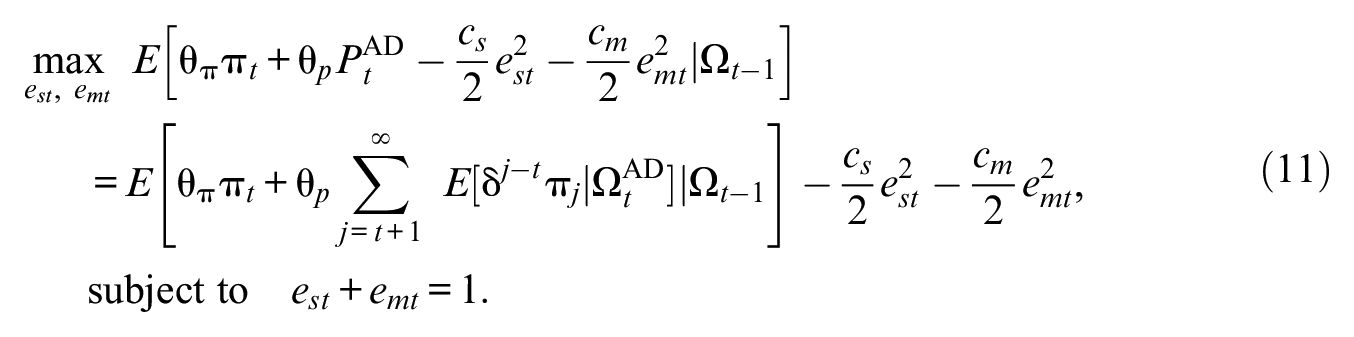
Solving this problem yields the equilibrium effort levels and stock price, as summarized in the following proposition.11,12
Proposition 1
Under the aggregated disclosure case, the equilibrium effort levels and stock price are


where
Equations (12)–(14) represent the optimal effort levels in markets s and m and the stock price in period t under the aggregated disclosure case, respectively. In these equations,
Equilibrium Under the Segment Disclosure Case
Next, we examine the case in which the manager discloses both segments’ earnings,

In equation (15), we define the terms

The interpretation of equation (15) is as follows. The weight
At period t, the manager chooses
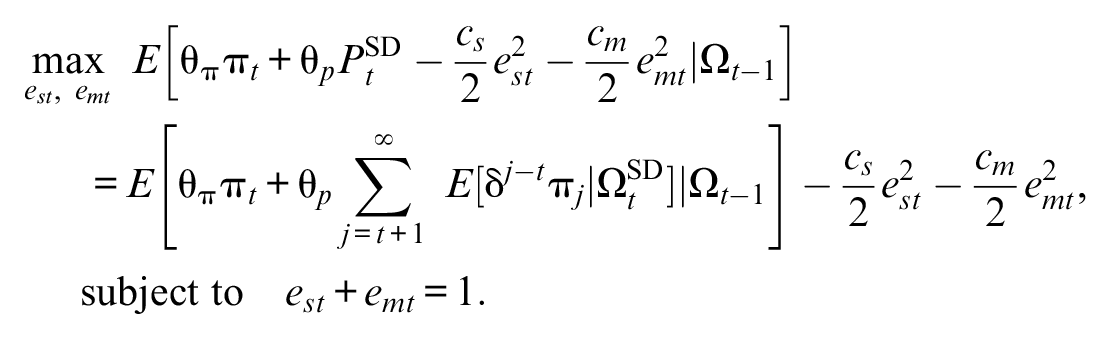
The equilibrium effort levels and stock price under the segment disclosure case are summarized in the following proposition. 13
Proposition 2
Under the segment disclosure case, the equilibrium effort levels and stock price are



where
Equations (16)–(18) represent the optimal effort levels in period t in markets s and m and the stock price under the segment disclosure case, respectively. Similar to the aggregated disclosure case,
Comparison Between Aggregated and Segment Disclosure Cases
In this section, we compare the equilibrium results for effort levels, stock prices, and the manager’s expected utility between aggregated and segment disclosure cases. We have derived propositions in terms of the equilibrium levels of effort and stock prices in period t. Although it is easy to compare effort levels in period t between aggregated and segment disclosure cases, comparisons of the stock price and expected utility regarding disclosure choice are less clear-cut, since they depend not only on current earnings, but also on all future sequences of market profitability and total effort incentive.
The point, however, is that we specify the conditions that withholding segment earnings dominates disclosing them in a variety of circumstances. To make our comparisons more manageable, we assume that the market profitability is time-invariant, that is,



where
Note that we evaluate stock prices at the beginning of the first period for expositional purposes. In this case,
Comparisons of Effort Levels and Stock Prices
By comparing effort levels between aggregated and segment disclosure cases, as shown in equations (19), we derive the following proposition.
Proposition 3
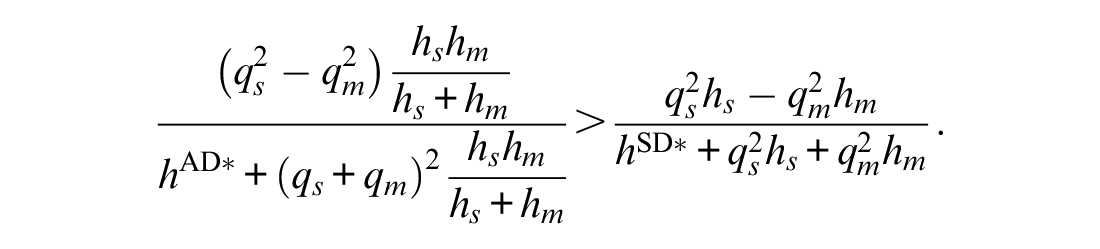
The intuition behind Proposition 3 is as follows. Part (a) states that the difference in effort levels between aggregated and segment disclosure cases depends on market profitability, the precision of shocks, and the precision of manager’s ability. Part (b) shows that when both markets have the same profitability, the difference in effort depends only on the difference in the precision of shocks. In this case, the effort level under the aggregated disclosure case corresponds to that under the benchmark case because there is no incentive for the manager to differentiate her effort level across the two markets. In other words, the manager cannot inform the market of her ability by engaging more actively in one market than in the other. On the contrary, under the segment disclosure case, even when the markets have the same profitability, the manager exerts more effort in one market. In this case, the manager tries to inflate her ability by increasing her effort in the market with lower market uncertainties. She does so because the capital market observes more information about her ability from more informative segment earnings. Part (c) states that when the conditional precision is lower in the more profitable market, the manager’s effort level in more profitable market under the aggregated disclosure case is higher than that under the segment disclosure case. This comes from the similar reason in part (b). That is, the manager faces a trade-off between maximizing earnings and informing her ability under the segment disclosure case, which leads to exert a lower effort in more profitable market.
We next investigate the difference in stock prices between aggregated and segment disclosure cases. Taking the difference in the expected stock price between aggregated and segment disclosure cases, we derive the following proposition.
Proposition 4

Part (a) of Proposition 4 shows that when the markets have different levels of profitability, the necessary and sufficient condition on the difference in stock prices between aggregated and segment disclosure cases is slightly different from that on the effort levels as shown in part (a) of Proposition 3. This is because the stock price depends on segment earnings, which are determined by both the effort level and market profitability. Thus, the condition depends on the relative market profitability in addition to the effort levels. Part (b) states that when the markets have the same profitability, the stock price is also the same. As shown in part (b) of Proposition 3, effort levels differ between aggregated and segment disclosure cases even for the same market profitability. However, when market profitability is the same, total earnings and stock price are independent of effort allocation. Thus, in this case, there is no difference in stock price between aggregated and segment disclosure cases. Part (c) indicates one sufficient condition that the stock price is greater under the aggregated disclosure case than under the segment disclosure case when market profitability differs. In this case, the manager concentrates on the business which is more profitable and less uncertain under the segment disclosure case. Therefore, the manager may allocate her effort more to the segment with low uncertainty even if that segment is less profitable when the condition specified in Part (c) is satisfied.
The Manager’s Disclosure Choice
Finally, we examine whether the manager chooses a voluntary disclosure of segment earnings by comparing the manager’s utility level at equilibrium. By comparing the manager’s expected utility in the stationary state, we obtain the following proposition.
Proposition 5

where
The intuition behind this proposition is as follows. If the manager discloses segment information, the market reacts to each segment’s earnings differently. This motivates the manager to concentrate more on the segment with more profitable and less uncertain, which raises the firm’s stock price. This concentration, however, implies a difference in effort levels across the two segments, which is undesirable for a manager who seeks to set her effort levels equal to the relative costs of exerting effort to minimize the total effort cost. She thus faces a trade-off between stock price maximization and effort cost minimization. By considering this trade-off, the manager withholds segment earnings when the necessary and sufficient condition of part (a) of Proposition 5 is satisfied. This condition indicates that when
This result is consistent with real-world businesses. After segment reporting is adopted as a management approach, the number of firms disclosing regional segment information decreases, whereas the number disclosing business segment information increases. According to our results, the characteristics of firms that withhold regional segment earnings are as follows. First, market profitability does not vary widely across the regions in which firms have businesses. In other words, they operate both businesses in similar economic contexts. Second, although market profitability is different in the two regions, the market uncertainty is relatively high in the region with a more profitable market. The second case is generally applicable to firms in developed countries, which expand their businesses overseas into high-profitability markets (e.g., emerging economies). However, the capital market finds it difficult to anticipate the manager’s ability based on foreign earnings because the market uncertainty of segment information in the foreign country is much higher than that in the home country. By considering the market’s reaction, the manager inefficiently allocates her effort level between segments under the segment disclosure case. As a result, the rational manager withholds her regional segment information.
Comparison With the Disclosure Policy for Maximizing Social Welfare
The utility-maximizing disclosure policy for the manager does not always maximize social welfare. We thus investigate the conditions under which a given disclosure policy maximizes social welfare. By comparing social welfare under aggregated and segment disclosure cases, we derive the following proposition.
Proposition 6

Part (a) in Proposition 6 represents the joint conditions of the manager’s expected utility maximization (Part (a) in Proposition 5) and social welfare maximization. When
Although the sufficient conditions for Propositions 5 and 6 (conditions of Part (b) and (c), respectively) are identical, there is a slight difference between the necessary and sufficient conditions. Since social welfare does not include the stock price, the benchmark effort levels purely maximize net earnings (i.e., total earnings minus effort costs). The benchmark effort levels, thus, are not distorted by any consideration of the capital market reaction. On the other hand, when the manager cares about the stock price, the effort levels are distorted compared to those in the benchmark case. Specifically, the effort levels react less to differences in market profitability, because the manager considers the market uncertainty which is an important factor when the manager shows her ability to the capital market.
According to our results, the manager can also withhold segment earnings information when there are no conflicts of interest between managers and shareholders. When the manager withholds segment earnings information, the capital market sets the stock price based on the precision of aggregate earnings information and the covariance between aggregate earnings and the manager’s ability. On the contrary, when the manager discloses segment earnings information, the capital market can more accurately predict her ability based on segment earnings. In this case, the capital market sets a higher price on segment earnings in a high-profit and low-uncertainty (high precision) market. Thus, even if the profitability of one market is high, the capital market might set a lower stock price if the information available for that market is unreliable. By taking this market conjecture into consideration, the manager exerts more effort in the high-profitability, low-uncertainty market under the segment disclosure case; this sometimes distorts her effort levels, making them inefficient. The sufficient conditions we derived here indicate that managers rationally withhold segment information and achieve higher social welfare if both segments have similar market profitability or if the market uncertainty is relatively high in the more profitable market. These results suggest new implications for the manager’s decision to disclose segment earnings. For example, if the firm’s earnings arise from similarly profitable markets or differently profitable markets with poor information available in the highly profitable market, the manager withholds segment earnings.
Our results partly support SFAS 131, which states that separately reporting segment information does not add significantly to an investor’s understanding of an enterprise if the firm’s operating segments are so similar that they can be expected to have essentially the same future prospects. 15 However, the mandatory disclosure of business segment information might harm social welfare if the growth opportunities differ and the market uncertainty is relatively high in the high-growth market.
Numerical Example
In Section 4, we have focused on the stationary state. However, our model is dynamic and can illustrate changes in the relationships among the variables. In this section, we consider numerical examples of the manager’s effort levels and social welfare before a stationary state is reached.
We assume that one market (market m) is mature and the other (market s) is growing. In other words, although market m is initially more profitable than market s, the profitability of market s gradually catches up with market m and overtakes it. Thus, market s becomes attractive to investors over time. In addition, we assume that market uncertainty is lower for market m than for market s. Specifically, each parameter takes the following value:
Figure 1 illustrates the effort levels over time.
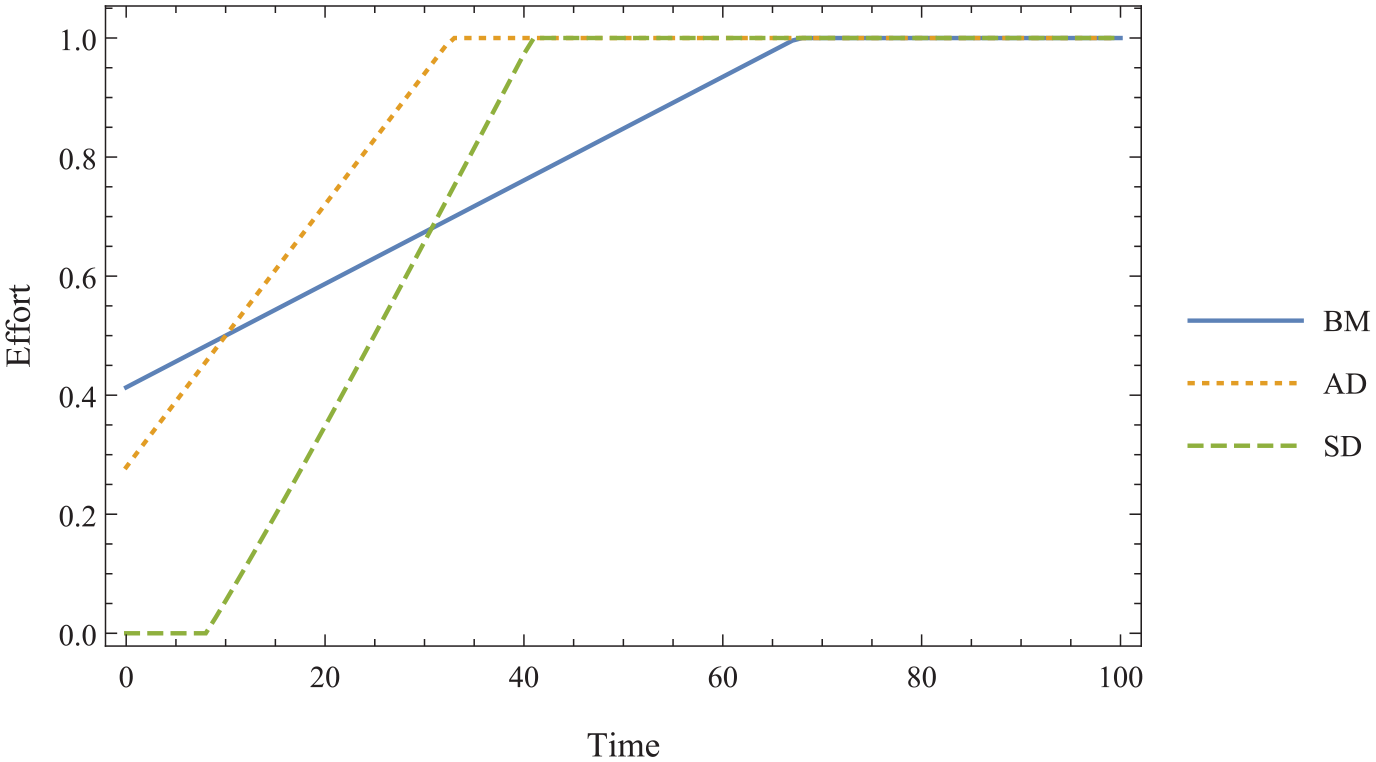
Effort level in market s over time.
Figure 2 depicts social welfare under all cases. Social welfare, as already defined, is the firm’s dividend net of the effort costs. In Figure 2,
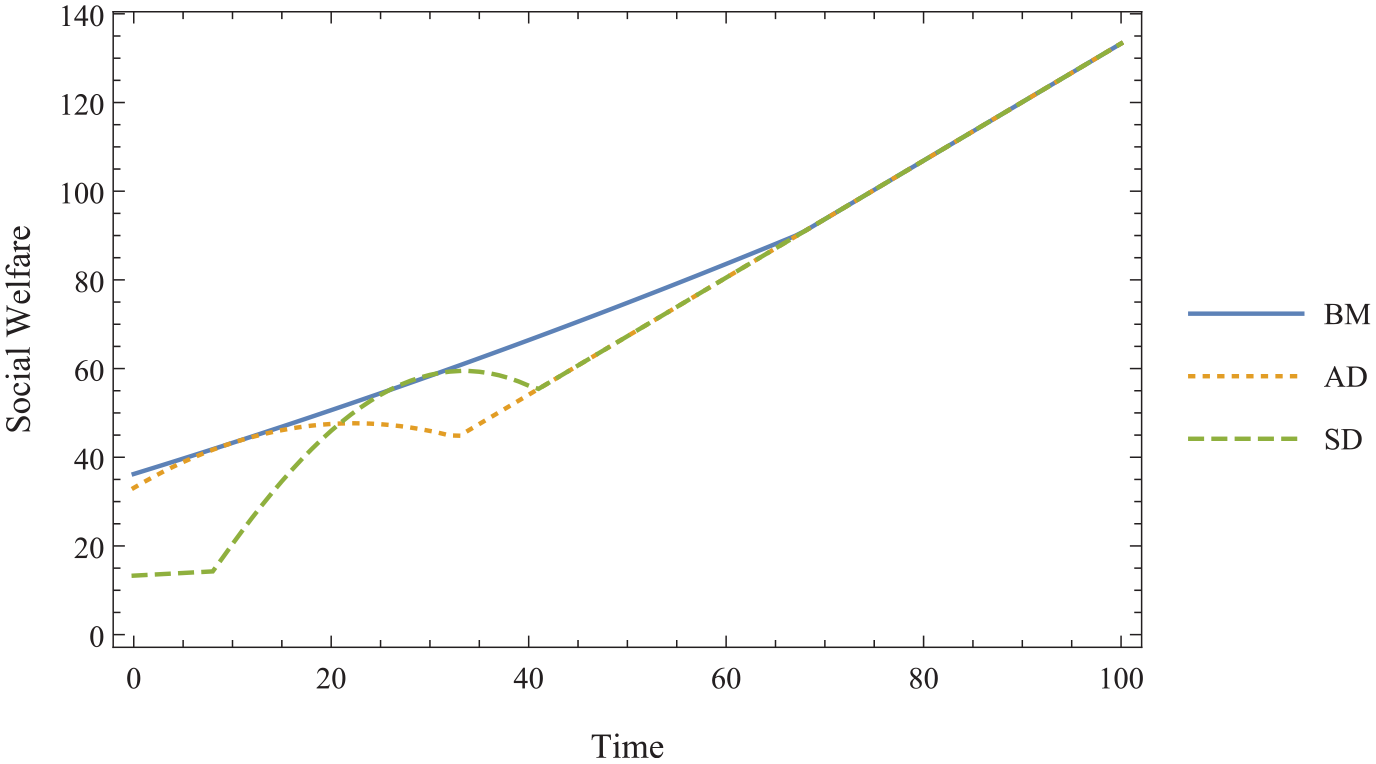
Social welfare over time.
Concluding Remarks
This paper investigated the consequences of aggregate and segment reporting in a capital market setting. In particular, we identified the conditions under which managers rationally withhold segment information and achieve higher social welfare. This is contrary to the stylized conception that segment-specific information is withheld as a result of conflicts of interest between managers and shareholders. We developed a multi-period model in which a manager decides how to allocate her effort between two businesses by considering the stock price, which is based on public information. Each segment’s profit is determined by the manager’s effort and ability as well as each segment’s market profitability and inherent uncertainty of each segment.
Our main results are that managers rationally withhold segment information and achieve higher social welfare if either (a) the segments have similar market profitability or (b) the market uncertainty is relatively high for the segment in the more profitable market. Our results on disclosure choices of segment earnings information provide more precise conditions, which contribute to the refinement of the agency cost hypothesis documented in empirical research.
As is common with analytical models, our model is limited by several assumptions made to increase tractability. First, we assumed that the manager engages in activities in both markets and faces a trade-off between them. This setting could be easily changed to one in which division managers separately exert effort in each segment; the results could then be compared with those of our model. This extension would enable us to consider the manager’s choice of organizational form. A second constraint of our model is that we do not model the contract between the manager and shareholders endogenously. However, we believe that this paper’s results would continue to hold as long as the manager is concerned to some extent about the firm’s current stock price, a condition generally satisfied in reality.
Footnotes
Appendix
A List of Variables
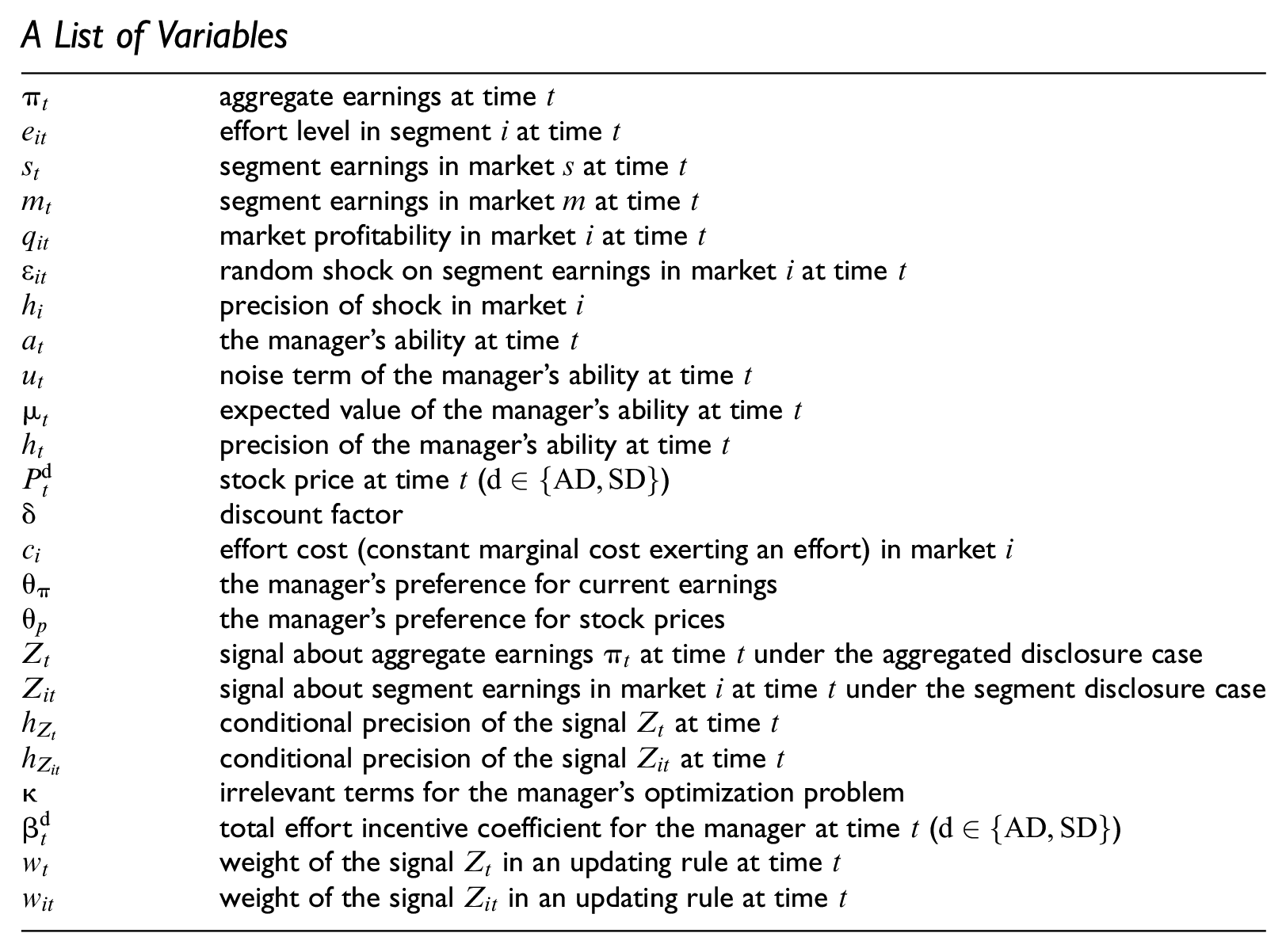
| aggregate earnings at time t | |
| effort level in segment i at time t | |
| segment earnings in market s at time t | |
| segment earnings in market m at time t | |
| market profitability in market i at time t | |
| random shock on segment earnings in market i at time t | |
| precision of shock in market i | |
| the manager’s ability at time t | |
| noise term of the manager’s ability at time t | |
| expected value of the manager’s ability at time t | |
| precision of the manager’s ability at time t | |
| stock price at time t ( ) | |
| discount factor | |
| effort cost (constant marginal cost exerting an effort) in market i | |
| the manager’s preference for current earnings | |
| the manager’s preference for stock prices | |
| signal about aggregate earnings at time t under the aggregated disclosure case | |
| signal about segment earnings in market i at time t under the segment disclosure case | |
| conditional precision of the signal at time t | |
| conditional precision of the signal at time t | |
| irrelevant terms for the manager’s optimization problem | |
| total effort incentive coefficient for the manager at time t ( ) | |
| weight of the signal in an updating rule at time t | |
| weight of the signal in an updating rule at time t |
Acknowledgements
We would like to thank Bharat Sarath (editor) and the anonymous reviewers. We also thank all the participants at 36th European Accounting Association Annual Congress (Paris), Asian Academic Accounting Association 14th Annual Conference (Penang), 25th Asian-Pacific Conference on International Accounting Issues (Bali), and the 2016 American Accounting Association Annual Meeting (New York).
Declaration of Conflicting Interests
The author(s) declared no potential conflicts of interest with respect to the research, authorship, and/or publication of this article.
Funding
The author(s) disclosed receipt of the following financial support for research, authorship, and/or publication for this article: Yutaro Murakami was supported by JSPS KAKENHI Grant Numbers JP21730385, JP23730441, and JP17K04068. Atsushi Shiiba was supported by JSPS KAKENHI Grant Numbers JP24530558, JP15K03769, and JP18H00913.
