



Abstract
Research suggests that employees who perceive interpersonal injustice in their workplace are more likely to engage in workplace deviance. However, researchers have seldom considered the role of personal values in shaping behavioral reactions to perceived injustice. This article investigates the moderating influence of justice-related values on reactions to perceived injustice. Results suggest that employees with strong interpersonal justice values, or justice orientations, are unlikely to engage in workplace deviance, regardless of their interpersonal justice perceptions. Results were consistent across two operationalizations of justice values and consistent across self-reported and coworker-reported workplace deviance.
“Don’t get mad, get even.”
“In taking revenge, a man is but even with his enemy; but in passing it over, he is superior.”
Conventional wisdom highlights conflicting strategies for dealing with injustice. One perspective suggests that injustice ought to be avenged (e.g., an eye for an eye). Alternatively, some would argue that the best response to injustice is to be more virtuous (e.g., turn the other cheek). Within the organizational justice literature, research has largely focused on retaliation as a common response to perceived injustice. For example, several meta-analytic reviews highlight negative relationships between perceptions of justice and workplace deviance (Berry, Ones, & Sackett, 2007; Colquitt, Conlon, Wesson, Porter, & Ng, 2001; Hershcovis et al., 2007). However, perceived injustice does not always lead to deviant behavior, and there is growing interest in understanding the role of individual differences in shaping behavioral reactions to injustice (Bradfield & Aquino, 1999; Karremans & Van Lange, 2005; Okimoto, Wenzel, & Feather, 2009).
Organizational justice scholars have rarely accounted for the role of personal values in shaping employees’ behavioral reactions to injustice (Fischer & Smith, 2006; Judge & Martocchio, 1995). This is an important oversight, as it is well documented that values play a central role in shaping human behavior (Rokeach, 1973). The purpose of the current study is to help integrate values into the organizational justice literature. We argue that accounting for the influence of personal values on behavior can lead to a clearer understanding of justice–workplace deviance relationships. More explicitly, this article presents the results of two studies that suggest the effect of interpersonal justice perceptions on workplace deviance is buffered by individuals’ values. In Study 1, we focus specifically on interpersonal justice values. We then expand our investigation of justice-related values in Study 2 by testing the moderating effect of justice orientation (Rupp, Byrne, & Wadlington, 2003).
Interpersonal Justice and Workplace Deviance
Workplace deviance represents voluntary and intentional action that is counter to organizational norms and harmful to organizational functioning (Bennett & Robinson, 2000; Robinson & Bennett, 1995, 1997). Examples of workplace deviance include withholding effort, theft, insubordination, physical aggression, and verbal abuse. It is important to note that these detrimental employee behaviors have been studied under a variety of labels (e.g., aggression, antisocial behavior, counterproductive work behavior, retaliation, revenge). Despite terminology differences, this line of research generally taps a common set of behaviors and often uses identical measurement scales (Spector & Fox, 2005; Spector, Fox, Penney, Bruursema, Goh, & Kessler, 2006). Unfortunately, workplace deviance is prevalent (Aquino, Lewis, & Bradfield, 1999; Bennett & Robinson, 2000) and has serious consequences for individuals (e.g., decreased morale, increased absenteeism, turnover) and organizations (e.g., tarnished reputations, increased insurance premiums; for reviews see O’Leary-Kelly, Griffin, & Glew, 1996; Robinson & Greenberg, 1999). Indeed, financial estimates suggest that deviance costs organizations billions of dollars annually (Bensimon, 1994; Bronikowski, 2000; Buss, 1993; Camara & Schneider, 1994; Coffman, 2003; Murphy, 1993). Accordingly, it is important for organizational scholars to accumulate a more complete understanding of the factors that contribute to these detrimental behaviors.
Perceived injustice is a core determinant of workplace deviance (Bennett & Robinson, 2000; Fox, Spector, & Miles, 2001). The prevailing notion that individuals will strike back and inflict harm in response to perceived injustice is grounded in principles of retributive justice. Specifically, retributive justice refers to the philosophy that a transgressor who commits an injustice deserves to be punished and punishment helps restore the subjective balance of justice (Carlsmith, Darley, & Robinson, 2002; Okimoto & Wenzel, 2009). In simple terms, punishing a transgressor helps a victim of injustice “get even.” More technically, retribution can help restore the power and social status that is often compromised by acts of injustice (Bies & Tripp, 1996; Vidmar, 2000).
It has been suggested that of the four justice dimensions (distributive, procedural, informational, and interpersonal) interpersonal justice is particularly important in shaping employee behavior (Greenberg & Alge, 1998; Judge, Scott, & Ilies, 2006; Neuman & Baron, 1997; Robinson & Greenberg, 1999; Skarlicki & Folger, 2004). Interpersonal justice captures the degree to which people are treated properly, with dignity, politeness, and respect (Colquitt, 2001). Day-to-day interpersonal encounters are so frequent in organizations that interpersonal justice often becomes more relevant and psychologically meaningful to employees, compared with other types of justice information (Bies, 2005; Fassina, Jones, & Uggerslev, 2008).
Multiple theoretical frameworks help explain why perceptions of interpersonal injustice often lead to workplace deviance. For instance, social exchange theory (Blau, 1964; Thibuat & Kelley, 1959) and the norm of reciprocity (Goulder, 1960) suggest that employees reciprocate the treatment (good or bad) they receive from others. Similarly, social learning theory (Bandura, 1977) asserts that people pattern their behaviors after behaviors they observe in their environments. Hence, employees who perceive unfair interpersonal treatment are generally more likely to engage in behaviors harmful to their organization or to individuals in their organization (Dalal, 2005; Mitchell & Ambrose, 2007; O’Leary-Kelly et al., 1996). Meta-analytic evidence corroborates the effect of interpersonal injustice on workplace deviance (Berry et al., 2007; Colquitt et al., 2001; Hershcovis et al., 2007).
Restraint in Response to Perceived Injustice
Although research suggests that perceived injustice can lead to deviant behavior, it is also important to recognize that people who perceive injustice often do not seek punishment or revenge against a transgressor (Aquino, Tripp, & Bies, 2006; Bradfield & Aquino, 1999; Okimoto & Wenzel, 2008, 2010; Okimoto, Wenzel, & Platow, 2010). Scholars have increasingly recognized that retribution is not the only means of restoring the balance of justice (Karremans & Van Lange, 2005; Wenzel & Okimoto, 2010). By deciding to not act upon their punitive desires, victims of injustice indicate that they will not be drawn down to the level of the offender (Heider, 1958). By refraining from seeking revenge, a victim of injustice can indicate a higher status or moral superiority to the transgressor (Bies & Tripp, 1996; Wenzel, Okimoto, Feather, & Platow, 2008). In this sense, deciding to not strike back against a transgressor can restore the balance of justice to the same degree as retribution (Wenzel & Okimoto, 2010).
Bies, Tripp, and Krammer (1997) stressed similar points in their theoretical framework on the “thermodynamics” of revenge. Contrary to conventional wisdom, their framework suggests that negative psychological reactions do not necessarily lead to destructive behaviors. Rather, employees often find constructive means of “cooling down” after perceiving injustice. For example, an employee might vent anger to friends or family, file a formal grievance, forgive the transgressor, or simply do nothing in response to unjust treatment. Thus, human beings have innumerable behavioral options for dealing with feelings of injustice, other than retaliation. However, we know very little about why employees choose to retaliate (or not) in the face of perceived injustice. Scholars have suggested that individual differences may help explain variability in behavioral responses to perceived injustice and have argued that values, in particular, merit greater research attention (Bradfield & Aquino, 1999; Karremans & Van Lange, 2005; Okimoto et al., 2009).
The Role of Values in Justice–Deviance Relationships
The constraining influence of personal values on behavior has long been recognized outside of the organizational justice literature. For instance, Rokeach’s (1973) influential theory of human values describes that values function as superordinate goals for achieving ideal behavior. 1 Because values reflect idealized behavioral goals, they are never fully satisfied and people continually strive to maintain consistency between their personal values and their behaviors in order to protect their self-concepts. By failing to act in accordance with important personal values, people experience a host of psychological consequences including guilt, shame, reduced self-esteem, and compromised self-identity.
Recently, the idea that values can constrain an individual from retaliating in the face of perceived injustice was articulated in the cognitive model of injustice-related aggression (Beugré, 2005a, 2005b). Specifically, this model describes the complex cognitive processes that occur between the time an individual experiences an injustice and the time she or he decides whether or not to retaliate. The model underscores that there are myriad possible responses in the face of perceived injustice. Why perceived injustice (and resultant anger) leads to retaliatory behaviors for some and not others rests largely on personal values, goals, and ethical standards (i.e., one’s self-image; Beugré, 2005a). The cognitive model of injustice-related aggression argues that individuals refrain from engaging in behaviors that are incompatible with their self-images. Thus, a person’s values influence how she or he psychologically reacts to injustice as well as how those psychological reactions manifest behaviorally (e.g., whether perceived injustice will lead to deviance).
Empirical research supports a complex cognitive process in which similar values can heighten a person’s psychological reactions to injustice and also inhibit their proclivity to retaliate. With respect to psychological reactions, research suggests, for instance, that people react with anger when their values are violated, particularly when the violations are interpersonal in nature (Ohbuchi et al., 2004). Similarly, individuals with a strong justice orientation react to poor justice climates with lower levels of job satisfaction and commitment compared with people low in justice orientation (Liao & Rupp, 2005). With respect to behavioral reactions, Greenberg (2002) found that employees high on moral values (e.g., saving a life, not stealing, keeping promises) were less likely to steal from their managers following acts of distributive injustice. Braithwaite (1998) reported that people who strongly valued harmony (e.g., equality, respect, peace) were more likely to endorse dialogue rather than punishment as a means of dealing with school bullies. Skarlicki, van Jaarsveld, and Walker (2008) found that employees high on moral internalization refrained from phone sabotage behavior (e.g., leaving customers on hold for long periods of time, hanging up on customers) in response to perceived injustice. Rupp and Bell (2010) found that individuals who expressed cognitions consistent with moral self-regulation were less likely to punish transgressors (participants identified as having greedy intentions) in a resource allocation paradigm, compared with individuals expressing retributive motives. Taken together, these studies suggest that strong moral values may inhibit retribution as a means of restoring justice.
It is important to note that people maintain a wide range of values of varying personal importance. The explanatory power of any particular value increases to the extent that it is conceptually related to the behavior of interest (Bardi & Schwartz, 2003; Meglino & Ravlin, 1998). In this study, we focus on interpersonal justice values. More specifically, we examine the value individuals place on the “rules” of conduct at the core of the interpersonal justice construct (i.e., respect, politeness, dignity, propriety; Colquitt, 2001). We target these specific values because research has demonstrated variability in the degree to which people value these concepts (Rokeach, 1973), and we maintain that these values are inconsistent with deviant behavior.
By definition, respect involves showing consideration, deference, or appreciation for others (Webster’s Universal College Dictionary, 1997). Politeness entails demonstrating concern for others in one’s speech and behavior. Maintaining dignity involves behaving in an honorable manner. Propriety is defined as behaving in a manner consistent with social norms. In contrast, workplace deviance involves intentional behavior that is harmful and violates norms (e.g., insubordination, stealing, wasting company resources, verbally abusing a coworker; Bennett & Robinson, 2000). Accordingly, we maintain that workplace deviance is incompatible with the core principles of interpersonal justice. An employee with strong interpersonal justice values should generally abstain from deviant behavior in order to avoid the psychological consequences (e.g., self-condemnation) that arise when one violates one’s own values (Bandura, 1986; Kluckholn, 1951; Rokeach, 1973).
Consistent with extant theory (Beugré, 2005a, 2006b; Rokeach, 1973) and research (Braithwaite, 1998; Greenberg, 2002; Rupp & Bell, 2010; Skarlicki et al., 2008), we expect that the relationship between interpersonal justice perceptions and workplace deviance will vary depending on the degree to which an employee values interpersonal justice. More specifically, employees with strong interpersonal justice values should generally refrain from deviant behavior, regardless of the level of interpersonal injustice they perceive in the workplace. Conversely, employees with weak interpersonal justice values may engage in deviant acts in response to perceived injustice without experiencing the psychological consequences that stem from violating one’s self-standards. Accordingly, we propose the following:
Hypothesis 1: The relationship between interpersonal justice perceptions and workplace deviance will be moderated by employees’ interpersonal justice values. More specifically, we expect a significant negative relationship between interpersonal justice perceptions and deviant behavior for employees who place little value on interpersonal justice. Conversely, we expect a null justice–deviance relationship for employees who strongly value interpersonal justice.
Study 1 Method
Participants and Procedure
Participants were recruited via the StudyResponse project hosted by the School of Information Studies at Syracuse University (see, e.g., Piccolo & Colquitt, 2006; Reynolds & Ceranic, 2007; Wallace & Chen, 2005; Wallace & Vodanovich, 2004). To help reduce issues associated with common method variance (Podsakoff, MacKenzie, Lee, & Podsakoff, 2003; Podsakoff & Organ, 1986) and strengthen claims of causality, we used a two-wave data collection strategy. Specifically, we assessed the predictor and criterion measures in consecutive surveys administered an average of 14 days apart (SD = 4.26 days). Initial e-mail requests soliciting participation from working adults were sent to 4,000 individuals in the StudyResponse panel. This panel includes over 95,000 participants. On average, panelists are 34.2 years of age, have about 2 years college experience, have 10.5 years of work experience, and work in a wide variety of occupations (StudyResponse, 2005). Of the panelists solicited, 471 individuals completed the first survey (12% response rate). Participants who failed to complete the second survey (n = 153) lacked criterion data and could not be included in our analyses. Thus, the final sample consisted of 318 employees representing numerous occupational fields, including administrative services, education, computer technology, accounting, financial services, and health care (for an overall response rate of 8%). The average respondent was 39 years of age (SD = 11.4) and had worked with his or her current organization for 7.5 years (SD = 7.8). A slight majority (53%) of respondents were female. Results of an independent-samples t test suggested that participants who completed both surveys were significantly older (M = 39 years) than participants who did not complete the second survey (M = 36 years), t(452) = 2.59, p < .01. However, no significant differences between participants with complete versus incomplete data were found on any of the variables assessed in this study.
Written instructions stated that participation was completely voluntary and that participants were free to withdraw from the study at any time. Instructions also stressed that all responses were completely anonymous and would be used only for research purposes. Individuals who completed the first survey were entered into a random drawing to win 1 of 16 gift certificates to Amazon.com in the amount of $50. Individuals who completed the second survey were entered into a second drawing for 1 of 12 $50 gift certificates to Amazon.com.
Measures
Descriptive statistics, correlations, and internal consistency reliability estimates for all measures are reported in Table 1.
Study 1 Scale Means, Standard Deviations, Correlations, and Internal Consistency Reliabilities

0 = female, 1 = male.
p < .05. **p < .01.
Interpersonal justice perceptions
We assessed interpersonal justice perceptions using four items developed by Colquitt (2001). Instructions asked participants to report on the interpersonal treatment employees receive in their workplace. As an example, one item asked, “To what extent does your organization treat people with respect?” Responses were collected using a Likert-type scale ranging from 1 (not at all) to 7 (very great extent).
Interpersonal justice values
To assess employees’ interpersonal justice values, we asked respondents to indicate how personally important they found each mode of conduct assessed in Colquitt’s (2001) interpersonal justice scale. We adopted a commensurate measurement approach (Edwards, 2002) to facilitate clearer comparisons of the effects of employees’ values and perceptions of justice. That is, we used the same item content to assess characteristics of the person (interpersonal justice values) and perceptions of the environment (interpersonal justice perceptions). Instructions stressed that people differ in how much value they place on particular workplace characteristics and asked participants to indicate how much personal importance they placed on each “rule” of interpersonal justice. For example, one item asked, “How important is it to you that organizations treat people with respect?” Responses were collected using a scale ranging from 1 (not at all important) to 7 (extremely important).
Workplace deviance
We assessed workplace deviance using the measure developed by Bennett and Robinson (2000). This scale includes 7 items that assess deviant behavior directed at individuals (Dev-I) and 12 items that assess deviant behavior directed at organizations (Dev-O). Spector, Bauer, and Fox (2010) indicate that researchers should use frequency formats when assessing deviance behaviors. Consistent with Bennett and Robinson’s instructions, respondents were asked to indicate the frequency with which they had engaged in a variety of behaviors in the last year, on a scale ranging from 1 (never) to 7 (daily). Example items include, “Acted rudely toward someone at work” (Dev-I) and “Put little effort into your work” (Dev-O). Although there is some empirical support for a two-factor model of workplace deviance (Bennett & Robinson, 2000), research also suggests that Dev-I and Dev-O are highly correlated (e.g., rc = .70; Dalal, 2005). As a result, some scholars have distinguished between the facets (e.g., Brown & Trevino, 2006; Henle, Giacalone, & Jurkiewicz, 2005; Jones, 2009; Mitchell & Ambrose, 2007), while others have combined the items to form a unidimensional measure of workplace deviance (e.g., Hastings & O’Neill, 2009; Judge et al., 2006; Lee & Allen, 2002). Recently, Colquitt and Shaw (2005) suggested that theoretically related constructs with correlations in the .70s should generally be combined, while correlations in the .50s are not worthy of aggregation. In this study, the correlation between Dev-I and Dev-O (r = .65) fell in the conceptual gray area. Therefore, we focus on unidimensional workplace deviance but also report post hoc tests distinguishing between Dev-I and Dev-O for the interested reader.
Control variables
We measured several control variables related to workplace deviance but that were not of direct interest to the current study. For instance, affective events theory (Weiss & Cropanzano, 1996) describes that employees’ affective states influence their perceptions and behaviors at work. In line with affective events theory, meta-analytic research suggests that positive affect (PA) and negative affect (NA) are significantly related to employee perceptions of justice (e.g., Barsky & Kaplan, 2007) and workplace deviance (e.g., Dalal, 2005). To control for these effects, we assessed PA and NA at both survey administrations. We used the Positive and Negative Affect Scales (Watson, Clark, & Tellegen, 1988), which consists of 20 words that describe different feelings and emotions. Participants were asked to indicate the extent to which each word represented their state at the present moment, using a 5-point scale. Additionally, younger and male employees may engage in deviant behavior more frequently than older workers and females (Berry et al., 2007; Hershcovis et al., 2007). Accordingly, we controlled for age and gender in our analyses.
Study 1 Results
To begin, confirmatory factor analyses in LISREL 8.52 (Jöreskog & Sörbom, 2002) were performed to test the dimensionality of the interpersonal justice perceptions and interpersonal justice values measures. We first tested a two-factor model with a simple structure in which items for interpersonal justice perceptions and interpersonal justice values were specified to load only on their respective latent constructs. This model did not meet conventional standards of a well-fitting model,
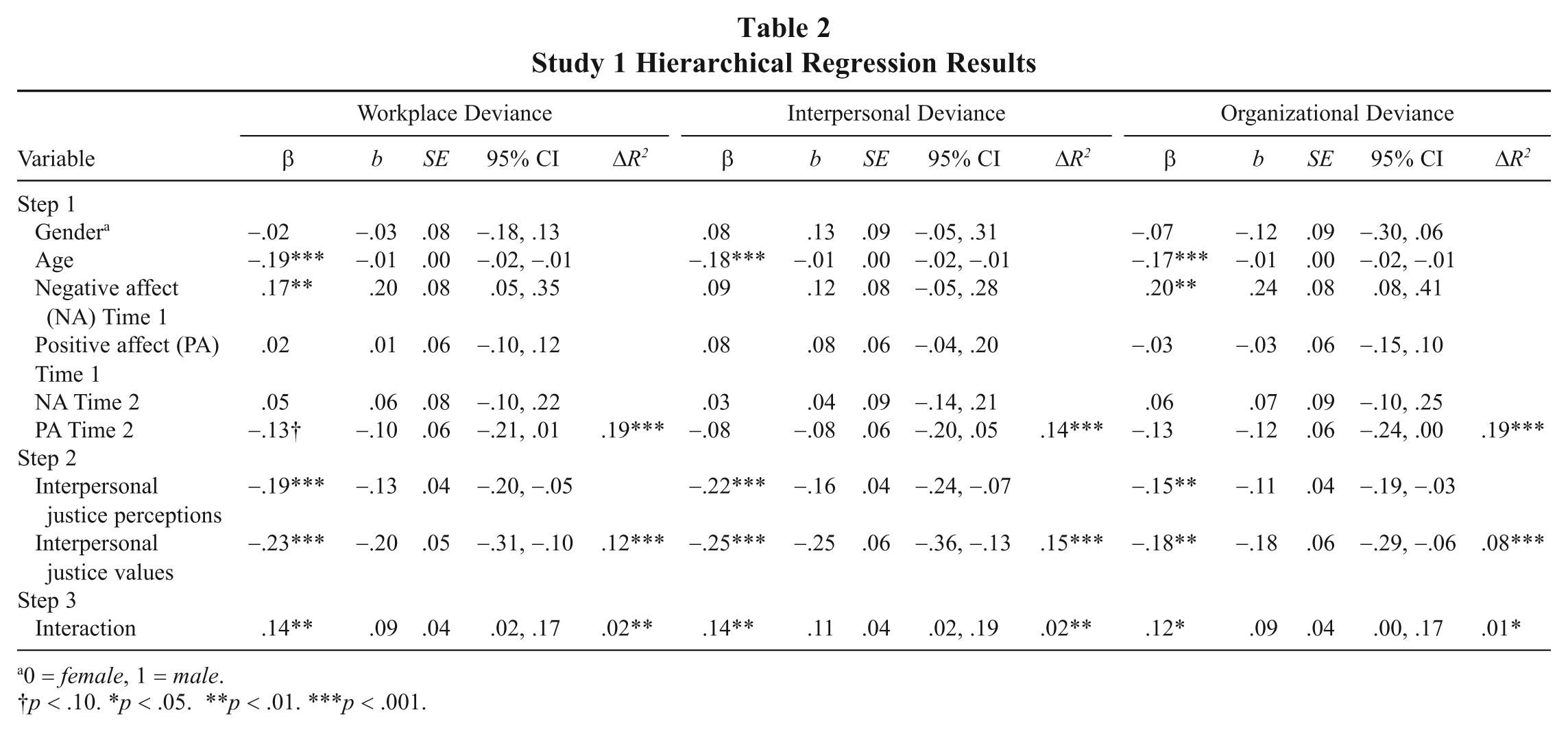
To test the hypothesis that interpersonal justice values moderate the relationship between interpersonal justice perceptions and workplace deviance, we conducted a hierarchical regression analysis with workplace deviance as the dependent variable. Before conducting the analysis, we centered the control and predictor variables (Cohen, Cohen, West, & Aiken, 2003). In the first step of the analysis, we entered each of the control variables (i.e., gender, age, NA Time 1, PA Time 1, NA Time 2, PA Time 2). Together, the control variables accounted for 19% of the variance in workplace deviance, R2 = .19, F(6, 308) = 11.91, p < .001. In the second step, we entered interpersonal justice perceptions and interpersonal justice values. These variables accounted for 12% of the variance in workplace deviance above and beyond the control variables alone, ΔR2 = .12, ΔF(2, 306) = 26.83, p < .001. In the final step, we entered the product term representing the interaction between interpersonal justice perceptions and interpersonal justice values. The interaction accounted for an additional 2% of the variability in workplace deviance, ΔR2 = .02, ΔF(1, 305) = 6.41, p < .01. Results of this analysis are presented in Table 2.
Study 1 Hierarchical Regression Results
0 = female, 1 = male.
p < .10. *p < .05. **p < .01. *** p < .001.
Results indicated that the partial regression coefficient for the product term was significant (β = .14, p < .01). To aid interpretation of the interaction, we plotted the regression slopes for workplace deviance on interpersonal justice perceptions at 1 standard deviation above and below the mean of interpersonal justice values (Aiken & West, 1991; Cohen et al., 2003). Visual inspection of Figure 1 suggests a stronger negative relationship between interpersonal justice perceptions and workplace deviance for employees with below-average interpersonal justice values, compared with employees with above-average interpersonal justice values. Next, we conducted simple slope analyses to probe the interaction further (Aiken & West, 1991). Results indicated a significant negative slope for employees 1 standard deviation below the mean on interpersonal justice values, b = –.21, t(308) = 3.6, p < .001, and a nonsignificant slope for employees 1 standard deviation above the mean on interpersonal justice values, b = –.05, t(308) = 1.1, ns. Taken together, these results fully support our hypothesis that the relationship between interpersonal justice perceptions and workplace deviance varies depending on employees’ interpersonal justice values. As predicted, perceived injustice did not lead to higher levels of deviance for employees with strong interpersonal justice values.
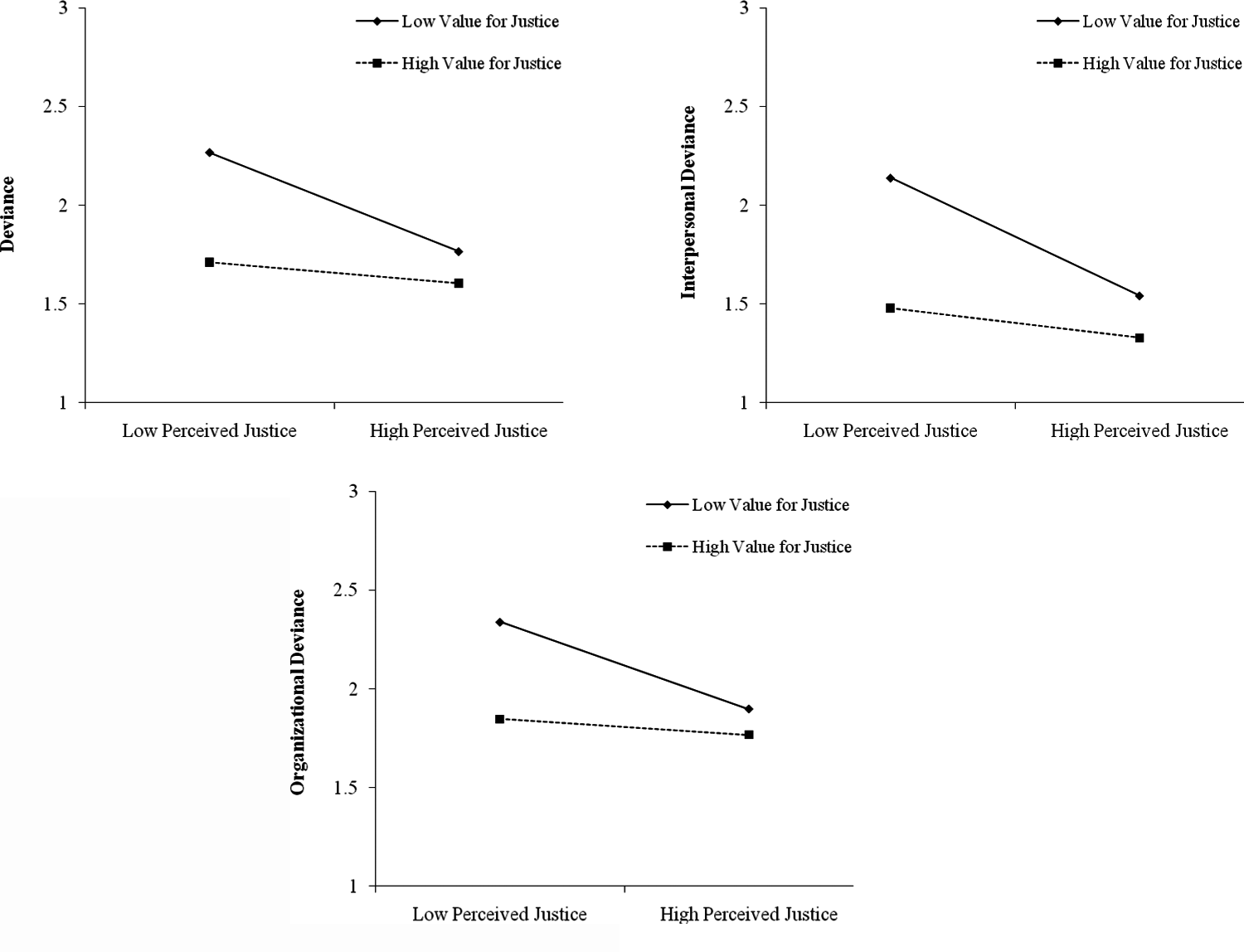
Interpersonal Justice Values × Interpersonal Justice Perceptions Interactions
Post Hoc Analyses
We conducted additional regression analyses to determine whether separating the interpersonal and organizational deviance facets would impact the results. The Interpersonal Justice Perception × Interpersonal Justice Value interactions were significant across both analyses (see Table 2). Moreover, the form of the interaction was similar whether the deviance facets were examined separately or combined in an overall workplace deviance scale (see Figure 1).
Study 1 Discussion
The results of Study 1 suggested that the effect of interpersonal justice perceptions on workplace deviance varied depending on employees’ interpersonal justice values. It is important to recognize that there are different possible approaches to operationalizing justice-related values. In Study 1, we focused on values associated with the “rules” of interpersonal justice. Again, we adopted this approach because, in our view, the core principles of interpersonal justice (i.e., dignity, politeness, propriety, and respect) are closely and inversely related to the behaviors associated with workplace deviance and the predictive power of particular values increases to the extent they are conceptually related to the behaviors of interest (Bardi & Schwartz, 2003; Meglino & Ravlin, 1998). However, given that there are other possible operationalizations of justice values, one might question whether the results of this study are an artifact of our measurement strategy. To help alleviate this concern and improve the generalizability of our findings, we conducted a second study to test these effects, using an established operationalization of justice-related values, namely, justice orientation (Rupp et al., 2003).
It is also important to note that all data reported in Study 1 were gathered using self-report measures. Research suggests that self-report measures are valid for assessing deviant behavior, particularly when data are collected under conditions of anonymity (Bennett & Robinson, 2000). Nevertheless, self-report measures are susceptible to social desirable responding (e.g., employees might underreport their deviance). Further, self-report measures are prone to problems of common method variance (Podsakoff et al., 2003; Podsakoff & Organ, 1986). Although we followed steps for reducing these problems, including ensuring anonymity and temporally spacing the predictor and criterion measures (Podsakoff et al., 2003), the use of self-reported workplace deviance is a limitation of Study 1. In Study 2, we collect criterion data from a different source to help address this limitation.
Study 2 Goal and Method
Study 2 extends Study 1 by testing whether justice orientation moderates the effect of interpersonal justice perceptions on coworker-reported workplace deviance. The justice orientation construct was developed in recognition of the view that individuals vary in how much they care about justice issues. More specifically, the justice orientation scale captures the degree to which individuals notice instances of injustice in their surroundings (i.e., attentiveness) and view justice as a desirable moral virtue (i.e., internalization). Thus, interpersonal justice values and justice orientation are related in the sense that they both assess the degree to which people care about justice. However, relative to the previously described interpersonal justice values construct, which is narrow in scope, justice orientation reflects a broader approach to assessing justice-related values. For example, justice orientation captures peoples’ concerns about fairness in the world, views on oppression, and desires to make amends for their own past unjust acts.
Liao and Rupp’s (2005) aforementioned study found that justice orientation moderated the relationship between justice climate and employees’ psychological reactions. Specifically, the relationships between justice climate and work-related attitudes (i.e., commitment, satisfaction) were stronger for employees higher in justice orientation. Their results, however, did not suggest that justice orientation moderated the effect of justice climate on employee behavior. Specifically, justice orientation did not impact the relationship between justice climate and organizational citizenship behavior. Interestingly, these findings highlight that justice orientation can differentially affect employees’ psychological and behavioral reactions to perceived injustice. However, no empirical research to date has examined whether justice orientation moderates the effect of perceived injustice on workplace deviance.
There is reason to suspect that individuals with a strong justice orientation may be less likely to pursue retribution as a means of justice restoration (Okimoto et al., 2010). As described previously, the cognitive model of justice-related aggression (Beugré, 2005a, 2005b) suggests that a person’s values and beliefs will influence whether she or he acts upon retributive cognitions stemming from perceived injustice, such that this person will not seek to retaliate if such behaviors would violate her or his value standards. Similarly, although their study focused on moral self-regulation rather than on justice orientation, Rupp and Bell (2010) concluded that concerns for justice may lead individuals to refrain from engaging in behaviors that are harmful to others. Because individuals with a strong justice orientation are highly concerned about whether people are treated fairly, we expect that justice orientation will buffer behavioral responses to perceived injustice. More specifically, we propose the following:
Hypothesis 2: The relationship between interpersonal justice and workplace deviance will be moderated by justice orientation. More specifically, we expect a significant negative relationship between interpersonal justice and workplace deviance for employees with a low justice orientation. Conversely, we expect a null interpersonal justice–deviance relationship for employees with a high justice orientation.
Participants and Procedure
Students enrolled in management courses in two universities in the northeast United States were awarded extra credit for recruiting participants into this study. Students provided employees with two standard recruitment letters. The first letter briefly described the study and presented instructions on how the employees should access the online survey. Employees were asked to distribute the second recruitment letter to coworkers who the employees believed could accurately evaluate their behavior at work (e.g., Grant & Mayer, 2009; Grant, Parker, & Collins, 2009; Lee & Allen, 2002; Mayer, Kuenzi, Greenbaum, Bardes, & Salvador, 2009; Morgeson, & Humphrey, 2006). This letter described the study and presented instructions on how the coworkers should access the online survey. Upon accessing the online surveys, participants were instructed to carefully read an informed consent page. The informed consent stressed that all responses would be kept strictly confidential and described that participation was completely voluntary and individuals were free to discontinue their participation at any time without penalty. Similar to Judge et al. (2006), we collected names, phone numbers, e-mail addresses, company names, job titles, and Internet protocol addresses to ensure that employees did not complete the coworker survey themselves. In appreciation for their effort, employee–coworker dyads were entered into a random drawing to win $50 gift cards to Amazon.com.
One hundred sixty-five employees completed the predictor survey, and 74% of these employees had coworkers complete the criterion survey. Participants who did not have coworkers complete the survey lacked criterion data and could not be included in our analyses. Thus, the final sample included 122 employees representing a wide variety of occupational fields including retail, health care, accounting, finance, and public services. The average age in the sample was 34.3 years (SD = 12.8), and the average tenure was 6.7 years (SD = 7.3). On average, employee–coworker dyads had worked together for 4 years (SD = 4.2 years). The majority (65%) of employees were female. An independent-samples t test suggested that employees who had coworkers complete the criterion survey had significantly higher NA (M = 1.6) compared with employees who did not have coworkers complete the survey (M = 1.4), t(161) = 2.08, p < .05). Employees with complete versus incomplete data did not differ significantly on any other variable assessed in this study.
We collected predictor and criterion data from different sources to help alleviate concerns of potential same-source bias. Consistent with previous research (e.g., Lee & Allen, 2002), we targeted coworker reports of workplace deviance rather than supervisor reports because peers generally have clearer insight into the typical day-to-day behavior of coworkers than supervisors do (Latham & Mann, 2006; Latham, Skarlicki, Irvine, & Siegel, 1993). We expected that our instructions requesting participants to recruit coworkers who could accurately assess their work behaviors would generate peer ratings of performance. However, responses indicated that 106 peers, 10 supervisors, and 6 subordinates provided criterion ratings. An analysis of variance (ANOVA) revealed significant mean differences between rater categories, F(2, 119) = 3.65, p < .05. Bonferroni post hoc comparisons suggested that supervisors provided significantly lower deviance ratings (M = 1.18; n = 10) than did peers (M = 2.02; n = 106). No differences were found between subordinates (M = 1.57; n = 6) and peers or supervisors. Given this finding, we controlled for rating source when testing our hypotheses.
Measures
Interpersonal justice perceptions
Interpersonal justice perceptions were assessed with the same items reported in Study 1 (i.e., Colquitt, 2001).
Justice orientation
We measured justice orientation using the 16-item scale developed by Rupp et al. (2003). For example, participants were asked to report the extent to which they agreed with the following statements: “People should care less about getting ahead and more about being fair” and “I am prone to notice people being treated unfairly in public.” Responses were collected using a 7-point scale (1 = strongly disagree to 7 = strongly agree).
Workplace deviance
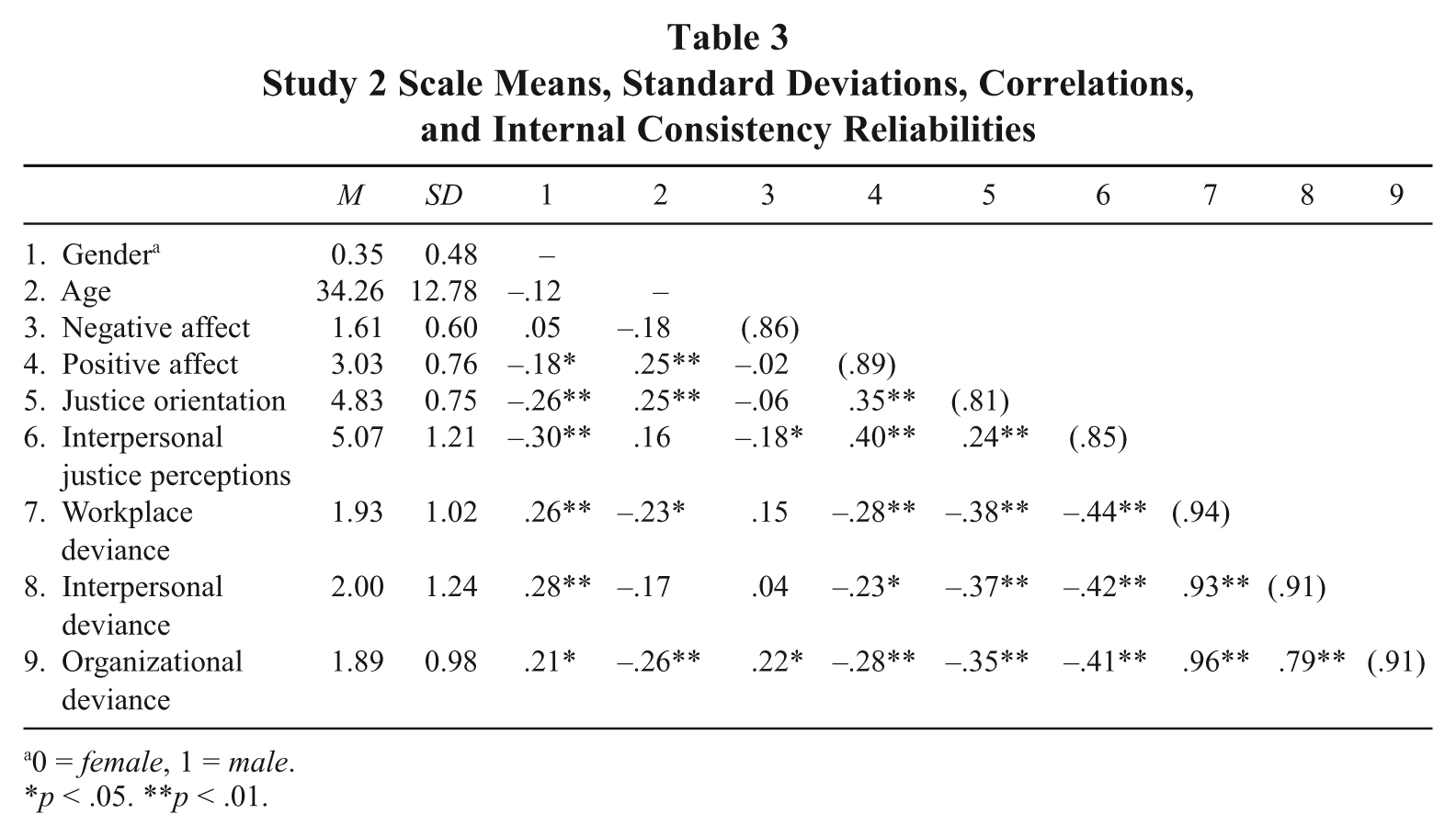
We assessed workplace deviance using Bennett and Robinson’s (2000) measure. However, coworkers completed the items rather than the employees themselves. Generally, the behaviors assessed in Bennett and Robinson’s scale are behaviors that would be observable to coworkers (e.g., showing up late). While some behaviors measured in the scale may be less easily observed (e.g., theft), previous research has used coworker reports successfully (Lee & Allen, 2002). Instructions informed the coworkers that they would be asked to assess the behavior of the employees who requested that they complete the survey. Instructions described that coworkers have a tendency to be overly favorable in evaluating their colleagues (e.g., leniency, halo effects) and asked respondents to answer the questions as honestly as possible. Further, instructions emphasized that responses would be kept strictly confidential, would not be seen by anyone except the researchers conducting the study, and were being collected for research purposes only. Respondents were asked to indicate, to the best of their knowledge, the extent to which their coworkers had engaged in the behaviors over the last year. Descriptive statistics, correlations, and reliability estimates for all measures are reported in Table 3.
Study 2 Scale Means, Standard Deviations, Correlations, and Internal Consistency Reliabilities
0 = female, 1 = male.
p < .05. **p < .01.
Study 2 Results
To begin, we conducted a series of confirmatory factor analyses to test the dimensionality of the measures. First, we tested a three-factor simple-structure model in which the items for interpersonal justice perceptions loaded onto one factor and the items associated with the justice orientation–attentiveness and justice orientation–internalization subscales loaded onto two distinct latent factors. This model presented a good fit to the data,
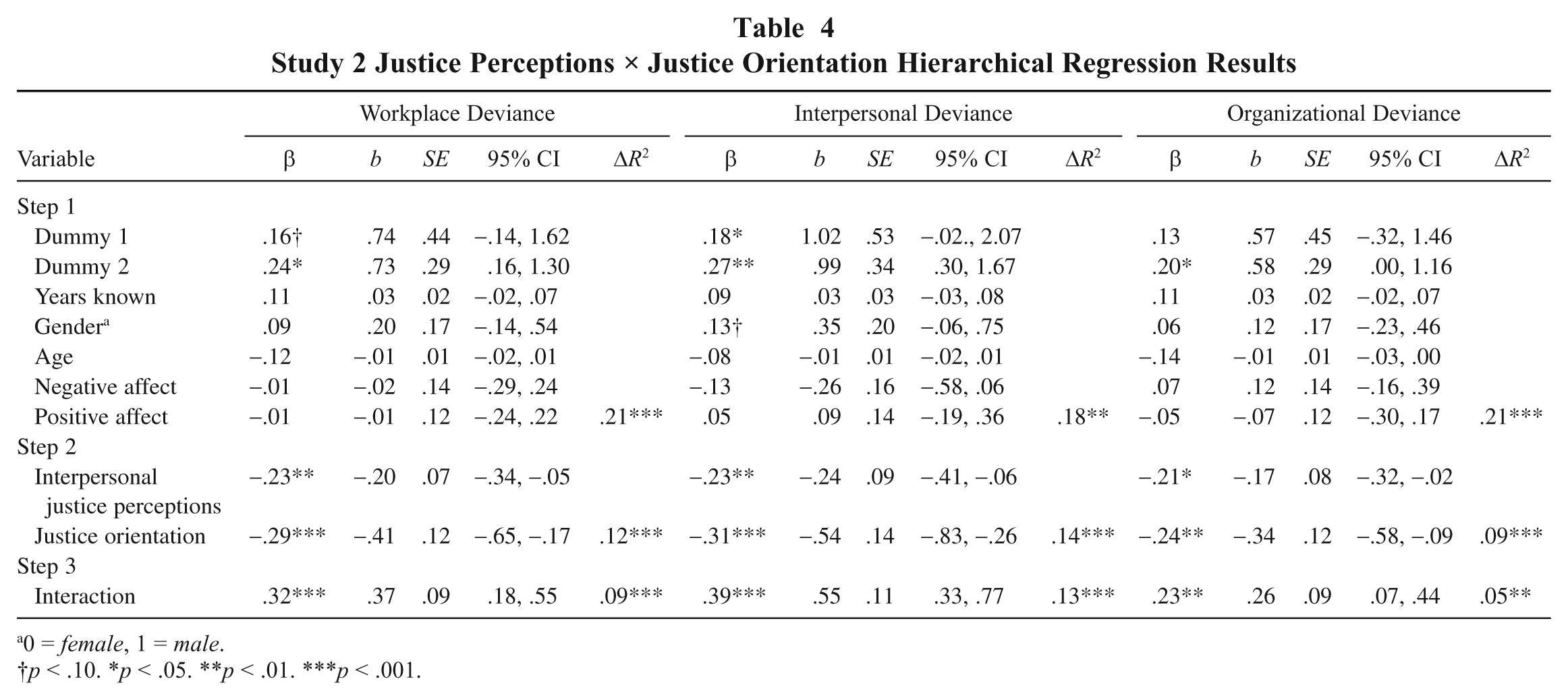
Next, to test whether employees’ justice orientation moderated the relationship between interpersonal justice perceptions and workplace deviance, we conducted a hierarchical regression analysis (see Table 4). In Step 1, we entered the control variables. As a set, the control variables accounted for 21% of the variance in workplace deviance, R2 = .21, ΔF(7, 110) = 4.05, p < .001. In Step 2, we entered interpersonal justice perceptions and justice orientation. Together, these variables accounted for 12% of the variance in workplace deviance above and beyond the control variables alone, ΔR2 = .12, ΔF(2, 108) = 9.92, p < .001. In Step 3, we entered the Interpersonal Justice Perception × Justice Orientation interaction term. Results indicated that the partial regression coefficient corresponding to the interaction term was significant (β = .32, p < .001), and the interaction accounted for an additional 9% of the variability in workplace deviance, ΔR2 = .09, ΔF(1, 107) = 15.76, p < .001.
Study 2 Justice Perceptions × Justice Orientation Hierarchical Regression Results
0 = female, 1 = male.
p < .10. *p < .05. **p < .01. ***p < .001.
Given the significant interaction, we plotted the regression of workplace deviance on interpersonal justice at 1 standard deviation above and below the mean of justice orientation (see Figure 2). Simple slope analyses indicated a significant negative slope for employees 1 standard deviation below the mean on justice orientation, b = –.46, t(109) = −5.23, p < .001, and a nonsignificant slope for employees 1 standard deviation above the mean on justice orientation, b = .06, t(109) = .58, ns. Together these results provide strong support for Hypothesis 2. Substantively, perceived interpersonal injustice did not result in greater workplace deviance for employees high on justice orientation.
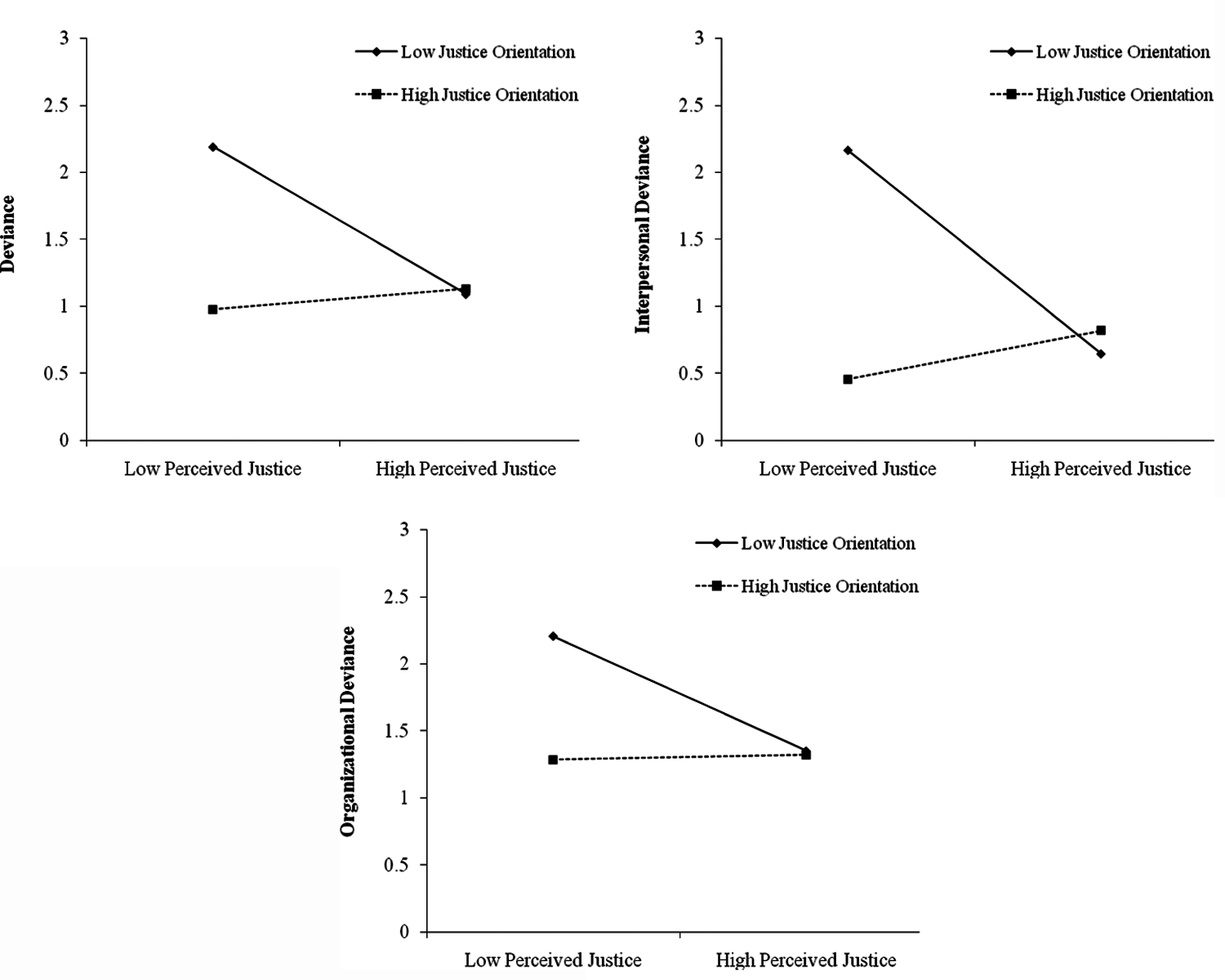
Justice Orientation × Interpersonal Justice Perceptions Interactions
Post Hoc Analyses
We conducted supplemental regression analyses to model the effects of interpersonal justice perceptions and justice orientation on the deviance subfacets. Results suggested that the moderating effects of justice orientation were similar regardless of whether interpersonal and organizational deviance were examined separately or in unidimensional form (see Table 4 and Figure 2). 3
General Discussion
Workplace deviance is widespread and has serious consequences for individuals and organizations alike (Bennett & Robinson, 2000). Hence, there are compelling interests in reducing the prevalence of deviant behavior in organizations. Developing effective interventions requires a sound understanding of the factors that influence employees’ propensity for engaging in workplace deviance. However, to date, little is known regarding the potential role of employees’ values in shaping the relationship between perceived injustice and workplace deviance. This investigation found that employees with strong justice values (operationalized as interpersonal justice values and justice orientation) refrained from engaging in deviant behavior, even in the face of perceived injustice. These results have important theoretical and practical implications.
Implications
Delineating boundary conditions for theoretical relationships is critical for scientific progress and the development of effective practical interventions (Aguinis, 2004). This research adds to the emerging body of literature clarifying the conditions under which perceptions of injustice lead to employee workplace deviance (e.g., Greenberg, 2002; Mitchell & Ambrose, 2007; Skarlicki et al., 2008; Thau, Aquino, & Wittek, 2007). Results suggest that organizational scholars can significantly improve the explanation of employee deviance by incorporating employee values into their research. Through a better understanding of factors that influence workplace deviance, organizations may be able to reduce the occurrence of deviance. Even modest reductions in workplace deviance can facilitate substantial cost savings. Although estimates vary greatly, the cost of workplace deviance may approach $200 billion annually (Murphy, 1993). Assuming a low estimate of $50 billion, reducing workplace deviance by just 7% could save organizations $3.5 billion a year (Henle, 2005).
Our findings also underscore the importance of distinguishing between psychological and behavioral reactions to injustice. As Pinder (1998: 235) described,
It is important not to confuse the attitude a person has towards an object (such as one’s company) with the attitude he holds toward behaving in a certain way towards that object (such as leaking the company’s trade secrets to a competitor).
While justice-related values may heighten psychological reactions to perceived injustice (e.g., Liao & Rupp, 2005; Ohbuchi et al., 2004), they may also constrain individuals from engaging in deviant behavior in response to injustice (e.g., Beugré, 2005a, 2005b; Bradfield & Aquino, 1999; Okimoto et al., 2010; Rupp & Bell, 2010). The findings that interpersonal justice values and justice orientation buffer behavioral reactions to perceived injustice do not imply that people who endorse these values forgo justice restoration. There is growing recognition that not acting upon retributive desires can restore the balances of justice as effectively as retaliation. In fact, refraining from striking back in the face of injustice may provide victims of injustice greater power and status (Wenzel et al., 2008; Wenzel & Okimoto, 2010).
Our results highlight the practical benefits of a workforce that highly values interpersonal justice or has a strong justice orientation. Importantly, organizations can take steps to help foster these values. For example, employee socialization programs might explicitly promote justice-related values. In this regard, longitudinal research by Ashforth and Saks (1996) suggests that collective socialization programs (Jones, 1986; Van Maanen & Schein, 1979), in which newcomers progress through a common learning experience, may be particularly effective at helping new employees adopt justice-related values over time. Additionally, recruitment practices can help shape the composition of values among employees. Schneider’s (1987) attraction-selection-attrition model describes that applicants are drawn toward companies with perceived congruent values, and research suggests that applicants who perceive value incongruence may self-select out of a selection process (Ryan, Sacco, McFarland, & Kriska, 2000). Thus, clearly articulating core justice principles throughout the recruitment process may help organizations attract employees with strong justice values.
Similarly, selecting applicants with strong justice values might help reduce workplace deviance. The criterion-related validity estimates of interpersonal justice values with self-reported deviance and of justice orientation with coworker-reported deviance were –.42 and –.38, respectively. These estimates are on par with the best predictors of workplace deviance (e.g., integrity ρ = .47; Ones, Viswesvaran, & Schmidt, 1993). Perhaps the robust validity estimates should not be surprising given that values are generally more proximal to behavior than other individual differences (Latham, 2007). Of course, these variables may covary with other individual differences such as integrity or conscientiousness. It would be beneficial for future research to further delineate the nomological net of interpersonal justice values and justice orientation and examine whether these variables contribute incremental validity above and beyond other established predictors of deviance. As with other noncognitive measures, steps would have to be taken to try to prevent socially desirable responding (e.g., warning against faking; Dwight & Donovan, 2002; McFarland, 2003) in an applicant context.
This study found that two operationalizations of individual differences in justice values (i.e., justice orientation and interpersonal justice values) demonstrated utility in the explanation of workplace deviance. Justice orientation had stronger interactive effects with interpersonal justice perceptions than with interpersonal justice values. Thus, justice orientation may be particularly useful for understanding and predicting behavioral reactions to perceived injustice. But it should also be noted that even small moderated effects can be practically important given the high cost of workplace deviance (e.g., Aguinis, Beaty, Boik, & Pierce, 2005), and the use of commensurate measures (e.g., interpersonal justice values and interpersonal justice perceptions) may be instrumental in some research contexts. For instance, scholars have recently advocated the use of polynomial regression and response surface techniques in justice research (Ambrose & Schminke, 2007; Shanock, Baran, Gentry, Pattison, & Heggestad, in press). These analytic techniques require commensurate measurement of person and environment characteristics (Edwards, 2002).
Limitations and Future Research Directions
The implications of this article should be tempered against several limitations. First, we assessed subjective ratings of workplace deviance. Ratings can avoid the potential shortcomings of objective indicators of deviance (Ones et al., 1993) but are susceptible to response errors (e.g., halo, leniency) and socially desirable responding. Although we took several steps to reduce the likelihood of socially desirable responding, future research should attempt to replicate the current findings, using objective measures of workplace deviance. 4
Second, we assessed employees’ general perceptions of the interpersonal treatment in their organizations rather than perceptions of a particular event or source of justice. Different methodological approaches could have been taken. For instance, research might examine these relationships using an event paradigm (Cropanzano, Byrne, Bobocel, & Rupp, 2001). Although studying workplace deviance directly following interpersonal conflict may present some logistical and ethical difficulties (Bies, Shapiro, & Cummings, 1988), critical incident methodologies can be used to study employee responses to specific instances of interpersonal injustice (Aquino et al., 2006; Bies et al., 1988; Holtz & Harold, 2008). Additionally, prediction may be enhanced when predictor and criterion variables target common foci (Lavelle, Rupp, & Brockner, 2007). Future research might investigate the moderating role of interpersonal justice values and justice orientation on the justice–deviance relationship involving specific foci (e.g., customers, peers, supervisors, organizations).
Third, this study focused on interpersonal justice values and justice orientation as moderators of interpersonal justice–deviance relationships. Of course, there are other possible combinations of justice-related values and perceptions that could be explored. For instance, it would be interesting to fully cross perceptions of, and values for, the different justice dimensions (e.g., distributive, procedural) to model the multiplicative effects of different justice values and perceptions. It will also be important to study overall justice perceptions. Recent research suggests that overall justice perceptions may exert a more proximal influence on outcome variables than do specific justice dimensions (Ambrose & Schminke, 2009; Jones & Martens, 2009). Given that justice orientation captures broad concerns for justice issues, it may be particularly fruitful to examine the multiplicative effects of overall justice and justice orientation on behavioral responses to injustice.
Finally, organizational behavior is inherently dynamic (George & Jones, 2000). Employee justice perceptions (Ambrose & Cropanzano 2003; Holtz & Harold, 2009) and deviant behavior (Judge et al., 2006) vary significantly over time. Our data do not speak to the dynamic interplay between values, justice perceptions, and workplace deviance. Given that values consistently influence behavior (Rokeach, 1973), we suspect that employees who strongly value justice might display significantly less variability in deviance across time. Future research might employ an experience sampling methodology (Beal & Weiss, 2003; Ilies & Judge, 2002) to examine whether values consistently prevent employees from engaging in deviant behavior despite temporal fluctuations in perceived injustice. Longitudinal research might also model the sequential influence of values in shaping employees’ psychological reactions to discrete events and their subsequent behavioral reactions. Demonstrating differential effects of justice-related values on psychological and behavioral reactions in a single study would provide an important contribution to the literature.
Notwithstanding these limitations, the present investigation has methodological strengths that bolster the findings. For instance, in Study 1 the predictor and criterion variables were assessed in consecutive surveys spaced 2 weeks apart to reduce issues of same-source bias and reciprocal causality. In Study 2, predictor and criterion data were collected from different sources (employees and coworkers, respectively). Further, this research examined two operationalizations of justice-related values. Substantively, the findings were consistent across interpersonal justice values and justice orientation and across self-reported and coworker-reported workplace deviance.
Conclusion
This article answers calls for research to investigate the role of employee values in shaping behavioral responses to perceived justice (Bradfield & Aquino, 1999; Karremans & Van Lange, 2005; Okimoto et al., 2009). Results suggest that the effect of perceived interpersonal injustice on workplace deviance depends on employees’ values. More specifically, employees who placed a high value on the “rules” of interpersonal justice, or had a strong justice orientation, abstained from deviant behavior regardless of their perceptions of interpersonal injustice.
Footnotes
Acknowledgements
This article was accepted under the editorship of Talya N. Bauer. We would like to thank Deborah Rupp, Chester Spell, and three anonymous reviewers their constructive comments on drafts of this article.