



Abstract
In this two-study article, the authors investigate the mechanism through which supervisory family support is linked to outcome variables and examine the moderating effect of family-friendly benefits on this relationship. Drawing on social exchange theory, they propose and find that the quality of leader–member exchange, a form of social exchange relationships, mediated the relationship between supervisory family support and work-related outcomes in Study 1 (N = 82). Furthermore, in Study 2 (N = 225), the model linking supervisory family support to outcome variables through social exchange relationships was moderated by the level of family-friendly benefits offered by the organization. Implications for research and practice are discussed.
Keywords
The past half century has seen the dismantling of the industrial world’s traditional family model. With the rapid entrance of women into the workforce, the traditional family featuring the husband as breadwinner and the wife as homemaker has been replaced by the “dual-earner family,” wherein both the husband and wife are gainfully employed (Bellavia & Frone, 2005). While this change of family structure has allowed women to work outside the home, it also fuels significant tension among working parents in demands for resources from the two competing domains (Bagger, Li, & Gutek, 2008; Frone, 2003; Kossek & Lambert, 2005). As a testament to this issue, a recent survey shows that almost half of men and women reported interference between their jobs and their family life (Kalleberg, 2008). These changes have left employees juggling work and family responsibilities, causing negative outcomes, including lower task performance, less discretionary behavior benefitting the organization and the supervisor, and job dissatisfaction (Eby, Casper, Lockwood, Bordeaux, & Brinley, 2005).
To address this situation, organizations have gone to great lengths to assist employees in alleviating the distress caused by work–family conflict, such as providing family-friendly benefits (Beauregard & Henry, 2009; Breaugh & Frye, 2008; Hammer, Neal, Newsom, Brockwood, & Colton, 2005). Yet, research shows that the effects of such benefits, albeit well intended, tend to be quite marginal when they are not accompanied by informal family support from supervisors (Behson, 2005; Rooney & Gottlieb, 2007; Thompson, Jahn, Kopelman, & Prottas, 2004). For example, Allen (2001) found that family-friendly benefits explained very little variance on employees’ job attitudes compared with the perceived family supportiveness of the work environment. These findings have inspired empirical studies designed to uncover the effects of supervisory family support, or supportive behavior demonstrated by supervisors that may reduce the stress employees experience as a result of the conflict between work and family, on employee attitudes and behaviors (Behson, 2005; Carlson & Perrewé, 1999; Hammer, Kossek, Yragui, Bodner, & Hanson, 2009; Thomas & Ganster, 1995). Researchers have linked supervisory family support to favorable work outcomes, including job satisfaction and lower turnover intentions (Breaugh & Frye, 2008; Cook, 2009).
However, a perusal of the existing literature on supervisory family support reveals two limitations. First, although recent research has shown that supervisory family support is influential in reducing work–family conflict (Behson, 2005), the mechanism through which these effects occur has not been adequately explored. A complete understanding of the mediating mechanism is critical for the advancement of research on supervisory family support. We address this limitation by using social exchange theory as our theoretical framework (Blau, 1964; Cropanzano & Mitchell, 2005). The theory states that goodwill gestures exhibited by one party (e.g., using fair decision-making procedures) to the other party may promote the formation of social exchange relationships, which in turn may lead to favorable outcomes (e.g., job satisfaction and lower turnover intentions). Social exchange theory is well suited to explain the mechanism through which supervisory family support influences work-related outcomes. In Study 1, we examine a model that links supervisory family support to job satisfaction and turnover intentions through the mediating mechanism of leader–member exchange relations (Graen & Scandura, 1987), a form of social exchange relations.
Second, although past research has shown that supervisory family support is linked to positive employee attitudes and behaviors (Behson, 2005; Hammer et al., 2009), little is known about the circumstances under which organizations can reap benefits from such support. This investigation is important against the backdrop of repeated calls for more supervisory support to assist employees in achieving a balance between their work and family obligations (e.g., Md-Sidin, Sambasivan, & Ismail, 2010; Taylor, DelCampo, & Blancero, 2009). Knowing the circumstances under which supervisory family support will yield the most positive outcomes may allow leaders to more appropriately allocate the limited resources at their disposal (Parks, Conlon, Ang, & Bontempo, 1999). To address this limitation, we use Study 2 to examine one possible moderating mechanism: the level of family-friendly benefits provided by the organization. Although past research has suggested that family-friendly benefits from the organization and supervisory family support are complementary to each other in influencing employee attitudes and behaviors (Breaugh & Frye, 2008), the nature of their relationship has not yet been clearly delineated in empirical research. Therefore, it is unclear whether the relationship between supervisory family support and work-related outcomes varies as a function of the level of family-friendly benefits provided by the organization. Given this, in Study 2, we examine a moderated mediating model tracing the interactive effects of supervisory family support and family-friendly benefits on employee task performance and citizenship behavior through the mediating mechanism of social exchange with supervisors.
Study 1
Theory and Hypotheses
Supervisory Family Support
Recent research has shown that one effective managerial intervention to reduce work–family conflict that employees experience is to provide them with supervisory family support (Hammer et al., 2009). Supervisory family support is one type of social support, which is defined as “the availability of helping relationships and the quality of social relationships” (Leavy, 1983: 5). Supervisory family support is defined as behavior exhibited by supervisors to their employees that will allow employees to achieve a balance between their responsibilities at home and at work (Thomas & Ganster, 1995). Supervisors may signal their support by inquiring about employees’ family needs or expressing concerns and encouragement to employees who are strained by competition for resources from family and work. Supervisors can also grant assistance such as allowing employees to have more flexible work schedules to accommodate their family needs or to bring their children to work when child care arrangements cannot be made (Lapierre & Allen, 2006). Scholars have argued that family support from supervisors is critical in reducing the work–family conflict that employees experience (Breaugh & Frye, 2008; Frye & Breaugh, 2004). In organizations where formal family-friendly policies are not available, supervisory family support involves assistance that is not officially sanctioned. Even in organizations where these policies are in place, employees may be reluctant to utilize them for fear of negative career consequences. Supervisors can assuage these concerns by serving as role models for their employees on how to integrate work and family (Thompson, Beauvais, & Lyness, 1999).
Researchers have argued that supervisory family support, driven by supervisors’ goodwill intentions to help employees balance their work–family demands, may elicit positive responses from their employees (Thompson et al., 1999). Specifically, when employees believe that their supervisors care about their family needs, they may respond by having more positive perceptions of their work environment, in the form of more satisfaction with their jobs and greater willingness to continue their employment with the organization. These arguments have received substantial empirical support. For example, in their study of 2,248 wage and salaried workers, Anderson, Coffey, and Byerly (2002) found that supervisory family support significantly impacted the levels of job satisfaction and turnover intentions. Similarly, using a sample of employees working in multiple grocery stores, Hammer, Kossek, Anger, Bodner, and Zimmerman (2011) showed that for employees who experienced a high level of family-to-work conflict, training their supervisors on how to become more family friendly increased these employees’ perceived supervisory family support. Supervisory family support was in turn linked to job satisfaction and turnover intention. To replicate these findings, we hypothesize the following:
Hypothesis 1a: Supervisory family support is positively related to job satisfaction.
Hypothesis 1b: Supervisory family support is negatively related to turnover intentions.
Social Exchange Relationships as a Mediator
An implicit assumption of the aforementioned studies is that by providing family support to employees, supervisors establish social exchange relationships with followers (Blau, 1964). Unlike individuals in an economic exchange relationship guided by the quid pro quo principle, social exchange partners enjoy considerable discretion in terms of when to return the favor and by how much (Blau, 1964; Cropanzano & Mitchell, 2005). Such open-ended and continuous exchanges allow supervisors and employees to establish long-term relationships that are based on mutual trust and commitment. According to March and Simon (1958), the survival of an organization in general—and a social exchange relationship in particular—depends on whether employees make sufficient contributions whose inducement should be deemed adequate relative to these contributions. In other words, employees are more likely to establish social exchange relationships with their supervisors when they can achieve an overall balance between their own contributions and the inducements from the supervisors over time. We argue that supervisory family support may be potentially interpreted as such inducements that lay the foundation of social exchange relationships (Behson, 2002, 2005; Hammer et al., 2009).
Leader–Member Exchange as an Operationalization of Social Exchange Relationships
One operationalization of social exchange relationships between employees and their supervisors is leader–member exchange, or LMX (Graen & Scandura, 1987; Schriesheim, Castro, & Cogliser, 1999; Sparrowe & Liden, 1997). LMX theory stipulates that there exists different types of exchange relationships between leaders and their subordinates. High-quality exchange relationships are characterized by a high level of mutual trust, respect, and liking between supervisors and their employees. In this kind of exchange relation, leaders form role expectations of a subset of their subordinates whose abilities to satisfy these expectations may be rewarded with more challenging assignments and autonomy at work. Subordinates also form expectations of leaders’ behaviors. When leaders exhibit behaviors that are consistent with their subordinates’ expectations, such as providing them with support and giving them more latitude at work, subordinates will reciprocate leaders’ goodwill gestures by engaging in behaviors that will benefit the leaders and the organization (Wang, Law, Hackett, Wang, & Chen, 2005). Low-quality exchange relationships, in contrast, are circumscribed by employment contracts and formal job descriptions. In other words, the support provided by leaders to their subordinates is limited to what is specified in the employment contract, and in return, employees tend to perform only what is expected of them in their job descriptions. As such, this type of exchange relationship tends to be high in formality and low in trust and mutual liking (Graen & Uhl-Bien, 1995). Past research has used LMX rated by either employees or supervisors (Sin, Nahrgang, & Morgeson, 2009). In the present study, we used LMX ratings provided by employees.
While a majority of existing LMX studies focus on how member characteristics influence the formation of the exchange relationship, they have overlooked leadership behavior as an important antecedent (Nahrgang, Morgeson, & Ilies, 2009). This limitation is surprising, as LMX scholars argue that leaders play a more important role in the development of LMX than employees do (Liden, Sparrowe, & Wayne, 1997). The beneficial actions from the supervisors provide the fertile soil needed to nurture a high-quality LMX relationship. For example, past research has shown that employees evaluate their LMX relationships more favorably when they have been treated fairly by their supervisors (Masterson, Lewis, Goldman, & Taylor, 2000). Similarly, Maslyn and Uhl-Bien (2001) found that the key to building a high-quality LMX relationship is the effort that one’s exchange partner invests in the relationship.
We believe that the family support provided by supervisors may lead to a high-quality LMX relationship between supervisors and their employees. LMX scholars argue that the extent to which employees are motivated to build high-quality LMX relationships with their supervisors may be determined by whether their supervisors can provide resources that meet the employees’ critical needs (Liden et al., 1997). For example, Venkataramani, Green, and Schleicher (2010) found that supervisors who are more resourceful (in terms of their network positions and their relationships with their own superiors) are more likely to form a higher level of LMX with their subordinates. In a similar fashion, we argue that supervisors who provide family support to their employees offer resources that allow employees to maintain a balance between their work and families and reduce their stress as a result of juggling between these two domains. Social exchange theory states that when one party provides something of significant value to the other party, it creates the obligation for the other party to reciprocate (Cropanzano & Mitchell, 2005). Since the family domain is considered to be the most valued domain by most individuals (Mortimer, Lorence, & Kumka, 1986), supervisory family support may promote trust and mutual commitment and generate the incentives for continuous improvement in the mutual exchange over time (Nahrgang et al., 2009), leading to a higher level of LMX.
Our argument that supervisory family support may enhance the quality of LMX is also consistent with research on the development of LMX over time. LMX scholars argue that the exchange relationship between supervisors and employees evolve from a stranger stage through an acquaintance stage to the eventual partner stage (Graen & Uhl-Bien, 1995). This developmental cycle coincides with a reduced focus on self-interest, characterizing a quid pro quo transactional exchange, and more emphasis on mutual trust and collective interest, characterizing a social exchange. Ballinger and Rockman (in press) argue that an anchoring event (or a series of events) that is highly emotional and instrumentally relevant can transform the nature and the quality of exchange relationship between leaders and their followers. We argue that family support from supervisors represents one of these anchoring events that raise the level of relationship from instrumental exchange to social exchange (Wang et al., 2005). It is important to note that we do not argue or assume that those who have a lesser need for family support are relegated to low-quality LMX relations with their supervisors. After all, researchers have suggested that leaders and followers exchange a variety of resources, and family support is one such resource that is used as a basis of the exchange relationship (Wilson, Sin, & Conlon, 2010).
Past research has shown that a high-quality LMX relationship may lead to several positive outcomes (Gerstner & Day, 1997). Researchers argue that employees who enjoy a high-quality LMX with their supervisors may express greater satisfaction with their work and may be less likely to quit their jobs. These links have indeed been established in empirical studies. For example, based on a sample of 184 employees and their supervisors working in a national bank in India, Venkataramani and colleagues (2010) found that LMX was positively related to job satisfaction and negatively related to turnover intentions. In a meta-analysis, Gerstner and Day (1997) found a sizable relationship between LMX and job satisfaction (corrected r = .50) and turnover intentions (corrected r = −.31).
Taken together, we argue that when employees receive family support from their supervisors, they see the exchange relationship as desirable. A high level of supervisory family support may represent a form of investment that supervisors make in their employees; as such, employees feel that they are valued and trusted members of a social exchange relationship (Blau, 1964; Gómez & Rosen, 2001), which in turn increases their satisfaction with the job and reduces their intention to leave the organization (Dienesch & Liden, 1986; Graen & Scandura, 1987). Although we propose that LMX may mediate the relationship between supervisory family support and outcome variables, it is important to note that past research has identified other mechanisms that also may mediate the relationships. For example, Anderson and colleagues (2002) found that work–life conflict mediated the relationship between supervisory family support and job satisfaction and turnover intentions, such that supervisory family support reduced the work–life conflict that employees experience, which in turn increased their job satisfaction and turnover intentions. Thompson and Prottas (2006) argued and found that supervisory family support increased employees’ perceived control of the environment, which in turn increased their job satisfaction and reduced their intention to quit. Neither of these studies reported full mediation, suggesting the need to further investigate other mediating mechanisms. Additionally, neither of these studies addressed the possibility that family support from supervisors may transform the relationship between supervisors and employees, leading employees to reciprocate by having more positive perceptions of their jobs and increasing their commitment to the organization (by having little desire to leave). Given these findings from previous research, we expect that LMX quality partially mediates the relationship between supervisor family support and job satisfaction and turnover intentions. A graphic representation of this model is presented in Figure 1. Based on the above, we predict:
Hypothesis 2a: LMX quality partially mediates the effect of supervisory family support on job satisfaction.
Hypothesis 2b: LMX quality partially mediates the effect of supervisory family support on turnover intentions.

Hypothesized Model (Study 1)
Method
Participants and Procedure
We conducted a field study to examine the proposed hypotheses. The research site was an institution of higher education in a metropolitan city in the southwestern United States. A total of 125 employees responded to the Time 1 survey (62.5% of the total workforce), while 92 employees responded to the Time 2 survey (46% of the total workforce). Eighty-two employees (41% of the total workforce) responded to both surveys. The average age of the participants was 31.54 (SD = 10.46). Employees reported working an average of 42 hours per week (SD = 8.77) and had an average tenure of 3.37 years (SD = 3.79). Among the respondents, 53.7% were male and 59.3% had a spouse. A majority (77%) did not have young children (younger than 17 years old).
Employees of this institution participate in bimonthly organizational training workshops. The first author attended one of these workshops and requested assistance from the participants. Paper-and-pencil surveys were distributed to those willing to participate. Two months later, the first author again attended a workshop to distribute the second survey. This design allows for temporal separation between predictor and outcome variables. To ensure confidentiality, each respondent created a unique six-digit number, which allowed us to match the two surveys. To encourage participation, each participant was given a $5 gift card upon completion of both surveys. Given that we observed sample attrition from Time 1 to Time 2, we compared the sample characteristics (age, gender, tenure, and work hours) of those participants who responded to both surveys with those of participants who failed to respond to the first one. We did not find significant differences between the two groups. Additionally, the human resources department confirmed that our sample characteristics were representative of all employees in the organization.
Measures
Responses to all scale items were rated on a 5-point continuum (1 = strongly disagree to 5 = strongly agree). Cronbach’s alpha is reported in Table 1.
Means, Standard Deviations, and Intercorrelations Among Study Variables (Study 1)

Note: N = 82. T1 = Time 1; T2 = Time 2. For gender, 0 = female, 1 = male; for spouse, 0 = single, 1 = spouse/partner. Cronbach’s alpha is shown on the diagonal.
p < .05. **p < .01.
Supervisory family support
Supervisory family support was measured at Time 1 with three items from Clark (2001). The three items are “My supervisor listens when I talk about my family,” “My supervisor understands my family needs,” and “My supervisor acknowledges that I have obligations as a family member.”
Leader–member exchange quality
LMX, which was measured at Time 2, consisted of seven items developed by Scandura and Graen (LMX-7; 1984). This measure reflects the extent to which employees believe that they have high-quality relationships with their supervisors. A sample item is “I have an effective working relationship with my supervisor.”
Job satisfaction
Job satisfaction was measured at Time 2 with three items from the Michigan Organizational Assessment Questionnaire (Camman, Fichman, Jenkins, & Klesh, 1979). A sample job satisfaction item is “All in all, I am satisfied with my job.”
Turnover intentions
The second dependent variable was also measured at Time 2. Turnover intentions was measured with three items from Cropanzano, Howes, Grandey, and Toth (1997). A sample item is “I intend to leave [name of the organization] within the next year.”
Control variables
We included six control variables; all were measured at Time 2. Since one’s family status and demographics may influence family needs, we inquired about participants’ number of children under the age of 17, relationship status (0 = single, 1 = spouse/partner), gender (0 = female, 1 = male), and age (in years). Work-related control variables included their average number of work hours per week and their tenure with the organization (in years).
Results and Discussion
Means, standard deviations, and intercorrelations are presented in Table 1.
Confirmatory Factor Analysis
We conducted a confirmatory factor analysis on supervisory family support, LMX, job satisfaction, and turnover intentions to verify their independent nature. The four-factor structure (χ2 = 178.55, df = 98, p < .001; comparative fit index [CFI] = .98, incremental fit index [IFI] = .98, root mean square error of approximation [RMSEA] = .10) was superior to the one-factor structure (χ2 = 396.08, df = 104, p < .001; CFI = .94, IFI = .94, RMSEA = .19; Δχ2 = 217.53, df = 6, p < .001).
Bivariate Analysis
Hypothesis 1 states that supervisor family support is positively related to job satisfaction (Hypothesis 1a) and negatively related to turnover intentions (Hypothesis 1b). As expected, results of the bivariate correlations indicate that supervisory family support was significantly correlated with job satisfaction (r = .52, p < .01) and turnover intentions (r = −.34, p < .01). Thus, Hypotheses 1a and 1b were supported. In addition, we found that supervisory family support was moderately and significantly correlated with LMX.
Mediating Analysis
Hierarchical regression was employed to examine the meditating hypotheses. Hypothesis 2a states that LMX quality mediates the relationship between supervisory family support and job satisfaction. Supervisory family support was significantly correlated with the mediator, LMX quality (β = .39, p < .01), meeting the first condition of mediation (Baron & Kenny, 1986). Supervisory family support was significantly correlated with job satisfaction (β = .59, p < .01), satisfying the second mediation requirement. We then entered the mediator. The mediator was also a significant predictor of job satisfaction (β = .39, p < .01), meeting the third requirement. Finally, most importantly, with the inclusion of the mediator, the relationship between supervisory family support and job satisfaction became reduced (β = .44, p < .01; see Table 2). We also confirmed the mediating model with Sobel’s (1982) test (Z = 2.63, p < .01). As such, LMX partially mediated the relationship between supervisory family support and job satisfaction, supporting Hypothesis 2a (James, Mulaik, & Brett, 2006).
Mediating Analyses (Study 1)

Note: N = 82.
p < .05. **p < .01.
Hypothesis 2b states that LMX quality mediates the relationship between supervisory family support and turnover intentions. Supervisory family support was significantly correlated with the mediator, LMX quality (β = .39, p < .01), meeting the first condition of mediation (Baron & Kenny, 1986). Supervisory family support was significantly correlated with turnover intentions (β = −.35, p < .01), satisfying the second mediation requirement. We then entered the mediator. The mediator was also a significant predictor of turnover intentions (β = −.24, p < .05), meeting the third requirement. Finally, most importantly, with the inclusion of the mediator, the relationship between supervisory family support and turnover intentions became reduced (β = −.25, p < .05; see Table 2). This reduction was again significant by Sobel’s (1982) test (Z = −1.96, p < .05). Thus, LMX partially mediated the relationship between supervisory family support and turnover intentions, supporting Hypothesis 2b.
Study 2
Theory and Hypotheses
Results of Study 1 show that discretionary family support from supervisors provided the basis for building high-quality LMX relationships with employees. In turn, this high-quality exchange relationship yielded significant payoffs for the organization (Gerstner & Day, 1997; Ilies, Nahrgang, & Morgeson, 2007). That is, when their supervisors were perceived as family supportive, employees were more content with their jobs and had little desire to leave the organization. As such, Study 1 fills a substantial gap in the work–family literature by identifying a mechanism—LMX quality—as the linkage between supervisory family support and work-related outcomes.
Study 2 was designed to accomplish three goals. First, although Study 1 allows us to understand the mechanism through which supervisory family support influences outcome variables, little is known about the condition under which such support may have greater (or less) impact on outcome variables. Therefore, the first goal of Study 2 is to build on Study 1 by examining the level of family-friendly benefits provided by the organization as a moderator of the mediating model linking supervisory family support to outcome variables through social exchange relationships. Second, to combat same-source bias, which is prevalent in the work–family literature (Casper, Eby, Bordeaux, Lockwood, & Lambert, 2007; likewise, our sample in Study 1), we use task performance and citizenship behavior rated by supervisors as the outcome variables. Third, instead of using one sample from a single organization (the most commonly used sampling method in the work–family literature; also, our sample in Study 1), we opted to use participants recruited from a broad range of sources. This strategy is necessary because it provides enough variance on the level of family-friendly benefits offered in the workplace.
Hence, in the following, we describe a moderated mediating model of supervisory family support. In this model, supervisory family support and family-friendly benefits interact to predict job performance and citizenship behavior toward supervisor (OCB-S), and these effects are mediated by employees’ social exchanges with their supervisors. A graphic representation of this model is presented in Figure 2.

Hypothesized Model (Study 2)
Interaction Between Supervisory Family Support and Family-Friendly Benefits on Social Exchanges
Although past research has demonstrated that supervisory family support may reduce the negative impact of juggling work and family, it is unclear under what circumstances its effects may be more or less pronounced. In the present study, we propose that one such circumstance is the level of family-friendly benefits offered by the organization. Past research suggests that supervisors have considerable discretion over the types and level of family support that employees receive (den Dulk & de Ruijter, 2008; McCarthy, Darcy, & Grady, 2010), irrespective of whether family-friendly benefits are provided by the organization. When there are few (or no) formal benefits offered, the supervisor becomes the only source of support that employees can count on to address the conflict between work and family. In this situation, employees may be particularly indebted to supervisors who provide support to them since these actions are not officially sanctioned. The lack of family-friendly benefits from official sources may also provide supervisors with opportunities to show employees individualized consideration and demonstrate sensitivity to their needs to maintain a work–life balance (Avolio, Zhu, Koh, & Bhatia, 2004). Such family support from supervisors stands in stark contrast to the lack of care characterizing the larger environment of the organization, making supervisory family support highly salient. This argument is akin to research on the interaction between procedural justice and outcome favorability (Brockner & Wiesenfeld, 1996). Specifically, employees respond more positively to a supervisor’s procedural fairness when they experience negative outcomes. Similarly, when family-friendly benefits are meager (a negative outcome), employees may respond more strongly to nice gestures shown by their supervisors. This argument suggests that employees may return the favor by forming a high-quality exchange relationship with their leaders.
In contrast, when the level of family-friendly benefits is high, employees can draw family support not only from their direct supervisors but also from official channels. As such, it follows that the effects of supervisory family support on the social exchange relationship are somewhat weakened given that employees can obtain support from alternative sources. In other words, supervisory family support may have less impact because it is less salient when support also is available from the organization (as family-friendly benefits). This is consistent with the notion of leadership substitutes, which refers to factors reducing the effects of leadership actions (Kerr & Jermier, 1978). In other words, family-friendly benefits from the organization serve as a substitute that neutralizes (moderates) the effects of supervisory family support. As indirect support to our argument, one moderator of leadership behavior that has been demonstrated in the leadership substitute literature is organizational reward (Podsakoff, MacKenzie, Ahearne, & Bommer, 1995). Thus, we predict:
Hypothesis 3: Supervisory family support interacts with the level of family-friendly benefits to predict social exchange with supervisors, such that the relationship is stronger when the level of family-friendly benefit is low.
Interaction Between Supervisory Family Support and Family-Friendly Benefits on Performance
We focus on the interactive effects of supervisory family support and family-friendly benefits on two aspects of employee behavior at work: task performance and OCB-S. Task performance is defined as the extent to which employees adequately complete what is required of them in the job specification (Williams & Anderson, 1991). Past research has shown that employees may experience a high level of strain when juggling conflicting demands for resources from family and from work (Frone, 2003). Family support from supervisors, such as expressing concerns to employees and providing time off to handle family issues, may alleviate the high level of stress that employees experience and allow them to meet their obligations and responsibilities at home (Clark, 2001). When employees believe that their supervisors genuinely care about their well-being and allow them to meet their family needs without sacrificing their careers, they may perceive a sense of obligation to reciprocate the received family support. Past research has suggested that performance can serve as a currency that employees use to meet their exchange obligations and to return the favor to their supervisors (Wang et al., 2005).
As we argued previously, the effects of supervisory family support may depend on the level of family-friendly benefits provided by the organization. When the level of family-friendly benefits is low, supervisory family support may become especially essential. As such, employees may perceive a sense of indebtedness to their supervisors for their empathy with employees’ desires to balance work and family responsibilities. When employees believe that they benefit from the generosity of their supervisors, they may reciprocate by performing at a higher level to maintain a balanced social exchange with their supervisors. When the level of family-friendly benefits is high, however, employees may attribute the support from their supervisors as part of the broader effort of the organization, thus lessening the effects of supervisory family support on their work performance (Major, Fletcher, Davis, & Germano, 2008; see also Allen, 2001). As such, we predict:
Hypothesis 4: Supervisory family support interacts with the level of family-friendly benefits to predict performance, such that the relationship is stronger when the level of family-friendly benefit is low.
Interaction Between Supervisory Family Support and Family-Friendly Benefits on OCB-S
We also investigate the interactive effects of supervisory family support and family-friendly benefits on OCB-S. OCB-S is defined as extra-role behaviors performed by employees to benefit their supervisors (Gerstner & Day, 1997). OCB-S may include such behaviors as helping supervisors when the workload is heavy or providing them with suggestions to improve unit performance. Social exchange theory stipulates that employees in a high-quality exchange relationship with their supervisors may go above and beyond the call of duty to maintain and to further develop the relationship (Ilies et al., 2007). Supervisory family support may reduce employees’ work–family conflict and allow them to enjoy a high level of family satisfaction without undermining their performance and career prospects. As such, employees who benefit from the family support may be motivated to engage in discretionary behavior to benefit their supervisors as a way of expressing their gratitude.
However, the extent to which employees engage in OCB-S to reciprocate may be moderated by the level of available family-friendly policies. A high level of family support from supervisors in the absence of family-friendly policies at the organizational level may accentuate its impact on employees. In other words, employees may come to rely on their supervisors for family support since they receive little support elsewhere. As such, they may be more likely to make discretionary contributions in the form of OCB-S (even though these behaviors are not recognized as an official part of their job descriptions) in order to maintain an equitable exchange relationship with their supervisors. In contrast, the role of supervisors may be less important when family support can be obtained from the official sources. Past research has shown that employees’ dependence on supervisors may be related to the quality of exchange relationships they establish with their supervisors (Schyns, Kroon, & Moors, 2008). When employees perceive less need to depend on the support from their supervisors as a result of the support available elsewhere, they may be less likely to engage in OCB-S to maintain a social exchange relationship with their supervisors. As such, we predict:
Hypothesis 5: Supervisory family support interacts with the level of family-friendly benefits to predict OCB-S, such that the relationship is stronger when the level of family-friendly benefit is low.
Social Exchange With Supervisor as a Mediator
Past research has linked social exchange to both performance and OCB-S, suggesting that employees in high-quality exchange relationships with their supervisors may use performance and OCB-S as currencies to pay back received supervisory family support (e.g., Wayne, Shore, Bommer, & Tetrick, 2002). Based on this, and our earlier arguments, we further predict that the interactive effects of supervisory family support and family-friendly benefits on performance and OCB-S may be mediated by social exchange relations. In other words, social exchange may explain how supervisory family support and family-friendly benefits interact to influence outcome variables. When the level of family-friendly benefits is low, employees may seek to establish social exchange relationships with their supervisors and may use high performance and more OCB-S to fulfill their obligations for reciprocity. In contrast, in the presence of a high level of family-friendly policies, the family support from supervisors may not be as critical for employees, which may also reduce their motivation to establish high-quality exchange relationships with their supervisors and their propensity to perform at a high level and to engage in extra-role behaviors. As such, we predict:
Hypothesis 6: Social exchange with supervisors partially mediates the relationship between the interaction of supervisory family support and the level of family-friendly benefits and employee performance and OCB-S.
It is important to note that we do not dispute the importance of supervisory family support, as past research has suggested that such support is more important to employees’ well-being than are family-friendly benefits (Thompson et al., 2004). We simply argue that its effect may be less pronounced in the presence of a high level of family-friendly benefits.
Method
Participants and Procedure
Students, following a standard recruiting protocol, were given course extra credit for identifying qualified participants for this study (Casper & Harris, 2008). In order to qualify, participants were required to (1) work at least 30 hours per week in a paid job (outside a family business or the university), (2) be able to read English, (3) have Internet access, and (4) have an immediate supervisor who would be willing to complete a separate brief online survey. All study participants and their supervisors were entered in a drawing for cash prizes.
Participants included 225 employees and their supervisors from a metropolitan area in the western United States. Participants received a cover letter that explained the purpose of the study, including a web address and an identification number with which they accessed the survey. A similar cover letter was given to each participant’s supervisor. We used the identification number to match the employee to his or her supervisor upon completion of the surveys. The mean age of the employee was 38 (SD = 9.9). Among these participants, 140 (62.2%) were women and 189 (84%) reported that they were married or in a significant relationship. Participants reported working 40 hours (SD = 10.84) a week on average and spending 33 hours (SD = 20.58) on household activities every week.
As a check on data quality, the authors called about 15% of study participants to verify their participation. Every respondent was asked a number of demographic questions that matched the questions asked in the survey (e.g., their age, the number of the children and their respective ages). All respondents were able to accurately answer the questions (i.e., their answers matched what they reported in the survey). This data collection procedure has been employed extensively in different literatures, including studies investigating work–family issues (e.g., Casper & Harris, 2008; Reeve & Smith, 2000; Smith, Tisak, Hahn, & Schmieder, 1997; Smith, Tisak, & Schmieder, 1993).
Measures: Employees
Level of family-friendly benefits provided
We asked about 13 family-friendly benefits, such as flexible scheduling and telecommuting (Hammer et al., 2005). Respondents were asked to indicate whether each benefit was offered by their employing organizations (1 = yes, 0 = no/I don’t know).
Supervisory family support
Supervisory family support was measured with a nine-item scale (Thomas & Ganster, 1995). Participants were asked to indicate to what extent (1 = never to 5 = very often) their supervisors engage in nine different family-supportive behaviors. A sample item is “My supervisor switches schedules to accommodate my family responsibilities.”
Social exchange relationship with the supervisor
An employee’s social exchange relationship with his or her supervisor was measured with an eight-item scale from Rupp and Cropanzano (2002). Responses were rated on a 7-point continuum (1 = strongly disagree to 7 = strongly agree). A sample item is “The supervisor has made a significant investment in me.”
Control variables
We included four control variables that have been shown to relate to work–family issues. First, we controlled for the number of children under the age of 17. We also controlled for the employee’s relationship status (0 = single, 1 = spouse/partner), gender (0 = female, 1 = male), and the number of hours he or she worked every week.
Measures: Supervisors
Task performance
Performance was measured using a seven-item scale from Williams and Anderson (1991). Responses to the measures were rated on a 7-point continuum(1 = strongly disagree to 7 = strongly agree). A sample item is “In general, your employee adequately completes assigned duties.”
OCB-S
OCB-S was measured with five items from Rupp and Cropanzano (2002). The supervisor was asked to indicate how often (1 = never to 5 = very often) his or her subordinate engages in citizenship behaviors directed at the supervisor. A sample OCB-S item is “How often does your subordinate help you when you have a heavy work load.”
Analytical Strategy
To examine whether the interactive effects of supervisory family support and family-friendly benefits on performance and OCB-S are mediated by social exchange relations with supervisors, we conducted a moderated mediation analysis (Preacher, Rucker, & Hayes, 2007). First, we examined whether the interactive effects influence the proposed mediator: social exchange with supervisors. Second, we examined whether the interactive effects influence the proposed outcome variables: performance and OCB-S. Third, we again examined whether the interactive effects influence the proposed outcome variable, when the mediator is controlled for. Finally, we used bootstrapping analysis to examine the significance of the conditioned indirect effects.
Results
Means, standard deviations, and correlations among the studied variables are reported in Table 3.
Means, Standard Deviations, and Intercorrelations Among Study Variables (Study 2)
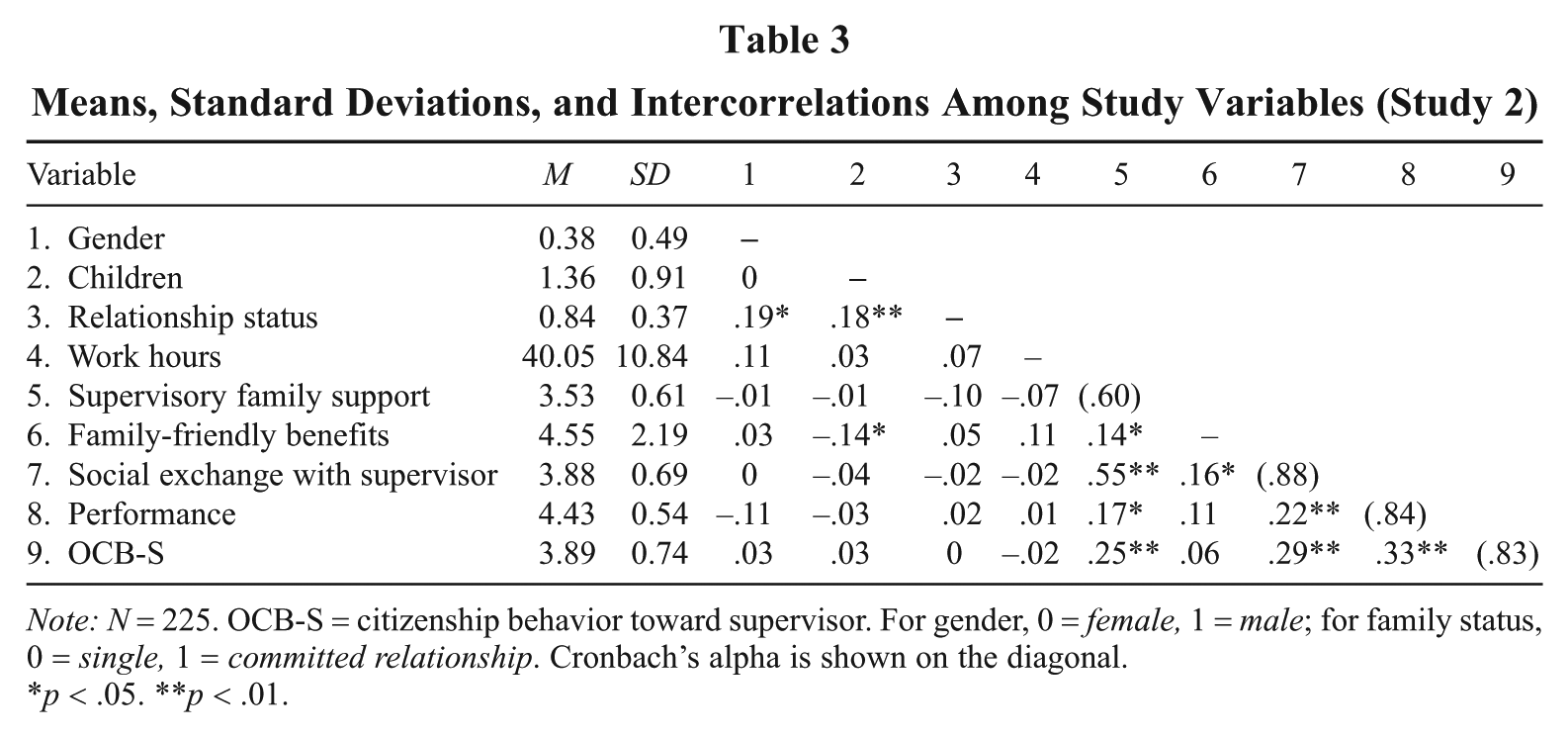
Note: N = 225. OCB-S = citizenship behavior toward supervisor. For gender, 0 = female, 1 = male; for family status, 0 = single, 1 = committed relationship. Cronbach’s alpha is shown on the diagonal.
p < .05. **p < .01.
Confirmatory Factor Analysis
We conducted a confirmatory factor analysis on supervisory family support and social exchange relationship with the organization, both of which were reported by the employee. The two-factor structure (χ2 = 216.76, df = 108, p < .001; CFI = .93, IFI = .93, RMSEA = .067) was superior to the one-factor structure (χ2 = 345.46, df = 109, p < .001; CFI = .84, IFI = .85, RMSEA = .098; Δχ2 = 128.7, df = 1, p < .001). Similarly, the two-factor structure (χ2 = 69.76, df = 52, p < .001; CFI = .99, IFI = .99, RMSEA = .039) of performance and OCB-S reported by supervisors was superior to the one-factor structure (χ2 = 452.39, df = 53, p < .001; CFI = .74, IFI = .74, RMSEA = .183; Δχ2 = 382.63, df = 1, p < .001).
Moderating Analysis
Hypothesis 3 states that supervisory family support interacts with family-friendly benefits to predict social exchange relationships with supervisors, such that the relationship is stronger when the level of family-friendly benefit is low. Following Cohen, Cohen, West, and Aiken (2003), we standardized all the independent variables and the control variables. We first entered the control variables into the regression equation, followed by supervisory family support and family-friendly benefits. In the third step, we entered the interaction term. As hypothesized, the interactions were significant (β = −.14, t = −2.35, p < .05; see Table 4). As can be seen in Figure 3, supervisory family support was more strongly related to social exchange relationships with supervisors when the level of family-friendly benefits provided by the organization was low (b = .47, t = 7.46, p < .05) rather than high (b = .28, t = 4.44, p < .05). Hypothesis 3 received full support.
Hierarchical Regression Analyses (Study 2)

Note: N = 225. OCB-S = citizenship behavior toward supervisor.
p < .05. **p < .01.

Interactive Effects of Supervisory Family Support and Family-Friendly Benefits on Social Exchange With Supervisors
Hypothesis 4 states that supervisory family support interacts with family-friendly benefits to predict performance, such that the relationship is stronger when the level of family-friendly benefit is low. As hypothesized, the interaction was significant (β = −.24, t = −3.58, p < .05; see Table 4). As can be seen in Figure 4, supervisory family support was more strongly related to performance when the level of family-friendly benefits provided by the organization was low (b = .21, t = 4.56, p < .05) rather than high (b = −.06, t = 4.56, ns). Accordingly, Hypothesis 4 was fully supported.

Interactive Effects of Supervisory Family Support and Family-Friendly Benefits on Performance
Hypothesis 5 states that supervisory family support interacts with family-friendly benefits to predict OCB-S, such that the relationship is stronger when the level of family-friendly benefit is low. As hypothesized, the interaction was significant (β = −.17, t = −2.62, p < .05; see Table 4). The relationship between supervisory family support and OCB-S was much stronger when the level of family-friendly benefits provided by the organization was low (b = .32, t = 4.10, p < .05; see Figure 5) rather than high (b = .05, t = .65, ns). As such, Hypothesis 5 was fully supported.

Interactive Effects of Supervisory Family Support and Family-Friendly Benefits on Citizenship Behavior Toward Supervisor (OCB-S)
Hypothesis 6 states that the interactions between supervisory family support and family-friendly benefits on performance and OCB-S are partially mediated by social exchange relationship with supervisors. When social exchange relationship with supervisors was entered into the regression equation, the interaction was still a significant predictor of performance (β = −.20, t = −3.25, p < .05), although the effects were somewhat weaker. Similarly, when social exchange relationships with supervisors was controlled for, the interaction was still a significant predictor of OCB-S (β = −.13, t = −2.23 p < .05), although the effects were a bit weaker. To further understand the mediating effects, we conducted a bootstrapping analysis. The indirect effect of the interactions between supervisory family support and family-friendly benefits on performance through social exchange relationship with supervisors was significant (Z = 1.84, p < .05, one-tailed). Also, the indirect effect of the interactions between supervisory family support and family-friendly benefits on OCB-S through social exchange relationship with supervisors was significant (Z = 2.29, p < .05). These findings provide full support for Hypothesis 6.
General Discussion
In the present study, we tested a moderated social exchange model of family support. In doing so, we strived to address two limitations in the current literature. First, we provided a process model that accounts for the effects of supervisory family support on outcome variables. Second, we expanded our model to account for the moderating effects of family-friendly benefits. In all, two field studies were supportive of our hypotheses.
In Study 1, we investigated a mechanism linking supervisory family support to two outcome variables: job satisfaction and turnover intentions. Consistent with past research (Thomas & Ganster, 1995), supervisory family support was related to both outcome variables. However, what is unique about the current study is that we found that a social exchange variable—here operationalized as LMX quality—served as a mediating mechanism (Liden et al., 1997). Past research has highlighted a number of ways that supervisors can facilitate the formation of social exchange relationships, such as treating employees fairly (Masterson et al., 2000) and investing in employees’ career development (Hom et al., 2009). Our study complements this line of research by showing that one additional way to nurture a high-quality social exchange relationship is to provide family support to employees. Our findings provide additional support to recent research suggesting that the extent to which employees are able to access valuable resources from their supervisors may influence the quality of exchange relationships between them and their supervisors (Venkataramani et al., 2010). The more resources employees can accrue from their leaders, the more they see them as attractive exchange partners, increasing employees’ motivation to establish exchange relationships with the leaders (Erdogan & Enders, 2007).
Our study expands the traditional LMX research in two very important ways. First, unlike past research that tends to focus on followers’ characteristics as antecedents of LMX, we found that one type of leadership behavior—the extent to which supervisors provide family support to their followers—may also enhance LMX (Nahrgang et al., 2009). Second, while past research tends to focus on work domain variables as predictors of LMX, we here shift the focus to the family domain by studying supervisory family support (Liden et al., 1997). These results also have theoretical implications for work–family research. Responding to calls (Major & Cleveland, 2007; Major et al., 2008; Major & Morganson, 2011) to integrate work–family and leadership literature, this study links LMX to an understudied construct: supervisory family support. As we uncovered in this study, supervisory family support creates a context that facilitates the formation of high-quality exchange relationships between supervisors and their employees.
In Study 2, we expand our theoretical model to reflect a contingency perspective. We include family-friendly benefits as a moderator of the relationship between supervisory family support and social exchange with supervisors and the relationship between supervisory family support and outcome variables. Consistent with our prediction, supervisory family support is more strongly related to the mediator and the outcome variables when the level of family-friendly benefits is low. These findings suggest that when formal support from the organization (family-friendly benefits) is low, employees are more likely to notice and appreciate the family support provided by their supervisors. In exchange for the family support from the supervisors, employees perform at a higher level, both in-role and extra-role behaviors. These findings are consistent with research showing that employees who experience the most work–family conflict (thus, who have the greatest need for family support from supervisors) respond most favorably to supportive behaviors exhibited by their supervisors as a result of the supervisory family support training given by the authors (Hammer et al., 2011). Our results are also consistent with research showing that employees who have access to resources from alternative sources may find it less critical to establish a high level of social exchange relationships with their supervisors (Venkataramani et al., 2010).
These results have theoretical implications for research on supervisory family support. Past research tends to focus on supervisory family support either as a predictor of employees’ attitudes or behaviors (support serves as a direct resource; e.g., Aryee, 1992; Carlson & Perrewé, 1999) or as a moderator on the relationship between stressors and employee outcomes (support enhances individuals’ abilities to cope; e.g., Luk & Shaffer, 2005; Md-Sidin et al., 2010; Paden & Buehler, 1995). However, there are very few empirical studies examining the conditions under which the effects of supervisory family support would be enhanced (e.g., Lu et al., 2009). As such, we advance the literature by showing that one such condition is when the level of family-friendly benefits provided by the organization is low.
We found that supervisory family support was not significantly related to performance and OCB-S when the level of family-friendly benefits was high. This finding, while somewhat counterintuitive (given that past research has suggested that benefits alone are not sufficient to influence employees’ attitudes and behaviors without informal family support from supervisors; Behson, 2005), is consistent with past research showing that organizational rewards can substitute for leadership behavior (Podsakoff et al., 1995).
Practical Implications
Past research has shown that there are multiple organizational benefits associated with providing supervisory family support to employees (Frone, Yardley, & Markel, 1997; Gajendran & Harrison, 2007; Wilson et al., 2010). We found that one implication of offering such support is that employees are more motivated to establish exchange relationships in response to the support they receive. These relationships, once they are established, provide a platform for employees to reciprocate in the form of work attitudes (Study 1: higher job satisfaction and lower turnover intentions) and behaviors (Study 2: higher task performance and more OCB directed at the supervisor) that are more positive. These findings suggest that supporting employees to have a more balanced life is not simply an “acting nice” gesture. It also makes good business sense, as positive employee attitudes and behaviors ultimately contribute favorably to the bottom line of the organization. From this perspective, our results are consistent with research showing that family support is linked to better organizational-level performance (Arthur, 2003).
When employees juggle to manage competing demands from work and family and have little support from their organizations, the unofficial support from their supervisors becomes all the more important. Our results indicate that employees responded more positively to support from their supervisors when the family-friendly benefits they received from their organizations were low. These findings suggest that while in general managers are well advised to provide support to employees to help them deal with work–life balance issues, managers should be more proactive in reaching out to their employees and accommodating their needs when organizational initiatives, in the form of family-friendly benefits, fall short. Thus we echo Taylor et al.’s (2009) call for training to help managers learn how to provide better family support to their subordinates.
Limitations and Strengths
This study is not without limitations. First, we relied on perceptual measures for both studies, thus risking common method variance. This concern, however, is largely assuaged by the temporal separation of responses to the measures in Study 1 and the use of responses from multiple sources in Study 2 (Podsakoff, MacKenzie, Lee, & Podsakoff, 2003).
Second, Study 1 had a relatively small sample size, although we addressed this issue with a much larger sample size in Study 2. Study 2, however, may be faulted by using a sample from a variety of sources, which renders it impossible to establish a common baseline across all the participants. For example, the provision of certain family-friendly benefits is more commonplace in some industries relative to others; as such, their implications for social exchange relationships and outcome variables may also vary.
Third, in Study 1, we hypothesized and found that LMX mediated the relationship between supervisory family support and job satisfaction and turnover intentions. Our premise is that high-quality social exchange relations may result when supervisors provide support to their employees to achieve a balance between work and family. However, it is also quite plausible that supervisors may be motivated to provide more family support to employees with whom they share a high level of LMX. This argument would suggest that LMX is a predictor rather than an outcome of supervisory family support. Our preference for the model tested in Study 1 (LMX as an outcome variable of supervisory family support) rests on the empirical literature on social support. For example, Carlson and Perrewé (1999) compared four models featuring social support as a predictor, a moderator, a mediator, and an antecedent of work–family related outcomes. Their study found that the model featuring social support as an antecedent received the strongest empirical support. Similarly, Wayne and colleagues (2002) found a significant path from social support to LMX, whereas the path from LMX to social support was not significant (see also Masterson et al., 2000). Our confidence in the hypothesized model in Study 1 is also buttressed by similar findings in our Study 2, despite the fact that different measures of supervisory family support and social exchange relationships were used. Nevertheless, since we did not measure LMX and supervisory family support at both time periods, we cannot completely rule out the possibility of a reversed relationship. It is possible that LMX and supervisory family support form a positive cycle whereby they positively affect and reinforce each other. 1 This possibility should be investigated in future research. Similarly, since we used a cross-sectional design in Study 2, caution should be exercised when inferring causality. For example, it is possible that employees who have excellent work performance tend to have high-quality exchange relationships with their supervisors, who may be more motivated to provide them with family support (in order to retain them).
These limitations should not eclipse the strengths of this article. First, two empirical field studies were used and convergent results were found, which greatly strengthens our confidence in these findings. Second, most of the studies in the work–family literature tend to use a cross-sectional design (Casper et al., 2007), which we address in our study with a design that separates temporal responses to study measures (Study 1). Third, to address the same-source bias commonly observed in the work–family literature (Casper et al., 2007), we used performance and citizenship behaviors rated by a different source, participants’ supervisors (Study 2).
Directions for Future Research
First, the present study focused on two sources of family support: supervisor and organization. Future research should investigate additional sources of support. For example, recent research has started to shed light on the role of coworkers on employees’ tendency to use family-friendly policies at work (Major et al., 2008; McManus, Korabik, Rosin, & Kelloway, 2002). In the article “Are You Too Family Friendly?” Wells (2007) argued that single and childless workers may perceive a sense of unfairness when they have to pick up the “slack” due to the excessive use of family-friendly policies by working parents. This argument suggests that even when family-friendly benefits are available, employees may be less inclined to use them when they sense resentment from their coworkers. In contrast, support from coworkers to achieve work–life balance may lead to the formation of social exchange relationships between employees and their coworkers, which may lead to desirable work outcomes. This possibility should be investigated in future studies.
Second, past research has identified a third type of workplace family support in addition to supervisory family support and family-friendly benefits: family-friendly organizational culture. A family-friendly culture refers to the norms and values collectively shared by members of a unit, such as whether it is acceptable to communicate with each other about family concerns or whether individuals need to place one’s work ahead of family obligations (Thompson et al., 1999). Allen (2001) found that a family-friendly culture explained unique variance on outcome variables when supervisory family support and family-friendly benefits were controlled for. Future research should examine whether employees respond more positively to supervisory family support when the work culture emphasizes excellence in work performance at the expense of family responsibilities.
Finally, future research should examine other variables that may moderate the effects of supervisory family support. One example is family identity salience (Amatea, Cross, Clark, & Bobby, 1986; Bagger et al., 2008), defined as the extent to which individuals identify with their family role. When family identity is salient, individuals are more likely to derive meaning from their family role and invest more resources, such as time and energy, into their family domain. Since individuals high on family identity are more concerned about and committed to the well-being and success of their family role, they may respond more positively to supervisory behavior intended to help them achieve positive family-related outcomes. This possibility should be investigated in future research.
Footnotes
Acknowledgements
We would like to thank Adam Butler, Russell Cropanzano, and Wesley Friske for commenting on earlier drafts of this article. We also are grateful for the many helpful comments and suggestions from Dr. Wendy Boswell, the associate editor, and from two anonymous reviewers. Both authors contributed equally to this article.