



Abstract
This study examines relationships among high-performance work systems (HPWS), job control, employee anxiety, role overload, and turnover intentions. Building on theory that challenges the rhetoric versus reality of HPWS, the authors explore a potential “dark side” of HPWS that suggests that HPWS, which are aimed at creating a competitive advantage for organizations, do so at the expense of workers, thus resulting in negative consequences for individual employees. However, the authors argue that these consequences may be tempered when HPWS are also implemented with a sufficient amount of job control, or discretion given to employees in determining how to implement job responsibilities. The authors draw on job demands–control theory and the stress literatures to hypothesize moderated-mediation relationships relating the interaction of HPWS utilization and job control to anxiety and role overload, with subsequent effects on turnover intentions. The authors examine these relationships in a multilevel sample of 1,592 government workers nested in 87 departments from the country of Wales. Results support their hypotheses, which highlight several negative consequences when HPWS are implemented with low levels of job control. They discuss their findings in light of the critique in the literature toward the utilization of HPWS in organizations and offer suggestions for future research directions.
As organizations consider ways to increase and enhance organizational performance, research on strategic human resource management (HRM) has gained increasing attention. Within research on strategic HRM, a particular focus has emerged on high-performance work systems (HPWS), also referred to as high-performance work practices and best practice HRM. HPWS are a set of practices that typically comprise comprehensive recruitment and selection, incentive-based compensation, performance management, extensive employee involvement, and detailed training initiatives (Huselid, 1995). Collectively, these practices are expected to provide a source of sustained competitive advantage to firms when the practices are horizontally matched as a complement to each other and also vertically aligned with the firm’s strategy (Delery, 1998; Huselid, 1995). Indeed, scholars have empirically established a relationship between HPWS and a variety of organizational outcomes including performance, productivity, and turnover (Batt, 2002; Guthrie, 2001; Huselid, 1995), suggesting that from an organizational perspective, HPWS are an important contributor to organizational success.
An interest in the theoretical rationale for why HPWS relate to organizational performance has also emerged. Researchers have drawn on the resource-based view of the firm (Barney & Wright, 1998), a contingent frameworks perspective (Boselie, Dietz, & Boon, 2005), and social exchange theory (Takeuchi, Lepak, Wang, & Takeuchi, 2007) to explain the positive effects of HPWS on organizational outcomes. While the mainstream view is that HPWS are beneficial for organizations, an alternative theoretical perspective has developed that challenges the “rhetoric versus reality” of HPWS. This perspective suggests that HPWS, which are aimed at creating a competitive advantage for organizations, do so at the expense of individual employees, thus resulting in role overload, burnout, and heightened pressure for individuals (Godard, 2001, 2004; Gould-Williams, 2007; Kroon, van de Voorde, & van Veldhoven, 2009; Ramsay, Scholarios, & Harley, 2000). From this vantage point, HPWS may have some deleterious consequences for individual employees. However, we argue that these consequences may be tempered when HPWS are implemented with a sufficient amount of job control, or discretion given to employees in determining how to implement job responsibilities (Karasek, 1979). At low levels of job control, we illuminate the potential for an alternative “dark side” of HPWS that places a true concern for workers at the expense of organizational performance (Ramsay et al., 2000). By examining the moderating effect of job control on the relationship between HPWS and employee experiences, we hope to address the question of the underlying mechanisms influencing employee reactions to HPWS.
Therefore, the purpose of this study is to contribute to extant literature on employee reactions to HPWS utilization. We adopt an individual-level perspective, which highlights the importance of considering the motivational implications of HPWS adoption and to draw on theories with a commensurate individual-level focus (Truss, 2001). We explore this relationship in the context of job demands–control theory (Karasek, 1979) and stressor–strain relations (Jex & Beehr, 1991). Job demands–control theory states that strain is a function of job demands and control (also referred to as job decision latitude). Thus, two employees faced with the same job demands will respond differently depending upon the amount of control or discretion they have in determining how to complete their jobs and fulfill their responsibilities (Karasek, 1979). We follow existing work that argues that HPWS not only present employees with great opportunity but also place great demands on employees (Evans & Davis, 2005; Kroon et al., 2009). However, we suggest that the relationship between HPWS (as a source of job demands) and stress-related outcomes will depend upon how much control or discretion employees possess over their work.
This research contributes to the HRM literature by looking at individual perceptions of HPWS and also by developing a theoretical perspective on the importance of job control in the implementation of HPWS. We also incorporate individual-level outcomes beyond those of firm-level financial performance and examine the effects of HPWS utilization on anxiety, role overload, and turnover intentions. This approach expands views of organizational performance from financial impact to employee well-being, thus bridging the psychological and economic perspectives of HPWS. In doing so, rather than relying solely on managerial views of HPWS utilization, we attempt to connect with a growing body of literature that emphasizes the effect of HPWS experiences on employee perceptions (Lepak, Taylor, Tekleab, Marrone, & Cohen, 2007; Liao, Toya, Lepak, & Hong, 2009; Nishii, Lepak, & Schneider, 2008).
In addition, the focus on these outcomes is consistent with suggestions by Arthur (1994), Godard (2001, 2004), and Gould-Williams (2003, 2007) that HPWS may, in fact, be perceived as a work stressor, and it brings together literatures relating human resource (HR) strategy to occupational strain in the form of anxiety and role overload. Further, we explore the mediating role of anxiety and role overload in the relationship between HPWS utilization, job control, and turnover intentions, consistent with increased interest around the mediating mechanisms impacting performance-related outcomes (Becker & Huselid, 2006; Wright & Gardner, 2003). Finally, we employ a multilevel approach in our investigation. With research calling for the study of organizational-level HR practices and employee-level HR perceptions simultaneously (Delery, 1998; Guthrie, 2001; Huselid, 1995; Takeuchi, Chen, & Lepak, 2009; Takeuchi et al., 2007; Way, 2002; Wright & Boswell, 2002), a multilevel model is more appropriate to account for the nesting of employees within organizational units, the linkages between individuals and departments, and the effects of HPWS on individual employees. Our conceptual model, illustrating the link between HPWS at the department and employee level, and our hypothesized relationships is presented in Figure 1.

Conceptual Model
Literature Review and Hypotheses
HPWS comprise a system of HR practices that, when aligned with organizational strategy, are designed to increase organizational performance and productivity (Delaney & Huselid, 1996; Huselid, 1995; Lepak & Shaw, 2008; Takeuchi et al., 2007). While the specific practices included in the conceptualization and measurement of HPWS tend to vary across studies, some consensus has emerged with practices falling into three important areas: enhancing employee skills, increasing motivation, and facilitating empowerment (Wright & Boswell, 2002). With these as a guide, the system of high-performance work practices examined in the current study includes selection and recruitment, employee training, performance management, management consultation of employees in decision making, career opportunities, adequate communication, team work, reduction of status differences between management and employees, job security, and competitive compensation. Further, in line with previous studies on HR practices, we adopt a system-level approach to our investigation of HPWS (rather than an examination of individual practices) and examine the collective impact of the set of practices on employee outcomes.
The Emergence of the “Dark Side” of HPWS
Researchers advocating a critical perspective or “dark side” of HPWS propose a distinction between hard versus soft HRM practices, which refer to those systems aimed at eliciting control versus commitment, respectively (Arthur, 1994; Guest, 1999; Lepak & Shaw, 2008). The hard, or control-oriented, view of HRM is focused on the employee as a resource or object, subject to controls around cost reduction, compliance with rules, and rewards based on business performance. The soft, or commitment-oriented, view suggests that organizations implement HR practices to enhance employees’ psychological commitment to the organization and engender trust by involving employees in decision making and showing concern for worker outcomes. Scholars of the “dark side” suggest that while the rhetoric of HPWS may be soft, the reality is almost always hard, as business performance trumps employee well-being, thereby leading workers to feel exploited (Truss, Gratton, Hope-Hailey, McGovern, & Stiles, 1997). Furthermore, scholars have challenged the efficacy of HPWS, suggesting that the focus on firm performance outcomes has largely ignored the potential negative effects on individual employee outcomes (Alvesson, 2009; Godard, 2001, 2004). For instance, Godard notes that “proponents [of HPWS] not only overestimate the positive effects of high levels of adoption of these practices, but also underestimate the costs—costs that are often not reflected in the performance measures used by researchers” (2004: 355).
As stated by Kroon et al., “Although employees may value the incentives offered to them through HPWSs, the message that the system signals to the employees is one of increasingly higher performance, and that it is the company which ultimately benefits from the employees’ extra effort (Legge, 1995)” (2009: 512). Similarly, Ramsay et al. (2000) suggest that the control and performance requirements stemming from HPWS can be taken only so far before employee dissatisfaction and conflict arise. Thus, the “dark side” of HPWS emerges, and the perceived demands of increased performance and effort at work become more salient. Kroon et al. (2009) examined this hypothesis in a study of HR managers and employees in a variety of organizations in the Netherlands. The organization’s utilization of a system of high-performance work practices included rigorous selection, development and career opportunities, rewards, performance evaluations, participation and communication, task analysis, and job design. Results supported the theorized relationship, such that as employee perceptions of HPWS utilization increased, perceptions of job demands also increased.
A Caveat to the “Dark Side”—The Importance of Job Control
The “dark side” viewpoint is not without question, as a majority of the research on HPWS has supported the positive effects of implementing this set of practices. To explore the effect of HPWS on employee experiences, we argue that a more detailed look at the set of practices implemented under HPWS may help to explain why employees and organizations may be experiencing HPWS somewhat differently. To do so, we turn to the literature on job demands–control theory. Job demands–control theory (Karasek, 1979) has served as the basis for much of the research on stress over the past 30 years and is composed of three components: job demands, job discretion, and mental strain. Job demands are psychological stressors such as expectations for working fast and hard and accomplishing large amounts of work, task pressures, and job-related personal conflict. Employees vary in the extent to which they have job discretion, or the individual’s potential control over tasks and conduct throughout the workday. According to the theory, employees who have more control over how and when decisions are made, delegation of work tasks, and autonomy may be better able to cope with job demands and experience less mental strain, which results when job demands overwhelm job discretion (Karasek, 1979). Mental strain has been captured using a variety of measures, including anxiety, defined as an emotional state of perceived apprehension and increased arousal (Spector, Dwyer, & Jex, 1988; Spielberger, 1966), and role overload, or when the expectations of work exceed the available time, resources, or personal capability of the employee (Dougherty & Pritchard, 1985; Rizzo, House, & Lirtzman, 1970).
The ability of employees to cope with workplace stressors has been the focus of much occupational research, and those who are able to effectively cope with stressful situations often experience fewer stress-related outcomes (Jex & Beehr, 1991; Jex, Bliese, Buzzell, & Primeau, 2001). As stated by Jex et al., “It is logical to conclude that stressors would be much more threatening to those who do not perceive themselves of being capable of performing their job tasks” (2001: 401). Therefore, we argue that the effect of HPWS on employee strain should be considered in light of employee job control. For example, an employee who has little control over how and when to do his or her work is likely to suffer greater psychological consequences from the perceived job demands associated with HPWS than another employee perceiving the same demands who has the latitude to exert more personal discretion.
Therefore, at low levels of job control, we argue that organizations are not likely to reap the positive benefits associated with HPWS. Since HPWS establish generalized norms for reciprocity, akin to a psychological contract (Guest, 1998; Rousseau & Greller, 1994), employees who are not afforded job control or discretion in completing work tasks may feel that they are getting less out of the system while being expected to perform with greater effort. Subsequently, the perception shifts from that of a soft, or commitment-oriented, approach to a hard, or control-oriented, approach, and the effort to comply with the demands of work is no longer discretionary but, rather, is required and expected (Evans & Davis, 2005). As a consequence, we argue that employees will experience greater strain, including higher anxiety and role overload. Therefore, taking into consideration individual differences in discretion, we hypothesize:
Hypothesis 1: The relationship between HPWS utilization and anxiety is moderated by job control. As job control decreases, HPWS utilization will relate to higher anxiety.
Hypothesis 2: The relationship between HPWS utilization and role overload is moderated by job control. As job control decreases, HPWS utilization will relate to higher role overload.
Mediating Role of Anxiety and Role Overload on Turnover Intentions
Further, we argue that anxiety and role overload will play an important role in the relationship between HPWS utilization, control perceptions, and turnover intentions. Research on the relationship between HPWS and turnover has generally found that HPWS are negatively related to turnover (as an indicator of organizational performance). These studies have typically been conducted at the organizational level of analysis and often rely upon firm-level measures of turnover (Guthrie, 2001; Huselid, 1995; Shaw, Dineen, Fang, & Vellella, 2009; Way, 2002) or quit rates (Batt, 2002). In addition, the question of possible mediating or moderating effects has been growing in importance, as several scholars have advocated for increased attention to understanding how HPWS relate to employee outcomes (Batt, 2002; Wright & Gardner, 2003). In sum, we theorize that firm-level research on turnover has not adequately considered individual attitudes that drive turnover intentions and that the relationship between HPWS and turnover intentions is likely to be affected by control perceptions as well as key psychological mediators.
Drawing on the stressor–strain relationship, work stressors act as triggers of negative emotions, attitudes, and cognitions, which ultimately lead to coping behaviors via emotional or physical withdrawal (Jex, 1998). Turnover intentions are a form of job-related withdrawal (Hanisch & Hulin, 1991), and several scholars have established empirical evidence linking stressful work to turnover intentions (Balfour & Neff, 1993; Todd & Deery-Schmitt, 1996). Furthermore, in a sample of Dutch truck drivers, the relationship between stressful work (as a function of job demands and control) and turnover intentions was supported by de Croon, Sluiter, Blonk, Broersen, and Frings-Dresen (2004).
De Croon et al. (2004) also found that psychological strain mediated the relationship between stressful work and turnover intentions. According to several models of work stress (see Jex & Beehr, 1991, for a review), it is important not only to understand the direct effects of stress on employee outcomes but also to identify the mediating mechanisms for a more complete understanding of the stress process (Beehr & Schuler, 1982). In line with this theorizing, we propose that the stressor of HPWS, in combination with low job control, will relate to increased anxiety and role overload perceptions. These perceptions, in turn, are theorized to relate to increased coping via turnover intentions. We posit that employees faced with job demands that overwhelm their personal control will seek to psychologically separate themselves from the demands of work by considering leaving the organization. In doing so, turnover intentions serve as a coping mechanism in response to anxiety and role overload. Based on these arguments, we hypothesize:
Hypothesis 3: Anxiety mediates the relationship between the interaction of HPWS utilization and control perceptions on turnover intentions.
Hypothesis 4: Role overload mediates the relationship between the interaction of HPWS utilization and control perceptions on turnover intentions.
Method
Data Source and Study Context
The sample for this study was derived from a larger study of government employees in Wales conducted in 2006-2007 (Gould-Williams, 2008; 2009). The Welsh government is structured in local government authorities, which are comparable to municipalities or city governments and provide typical local government services such as education, social work, road services, and waste management, among others. Within each government authority sits various departments (such as waste management or education) responsible for different areas of service. Unlike traditional departments within a firm, such as marketing or finance, each department in the local government authority is an autonomous unit with discretion over employment policies.
Because the impact of HRM policies and practices often depends upon the social, political, and union contexts (Boselie, Paauwe, & Richardson, 2003), it is important to recognize that the HPWS practices examined in the current study were implemented under the Best Value regime established by the Welsh government in 1999 (Gould-Williams, 2003; National Assembly for Wales, 2000). The Best Value regime is a program designed to increase the quality and effectiveness of services provided to constituents and encourages staff at all levels to become involved in the process. Similar to a private-sector business implementing an HPWS for its employees, there may be transitional problems as employees adjust to new work settings. The current survey was conducted approximately 8 years after implementation of the Best Value regime, and therefore the HPWS practices were believed to be well established. In addition, the overall effects of HPWS in public-sector organizations have been found to be similar to results observed in private-sector organizations (Gould-Williams, 2007).
Procedures and Sample
Procedures
Twenty-two local government authorities were asked to participate in a study on employee practices. To encompass a wide array of services while managing survey costs, the study focused on eight departments in each authority: Education (excluding schools), social services (Children’s Services), Planning, Housing Management, Revenues and Benefits, Waste Management, Leisure and Culture, and Human Resources. Of the 22 authorities, 6 declined participation because they were going through internal restructuring, lacked adequate resources to conduct a survey across different departments in the local authority, or had recently conducted a similar workforce survey. This resulted in a participating sample of 128 departments (16 local authorities with 8 departments each; Appendix A). Employees and department heads from the participating departments were then invited to complete surveys. The employee survey was conducted by mail and assessed employee perceptions of HPWS, job control, anxiety, role overload, and turnover intentions. The departmental survey was conducted by mail or phone and assessed the use of HPWS within the department; departmental responses from the department head were used to examine the validity of employee perceptions.
Employee-level sample
To ensure representativeness across occupational classes, a stratified sample was used. Some authorities have a higher number of individuals in the Waste Management Department, while others have a higher percentage of employees in professional ranks in the Education Department. To ensure representativeness, self-completion questionnaires were distributed to a stratified sample, with a purposeful oversampling of frontline, nonmanagerial staff. The targeted sample of 6,625 nonmanagerial employees held a variety of occupational titles. Of those asked to participate, 1,755 returned questionnaires by the cutoff date, providing a response rate of 26.5%. Details about the number of respondents per authority and department are provided in Appendix B (Table B.1). Based on the total number of individuals employed in the Welsh Government Authority in 2007 (population size = 22,603) and the total number of targeted employees (n = 6,625; sample proportion = 29.3%), the sampling error at 99.9% was 3.4%. The sampling error is within recommended limits (McNemar, 1947), suggesting that response bias was not a concern. To further ensure representativeness at the department level, we calculated sampling error for each department in the local authorities. As shown in Table B.2 in Appendix B, among the units included in the analysis, the highest sampling error was 5.79% for the Revenue and Benefits Department in authority number 11.
Department-level sample
Of the 128 departments that initially agreed to participate, 16 of the service departments failed to provide enough employee responses (fewer than 3) to warrant a departmental survey. The resulting population of 102 department heads, who were not a part of the employee survey, were invited to participate. A total of 91 responses were received from department heads, representing a response rate of 89.2%. Sixty-five department heads returned completed questionnaires by mail, and 26 answered the questionnaire by phone.
We removed units with fewer than 10 employee responses, which are indicated in gray in Appendix B, Table B.1. This resulted in the final sample of 1,592 employees representing 87 departmental units. The Revenue and Benefits Department in authority number 1 represented the highest number of employees (39 employees), and the lowest number of employees (11 employees) were from Planning (authorities 9 and 17), Social Services (authorities 6 and 15), Housing (authorities 5 and 17), Education (authority 7), Leisure (authority 8 and 19), Waste Management (authority 17), and HR (authorities 9 and 10). To assess whether our data had adequate power for multilevel analysis, we calculated the power estimate to be 0.89 (above the recommended limit of 0.80). Power analysis was based on the procedure recommended by Raudenbush and Liu (2000).
Measures
Employee-level measure of HPWS
Since our research questions are designed to assess the effects of HPWS on employee-level outcomes, it is essential to measure employee perceptions of HR policies and practices. Recently, Huselid and Becker (2011) reviewed the growing number of studies that assess recognition, perception, and effects of HPWS on individual employees. Here we build upon this work to examine the individual-level perceptions of employees in the context of HPWS. To measure employee perceptions of HPWS, a 15-item scale was utilized (Appendix C). The scale consisted of (a) 7 HR practice items drawn from Gould-Williams and Davies (2005) and (b) 8 items from Truss (1999), consistent with content reflecting employee skills, motivation, and empowerment. Employees were asked to indicate on a 7-point scale (1 = strongly disagree to 7 = strongly agree) the extent to which they agreed or disagreed that each practice was being utilized (α = .81).
Department-level measure of HPWS
Department heads were asked to indicate the percentage of employees within their departments who were managed by HPWS practices. Prior studies on HPWS have used a dichotomous measure of whether a practice is used within a firm. However, several recent studies call for assessing presence and prevalence of practices (Becker & Huselid, 2006). The measure of HPWS at the department level was composed of 21 items (Appendix C), 19 of which were from the HPWS measure utilized by Datta, Guthrie, and Wright (2005). Two additional items were used to assess utilization of family-friendly policies. Cronbach’s alpha for this scale was .81.
We used the departmental-level measure of HPWS to examine the validity of our employee measure of HPWS utilization and to address concerns associated with common-method bias (Gerhart, Wright, McMahan, & Snell, 2000). Matched data on departmental reports on the use of various HPWS practices was correlated with aggregated employee reports of HPWS utilization. The correlation between department-reported HPWS and aggregated employee reports of HPWS from respective departments was r = .59 (p < .001, one tailed), suggesting consistency in departmental and employee attitudes toward the use of HPWS.
Job control
The measure of job control, taken from Spreitzer (1995), was composed of six items. Employees were asked to indicate on a 7-point scale (1 = strongly disagree to 7 = strongly agree) responses to the following items: (a) I have significant autonomy in determining how I do my job; (b) I can decide on my own how to go about doing my work; (c) I have considerable opportunity for independence and freedom in how I do my job; (d) I have a large impact on what happens in my section of this department; (e) I have a great deal of control over what happens in my section of this department; and (f) I have significant influence over what happens in my section of this department. Cronbach’s alpha for this scale was .88.
Anxiety
Anxiety was measured using a six-item scale derived from Derogatis and Spencer (1983). As is common with the measurement of anxiety in occupational settings (e.g., Spector et al., 1998), employees were asked to indicate on a 4-point scale (1 = not at all to 4 = definitely/very much) how they had been feeling over the past month. The items were (a) I feel tense or wound up, (b) I get a sort of frightened feeling like “butterflies” in the stomach, (c) I get a sort of frightened feeling as if something awful is about to happen, (d) I feel restless as if I have to be on the move, (e) I get sudden feelings of panic, and (f) I can sit at ease and feel relaxed. Cronbach’s alpha for this scale was .79.
Role overload
Role overload was measured using an eight-item scale from Cousins et al. (2004). Employees were asked to indicate on a 7-point scale (1 = strongly disagree to 7 = strongly agree) their responses to the following items: (a) I am pressured to work long hours, (b) I have unachievable deadlines, (c) I have to work very fast, (d) I have to work very intensively, (e) I have to neglect some tasks because I have too much to do, (f) Different groups at work demand things from me that are hard to combine, (g) I am unable to take sufficient breaks, and (h) I have unrealistic time pressures. Cronbach’s alpha for this scale was .91.
Turnover intentions
Turnover intentions were assessed using a four-item scale (1 = strongly disagree to 7 = strongly agree) derived from Tett and Meyer (1993): (a) I often think of quitting this job, (b) I am always on the look out for a better job, (c) It is likely that I will look for another job during the next year, and (d) There isn’t much to be gained by staying in this job. Cronbach’s alpha for this scale was .89.
Control variables
Given the multilevel nature of the study, we used controls at both the employee and department levels. At the department-level, we controlled for (a) percentage of managerial employees, (b) percentage of professional employees, (c) total number of employees, and (d) performance. We included these controls because of the established connection between HPWS utilization and aggregated performance measures (Guthrie, 2001; Huselid, 1995; Takeuchi et al., 2007) and the potential effects of the nature of the workforce on employee perceptions of HPWS. For instance, several studies have noted that different types of employees experience disparate models of HRM (Lepak & Shaw, 2008; Lepak & Snell, 1999; Lepak et al., 2007). In particular, these studies have noted that greater attention is focused upon managerial and professional employees relative to their counterparts.
Departmental performance was assessed by aggregating employee responses in each department to four questions measured on a 7-point Likert-type scale (ranging from 1 = strongly disagree to 7 = strongly agree): (a) This department provides excellent service when compared to similar departments in other authorities, (b) This department has a good reputation, (c) This department provides excellent value for money, and (d) This department wastes resources (reverse coded). This measure reflects two key areas of performance in public-sector organizations: the quality of the service provided and departmental reputation (Anheier, 2000; Drucker, 2006; Mayston, 1985). The Cronbach’s alpha measuring reliability was .81 for this measure (ICC1 = 0.17; ICC2 = 0.88; r*wg(j) = 0.90). Given the high level of agreement, aggregation of employee responses to the performance of the service department level seemed valid. To assess the accuracy of aggregated employee perceptions of performance, we compiled data on departmental rankings provided by the Welsh Assembly Government (2008). We took the 2008 rank of the individual departments and correlated it to aggregated employee responses. The correlation was significant (r = .72, p < .001), indicating that employee perceptions of departmental performance were consistent with government rankings.
At the employee level, we controlled for (a) job position, measured as a dummy variable with nonmanager as a reference category (1 = manager, 2 = supervisor); (b) employment status (1 = permanent, 0 = temporary); (c) gender (1 = male, 0 = female); (d) years of education; (e) age; (f) marital status (1 = married, 0 = unmarried); and (g) years of service. The selection of control variables was guided by previous studies (e.g., Datta et al., 2005; Fox, Dwyer, & Ganster, 1993; Guest, 1999; Lepak et al., 2007; Takeuchi et al., 2007). By including these factors, we control for the potential effects of individual demographic differences, such as gender and tenure, which might affect the way an individual perceives stress, anxiety, job control, or role overload. For instance, it has been noted that women may experience greater levels of work stress and overload than their male counterparts do (Bolino & Turnley, 2005; Lundberg & Frankenhaeuser, 1999). Further, Nishii et al. (2008) note that long-tenured employees are less likely to have favorable views of the HR system; therefore, this is an important factor to control for in our model.
Results
The means, standard deviations, and correlations of study variables are presented in Table 1. To account for the effects of departmental practices on employee-level outcomes and the nesting of employees within departments, we utilized a multilevel approach, as described below.
Means, Standard Deviations, and Correlations of Study Variables

Note: Coefficients alpha are in italics along the diagonal. Job position coded 1 = manager, 2 = supervisor, with nonmanager as reference category. Employment status coded 1 = permanent, 0 = temporary. Gender coded 1 = male, 0 = female. Marital status coded 1 = married, 0 = unmarried. HPWS = high-performance work systems.
p < .05; **p < .01.
Muthén and Satorra (1995) propose two approaches to address modeling complex data in a multilevel latent variable framework either via aggregated or disaggregated analysis. Aggregated analysis is useful in developing population average models that do not provide generalizations to any particular sampling unit. Disaggregated analysis, on the other hand, estimates variability in Level 1 variables (here, the employee level) across independent sampling units. To assess the effects of HPWS utilization at the employee level, disaggregated analysis offers the more informative approach while accommodating variability at Level 2. In the current sample, it is likely that variability in managerial styles, resource availability, and differences in departmental tasks could affect employee-level outcomes. A multilevel setting helps control for such fixed effects. Traditionally, multilevel analysis using hierarchical linear modeling has been able to test mediation models but only when the outcome variable is at Level 1. However, recent analysis by Preacher, Zyphur, and Zhang (2010) proposed the use of multilevel structural equation models to overcome the limitations of traditional multilevel analysis in predicting mediation effects through multiple levels. We follow this prescription.
Disaggregated multilevel structural equation models were first developed by Goldstein and McDonald (1988) and were recently proposed by Preacher, Zhang, and Zyphur (2011) as appropriate methodological tools for use in organizational research. Disaggregated multilevel structural equation models test multilevel structural equation models. For the analysis presented here, we used the M-Plus software package to estimate the multilevel structural equation model. Although multilevel structural equation models have been used recently for confirmatory factor analytic models, their true implementation as complete structural equation models has been rare (see, for exception, Gottfredson, Panter, Daye, Allen, & Wightman, 2009; Preacher et al., 2010; Preacher et al., 2011). Since we do not use latent variables, we used multilevel path analysis in the proposed model. Extensive psychometric expositions of this method are available in works by Bollen, Bauer, Christ, and Edwards (2010), Goldstein and McDonald (1988), and Skrondal and Rabe-Hesketh (2004).
We utilized Mplus Version 5.21 (Muthén & Muthén, 1998-2009) to estimate all structural equation models. A full information maximum likelihood estimator was used for all analyses, and the weighted least squares mean and variance-adjusted estimator was also used to test model fit based on chi-square measures. The MLR estimator is asymptotically equivalent to the estimator proposed by Yuan and Bentler (2000). Adaptive Gauss-Hermite quadrature with default integration points was used for numerical estimation. The sampling units or departments have a two-way cross-categorization: (a) within authorities and (b) among departments. Departments located in individual local authorities are therefore likely to have correlated error terms. Similarly, departments engaging in similar functions across authorities may have correlated errors. For example, the Education Departments in two different local authorities may have correlated errors. To limit the effects of the cross-cutting correlation among standard errors, we clustered the departments and the authorities as a bimodal distribution of standard errors.
Table 2 shows the results of the estimation. We used the residual covariance matrix, which is derived after removing the effects of control variables. The results of this analysis provided a model demonstrating satisfactory fit, χ2/df = 1.059; root mean square error of approximation = 0.069; standardized root mean square residual–within (SRMRwithin) = 0.019; SRMRbetween = 0.006; comparative fit index = 0.957; Tucker-Lewis index = 0.939.
Multilevel Path Analysis Results
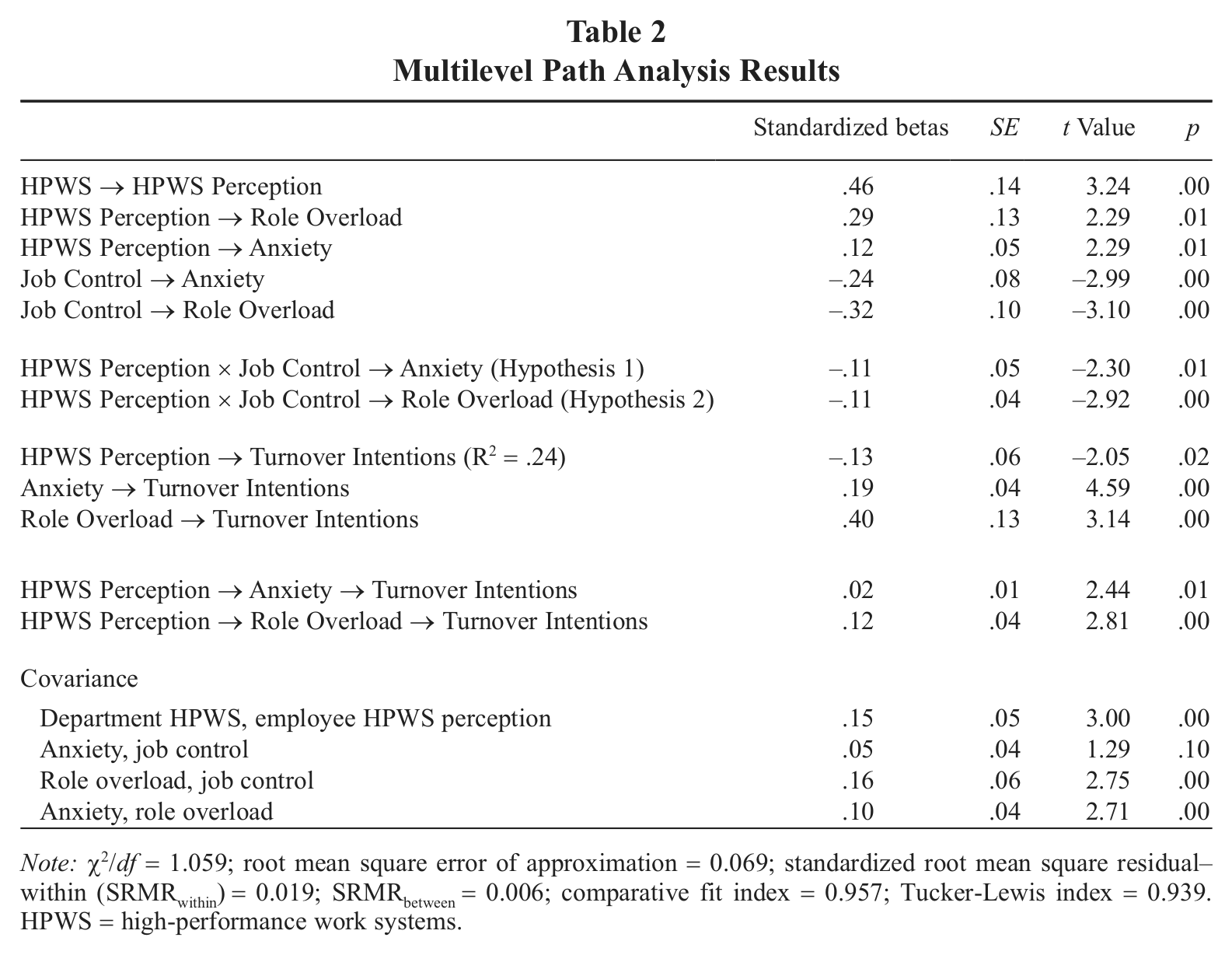
Note: χ2/df = 1.059; root mean square error of approximation = 0.069; standardized root mean square residual–within (SRMRwithin) = 0.019; SRMRbetween = 0.006; comparative fit index = 0.957; Tucker-Lewis index = 0.939. HPWS = high-performance work systems.
Hypotheses 1 and 2 proposed moderating effects of job control on anxiety (β = –.11, p < .01) and role overload (β = –.11; p <.01), respectively. In Figures 2 and 3, we show the interaction plots for these results. In both figures, with increasing HPWS perceptions at the employee level, we see that at high levels of job control, anxiety and role overload are almost flat, while at lower levels of job control, anxiety and role overload are significantly greater. Therefore, Hypotheses 1 and 2 are supported.

Moderation Effects for High-Performance Work System (HPWS) Perception

Moderation Effects for High-Performance Work System Perception
Hypotheses 3 and 4 suggested moderated-mediation effects. To test the significance of the moderated-mediation paths, differences in mediation effects at high and low levels of job control were calculated and are presented in Table 3. Hypotheses 3 and 4 proposed moderated-mediation effects of the interaction of HPWS and job control through anxiety (β = –.04, p < .05) and role overload (β = –.10, p < .05) on turnover intentions, respectively. The results of our analysis support partial mediation of anxiety and role overload on the relationship between the interaction of HPWS and job control on turnover intentions.
Moderated Mediation Effect

Note: HPWS = high-performance work system.
Discussion
HPWS have received a great deal of research attention in the strategic HRM literature. These studies have suggested that HPWS may be utilized to reduce turnover, increase productivity, enhance customer service, and ultimately enhance firm performance (Cappelli & Neumark, 2001; Chuang & Liao, 2010; Datta et al., 2005; Delaney & Huselid, 1996; Delery & Doty, 1996; Guthrie, 2001; Huselid, 1995; Huselid & Day, 1991; Liao et al., 2009; Messersmith & Guthrie, 2010; Takeuchi et al., 2007; Way, 2002). The net result of these studies has generated a strong paradigm in HR research that advocates the positive performance benefits that arise from HPWS adoption and implementation (Guest, 1999; Kroon et al., 2009).
Furthermore, prior work on the effectiveness of HPWS has mainly focused at the firm level and has paid particularly close attention to financial outcomes. Although data on firm-level measures of HPWS and performance obtained from organizational leaders are useful in explaining the overall effects of HR practices, this research focuses on the effects of HPWS utilization at the individual employee level. In addition, the potential negative side effects that HPWS utilization may hold for an organization’s workforce are rarely studied, despite calls for a balanced examination of the effects of HPWS on employees and their job attitudes (Keegan & Boselie, 2006). Thus, in this study we examine the potential “dark side” of HPWS by focusing on the interaction of HPWS perceptions and job control on anxiety, role overload, and turnover intentions.
After controlling for the nesting of employees within departments and authorities, the results of our analysis demonstrate a significant interaction between employee perceptions of HPWS utilization and job control on both role overload and anxiety. Employees who perceive greater organizational use of HPWS and who possess more job control demonstrate lower levels of anxiety and role overload, while those with less job control demonstrate higher levels of anxiety and feel that their roles are overloaded. Further, the results of the study suggest that anxiety and role overload partially mediate the relationship between the interaction of HPWS perceptions and job control on turnover intentions. This finding implies that HPWS utilization, when coupled with low levels of job control, tends to leave employees feeling greater levels of anxiety, role overload, and more prone to turnover intentions. While we hypothesized full mediation, the results showing partial mediation illustrate that turnover intentions, which are a form of strain, are also directly affected by employee perceptions of HPWS and job control.
Taken together, these results speak to a critique in the literature toward the motivation of top managers in their decisions to utilize HPWS in organizations (i.e., Godard, 2001, 2004; Guest, 1999; Keenoy, 1997; Kroon et al., 2009; Legge, 1995; Ramsay et al., 2000). These critical assessments have a multitude of complex philosophical roots, but each concentrates on one encompassing question: While HPWS may benefit organizational performance, what effect do they have on the lives of individual employees? Critical scholars have argued that HR systems, such as HPWS, are little more than a “wolf in sheep’s clothing” (Godard, 2001; Keenoy, 1990). These authors suggest that organizations implement HPWS as a form of covert exploitation designed at eliciting greater levels of participation and effort from employees (Kroon et al., 2009; Legge, 1995; Willmott, 1993). However, to date, little empirical work has been done to address this viewpoint. Early assessments have relied primarily upon case studies, which have not necessarily been directed at assessing the utilization of HPWS specifically but have focused more upon performance management and other more narrow aspects of HRM (Guest, 1999). The present analysis, along with recent work on burnout by Kroon et al. (2009), suggests that when HPWS are implemented with low levels of job control employees are more likely to experience the “dark side” of HPWS. Thus, it may not be the malicious intent of managers or the organization but the absence of job control accompanying HPWS implementation that results in negative consequences for anxiety, role overload, and turnover intentions.
Theoretical and Practical Implications
The results of this study highlight the need for further discussions of HPWS utilization by both practitioners and organizational scholars alike. More specifically, the implications of this study suggest that careful analysis needs to be undertaken to assess ways to best reconcile individual perceptions with the demands for organizational performance. In other words, how may HPWS or the HR system in general best be used to simultaneously support the interests of both the organization and the individual?
While this remains an open question, there is some evidence from this study and elsewhere that the way in which an HPWS is implemented and the philosophy behind the implementation of the system may have significant effects on the resulting perceptions of HPWS by organizational members. For instance, the present study demonstrates that job control attenuates the relationship between HPWS and both role overload and anxiety such that employees who are given more autonomy and control over their individual assignments feel less pressure as a result of HPWS utilization within the organization. These results echo the literature on job demands–control theory (Karasek, 1979), which has long recognized the importance of control perceptions on employee attitudes.
Further, these results support the conclusion advanced by Guest (1999) about why employees tend to have an overall positive assessment of HPWS. Systems of HR practices that are adopted under a soft approach to HRM, in which employee involvement, commitment, and collaboration are at the heart of the HR system, may elicit greater feelings of autonomy and care than hard forms of HRM do. While critics have argued that such soft approaches are merely a means to exploit employees, it may be that such systems truly do exhibit mutuality (Walton, 1985), or the idea that what is best for the employee is also best for the organization, when implemented in proper ways. Therefore, the results of this study further underscore the importance of how HPWS are experienced and perceived by employees in determining the likely effects on organizational performance (Liao et al., 2009; Nishii et al., 2008).
The literature on job design speaks to the heart of this issue by relating the inconsistency between organizational intentions around HPWS implementation and employees’ experiences of anxiety and overload. As noted by Becker and Huselid (2006, 2011), the universal hypothesis regarding HPWS is that “more is better” and that one type of HPWS is likely to fit all organizations, yet this is rarely the case. While this argument goes more specifically into the set of practices included in HPWS, we believe it relates to the findings of this study as well. Namely, HPWS are likely to be less effective in jobs where low levels of autonomy and control exist.
These findings further support the configurational perspective of HR systems, which suggests the need to carefully examine and select practices, integration systems, and HR philosophies that complement one another (Delery & Doty, 1996). As stated by Lepak and Shaw, “A key issue in the configurational perspective is the argument that a given HRM practice—regardless of its situational superiority—is unlikely to yield substantial benefits at the organizational level unless it is combined with other effective practices” (2008: 1488). The results of this study suggest that working to align the context of implementation through job design and systems that support employee discretion, and focusing on the organization’s intentions around HPWS, may be a necessary step to instill a sense of control and autonomy in employees, which may assist firms in avoiding the potential “dark side” of HPWS. Finally, we would argue that autonomy and control are critical components of HPWS effectiveness, and organizations that attempt to implement HPWS without also addressing job design issues relating to employee discretion are not as likely to achieve valued outcomes.
Limitations and Future Directions
The results of this study should be considered in light of its limitations. First, the sampling frame for this study focuses upon public-sector employees in the government of Wales. The sampling frame provides a unique context that limits the generalizability of the findings. It may be that public-sector employees are more apt to feel anxiety and role overload from the utilization of HPWS than their counterparts in private-sector organizations. In particular, the government of Wales has a history of demanding high performance standards from employees (National Assembly for Wales, 2000). Further, in an era where greater scrutiny is placed on the use of public funds, it may be that public-sector employees are more prone to have negative perceptions of HPWS, which serve to color their attitudes and intentions. As a result, future studies should investigate the hypothesized model in a private-sector setting.
In addition, the study focuses on turnover intentions rather than on actual turnover events. While Ajzen’s (1991) model has been useful in linking intentions to behaviors, focusing on turnover intentions rather than actual turnover remains a weaker test of this important individual and organizational outcome. Future research may endeavor to collect data on actual turnover events and supplement these empirical findings with qualitative assessments from exit interviews. Such assessments would provide a more fine-grained assessment of the linkages between HPWS utilization and turnover in organizational settings. This is particularly salient given that existing research in strategic HRM has reported a negative relationship between HPWS utilization and turnover rates at the organizational level of analysis (i.e., Guthrie, 2001; Huselid, 1995; Way, 2002). Additional work is needed to help reconcile these findings between individual perceptions of intent to turnover and actual turnover rates at the organizational level.
We also acknowledge the possibility of a third variable, or an alternative explanation for our findings. While departmental reports and employee perceptions of HPWS utilization were highly correlated, we were unable to assess how effectively the practices had been implemented or whether effects related to the employee’s manager, such as managerial style, may explain why some employees experienced greater anxiety and role overload. In our multilevel analysis, we controlled for departmental effects but did not assess for the effects of managerial style and behaviors. However, because managers often have a strong influence over employees’ day-to-day experiences, future research should investigate the role of managerial and organizational characteristics more fully.
Using cross-sectional data, this study was also an examination of the effects of HPWS on employee outcomes. Thus, we cannot infer causality. Research in this area can build upon our findings by examining the effects of HPWS on employees’ experiences through longitudinal research. In doing so, more clarity can be brought to the question over whether employee perceptions of HPWS change over time, with subsequent effects on anxiety, role overload, or turnover intentions. Several studies have begun to examine the longitudinal effects of HR practices on business performance (Birdi et al., 2008; Ployhart, Weekley, & Ramsey, 2009), yet given the effects of employee stress and health on productivity (Tetrick, Perrewe, & Griffin, 2010), this is an important area for future work.
Finally, the strategic HRM literature has yet to consistently agree upon a set of practices that constitute HPWS (Takeuchi et al., 2007). As a result, the specific practices selected for this study may not be representative of all HPWS utilized in organizations. However, we attempt to mitigate this by including a large number of practices that have been identified as elements of HPWS in previous strategic HRM studies (e.g., Gould-Williams & Davies, 2005; Truss, 1999).
Conclusion
HPWS hold the promise of offering organizations a strategic mechanism to achieve performance benefits; however, the results of the present analysis suggest that organizations must be cognizant of the effects of HPWS on employees. If the implementation of HPWS practices is not coupled with an appropriate increase in control and autonomy to individual employees, simply instating a bundled set of integrated HR practices may have negative effects on employee perceptions of anxiety and role overload. This becomes even more salient when turnover intentions are considered, as results from the present analysis suggest that HPWS lead to stronger turnover intentions through the perceptions of anxiety and role overload. In conclusion, this study suggests a more nuanced approach to assessing HPWS in organizational settings.
Footnotes
Appendix A
Appendix B
Sampling Error per Included Unit
| Service Department (percentages) |
||||||||
|---|---|---|---|---|---|---|---|---|
| Authority Number | Planning | Social Services | Housing Management | Education | Leisure | Waste Management | Revenue and Benefits | Human Resources |
| 1 | 5.59 | 5.74 | 2.44 | 3.44 | 2.03 | 1.93 | 2.03 | 1.74 |
| 2 | 1.61 | 2.05 | 5.22 | 5.49 | 2.02 | 2.48 | 5.63 | 2.25 |
| 3 | 1.62 | 1.57 | 3.73 | 4.85 | 5.78 | 3.75 | 4.77 | 1.71 |
| 5 | 4.25 | 7.96 | 5.58 | 3.72 | 5.71 | 9.69 | 9.31 | 8.48 |
| 6 | 4.37 | 5.33 | 18.31 | 4.08 | 5.27 | 8.45 | 4.02 | 3.90 |
| 7 | 2.27 | 5.06 | 19.25 | 3.86 | 3.84 | 12.06 | 3.96 | 10.77 |
| 8 | 4.02 | 4.98 | 4.93 | 3.43 | 5.05 | 15.64 | 3.98 | 1.73 |
| 9 | 2.70 | 4.89 | 3.70 | 1.51 | 3.50 | 8.03 | 5.68 | 4.46 |
| 10 | 5.69 | 3.86 | 4.09 | 2.19 | 4.62 | 6.27 | 5.01 | 4.27 |
| 11 | 2.59 | 4.42 | 17.27 | 5.46 | 2.24 | 9.47 | 5.79 | 3.57 |
| 13 | 2.41 | 3.68 | 4.48 | 2.32 | 5.27 | 6.40 | 4.31 | 1.75 |
| 14 | 5.10 | 3.55 | 4.68 | 4.60 | 3.76 | 9.11 | 9.88 | 4.30 |
| 15 | 6.94 | 5.11 | 11.51 | 5.15 | 5.13 | 9.80 | 10.13 | 5.53 |
| 16 | 3.77 | 1.66 | 4.10 | 2.49 | 2.48 | 1.89 | 2.28 | 1.58 |
| 17 | 4.90 | 4.99 | 4.87 | 5.67 | 1.72 | 4.14 | 15.55 | 14.12 |
| 19 | 1.79 | 1.68 | 1.50 | 4.00 | 5.59 | 4.70 | 4.74 | 2.36 |

Note: Gray highlights indicate dropped units, for a final sample of 1,592 employees representing 87 units.
Appendix C
Employee and Department-Level Measures of High-Performance Work Systems
|
|
| To what extent do you agree or disagree with each of the following statements about your department? (1 = strongly disagree to 7 = strongly agree) |
| 1. I am provided with sufficient opportunities for training and development. |
| 2. I receive the training I need to do my job. |
| 3. This department keeps me informed about business issues and about how well it’s doing. |
| 4. There is a clear status difference between management and staff in this department. |
| 5. Team working is strongly encouraged in our department. |
| 6. A rigorous selection process is used to select new recruits. |
| 7. Management involve people when they make decisions that affect them. |
| 8. Communication within this department is good. |
| 9. Communication between departments is good. |
| 10. I feel my job is secure. |
| 11. The rewards I receive are directly related to my performance at work. |
| 12. Career management is given a high priority in this department |
| 13. I have the opportunities I want to be promoted. |
| 14. The appraisal system provides me with an accurate assessment of my strengths and weaknesses. |
| 15. I am given meaningful feedback regarding my performance at least once a year. |
|
|
| We are trying to get an overall impression of how employees are managed in your department. Please provide your best estimate in each case that describes the HR practices in existence in YOUR Department. Indicate what percentage of employees . . . |
| 1. Have one or more employment test prior to hiring (e.g. personality, ability tests). |
| 2. Hold non-entry level jobs as a result of internal promotions ( i.e. % of employees that have been promoted within the organisation since their initial post). |
| 3. Are promoted on the basis of merit or performance as opposed to length of service. |
| 4. Are hired following intensive/extensive recruiting (e.g. your department had to put forth a lot of effort to recruit). |
| 5. Are routinely administered attitude surveys to identify and correct employee morale problems. |
| 6. Are involved in programmes designed to elicit participation and employee input (e.g. quality circles, problem-solving or similar groups). |
| 7. Have access to a formal grievance and/or complaint system. |
| 8. Are provided with service department operating performance information. |
| 9. Are provided with financial performance information. |
| 10. Are provided with information on strategic plans. |
| 11. Receive a formal personal performance appraisal/feedback on a regular basis. |
| 12. Receive a formal personal performance appraisal/feedback from more than one source (i.e. from several individuals such as supervisors, peers, etc.). |
| 13. Receive rewards which are partially contingent on group performance (e.g. department bonuses). |
| 14. Are paid on the basis of a skill rather than a job-type (i.e. pay is primarily determined by a person’s skill or knowledge level as opposed to the particular job they hold). |
| 15. Receive intensive/extensive training in organization-specific skills (i.e. task or organization specific training). |
| 16. Receive intensive training in generic skills (e.g. problem-solving, communication skills) |
| 17. Receive training in a variety of jobs or skills (“cross-training”). |
| 18. Routinely perform more than one job (are “cross utilized”/multi-skilled). |
| 19. Are organized in self-directed teams in performing a major part of their work roles. |
| 20. Are offered flexible working (e.g. job share/term-time employment/flexitime, home working). |
| 21. Are covered by “family-friendly” policies (e.g. time off to care for dependents). |

Note: For the employee-level measure, items 1, 3, 4, 5, 6, 7, and 10 are from Gould-Williams and Davies (2005), and items 2, 8, 9, 11, 12, 13, 14, and 15 are from Truss (1999). For the department-level measure, items 1 through 19 are from Datta, Guthrie, and Wright (2005).
Acknowledgements
We would like to thank Jim Guthrie, Tjai Nielsen, and Jana Raver for their helpful feedback and comments. We acknowledge Dr. Julian Gould-Williams, the Economic and Social Research Council, and the UK Data Archive for data access and funding. The original data creator, depositor, or copyright holders, the funder of the data collection, and the UK Data Archive bear no responsibility for the analysis or interpretation of the data.