



Abstract
This review systematically examines comparative international entrepreneurship (CIE) research, analyzing 259 articles published in 21 leading journals from 1989 to 2010. We outline the importance of multi-country studies of entrepreneurial activity in enabling the comparison and replication of research and generating meaningful contributions to scholarship, practice, and policy. Our systematic review classifies research findings into four levels—individual, firm, industry, and country—each with respect to characteristics, antecedents, and outcomes of entrepreneurial activities as well as theory and methodology. Taken together, our review highlights the heterogeneous nature of entrepreneurship across countries and its role in explaining outcomes at firm (e.g., financial and export performance) and country (e.g., economic growth) levels as well as antecedents at the country level (e.g., culture). We find the CIE literature is highly fragmented with substantial knowledge gaps related to content, theory, and methodology, for which we outline a detailed future research agenda. Given the atheoretical nature of most published CIE research, we provide specific suggestions to extend the current dominant theoretical perspectives (institutions, culture, resource-based view, transaction cost economics, economic growth, and human capital); consider new lenses from management, international business, and entrepreneurship; and integrate and test multiple theories. From a content perspective, we outline the need to define and cross-reference prior studies of entrepreneurship and prioritize emerging phenomena that are critical to practice, and policy, and offer specific directives for integrated and multi-level studies of characteristics, antecedents, and outcomes. Methodological suggestions include theory-based rationale for the selection of countries, greater attention to data collection and sample selection equivalence, and the solutions to the ecological fallacy problem. We urge scholars to work together and across countries, cooperating with interested agencies and associations to develop new longitudinal, multi-level data sets and introduce dual qualitative/quantitative approaches and new diverse, sophisticated analytical tools.
Keywords
International entrepreneurship (IE) is “the discovery, enactment, evaluation and exploitation of opportunities—across national borders—to create future goods and services” (Oviatt & McDougall, 2005: 540). 1 According to Oviatt and McDougall (2005: 540), “There are two branches to the study of international entrepreneurship, one focusing on the cross-national-border behaviour of entrepreneurial actors and another focusing on the cross-national-border comparison of entrepreneurs, their behaviors, and the circumstances in which they are embedded” (emphasis added). Thus research in the comparative branch of IE, or comparative international entrepreneurship (CIE), involves cross-national comparisons of domestic entrepreneurship (e.g., differences in entrepreneurial activity rates across countries) and of entrepreneurial internationalization (e.g., cross-country differences in the drivers of new venture internationalization) (Hessels, 2008). 2
CIE scholarship is limited and in an “infancy” stage (Engelen, Heinemann, & Brettel, 2009). As noted by Baker, Gedajlovic, and Lubatkin (2005: 492-493), compared to (noncomparative) entrepreneurial internationalization research, “the comparative IE stream, however, has not developed at a similar pace,” and despite the large cross-national variations identified, there are “limited theoretical insights.” Apart from the theoretical challenges, CIE suffers from a lack of consensus on the definition of entrepreneurship (Yeung, 2002) as well as the difficulty of conducting cross-national research.
Taken together, this is troubling because CIE research is critical for entrepreneurship research and practice and has considerable potential within the IE field (Coviello & Jones, 2004). Cross-national research enables comparison and replication and reduces the risk of nation-specific results that are not generalizable to other countries. Such studies enable the evaluation of different models of activity at multiple levels (individual, firm, industry, country) through commonly understood vocabulary and methodology. As Reynolds (1991: 245) argues, “finding the same empirical patterns in different countries provides evidence that the same explanations of entrepreneurial phenomena have broad empirical support and, hence, deserve greater confidence for applications in any one situation.” Although scholars “traditionally assumed that their findings are universal as opposed to being nation-specific” (Aldrich, 2000: 6), it is easier to claim generalizability when results are confirmed across different national contexts.
In addition to finding similar patterns, CIE research may also help to identify fundamental differences in entrepreneurial activity across countries and to investigate their sources as well as their implications. When asked about the most promising directions in entrepreneurship research, Nobel Laureate Ronald Coase recently shared, “This global blossoming of entrepreneurship provides a great opportunity for scholars to study how the market economy functions in countries with different histories, cultures, and political systems” (Terjesen & Wang, 2013: 180). An appreciation of similarities as well as fundamental differences enables scholars to develop better theories to explain conditions that help or hinder entrepreneurial activity in different countries as well as the implications of entrepreneurship. Further, cross-country studies can help to identify government policies and programs that best support entrepreneurial efforts and desired outcomes in terms of innovation and growth in different national contexts. Comparative entrepreneurship studies are extensively profiled in government (e.g., Organisation for Economic Co-operation and Development [OECD], 2009) and media (e.g., Economist, 2009, 2011) outlets. CIE investigation is particularly essential if entrepreneurial activity leads to greater national economic prosperity (Carree, van Stel, Thurik, & Wennekers, 2002). CIE is also a central component of teaching, receiving substantial attention in entrepreneurship and international business textbooks (e.g., Hisrich, 2009; Peng, 2012).
To the best of the authors’ knowledge, the present study is the first comprehensive review to specifically focus on CIE research. Recent literature reviews (e.g., Coviello & Jones, 2004; Keupp & Gassmann, 2009; Rialp, Rialp, & Knight, 2005; Zou & Stan, 1998) enhanced the knowledge of entrepreneurial internationalization activities but did not distinguish between single and multiple country studies. 3
The primary objectives of our review are to (1) systematically review and assess the current status of CIE research and (2) highlight knowledge gaps and offer promising directions for future research. Our review is the first to systematically inventory the heterogeneous CIE literature, which emerges from management, entrepreneurship, and international business journals. We explore the patterns of (1) journal publication; (2) geographies of authors and data; (3) content by characteristics, outcomes, and antecedents; (4) theories; and (5) methods used. Based on this general framework, we critically analyze extant research and provide an overview of promising future research directions with respect to content, theory, and methodology.
Taken together, our review of CIE research highlights the heterogeneous nature of entrepreneurial activity across countries and its importance especially in terms of outcomes at firm (e.g., financial and export performance) and country (e.g., economic growth) levels. Extant CIE research also identifies country-level antecedents (e.g., culture, other institutions) to entrepreneurial activity. The literature, however, is highly fragmented, and there are substantial knowledge gaps in content, theory, and methodology.
Methodology Used for the Systematic Review
We analyze 259 CIE studies that were published or available in press from 1989 to June 2010 in the following 21 journals: Academy of Management Journal (AMJ), Academy of Management Review (AMR), Administrative Science Quarterly (ASQ), Entrepreneurship & Regional Development (E&RD), Entrepreneurship Theory & Practice (ET&P), International Business Review (IBR), International Marketing Review (IMR), Journal of Business Venturing (JBV), Journal of International Business Studies (JIBS), Journal of International Entrepreneurship (JIE), Journal of International Management (JIMgmt), Journal of International Marketing (JIMktg), Journal of Management (JOM), Journal of Management Studies (JMS), Journal of Small Business Management (JSBM), Journal of World Business (JWB), Management International Review (MIR), Management Science (MS), Organization Science (OS), Small Business Economics (SBE), and Strategic Management Journal (SMJ). This list is based on journals with high impact (Podsakoff, MacKenzie, Bachrach, & Podsakoff, 2005) and a history of international entrepreneurship research (Coviello & Jones, 2004; Gamboa & Brouthers, 2008; Keupp & Gassmann, 2009).
We follow the “systematic review process” (Tranfield, Denyer, & Smart, 2003), using Business Source Premier, JSTOR, and ProQuest to search the following keywords: entrepreneurial, entrepreneurs, entrepreneurship, intrapreneur, intrapreneurship, new firm(s), new ventures, spin-off/spinoff, start-up/startup, venture, and venturing and one or more of these keywords: comparative, countries, cross-cultural, cross-national, global, international, and multi-country. 4 As such, our definition of entrepreneurship is broad and inclusive of many subtopics.
Following Ireland, Reutzel, and Webb (2005), we do not include innovation and small business as search terms. We do, however, incorporate articles containing the terms innovation and small business if these articles also include the above-mentioned search terms. Articles that contain these keywords and are based on data sets of small and medium-sized enterprises (SMEs) are included, as a large body of IE research is based on SME data (Keupp & Gassmann, 2009). We include special issue introductions, narratives, and thought pieces but exclude teaching cases and book and thesis reviews. (See appendix for included articles.)
Each author independently read the original collection of over 600 articles to identify which should be included and then compared notes to reach agreement.
Current Status of CIE Research 5
Demographics: Journal Outlets and Geographic Distribution of Authors and Data
We begin by examining journal outlets for multi-country comparative entrepreneurship research and analyzing the geographic distribution of authors and data. This analysis is informative when interpreting patterns of content, theory, and methods used. For example, the number and type of countries involved provide insights regarding the extent to which results may be generalizable across different national contexts.
Journal Outlets
The four journals publishing the most CIE research articles are SBE, ET&P, JBV, and E&RD. CIE research is predominantly published in entrepreneurship journals (80%), with only 17% published in international business journals. This probably relates to the fact that most CIE studies (82%) examine cross-country differences in domestic entrepreneurship, while research on cross-country comparison of internationalization by entrepreneurial firms (i.e., CIE) is limited (18%). While the number of publications has recently increased in both international business and management journals, the academic conversation on CIE is largely confined to entrepreneurship. The isolated nature of the field may indicate that CIE research is a niche that is not well communicated to scholars outside entrepreneurship departments. This is problematic because by nature, CIE is interdisciplinary and scholars should have open lines of communication in order to share and build upon related findings.
Although the majority of CIE research is published in entrepreneurship journals, the most impactful CIE studies appear in various journals. To understand journal outlet impact on the CIE field, we explore our sample’s citation counts. 6 The 10 most cited articles are Baumol (1996; over 2,800 citations); Oviatt and McDougall (1994; over 1,000); McDougall and Oviatt (2000; over 400); Sapienza, Manigart, and Vermeir (1996; over 400); and with over 200 citations each, Mueller and Thomas (2000); Carree et al. (2002); Loveman and Sengenberger (1991); Mitchell, Smith, Seawright, and Morse (2000); Antoncic and Hisrich (2001); and Thomas and Mueller (2000). In contrast to Davidsson’s (2013) findings that the top 20 most cited papers in entrepreneurship are dominated by North American scholars, we find that the most cited CIE articles are split nearly equally between North American and European scholars. The most cited articles are published in JBV, AMJ, JIBS, and SBE and thus not strictly confined to entrepreneurship journals. The cross-disciplinary focus of research is encouraging, indicating the promise and prominence of CIE. Furthermore, these articles constitute key, often seminal, contributions across multiple fields, including culture, economic growth and development, entrepreneurial firm internationalization, psychological capital, and venture capital. Leading articles utilize a wide variety of data (including surveys and secondary data) and methods (e.g., case studies) and are exemplary in integrating literature from different disciplines and cross-validating methodological tools.
While the “infancy” feature of CIE research is reported in prior review studies (e.g., Aldrich, 2000; Coviello & Jones, 2004; Keupp & Gassmann, 2009), we find that research output has increased dramatically over the past two decades and that 45% of CIE articles were published in the past 5 years, indicating that the field of CIE is rapidly transitioning into an “adolescence” stage.
Geographic Analysis of Authorship Origin and Data Focus
We identify 582 authors from institutions in 45 countries, dominated by the United States, with substantial contributions from the United Kingdom, Netherlands, Germany, Canada, and Belgium. Despite the diversity of countries, 61% are written by an author or author team based in one country, compared to 30% in two countries and 9% in three countries. Furthermore, when countries are examined in the context of their home regions, 7 one region is dominant (74%), followed by two regions (24%) and three regions (2%). 8 This finding that only a fraction of CIE research involves a truly global author team is surprising, given the abundance of international research networks and available technologies to aid cross-country collaboration. Our findings, however, do suggest progress since Aldrich’s (2000) assessment that few non–North American scholars form collaborative relationships or research teams with U.S. scholars. There remains significant opportunity for global research collaboration.
In terms of geographic coverage by empirical data, the number of countries covered in CIE articles ranges from 2 to 76 countries, with a mean of 9.3, mode of 2, and median of 3. Although not nearly as dominant as the geographic authorship pattern discussed above, developed countries are the most commonly studied (66%). The number of countries studied has increased in the past 5 years (mean = 14.1 countries and 2.9 regions in 2005 to 2010, compared to 4.1 and 1.9 in 1989 to 1994), possibly reflecting the increased public availability of international comparative data sets covering many countries. Historically, articles with coauthors from 2 or 3 countries utilize primary data gathered from their respective countries. More recently, authors work with data from outside their countries; it is not uncommon to find two scholars, from the same country, publishing results from regression analyses using a sample of 40 countries.
Taken together, the geographic analyses demonstrate great asymmetry: Our sample includes data from 78 countries, but authors hail from only 45 countries. Despite the recent growth in the study of transitioning/emerging markets, only 6% of studies include the fast-growing BRIC (Brazil, Russia, India, and China) economies. Furthermore, BRIC authors constitute less than 1%, indicating that scholars in these countries are largely left out of published conversations.
Content
Table 1 depicts the articles’ content. Following Cooper and Gimeno-Gascon (1992), we classify studies into four levels: individual, firm, industry, and country. We examine findings with respect to characteristics, antecedents, and outcomes for each level and report these in subsequent sections. Antecedent and outcome research focuses on causes and effects of entrepreneurial activity and substantially contributes to our theoretical understanding of entrepreneurial phenomena. Characteristics research describes what exists and does not try to determine cause and effect or make predictions. This type of CIE research is used to gain a better understanding of a new topic (e.g., a new or unknown type of entrepreneurship, such as social entrepreneurship), provide an in-depth or detailed examination of how countries differ (e.g., in terms of specific institutions, systems, processes, and attributes of entrepreneurs), analyze the development of industries or institutions across countries, evaluate the cross-national generalizability of different empirical measures or constructs, and compare various international datasets. These often seminal studies, albeit usually atheoretical and based purely on descriptive statistics, define and delimit the phenomenon and provide context to theory, thus contributing to the evolution and subsequent development of a field.
Comparative International Entrepreneurship Content and Sample Research Questions

Note: All research questions have a multiple-country perspective, but countries are not listed due to space considerations.
Individuals
Individual-level studies shed light on the existence and characteristics of various types of entrepreneurial individuals. The vast majority (82%) of individual-level CIE research examines characteristics of entrepreneurs, especially their gender, social capital, human capital, and psychological capital. In terms of gender, a uniform finding across countries is that women are less involved in entrepreneurial activities than their male counterparts (Klofsten & Jones-Evans, 2000; Verheul, van Stel, & Thurik, 2006), grow their ventures more slowly (Liedholm, 2002), and face similar start-up motivations and challenges (Lituchy & Reavley, 2004). Regarding social capital, there are common patterns across countries (and gender) as well as cross-country diversity. An early analysis of Italy and the United States shows that women’s networks contain mostly men, while men’s networks contain almost no women, and network density in terms of strangers is similar across both genders and countries (Aldrich, Reese, & Dubini, 1989). A separate study finds that compared to entrepreneurs in Hungary, Irish entrepreneurs are more likely to be acquainted with other entrepreneurs (Acs, O’Gorman, Szerb, & Terjesen, 2007). CIE studies of entrepreneurs’ human capital focus mainly on their education and work experience and indicate significant cross-country variation. Irish entrepreneurs, for example, have higher formal education qualifications than their Hungarian counterparts (Acs et al., 2007). With respect to psychological capital, some studies on individuals’ attitudes, aspirations, and motivations report cross-country similarities among entrepreneurs, especially when compared to managers. For example, Del Junco and Brás-dos-Santos (2009) find that compared to managers, entrepreneurs share a similar pattern of personal values. McGrath and MacMillan (1992) show that even among culturally very different societies, there is a core set of perceptions that entrepreneurs hold about others. Specifically, entrepreneurs feel that others in their society are unwilling to determine their own destiny and to work hard to earn social rewards and are less likely to enjoy what they are doing. Other studies describe cross-country differences among entrepreneurs in terms of internal locus of control, tolerance for ambiguity, autonomy, risk-taking propensity, and energy levels. For example, Thomas and Mueller (2000) report that entrepreneurial characteristics, such as internal locus of control, moderate risk-taking propensity, and high energy level, decrease in frequency as cultural distance from the United States increases. Tajeddini and Mueller (2009) indicate that characteristics associated with entrepreneurial success (e.g., autonomy, propensity for risk taking, and locus of control) are more prevalent among British than among Swiss entrepreneurs, while need for achievement, tolerance for ambiguity, innovativeness, and confidence are more likely to be found among Swiss than among British entrepreneurs.
In addition to entrepreneurs, other “entrepreneurial” individuals studied are informal investors, venture capitalists (VCs), and immigrant/transnational entrepreneurs. Three studies on informal investors describe a similar profile across countries: predominately male, entrepreneurial background, and financially comfortable but differences in terms of investment behavior, performance, and satisfaction. In an early study, Harrison and Mason (1992) find that compared to U.S. investors, U.K. informal investors have more investment opportunities brought to their attention, seriously consider more proposals, operate independently with syndication and joint investments relatively uncommon, have a higher rate of return and capital gains expectations, are slightly less patient investors, and are rather less satisfied with the overall performance of their portfolios. Landström (1993) reports differences along professionalism in investment activity (United Kingdom, low; United States, moderate; Sweden, high), investment portfolio risks (United Kingdom, moderate; United States, high; Sweden, low), and extent of involvement in portfolio firms (United Kingdom, low; United States, high; Sweden, moderate). The 15 comparative VC studies, possibly due to the premature VC industry in many countries, report a mix of commonalities and differences. VCs in rules-based market economies tend to rely more on market information than their counterparts in emerging economies (Zacharakis, McMullen, & Shepherd, 2007). Despite the high prevalence rate of immigrant/transnational entrepreneurship, especially in high technology and growth-oriented sectors (Wadhwa, Saxenian, Rissing, & Gereffi, 2007), the phenomenon is understudied. We identify one empirical cross-country study indicating that transnational entrepreneurs utilize economic, social, cultural, and symbolic capital to navigate multiple institutional environments (Terjesen & Elam, 2009).
A limited body of CIE work explicitly examines individual-level factors as antecedents (e.g., human capital and demographics) and outcomes (e.g., autonomy, wealth creation, and quality of life) of entrepreneurship—11 studies and 1 study, respectively, making it difficult to draw any general conclusions and clearly marking uncharted CIE territory. The lack of individual-level antecedent studies is particularly striking as the entrepreneurship and international entrepreneurship literature emphasizes the importance of entrepreneurs’ characteristics and experiences for start-up and other strategic decisions.
Firms
Firm-level research composes the largest portion (42%) of the existing CIE field, with the primary foci on characteristics and outcomes of entrepreneurial firms. We identify only 10 studies of firm-level antecedents. The diverse nature of this research makes it impossible to draw any meaningful conclusions. Our discussion below focuses on the characteristics of entrepreneurial firms and outcomes at the firm level.
In terms of characteristics, CIE studies of “entrepreneurial” firms generally report cross-country differences in entrepreneurial orientation (EO; Hansen, Deitz, Tokman, Marino, & Weaver, 2011; Kemelgor, 2002; Slevin & Terjesen, 2011). Although ventures across countries adopt similar technology and business profiles (Johannisson, 1995), there is variance in how technologies contribute to venture survival and growth (Roper, 1997). The three VC firm characteristic studies suggest great cross-country differences in discounted cash flow–based measures, price/equity comparators (Wright, Manigart, Sapienza, Desbrieres, & Hommel, 2004), and use of networks (Ahlstrom & Bruton, 2006) but lack insight on the source of these differences and the implications for VC-backed firms.
CIE research on firm-level outcomes is rather extensive (49 studies) but diverse and can be categorized into venture performance and venture internationalization. Venture performance is mainly studied in terms of financial performance (such as profitability, sales growth, and cost reduction) and innovation performance. Regarding financial performance, there is mixed evidence on the effect of characteristics of owners/managers and ventures. Across countries, venture/SME success depends on management skill (Gebert & Steinkamp, 1991; Yusuf, 1995), self-employment experience (Kessler, 2007), R&D activity (Goedhuys & Sleuwaegen, 2010; Hölzl, 2009), and ownership structure (Bruton, Filatotchev, Chahine, & Wright, 2010). Regarding innovation performance, we know much about the cross-country pattern of venture/SME innovation performance in Europe (e.g., Boter & Holmquist, 1996) but little about patterns and differences in other regions.
With respect to venture internationalization, national culture has a small role in determining firm internationalization, especially compared to the effects of industry characteristics (e.g., Boter & Holmquist, 1996; Perks & Hughes, 2008). Internationalization decisions are based on features of the entrepreneur/manager, firm, and external environment. Entrepreneur/manager features include global vision (Johnson, 2004), international knowledge and experience (Terjesen & Elam, 2009), and personal/business networks (Gassmann & Keupp, 2007; Johnson, 2004; Loane & Bell, 2006). Venture/SME features include intangible assets (Loane, Bell, & McNaughton, 2007) and niche-focused international strategy (Gassmann & Keupp, 2007). External environment aspects include intellectual property protection (Gassmann & Keupp, 2007), policy changes (Bell, McNaughton, & Young, 2001), and international trade (De Clercq, Hessels, & van Stel, 2008). Research on ventures’ export performance has a greater diversity in geographic regions covered but is also focused mostly on Europe. Oviatt and McDougall’s (1994) seminal study spurred interest in new ventures’ internationalization timing, export support (Seringhaus & Botschen, 1991), entry modes (Brouthers & Nakos, 2004), and related decisions. While the number of CIE studies on venture internationalization has increased to 22% of all CIE studies in the past 5 years (compared to 14% of CIE articles published in 1989 to 2004), the number of studies and countries examined is still limited and prevents us from drawing meaningful conclusions regarding cross-country patterns.
Industries
Industry-level CIE research is limited. Only six studies explore characteristics of industries of entrepreneurial firms, SMEs, VC, and the informal sector, with no consistent findings. The paucity of research may be explained by the difficulty in obtaining comparable industry data. With respect to the VC industry, there is substantial variance across countries and regions. For example, compared to the United States, European countries’ VC industries have distinct structures, institutions, policies, and characteristics (Ooghe, Manigart, & Fassin, 1991). This study reports that only 14% of European investments are in seed or start-up companies, much less than the 30% in the United States. Bruton and Ahlstrom (2003) highlight vast differences in the VC industry between East Asia and the West, specifically that East Asian VC firms are more likely than their Anglo-Saxon-based counterparts to use networks to replace formal institutions.
Industry-level antecedents are largely absent, with only two studies. We identify one study of industry-level outcomes: Leleux and Surlemont (2003) examine the development of the VC industry across 15 European countries, finding that public involvement serves as a signal to the market and leads to greater investment amounts.
Countries
One quarter of country-level CIE research is characteristics based and describes extensive cross-country variety in entrepreneurial activity and cultural, political, environmental, social, technological, ecological, and legal institutions, albeit with varied definitions and measurements. Although this descriptive work offers interesting comparisons, it provides limited insight into the mechanisms driving and resulting from these differences. The majority of research in this category was conducted during the 1980s and early 1990s. While the theoretical exploration of cross-country differences has been limited, this research provides a solid foundation for the later development of CIE field, for example, by offering insight into the prevalence of (different types of) entrepreneurs across countries and the institutional contexts in which they operate.
Although research on country-level antecedents (e.g., regulatory, political, economic, cultural, and social institutions) has considerably matured and progressed, there remain varied definitions and institutions. A large body of culture research reports significant associations between culture indicators and entrepreneurial activity (Autio, Pathak, & Wennberg, in press). A consistent finding is that individualism contributes to start-up activity (Baughn & Neupert, 2003; Mitchell et al., 2000) and corporate entrepreneurship (Morris, Davis, & Allen, 1994). Uncertainty avoidance and femininity explain participation of entrepreneurs/firms in collaboration agreements (Steensma, Marino, & Weaver, 2000; Steensma, Marino, Weaver, & Dickson, 2000). Social status of entrepreneurship at the cultural level predicts interest in entrepreneurship better in East Asian than in Anglo-Saxon countries (Begley & Tan, 2001).
The 28 country-level antecedent CIE studies on legal, political, and economic dimensions present mixed evidence. A growing stream investigates the impact of legal system quality on VC activity (Bruton, Fried, & Manigart, 2005; Cumming, Fleming, & Schwienbacher, 2009; Cumming, Schmidt, & Walz, 2010). Specific regulations as antecedents include bankruptcy law (S.-H. Lee, Peng, & Barney, 2007), taxes, and business regulations (Acs, Desai, & Hessels, 2008; Ho & Wong, 2007; van Stel, Storey, & Thurik, 2007). For example, across OECD countries, lower taxes stimulate self-employment (Fölster, 2001) and the perception of administrative complexities affects entrepreneurial drive (Grilo & Irigoyen, 2006). Moreover, the 5 studies on political institutions and lack of empirical investigation inhibit generalizations. For example, Ireland, Tihanyi, and Webb (2008) propose that a social movement advocating capitalism in central and southern European countries facilitates an entrepreneurial culture but that social democratic movements lead to a moderate decline in entrepreneurial culture. Pure economic indicators research has been conducted in the past 5 years, generating disconnected findings from the 5 studies in part due to the diversity of measures of entrepreneurial and economic activity; for example, GDP per capita is negatively associated with necessity-motivated entrepreneurship (Hessels, van Gelderen, & Thurik, 2008; McMullen, Bagby, & Palich, 2008) and unemployment rates negatively impact male but not female entrepreneurship (Verheul et al., 2006).
Regarding country-level outcomes, we observe an increase in CIE research on the relationship between entrepreneurship and economic growth. Research indicates that entrepreneurship contributes to economic growth, at least in higher-income countries (Acs & Amorós, 2008; Carree & Thurik, 2008; Minniti & Lévesque, 2010; Valliere & Peterson, 2009). However, not all new firms promote economic growth. Baumol (1996) distinguishes productive entrepreneurial activities (e.g., innovation) from unproductive ones (e.g., rent seeking) and suggests that policies influence the allocation of these types and subsequent economic growth (Baumol & Strom, 2007). High-expectation or high-growth-potential entrepreneurship, rather than necessity-based entrepreneurship, generates country wealth and growth (Valliere & Peterson, 2009; Wong, Ho, & Autio, 2005). Although this research is mostly based on a small number of countries, these types of studies clearly suggest, based on empirical analyses, that entrepreneurial activity, particularly in the form of ambitious high-technology start-ups, drives economic growth.
Theory
Next, we examined the theoretical perspectives employed in CIE research. We follow Sutton and Staw (1995) and Whetten (1989) in referring to theory as the building blocks answering what (variables, constructs, concepts) causes what and why (underlying psychological, economic, or social dynamics) and who, where, when (temporal and contextual factors that set the boundaries of generalizability), and how (relationships among variables, constructs, and concepts). We judged articles to have a strong theory application and/or building focus when evidenced by espoused purpose, argumentation, stated contributions, and/or implications. 9
We find that only 29% of the articles we reviewed explicitly build, develop, and/or contribute to theory; the majority tends to focus on describing the characteristics of the phenomenon or the findings from an empirical test. This is consistent with Baker et al.’s (2005) assessment of a deficiency of theory in CIE research; however, we find substantial progress in the 5 years since its publication. The atheoretical nature of CIE research is a major concern, hampering the development of the field. The five most employed theories in the CIE literature are institutional, culture, transaction cost economics (TCE); resource-based view (RBV); and economic growth. Given their importance to CIE research, we briefly comment on each.
Institutional theory is defined and applied variously in 24 CIE studies. Within this stream, the majority adopt an approach in line with North’s (1994) description of institutions as formal (e.g., rules, laws, constitutions) and informal (e.g., norms of behavior, conventions, self-imposed codes of conduct) constraints. For example, studies theorize about the effects of government restrictions on freedom (McMullen et al., 2008), bankruptcy laws (Peng, Yamakawa, & Lee, 2010), and a variety of formal and informal institutions (Ireland et al., 2008) on entrepreneurial activities. Others apply Scott’s (1995) three pillars of regulative, normative, and cultural-cognitive institutions in investigating entrepreneurial activity variance across countries (Busenitz, Gómez, & Spencer, 2000) and gender (Baughn, Chua, & Neupert, 2006). However, institutional approaches developed in other disciplines, such as sociology and public policy (e.g., varieties of capitalism, as in Terjesen & Hessels, 2009), are seldom applied. Taken together, although CIE interpretations of institutional theory are varied, existing research focuses on the structure of institutions, especially at the national level, rather than their dynamic nature and the underlying processes.
The nine studies grounded in culture theory are dominated by the perspective of Hofstede’s (2001) definition of culture as collective mental programming that tends to be shared by individuals within a nation and differs substantially across nations. Scholars have explored national differences in patterns of entrepreneurial activity based on shared attitudes, values, and norms with respect to Hofstede’s five dimensions (e.g., Del Junco & Brás-dos-Santos, 2009; Steensma, Marino, & Weaver, 2000; Steensma, Marino, Weaver, et al., 2000).
Six CIE articles examine TCEs across countries and corresponding similarities and differences in entrepreneurial activities by individuals and firms. At the firm level, researchers apply TCE to examine venture internationalization modes (Brouthers & Nakos, 2004). A growing body of TCE-grounded CIE studies focuses on the role of free markets in stimulating entrepreneurship (e.g., Tesfom, Lutz, & Pervez, 2003). For example, some scholars equate “increases in economic freedom to reductions in transaction costs” (McMullen et al., 2008: 876).
In six studies, RBV perspectives focus on how firms in different countries possess unique sets of resources that impact strategies (especially internationalization, networking, and alliance formation) and performance. Networks provide access to resources that aid internationalization (Loane & Bell, 2006). There is limited RBV theorizing on differences across and within nations in individuals’ unique sets of resource stocks and corresponding entrepreneurial behavior.
Six CIE research studies adopting the economic growth theory (see Barro & Sala-i-Martin, 2003, for an overview) focus on the role of entrepreneurship in economic growth and development. Endogenous growth theories (e.g., Lucas, 1988; Romer, 1990) are used to explain how entrepreneurs help to commercialize new economic knowledge stemming from individual actions or agents (e.g., Hessels & Van Stel, 2011). Recent popular press emphasizes the importance of growth at firm (M. Olson & Van Bever, 2008) and national economy (Hubbard & Navarro, 2010) levels; however, there is limited comparative international entrepreneurship research in this area. These studies are all empirical, investigating the role of nascent entrepreneurship (van Stel, Carree, & Thurik, 2005), early-stage entrepreneurship (Hessels & Van Stel, 2011), and business ownership (Carree et al., 2002) in driving economic growth, especially in terms of entrepreneurial quality such as job growth (Wong et al., 2005) and innovation (Minniti & Lévesque, 2010).
Fourteen studies integrate theoretical approaches, for example, exploring the role of resources and the institutional environment on firm entrepreneurial behavior (Dickson, Weaver, & Hoy, 2006). This is surprising, as entrepreneurship is a multi-level phenomenon and integrated theoretical approaches enable multi-level evaluation. Despite the development of several theoretical paradigms in CIE research, we note a paucity of the most prominent theories from management, international business, and entrepreneurship as well as from related fields, such as economics, finance, and sociology.
Methods Used
Our systematic review yields several insights regarding CIE studies’ data and methodology (see Table 2). The primary unit of analysis of CIE research is country, followed by firm and individual (with 12% employing two or more different levels). This finding substantially differs from prior research describing the broader field of entrepreneurship research as dominated by micro-unit analyses focusing on the individual entrepreneur (Chandler & Lyon, 2001; Davidsson & Wiklund, 2001; Ireland et al., 2005). CIE research’s focus on the country unit of analysis also differs from the international entrepreneurship subfield examined by Coviello and Jones (2004), as they identify firm as the primary unit of analysis followed by individual. The use of data with country as the primary unit of analysis is facilitated by the relatively easier access to country-specific data across multiple nations in recent years, especially the GEM survey of over 80 countries.
Analytical Methods in Qualitative/Quantitative Articles by Unit of Analysis and Time Frame
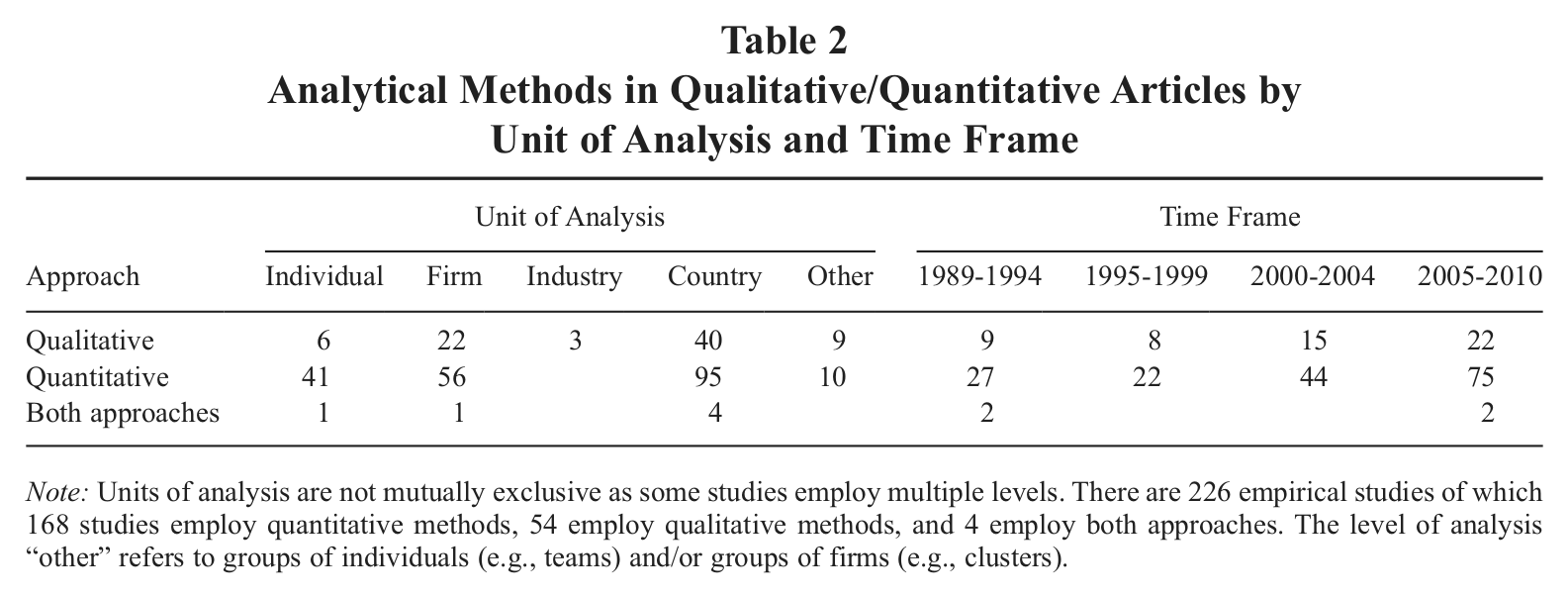
Note: Units of analysis are not mutually exclusive as some studies employ multiple levels. There are 226 empirical studies of which 168 studies employ quantitative methods, 54 employ qualitative methods, and 4 employ both approaches. The level of analysis “other” refers to groups of individuals (e.g., teams) and/or groups of firms (e.g., clusters).
Another interesting contrast to prior reviews is that the most common dependent variables in CIE studies are some measure of entrepreneurship (e.g., entrepreneurial intention/motivation, self-employment rate; 35%), firm performance (19%), or VC/informal investment activity (19%). This finding sharply contrasts with Keupp and Gassmann (2009), who note that dependent variables reflecting aspects of entrepreneurship are largely absent in IE research. The difference likely stems from Keupp and Gassmann’s focus on internationalization, while measures of entrepreneurship are exclusively used in CIE research on cross-country comparison of domestic entrepreneurship.
We identify several important methodological concerns that inhibit the advancement of CIE research. First, only 15% of the studies with a key informant utilize more than a single informant. While it is encouraging to see a nontrivial portion of CIE studies cross-verify data collection, this small percentage is still way below a satisfactory level. Informant selection is critical for instruments such as surveys. Cross-country data collection is particularly challenging, as appropriate informants must be identified in each country. Differences in national culture (particularly power distance differences) and resulting variance in organization hierarchies may mean that informants who are considered knowledgeable about certain venture areas in the researchers’ home countries may or may not possess the same level of knowledge as comparable informants in another country.
Second, we find that the CIE literature fails to consider the “ecological fallacy” problem, that is, making statements about individual behaviors based on aggregated data (Robinson, 1950). The international business literature has typically seen this error as making inferences from data aggregated at the country level to individual/firm behaviors, due to the neglect of the discrepancy between individual/firm and ecological correlations. The international business literature recognizes this problem and attributes most of its debate to the appropriateness of the use of Hofstede’s (2001) country culture indices at individual/firm levels (e.g., Berry, Guillén, & Zhou, 2010; Earley, 2006; Grenness, 2012; Lenartowicz & Roth, 2004; L. Lim & Firkola, 2000; Malhotra, Agarwal, & Peterson, 1996). Despite the frequent use of aggregated data in our review, we were unable to find one CIE study that acknowledges this potential methodological problem. A number of solutions are suggested in the sociology and political science literatures (e.g., Freedman, 1999; King, 1997). In the international business literature, solutions include direct rather than indirect inference (e.g., GLOBE survey; Javidan, House, Dorfman, Hanges, & Sully de Luque, 2006), examination of internal validity and construct validity (e.g., Schwartz, 1994), and adoption of multi-level analytic tools (e.g., L. Lim & Firkola, 2000; Peterson, Arregle, & Martin, 2012). Several international business studies address potential ecological fallacy problems, offering valuable information and templates for CIE research (e.g., Barr & Glynn, 2004; Fu et al., 2004; Koch & Koch, 2007; Newburry & Yakova, 2006).
Third, given the importance of establishing equivalence in cross-national research (Schaffer & Riordan, 2003; Singh, 1995), a great concern is that only 31% of the CIE analytical studies explicitly specify sample selection equivalence criteria. Sample selection equivalence refers to the identification of specific criteria for country/culture selection and is critical for cross-cultural research. We find little improvement in sample selection equivalence reporting over time. The low percentage indicates that there may be problems in drawing conclusions regarding cross-country patterns and divergences.
Third, CIE research falls short on data collection equivalence, which is of great importance in comparative research. Data collection equivalence refers to the consistency of data collection process in terms of setting, instruction, response, timing, and characteristics of researchers and is addressed by only 51% of the relevant studies in our review. We observe little progress in the reporting of data collection equivalence over time.
Finally, a striking aspect of CIE research is the share of studies (30%) utilizing large sample sizes (>500). Sample size is important since large sample sizes enable reliable inferences about underlying relationships. Average sample size increased impressively over time, especially in 2005 to 2010 (4379.2; compared to 792.6 in 1989-1994, 539.6 in 1995-1999, and 1150.5 in 2000-2004). Yet, considering the shortage of sample selection and data collection equivalences, increasing sample size per se does not guarantee the reliability of comparative findings. The share of purely descriptive statistics decreased 50% from 1989-1994 to 2005-2010, revealing an encouraging pattern of increasing adoption of complex analytical techniques, such as structural equation modeling.
While quantitative studies dominate, qualitative studies constitute about a quarter of studies. We observe a surprisingly large portion of cross-sectional CIE research, with only 5% of studies using panel data and 2% employing longitudinal analysis. CIE research, like the broader domain of IE research, is dominated by static perspectives with longitudinal studies uncommon (Coviello & Jones, 2004; Keupp & Gassmann, 2009). Finally, it is striking that only six studies combine quantitative and qualitative approaches, despite the potential to serve complementary purposes. A typical example is Malo and Norus (2009), who include country-level data gathered from a secondary source, and some firm-level data (case studies). We found no research that utilizes both qualitative and quantitative data from the same set of individuals, firms, industries, and/or countries.
Discussion of Future Directions
Our review of the existing body of CIE research reveals abundant opportunities for future examination. Following the structure of the above review of the current status of CIE research, we highlight knowledge gaps and suggest promising directions for future research with respect to (1) content, (2) theory, and (3) methodology. Table 3 depicts our general framework for future research directions.
Promising Future Research Directions: CIE Content, Theory, and Methodology

Note: CIE = comparative international entrepreneurship; IB = international business; TCE = transaction cost economics; RBV = resource-based view.
Content: Future Directions
CIE research has advanced our knowledge by identifying relevant characteristics, antecedents, and outcomes of different kinds of entrepreneurship; however, the extant research base is so diverse and fragmented that few definitive conclusions can be drawn.
The first and foremost challenge is that, despite the increase in CIE studies in the past decade (over two thirds of the CIE studies that we reviewed were published in the past 10 years), there is still a lack of agreement on the definition of entrepreneurship. Entrepreneurship is variously defined as self-employment, (new) business ownership, and early nascent pre-start-up phases. As a general rule, within each type, there are further classifications related to the degree of formal or informal incorporation, necessity or opportunity motivation, technology innovation, and internationalization. In our view, the lack of agreement is not a problem as long as researchers specify their definition of entrepreneurship based on theoretical relevancy and cross-reference prior studies with similar definitions or research questions. Furthermore, we believe that CIE research has the potential to make a substantial contribution to the resolution of the definitional debate within and across groups of scholars, practitioners, and policy makers. For example, CIE research can determine which entrepreneurship categories (e.g., self-employment or opportunity-based entrepreneurship) are most prevalent in certain countries, and it can assess the relationship between distinct types of entrepreneurship and the national environment, for example, economic growth and development.
Next, we highlight promising future research directions in terms of characteristics, antecedents, and outcomes of entrepreneurship.
Characteristics
Initial CIE studies were characteristics-based at individual, firm, and country levels. As the CIE field evolves to examine more causal influences in terms of antecedents and outcomes, characteristic-based research remains of particular relevance for new phenomena. We urge scholars to pursue, in our view, the following important phenomena.
First, although the prevalence and contribution of social entrepreneurship is increasingly acknowledged, there are few quantitative studies analyzing who these entrepreneurs are, what drives them, and how they perform, especially across countries (Lepoutre, Justo, Terjesen, & Bosma, 2013; Short, Moss, & Lumpkin, 2009). Addressing this knowledge void is important because a seminal CIE study can determine whether there are cross-country similarities or differences in social entrepreneurs’ backgrounds, venture activities, and contributions to society. A second key knowledge gap is entrepreneurial firms’ alliances with established firms. Advancements in this area will provide critical managerial insight into the benefits and pitfalls of alliance partnerships, especially with intermediaries. Third, with respect to corporate entrepreneurship, corporate VC and technology transfer offer promising directions related to the venture internationalization process, including choice of country markets and product strategies over time. Fourth, there are ample opportunities for characteristics-based and case study industry-level research, particularly for high-value, knowledge-intensive industries characterized by high degrees of uncertainty. Research in these dynamic industries has great potential to inform decisions by firm managers, industry associations, and policy makers.
Characteristics research is also relevant for assessing how entrepreneurship-related features and phenomena develop over time in different countries, for example, with respect to individuals (e.g., entrepreneurs’ accumulation of human and social capital over time), firms (e.g., change in importance of social goals), industries (e.g., decline and emergence of industries), and countries (e.g., institutional development). Current CIE research is largely static and therefore, we believe that from the viewpoint of describing developments over time, characteristics-based research offers ample opportunities for future research, and the examples given between brackets illustrate some ideas that could be pursued. Such research may be particularly relevant for the subsequent development of theories to explain the antecedents and outcomes of developments at different levels over time.
Antecedents
A substantial body of CIE research is devoted to identifying antecedents of entrepreneurship at the country level in particular institutions. Although the volume of this group of CIE research is large and some consensus has been reached, this area is still fragmented, usually considering only one or a few types of institutions. Future research should examine different types of institutional influences to shed more light on their relative importance. As most research investigates direct linkages between institutions and some form of entrepreneurship, research on indirect linkages will help to develop more detailed theories. For example, institutions may shape attitudes, intentions, or skills, which in turn may impact whether or not someone starts a business. Furthermore, most antecedent CIE studies take a static perspective with no attention to institutional convergence, divergence, and other types of institutional development across countries and time and to how these dynamics may impact entrepreneurship. Addressing this knowledge void is important, considering the evolving membership of economic and political unions, such as the European Union.
There is an urgent need for antecedent CIE research at individual, firm, and industry levels that can contribute to our understanding of what leads to entrepreneurial activity. At the individual level, researchers could explore what human capital (e.g., knowledge, work experiences) and social capital (e.g., relationships, networks) are most likely to lead to particular types of entrepreneurial activity (e.g., technology-based entrepreneurship) in certain countries. Advancing our understanding of this knowledge gap is essential to policy makers who can then best direct resources toward certain capital-building initiatives (e.g., special training, entrepreneurial networks). This line of enquiry is particularly interesting with respect to immigrant/transnational entrepreneurs who start businesses in their home and host countries. For example, Ahlstrom, Chen, and Yeh (2010) note the success of ethnic Chinese entrepreneurs inside and outside China and suggest that theories and constructs should be developed in the indigenous Chinese context and subsequently tested in Western contexts. Through this research, scholars will be able to determine what types of capital are most beneficial to immigrant/transnational entrepreneurs in different national contexts and to develop and test new non-Western theories. Given the potential impact that firms operating in a similar environment have on one another, future research should investigate how a firm’s entrepreneurial strategies are shaped by other firms. At the industry level, cross-country comparisons should explore how industry development (or lack thereof) impacts regional, national, and international policies as well as individual and firm entrepreneurial behavior.
Considering the multi-level nature of entrepreneurship phenomenon, multi-level investigation of entrepreneurship antecedents is especially promising (Elam & Terjesen, 2010). This is important not only to establish the relative importance of antecedents at different levels but also to investigate whether and how antecedents at different levels may interact. For example, individual entrepreneurial characteristics (e.g., entrepreneurial ability) could interact with country-level institutional characteristics (e.g., economic freedom) to determine outcomes at various levels (e.g., firm growth or national economic growth).
There are two recent theoretical articles of note. Baker et al.’s (2005) “comparative discovery, evaluation, and exploitation” framework proposes that a country’s social context influences the characteristics of opportunities and the individuals who discover, exploit, and evaluate them. Bruton et al. (2005) develop testable propositions related to how national institutions affect VC industries. These two articles illustrate the richness of antecedents at various levels and the complexities of entrepreneurship processes. Furthermore, the classic debate in the strategic management literature on the impacts of strategy, structure, and environment has not blossomed in CIE, and country comparison along these research dimensions is nonexistent. The evolutionary path of the strategy literature offers an exemplar for advancing CIE research. This research on cross-country differences in the co-evolution of venture strategy and structure would offer insights into optimal venture creation and management in different countries and the strategic management literature in general.
Outcomes
CIE research on outcomes focuses on firm (e.g., internationalization, financial performance) and country (e.g., economic growth) levels, but there are many gaps in our understanding of the consequences of entrepreneurship.
While CIE research on firm-level outcomes is abundant, the few cross-country investigations of venture internationalization have a regional focus with two or three countries, likely due to data availability issues. CIE research on internationalization outcomes is greatly needed to enrich our understanding of the increasing diversity of internationalizing ventures. Furthermore, as the Internet has dramatically changed the landscape of doing business, and there is great cross-country variation in usage, future studies should explore the role of technology in facilitating new venture creation and development.
One of the greatest contributions of existing CIE research is the examination of the relationships between some manifestation of entrepreneurial activity and country-level output indicators, such as economic growth and innovativeness. Scholars can extend this research base to more countries, longer time periods, and different types of entrepreneurship. Furthermore, when exploring the relationship between entrepreneurship and development, we encourage researchers to consider subjective and non-income dimensions. Our literature review documents limited understanding and empirical evidence of how entrepreneurship may shape institutions. This relationship is complex, as institutions may drive entrepreneurship, institutions and entrepreneurship may drive macro-level growth, and entrepreneurship may shape how institutions evolve. We encourage scholars to explore integrated frameworks that consider different types of institutions simultaneously, while also taking into account the impact of institutions on entrepreneurship and macro-economic output. Researchers should also examine the possible moderating effects of macro-level institutions on the relationship between entrepreneurship and macro-economic growth and other development indicators; for example, entrepreneurs’ potential to contribute to growth may depend on the favorability of institutions in the environment. Our study reveals a paucity of CIE research on individual-level outcomes, which is surprising given anecdotal evidence from entrepreneurs about beneficial outcomes, such as autonomy, wealth creation, and quality of life. Future research can explore outcomes in terms of the entrepreneur’s well-being (e.g., happiness, health) and stakeholder value (e.g., customers’ demand for/access to a new product). Insights from this work have the potential to substantially contribute to the overall well-being of societies. At the industry level, as countries differ in the extent to which entrepreneurial activities are allocated toward mature versus new industries, research could explore entrepreneurial performance across industries. Addressing this knowledge void is important to best direct resources to the most promising industries.
Integrate Research Into Characteristics, Antecedents, and Outcomes
As described earlier, characteristics, antecedents, and outcomes are mainly investigated in isolation from one another, and there is little effort toward a comprehensive analysis. We urge researchers to integrate research into antecedents and outcomes of entrepreneurship and to explore the potential mediating role of entrepreneurship on different types of outcomes. For example, institutions that facilitate firm growth could spur ambitious entrepreneurship, which in turn may positively affect a country’s growth rate. Future research could also investigate critical global events and their impact on entrepreneurship. At present, there are approximately 30 ongoing conflicts/wars in four continents, affecting the livelihoods of millions (Uppsala Conflict Data Program, 2012). In parallel, the world is characterized by high levels of terroristic activity, which is often linked to limited labor opportunities (Sayre, 2009). Entrepreneurship could be a model of productive growth. Furthermore, the global financial crisis’s disintegration of existing institutions (e.g., large multi-national banks and national economies) may impact entrepreneurial activity, and new entrepreneurial activity may have the potential to stimulate certain national and regional economies.
Theory: Future Directions
We note a deficiency in the development and use of theory in CIE research, although significant improvements have been made in recent years. Going forward, theory should be the platform for CIE research. We offer important extensions to theories currently in use and outline several promising new theoretical lenses.
While most CIE research utilizing Nobel Laureate Gary Becker’s (1994) human capital theory focuses purely on investments in education and training, it is important to consider that Becker also highlights the role of expenditure on health care and the influence of parents on their children. Future research should be more comprehensive in examining, across countries, differences in entrepreneurs’ health expenses, family resources, professional skills, and specific educational experiences. Addressing this knowledge gap is important to understand the full set of human capital theory components and develop optimal policy, firm, and individual strategies in different country settings.
Other branches of the institutional theory perspectives can offer new insights into CIE research. First, varieties of capitalism scholarship by Hall and Soskice (2001), Whitley (1999), and others provide country-level indicators of political and business frameworks that directly impact policy and business strategy, providing a comprehensive view of the environment. Second, an institutional entrepreneur theory lens (DiMaggio, 1988) could be used to examine how specific actors create new systems and how industry norms and culture changes make room for more innovative processes. This line of enquiry is particularly promising to expand the current focus on static institutional structures to longitudinal dynamics and processes. Third, Esping-Andersen’s (1990) welfare state regime theory offers insight into how particular policy decisions, expenditures, and social structures may impact entrepreneurship. Gender research could be significantly advanced by examining how state child care expenditure differences across countries lead to gender distribution of certain manifestations of entrepreneurial activity. Fourth, Nobel Laureate Elinor Ostrom’s (1990) institutional analysis and development lens offers a useful framework for examining collective action in multi-country social entrepreneurship efforts.
Given the current Hofstede-dominated cultural theory perspective in CIE (Hofstede, 2001), there are three promising cultural frameworks that offer new insights: Bourdieu’s (1977) cultural capital; House, Hanges, Javidan, Dorfman, and Gupta’s (2004) Global Leadership and Organizational Behavior Effectiveness (GLOBE) cultural leadership dimensions; and the World Values Survey (WVS). Bourdieu’s notion of cultural capital is especially promising for examinations of cross-country differences in entrepreneurs’ social relations. GLOBE incorporates under-examined cultural and leadership dimensions, such as performance orientation, humane orientation, assertiveness, and gender egalitarianism. WVS’s broad array of measures tracks religion, politics, economic, and social life in 97 societies on six continents. Research integration and competing tests of all four frameworks will help determine which aspects of culture prevail in an entrepreneurial context. Cultural theory frameworks could also be meaningfully extended by examining the role of language and linguistic structures.
While TCE is one of the most employed theories in our review, extant scholarship explores only a few paths for how institutions minimize the transaction costs of production and distribution across countries and the subsequent impact on individual, firm, industry, and country-level entrepreneurship. TCE scholarship could be significantly extended by exploring the impact of the costs of doing business on entrepreneurial activity at individual, firm, industry, and country levels. Advancing this research area will help to determine the most favorable allocation of entrepreneurship at all four levels. Research could also examine the impact of variations in TCEs, across countries, in terms of entry mode choice and alliance choices, offering critical insights to entrepreneurs’ decision making.
CIE research relying on economic growth theory fails to provide detailed explanations of the exact mechanisms through which entrepreneurship contributes to economic growth, in particular, the relative importance of channels such as knowledge spillovers, increased competition, or increased diversity. This research should be extended to examine moderating factors that enable entrepreneurship to contribute to economic growth, ranging from individual entrepreneurial ability to specific types of institutions. The development and wealth-building impact could be extended to social, ethnic, institutional, academic, and serial entrepreneurship. The pure economic growth perspective should be broadened to include other aspects of development, such as well-being (e.g., health, happiness, life expectancy, job satisfaction) and sustainability. In this respect, CIE could build on Nobel Laureate insights from development economics to better understand and conceptualize the role of entrepreneurship in development (e.g., Naudé, 2010). Amartya Sen’s (1999:14-15) human capabilities framework highlights the importance of individuals’ substantial (or positive) freedom in terms of being able to become “fuller social persons, exercising our own volitions and interacting with—and influencing—the world in which we live”; entrepreneurship may help individuals to achieve these freedoms (Gries & Naudé, 2011). Arthur Lewis’s (1954) structural change model emphasizes how primarily agricultural subsistence economies can urbanize by transferring surplus labor into the industrial sector, and the model could be extended to analyze entrepreneurship’s role in structural economic transformation (Gries & Naudé, 2010).
As research generally includes just one theoretical perspective that is often presumed to prevail, future scholars should utilize “theory pruning”—that is, the integration of multiple theories to more deeply explore complex cross-country phenomenon, which also involves the testing of competing theories to determine which theory offers the most explanatory power. For example, researchers could combine cultural and institutional perspectives to assess the relative importance of each on new venture creation activity. This specific line of enquiry will provide a better understanding of the interactions among formal and informal institutions. Human capital theory could be integrated with economic perspectives to assess the importance of different types of human capital for translating entrepreneurship into growth. Another promising avenue is the examination of individual psychological capital (e.g., positive psychology) and national culture and linguistic preferences to examine how attitudes, motivations, and aspirations are shaped by society. Armed with knowledge from these new streams of research, entrepreneurship proponents can best promote and maintain entrepreneurial populations.
Moreover, we encourage scholars to ask which important CIE phenomenon might be better understood through the applications of theories not widely embraced in the CIE domain. There are a number of promising but little-explored theories from management, international business, and entrepreneurship. From management, Ocasio’s (1997) attention-based model builds on bounded rationality, arguing that managers’ decisions are based on where they allocate their limited attention within a particular context (e.g., firm structure, industry/national environment). Ocasio (2011) further emphasizes the role of institutional environment on managers’ attention allocation, which he attributes to organizational changes. This theory offers tremendous relevance at multiple levels, as entrepreneurs face unlimited environmental stimuli/uncertainties and must choose where to focus their limited attention and resources. International business theories may be particularly fruitful for CIE enquiries. For example, the recent advancement of Dunning’s (1988) eclectic paradigm into the entrepreneurship field (e.g., Lopes, 2011) stresses the role of entrepreneurs for both new ventures and incumbents in obtaining firm-specific ownership advantages in internationalization.
A rich literature of theory developed within entrepreneurship has potential for CIE research. Effectuation describes the set of decision-making principles utilized by entrepreneurs in uncertain environments (Sarasvathy, 2001, 2009). This theory offers important insights to CIE research at multiple levels, for example, in terms of cross-country comparisons of entrepreneurs’ willingness to take risks based on their estimation of resources and preferences and evaluation of potential market opportunities and self-employment decisions in different institutional environments. Another example is subjectivist entrepreneurship theory (Mahoney & Michael, 2005), which explores subjective aspects of managers’ and entrepreneurs’ decision making, especially focusing on the recognition and exploitation of entrepreneurial opportunities as a function of individuals’ subjective visions and perceptions (specifically, idiosyncratic knowledge of firm resources, capabilities, and industry environment). Within a CIE context, research could explore cross-country differences in entrepreneurs’ exploration for new market opportunities within their own home countries and across national borders.
The specific theories employed must be chosen in support of the research questions being addressed. Good theory guides data selection, that is, the study of certain individuals, firms, industries, and countries. The aforementioned theories are not identified based on any inherent superiority relative to currently used theories in CIE research. Instead, these theories are simply offered as potentially useful lenses through which new, high-value-added research questions might be explored.
Methodology: Future Directions
Although the methods used in CIE research have become more sophisticated, the challenge is to develop more integrative approaches studying determinants and outcomes of entrepreneurship at the same time or different types of entrepreneurship simultaneously. We offer recommendations on sample selection, data collection, and analytical tools to improve the methodological rigor of CIE research.
Sample Selection
There are three critical challenges related to sample selection. First, the existing body of CIE research covers a limited number of countries and regions. National contexts compared are chosen for various reasons, including data availability, successful entrepreneurship experience, or contrast between developing and developed countries. While the growing diversity of geographic coverage is encouraging, scholars should be motivated by theory-based rationale for the inclusion of countries. Although the majority of articles using qualitative and/or quantitative approaches specify some sort of sample criteria, it is usually only one criterion, which is insufficient for valid sampling design for any theory-driven CIE study.
A second, and related, challenge is that comparison and generalization of findings across national borders is limited, as the majority of CIE research does not specify sample selection equivalence criteria. Equivalent sample selection is the first step to a meaningful comparison of entrepreneurship across countries. Consideration of sample equivalence can contribute to the extension of theoretical frameworks. For instance, as national educational systems shape beliefs about work, gathering samples of entrepreneurs with the same educational background enables in-depth enquiry based on human capital and institutional theories. Future research should also be more systematic in terms of the sample criteria and its equivalence, as this will help scholars to understand, for example, if some aspects are especially critical in certain countries. We urge researchers to exercise great care in selecting key informants and to cross-verify data collection by using multiple informants.
Third, researchers should be aware of and address issues regarding sample selection bias. For instance, researchers may select only those individuals who succeeded in becoming entrepreneurs or only those ventures with international sales. To address issues of sample selection bias, research should use two-stage models (e.g., Heckman selection) where possible and thus take into account the multiple decision-making process stages. For example, a first stage focuses on the decision to become an entrepreneur or not, and a second stage focuses on strategic decisions made after firm establishment, such as to export or not.
Data Collection
We encourage scholars to access entrepreneurship data through existing organizations as well as to develop new data sets. Existing robust sources of publicly available data include COMPENDIA, Eurobarometer, Eurostat, GEM, Observatory of European SMEs, OECD Entrepreneurship Indicators Project (EIP), Panel Study of Entrepreneurial Dynamics, 10 World Bank Doing Business Data, World Bank Group Entrepreneurship Survey, Community Innovation Survey, and WVS. The Eurobarometer and GEM data sets contain individual and country levels. Utilizing such standardized data sets aids data collection and sample equivalence, which extant CIE research lacks. Several of these data sets offer opportunities to explore entrepreneurial activity across time, a critical gap in the CIE field. Historically, there is limited availability of internationalizing firm data; however, new resources exist through EIP, GEM, and the Observatory of European SMEs.
Scholars can develop data sets through cooperation with supra-national agencies, such as the UN and OECD, industry associations, and government agencies at local and national levels. Such efforts aid the relevance of scholarship, as these stakeholders are interested in directing resources to the most pressing policy and practice concerns. One instance of the development of a global professional research network is the GEM project, which began in 1999 with a network of 30 scholars in 10 countries and has blossomed into long-standing research initiatives and exchanges among approximately 500 scholars in 80 countries (personal communication, P. Reynolds, 2012).
To address critical questions on processes, the innovative technique of experience sampling methodology (ESM) may be helpful. ESM “requires participants to provide reports of their thoughts, feelings, and behaviors at multiple times across situations as they happen in the natural environment” (Uy, Foo, & Aguinis, 2010: 31). Although this sampling/data collection method is likely to be expensive when implemented across countries, it is promising in capturing the dynamic aspect of entrepreneurial activities in their “natural” national contexts.
Analytical Tools
We recommend scholars pursue more diverse and sophisticated analytical techniques and offer examples of potential methods: content analysis of secondary sources, qualitative research, meta-analysis, and multi-level methodologies. First, content analyses of secondary data sources may be useful, as new ventures’ information is not as well documented as that pertaining to their large, established, and especially, public counterparts. New firms that go public in the United States are captured in large databases; however, this is not true for other countries with very limited financial databases and/or stock exchanges. Yet, media reporting on local economies is likely to document successful ventures and even struggling ventures. Such information can be invaluable in CIE research, particularly in understudied countries.
Second, although case studies have been frequently adopted in CIE research, other qualitative research methods (in addition to content analysis) offer great potential to yield unique insights. Scholars could explore methods such as life history calendar, ethnography, repertory grid, and experiments. In the cross-country context, qualitative methods can serve as a solid foundation for the development of possible quantitative measures, enable the collection of rich information for process studies, and potentially trigger the development of grounded theories. Furthermore, research that incorporates both qualitative and quantitative approaches can offer complementary insights.
Third, “infancy stage” CIE research may not seem to be a munificent area for meta-analysis, which requires a large number of studies on similar topics; however, our review uncovered a great quantity of work on factors related to firm performance outcomes. A meta-analysis of existing studies would enable scholars to determine which factors affect various aspects of firm performance. As the institutional and cultural streams continue to develop, there is potential for a meta-analysis here too. Meta-analyses may reveal general patterns of country similarity and dissimilarity and specific geographic patterns of antecedents and outcomes of entrepreneurial activities, all of which can advance CIE-related knowledge.
Fourth, while it is encouraging to observe the examination of constructs at multiple levels in CIE research, multi-level methodologies are rarely adopted. That is, multi-level conceptual models have been frequently discussed implicitly or explicitly in the CIE literature, but there are few empirical tests. Multi-level methodologies enable scholars to better analyze entrepreneurship activities in a comprehensive and integrative manner, generate more precise estimates, and mitigate ecological fallacy problems. We urge scholars to incorporate determinants and outcomes of certain stages and types of entrepreneurship into one model, considering the potential mediating role of entrepreneurship and the effect of moderators. This is relevant from a methodological standpoint, as error terms explaining entrepreneurship and some outcome may be correlated and therefore generate biased estimates. It is therefore critical to estimate determinants and outcomes of entrepreneurship in one model while accounting for (potential) correlation of error terms across both equations.
Conclusion
Our systematic and thorough review of 259 CIE articles identifies important progress in understanding the very diverse nature of entrepreneurial activity across countries. There is a growing body of CIE evidence in a few areas, for example, how certain country-level entrepreneurial activity impacts firm performance in terms of financial and export measures and country-level economic growth as well as which country-level antecedents lead to certain types of entrepreneurial activity. Yet, our review also reveals that the bulk of the CIE literature is very fragmented, and there are substantial knowledge gaps in content, theory, and methodology that form the basis of the future research directions outlined above. In an effort to stimulate open conversation, we provided a range of suggestions for the advancement of CIE research.
The pursuit of CIE research can generate meaningful contributions to scholarship, practice, and policy. From a scholarship perspective, comparative research can lead to common understandings of definitions and methods across multiple levels of analysis. The results will indicate whether there are generalizable patterns—similarities as well as differences—across countries or country groups, leading to the development of better theories. In terms of policy, findings from different national environments may help identify “best practices” and develop supportive entrepreneurship programs. From a practice perspective, CIE research can also yield important insights for individual, firm, and industry decision makers. Taken together, dedicated CIE research can guide policy and practice, with the goal of improving the quality of life of individuals, performance of firms/industries, and national wealth-building and well-being.
Footnotes
Appendix
Acknowledgements
This article was accepted under the editorship of Deborah E. Rupp. The authors thank editor Steve Michael and the anonymous reviewers for providing constructive and helpful guidance throughout the review process.