




Abstract
Human capital theory has recently expanded to include multilevel analysis by conceptualizing the unit-level human capital resource. At the same time, the value of complementary resources has been theorized to provide competitive advantages for firms. Thus, human capital at one level in the firm may impact the performance of human capital at another level in the firm if the resources are complementary. Through a multilevel analysis performed using hierarchical linear modeling of Major League Baseball data, we show that the relationship between individual human capital and individual performance is impacted by complementary functional and managerial unit-level human capital resources. As such, this paper contributes to the understanding of how complementary multilevel human capital resources relate to performance outcomes. Implications of our findings include support for the notion that more is not always better when it comes to high-quality human capital and that unit-level human capital plays an important role in performance of individual-level human capital.
Keywords
The human capital–performance link has received a substantial amount of attention from both macro- and micro-oriented management scholars (Nyberg, Moliterno, Hale, & Lepak, 2012). Research from a micro perspective has extensively investigated several individual characteristics, such as cognitive ability or personality, and found strong empirical support for a positive link to individual performance (see Schmidt & Hunter, 2004, for a review). Likewise, macro-oriented management scholars have examined and identified a positive association between human capital and performance (see Crook, Todd, Combs, Woehr, & Ketchen, 2011, for a review), though the focal level of analysis for these scholars has been at the firm level (Nyberg et al., 2012).
While these perspectives differ in the level of analysis at which they investigate the human capital and performance relationship, they are similar in that they both examine within-level effects. Such within-level research has been insightful and generally improved our understanding of the value and importance of human capital to organizations. However, the strong focus on the within-level relationship between human capital and performance has resulted in a large neglect of cross-level influences (Nyberg et al., 2012). This omission is particularly problematic in that a number of multilevel factors are likely to play important roles in shaping and deploying human capital at these various levels (Coff & Kryscynski, 2011). Additionally, the failure to consider the inherent multilevel nature of human capital can lead to a number of potential issues that can hinder or bias inferences drawn from these prior studies (Ployhart & Moliterno, 2011).
Consistent with these concerns, Nyberg and colleagues (2012) recently called for research that explicitly examines human capital at multiple levels and considers cross-level effects. We seek to answer this call by focusing on the manner in which complementary bundles of human assets influence the within-level human capital effects at lower levels. More specifically, we consider the cross-level manner in which human capital at the unit level impacts the relationship between human capital and performance at the individual level. As such, we empirically examine the notion that complementarities from higher levels of the firm have important performance implications for individual human capital resources (Campbell, Coff, & Kryscynski, 2012).
This study makes two important contributions. First, we make an empirical contribution by measuring human capital at multiple levels of analysis and exploring cross-level effects. As noted above, the majority of prior human capital studies have explicitly focused on within-level analysis, and there is thus an important need for empirical research that adopts multilevel perspectives (Nyberg et al., 2012; Ployhart & Moliterno, 2011; Wright & McMahan, 2011). Second, this paper makes a theoretical contribution by elucidating the complementary manner in which human capital is related across levels. That is, we provide a theoretical rationale for human capital’s complementary cross-level effects on performance by explaining how human capital resources at the unit level impact the individual. Several studies in the human capital literature imply such complementary effects (e.g., Campbell et al., 2012; Hess & Rothaermel, 2011) but do not fully articulate the mechanisms at play in the cross-level relationship.
We begin by providing a brief overview of the literature examining within-level findings between human capital and performance. Then we describe the value of considering multilevel influences in human capital research and discuss the cross-level effects of complementary human capital resources. Drawing on this conceptual integration, we develop hypotheses that examine the cross-level human capital effects on individual performance. We then test these hypotheses using hierarchical linear modeling and a multilevel data set from Major League Baseball (MLB). The professional sports context in general, and MLB in particular, is ideally suited for the empirical examination of the questions we raise here inasmuch as both individual and unit-level human capital can be precisely measured and cross-level models rigorously examined. Last, we discuss the results from our analysis and provide a number of future research suggestions and implications.
Theory and Hypotheses Development
Within-Level Analysis of Human Capital and Performance
The relationship between human capital and performance has been studied at both the individual and firm levels of analysis. At the individual level, research has demonstrated a positive link between human capital—defined as the knowledge and skills that cannot be separated from individuals—and performance (Becker, 1964; Schmidt & Hunter, 1998). Several within-level studies in industrial/organizational (I/O) psychology contend that individual differences in knowledge and skills directly impact individual training success and job performance (Ree & Earles, 1992; Schmidt & Hunter, 2004). The positive relationship between individual human capital and individual performance outcomes has been further theorized and supported by additional I/O studies (Judge, Higgins, Thoresen, & Barrick, 1999; Judge, Klinger, & Simon, 2010; Neuman & Wright, 1999; Wagner, 1997) in a variety of occupational contexts (Schmidt & Hunter, 2004). Relatedly, Schmidt and Hunter’s (1998) meta-analysis concludes that in over 85 years of empirical research, there is adequate support for the positive relationship between individual knowledge and skills and individual performance outcomes. As a whole, there is substantial empirical support for traditional human capital theory (e.g., Becker, 1964; Spearman, 1927), which contends that there is a strong positive relationship between an individual’s knowledge and skill endowment and his or her performance (Wright & McMahan, 2011).
At the firm level of analysis, scholars have studied human capital collectively in the organization and in doing so have conceptualized it as a unit-level resource that is founded on the interdependencies of individual knowledge, skills, and abilities (Ployhart & Moliterno, 2011). Research on human capital at this level of analysis has leveraged resource-based theory (e.g., Barney, 1991) to argue that collective human capital can enhance firm performance (Barney & Wright, 1998; Nyberg et al., 2012). Indeed, several studies support the validity of this argument. For instance, Hatch and Dyer (2004) explain how firms that are able to identify and employ individuals with higher abilities and skills are more likely to experience positive firm-level outcomes, such as increased productivity and efficiency. Research in this area has also demonstrated that the human capital of a firm is positively related to more distal measures of firm performance, such as financial profitability (Hitt, Bierman, Uhlenbruck, & Shimizu, 2006; Kor & Leblebici, 2005; Sherer, 1995). A recent meta-analysis of the firm performance effects of human capital also supported the positive implications of this relation (Crook et al., 2011).
Drawing on the logic inherent in these findings that link human capital to performance within levels, scholars have attempted to combine and cross levels in an effort to better explain this relationship. For example, human resource management scholars have sought to close the gap between micro and macro levels of analysis (Combs, Liu, Hall, & Ketchen, 2006; Nishii, Lepak, & Schneider, 2008; Wright & Boswell, 2002) in order to research organizational performance implications of firm-level practices that impact individual human resources. These studies have extended understanding of how human capital at multiple levels throughout the organization may relate to unit-level performance and have raised important issues regarding the explanatory value of integrative approaches. However, a substantial amount of this and other human capital research has adopted a “more is better” approach whereby increasing levels of high-performing individual human capital is assumed to lead to enhanced organizational performance (Ployhart & Moliterno, 2011; Wright & McMahan, 2011). In this way, scholars have suggested that a more valuable unit-level human capital resource can be created by simply hiring or developing higher-quality individuals. However, the perspective that accumulating additional individual human capital can lead to improved firm-level performance raises a number of important multilevel issues (Ployhart & Moliterno, 2011).
The multilevel issues in examining the association between human capital and performance across levels result from two overarching themes: cross-level fallacies of assuming the relationship is consistent at different levels and the special nature of human capital as a firm resource. Extrapolating findings from the individual level to the organization level creates the potential for a cross-level fallacy since relationships may not be isomorphic across levels (Rousseau, 1985). That is, relationships among human capital and performance at an individual level may not necessarily hold at a higher unit level due to a variety of factors, such as task environment complexity and resource context specificity (Ployhart & Moliterno, 2011). Similarly, there is also the potential to make incorrect inferences when analyzing human capital in isolation at the individual level without recognizing contextual factors and influence from higher unit-level human capital (Hannan, 1971; Rousseau, 1985). Furthermore, the lack of a multilevel perspective assumes that the combination of individual human capital within a firm is a simple linear function (Nyberg et al., 2012). While some situations may indeed warrant a “more is better” approach, they are unlikely to be generally applicable across contexts (Klein & Kozlowski, 2000; Rousseau, 1985). Each individual possesses human capital of different value to the firm (Lepak & Snell, 1999), and this value can be influenced by a number of different contextual factors (Coff & Kryscynski, 2011; Hunter, Schmidt, & Judiesch, 1990; Ployhart & Moliterno, 2011). Taken together, these potential issues suggest that examinations of human capital necessitate a multilevel perspective that considers the connection between micro and macro levels to explain performance outcomes (Nyberg et al., 2012; Ployhart & Moliterno, 2011; Wright & McMahan, 2011).
Multi-Level Influences on Human Capital and Performance
A multilevel perspective of human capital contends that an understanding of the influence of human capital on performance—at either the individual or organizational level of analysis—requires a dual focus on the characteristics of individuals and the idiosyncratic organizational factors that impact and shape such individuals (Coff & Kryscynski, 2011). That is, “cross-level” effects are likely to be present when examining the association between human capital and performance at either level of analysis. Indeed, several recent studies lend support to this notion. For instance, Groysberg, Lee, and Nanda (2008) examined the mobility of star knowledge workers and suggested that the link between individual human capital and individual performance may depend on several firm-specific elements. Additionally, Mollick (2012) considered the role of individuals and firms in new product launches and found that while key individuals (e.g., innovator, project manager) contributed to the success of products, a substantial amount of variance in performance was due to firm and other contextual factors. Similarly, Campbell et al. (2012) invoke this notion of cross-level effects in considering the value of a worker’s skills in the context of an organization’s human capital resource.
In this way, extant theory suggests that unit-level human capital can have important implications for the within-level association between individual human capital and performance. Such cross-level influences are likely to be particularly prominent when resource complementarities are present. Resource complementarities refer, in general, to situations in which the performance of one resource increases in the presence of the other (Adegbesan, 2009; Clougherty & Moliterno, 2010; Hess & Rothaermel, 2011; Milgrom & Roberts, 1990). In the case of human capital, resource complementarities are likely to manifest themselves across levels when interdependencies exist between individual and collective action because such interdependencies introduce dual influences on the performance of individuals (Ethiraj & Garg, 2012; Millhiser, Coen, & Solow, 2011; Tzabbar, Aharonson, Amburgey, & Al-Laham, 2008). That is, when the tasks of individuals involve direct workflow or other dependencies with their colleagues—which is often the case (Grant & Hayton, 2011)—a complementary relationship with such functionally oriented unit-level human capital resources could be present.
The resource complementarities that result from combining functional unit– and individual-level human capital can arise directly within workflow dependencies, such that the aggregate knowledge and skills at the unit level fit well with and supplement the particular knowledge and skills at the individual level (Ethiraj & Garg, 2012; Hess & Rothaermel, 2011). For example, a surgical support team that has substantial training and experience in a particular function would complement the performance of an expert surgeon as the surgical team’s actions could have a direct impact on the expert’s ability to achieve a positive surgical outcome. Such direct complementary effects are due, in part, to the improved task synchronization and integration that can arise from the coupling of high-quality human capital at the unit and individual levels (cf. Tziner & Eden, 1985; Stewart, 2006; Somaya, Williamson, & Zhang, 2007). That is, the combination of high levels of human capital at the unit and individual levels are likely to streamline and improve the actions of individuals because the functional unit is more likely to provide the appropriate actions at the requisite times.
In addition to these direct influences, complementarities between functional unit–level human capital and individual-level human capital may also manifest themselves in more indirect ways due to the influence group characteristics have on individuals (DeShon, Kozlowski, Schmidt, Milner, & Wicchmann, 2004; Hackman, 1992; Kozlowski & Ilgen, 2006). Indeed, several multilevel studies support this notion. Liao and Chuang (2004), for instance, examined employee service performance and found that aggregate perceptions of service orientation improved the performance of individual employees. Similarly, Ployhart, Weekley, and Baughman (2006) examined the multilevel influences of personality on individuals and found that aggregate personality characteristics at higher organizational levels influenced individual outcomes, such as job satisfaction and performance. Although these multilevel studies examine mechanisms that are not directly related to workflow dependencies between the individual and group, the findings suggest that groups can influence the performance of individuals in more indirect ways.
Consistent with this idea, functional unit–level human capital is posited to indirectly complement individual human capital by enhancing the likelihood that individuals fully deploy their knowledge and skills. In particular, interacting with and being supported by a highly knowledgeable and skilled functional unit is likely to generate cognitive and motivational benefits that, in turn, can aid in the utilization of individual human capital. From a cognitive standpoint, working with a capable unit reduces concerns about the inherent contingencies associated with interdependent work (Ethiraj & Garg, 2012; Stewart, 2006; Thompson, 1967) and allows the individual to focus more attention on his or her own actions. Such focused attention allows individuals to allocate their scarce cognitive resources to the task at hand (Kanfer, Chen, & Pritchard, 2008) and thus provides more capacity for an individual to fully utilize his or her human capital. This assertion is consistent with prior studies on working memory capacity. Working memory capacity refers to the degree to which an individual can focus his or her cognitive resources on the task at hand (Engle, 2001). Research in this area has demonstrated that working memory capacity is related to task performance (La Pointe & Engle, 1990; Turner & Engle, 1989) and that distractions related to apprehension or anxiety can reduce working memory capacity (Ashcraft & Kirk, 2001; Derakshan & Eysenck, 1998; Klein & Boals, 2001; Sorg & Whitney, 1992), thereby diverting cognitive resources away from the focal task and reducing performance (Schmader & Johns, 2003). Drawing on this prior research, we therefore suggest that since working with a capable functional unit reduces apprehension regarding the functional unit providing the appropriate actions at the appropriate time (Ethiraj & Garg, 2012), individuals are more apt to focus their scarce cognitive resources on the task at hand, and such focus, in turn, should enhance the performance benefits that can be derived from their stock of knowledge and skills.
From a motivational perspective, individuals are likely to feel as though there is a greater chance they can realize positive outcomes through their actions when they are working with high-quality functional unit–level human capital, and such feelings of efficacy can encourage individuals to put forth additional effort and persevere in the face of challenges (Bandura, 1997). Support for this perspective can be found in the extant research on group dynamics. Research within this domain, for instance, contends that group-level abilities can influence individual-level self-efficacy (Chen, Kanfer, DeShon, Mathieu, & Kozlowski, 2009). Specifically, scholars suggest that since individuals often interact with and are dependent on the actions of group members in the course of task completion, they are likely to view such members as a source of their success (Eden, 2001). In this way, the competencies of a group can influence one’s perception of one’s ability to achieve positive outcomes (i.e., self-efficacy; Chen et al., 2009). As self-efficacy influences effort and persistence (Bandura, 1997), and such motivational factors are a key component to performance (Mitchell & Daniels, 2003; Vroom, 1964), it is of no surprise that studies have continually found a positive link between self-efficacy and work-related performance outcomes (see Stajkovic & Luthans, 1998, for a review). On the basis of this prior research, we therefore contend that working with a talented functional unit creates efficacy benefits that, in turn, enhance the performance that can be generated from an individual’s knowledge and skill endowment.
In summary, we expect functional unit–level human capital to complement individual-level human capital due to direct and indirect influences. The direct influence arises from workflow dependencies between the functional unit–level and individual-level human capital, whereas the indirect influence pertains to the cognitive and motivational benefits that result from working with a capable functional unit and positively impact the utilization of an individual’s stock of knowledge and skills. As a result of these influences, we expect that when functional unit–level human capital is at high levels, a performance benefit will accrue at the individual level. Thus, motivated by the potential for cross-level complementarities between functional unit–level and individual-level human capital, we predict the following hypothesis with respect to individual performance:
Hypothesis 1: Functional unit–level human capital will moderate the positive association between individual human capital and individual performance: This association is stronger as functional unit–level human capital resources increase.
We further explore the notion that human capital at a higher level can impact the relation between individual human capital and performance by examining the potential influence of managerial unit–level human capital. Prior research indicates that many decisions within organizations involve the input and judgment of several managers (Carpenter, Geletkanycz, & Sanders, 2004; Menz, 2012; Wooldridge, Schmid, & Floyd, 2008) and that the collective knowledge, skills, and abilities of such managers can be a valuable human capital resource (Castanias & Helfat, 2001; Kor, 2003; Sirmon & Hitt, 2003; Sirmon, Hitt, & Ireland, 2007). Similar to functional unit–level human capital, managerial unit–level human capital may provide a complementary impact to the individual-level human capital. However, unlike the functional unit, the managerial unit is not directly involved in task completion. Instead, the managerial unit can influence the productive capacity of individual-level human capital through the deployment of such resources (Holcomb, Holmes, & Connelly, 2009). That is, through decisions regarding when and how to use individual human capital, the managerial unit can impact the degree to which an individual’s particular stock of knowledge and skills impacts performance.
Effective deployment of individual-level human capital, however, is likely to require a managerial unit that has high levels of knowledge and skills. Extant research on resource deployment, for instance, suggests that resource deployment requires knowledge of both the individual resources and the competitive context (Holcomb et al., 2009). It is through the combination and application of this knowledge that the managerial unit can effectively deploy individual human capital resources. Applying the appropriate knowledge at the appropriate time is a function of experience (Shamsie & Mannor, 2013), and prior research has shown that manager ability to deploy resources within the appropriate context can relate positively to performance outcomes (Sirmon, Gove, & Hitt, 2008). Thus, through appropriately matching the individual to the context, a high-quality managerial unit can leverage its expertise in knowing when and how to use individual resources effectively to enhance the performance that can be achieved with a given stock of individual knowledge and skills. As such, managerial unit–level human capital can have a complementary effect on individual-level human capital.
While the complementary effect of managerial unit–level human capital has the potential to enhance the performance impact of all levels of individual human capital, the effect seems likely to be most pronounced when the level of individual human capital is low (cf. Holcomb et al., 2009). Since individuals with lower levels of human capital do not have the requisite knowledge and skills that translate into high levels of performance, these individuals can potentially benefit most from the superior deployment abilities associated with a highly knowledgeable and skilled managerial unit. For example, managers can minimize the negative impact of not-yet-developed or poor-quality knowledge and skills by deploying such individuals in contexts where these attributes are less consequential and/or deploying them in those situations in which their limited knowledge and skills fit well. In contrast, individuals with higher levels of human capital have a larger repertoire of knowledge and skills from which they can utilize to handle varied competitive contexts. That is, since individuals with high levels of human capital have substantial knowledge and skills, they can potentially be successful in more competitive contexts than those individuals with lower levels of human capital. Accordingly, the resource deployment abilities that accompany highly skilled and knowledgeable managerial units are likely to be more consequential when individual human capital is at low levels. We therefore expect that the cross-level complementarities associated with managerial unit–level human capital will differentially benefit lower levels of individual human capital such that the within-level positive association between individual human capital and performance is attenuated by the presence of a highly knowledgeable and skilled managerial unit. In formal terms,
Hypothesis 2: Managerial unit–level human capital will moderate the positive association between individual human capital and individual performance: This association is weaker as managerial unit–level human capital resources increase.
Method
Context and Data
In order to test the hypotheses presented above, we collected data from MLB on pitchers, fielders, and managers. The MLB context has been used in prior research (Hofmann, Jacobs, & Gerras, 1992; Humphrey, Morgeson, & Mannor, 2009; Moliterno & Wiersema, 2007; Schwab, 2007; Shamsie & Mannor, 2013; Sirmon et al., 2008) and provides an ideal setting for examining the relationships detailed in the previous section. In particular, our theoretical development requires that we measure both individual- and unit-level human capital resources as well as model the complementarities between them. To examine these predictions, we focus on the human capital of 452 MLB pitchers who played in the 162-game 2012 regular season. Pitchers perform a critical individual-level defensive role for their team (i.e., preventing the other team from putting the ball into play), and the team of fielders works as a unit to support the pitcher by fielding balls that are put into play and making outs.
There is considerable task interdependence between the pitcher and fielders (Humphrey et al., 2009). For instance, pitchers can influence the possibility that a batter on the opposing team will hit a ball into the field of play by altering the positioning and speed of the ball pitched. However, the result of a ball hit into the field of play depends on the actions of the fielders on the pitcher’s team. Since the pitcher’s individual-level performance is a function of the complementary influence of these individual and functional unit–level actions, MLB provides an appropriate context to examine our hypotheses regarding the cross-level influence of functional unit–level human capital on the individual-level human capital and performance relationship. The MLB context is also appropriate to examine our hypotheses regarding the cross-level impact of managerial unit–level human capital because the deployment of pitcher resources involves the collective knowledge and skills of several managers (Shamsie & Mannor, 2013). While other organizational contexts are also likely to offer situations where individual performance is affected by these cross-level influences, we chose to focus on a professional sports context because such settings have unparalleled availability and accuracy of individual- and unit-level data (Humphrey et al., 2009; Moliterno & Wiersema, 2007; Wolfe et al., 2005) needed to understand and explain the multilevel human capital questions examined in this paper.
Measures
Dependent variable
We measured the individual-level performance of the MLB pitchers using earned run average (ERA). ERA is a common measure of performance for pitchers (Hofmann et al., 1992; Humphrey et al., 2009) that assesses the average number of earned runs that a pitcher allows per nine innings pitched. Specifically, ERA is calculated as

where Earned Runs Allowed is the total runs that were scored, less adjustments for runs that resulted from official fielding errors, and Innings Pitched is the total number of innings pitched. Since ERA is a measure of the pitcher’s defensive contribution (i.e., preventing runs scored against the team), lower values typically indicate higher performance. However, all of the ERA values used in the below analyses were reversed coded to ease interpretation of the results. To the extent that the calculation of ERA is sensitive to the number of innings pitched, only pitchers who pitched nine or more innings were included in the study.
ERA is particularly relevant in the context of our study as it captures the performance implications of task interdependencies between individual- and unit-level human capital (Basco & Davies, 2010): An earned run can occur when the pitcher pitches a ball that is easily hit and when the fielders do not make outs on balls that are hit. As such, ERA includes the potential complementary effects between individual- and unit-level human capital in our context and is thus an appropriate performance outcome given our research questions. Additionally, the measure is contextually important as it captures the strategic value of pitcher performance to MLB franchises. For the 2012 season considered in the current study, the average ERA of a team’s pitchers was highly correlated (r = .81) with overall team performance (i.e., win ratio).
Independent variables
To measure the individual human capital of MLB pitchers, we used a multidimensional approach to account for their various skills and knowledge. As the pitcher’s principle function is to prevent the opposing team from scoring runs, we focused on a number of pitching skills that are likely to reduce the degree to which batters can successfully hit pitches into the field of play. First, we measured the number of pitch types, because a pitcher with a greater number of pitch types has a larger repertoire of pitches to draw from when facing batters. This gives the pitcher more flexibility in matching pitch types to batter particularities and also makes it challenging for batters to predict and react to pitches. Second, we measured the average velocity of fastballs, as higher pitch speeds give the batter less reaction time to pitches. Last, we measured the average horizontal movement and average vertical movement of pitches, because greater movement can make it more challenging for a batter to hit pitches. These four pitching skills were measured directly from the pitch f/x data for the 2012 season. Pitch f/x is a pitch-tracking system in all MLB stadiums that provides detailed data on every pitch thrown during the MLB season (Fast, 2010).
In addition to the above pitching skills, our measure of individual human capital also accounted for the knowledge of pitchers. While possession of skills is indeed important to the tasks of pitchers, knowledge regarding when and where to use a pitcher’s various skills is of equivalent utility. As this type of knowledge is developed only from experience (Humphrey et al., 2009), we measured the knowledge of pitchers as the number of years played in MLB.
The five dimensions accounting for a pitcher’s skills and knowledge were summed to create a composite measure of individual human capital. Thus, a pitcher who has large values on all dimensions (number of pitch types, average velocity of fastballs, average horizontal movement, average vertical movement, and experience) is assumed to have a higher level of human capital than a pitcher who has low values on the dimensions. In that the five dimensions were on different scales, each dimension was standardized prior to aggregation.
As noted above, the performance of pitchers involves task interdependencies with the actions of a team’s fielders (Humphrey et al., 2009). Accordingly, we measured functional unit–level human capital with an aggregate indicator of team fielding talent. Specifically, we measured this unit-level resource with the summation of the “ultimate zone ratings” (UZRs) of a team’s fielders. The UZR is a sophisticated statistic that utilizes detailed play-by-play data to estimate a player’s fielding talent (Lichtman, 2010). The statistic, which has attracted scholarly attention (Jensen, Shirley, & Wyner, 2009), is based on a complex algorithm that uses 6 years of historical play-by-play data and an array of situational factors (e.g., type, speed, and location of the batted ball; handedness, speed, and power of the batter; number of base runners and outs; and park characteristics, such as the size and configuration of the outfield and the speed of the infield) to estimate the probability that a batted ball will be successfully fielded (i.e., an out is made). The estimated probability is then used to assign points to a player based on his actual actions. For example, if a player successfully fields a ball that has a low probability of being fielded, he will receive a larger number of positive points than if he had fielded a ball that had a high probability of being fielded. Similarly, if a fielder fails to field a ball that has a high probability of being fielded, he will receive a larger number of negative points than if he had missed a ball with a low probability of being fielded. These negative and positive play-by-play points are then aggregated to provide a measure of the player’s fielding knowledge and skills. A player with a UZR of zero is assumed to have average fielding talent, whereas a negative and positive UZR are indicative of below- and above-average talent, respectively. It is important to note that while this measure uses the actions of a fielder, it is an appropriate measure of a player’s knowledge and skills, as the algorithm used to generate the probability of fielding success takes into account the impact of numerous situational factors. That is, since the measure essentially controls for all consequential situational factors, the residual explanation for the actions of a fielder can be attributed to his knowledge and skills.
In that this measure is grounded in the play-by-play actions of a team’s fielders, we summed the player’s UZR scores to provide a measure of the functional unit’s fielding talent. Accordingly, a team with a positive UZR score would have a higher level of functional unit–level human capital than a team with a negative UZR score. For example, in our data, the Cleveland Indians had a UZR of −57, while the Atlanta Braves had a UZR of 53; this indicates that the knowledge and skills of fielders on the Cleveland Indians were nearly as far below average as the Atlanta Braves’ fielders were above average.
To measure managerial unit–level human capital, we created an aggregate indicator to represent the collective knowledge and skills of managerial staff involved in decisions associated with the deployment of pitcher resources. In the context of MLB, decisions regarding pitcher resource deployment (i.e., decisions about when and how to use a pitcher resource) involve an array of considerations associated with the competitive context and pitcher resources. As such, these decisions involve the head coach, who is responsible for the entire team, as well as specialist coaches who focus on pitcher resources (pitching and bullpen coaches) and the competitive context (bench coach) (cf. Shamsie & Mannor, 2013).
To capture the collective knowledge and skills of these managers (head coach, bench coach, pitching coach, and bullpen coach), we used two steps. In the first step, we calculated the adjusted winning percentage (AWP) of each manager using the following equation:

where Career Winning Percentage is the proportion of games in which a manager’s teams have won to the total number of games played over his career in the current manager role, and Total Number of Coaching Years is the number of seasons that the manager has worked in the current manager role. This measure has been used in prior studies of managerial human capital (e.g., Dirks, 2000; Holcomb et al., 2009) as it captures both the quality and quantity dimensions of managers’ prior experiences. The managerial knowledge and skills needed to successfully deploy resources are best acquired from experiences (Shamsie & Mannor, 2013); however both the quality and quantity of experience is important. To illustrate, those managers that have only low-quality experiences or a small number of high-quality experiences will not have accumulated as much applicable knowledge as managers with a large number of high-quality experiences (Holcomb et al., 2009). In the second step in creating the managerial unit–level human capital measure, the AWP values for each manager were summed to provide an aggregate indicator of the collective managerial knowledge and skills associated with pitcher resources.
Controls
At the individual level, we controlled for whether a pitcher was a nonstarter. Such pitchers enter midgame and are less likely to be expected to pitch for as many innings as a starting pitcher. Nonstarters can therefore immediately devote their full physical effort as they do not need to reserve energy for long game appearances. As a result, pitchers who do not start games are able to obtain higher performance (i.e., lower ERAs) than starting pitchers. We include in our models the dummy variable nonstarter, which takes on a value of 1 if a pitcher did not start any games during the season and a value of 0 otherwise.
We also controlled for the level of variability among the pitcher skill dimensions in our individual human capital measure, as it is possible for a pitcher to have a high overall human capital value due to exceptional skills in only one or two dimensions. To account for this possibility, we included the standard deviation of the standardized scores across the pitcher skill dimensions in our models. Additionally, we included the draft round in which each player was selected in the player draft in our models to account for potential selection bias and endogeneity issues.
At the organizational (team) level, we controlled for the average strength of opponents faced by each team to account for potential differences in the offense abilities of teams within divisions and leagues. We measured the average offense abilities of a team’s opponents using three steps. First, we measured each team’s offense ability using the average number of runs scored per game in the 2012 season. Second, we used the 2012 team schedules to calculate the number of times that each team played specific opponents. In the last step, we used the frequency that each team played opponents and the offense abilities of these opponents to generate a weighted average estimate of the offense abilities of opponents faced by a team.
Analysis
Due to the multilevel nature of the hypotheses and the nested structure of the data (e.g., players nested within teams), we used a hierarchical linear modeling (HLM; Raudenbush & Bryk, 2002) approach that consisted of five steps. First, a null model was estimated with no predictors at the individual or organizational level. This model allows for the variation in the outcome variable to be disaggregated into individual and organizational components. Second, the individual level variables were grand-mean centered and added as predictors of the outcome variable. In this step, a regression line is essentially fitted for the individual level data of each team. Third, a random intercept model was estimated, where the organizational-level variables were grand-mean centered and added to the model to explain variation in the intercepts of each team. In the final two steps, random intercept and slope models were estimated. These models add organizational-level variables as predictors of the variability in slopes of each team for the individual human capital and individual performance relationship. The grand-mean centered opponent offense ability control variable was added as a predictor of the individual human capital–performance slope in Step 4, and the grand-mean centered unit-level human capital variables were added in Step 5.
Results
Descriptive statistics and correlations for the individual-level (MLB pitchers) and organizational-level (MLB teams) variables are listed in Table 1. The results of the HLM analysis are listed in Table 2. This table includes five models that relate to the five modeling steps described above. In Model 1, a null model was estimated without any individual-level or organizational-level variables. The variance component for the intercept was significant in this model (τ00 = 19.39, p < .05), thereby indicating that organizational (MLB team) factors impacted the performance of individuals (MLB pitchers). The interclass correlation (ICC) was 0.08, which suggests that approximately 8% of the variance in MLB pitcher performance was due to organizational-level factors and 92% was due to individual-level factors.
Descriptive Statistics: Means, Standard Deviations, and Correlations Among Variables
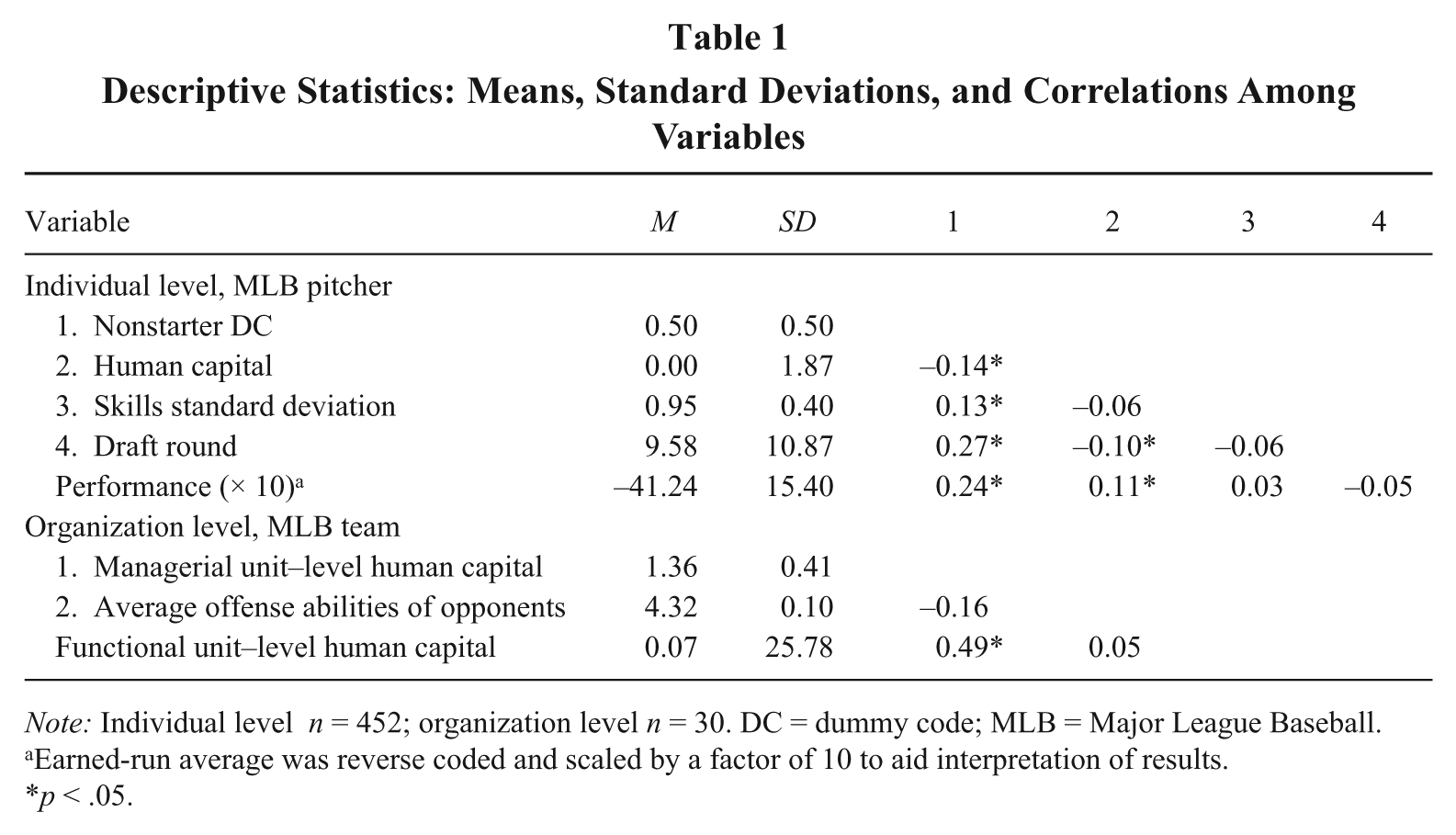
Note: Individual level n = 452; organization level n = 30. DC = dummy code; MLB = Major League Baseball.
Earned-run average was reverse coded and scaled by a factor of 10 to aid interpretation of results.
p < .05.
Hierarchical Linear Modeling Results for Performance a

Note: Individual level n = 452, organization level n = 30. Entries are estimates of fixed effects. Estimates of variance components are in parentheses. DC = dummy code.
Earned-run average was reverse coded and scaled by a factor of 10 to aid interpretation of results.
p < .05.
Model 2 includes the controls and human capital main effect at the individual level. The relationship between human capital and performance at the individual level is positive and significant (γ20 = 1.18, p < .05). Additionally, the variance component is significant for individual human capital (τ20 = 2.05, p < .05). This suggests that the slope of the relationship between human capital and performance at the individual level is moderated by organizational-level factors.
Model 3 adds the unit-level human capital variables and organizational-level control variable as predictors of the individual level intercepts. The coefficient for the functional unit–level human capital resources is significant (γ03 = 0.10, p < .05), which suggests that such resources have a positive main effect on individual performance. Model 4 adds the organizational-level control variable as a predictor of the individual human capital and performance slope. The coefficient is not significant, which suggests that the average offense strength of opponents does not have a cross-level effect on the relationship between individual human capital and individual performance.
Model 5 adds the unit-level human capital variables as predictors of the individual human capital and performance slope. This model tests Hypothesis 1, which predicts that the level of functional unit–level human capital will enhance the positive relationship between individual human capital and performance. The results support this prediction, as there is a positive and significant cross-level interaction between individual and functional unit–level human capital (γ23 = 0.05, p < .05). A graph of the interaction (Figure 1) confirms that the cross-level interaction is in the intended direction. That is, higher levels of functional unit–level human capital resources appear to strengthen the positive relationship between individual human capital and performance. A test of the simple slopes of the interaction indicates that while the individual human capital–performance slope is positive and significant when there are high levels of functional unit–level human capital resources (t = 3.80, p < .05), the slope is not significantly different from zero when there are low levels of functional unit–level human capital resources. This suggests that the ability to realize performance benefits from increases in individual-level human capital is dependent on the presence of high levels of functional unit–level human capital resources.
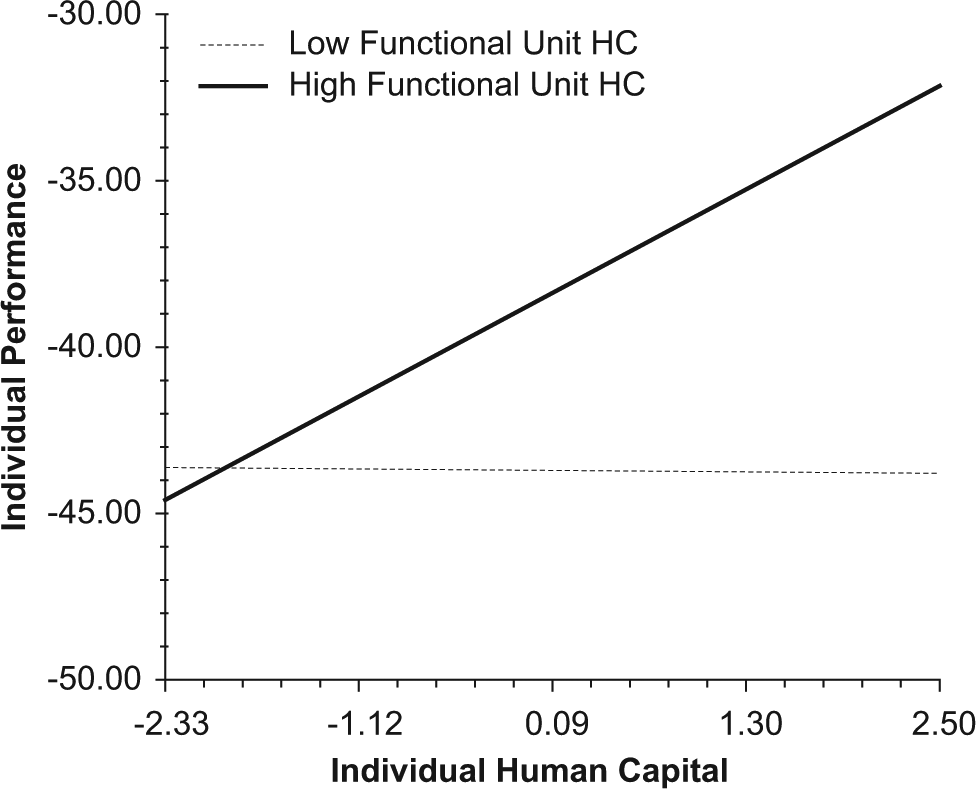
Individual and Functional Unit–Level Human Capital Cross-Level Interaction
Model 5 also tests Hypothesis 2, which predicts that the level of managerial unit–level human capital will moderate the individual-level human capital and performance relationship such that high levels of managerial unit–level human capital lessen the positive relationship between human capital and performance at the individual level. The results support this prediction, as the cross-level interaction between individual and managerial unit–level human capital is negative and significant (γ21 = −2.66, p < .05). A graph of the interaction (Figure 2) confirms that the interaction is in the intended direction. Specifically, the graph suggests that higher levels of managerial unit–level human capital reduce the positive relationship between individual-level human capital and performance. A test of the simple slopes adds further credence to this interpretation as the individual-level human capital–performance slope is positive and significant when there are low levels of managerial unit–level human capital resources (t = 3.36, p < .05) and not significantly different from zero when there are high levels of managerial unit–level human capital resources.

Individual and Managerial Unit–Level Human Capital Cross-Level Interaction
Discussion
In this study, we examined the cross-level effects of unit-level human capital on individual performance. The results provide support for the belief that cross-level perspectives are needed to understand links between human capital and performance (Coff & Kryscynski, 2011) and for the argument that complementarities between human capital resources at different levels can influence the productive capacity of an individual’s human capital (Campbell et al., 2012). Specifically, our multilevel analysis of detailed individual-level and functional unit–level human capital data found that the relationship between individual-level human capital and individual-level performance was positive but strongly dependent on the presence of high-quality functional unit–level human capital resources. Additionally, we found that a high-quality managerial unit can enhance the performance that can be derived from individuals with less abundant knowledge and skills. In general, the results of our study contribute to the emerging literature on multilevel human capital theory (e.g., Coff & Kryscynski, 2011; Nyberg et al., 2012; Ployhart & Moliterno, 2011) and raise a number of important issues and research questions that research on human capital and the broader literature on resource-based theory has yet to address. We discuss the results and these important implications in greater detail below.
Our results show a positive within-level association between individual human capital and performance. As such, the results are supportive of a large body of prior micro-oriented research that indicates individuals with higher knowledge and skills will outperform those with lower knowledge and skills. However, the support we found for Hypothesis 1, which argued that the within-level association between individual human capital and performance would be moderated by functional unit–level human capital, suggests that the within-level relationship between human capital and performance at the individual level is more complex than previously acknowledged by micro-oriented human capital researchers. In particular, our results indicate that while higher levels of individual human capital are associated with higher performance when coupled with a knowledgeable and skilled functional unit, such performance benefits substantially reduce when functional human capital at the unit level is low. This suggests that simply hiring or developing human capital at the individual level may not result in higher performance unless such human capital is coupled with a highly capable functional unit. The support we found for Hypothesis 2, which argued that a talented managerial unit would moderate the individual human capital–performance link, also lends credence to the complexity associated with the within-level individual human capital and performance relationship. Specifically, our results indicate that a highly knowledgeable and skilled managerial unit can attenuate the positive relationship between individual-level human capital and performance. As such, our results suggest that a talented managerial unit can enhance the performance of individuals that have lower levels of knowledge and skills. Taken together, our findings suggest that much can be learned about the within-level relationship between individual human capital and performance by adopting multilevel perspectives that account for the potential influence of unit-level characteristics and other contextual factors.
Our findings also lend credence to the concerns raised in the multilevel human capital literature regarding the “more is better” approach to achieving human capital–based advantages. To the extent that unit-level human capital complementarities play an important role in individual performance, adding additional higher-quality individuals may not have the same relation to higher levels of performance. Additionally, the influence that functional and managerial unit–level human capital resources have on the association between individual-level human capital and individual-level performance supports the notion of human capital as a “portfolio of human assets” that resides at, and is influenced by, multiple levels (Nyberg et al., 2012). In this way, our findings aid in the advancement of perspectives that seek to integrate micro and macro perspectives on human capital (e.g., Molloy, Ployhart, & Wright, 2011; Nyberg et al., 2012; Ployhart & Moliterno, 2011; Wright & McMahan, 2011) and also highlight the criticality of considering multilevel factors in research on the performance impacts of human capital.
At a general level, our findings are consistent with more macro-oriented human capital research that contends that the productive capacity of human capital is influenced by a variety of social and contextual factors, such as firm strategy (Hitt, Bierman, Shimizu, & Kochhar, 2001), managerial talent (Sirmon et al., 2008) and characteristics (Somaya et al., 2007), and technical structures (Tzabbar, 2009). However, our paper is also distinct from these studies in that it begins to unpack the multilevel factors involved with the human capital–performance link. That is, while these prior studies have focused on the within-level association between firm-level factors and performance, we focus theoretically and empirically on how factors at higher levels in the organization influence the performance of individual-level human capital. As the human capital resources at higher levels in the organization is composed of individuals (Coff & Kryscynski, 2011; Wright & McMahon, 2011), understanding how contextual factors influence the productive capacity of individual human capital is essential to more fully understand this vital firm resource. While our study focuses on the cross-level influences of unit-level human capital resources, we encourage future research to focus on the multilevel considerations associated with other contextual factors identified by macrolevel human capital researchers.
This paper’s findings also make a contribution to, and have important implications for, the research focused on the microfoundations of human capital. This research stream contends that greater attention should be given to the influence of individuals and the manner in which organizational resources and practices interact with and shape such individuals into valuable firm resources (Coff & Kryscynski, 2011). Our finding that unit-level human capital resources can influence the performance of individuals is consistent with this notion. However, this finding departs from the traditional microfoundational view (Felin & Foss, 2005; Felin & Hesterly, 2007) in that it emphasizes effects that come from the top and make an impact downward (i.e., top-down effects) as opposed to those that originate at lower levels and carry influence upward (i.e., bottom-up effects). To elaborate, scholars interested in the microfoundations of human capital tend to emphasize the importance of examining the role that organizational practices and processes play in the emergence of unit-level human capital resources from individuals (Nyberg et al., 2012). Emergence happens when a lower-level phenomenon, in this case, individual human capital, combines to create a higher-level phenomenon, such as a unit-level human capital resource (Ployhart & Moliterno, 2011). While organizational-level factors may impact the manner in which unit-level human capital resources emerge, the results of our study suggest that unit-level human capital resource may also have top-down effects on individual-level human capital, which in turn could impact the emergence process. As such, the results of our study imply that there may be important reciprocal effects that deserve greater attention in research on the microfoundations of the human capital resource.
In a related sense, our study has implications for the literature on resource orchestration (Sirmon, Hitt, Ireland, & Gilbert, 2011) by examining the manner in which complementary resources at one level can be structured, bundled, and leveraged to impact the performance of resources at lower levels. Specifically, our finding regarding the cross-level complementary effect of functional unit–level human capital suggests that the “orchestration” of resources may involve important multilevel factors. While this literature has given some consideration to the influence of managerial level on the orchestration of resources (Sirmon et al., 2007), scant work has focused on the multilevel manner in which resources at one level may be bundled and used to leverage the value of resources at a different level. In the context of our study, such multilevel views of resource orchestration could provide insight into the factors that are antecedent to the development of valuable unit-level human capital resources. That is, while our findings show that unit-level human capital can be complementary to individual human capital, we did not investigate the organizational capabilities that aid the firm in acquiring, developing, and bundling such a valuable unit-level resource. In that such multilevel bundling may play a key role in generating a sustained competitive advantage (Coff & Kryscynski, 2011), we strongly urge future research on resource orchestration to give more attention to multilevel perspectives associated with configuring and deploying human capital.
Last, our findings on the value of complementary resources align with overarching themes in resource-based theory (Barney, 1991). In particular, research on strategic factor markets contends that the presence of heterogeneous complementarities can create the potential for resource acquisitions at below their value-generating ability (Adegbesan, 2009). The results of our study suggest that one source of such complementarities may be an organization’s unit-level human capital resources. Future research could thus extend these findings to research on strategic factor markets to explore the manner in which cross-level complementarities between unit- and individual-level human capital allow organizations to advantageously procure individual-level human capital.
While the current study makes important contributions to scholarly inquiry surrounding human capital, it has several potential limitations. First, our use of a professional sports context may potentially limit the generalizability of our findings. However, the resource deployment requirements of coaches and the task interdependencies inherent to pitchers and fielders are analogous to those present in many other organizational settings. Additionally, professional sports contexts are frequently used as samples in organizational studies and there are a number of conceptually similar attributes between industrial and professional sport organizations (Wolfe et al., 2005). Nonetheless, future research should validate our findings in other, more “standard,” industrial contexts. A second limitation lies in the cross-sectional nature of our study. While we are not aware of unique factors that occurred during the 2012 MLB season that may have biased the results, we encourage future research to longitudinally examine the implications of complementarities between unit- and individual-level human capital. Such investigations would also have the added benefit of exploring the manner in which such complementarities develop and are sustained over time.
Conclusion
The purpose of this study was to investigate the cross-level effects of unit-level human capital resources on the individual-level human capital–performance relationship. Our results revealed that the association between individual-level human capital and individual-level performance was strongly influenced by the presence of high-quality managerial and functional unit–level human capital resources. In general, these findings lend credibility to the importance of measuring human capital at multiple levels and assessing the cross-level manner in which such levels of human capital are related. This makes a substantial contribution to the multilevel human capital literature, where very little empirical research has examined such cross-level effects, and demonstrates the empirical insights that might be garnered by employing multilevel approaches to study human capital. We hope that the findings reported in this paper will encourage future researchers to give greater attention to multilevel human capital perspectives.
Footnotes
Acknowledgements
Both authors contributed equally to this work. The authors would like to express gratitude to Patrick Wright and two anonymous reviewers for comments that substantially improved this manuscript. The authors would also like to thank Charles Manz, Bruce Skaggs, and Ari Yezegel for helpful comments on earlier versions of the paper.