




Abstract
Extant stakeholder studies posit that the media have a direct impact on firms’ pollution behaviors. By integrating agenda-setting theory with the stakeholder framework, we propose the media exert an influence on firms’ pollution behaviors through two primary stakeholders: the government and the public. Longitudinal archival data collected from Chinese newspapers in 2009 indicate that the government tends to take actions upon the official newspaper reports, while the public acts upon the reports from commercialized papers. Both the government’s and the public’s actions can prompt the firm to provide solutions to its pollution problems. In addition, the government’s actions mediate the relationship between official media coverage and firm solutions, and the public’s actions mediate the link between commercialized media coverage and firm solutions.
In stakeholder research, the media are largely treated as a primary stakeholder (i.e., a stakeholder upon whom firms rely to survive; Clarkson, 1995) that exerts a direct impact on firms’ environmental behaviors (e.g., Kassinis & Vafeas, 2006; Tang & Tang, 2012; Weaver, Trevino, & Cochran, 1999). This perspective of the media has produced mixed results in empirical studies. One stream of research finds that the media indeed are able to motivate firms to discipline their environmental behaviors (Kassinis & Vafeas, 2006; Weaver et al., 1999), yet another stream of studies indicates that the media’s power over firms can be effectively countered (Tang & Tang, 2012) or compromised (Tan, 2009). This discrepancy may be due to the fact that as a secondary stakeholder (i.e., a stakeholder that is not engaged in contractual or legal transactions with firms; Clarkson, 1995), the media may not be able to exert a strong direct effect on firms. In other words, the media’s influence may be reduced or compromised if the media fail to prompt primary stakeholders to act on their calls.
To the best of our knowledge, only a couple of case studies (e.g., Frooman, 1999) have explored the interplay between the media and other stakeholders in their impact on firms’ social performance. Yet theory building and systematically conducted empirical analyses remain rare. Studying the media through the lens of secondary stakeholders does not deny the fact that the media can have a major influence on a focal firm. We, however, suggest that such an influence is mostly indirect and its effectiveness can be jeopardized if primary stakeholders question the media’s credibility and refuse to take expected actions.
We integrate agenda-setting theory (Jennings & Miron, 2004; Walgrave & van Aelst, 2006) with stakeholder theory (Freeman, 1984; Frooman, 1999; Mitchell, Agle, & Wood, 1997) to investigate how the media influence Chinese firms’ pollution behaviors through such primary stakeholders as the government and the public. The basic notion of agenda-setting theory has received wide support in the past three decades in media and communication research; that is, “the amount of press coverage that issues receive gives individuals salience cues with which they learn the relative importance of these issues” (Wanta & Ghanem, 2007: 37). Dearing and Rogers (1996) pinpoint three major interconnected agenda-setting processes: the media agenda setting, the public agenda setting, and the policy agenda setting. Both the public’s and policy makers’ agendas are heavily influenced by the media’s agenda in the modern society. Extending this line of thinking, we examine how the media impact Chinese firms’ environmental performance through the public and government. In particular, we first investigate if, after the first report appears in newspapers regarding a pollution incident, the agenda set by the media, which is reflected by the total number of news counts on this incident cumulated in both official and commercialized newspapers in a month, will lead to the public’s or government’s actions. We then examine whether the public’s or government’s actions will impact the likelihood of the firm’s providing a solution within a month. We also explore whether the public’s and government’s actions mediate the relationship between the media’s agenda and firm solutions.
We draw on the events reported in newspapers to identify the media’s agenda-setting effect. Although the debate over the power of print and electronic media is far from settled, previous research indicates that newspapers have more power than the electronic media due to their in-depth and complete coverage (Dearing & Rogers, 1996; Stromback & Kiousis, 2010; Walgrave & van Aelst, 2006). Newspapers are especially a reliable source to study the media effect in China (Stockmann, 2010; Tan, 2009) because they are the major channel for Chinese to obtain information on the society (Tian, 2009). Newspaper sales have been increasing in China, and China remains the largest newspaper market globally (Xinhuanet, 2007). Following Stockmann (2010), we categorize Chinese newspapers into three groups—official, commercialized, and semiofficial—and we focus on official and commercialized newspapers in the current research.
We intend to make two much-needed contributions to stakeholder research. First, we do not assume a direct link between the media and firms; instead, we decode the mechanisms through which the media affect firms’ pollution behaviors. We thoroughly investigate both the direct and indirect impact of the media on firms, which will provide a better insight on how to apply media power to discipline firms’ pollution behaviors. We also initiate one of the first attempts, which have long been called for, to draw the influence map between various stakeholders and a focal firm (Agle, Mitchell, & Sonnenfeld, 1999). Clearly, many opportunities exist to further investigate this topic by studying the interdependence between other secondary stakeholders (e.g., nongovernment organizations) and primary stakeholders (e.g., suppliers and employees), as well as their joint impact on firms. Second, although frameworks abound for studying stakeholders’ influence on firms’ social performance, less effort has been put forth into theorizing and testing such effects in the idiosyncratic institutional environment of China. China, however, presents a distinct opportunity for us to test how different types of media can affect primary stakeholders and firms differently. Unlike the Western media, which gain their legitimacy largely through reporting the true facts, the Chinese media operate with different types of legitimacy and credibility. Official media, for instance, are granted government-endorsed legitimacy, and thus are able to exert a much stronger impact on the government than on the public. The public, on the other hand, tends to act upon the commercialized media’s reports. The current research, by analyzing longitudinal archival data of the Chinese media, greatly extends the generalizability of stakeholder theory and agenda-setting theory to an important context.
Next, we review stakeholder and agenda-setting theories to provide a theoretical background for our model. We then propose six hypotheses to highlight the relationships between different types of media (i.e., official and commercialized), the public and government actions, and firm solutions. We coded 209 pollution events in the Chinese newspapers in 2009 to test these hypotheses. Discussions and implications are offered in the end.
Theoretical Background
The Media in Stakeholder Theory and Agenda-Setting Theory
The majority of stakeholder studies have examined the direct impact of the media on firms, with two notable exceptions. One case study explored how television advertisements were utilized to motivate customers to boycott StarKist’s products until the company adopted a more eco-friendly supply method (Frooman, 1999). This study illustrates the critical role of customers (a primary stakeholder) in the media’s attempts to realize their environmental agenda. Similarly, another case study, conducted in the biotechnological field in India, indicated that the media were able to exert influence on firms only insofar as they could successfully alter the perspective of primary stakeholders such as customers (Raman, 2004). Nonetheless, theory seeking to investigate the indirect effect of the media remains largely unexplored in stakeholder research.
Whereas stakeholder studies suggest that the media possess power over a focal firm, agenda-setting theory proposes that the media distribute power in a society (Entman, 2007; McCombs & Shaw, 1972). As news coverage of different social issues is intensively disseminated, the public and government officials get the cues of the relative salience of these issues and consequently determine which issues should take priority in their own agendas (McCombs, 2004). In particular, the media can greatly influence the government’s agenda because the media are viewed as an important channel for politicians to absorb public opinions (Walgrave & van Aelst, 2006). The public, with a generally random agenda, relies more on the media than does the government regarding current events. Put eloquently, “The media may not be successful much of the time in telling people what to think, but is stunningly successful in telling its readers what to think about” (Cohen, 1963: 13, italics original).
Numerous studies have sought to verify the connections between the media’s agenda and the public’s as well as the government’s agenda. For instance, the amount of media coverage was found to be closely related to the amount of attention paid by the public and politicians to different social issues in Washington (Dearing & Rogers, 1996). Another study of the 2002 Florida Gubernatorial election confirmed that the salience of issues covered in the media is positively related to the perceived salience of issues in public opinion (Kiousis, Mitrook, Wu, & Seltzer, 2006). The agenda-setting effect has been observed in other nations as well. For example, the attention paid by the media to political news helped predict the issue salience perceived by the public during the 2006 Swedish parliamentary election (Stromback & Kiousis, 2010).
Although agenda-setting theory proves beneficial in decoding the process through which the media motivate the public and government to follow their own agenda, efforts that further investigate how this process affects firms’ behaviors are exceedingly rare in both stakeholder and communication studies. Acknowledging this gap, we intend to integrate stakeholder framework with agenda-setting theory to explore the relationships among the media, the public, the government, and firms.
Agenda-Setting Effect in China
China offers a variety of newspapers. Based on the legitimacy of the media, that is, whether the media are viewed as acceptable or proper to exert their power in a society (Davis, 1973), Chinese newspapers can be classified into three groups. Official newspapers are administratively and financially supported by the government or government agencies (Stockmann, 2010). They have more responsibility to convey the ruling party’s message to the public than do other newspapers. Thus, official newspapers have the highest level of legitimacy acknowledged by the government. Commercialized newspapers, on the other hand, are financed through commercial advertising or private investment, and are operated as an enterprise with the primary goal of making profits (Stockmann, 2010). Commercialized newspapers lack government-endorsed legitimacy, yet precisely due to this deficiency, commercialized newspapers strive to report closest to the truth to build much-needed legitimacy with the public. Last, semiofficial newspapers fit in the middle: They do not receive private investment but rely extensively on advertising. They lack not only the authority exemplified by official newspapers but also the aggressiveness associated with commercialized newspapers (Stockmann, 2010). Being squeezed in the middle, semiofficial newspapers attempt to maintain a delicate balance between the government’s expectations and the public interests. These newspapers seek to focus on such matters as neighborhood disputes or entertainment news, and stay away from the events that may potentially cause social unrest. As a result, semiofficial newspapers are rarely viewed as a reliable or necessary source for the public to learn about major pollution events (Shirk, 2011). Therefore, in the current research, we focus on official and commercialized newspapers.
One may question if the agenda-setting effect, that is, the media’s agenda affects the government’s and public’s agendas rather than the other way around, exists in China. Such an effect does exist, at least in environmental reports, based on the following rationales. First, counter to the popular stereotype, Chinese newspapers are market-oriented and profit-driven enterprises. The media reform that took place in 2004 opened the door for private investment to enter the media industry, and prohibited newspapers and magazines from collecting subscriptions from the government and governmental agencies (He, 2008). This reform clearly specified that no direct subsidy (i.e., government funds that support the newspapers’ daily operations) should be provided (Fook, 2006). Although indirect support (e.g., bank loans with favorite terms) from the government to official newspapers may still exist, the profit-driven business model has begun to dominate. As a result, even official newspapers attempt to report such social issues as environmental incidents and disasters to appeal to a large customer base. As public-oriented, instead of government-controlled, opinions are reflected in newspapers, the agenda-setting effect does exist in today’s China, at least to a certain extent.
Second, the extent to which the agenda-setting effect in reporting environmental news takes place depends on the type and the degree of censorship. Contrary to the Soviet Union style of media control, the Chinese press has never been through extensive prepublication censorship (Hassid, 2008). In fact, the Chinese government does not directly interfere with the content prior to publication (Spegele, Chin, & Mozur, 2013). Instead, the alignment with the government mission relies on self-censorship by newspapers themselves and postpublication or after-the-fact measures. The Chinese government provides general guidelines on reporting content, but these guidelines are rather vague and focused mainly on political events (New York Times, 2010; Nieman Reports, 2011). It is believed that they are kept vague on purpose to strike a balance between the goals of maintaining societal stability and of loosening media control (Hassid, 2008). As a result, governmental control on environmental news has eroded considerably (Shambaugh, 2007). Indeed, environmental news has become an integral part of many media outlets (Rong, 2009). A large number of studies have offered evidence that the Chinese government is surprisingly tolerant of negative remarks and criticisms (e.g., Chen, 2012; Fook, 2006; Luther & Zhou, 2005; Rong, 2009; Shen, Lu, Guo, & Zhou, 2011). Pollution news in many provinces, such as Fujian, Guangdong, and Shaanxi, has prompted local governments’ actions to crack down on these infractions (Einhorn, 2009).
Taken together, the media’s agenda-setting effect on the government clearly exists, at least in regard to pollution-related reports. This statement is supported by both observers and environmental groups. For example, Einhorn (2009) observed cases of how the media prompted the government to take actions against polluting companies. China Environment Series also reported many cases indicating that news reports helped raise the public’s awareness and prompt the government to adopt measures to solve environmental problems (Andrews, 2008/2009). Please note that by no means are we attempting to defend the current media system in China. Without doubt, the Chinese media system has major flaws. However, Chinese newspapers do cover a large range of environmental issues that are immune to government censorship. As David Bandurski put it during an interview with Olsen (2011), ironically, although the Western press criticizes the Chinese media as being mouthpieces of the party or watchdogs on a leash, they rely extensively on the investigative reporting conducted by the Chinese media to reveal scandals such as the Henan AIDS epidemic, Sichuan’s “tofu” buildings, melamine-tainted dairy products, and forced child labor. Apparently, the Chinese media have been reporting a variety of environmental news, yet the Western press has failed to account for the complexities and nuances of what is actually happening within the Chinese media.
Hypotheses Development
In the current research, we take the position verified by a large body of stakeholder studies that the media have an impact on firms’ environmental behaviors. For example, firms are more likely to engage in corporate social responsibility (CSR) when the media are monitoring their behaviors (Campbell, 2007). Similarly, CSR-reactive firms, that is, firms that view environmental protection irrelevant to their companies and do not have specific plans to promote environmentally friendly procedures, are found to be especially sensitive to media reports (Henriques & Sadorsky, 1999). Drawing on this research, we build a mediation model to explicate how official media discipline firms’ pollution behaviors through their impact on the government, and how commercialized media do so through their influence on the public in China.
Media Coverage and the Public’s and Government’s Actions
Agenda-setting theory suggests that the media’s power is attained from their ability to choose from a variety of events, emphasize some of them, and ignore the rest (Larcinese, Puglisi, & Snyder, 2011). The agenda-setting process is a process through which issue proponents compete to “gain the attention of media professionals, the public, and policy elites” (Dearing & Rogers, 1996: 1-2). The agenda-setting capability of the media determines the extent to which certain social events are accessible to other stakeholders. When a great deal of news coverage is produced for a certain event, it does not just reveal information about the event, but signals the relative importance of this event versus the others and calls for immediate attention or action from relevant stakeholders. Especially in an information explosion era when numerous events are competing for the limited attention of stakeholders, an issue has to receive a certain amount of processing time and attention to ensure the media’s effect (Scheufele & Tewksbury, 2007).
Turning first to the role of the official media in China, these outlets assume more responsibility to convey the government’s intentions regarding major social issues than do other newspapers and are often viewed as a reliable predictor of what may or will happen in China (e.g., Ralston, Egri, Steward, Terpstra, & Yu, 1999). The official media promote the values accepted by the Party while downplaying or discounting opposite perspectives. The readership of official newspapers is mainly composed of government officials and civil employees (Li, 2011). When official media continue or avoid reporting certain pollution events, the media assign importance of these events to their major readers, that is, policy makers (Chen & Meindl, 1991) and provide the schema to evaluate the severity and possible outcomes of these events (Yu, Sengul, & Lester, 2008). Thus, when a pollution event is reported in the official media, it is reasonable to expect that this event will attract the government’s attention and the government is more likely to incorporate it on its agenda and take actions to correct it. As the agenda-setting theory posits that the amount of press coverage of certain issues gives the audience salience cues to learn about these issues and take actions accordingly (Wanta & Ghanem, 2007), we propose that as the primary readers of official newspapers are government employees and policy makers, the agenda set by the official media regarding certain pollution events will first and foremost affect the government’s actions.
Hypothesis 1 (H1): Media coverage of a firm’s pollution incident in official newspapers is positively associated with the government’s actions.
The commercialized media, on the contrary, are often regarded as the news source that is the closest to the true story (Stockmann, 2010). Commercialized newspapers often test the boundaries of the government’s tolerance by aggressively exposing a variety of social issues, even if these issues (e.g., severe pollution incidents) may be a potential threat to the harmony of the society (See, 2009). Instead of focusing on a typically excessively positive side of China, the commercialized media choose to utilize their influence to safeguard the public’s social interests even though doing so involves revealing the adverse aspects of the society (Khanna, 2009). Indeed, that is how the commercialized newspapers gain their legitimacy. Such a bold stance of major commercialized newspapers prompts the Chinese public to rely on their reports to attain the true facts and take actions accordingly.
Furthermore, media coverage of an event determines the level of information intensity, that is, the likelihood that an average person will learn about, or be aware of, certain events (Schuler & Cording, 2006). Greater information intensity will translate into a higher level of awareness of the possible repercussions of this event and motivate the public to include the event into their own agenda. For example, Phoenix Weekly, a commercialized newspaper, thoroughly reported on the potentially fatal environmental effects of a chemical plant which was planned to be built in Xiamen, a southeastern coastal city, in 2007. Upon the release of these reports, residents in Xiamen took a series of actions including organized street walks and volunteer associations to protest this decision. Such actions eventually forced the plant to be relocated (Su, 2007). Similarly, Southern Weekend, the largest weekly newspaper in China, has established a solid reputation among the public for its in-depth investigations of controversial and sensitive issues in China (van Rooij, 2006). Thus, as predicted by the agenda-setting theory that the media may have distinctive impact on different reader groups (Kiousis et al., 2006), while the official media’s influence is mainly on the government, the commercialized media exert their influence primarily on the public.
Hypothesis 2 (H2): Media coverage of a firm’s pollution incident in commercialized newspapers is positively associated with the public’s actions.
The Public’s and Government’s Actions and the Firm’s Solution
As argued above, agenda-setting theorists posit that the media’s agenda can affect the agenda of the public and government (Dearing & Rogers, 1996). Extending this line of thinking, stakeholder studies suggest that the government and public are two major external drivers in forming firms’ environmental behaviors (e.g., Fryxell & Lo, 2003; Maignan & Ralston, 2002; Weaver et al., 1999). Integrating agenda-setting and stakeholder theories, we propose that when the Chinese government and public act upon a pollution incident, the involved firm will be more likely to proceed to seek a solution.
Compared with governments in the West, the Chinese government possesses greater power over firms (McCarthy & Puffer, 2008). The Chinese government can make decisive choices on a wide range of issues that affect firms’ operations, implement their decisions in a more direct and powerful manner (Luo, 2006), and effectively alter the supply–demand relationship by enforcing certain environmental standards (Kassinis & Vafeas, 2006). For instance, since June 1, 2008, China has banned the production, sale, and usage of plastic bags with thicknesses under .025 mm and is the first major country to ban nonbiodegradable plastic bags. It is not an understatement that in China, the government controls the life line (e.g., land, license, and tax) of firms (McCarthy & Puffer, 2008). This observation echoes the findings of previous stakeholder studies (e.g., Tang & Tang, 2012) that the government plays a key role in motivating firms to be socially responsible. The role of the government is more evident in China due to its direct control of economic activities. Thus, when the Chinese government is determined to take actions to solve a pollution issue, the involved firms are expected to provide prompt solutions to avoid harsh punishments.
Hypothesis 3 (H3): When the Chinese government takes actions regarding a firm’s pollution incident, the firm will proceed to seek a solution.
The public in China can also significantly affect a firm’s pollution behaviors (Frooman, 1999; Kassinis & Vafeas, 2006). As the majority of Chinese are lifted out of poverty, their desires for such nonmaterial items as fresh air, clean water, and a more visibly eco-friendly environment become more and more imperative. The awareness of environmental problems among the Chinese public has been growing exponentially (Peredo & Chrisman, 2006). This awareness is heightened when the public is exposed to the large body of news reports on environmental disasters, governmental policies, and international environmental strategies. As the media have taken on a much bigger responsibility in monitoring the environmental behaviors of Chinese companies (Campbell, 2007), the public has been better informed of the environmental implications of a firm’s activities and taken actions accordingly. These actions can effectively press firms to clean up their environmental act (Christmann & Taylor, 2001). For instance, the protests from local residents in the form of organized walks, rapidly assembled networks, meet-ups, or viral email listings (Bimber, 2005) have successfully prevented polluting projects to be executed in several major cities such as Xiamen, Shanghai, and Dalian. Thus, drawing on the findings of stakeholder studies that the public possesses significant power in drawing out firms’ social behaviors (Frooman, 1999), we propose,
Hypothesis 4 (H4): When the Chinese public takes actions regarding a firm’s pollution incident, the firm will proceed to seek a solution.
So far, we have argued that media coverage in official newspapers will motivate the government and media coverage in commercialized newspapers will motivate the public to take actions concerning the focal firm’s pollution incident. We have also proposed that the government’s and the public’s actions will, in turn, prompt the focal firm to seek solutions. Taken together, we expect that the government’s and the public’s actions are important mechanisms through which the media influence firms’ solutions:
Hypothesis 5 (H5): The Chinese government’s actions mediate the relationship between official newspapers’ coverage and the likelihood that the focal firm will provide a solution to its pollution incident.
Hypothesis 6 (H6): The Chinese public’s actions mediate the relationship between commercialized newspapers’ coverage and the likelihood that the focal firm will provide a solution to its pollution incident.
Method
Sample and Data Collection
We follow previous environmental studies to focus on four major types of pollution: water, air, soil, and noise pollution (e.g., Bodily & Gabel, 1982; Cortazar, Schwartz, & Salinas, 1998; Klassen & Vachon, 2003 for air pollution; Klassen & Vachon, 2003; Sueyoshi & Goto, 2009 for water pollution; Klassen & Vachon, 2003; Sueyoshi & Goto, 2009 for soil pollution; and Sueyoshi & Goto, 2009 for noise pollution). Our coding process also verifies that these four types cover the majority of pollution incidents that occurred in China in 2009.
We chose 2009, the latest complete calendar year that was available at the beginning of the project, as our research period. If any stakeholder’s or company’s actions occurred later than 2009, we included these events as well for a complete record. We coded the number of news reports that appeared in each type of major newspapers within one month after a pollution incident was first reported. Given the fact that both the government and the public need sufficient time to collect information, assess the situation, make the decision, and then take proper actions, one month is a reasonable cutoff point. In fact, in most cases, the government or the public acted within a month. For the Robustness Checks section, we employed three months as the cutoff period and attained similar results. We further coded whether the company would provide a solution to its environmental problem within a month. The coding process reveals that all companies either provided solutions within a month after a primary stakeholder acted or did not provide any solution at all.
The unit of analysis in this study was the event reported in newspapers. We chose events over firms as the unit of analysis for two reasons. Theoretically, our hypotheses were developed around news events rather than firms. In addition, although the involved firm can be named or discussed in the news coverage, the focus of a news report is usually on the event instead of the firm because it is the event that makes the story (Dawkins & Fraas, 2011). Three trained research assistants identified and coded a total of 211 pollution events. Two cases have missing values, and thus 209 cases were retained for final analysis. Each of the three assistants worked on two thirds of the news, so that each piece of news was coded twice by two different assistants. The interrater reliability was above .80.
Following previous studies that employed news accounts as the data source (Bansal & Clelland, 2004; Hamilton, 1995; Mishina, Dykes, Block, & Pollock, 2010; Schnatterly, 2003), we adopted a multiple-source method to cross-validate the reliability of our data. The first source came from the list of major official, semiofficial, and commercialized newspapers in China compiled by Stockmann (2010), as shown in the appendix. The official newspapers include such papers as People’s Daily and China Daily; the commercialized newspapers include papers such as Southern Weekend and 21 Shijie Jingji Baodao; and the semiofficial newspapers include such papers as Jinrong Shibao and Global Times. We coded the events in the semiofficial newspapers to control for any possible effect imposed by this type of newspaper. The second source was drawn from the databases maintained by the Institute of Public & Environmental Affairs (IPE). IPE is a renowned nongovernmental organization that has been in operation in Beijing since 2006 (LaFraniere, 2011). IPE has developed and maintained two large databases that capture water and air pollution news reports in China. Approximately 400 reports on pollution events as well as related policy and regulation changes were included in these databases in 2009. We used this source to ensure that no major pollution news (particularly water and air pollution news) was missed from the first round of coding. Third, we conducted a keyword (e.g., pollution, air pollution, soil pollution) search, albeit in English, in such databases as Factiva and LexisNexis for the pollution news reported in 2009 in China. Factiva and LexisNexis are two leading news databases covering major news sources around the globe (Mishina et al., 2010). This search verified that the news reports obtained from the previous two sources were comprehensive, and no additional news coverage was found.
Measures
Media coverage variables
We created two variables to measure the news coverage, that is, agenda-setting effects. The variable official calculates the total number of news reports about a pollution event within one month after the initial news release in the official newspapers, and commercialized refers to the total number of news reports about a pollution event in the commercialized newspapers in one month since the event was first reported.
The government’s actions
In our sample, the government took actions in 165 cases. Government actions can range from minimal to substantial (Walgrave & van Aelst, 2006). In our coding process, we found that the Chinese government had adopted the following actions to discipline the polluting firm: imposing fines, forcing the firm leaders to resign, initiating lawsuits against the firm, requiring alterations of processes and operations, and shutting down the factory. Some of these actions are not as widely adopted as others. The sample thus lacks the variance to analyze each individual government action. Therefore, we coded a dummy variable to gauge whether the government took any action upon a pollution incident, with 1 indicating yes and 0 indicating no. For the Robustness Checks section, we conducted an additional set of analyses to assess each government action to provide a reference point.
The public’s actions
The media often attend to news “tips” from individuals. In this regard, the media are not the ones who initially discover the news; they are, however, the ones who bring the news to the mass public’s attention (Rhee & Valdes, 2009; Rindova, Williamson, Petkova, & Sever, 2005; Yu et al., 2008). Hence, in our study, we focus on group actions taken by the public, which are different from individual actions such as providing news “tips” to the media. In our data, the Chinese public employed the following group actions to urge the company to solve its pollution problems: staging street protests, bringing the company to court, getting the government involved, and boycotting the firm’s products. Again, due to the variety and idiosyncrasy of some actions taken by the public, we did not have adequate variance to analyze each individual action. We thus coded a dummy variable to gauge whether the public took any action upon a pollution incident, with 1 indicating yes and 0 indicating no. The public acted upon 21 pollution cases in our sample. For the Robustness Checks section, we conducted an additional set of analyses to assess each individual action by the public to provide a reference point.
Firm solutions
In our sample, companies provided solutions in 62 cases. The focal firm’s response to stakeholders’ actions can span a large spectrum, ranging from defensive (e.g., denial or attacking reporters; Li & Song, 2010) to accommodative (e.g., offering an apology or monetary compensation; Yu et al., 2008). In our data, the firms’ solutions included making financial compensations to affected customers and other related parties, improving operations and processes, offering public apologies, and, in extreme cases, shutting down the factory or serving jail time if the firm’s leaders were convicted of criminal activities. Again, because some of the solutions were not widely adopted and we did not have enough cases to support analyzing each type of solution, we coded a dummy variable to measure whether the focal firm provided any solution, with 1 indicating yes and 0 indicating no. For the Robustness Checks section, we analyzed each individual solution to provide a reference point.
Control variables
We included 10 variables to control for their potential effects on our hypothesized relationships. The first four control variables relate to the types of pollution. Different types of pollution may draw differential levels of attention and actions from primary stakeholders. Hence, we created four dummy variables to specify the nature of the pollution event: water pollution, air pollution, soil pollution, and noise pollution (1 = yes and 0 = no). As one pollution event may involve more than one type of pollution, these four variables are not exclusive of each other.
The next three variables capture the context of each event. As more pollution events may come from manufacturing industries, we controlled for industry with 1 representing manufacturing industries and 0 representing service industries. The GDP per capita of the area where the event occurred was also controlled for because the higher the local income, the more likely the public will fight against pollution problems (Kassinis & Vafeas, 2006). This variable was created by calculating the logarithm of the GDP per capita of the province or the municipality under the direct jurisdiction of the central government where the pollution occurred. When a firm has more than one type of pollution, it may be under more pressure to clean up its act. Thus, we created a dummy variable, multi-polluter, to indicate if a firm has more than one type of pollution, with 1 indicating yes and 0 indicating no. Eight firms, associated with 16 cases, were found to produce more than one type of pollution in our sample.
Another two control variables capture how the pollution event was initially reported. If the reporter involved a stakeholder in the investigation of the pollution, the related stakeholder may be more likely to act upon the report. Hence, report–public indicates whether the reporter interviewed any customers or local community members to collect information in the initial report, with 1 representing yes and 0 representing no. Report–government indicates whether the reporter interviewed any government officials or government agencies in the initial report, with 1 representing yes and 0 representing no. Last, we controlled for the total number of news reports in major semiofficial newspapers as listed by Stockmann (2010) within a month after a pollution event was first released, and named it semiofficial.
Analysis and Results
Multicollinearity Checks
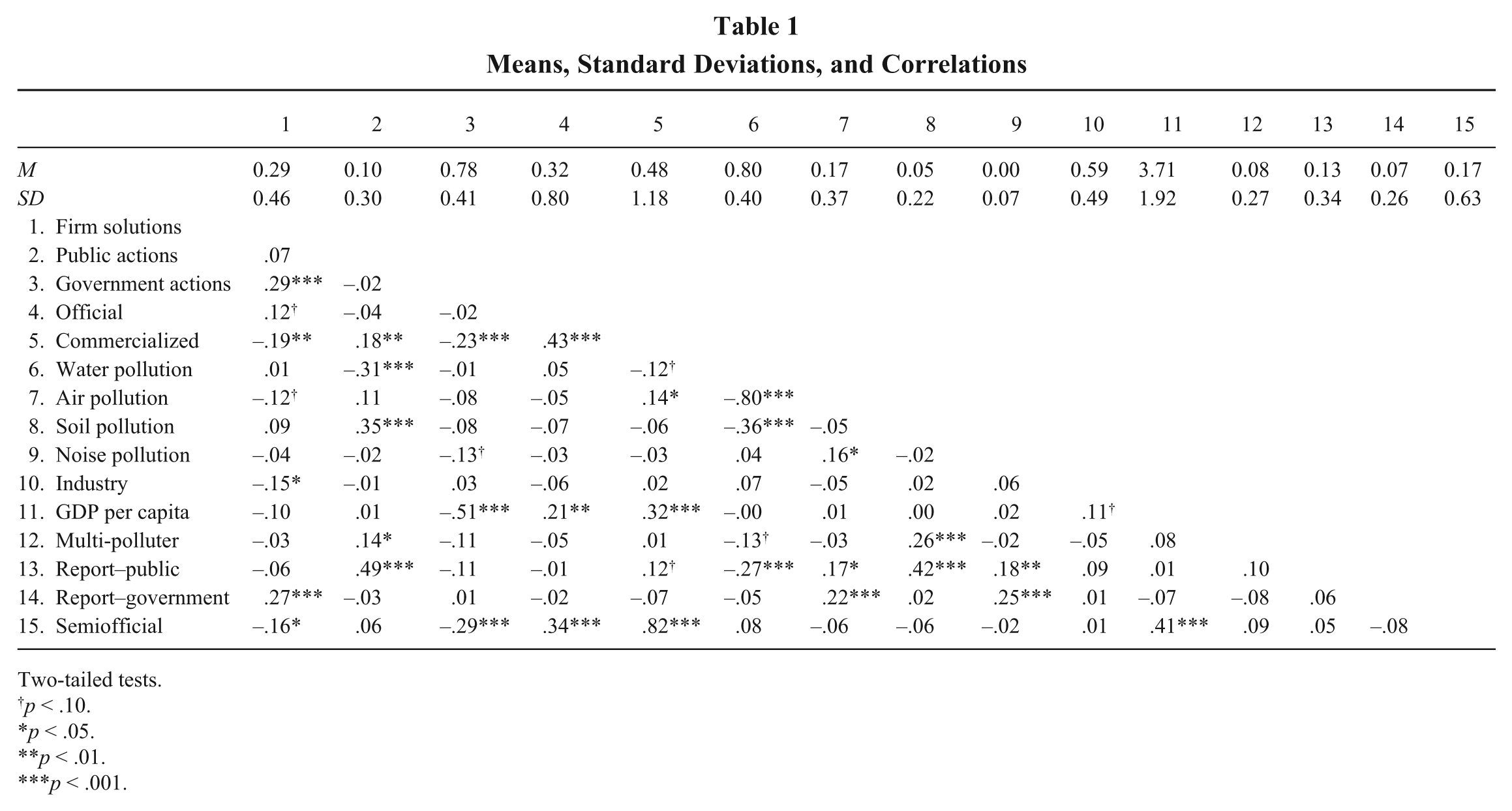
Table 1 presents the means, standard deviations, and Pearson correlations of the variables. As indicated in Table 1, some of the control variables are highly correlated (e.g., r = –.80, p < .001 for water pollution and air pollution; r = .82, p < .001 for semiofficial and commercialized media coverage). Although our analysis results indicated no variance inflation factor (VIF) value was higher than 7, which is lower than the threshold of 10 (Perrini, Russo, & Tencati, 2007), we made several attempts to further lower the VIF value.
Means, Standard Deviations, and Correlations
Two-tailed tests. †p < .10.
p < .05.
p < .01.
p < .001.
First, as water and air pollution were highly correlated, we dropped either variable and reran the analysis; the hypothesis test results appeared the same. Thus, the high correlation between these two variables should not affect our findings. To account for the effect of both types and to lower the VIF value, we combined these two types (1 indicating an event involving either water or air pollution, and 0 indicating neither). However, the new variable had a high correlation (r = –.85, p < .001) with soil pollution. We thus further combined the three pollution types (1 indicating an event involving air, water, or soil pollution, and 0 indicating none). The new variable, water–air–soil pollution, has no significant correlation with noise pollution (r = .01, p > .05). We thus retained these two pollution variables (i.e., water–air–soil pollution and noise pollution) as controls in our final report. As a result, VIF was much lower, 3.60. It is important to note that the hypothesis test results appeared the same in this process. Second, as semiofficial and commercialized were highly correlated, to reduce multicollinearity we dropped semiofficial from the analysis and the hypothesis test results appeared the same.
Tests for Hypotheses
We employed Probit regression to test our hypotheses. Probit regression fits the cumulative distribution function of the standard normal distribution to specified data, that is, binomial distributions where the data of interest have two states (0 or 1; Hoetker, 2007). First, we tested the agenda-setting effects, that is, the effects of official and commercialized newspaper coverage, on the government’s and public’s actions (H1 and H2). Second, we tested if the government’s and public’s actions affected firm solutions (H3 and H4). Drawing on the results of these tests, we are then able to test whether the government’s and the public’s actions mediated the link between media coverage variables and firm solutions (H5 and H6).
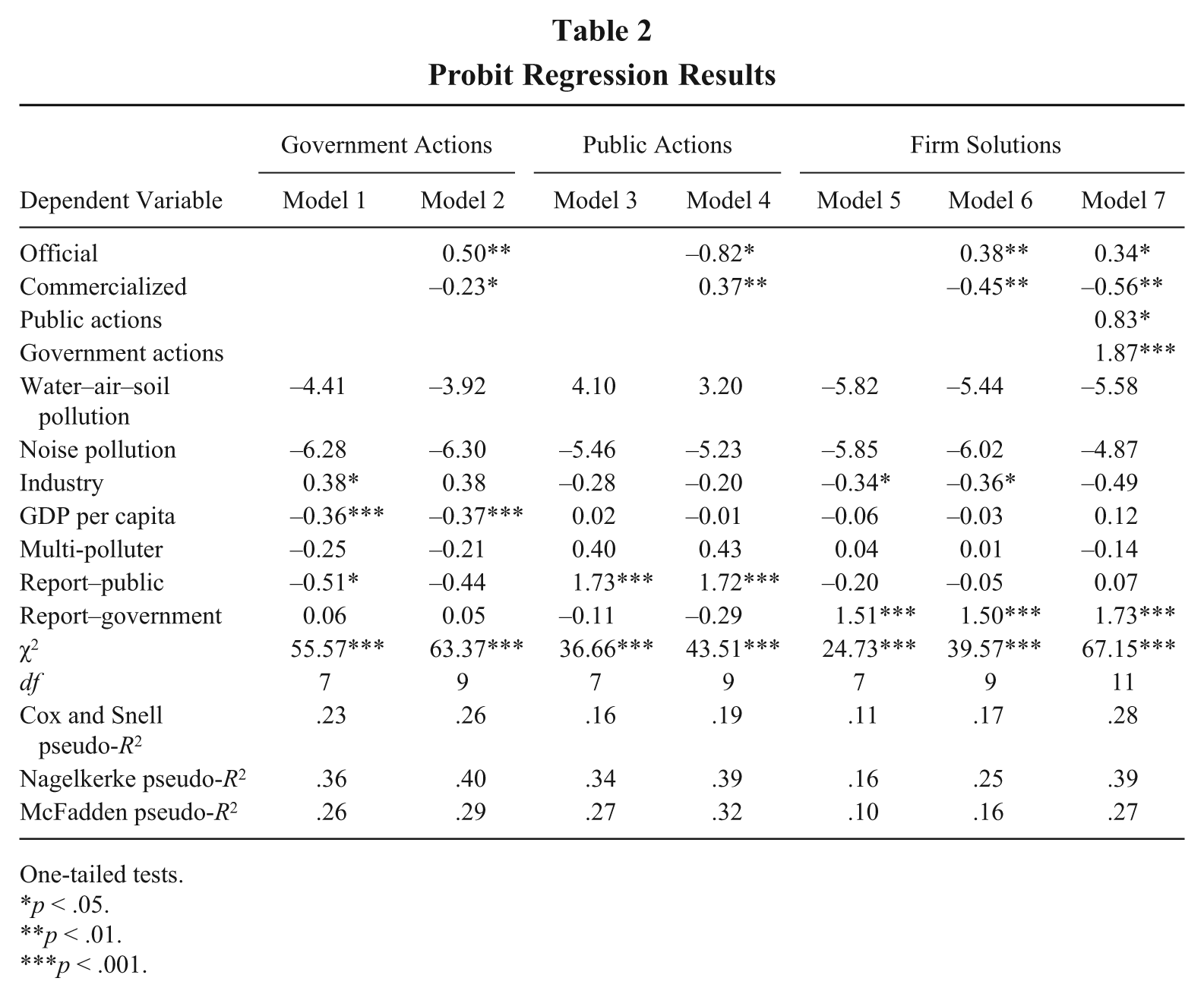
Table 2 summarizes the hypothesis test result. With the public’s and government’s actions as the dependent variable, Models 1 and 3 include covariates to provide a baseline model. Models 2 and 4 add official and commercialized news coverage into the analysis. H1 predicts that media coverage in official newspapers is positively associated with the government’s actions in China. Model 2 indicates that with the effect of commercialized media coverage controlled, official media coverage indeed has a positive effect on the government’s actions (B = 0.50, p < .01). Thus, H1 is supported. H2 proposes that commercialized newspaper coverage is positively associated with the public’s actions. Model 4 shows that with the effect of official media coverage controlled, commercialized news coverage positively affects the public’s actions (B = 0.37, p < .01). Thus, H2 is also supported.
Probit Regression Results
One-tailed tests.
p < .05.
p < .01.
p < .001.
Models 5 to 7 pertain to the test results for H3 to H6. With firm solutions as the dependent variable, Model 5 includes all covariates and Model 6 tests the direct effects of official and commercialized news coverage on firm solutions. Model 7 further includes the government’s and public’s actions. H3 predicts that when the Chinese government takes actions, a firm will proceed to seek a solution to its pollution problems. Model 7 shows that the government’s actions have a strong positive impact on firm solutions (B = 1.87, p < .001). Thus, H3 is supported. H4 predicts that when the Chinese public takes actions, the firm will proceed to seek a solution. Model 7 indicates that the public’s actions have a significantly positive impact on firm solutions (B = 0.83, p < .05). Thus, H4 is supported.
H5 proposes that the government’s actions mediate the relationship between official news coverage and firm solutions and H6 proposes that the Chinese public’s actions mediate the relationship between commercialized newspaper coverage and firm solutions. In this study, we follow the method developed by James and Brett (1984) and James, Mulaik, and Brett (2006) to test the mediating relationships. The logic of this method differs from the widely used Baron and Kenny’s (1986) logic in that it does not assume that the direct link between the independent variable and the dependent variable is necessary to verify a mediating relationship. According to this logic, as long as the path from the independent variable (i.e., news coverage variables) to the mediators (i.e., the government and public actions) and the path from the mediators to the outcome variable (i.e., firm solutions) are verified, mediation is established. This method has been commonly applied in management research (e.g., Nadkarni & Herrmann, 2010). As reported above, official news coverage affected the government’s actions, which further led to firm solutions; and commercialized news coverage led to the public actions, which further led to firm solutions. Therefore, based on the criteria developed by James and Brett (1984) and James et al. (2006), the government’s actions mediate the relationship between official news coverage and firm solutions and the public’s actions mediate the relationship between commercialized news coverage and firm solutions, lending support to H5 and H6.
To confirm the mediating effects of the government’s and the public’s actions, we applied Preacher and Hayes’s (2008) approach. Preacher and Hayes developed this approach as an extension of the Sobel (1982) test for a refined testing of the indirect effect of independent variables (i.e., the media) on the dependent variable (i.e., firm solutions). This method allows us to examine the extent to which each hypothesized mediator mediates the effect of the independent variable on the dependent variable in the presence of the other mediator (Christian & Ellis, 2011). This reduces the likelihood of parameter bias and enables a comparison of the magnitudes of the indirect effects. Following previous studies (e.g., Preacher & Hayes, 2008; Shrout & Bolger, 2002; Williams & MacKinnon, 2008), we estimated the indirect effects using unstandardized coefficients from the full model (i.e., Model 7) and utilized bootstrapping procedures with 1,000 resamples to place 95% confidence intervals (CIs) around the estimates of the indirect effects. Results indicated that the direct effect of official media on the government’s actions was significant (coefficient = 0.09, p < .01) and the direct effect of the government’s actions on firm solutions was also significant (coefficient = 4.10, p < .001). Official media had a significant impact on firm solutions both before (coefficient = 0.73, p < .01) and after (coefficient = 0.57, p < .05) the mediator, the government’s actions, was added into the model. Thus, the mediating effect predicted by H5 is verified.
Similarly we used Preacher and Hayes’s (2008) approach to verify the individual mediating effect of the public’s actions in the presence of the government’s actions. Results showed that the direct effect of commercialized media on the public’s actions was significant (coefficient = 0.04, p < .01) and the direct effect of the public’s actions on firm solutions was significant too (coefficient = 1.57, p < .05). Commercialized media had a significant impact on firm solutions both before (coefficient = −0.96, p < .01) and after (coefficient = −1.14, p < .01) the mediator, the public’s actions, was added into the model. Thus, the mediation effect predicted by H6 is also supported.
Robustness Checks and Post Hoc Analyses
We conducted a series of additional analyses to check for any (a) later-stage agenda-setting effect, (b) effects due to the interplay between the government’s actions and the public’s actions, (c) duration bias, (d) differences between agenda-setting effects and media legitimacy effects, (e) differences among probit, logit, and binary logistic regressions, and (f) differences in each individual action taken by the public or government as well as each individual firm solution.
First, we intended to verify that the focal company provides solutions in response to the pressure of primary stakeholders instead of the later-stage agenda-setting effect of the media. We collected the total number of news reports in official and commercialized newspapers between the time of the government’s or the public’s actions and the time when the focal firm provided solutions. We then entered these later-stage agenda-setting variables into Model 7 of Table 2 to identify whether it was the primary stakeholders’ actions or the agenda-setting effect in the later stage that motivated the firm to provide a solution. Results indicated that neither of the later-stage agenda-setting variables was significantly related to firm solutions. More important, after these later-stage agenda-setting variables were added, the effects of the government’s and the public’s actions on firm solutions remained significant. These results confirm that primary stakeholders’ actions are a critical component for the media to exert their effects on firms.
Second, we tested whether the government’s actions may reduce the likelihood of actions by the public because the purpose of actions by the public might be to move the government to act. We reran Model 4 of Table 2 by entering the government’s actions as a control variable, and results indicated that the impact of commercialized media on the public’s actions remains significant. This verifies that commercialized media coverage indeed motivates the Chinese public to act upon their pollution news reports.
Third, we checked for any potential duration bias in our analysis. Duration bias can occur with events spanning randomly chosen, multiple points in time, and can be reduced by analyzing events across different time points (Byun & Rozeff, 2003; Loughran & Ritter, 1995). In the current research, we used one month as the cutoff point. To determine if there was any bias by this choice, we coded the agenda-setting variables within 3 months after the news was first released and examined whether the government or public acted within 3 months. Nine more cases were added. We then reran the analyses and the results appeared very similar. Thus, duration bias should not be a major concern in our study.
Fourth, to differentiate the agenda-setting effect, which is based on the number of news reports (Tai, 2009), from the media legitimacy effect, which is determined by the type of media, we created two additional variables. Official legitimacy indicated that the pollution event was originally reported in official newspapers and commercialized legitimacy indicated that the pollution event was originally reported in commercialized newspapers, with 1 representing yes and 0 representing no. We replaced media coverage variables with these legitimacy variables. Results showed that publishing in official newspapers did not affect the government’s or the public’s actions. Whereas publishing in commercialized newspapers did not affect the public’s actions, it negatively impacted the government’s actions (B = −0.77, p < .05). Thus, primary stakeholders’ actions largely reflected the agenda-setting effect (i.e., the total number of news reports), instead of the media legitimacy effect (i.e., the type of newspapers).
Fifth, in the current research, we employed probit regression to test our hypotheses because probit regression has relatively stricter assumptions and the results attained by probit analysis are generally more realistic with less error as compared to logit or binary logistic analysis for normal distribution of strength (Shariff, Zaharim, & Sopian, 2009). Since both logit and binary techniques are also commonly used to analyze the relationship between a dichotomous outcome variable and continuous and dichotomous independent variables, we reran the analysis with logit and binary logistic regressions. The results attained from both analyses are highly aligned with our findings. Thus, our findings should be robust to the analysis techniques adopted.
Last, we tested if the media coverage variables would have any differential effects on each individual action taken by primary stakeholders. We first coded five dummy variables to indicate each government action, with 1 representing yes and 0 representing no: (a) imposing fines, (b) forcing firm leaders to resign, (c) initiating lawsuits against the firm, (d) requiring alterations of processes and operations, and (e) shutting down the factory. We reran the analysis as shown in Model 2 in Table 2 with these five dependent variables entered separately. Results indicate that official newspapers have a positive impact on the government’s initiating lawsuits against the firm (B = 0.36, p < .05) and on requiring alterations of processes and operations (B = 0.44, p < .01).
We then coded four dummy variables to indicate each action by the public, with 1 representing yes and 0 representing no: (a) bringing the company to court, (b) getting the government involved, (c) boycotting the focal firm’s products, and (d) staging street protests. We reran Model 4 in Table 2 with these four dependent variables entered separately. We found that commercialized newspapers can motivate the public to boycott the company’s products (B = 0.41, p < .05) and to engage in street protests (B = 0.79, p < .01). Finally, we coded the company’s solutions into four dummy variables with 1 representing yes and 0 representing no: (a) making financial compensations, (b) improving the processes and operations, (c) shutting down the polluting factory, and (d) serving of jail time by responsible managers. With these four solutions entered separately as dependent variables, we reran Model 7 in Table 2. Results illustrated that the government’s actions had a positive impact on improving the processes and operations (B = 1.68, p < .001), while the public’s actions had a positive effect on serving of jail time by responsible managers (B = 1.17, p < .05). Overall, these post hoc analyses reveal finer-grained information regarding how the media influence pollution control in China through the government and public.
Discussion
In the current research, we sought to investigate how the media, as a secondary stakeholder, influence Chinese firms’ pollution behaviors through their impact on two primary stakeholders: the government and the public. Drawing on a prominent communication theory—agenda-setting theory—and positioning ourselves in the stakeholder research stream, we aim to contribute to stakeholder theory by clearly mapping the influence path from the media to the firm. Our research reveals that in the Chinese institutional environment, primary stakeholders are motivated by different types of media. While official newspapers have a strong positive impact on the government’s actions, the public tends to act upon the agenda set by commercialized newspapers. Furthermore, we found that the government’s actions mediate the relationship between official newspapers’ agenda-setting effects and firms’ solutions to their pollution incidents and that the public’s actions mediate the link between commercialized newspapers’ agenda-setting effects and firm solutions.
Implications for Research
Our findings offer several key implications for stakeholder research. First, although the media have been theoretically classified as a secondary stakeholder (Clarkson, 1995), extant research has largely treated the media as a primary stakeholder and focused on their direct impact on firms’ social behaviors (Eesley & Lenox, 2006; Rindova et al., 2005; Tang & Tang, 2012). Such a focus suggests that the media have the capability to motivate firms to engage in social behaviors without the involvement of primary stakeholders. This assumption can lead to an overestimation and oversimplification of the media’s influence on firms. Our study finds that although official newspapers in China have a direct impact on firms’ pollution behaviors, their impact is at least partially mediated by the government. Failing to take into account the indirect impact of the media will provide an incomplete picture of the dynamics between the media and firms and will result in an exaggeration of the media’s power.
Second, our study can help to provide an explanation for the mixed findings regarding the effect of the media on firms’ social behaviors. Although previous research has suggested that the media enjoy an almost absolute power over firms, empirical studies have mixed results. Some studies found that the media indeed are able to discipline firms’ environmental behaviors (Kassinis & Vafeas, 2006; Weaver et al., 1999), but others found that the media’s power can be effectively countered (Tang & Tang, 2012) or compromised (Tan, 2009). Previous research has sought institutional explanations for such a discrepancy (Tang & Tang, 2012). We suggest that it is the type of media that may account for the mixed findings. While the role of the official media in disciplining firms’ environmental behaviors is quite clear in China, the role of the commercialized media is more complicated. Although the commercialized media have an indirect, positive effect on a firm’s pollution behaviors via the public’s actions, they have a direct, negative impact on firms’ solutions. This direct, negative impact of commercialized newspapers on firm solutions may be counterintuitive as, according to the agenda-setting theory, the more attention drawn by newspapers to a certain pollution event, the more likely the involved firm will strive to provide a solution. This finding, however, may provide some evidence of the difficult industry environment that the commercialized newspapers have to cope with as this negative effect may be due to the fact that when pollution news is reported in the commercialized media, the focal firm expects the government to neutralize the negative consequences of such reports rather than attempting to solve the pollution problem. Note that the link between commercialized media and government actions is negative (B = −0.23, p < .05). Indeed, it is not uncommon for the Chinese government to discourage the commercialized media from disclosing the negative side of the society. Future research is warranted to further explore the rationale behind these findings.
Third, our results suggest that in China, primary stakeholders tend to rely on a couple of major measures to respond to the agenda-setting effects. The government tends to initiate lawsuits against the polluting firm and to demand alterations of processes and operations in response to the official media reports. The public is more likely to boycott the company’s products and to engage in street protests to respond to the commercialized media reports. Similarly, our findings indicate that the focal firm tends to provide different solutions to respond to the actions taken by different primary stakeholders. Under government pressure, the firm is more likely to improve its polluting processes and operations, whereas the public’s actions are more likely to result in firm leaders’ serving jail time.
Last, interestingly, our findings indicate that the Chinese public and government tend to take opposing actions regarding the agenda set by different types of newspapers. Although the government acts upon the calls from the official media, the public acts against such calls. The public, however, acts positively in response to the reports in commercialized newspapers, while commercialized newspapers have a negative impact on the government’s actions. Previous research indicates that reliable and respected news outlets should have more impact on their audience than do dubious news sources (Walgrave & van Aelst, 2006). This perspective may not apply in China because different types of newspapers possess differential types of legitimacy. Although official newspapers enjoy the authorized legitimacy granted by the government, their legitimacy is questioned or even challenged by the public. Commercialized newspapers, on the contrary, mainly gain their legitimacy by aggressive, sometimes even bold, investigations of issues that affect the public interest. Thus, although commercialized newspapers lack government-sponsored legitimacy and may suffer from this disadvantage (e.g., Southern Weekend had to let go several of its editors-in-chief due to their reports of sensitive issues), their reports enjoy high credibility among the public. This situation may be idiosyncratic to China, but it highlights the importance of studying different types of media as they may exert their power over firms through differential routes.
Implications for Practice
Our research offers implications for practice as well. As a secondary stakeholder, the media should pay close attention to motivating primary stakeholders to act upon their reports. Without the involvement of primary stakeholders, the media’s full power will be discounted and companies may not seek to improve their behaviors actively. Our results indicate that in China, both the government’s and public’s actions have a strong impact on whether the focal firm will provide a solution to its pollution problems. Thus, by focusing on the government and the public, the media will be able to discipline companies’ pollution behaviors more effectively.
In addition, the findings reported in this article can help firms to make proper strategic decisions during pollution crisis management. For example, as official newspapers are more likely to exert their agenda-setting influence on the government, the government may take such actions as pressuring the firm to change the current polluting processes and operations or initiating lawsuits against the firm and the responsible managers. Thus, when official newspapers report a firm’s pollution incident, the focal firm will have a higher chance of facing regulatory risks. By contrast, if a pollution incident is mainly reported in commercialized newspapers, the public will be more likely to respond and take actions such as boycotting the company’s products. Equipped with such knowledge, firms will have a clearer picture of the repercussions of their polluting behaviors, which will help them cope with the consequences, and possibly deter such behaviors in the future.
Limitations and Suggestions for Future Research
Although we have strived to conduct a solid and robust analysis to test our hypotheses, as with all studies, our research has a few limitations that constrain the generalizability of our findings. First, we did not include other media outlets such as television or the Internet in the sample. However, digital media have become more and more popular in China, and future studies should incorporate digital media in their investigations of the media’s power. Second, the temporal issue may exist in our model. Although the agenda-setting effect, that is, how the media’s agenda affects the government’s and the public’s agenda, does exist in China, the reverse effect, that is, how the media’s agenda is affected by the government’s and the public’s agenda, is unknown to us, yet it may be especially acute in the challenging media environment of China. Since the media are a highly context-specific stakeholder, future studies are warranted to replicate our model in other institutional contexts.
Third, due to data limitations and our focus on the event as the unit of analysis, we did not control for firm characteristics in our analysis. Firm size, firm age, and financial performance may all affect the solutions available to the focal firm. It will be important for future studies to take into account the effects of such firm characteristics. Last, we investigated only the interdependence among the media, the government, the public, and companies, as suggested by the agenda-setting theory (Dearing & Rogers, 1996). The relationships between the media and other primary and secondary stakeholders are also worth investigating. Future research could establish a network map for the stakeholder−firm relationship. This map would allow us to draw the direct and indirect impact stemming from each stakeholder to the focal firm. More important, such a map would greatly help stakeholders and firms to better interact with each other and improve firms’ environmental performance.
Footnotes
Acknowledgements
This article was accepted under the editorship of Deborah E. Rupp.