




Abstract
Using 50 effect sizes from both published and unpublished studies (team n = 3,198), we provide meta-analytic support for the positive relationship between shared leadership and team performance. Employing a random effects model, we found that the theoretical foundation and associated measurement techniques used to index shared leadership significantly moderated effect size estimates. Specifically, as compared to studies that conceptualized and employed assessments of overall shared leadership from members (i.e., an aggregation approach), network conceptions and measures of shared leadership evidenced higher effect sizes. Both network density and (de)centralization approaches to the study of shared leadership–performance relations exhibited significant and higher effect sizes than did the aggregation-based studies. Analyses also revealed lower average effect sizes when the sample studied was in the classroom/lab as compared to the field. Task complexity significantly moderated the shared leadership, with lower effect sizes observed with more complex tasks. No significant influence of team task interdependence was observed. We highlight the relative value of employing social network theories and measures as compared to aggregate theories and measures of shared leadership. Directions for future research and application are discussed.
Over the last two decades, there has been a growing advocacy of the benefits of adopting shared leadership as a means of enhancing team performance. For example, Pearce and Manz (2005) submitted that shared leadership is often advantageous as it is “ever more difficult for any leader from above to have all of the knowledge, skills and abilities necessary to lead all aspects of knowledge work” (p. 132). Indeed, many studies have demonstrated the positive influence of using shared leadership and argued that it yields higher team-level performance benefits than do traditional hierarchical leadership structures (Avolio, Jung, Murry, & Sivasubramaniam, 1996; Carson, Tesluk, & Marrone, 2007; Perry, Pearce, & Sims, 1999). But that has not always been the case (e.g., Bowers & Seashore, 1966), and the extent to which shared leadership relates to team performance is unclear. Moreover, as research evolves, the fundamental question of what exactly shared leadership is takes on more prominence.
Traditional definitions of leadership are not necessarily clear or consistent (Bass & Bass, 2009), and what it takes to be a leader, as well as who is a leader “in any given social context, is ambiguous, dynamic, and contextual” (DeRue & Ashford, 2010: 630). Overlaying the idea that leadership is somehow shared by team members only further complicates an already ambiguous situation. Over the years, the literature has become quite disjointed with a proliferation of nomenclature and conceptualizations. For example, shared leadership (Avolio et al., 1996; Boies, Lvina, & Martens, 2010; Carson et al., 2007), distributed leadership (Bolden, 2011; Gibb, 1954; Mehra, Smith, Dixon, & Robertson, 2006), collective leadership (Friedrich, Vessey, Schulke, Ruark, & Mumford, 2011; Hiller, Day, & Vance, 2006), team leadership (Chen & Lee, 2007; Morgeson, DeRue, & Karam, 2010; Sivasubramaniam, Murry, Avolio, & Jung, 2002), informal leadership (Neubert, 1999), and peer leadership (Bowers & Seashore, 1966; Gerstner, 1998) have all been advanced as ways to conceptualize and understand how leadership may emanate from, and be shared by, team members (Morgeson et al., 2010).
Recently, scholars have attempted to clarify the boundaries of shared leadership by defining the complex adaptive process that occurs between leaders and followers in teams (DeRue, 2011) and offering a typology of collective leadership (Contractor, DeChurch, Carson, Carter, & Keegan, 2012). These propositions leverage the nature of contemporary work in organizations and embrace the perspective that leadership is an emergent and dynamic process whereby multiple individuals can take on leadership roles according to the needs of the group (Morgeson et al., 2010). Specifically, these studies stress the importance of team member interactions (DeRue, 2011), leadership roles, time, and distributions (Contractor et al., 2012) in understanding shared leadership.
While researchers grapple with how to define and articulate a theory of shared leadership, it is imperative to appreciate that shared leadership conceptions diverge from traditional leadership theories. Specifically, traditional theories have focused on leaders’ downward influence on their followers (Pearce, 2004; Pearce & Conger, 2003) through formal authority and power. However, we know that leadership is more complex than a unidirectional line pointing down toward subordinates (e.g., leader-member exchange; Graen & Uhl-Bien, 1995) and more complex than using a team as a simple sum of its components (e.g., Contractor et al., 2012). Despite this understanding, most researchers discuss shared leadership by drawing on hierarchical, individualized, and unidirectional theories (DeRue, 2011). Interestingly, a close inspection of the various definitions of shared leadership suggest that the way in which researchers define the phenomenon may in fact influence the nature of its observed relationship with team performance. It is this realization that served as motivation for our analysis.
We have two primary objectives for the current study. First, although many authors cite the positive benefits of shared leadership, the magnitudes of such effects and whether they are consistent across studies and different conceptualizations of shared leadership remain as open questions. We use meta-analytic techniques to address these questions with the expectation that shared leadership will evidence significant positive relationships with team performance, but we also anticipate that such effects will not be uniform across studies. Second, we suggest that the types of underlying theories guiding shared leadership investigations and their associated measurement protocols will influence the magnitude of observed effects with team performance. That is, as theory and measurement get closer to embracing the complexities of different forms of shared leadership, we anticipate seeing stronger relationships with team performance. Specifically, we will discuss and analyze aggregation, dyadic exchanges, and distribution theories and measurement strategies of shared leadership. Aggregate theories and measurement strategies position the source of leadership as an undifferentiated whole of members and typically use the team mean of a behavioral Likert-type scale. Dyadic exchanges focus on team member linkages or ties between each other (commonly measured as a density score) and suggest that these one-on-one relationships combine to form a team’s leadership network. Distribution theories suggest that the placement (or centrality) of a team’s leadership influence is the driving force behind its leadership structure. At a high level, these theories fundamentally differ in terms of the team’s source of leadership influence as well as the target of leadership influence. We advance and test hypothesized differences using meta-analytic findings while controlling for methodological features of the empirical investigations.
Shared Leadership Theoretical Background
Shared Leadership Defined
As evidenced by the numerous definitions presented in Table 1, it is important to determine what exactly is meant by shared leadership when synthesizing the extant literature. Accordingly, as a first step in our analysis, we reviewed the various definitions of shared leadership and identified five salient themes throughout: (a) locus of leadership, (b) formality of leadership, (c) equal and nonequal distribution, (d) temporal dynamics, and (e) the involvement of multiple roles and functions.
Representative Definitions of Shared Leadership by Theoretical Distinction
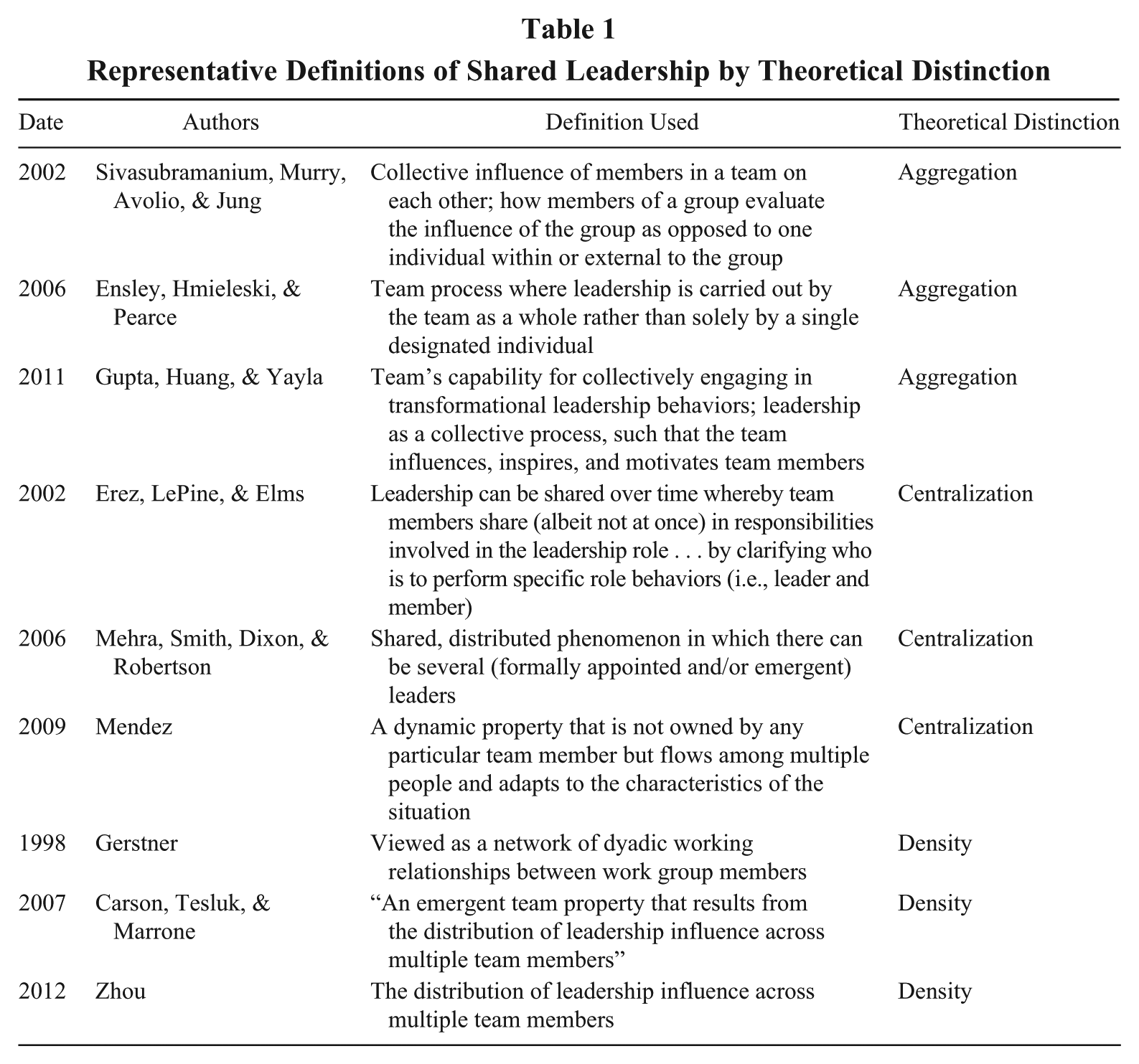
The first two themes (i.e., locus and formality of leadership; Morgeson et al., 2010) refer to the sources of leadership. The locus-of-leadership dimension suggests that team leadership can originate from one of two sources: outside the team (i.e., external) or within the team (i.e., internal). The formality of leadership reflects whether the leader’s authority is formalized in the organization (i.e., formal) or whether there is no direct leader responsibility (i.e., informal). In line with previous work (Morgeson et al., 2010) and existing definitions of shared leadership, it is generally assumed that shared leadership is an informal and internal process. However, we suggest that some shared leadership designs may be formally designated and should not necessarily be precluded. For example, in their study of dynamic delegation, Klein, Ziegert, Knight, and Xiao (2006) observed Trauma Resuscitation Units and found that rather than leadership existing within a specific person, leadership was formally vested in three positions: attending surgeon, surgical fellow, and admitting resident. While this leadership structure was considered more formal, shared leadership existed because multiple individuals were seen as leaders in these specific roles. A second example exists in the case of rotated leadership. Erez, LePine, and Elms (2002) studied classroom project teams who were tasked with various assignments over the course of a semester. Rather than assigning a team leader, students were told to choose different team members to lead the various assignments over time. Thus, over the life cycle of the team, multiple leaders emerged, yet those leaders were formally chosen by team members to lead different tasks. Both of these situations involve leadership from multiple individuals in a team and constitute shared leadership albeit without the “informal” designation.
The third theme, equal and nonequal distributions, refers to the extent to which team members participate in leadership. While the first two themes are fairly consistent across studies, this dimension varies. Specifically, in studies employing aggregate theories of shared leadership, definitions generally position the phenomenon as emanating from an undifferentiated set of members. That is, shared leadership is a “team-as-a-whole” phenomenon, and the unique contributions of team members, whether they are leading different functions or shifting responsibilities, are not considered. In contrast, studies employing social network approaches (i.e., dyadic exchange and centralization) suggest that the unique influences of team members are important and should be considered as a basis for construct definition (see Table 1 for examples). Although approaches vary across studies, it is our position that shared leadership involves unique influences of team members (Carson et al., 2007; Contractor et al., 2012; Mayo, Meindl, & Pastor, 2003) where leadership is distributed rather than combined.
The fourth theme we identified was the temporal or dynamic quality of shared leadership. In their typology of collective leadership, Contractor and colleagues (2012) highlight time as a core aspect of the phenomenon. The time component suggests that shared leadership is not static (Friedrich et al., 2011) and that leadership roles can be assumed by different team members either at the same time (Kukenberger, 2012) or at various points during the team’s life cycle (Erez et al., 2002). The final theme, the involvement of multiple roles and functions, acknowledges that leadership is not a unidimensional construct, but rather, there are various functions and responsibilities of leaders (Contractor et al., 2012; Kukenberger, 2012; Morgeson et al., 2010; Yukl, 1989). Acknowledging that multiple leadership responsibilities exist creates a mechanism by which leadership responsibilities can be distributed among team members to facilitate task completion. Based on these themes, we propose the following integrative definition: Shared leadership is an emergent and dynamic team phenomenon whereby leadership roles and influence are distributed among team members.
Shared Leadership and Team Performance
The idea of multiple leaders dates back at least to Follett’s (1924) assertion that one should look for guidance on the basis of individuals’ knowledge of the situation at hand and not necessarily to the designated leader. Later, Gibb (1954) described distributed leadership as groups comprised of leaders who perform multiple group functions. Despite these early works, research in this area remained fairly stagnant until the late 1990s. While there were some theoretical developments in shared leadership, relatively few empirical studies appeared during that period. However, Avolio and colleagues (1996) rekindled interest in the topic and demonstrated a positive relationship between shared leadership and team performance.
Since the mid-1990s, the topic of shared leadership has garnered substantial attention in the research community (e.g., Avolio et al., 1996; Carson et al., 2007; Pearce & Sims, 2000, 2002; Seers, 1996) and in applied contexts (e.g., Pearce, 2004; Pearce & Manz, 2005; Pearce, Manz, & Sims, 2008). Even though this topic has been empirically advanced by a relatively small number of researchers, there have been dozens of qualitative studies, over 100 theoretical models, and a handful of literature reviews, along with increased attention in mainstream practitioner outlets (e.g., Goldsmith, 2010). Despite its growing popularity, the science supporting the value of shared leadership is unclear. While most shared leadership scholars claim that it relates positively with team performance, a closer examination of the literature reveals inconsistent results that may, in fact, be the result of theoretical and conceptual differences.
Research on shared leadership has often found beneficial results such that it is positively related to team performance (Avolio et al., 1996; Hoch & Kozlowski, 2012) and a better predictor of team performance than vertical leadership (Ensley, Hmieleski, & Pearce, 2006; Pearce & Sims, 2002). Additionally, Taggar, Hackett, and Saha (1999) found a positive correlation between emergent leadership behaviors, whatever their origin, and team performance. Recently, Gupta, Huang, and Niranjan (2010) demonstrated support for the positive impact of shared leadership on team performance using a longitudinal design. Collectively, these studies and others illustrate positive relationships between shared leadership and performance outcomes.
However, shared leadership does not always produce positive team results. In the first empirical study of shared leadership, Berkowitz (1953) examined manufacturing conference groups and the extent of functional differentiation of the leader (i.e., chairman) from other behavioral leaders among group members. Results indicated that when the chairman was the sole behavioral leader in the group, the group was more satisfied and more productive than when group members engaged in behavioral leadership. Bowers and Seashore (1966) explored peer leadership in the form of support, goal emphasis, work facilitation, and interaction facilitation as related to team performance. Across all dimensions, peer leadership exhibited negative effects. More recently, Boies et al. (2010) found that shared leadership identified using transformational leadership had negative effects on team performance.
Despite the inconsistencies noted above, on balance, we believe that shared leadership will relate positively with team performance. Leadership, whatever its source, is a critical driver of team effectiveness (Morgeson et al., 2010), and we believe that shared leadership will likely relate positively to team performance. Katz and Kahn (1978) suggested that when team members offer leadership, they will bring more resources to the task, share more information, and experience higher commitment with the team. Collectively, these consequences should lead to higher levels of team performance. Additionally, when team members receive influence or are open to the influence of others, it can generate higher levels of team functioning in terms of respect and trust. Teams that exhibit these characteristics have also exhibited higher levels of performance (Day, Gronn, & Salas, 2004; Marks, Mathieu, & Zaccaro, 2001). This premise aligns with the empirical evidence (e.g., Carson et al., 2007; Erez et al., 2002; Pearce & Sims, 2002) and the basic argument that when team members offer their leadership to others, they should better execute team functioning and thereby higher performance. Therefore,
Hypothesis 1: Shared leadership will be positively related to team performance.
Theories of Shared Leadership
Generally speaking, we anticipate shared leadership to be positively related to team performance. However, given the inconsistency of previous results, we also anticipate that the effect sizes will likely be heterogeneous across samples. To explain such variance, we consider different theoretical approaches to the study of shared leadership. We use these theories to review and code previous studies, advance hypotheses concerning their relative predictive value, and then test our hypotheses using meta-analytic techniques.
Leadership has often been conceptualized as a top-down process where researchers isolate a single leader. However, Carson and colleagues (2007) argued that “shared leadership originates with individual members of a team engaging in activities that influence the team and other team members in areas related to direction, motivation, and support” (pp. 1218-1219). Furthermore, DeRue (2011) suggested that shared leadership is a complex, adaptive process that involves a series of leading and following interactions. Broadly speaking, individuals who assume leadership roles give direction, motivation, and support to their teammates, whereas “follower” roles can be conceptualized as members who receive direction, motivation, and support. Specifically, team members take on these roles through a leader-identity claiming and granting process where who is a leader and who is a follower is constructed through a social process rather than an overall assessment of leadership through absolute measures across teams. However, few studies to date have adopted such an approach. Below, we discuss three major theoretical explanations for shared leadership and the subsequent impact of theoretical decisions on the shared leadership–team performance relationship.
Sharing leadership using aggregation
Most empirical studies on shared leadership employ aggregation theories and rationales. Aggregate theories of shared leadership shift the source of leadership from an external individual to an undifferentiated whole of members. These models of shared leadership are akin to composition models, which rely on within-unit consensus (agreement) or consistency (reliability) to justify the aggregation of team-level constructs (Mathieu & Chen, 2011). These have also been referred to as referent-shift measures (Chan, 1998), whereby the normal (e.g., single external leader) referent of measures is replaced by another focus (e.g., leadership from team members). This approach makes no differentiation in terms of who or which members from the team are exhibiting leadership; rather, the idea is to change the focus from what an external person does to what the team as a whole provides in terms of leadership. However, our current theoretical understanding of shared leadership suggests that it is a much more complex phenomenon than overall leadership from members (Carson et al., 2007; DeRue, 2011; DeRue & Ashford, 2010; Uhl-Bien, 2006). Nevertheless, the majority of past shared leadership investigations have adopted this referent-shift conception and used average scores, per team, as an index of shared leadership.
Although the aggregation approach provides a rough gauge of the leadership from team members, we believe that it may be deficient for at least two reasons. First, while understanding the influence from the team as a whole is important, we believe it provides only a small glimpse into the influence and complexities of sharing leadership. In other words, this referent-shift approach essentially asks participants to mentally aggregate different dyadic member relations and to derive an overall estimate of how much leadership is occurring within the team (Crawford & LePine, 2013). Consequently, important details and nuances are likely to be glossed over in the process. For instance, a team member may focus on two strong leaders on the team and rate the collective as high on shared leadership. Alternatively, a team member may focus on a single team member who engages in social loafing and acts as the “bad apple in the bunch” and report poor shared leadership. Furthermore, different members may focus on different components. As a result, the unique influences of individual team members or relationships between team members are obscured when using the aggregation approach (Crawford & LePine, 2013; Mathieu, Maynard, Rapp, & Gilson, 2008; Murase, Doty, Wax, DeChurch, & Contractor, 2012).
Second, most studies that employ aggregation conceptualizations of shared leadership have adopted inherently hierarchical leadership themes, such as transformational, transactional, aversive, directive, and/or empowering leadership (Ensley et al., 2006; Pearce & Sims, 2002; Pearce, Yoo, & Alavi, 2004; Sivasubramaniam et al., 2002) to describe leadership behaviors among team members. However, the fundamental tenets of these behavioral leadership theories are grounded in the hierarchical system of leadership. For example, transactional leadership has its roots in expectancy theory and centers on “motivating subordinate performance” through reinforcing behaviors (Pearce & Manz, 2005: 174). Transformational leadership in a team setting suggests that leaders “can influence . . . individual followers at lower levels” (Yammarino, 1994: 26), implying a hierarchical structure. While some may argue that one can adapt hierarchical dimensions for a shared leadership setting, DeRue (2011) explains that current leadership theories may not be able to sufficiently explain situations outside of downward leadership influence, for example, situations when “subordinates” emerge into leader roles (i.e., “leading up”) or where team members lead each other (i.e., “leading across;” DeRue, 2011). In other words, the very nature of shared leadership behaviors may differ from those of traditional vertical leadership. For example, peers will not have the same power or authority to lead (cf. Hollander & Offermann, 1990) or may lead in fundamentally different areas (Kukenberger, 2012). Accordingly, we suggest that shared leadership effects on team performance gathered using aggregate theories and techniques will yield smaller effect sizes as compared to other methods because they are unable to illuminate the complexities of shared leadership.
Sharing leadership using social network approaches
Scholars have recently advanced social network approaches to study shared leadership (Carson et al., 2007; Mehra et al., 2006), which begin to model the patterns of relationships among interconnected team members. In general, a network is a set of individuals (i.e., actors) and the relationships (i.e., ties) between them (Wasserman & Faust, 1994). Ties can be measured using binary (i.e., leader or not) or valued (i.e., measured on a scale) items with different implications for both techniques. Specifically, binary ties assess the presence of a tie, whereas a valued assessment evaluates the strength of the relationship (Borgatti & Foster, 2003). Use of these different functions will be determined based on conceptualization of the shared leadership construct.
Social network approaches (i.e., sociometric approach) are akin to configural constructs or compilational models, which do not assume a convergence of attitudes but, rather, embrace discontinuity and a complex nonlinear emergence of constructs (Mathieu & Chen, 2011). This methodology assumes that each dyadic subgroup combines to form the overall group. Additionally, it allows leadership to be viewed and studied as a shared activity while incorporating the reciprocal, recursive influence processes among multiple members (Yukl, 1989). This rationale follows recent work by DeRue (2011), who described leadership processes as a series of leading-following double interacts that take on distinct patterns of interaction over time. Accordingly, social network theory provides a natural theoretical and analytical approach to studying the relational influence structure in teams (Carson et al., 2007; Mehra et al., 2006).
Mayo and colleagues (2003) note that using a social network perspective in shared leadership research (a) begins with the assumption that social actors are embedded in a complex web of relationships and (b) has developed conceptual and methodological tools to describe and analyze social structures (e.g., Carley, Pfeffer, Reminga, Storrick, & Columbus, 2012; Ripley, Snijders, & Preciado, 2011). Specifically, social network analysis allows for the study of multiple sources of leadership influence and the ability to model patterns of influence within a team while preserving rich data about the actual distribution of such influences (Mehra et al., 2006). In contrast to aggregation approaches, where members rate the team’s overall level of shared leadership, the network approach requires each team member to rate all other members in terms of their respective leadership influence. Accordingly, this approach allows for a much more nuanced view into the “black box” of shared leadership.
Dyadic exchange: Density
The most common index used to leverage the network measurement in shared leadership has been density (Carson et al., 2007; Mehra et al., 2006). Density of a network is the proportion of possible links that are actually present in the network (Wasserman & Faust, 1994). In a binary relationship, the density of a network takes the number of existing ties and divides by the maximum number of ties. If all ties are present, the network is said to be complete (Wasserman & Faust, 1994). Valued ratings of density provide a different assessment of the network by determining the strength of ties across all possible ties. In shared leadership studies utilizing density, ties between team members exist when one team member perceives another as exerting leadership influence in the team. For example, Carson and colleagues (2007) asked every team member to rate each of his or her teammates (1, not at all, to 5, to a very great extent) on the following question: “To what degree does your team rely on this individual for leadership?” As such, the density of the shared leadership network increases as more team members provide leadership (cf. Sparrowe, Liden, Wayne, & Kraimer, 2001).
Using a density or dyadic exchange rationale begins to embrace the complexities of sharing leadership. However, it should be noted that density amounts to an aggregation measure because it is essentially a mean score of dyadic relationships. Still, we submit that using a density score will provide a better estimate of shared leadership than aggregate methods. In particular, deriving density indices from a network approach removes the mental arithmetic that referent-shift approaches require of respondents. Therefore, some areas of potential bias are removed or attenuated (Crawford & LePine, 2013). For example, in a team composed of two strong leaders and two social loafers, aggregation and density approaches could lead to remarkably different results in terms of the amount of shared leadership within the team. Specifically, in aggregation studies, if a team member is prone to a leniency bias, he or she may rate the team as high on shared leadership (4 or 5 on a scale of 1 to 5) because two members took on leadership responsibilities. However, using a binary density approach, this same team may be assessed only around 0.5 (on a scale of 0 to 1). Accordingly, we believe that conceptualizing shared leadership as the pooling of dyadic member influences will yield a richer and more informative measure of shared leadership than will overall ratings. Therefore,
Hypothesis 2: The shared leadership–team performance relationships will be stronger in samples that used a network density approach as compared to an aggregation approach.
Distributions: Centralization
Team network centralization has also been used as an index of shared leadership in teams. Determining which actor or node (i.e., person) within a network is the most influential has been one of the primary uses of social network analysis (Wasserman & Faust, 1994). Actors that are extensively involved in relationships with other actors are considered prominent or “central.” Node centrality is an index that represents the number of ties any specific actor has in a specific network. Network centralization however, is a group-level index that represents how dyadic ties are distributed in the overall network. Essentially, a network centralization measure calculates the sum of differences in centrality between the most central node in a network and all other nodes. Therefore, network centralization is a measure of compactness, as it describes the distribution of network ties and whether those links are organized around particular focal points.
As Mayo and colleagues (2003) suggested, centralization concepts are a useful way to understand both the leadership roles of different individuals and the entire network. Members with higher individual node centralities occupy more powerful roles within the team and would likely be recognized as leaders. To the extent that the entire team network is highly centralized, it suggests that one or two members are serving as leaders. However, the interpretation of teams with low network centralization scores is less clear. Specifically, low scores can suggest that there is no one clear leader or that everyone in the team is providing leadership, and in both cases, it assumes leadership is evenly distributed. Despite the lack of a clear distinction in low centralization scores, scholars advancing this network centralization conception have equated low network centralization as representing high degrees of shared leadership. To be clear, this is typically indexed in primary studies by multiplying team network centrality scores by −1. For purposes of exposition, we will refer to this conceptualization as the “centralization approach” with the understanding that it actually refers to team network decentralization.
Across shared leadership studies, the method for leveraging the centralization indices has been varied. For example, Mehra et al. (2006) generated visual representations of the networks and had raters code them as “traditional leader-centered” versus “distributed” structures. They considered a network distributed if there was at least one individual within the team other than the formal leader who received sufficient nominations to be considered as an emergent leader. Kukenberger (2012) used a combination of network centralization and diversity indices of members’ contributions along multiple networks of leadership as an index of shared leadership. Small and Rentsch (2010) and Mendez (2009) argued that a network centralization value of 1 indicates that a single individual is central (i.e., little sharedness), whereas deviations from 1 reveal that leadership is not limited to one individual.
We argue that conceptualizing shared leadership in terms of network centralization offers benefits as compared to the aggregation approach. Like density, centralization is derived from a network approach where each group member provides a specific rating for every other group member. Whereas an overall aggregate score around a scale midpoint may suggest an average amount of shared leadership in the team, network centrality scores would reveal the concentration of leadership within members of the team. While centralization provides an assessment of leadership distribution, it does not completely capture the nuances of dyadic exchange relationship as it is a network-level measure. However, we suggest that understanding these distributions reveals more regarding the nature of shared leadership. Therefore, we argue the following:
Hypothesis 3: The shared leadership–team performance relationship will be stronger in studies using a network centralization approach as compared to an aggregation approach.
Density and centralization
As described above, we believe that sociometric approaches, including both network density and centralization conceptualizations, will evidence higher effect sizes for shared leadership–team performance relations than will more traditional team aggregation or psychometric approaches. Naturally, this raises the question of whether density or centralization conceptions will exhibit higher effect sizes when compared to each other. While there is no overarching theory of social networks, scholars in this area focus on two basic concepts: the structure and the number of dyadic ties (Kilduff & Tsai, 2003). The structure of the network refers to the pattern of connections between nodes, or in this case, the distribution of shared leadership in the team. The number of dyadic ties yields density scores, which represent the amount of shared leadership in the team. Whether the amount or the distribution of shared leadership is more important is an open question with little theoretical guidance to advance an a priori prediction. Therefore, we will examine their relative impact on the magnitude of shared leadership–performance correlations in an exploratory fashion.
Research Question 1: Will studies using density or centralization indices of shared leadership evidence higher effect sizes?
Additional Influences on the Shared Leadership–Performance Relationship
Besides the substantive differences between shared leadership investigations, differences between study features may have significant influences on observed results. For example, team type is perhaps one of the more commonly examined moderators of team-related effect sizes in meta-analyses (e.g, De Dreu & Weingart, 2003; Mesmer-Magnus & DeChurch, 2009). However, Hollenbeck, Beersma, & Schouten (2012) recently argued that team types and taxonomies offer little utility for advancing our understanding of the critical drivers of team effectiveness. Instead, they advocated a dimensional approach whereby scholars should compare and contrast empirical findings on the basis of various features of teams. Below, we outline several dimensions upon which shared leadership studies may be differentiated and suggest how they may operate as potential moderator variables.
Sample type
Classroom and lab samples are often criticized in organizational research because they are believed to be nonrepresentative of organizational settings (Highhouse & Gillespie, 2008; Peterson, 2001). The implicit assumption is that results of student samples, particularly ones working on laboratory tasks, are not likely to generalize to real working populations. Alternatively, Driskell and Salas (1992) and Mathieu, Heffner, Goodwin, Salas, and Cannon-Bowers (2000) argued that laboratory research with student samples may generalize to work teams when the focus is upon the underlying principles or the construct relationships in question. In a comprehensive review of 82 meta-analyses, Mitchell (2012) concluded that the generalizability of laboratory effect sizes to field settings varied widely across fields, with work in industrial/organizational psychology exhibiting among the highest convergence. Nevertheless, the question of the comparability of research conducted with student teams—typically performing contrived or classroom-related tasks—to actual teams working in organizational settings has both practical and theoretical importance.
Performance measurement
Tesluk, Mathieu, Zaccaro, and Marks (1997) argued that different sources of measurement are suitable for assessing different types of team-related variables. They submitted that social psychological or emergent state (see Marks et al., 2001) style variables are perhaps best assessed from individual members, whereas variables such as team performance are better indexed using other sources of measurement. For example, the extent to which leadership is shared among team members is probably best indexed by members themselves, as they are privy to such behaviors more so than others. This is especially true in field settings where many team interactions occur out of sight of others. 1
The measurement of team performance, however, is preferably done using sources other than members’ self-reports. It is well known that subjective ratings may suffer from a variety of different biases, such as leniency effects or process-outcomes performance cuing effects (Martell & Leavitt, 2002). In short, ratings are prone to contamination effects. Alternatively, archival or “objective” measures of performance are not as prone to subjective contamination effects but may well be deficient and fail to represent the entire performance domain. In their meta-analysis of information sharing–team performance relations, Mesmer-Magnus and DeChurch (2009) proposed that “contamination will inflate relationships with subjective criteria and that deficiency will suppress relations to objective criteria” (p. 536). Indeed, their meta-analysis findings were consistent with this hypothesis. Thus, we anticipated shared leadership–performance relationships would be higher among studies using subjective criterion measures.
Task characteristics
Another factor that we believe may contribute to differences in the shared leadership–performance relationship is the characteristics of the task. While shared leadership can be appropriate in some situations, it certainly is not a panacea. For example, teams in crisis situations with limited time may fail if leadership is shared between team members. On January 15, 2009, when US Airways Flight 1549 encountered a bird strike minutes after takeoff, the aircraft crew needed to act fast as any delay in action could have been the difference between life and death for passengers and crew. In this time-limited situation, leadership from a single person was necessary to direct others and make a quick decision. In contrast, a project team given a task of designing, promoting, and marketing a new product may thrive with leadership responsibilities shared among the team. Accordingly, it is important to consider when and how shared leadership might be most beneficial. Specifically, because shared leadership is more complex and time-consuming than traditional leadership structures, it is likely to be most beneficial when tasks are so complex that they cannot be led effectively by a single individual.
Team task interdependence
Pearce (2004) suggested that the benefits of shared leadership are the greatest in contexts characterized as interdependent. Interdependence is a fundamental component of teams and can be conceptualized in a number of ways, including (a) task (i.e., the degree of task-driven interaction among members), (b) goal (i.e., the extent to which members share one or more common goals that guide their actions), and (c) outcome (i.e., the extent to which feedback and rewards are tied to collective vs. individual actions) (Saavedra, Earley, Van Dyne, & Lee, 1993; Sherman & Keller, 2011; Thompson, 1967). Although the three forms of interdependence are conceptually distinguishable, they tend to covary positively in practice. In their meta-analyses, Gully, Incalcaterra, Joshi, and Beaubien (2002) and Stajkovic, Lee, and Nyberg (2009) both found that team interdependence significantly moderated team efficacy–performance relations, with higher effect sizes observed to the extent that teams were more interdependent. LePine, Piccolo, Jackson, Mathieu, and Saul (2008) found a similar pattern in their meta-analysis of team process–performance relations, with higher effect sizes evident to the extent that teams had greater interdependence. It follows that shared leadership–performance relationships might exhibit stronger relationships to the extent that teams are performing more interdependent work.
Task complexity
In his work on shared leadership, Pearce (2004) suggested that “the more complex the task, the lower the likelihood that any one individual can be an expert on all task components” (p. 49). Specifically, complex tasks may require multiple exchange relationships among team members (Seers, Keller, & Wilkerson, 2003: 93). Wood (1986) described task complexity as the relationships between task inputs as an important determinant of human performance as these relationships create demands on the knowledge, skills, and resources of team members. Specifically, task complexity varies as a function of three underlying factors: (a) component complexity (i.e., the number of distinct acts and information cues needed to be attended to while performing the task), (b) coordinative complexity (i.e., the strength of relationships among various task inputs and task outputs), and (c) dynamic complexity (i.e., the stability of task requirements over time). Kerr and Jermier (1978) suggested that as task complexity increases, the need for leadership also increases; that is, extremely routine tasks reduce the need for leadership. Additionally, as tasks increase in complexity, the likelihood that all of the knowledge, skills, and abilities necessary to complete the task reside in a single person is small (Bligh, Pearce, & Kohles, 2006; Pearce & Manz, 2005). Cox, Pearce, and Perry (2003) suggested that as task complexity increases, teams should look toward leadership structures other than the traditional hierarchy to aid in successful task completion. Accordingly, as task complexity increases, the benefits of shared leadership become more apparent.
Method
Identification of Studies
We performed an extensive electronic and manual search to identify published articles, conference papers, and doctoral dissertations involving shared leadership. For the electronic database search, we used PsycINFO, Business Source Premier, Web of Science, and ProQuest Dissertation and Theses databases using the following key words: shared leadership, collective leadership, distributed leadership, team leadership, and peer leadership. We also performed manual searches of recent issues of relevant organizational research journals and conference proceedings to identify additional studies.
Following the inclusion criteria described below, these combined efforts resulted in a total of 43 studies from which we were able to extract 50 effect sizes to use in our analysis. 2 This represents 3,198 teams (M = 63.96, SD = 52.85) that included 16,010 individuals (M = 320.20, SD = 261.59). A wide variety of team types was represented across samples, including consulting, change management, project, virtual, sales, production, manufacturing, student, and research and development teams. Additionally, these teams represented a number of different industries, including automobile, social work, financial services, insurance, government, firefighting, and aviation.
Criteria for Inclusion
The article abstracts were reviewed for content and considered for inclusion in the meta-analysis. If it was unclear from the abstract how leadership was measured or conceptualized, we performed a full-text search to determine if the study met our criteria. In accordance with our relationships of interest, several rules for study inclusion were established. First, the article needed to include measures of both shared leadership and performance at the team level of analysis. Second, teams used in each sample had to have multiple leaders during the study time frame. Notably, studies reporting indices of a leadership climate were excluded because climate does not necessarily imply shared leadership. We also excluded laissez-faire leadership effect sizes. Laissez-faire leadership is a component of Bass’s (1985) conceptualization of transactional leadership and refers to a “hands-off” leadership style where the individual does not engage in influence of team members. In other words, it refers to the absence of leadership. Third, teams must have engaged in some form of shared leadership. As articulated above, this includes instances where leadership is shared over time, team members provide leadership influence and may be engaged in different leadership roles or functions, and the distribution or engagement of leadership does not need to be equal across team members. In particular, investigations involving rotated leadership were included, but instances where only vertical power differentiation existed were not included. Finally, articles needed to report correlations between our primary variables of interest or provide statistical information needed to compute effect sizes.
Potential Methodological Moderators
Each of the authors independently reviewed and coded the studies that met these inclusion criteria, and we evidenced perfect agreement on the (a) nature of shared leadership that was examined in each (i.e., aggregation versus network density or decentralization), (b) team and individual sample sizes, (c) type of sample that was used (coded classroom/lab = 0, field = 1), and (d) the type of performance measurement that was used (coded objective = 0, member or other subjective ratings = 1). 3
We also independently evaluated the degree of team interdependence and task complexity sampled in each study and evidenced high intercoder reliability. Specifically, we independently rated three facets of team interdependence for each sample (i.e., task, goal, and outcome) using 0- to 3-point scales from Gully et al. (2002), where higher values indicated greater interdependence. Ratings of the three facets evidenced high internal consistency (α = .83), so we summed them, per rater, to yield a single score for interdependence. We then correlated our individual ratings (i.e., rs = .68, .74, and .81; ps < .001) which yielded an overall intercoder reliability of .94. Therefore, we averaged our three ratings to yield a single interdependence score per sample. Task complexity was rated on a 10-point scale adapted from Wood (1986), with higher values representing greater complexity. We evidenced high interrater reliability on these ratings of task complexity (ρ range = .67-.79; p < .001), so we averaged scores across coders to yield a single task complexity score.
Analytic Techniques
Effect sizes were calculated by extracting Pearson correlations (r) from each sample. In instances where multiple effect sizes were reported (e.g., for different dimensions of shared leadership), we averaged them to yield a single effect size. We then used Fisher’s Z transformation to normalize our effect sizes given the inherently skewed distribution of Pearson’s r around a given population ρ (Hedges & Olkin, 1985). However, Zr is not readily interpretable (i.e., is not bounded by correlation conventions), and it was converted back to r for interpretation and reporting in our results. Additionally, to account for the potential influence of sample size in the precision of individual effect sizes across studies, we computed the standard error of Zr and used its inverse to weight each study (Card, 2012).
We used a random-effects model implemented with Wilson’s SPSS macros (Wilson, 2010). Prior research on meta-analytic methods (Erez, Bloom, & Wells, 1996; Hunter & Schmidt, 2004; Sivasubramaniam et al., 2002) has shown that random-effect approaches generate more accurate parameter estimates than do fixed-effect approaches. We employed a Z test to determine whether average effect sizes differed significantly from zero and Hedge’s Q statistic to test for the heterogeneity of effect sizes (Lipsey & Wilson, 2001).
We employed weighted generalized least squares analysis to test our hypotheses (see Wilson, 2010). Specifically, we followed a hierarchical two-stage approach where, after weighting by the number of teams sampled, we regressed observed effect sizes on the four potential methodological moderators to control for their potential effects. In a second step, using aggregation-based shared leadership samples as a contrast group (coded 0), we simultaneously introduced two dummy codes in the equation for density (coded 1) and decentralization (coded 1) to test Hypotheses 2 and 3, respectively. We later used density samples as the contrast group to test whether density (coded 0) and decentralization (coded 1) effect sizes differed significantly from one another. Our hypotheses were tested using two-tailed tests, and we employed p < .05 as our critical value throughout.
Results
Meta-Analyses
Table 2 presents a summary of the overall meta-analysis and subsample meta-analyses by shared leadership type. The raw observed 50 sample (i.e., k) correlations ranged from –.27 to .66 with an average of r = .21 (SD = .19). Moreover, the overall sample-size weighted average effect size (ES) between shared leadership and team performance was ES = .21 (SD = .21, CI = [.15, .27], p < .001). The confidence interval did not contain zero and the Z = 6.94,p < .001, test was significant, providing support for Hypothesis 1. Effect sizes varied across samples, with most containing the overall mean effect size within their respective 95% confidence intervals. Although the overall mean effect size was significantly different from zero, the correlations also varied significantly, Q(49) = 128.00, p < .001, which suggests that there is sufficient heterogeneity for potential moderators to operate.
Summary of Overall and Subsample Shared Leadership–Performance Random Effects Meta-Analyses

Note: k = number of effect sizes; CI = confidence interval; df = degrees of freedom; Z = test of significance from zero, Q = homogeneity of effect sizes test.
p < .001.
Next, we conducted three subsample meta-analyses separately by type of shared leadership examined and indexed in the original studies. The aggregate approach (k = 32) yielded an average weighted ES = .15 (SD = .19, CI = [.08, .22]), which was significantly different from zero (Z = 4.04, p < .001). This subset of effect sizes exhibited significant heterogeneity, Q(31) = 76.30, p < .001. The meta-analysis of 10 samples (nine unique studies) that employed the density approach yielded an average weighted ES = .35 (SD = .14, CI = [.27, .44]), which also differed significantly from zero (Z = 6.69, p < .001). This subset of correlations did not exhibit significant variability, Q(9) = 13.00, ns. Finally, the meta-analysis of the 8 samples (seven unique) that utilized the centralization approach revealed an average weighted ES = .29 (SD = .16, CI = [.18, .39]), which also differed significantly from zero (Z = 5.01, p < .001). This last subset of correlations also did not exhibit significant variability, Q(7) = 7.87, ns.
Moderator Analyses
While only the aggregate shared leadership approach subsample analysis revealed significant effect size heterogeneity, given the fact that the overall meta-analysis of correlations exhibited significant variability, we have preliminary evidence that type of shared leadership serves as a moderator variable. However, given the low power of subsample meta-analyses (see Sackett, Harris, & Orr, 1986), we used weighted generalized least squares analyses to test Hypotheses 2 and 3 while controlling for potential methodological moderators. Table 3 presents descriptive information and correlations among these study features. Notably, both the sample type used in the primary studies (r = .25, p < .05) and the use of a density measure of shared leadership (r = .31, p < .05) correlated significantly with the magnitude of observed effect sizes, and the level of task complexity and team interdependence exhibited significant correlations with each other (r = .65, p < .001). We then performed a weighted generalized least squares analysis to test Hypotheses 2 and 3. As summarized in Table 4, we first regressed the weighted effect sizes on to performance measurement type (β = .06, ns), sample type (β = .14, p < .05), team interdependence (β = .05, ns), and task complexity (β = –.05, p < .05) ratings, which collectively accounted for R2 = .17, ns, of the observed variance in effect sizes. 4 Notably, this suggests that effects were significantly higher for field, as compared to classroom/lab, samples, and counter to our arguments, task complexity evidenced a significant negative effect on the magnitude of shared leadership–team performance relationship.
Study Variable Descriptives and Correlations

Note: N = 50 effect sizes. SL = shared leadership. k = number of correlations meta-analyzed.
Coded 0 = objective, 1 = subjective.
Coded 0 = classroom/lab, 1 = field.
Coded 0 = other, 1 = density.
Coded 0 = other, 1 = centralization.
p < .05.
p < .01.
p < .001.
Weighted Least Squares (by Sample Size) Regression Analysis
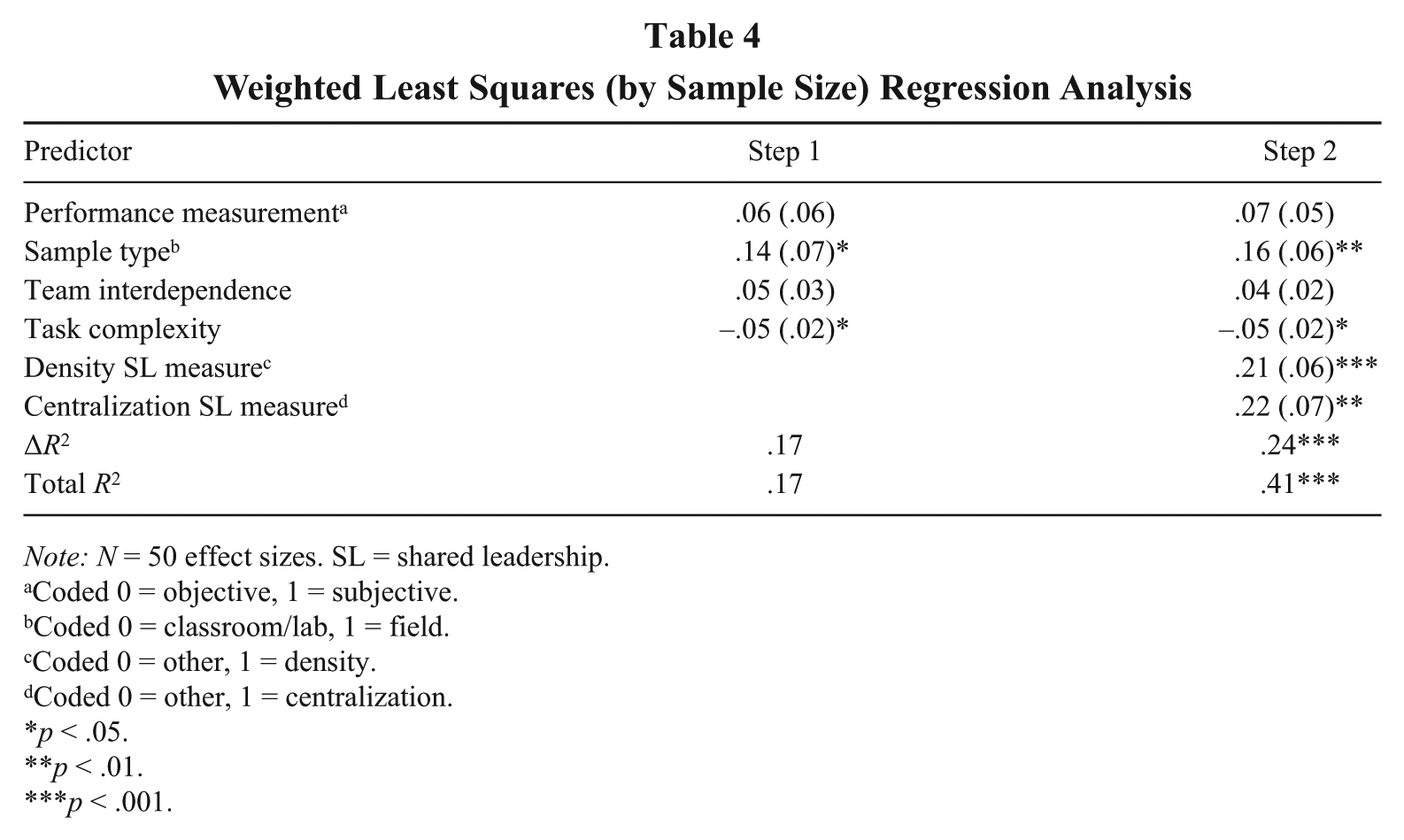
Note: N = 50 effect sizes. SL = shared leadership.
Coded 0 = objective, 1 = subjective.
Coded 0 = classroom/lab, 1 = field.
Coded 0 = other, 1 = density.
Coded 0 = other, 1 = centralization.
p < .05.
p < .01.
p < .001.
Next, using the aggregate shared leadership samples as the comparison base (coded 0), we added dummy codes (coded 1) for both shared leadership density (β = .21, p < .001) and centralization (β = .22, p < .01) to the equation, which combined accounted for a significant ΔR2 = 24%, p < .001. The final equation accounted for 41% of the variability of the sample-size weighted effect sizes. Both the dummy codes for density and centralization forms of shared leadership were positive and significant, consistent with Hypotheses 2 and 3, respectively. In a supplemental analysis, we also contrasted the relative effect sizes of density and centralization approaches, and they did not differ significantly from one another (β = .02, ns). Therefore our research question was inconclusive.
Discussion
The purpose of our research was twofold. First, we tested the extent to which shared leadership relates positively to team performance. Across 50 effect sizes, we found a significant positive relationship between shared leadership and team performance, supporting the claim of its positive benefits. However, we also found that the magnitudes of this relationship varied widely across studies. Second, we tested whether different conceptualizations of shared leadership and their associated measurement protocols accounted for a significant portion of the heterogeneity of effect sizes after accounting for several potential methodological moderators. We found that as theory and measurement get closer to embracing the complexities of shared leadership, the magnitude of observed shared leadership–team performance relationships became stronger. Specifically, we found support for our hypotheses that network conceptions of the number of dyadic leadership exchanges in the team (i.e., density) and their distribution throughout the team (i.e., decentralization) both evidenced significantly higher correlations as compared to holistic aggregation conceptualizations of shared leadership. Notably, we also found teams sampled from classroom and laboratory settings yielded lower average effect sizes as compared to teams sampled from field settings. We further found that the complexity of team tasks related negatively to the magnitude of shared leadership–performance relations. Last, we compared the relative effect sizes of density versus centralization conceptions of shared leadership and did not find their effect sizes to differ significantly from one another.
Theoretical Implications
Aggregate theories of shared leadership have largely dominated the shared leadership research over the past couple of decades. More recently, scholars have turned to network approaches, which, our results suggest, may be a more informative way to study shared leadership dynamics. Crawford and LePine (2013) note that from a measurement perspective, referent-shift (i.e., aggregation) approaches require respondents to perform “mental arithmetic” in that they need to collapse various member behaviors into a single representative team score. Additionally, research on informant accuracy indicates that shared perceptions of team properties and their corresponding structural configurations are not necessarily related (Bernard, Killworth, Kronenfeld, & Sailer, 1984). However, this is not to say that the aggregation approach is inappropriate for studying shared leadership. In fact, we encourage future researchers to consider a number of avenues while engaging in shared leadership research.
To start, researchers should examine the utility of traditional vertical leadership constructs (i.e., transformational, transactional, aversive, directive, and/or empowering leadership) at the team level. As the fundamental tenets of these behavioral leadership theories are grounded in the hierarchical system of leadership, we questioned the degree to which they are isomorphic and equally applicable for shared leadership phenomena. Researchers must collectively consider the alignment of the levels of theory, measurement, and analysis to support shared leadership behaviors as a team-level construct to reduce the potential for level-related confounds or fallacies of the wrong level (Mathieu & Chen, 2011). Typically, aggregate statistics or referent-shift techniques have been used to justify aggregation in addition to drawing on parallels with other similar individual to team variables (such as empowerment and self-efficacy) to argue in favor of such aggregation methods (Avolio, Sivasubramaniam, Murry, Jung, & Garger, 2003). In fact, research has shown that team members can collectively exhibit concern for each member’s needs and development (Avolio & Bass, 1995), which has supported the aggregation of Multifactor Leadership Questionnaire–type concepts. However, the introduction of more nuanced methodologies that consider and capture the dyadic social underpinnings of relationships in teams places a greater burden of justification on researchers interested in using referent-shift aggregation methods (Crawford & LePine, 2013).
Based on our results, sociometric or network-based approaches in conceptualizing, collecting, and analyzing shared leadership data seem to provide promise for future investigations. However, while recent social network methods are favorable compared to aggregation referent-shift approaches, they are still somewhat limited in their ability to fully explain the group structure of shared leadership. First, shared leadership has been argued to be a multilevel, complex arrangement between recurring and looping paths and patterns between follower and leaders (e.g., Carson et al., 2007; Carter & DeChurch, 2012; DeRue, 2011). The popular shared leadership network index employed to date, density, is generally considered one of the more simplistic measurements in the network arsenal. Second, while overall centralization informs us about the distribution of leadership within a network, it also tells us little about network patterns of influences. Moreover, and most importantly, we should note that scholars who have employed network centralization as an index of shared leadership in the studies we examined here have implicitly assumed that decentralized networks equate to shared leadership. However, while a decentralized network implies that there is no one clear leader, it does not necessarily indicate that leadership is shared throughout the team. Low centralization scores would also result from an absence of shared leadership in the team. In other words, if no one is exhibiting leadership in the team, network centralization will also be low.
In sum, viewing network indices in isolation does not allow for a complete understanding regarding the form of leadership, and researchers have recommended combining network indices (Mayo et al., 2003). Specifically, they submitted that the highest levels of shared leadership would generate a combination of high network density and low network centralization. High density alone suggests that shared leadership exists in the team but does not reveal the distribution or patterns of influences. So while our results have suggested that network conceptualizations of shared leadership offer advantages as compared to aggregation approaches, to date, they have not been fully exploited. Echoing Mayo et al.’s (2003) call, we recommend using a combination of network density and centralization in future investigations. In a similar vein, we also encourage researchers to explore the utility of various network indices in future analyses, as different indices may reveal different aspects or nuances about the structure and functioning of shared leadership arrangements.
Methodological Implications
We examined a number of potential moderators of the shared leadership effect sizes. Surprisingly, the nature of the performance measures did not exert a consistent significant effect. However, we also tested sample type (classroom/lab vs. field) as a potential moderator. Generally speaking, classroom samples performed contrived laboratory tasks over relatively short durations (e.g., ~3 hours; Resick, DeChurch, Randall, Murase, & Jimenez, 2009) or business simulations that lasted between 2 and 3 months (e.g., Gupta, Huang, & Yayla, 2011), although some performed complex field projects comparable to actual employees (e.g., Carson et al., 2007; Hoch, Pearce, & Dulebohn, 2010). In any case, this comparison amounts mainly to contrasting student teams completing complex simulations or projects as compared to employees working in field settings. Even controlling for the other moderators in a weighted generalized least squares analysis, the effect sizes for the classroom/lab samples were significantly lower than those observed with employees in field settings. These results are consistent with Mitchell’s (2012) more general observation that laboratory effect sizes in industrial/organizational studies parallel those observed in field settings, although of lower magnitudes. In other words, perhaps counter to conventional wisdom about sampling effects, students competing in complex simulations or completing classroom projects offer conservative settings for testing the effects of shared leadership on team performance.
We also found a significant influence of the level of task complexity on the relationship between shared leadership and performance. Interestingly, however, this influence suggests that teams performing tasks with higher levels of complexity exhibit lower effects of shared leadership on team performance. Pearce and Manz (2005) have suggested that the more complex the work is that is being performed, the more likely it is that shared leadership will be needed for optimal performance. Specifically, complex work involves many different facets, and it is unlikely that one person will possess all of the expertise and leadership abilities to successfully lead a team to goal completion. While this may be in the case in some situations, on the basis of our meta-analysis, shared leadership does not appear to be beneficial in terms of team performance for teams with high levels of complexity.
There may be several reasons for this counterintuitive finding. First, the nature of the team (i.e., project, action) may differentially direct the influence of task complexity. Specifically, a cockpit crew may share leadership during stable times, but during crisis situations, a single leader may take charge to ensure safety and execution of an emergency plan. Klein and colleagues (2006) discuss dynamic delegation of leadership, where sharing leadership was necessary for team performance because each member of the trauma team brought different expertise to bear. This logic is consistent with some of the work by Pearce and colleagues (Bligh et al., 2006; Pearce & Sims, 2002), which suggests that as tasks become more complex, it is unlikely that a single person will have all of the necessary abilities to lead the team. Second, it may also be that as tasks become more complex, shared leadership becomes too hard to manage and having fewer leaders is advantageous. And finally, it could well be that this effect may simply be that teams perform worse on complex tasks than they do on simpler tasks, and any leadership effects will be reduced.
Limitations and Future Research
Any meta-analysis is limited by the availability of empirical studies and the diversity of moderators available. Whereas 50 effect sizes represent a sufficient number to test the consistency of findings, our subgroup analyses had relatively few available for definitive tests. Nevertheless, the conceptualization and measurement of shared leadership approaches evidenced significant effects on the magnitude of effect sizes even after controlling for four potential methodological moderators. It is also the case that we limited our investigation to the relationship between shared leadership and team performance. Certainly there are other outcomes of interest that are likely associated with the development of shared leadership (e.g., team compositional effects, training interventions, contextual influences) as well as outcomes of shared leadership at the team (e.g., team adaptability, creativity, or viability) and individual levels (e.g., members’ team commitment and other work-related attitudes, individuals’ skill development, turnover implications) that warrant study in their own rights. We chose to focus our attention on the performance implications of shared leadership, but this is not to suggest that it does not pay other dividends as well.
We should also note that our meta-analyses adjusted only for the effects of different sample sizes. Other influences on the variability of observed effect sizes include differences in measurement reliability, variable ranges, and other statistical artifacts (Hunter & Schmidt, 2004). However, the primary studies did not report sufficient information to make additional adjustments. Moreover, the question of what constitutes the proper reliability coefficient for use in shared leadership applications remains open. While the literature is not at all clear, measurement reliability certainly plays a prominent role in meta-analyses and more advanced modeling techniques, such as structural equation modeling. In the current case, the social network and aggregate approach contrasts embody not only their respective theoretical heritages but also their respective measurement protocols. Specifically, in our analysis, assessment of the predictor construct (i.e., shared leadership) was assessed across predictor methods (i.e., psychometric, sociometric), which makes it difficult to isolate the effect of one over the other (see Arthur & Villado, 2008). That is, aggregate studies assessed shared leadership primarily using leadership behaviors, whereas network studies primarily used single-item responses. Consequently, it is not unequivocally clear whether the difference that we observed is attributable to substantive differences between the two approaches or measurement artifacts—or some combination of the two. For example, 56% of the sociometric samples that we investigated employed a single overall measure of shared leadership quality, whereas only 44% employed multiple dimensions. In contrast, 84% of the aggregate samples that we investigated indexed shared leadership along multiple dimensions. Of those, 78% collapsed the different dimensions to an overall composite, 19% reported results separately for different dimensions, and only 11% employed multivariate analyses that accounted for the intercorrelation of leadership dimensions. We encourage future investigations, whether they employ aggregate or social network approaches, to index multiple substantive dimensions of shared leadership and to analyze their findings accounting for their interrelationships.
Past research has leveraged a number of constructs (e.g., transformational, transactional, aversive, directive, and empowering leadership) to explore various behavioral forms of shared leadership. However, the extent to which studies overlapped on these dimensions did not allow for a meta-analytic examination of these differences. Future research should certainly consider the utility of multiple dimensions across and within the broad theoretical positions used in our analysis (i.e., aggregation and network) as different forms or behavioral styles as even highly related constructs can evidence differential validity. Furthermore, if multiple dimensions of leadership are considered, the potential patterns of shared leadership increase almost exponentially. For instance, a multidimensional analysis of shared leadership may reveal that some members actively lead transition processes, whereas others lead the coordination of action phase activities (cf. Marks et al., 2001). Adopting a multidimensional approach (i.e., multiplex; see Borgatti & Foster, 2003), with suitable dimensions for horizontal leadership, will likely yield valuable insights as to the underlying nature of shared leadership. However, employing these designs do require more from survey participants, and the benefits gathered from social network analysis should be contemplated in light of collection considerations.
We had also intended to include team size as a moderator in our analysis. However, average team size and variance indices were often difficult to determine as study statistics were not always reported. Our primary concern was the construct validity of using average team size to assess the impact of team size. Notably, teams often varied greatly in size within the same study (Mehra et al., 2006, ranges from 6 to 22; Berkowitz, 1953, ranges from 5 to 17; Cashman, 2008, ranges from 3 to 20; Ensley et al., 2006, ranges from 2 to 6; Hiller et al., 2006, ranges from 3 to 13). Therefore it is difficult to ascertain differences in effects between smaller teams (i.e., 3) and larger teams (i.e., 20) when a simple study average is computed. It is also the case that meta-analyses cannot necessarily evaluate the influence of moderators that are heterogeneous within studies. In other words, if team size moderates shared leadership–performance relations, and a sample includes teams that range in size from 6 to 22, characterizing the study effect size as associated with teams of N = 14 (i.e., the mean) misrepresents many if not most of the teams in question. Moreover, using the average team size eliminates the variance of interest and runs the risk of committing a classic ecological fallacy (i.e., assuming that analyses of mean scores reveal lower-level relationships; see Firebaugh, 1978).
Furthermore, many studies do not report team size ranges, and team size is often used as a covariate rather than a substantive variable of interest—or as a potential moderator. However, we suggest that future research should consider the influence of team size at a more fine-grained level and explore how, and to what extent, it influences shared leadership and performance. Additionally, we urge authors to include detailed characteristics of teams studied to promote further understanding of the phenomenon. In other words, it is difficult if not impossible to test between study moderators in a meta-analysis that are not homogeneous within studies.
In addition, while our results point to the utility of social network indices, it is also important to consider how different measurement approaches may work together to provide a more comprehensive assessment of shared leadership. For example, comparing overlap in aggregate and social network assessments or uncovering unique areas of prediction between these measures will help to uncover important nuances in shared leadership. Moreover, we foresee two other challenges that should be incorporated to provide a fuller understanding of shared leadership phenomena: (a) modeling temporal dynamics and (b) multidimensional behaviors. DeRue (2011) argued that leadership itself develops as a consequence of leader-follower double interacts over time. If shared leadership networks change over time, respondents will be faced with either performing a mental algorithm exercise (over time) or reporting patterns as to some idiosyncratic point in time. In contrast, assessing shared leadership at multiple points in time and employing dynamic network analytic techniques would help to uncover such temporal changes and their potential influence on other variables of interest (Contractor et al., 2012; Contractor, Wasserman, & Faust, 2006).
We fully recognize that what we are advocating represents a daunting task. For instance, modeling shared leadership over time raises issues such as when to best assess it, how often, and using what methods? Adopting multidimensional longitudinal designs may necessitate the development of alternative measurement techniques, such as unobtrusive measures or digital traces (e.g., text-based interactions), but facing and overcoming these challenges offers much in exchange in terms of unpacking shared leadership dynamics.
Applied Implications
Our work also has numerous applied implications. Most notably, our meta-analysis results confirm the performance benefits of employing shared forms of leadership. Although we do not suggest that shared leadership is a panacea that is valuable in all instances and in all times, our results do indicate that it is generally beneficial in the contexts in which it has been studied. Moreover, we provide empirical support of adopting network conceptualizations, which not only promises to provide theoretical and research progress but should also sharpen applied implications. For example, it is one thing to suggest that leadership should not be limited to downward vertical exchanges but should also be shared among team members; but it is far more to provide guidance as to who should be leading, which types of activities, at what times, and under what circumstances. An additional advantage of the network approach is that it can be used to provide diagnostic information to determine where changes of interaction should take place within specific teams. As Crawford and LePine (2013) suggest, understanding the network structure can provide specific information about who is dominating the interaction, who is peripheral, and if interactions are entrenched between two or three competing factions. While a referent-shift aggregation can provide general information about the degree to which a team is sharing leadership, without observing the actual structure, it is difficult to change the pattern of interaction.
Certainly, adopting a shared leadership design necessitates selecting and developing employees not only to accept leadership from multiple parties (many of whom are at the same level as themselves) but who are also willing to step up and accept leadership roles themselves. Orchestrating the exact form or pattern of shared leadership will require ongoing efforts and vigilance, particularly if circumstances change over time or if team membership is fluid. Our results suggest that, once established, shared leadership offers benefits in terms of higher team performance. But the costs associated with building that capacity and maintaining it over time also need to be considered and weighed against other design alternatives. Nevertheless, we believe that the efforts to do so will likely prove advantageous for organizations and employees alike.
Footnotes
Acknowledgements
This article was accepted under the editorship of Deborah E. Rupp. The authors would like to acknowledge Fred Oswald, Blair Johnson, and two anonymous reviewers for both comments on previous drafts and help in shaping our ideas for this manuscript.