



Abstract
Theory and practice suggest workplace incivility is progressive and dynamic. To date, however, workplace incivility has been assessed as a between-person phenomenon by asking employees to summarize their exposure to incivility over some specific period (e.g., 1 year or 5 years). Consequently, little is known about the time-varying and progressive aspects of workplace incivility as suggested by both the referent literature and experience. Within the context of employee burnout and withdrawal, we developed a novel, dynamic mediated model of workplace incivility change and tested specific predictions about its time-sequential effects. Latent change score modeling of weekly survey data from 131 employees indicates that incivility change uniquely affects subsequent changes in burnout, which, in turn, lead to subsequent changes in turnover cognitions. We also explore whether this dynamic mediated effect varies across time and individuals.
Tracking a growing concern with an apparent increase in rudeness and discourteous behavior within politics and mainstream popular culture (Clay, 2013; Feintzeig, 2013), the nature and consequences of workplace incivility have drawn attention across academic disciplines. Workplace incivility, generally defined as “low-intensity deviant behavior with ambiguous intent to harm [a] target, in violation of norms for mutual respect” (Andersson & Pearson, 1999: 457), is estimated to touch 98% of employees in the United States, with half experiencing incivility on a weekly basis (Porath & Pearson, 2013). Among its various adverse effects, believed to cost U.S. businesses millions of dollars annually (Porath & Pearson, 2010), workplace incivility is associated with higher levels of job burnout and turnover cognitions (e.g., Cortina, Magley, Williams, & Langhout, 2001; Laschinger, Leiter, Day, & Gilin, 2009). 1
To gauge these effects, researchers have traditionally asked employees to summarize their exposure to incivility over some specific period (e.g., 1 year or 5 years) and to make similar collective judgments about their levels of job burnout and intentions to quit or seek other employment. In doing so, incivility and its consequences have been cast as between-person phenomena rather than time-varying and dynamic processes (Weiss & Rupp, 2011). Scholars have long recognized, however, that incivility, job burnout, and turnover cognitions are progressive and change over time (Andersson & Pearson, 1999; Maslach, Schaufeli, & Leiter, 2001; Mitchell, Burch, & Lee, 2013). Nonetheless, the dominant focus of prior research on incivility has concentrated attention at the individual difference or between-person level of analysis (which is inherently stable) rather than a more realistic within-person level (which is inherently dynamic). Mirroring entreaties within the organizational sciences as a whole (Grimm, An, McArdle, Zonderman, & Resnick, 2012), we sought to understand the dynamic effects of workplace incivility as temporally experienced.
The current study is the first to emphasize the theoretical significance of incivility change. We conceptualize workplace incivility as a dynamic process that will likely develop, change, and evolve over time. In doing so, the present study reflects an initial attempt to understand such perpetrator-target incidents as they are experienced within a temporal context (e.g., a given work week). We expect the direction and magnitude of workplace incivility change (i.e., increases or decreases in the frequency with which one experiences incivility across time) to predict subsequent change in job burnout, which, in turn, predicts subsequent change in turnover cognitions. That is, we anticipate a dynamic mediated relationship at the within-person level of analysis. Thus, by addressing the heretofore neglected role of time as a backdrop against which workplace incivility is experienced, we shift from an examination of static relationships to longitudinal, multivariate relationships as prescribed by theory.
Theory and Hypotheses
The Dynamic Nature of Incivility and Its Consequences
Workplace interactions are known to have an episodic quality (Barker, 1963, 1968; Frijda, 1993). Individuals experience interactions as a series of events that have “a coherent, thematic organization” (Beal, Weiss, Barros, & MacDermid, 2005: 1055). These events are also naturally segmented, as the conclusion of one normally marks the initiation of another (Marks, Mathieu, & Zaccaro, 2001). According to Shipp and Jansen (2011), because individuals make sense of and behave in response to workplace events as they occur across time, it is important to understand how individuals’ experiences change across time periods or episodes.
We therefore conceptualize intraindividual variation or “change” as a distinct construct (cf. Grimm et al., 2012). Intraindividual change reflects the extent to which an individual’s perceived level of a dynamic process shifts from one point in time to another (e.g., week to week). Because the direction and magnitude of change are indicative of what one may expect in the future (Shipp & Jansen, 2011), we anticipated that when departures from typical patterns of experience occur, associated disruptions will capture meaningful information beyond current and past experiences.
When examining the manner in which a dynamic process changes over time within a workplace setting, there are a number of factors to consider. The first two factors, or sources of change, occur within a construct over time. The constant change associated with a dynamic process reflects the amount of within-construct fluctuation per one-unit change in time, and its proportional change refers to the time-sequential fluctuation that is proportionate to the construct’s previous true-score level. These two types of change determine whether a single dynamic construct, such as incivility change, is accelerating or decelerating in an upward or downward direction (Grimm et al., 2012). For instance, the underlying pattern of incivility change could be stable over time or exhibit a trend that is either increasing or decreasing, as well as either increasing or decreasing proportionally to its former level.
Given that we are interested in the multivariate relationships that can occur across two (or more) dynamic constructs, additional sources of change may also be examined. For instance, consider a situation in which incivility change and burnout change both exhibit positively accelerating trends (as determined by their constant and proportional change models described above). In addition to each construct’s underlying pattern, we may now examine whether changes in one dynamic process (e.g., burnout) are determined by the previous level of the second process (e.g., incivility) and vice versa. If the level of incivility predicts subsequent changes in burnout, then the underlying pattern for burnout would have deflections from its usual trajectory. Conceptually, this would imply that a certain level of incivility is needed to obtain subsequent change in burnout. A positive level-to-change parameter (alternatively known as a coupling parameter) from incivility to burnout would indicate a similar exponential growth trend, but the pattern of change for burnout would be positively deflected and, thus, further increase over time. In addition to level-to-change effects, we may also investigate change-to-change effects, defined here to mean that previous changes in one construct are leading indicators of subsequent changes in another construct. For example, it may be that the previous level of incivility is not a significant determinant of burnout change, but instead the extent to which incivility has recently changed might be an important predictor of burnout change. Because the latter change source helps one determine whether change in one dynamic process (e.g., from time t – 1 to t) predicts change in another dynamic process (e.g., from time t to t + 1), we focus explicitly on the change-to-change components of our dynamic variables when testing study hypotheses (while controlling for the other identified change factors).
Changes in Incivility, Burnout, and Turnover Cognitions
Scholars have increasingly adopted a conservation of resources (COR; Hobfoll, 1989, 2001) lens to understand the process of stress in workplace settings. A basic COR tenet is that individuals strive to foster and protect the quality and quantity of their psychological and social resources. Further, according to COR theory, individuals experience stress outcomes when resources are threatened or lost, and when they fail to gain or recoup resources following significant resource investment. Burnout is widely acknowledged as one such outcome because it follows from a process of repeated resource loss without counterbalancing resource replenishment (Halbesleben & Buckley, 2004). Given this reasoning, we draw on COR theory to provide an overarching framework for understanding how and why perceived changes in workplace incivility might lead to subsequent changes in one’s turnover cognitions vis-à-vis intermediate changes in feeling burned out. In what follows, we more fully delineate our proposed dynamic mediated model by describing the anticipated relationships.
To begin, there are several reasons to expect a positive relationship between incivility change and subsequent burnout change. When considered in a dynamic context, upward changes in experienced incivility may be psychologically draining because being the target of uncivil behavior is typically frustrating, offensive, and emotionally taxing. Repeated instances of workplace incivility may also deplete psychosocial resources derived from professional relationships (Hobfoll, 1989, 2001; Hobfoll, Freedy, Green, & Solomon, 1996). According to Andersson and Pearson (1999), each incivility-related occurrence is likely to result in losses to dignity, respect, and relationship quality and thereby likely to contribute to upward changes in burnout. In a similar manner, individuals experiencing upward incivility change may incur subsequent changes in job burnout when others, for instance, repeatedly question their judgment or make derogatory or demeaning remarks about their person or performance (Kern & Grandey, 2009; Miner-Rubino & Cortina, 2007). Maslach and Jackson (1981) have likewise suggested that such adverse job conditions play a major role in the burnout process.
These considerations combine to suggest that individuals subjected to workplace incivility on a recurring and increasing basis will respond by disengaging psychologically from their work in an effort to detach emotionally and mentally from their workplace surroundings (Cole, Bruch, & Vogel, 2006; Maslach & Leiter, 2008). In contrast, when targets experience a downward change in the frequency of incivility, the ensuing respite provides them with an opportunity to recuperate lost resources. Because resource replenishment is typically accompanied by an improved sense of psychological well-being (e.g., Hobfoll & Shirom, 1993), we expected a downward change in incivility to prompt a subsequent downward change in job burnout. As such, these expectations reflect two sides of the same single effect:
Hypothesis 1: Change in incivility will be positively related to subsequent change in job burnout the following week. This relationship will hold when other sources of an individual’s change in incivility (i.e., constant and proportional change components) and burnout (i.e., constant, proportional, and level-to-change components) are taken into account.
Adopting a COR perspective also assists with understanding the anticipated relationship between burnout change and subsequent turnover cognitions change. Specifically, COR theory posits that burned out individuals are increasingly likely to seek refuge from the factors believed to initiate the burnout process (Halbesleben & Buckley, 2004; Lee & Ashforth, 1996). It follows that these individuals may increasingly contemplate leaving an organization in an attempt to protect and conserve what remains of their valued resources. Hence, we expected that an upward change in burnout will encourage incivility targets to contemplate alternatives to their present situation, including quitting, thereby prompting an upward change in turnover cognitions. Conversely, when individuals perceive a downward change in burnout, they may view their work situation as improving (e.g., fewer resource losses are anticipated for the future). A downward change in burnout likewise implies that individuals’ psychological well-being is improving. From a COR perspective, this suggests that individuals are replenishing the psychosocial resources needed to cope with workplace stressors and, as such, may reconsider the need to seek other employment so as to avoid future incidents of incivility (Porath & Pearson, 2010). Put differently, to the extent that individuals are able to recoup resources as a result of a downward change in burnout, we predict that these individuals will experience a subsequent decline (i.e., a downward change) in turnover cognitions. We therefore expected that changes in burnout will be positively associated with subsequent changes in turnover cognitions.
Hypothesis 2: Change in job burnout will be positively related to subsequent change in turnover cognitions the following week. This relationship will hold when other sources of an individual’s change in burnout (i.e., constant and proportional change components) and turnover cognitions (i.e., constant, proportional, and level-to-change components) are taken into account.
Taken together, the research and arguments offered above suggest that within-person changes in burnout will transmit the effects of prior workplace incivility change on subsequent turnover cognitions change. Supporting this proposition, Mitchell and Lee (2001) have described how shocks to an individual’s system can have dramatic consequences for the subsequent process of turnover. In this sense, upward changes in perceived incivility are anticipated to serve as leading events that “jar” employees toward deliberate judgments about their jobs (Holtom, Mitchell, Lee, & Inderrieden, 2005). We thus predict that an individual who experiences an upward change in incivility from one time period to the next (e.g., from week 1 to week 2) will experience a subsequent upward change in burnout (e.g., from week 2 to week 3) and, in turn, a subsequent upward change in turnover cognitions (e.g., from week 3 to week 4). By the same token, an individual who experiences a downward incivility change should subsequently experience a downward change in burnout, followed by a downward change in turnover cognitions. We expected these dynamic relationships would hold even when accounting for individuals’ levels of incivility, burnout, and turnover cognitions. Stated formally, we hypothesize the following:
Hypothesis 3: Change in incivility will indirectly affect subsequent turnover cognitions change via an interceding change in burnout. This mediated relationship will hold when other sources of change (i.e., constant, proportional, and level-to-change components of each focal construct) are taken into account.
Do Dynamic Incivility Effects Vary Across Time for the Same Individual?
Given evidence that incivility change demonstrates unique effects beyond incivility levels, one might then wonder whether the passage of time affects the direction or magnitude of the (anticipated) dynamic mediated relationships. For instance, individuals who experience increasing levels of incivility (i.e., repeated instances of upward incivility change) over an extended period of time may feel their personal resources are being especially depleted, leaving them exhausted and cynical (Lim, Cortina, & Magley, 2008). Individuals may experience relatively smaller upward changes in burnout (and turnover cognitions), however, if their incivility experiences, though increasing, are changing at a diminishing rate. Conversely, although declines in incivility (i.e., downward incivility change) should promote downward changes in feeling burned out, the magnitude of this dynamic relationship may be greater when the downward change is gaining momentum. Although such speculation seems plausible (e.g., see Pearson, Andersson, & Porath, 2000), little is known about the specific nature of workplace incivility’s time-related effects.
Given the complex and nuanced ways in which time functions more broadly (George & Jones, 2000; Mitchell & James, 2001), we offer an exploratory research question that asks whether the dynamic linkages associated with our within-person mediation model vary across time. Thus, beyond considering whether the frequency with which an individual experiences incivility systematically changes over time, we explore the varying impact these changes may have on individuals’ subsequent changes in job burnout and turnover cognitions. By addressing this research question, our findings may shed light on the nature of incivility’s temporal effects and provide a better understanding of its underlying dynamics (cf. Locke, 2007).
Research Question 1: At the within-person level, does the dynamic mediated effect (viz., incivility change → burnout change → turnover cognitions change) remain stable or vary over time?
Do Dynamic Incivility Effects Vary Between Individuals?
Whereas the previous research question asks whether the proposed within-person mediated effect remains stable or varies over time, it is also possible that the mediated effect differs across individuals. It is a COR tenet that individuals’ characteristics influence the availability and use of personal resources and, thus, affect how they cope with ongoing stressful experiences (Hobfoll, 1989). Existing research indicates that one trait in particular—conscientiousness—may serve as a between-person boundary condition on the proposed within-person relationships. Whereas prior studies drawing on COR theory offer some insight into how conscientiousness might moderate the dynamic relationship examined here (cf. Penney, Hunter, & Perry, 2011; Witt, Andrews, & Carlson, 2004), incivility research has produced mixed results regarding how conscientiousness moderates individuals’ reactions to experiences of incivility (cf. Taylor, Bedeian, & Kluemper, 2012; Taylor & Kluemper, 2012). We therefore explore and test competing theoretical predictions. Such an approach exposes theories to risky tests and, thereby, advances a discipline’s knowledge base (Edwards, 2008; Platt, 1964). Commenting on this approach, Van de Ven and Johnson (2006: 814) have observed that “one has a much greater likelihood of making important knowledge advances to theory and practice if [a] study . . . juxtaposes and compares competing plausible explanations of the phenomena being investigated.”
When based in a COR perspective, most discussions of conscientiousness treat this personality trait as a resource. Recognizing that conscientious individuals are organized, dutiful, and responsible (McCrae & Costa, 1996), prior work has suggested conscientious individuals employ resources more efficiently and effectively, thereby reducing their experience of strain (e.g., Perry, Witt, Penney, & Atwater, 2010; Zellars, Perrewé, Hochwarter, & Anderson, 2006). As such, one might anticipate that the adverse effects of incivility change on subsequent change in burnout (and, by extension, turnover cognitions) will be weaker for more conscientious than for less conscientious individuals. This is because individuals relatively lower in conscientiousness possess a smaller pool of resources to draw upon as they attempt to cope with instances of mistreatment. As a resource, conscientiousness serves to buffer the detrimental effects of incivility change on burnout change.
Others have argued that relatively high levels of conscientiousness make individuals more sensitive to incivility experiences. Taylor et al. (2012) have shown that the adverse consequences associated with workplace incivility have more profound effects for conscientious individuals. They reasoned that conscientious individuals are more likely to view mistreatment as particularly distressing because such behavior violates workplace norms and relational expectations for mutual respect. It has also been suggested that conscientious individuals are more likely than their less conscientious counterparts to experience stress when rules (e.g., regarding interpersonal conduct) are not followed (Judge, Piccolo, & Kosalka, 2009). Conversely, individuals lower in conscientiousness can be characterized as apathetic and indifferent (Johnson & Ostendorf, 1993). It follows that they may not suffer as much psychologically or emotionally when experiencing an upward incivility change (see Witt et al., 2004). Thus, as a between-person moderator, conscientiousness may exacerbate the degree to which incivility change influences subsequent change in burnout (and, consequently, turnover cognitions). In the tradition of strong inference testing, we offer the following research question with two alternatives:
Research Question 2: Conscientiousness (a between-person variable) will moderate the first stage of the dynamic (within-person) mediated relationship. The first stage of the mediated effect (i.e., between incivility change and subsequent burnout change) may be (a) weakened or (b) strengthened by conscientiousness.
Method
Participants and Procedures
Study data were solicited from 131 employees of a nonprofit organization located in a large urban area within the southeastern United States. The organization provides mentoring and learning experiences for at-risk youth. The Data collection occurred during the summer months, a period of time during which the organization routinely updated its curriculum and adjusted its mentoring programs for the upcoming school year.
We employed an interval-contingent experience sampling methodology (Alliger & Williams, 1993) in which employees were requested to complete a one-page paper-and-pencil survey each Friday for 6 consecutive weeks. During the study’s kickoff meeting, we assured employees (both verbally and in writing) that their responses would be held in the strictest confidence. At each survey wave, employees were reminded that their participation was strictly voluntary. Employees placed completed surveys in sealed envelopes, which were personally collected weekly by a member of the research team. To link responses across the six data waves, participants provided a three-digit code (randomly assigned), again, under the guarantee of confidentiality. In total, 516 surveys were completed. Given that there were 786 (131 participants × 6 time waves) potential observations, the overall response rate was 66%. The average number of surveys completed per participant during the 6-week period was 4. Respondents were predominantly female (82%) and African American (87%), with an average age of 31 years. They worked on average 26.1 hours per week and had an average of 9.5 years of work experience.
We chose to collect weekly data for a span of 6 consecutive weeks for various reasons. Given its periodic rhythm, a standard 5-day workweek was considered a logical time base for data collection (cf. Ancona, Okhuysen, & Perlow, 2001; Porath & Pearson, 2010). We believed a 6-week study span was long enough for the proposed mediation process to have time to unfold—and yet short enough so as to circumvent the likelihood that subject mortality (Selig & Preacher, 2009) or personal interventions (Leiter, Laschinger, Day, & Gilin-Oore, 2011) might somehow obfuscate the anticipated changes in our model’s focal variables. Finally, our research design took into account concerns (e.g., completing multiple, lengthy surveys on company time) voiced by the cooperating nonprofit’s director.
Measures
Workplace incivility, job burnout, and turnover cognitions were assessed each week using a 1-week frame of reference. Because respondents’ demographic information and personality scores were regarded as time invariant (i.e., as not changing over the 6-week study time frame), they were obtained during the initial data wave. Responses to all survey items were summed such that high scores reflect higher levels of the constructs assessed.
Workplace incivility
We assessed workplace incivility at each time period using a 12-item measure developed by Taylor (2010). 2 Respondents rated the items using a 5-point frequency scale (0 = never; 4 = frequently). Sample items include “Spoke to me in a demeaning way” and “Been insensitive to my feelings.” We followed Geldhof, Preacher, and Zyphur’s (2014) approach to estimate incivility’s level-specific reliability; within-level alpha was .96 and between-level alpha was .99.
Job burnout
We assessed burnout at each time period with 10 items from the Maslach Burnout Inventory–General Survey (MBI-GS; Schaufeli, Leiter, Maslach, & Jackson, 1996). Conceptual and empirical evidence points to the pivotal roles of emotional exhaustion and cynicism as the core components composing the burnout syndrome, as opposed to the MBI-GS’s third subscale, that is, professional efficacy (Demerouti, Bakker, Nachreiner, & Schaufeli, 2001; Lee & Ashforth, 1996; Schaufeli & Enzmann, 1998). As a result, dropping the professional efficacy subscale has become increasingly common in burnout research (Cole, Walter, Bedeian, & O’Boyle, 2012; Demerouti, Mostert, & Bakker, 2010; González-Romá, Schaufeli, Bakker, & Lloret, 2006). Accordingly, the third MBI-GS subscale was excluded from this study.
Emotional exhaustion was assessed with five items that reference feelings of fatigue from one’s work. A sample item includes “I feel emotionally drained from my work.” Cynicism was assessed with five items that reflect indifference or a distant attitude toward work. A sample item includes “I have become more cynical about whether my work contributes anything.” 3 Respondents rated the items using a 5-point frequency scale (0 = never; 4 = frequently). Estimated within-level alpha was .77 and the between-level alpha was .95 (Geldhof et al., 2014). The average within-person correlation between the subscales was .74 (p < .001); the between-person correlation between the subscales was .78 (p < .001).
Turnover cognitions
Individuals’ turnover cognitions have been shown to materialize in the form of job-search intentions and thoughts about quitting (Hom & Griffeth, 1995). On this basis, we used a four-item measure developed by Kelloway, Gottlieb, and Barham (1999) to tap both forms of turnover cognition. This measure has been widely used in prior research (e.g., Chen, 2005; Hausknecht, Sturman, & Roberson, 2011), including a recent study on turnover cognitions change (Chen, Ployhart, Thomas, Anderson, & Bliese, 2011). Respondents in the present study indicated their extent of agreement with each statement on a 5-point scale (1 = strongly disagree; 5 = strongly agree). Sample items include “I am planning to look for a new job” and “I intend to ask people about new job opportunities.” Estimated within-level alpha was .80 and between-level alpha was .97 (Geldhof et al., 2014).
Conscientiousness
We assessed conscientiousness with 10 items from the International Personality Item Pool (IPIP; Goldberg et al., 2006). Respondents indicated the extent of agreement with each statement on a 5-point scale (1 = strongly disagree; 5 = strongly agree). Sample items include “I carry out my plans” and “I am always prepared.” Estimated alpha was .86.
Control variables
We controlled for neuroticism and agreeableness because these Big Five personality traits have been shown to influence individuals’ reactions to workplace incivility (e.g., Taylor & Kluemper, 2012). The measures of neuroticism and agreeableness each consisted of 10 items taken from the IPIP; estimated alphas were .63 and .81, respectively.
Data Analytic Strategy
We used latent change score (LCS) models (alternatively known as latent difference score models; see Ferrer & McArdle, 2010; Selig & Preacher, 2009) to test our hypotheses and examine our research questions. Although LCS models are used frequently in other disciplines (e.g., developmental psychology), the utility of this data-analytic technique has only recently been recognized by management and applied psychology researchers (e.g., Halbesleben & Wheeler, 2012; Huang, Zhao, Niu, Ashford, & Lee, 2013; Jones, King, Gilrane, McCausland, Cortina, & Grimm, 2013; Li, Fay, Frese, Harms, & Gao, 2014; Smith, Amiot, Smith, Callan, & Terry, 2013). Principal reasons for using LCS modeling are to explicitly represent a variable’s change score (between two adjacent measurements) as a distinct latent construct and to allow a variable’s trajectory to change across the span of the study (Selig & Preacher, 2009).
Figure 1 presents a hypothetical univariate LCS model for “variable y,” which was assessed on six separate occasions. As shown in this example, variable y at Time 2 (i.e., y2) is a function of variable y at Time 1 (y1) and of the latent change score of variable y (Δy2). The latent intercept (I) is modeled to affect the first measurement occasion, and the latent slope (S) is modeled to affect all latent change score (Δy) variables. As Figure 1 further shows, latent change scores of variable y are predicted by α paths and β paths. The α paths reflect linear-constant change (a fixed parameter set to 1.0) over the time series and carry the influence of the latent slope’s mean (µ s ) onto each latent change score (Δy2 to Δy6). The β paths are estimated and allow for nonlinear trajectories, thus representing proportional change that occurs in variable y from one measurement period to the next.
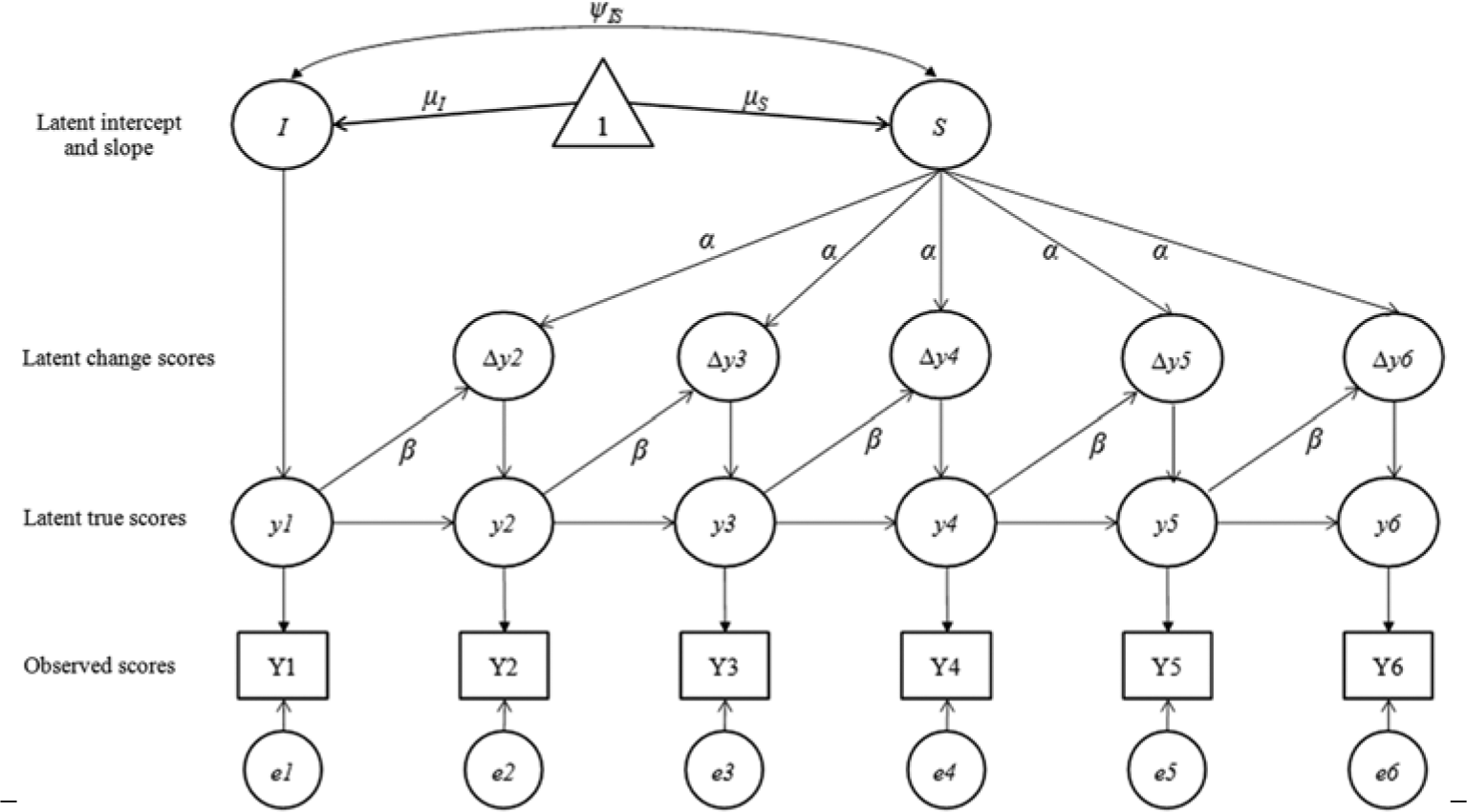
Latent Change Score (LCS) Model for a Single Variable
Univariate LCS models can be extended to examine relationships between two or more repeatedly assessed variables (Grimm et al., 2012). In a basic bivariate LCS model, the prior level of variable x (e.g., x1) is estimated to explain the latent change score of variable y measured at a subsequent occasion (e.g., Δy2), and the prior level of variable y (e.g., y1) is estimated to explain the latent change score of variable x measured at a subsequent occasion (e.g., Δx2). These effects are commonly referred to as coupling parameters and are represented by γ yx (i.e., regressing Δy on the prior level of x) and γ xy (i.e., regressing Δx on the prior level of y) paths in Figure 2 (McArdle, 2009). We extended this basic bivariate model to include paths from a latent change score of a predictor variable (e.g., Δx2) to the latent change score of an outcome variable at a subsequent occasion (e.g., Δy3). As shown in Figure 2, these change-to-change effects are represented by the ξ paths and are the key parameters for testing Hypotheses 1 and 2.
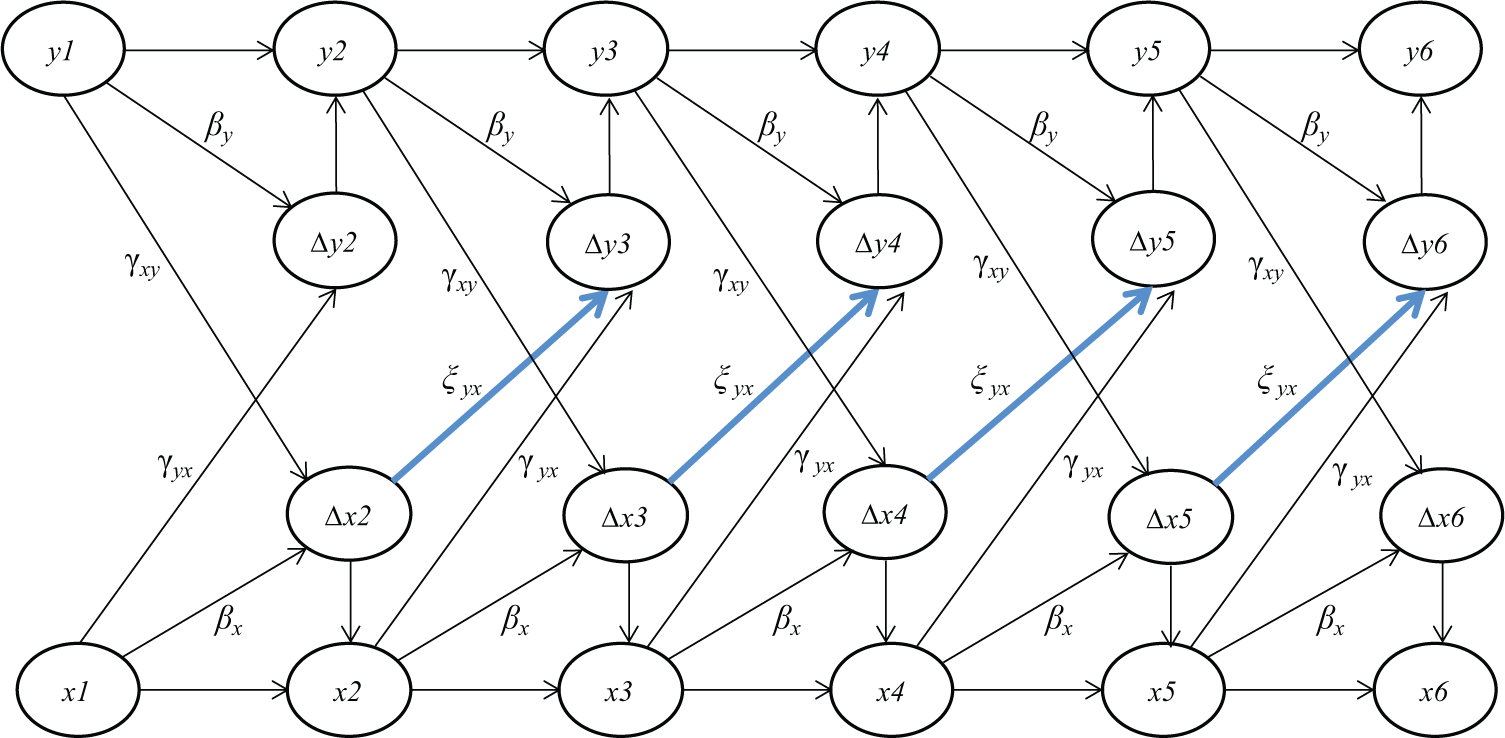
An Extended Bivariate Latent Change Score (LCS) Model
To ensure that our hypotheses tests were based on the most appropriate cross-lagged structures, we took a building-up approach. We first compared overall model fit for the basic LCS bivariate model (i.e., the full model) with several reduced models: (a) a model without γ xy coupling parameters, (b) a model without γ yx coupling parameters, and (c) a model without both sets of coupling parameters. With the most parsimonious level-to-change model identified for each of the two bivariate LCS models (i.e., incivility-to-burnout and burnout-to-turnover cognitions), we proceeded to add the change-to-change parameters (i.e., the ξ paths) in a subsequent step. For Hypothesis 1, a significant and positive ξincivility–burnout coefficient (with equality constraints applied to each ξ across the time series) would support our prediction that a prior change in incivility leads to a subsequent change in burnout. Similarly, for Hypothesis 2, a significant and positive ξburnout–turnover cognitions coefficient (again, with equality constraints applied to each ξ across the time series) would affirm our prediction that changes in burnout impact subsequent changes in turnover cognitions. When testing Hypothesis 1 and Hypothesis 2, we controlled for other sources of change—that is, α, β, and γ paths.
In the next step of our building-up approach, we developed a trivariate or three-variable LCS model to test Hypothesis 3 (i.e., dynamic mediation). As illustrated in Figure 3, the trivariate model tested whether incivility change (e.g., Δx2) predicts burnout change at an ensuing measurement occasion (e.g., Δm3) which, in turn, leads to later changes in turnover cognitions (e.g., Δy4) and so on. 4 Mirroring the bivariate LCS models, we assessed the ξ paths (i.e., ξ1 and ξ2) to test our dynamic mediated relationships. As also shown in Figure 3, we allowed the predictor (incivility change) to have a direct effect (path ξ3) on the outcome variable (subsequent turnover cognitions change). Once more, these estimates were obtained while controlling for other sources of change (α, β, and γ paths). Finally, we tested the significance of the dynamic mediated effect (= ξ1 * ξ2) by using a case-based bootstrapping function (Selig & Preacher, 2009) provided in Mplus. In the present instance, bias-corrected confidence intervals of the mediated effect were calculated using 2,000 bootstrapped samples.

Trivariate Latent Change Score (LCS) Model for Testing Mediation
Research Question 1 explored whether the dynamic within-person relationships remained stable or varied over time. To empirically address this question, we relaxed the respective equality constraints associated with Hypothesis 3’s ξ paths (ξ1, ξ2, and ξ3) and γ paths (from x to Δm, from m to Δy, from x to Δy) across the six measurement periods. If these alternative trivariate LCS models do not significantly improve fit to the observed data (as compared to the trivariate model used to test H3), we can conclude that the within-person relationships (and the resulting dynamic mediated effect) remain stable over time.
To test Research Question 2, we incorporated the between-person (i.e., time-invariant) conscientiousness scores into the trivariate LCS model. Because we anticipated that conscientiousness would moderate the dynamic relationship between incivility change and subsequent burnout change, we tested what Edwards and Lambert (2007) refer to as first-stage moderated mediation. For each of the first-stage mediation paths (ξ1 terms shown in Figure 3), we included the interaction term between incivility change and conscientiousness to predict subsequent burnout change. The interaction terms were expressed as a product of latent variables (using the XWITH function in Mplus), with equality constraints placed on the coefficients of the interaction terms. Consistent with prior research that has combined LCS techniques with moderation (Toker & Biron, 2012), we used the latent moderated structural (i.e., LMS; Klein & Moosbrugger, 2000) approach to estimate the interactions. We implemented LMS in Mplus. Finally, case-based bootstrapping is unavailable in Mplus for models with latent interactions. Therefore, to compute the confidence intervals associated with the conditional indirect effect estimate, we used Monte Carlo bootstrapping as recommend by Preacher and Selig (2012).
Results
Table 1 presents descriptive statistics and within- and between-person correlations between study variables.
Descriptive Statistics and Correlations Between Study Variables

Note: Correlations above the diagonal represent between-individual scores, that is, individuals’ mean variables (n = 94-131 due to missing data in personality variables). Correlations below the diagonal represent within-individual scores, that is, individual-mean-centered variables, pooled across 6 weeks (n = 455-488).
p < .05.
p < .01.
Preliminary Tests
Discriminant validity
For each of the six data waves, we applied omnibus confirmatory factor analyses (CFAs) to compare the expected three-factor measurement model (incivility, burnout, and turnover cognitions) with a series of alternative models. Cognizant of the various advantages associated with item parcels (Landis, Beal, & Tesluk, 2000), we randomly assigned two incivility items to a parcel (i.e., leading to six incivility parcels) and two burnout items to a parcel (i.e., leading to five burnout parcels). The four original items were used for turnover cognitions. As shown in Table 2, the three-factor model exhibited a satisfactory fit for each of the six data waves. The confirmatory fit index (CFI) and Tucker-Lewis index (TLI) values ranged from .96 to .98, and the root mean square error of approximation (RMSEA) ranged from .06 to .08. We then examined the fit of four alternative models (combining parcels/items onto a common latent factor) to ensure the three variables’ empirical distinctiveness. Chi-square difference tests demonstrated that each of the alternative two-factor and single-factor models exhibited a significantly worse fit to the observed data.
Model Fit Statistics for Testing Discriminant Validities and Measurement Invariance

Note: Model A = equal factor loadings and equal indicator intercepts; Model B = equal factor variances in addition to Model A configurations. The difference in χ2 between Model A and Model B was not significant, Δχ2 = 20.7, Δdf = 15, ns. CFI = confirmatory fit index; TLI = Tucker-Lewis index; RMSEA = root mean square error of approximation.
p < .05.
p < .01.
p < .001.
Measurement invariance over time
We then examined the three-factor measurement model’s longitudinal invariance. Following Vandenberg and Lance’s (2000) recommendations, we initially examined an unconstrained measurement model, in which the factor loadings and indicator intercepts were allowed to be different across the 6 weeks. This unconstrained model required 336 parameters to be estimated, whereas the longitudinal data set has a total of 516 observations. This parameter–to–sample size ratio created difficulty in model convergence. After we placed equality constraints (across the 6 weeks) on the latent constructs’ factor loadings and indicator intercepts (see Model A in Table 2), the model converged and satisfactory model fit was achieved (CFI = .97, TLI = .97, RMSEA = .07). Next, we added the additional constraint of time-invariant factor variances. This second, increasingly restricted measurement model (see Model B in Table 2) also exhibited satisfactory fit (CFI = .97, TLI = .97, RMSEA = .07), and the chi-square change between Model A and Model B was not significant (Δχ2 = 20.7, Δdf = 15, ns). These results show sufficient measurement invariance across the 6-week study span.
Hypotheses Tests 5
As noted, prior to hypothesis testing, we elected to take a building-up approach to ensure that the most appropriate cross-lagged structure was included in our LCS models. In doing so, we used single-indicator manifest variables in the ensuing path analytic models. The use of single-indicator manifest variables helped to simplify the computation of highly complex models involving mediation and moderation. This approach is consistent with McArdle’s (2009) illustration of LCS models.
The first series of analyses pertain to the dynamic relationship between workplace incivility change and subsequent burnout change. Our baseline model (Model 1) is a bivariate LCS model with coupling parameters in both directions (χ2 = 90.65, df = 66, CFI = .95, TLI = .95, RMSEA = .05; γ yx = .46, p < .10, γ xy = .08, ns). Model 2 includes only the coupling parameter from incivility to subsequent burnout change. This model fit the data equally well as compared with Model 1 (Δχ2 = .93, Δdf = 1, ns). Further examination revealed that the coupling parameter was significant (γ yx = .62, p < .01). Model 3 includes only the coupling parameter from burnout to subsequent incivility change. In comparison to Model 1, Model 3 exhibited significantly worse fit to the data (Δχ2 = 5.94, Δdf = 1, p < .05). Model 4 excludes both sets of coupling parameters. Again, a chi-square difference test indicated that this model demonstrated poorer fit than the baseline model (Δχ2 = 16.21, Δdf = 2, p < .001).
Given that Model 2 exhibited the most appropriate cross-lagged structure for testing Hypothesis 1, we added the change-to-change (i.e., ξ) parameters to Model 2. The resulting model exhibited a good fit (χ2 = 84.80, df = 66, CFI = .96, TLI = .96, RMSEA = .05). As illustrated in Table 3, individuals’ underlying pattern of burnout did not significantly increase or decrease from one time point to the next (as reflected by the within-construct sources of change). Further, the coupling parameters from prior incivility levels to burnout change were not significant (γ = .64, ns), suggesting that the pattern of change for burnout was not impacted by certain levels of incivility. As likewise shown in Table 3, the predicted relationship between incivility change and subsequent burnout change was significant and positive (ξ1 = 1.34, p < .05). Thus, as hypothesized, incivility change led to a subsequent change in burnout after controlling for other sources of incivility and burnout change. Hypothesis 1 was therefore supported.
Estimated Path Coefficients for Bivariate Latent Change Score Models

Note: N = 131. Unstandardized coefficients are reported. For the model predicting ΔBurnout, the means of the latent intercept factor and the latent slope factor for incivility are µI_incivility = .58, SE = .08, p < .001, and µ S _incivility = .03, SE = .05, ns, respectively. The β path for incivility is –.22, SE = .11, p < .10. For the model predicting ΔTurnover cognitions, the means of the latent intercept factor and the latent slope factor for burnout are µI_burnout = 1.46, SE = 0.09, p < .001, and µ S _burnout = .12, SE = .07, ns, respectively. The β path for burnout is –.09, SE = .05, p < .10.
p < .05.
p < .01.
p < .001.
An identical set of model building steps and nested model comparisons was carried out to test the dynamic relationship between burnout change and subsequent turnover cognitions change. Once again, our baseline model (Model 1) represents a bivariate LCS model with coupling parameters in both directions (χ2 = 101.12, df = 63, CFI = .95, TLI = .95, RMSEA = .07; γ yx = .31, p < .01, γ xy = .03, ns). Compared to Model 1, Model 2 fit the data equally well (χ2 = 101.35, df = 64, CFI = .95, TLI = .95, RMSEA = .07). Further inspection revealed that the coupling parameter from burnout to turnover cognitions change was significant (γ yx = .31, p < .01). In contrast, a chi-square difference test indicated that Model 3 fit the data significantly worse than the baseline model (Δχ2 = 10.79, Δdf = 1, p < .001). Model 4 likewise exhibited poorer fit to the data (Δχ2 = 11.40, Δdf = 2, p < .001). Therefore, Model 2 was the most parsimonious model, providing the appropriate cross-lagged structure for testing Hypothesis 2.
We then added the change-to-change (i.e., ξ) parameters to this best-fitting model, with the resulting model exhibiting a good fit (χ2 = 98.21, df = 63, CFI = .95, TLI = .95, RMSEA = .07). Regarding the underlying pattern of change for turnover cognitions (see Table 3), it appears that individuals’ level of turnover cognitions increased over the 6-week period (µS_turnover = 1.06, p < .001) but plateaued over the course of the study span (i.e., decreasing 57% from one time point to the next; β = –.57, p < .001). The coupling parameters suggest that turnover cognitions change was not influenced by prior burnout levels (γ = .09, ns). Moreover, as also shown in Table 3, the hypothesized relationship from burnout change to subsequent turnover cognitions change was significant and positive (ξ2 = 1.55, p < .001). As burnout change positively predicted subsequent change in turnover cognitions after controlling for other sources of burnout and turnover cognitions change, Hypothesis 2 was supported.
Next, we integrated the two best-fitting bivariate LCS models in such a way as to test the dynamic mediated effect of incivility change on turnover cognitions change via burnout change (i.e., Hypothesis 3). Shown in Table 4, our trivariate LCS model revealed that the ξ1 estimate from ΔIncivility[T–1] to ΔBurnout[T] was .86 (p < .001), and the ξ2 estimate from ΔBurnout[T] to ΔTurnover cognitions[T+1] was 1.80 (p < .01). These effects were obtained when the direct effect (ξ3) from ΔIncivility[T–1] to ΔTurnover cognitions[T+1] was likewise included in the LCS model. 6 The mediated (indirect) effect was 1.55, with a 95% bias-corrected bootstrapped confidence interval (CI) excluding zero (95% CI = [0.43, 2.67]). These results support Hypothesis 3. 7
Estimated Path Coefficients for the Trivariate Latent Change Score Model

Note: N = 131. Unstandardized coefficients are reported.
p < .05.
p < .01.
p < .001.
Testing the Research Questions
Research Question 1 asked whether the dynamic mediated effect remains stable or varies over time. When we allowed the ξ1 and γ1 paths to differ across time, a chi-square difference test indicated our trivariate LCS model’s fit to the data did not significantly improve (Δχ2 = 10.75, Δdf = 6, ns). When we allowed the ξ2 and γ2 paths to vary across time, we obtained a similar result (Δχ2 = 4.76, Δdf = 7, ns). When we allowed the ξ3 and γ3 paths to vary across time, we again obtained a similar finding (Δχ2 = 6.11, Δdf = 5, ns). On the basis of these results, it appears that the magnitude of the within-person mediated relationships among incivility change, burnout change, and turnover cognitions change remained stable with the passage of time.
Whereas Research Question 1 explored the stability of the dynamic within-person relationships, Research Question 2 asked whether the effect of incivility change on subsequent burnout change is moderated by between-person differences in conscientiousness. Results demonstrated that conscientiousness moderated the dynamic relationship between incivility change and subsequent burnout change (interaction = 1.62, p < .05). To clarify the nature of this interaction, we plotted its form and calculated simple slopes at high (+1 SD) and low (–1 SD) levels of conscientiousness. As Figure 4 shows, the simple slope of incivility change predicting subsequent burnout change was significant at high (slope = 1.79, p < .001) but not low (slope = .56, ns) levels of conscientiousness. Going a step further, we examined the extent to which the overall dynamic mediated effect is conditionally influenced by individuals’ conscientiousness levels—thereby yielding a pattern of moderated mediation. The effect of ΔIncivility[T–1] on ΔTurnover cognitions[T+1] via ΔBurnout[T] was significant at high (dynamic mediated effect = 2.69, p < .05, Monte Carlo bootstrapped 95% CI = [0.37, 5.02]) but not low (dynamic mediated effect = .85, ns, Monte Carlo bootstrapped 95% CI = [–0.61, 2.30]) levels of conscientiousness. Taken together, these results support the risk-factor view proposed in Research Question 2b. 8

Moderating Effect of Conscientiousness
Discussion
Theoretical Contributions
Incivility is a temporally bound experience that varies meaningfully within individuals over time (Andersson & Pearson, 1999; Porath & Pearson, 2010). As prior empirical research (including our own) has failed to hypothesize, design, and test for the possibility of dynamic relationships between workplace incivility and its consequences, the pertinent literature to date provides an insufficient basis for summarizing mistreatment as experienced by targeted individuals. Indeed, an increasing amount of empirical evidence suggests that conceptualizing workplace experiences as solely between-person phenomena (as opposed to within-person phenomena) results in biased estimates and equivocal findings (Beal, 2012; Pitariu & Ployhart, 2010). With this in mind, our study sheds some light on the theoretical importance of workplace incivility’s relative nature.
We theorized and empirically demonstrated that, beyond past and present levels of experienced incivility, the direction and magnitude of incivility change reflects meaningful variation. Toward this end, it appears that absolute levels of incivility may not be responsible for resource loss and its associated consequences, but rather, changes relative to one’s previous experiences of incivility—irrespective of how high or low that incivility might have been—can generate significant changes in burnout and, in turn, thoughts about leaving. This implies that, even when one’s current level (i.e., latent true score) of experienced incivility is relatively low, one may still experience an upward change in burnout if the current level of mistreatment is judged to be more frequent than that experienced in the prior (adjacent) time period. This unique finding provides workplace mistreatment research with a more nuanced perspective from which to understand the adverse consequences associated with incivility-related experiences, highlighting the role of targets’ (previous and present) perceived levels of workplace incivility and the extent of change between the two time periods.
Our results likewise advance the organizational literature by examining the psychological processes proximally associated with incivility change. Consistent with COR theory, we found burnout change to mediate the dynamic relationship between incivility change and subsequent turnover cognitions change. This is a novel finding insofar as the chain of events associated with “loss spirals” has received limited empirical attention (see Halbesleben & Wheeler, 2012). Moreover, by explicitly modeling latent change via repeated measurements (Ployhart & Vandenberg, 2010), we offer an important methodological advancement to the incivility literature. Given that the “substantial bias that typically exists in cross-sectional analyses of mediation can render p-values or confidence intervals obtained from cross-sectional data essentially meaningless” (Maxwell, Cole, & Mitchell, 2011: 837), our overall model testing (based on a robust analytic technique) reflects an empirical contribution that responds to calls for research into the dynamics inherent in turnover decisions (Mitchell et al., 2013).
We also uncovered two additional effects that offer opportunities for future research. First, we found that the linkages within our proposed dynamic mediation model remained relatively stable across time. Whereas Pearson et al. (2000) point out various reasons why the adverse effects of incivility might not vary with time (e.g., targets may resolve to carry on as though nothing happened), we can see theoretical reasons why one might expect the effects of incivility experiences on turnover cognitions (via burnout) to increase or strengthen with the passage of time. Although caution is always warranted when interpreting results based on an exploratory research question, we hope this finding spurs future research on the nature of these “dynamic interchanges” (Andersson & Pearson, 1999) across time. For example, different results might have been obtained had we focused on incivility-related incidents occurring throughout a single workday. Such a notion is consistent with George and Jones’s (2000) observation that temporal factors will oftentimes alter the manner in which theoretical constructs and their interrelationships are conceptualized and, therefore, amend the propositions that derive from a theory. Second, the impact of incivility change on subsequent burnout change may be moderated by targets’ conscientiousness. Although tentative, results suggest that for targets high in conscientiousness, an upward incivility change led to greater subsequent changes in burnout (and, consequently, turnover cognitions) relative to their less conscientious counterparts. Given various viewpoints regarding the moderating effect of conscientiousness, we encourage subsequent research efforts to further explore relations between personality and workplace incivility across multiple levels of theory and analysis.
More generally, our results suggest an alternative to prevailing conceptualizations and methods used in the broader employee mistreatment literature. Integrating the present study with prior work on time and temporal dynamics (e.g., Mitchell & James, 2001; Shipp & Jansen, 2011), the adoption of a purely between-persons approach toward employee mistreatment (e.g., bullying, undermining) may mask considerable and meaningful fluctuations in the experience of, responses to, and consequences of such behavior. This notion builds upon the idea that as researchers, we tend to develop and test hypotheses that generally overlook the fact that “organizational and psychological processes are not static but instead develop, change, and evolve over time” (Pitariu & Ployhart, 2010: 405). Pitariu and Ployhart (2010) suggest that, as a discipline, we tend to offer simple explanations for what are complex phenomena (also see Edwards, 2008). These possibilities raise the question of whether employee mistreatment research has been too simplistic and, thereby, inadequate for understanding the dynamic and emergent nature of the relationships between such behavior and important workplace outcomes.
Managerial Implications
Although workplace incivility should be discouraged broadly, our results suggest managers must consider the extent to which a particular incident is deemed uncivil compared to an employee’s typical experiences (e.g., relative to the current norms of an organization or team). Given the ubiquitous nature of incivility, careful attention to changes in the uncivil behavior of an organization’s employees would seem particularly important. To this end, Tripp, Bies, and Aquino (2007: 29-31) contend that managers should assume three complementary roles. The most immediate role is manager as first responder. To be first “on the scene,” managers must be made aware of an incivility-related incident; employees who believe their managers are trustworthy, supportive, and fair will feel more comfortable voicing complaints (Olson-Buchanan & Boswell, 2008).
A second role is manager as mediator. Tripp and colleagues (2007) argue that a manager’s initial action as mediator should be to initiate relationship repair by encouraging a perpetrator to apologize and make amends. A viable alternative may include encouraging open dialogue (within teams, departments) about expectations of respectful conduct among all employees. Along these lines, various programs have been developed to foster such dialogue. One such program is known as the CREW initiative (Civility, Respect, Engagement in the Workforce). CREW is designed as a group-level intervention and has been shown to be effective in reinforcing norms for mutual respect in workplace interactions (Leiter et al., 2011). Specific CREW processes include having explicit conversations about and laying out ground rules for appropriate workplace conduct, identifying disrespectful workplace behaviors and providing suggestions for responding to them, and recommending specific practices to promote civil behaviors.
A final role for fostering workplace civility is manager as judge and executioner. If perpetrators fail to apologize or have a history of incivility, Tripp et al. (2007) advise that they are publicly punished. They maintain that to punish in private risks targets remaining unaware of how (or if) a perpetrator was disciplined and, thus, may respond with increasingly aggressive acts—much like “vigilantes take the law into their own hands” (Tripp et al., 2007: 24). Third-party onlookers may also be interested to know whether and how incidents of incivility were addressed. In addition to gaining insights about a workplace’s culture and its managers’ tolerance for incivility, bystanders will vicariously learn about the treatment they might expect as either a perpetrator or a target.
Study Limitations and Future Research Directions
A first potential limitation is that study data were collected from a single source. Although common in longitudinal studies, the exclusive use of self-report measures suggests possible same-source variance should be considered when interpreting the reported results. A second potential limitation concerns the generalizability of our study’s results. For example, we did not consider contextual (e.g., environmental or social) factors in our proposed model. It is therefore conceivable, for instance, that local-area levels of employment and the prevailing economic climate (Queenan, 2009; Shoss & Penney, 2012) may have affected participants’ responses to the study’s survey measures. Alternatively, work environments under the control of abusive supervisors may foster a culture of incivility and, therefore, indirectly impact changes in burnout and turnover cognitions. Incorporating these and other multilevel factors, future research may find that some contextual variables serve merely to initiate the dynamic processes we examined, whereas others are enmeshed more deeply in how the dynamic processes unfold (e.g., as broader moderators of the processes). Related to the issue of generalizability, our overall response rate (66%) was lower than those typically reported in studies employing repeated measures designs (Beal & Weiss, 2003), and study participants worked (part-time) for a nonprofit organization. Although both issues should be taken into account when interpreting our results, we likewise infer that it is unlikely these study characteristics have unduly influenced our findings. This is because when one focuses on dynamic within-person relationships (as we do), a researcher’s emphasis is typically placed on sampling a sufficient number of time periods or occasions so that a study’s findings can “generalize to the population of experiences” as opposed to individuals (Conner & Lehman, 2012: 95).
A final potential limitation is that there are other variables that were not considered but could be potentially relevant to the mediated process we examined. Although incivility and burnout are well-known predictors of individuals’ turnover cognitions, the stress and coping literatures suggest the existence of additional mediating factors (e.g., discrete emotions, such as anger) that could find a place in our proposed model and potentially change the nature of the underlying processes. Nevertheless, given our ability to leverage strong theory, measurement quality, and state-of-the-art structural equation modeling techniques, we have greater confidence in our position from which to draw mediational inferences. Yet, we recognize the need for more evidence based on longitudinal or experimental research.
Beyond addressing study limitations, future research might advance our findings in other directions. As noted by an anonymous reviewer, whereas we focused on turnover cognitions as an adaptive (“flight”) response to incivility experiences, targets may choose from an array of behavioral outcomes, including “fight” responses, such as deviant or aggressive behavior directed at perpetrators or an employing organization (Bunk & Magley, 2013; Porath & Pearson, 2012). We concur and, thus, wish to echo Cortina and Magley’s (2009) sentiment that it is important to ultimately catalogue the extent to which workplace incivility is connected to both fight and flight outcomes (over time).
Our theoretical framework may also be extended through a consideration of additional between-person moderators. Stress theory (Lazarus, 1999) and indirect empirical evidence (e.g., Cortina & Magley, 2009; Porath & Pearson, 2012) suggest that targets of incivility may vary in how they cognitively appraise these negative incidents as they occur over time. As such, antecedent-focused regulation mechanisms (e.g., hardiness; Maddi, 1999) may buffer the adverse effects of incivility change on subsequent increases in burnout change. In a similar vein, the various forms of response-focused emotion regulation (Gross & John, 2003) may play a role across time in strengthening or weakening targets’ responses to incivility and subsequent feelings of burnout (see, e.g., Beal, Trougakos, Weiss, & Dalal, 2013). Future longitudinal studies that expand our proposed framework to consider these and other between-person boundary conditions would make for an interesting contribution to the workplace incivility literature.
Conclusion
The present study develops and tests a novel dynamic representation of workplace incivility change. With the current study demonstrating the unique insight that is gained by focusing on incivility change, we suggest that future researchers likewise develop “strong” hypotheses that consider the temporal aspects of the psychological experience underlying workplace incivility (e.g., time, duration, and shape of dynamic relationships over time). More broadly, we further suggest that a lack of attention to the temporal aspects inherent in theoretical explanations of employee mistreatment will impede an understanding of the complex and dynamic manner in which workplace interactions unfold.
Footnotes
Acknowledgements
This article was accepted under the editorship of Deborah E. Rupp. The authors thank Wendy R. Boswell, Timothy D. Chandler, Donald H. Kluemper, Adrian H. Pitariu, Hettie A. Richardson, and Jixia Yang for their helpful vetting of earlier draft manuscripts.