




Abstract
We used data obtained from customer contact employees in the People’s Republic of China to test a moderated mediation model of the processes through which core self-evaluations (CSE) influence voice behavior. Specifically, we examined personal control and approach/avoidance motivation as psychological pathways and procedural justice perceptions as a moderator of the CSE–voice behavior relationship. As predicted, our results revealed that CSE related to employee voice behavior indirectly through personal control and approach motivation but not avoidance motivation. Furthermore, and consistent with our prediction, results showed that procedural justice perceptions moderated the mediated influence of both personal control and approach motivation on the CSE–voice behavior relationship such that this relationship is stronger when procedural justice perceptions are high but not low. We discuss the implications of these findings in terms of explanatory frameworks for understanding the documented effects of CSE on employee work outcomes.
Keywords
The increasingly dynamic global business environment has underscored the criticality of employee proactive behaviors to organizational adaptation and survival (Crant, 2000; Griffin, Neal, & Parker, 2007; Parker & Collins, 2010). One such proactive behavior that has enjoyed much research attention is voice behavior defined as “discretionary communication of ideas, suggestions, concerns, or opinions about work-related issues with the intent to improve organizational or unit functioning” (Morrison, 2011: 375). The recognition that the knowledge and ideas necessary to improve organizational processes and decision-making quality do not necessarily reside in the top echelons of the organization (Senge, 1990: 4) has since received much empirical validation. Specifically, research has shown voice behavior to relate to prevention of crises (Schwartz & Wald, 2003), improvement in organizational processes and innovation (Argyris & Schon, 1978), and more recently, to organizational performance (Lam & Mayer, in press).
While research on the individual/personality antecedents of voice behavior has illuminated our understanding of the construct, Morrison observed that “it lacks a coherent theoretical framework for integrating various empirical findings related to individual-level predictors” (2011: 393). Given the sense of agency that underpins voice behavior, prior research has alluded to the potential role of control in explicating this construct (Parker & Collins, 2010; Tangirala & Ramanujam, 2008a). Although Tangirala and Ramanujam specifically adopted a control-based explanation of voice behavior, they did not examine the dispositional basis of personal control in predicting the construct. One such personality attribute that may underpin personal control is core self-evaluations (CSE), which describes a positive self-concept or bottom-line evaluations that individuals hold about themselves (Judge, Erez, & Bono, 1998). Understanding the influence of CSE on employee work behaviors is particularly critical in view of the changed organizational context and the potential influence of CSE on the proactive behaviors that may enhance organizational survival in the contemporary dynamic marketplace. As Judge and Kammeyer-Mueller observed, There is a stronger need than ever for organizations to seek out individuals who are confident in their own abilities and who believe that they can control their own fates than ever. Individuals who are higher in core self-evaluations may be especially valuable in the less hierarchical, more flexible organization of the future. (2011: 339)
Although Judge and colleagues’ (Judge, Bono, & Locke, 2000; Judge, Locke, Durham, & Kluger, 1998; Judge, Van Vianen, & De Pater, 2004) initial formulation was meant to account for the dispositional sources of job satisfaction (Chang, Ferris, Johnson, Rosen, & Tan, 2012; Ferris, Johnson, Rosen, Djurdjevic, Chang, & Tan, 2013), CSE have since been shown to relate to performance defined in terms of task, citizenship, and deviant behaviors (Chang et al.; Ferris, Rosen, Johnson, Brown, Risavy, & Heller, 2011; Grant & Wrzesniewski, 2010; Kacmar, Collins, Harris, & Judge, 2009). While this is encouraging, there is a need to broaden the performance construct to include those that have become important in light of the dynamic environment in which organizations operate and that have made employee proactive behaviors, such as voice, particularly critical. Furthermore, until the recent call to theoretically ground this stream of research in the approach/avoidance framework (Chang et al.; Ferris et al., 2011; Ferris et al., 2013), it has largely proceeded without much theoretical grounding. Given that a control-based explanation (Tangirala & Ramanujam, 2008a) and an approach/avoidance framework are both underpinned by a sense of agency, they constitute potential psychological pathways through which CSE may relate to voice behavior.
While much is now known about the psychological pathways through which its antecedents influence voice behavior, and despite the observation that the complexity of proactive behaviors, such as voice, are better understood in terms of its facilitating boundary conditions, only a minority of research has examined such boundary conditions (Tangirala & Ramanujam, 2008a; Venkataramani & Tangirala, 2010). Additionally, Ferris and colleagues’ (2011) suggestion that research should examine contingencies that activate approach tendencies has yet to be addressed particularly in the context of voice research. To address these concerns, we proposed and tested a moderated mediation model in which we posit CSE to indirectly influence voice behavior through the dual psychological pathways of personal control and approach/avoidance frameworks. Additionally, we examine perceptions of procedural justice as a boundary condition of the influence of these psychological pathways on the relationship between CSE and voice behavior. By pursuing these objectives, our study contributes to the literature in three significant ways. First, our study not only examines voice behavior as a performance outcome of CSE but also proposes and tests a dual psychological pathway through which CSE relate to voice behavior. As prior research has examined a control-based explanation (Tangirala & Ramanujam), our focus on the approach/avoidance framework extends this framework to voice research and provides an opportunity to test the utility of these competing perspectives in demonstrating the sense of agency that provides the motivational underpinning of voice behavior.
Second, by examining perceptions of procedural justice as a boundary condition of the role of psychological pathways in the CSE–voice behavior relationships, we not only extend prior research that has examined organizational (work group) identification (Tangirala & Ramanujam, 2008a; Venkataramani & Tangirala, 2010) but also respond to Ferris and colleagues’ (2011) call that research should examine the contingencies that activate approach tendencies. As procedural justice perceptions suggest an environment in which managers are constrained from the arbitrary use of power to punish employees who engage in voice behavior, it provides a facilitative context that enhances the expectancy of success in engaging in this behavior. Lastly, the high power distance that characterizes a Chinese society can potentially undermine an employee’s sense of agency or expectancy of success in engaging in voice behavior (Liang et al., 2012). Although previous research has shown CSE to have a bivariate relationship with creativity (Zhang, Kwan, Zhang, & Wu, 2014) and organization-based self-esteem (a constituent CSE trait) to relate to voice behavior (Liang et al.), the motivational pathways that CSE engender that lead to voice behavior in a Chinese context have yet to be examined. In view of the potential influence of culture on cognition and motivation (Markus & Kitayama, 1991), our study provides an opportunity to empirically ascertain the generalizability of Western-inspired theories to explaining voice behavior in the high power distance Chinese context (Liang et al.).
Theoretical Framework and Hypotheses Development
Control-Based Theory
At the heart of a control-based explanation of employee performance is a sense of human agency. Control theorists (e.g., DeCharms, 1968; Greenberger & Strasser, 1986; Greenberger, Strasser, Cummings, & Dunham, 1989; White, 1959) consider the desire to affect the environment as a fundamental motivational propensity. Following the work of Rothbaum, Weisz, and Snyder (1982), control theorists distinguish between primary and secondary control. While primary control is externally oriented and describes an attempt to change the world in order to fit in, secondary control, in contrast, describes an attempt to fit in with the world. These forms of control are usefully illustrated by the distinction between problem-focused (primary control) and emotion-focused (secondary control) coping (Folkman, 1984; Ganster, Fox, & Dwyer, 2001). The control-based explanation adopted in this study draws on primary control and, therefore, reflects an individual’s motivation to engage with his or her environment and the expectancy of successfully initiating actions to achieve this objective.
Approach/Avoidance Framework
The approach/avoidance motivational framework draws its conceptual heritage from Greek ethical hedonism that emphasized the pursuit of pleasure and the avoidance of pain. This notion constitutes a motivational foundation in psychology that views pleasure and pain as drivers of human behavior (Elliot, 1999; Elliot & Thrash, 2002; Higgins, 1998). Although the distinction between approach and avoidance is considered an individual difference in sensitivity to positive or negative outcomes, or what Elliot and Thrash labelled approach or avoidance temperaments, our use of the constructs in this context focuses on their motivational implications. Elliot defined approach motivation “as the energization of behavior by, or the direction of behavior toward, positive stimuli . . . whereas avoidance motivation may be defined as the energization of behavior by, or the direction of behavior away from, negative stimuli” (2006: 112). Research has since shown approach and avoidance motivation to be relatively independent such that individuals high in approach motivation, for example, are not necessarily low in avoidance motivation and vice versa (Elliot & Thrash).
As shown in Figure 1 and following the view that personality traits constitute distal antecedents of behavior (Barrick & Mount, 2005; Li, Barrick, Zimmerman, & Chiaburu, 2014), we posit CSE to influence voice behavior through the dual motivational pathways of personal control and approach/avoidance. We also posit that while these motivational pathways enhance the probability of successfully engaging in voice behavior, there is still an element of uncertainty involved. Thus, we posit procedural justice perceptions as a boundary condition of the role of these pathways in the CSE–voice behavior relationship, consistent with the uncertainty reduction function of justice (Lind & van den Bos, 2002; Takeuchi, Chen, & Cheung, 2012; van den Bos & Lind, 2002).

Hypothesized Model
CSE and Personal Control
As bottom-line evaluations that individuals hold about themselves, CSE reflect a higher-order construct comprising the four lower-order traits of self-esteem (worthy of respect and regard), generalized self-efficacy (belief in one’s capability of solving problems), locus of control (responsible for what happens to oneself), and emotional stability or low neuroticism (optimistic and free from doubts and worries). We followed previous research (e.g., Brockner, Spreitzer, Mishra, Hochwarter, Pepper, & Weinberg, 2004; Tangirala & Ramanujam, 2008a) and conceptualized personal control as an additive construct comprising the autonomy and impact dimensions of psychological empowerment. Autonomy describes the extent to which employees perceive themselves as having control over their work behavior, while impact refers to the extent to which employees believe they have control over important outcomes (Spreitzer, 1995). According to Brockner and colleagues, high personal control exists when autonomy and impact are both high, suggesting that employees have discretion over their work behaviors and influence over important work outcomes. The constituent traits of CSE, such as generalized self-efficacy, locus of control, emotional stability, and self-esteem, reflect human agency or a predisposition to interact with the environment. This predisposition enables high-CSE individuals to persist in the face of difficulties or setbacks, feel they can control their environment or at least outcomes, believe in their capabilities, and feel less threatened by new or challenging situations (Judge & Hurst, 2007). Since high-CSE individuals consider themselves as efficacious and are self-confident, they perceive themselves as having control over their work environment.
Much research has examined personal control as an outcome of organizational practices designed to give employees opportunities to experience discretion at work, such as job redesign, (Spreitzer, 1995) or leadership behaviors, such as transformational leadership (Kark, Shamir, & Chen, 2003). However, as a perceptual construct, personal control does not necessarily reflect objective features of the work environment and may have a dispositional source (Greenberger & Strasser, 1986). We posit that the constituent elements of CSE suggest that high-CSE individuals will have an internal drive to exert control over their work environment, leading to high levels of personal control. Although we are not aware of research that has shown CSE to relate to personal control, there is evidence linking CSE to perceived job complexity (Judge et al., 2000), which entails personal control. Consequently, we expect CSE to influence personal control.
Hypothesis 1a: CSE will positively relate to personal control.
CSE and Approach/Avoidance Motivation
The sense of agency that defines high-CSE individuals will lead them to demonstrate both approach and avoidance motives, albeit through different processes. As high-CSE individuals are confident in themselves and in their capabilities, they will be energized to take proactive steps to act upon their environment. These attitudinal tendencies will lead high-CSE individuals to adopt an approach orientation because such an orientation engenders the setting of ambitious goals and, therefore, constitutes a form of self-verification (Elliot, 1999; Higgins, Friedman, Harlow, Idson, Ayduk, & Taylor, 2001). Furthermore, because high-CSE individuals are said to focus on the positive features of the work environment, they will perceive more intrinsic job attributes, which dovetails with the autonomy and accomplishment goals that define an approach motivation (Ferris et al., 2011). Thus, we expect CSE to positively relate to approach motivation.
In contrast, we expect CSE to negatively relate to avoidance motivation. This is because while the sense of agency inherent in CSE leads high-CSE individuals to emphasize accomplishments and, therefore, the pursuit of positive outcomes (Judge & Kammeyer-Mueller, 2011), avoidance motivation entails security concerns and by implication, a preoccupation with avoiding negative outcomes. Such an orientation (avoidance motivation) is inconsistent with the self-verification information that high-CSE individuals desire. In support of our arguments, Ferris and colleagues (Ferris et al., 2011; Ferris et al., 2013) reported CSE to relate positively to approach motivation and negatively to avoidance motivation. Thus, we propose the following:
Hypothesis 1b: CSE will positively relate to approach motivation.
Hypothesis 1c: CSE will negatively relate to avoidance motivation.
Mediating Influence of Personal Control
Although much research has now shown CSE to relate to employee performance (Chang et al., 2012; Ferris et al., 2011; Judge, Erez, & Bono, 1998), as previously noted, it (performance) has been defined primarily in terms of task performance, global organizational citizenship behavior (which combines interpersonally and organizationally directed organizational citizenship behavior), counterproductive work behavior (Chang et al.), and overall performance (Kacmar et al., 2009). As a “promotive behavior that emphasizes expression of constructive challenge intended to improve rather than merely criticize” the status quo (Van Dyne & LePine, 1998: 109), voice behavior implies a change-oriented behavior that aims at suggesting improvements and, therefore, constitutes a form of assertive nonconformance that can often disrupt or alter an organization’s status quo (Morrison et al., 2011). Tangirala and Ramanujam (2008a) observed that the challenge-oriented nature of voice behavior requires that individuals who engage in voice behavior must have a motivation to exercise control. High-CSE individuals are characterized by a sense of agency, which should motivate them to engage in voice behavior. However, following the view of dispositions as distal antecedents of behavior (Barrick & Mount, 2005; Li et al., 2014), we posit CSE as relating to voice behavior indirectly through personal control.
Personal control has been shown to relate to employee performance (Greenberger, Strasser, & Lee, 1988; Spector, 1986) and to voice behavior (Tangirala & Ramanujam, 2008a). As a constructive challenge to the status quo, voice behavior involves risk taking (LePine & Van Dyne, 1998; Takeuchi et al, 2012; Tangirala & Ramanujam, 2012) because it entails pointing out areas for improvement to those who may have devised, be responsible for, or feel personally attached to the status quo regarding the program or policy at hand (Detert & Burris, 2007). For this reason, the decision to engage in voice behavior may be considered a planned behavior (Liang et al., 2012) requiring employees to cognitively assess the costs and benefits of engaging in such a behavior. Accordingly, employees will be motivated to engage in voice behavior only when they are confident of the expectancy of successfully engaging in this behavior (Ashford, Rothbard, Piderit, & Dutton, 1998; Morrison, 2011). Inherent in this expectancy of successfully engaging in voice behavior is the personal control that individuals believe themselves to possess, which motivates them to initiate action. Furthermore, because personal control fosters a sense of self-determination and autonomy, individuals high in personal control will initiate action to craft their jobs more broadly, which may encompass voice behavior. As a result, engaging in voice behavior enables such individuals to ensure consistency between their self-concept as having autonomy and making an impact at work and their actual behavior (Korman, 1970).
From a control-based perspective, personal control enables high-CSE employees to implement their self-concept in terms of making suggestions for improvement. Although personal control has been shown to have a curvilinear relationship with voice behavior (Tangirala & Ramanujam, 2008a), we treated CSE as a distal antecedent (Barrick & Mount, 2005; Li et al., 2014) that operates through the underlying psychological mechanism of personal control to influence voice behavior.
Hypothesis 2: Personal control will mediate the CSE–voice behavior relationship.
Mediating Influence of Approach/Avoidance Motivation
Consistent with personality theorists’ view that personality relates to performance outcomes through proximal motivational pathways (Barrick & Mount, 2005; Higgins, 2005; Lanaj, Chang, & Johnson, 2012; Li et al., 2014) is our assertion that approach/avoidance motivation constitutes a framework for accounting for the influence of CSE on voice behavior (Ferris et al., 2011). However, we posit that the CSE–voice behavior relationship will be accounted for by an approach rather than an avoidance motivation. As voice behavior entails challenging the status quo and, therefore, is oriented toward improving organizational processes, engaging in this form of workplace behavior requires employees who are focused on positive outcomes, such as engendered by approach motivation. Furthermore, employees high in approach motivation are likely to be open-minded and will explore ways to improve organizational processes, leading them to engage in voice behavior as a way of seeking growth (cf. Neubert, Kacmar, Carlson, Chonko, & Roberts, 2008). In contrast, because avoidance motivation entails a focus on security needs and prevention of negative outcomes, individuals high in this motive will tend to work diligently to accomplish their prescribed roles and duties.
As voice behavior challenges the status quo, individuals high in avoidance motivation who by definition have a tendency to act cautiously will be discouraged from engaging in voice behavior because of the threat to their job security and other potentially negative outcomes. Furthermore, such individuals may have internalized organizational behavioral expectations and are therefore unlikely to challenge the status quo (Lanaj et al., 2012). As Lanaj and colleagues observed, individuals high in prevention focus (which is conceptually similar to avoidance motivation) tend to be risk averse and more comfortable with following established rules and standards (2012: 1025). Thus, we expect avoidance motivation to be unrelated (or negatively related) to voice behavior. Although research has yet to examine the influence of approach and avoidance motivation on voice behavior, there is evidence that approach and not avoidance motivation relates to extrarole behaviors such as innovative performance and organizational citizenship behavior (Lanaj et al.) as well as creative behavior (Neubert et al., 2008).
In summary, consistent with the extant research relating CSE to employee performance (Chang et al., 2012; Ferris et al., 2011; Judge & Kammeyer-Mueller, 2011; Neubert et al., 2008), the expectation is for CSE to relate to voice behavior. However, as a personality construct, CSE represent a distal antecedent and, therefore, influence voice behavior indirectly through approach rather than avoidance motivation.
Hypothesis 3: Approach motivation will mediate the CSE–voice behavior relationship.
Moderating Influence of Procedural Justice Perceptions
Procedural justice perceptions describe the fairness of the policies and procedures used in the allocation process to achieve work outcomes (Lind & Tyler, 1988). Thibaut and Walker (1975) distinguished between decision control (amount of control over an outcome) and process control (amount of control over procedures used to settle a grievance) and emphasized the importance of the latter. Building on this initial formulation, Leventhal (1980) highlighted the importance of process control in allocation contexts and noted that procedures that ensure consistency of decisions, bias suppression, and correctability contribute to procedural justice perceptions. Grounded in a self-interest view, the process control inherent in procedural justice perceptions suggests that employees prefer procedures that maximize their personal outcomes, and control constitutes a vehicle for attaining this objective (Lind & Tyler). Indeed, Cropanzano, Byrne, Bobocel, and Rupp (2001) posit that justice matters because it serves the human need for control. This view dovetails with uncertainty management theory’s proposition that justice helps to manage uncertainty, including the feeling of not being in control (Lind & van den Bos, 2002; van den Bos & Lind, 2002).
As shown in Figure 1, we posit that the effect of CSE on voice behavior is mediated through the interaction of personal control and procedural justice perceptions, which is consistent with a control-based explanation of voice behavior. A high level of procedural justice perceptions suggests that one has control over decisional processes and enhances one’s expectancy of success in engaging in voice behavior. This is because voice behavior entails a fair amount of risk as it involves challenging the status quo, engendering the possibility of reprisals from authority figures who might have designed and, therefore, have a vested interest in maintaining the status quo (Burris, 2012). The augmenting influence of procedural justice perceptions on the influence of personal control will be particularly critical in assuring employees that there will be no reprisals and, therefore, enhancing the expectancy of successfully executing voice behavior. In such a context, the personal control engendered by CSE will motivate employees high in personal control to engage in voice behavior. In contrast, low procedural justice perceptions signal adverse consequences when employees engage in voice behavior. In such a nonfacilitative context, the personal control engendered by CSE will not motivate employees to engage in voice behavior. In support of the preceding argument, researchers have demonstrated a moderating influence of procedural justice perceptions (Takeuchi et al., 2012) as well as procedural justice climate (Tangirala & Ramanujam, 2008b) in voice behavior research.
Hypothesis 4a: Procedural justice perceptions will moderate the strength of the mediated relationship between CSE and voice behavior through personal control such that the mediated relationship is stronger when procedural justice perceptions are high but not low.
Similarly, we expect the indirect influence of CSE on voice behavior through approach motivation to be moderated by procedural justice perceptions. In accounting for the inability of approach motivation to explain the influence of CSE on the performance outcomes they examined, Ferris and colleagues speculated that the “beneficial effects of approach constructs are contingent upon incentives or rewards that activate approach tendencies” (2011: 156). One such contingency examined in this study is procedural justice perceptions. Perceptions of procedural justice signal to employees that engaging in voice behavior will not result in their being unfairly penalized or will not have adverse consequences. Thus, while approach motivation engendered by CSE will lead employees to engage in voice behavior, this is conditional on procedural justice perceptions. Given the inherently risky nature of engaging in voice behavior, when procedural justice perceptions are high, they signal an assurance that engaging in voice behavior will not have adverse personal consequences, thereby leading individuals high in approach motivation to engage in voice behavior. In contrast, low procedural justice perceptions suggest a possibility of adverse personal consequences for engaging in voice behavior. Thus, in such a nonfacilitative context, the approach motivation engendered by CSE will not lead to voice behavior.
Hypothesis 4b: Procedural justice perceptions will moderate the strength of the mediated relationship between CSE and voice behavior through approach motivation such that the mediated relationship is stronger when procedural justice perceptions are high but not low.
Method
Sample and Data Collection
We obtained data for this study from supervisor-subordinate dyads in 15 organizations in two northeastern provinces in the People’s Republic of China. Of these organizations, 10 were in the service sector while the remaining 5 were in manufacturing. Respondents were employed in customer contact roles. A human resource officer in each of the participating organizations who served as a research coordinator prepared a list of employees in customer contact roles from which we randomly selected respondents. Two research assistants working with one of the authors distributed questionnaires to respondents during working hours, and completed questionnaires were directly returned to the research team. Respondents were then asked to indicate the names of their supervisors to whom separate questionnaires were sent requesting them to provide their demographic details and rate the performance (voice behavior) of their subordinate. Each supervisor rated the voice behavior of a single subordinate. Supervisors sent their completed questionnaires to the human resource officer coordinating the survey in their respective organizations.
Of the 350 questionnaires distributed, 276 usable subordinate-supervisor dyads were returned yielding an approximately 79% response rate. Of the subordinates, 49% were female, with a mean age of 34.42 years (SD = 9.71) and a mean level of education of 13.58 years (SD = 2.78). Of the supervisors, 63% were male, with a mean age of 42.03 years (SD = 9.71) and a mean level of education of 13.19 years (SD = 2.50).
Measures
Questionnaires were administered in Chinese using Brislin’s (1980) back-translation procedure to translate the original English-language version. We subsequently pilot tested the Chinese version using 30 employees of one of the participating organizations who were not involved in the study. On the basis of the feedback from the pilot study, we reworded a few items to ensure clarity. Unless otherwise indicated, response options ranged from 1 (strongly disagree) to 5 (strongly agree).
CSE
We used Judge, Erez, Bono, and Thoresen’s (2003) 12-item scale to measure CSE. Sample items are “I am capable of coping with most problems,” “I have confidence in my competence or ability,” and “I rarely feel depressed.” The scale’s alpha reliability in this study is .79.
Personal control
We used a six-item scale that combines the impact and autonomy dimensions of Spreitzer’s (1995) psychological empowerment scale and that was used by Tangirala and Ramanujam (2008a) to measure personal control. Sample items are “I have significant autonomy or control in determining how I do my job” and “My impact on what happens in my department is large.” The scale’s alpha reliability in this study is .85.
Approach/avoidance motives
We used Johnson, Chang, Meyer, Lanaj, and Way’s (2013) 12-item scale to measure approach/avoidance motivation. Sample items are “My goal at work is to fulfill my potential to the fullest in my job” and “I am focused on failure experiences that occur at work while working.” The alpha reliabilities for the 6-item approach motivation scale and the 6-item avoidance motivation scale are .82 and .86, respectively.
Procedural justice perceptions
We used a six-item abbreviated version of Niehoff and Moorman’s (1993) scale to measure procedural justice perceptions. Sample items are “My present organization has procedures designed to provide opportunities to appeal or challenge a decision” and “My present organization has procedures to provide useful feedback regarding a decision and its implementation.” The scale’s alpha reliability in this study is .87.
Voice behavior
We used Liang and colleagues’ (2012) five-item promotive voice scale to measure voice behavior. Supervisors rated the frequency with which their subordinate engaged in each of these behaviors. Response options ranged from 1 (almost never) to 5 (almost always). Following the stem “This particular subordinate . . .,” supervisors indicated the frequency with which a respondent “develops and makes suggestions for issues that may influence the work group” and “makes suggestions to improve this work unit’s working procedures.” The scale’s alpha reliability in this study is .91.
Control
We controlled for work engagement, which we measured with a six-item scale adapted from Rich, LePine, and Crawford’s (2010) measure of work engagement. We used two items from each of the three dimensions (physical, emotional, and cognitive) of the construct. The scale’s alpha reliability in this study is .88.
Analytic Strategy
We used structural equation modeling with AMOS maximum likelihood procedure (Byrne, 2010) to test Hypotheses 1 through 3. To test for mediation, we first examined the significance and direction of all paths in the best-fitting structural model and then followed the Rmediation procedure developed by Tofighi and MacKinnon (2011) that computes confidence intervals (CIs) for mediated effects to confirm whether the indirect effects reported are indeed significant. To test the moderated mediation proposed in Hypothesis 4 (Muller, Judd, & Yzerbyt, 2005; Preacher, Rucker, & Hayes, 2007), we examined four situations: (a) significant effect of CSE on voice behavior; (b) significant interaction between CSE and procedural justice perceptions in predicting the psychological pathways of personal control and approach motivation, and significant interactions between these psychological pathways and procedural justice perceptions in predicting voice behavior; (c) significant effect of personal control and approach motivation on voice behavior; and (d) different conditional indirect effect of CSE on voice behavior through personal control and approach motivation across low and high levels of procedural justice perceptions. The last situation, which is the core of moderated mediation, establishes whether the strength of the mediation through personal control and approach motivation differs across the two levels of the moderator (Preacher et al.). We used Preacher and colleagues’ MODMED program to test the moderated indirect effects and operationalized high and low levels of procedural justice perceptions as 1 SD above and below the mean score.
Results
Table 1 shows the correlations and descriptive statistics among the study variables.
Correlations, Means, and Standard Deviations

Note: N = 276. The internal reliability (alpha) coefficients are shown on the diagonal.
p < .01 (two-tailed).
Confirmatory Factor Analyses
We conducted a series of confirmatory factor analyses using AMOS maximum likelihood to examine whether CSE, personal control, approach motivation, avoidance motivation, and perceptions of procedural justice (we included the control variable of work engagement in all the analyses), all of which were collected from the same source (direct reports), captured distinct constructs. To do this, we randomly created four parcels of items for CSE and two parcels of items each for work engagement, procedural justice perceptions, personal control, approach motivation, avoidance motivation, and voice behavior. We used this procedure because it minimizes the extent to which the indicators of each construct share variance and because it has the ability to generate more stable parameter estimates (Robert, Probst, Martocchio, Drasgow, & Lawler, 2000).
Results show that the seven-factor model fit the data well (χ2 = 180.90, df = 83, p < .01, Tucker-Lewis index [TLI] = .95, comparative fit index [CFI] = .96, root mean residual [RMR] = .022, root mean square error of approximation [RMSEA] = .065). As shown in Table 2, relative to the hypothesized seven-factor model, all alternative models fit the data significantly worse. For example, relative to the seven-factor model, a one-factor model, where all indicators load onto one factor, showed a poor fit to the data (χ2 = 1,481.45, df = 104, Δχ2 = 1,300.55[21], p < .01, TLI = .42, CFI = .509, RMR = .079, RMSEA = .219). Similarly, a six-factor model where CSE and avoidance motivation indicators are combined to load onto one factor showed a poor fit to the data (χ2 = 376.53, df = 89, Δχ2 = 195.63[6], p < .01, TLI = .86, CFI = .90, RMR = .029, RMSEA = .108). Taken together, these results support the distinctiveness of the measures of CSE, procedural justice perceptions, personal control, approach motivation, and avoidance motivation as well as voice behavior.
Comparison of Measurement Models
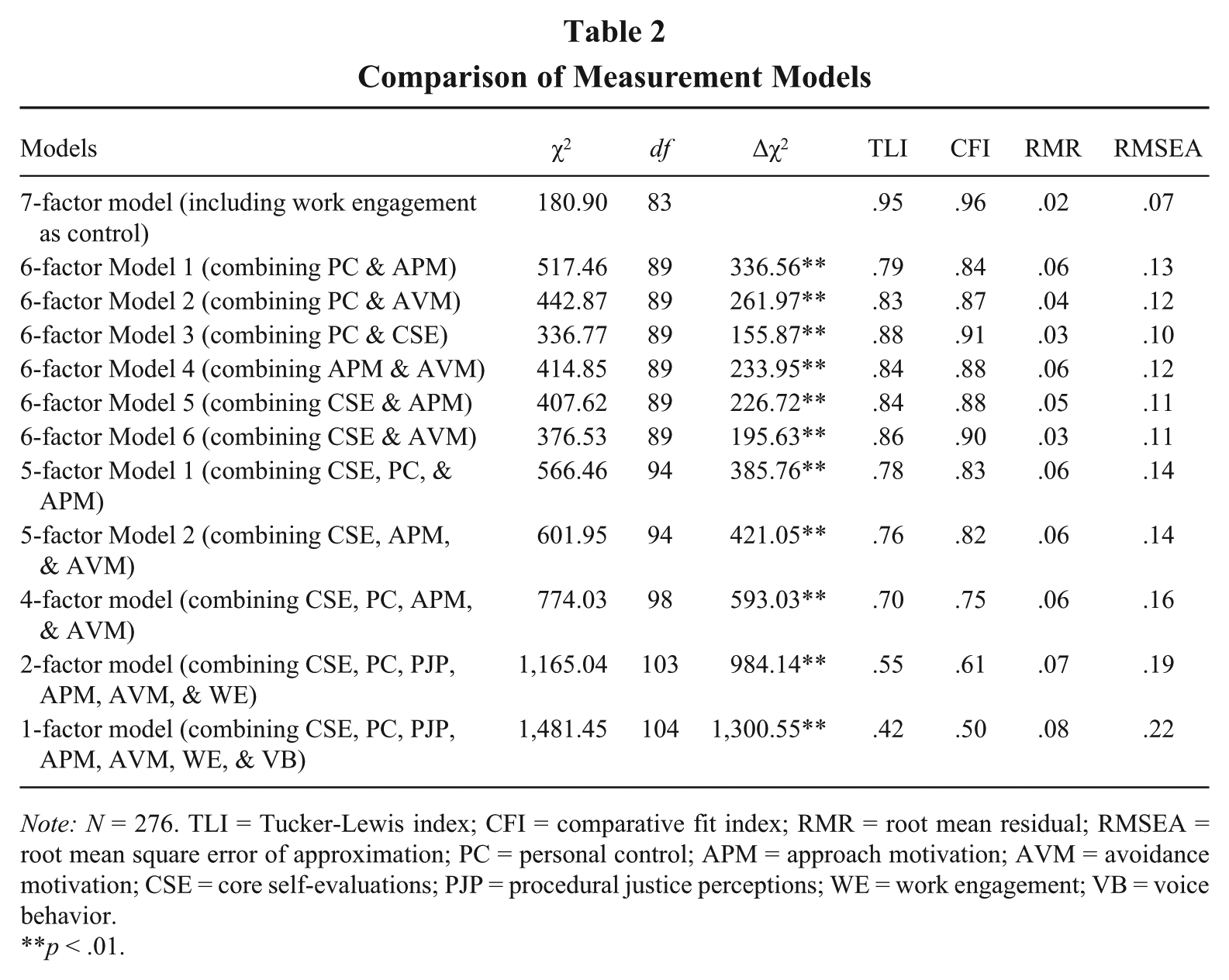
Note: N = 276. TLI = Tucker-Lewis index; CFI = comparative fit index; RMR = root mean residual; RMSEA = root mean square error of approximation; PC = personal control; APM = approach motivation; AVM = avoidance motivation; CSE = core self-evaluations; PJP = procedural justice perceptions; WE = work engagement; VB = voice behavior.
p < .01.
Hypothesis Testing
Hypotheses 1a, 1b, and 1c suggested that CSE would be positively related to personal control (Hypothesis 1a) and approach motivation (Hypothesis 1b) but negatively related to avoidance approach (Hypothesis 1c). Hypothesis 2 posited that personal control would mediate the CSE–voice behavior relationship, whereas Hypothesis 3 posited that approach motivation would mediate the CSE–voice behavior relationship. Before testing these hypotheses, we first compared two competing models. The first model was our hypothesized parsimonious structural mediated model. This model was compared to a fully saturated model in which we added a direct path from CSE to voice behavior. We used the same parcels used in the measurement model above and with work engagement as a control variable.
Results shown in Figure 2 suggest that the more parsimonious structural mediated model provided a good fit to the data (χ2 = 238.56, df = 69, p < .01, TLI = .90, CFI = .93, RMR = .039, RMSEA = .095). Compared to the second model shown in Figure 3, where we added a direct path from CSE to voice behavior, we found that the fit statistics were almost identical to that of the model shown in Figure 2 (χ2 = 237.88, df = 68, p < .01, TLI = .90, CFI = .93, RMR = .039, RMSEA = .095), with the difference in fit nonsignificant (χ2[1] = 0.68). However, the added direct path from CSE to voice behavior was nonsignificant (β = −0.12, n.s.). Under rules of model parsimony, we retained the model shown in Figure 2 because it is more parsimonious and used it to test Hypotheses 1 through 3.
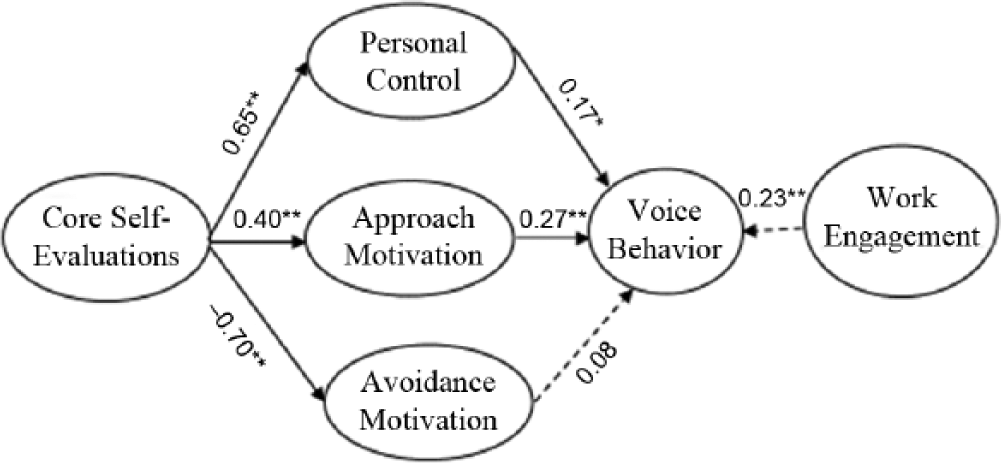
Structural Equation Modeling Results
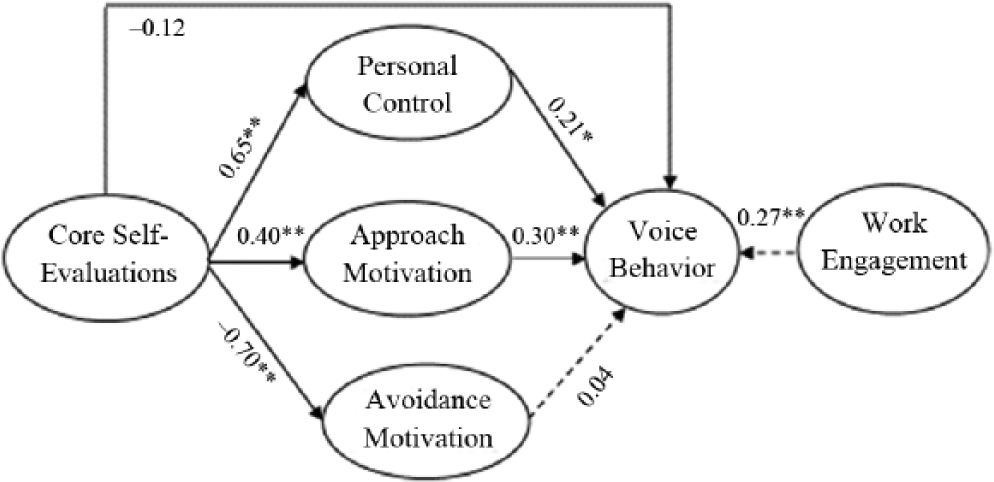
Alternative Model: One Path Added
Results shown in Figure 2 indicate that CSE significantly positively relate to personal control (β = 0.65, p < .01) and approach motivation (β = 0.40, p < .01) but negatively to avoidance motivation (β = −0.70, p < .01). These results provide support for Hypotheses 1a, 1b, and 1c. Results shown in Figure 2 also suggest that both personal control (β = 0.17, p < .05) and approach motivation (β = 0.27, p < .01) significantly relate to voice behavior. Taken together, with results reported for Hypotheses 1a and 1b, these results suggested a mediated relationship.
Using the Rmediation procedure (Tofighi & MacKinnon, 2011) to test for mediation proposed in Hypotheses 2 and 3, we found that the 95% CI for personal control in the CSE–voice behavior relationship lies between 0.03 and 0.41, whereas the 95% CI for approach motivation in the CSE–voice behavior relationship lies between 0.09 and 0.35. Because 0 is not contained in the 95% CI, we concluded that the indirect effects reported in Figure 2 are indeed significantly different from 0 (p < .01, two-tailed). These results provide support for Hypotheses 2 and 3.
Hypothesis 4a posited that procedural justice perceptions would moderate the indirect effect between CSE and voice behavior through personal control, such that the indirect effect would be stronger when procedural justice perceptions are high but not low, whereas Hypothesis 4b posited that procedural justice perceptions would moderate the indirect effect between CSE and voice behavior through approach motivation, such that the indirect effect would be stronger when procedural justice perceptions are high but not low. As already discussed above, moderated mediation would be demonstrated when the conditional indirect effect of CSE on voice behavior through personal control and approach motivation differs in strength across high and low levels of procedural justice perceptions.
Our correlation table shows that CSE are significantly related to voice behavior, providing support for Condition 1 for moderated mediation. To test for Condition 2, we first examined whether the interaction of CSE with procedural justice perceptions was significant in predicting personal control and approach motivation, respectively. We mean centered the product terms (Aiken & West, 1991) and controlled for work engagement. Results of the moderated regressions showed that the interaction term was significantly related to personal control (β = 0.14, p < .01) and approach motivation (β = 0.16, p < .01). We then tested whether the interaction of personal control and approach motivation, respectively, with procedural justice perceptions were significantly related to voice behavior controlling for work engagement and CSE. Moderated regression results showed that the interaction term of approach motivation and procedural justice perceptions in predicting voice behavior was significant (β = 0.16, p < .01), whereas the interaction term of personal control and procedural justice perceptions was nonsignificant (β = −0.00, n.s.). Taken together, Condition 2 was satisfied for approach motivation with procedural justice perceptions but not entirely for personal control because procedural justice perceptions did not interact with personal control to affect voice behavior. Condition 3 was supported by our results shown in Figure 2, where we show that both personal control and approach motivation are positively related to voice behavior.
To verify whether moderated mediation relationships indeed are present, we examined Condition 4, which requires the magnitude of the conditional indirect effect of CSE through personal control and approach motivation, respectively, to be different across high and low levels of procedural justice perceptions, using Preacher and colleagues’ (2007) MODMED program. Table 3 shows the results.
Moderated Mediated Results for Core Self-Evaluations Across Levels of Procedural Justice Perceptions
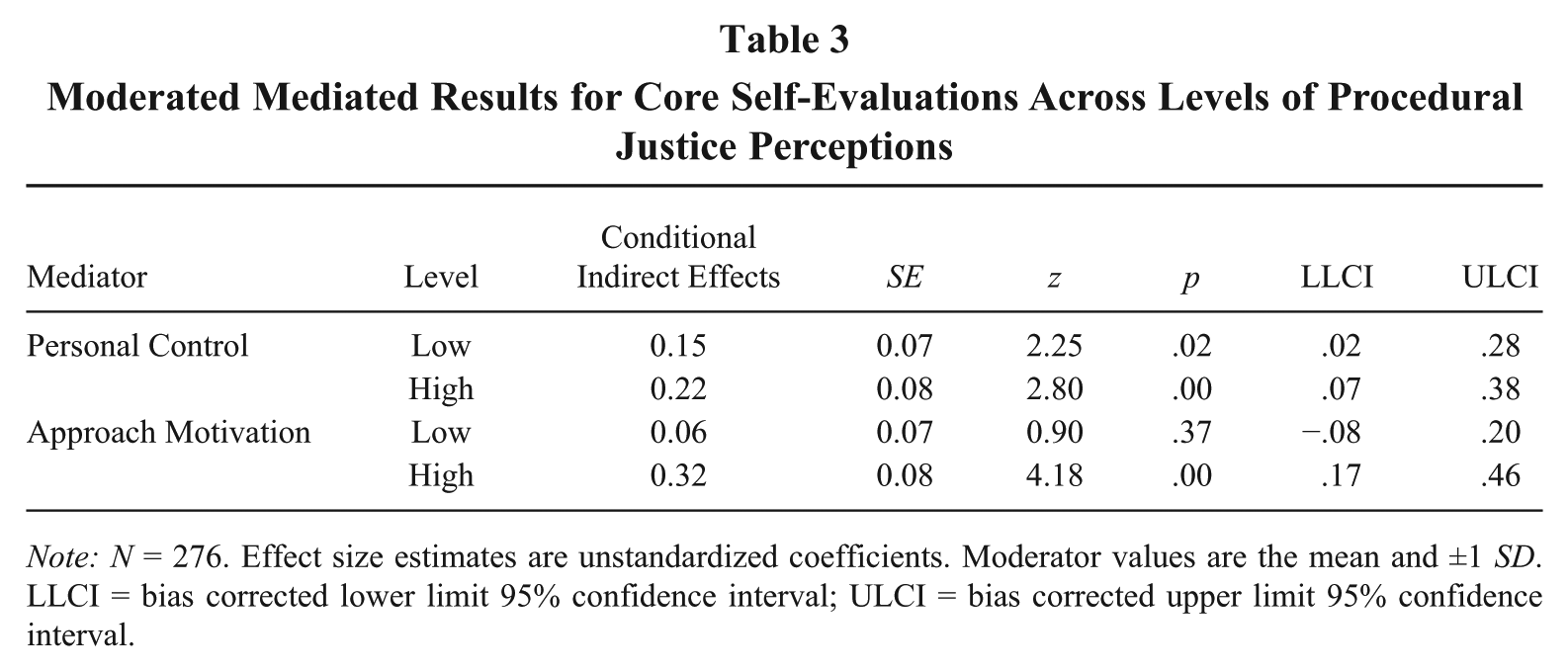
Note: N = 276. Effect size estimates are unstandardized coefficients. Moderator values are the mean and ±1 SD. LLCI = bias corrected lower limit 95% confidence interval; ULCI = bias corrected upper limit 95% confidence interval.
In testing Condition 4 for Hypothesis 4a, we found that the indirect effect of CSE via personal control on voice behavior is stronger when procedural justice perceptions are high (b = 0.22, SE = 0.08, p < .01; indirect effect range: 0.07 to 0.38) than when procedural justice perceptions are low (b = 0.15, SE = 0.07, n.s.; indirect effect range: 0.02 to 0.28). These results suggest that although we did not find evidence for the interaction term of personal control and procedural justice perceptions in predicting voice behavior, the statistical significance tests appear to indicate that procedural justice perceptions moderate the strength of the mediated relationship between CSE via personal control such that the mediated relationship is stronger under high procedural justice perceptions than under low procedural justice perceptions. Regarding Hypothesis 4b, we also found that the indirect effect of CSE via approach motivation on voice behavior is stronger when procedural justice perceptions are high (b = 0.32, SE = 0.08, p < .01; indirect effect range: 0.16 to 0.46) than when procedural justice perceptions are low (b = 0.06, SE = 0.07, n.s.; indirect effect range: –0.08 to 0.20). These results provided support for Hypothesis 4b.
Discussion
We proposed and examined a moderated mediation model of the processes through which CSE influence voice behavior. As predicted, our findings revealed that CSE indirectly related to voice behavior through personal control and approach motivation but not through avoidance motivation. Furthermore, and consistent with our predictions, results showed that procedural justice perceptions enhanced the strength of the indirect influence of CSE on voice behavior through both personal control and approach motivation such that these relationships are stronger when procedural justice perceptions are high but not low. Support for our moderated mediation model suggests a number of implications, which we discuss below.
Theoretical Implications
Although personality has been shown to influence proactive behaviors, such as voice, (LePine & Van Dyne, 2001; Morrison, 2011), research has yet to examine CSE, a dispositional construct that underpins an employee’s sense of agency, as an antecedent of voice behavior. Grounded in a control-based explanation and an approach/avoidance framework, we examined not only the relationship between CSE and voice behavior but also the utility of these psychological pathways in accounting for this relationship. The indirect influence of CSE on voice behavior that we demonstrated underscores the utility of these explanations. Given that a control-based explanation has previously been shown to influence the personal control–voice relationship, albeit in a curvilinear fashion (Tangirala & Ramunajam, 2008a), our finding that the influence of CSE on voice behavior can also be explained in terms of the approach motivation component of the approach/avoidance framework extends our understanding of why CSE relate to work-related behaviors. Support for the two psychological pathways underpins the expectation of success that a sense of agency engenders in influencing a proactive behavior such as voice. Our findings pertaining to the utility of the approach component of the approach/avoidance framework in accounting for voice behavior validates Ferris and colleagues’ (2011) call for research on the work outcomes of CSE to be grounded in this framework.
Our results revealed that CSE related positively to approach motivation but negatively to avoidance motivation (Ferris et al., 2011) and positively to personal control. Much of the research on personal control has focused on leadership and task antecedents of the construct (Greenberger et al., 1989; Greenberger & Strasser, 1986; Spector, 1986). Consequently, our focus on an individual or dispositional antecedent of personal control adds to our understanding of the sources of the construct. This finding extends Tangirala and Ramanujam’s (2008a) finding by highlighting a personality antecedent of personal control and, therefore, underscores the importance of an internally driven sense of personal agency in shaping one’s sense of being impactful and self-determining in the context of work. Our replication of Ferris and colleagues’ finding regarding the relationship between CSE and approach/avoidance motivation in a Chinese context provides initial evidence of the generalizability of the sense of agency inherent in this construct and the resulting motivational implications.
Our findings further revealed that procedural justice perceptions enhanced the mediated influence of both personal control and approach motivation on the CSE–voice behavior relationship. The moderating influence of procedural justice perceptions suggests that fair decision-making structures augment high–personal control employees’ sense of being impactful and self-determining as well as high–approach motivation employees’ focus on positive outcomes, thereby enhancing the expectancy of successfully engaging in voice behavior. While previous research has examined procedural justice perceptions as a moderator of the other facets of justice on voice behavior (Takeuchi et al., 2012), this finding highlights the tantalizing possibility that procedural justice perceptions operate in a way akin to psychological safety perceptions, at least for employees high in personal control and approach motivation. This is because both constructs lower employee concerns about the adverse consequences of voice behavior, thereby enhancing the expectancy of successfully engaging in voice behavior. The moderating role of procedural justice perceptions in the mediated influence of approach motivation in the CSE–voice behavior relationship reinforces Ferris and colleagues’ (2011: 156) suggestion that research should incorporate situational/contextual contingencies into the approach/avoidance framework, as these contingencies activate approach tendencies.
Practical Implications
Our findings provide actionable knowledge that organizations can leverage to promote voice behavior. First, while much research has examined situational or contextual antecedents of personal control (Greenberger et al., 1989), our finding that CSE influence perceptions of personal control and, as in prior research (e.g., Ferris et al., 2011), approach motivation, suggests a dispositional basis to these motivational pathways. Although we encourage organizations to foster the development of personal control (and potentially approach motivation) through job redesign, leadership development, and empowerment programs, our findings suggest a role for selection based on CSE as a source of personal control and approach motivation. The increasingly dynamic business conditions and the need to source improvement-oriented ideas from all levels of the organization make CSE a particularly valuable personality trait. Second, the moderating influence of procedural justice perceptions on the mediated influence of CSE on voice behavior through the psychological pathways of personal control and approach motivation suggests a need for organizations to foster facilitative conditions that enhance employees’ sense of agency and, thereby, the expectancy of successfully engaging in voice behavior. This is necessary if organizations are to tap into employee suggestions, concerns, and ideas about work-related issues and leverage them to promote improvement opportunities. Although we examined only procedural justice perceptions (Takeuchi et al., 2012), organizations must focus on promoting a procedural justice climate because as an important feature of the social context, it provides cues about the behaviors expected of employees (Naumann & Bennett, 2000; Tangirala & Ramanujam, 2008b). This can be done through training of leaders in procedural justice rules and ensuring human resource policies and practices meet the conditions of bias suppression, correctability, and consistency (Leventhal, 1980).
Limitations and Directions for Future Research
Our findings must be interpreted against a background of the study’s limitations. First, the cross-sectional research design precludes any inferences of causality. Future research that adopts a longitudinal design may be better placed to ascertain the causal basis of the relationships we reported. Second, although our study provides initial evidence regarding voice behavior as a performance outcome of CSE, we examined promotive and not prohibitive voice (expression of concern about existing work-related issues), which has been shown to exist in China (Liang et al., 2012). Future research should examine the processes linking CSE to these two forms of voice behavior. Third, we did not examine the boundary conditions of the influence of CSE on personal control and approach/avoidance motivation. Future research should examine the influence of theoretically informed contextual variables, such as empowering leadership and organizational structure, that augment the influence of CSE on personal control as well as approach/avoidance motivation. Fourth, we did not address the issue of construct validity, which has emerged as one stream of CSE research (Johnson, Rosen, & Levy, 2008; Judge et al., 2004). Future research, particularly in a Chinese context, should ascertain the validity of the construct. Lastly, our study examined an individual-level model of the processes through which CSE relate to voice behavior. Given that this behavior takes place in an organizational context, future research should examine a cross-level model in which unit/organizational-level factors activate approach (personal control) tendencies leading to voice behavior and its personal and organizational outcomes.
Conclusion
We sought to examine the processes through which CSE influence voice behavior of employees in customer contact roles. Our findings revealed that CSE related to voice behavior directly and indirectly through the motivational pathways of personal control and approach motivation but not avoidance motivation. Furthermore, procedural justice perceptions enhanced the mediated influence of personal control and approach motivation on the CSE–voice behavior relationship such that these relationships are stronger when procedural justice perceptions are high but not low. In general, our findings revealed support for our proposed moderated mediation model, thereby reinforcing the notion that personality traits matter at work. Consequently, efforts to understand work-related behaviors, particularly of the proactive type, should focus on investigating theoretically grounded mediators (as well as moderators) of the personality–work-related behavior relationship.
Footnotes
Acknowledgements
This article was accepted under the editorship of Deborah E. Rupp. Funding for data collection for this article was provided by grants from University of Surrey and City University of Hong Kong. We are grateful to our action editor, Michelle Duffy, and two anonymous reviewers for their encouragement and constructive feedback.