



Abstract
Applications of social exchange theory in organizational research have tended to ignore the resource context and its impact on a focal dyadic social exchange. Integrating insights from the social exchange theory and the conservation of resources theory, we examine the role of resource availability in the social exchange of resources. The type of social exchange we focus on is the psychological contract. Specifically, we examine the antecedents and consequence of breach of employee obligations to an employer. We test our predictions using multisource data obtained from employees over three measurement periods in Sample 1 and matched triads (employee, supervisor, and coworker) in Sample 2. We found that family–work conflict (FWC) and breach of employer obligations are positively, while conscientiousness is negatively, related to employees’ perceptions of breach of their obligations. Conscientiousness moderated the FWC–breach relationship: Employees low on conscientiousness have a stronger positive relationship between FWC and breach of employee obligations. Breach of employee obligations is, in turn, negatively related to employee career progression (a job promotion over the following year in Sample 1 and supervisor-rated promotability in Sample 2). Findings highlight the interconnected nature of demands, resources, and obligations and that dyadic social exchange obligations should be examined in the context of other demands.
An employee’s psychological contract consists of beliefs about the employer’s obligations to the employee (also referred to as inducements) and the employee’s own obligations to the employer (also referred to as contributions; Chen, Tsui, & Zhong, 2008; Rousseau, 1995). Employees may perceive a breach of psychological contract when either of the psychological contract obligations is not delivered. A great deal of empirical research has demonstrated the negative consequences of employees’ perceptions that the employers have failed to deliver on their obligations (Conway & Briner, 2009; Montes & Zweig, 2009; Robinson & Morrison, 2000). However, there is remarkably little research devoted to the antecedents and consequences of employees’ own breach of obligations (Bal, Jansen, van der Velde, de Lange, & Rousseau, 2010; Coyle-Shapiro & Kessler, 2002; Lambert, 2011).
Moreover, existing research has examined breach of employee obligations only from the standpoint of the social exchange theory (SET) and the dyadic reciprocity norm. That is, breach of employee obligations has been shown to be a consequence of the breach of employer obligations (Coyle-Shapiro & Neuman, 2004) or a consequence of lack of agreement on reciprocal obligations (Dabos & Rousseau, 2004; Tekleab & Taylor, 2003). However, there are other circumstances outside of the employee–organization social exchange context that may limit the ability of an employee to deliver on his or her obligations. For example, there may be a scarcity of resources that are needed by the employee to make the obligated contributions to the organization (Grandey & Cropanzano, 1999). Therefore, we adopt a resource demand perspective (specifically, the conservation of resources, or COR, theory; Hobfoll, 2002)—in addition to the social exchange perspective—to examine antecedents of breach of employee obligations. In particular, we look at the effects of a situational resource constraint (i.e., family–work conflict [FWC]; Allen, 2013) that increases, and a personal resource (i.e., conscientiousness; Halbesleben, Harvey, & Bolino, 2009) that decreases, the likelihood of breach of employee obligations.
The proposed relationships represent a confluence of social exchange and COR perspectives and are presented in Figure 1. Based on SET, we predict that perceptions of breach of employer obligations will be positively related to breach of employee obligations. Moreover, based on COR theory, we predict that FWC will be positively related, and conscientiousness will be negatively related, to breach of employee obligations. Recent work has highlighted the role of conscientiousness as a resource that has a direct effect as well as a moderating effect in the form of a meta-resource (Halbesleben et al., 2009). That is, conscientiousness allows better overall governance and management of other available resources. We test this idea by examining the interaction of conscientiousness with other predictors of employee breach. Finally, breach of employee obligations is predicted to be negatively related to employee career progression in the organization.
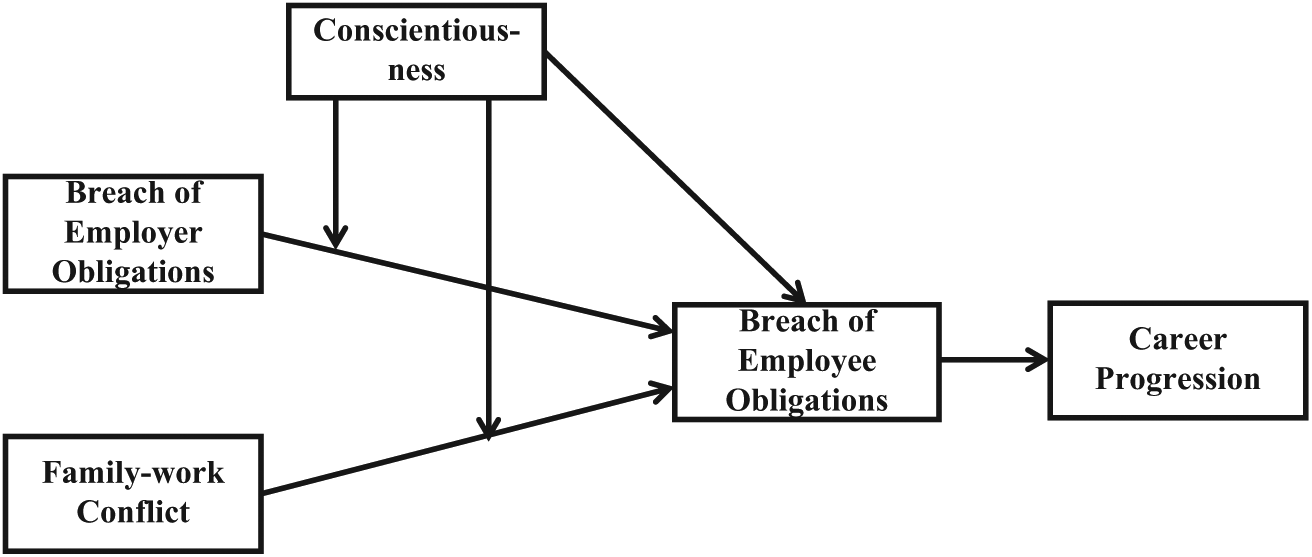
The Hypothesized Research Framework
Our research makes several important contributions. First, we contribute to the psychological contract and the wider social exchange literature by examining the influence of the resource context on breach of employee obligations. Second, we contribute to the psychological contract literature by examining employees’ perceptions of breach of obligations, a largely underresearched topic. Nearly all conceptualizations of the psychological contract emphasize two elements of the employee psychological contract: The “taking” of employer inducements obligates the employee to “give” in terms of contributions (Conway & Briner, 2009; Rousseau, 1995). Thus, the dearth of research attention to employee obligations is an important theoretical and empirical gap in the research literature on psychological contracts. Understanding the antecedents and consequences of breach of employee obligations is of importance as employee contributions are vital for the successful achievement of the individual’s career goals as well as for organizational performance (Coyle-Shapiro & Conway, 2004).
Finally, Coyle-Shapiro and Shore (2007) called for greater attention to outcomes of employee–organization relationships, in particular, outcomes that reflect the state of the social exchange relationship. A job promotion is a tangible reward that an organization bestows on an employee, largely in return for the employee’s contributions to the organization. However, psychological contract research has made limited theoretical or empirical links between the state of the psychological contract and employees’ career progression in the organization. Career growth is important to employees, as it is associated with tangible (e.g., salary) and intangible gains (e.g., status and satisfaction; Ng, Eby, Sorensen, & Feldman, 2005). Therefore, we examine the consequence of breach of employee obligations for the employee’s career progression in the organization. In the following sections, we introduce the theoretical approach and develop hypotheses to be tested in this paper.
Theoretical Background: The Resource Context of Social Exchange Relationships
Social exchange, or the trust-based reciprocal exchange of material and nonmaterial resources between two parties, has been theorized to underlie a variety of workplace relationships (Coyle-Shapiro & Conway, 2004; Cropanzano & Mitchell, 2005). For example, the employee–organization relationship is conceptualized as a social exchange involving employee contributions in exchange for organizational inducements (March & Simon, 1958). While SET has been hugely influential in organizational behavior, there remain several conceptual and operational concerns over how it has been applied to workplace phenomena (see Coyle-Shapiro & Conway, 2004, and Cropanzano & Mitchell, 2005, for critical reviews). One shortcoming has been the focus on the exchange in a dyadic relationship with limited attention to the larger context in which the relationship exists and, indeed, may be dependent upon (Emerson, 1981). In most applications of SET to workplace phenomena, the exchange of resources is expected to be contingent upon the mutuality and reciprocity in the dyadic relationship. However, each partner in the dyad is embedded in a wider social context (Zagenczyk, Gibney, Murrell, & Boss, 2008), with other relationships that also demand resources; therefore, a partner’s ability to deliver on obligations in the focal relationship may be dependent on availability of resources. As Blau (1964:105) noted in his seminal work on SET, “the immediate exchange processes cannot be understood without taking into account other exchange transactions that impinge on them.” Unfortunately, there is limited research attention devoted to how other demands may limit the contributions in a social exchange relationship.
In the research reported here, we examine the influence of available resources on an employee’s ability to meet social exchange obligations. The form of social exchange we focus on is the psychological contract (Rousseau, 1995). We wish to highlight two reasons for breach of employee obligations: The first represents a social exchange–based motivation not to contribute in response to breach by the employer (i.e., a “will not” reason); the second represents the inability to contribute due to insufficient resources (i.e., a “cannot” reason, due to high FWC or low conscientiousness).
In the predicted pattern of relationships (see Figure 1), we connect research areas that have each generated a great deal of empirical work but with very little interchange between them. We believe there is much to be gained by this connection. Examination of social exchange processes at work has been largely within dyadic relationships, focusing on the reciprocity between two parties (such as the supervisor and the subordinate or the employee and the organization; Coyle-Shapiro & Conway, 2004). Given the interconnections among exchange relationships, researchers are beginning to examine the relationships between various exchange-based constructs (perceived organizational support, leader–member exchange, and psychological contracts; Dulac, Coyle-Shapiro, Henderson, & Wayne, 2008) as well as interdependencies between various exchange dyads (organization–supervisor, supervisor–subordinate, and subordinate–customer; Bordia, Restubog, Bordia, & Tang, 2010). However, such research has remained within the context of organizational boundaries. The work–family interrole conflict literature draws attention to the increasingly permeable boundaries between work and nonwork domains; acknowledging and incorporating the influence of nonwork demands will enhance our understanding of why and when employees may breach their social exchange obligations at work. Therefore, we examine the effects of FWC on employees’ breach of obligations.
Connections with social exchange processes at work also have the potential to enrich work–family research. The social exchange perspective emphasizes the commitments made by individuals in exchange relationships and thereby the obligatory nature of demands on their time and attention in the work context (Eisenberger, Armeli, Rexwinkel, Lynch, & Rhoades, 2001). This obligatory nature of exchange relationships highlights the costs incurred by employees when interrole conflict leads to breach of obligations: Promises go unfulfilled, trust gets undermined, and the viability of exchange relationships are threatened (Rousseau, 1995). The risk of accruing these costs may induce employees toward resource expenditure at work, even when confronted with rival demands from nonwork domains, resulting in work–life conflict.
Antecedents of Breach of Employee Psychological Contract Obligations
A psychological contract, as opposed to a formal job contract, comprises beliefs that include subjective interpretations of promises made by both parties that obligate them to a reciprocal exchange (Rousseau, 1995). A breach of employee obligations would occur when the employee fails to deliver on the promised obligations (Coyle-Shapiro & Kessler, 2002; Tekleab & Taylor, 2003). While performance-related contributions will form an important part of this assessment, the employee’s perceptions of breach will develop in the context of the reciprocity-based obligations in the employee–organization relationship (Lambert, 2011). A given level of job performance may (or may not) represent breach from the employee’s perspective, depending on whether (or not) it represents a failure on the part of the employee to deliver on what he or she feels is owed to the organization (Rousseau, 1995). Thus, a perception of breach is more than an assessment of job performance–related contributions: It refers to an employee’s overall belief that he or she has failed to contribute to the level that he or she was obligated to in the context of the reciprocal exchange agreement. This context includes the extent to which the organization has satisfied its obligations to the employee as well as the employee’s level of available resources.
We propose that employees’ perceptions of breach obligations could arise from two reasons: a willful breach in response to breach of obligations by the employer or an inability to fulfill obligations due to lack of sufficient resources. We integrate two theoretical perspectives, namely, the SET (Blau, 1964) and COR theory (Hobfoll, 2002), respectively, to explain the above two reasons and to identify antecedents of employee breach of obligations.
SET is the most widely used theoretical perspective to shed light upon the causes of breach of obligations (Coyle-Shapiro & Kessler, 2002). The psychological contract relationship between the employee and the employer is predicated upon a reciprocity-based social exchange relationship (Bal et al., 2010; Coyle-Shapiro & Neuman, 2004). If one party fails to deliver on promised obligations, it is likely that the other party will reciprocate in kind (Rousseau, 1995). Thus, if the employer breaches its psychological contract obligations, the employee is likely to respond by withholding contributions and committing a breach of employee obligations (Coyle-Shapiro & Kessler, 2002). Therefore, we predict a positive relationship between breach of employer obligations and breach of employee obligations.
Hypothesis 1: Breach of employer obligations will be positively related to breach of employee obligations.
An employee’s ability to deliver on the promised obligations is also likely to be influenced by the availability of personal and situational resources (Grandey & Cropanzano, 1999; Hobfoll, 2002; Peters & O’Connor, 1980). Resources include objects (e.g., work tools), conditions (e.g., marital status), and personal characteristics (e.g., traits, skills, and abilities; Halbesleben, Neveu, Paustian-Underdahl, & Westman, 2014; Hobfoll, 2002) required to meet the demands placed upon the individual. The impact of resource availability on performance and well-being has been examined under the theoretical framework of COR (Hobfoll, 2002). According to COR theory, individuals are motivated to acquire and conserve resources. This motivation is particularly active when there is a lack of available resources or a threat of resource depletion; such situations are perceived as stressful, and individuals react by seeking additional resources or conserving their current resources by reducing resource expenditure in other contexts (Hobfoll, 2002).
Lack of resources (e.g., skill deficiencies) or high demand on resources (e.g., time and attention to look after an ill member of the family) may limit the availability of resources needed to meet other demands (e.g., time and attention at work; Peters & O’Connor, 1980), including social exchange obligations. Based upon this idea, we propose that breach of employee psychological contract obligations may also be influenced by resource availability, over and above the state of the social exchange relationship. That is, inclusion of resource variables will shed unique light upon employee breach of obligations.
Hypothesis 2: The COR variables will explain additional variance in breach of employee obligations over and above that explained by the social exchange variable (i.e., breach of employer obligations).
We now turn to predictions regarding specific resource-based variables. One kind of demand on resources that might affect fulfillment of work obligations is FWC (Grandey & Cropanzano, 1999). FWC refers to a role-based conflict in which family-related roles and responsibilities interfere with those at work (Allen, 2013; Netemeyer, Boles, & McMurrian, 1996). As predicted by COR theory, when employees experience resource drain due to family demands, they respond by conserving resources in the work context (Grandey & Cropanzano, 1999). Applying this idea to the context of employee obligations, we predict that when employees are faced with high levels of family demands that interfere with work performance, they will find it difficult to meet their obligations to the organization.
Hypothesis 3: FWC will be positively related to breach of employee obligations.
A personal resource characteristic that should enhance the likelihood that employees deliver on promised obligations is conscientiousness (Gellatly, 1996; Halbesleben et al., 2009). Conscientiousness is a particularly relevant and interesting trait-based resource. First, it affords its own advantages in achieving work goals. Conscientious individuals concentrate on the task at hand by the “diligent performance of role behavior” (Hofmann & Jones, 2005: 513). Second, conscientiousness serves as a “meta-resource” (Halbesleben et al., 2009: 1460). That is, individuals high on conscientiousness are good at managing their overall pool of resources. They are better at planning and time management, and these organizational skills allow them to allocate resources when and where most needed. We use these two characteristics of highly conscientious individuals to propose direct and moderating effects of conscientiousness, respectively.
We have chosen conscientiousness as the personal resource for several reasons. Of the Big Five personality variables, conscientiousness has the strongest relationship with employee contributions, such as performance (Barrick & Mount, 1991). Conscientiousness as a personality trait is characterized by self-discipline, efficiency, and reliability (Colquitt & Simmering, 1998; Marcus & Schuler, 2004). Those high in conscientiousness follow rules, prefer regular updates, and choose their words carefully (Goldberg, 1992). Highly conscientious individuals value their contribution toward the organization (Flaherty & Moss, 2007) and are likely to display higher commitment and job performance than individuals who are low in conscientiousness. Therefore, those higher in conscientiousness are more likely to fulfill their obligations to the organization (Barrick & Mount, 1991; Meyer, Stanley, Herscovitch, & Topolnytsky, 2002). Following from this, we predict the following:
Hypothesis 4: Conscientiousness will be negatively related to breach of employee obligations.
We also expect that conscientiousness will moderate the effect of FWC upon breach of employee obligations. Personal resources, such as conscientiousness, act as meta-resources (Halbesleben et al., 2009) or key resources (ten Brummelhuis & Bakker, 2012; Halbesleben et al., 2014), in that they enable efficient use of other resources and better problem-solving and coping skills. For example, Halbesleben et al. (2009) found that expenditure of resources in the form of organizational citizenship behaviors was positively related to work interference with family; however, this relationship was weaker for employees high on conscientiousness. People high on conscientiousness have better organizational skills and engage in more optimal use of other resources, such as time and energy. In the context of our study, when confronted with FWC, employees high on conscientiousness will enlist other resources to ensure that they fulfill their psychological contract obligations (Hofmann & Jones, 2005). Put in terms of COR theory, people high in conscientiousness will have a lower need to conserve resources (and reduce contributions at work) when faced with FWC (Colquitt & Simmering, 1998), thereby attenuating the relationship between FWC and breach of employee obligations. On the other hand, people low on conscientiousness lack the extra organizational skills and will find it difficult to meet work demands when they experience a resource drain, such as FWC (Marcus & Schuler, 2004). Therefore, the relationship between FWC and breach of employee obligations will be stronger for those low in conscientiousness.
Hypothesis 5: Conscientiousness will moderate the positive relationship between FWC and breach of employee obligations, such that the relationship will be stronger for those who are low on conscientiousness compared to those who are high on conscientiousness.
Similarly, conscientiousness is likely to moderate the positive relationship between breach of employer obligations and breach of employee obligations. People high in conscientiousness are performance oriented and have a long-term relationship with the organization in mind (Raja, Johns, & Ntalianis, 2004). When they experience breach from the employer, they are less likely to be perturbed by it and will persist with fulfilling their obligations (Flaherty & Moss, 2007). On the contrary, people who are low in conscientiousness are more likely to be emotion focused and impulsive in their reactions and may reciprocate breach with breach (Marcus & Schuler, 2004). Therefore, the relationship between breach of employer obligations and breach of employee obligations will be stronger for individuals low on conscientiousness.
Hypothesis 6: Conscientiousness will moderate the positive relationship between breach of employer obligations and breach of employee obligations, such that the relationship will be stronger for those who are low on conscientiousness compared to those who are high on conscientiousness.
Breach of Employee Obligations and Employee Career Progression
In the organizational literature, career advancement has been explained from the theoretical standpoint of Turner’s career mobility perspective (Turner, 1960; Rosenbaum, 1984). According to this theory, career progression is a result of two pathways: the contest mobility pathway and the sponsored mobility pathway. In the contest mobility pathway, career progression is a competition among employees. Those with stronger human capital–based performance win and get promoted to higher levels in the organization (Judge, Cable, Boudreau, & Bretz, 1995; Ng et al., 2005). In the sponsored mobility pathway, employees achieve career progression because of sponsorship from management; promising candidates are identified by senior management and provided unique access to career progression pathways in the form of support, encouragement, mentoring, and access to opportunities (Wayne, Liden, Kraimer, & Graf, 1999). On the basis of the career mobility perspective, we propose that employees’ breach of obligations will hurt their career progression in the organization. This prediction is supported by both the contest mobility and sponsorship mobility pathways. Breach of obligation implies that the employee performs poorly compared to the benchmark in the employment relationship (Tekleab & Taylor, 2003), making it less likely that the employee will be able to win the contest for promotion. Breach of obligations will also make it less likely that the employee will receive sponsorship from the supervisor and other senior managers. Indeed, SET and the norm of reciprocity also predict that if the employee does not fulfill his or her obligations to the organization, organizational agents are less likely to provide inducements, such as mentoring and support, necessary for career progression (Chen et al., 2008).
Hypothesis 7: Breach of employee obligations will be negatively related to career progression.
Finally, we consider the interplay among resource and social exchange variables in explaining career progression in the organization. Combining the propositions related to the antecedents and the consequences of breach of employee obligations, we suggest an indirect effect of the antecedents on the consequences via breach of employee obligations. That is, breach of employee obligations will carry indirect effects of breach of employer obligations, FWC, and conscientiousness upon career progression. Moreover, we expect that conscientiousness will moderate the indirect effects of breach of employer obligations and FWC (i.e., a first-stage moderation, as suggested by Hypotheses 4 and 5): The indirect effects will be stronger for employees low in conscientiousness compared to those high in conscientiousness. These predictions are captured in the form of the moderated mediation hypotheses presented below.
Hypothesis 8: The indirect effect of FWC upon career progression via breach of employee obligations will be moderated by conscientiousness, such that the indirect effect will be stronger for those individuals who are low on conscientiousness as opposed to those who are high on conscientiousness.
Hypothesis 9: The indirect effect of breach of employer obligations upon career progression via breach of employee obligations will be moderated by conscientiousness, such that the indirect effect will be stronger for those individuals who are low on conscientiousness as opposed to those who are high on conscientiousness.
Method
We tested our hypotheses with two samples from the Philippines. Sample 1 was from a public-sector organization and involved data collection over three time periods. We collected both self-report and archival sources of data. Sample 2 involved full-time employees enrolled in the MBA/Master in Commerce programs. We used self, peer, and supervisor sources of data. We also sought constructive replication (Lykken, 1968) by using diverse operationalizations of several variables across the two samples. For example, career progression was measured as actual promotion in Sample 1 and supervisor ratings of promotability in Sample 2.
Participants and Procedure
Sample 1
The research site was a large public-sector organization responsible for the development and implementation of housing infrastructure and monitoring of housing demand, supply, and affordability. Data were collected at three measurement periods, each 1 year apart. A participant-generated code allowed matching of survey responses across Times 1 and 2. The participants also gave their employee ID number and the anonymous code to an independent person who matched the survey responses to archival records of employee promotion at Time 3. Neither the organization nor the research team had access to both the employer ID and the anonymous code.
At Time 1, permission was obtained to survey a convenience sample of 340 full-time employees in the organization. We assessed demographic characteristics, FWC, and breach of employer obligations. Two hundred twenty-nine out of the 340 employees completed the survey, yielding a response rate of 67.35%. One year later, at Time 2, the 229 Time 1 respondents were requested to participate in a follow-up survey, which assessed breach of employee obligations and conscientiousness. To further encourage participation, we sent out reminder cards 2 weeks after the initial mail-out and sent another reminder card along with the survey questionnaire and a small chocolate bar 4 weeks after the initial mail-out. One hundred ninety-five employees (85.15%) completed the second survey. At Time 3, 1 year later, we obtained actual promotion decisions for employees who participated in the Time 2 data collection. This resulted in a matched sample of 156 participants who completed both Time 1 and Time 2 surveys with accompanying promotion information. Employees without the promotion data were excluded from the analysis. A series of univariate analyses were conducted to assess sampling bias. We compared the final matched sample of 156 against those who participated in Time 1 and Time 2 without promotion data. There were no significant differences in age, t(220) = 1.19, ns, and tenure, t(220) = .42, ns. However, there was a statistically significant difference in terms of gender, t(220) = 3.64, p < .001. There were more men in the final matched sample than in the group that completed the Time 1 and Time 2 surveys alone. It is important to note, though, that a comparison of the demographic composition of the organization and the final matched sample showed that the sample closely resembled the organizational population profile.
The final sample comprised 73 men and 83 women. On average, participants had 21.88 years of organizational tenure. Age was assessed using age bands as follows (along with percentage of sample in each band): 20 to 25 years (0.6%), 26 to 30 years (3.2%), 31 to 35 years (3.8%), 36 to 40 years (2.6%), 41 to 45 years (41%), 46 to 50 years (25.6%), and over 50 years (23.1%). In terms of education, 60% had completed a university degree, 32.7 had postgraduate qualifications, and 7.1% had a high school diploma.
Sample 2
We surveyed a total of 156 full-time employees enrolled in part-time Master in Business/Commerce programs in a large university in the Philippines. All participants completed questionnaires containing identity codes to allow each employee’s ratings to be matched with those of his or her corresponding supervisor. They were assured of confidentiality and were informed that they could withdraw from the study at any time. There were three sources of data for the sample: (a) survey data from employees, (b) survey data from supervisors, and (c) survey data from peers/coworkers.
Surveys were administered by research assistants to 300 employees enrolled in part-time postgraduate business programs. The respondents were also asked to pass on a brief questionnaire to a coworker who works closely with the focal employee on a regular basis to provide ratings on his or her levels of conscientiousness. Two hundred and forty-seven employee surveys were returned, representing a response rate of 82.33%. We disregarded 31 surveys from those engaged in family business (n = 5) and part-time work (n = 3) as well as those surveys with a large number of missing responses (n = 14) and missing identity codes (n = 9), resulting in 216 completed employee surveys. In addition, we received 261 coworker surveys. We disregarded 19 surveys that were unanswered (n = 15) and with missing identity codes (n = 4). Two weeks later, each of the 216 participants received a brief rating form to be completed by his or her supervisor in order to assess the participant’s likelihood of promotability. Supervisors returned the completed rating form directly to the research team using prepaid reply envelopes. A total of 174 surveys were received, yielding a response rate of 80.56%. We disregarded 18 surveys with missing identity codes (n = 5) and those that were returned unanswered (n = 13). Overall, the two rounds of data collection resulted in 156 matched employee–peer/coworker–supervisor triads.
To ensure the integrity of the independent source data, two research assistants randomly contacted 10% of the participating supervisors and peers/coworkers using the optional e-mail/cell phone information that were obtained in the supervisor rating/peer rating forms. Questions with respect to the content and length of the surveys were asked to determine whether the supervisor or coworker had actually completed the survey. All supervisor/coworker participants provided accurate information supporting the integrity of the data.
The employee sample consisted of 62 men and 94 women. The average age of employees was 30.99 years (SD = 9.40). Participants’ tenure was reported as follows: less than 1 year (22.4%), 1 to 5 years (50.6%), 6 to 10 years (11.5%), 11 to 15 years (5.1%), 16 to 20 years (5.8%), 26 to 30 years (2.6%), and over 30 years (1.9%). Participants worked in a variety of occupations, such as banking and finance (21.2%), human resources (HR) and administration (19.9%), sales and marketing (18.6%), hospitality (17.9%), information technology (14.7%), and engineering and operations (7.7%). Among the supervisor participants, 59% were women and the average age and tenure were 39.74 years (SD = 3.98) and 10.01 years (SD = 8.09), respectively. Among the coworker participants, 59% were women and the average age and tenure were 31.59 years (SD = 9.47) and 6.33 years (SD = 7.28), respectively.
Measures
Multi-item scales were used to ensure adequate measurement of each study variable. Unless otherwise specified, the response format for all items, excluding the demographic variables, was a 7-point Likert-type scale with items coded such that a higher score indicated a greater amount of the focal construct (except for reverse-coded items). Survey length constraints imposed by the participating organization made it necessary to shorten some of the scales (see details below).
Employees’ FWC
For Sample 1, α = .91; for Sample 2, α = .85. FWC was measured with the five-item scale developed by Netemeyer et al. (1996). An example item is “The demands of my family or spouse interfere with work-related activities.”
Breach of employer obligations
For Sample 1, α = .74; for Sample 2, α = .80. We assessed employee perceptions of breach of employer obligations using the five-item scale developed by Robinson and Morrison (2000). An example item is “Almost all the promises made by my employer during recruitment have been kept so far” (reverse scored).
Conscientiousness
For Sample 1, α = .69; for Sample 2 peers, α = .91. In Sample 1, we assessed conscientiousness with four items from John and Srivastava’s (1999) nine-item conscientiousness scale. An example item is “I see myself as someone who does a thorough job.” While we had to use a shorter measure due to the organization-imposed constraint on survey length, we assessed the adequacy of the short measure using an independent sample. We administered the full measure to an independent sample of 353 full-time employees from diverse business sectors in the Philippines. Bivariate correlations indicated that the shortened and full versions of the conscientiousness scale were highly correlated, r = .97. In Sample 2, in line with prior work and to minimize self-report bias and skewed self-report responses (Mount, Barrick, & Strauss, 1994), we requested coworkers/peers to rate the conscientiousness of the focal employee using the semantic differential scale developed by Goldberg (1992). Example items include disorganized–organized, irresponsible–responsible, and negligent–conscientious.
Breach of employee obligations
For Sample 1, α = .95; for Sample 2, α = .98. We assessed employees’ perceptions of the extent to which they had breached their obligations to their organization. There are two general approaches to the measurement of breach: facet-based and global measures (Conway & Briner, 2009). Facet-based measures list a variety of specific obligations and ask respondents to indicate whether these obligations have been breached. The assessments of breach across the various facets are then summated to arrive at an overall assessment of breach. However, facets of psychological contract obligations tend to be context dependent, and there is a risk that a facet-based measure may omit a facet that is very important to the respondents. Moreover, in the summation process, facets are generally assumed to be equal in weight. This may be an overly simplistic assumption of the respondents’ relative preference for some facets over others (Crossley, Bennett, Jex, & Burnfield, 2007).
Global measures, on the other hand, ask respondents for an overall assessment of whether obligations have been kept or breached. Here, the aim is to get an overall impression of respondents’ perceptions of breach, irrespective of the specific facet that may have been breached. Given our interest in measuring employees’ overall perceptions of breach of obligations (rather than specific facets they may have breached), a global measure suited our purpose. We adapted the widely used global measure of breach of employer obligations developed by Robinson and Morrison (2000) by reframing the items to reflect breach of employee obligations. The items include “In general, I have kept my obligations to my organization,” “I have honored the obligations/commitments I have made to my organization,” “I have delivered all the things I have committed to my organization when I was hired,” and “I have fulfilled my obligations to my organization.” All items were reverse coded to arrive at an assessment of breach of obligations.
Given that this is the first study to assess breach of employee obligations using this global measure, we conducted extensive validation of the measure using an independent sample. This validation exercise is presented in the appendix (provided as online supplementary material). Specifically, we conducted a confirmatory factor analysis and show that breach is a distinct factor in comparison to in-role performance and organizational citizenship behaviors (divergent validity), that breach explains additional variance in supervisor-rated promotability over and above in-role performance and citizenship behaviors (incremental validity), and that self-rated breach is significantly related to supervisor ratings of the employee’s breach of obligations (convergent validity).
Career progression
Career progression has been operationalized in various ways in the literature, including subjective measures, such as self- and supervisor-rated promotability; objective measures, such as actual promotion; and career-wide advancement measures, such as number of promotions in a career and promotion rate (number of promotions divided by tenure; Ng et al., 2005). In this study, we operationalized promotion in two ways.
In Sample 1, we were interested in a specific, time-bound, career-related consequence of breach of employee obligations instead of advancement over the career span. Therefore, we focused on the discrete career progression outcome of actual promotion. Actual promotions are regarded as one of the most important benchmarks of objective career success (Hui, Lam, & Lam, 2000). In this organization, employees who wished to apply for promotion to the next rank submitted their promotion portfolio to their immediate supervisor. This portfolio is then passed onto the personnel office, which convenes the promotion committee. Promotion decisions are deliberated by a committee consisting of the immediate supervisor, the departmental manager or director of the division, a senior representative, an employee union representative, and the personnel manager. All applicants had an opportunity to be promoted if they met the promotion criteria. At Time 3 (1 year after Time 2 data collection), we used archival data from HR management records to operationalize actual promotion decisions in the past year: A successful promotion decision was coded as 1 and unsuccessful as 0. In this period, 48 employees (or 30.8%) were granted a promotion. In order to protect the employees’ anonymity, an independent person matched the promotion information with the survey responses.
In Sample 2, supervisors rated the employee’s likelihood of promotion with two items from previous research (Colarelli, Dean, & Konstans, 1987; Shore, Barksdale, & Shore, 1995). The items were “What is the likelihood that this employee will be promoted to a higher position sometime during his/her career within your organization?” (no likelihood to high likelihood) and “How promotable is this employee?” (definitely not promotable to definitely promotable). These two items had a strong correlation, r = .95 (p < .001).
Control variables
We measured several demographic variables to control for alternative explanations. We measured gender because there is evidence that men as opposed to women are more likely to be selected for career development opportunities (Tharenou, 1997); age was measured because social emotional selectivity theory (Carstensen, 1992) suggests that age often results in higher levels of emotional maturity, which allows an individual to manage more challenging roles and responsibilities (Carstensen, 1992); tenure was measured in the organization because employees who have stayed in the organization for a longer period of time would have accumulated more professional experiences and therefore have a greater likelihood of career progression in the organization (Judge et al., 1995). Finally, education was measured because those with higher education have greater human capital and are also sensitive to intrinsic rewards from work (Mottaz, 1986).
Results
Means, standard deviations, and zero-order correlations are presented in Tables 1 and 2 for Samples 1 and 2, respectively. All correlations were in the expected direction. In Sample 1, only education was related to breach of employee obligations; the higher the education, the less likelihood of breach, perhaps as a result of greater human capital or the need for extrinsic and intrinsic rewards among the higher educated (Mottaz, 1986). We controlled for education in subsequent analyses involving Sample 1. In Sample 2, gender was related to breach of employee obligations and career progression. Females were less likely to breach their obligations. In a study of knowledge workers, Flood, Turner, Ramamoorthy, and Pearson (2001) found that male as opposed to female employees had lower levels of felt obligation to contribute to their organization in terms of their willingness to do overtime work, engagement in knowledge sharing, and prosocial behaviors. Therefore, we controlled for gender in analyses involving Sample 2.
Means, Standard Deviations, and Intercorrelations Among Variables in Sample 1
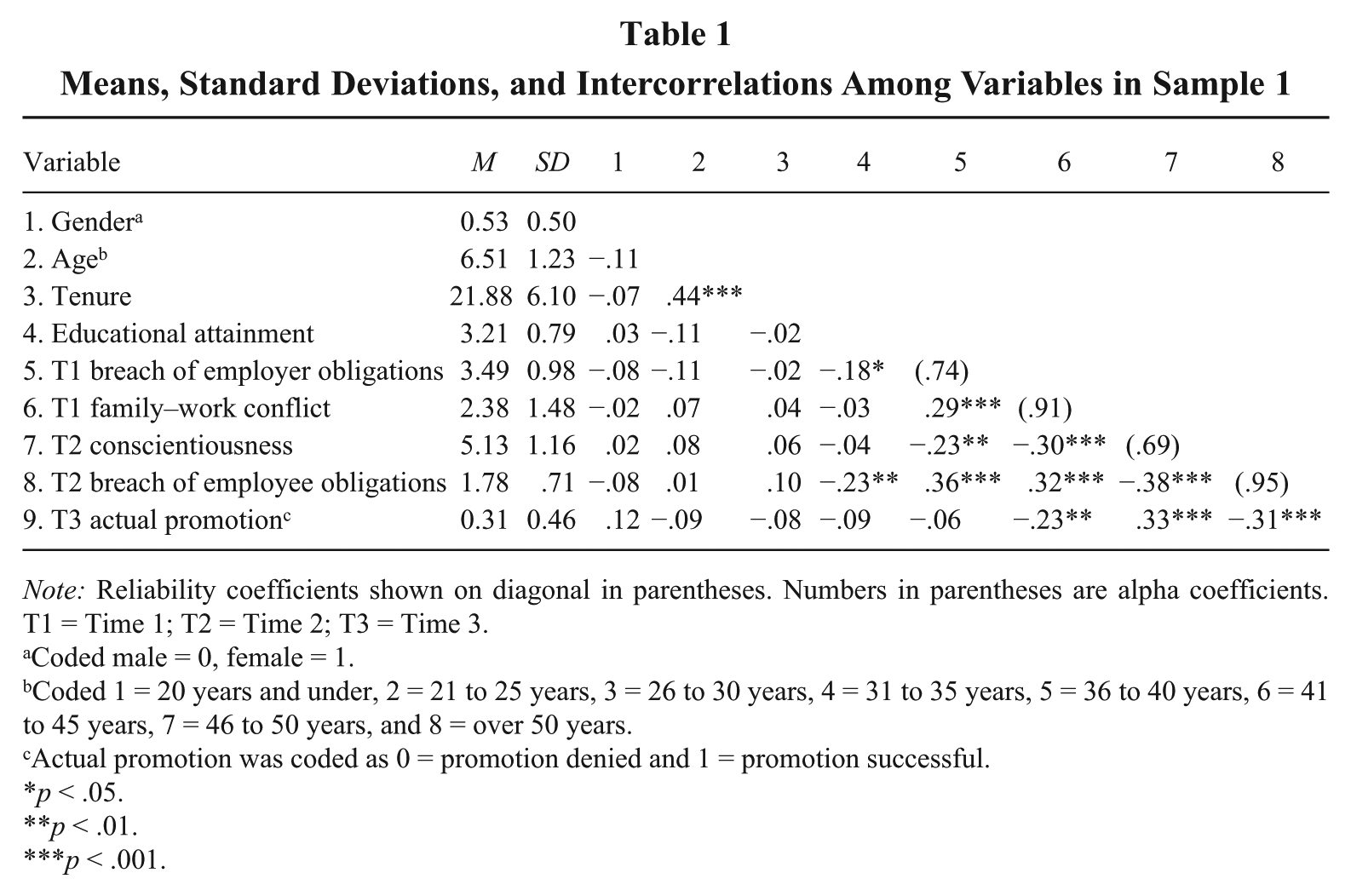
Note: Reliability coefficients shown on diagonal in parentheses. Numbers in parentheses are alpha coefficients. T1 = Time 1; T2 = Time 2; T3 = Time 3.
Coded male = 0, female = 1.
Coded 1 = 20 years and under, 2 = 21 to 25 years, 3 = 26 to 30 years, 4 = 31 to 35 years, 5 = 36 to 40 years, 6 = 41 to 45 years, 7 = 46 to 50 years, and 8 = over 50 years.
Actual promotion was coded as 0 = promotion denied and 1 = promotion successful.
p < .05.
p < .01.
p < .001.
Means, Standard Deviations, and Intercorrelations Among Variables in Sample 2
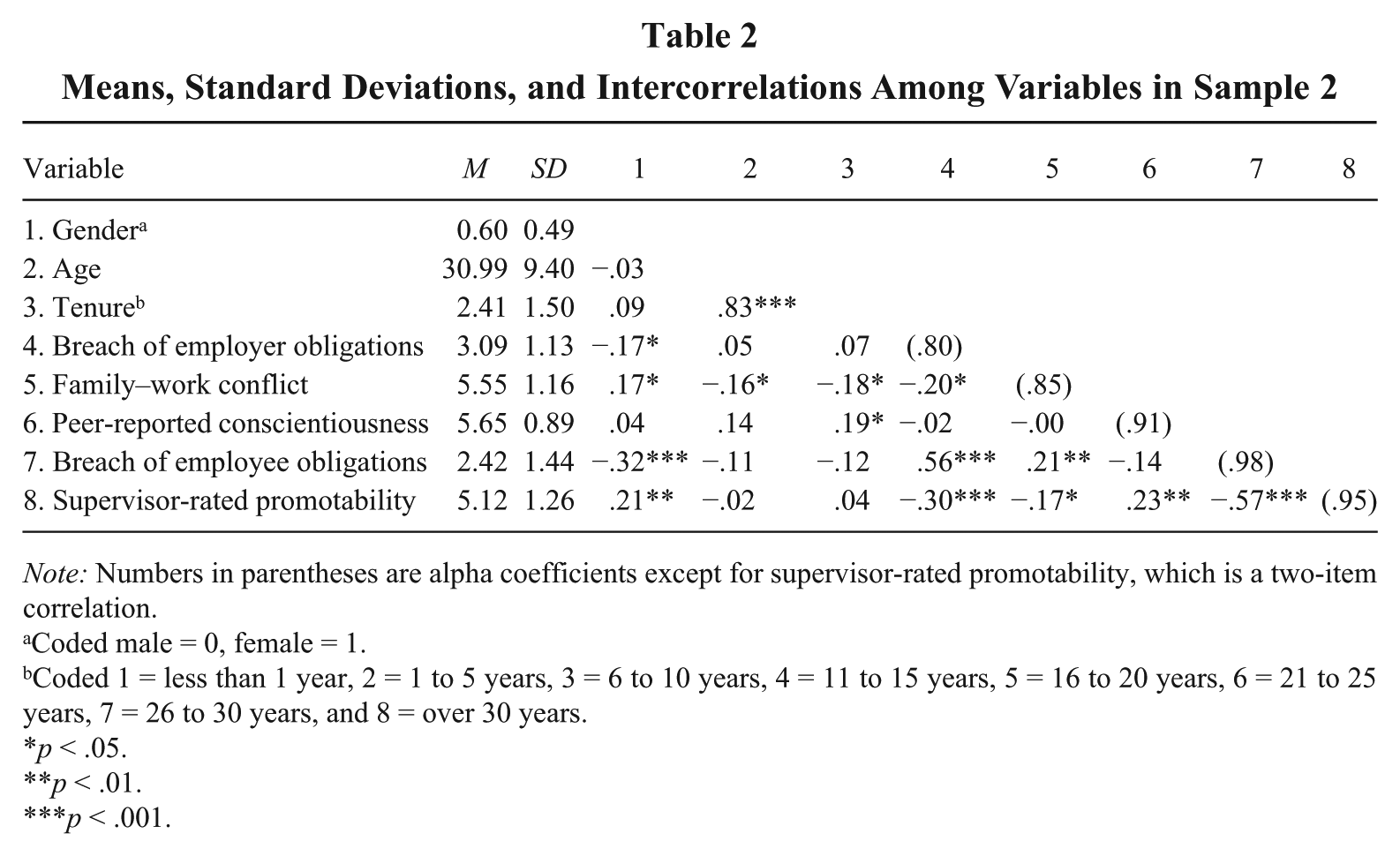
Note: Numbers in parentheses are alpha coefficients except for supervisor-rated promotability, which is a two-item correlation.
Coded male = 0, female = 1.
Coded 1 = less than 1 year, 2 = 1 to 5 years, 3 = 6 to 10 years, 4 = 11 to 15 years, 5 = 16 to 20 years, 6 = 21 to 25 years, 7 = 26 to 30 years, and 8 = over 30 years.
p < .05.
p < .01.
p < .001.
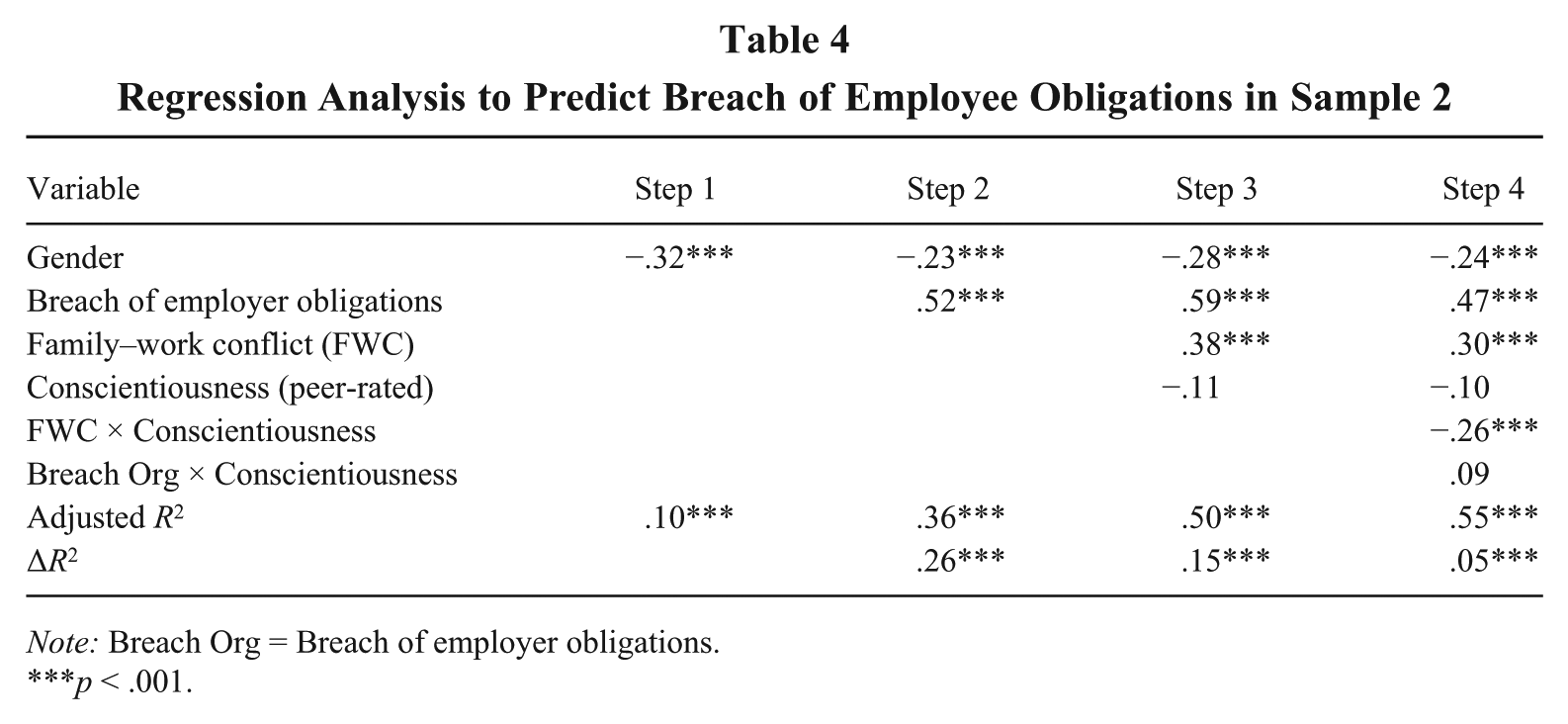
In line with a social exchange perspective, Hypothesis 1 predicted that breach of employer obligations would be positively related to breach of employee obligations. We conducted hierarchical regression analyses to test this hypothesis (see Tables 3 and 4 for regression results for Samples 1 and 2, respectively). The results showed that after controlling for demographic variables, breach of employer obligations (Step 2) was associated positively with breach of employee obligations (Time 2, β = .33, p < .001) in Sample 1 and Sample 2 (β = .52, p < .001). These findings support Hypothesis 1.
Regression Analysis to Predict Time 2 Breach of Employee Obligations in Sample 1
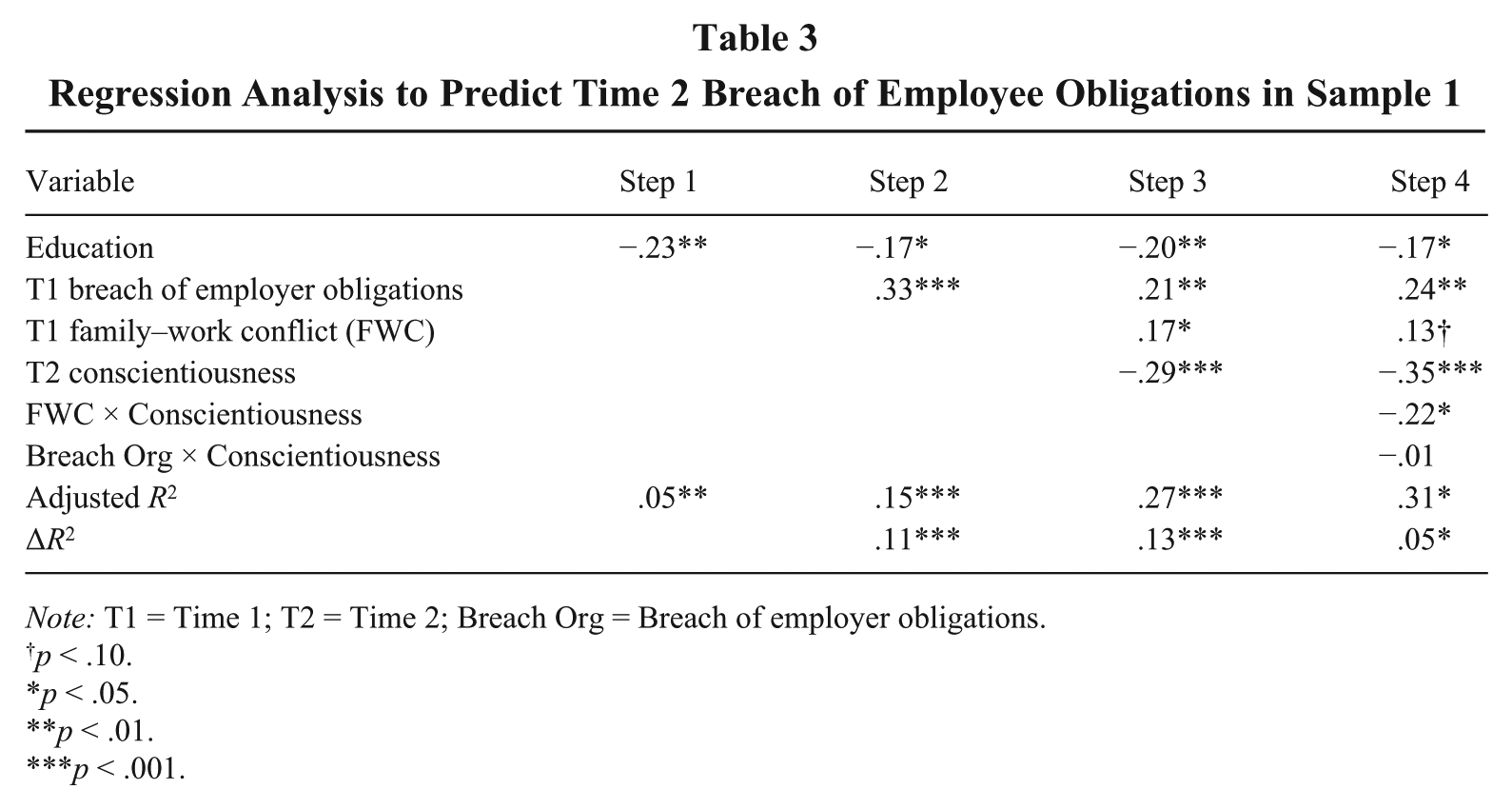
Note: T1 = Time 1; T2 = Time 2; Breach Org = Breach of employer obligations.
p < .10.
p < .05.
p < .01.
p < .001.
Regression Analysis to Predict Breach of Employee Obligations in Sample 2
Note: Breach Org = Breach of employer obligations.
p < .001.
Following a COR perspective, Hypotheses 2 predicted that the COR variables will explain additional variance in breach of employee obligations, over and above the social exchange variable of breach of employer obligations. As shown in Tables 3 and 4, after controlling for breach of employer obligations in Step 2, the COR variables in Step 3 explained additional variance (ΔR2 = .13, p < .001, in Sample 1 and ΔR2 = .15, p < .001, in Sample 2). Thus, Hypothesis 2 was supported.
Hypotheses 3 and 4 proposed that FWC would be positively and conscientiousness would be negatively associated with breach of employee obligations. After controlling for demographics and breach of employer obligations, FWC and conscientiousness explained additional variance in breach of employee obligations. FWC (Sample 1, β = .17, p < .05; Sample 2, β = .38, p < .001) was positively and self-reported conscientiousness (Sample 1, Time 2, β = –.29, p < .001) was negatively related to breach of employee obligations. The relationship between peer-reported conscientiousness and breach of employee obligations was nonsignificant (Sample 2, β = −.11, ns). Therefore, Hypothesis 3 was supported while Hypothesis 4 was partially supported.
Hypothesis 5 predicted that conscientiousness would moderate the relationship between FWC and breach of employee obligations, whereas Hypothesis 6 predicted that conscientiousness would moderate the relationship between breach of employer obligations and breach of employee obligations. We mean-centered the variables and created interaction terms to test the moderating effect. The interaction term FWC × Conscientiousness was significant in Samples 1 and 2. We plotted the interactions and tested the significance of the simple slopes at +1 standard deviation and −1 standard deviation of conscientiousness (Aiken & West, 1991; see Figures 2 and 3 for analyses involving Samples 1 and 2, respectively). In Sample 1, FWC was more strongly related to breach of employee obligations when employees had lower, B = .18, t = 3.87, p < .001, as opposed to higher levels of self-reported conscientiousness, B = –.07, t = −1.40, ns. In Sample 2, there was a stronger positive relationship between FWC and breach of employee obligations for employees rated as low, B = .69, t = 7.63, p < .001, as opposed to high, B = .06, t = .48, ns, in conscientiousness by their peers. Therefore, Hypothesis 5 was supported.
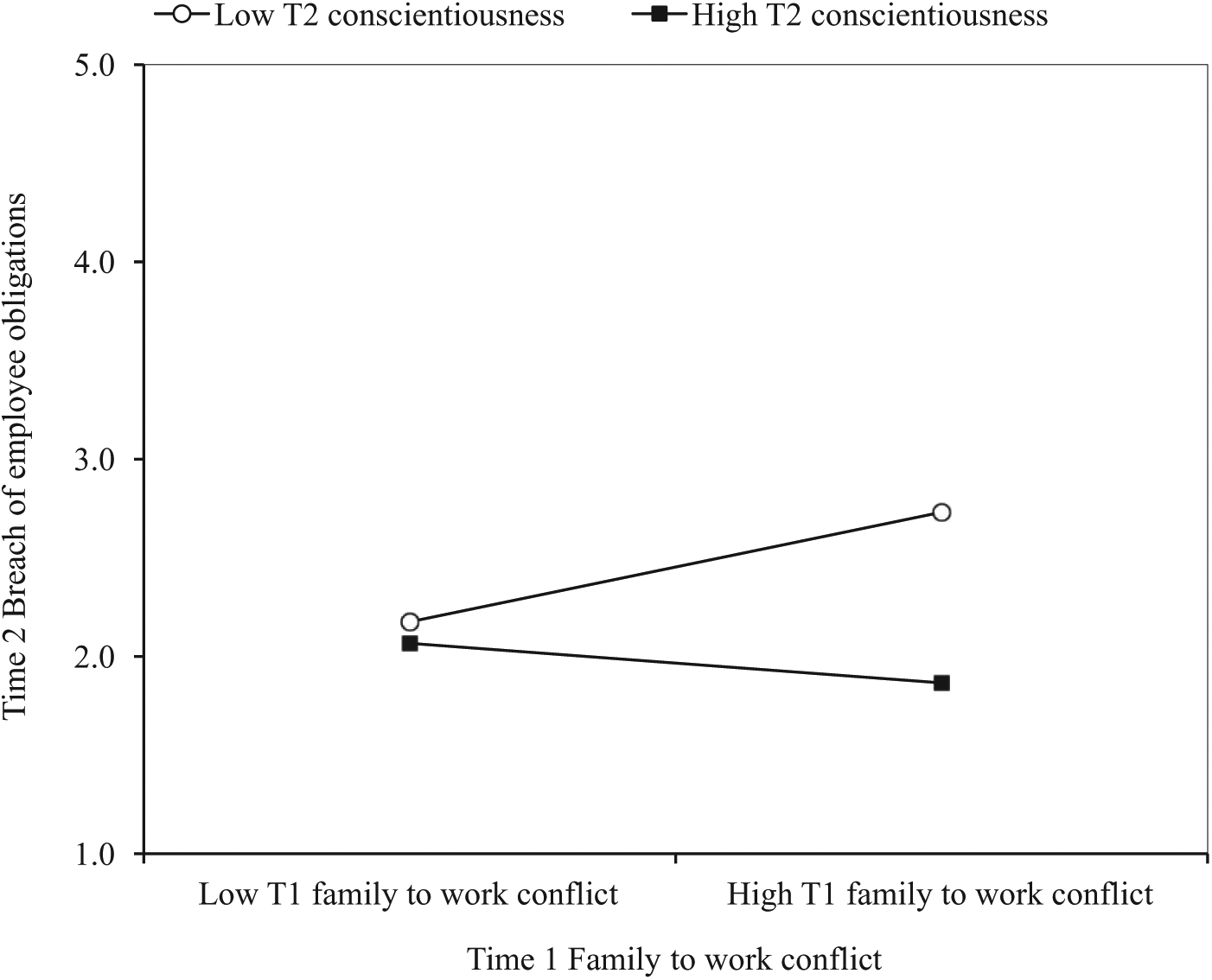
The Relationship Between Family–Work Conflcit (FWC) and Breach of Employee Obligations at High and Low Levels of Conscientiousness in Sample 1
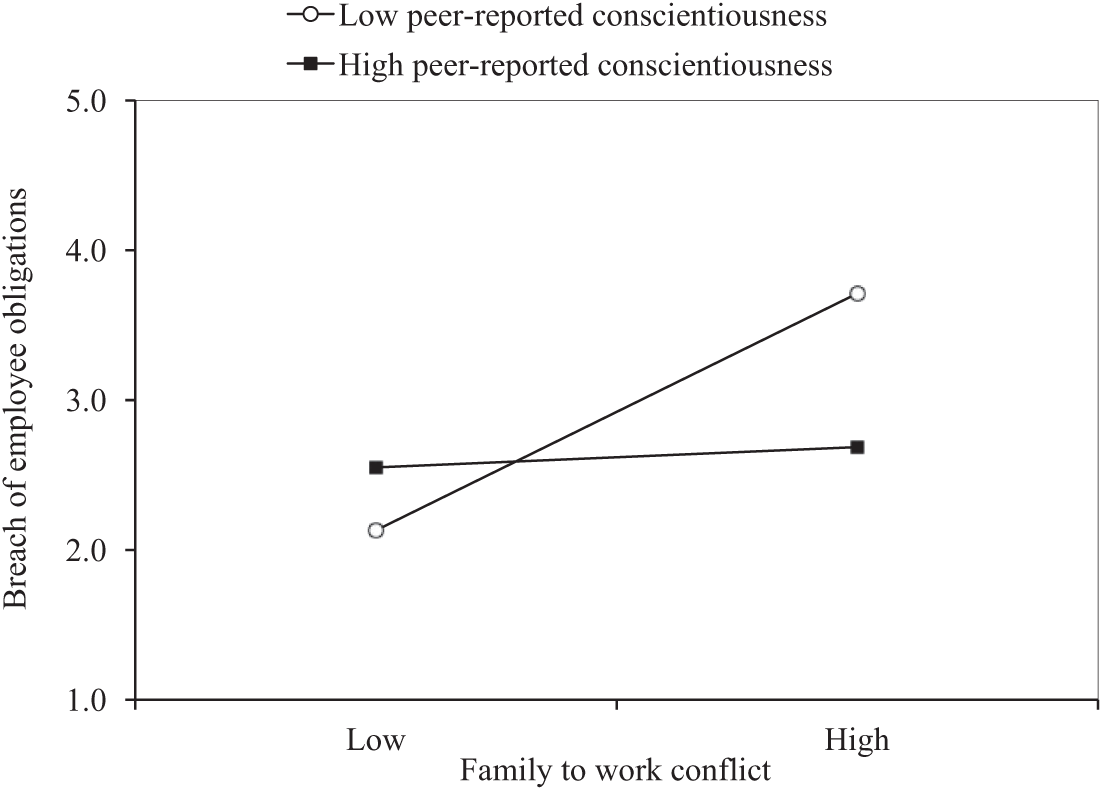
The Relationship Between Family–Work Conflict (FWC) and Breach of Employee Obligations at High and Low Levels of Conscientiousness in Sample 2
The interaction terms Breach of Employer Obligations × Self-Reported Conscientiousness and Breach of Employer Obligations × Peer-Reported Conscientiousness did not predict breach of employee obligations in Samples 1 and 2, respectively. Therefore, Hypothesis 6 was not supported.
Hypothesis 7 predicted that breach of employee obligations would be negatively related to career progression. Given the categorical nature of our outcome variable in Study 1, we conducted a logistic regression to test this prediction. After controlling for education and other substantive variables in this study (breach of employer obligations, FWC, and conscientiousness), breach of employee obligations significantly predicted actual promotion (B = −1.19, p < .01). In Sample 2, using multiple regression in which we controlled for gender and the same substantive variables as in Sample 1, breach of employee obligations was negatively associated with supervisor-rated promotability (β = −.51, p < .001). Across both studies, the results supported Hypothesis 7.
Hypothesis 8 proposed that the conditional indirect effects of FWC in predicting actual promotion via breach of employee obligations would be stronger under low as opposed to high conscientiousness. To examine the proposed moderated mediation effect, we used Hayes’s (2012) “Process” macro (Model 7) for SPSS to estimate the model and obtain bias-corrected bootstrapped confidence intervals (using 5,000 bootstrap samples) for the conditional indirect effect. After controlling for education, the results of our moderated mediation test revealed a significant conditional indirect effect of FWC on actual promotion via breach of employee obligations when self-reported conscientiousness was low (indirect effect = −.28, SE = .11, 95% CI [−.53, −.11]) but not when self-reported conscientiousness was high (indirect effect = .04, SE = .08, 95% CI [−.12, .20]). Similarly, the conditional indirect effects were significant only for low peer-reported conscientiousness (Sample 2, indirect effect = −.19, SE = .08, 95% CI [−.34, -.02]) but not for high peer-reported conscientiousness (Sample 2, indirect effect = −.05, SE = .08, 95% CI [−.21, .08]). Overall, Hypothesis 8 was supported.
Hypothesis 9 predicted that the conditional indirect effects of breach of employer obligations on career progression via breach of employee obligations would be moderated by employee conscientiousness. After controlling for education, we found a significant indirect effect for both low (indirect effect = −.32, SE = .14, 95% CI [−.65, −.09]) and high (indirect effect = −.28, SE = .11, 95% CI [−.54, −.12]) self-reported conscientiousness in Sample 1. In Sample 2, we found a significant conditional indirect effect for both low (indirect effect = −.31, SE = .13, 95% CI [−.56, −.05]) and high (indirect effect = −.40, SE = .12, 95% CI [−.63, −.18]) peer-rated conscientiousness. Therefore, Hypothesis 9 was not supported.
To rule out alternative explanations to our findings, we also examined alternative models. It is possible that conscientiousness may also influence the breach of employee obligations–career progression link (i.e., act as a second-stage moderator). To test this possibility, we examined the role of conscientiousness as a second-stage moderator for Samples 1 and 2. Our results showed that the conditional indirect effects of FWC and breach of employer obligations on career progression via breach of employee obligations were significant for both high and low levels of conscientiousness as a second-stage moderator. Thus, conscientiousness did not act as a second-stage moderator.
Discussion
SET remains one of the most widely used theoretical frameworks to explain social relationships at work. However, many aspects of this theory remain underspecified, including the precise nature of resources exchanged, the mediating mechanisms that capture the reciprocal obligations, and the lack of attention to contextual influences on a given dyadic exchange (Cropanzano & Mitchell, 2005). In this research, we have drawn attention to the idea that social exchange relationships do not occur in an exchange context cordoned off from other resource demands (Blau, 1964; Coyle-Shapiro & Conway, 2004; Emerson, 1981). On the contrary, both the employee and the employer have multiple demands on their resources and have to fulfill psychological contract obligations in the context of these multiple obligations. Employees bring personal resources (such as conscientiousness) that make it more likely that they will be able to deliver on the obligations. However, as the literature on work–life interface has shown, employees face multiple demands, including demands from outside the work context (Allen, 2013). Demand on resources from the family domain can lead to FWC, which results in fewer resources available for the fulfillment of work obligations.
We used two complementary theoretical perspectives to understand when employees may or may not breach their obligations. Both perspectives deal with resources: SET focuses on the exchange of resources, while COR theory is concerned with whether individuals have an adequate pool of resources. These two theoretical perspectives drew attention to different antecedents of breach of employee obligations. Consistent with the social exchange perspective and replicating previous research (Coyle-Shapiro & Kessler, 2002; Coyle-Shapiro & Neuman, 2004), we found that breach of employer obligations was positively related to breach of employee obligations. The norm of reciprocity forms the ideological undercurrent of social exchange, and when employees perceive the organization as not fulfilling its obligations, they withhold their side of the bargain, resulting in breach of their contributions in the psychological contract “give and take.”
Going beyond this dyadic reciprocity context and consistent with COR theory, we found that FWC was positively, and conscientiousness was negatively, related to breach of employee obligations. Thus, resource drain (FWC) makes it more likely and resource gain (conscientiousness) makes it less likely that obligations will be breached. Moreover, conscientiousness interacted with FWC such that the negative relationship between FWC and employee breach was stronger when conscientiousness was low and weaker when conscientiousness was high. Individuals high in conscientiousness are performance focused, organized, and inclined to fulfill their obligations (Gellatly, 1996). Conscientiousness also allows better management of existing resources (Halbesleben et al., 2009). When confronted with challenging circumstances, such as FWC, highly conscientious individuals are more likely to “put their shoulder to the wheel” and try to avoid breaching the psychological contract. Therefore, the relationship between FWC and breach of employee obligations was nonsignificant for individuals high in conscientiousness.
Interestingly, conscientiousness did not moderate the relationship between breach of employer obligations and breach of employee obligations. Perhaps highly conscientious individuals do not feel like they need to make up for the organization’s shortcomings (unlike in the case of FWC, where they might feel some personal responsibility). Taken together, the findings related to Hypotheses 5 and 6 provide a more nuanced understanding of when highly conscientious individuals are likely to invest their resources (such as when they feel they have something to make up for) versus when they are likely to withdraw (such as when they feel the organization has let them down).
The results also provided strong evidence for the negative relationship between breach of employee obligations and career progression. Breach was negatively related to actual promotion decisions in the organization in Sample 1 and supervisor-rated promotability in Sample 2. As would be predicted by contest and sponsored mobility pathways (Rosenbaum, 1984), breach of employee obligations leads to a lower likelihood that the employee will be rewarded with a promotion. These findings are also consistent with the social exchange explanation of the consequences of breach. When an employee fails to fulfill his or her obligations, the organization responds by withdrawing career-related inducements.
Finally, in keeping with the theoretical interconnectedness between resource availability, social exchange, and career progression, we linked the resource and social exchange variables with the career promotion outcome. We found that when employees have a drain of resources (FWC), and when they do not have alternate resources (conscientiousness) to compensate for this drain, they are more likely to breach their obligations to the organization, which in turn results in negative career outcomes. These findings demonstrate resource-based antecedents to career mobility within the organization: Resource drain (and the absence of compensatory mechanisms) makes it less likely that an employee will achieve upward mobility. These findings also put the employee–organization social exchange in the wider context of the employee’s resource demands. They demonstrate that employee contributions are influenced by the reciprocity in the dyadic relationship as well as the availability of resources in general.
Theoretical Implications and Future Directions
Our findings highlight the interconnections and dependencies among various social relationships (Coyle-Shapiro & Conway, 2004). Employees are embedded in a web of relationships, some at work (e.g., chain of hierarchical and horizontal relationships in the organizational structure) and some outside of work (e.g., in family and community structures). An employee’s ability to meet obligations in a social exchange relationship at work may be dependent upon successfully negotiating the demands of other social relationships (Blau, 1964). Emerson’s classic work on interconnected social exchange networks noted that exchange in one network may be dependent on resource exchange in another network (Cook & Emerson, 1978; Emerson, 1981). However, these interconnections have received limited examination. There is a need to expand the study of social exchange relationships at work by incorporating the interconnections between various exchange relationships within the organization as well as outside the organization. Of course, these interdependencies do not have to result in conflict; family and work roles may be mutually enhancing, making it more likely that employees meet their psychological contract obligations (Allen, 2013). Future research should adopt a more comprehensive approach, incorporating both conflict and enrichment processes, when examining the consequences of multiple role demands on psychological contract obligations.
The employee–organization relationship, as characterized by psychological contract theory, comprises mutual obligations involving the reciprocal exchange of inducements and contributions (Rousseau, 1995). In contrast to breach of employer obligations, breach of employee obligations has received scant research attention (Coyle-Shapiro & Conway, 2004; Coyle-Shapiro & Kessler, 2002). We have strived to gain some balance in the research literature by drawing attention to antecedents and consequence of breach of employee obligations. In this regard, our findings make several important contributions. We have drawn attention to the social exchange– and resource-based antecedents of breach of employee obligations. In fact, both the employee and the organization are situated in resource contexts that may influence their ability to meet the employee–organization social exchange obligations. Greater awareness of both resource contexts will have theoretical and applied benefits. In terms of theory, incorporating the resource context will enhance our predictions regarding the likelihood of reciprocity in the exchange relationship. In terms of practical benefits, an understanding of each party’s resource constraints may lead to greater agreement on each other’s obligations in the social exchange relationship (i.e., enhance mutuality; Dabos & Rousseau, 2004). An understanding of the extenuating circumstances underlying breach may also make the other party more willing to accept the breach and temper the reactions to the experience of breach (Robinson & Morrison, 2000).
Note that breach of employees’ psychological contract obligations can include both over- and underfulfillment of obligations (Lambert, Edwards, & Cable, 2003). While we have examined underfulfillment, future research should also consider resource implications of overfulfillment. In the short term, overfulfillment may lead to expenditure of resources and result in lack of resources available for family or other nonwork social exchange obligations. However, overfulfillment at work may also result in an accumulation of resources, which can then be used later to attend to nonwork demands (e.g., a monetary bonus or vacation time; ten Brummelhuis & Bakker, 2012). Thus, there is a need to examine the longer-term resource implications of psychological contract over- and underfulfillment.
Another contribution of this paper is demonstrating the link between breach of employee obligations and career progression. Psychological contract processes have primarily been related to attitudinal or performance outcomes (Conway & Briner, 2009). We have provided evidence of the important impact of such processes on career progression across two distinct samples using a measure of promotability and of actual promotion. Our findings converge to demonstrate that breach of employee obligations can derail career progression. Given the importance of career progression in terms of tangible and intangible gains for employees, additional research needs to examine the extent of damage caused by breach to the career prospects of the employee. More specifically, how long does the negative effect of breach last? In Sample 1, we found effects lasted up to a year. Can the employee restore the career prospects by meeting (or even exceeding) future psychological contract obligations? Future research also needs to examine the moderators of the breach–career progression relationship, such as the role of supervisor attributions for employee breach (given that supervisors are likely to play a key role in the employee’s career progression).
Finally, we have demonstrated the interrelationships between resources across contexts—in particular, we have shown that the availability of a resource in one distinct context can compensate for another resource that has been drained in a separate context. Our finding contributes to the growing literature that looks at how multiple resources are utilized to manage contexts with scarcity or abundance of resources (Parker, Johnson, Collins, & Hong, in press). Our findings also contribute to the theoretical treatment of conscientiousness by considering it as a resource that not only helps fulfill work obligations but also buffers the negative impact of other resource drains (Halbesleben et al., 2009). We would like to draw attention to three implications of this finding and suggest future research directions. First, our findings support the notion of conscientiousness as a meta-resource. Future research needs to examine in more detail how precisely conscientiousness is utilized in the management of other resources. Second, conscientiousness buffered the effects of FWC but not breach of employer obligations. This suggests a motivational element to the use of conscientiousness as a resource; that is, individuals high in conscientiousness choose to apply this resource in light of the context. Future research should further explore the motivational preferences of highly conscientious employees. Third, note that resources are limited and they do exhaust (Hobfoll, 2002). Conceptualizing conscientiousness as a resource, therefore, has an interesting implication: Conscientiousness may be an exhaustible resource. This perspective suggests a within-person variation in conscientiousness as a result of high demand on resources (i.e., depletion of the conscientiousness resource). While between-person variation in conscientiousness is well established, within-person variation is yet to be examined. Remaining questions that need addressing include “What types of circumstances deplete conscientiousness?” and “How is conscientiousness regained?” Given the implications of conscientiousness for performance (Barrick & Mount, 1991), these would be highly worthwhile questions to pursue.
Methodological Strengths and Limitations
Conway and Briner (2009) noted that the majority of studies on psychological contracts have examined attitudinal variables as outcome variables. We were able to link breach of employee obligations to an objective indicator, actual promotion (in Sample 1). We were also able to replicate our findings, including the moderated mediation results, across two samples. Sample 1 involved data collection over multiple time points, strengthening causal implications of the relationships. However, we did not measure all variables at all time points, and thus our design was not truly longitudinal. Therefore, we cannot draw conclusive causal inference from our findings. Similar weaknesses have been noted in the work–family research, including predominantly cross-sectional survey designs (Allen, 2012, 2013). We provided extensive validation of the global measure of breach of employee obligations.
Our measure of conscientiousness in Sample 1 had several limitations. Due to survey length constraints imposed by the participating organization, we could use only a shortened four-item measure (although we did demonstrate its high correlation with the full measure using an independent sample). Moreover, this measure had a relatively weak alpha (.69). Sample 2 provided constructive replication with a different and longer measure of conscientiousness. We also used multiple sources of data, including self, peer, and supervisor sources, to address same-source bias. However, we acknowledge that common method variance may play a role in the relationships between breach of employer obligations, FWC, and breach of employee obligations as these were measured by self-reports.
Finally, breach of employee obligations can be assessed by self-ratings (i.e., employee’s own assessment of breach) or by supervisor ratings. We adopted the former approach because we were interested in the employee’s own assessment of his or her breach of obligations. However, we were able to replicate the results with another sample using supervisor ratings of employee breach (please contact the authors for details).
Practical Implications
Research on employer breach recommends that employers should manage employee attributions and sense-making by explaining reasons for breach (such as fall in market demand for products) and thereby mitigate the harmful effects of broken promises (Bordia, Restubog, & Tang, 2008). A similar rationale could apply to the management of employer perceptions. The findings of this research draw attention to a variety of reasons why employees may breach their obligations to the organization. Some of these reasons, such as FWC arising from caring for a sick child, could be beyond the employees’ control and may be considered extenuating circumstances for breach of employee obligations. Employers may be willing to grant an amnesty to employees who need to attend to a temporary spike in family demands. However, employees need to be aware that any amnesty is likely to be temporary and that ongoing breach of obligations will have damaging consequences for their career progression.
Our findings suggest that breach of obligations can result in a domino effect, whereby an employer breach is reciprocated by an employee breach, which in turn can result in the employee’s being turned down for a promotion. This negative reciprocity could ultimately result in the dissolution of the employment relationship, an outcome that may not be of interest for either party (Kacmar, Andrews, Van Rooy, Steilberg, & Cerrone, 2006). We recommend that employers and employees take steps to minimize the occurrence of breach of obligations. Employees should take into account their skills and abilities and nonwork demands before they promise to make contributions when negotiating a psychological contract. Employers should adopt measures that will help employees cope with resource demands. This may include help in dealing with FWC by providing formal (e.g., supervisor support; Hammer, Kossek, Anger, Bodner, & Zimmerman, 2011) and informal (e.g., a work climate that is supportive of family issues; Shockley & Allen, 2007) assistance to manage multiple demands (Allen, 2012). Indeed, research shows that when employees are able to achieve work–life balance, it enhances their career advancement potential (Lyness & Judiesch, 2008). Finally, although conscientiousness is a trait, characteristics of highly conscientious people can be inculcated in others (Bruck & Allen, 2003). For example, better planning behavior can reduce the interference between work and family domains (Lapierre & Allen, 2012), and therefore employees may benefit from time management training.
It would also help to minimize incongruence or lack of agreement on the mutual obligations in the employee–employer relationship (Dick, 2006). We recommend that given the important role of nonwork influences on work outcomes, there be an open discussion of mutual needs and responsibilities when it comes to expectations of support and family-friendly practices in the workplace. Employee preferences for contributions and inducements can be ascertained, and this may reduce instances of breach (Low & Bordia, 2011). If needed, idiosyncratic psychological contracts (i.e., “i-deals,” or unique arrangements between an employee and employer; Rousseau, 2005) can be developed that meet the special needs of employees. Such i-deals may avoid situations where uniformly imposed practices help some but hurt others. Flexible work practices have been shown to decrease FWC for women with high family responsibilities but increase FWC for women with low family responsibilities (Shockley & Allen, 2007).
Conclusion
A major contribution of the psychological contract framework is that it draws attention to mutual obligations in the employee–organization relationship. A successful and sustainable employee–organization relationship is one in which both parties meet their obligations and neither party should expect to get away with a breach of obligations. In this paper, we have highlighted a variety of influences that can make it difficult for employees to keep their part of the bargain. We hope these findings make both parties aware of the challenges—as well as the importance—of meeting their obligations.
Footnotes
Acknowledgements
This article was accepted under the editorship of Deborah E. Rupp. We are grateful to Matthijs Bal, Bob Eisenberger, Patrick Garcia, Samantha Montes, and Tom Zagenczyk for their comments on previous versions of this manuscript and Chris Asuncion, Susie Eala, and Marigirl Padilla for help in data collection. This research was partially supported by a grant from the Australian Research Council to the first author (DP1096037).
Supplemental material for this article is available online.
References
Supplementary Material
Please find the following supplemental material available below.
For Open Access articles published under a Creative Commons License, all supplemental material carries the same license as the article it is associated with.
For non-Open Access articles published, all supplemental material carries a non-exclusive license, and permission requests for re-use of supplemental material or any part of supplemental material shall be sent directly to the copyright owner as specified in the copyright notice associated with the article.
