




Abstract
We examined the conditions under which workplace ostracism promotes prosocial reactions (i.e., helping behavior) and deters antisocial behavior (i.e., social loafing). Using data from 213 employees and their direct supervisors, we found that when group identification is strong, workplace ostracism increases the helping behavior and decreases the social loafing of employees. Moreover, we found that employees’ tenure further moderates this effect; for those employees who have a strong group identification and long tenure, the positive association of ostracism and helping behavior is the strongest.
Introduction
The experience of ostracism, including feeling ignored, excluded, or invisible at work, is a common and impactful experience (Ferris, Brown, Berry, & Lian, 2008; Fox & Stallworth, 2005; Hitlan, Kelly, Schepman, Schneider, & Zarate, 2006). Most research on workplace ostracism to date has addressed its negative implications, revealing the impact of ostracism on targets’ reduced job satisfaction, commitment, and well-being (Ferris et al.; O’Reilly, Robinson, Berdahl, & Banki, in press; Penhaligon, Louis, & Restubog, 2009). One notable exception to the negative impact of ostracism is its effect on behavioral reactions: Ostracism has been found to induce both positive and negative behavioral reactions (Williams, 2007). Ostracized individuals may respond negatively by withdrawing or being aggressive (Leary, Twenge, & Quinlivan, 2006; Twenge, Baumeister, DeWall, Ciarocco, & Bartels, 2007; Williams, 2001), but they may also act prosocially, such as by being more helpful and cooperative (Williams, Cheung, & Choi, 2000; Williams & Sommer, 1997). In line with social exchange theory (Blau, 1964), that individuals respond to ostracism with negative behaviors is not surprising. However, it is surprising and intriguing that ostracized individuals sometimes respond to such aversive treatment by engaging in prosocial behavior rather than “tit-for-tat” antisocial behavior.
Drawing on self-verification theory, we attempt to understand when employees respond prosocially to workplace ostracism. According to self-verification theory, people are motivated to maintain their self-view in that they prefer others to see them as they see themselves (Swann, 1983, 2011). Being ostracized makes people feel marginalized and leads them to question whether they are still in-group members (Schmitt & Branscombe, 2001). Thus, ostracism can challenge individuals’ self-conception of their in-group identity. To verify their self-view as group members, ostracized individuals may engage in compensatory progroup behaviors (e.g., increasing helping behavior and decreasing social loafing) to shore up in-group identity through making others see and recognize them as in-group members (Gomez, Seyle, Huici, & Swann, 2009; Swann, Gomez, Seyle, Morales, & Huici, 2009). However, this striving for self-verification occurs only when in-group identity composes an important part of an individual’s self-view (Chen, Chen, & Shaw, 2004; Gomez et al.; Kraus & Chen, 2009; Pelham & Swann, 1994). The extent to which people see in-group identity as a significant part of their self-conception is reflected by how much they identify with the group (Ellemers, Spears, & Doosje, 1999; Tajfel & Turner, 1979). If employees have high levels of identification toward the group, they may regard this group-based self-view as an indispensable part of their self-view. Consequently, threats to the group-based self-view are more likely to motivate individuals to verify it via compensatory, prosocial behaviors within the group.
We further propose that the threat to group-based self-view caused by ostracism may be more salient for those employees who have a longer tenure. These employees have generally longer working relationships with their coworkers, who are supposed to know and understand them well. The evaluations provided by the coworkers should be more impactful. Moreover, a longer tenure suggests a higher level of escalated commitment, both affectively and instrumentally. Thus, the epistemic and pragmatic costs should be higher if well-known teammates do not verify an individual’s group-based self-view (Chen et al., 2004). Thus, we propose that tenure will further intensify the influence of group identification on the relationship between ostracism and employees’ behavioral reactions.
This study seeks to contribute to the literature in several ways. First, this study seeks to demonstrate the prosocial implications of ostracism at work. The preponderance of research on workplace ostracism has focused on its detrimental consequences; thus, it has presented only half of the picture of how employees react to ostracism, missing whether and when ostracized employees react to the aversive experience of ostracism in prosocial ways. Second, and more importantly, this study explores the reasons why employees may engage in prosocial reactions rather than negative ones. In this regard, building on the self-verification striving model (Swann, 1983, 1990, 2011), we propose and examine the moderating role of group identification and ostracized employees’ tenure as joint boundary conditions whereby ostracism leads to more prosocial behavior and less antisocial behavior. Our study thus presents the other half of the puzzle and makes an attempt to understand the intriguing phenomenon, perhaps unique to ostracism, that when ostracized, individuals respond prosocially. In addition, researchers generally assume that it is difficult for ostracized employees to identify with the organization or the group and that, as a consequence, this lack of identification may negatively affect their performance outcomes. However, empirical evidence suggests that a variety of factors can influence group identification (e.g., Bergami & Bagozzi, 2000; Ellemers et al., 1999; Van der Vegt & Bunderson, 2005) and, therefore, that it is possible that employees will maintain group identification in the face of ostracism. The effects of ostracism on employee responsive actions, however, may vary among ostracized individuals with different levels of group identification. By interlacing ostracism with identification in this dynamic way, our study sheds light on the possibility that group identification can provide a motivational force for ostracized employees to transcend the aversive feelings induced by ostracism. This motivational force may lead employees to exert efforts to alter their behavior to remedy their interpersonal problems and to be more adaptive within the team.
Theory and Hypotheses
Ostracism and Behavioral Responses
Ostracism is commonly experienced by employees at work (Ferris et al., 2008; Fox & Stallworth, 2005; Hitlan et al., 2006) and occurs more frequently than more overt forms of bullying and harassment (O’Reilly et al., in press). One study of over 5,000 workers showed that 13% of the respondents had been excluded at work in the previous 6 months (Hitlan et al.), and another found that 66% of employees had been given the silent treatment over the previous 5 years (Fox & Stallworth).
Workplace ostracism occurs “when an individual or group omits to take actions that engage another organizational member when it is socially appropriate to do so” (Robinson, O’Reilly, & Wang, 2013: 206). It involves acts that reduce social engagement rather than acts that increase social engagement, such as aggression. Moreover, because it involves the absence of behavior, it is inherently ambiguous with regards to whether it is occurring and, as important, why it is occurring.
The motives for ostracism are many, including oversight or accident as well as more intentional motives, such as the need to hurt or control the target or to benefit the actor by avoiding the target (Williams, 1997). Consistent with much of the literature on ostracism to date is our phenomenological approach to ostracism, emphasizing the importance of one’s experience as a target (O’Reilly et al., in press; Robinson et al., 2013).
We know that individuals who experience ostracism at work are significantly and negatively affected by the experience, experiencing psychic pain due to thwarted needs, of which one in particular—the need to belong—is thwarted. In fact, the impact of ostracism goes beyond that experienced by harassment or other more overt forms of mistreatment at work (O’Reilly et al., in press). Behavioral reactions to that psychic pain are intended to alleviate it. In general terms, ostracized individuals react to the aversive experience either in antisocial or prosocial ways. Prosocial reactions include being more helpful and cooperative and complying with the norms, whereas antisocial behaviors include being aggressive, deviant, mean spirited, and sometimes engaging in withdrawal (for a review, see Robinson et al., 2013; Williams, 2007). Antisocial reactions, such as withdrawal or aggression, may be motivated to reduce the pain, although in some cases may in fact further increase ostracism (Thau, Aquino, & Poortvliet, 2007).
What remains unclear is when or why employees subjected to ostracism will react prosocially or antisocially, a question this study seeks to address. In general, it has been argued that the need to belong drives individuals to engage in compensatory progroup behavior so as to regain inclusion. Our interest here is to investigate when the need to belong is so important to ostracized individuals that it motivates them to act prosocially toward those who bring the social pain to them.
In line with the results of a meta-analysis study (Gerber & Wheeler, 2009) is the argument posited by Robinson et al. (2013) that, in general, employees are prone to reacting to experienced ostracism by exhibiting negative behaviors rather than positive behaviors. However, they also pointed out that the targets of ostracism are likely to engage in prosocial behaviors “if they have high motivation to gain belonging from those that would be directly influenced by these positive actions” (Robinson et al., 2013: 225). Prosocial behaviors may be seen by ostracized individuals as a solution to turn around the aversive condition of being excluded (Jamieson, Harkins, & Williams, 2010; Robinson et al.; Williams & Govan, 2005; Williams & Nida, 2011). As proposed by Robinson et al., Ostracism is more likely to lead to positive, pro-social behaviors when the target has a strong motivation for inclusion, such as when he or she has a strong sense of identification or attachment to the actors or when the target is of low organizational status. (225)
However, it is theoretically unclear why and when gaining inclusion is so important that it drives the ostracized employees to act prosocially to those whom they believe mistreat them in the first place. To answer this question, we build our theoretical framework on the basis of self-verification theory. In a nutshell, we contend that when ostracized employees regard their group-based self-view as constituting an important part of “who they are,” they are motivated to restore this self-view threatened by ostracism via prosocial behaviors.
A Self-Verification Perspective: The Moderating Role of Group Identification
The “self” can be defined on multiple levels (Ashforth & Mael, 1989; Chen et al., 2004; Gomez et al., 2009; Swann et al., 2009). Research has shown that people define themselves as individuals (e.g., “I am smart”) and in relation to social groups (e.g., “I am a Democrat”; see, e.g., Brewer & Gardner, 1996). The group-level self is “every bit as real, important, and authentic as the individual self” (Chen et al., 2004: 79). Social interaction plays an important role in affecting people’s self-reflection on their group-level self-view (Banaji & Prentice, 1994; Baumeister, 1998; Swann, Milton, & Polzer, 2000). The extent to which individuals are recognized or valued by the other group members has a profound effect on their group-level self-view. For example, being ostracized by coworkers may signal to the ostracized individuals that the other group members do not consider them to be part of the group and, thus, may threaten the self-view of ostracized individuals in relation to their in-group identity.
People’s self-concept is generally stable across time. Although individuals’ self-concept could transition to adapt to environmental opportunities and demands across a long time span, the new conditions should “elicit fundamental changes in the meaning, importance, or support that a central identity has” (Ethier & Deaux, 1994: 243). Out of epistemic and pragmatic desires to maximize prediction and control, they not only view themselves consistently but also strive to maintain such consistency through creating supportive social conditions, especially when the self-view is at stake (Swann, 1983, 1990).
Compelling evidence has shown that people are motivated to verify their self-conception of their personal identity (for a recent review, see Swann, Chang-Schneider, & Angulo, 2007). Recent research has shown that the self-verification process also extends to people’s self-conception in regard to their group identity (Chen et al., 2004; Chen, Shaw, & Jeung, 2006; Gomez et al., 2009; Lemay & Ashmore, 2004; Swann et al., 2009). When individuals’ group-related self-conception is threatened, they will compensate by intensifying their effort to obtain self-verifying feedback (Brooks, Swann, & Mehta, 2011; Swann, 2011; Swann & Hill, 1982). Moreover, communicating identity through action is a common self-verification strategy (Swann). For example, in a study by Swann and Read (1981), participants who perceived themselves as either likable or dislikeable were informed that they would be interacting with a partner who found them either likeable or dislikeable. Those participants who suspected that their partners viewed them either more or less favorably than they perceived themselves redoubled their efforts to behaviorally acquire self-confirmatory reactions, for instance, by using ingratiation.
Drawing on self-verification theory, we argue that when in-group identity is threatened by ostracism, people are motivated to restore their group-based self-view by investing in actions to influence other members. As such, the ostracized employees are likely to be motivated to engage in compensatory progroup behaviors, such as helping behavior, and to decrease their antisocial behaviors, such as social loafing. Helping behavior refers to promotive behavior characterized by small acts of consideration (Van Dyne & LePine, 1998). Social loafing refers to employees’ reduced motivation and effort when working collectively in a group (Karau & Williams, 1993). Social loafing may cause damage to group cohesion and effectiveness, as it violates group members’ expectations of normatively appropriate behaviors but also is deleterious to the interests of the group or other group members. Individuals working in a group are expected to exhibit behaviors that embody, not undermine, their value and importance in the group. Therefore, withdrawing social loafing while increasing help may be perceived as the effective means for ostracized employees to get others to recognize their value as in-group members.
Ostracism may not constitute a threat to those employees whose self-conception is defined less by their group identity and, therefore, may not induce self-verification strivings to shore up the employees’ in-group identity. In contrast, when employees’ self-conception is defined more by their group-based identity, they will be more likely to perceive ostracism by other group members as a threat and, thus, be more likely to strive for self-verification via compensatory actions. Therefore, we argue that the extent to which ostracism motivates employees to increase their prosocial behavior and decrease their antisocial behavior is based on how much this group identity matters to their self-conception, reflected by the level of their identification with the group (Gomez et al., 2009; Turner, 1982). Group identification captures the extent to which a group is valued by an individual and contributes to the individual’s sense of self (Ashforth & Mael, 1989).
Social identity theory literature has identified several important factors that are most likely to increase the tendency to identify with groups, including group distinctiveness and prestige, out-group salience, and group formation factors, such as interpersonal similarity, proximity, common history, and so forth (for a review, see Ashforth & Mael, 1989). Interestingly, research shows that simply assigning an individual to a group is sufficient for identification to occur, showing in-group favoritism (Brewer, 1991; Tajfel, 1982), out-group discrimination, and increased intragroup cooperation and cohesion (e.g., Billig & Tajfel, 1973; Locksley, Ortiz, & Hepburn, 1980).
When individuals’ identification with the group is high, ostracism may motivate self-reflection on their behavior and lead them to rectify any wrongdoings and to try to compensate for the wrongdoings through prosocial behavior. Also, ostracism may motivate them to further demonstrate their loyalty and value to the group by redoubling their efforts to support the group. In so doing, ostracized employees may gain others’ recognition that they are valuable in-group members and, thereby, reaffirm their in-group identity. When group identification is high, ostracism is more likely to motivate employees to engage in compensatory behaviors to reaffirm their identity through increased prosocial behavior and decreased antisocial behavior. However, when group identification is low, in-group identity may be less important to individuals’ self-conception; thus, ostracism is less likely to constitute a threat to their self-view. As a result, the ostracized employees will feel less motivated to engage in compensatory behaviors.
Moreover, identification elicits individuals’ desire for oneness with or belonging to the team (Ashforth & Mael, 1989; Bezrukova, Jehn, Zanutto, & Thatcher, 2009; Van der Vegt, Van de Vliert, & Oosterhof, 2003). When employees are ostracized in the group, they may try to restore the sense of belonging by showing behaviors desired by the group and the group members. Employees high in identification with the group may react more strongly by exhibiting prosocial behavior and reducing antisocial behavior, whereas those with low identification with the group may have less desire to curb their behaviors for reinclusion. Taken together, this leads to the following hypotheses:
Hypothesis 1: Group identification moderates the relationship between ostracism and helping behavior such that when group identification is higher, ostracism is positively related to helping behavior.
Hypothesis 2: Group identification moderates the relationship between ostracism and social loafing such that when group identification is higher, ostracism is negatively related to social loafing.
The Role of Tenure
In the above discussion, we argued that for those employees high in identification with the group, ostracism threatens their valued group identity and thereby motivates them to engage in compensatory progroup behaviors to shore up the identity. However, self-verification theory would further suggest that even for those with high identification, the tendency of engaging in progroup behaviors to restore their group-level self-conception could still vary, depending on one’s relational ties with the source of evaluation.
Research shows that people are especially inclined to seek verification from the source with which they have a long-term relationship because the identity-relevant evaluations from such a source should be more meaningful and impactful for individuals (Kwang & Swann, 2010). Relationship longevity reflects the degree of personal investment in and commitment towards a relationship. The longer the relationship, the more escalated commitment an individual has to maintain the relationship. Thereby, whether this “who I am” is accepted and agreed on by people in such a relationship concerns the individual more (Chen et al., 2004). In other words, how the relationship partners evaluate the focal individual is salient to him or her.
Specifically, we consider those who are in an established relationship or have been in a long-term relationship with us as more significant and relevant evaluation sources for identity-relevant verification. On an epistemic level, those who know us for a long time are in an especially good position to evaluate us. They ought to know and understand us better and, therefore, are able to provide more important and useful verification information. On a pragmatic level, interactions with those people may be regarded as more consequential and valuable given the escalated commitment in the long-term relationship. It is thus important whether they see us as consistent with our own self-beliefs. In other words, it is more undermining if those who know us for a long time do not verify us because the epistemic and pragmatic costs of failing to be verified are greater (Chen et al., 2004; Swann, De La Ronde, & Hixon, 1994). For example, in marital relationships, verification from one’s spouse is particularly impactful (Chen et al.; Swann et al.) because married couples are in a committed and established relationship in which people seek evaluations that are consistent with what they see themselves (Swann, 1990). Indeed, research shows that in established or long-term relationships, people feel more comfortable when others give them verifying evaluations (Campbell, Lackenbauer, & Muise, 2006; Katz, Beach, & Anderson, 1996). Therefore, relationship longevity intensifies people’s self-verification motives, especially when information from such a source is not consistent with individuals’ self-view (Campbell et al.; Kwang & Swann, 2010).
Following the above reasoning, we contend that an employee’s tenure may be a salient boundary condition that may either strengthen or weaken how group identification moderates the link between employees’ experienced ostracism and their behavioral reactions. Put differently, ostracized employees’ tenure may be an important variable that further qualifies our self-verification logic. Specifically, although employees high in group identification may react to ostracism by showing more prosocial behavioral reactions, their reactions may also depend on their relational longevity with their coworkers. If individuals have a long tenure, their in-group identity is more likely to be embedded in their relationships with other coworkers, and they are likely to be more concerned about the evaluations of their coworkers. Coworkers’ evaluative behaviors, such as ostracism, may send a stronger and more persuasive message to the focal employees to disconfirm their group-based self-view. This is because the evaluations made by people who have developed long-term relationships with the focal employees are generally seen by the focal individuals as more reliable and convincing indicators of the state of their investment in the relationships. Hence, for employees high in tenure, high group identification is more likely to drive ostracized employees to shore up their group-based self-view by exhibiting more prosocial and less antisocial behaviors.
By contrast, employees with a shorter tenure may have relatively lower investment in and commitment towards relationships with their coworkers. As a result, ostracism by their coworkers may send a less impactful signal to them, even if the focal employees have a high level of identification with the group. In other words, for employees with a shorter tenure in the group, the evaluation regarding self-concept from their coworkers may not be taken seriously because their coworkers may not know them well. So, even if the ostracized employees have a strong identification with the group, their motivation to shore up this group-based identity is less salient than those having a longer tenure. Therefore, the tendency in using progroup behaviors as self-verification strivings is lower. We thus argue that tenure further moderates the association of ostracism and group identification on helping behavior and social loafing. Hence, we predict the following:
Hypothesis 3: The positive relationship between ostracism and helping behavior will be the strongest when group identification is higher and tenure is longer.
Hypothesis 4: The negative relationship between ostracism and social loafing will be the strongest when group identification is higher and tenure is longer.
Method
Sample and Procedure
The survey data were collected in a call center of a telecommunications company in northern China. This provincial call center was responsible for mobile services, fixed line services, and 3G services across the whole province. Before collecting the data, the researchers went to the site to observe the work environment and conducted several interviews with employees, supervisors, and the general manager. This is because it was important to ensure that this context was appropriate for the purposes of the study, that is, that the environment was one that allowed for and provided opportunities for regular interpersonal interactions (where ostracism could emerge) and where employees worked in groups.
Our observations and interviews revealed that employees in the call center have many opportunities to interact with one another. For example, before and after every shift, employees were required to meet to inform the employees of the next shift about unresolved issues or pending tasks, problems that they had encountered on their shift, and, sometimes, standard guidelines in response to inquiries about specific services or products. Given that new service products were launched frequently in the call center, employees were organized to attend workshops to learn new knowledge and skills. In the workshops, they interacted with each other through various activities, such as group discussions, debates, and role-play games. The call center also had a canteen, a reading room, and a lounge for employees to spend time during breaks. In addition, to deal with potential burnout due to the heavy workload, the call center organized activities, such as singing contests, short tours, and variety shows.
Employees in the call center work in groups. There are 24 groups in the call center, and group size ranges from 19 to 37. We randomly selected 10 groups to participate in the survey. Group members were arranged to rotate in three shifts a day, which allowed them to interact with one another even though the group size in our study was relatively large (M = 26.08, SD = 5.62). The nature of their work provided ample interactions among group members with respect to providing support, resolving pending tasks, and collective learning. The performance of group members is based on an evaluation of two criteria: the number of calls answered and service quality. To perform well, one not only needs to be adept at the required knowledge and communication skills but also needs to have the assistance, help, and support from other group members. To encourage better performance, the call center recognized individual top performers but also organized competition between groups with rewards in the form of trophies, bonuses, and recognition in the company’s newsletter.
We collected data at two points in time separated by a 1-month interval. We collected our predictor variable (i.e., ostracism), moderators (i.e., group identification, tenure), and control variables at Time 1. We collected our criterion variables (i.e., helping behavior, social loafing) at both Time 1 and Time 2. This allowed us to regress each of the criterion variables at Time 2 upon the predictor variable and/or moderator variables while also controlling for the relevant criterion variable at Time 1. By doing so, we are able to demonstrate that the predictor variable predicted a change in our criterion variables.
We distributed paper-and-pencil surveys to 24 supervisors and 235 subordinates. We asked the subordinates to report on ostracism, tenure, and group identification and asked the supervisors to rate their subordinates’ helping behavior and social loafing. We visited each respondent in person to brief them on the purpose of the study and to explain the survey procedures. The respondents received a cover letter explaining the study, a questionnaire, and a return envelope. To ensure confidentiality, we had the respondents seal the completed questionnaires in the envelopes and return them directly to us on site.
After we deleted dyads that could not be matched at both points in time, the final sample consisted of 213 subordinates working under 24 supervisors. The effective response rates were 91% for the subordinates and 100% for the supervisors. In the supervisor sample, 93% were female and the mean age was 29.31 years. In the subordinate sample, 83% were female and the mean age was 24.68 years. Seventy-seven percent of the subordinate sample had received a college education or above.
Measures
All of the measures used in the study were originally developed in English and subsequently translated into Chinese using a double-blind back-translation procedure (Brislin, Lonner, & Thorndike, 1973).
Ostracism
We assessed ostracism using the 7-point, 10-item scale developed by Ferris et al. (2008). The respondents were asked to indicate the frequency with which they were subjected to ostracism by their group members. Sample items include “My group members ignored me at work” and “My group members avoided me at work.” Responses were made on a scale ranging as follows: 1 = never, 2 = once in a while, 3 = sometimes, 4 = fairly often, 5 = often, 6 = constantly, 7 = always (α = .71).
Group identification
Group identification was measured using the 7-point, four-item scale of Van der Vegt et al. (2003). Sample items include “I strongly identify with the other members of my work group” and “I feel emotionally attached to this work group.” Responses were made on a scale from 1 (strongly disagree) to 7 (strongly agree; α = .83).
Helping behavior
We assessed helping behavior using the 7-point, seven-item scale developed by Van Dyne and LePine (1998). Sample items include “this particular employee volunteers to do things for the group” and “this particular employee attends functions that help this group.” Responses were made on a scale from 1 (strongly disagree) to 7 (strongly agree; α = .95).
Social loafing
Social loafing was assessed using the 5-point, four-item scale developed by Mulvey and Klein (1998). Sample items include “this employee is a free-loader,” “this employee is contributing less than I anticipate,” and “given his/her abilities, this employee is doing the best he/she can” (reverse coded). Responses were made on a scale ranging from 1 (strongly disagree) to 5 (strongly agree; α = .77).
Tenure
Employees were asked to report how long they had worked for the group in number of years.
Control variables
We controlled for various demographic variables, including subordinates’ gender, age, and education, that can influence how people react to mistreatment in organizations (Robinson & O’Leary-Kelly, 1998; Taylor, Klein, Lewis, Gruenewald, Gurung, & Updegraff, 2000; Williams, 2007). We also controlled for group size (as provided by the company) because this variable has been shown to affect the dynamics of group identification (Ashforth & Mael, 1989; Richter, West, van Dick, & Dawson, 2006). In addition, we controlled for core self-evaluation (CSE), the higher-order latent trait indicated by self-esteem, self-efficacy, locus of control, and emotional stability (Judge, Locke, & Durham, 1997), as ostracism may also negatively affect individuals’ personal-level self-view, which may induce negative behaviors (Ferris et al., 2008). We used a 5-point, 12-item scale developed by Judge, Erez, Bono, and Thoresen (2003; α = .80). Finally, we controlled Time 1 criterion variables so as to provide evidence that ostracism is related to a change in the criterion variables by Time 2.
Data Analysis
We conducted hierarchical linear modeling to test our hypotheses, as our data are hierarchically structured with subordinates nested within supervisors. Given that our theoretical interest was in raw differences in general between ostracism and group identification, rather than relative to those in groups, we used grand mean centering to test our hypotheses (cf. Aiken & West, 1991; Cohen & Cohen, 1983; Kreft, de Leeuw, & Aiken, 1995).
The hypothesis testing consisted of six steps. In Step 1, we entered the control variables. In Step 2, we entered the main effect of ostracism. In Step 3, we entered the two moderators. In Step 4, we entered the two-way interaction of ostracism and group identification to test Hypotheses 1 and 2. We then entered the other combinations of two-way interactions. In the final step, we entered the three-way interaction terms to test Hypotheses 3 and 4.
Results
Descriptive Statistics
Table 1 presents the means, standard deviations, and zero-order Pearson correlations of the variables.
Means, Standard Deviations, and Correlations Among the Variables
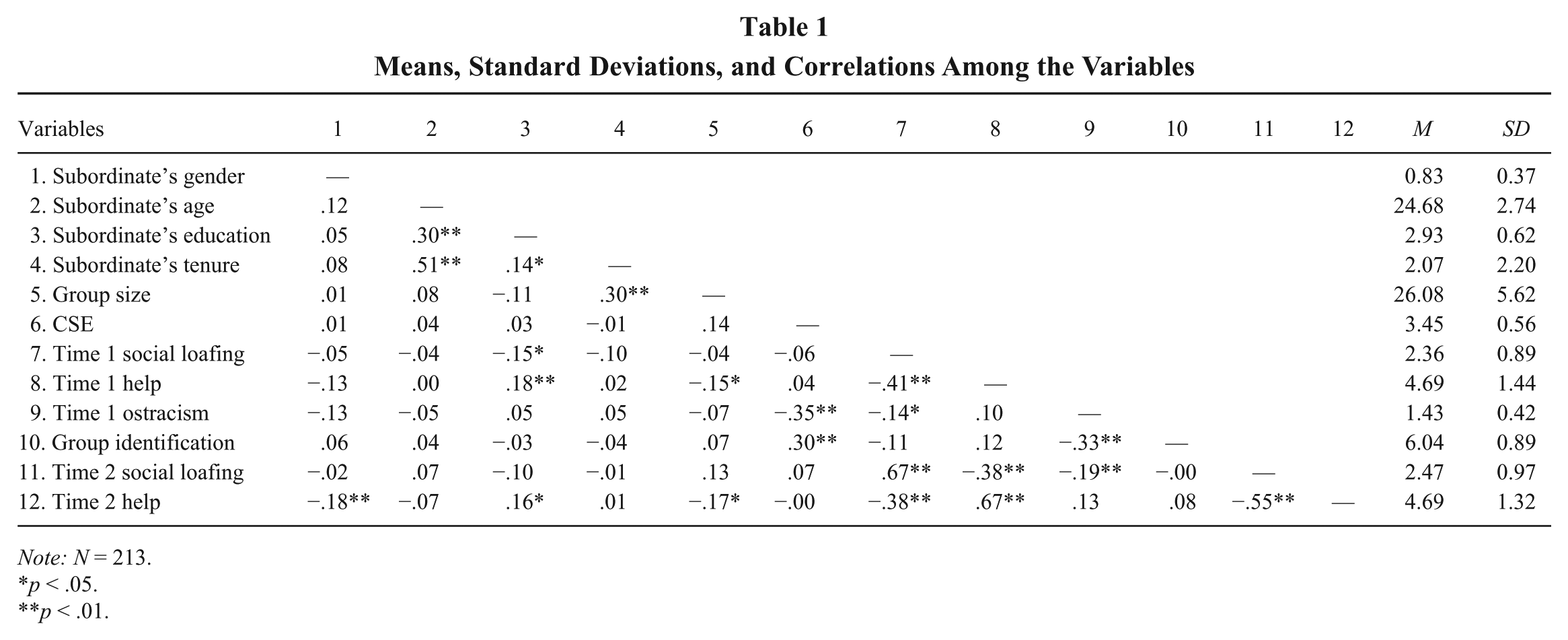
Note: N = 213.
p < .05.
p < .01.
Hypothesis Testing
Before testing the hypotheses, we first ran null models with no predictors but with either helping (Time 2) or social loafing (Time 2) as the criterion variable. The results show significant between-group variances in helping behavior, χ2(24) = 596.85, p < .001, intraclass correlation (ICC1) = .47, which indicates 47% of variance residing in between groups, and social loafing, χ2(24) = 517.41, p < .001, ICC1 = .29, indicating 29% of variance residing in between groups.
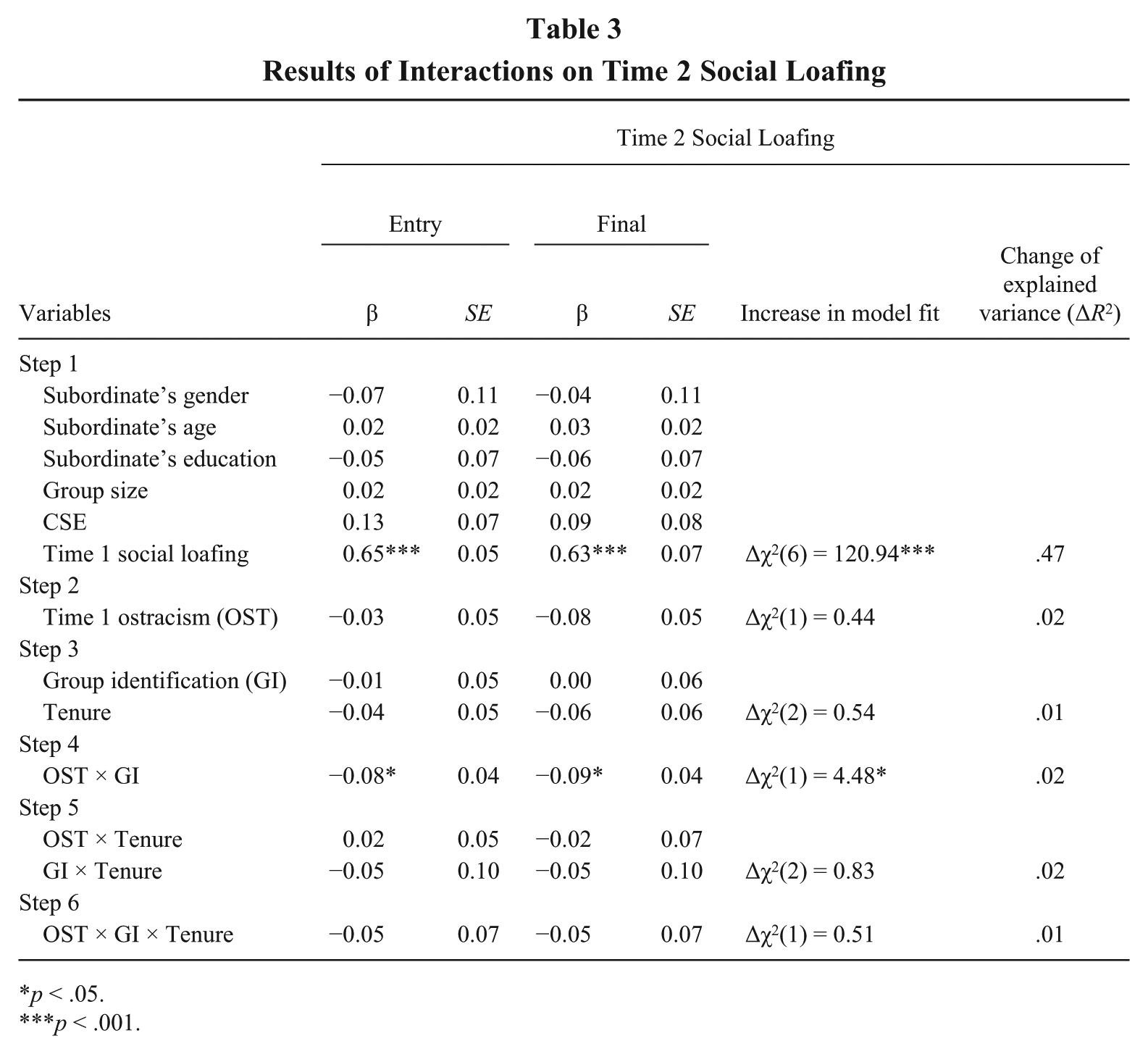
Tables 2 and 3 show the hierarchical linear modeling results for the hypothesis testing. Hypotheses 1 to 2 predict the two-way interaction of ostracism and group identification on helping behavior and social loafing at Time 2. As can be seen in Step 4 of these tables, the interactive effects were significant for helping behavior, Δχ2(1) = 3.92, β = 0.11, p < .05, and for social loafing, Δχ(1) = 4.48, β = −0.08, p < .05.
Results of Interactions on Time 2 Helping Behavior
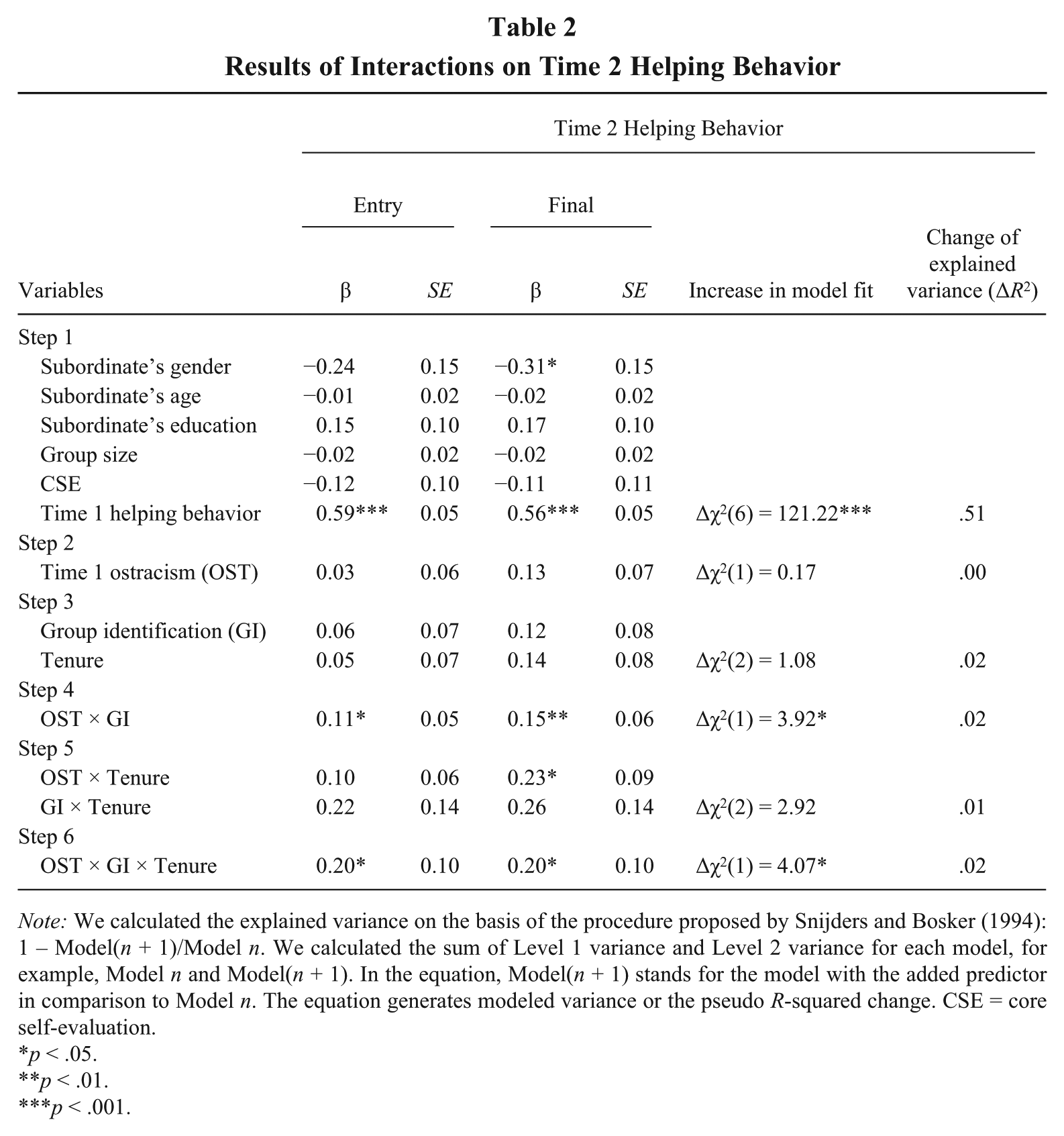
Note: We calculated the explained variance on the basis of the procedure proposed by Snijders and Bosker (1994): 1 – Model(n + 1)/Model n. We calculated the sum of Level 1 variance and Level 2 variance for each model, for example, Model n and Model(n + 1). In the equation, Model(n + 1) stands for the model with the added predictor in comparison to Model n. The equation generates modeled variance or the pseudo R-squared change. CSE = core self-evaluation.
p < .05.
p < .01.
p < .001.
Results of Interactions on Time 2 Social Loafing
p < .05.
p < .001.
Hypotheses 3 and 4 predict the three-way interactive effect of ostracism, group identification, and tenure on helping behavior and social loafing. As shown in Step 6 of Tables 2 and 3, the interaction effect was significant for helping behavior, Δχ2(1) = 4.07, β = 0.20, p < .05; however, it was not significant for social loafing.
We first tested the simple slopes for two-way interactions when there was strong group identification and weak group identification. The simple slope tests (cf. Aiken & West, 1991) further revealed that when employee group identification was weak, ostracism at Time 1 was not significantly related to helping behavior or social loafing at Time 2. In contrast, when employee group identification was strong, ostracism at Time 1 was strongly and positively related to helping behavior at Time 2 (β = 0.18, p < .05) and was strongly and negatively related to social loafing at Time 2 (β = −0.15, p < .01). These findings support Hypotheses 1 and 2.
We then tested the simple slopes for the three-way interactions. The simple slope tests further showed that only when group identification and tenure were both high was ostracism significantly and positively related to helping behavior (β = 0.71, p < .01), which supports Hypothesis 3. However, the three-way interaction effect was not significant for social loafing; thus, Hypothesis 4 was not supported. Although the three-way interaction effect was not significant for social loafing, the result of the simple slope test was somewhat encouraging in that it revealed a marginally significant and negative relationship between ostracism and social loafing when group identification and tenure were both high (β = −0.24, p < .10). These findings seem to suggest that, in order to shore up the in-group identity, ostracized individuals should take more proactive actions, such as increasing helping behavior, to draw the attention of other group members. Actions such as reducing social loafing, in contrast, are relatively passive and less visible to others; thus, the effect of ostracism on social loafing is less likely to be observed.
Facilitating the interpretation of the two-way interaction effects, Figures 1 and 2 illustrate the interactive effects of ostracism and group identification on helping behavior and social loafing, respectively. Figure 3 illustrates the three-way interaction effect on helping behavior.

The Two-Way Interaction of Ostracism and Group Identification on Helping Behavior

The Two-Way Interaction of Ostracism and Group Identification on Social Loafing

The Three-Way Interaction of Ostracism, Group Identification, and Tenure on Helping Behavior
Discussion
This study attempts to examine the conditions in which ostracism promotes prosocial reactions, such as increased helping behavior and decreased social loafing. We examined the moderating roles of group identification and tenure in the relationships between ostracism and helping behavior and social loafing. We found that when group identification was strong, ostracism increased employees’ helping behavior and decreased employees’ social loafing. Moreover, we found that when group identification was strong and tenure was long, the positive association of ostracism and helping behavior was the strongest.
Theoretical Implications
The findings of this study have several theoretical implications. First, research has shown that ostracism can lead to a variety of reactions. The interesting puzzle is that while ostracism has often been shown to elicit negative or antisocial behavior, some research shows that it can also elicit prosocial behavior (for a review, see Robinson et al., 2013; Williams, 2007). It is easy to understand that the anger, frustration, or threats caused by ostracism may create an impulse for revenge and trigger “tit-for-tat” antisocial behavior (Romero-Canyas, Downey, Reddy, Rodriguez, Cavanaugh, & Pelayo, 2010). However, it is unclear when individuals react prosocially to ostracism. We contribute to this line of research by using self-verification theory to illuminate when ostracized employees may demonstrate prosocial behavior. When employees strongly identify with the group, the in-group identity constitutes an important part of their self-view. Therefore, when this in-group identity is threatened, the desire for self-verification is likely to motivate ostracized employees to engage in behaviors to restore this important sense of identity (i.e., increasing helping behavior and decreasing social loafing).
Consistent with self-verification theory, this effect was found to be especially pertinent for those ostracized employees with a longer tenure. Group-identity evaluations from individuals with whom one has worked a long time should be more reliable, relevant, and consequential; thus, ostracism poses a stronger threat to employees’ group identity for those high in group identification and, hence, induces more self-verification strivings in terms of increased help and decreased social loafing.
Second, the phenomenon of ostracism has attracted the attention of organizational scholars only recently. As such, the existing findings on ostracism mainly come from social psychology studies that use an experimental design approach (e.g., Twenge et al., 2007; Williams et al., 2000; Williams & Sommer, 1997), which fails to address what happens to ostracized employees in the workplace. The few existing field studies on workplace ostracism mainly focus on how ostracism negatively influences employees’ in-role and extrarole performance (e.g., Ferris et al., 2008; O’Reilly & Robinson, 2009; Wu, 2011). We contribute to the literature by suggesting that ostracism may have a constructive function by serving as an informal sanction to encourage helping behavior and deter social loafing. However, this effect was observed only among employees who valued group membership. Rather than unanimously defining ostracism as a destructive act, it can be seen from an evolutionary perspective to have a constructive function in promoting group cohesiveness and effectiveness (Gruter & Masters, 1986; Williams, 2007).
Limitations
The results and implications of this study should be interpreted with awareness of its several limitations. First, we cannot draw firm conclusions in regard to causality even though we controlled the Time 1 criterion variables to show that ostracism caused a change in the criterion variables in Time 2. However, the reverse direction makes less logical sense. Theoretically, it is not clear why high supervisor ratings on prosocial behavior (or low antisocial behavior) would be positively related to being ostracized by coworkers, especially when group identification is high. Although we feel relatively confident about the direction of the relationships, an examination of this study, or studies in general regarding the relational dynamics between employees, could greatly benefit from a more nuanced empirical assessment. For example, by examining actual changes over time, using event sampling methodology or dynamic social network analyses, we may garner a more sophisticated understanding of the causal relationships between our variables as they evolve over time in the workplace. We acknowledge the need for further evidence before claims of causality can be supported.
Second, following the above point, it might not be necessarily safe to assume that the moderator (group identification) is stable, even though it tends to remain unchanged over time between persons (Ethier & Deaux, 1994). It may be that, from a within-person perspective, employees experience a temporary decrease in the strength of group-based identity as a result of workplace ostracism. Under such conditions, the temporary variation on the strength of group-based identity may affect their subsequent reactions. We thus encourage future research to investigate this issue from a within-person approach by tracing the changes in ostracized employees’ group identification and related behaviors.
Similarly, ostracism could be temporary or enduring. In some situations, employees may believe that they have a chance to turn around the aversive condition, but in other situations, employees may realize that they remain on the periphery of the group no matter what they try. Ostracized employees’ reactions could differ substantially under such different conditions. Despite this possibility, it is not clear how a change in ostracism would explain the two-way and three-way interaction effects found in our study. Nevertheless, future research could benefit from a fully cross-lagged panel design with repeated measures of each of the focal variables, which not only eases the concern of causality but also enables richer and more informative analyses (Shingles, 1985).
Third, the generalizability of our findings may be a concern. We collected the data from one call center in one company, and the sample was fairly homogeneous in terms of background, which may raise concerns about the generalizability of our findings to other industries and settings. Although the research design helped to rule out alternative explanations, such as team-level or organizational-level effects (e.g., C. P. Parker et al., 2003), statements about generalizability must await the results of investigations in different industries and cultures.
Future Directions
There are several interesting directions for future inquiry. First, we have shown that ostracism can elicit more prosocial behavior and deter antisocial behavior in ostracized employees who have a high level of group identification. Our findings seem to suggest that when social identity (i.e., group identification) plays an important role in self-conception, ostracized employees may be more adaptive in behaving in the ways that others desire. However, our study does not provide any answers in regard to when ostracism stimulates individuals to lash out or behave aggressively. According to social identity theory (e.g., Tajfel, 1982; Tajfel & Turner, 1986), an individual’s self-conception is composed of both personal identity and social identity. Personal identity refers to the attributes of the individual, such as abilities, attractiveness, and competence (Gergen, 1971; Tajfel; Tajfel & Turner, 1979, 1986). Ostracism can threaten people’s self-worth as competent and valuable human beings who deserve respectable treatment in social interactions. Being excluded can also threaten people’s evaluations in functionally important dimensions, such as ability, attractiveness, desirability, value, and contribution, compared with others. Evolutionary psychologists argue that individuals tend to act aggressively toward those who threaten these domains to maintain their dominant status and restore their self-image (de Waal, 1982; Kirkpatrick & Ellis, 2001; G. A. Parker, 1974; Westermarck, 1932). An interesting future direction would be to investigate how the interplay of personal and social identity results in different reactions.
Second, our study looked at the behaviors of ostracized members directed towards their group members. Increasing prosocial behavior and withdrawing antisocial behaviors are adopted means to reaffirm their group identity that matters to them. However, another interesting direction is to examine behaviors of ostracized members that are directed towards out-group members. To verify an in-group identity, ostracized group members may be more prone to engage in overt aggression and hostility towards out-groups (Brewer, 1991).
Third, our results suggest that when employees attempt to turn around incidents of ostracism, they are likely to socially compensate and present themselves in a favorable way by being more helpful and cooperative and by working harder. However, as Williams pointed out, “In many instances, trying to be more socially acceptable can lead individuals down the path of gullibility and social susceptibility, making them easy targets for social manipulation” (2007: 439). Thus, more investigation is needed on the long-term effects of the sanctioning role of ostracism to ascertain whether it helps individuals to be more adaptive in the group or gradually makes them victims of other types of misbehavior, such as manipulation and abuse (Crocker & Knight, 2005; Romero-Canyas et al., 2010).
Practical Implications
The results of this study suggest several practical implications. First, our results clearly show that self-verification is a strong motive for people to regulate their behaviors when their valued self-concept is at stake. In our study, ostracized employees with strong group identification resorted to prosocial behaviors to shore up their group-based identity. Such behaviors that are driven by self-verification motives are more likely to help ostracized employees cope with difficult situations. To act prosocially toward people who inflict pain in the first place is not easy unless one has an innate motive to respond as such. This would suggest that to the extent that management practice can bolster employees’ identification with the group or the organization, it may be particularly functional in light of negative experiences, such as ostracism. Such practices might include fostering employees’ positive attitudes towards the group or organization (Van der Vegt & Bunderson, 2005), embracing socialization practices that increase identification, increasing the task and goal interdependence among group members (Van der Vegt et al., 2003), or developing strong cultures where identification can flourish.
Our results also suggest that those who have longer tenure have an even stronger self-verification motive to shore up their group-based identity via prosocial behaviors. By contrast, those shorter tenured employees who possess a high level of group identification still refrain from coping with ostracism in a prosocial manner. This is because the group-based identity may not be as important to shorter tenured employees as it is to longer tenured employees. Our findings suggest that workplace ostracism is more likely to have detrimental effects on shorter tenured and new employees. Developing strong group/organizational identification may not be adequate to help these employees cope with ostracism proactively. Rather, practicing managers should make efforts to reduce workplace ostracism targeting new employees.
Conclusion
We began this study with the question of why and when employees respond to workplace ostracism prosocially. Drawing on self-verification theory, our findings suggest that ostracized employees increase helping behavior while decreasing social loafing to shore up their group-based self-view threatened by ostracism. The evidence indicates that group identification plays a crucial role in this process, especially for those employees who have a longer tenure. The theory and results presented here are an initial attempt to resolve the contradictory findings on the link between ostracism and behavior.
Footnotes
Acknowledgements
This article was accepted under the editorship of Deborah E. Rupp.