



Abstract
This study examines the role of team political skill in predicting team effectiveness. Extending the current paradigm of individual political skill and contributing to the team effectiveness literature, we offer a theoretical framework for team political skill composition and test a model whereby task and social cohesion mediate the relationship between team political skill and team performance. On the basis of the results obtained from 189 student project teams and 28 business work teams, we demonstrate that team political skill benefits extend to groups. In both samples, team political skill directly related to subjective and objective team performance. Among several team political skill composition models, the interaction between the group skill mean and standard deviation (“skill strength”) was found to be the best predictor of team emergent states and outcomes. Team political skill was related to objective team performance via social and task cohesion in the student teams and via task cohesion in the work teams. Finally, we investigated the potential dark side of high team political skill but failed to support the too-much-of-a-good-thing hypothesis. Given the social focus of the construct, an aim for future research is to further understand how the composition of individual political skill influences team dynamics and outcomes. Multiple organizational implications extend to recruitment, training, development, and team building.
Keywords
Emerging research suggests that “soft skills,” reflected in factors such as emotional intelligence, team personality, and shared mental models, can both affect team performance directly (Bell, 2007; Fisher, Bell, Dierdorff, & Belohlav, 2012) and moderate the relationship between key variables and team performance (e.g., Edwards, Day, Arthur, & Bell, 2006). Given the demonstrated importance of such constructs for team effectiveness within the team input-process-outcome theoretical framework (e.g., Mathieu, Maynard, Rapp, & Gilson, 2008), it is critical to further examine the antecedents relevant to interpersonal interactions in teams.
With the notable exception of the validation of a measure for emotional intelligence in teams (Jordan, Ashkanasy, Härtel, & Hooper, 2002; Troth, Jordan, Lawrence, & Tse, 2012), few studies have examined social effectiveness constructs that specifically evaluate people’s ability to thrive in work groups. Considering political skill’s superior predictive abilities when compared to other social effectiveness constructs (Banister & Meriac, in press; Semadar, Robins, & Ferris, 2006) and a call to examine the properties of teams that can result in higher effectiveness (Hackman, 2012), we propose that such skill can serve as a critical team input.
Political skill is a contextual understanding of others at work applied to influencing their actions and thus advancing one’s own or an organizational agenda (Ferris et al., 2005). Although researchers have demonstrated a positive association between individual political skill and individual outcomes (work performance: Blickle et al., 2008; Ferris et al., 2008; Semadar et al., 2006; career success: Forret & Dougherty, 2004; leader effectiveness: Douglas & Ammeter, 2004; Treadway et al., 2004), the literature does not speak to the question of whether teams can be portrayed as possessing political skill and whether the benefits of political skill extend to more collective outcomes. As evident from a recent review of the literature (Kimura, 2015), proof for the impact of political skill in teams is largely missing. Similarly, a meta-analysis concerning political skill concludes that “research remains very limited regarding the operation of political skill within follower, group, and team contexts. Even less research has examined unit-level effects of political skill” and suggests that “there is incredible promise for political skill research in group and organizational processes” (Munyon, Summers, Thompson, & Ferris, 2015: 173).
Whether and why political skill matters at the team level is of impelling interest given the decidedly social focus of the construct. In a positive scenario, the synergy of individual virtues encompassed in political skill might benefit teams. Being socially astute to the needs of colleagues and appearing genuine in their interactions with them, politically skilled team members can befriend many and foster positive communication. This can lead to high group attractiveness and translate into group cohesiveness.
Conversely, teams populated with a number of politically skilled individuals could conceivably be dysfunctional. While research suggests that politically skilled individuals are adept at achieving their own performance, leadership, and career goals, the effects of such outcomes on team cohesion and performance are uncertain. The issue of whether there is “too much of a good thing” (TMGT; Pierce & Aguinis, 2013) has yet to be explored in the team context. It is possible that groups populated by people with elevated political skill could fall prey to false consensus and groupthink, on one hand, or conflict over resources, on the other hand.
As both positive and negative scenarios are plausible, there is a need to understand how the composition of individual political skill influences team dynamics and effectiveness. While researchers have demonstrated the importance of other aggregated individual differences, such as personality traits, cognitive ability, and affect, in facilitating team performance (e.g., Barry & Stuart, 1997; Bell, 2007) and creativity (Somech & Drach-Zahavy, 2013), political skill has not been examined as a group-level construct despite its clear social focus. Hence, this study develops a theoretical rationale for taking the political skill–outcomes relationship to a higher level of analysis. Drawing on multilevel theory and research (Chan, 1998; Hollenbeck, DeRue, & Guzzo, 2004; Kozlowski & Klein, 2000; van Mierlo, Vermunt, & Rutte, 2009), the resource-based view (Barney, 1991, 2001), and social capital theory (Burt, 1997; Nahapiet & Ghoshal 1998), we offer a theoretical framework for team political skill composition. Then, we develop a model whereby task and social cohesion mediate the connection between team political skill and team performance. We test our hypotheses with university student teams completing group projects and partially replicate these results by using retail store work teams.
Political Skill at the Team Level
Team Political Skill Composition and Team Performance: Direct Effect
At the individual level, research has established the construct validity of political skill and provided evidence for the validity of the Political Skill Inventory (PSI; Ferris et al., 2005; Ferris et al., 2008). Ferris and colleagues (2005) and Ferris and colleagues (2008) advocated four dimensions to political skill: social astuteness, interpersonal influence, networking ability, and apparent sincerity. In the literature, political skill is assessed either as a multidimensional construct or as a global state (Huang, Frideger, & Pearce, 2013). Unlike individual political skill, which is always directed from within to the outside (to colleagues, to supervisors, or to clients), team political skill can be targeted either at the team itself or directed outside the team.
We initiate our conceptual model by introducing team political skill as a higher-level emergent construct that is defined via the additive composition of individual team members’ political skill (Kozlowski & Klein, 2000). In doing so, we follow research on conceptually similar variables (e.g., group personality and group emotional intelligence; Bell, 2007). Drawing on Barrick, Stewart, Neubert, and Mount (1998), who tested team personality composition, we examined the team composition of political skill, a decidedly more social construct. We began with the expectation that a parsimonious additive composition model (Chan, 1998) would be appropriate to express team political skill. This model posits that such skill is the simple average of the political skill of the team’s individual members. Additive models are compensatory in that they assume that a skill deficit on the part of one team member can be compensated by elevated skill on the part of another. The logic is that political skill can be treated as a valuable pool of team resources and capabilities.
From this perspective, political skill is an intangible asset or capability of the team that provides a competitive advantage, resulting in higher performance, as per resource-based theory (Barney, 1991). Similar to organizational capabilities, defined as “a special type of resource, specifically an organizationally embedded non-transferable firm-specific resource whose purpose is to improve the productivity of the other resources possessed by the firm” (Makadok, 2001: 389), team political skill is a team-specific capability that is hard to imitate and allows for effective use of other team resources, such as coordination, technical skills, or mental ability.
Having established a place for political skill at the team level, we now explicate the role of team political skill as a predictor of team effectiveness. Highly politically skilled individuals are known to effectively control their emotions and adjust their behavior to the demands of the situation while being attuned to the needs of others and demonstrating sincere interest in their well-being. These qualities are expected to mitigate certain negative facets of group dynamics (e.g., process losses) while enhancing mutual likability. The latter is argued to facilitate numerous and effective social interactions and boost group cohesion, thus leading to effective team performance. We examine subjective performance as assessed by team members and performance as rated by the teams’ superiors because these represent distinct dimensions of team effectiveness. On one hand, collective perception of team success is critical for team development. On the other hand, organizations are frequently concerned about tangible outcomes. Hence, the focus on both the perceived and received aspects of team performance is warranted.
At the individual level, political skill has been shown to relate positively to both types of job performance (e.g., Blickle et al., 2011; Semadar et al., 2006). We expect a similar result at the team level. Influencing others to achieve one’s goals, and doing this in a subtle manner while being sincerely attuned to the needs of others, should lead to the subjective perception of the team’s ability to perform well. At the same time, the capability of building a network of colleagues who provide help when needed may explain why politically skilled teams reach higher levels of externally rated performance. Hence, it is reasonable to expect the following:
Hypothesis 1a: Average team political skill is positively related to subjective team performance.
Hypothesis 1b: Average team political skill is positively related to objective team performance.
Social capital theory (Burt, 1997) suggests that, in addition to an additive composition model, team political skill might be expressed by a dispersion model (Chan, 1998). Dispersion models represent group-level constructs via variance or a joint function of the group mean and variance. The combination of a high level and low dispersion of skill at the team level would denote team high political skill strength. As highly politically skilled individuals enjoy higher social capital (Burt; Nahapiet & Ghoshal, 1998), high skill strength would likely produce a synergistic “meeting of the minds” among team members concerning proper social interaction. Facile at networking and liked by others, the politically skilled may “act as go-betweens, bridging the structural holes between disconnected others, facilitat[ing] resource flows and knowledge sharing” (Mehra, Kilduff, & Brass, 2001: 121). This effect is multiplied when there are numerous “go-between” facilitators. Team profiles are reflected in the dispersion of the skill, underscoring the importance of considering the variance in the operationalization of team political skill.
In support of this approach, the outcome of some traits previously shown to relate to political skill, such as agreeableness (e.g., Barrick et al., 1998; Blickle et al., 2008), emotional stability (trait anxiety in Ferris et al., 2005), and extraversion (Lvina, Johns, & Bobrova, 2009), has been found to depend on team trait distribution. Thus, teams with high team political skill strength—more pronounced skill homogeneity, operationalized as low variability and high average skill—should demonstrate positive outcomes over and above those accounted for by a basic additive model.
Hypothesis 2a: Team political skill strength is positively related to subjective team performance and explains variance over and above mean team political skill.
Hypothesis 2b: Team political skill strength is positively related to objective team performance and explains variance over and above mean team political skill.
Task and Social Cohesion as Mediators of Team Political Skill Effects
To explain how team political skill affects team effectiveness, we propose a mediation model whereby political skill is related to team effectiveness via the team emergent state of group cohesion. Team effectiveness is largely a function of interaction processes and emergent states (e.g., DeChurch & Mesmer-Magnus, 2010), with group cohesion being a salient group process construct (Friedkin, 2004). Figure 1 depicts a proposed mediating relationship in which task and social cohesion are the mechanisms by which team political skill influences team performance.
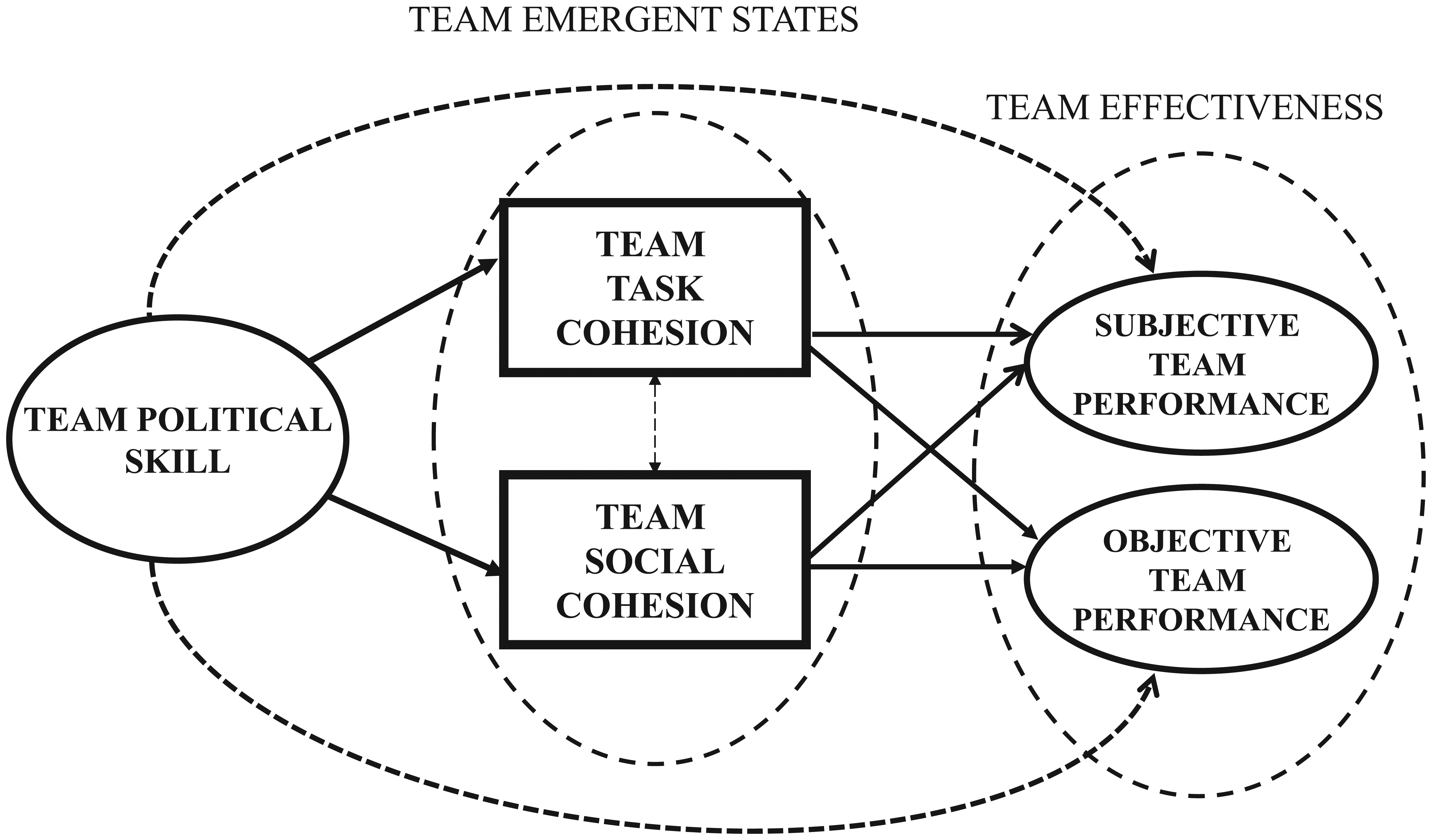
Theoretical Model Linking Team Political Skill and Team Effectiveness
Group cohesion is a team process variable defined as “the resultant of all forces acting on members to remain in the group” (Festinger, Schachter, & Back, 1950, as quoted and cited in Dobbins & Zaccaro, 1986: 204). We choose to focus on cohesiveness as a mediator because in the team literature, it is one of the most studied (see Friedkin, 2004, for reviews) and most relevant mediators that affect group performance (Gonzalez, Burke, Santuzzi, & Bradley, 2003; Greer, 2012; Zaccaro, 1991).
Cohesive groups have been found to exhibit persistence despite obstacles, which eventually leads to better performance (see the meta-analyses of Beal, Cohen, Burke, & McLendon, 2003; Evans & Dion, 1991; Gully, Devine, & Whitney, 1995; Mullen & Copper, 1994). There is considerable evidence that cohesion is multidimensional (Dobbins & Zaccaro, 1986; Mullen & Copper), comprising social and task foci. Although there is no uniform agreement on the distinctive roles of task versus social cohesion (Chiocchio & Essiembre, 2009; Mullen & Copper; Picazo, Gamero, Zornoza, & Peiró, 2015), both have consistently been found to relate to team effectiveness (Barrick et al., 1998; Mathieu et al., 2008). We define task cohesion as shared task commitment and social cohesion as established social bonds.
Given the very definition of teams as individuals working interdependently for a common goal, it is evident that facile interaction, implied in the construct of political skill, and mutual dependence are prerequisites for team cohesion. Politically skilled individuals come across as less stressed (Brouer, Ferris, Hochwarter, Laird, & Gilmore, 2006; Perrewé, Zellars, Ferris, Rossi, Kacmar, & Ralston, 2004), more in control of the situation (Ferris et al., 2007), and more effective performers (Blickle et al., 2008; Ferris, Treadway, Perrewé, Brouerz, Douglas, & Lux, 2008; Semadar et al., 2006). Most people prefer to interact with those who are positive, successful, and possess higher status (Fiske, 2010; Shaw, 1981). As political skill enhances informal status, the level of team members’ political skill should translate into overall team attractiveness and, consequently, team cohesion. Furthermore, politically skilled individuals are keenly attuned to diverse social situations and the needs of others and capable of calibrating their behavior to situations (Ferris et al., 2005). Being socially astute to the needs of colleagues and appearing genuine in the interactions with them will lead to elevated group attractiveness, which is known to foster performance. Teammates who are able to effectively influence other members can align the activities of their team in the same direction and catalyze buy-in among colleagues. Thus, political skill enables individuals to diagnose the task at hand and adjust their routines accordingly, which in turn will lead to higher task cohesiveness. Given that the task cohesion–performance link has often been documented in previous research (Beal et al., 2003; Mullen & Copper, 1994), we hypothesize:
Hypothesis 3a: Group task cohesiveness mediates a positive relationship between team political skill and subjective team performance.
Hypothesis 3b: Group task cohesiveness mediates a positive relationship between team political skill and objective team performance.
Politically skilled individuals are adept at developing and using diverse networks of people, so they are directly tied to numerous individuals within the team and beyond. By virtue of appearing to others as possessing high levels of integrity, authenticity, sincerity, and genuineness, these individuals make many friends. As a rule, friendly people enjoy a greater amount of social-emotional support from their social network (Adler & Kwon, 2002). In a team with many politically skilled individuals, this will lead to further group attractiveness and, thus, to higher social cohesiveness. Ultimately, similar to task cohesion, social cohesion can lead to higher team performance. Group attractiveness facilitates team member interaction, creates a nonthreatening climate, enables cooperation, and as such leads to higher team performance. In support of this mechanism, the Beal et al. (2003) meta-analysis demonstrates that social cohesion correlates positively with performance. Thus, we maintain:
Hypothesis 4a: Group social cohesiveness mediates a positive relationship between team political skill and subjective team performance.
Hypothesis 4b: Group social cohesiveness mediates a positive relationship between team political skill and objective team performance.
TMGT: A Curvilinear Effect of Team Political Skill on Team Performance?
In pursuit of a possible “dark side” to team political skill, we theorized a curvilinear relationship between political skill and the two types of team performance. Recently, scholars have examined the TMGT effect (e.g., Grant & Schwartz, 2011; Zettler & Lang, 2015), and Pierce and Aguinis developed a theory of the effect, arguing that “too much of any good thing is ultimately bad” (2013: 315). As it may result in asymptotic or even reversed relationships between variables, research is needed to investigate the TMGT phenomenon in management. This metatheory has already served as a framework for investigating several frequently studied variables (e.g., Lam, Spreitzer, & Fritz, 2014, on proactive behavior) and is used here to examine a potential drawback of team political skill.
TMGT may apply to the team political skill–team performance relationship. In support of this, an inverted U-shaped relationship between political skill and job performance has been found at the individual level (Zettler & Lang, 2015). Also, on the basis of negative reactions to self-serving behavior and resistance to excessive influence, Kolodinsky, Hochwarter, and Ferris (2004) found that both lower and higher levels of political skill led to lower levels of job satisfaction and higher levels of job tension.
Too much political skill may result in resistance, lower trust, and insufficient collaboration. Being socially astute, highly politically skilled individuals will effectively read others’ intentions and attempts to influence. The more politically skilled individuals a team comprises, the more difficult it is to hide such attempts. And, on the basis of the fundamental attribution error, the attempts can be inadvertently interpreted by others as self-serving. Furthermore, some dimensions of political skill, such as networking, are argued by some to be more self-oriented rather than team oriented as they “intend to serve agent’s self-interest” (Zettler & Lang, 2015: 548). For instance, time spent networking may shorten the time spent actually working. Also, groupthink, excessive attention to status quo, and false consensus are other possible dysfunctions. Thus, we propose a negative effect of team political skill at its higher levels.
Hypothesis 5a: There is a curvilinear inverted U-shaped relationship between team political skill and subjective team performance.
Team political skill is also proposed to have a curvilinear relationship with team performance rated by others (instructors or managers). Excessive attention to successful in-group interactions may detour teams from effective task completion, especially if the latter challenge the team status quo. It may also lead teams to groupthink, or even prompt teams to favor their own interests when these are not in line with those of the organization, and, hence, jeopardizing team performance and negatively affecting performance assessment by superiors.
Hypothesis 5b: There is a curvilinear inverted U-shaped relationship between team political skill and objective team performance.
This study employed two samples: students enrolled in a required organizational behavior course at a business school at a large Canadian university (Sample 1) and employees of a Russian branch of a multinational retail firm (Sample 2). As the second study replicates the first, identical measures were used and most tables summarize the results across both samples. Descriptive statistics are presented in Tables 1 and 2 for individual-level data and in Tables 3 and 4 for team-level data.
Descriptive Statistics and Individual-Level Correlations in Sample 1

Note: N = 879. Gender was coded 1 for males and 0 for females. Work, company, team experience, and tenure with current leader were measured in months. Team performance was self-reported by the team members. Values in parentheses are the reliabilities.
p < .05.
p < .01.
Descriptive Statistics and Individual-Level Correlations in Sample 2

Note: N = 156. Gender was coded 1 for males and 0 for females. Work, company, team experience, and tenure with current leader were measured in months. Team performance was self-reported by the team members.
p < .05.
p < .01.
Descriptive Statistics and Team-Level Correlations in Study 1

Note: N = 189.
p < .10.
p < .05.
p < .01.
Descriptive Statistics and Team-Level Correlations in Study 2

Note: N = 28.
p < .10.
p < .05.
p < .01.
Sample 1: Method
Sample and Procedure
Initially, data were collected from 285 teams in a large Canadian university business school. The sample was chosen because of the academic requirement for term-long compulsory team-based projects with a common grade given to each team member. However, data from 94 teams were not used because too few members participated in the research. Comparison between the 94 teams that were dropped and the remainder of the sample showed no significant differences, except for students’ grade point average (GPA). The respondents from the dropped teams who completed the survey demonstrated slightly higher GPAs, possibly because their less diligent peers chose not to respond to earn the extra credit.
In total, the study employed 189 teams comprising 879 students. Among them, we had 112 teams with a 100% participation rate and 77 teams with 1 missing member responding on the target variable of political skill. For other variables, the response rates ranged from 65% to 100%. Teams were dropped for one of the following three reasons: missing political skill data from at least 1 team member; missing instructors’ reports on team objective performance; or missing over 65% of team data on other variables. Teams ranged from 3 to 6 members with a mode of 5. Participants’ average age was 22 years old, and 51% of participants were men.
The team task involved analyzing a business case and submitting a written report. The work was done outside of class time, and the life span of a typical team was between 6 and 10 weeks. Teams were graded as a group on the project, so this activity required achieving a common consequential goal.
The data collection was completed in two waves. First, three-fourths into the term, participants were asked to fill out an in-class survey that included the PSI (Ferris et al., 2005) and demographic variables. Our reason for collecting the political skill data in the last quarter of the semester was to give the students sufficient time to interact, develop into teams (Gersick, 1988), and use their political skills before we asked them to assess those skills. An opportunity to win a gift card was offered in exchange for participation in this part of the study. Then, during the last week of the term, 3 to 4 weeks after the data on the independent variable were collected, the students were directed to the management department’s research participant pool Web site. In exchange for completion of the second questionnaire containing the remaining variables, the students received 1 point toward their final grade. By using two modalities for data collection (paper and Web) and temporally separating the measurement of political skill from its hypothesized consequences, we implemented procedural cautions against common method effects (Podsakoff, MacKenzie, & Podsakoff, 2012). Additional strategies for examining and ameliorating method effects are addressed below.
Measures
Political skill
Political skill was measured using the 18 statements from the PSI (Ferris et al., 2005); responses were made using a 7-point Likert scale ranging from 1 (strongly disagree) to 7 (strongly agree). Sample items are “I am particularly good at sensing the motivations and hidden agendas of my team members (others)” and “When communicating with my team (with others) I try to be genuine in what I say and do.” As the PSI was used in teams, it was thus revised accordingly. We used “in my team” instead of “at work” and used “my team members” instead of “others.” The wording was important, as we were interested in team political skill directed toward the team rather than toward outsiders.
We chose to analyze political skill as a unidimensional construct on the basis of the underlying character of the construct and previous research. Political skill comprises a set of highly correlated skills and attitudes (mean correlation above .5; see Ferris et al., 2005). It was initially developed as a unidimensional construct (Ferris, Berkson, Kaplan, Gilmore, Buckley, & Hochwarter, 1999), and it is frequently operationalized as a total score in the literature (e.g., Gentry, Gilmore, Shuffler, & Leslie, 2012; Huang et al., 2013; Shi, Johnson, Liu, & Wang, 2013). We ran a confirmatory factor analysis (CFA) for a one- versus four-factor model and found similarly good statistical fit for both; for example, results showed a comparative fit index (CFI) of .939 versus .966 and a root mean square error of approximation (RMSEA) of .087, 90% confidence interval (CI) of .081 to .092, versus .066, 90% CI of .061 to .072.
The strength of team political skill was measured as a product of the mean and the standard deviation of the skill. The value of the standard deviation was standardized and reversed in sign (Colquitt, Noe, & Jackson, 2002). Hence, a higher value represents higher strength of team political skill (high mean and low standard deviation).
Group cohesion
Task and social cohesion were measured using eight items from Chang and Bordia (2001). Respondents rated statements by using a 9-point scale ranging from 1 (strongly disagree) to 9 (strongly agree), with higher scores indicating higher cohesion. On the basis of the results of an exploratory factor analysis, we deleted the items with high residual variance and low factor loadings. Thus, only five of eight items were retained in the cohesion measure. A sample item for social cohesion is “Team members stick together outside of the team project.” An item for task cohesion is “Everyone tries to help if members have problems.” We ran a one-factor versus two-factor CFA, and the latter yielded better statistical fit—two-factor model: χ2(8) = 15.38, CFI = .982, standardized root mean square residual = .030, RMSEA = .07, 90% CI = [.00, .13]; one-factor model: χ2(9) = 54.47, CFI = .887, RMSEA = .17, 90% CI = [.13, .22]; Δχ2(1) = 39.09, p < .01—supporting the decision to employ the two dimensions of cohesion separately.
Team performance
Team members self-reported subjective team performance by using three items from Pearce and Sims (2002; e.g., “The team does very good work.”). Team project grades provided by course instructors were used to measure objective team performance.
Controls
We controlled for team size, average age, and gender mix (as gender was previously shown to relate to individual political skill in Treadway, Hochwarter, Kacmar, and Ferris, 2005, and in Perrewé et al., 2004). We also controlled for members’ previous familiarity with each other as it may condition group cohesiveness. Some research has reported cognitive ability to interact with political skill (Treadway et al., 2004). Moreover, performance is a partial function of individual intellectual input. Thus, this variable was also controlled for. A team average score of the students’ self-reported GPAs was used as a proxy for general cognitive ability.
Sample 1: Results
Descriptive statistics (individual and team) are presented in Tables 1 and 3. The hypothesized model was tested with structural equation modeling (SEM) using EQS-6 and Mplus 6 and regression analysis using SPSS Statistics 20.0.
As all hypotheses were tested at the team level, the appropriateness of aggregation was determined. To do so, we calculated a within-team index of agreement (rwg) and the proportion of group-level variance, or ICC(1). James, Demaree, and Wolf (1984) recommend .70 as a cutoff for within-team interrater agreement, while other researchers (e.g., Guzzo, Yost, Campbell, & Shea, 1993) suggested that values of .50 and above can be used. Conventions used when interpreting ICC(1) suggest that 25% of variance explained can be considered a large effect, while 10% is medium and 1% is small (e.g., Murphy & Myors, 1998). As ICC(k) represents a combined measure of agreement and reliability, it is appropriate to use traditional reliability standards, where values above .65 are deemed appropriate. In support of aggregating the variables to the team level, we found medium to large effects for within-team agreement and an appropriate level of between-team variance. The agreement indices are shown in Table 5.
Indexes of Agreement and Reliability in Samples 1 and 2

Note: The values for indices of agreement are those for Sample 1 and Sample 2, respectively. rwg = within-team interrater agreement; ICC(1) = proportion of group-level variance; ICC(k) = a combined measure of agreement and reliability.
N = 189 for team political skill, and N = 167 for other variables for Sample 1. N = 28 for Sample 2.
p < .10.
p < .01.
Testing Operationalizations of Team Political Skill Composition and Its Direct Effect on Team Performance
Team political skill as a group average
Multiple linear regression analyses were employed to examine the first set of hypotheses implying a positive relationship between the group mean for team political skill and team effectiveness. Supporting Hypothesis 1a, a significant positive relationship was found between mean team political skill and team subjective performance (β = 0.17, p < .05). However, Hypothesis 1b, stating a similar relationship for objective performance, was not supported (β = 0.03, n.s.).
Team political skill strength
This analysis was based on the approach of Dineen, Noe, Shaw, Duffy, and Wiethoff (2007) and Cole, Bedeian, Hirschfeld, and Vogel (2011). We employed it because it allows for testing if the mean−standard deviation interactions were a spurious by-product of a curvilinear effect associated with the cross-product component term. The cross-product of team political skill level and dispersion explained additional variance in team subjective performance (β = 0.33, p < .05, ΔR2 = .04, p < .10), providing support for Hypothesis 2a (see Table 6). Similarly, and unlike the political skill mean, political skill strength was positively related to objective performance, supporting Hypothesis 2b (β = 0.77, p < .01, ΔR2 = .09, p < .05; see Table 7). 1 Figure 2 depicts the interaction between team political skill mean and its dispersion. As a follow-up to the regression analyses, SEM was used to compare the two operationalizations, and the results are described below. On the basis of these results, the operationalization of team political skill as skill strength—the interaction between the skill level and dispersion—was used in the subsequent analyses.
Regression Analysis: Direct Effect of Team Political Skill Strength on Team Subjective Performance in Samples 1 and 2

Note: Standardized regression coefficients are shown.
p < .10.
p < .05.
p < .01.
Regression Analysis: Direct Effect of Team Political Skill Strength on Team Objective Performance in Samples 1 and 2

Note: Standardized regression coefficients are shown.
p < .10.
p < .05.
p < .01.
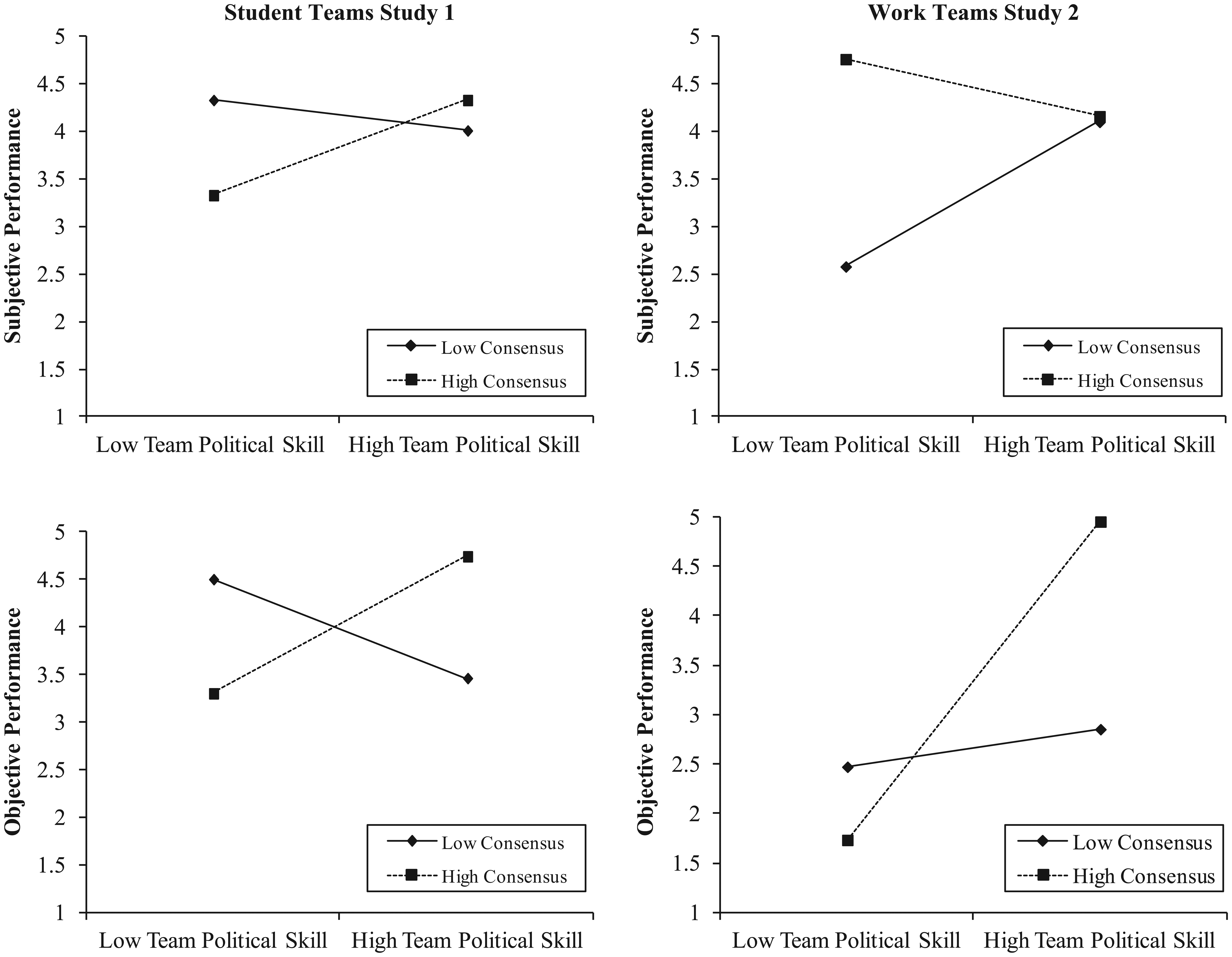
Team Political Skill Mean and Team Performance Moderated by Political Skill Consensus
SEM Measurement Model Analyses
We estimated a five-factor CFA model that included the covariances of team political skill strength, cohesion mediators, and the two types of performance. This model employed observed indicators loading onto the latent variables of cohesion and team performance, a team political skill latent variable with a single indicator fixed to the square root of its reliability, and the remaining latent variable of team objective performance set equal to its observed score. On the basis of the robust maximum likelihood method (MLM) of estimation, the measurement model yielded acceptable fit: χ2(45) = 78.85, CFI = .941, RMSEA = .08, p < .01. All factor loadings were significant and in the expected direction. The model proved superior to more parsimonious models (p < .01), supporting the distinctiveness of the study’s constructs.
In addition to the aforementioned procedural controls for method variance, we ran a supplementary test employing nested models with and without an orthogonal method factor (e.g., Elangovan & Xie, 1999; Widaman, 1985). The addition of a method factor (latent construct with team political skill, team cohesion, and performance items loading on it) to an original baseline measurement model did not improve the overall model fit—TRd(df) = 12.03(9), n.s. Furthermore, the incremental fit index rho yielded a value of .02, demonstrating that this method effect was nonsignificant. In addition, the factor loadings of the baseline model remained significant even after the method effect was partialled out. This provides further support for the conclusion that respondents were able to differentiate among the variables and that common method bias was limited. After examination of the modification indices, two minor modifications were included in the model to ensure that the measurement of the latent factors was psychometrically adequate. 2
Mediation Effect: Structural Model Analyses
To test our hypotheses, we fit “only direct” and “no direct” effects models to serve as additional comparisons to the hypothesized mediation model (Mathieu & Taylor, 2006). In the model estimating direct relationships from team political skill to team performance, skill strength related significantly to both team-assessed performance and objective performance (β = 0.42, p < .01 and β = 0.58, p < .01). While this provides additional support for Hypotheses 2a and 2b, the fact that the only direct effects model exhibited poor fit and differed significantly from the baseline CFA model suggested the presence of mediators (see Table 8).
Mediation Analysis: Fit Indices for the Baseline and Nested Model

Note: No confidence intervals are available for root mean square errors of approximation (RMSEAs) when the maximum likelihood method (MLM) is used. TRd, or the Satorra-Bentler scaled chi-squared difference, represents the chi-squared difference of the nested models compared to the baseline model when MLM is used. In computing a chi-squared difference test for robust MLM estimation for nested models, we followed the procedure described in the Mplus Technical Appendices at www.statmodel.com. Scaling correction cd and the TRd were used to determine significance of the models difference. CFI = comparative fit index; SRMR = standardized root mean square residual; CFA = confirmatory factor analysis; TPS = team political skill.
Nonsignificant.
p < .05.
p < .01.
The no direct effects model estimated paths from political skill to the mediators and from the mediators to the outcomes. Overall, this model exhibited acceptable fit and did not differ from the baseline model: χ2(43) = 74.55, CFI = .955, RMSEA = .08, Δχ2(2) = TRd = 4.9, n.s. 3 The evidence of mediation was substantiated by bootstrapping the indirect effects and calculating bias-corrected CIs for these effects. The point estimates and 95% CIs are shown in Table 9.
Indirect Effect of Team Political Skill (TPS) on Team Performance Through Social and Task Cohesion in Samples 1 and 2

Note: 1,000 bootstrap samples. The values for the coefficients are those for Study 1 and Study 2, respectively. BCa = bias corrected and accelerated; CI = confidence interval (CIs containing 0 are interpreted as nonsignificant).
Supporting Hypothesis 3b, task cohesion mediated the relationship between team political skill strength and objective team performance (β = 0.37, p < .05). It was not found to be related significantly to subjective team performance, showing no support for Hypothesis 3a. Team social cohesion mediated the relationship between team political skill and team subjective performance, supporting Hypothesis 4a (β = 0.76, p < .05). However, and contrary to some previous findings, social cohesion demonstrated a negative relationship with team objective performance (β = −0.50, p < .05), not supporting Hypothesis 4b. See Figure 3 for further detail. To address the possibility of a reverse relationship, we tested an alternative model whereby team political skill mediated the cohesion–outcomes relationship. This model exhibited a less optimal fit and differed significantly from the baseline model. Hence, we concluded that our original model was viable.
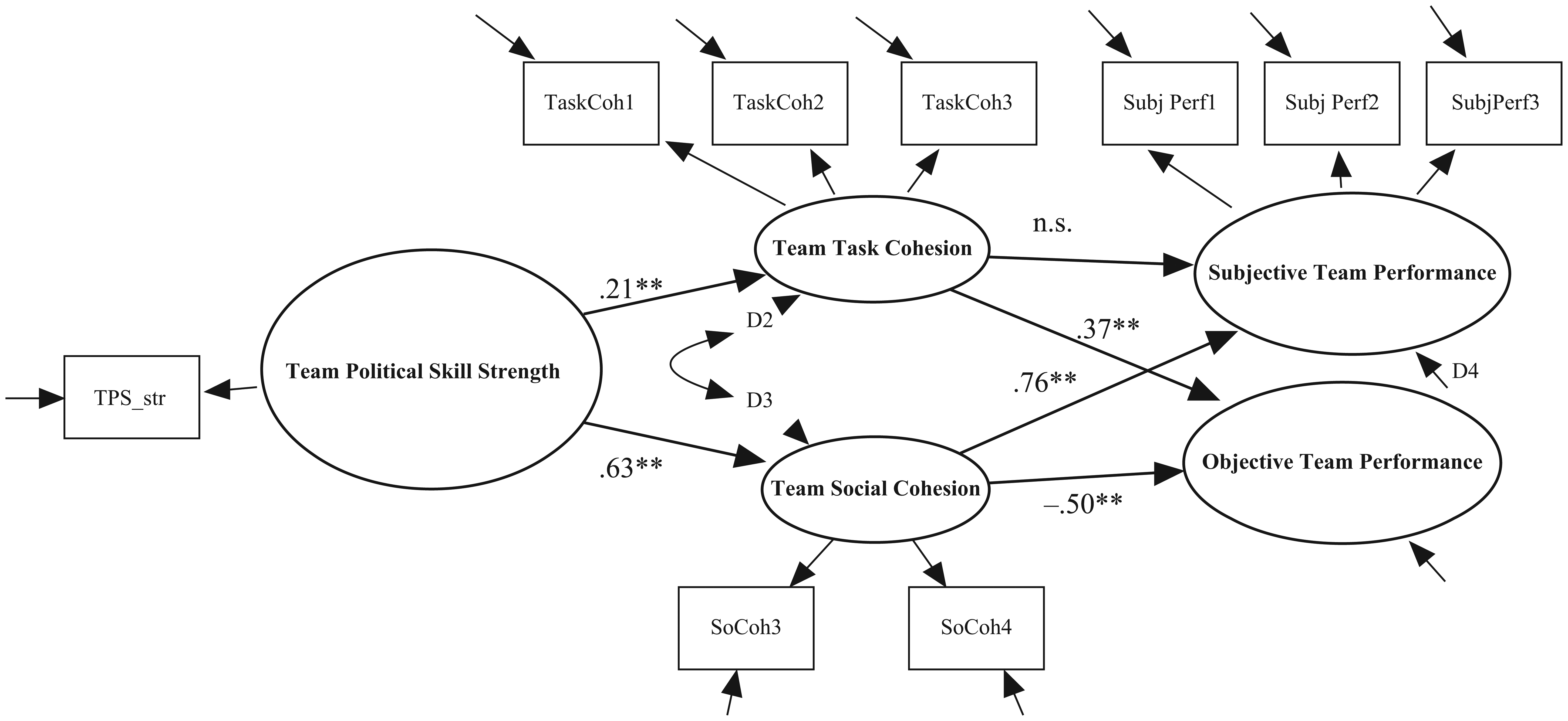
Final Model Linking Team Political Skill, Team Cohesion, and Team Effectiveness
Next, we tested an alternative model that specified partial mediation in which a direct relationship between independent and dependent variables was specified. The model demonstrated no improvement over the baseline model—Δχ2(4) = 1.3, p > .05. The partial mediation model showed no improvement over the fully mediated model—Δχ2(2) = 3.66, p > .05—and the effect of team political skill on team performance was not significant. Given the earlier finding of a significant relation between team political skill and team outcomes, this suggests full mediation for team social cohesion and both kinds of team performance and for task cohesion and subjective team performance.
As a final check on method bias, post hoc tests using a split-sample technique that rendered the sources of the mediator and outcomes independent were employed. The teams were randomly split into two groups to allow the test of the links between team cohesion as rated by one half of the team and team performance as rated by the other half of the team. Even though model fit deteriorated somewhat—χ2(43) = 88.55, CFI = .921, RMSEA = .10—the results of split-sample SEM analyses proved to be similar to the complete sample findings. On the basis of our earlier discussed use of procedural and statistical controls and this split-sample test, we concluded that our final results were not contaminated by common method variance.
Team political skill operationalization: Mean versus strength model
An alternative SEM mediation model operationalizing team political skill as additive was run to provide an empirical comparison with the previously tested team political strength model. As these models are not nested, our conclusion that team political skill strength represents an optimal operationalization of the construct is based on simple inspection of the model fit statistics (team political skill strength: χ2(43) = 74.55, CFI = .955, RMSEA = .08; team political skill mean: χ2(43) = 91.03, CFI = .920, RMSEA = .10. Hence, separate but related analyses support skill strength as the best composition model for team political skill and team cohesion as a salient mediator of the focal relationship.
Test of Curvilinear Effect
Our SPSS test of curve fit suggested a nonlinear relationship between team political skill and performance. However, our subsequent regression analysis built upon the Lam et al. (2014) approach suggested a stronger upward relationship rather than a drop in subjective performance. Namely, both team political skill strength and its squared term demonstrated a strong positive relationship with team subjective performance (β1 = 0.34, p < .0; β2 = 0.28, p < .01; ΔR2 = .04, p < .01). No curvilinear relationship was found with objective performance. (Estimates are available from the first author.) Thus, Hypotheses 5a and 5b were not supported.
Sample 2: Method
Sample and Procedure
Twenty-eight workgroups (156 employees) in a business organization were approached to replicate the student sample study. The sample was obtained from a Russian store of a large multinational retail company. Individual- and team-level descriptive statistics are presented in Tables 2 and 4. Measures were translated into Russian and collected from 156 employees and 26 team leaders, yielding a 68% response rate. Gender composition of the sample was 67% female, and the average age of participants was 29 years old. The company provided demographic data for the entire store, and we were able to compare the gender and age means of respondents and nonrespondents. No significant differences were detected.
Measures
Measures identical to those of Sample 1 were employed. Recent research has supported the validity of the Russian version of the PSI (Lvina et al., 2012). Self-reported and archival data were used, along with the store manager’s assessment of team performance. The data obtained from 28 functional teams were aggregated to the team level, as indices of reliability and within-team agreement for this sample were deemed acceptable (rwg ranged from .64 to .97, with team performance median rwg of .86, social cohesion rwg of .93, and task cohesion rwg of .88 and acceptable ICCs; see Table 5). In order to establish a lack of the common method bias, a post hoc split-sample technique was used. Similar to the student sample, the results suggested that common method bias was limited.
Sample 2: Results
As a result of the relatively low sample size, a series of multiple linear regression analyses, rather than SEM, was employed to examine the proposed models. As in the previous study, we employed the Dineen et al. (2007) approach.
Hypotheses 1a and 1b, specifying a direct positive relationship between team political skill and team performance measured by teams and by the store manager, were confirmed. Team political skill strength was found to explain additional variance in team objective performance but had no better predictive power for team subjective performance. Thus, Hypothesis 2a was rejected and 2b was supported (see Tables 6 and 7). In addition, social cohesion did not demonstrate the hypothesized directionality, as it was found to be negatively related to both team political skill and team-reported performance.
To develop a better understanding of the relationship, we bootstrapped the indirect effects of team political skill on team performance by using the SPSS syntax and macro provided by Preacher and Hayes (2008). Point estimates and 95% CIs are shown in Table 9. In agreement with Hypotheses 3a and 3b, the indirect effect of team political skill via task cohesion was significant and positive for both types of performance. Hypotheses 4a and 4b were not confirmed, as team social cohesion did not mediate the predicted relationship (the CIs contained 0 for objective performance, and a nonsignificant point estimate was found for subjective performance). Hypotheses 5a and 5b testing a TMGT effect were not confirmed (estimates are available from the first author).
Overall, we found support for 7 out of 10 hypotheses in at least one sample. Three hypotheses tested in the two samples were supported, and 3 failed to find support in both studies. A summary of results pertaining to the hypotheses is presented in Table 10.
Summary of the Findings for the Two Studies

Discussion
Contribution to Theory and Research
What has been accomplished here? First, we have shown that political skill, an individual-level variable, but one with a clear social referent, can be profitably conceptualized as operating at the team level. Second, we have explicated the composition models by which individual skill translates into team skill. Third, we have explained the mechanisms by which team political skill facilitates team effectiveness. Fourth, we have shown that team political skill is on the whole beneficial for teams and that high level of skill does not appear to be problematic. As noted earlier, this was not a foregone conclusion, as the personal benefits of political skill might conceivably be dysfunctional in the team context. In the following paragraphs, we discuss these contributions in more detail.
This study offers a new perspective on the impact of political skill in the socially demanding context of teamwork. It thus responds to multiple calls for looking at the construct from a collective perspective and investigating intermediate linkages between political skill and team effectiveness (Kimura, 2015; Munyon et al., 2015) while also addressing a call to further explore aggregated individual differences in teams (Bell, 2007). The combined results of our studies provide greater understanding of team political skill composition as a team input and its relationship with team cohesiveness and team performance.
The study represents the first attempt to answer the question of whether the benefits of political skill extend beyond individual outcomes. While researchers have demonstrated the importance of aggregating individual traits and abilities, political skill has not yet been employed as a group-level construct. Yet there is a reason to believe researchers need to shift their focus from technical to psychosocial determinants of team performance (Chiocchio & Essiembre, 2009) and further explore the role that soft skills composition plays in effective team building.
Hence, we chose to extend the political skill construct theoretically by exploring various composition models of team political skill. This is an important issue, as current literature demonstrates that different operationalizations of a group-level construct can affect the strength of the predictor–outcome relationship (see, e.g., the meta-analysis for consensus models of organizational climate; Wallace, Edwards, Paul, Burke, Christian, & Eissa, 2013). We demonstrated that political skill could be operationalized with an additive model (Chan, 1998) that represents a common pool of the skill. A dispersion model that also incorporated within-group skill variance was used as an alternative operationalization. Although the additive model performed well, team political skill strength explained variance in team cohesion beyond that explained by the additive model, thus emphasizing the role of skill dispersion in teams.
We argued that political skill is likely to act as a precondition that enhances some desirable properties of teams, such as cohesiveness, and eliminates some barriers that hinder team performance. Consistent with these predictions, the results demonstrated that team political skill strength related to team performance measured both objectively and subjectively. These results mirror previous findings at the individual level (Blickle et al., 2008; Ferris et al., 2008; Semadar et al., 2006). The direct effect between team political skill strength and team performance held true in the student data and was partially replicated in the business setting. The fact that some of our work findings were not identical to the student findings can perhaps be attributed to the team disparities in organizational versus academic settings (Chiocchio & Essiembre, 2009).
Our results supported a mediation effect of team social cohesion between political skill strength and subjective performance in the student sample. Apparently, the high quality of social interactions relates positively to the overall perception of the team’s “doing things right.” Contrary to expectations, social cohesion was found to be negatively related to objective performance, signaling a potential dark side of team political skill: Enjoyable in-group interactions resulting from enacted political skill may negatively affect externally evaluated outcomes. The fact that socially cohesive teams assessed their performance positively suggests that they erroneously took enjoyable in-group interactions for good performance.
A closer look at the relationship between team political skill and team cohesion and performance provides further understanding of the phenomenon. Failing to support the TMGT hypothesis, political skill strength showed a positive linear relationship with team subjective performance in the student sample. The relationship may indicate unrealistic (as skill did not lead to objective performance) optimism possibly caused by high social effectiveness (Kimura, 2015). By the same token, it may lead to overestimation of success, as likely happened in our study.
Contrary to previous studies, in the retail store sample, social cohesion was negatively related to team political skill composition and team-rated subjective performance, likely because of some influence of the national or organizational culture. Possibly, for Russian respondents, high social cohesion implies excessive politicking and low professionalism and is perceived as a negative phenomenon.
In the student teams, task cohesion did not demonstrate a significant relationship with subjective performance, hence precluding any conclusions on the mediation effect. This lack of relationship between process and performance is far from unusual (see Hackman, 2012). The relationship was found in the replication study, however: Team task cohesion positively and significantly mediated the connection between skill strength and team-assessed performance. Arguably, political skill facilitates task diagnosis and allows efficient adjustment of routines, leading to higher task cohesiveness and perception of better control. The latter results in higher self-evaluations of performance as well as higher objective performance. Indeed, team task cohesion positively and significantly mediated the skill strength–objective performance relationship in both samples. In addition, social cohesion acted as a mediator of the team political skill strength–team objective performance relationship in the student teams.
Strengths and Limitations
The controlled environment of the student sample allowed for the achievement of one of the largest samples currently reported in team studies and enabled us to avoid much missing data, a necessity for examining composition models. However, the nature of student groups differs from groups in a typical organization. Although group research is frequently conducted with student samples, we recognize that the short life cycle of the teams and potential lower level of commitment to the course (compared to a job) task may influence the findings. However, it is worth noting that these were real project teams with consequential tasks to which rewards were attached. In addition, similar results obtained from the contrasting samples allow for more generalizable conclusions on how political skill operates at the team level of analysis. Overall, 7 of 10 hypotheses were confirmed in the student sample, and 5 out of 10 hypotheses were supported in the work sample, with 5 of them producing overlapping results. Hence, we concluded partial replication of the student team results.
Self-reported political skill can be criticized for its highly subjective character. Certainly, there might be a gap between a self-reported score and reality. However, we contend that exaggerating responses in a socially desirable fashion is not detrimental for our findings. Similar to personality and integrity tests (Ones & Viswesvaran, 1998), respondents are likely to offer more than a grain of truth in the assessment of their political skill, resulting in virtually unaffected correlations with other variables of interest.
Practical Implications
While recruitment and selection generally focus on individuals, this research suggests that hiring employees with political skill will make them “team ready” in addition to the more personal benefits accruing from such skill. This team readiness will facilitate team staffing, particularly as it relates to critical team positions. In principle, both self-reports and assessment centers are amenable to identifying the more skilled. Also, political skill seems trainable, and it would be addressable in the context of team building exercises (Munyon et al., 2015).
Hackman emphasized the need to “move thinking about group behavior from a focus on cause-effect relations to an analysis of the conditions under which groups chart their own courses” (2012: 435). He argued that enabling conditions will more likely result in favorable outcomes than online process management, which is predominantly focused on fixing problems. This study suggested a sequential relationship from team political skill to team cohesion to team performance. While cohesion has been found to be a contributor to higher performance, it is an affective state that cannot be manipulated directly. Developing group cohesiveness via oft-proposed actions, such as toughness of initiation, enhanced threat, and competition, is cumbersome, time consuming, and uncertain. One may argue that ensuring higher cohesiveness via team composition based on political skill would be relatively easy and preemptive.
Future Research
To address the fact that political skill may be used differently within the team and outside of it, we would highlight the importance of exploring this avenue. Outwardly directed team political skill is conceptually related to team boundary spanning (Ancona, 1990; Ancona & Caldwell, 1992) and can effectively facilitate the team’s capability to coordinate efforts and manage relationships across boundaries, such as ones with clients, supervisors, other teams, and critical figures outside the organization.
Some assumptions can be made in terms of the temporal criticality of team political skill. As this construct directly influences the quality of relationships, it would seem to be important at the early stages of group development (Tuckman & Jensen, 1977). It is also an interesting question whether team political skill facilitates a successful midpoint transition in team projects with defined time limits (the punctuated equilibrium model; Gersick, 1988).
Minimum and maximum political skill operationalizations were not tested as predictors of team emergent states or outcomes. However, one might argue that effective interpersonal relationships within a team require the combined effort of many, but it might take only a single politically unskilled person to destroy a relationship. Additionally, it is possible that team political skill directed outside the team may be better operationalized by minimum or maximum skill models. For instance, the team member with the highest political skill could act as an external emissary for his or her team.
Although political skill was studied as a total score here, we agree with an anonymous reviewer who emphasized the potential importance of studying the role of each of the four skill dimensions separately (for some theoretical propositions, see Kimura, 2015).
Finally, while our preliminary test of curve fit suggested a nonlinear relationship between team political skill and performance, our subsequent regression analysis did not confirm this. However, we still believe that research needs to explore the context in which extremely politically skilled teams may turn out to be dysfunctional. For instance, excessive attention to successful in-group interactions may detour teams from effective task completion, especially should changes in the status quo be necessary. It may also lead teams to groupthink or prompt teams to favor their own interests when these are not in line with those of the organization.
Footnotes
Acknowledgements
This article was accepted under the editorship of Patrick M. Wright. This study was supported by Grant CS1061 from Concordia University, Grant 129394 from Fonds québécois de la recherche sur la société et la culture, a Saint Joseph’s University research grant, and a Michael J. Morris grant.