



Abstract
Mindfulness research activity is surging within organizational science. Emerging evidence across multiple fields suggests that mindfulness is fundamentally connected to many aspects of workplace functioning, but this knowledge base has not been systematically integrated to date. This review coalesces the burgeoning body of mindfulness scholarship into a framework to guide mainstream management research investigating a broad range of constructs. The framework identifies how mindfulness influences attention, with downstream effects on functional domains of cognition, emotion, behavior, and physiology. Ultimately, these domains impact key workplace outcomes, including performance, relationships, and well-being. Consideration of the evidence on mindfulness at work stimulates important questions and challenges key assumptions within management science, generating an agenda for future research.
Interest in mindfulness, defined in basic terms as present-centered attention and awareness (Brown & Ryan, 2003), is surging. Organizations such as Google, Aetna, Mayo Clinic, and the U.S. Army use mindfulness training to improve workplace functioning (Jha et al., 2015; Tan, 2012; West et al., 2014; Wolever et al., 2012). Thirteen percent of U.S. workers report engaging in mindfulness-enhancing practices (Olano et al., 2015), and at the time of this writing, there are over 4,000 scholarly articles on the topic (Black, 2015).
The reason for this interest is simple and compelling—mindfulness appears to have broadly positive impacts on human functioning (Brown, Ryan, & Creswell, 2007). Research in such disciplines as psychology, neuroscience, and medicine provides a wealth of evidence that mindfulness affects attention, cognition, emotions, behavior, and physiology in positive ways. A small but growing body of work in the management area also suggests that mindfulness is linked to better workplace functioning (Glomb, Duffy, Bono, & Yang, 2011). The mindfulness literature is rapidly evolving, spread across disciplines and journals, technically complex, and tends to be oriented toward demonstrating positive effects, all of which points to the importance of a critical and systematic review of mindfulness and its potential impact on the field of management.
Our goal in this article is to integrate the broader literature on mindfulness with the aim of generating new research by management scholars and new insights for organizational leaders. We organize this article as follows: We begin by defining mindfulness, then review and summarize the research literature outside of management, with a focus on identifying the fundamental ways in which mindfulness appears to influence human functioning. Next, we turn our focus to three core workplace outcome areas: performance, interpersonal relationships, and well-being, in which we review nascent mindfulness research in management, suggest how mindfulness research outside of management can be applied to each topic, and lay out next steps for research. We conclude with a discussion of central themes and questions relevant to management, issues that we believe must be researched, debated, and perhaps resolved before the effects of mindfulness on workers, work processes, and organizations can be fully understood and applied. Figure 1 summarizes the content and flow of the article.
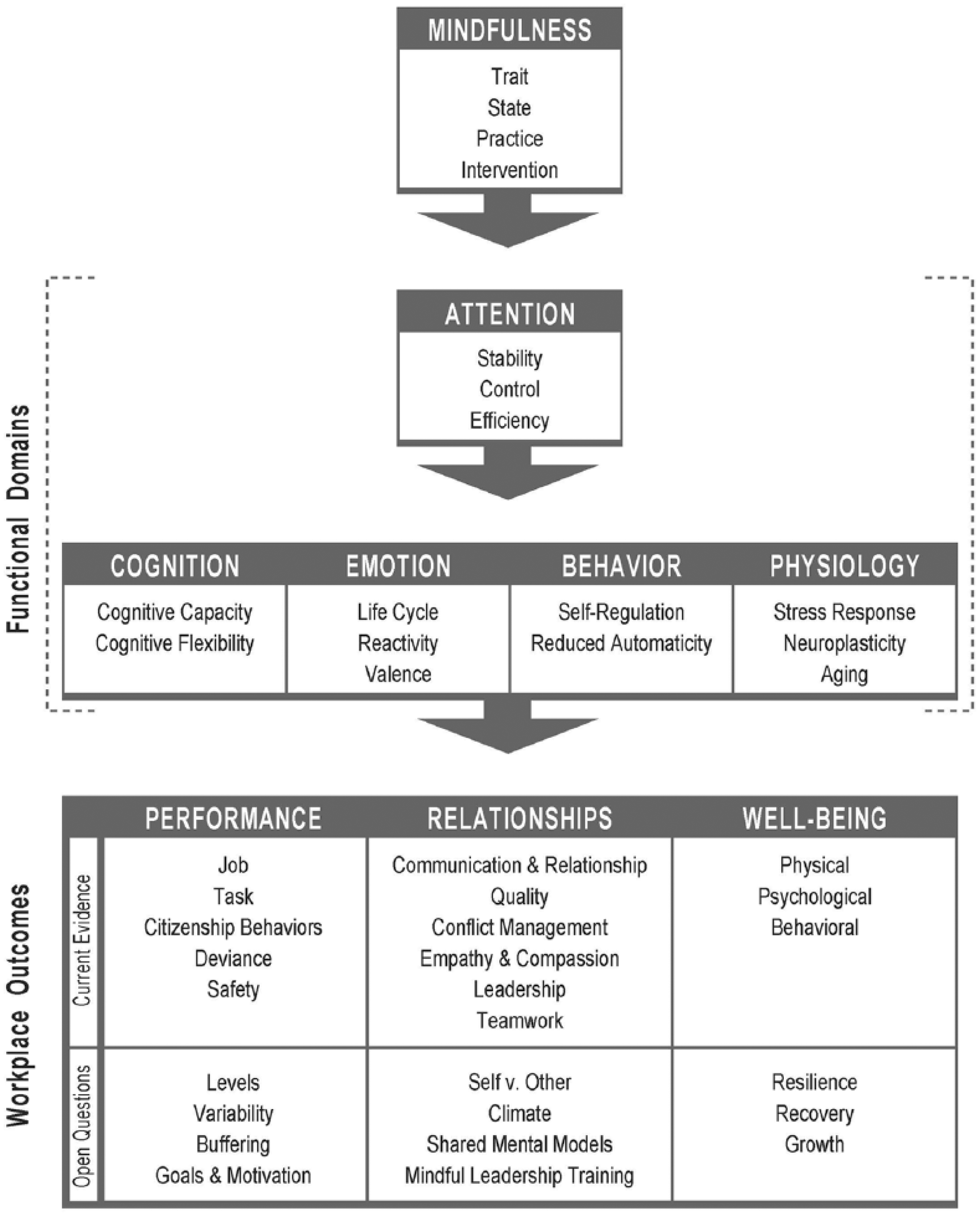
Integrative Framework Relating Mindfulness to Workplace Outcomes
What Is Mindfulness?
Background and definition
Mindfulness has been a central aspect of Buddhist mental training for centuries. Mindfulness training began to draw attention in the late 1970s as a therapeutic tool to help medical patients manage chronic illness (Kabat-Zinn, 2003). Two decades later, Weick and Roberts (1993), inspired by Langer and colleagues’ research (e.g., Langer, 1989), introduced mindfulness into the management literature, but their conception of mindfulness as cognitive flexibility and attention to novelty is largely distinct from Buddhist conceptions.
Classical Buddhist accounts of mindfulness highlight clear-minded attention to and awareness of what is perceived in the present (Quaglia, Brown, Lindsay, Creswell, & Goodman, 2015). The terms attention and awareness are important to understanding mindfulness as their integration helps to distinguish mindfulness from related states. Attention by itself may be focused, but only when coupled with meta-awareness—an apprehension of the current state of the mind that monitors that focused attentiveness—does it become mindful (Dreyfus, 2011).
Because the concept of mindfulness as we discuss it here emerged from Buddhist philosophy and because it is an internal state that is difficult to observe and describe, a consensual definition of the phenomenon has been elusive. In this review, we theorize that in simple terms, mindfulness is a “receptive attention to and awareness of present events and experience” (Brown et al., 2007: 212; Quaglia, Brown, et al., 2015). This definition reflects a common classical understanding of mindfulness but leaves considerable ambiguity for understanding how mindfulness intersects with workplace functioning.
One way to understand mindfulness at work is to contrast the conceptual processing that is central to organizational life (Walsh, 1995) with the experiential processing (Brown et al., 2007; Teasdale, 1999) that is a hallmark of mindfulness. In a conceptual processing mode, thought tends to dominate attention. As we encounter stimuli throughout the day, thought rapidly operates to evaluate and interpret what is perceived. When thought is turned inward to operate upon itself—termed metacognition—a common expression of this mode of processing is to dwell on mental content in an attempt to understand, work through, or resolve what occupies the mind, especially when it has personal importance; that is, self-concern is a reference point in interpreting what has, is, or will occur. In addition, conceptual processing is often recurrent or repetitive, taking forms such as worry or rumination (Watkins, 2008). In sum, conceptual processing involves interpreting stimuli in a way that is abstract, evaluative, and biased toward self-concerns (Leary, 2004; Watkins, 2008).
In contrast, mindfulness involves experiential processing (Brown et al., 2007; Teasdale, 1999), which involves attention to the internal (e.g., thought, emotion) or external stimulus itself in a registering of the facts observed. Experiential processing permits the individual to attend to a stimulus as it is, without immediate attempts to derive meaning from it, which are often of a habitual nature. In experiential processing, common psychological content—mental images, self-talk, emotions, impulses to act, and so on—can be observed as part of the ongoing stream of consciousness. This mode of processing has been referred to as “decentering,” as it involves attending to experiences within a wider context of awareness (e.g., to view thoughts as just thoughts); stimuli and resulting reactions to them are observed rather than habitually interpreted with positive or negative implications for the self (Brown et al., 2007). For example, in moment-to-moment contact with a threatening stimulus, such as an angry or abusive boss, the internal experience of fear, anger, or other reactions is observed in its cognitive, emotional, somatic, and conative manifestations (e.g., awareness of one’s interpretations of the outburst, of fear arising, of the heart racing, and of a desire to appease).
Awareness of and attention to these reactions affords a degree of mental distance or disengagement from self-relevant evaluations. With the capacity to witness events, thoughts, and emotions as they play out comes an ability to attend to occurrences as concrete phenomena rather than interpreting them in ways biased by personal memories, learned associations, or future projections (e.g., “Here we go again. He is overly emotional and overreacts to everything. I wonder what I did today to set him off. I might as well leave because this is just going to escalate.”). Importantly, mindfulness is not antithetical to evaluation or judgment. Rather, in the state of alert attentiveness that characterizes mindfulness, evaluations, judgments, and associated memories can be closely attended to by a mind that is aware of what is happening moment to moment.
Operationalization
In the research literature, two basic approaches are used for assessing mindfulness: self-report questionnaires and engagement in mindfulness practices (Davidson, 2010). Self-report measures include trait measures (e.g., the Five Factor Mindfulness Questionnaire; Baer, Smith, Hopkins, Krietemeyer, & Toney, 2006; the Mindful Attention Awareness Scale; Brown & Ryan, 2003) and state measures (e.g., Lau et al., 2006). Mindfulness practices include those that focus attention (e.g., to a ready perceptual object like the breath) and those that permit open monitoring of various sensory stimuli (e.g., as can be done in mindful movement; Lutz, Slagter, Dunne, & Davidson, 2008). These practices are often bundled into training programs, such as the well-validated Mindfulness-Based Stress Reduction program (MBSR; Kabat-Zinn, 2003), which includes lecture, discussion, and practice and has been adapted for the workplace (e.g., Hülsheger, Alberts, Feinholdt, & Lang, 2013). Such workplace interventions tend to be shorter (a few hours to six weeks), but they include similar mindfulness training exercises, such as mindful eating or scanning the body to notice various sensations that might be present. The focus of mindfulness training programs is on developing awareness of thoughts, emotions, and physiological reactions via daily practices. In the literature, programs that train in these practices as well as experiences with the practices themselves (e.g., lifetime meditation hours) are used as proxies for mindfulness.
Throughout this article, we refer to the mindfulness operationalization used by authors in reference to specific studies (e.g., trait mindfulness or mindfulness training), but when discussing results in aggregate, we use the term mindful individuals to describe those higher in self-reported mindfulness, participating in mindfulness practices and training, and with high levels of lifetime meditation practice; we use the term mindfulness when referring to the cognitive phenomenon itself.
Impact of Mindfulness on Human Functioning
To fully understand how mindfulness might affect individuals, teams, and organizations, it is important to first consider its basic effects on major domains of human functioning, including attention, cognition, emotion, behavior, and physiology (see Figure 1). 1 Emerging research shows that enhanced functioning in these domains may mediate diverse workplace outcomes (e.g., Mrazek, Franklin, Phillips, Baird, & Schooler, 2013; Quaglia, Goodman, & Brown, 2015), and therefore we review them in detail.
Attention
Mindfulness is theorized to affect human functioning primarily through attention, which then alters other domains of basic functioning (see Figure 1). Mindfulness has been shown to improve three qualities of attention—stability, control, and efficiency. Mindfulness can support attentional stability. The human mind is estimated to wander roughly half of our waking hours (Killingsworth & Gilbert, 2010), but mindfulness can stabilize attention in the present (Smallwood & Schooler, 2015). Dispositional mindfulness (Mrazek, Smallwood, & Schooler, 2012) and mindfulness training ranging from a few (Mrazek et al., 2013) to thousands of hours (Brewer et al., 2011) have been associated with reduced mind wandering. Individuals who completed mindfulness training were shown to remain vigilant longer on both visual (MacLean et al., 2010) and audio (listening) tasks (Lutz et al., 2009). Experienced meditators also show reduced activation in the neural network indicative of mind wandering (Brewer et al., 2011) and brain activity patterns consistent with sustained attention (Pagnoni, 2012). Increased attentional stability may stem from noticing mind wandering and returning to present-moment focus, a core feature of mindfulness (Hasenkamp, Wilson-Mendenhall, Duncan, & Barsalou, 2012).
Attentional control refers to appropriately directing attention amid competing demands (Ocasio, 2011). Evidence suggests that mindfulness supports attentional control by reducing habitual allocation of attention (Wadlinger & Isaacowitz, 2011) and reducing attention to distracting information. Studies have found meditators to be less distractible (Tang et al., 2007), even when distractions are emotional in nature (Allen et al., 2012). Neurological evidence supports these findings, as brain wave activity suggests more effective identification of and disengagement from distractions among long-term meditators (Cahn, Delorme, & Polich, 2013).
Mindfulness also supports attentional efficiency, the economical use of cognitive resources (Neubauer & Fink, 2009; Slagter et al., 2007). When mindfulness increases attentional control and lessens attention to off-task thoughts or activities, attention becomes more efficient. Research shows that meditators spend fewer attentional resources processing distractions (Cahn & Polich, 2009) and do not overinvest attention to an initial stimulus, which enables faster detection of subsequent stimuli (Slagter et al., 2007). Expert meditators report that attention takes less effort (Tang, Hölzel, & Posner, 2015), and fMRI scans show that they use fewer resources in brain areas linked to executive attention (Kozasa et al., 2012; Lutz et al., 2009).
In summary, mindfulness has been associated with improved attentional stability (sustaining attention on a current target with less mind wandering), better control of attention (selecting appropriate targets from among a field of potential targets), and attentional efficiency (economical use and allocation of attentional resources). These qualities of attention are theorized to influence cognitive, emotional, behavioral, and physiological domains of functioning (see Figure 1).
Cognition
There is considerable research linking mindfulness and attentional qualities to cognitive performance (e.g., Smallwood & Schooler, 2015), including cognitive capacity and cognitive flexibility. Although general mental ability is typically viewed as a stable individual difference (Kane & Engle, 2002), working memory and fluid intelligence are more malleable aspects of cognitive capacity. Working memory acts as a short-term buffer for holding and processing information that links attention and higher-order cognition (Baddeley, 1992). A series of intervention studies conducted in diverse populations (e.g., soldiers, students, teachers) suggests that mindfulness increases working memory capacity (e.g., Roeser et al., 2013). Dispositional mindfulness has also been associated with working memory capacity even after controlling for general intelligence (Ruocco & Direkoglu, 2013). Both brief (Tang et al., 2007) and lifelong (Gard et al., 2014) mindfulness training also may benefit fluid intelligence, the ability to process and respond to novel information by assessing patterns and relationships.
Mindfulness has also been associated with flexible cognition, which supports adaptation via the generation of novel perspectives and responses (Walsh, 1995). Meditation experience has been linked to creativity and divergent and convergent thinking (Colzato, Ozturk, & Hommel, 2012), and both trait mindfulness and mindfulness training have predicted better insight problem solving (Ostafin & Kassman, 2012). Ding et al. (2015) found that participants randomly assigned to a brief mindfulness training were more likely to search for new perspectives when stuck on a problem, and their neural patterns suggested the cognitive flexibility was due to greater attentional control. Considered as a whole, these results suggest that mindfulness increases cognitive capacity and flexibility, at least in part via its effects on attention.
Emotion
Emotions are the result of evaluative reactions to observed stimuli that serve to catalyze behavior (Frijda, 1988). Mindfulness appears to influence emotions via attention, which influences selection of stimuli for observation, and alters how they are evaluated and appraised, ultimately shaping downstream emotional reactions (Killingsworth & Gilbert, 2010; Wadlinger & Isaacowitz, 2011). Mindfulness may alter the lifecycle of emotional reactions as well as the overall valence of emotional experience (Desbordes et al., 2014).
Emotional reactions exhibit a lifecycle (Davidson, 1998), and mindfulness appears to shorten that cycle, reducing the time to reach peak emotional arousal and return to baseline. In two studies, mindfulness sped recovery from negative emotions after both a mood induction (Keng, Robins, Smoski, Dagenbach, & Leary, 2013) and public speaking (Brown, Weinstein, & Creswell, 2012). Mindfulness training has also produced a shorter time to peak arousal in a sample of patients with social anxiety (Goldin & Gross, 2010).
Related to this, mindfulness also appears to influence reactivity to emotional stimuli. Dispositionally mindful individuals have shown reduced negative affect after stressors (Arch & Craske, 2010), a finding consistent with studies showing less threat-related neural activation among mindful individuals who viewed faces expressing negative emotions (e.g., fear, anger; Creswell, Way, Eisenberger, & Lieberman, 2007). Most studies examine responses to negative emotional stimuli, but neurological studies of trait mindfulness and both long-term and novice meditators suggest mindfulness also dampens emotional reactions to positive stimuli (Brown, Goodman, & Inzlicht, 2013; Desbordes et al., 2012; Taylor et al., 2011).
Reduced reactivity to emotional stimuli may be explained by shifts in emotional appraisal fostered by mindfulness. Stimuli are habitually evaluated as positive or negative for the self (Frijda, 1988), but mindful-experiential processing may promote more neutral evaluations, in which experiences are viewed without habitual self-reference. As mindful individuals more objectively observe their experiences, a decoupling of the brain networks underlying sensory processing and narrative self-processing appears to occur, providing a degree of psychological distance (Farb et al., 2007; Hülsheger et al., 2014).
Mindfulness has been implicated not only in emotional reactivity but also general emotional tone. Emotional tone or valence refers to the overall positivity or negativity of emotions, and the attentional presence that characterizes mindfulness may inhibit habitual mental “time travel” into the perceived past and future that can lead to negative emotions (e.g., regret about past experiences, anxiety about anticipated futures). Indeed, a recent meta-analysis showed that mindfulness trainings are associated with less negative and more positive emotional tone (Eberth & Sedlmeier, 2012), which may be important to day-to-day workplace climate.
Behavior
Glomb et al. (2011) argue that mindfulness confers superior self-regulation of behavior that shapes workplace functioning. The shared conceptual space between mindfulness and self-regulation is not surprising given that attention to ongoing events and experiences underlies multiple theories of motivation and self-regulation, including self-determination theory (Deci & Ryan, 1985) and control theory (Carver & Scheier, 1982).
A key mechanism linking mindfulness to superior self-regulation of behavior is reduced automaticity, the effect of which is a mental gap between stimulus and behavioral response. Automaticity is the ability to effortlessly engage in behaviors without conscious oversight of their operational details and thus has adaptive benefits for information processing when, as is often the case, cognitive capacity is constrained (Bargh & Chartrand, 1999). Yet it also means that stimuli are rarely seen impartially; rather, they are viewed through the filters of prior conditioning and habits. By fostering awareness of automatic operations and habitual behaviors (i.e., experiential processing), mindfulness provides a degree of choicefulness over whether to allow the automatic responses to run or to consciously regulate behavior in the service of more adaptive outcomes.
Empirical research on health-related behavior illustrates the role of mindfulness in changing behaviors with deeply ingrained, often automatized behavior, such as addiction. For example, mindfulness practice has been shown to help individuals quit smoking by reducing cigarette cravings (Westbrook et al., 2013) and by breaking the connection between craving and smoking (Elwafi, Witkiewitz, Mallik, Thornhill, & Brewer, 2013). Exploring the neural correlates of this training effect, Tang, Tang, and Posner (2013) found higher activations in brain regions associated with behavioral self-control, which coincided with reduced cigarette craving. Mindfulness has been linked to other aspects of behavioral health as well, including reduced sexual and eating compulsions (Papies, Pronk, Keesman, & Barsalou, 2014). The processes involved here are unclear, but mindful attention is thought to create a gap between stimulus (e.g., “I want a cigarette”) and the habitual response (to smoke), which enables choicefulness and consequently, more effective behavioral regulation (e.g., “I’ll go for a walk instead”).
Physiology
In addition to effects on cognition, emotion, and self-regulation of behavior, mindfulness also has physiological impacts. Given our focus on work settings, we only briefly review this line of research, though we believe it has potential for better understanding the role of mindfulness in organizational phenomena in the future.
One of the strongest empirical findings linking mindfulness to physiology is its role in the stress response. Mindfulness is related to numerous neurobiological mechanisms involved in stress regulation (Creswell & Lindsay, 2014), including dampened stress reactions (e.g., less elevated cortisol) in response to a variety of cognitive and social threats and faster recovery to baseline levels (Brown et al., 2012). These effects have been linked both to dispositional mindfulness and mindfulness training and outcomes like improved sleep quality (Hülsheger et al., 2014).
Mindfulness has also been associated with changes in the brain, referred to as neuroplasticity, including structural transformations of brain tissue (e.g., shrinking the amygdala; Hölzel et al., 2010) and functional transformations in patterns and regions of activation (Brewer et al., 2011). Meta-analysis links mindfulness training to alterations in brain regions associated with attention, memory, self, and emotion regulation (Fox et al., 2014). Indeed, the brain structures of mindfulness practitioners are so distinct, they can be accurately identified via brain scan (Sato et al., 2012).
More broadly, mindfulness has been implicated in the aging process, with preliminary evidence suggesting that mindfulness training may “slow, stall, or even reverse age-related brain degeneration” (Luders, Cherbuin, & Kurth, 2015: 1). Those authors found that experienced meditators showed fewer age-related degradations in neural tissue (Luders et al., 2015) and slower declines in fluid intelligence (Gard et al., 2014). Mindfulness may also influence aging-related cellular processes; it has been linked to disease resistance (Davidson et al., 2003), epigenetic expression corresponding to reduced inflammation and stress hormones (Kaliman et al., 2014), and telomerase activity, a biomarker of DNA health (Schutte & Malouff, 2014).
Integration Into Workplace Research
These broad effects of mindfulness on the functional domains of attention, cognition, emotion, behavior, and physiology appear to influence a wide variety of workplace outcomes (e.g., Akinola, 2010; George, 2000; Lord, Diefendorff, Schmidt, & Hall, 2010; Ocasio, 1997; Walsh, 1995). As depicted in Figure 1, we propose that these mechanisms influence three clusters of outcomes: performance, relationships, and well-being. For each cluster, we: (a) briefly review evidence from available studies of workplace populations, (b) leverage the mindfulness literature outside of management to generate new insights, and (c) identify key next steps that will further advance research on mindfulness within the cluster.
Workplace Outcomes: Performance
Accumulating evidence suggests the influence of mindfulness on a range of performance categories, including job, task, citizenship behaviors, deviance, and safety performance (see Figure 1). Trait mindfulness has been associated with job performance among restaurant servers (Dane & Brummel, 2014) and supervisors (Reb, Narayanan, & Chaturvedi, 2014). A link between academic performance (overall GPA among MBA students) and trait mindfulness was also found, but only for women (Shao & Skarlicki, 2009). Middle managers receiving mindfulness training exhibited large improvements in supervisor-rated job performance compared to their initial performance and to that of a control group (Shonin, Gordon, Dunn, Singh, & Griffiths, 2014).
Similar results have been found among health care workers. For example, Beach et al. (2013) found that higher clinician trait mindfulness was associated with more favorable patient ratings of communication quality and overall satisfaction. Similarly, a mindfulness intervention improved the family-friendliness of admissions treatment teams (Singh et al., 2002). Finally, psychotherapists trained in mindfulness appeared to perform in ways that benefited patient outcomes as the patients reported more favorable symptom outcomes, such as reduced anxiety and hostility, relative to patients of control group therapists (Grepmair et al., 2007).
Preliminary research has linked mindfulness to elements of performance—specifically, ethical, prosocial, and deviant behavior. Reb, Narayanan, and Ho (2015) found that trait mindfulness was related to higher ethical and prosocial behavior and lower deviance. Krishnakumar and Robinson (2015) also found a link between trait mindfulness and lower counterproductive behaviors, an effect that was mediated by reduced hostile feelings.
Two studies suggest that mindfulness may also be linked to safety performance. In a study of nuclear power plant employees (Zhang, Ding, Li, & Wu, 2013), a significant positive association between trait mindfulness and self-reported safety was found among workers responsible for complex tasks (control room operators). A follow-up study replicated this finding, with the strongest association among more experienced and intelligent workers (Zhang & Wu, 2014). In summary, the initial evidence supports a role for mindfulness on work performance, but more experimental evidence is needed, and occupation, task characteristics, and context may be important boundary conditions to explore.
Open Questions: How Might Mindfulness Influence Work Performance?
Despite emerging evidence, questions remain about how and why mindfulness predicts work performance (see Figure 1). Empirical evidence suggests that mindfulness may influence performance in multiple ways, including: (a) improving performance levels, (b) reducing performance variability, (c) buffering performance in disruptive or threatening contexts, and (d) influencing goals, goal-directed behavior, and motivation.
Performance levels
Currently, a leading theory of mindfulness in relation to task performance is Dane’s (2011) contingency theory, based on the assumption that mindfulness widens attentional breadth (e.g., seeing more peripheral stimuli and being less focused on a specific target). This quality makes it valuable for experts in novel contexts but detrimental for novices in routine contexts. Based on evidence reviewed earlier, we agree with his general proposition that the value of mindfulness for performance is largely contingent on attentional qualities; further, these qualities, described by Dane and in our framework, are undoubtedly valuable in complex, dynamic environments.
However, the attentional qualities in our model (i.e., stability, control, and efficiency) yield alternative predictions for how mindfulness affects performance and suggest the positive effects may be more generalized, even to routine contexts. Through effective control and stability of attention to current, task-relevant information, individuals should generally exhibit better task performance. For example, efficient attention implies reduced attentional costs, suggesting that mindfulness allows for more stable and controlled attention in routine contexts where individuals are prone to errors due to attention lapses. Mindfulness may reduce errors by reducing such lapses (Smallwood & Schooler, 2015). Further, the cognitive, emotional, physiological, and behavioral changes described in the framework may be key mechanisms to promote performance. Fluid intelligence (Postlethwaite, 2011), positive emotional tone (Miner & Glomb, 2010), and attenuated stress responses (Hunter & Thatcher, 2007) have all been shown to enhance task and job performance in organizational settings.
Given the multiple pathways to performance, it is tempting to posit that mindfulness will have global, positive effects on performance. However, much of the research on performance has looked at effects without careful exploration of the mechanisms driving performance. Also absent are questions about the task and contextual features that may significantly interact with mindfulness in predicting performance. Future research should address not only the overall relation between mindfulness and performance levels but propose contingency theories hypothesizing how specific mechanisms may contribute to performance in specific contexts.
Performance variability
Mindfulness may also be key to understanding within-person performance variability. There is growing appreciation of the importance of performance variability, particularly catastrophic minimum performances labeled troughs (Dalal, Bhave, & Fiset, 2014). Within-person variance has been found to account for 39% to 64% of performance variation, influenced by attention, aging, negative and positive emotions, sleep, and self-control (Dalal et al., 2014; Mullins, Cortina, Drake, & Dalal, 2014), which have been associated with mindfulness. Stability of attention and superior regulation of behavior resulting from mindfulness may be important mechanisms in reducing troughs and performance variability. An open and provocative question is whether mindfulness operates on both sides of the variability equation by reducing both performance troughs as well as performance peaks. Future research should examine the role of mindfulness in the interplay of performance level and variability, especially in contexts in which high performance variability can be readily captured.
Performance buffering
Mindfulness may also buffer workplace performance from a variety of potentially disruptive factors that can appropriate attention. By stabilizing and controlling attention and by augmenting cognitive capacity and flexibility, mindfulness may promote dexterity in responding to environmental turbulence and discontinuity. With increased cognitive capacity, mindful workers will have expanded cognitive resources and may be able to deploy them more effectively in distracting environs. For example, soldiers receiving mindfulness training were shown to maintain greater attentional stability than controls during intensive pre-deployment training (Jha et al., 2015).
Modern workplaces are commonly full of interruptions and distractions that can challenge attentional control and harm occupational functioning (Jett & George, 2003). For example, nurses face up to 14 interruptions an hour (Trbovich, Prakash, Stewart, Trip, & Savage, 2010); each is associated with a 12% increase in errors (Westbrook, Woods, Rob, Dunsmuir, & Day, 2010). Interruptions leave a “residue” of attention (e.g., thinking about the prior stimulus rather than the present one) that can hamper subsequent performance, but five minutes of mindfulness practice has been shown to reduce this residue on simple tasks (Kuo & Yeh, 2015). Mindful individuals may be better able to disengage from thoughts and emotions about the interrupting task or event (Long & Christian, 2015) and enable sustained engagement with intended tasks.
Internal distractions might also be managed with mindfulness. For example, one common internal disruption is identity threat; stereotype research literature documents reduced performance among individuals who fall within identity categories stereotypically linked to poor performance (e.g., women are poor at math). A five-minute mindfulness induction was shown to eliminate this math performance effect (Weger, Hooper, Meier, & Hopthrow, 2012). Emotional stressors at work can also inhibit performance. Through reduced re-activity to and quicker recovery from emotional threats, Kirk, Downar, and Montague (2011) found that mindfulness trainees buffered decrements in an emotionally charged environment.
Research in emotionally charged, distracting, or intense workplace contexts will be needed to examine the buffering effects of mindfulness. Particularly illuminating would be field experiments investigating the role of mindfulness interventions in buffering performance during periods of emotional intensity (e.g., in the context of imminent layoffs), in distracting performance environments (e.g., busy customer settings), and among employees whose task performance depends on close attention, such as those responsible for detecting rare signals (e.g., Hollenbeck, Ilgen, Tuttle, & Sego, 1995), or performing routine tasks (Smallwood & Schooler, 2015).
Goals and motivation
The external research on mindfulness also suggests intriguing questions about whether mindfulness detracts from or is conducive to goal pursuit. On one hand, mindfulness implies a sense of non-striving and attention to present-moment events (Williams, 2008); these properties may seem at odds with the future orientation of goal setting and its associated outcomes. Yet, brain imaging research indicates that mindfulness trainees are less impacted by extrinsic rewards (i.e., money; Kirk, Brown, & Downar, 2015) that are often tied to workplace goal accomplishment, but these trainees showed no task performance decrements relative to matched controls.
On the other hand, mindfulness may support goal pursuit through improved attentional and motivational properties. Although mindfulness involves non-striving, it should not be confused with passivity. Indeed, autonomous motivation—that is, the drive to pursue activities perceived as important, valued, or enjoyable—appears to be higher among mindful individuals (e.g., Brown & Ryan, 2003; Levesque & Brown, 2007). Autonomously motivated action tends to be more satisfying, is persisted at longer, and shows greater success than action that is extrinsically motivated (e.g., Ryan & Deci, 2000). In line with this, self-regulation of behavior (e.g., smoking cessation) is improved with mindfulness, perhaps through goal pursuit driven by more autonomous motivation.
People who are mindful may also respond less intensely to goal feedback. Given its role in reducing emotional reactivity, mindfulness may lead to shorter and less intense emotional reactions following positive feedback and success, which have been shown to increase goal levels (Ilies & Judge, 2005). Yet, reduced reactivity may benefit mindful individuals when goal feedback is negative; these individuals may be less likely to self-criticize because they are less identified with self-relevant outcomes (Vago & Silbersweig, 2012). Mindful individuals may also be less likely to have past- or future-oriented emotional responses to goal failure (e.g., guilt or embarrassment).
Precisely how mindfulness relates to aspects of the goal process is understudied, but future research with goal paradigms could investigate the links between goal establishment, pursuit, and attainment as a function of mindfulness. For example, goal paradigms in lab experiments could examine the impact of brief mindfulness interventions on task performance with manipulations of feedback valence (i.e., positive or negative) and degree of self-relevance. Lab studies might also explore whether attentional and emotional reactivity processes mediate such effects. Companion field experiments would be particularly informative. Researchers could pair a goal-setting intervention with a mindfulness or active control condition to detect whether and how mindfulness influences goal setting and the influence of goal feedback on performance. A sales workforce setting may be particularly appropriate to track the effects of mindfulness on reactions to goal attainment and to feedback over time.
Workplace Outcomes: Relationships
Many core areas of organizational science and practice are inherently relational, including leadership, teamwork, inter-firm partnerships and coordination, trust, psychological safety, communication, conflict, and social networks. Relationships with supervisors and managers are among the most important relationships we have at work (Dienesch & Liden, 1986), and work in groups often depends on effective cooperation and coordination between members (Mathieu, Heffner, Goodwin, Salas, & Cannon-Bowers, 2000).
Although mindfulness is an individual quality, initial evidence suggests that it affects interpersonal behavior and quality of dyadic and workgroup relationships (see Figure 1). For example, both dispositional mindfulness and mindfulness training among health care practitioners relate to improved communication quality, including open listening with increased awareness and less evaluative judgment of others (Beckman et al., 2012), as well as better client-rated relationship quality (Beach et al., 2013). Reb and colleagues (2014) found that leaders’ dispositional mindfulness was associated with more favorable subordinate attitudes and behaviors via improved relationship quality. Through better self-regulation of undesirable responses to negative work events, dispositional mindfulness and mindfulness training may improve relationships; in an initial pair of studies, both moderated reactions to injustice, including reduced rumination, negative emotion, and retaliation (Long & Christian, 2015).
The broader literature outside of management settings, primarily from studies of intimate partners, also provides evidence for the positive effects of mindfulness on relationship quality. Pathways through which mindfulness might improve relational functioning are diverse, including greater attention to others, better communication, reduced conflict, reduced emotional reactivity, and greater expression of other-directed emotions, such as compassion and empathy. Trait mindfulness among intimate partners has been linked positively to relationship quality (Quaglia, Goodman, et al., 2015; Wachs & Cordova, 2007) and stability (Saavedra, Chapman, & Rogge, 2010). Likewise, couples who participated in mindfulness training showed improvements, compared to controls, in relationship quality and functioning, including relationship satisfaction, relatedness, closeness, and acceptance of the partner (Carson, Carson, Gil, & Baucom, 2004).
Mindfulness may improve relationships via sustained attention to interaction partners, which improves communication and increases the capacity to communicate emotional information (Wachs & Cordova, 2007). State mindfulness was associated with better communication quality between intimate partners, as rated by experts (Barnes, Brown, Krusemark, Campbell, & Rogge, 2007). In addition, individuals higher in trait mindfulness were better able to maintain a positive tenor and had reduced emotional reactions during partner conflict (Barnes et al., 2007); they have also exhibited less hostility (Saavedra et al., 2010) and anger (Wachs & Cordova, 2007).
Mindfulness also may improve relationships through greater empathy and compassion. Related research supports an association between trait mindfulness and empathy (Dekeyser, Raes, Leijssen, Leysen, & Dewulf, 2008). In a novel study (Condon, Desbordes, Miller, & DeSteno, 2013), participants randomly assigned to a mindfulness-based stress reduction program exhibited greater compassion than controls. When a confederate—walking with crutches and visibly suffering—entered a full waiting room, half of those who completed mindfulness training offered their seats, compared to fewer than 20% of the wait-group controls.
In summary, attentional and emotional processes influenced by mindfulness, such as more stable attention, reduced emotional reactivity, and more positive emotional tone, may be key to understanding the beneficial effects for relationships. In addition to its effects on relationships more generally, mindfulness may also affect workplace processes that rely on effective working relationships; we focus on leadership and teamwork.
Leadership
Despite its importance to management, leadership has not been extensively studied by mindfulness researchers. In existing work, the focus has not been directly on the relationship between leaders and followers but rather on the beneficial role of individual mindfulness for leaders and their subordinates. Reb et al. (2014) found leaders’ trait mindfulness was positively associated with employees’ work-life balance, job satisfaction, citizenship behaviors, and job performance and negatively related to employee exhaustion and deviance; psychological need satisfaction mediated many of these associations. Another study (Liang et al., in press) found that dispositional mindfulness among supervisors reduced the likelihood that hostility toward subordinates would be expressed as abuse; the authors attributed this finding to supervisors’ increased attention to and awareness of their hostility as well as superior self-regulatory capacity.
Teamwork
It has been clearly established in the management literature that social processes play a central role in team performance (Mathieu et al., 2000), but the few published studies on mindfulness and relational team processes are found outside the management literature, especially in health care. For example, Singh, Singh, Sabaawi, Myers, and Wahler (2006) implemented a mindfulness-based mentoring intervention in multidisciplinary therapeutic treatment teams. They observed process improvements in team meetings, including more active listening, more patient-focused discussion and collaboration, and greater respect among team members; these effects remained one year later. In another study using student groups without formal leaders, teams benefited from randomization to a short mindfulness induction in showing increases on measures of both cohesion and collective performance (Cleirigh & Greaney, 2014).
Another way that mindfulness may support relational team processes, such as cohesion, is through better conflict management. As already noted, state mindfulness has been associated with less aggressive communication during romantic partner conflicts (Barnes et al., 2007). Mindfulness training may bolster perspective-taking (Krasner et al., 2009), which has been found helpful for negotiation (Galinsky, Maddux, Gilin, & White, 2008) and may be beneficial for resolving task conflict.
We speculate that mindfulness may also affect team functioning by modulating the emotional tone of the team. Because, as already discussed, mindful individuals appear to be less reactive to negative events and recover from negative emotions more quickly, they may influence collective moods and reduce emotional contagion. During conflict, individuals with high dispositional mindfulness exhibit more positive tenor, reduced emotional reactions (Barnes et al., 2007), and less hostile behavior (Saavedra et al., 2010). Effective teamwork may also benefit from controlled and stable attention, which serves as the basis for the effective coordination and shared mental models (Metiu & Rothbard, 2012).
Open Questions: How Might Mindfulness Affect Teamwork and Leadership?
Research in neuropsychology, cognitive psychology, medicine, and related disciplines has laid the groundwork for developing and testing theory about how mindfulness might affect relational processes, such as teamwork and leadership, but management scholars have not yet seriously undertaken that challenge. Although there are myriad questions that could be addressed, we focus on four central issues (see Figure 1).
Self-orientation versus other-orientation
Our review suggests that mindfulness leads to increased other-orientation, facilitating the experience and expression of prosocial behavior, but the ramifications of this change on workplace functioning are unknown. The literature provides evidence that mindfulness leads individuals to process events and occurrences in a less self-referential or ego-involved way, which fosters greater attentiveness to and care for others and a stronger focus on interpersonal concerns rather than self-concerns. This could lead to more compassionate behavior but also potentially interfere with decision making oriented to maximize profits, such as enacting layoffs. Yet, mindful individuals need not lose motivation for self-gain or self-care. Reb and Narayanan’s (2014) negotiation studies are illustrative, showing that negotiators randomized to short mindfulness interventions (a raisin eating exercise) were more successful in distributive negotiations. These effects were speculatively attributed to mindful attention (e.g., increased focus on task and partner cues, less distraction), which may have enabled greater self-gain. Future research might explore underlying questions of whether contextual factors like power or competition lessen the effect of mindfulness on concern for others or if mindful concern for others trumps circumstances.
Climate: Safety, voice, and trust
One of the ways that mindfulness might influence team and organizational functioning is by its effects on workplace climate. When high-quality relationships, characterized by emotional carrying capacity, resilience to setbacks, and openness to new ideas (Dutton & Heaphy, 2003), are developed, an environment of psychological safety can emerge, enhancing employees’ use of “voice” (Fast, Burris, & Bartel, 2014). In addition, as mindful leaders engage in nonjudgmental ways with employees, they may induce trust (Mayer, Davis, & Schoorman, 1995) and psychological safety, both of which encourage error correction and learning (Edmondson, 1999).
From the standpoint of employees, mindfulness may increase voice by creating separation between events and outcomes and the self. Mindful employees may be less worried about how organizational leaders will react to their ideas since acceptance or rejection of the idea does not imply rejection of the person. Research associating mindfulness and climate aspects, such as the expression of and reactions to voice behavior, would be insightful.
Shared mental models
How would mindfulness at the individual or team level influence the team’s ability to develop and use shared mental models? Mental models are organized knowledge structures—such as schemas—that facilitate recognition and remembering of events and experiences and enable explanation and prediction (Mathieu et al., 2000). Effective team mental models have two properties: similarity (team members have similar knowledge structures) and accuracy (mental schema accurately represent facts); they facilitate teamwork and performance, especially in high-performance teams, such as flight crews and medical teams (Mohammed, Ferzandi, & Hamilton, 2010). It is possible that the qualities of attention affected by mindfulness would lead team members to be more aware of others’ tasks and characteristics, helping with the development of shared and accurate mental models. However, brain scans reveal reduced conceptual processing of events and experiences for meditators (Pagnoni, Cekic, & Guo, 2008); mindfulness practices therefore make it less likely that an individual will tie experiences to the past or to team identities. Thus, mindfulness may both improve the development of shared mental models and reduce the extent to which such models affect decisions and behavior.
This question could be addressed by a study examining the effects of mindfulness on the development of individual mental models as well as the extent to which they were accurate and similar to others in the team (per Lim & Klein, 2006). In addition to influencing the content and structure of mental structures, mindfulness may also moderate the association between team mental models and team cohesion and performance.
Mindful leadership training
As noted in our introduction, mindfulness training is popular in the business world as a component of leadership training. Anecdotally, participants in such training report benefits like enhanced listening ability, ability to think strategically, and increased innovation. Yet these anecdotes are not yet supported by empirical research. What is needed is more rigorous experimental or quasi-experimental field research in which, for example, leaders are randomly assigned to either routine corporate leadership training or a mindful leadership training that are comparable in time and intensity. Pre- and post-training assessments of both groups might include others’ (peers, bosses, etc.) observations of emotional reactivity, attention to and compassion for others, or individual and team creativity. Changes in team or organizational climate should also be studied to detect whether the effects of mindful leaders cascade throughout organizations. Moreover, these studies should also examine precisely how mindfulness affects outcomes by linking it to cognitive, emotional, and self-regulatory processes.
One such investigation that may be particularly fruitful is assessing whether mindfulness benefits aspects of transformational leadership like individualized consideration, which involves attention to individuals, listening openly, and mentoring (Judge & Piccolo, 2004). The improvement in attention qualities conferred through mindfulness may give leaders richer perception of followers’ needs. One way that leaders high on dispositional mindfulness may build high-quality relationships is by attending to the needs of followers, thus providing them with relational support that leads to employee flourishing (e.g., Colbert, Bono, & Purvanova, in press). Related to this, Quaglia, Goodman, and Brown (in press) found that trait mindfulness corresponded with greater attention control, which in turn predicted superior facial recognition. This research suggests that mindful leaders may be more attuned to followers’ ongoing nonverbal communication and emotional states, enabling greater discernment of individual differences and needs.
Workplace Outcomes: Well-Being
Employee well-being can be broadly defined as “the overall quality of an employee’s experience and functioning at work” (Grant, Christianson, & Price, 2007: 52). It comprises psychological, physical, and behavioral aspects and both hedonic (e.g., employee mood) and eudemonic (e.g., resilience) facets (Ryan & Deci, 2001). Given this, it is not surprising that well-being is a major outcome of interest among mindfulness researchers and a major driver of its integration into corporate life. A growing body of evidence indicates that employee well-being is associated with significant benefits to employee and organizational performance via its effects on employee physical and psychological health, absenteeism, turnover, and in-role performance (Danna & Griffin, 1999).
Results support a link between both self-reported mindfulness and the practice of mindfulness with well-being (see Figure 1). Meta-analytic evidence suggests mindfulness practices can have a strong impact on a range of well-being outcomes (Eberth & Sedlmeier, 2012). Among working samples, mindfulness and mindfulness-based practices have been linked to reduced levels of reported burnout (Flook, Goldberg, Pinger, Bonus, & Davidson, 2013; Krasner et al., 2009), perceived stress (Roeser et al., 2013), work-family conflict (Allen & Kiburz, 2012), and negative moods (Roche, Haar, & Luthans, 2014), along with greater sleep quality (Hülsheger et al., 2014). Likewise, Hülsheger et al. (2013) examined within- and between-person variation in mindfulness, finding that trait and state mindfulness were positively related to job satisfaction, but trait mindfulness bore a stronger relation. A second study randomly assigned employees to a self-directed mindfulness intervention, which also yielded higher job satisfaction (Hülsheger et al., 2013). These relationships have also been found in a diversity of occupations, including doctors (Krasner et al., 2009), soldiers (Jha et al., 2015), and teachers (Roeser et al., 2013).
While less frequently studied, mindfulness has also shown effects that are more aligned with eudemonic outcomes. Specifically, mindfulness has been linked to the development of self-compassion (Roeser et al., 2013), psychological capital, and resilience across a variety of occupations, including managers and entrepreneurs (Roche et al., 2014), and in extreme contexts, like live combat simulations (Jha, Stanley, Kiyonaga, Wong, & Gelfand, 2010). Dispositional mindfulness has been related to engagement among restaurant servers (Dane & Brummel, 2014), and mindfulness training predicted employee engagement among employees at the Mayo Clinic (West et al., 2014). Mediators of this link found among workplace populations include greater authenticity (Leroy, Anseel, Dimitrova, & Sels, 2013), positive emotions, hope, and optimism (Malinowski & Lim, 2015).
Open Questions: How Might Mindfulness Foster Workplace Well-Being?
Taken together, literature in the psychological and organizational domains suggests that mindfulness can have significant influence on employee well-being, though much of this work has been conducted in fields outside management. Although there is some evidence regarding mindfulness and well-being at work, a number of questions remain. Key among these questions is the mechanisms by which mindfulness influences workplace well-being outcomes. Although there are a multitude of paths and variables researchers may wish to consider, due to space constraints and the volume of work on mindfulness and well-being, in the following, we highlight a few potential pathways in a discussion of one form of workplace well-being: resilience (see Figure 1).
Resilience
Resilience captures the capacity to rebound from adversity, conflict, and failure and to develop as a result of these challenges (Luthans, Avolio, Avey, & Norman, 2007). Resilient employees not only recover but also may grow in the face of adversity. Although relatively new to the organizational literature, resilience is increasingly recognized as a form of psychological capital at work.
As noted earlier, initial work suggests that mindfulness is linked to the development of resilience in certain populations. Exactly how mindfulness fosters resilience is unclear, but we argue that mindfulness may foster resilience through several potential channels. First, mindfulness may allow one to observe potentially toxic workplace events while adopting a “decentered perspective” (Bishop et al., 2004) in response to these stressful external events (i.e., layoffs, office politics, an abusive boss). As a result of this decentered perspective, perceived stressors are experienced as less threatening. For example, an employee who witnesses verbal aggression directed at coworkers typically experiences physiological reactivity and psychological stress. However, experiencing these events with mindful attention could decouple the automatic link between toxic experience and emotional and physiological reactivity, leaving the employee less depleted. Flexible cognition about the event may allow employees to reinterpret the situation. This may involve perception of stressors as challenges that elicit growth—rather than as hindrances—which can be beneficial (e.g., Lepine, Podsakoff, & Lepine, 2005). We assert that by decoupling the external experience (i.e., toxic boss) from automatic physiological and psychological harm, mindfulness fosters the first aspect of resilience—recovery from toxic events.
How might mindfulness foster the second aspect of resilience—growth in the face of adversity? First, a wealth of research shows that exposure to an environmental threat without being overcome by that threat can result in higher levels of well-being than if one had not experienced the threat at all (Neff & Broady, 2011). In other words, experiencing but quickly recovering from exposure to toxic workplace events may indeed make a worker stronger. Second, mindful individuals tend to show greater response flexibility across stressful and adverse situations. As individuals utilize a variety of coping habits successfully, confidence may grow in one’s ability to deal with challenging workplace situations that can lead to greater resilience. While our illustration has a fairly low base-rate (expressed anger), employees face numerous threats at work, ranging from coworker conflict to poor performance evaluations. By decoupling habitual stimulus-response associations, mindfulness enables faster recovery and more flexible thought about the event. This gives employees a greater ability to choose from a variety of behavioral response options, thereby fostering confidence and facilitating resilience.
Third, positive emotions are believed to play a crucial role in individuals’ ability to recover physiologically from adverse events and to facilitate better emotion and behavior regulation (Fredrickson, 2000). Given the role of mindfulness in emotional experience discussed earlier, positive emotions may be more prevalent among mindful individuals, even in difficult situations. Future research might explore the question of whether mindfulness interventions designed around specific workplace challenges decrease physiological and emotional reactivity when exposed to adverse events and whether this decreased reactivity leads to alternative thoughts and emotions about and adaptive coping with the adverse event.
Future research should also examine the mechanisms by which mindfulness provides an alternative way to negotiate stressful situations. One can cognitively appraise stressful work situations, both those that are chronic (e.g., abusive supervision, unpleasant work environment) and acute (e.g., angry customer, intense workload, task failure), in ways that allow for a “deautomatization” (Deikman, 1982) of the negative thoughts, emotions, and maladaptive behaviors that are common companions of such events. By attenuating or neutralizing habitual reactions to workplace events and, relatedly, by decoupling experiences from narrative self-concern, mindfulness may help to buffer individuals from negative workplace experiences. As a consequence, behavioral responses are likely to be more flexibly expressed.
One could argue that mindful presence in a stressful situation might evoke worse outcomes. Individuals may habituate to unpleasant aspects of their work, but by freshly perceiving their environments, mindful individuals may open themselves to a regular re-experience of unpleasantness. Yet, less automatized responses may allow for more situationally appropriate and effective coping (e.g., Weinstein, Brown, & Ryan, 2009). Testing these competing possibilities in future studies is important for understanding mindfulness and well-being in stressful workplace contexts.
Research might also consider unintended consequences of reduced reactivity and increased resilience at work. Blunting the harm of a workplace stressor like abusive supervision may unwittingly promote acceptance of mistreatment, potentially interfering with adaptive responses, such as proactively addressing supervisor conflicts and behavior, filing a grievance, or changing jobs. So while mindfulness may leave individuals less affected by negative work events, an open question is whether it coincides with passivity, allowing unhealthy patterns to continue unchecked.
Advancing Management Theory, Research, and Practice
Our review raises a variety of issues to tussle with as management researchers and practitioners seek to integrate the burgeoning mindfulness research from other disciplines. In this final section, we showcase themes to help frame future debates and research on how mindfulness influences workplace functioning. Specifically, we examine (a) challenges to fundamental assumptions of management theory and (b) issues in advancing research and practice in this domain.
Challenges to Assumptions of Management Theory
Being/doing
In his seminal book on mindfulness, Kabat-Zinn (2013: xvii) said, “Each of us gets the same twenty-four hours a day . . . we fill up those hours with so much doing that we scarcely have time for being” (italics added). Organizations typically compel members to adopt a cognitive mode that supports doing; workers must plan for the future, interpret complex environments, and set goals (Walsh, 1995)—they are focused on getting things done, mindfully or not. Williams (2008) describes mindfulness as reflecting the other fundamental mode of human functioning: being. A reorienting toward being, rather than doing, may represent a strikingly different mode of thought and action than is typical in organizational functioning (e.g., Weick & Putnam, 2006). Being involves attending to the present without striving (e.g., mindfulness), whereas doing involves cognitive operations that support the goal-oriented behavior often driving organizational life (Cyert & March, 1963). These modes are so distinct that mindfulness has been playfully called an “orthogonal rotation in consciousness” (Kabat-Zinn, 2013: 426), while other theories suggest these modes can be antagonistic (Dane, 2011) or antithetical (Williams, 2008). Combining these two modes therefore may then involve transcending paradox (Smith & Lewis, 2011); for example, a mindful manager must be present while planning for the future. When achieved, individuals may no longer “do” work automatically without awareness but instead work mindfully by simultaneously maintaining a sense of “being while doing.”
Identity and the self
Identity and self-concept are powerful organizing schemas in organizational science because they drive workplace attitudes and behavior (Ashforth, Harrison, & Corley, 2008). Organizational theories based on the self generally assume that individuals hold narrative identities (e.g., I am a professor). These are constructed by stitching together prior experiences into a coherent whole, shaping interpretation of reality (Weick, 1995).
The narrative self’s dominance in workplace functioning demands reexamination when considering mindfulness. As individuals become mindful, they stabilize attention in the present, leading to emergence of a so-called experiential self that witnesses present-moment “thoughts, feelings, and body states without purpose or goal” (Farb et al., 2007, pp. 314-315). Narrative and experiential processing coincides with activation in distinct neural networks, underscoring their distinction (Vago & Silbersweig, 2012). Further, mindfulness practice corresponds with deactivation in brain regions linked to self-referential narratives (Brewer & Garrison, 2014), suggestive of reduced influence of the narrative self.
A crucial question for organizational science is how the experiential self might alter the motivations and behaviors driven by narrative self-processing. Rather than the typical drives for self-consistency or self-enhancement, the experiential self’s alternative nature may yield greater comfort with change and acceptance of self, others, and events. This shift in the locus of identity may elicit different workplace functioning. For example, during job transitions, experiential processing may influence typical narrative self-based reactions to the transition, such as stress or attachment to old aspects of identity. Shifting emphasis from the narrative self to the experiential self may have profound implications for phenomena driven by narrative identities, ranging from personality consistency (Crescentini & Capurso, 2015) and identity work (Ibarra & Barbulescu, 2010) to sense-making (Weick, 1995), intergroup relations (Ashforth & Mael, 1989), and organizational identification processes and practices (Ashforth et al., 2008).
Bounded rationality
An assumption of organizational science is that attention is limited. Restrictions on human information processing capabilities bound the rationality of organizational decision making and behavior (Simon, 1971). Environmental factors like interruptions and internal factors like mind wandering and attentional fatigue may influence individuals to effectively settle for attentional capacity well below optimal levels.
Mindful individuals may better direct attention to their tasks with greater stability, control, and efficiency, expanding their effective attentional capacity. This may allow them to better process information and behave more rationally (e.g., Kirk et al., 2011). To illustrate this idea, if individuals typically mind-wander up to 50% of their waking hours, but mindful individuals do this significantly less, such that attention more frequently remains on task (Smallwood & Schooler, 2015), then mindful individuals have greater effective attentional capacity. Attention may always be scarce, but mindfulness may allow more responsible stewardship of this precious cognitive resource.
Ultimately, this may invite reconsideration of theories based on bounded rationality, with potential impacts on key areas of study like information processing, learning, strategy, routines, and decision making. For example, the effective, less habitual deployment of mindful attention may allow individuals to not only deploy their present knowledge but also to explore new possibilities; in so doing, they may exhibit greater learning ability (e.g., Kanfer & Ackerman, 1989), creativity (Ostafin & Kassman, 2012), and ambidexterity (e.g., Gibson & Birkinshaw, 2004; Good & Michel, 2013). Mindful attention may reduce satisficing and heuristic processing, reducing the likelihood of decision biases. For example, Hafenbrack, Kinias, and Barsade (2013) found both trait mindfulness and a brief mindfulness induction were associated with fewer sunk-cost decision errors. Kirk et al. (2011) found expert meditators were twice as likely to make economically rational decisions when conditions were very unfair in an ultimatum game; they also showed distinct brain activity compared to controls suggesting a decoupling of negative emotions (about unfairness) from behavior (accepting payment).
Issues in Advancing Research and Practice
Methodological limitations
There are methodological issues to consider as we translate research on mindfulness to workplace application. Much experimental evidence on mindfulness has emerged from laboratories with non-workplace samples, raising questions of generalizability. Although mindfulness, and in particular mindfulness in work settings, remains an emerging area that would benefit from exploratory qualitative and cross-sectional work, it is sufficiently mature to demand studies using more rigorous designs (Edmondson & McManus, 2007). Organizational field studies, including quasi-experimental, longitudinal, and active-controlled intervention studies, will propel this research forward and support greater confidence in the effects of mindfulness. Studies should also include carefully considered control variables. Research on workplace mindfulness typically lacks adequate measurement of common individual differences (e.g., intelligence, attitudes, personality) that present alternative explanations for mindfulness’ effects. Nor do studies typically control for organizational context (e.g., role, task characteristics, team climate), which may moderate the relation between the quality and practice of mindfulness and workplace outcomes.
Considerations for practical deployment
Mindfulness appears to have broad effects on individual functioning that may make it an attractive management tool. Foremost is that mindfulness may be a single lever for beneficially influencing many variables, enabling general management of organizational functioning via a parsimonious intervention.
Mindfulness may also influence management practice through traditional strategies of selection, training, and design. Trait mindfulness appears to be associated with numerous positive psychosocial qualities, making it a potentially attractive assessment tool for certain personnel decisions. It may be particularly important for selection into jobs that require such important attributes as focused attention, self-regulation, and interpersonal sensitivity. However, considerable predictive validity work must be done to support the use of mindfulness assessments in staffing and selection. Mindfulness training also offers promise in fostering the development of key role attributes.
Mindfulness training programs are increasingly applied in work settings. Typically truncated versions of well-validated programs (e.g., MBSR), these adaptations are made without drawing on specific knowledge of how and why these programs work. A critical area for future applied research is discovering how to optimally design and target mindfulness training at work for maximum efficacy and sustainability.
As mindfulness moves into organizations, research must be done that increases confidence in causal inferences. This will likely involve unpacking and testing the impacts of specific practices within specific contexts, both independently and in combination with each other. Mindfulness training programs are often multifaceted, including experiential practices, didactic instruction, and social support. Little work has been done to identify the active ingredients in these programs. If different components of mindfulness training have differential effects, then organizations may tailor interventions based on program goals. The great promise of mindfulness for improving performance, relationships, and well-being at work may go unrealized unless scholars adopt a more critical view of existing research and a more rigorous approach to future research and practice.
Likewise, coupling mindfulness with other training may produce beneficial synergistic effects. For example, among doctors, bundling mindfulness training with narrative medicine resulted in positive changes in empathy, well-being, and ability to relate to patients (Krasner et al., 2009). By facilitating changes in functional domains (e.g., attention, cognition), mindfulness training may help to lay groundwork that supports effectiveness of other training programs in leadership, teamwork, and so on.
The practicality of mindfulness training may hinge on the “dose” required for effects. Research on minimum effective doses is promising; just 5 minutes of training induced changes in negotiation performance (Reb & Narayanan, 2014), and 15 minutes resulted in better decision making (Hafenbrack et al., 2013), though such effects are undoubtedly ephemeral. Brain changes have been found to occur rapidly, including more neural efficiency with 3 hours of training (Moore, Gruber, Derose, & Malinowski, 2012) and structural changes in 11 hours of training (Tang et al., 2010). Yet the sustainability of these effects and their generalizability to the workplace is unknown and merits investigation.
In addition to selection and training, managers might consider how organizational context influences mindfulness levels. Changes to work design and physical space might foster a more mindful workforce. Modern workplaces can promote frenetic activity and nonstop thinking that may interfere with presence of mind (e.g., Mazmanian, Orlikowski, & Yates, 2013). In contrast, traditional contexts for mindfulness practice, like retreat centers and monasteries, have markedly different cultures, routines, aesthetics (e.g., natural beauty, simplicity), and physical spaces to support mindful states. Organizations might consider adapting design elements from contemplative contexts to support mindfulness.
Toward mindfulness as a root construct
Coalescing evidence across several scientific fields indicates that mindfulness may benefit a spectrum of human functioning important to organizations. A construct with such broad effects, those “critical to how and what one values, thinks, feels, and does in all social domains, including organizations,” has been called a “root construct” (Albert, Ashforth, & Dutton, 2000: 14). Root constructs (e.g., motivation, personality, identity) shape our basic understanding of human functioning at work. If evidence continues to accumulate on the effects of mindfulness in organizational processes and outcomes, we may one day think of mindfulness as a root construct in organizational science, as it shapes human experiences in a wide variety of functional domains, including thought, emotion, and action (Brown et al., 2007). For the time being, mindfulness stands as a construct with both great possibilities and challenges worth investigating in further research.
Footnotes
Acknowledgements
The first two authors contributed equally. The authors would like to thank J. Craig Wallace and the anonymous reviewers for providing insightful comments and suggestions. We would also like to thank the following individuals: Corinne Coen, Erik Dane, Jochen Reb, and John Paul Stephens. We thank Sagree Sharma for her efforts on the graphical design. Darren Good gratefully acknowledges support from the Julian Virtue Professorship endowment.