



Abstract
In this article, we theoretically develop and test the temporal intricacies of job engagement. Drawing on the attention view of social cognition, we examine the interplay of employees’ temporally relevant perspectives of fit (i.e., retrospected, current, and anticipated) within their ongoing membership to the organization. Utilizing field data gathered from a large multinational company over multiple time periods, we found support for a conditional indirect effect model. Specifically, our findings showed that current needs-supply (NS) fit accounted for two of the previously investigated antecedents of job engagement (i.e., psychological meaningfulness and safety), especially when organizational identification was low. Moreover, anticipated perceptions of NS fit fully mediated the influences of psychological meaningfulness and availability on job engagement. The mediating effect relating to psychological availability was also especially pronounced when organizational identification was low. By shedding light on employees’ temporally constructed psychological experiences, our research suggests that job engagement is not only affected by employees’ contemporaneous understandings of their jobs but also influenced by their perceptions of anticipated opportunities.
Job engagement, defined as the investment of individuals’ emotional, cognitive, and physical energies into task performance (Kahn, 1990; Rich, Lepine, & Crawford, 2010), is a motivational state driven by perceptions of psychological meaningfulness, safety, and availability at work, and it predicts important outcomes, such as task performance, citizenship behavior, job satisfaction, and organizational commitment (for a meta-analytic review, see Christian, Garza, & Slaughter, 2011). Although substantial empirical progress has been made in testing these antecedents and outcomes, the current understanding of job engagement is focused on the contemporaneous experiences of employees. Little is known about the temporal context of job engagement; this is problematic given the significant role temporal perceptions can play in attentional processes. Lack of knowledge about the temporal intricacies of job engagement thus raises the question: How is job engagement influenced by the interplay of temporally relevant perspectives? We investigate the function of such perspectives in attentional processes to explain the temporal intricacies of job engagement.
The role of attentional processes is highlighted in the attention view of social cognition (Chajut & Algom, 2003; Huguet, Galvaing, Monteil, & Dumas, 1999), which emphasizes attention as an effortful activity bombarded by a multitude of stimuli composed of to-be-responded-to attributes and to-be-ignored attributes. Chajut and Algom pointed out that “the to-be-responded-to dimension always commands priority, if not exclusivity, in attentional processing” (232). Indeed, given our limited attentional capacity (Kahneman, 1973), when motivational intensity is heightened, individuals’ attentional focus narrows significantly to this to-be-responded-to dimension (Gable & Harmon-Jones, 2010). Consistent with the attention view of social cognition, past research on job engagement has demonstrated that it is influenced by a number of individual- and organizational-level attentional sources. Characterized as a state of intense absorption, job engagement increases individuals’ ability to focus on work tasks. To advance the job engagement literature, we utilize the attention view framework to examine how job engagement is influenced by the interplay of temporally relevant, individual- and organizational-level to-be-responded-to attentional inputs.
Specifically, we propose that job engagement emerges from attentional stimuli composed of employees’ retrospected, current, and anticipated fit perspectives, in relation to their identification with the organization. We build from the notion that individuals tend to perceive their jobs as ongoing narratives rather than a series of discrete instances (Shipp & Jansen, 2011). For example, during trying economic times, employees might choose to focus not on their current job difficulties but rather on better times of the past or potential future circumstances. Moreover, as was seen during the Great Recession, in times of furloughs, employees often relied on their ongoing attachment to the organization to withstand the temporary cutbacks in their job roles. Employees’ work-related evaluations can, therefore, change on the basis of their temporally relevant attentional inputs. If we examine only employees’ current perceptions of their jobs, we ignore relevant to-be-responded-to attributes that are embedded in employees’ recollections of the past and expectations of future roles, as well as their ongoing membership to the organization.
We begin with an overview of our theoretical rationale built on the tenets of the attention view framework. We then discuss Kahn’s (1990) antecedents of job engagement (psychological meaningfulness, safety, and availability), the mediating role of fit perceptions (demands-abilities, DA, and needs-supply, NS), and the moderating role of organizational identification. Our hypotheses of these antecedent elements are based on the underlying temporal assumption that employees pay attention to different aspects of their work and make sense of their work trajectories through reflective, ongoing social processes. We then test our theoretical model in a large-scale organizational field study and discuss the implications of our results to both theory and practice.
Overview of Theoretical Rationale
The attention view framework highlights how individuals can shift their scope of attention between the narrow pursuit of an immediate goal and broader progression of completing a goal, which allows for the integration of new opportunities (Harmon-Jones, Gable, & Price, 2012). Within organizations, “individuals are not just promoted or socialized to new jobs; they are promoted or socialized within a timetable spanning their careers (or even their lives)” (Ancona, Goodman, Lawrence, & Tushman, 2001: 651); their attentional scope, therefore, can shift between a focus on their current role and the broader progression of their professional lives. As Kahn (1990) suggested, job engagement ebbs and flows as a result of how employees view their roles and emphasize the role of membership in coping with both internal ambivalences and external conditions. This reasoning implies that our current understanding of job engagement might change if we consider employees’ temporally relevant perspectives.
We examine the distinct influences of retrospected, current, and anticipated fit perspectives on job engagement. We argue that job engagement is affected not only by employees’ contemporaneous involvement in work (i.e., “the way things are now”) but also by their perceptions of past experiences (i.e., “the way things used to be”). Indeed, individuals’ subjective sense of present and past has been found to affect important work activities, such as the goals they set. In comparison to individuals who believe they failed in a past role, individuals who believe they succeeded are more likely to set, and display firmer commitment to, higher goals in their current work (Locke & Latham, 1990). It is plausible then that not only current but also retrospected fit perceptions can influence job engagement.
Furthermore, individuals’ presumptions about the future (i.e., “the way things can be”) can also help them to anticipate current states (Weick, Sutcliffe, & Obstfeld, 2005). Scholars have shown, for example, that individuals make choices on the basis of their estimates of how well the expected result of a given behavior is going to lead to a desired result (Vroom, 1964). Consistent with this reasoning, research has shown that individuals protect and exchange resources (objects, personal characteristics, conditions, or energies) that are instrumental in attaining future states (Hobfoll, 1989). When resources are threatened, individuals experience a state called anticipatory stress (Hobfoll), which can be as acute as actual stress. As it relates to job engagement, these findings imply that the effect of individuals’ anticipated fit perceptions on job engagement can function as powerfully as their current fit perceptions.
Moreover, temporally relevant attentional inputs can consist of not only individual-level attributes but also organizational-level characteristics that represent a source of membership and broader connection. Kahn (1990) noted that individuals protect themselves from isolation by alternately pulling away from and moving toward their memberships and that such psychological adjustments can lessen or reinforce individuals’ links to job engagement. Taken together, we propose that employees’ organizational identification can weaken or strengthen the effect of their retrospected, current, and anticipated perceptions of fit on job engagement.
In the following sections, we detail our specific hypotheses. We begin by grounding our arguments within the job engagement literature and build theory regarding the temporal emphases of each antecedent put forth by Kahn (1990). We then integrate these insights with the fit literature to make predictions regarding the specific mechanisms through which Kahn’s antecedents influence job engagement and the moderating role of organizational identification.
Hypotheses Development
Kahn’s Antecedents
Kahn (1990) introduced three psychological conditions that drive job engagement: A sense of return on investments of self-in-role performance (i.e., psychological meaningfulness); a sense of being able to apply oneself with clear and encouraging support, and without fear of negative consequences (i.e., psychological safety); and a sense of possessing and applying the physical, emotional, and psychological resources to perform the job (i.e., psychological availability).
Psychological meaningfulness is related to employees’ perceived significance of the work and its impact on close others; therefore, it influences how employees invest themselves in tasks (Hackman & Oldham, 1980) and roles (Maehr & Braskamp, 1986) that satisfy personal needs (Alderfer, 1972; Maslow, 1954) for meaning in work and life. Job engagement is positively associated with the experience of psychological meaningfulness such that when employees feel valuable and useful, when they sense that their internal resources and energy will positively affect others, and when they consider their job relevant, employees will become more engaged (Kahn, 1990).
Furthermore, employees evaluate the elements of social systems by looking for signals of a nonthreatening, predictable, and consistent social situation (Kahn, 1990). These elements help employees to express themselves without the fear of reprisals to self-image, status, or career. Thus, psychological safety is the extent to which others will give an individual the benefit of the doubt when, for example, he or she has made an error (Edmondson, 2004). When employees feel safe, they believe they will not suffer interpersonal consequences for their engagement.
Finally, psychological availability is defined as the possession of the physical, emotional, or cognitive resources to engage (Kahn, 1990). It is determined by the extent to which work and nonwork challenges require varying levels of internal resources and energy. For that reason, employees will become engaged when they find ways to meet the demands of both the work and nonwork aspects of their lives.
Drawing on Kahn’s (1990) inductive analysis, we consider these three antecedents (i.e., psychological meaningfulness, safety, and availability) as opportunities to become engaged. Consistent with the attention view framework is our supposition that individuals’ current psychological states can influence individuals’ attentional scope (Harmon-Jones et al., 2012), which can shape how they interpret past and anticipate future events (Weick et al., 2005). Accordingly, we extend Kahn’s findings to explore how employees’ retrospected, current, and anticipated fit perceptions can account for Kahn’s antecedents and interact with organizational identification to guide individuals’ attentional span in creating job engagement.
The Mediating Role of Fit Perceptions
The attention view framework suggests that individuals’ attentional scope can incorporate different temporal attributes such that attentional shifts can make specific to-be-responded-to characteristics (e.g., job needs and demands) more salient, vivid, and cognitively accessible (Fiske & Taylor, 1991). Likewise, expanding on early models of fit (e.g., French, Rodgers, & Cobb, 1974; Lewin, 1951), Caplan (1983) theorized that “fit” was a dynamic psychological process that integrated employees’ past, current, and future experiences. Because the organizational context is in a constant state of change, shifting individuals’ attentional scope, fit interpretations are continually readjusted. As such, employees compare their current and previous work experiences to create expectations about the future. In their theory of “narratives of fit,” Shipp and Jansen (2011) asserted that this process of fit perception is rooted in retrospections and anticipations of fit (i.e., fit within psychological time). Employees craft and recraft their stories of fit in medias res—in the middle of things—by using both flashbacks and flash-forwards to construct their understanding of their role within the organization.
We posit that individuals’ assessment of their current in-role experiences, as well as their retrospected and anticipated roles, can play a central function in determining whether psychological meaningfulness, safety, and availability lead to job engagement. Accordingly, we expect that retrospected, current, and anticipated fit perceptions will mediate the relationship between Kahn’s psychological conditions and job engagement. To expand on this central thesis, we first theorize about the distinct temporal emphases of Kahn’s antecedents. We then integrate past work on fit to develop specific hypotheses regarding the dimensions of fit and their relationship with Kahn’s antecedents and job engagement.
Temporal Emphases of Kahn’s Antecedents
We argue that employees’ attention to what they consider psychologically meaningful spans their understanding of past, current, and expected future work outcomes. Thus, we posit that the temporal nature of psychological meaningfulness can create perceptions of fit (i.e., retrospected, current, and anticipated) that match this temporal perspective; these fit perceptions, in turn, lead to job engagement. Indeed, psychological meaningfulness has been found to have the most powerful relation to job engagement as compared to psychological safety and availability (May, Gilson, & Harter, 2004). Kahn’s (1990) definition of psychological meaningfulness, as a sense of return on investment of employees’ work efforts, implies a reflective focus on how past activities have created results that are viewed as useful, valuable, and not taken for granted. Drawing on other literatures that have theorized about meaning, we argue that psychological meaningfulness also contains both a current and a future focus. Research on job crafting, for example, has shown that employees can psychologically generate meaning in their current work by redefining the cognitive, task, and relational aspects of their job roles (Wrzesniewski & Dutton, 2001). Research on intergenerational decision making has focused on the future-oriented aspects of meaning and meaning creation, emphasizing how meaning is defined by anticipated benefits, such as the sustainability of a cause or entity (Fox, Tost, & Wade-Benzoni, 2010; Wade-Benzoni, Tost, Hernandez, & Larrick, 2012). Extending these insights to job engagement, we theorize that psychological meaningfulness can create job engagement by directing employees’ attention to past contributions that have yielded positive returns, current efforts that maintain meaningful ties to these contributions, and the potential, future impact of their work.
In addition, we theorize that psychological safety primarily emphasizes employees’ current work environment. As such, we argue that the temporal emphasis of psychological safety on the present operates by creating current, but not retrospected and anticipated, perceptions of fit. Previous research has highlighted the role of organizational norms in contributing to psychological safety: “Norms are shared expectations about the general behaviors of system members (Hackman, 1986). People that stayed within generally appropriate ways of working and behaving, felt safer than those who strayed outside those protective boundaries” (Kahn, 1990: 712). Norms can drive individuals’ attention to the current demands and expectations of the environment. Empirical findings have also shown a positive association between current, rewarding coworker and supervisor relations and psychological safety (May et al., 2004). These relationships communicate to employees the degree of risk (and support) involved in applying their skills to the task at hand “without fear or negative consequences to self-image, status, or career” (Kahn: 705). Cumulatively, these arguments suggest that the existing environmental norms and relational connections at work can help sustain the stability, predictability, and consistency of tasks to make employees feel safe in their actions. Building on this rationale, we theorize that psychological safety leads to job engagement because of employees’ focus on the predictability-inducing features of the current work environment.
As it relates to psychological availability, we argue that employees’ attention to anticipated circumstances is paramount; in particular, employees focus on their future resource availability. We posit that a temporal emphasis on the future formulates anticipated fit perceptions; accordingly, we predict that psychological availability influences anticipated, but not retrospected and current, perceptions of fit. For example, employees might question the future demands and accessibility of key resources to get a job done: Will there be enough time to complete a project? Enough funding to meet the requirements? Enough personnel to contribute pertinent knowledge? Ultimately, are they up for the task? Interestingly, past research has found that outside life events can also play a role; they can both deplete (May et al., 2004) and fuel personal resources applied to work (e.g., Bakker, Demerouti, & Schaufeli, 2005; Rothbard, 2001). Following Kahn’s arguments and past empirical work, an emphasis on employees’ anticipated circumstances implies that if employees’ resources are divided between work demands and outside commitments (such as caring for a sick child or an elderly parent), employees will have fewer resources to put toward their work. However, if nonwork activities enrich employees’ personal lives (through hobbies and positive family relations), employees will have greater resources to contribute toward their work. These arguments imply that psychological availability is derived from expected resource availability based on employees’ anticipated work and nonwork demands, as well as potential future capabilities and rewards.
In sum, given our temporal analysis regarding the distinct temporal emphases of Kahn’s antecedents, we posit that each factor might align with different temporal assessments of fit: psychological meaningfulness to retrospected, current, and anticipated fit perceptions; psychological safety to current fit perceptions; and psychological availability to anticipated fit perceptions. It is important to underline that it is the temporality of fit that plays a central function in our proposed theoretical model (see Figure 1); by assessing fit perceptions, we can change our understanding of how Kahn’s antecedent factors affect job engagement.

Proposed Theoretical Model
Dimensions of Fit
We expand on our theoretical arguments regarding the temporal emphases of Kahn’s antecedents by examining two types of fit perceptions: Perceptions of DA fit, which is the congruence between the job’s demands and individuals’ ability, and perceptions of NS fit, which characterizes the congruence between what employees need and the job’s rewards (Cable & DeRue, 2002). It is important to note that Cable and DeRue also included person-organizational fit in their test of discriminant and convergent validity. However, in this research, we investigated job changes in the same organization, which does not necessarily influence person-organizational fit.
We focus on perceptions of DA and NS fit for two reasons. First, individuals pay attention to different parts of the job and form distinct cognitions about their fit within an organization and specific jobs (Cable & DeRue, 2002), which allows them to evaluate perceptions of DA and NS fit separately from person-organizational fit and individually based on each role. Second, individuals may have different perceptions of DA and NS fit as their roles change within the same organization. Researchers have shown that job demands and supplies vary by role (for a review, see Bakker & Demerouti, 2007). Similarly, Milkovich and Newman (1999) proposed that abilities and needs fluctuate throughout individuals’ work lives. Hence, there is sufficient reason to propose retrospected, current, and anticipated perceptions of DA and NS fit as separate mechanisms.
Notably, researchers have advocated for refinement in theorizing and empirical testing to better understand specific causal processes in organizations in general (e.g., Ashforth, Kreiner, & Fugate, 2000; Fiss, 2011; Harrison, Newman, & Roth, 2006) and in the fit literature specifically (for a review, see Edwards, 2008). Stressing the need for stronger theory, Edwards stated that “fit theories must move beyond general statements that disregard the content of person and environment dimensions” (220). Following the call for greater specificity in the content of fit perceptions, and integrating our temporal analysis of Kahn’s antecedents, we outline specific hypotheses for the mediating role of DA and NS fit perceptions.
Psychological meaningfulness and fit perceptions
With regard to perceptions of DA fit, we reason that when individuals view meaning in their work, they are generally unfazed by demanding working conditions (past, current, or future) because they focus instead on intangible rewards (e.g., Bunderson & Thompson, 2009). In contrast, as depicted in Figure 1, we predict that retrospected, current, and anticipated perceptions of NS fit will mediate the relationship between psychological meaningfulness and job engagement. Considering that different jobs provide different meanings at different life stages (Milkovich & Newman, 1999), we predict that employees’ sense of meaningfulness will guide their attention to how past and current investments of time and energy have created a sense of return, as well as how possible future circumstances will offer them increased rewards (e.g., promotions, increases in salary) or intangible benefits (e.g., creating a positive legacy; Fox et al., 2010; Wade-Benzoni et al., 2012).
Hypothesis 1: The positive relationship between psychological meaningfulness and job engagement will be mediated by (i) retrospected, (ii) current, and (iii) anticipated perceptions of NS fit.
Psychological safety and fit perceptions
Furthermore, given employees’ focus on the predictability-inducing features of the current work environment, we predict that current perceptions of DA fit will mediate the relationship between psychological safety and job engagement by influencing the degree to which employees view organizational norms as supporting or creating demands that challenge their knowledge, skills, abilities, and other characteristics (KSAOs). Moreover, we propose that current perceptions of NS fit will mediate the relationship between psychological safety and job engagement because perceived, immediate threats in the organizational context can drive employees’ likelihood of involvement and effort (Brown & Leigh, 1996).
Hypothesis 2: The positive relationship between psychological safety and job engagement will be mediated by current perceptions of (a) DA and (b) NS fit.
Psychological availability and fit perceptions
Past research has found that KSAOs change on the basis of different types of jobs and roles (e.g., global leadership development; Caligiuri, 2006). Taking into account that employees’ psychological availability is often based on their perception of future demands and their ability to meet those demands, we hypothesize that anticipated perceptions of DA fit will mediate the relationship between psychological availability and job engagement. Moreover, we predict that anticipated perceptions of NS fit will mediate the relationship between psychological availability and job engagement because employees who anticipate that their needs will be met (i.e., that they will have the time, funding, personnel to take on a new challenge) and that their personal lives will generate positive resources they can apply toward their work (e.g., Bakker et al., 2005; Montgomery, Peeters, Schaufeli, & Ouden, 2003; Rothbard, 2001) are more likely to become engaged.
Hypothesis 3: The positive relationship between psychological availability and job engagement will be mediated by anticipated perceptions of (a) DA and (b) NS fit.
The Moderating Role of Organizational Identification
The attention view framework can inform how individuals focus on organizational-level to-be-responded-to and to-be-ignored attributes. Defined as “the perception of oneness or belongingness to some human aggregate” (Ashforth & Mael, 1989: 21), organizational identification represents a relatively stable component of the temporal context. When individuals identify with their organization, they pay attention to what they have in common with other organizational members (Brickson, 2000); they internalize the organization’s values and personally embody its shared beliefs. For this reason, organizational identification is socially construed, stable, and deeply rooted in the self-schemas of the employees and not highly influenced by changes in employees’ roles (e.g., Ashforth, Harrison, & Corley, 2008; Dutton, Dukerich, & Harquail, 1994; Rousseau, 1998).
Our moderating hypotheses are guided by Kahn’s (1990) theory, which posits that ongoing membership is related to job engagement because it helps individuals cope with their internal ambivalences about their job roles. Kahn found that a sense of relatedness allowed “people to feel known and appreciated and that they were sharing their existential journeys with others” (707). To extend the propositions Kahn deduced, we theorize and test a model in which a focus on organizational-level attentional attributes can enhance or attenuate employees’ focus on individual-level attentional attributes, such as their retrospected, current, and anticipated fit perceptions.
Specifically, we expect that at high levels, organizational identification will increasingly become a to-be-responded-to attentional attribute and fit perceptions will increasingly become a to-be-ignored attentional attribute. This implies that organizational identification can compensate for a lack of fit by shifting employees’ attentional focus to organizational-level characteristics, such as in our earlier example of the Great Recession and furloughs. Furthermore, at low levels of organizational identification, fit perceptions will increasingly become a to-be-responded-to attentional attribute and organizational identification will increasingly become a to-be-ignored attentional attribute. That is, when organizational identification is lacking, employees might focus instead on individual-level characteristics, such as their skill development (e.g., DA fit) and compensation (e.g., NS fit) across past, current, and future roles. A common example of the latter is the “golden handcuffs” that employees perceive when they are exceptionally pleased with their pay (for the work they do) but lack a sense of belonging or connection to the organization. As shown in Figure 1, these relationships imply a pattern of moderated mediation.
Hypothesis 4: The influence of (a) DA and (b) NS fit on job engagement will be moderated by organizational identification such that lower levels of organizational identification will enhance the positive effects of both types of fit on job engagement.
Method
Sample and Procedure
The sample was composed of Brazilian employees at a large technology company that has worldwide operations. This company has a highly diversified product line ranging from office supplies to medical equipment and core values that highlight the importance of innovative technology and superior quality to customers. We conducted interviews with the regional manager and the human resources director and found that the company incentivized the development of its employees’ diverse talent, initiative, and leadership.
Since the survey was administered to Portuguese-language speakers, we followed Brislin’s (1986) back-translation procedure: The questionnaire was initially formulated in English, translated into Portuguese by a researcher who is a native Portuguese speaker, and then back-translated into English by another researcher. A pilot questionnaire was reviewed by the company’s human resources manager and administered to five randomly selected employees to evaluate the accuracy of the translation (these data were eliminated from our final data collection). They found the English and Portuguese versions of the questionnaire to be consistent.
We collected time-lagged data to minimize common-method variance (Podsakoff, MacKenzie, Lee, & Podsakoff, 2003). The data collection took 60 days and consisted of four phases. Phase 1, in which we administered questionnaires to 379 employees, included measures of psychological meaningfulness, safety, and availability and current perceptions of job fit (DA and NS). Of the employees solicited, 319 filled out the questionnaires (response rate of 84%). In Phase 2, which took place 15 days after Phase 1, we asked all 379 employees to assess their retrospected perceptions of fit (DA and NS) and levels of job engagement; we received 302 responses (response rate 80%). Fifteen days after our second data collection, we gathered data for Phase 3. The survey included measures of anticipated perceptions of fit (DA and NS) and organizational identification; we had 292 respondents, resulting in a 77% participation rate. In the final phase, the organization provided demographics, job titles, and tenure information. After matching respondent ratings across the four phases, deleting two outliers, and identifying participants who did not have a prior job or expect advancement opportunities within the organization, we had a total of 210 complete forms resulting in a participation rate of 55% (22% female; average tenure = 13.11, SD = 10.03; mean age = 39.20, SD = 9.50).
To ensure confidentiality, we had participants fill out online surveys, and we assigned a unique identification number to each participant that had to be entered at the beginning of each phase of data collection. These identification numbers were used in the matching process, and names were deleted from our database. We did not find significant differences in terms of age (t = 1.28, n.s.), gender (t = 1.35, n.s.), and time in the job (t = 1.10, n.s.) between our initial and final samples.
Measures
All measures were scored on a 5-point Likert-type scale ranging from 1 (strongly disagree) to 5 (strongly agree), except for job engagement, which was scored on a 7-point Likert-type scale ranging from 1 (never) to 7 (always).
Job Engagement
Job engagement was assessed with the scale developed by Rich et al. (2010). This scale is composed of three 6-item subscales that reflect Kahn’s (1990) definition of engagement: physical (e.g., “I work with intensity in my job” and “I exert a lot of energy in my job”), emotional (e.g., “I am enthusiastic in my job” and “I am excited about my job”), and cognitive (e.g., “At work, my mind is focused on my job” and “At work, I am absorbed by my job”; Cronbach’s α = .92).
Psychological Meaningfulness
We measured psychological meaningfulness with the May et al. (2004) six-item scale (e.g., “My job activities are personally meaningful to me”; Cronbach’s α = .94).
Psychological Safety
Psychological safety was assessed by using Edmondson’s (1999) seven-item scale (e.g., “No one in this company would deliberately act in a way that undermines my efforts”; Cronbach’s α = .71).
Psychological Availability
Psychological availability was measured with the May and Schwoerer (1994) scale. This scale is composed of five items, such as “I am confident in my ability to deal with problems that come up at work” (Cronbach’s α = .84).
Current Perceptions of Fit
Cable and DeRue’s (2002) scales of DA and NS fit were used to measure current perceptions of fit (e.g., “The match is very good between the demands of my current job and my personal skills” and “There is a good fit between what my current job offers me and what I am looking for in a job”—DA and NS, respectively; Cronbach’s α = .83 and .91, respectively).
We adopted a molar approach, instead of an atomistic or a molecular approach, to quantify perceived similarity between person and the environment (DA and NS) because our focus is on abstract temporal fit evaluations. This approach is appropriate for at least two reasons. First, the molar approach is based on perceived person and environment discrepancies but disregards the direction of the differences, treating positive and negative discrepancies as misfit. It is a gestalt approach to fit (Edwards, Cable, Williamson, Schurer-Lambert, & Shipp, 2006). We theorized that perceptions of fit represent overall discrepancy evaluations that change over time and across roles in the organization. Regardless of the direction, such perceptions are influenced by life events and experiences that can maximize or minimize the perceived discrepancy. Second, the molar approach is a perceived measure of person-environment fit (Kristof, 1996; Kristof-Brown, Zimmerman, & Johnson, 2005). In contrast to objective fit (comparisons between person and environment variables reported by different sources) and subjective fit (comparisons of person and environment variables reported by the same person), perceived fit focuses on the individual assessment of the compatibility between person and environment. Subjective and objective fit compare two evaluations (person and environment variables) that require experiencing or living the situation. Because this research focuses on temporal constructions of fit, we did not compare measures of subjective and objective fit; rather, we assessed psychological time traveling (past and future; e.g., George & Jones, 2000; Shipp & Jansen, 2011) with measures of how individuals perceived their retrospected and anticipated fit.
Retrospected Perceptions of Fit
We adopted the scales of DA and NS fit developed by Cable and DeRue (2002) to assess retrospected fit. Specifically, we changed the verb tense to past tense (e.g., “The match was very good between the demands of my past job and my personal skills” and “There was a good fit between what my previous job offered me and what I was looking for in a job”—DA and NS, respectively). Participants were asked to limit their evaluation to their previous job in the same company. Participants were deleted from the analysis if they had not had prior experience in the same company (Cronbach’s α = .86 and .84, respectively).
Anticipated Perceptions of Fit
Similarly to retrospected fit, we changed the verb tense of the scales developed by Cable and DeRue (2002) to assess anticipated fit (e.g., “The match will be very good between the demands of my next job in this organization and my personal skills” and “I believe that there will be a good fit between what my next job in this organization will offer me and what I am looking for in a job”—DA and NS, respectively). Participants were asked to limit their evaluation to their next job in the same company. Participants were deleted from the analysis if they had no expectations of changing jobs in the same company (Cronbach’s α = .81 and .86, respectively).
Exploratory Qualitative Data on Fit Perceptions
Additionally, we collected qualitative data from employees on their fit perceptions within each phase of data collection. After filling out the questionnaires, employees were asked to reflect on their current (Phase 1), previous (Phase 2), and potential (Phase 3) next job within the company and evaluate their fit with each particular job. Consistent with the quantitative items, these questions probed employees’ perceptions of their needs and abilities and the job’s supply and demands; more broadly, we asked about any other aspect of the job that could be used to describe “fit,” whether their perceptions of fit had changed over the years, and if so, how. We used these data to inform our theoretical understanding of fit perceptions and quantitative results.
Organizational Identification
We measured organizational identification with the scale developed by Mael and Ashforth (1992). This scale is composed of six items, such as “When someone criticizes the organization, it feels like a personal insult” (Cronbach’s α = .82).
Control Variables
Following prior work that emphasized the importance of tenure and work experience on fit (Kristof-Brown, Jansen, & Colbert, 2002), we controlled for tenure in the organization, time in the current job, and job titles.
Results
Table 1 reports descriptive statistics and correlations among all study variables. Of substantive interest, job engagement had high significant correlations with our independent variable, which could indicate that multicollinearity is an issue. We calculated the variance inflation factor for the variables and they were all under 2, which suggests that the level of multicollinearity is not problematic (Kutner, Nachtsheim, & Neter, 2004). Furthermore, the results of confirmatory factor analyses revealed that the proposed 14-latent-factor model (psychological meaningfulness, safety, availability, retrospected, current, and anticipated perceptions of DA and NS fit, organizational identification, and job engagement with the controls: job title, tenure in the company, and time in the current job) yielded acceptable fit to our data (χ2 = 732.09, df = 506, root-mean-square error of approximation [RMSEA] = .04, comparative fit index [CFI] = .95, Tucker-Lewis index [TLI] = .94). We then compared this 14-latent-factor model to three alternative models: First, we collapsed across anticipated DA and NS fit to create three perceptions of fit variables (retrospected, current, and anticipated; χ2 = 1,084.50, df = 542, RMSEA = .07, CFI = .87, TLI = .85). Second, we collapsed across time to create two perceptions of fit variables (DA and NS; χ2 = 2,094.29, df = 552, RMSEA = .12, CFI = .64, TLI = .59). Third, we collapsed across the three psychological antecedents to create one more parsimonious psychological antecedent (χ2 = 1,156.89, df = 531, RMSEA = .08, CFI = .86, TLI = .83). The alternative models did not fit the data better than the proposed 14-latent-factor model, which suggests that the theorized measurement model can be used for statistical analysis.
Pearson Correlations and Descriptive Statistics
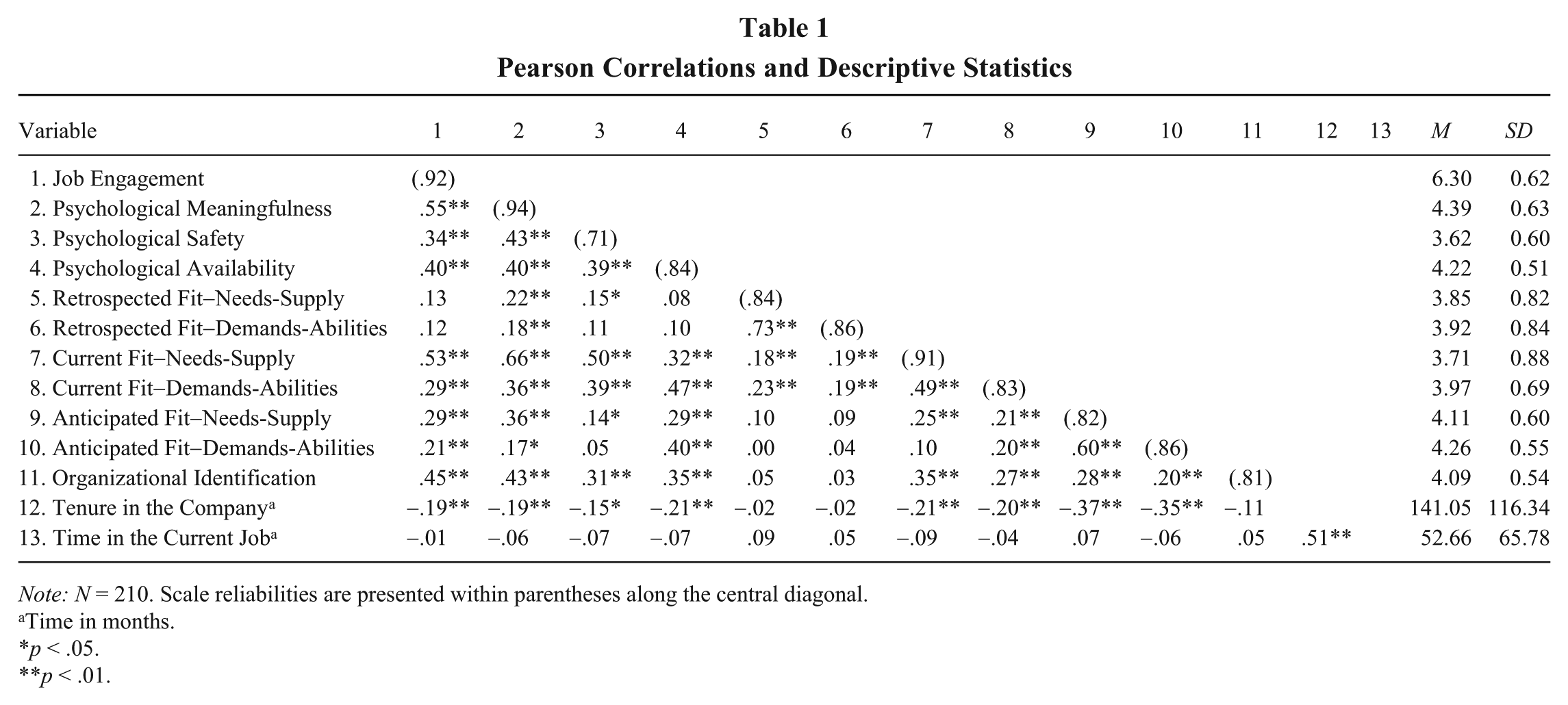
Note: N = 210. Scale reliabilities are presented within parentheses along the central diagonal.
Time in months.
p < .05.
p < .01.
We tested our hypotheses on Mplus software (Muthén & Muthén, 1998–2010) and used structural equation modeling (Bollen, 1989) to test for mediation (Hypotheses 1–3) and moderation (Hypothesis 4). We also ran regressions and simple slope analyses to test our moderation hypotheses. Finally, we calculated bootstrapping with bias-corrected confidence estimates to provide a robust test for the indirect and conditional indirect effects hypotheses.
Test of Mediation for Perceptions of Fit
Hypotheses 1 through 3 proposed specific indirect effects whereby the relationship between psychological meaningfulness, safety, and availability and job engagement is transmitted through retrospected, current, and anticipated perceptions of fit (DA and NS). Our structural equation, Model 1, represents a fully mediated model in which the residual variances of the mediating variables are allowed to correlate with each other (Hayes, 2013; Preacher & Hayes, 2008). Although we had specific mediating hypotheses, we began by adopting a conservative test that specified all paths from psychological meaningfulness, safety, and availability to retrospected, current, and anticipated perceptions of DA and NS fit and from retrospected, current, and anticipated perceptions of DA and NS fit to job engagement (controlling for job title, tenure in the company, and time in the current job). Table 2 shows that Model 1 has an acceptable level of fit (χ2 = 679.84, df = 444, RMSEA = .05, CFI = .94, TLI = .93).
Comparison of Structural Equation Models
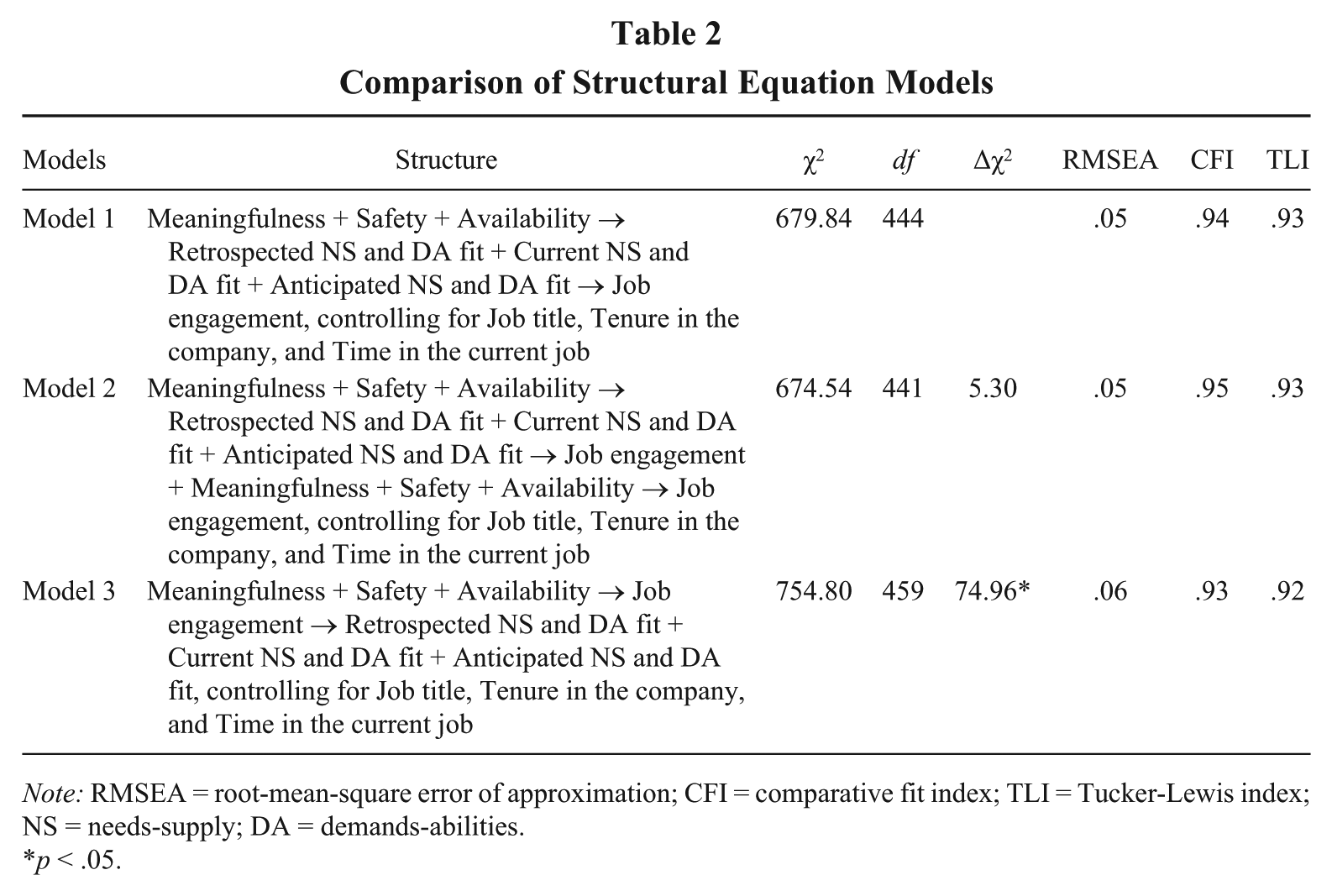
Note: RMSEA = root-mean-square error of approximation; CFI = comparative fit index; TLI = Tucker-Lewis index; NS = needs-supply; DA = demands-abilities.
p < .05.
Additionally, we tested a nested model (Model 2) and added direct paths from psychological meaningfulness, safety, and availability to job engagement. Thus, we compared the fully mediated relationship (Model 1) to this partially mediated model. The partially mediated model improved the fit by a nonsignificant amount (Δχ2 = 5.30, df = 3) and, thus, under the principle of parsimony, significant results are presented based on Model 1.
Model 3 is an alternative model that is not hierarchically related to the above two models. We included this model to assess the effects of changing construct ordering. Specifically, we changed the order of retrospected, current, and anticipated perceptions of DA and NS fit and modeled the influence of job engagement on them. This model did not fit the data better than the hypothesized relationships (χ2 = 754.80, df = 459, RMSEA = .06, CFI = .93, TLI = .92). Moreover, we used Akaike’s information criterion (AIC), which is a predictive fit index, to compare these two models (Kline, 2011). Model 1 had an AIC of 21,290.21, whereas the competing nonhierarchical model (Model 3) had an AIC of 21,335.17. Kline suggested that the model with the lowest AIC is preferred over the other models. All in all, the comparisons between the three structural models suggest that Model 1 best describes the data.
We begin by reporting our mediation tests for perceptions of DA fit. Specifically, Hypothesis 2a proposed that the relationship between psychological safety and job engagement is mediated by current perceptions of DA fit. The path between psychological safety (β = 0.23, p < .05) and current perceptions of DA fit was significant. However, the path between current perceptions of DA fit and job engagement (β = −0.02, p = .86) was not significant. To test for the proposed indirect effects, we adopted bootstrapping methods with bias-corrected confidence estimates (Preacher & Hayes, 2008), which demonstrated that the indirect path of psychological safety (β = −0.004, p = .97, 95% confidence interval, CI, [–0.24, 0.18]) to job engagement through current perceptions of DA fit was not significant. As such, Hypothesis 2a was not supported.
Hypothesis 3a proposed that the relationship between psychological availability and job engagement is mediated by anticipated perceptions of DA fit. Psychological availability had a significant relationship with anticipated perceptions of DA fit (β = 0.51, p < .01). However, the relationship between anticipated perceptions of DA fit and job engagement was not statistically significant (β = 0.09, p = .86). Bootstrapping analysis did not lend support for our predicted indirect effect (β = 0.10, p = .90, 95% CI [–2.32, 1.67]); thus, Hypothesis 3a was not supported.
Taken together, these results suggest that current and anticipated perceptions of DA fit do not mediate the relationship between psychological safety and availability on job engagement, respectively. Since none of the paths from perceptions of DA fit and job engagement and none of the indirect effects via perceptions of current and anticipated perceptions of DA fit were significant, we follow the recommendations of scholars to proceed with a more parsimonious model (Kline, 2011; MacCallum & Austin, 2000; Preacher, 2006; Preacher & Merkle, 2012), which focuses on the indirect and conditional indirect effects through perceptions of NS fit.
Hypothesis 1i proposed that the relationship between psychological meaningfulness and job engagement is mediated by retrospected perceptions of NS fit. The results showed that psychological meaningfulness did not predict retrospected perceptions of NS fit (β = 0.18, p = .07). Our results also showed that the relationship between retrospected perceptions of NS fit and job engagement was not significant (β = 0.02, p = .73). These findings suggest that retrospected perceptions of NS fit do not mediate the relationship between psychological meaningfulness and job engagement. Accordingly, Hypothesis 1i was not supported.
We then tested Hypotheses 1ii and 1iii, which proposed that current and anticipated perceptions of NS fit mediate the relationship between psychological meaningfulness and job engagement. Psychological meaningfulness had significant relationships with current (β = 0.50, p < .01) and anticipated (β = 0.32, p < .01) perceptions of NS fit. Moreover, our results showed that the relationships between current perceptions of NS fit and job engagement (β = 0.62, p < .01) and between anticipated perceptions of NS fit and job engagement (β = 0.21, p < .01) were significant. Using bootstrapping methods with bias-corrected confidence estimates (Preacher & Hayes, 2008), we found consistent support for the proposed indirect effects. The indirect paths via current (β = 0.55, p < .01, 95% CI [0.13, 0.93]) and anticipated (β = 0.12, p < .05, 95% CI [0.01, 0.91]) perceptions of NS fit were significant. Hypotheses 1ii and 1iii were thus supported.
We then tested Hypothesis 2b, which proposed that current perceptions of NS fit mediate the relationship between psychological safety and job engagement. Our results showed that psychological safety had a significant relationship with current perceptions of NS fit (β = 0.41 p < .01). Given the positive and significant relationship between current perceptions of NS fit and job engagement (β = 0.62, p < .01), as well as the results of bootstrapping analyses that showed a significant indirect effect of psychological safety (β = 0.29, p < .01, 95% CI [0.05, 1.51]) to job engagement through current perceptions of NS fit, we can conclude that Hypothesis 2b was supported.
Finally, we adopted a similar strategy to test Hypothesis 3b, which proposed that anticipated perceptions of NS fit mediate the relationship between psychological availability and job engagement. Psychological availability (β = 0.35, p < .01) was significantly related to anticipated perceptions of NS fit. Moreover, anticipated perceptions of NS fit and job engagement had a positive significant relationship (β = 0.21, p < .01). The results of bootstrapping analyses confirmed that the indirect effect of psychological availability (β = 0.15, p < .01, 95% CI [0.01, 0.78]) was significant. Thus, Hypothesis 3b was supported. We display the significant results of Model 1 in Figure 2.

Results of Structural Equation Modeling on Job Engagement
Test of Moderation and Conditional Indirect Effect
Hypotheses 4a and 4b proposed that the indirect effects of both types of fit on job engagement are moderated by organizational identification, resulting in a conditional indirect effect model. We predicted that the effects would be stronger when organizational identification is low, as compared to when organizational identification is high. Guided by our previous findings, we focused the statistical tests on current and anticipated perceptions of NS fit to investigate whether they had different effects on job engagement based on organizational identification.
We first used Mplus 6.11 to test for the significance of interactions in latent variables (Muthén & Muthén, 1998–2010). The results showed that the models with all psychological antecedents and current and anticipated perceptions of NS fit had significant interaction paths (b = −0.79, p < .01; b = −1.10, p < .05); this model fit the data better than the correspondent nested model without the interaction (2Δlog likelihood = 18.35, df = 14, p < .01; 2Δlog likelihood = 9.24, df = 14, p < .01; current and anticipated perceptions of NS fit, respectively; Klein & Moosbrugger, 2000). These results provided preliminary support for Hypotheses 4a and 4b.
We next ran ordinary least squares regressions and performed simple slope analyses to provide a more robust set of analyses. Following Aiken and West’s (1991) recommendations, we mean-centered our independent variables (current and anticipated perceptions of NS fit) and moderator (organizational identification). The results yielded significant interaction terms on job engagement (current perceptions of NS fit: b = −0.23, p < .01; anticipated perceptions of NS fit: b = −0.22, p < .01). Simple slope analyses confirmed that the results were in the expected direction for both types of fit: The effects on job engagement were stronger when individuals were low in organizational identification than when individuals were high in organizational identification for both current (low: b = 0.39, p < .01; high: b = 0.12, p = .07) and anticipated (low: b = 0.29, p < .01; high: b = 0.04, p = .68) perceptions. Thus, Hypotheses 4a and 4b were supported.
To provide a final, comprehensive examination of these relationships, we tested the indirect effects once the moderating effects were taken into account by mean-centering our independent, mediator, and moderator variables (Aiken & West, 1991) and by using a macro (quantpsy.org; Preacher, Curran, & Bauer, 2006) to estimate the coefficients and calculate the bias-corrected CIs for 1,000 bootstrap samples with replacement. Bootstrap CIs demonstrated that the indirect effects of psychological meaningfulness and safety on job engagement through current perceptions of NS fit were stronger when levels of organizational identification were low as compared to when levels were high. Table 3 displays the results.
Regression Results for Conditional Indirect Effects for Current Perceptions of Needs-Supply (NS) Fit

Note: N = 210. Unstandardized regression coefficients are reported. Bootstrap sample size = 1,000. CI (LL, UL) = confidence interval (lower limit, upper limit).
We adopted an analogous procedure to test for the indirect effects via anticipated perceptions of NS fit (see Table 4 for the results). Bootstrap CIs showed that the conditional indirect effect of psychological meaningfulness on job engagement through anticipated perceptions of NS fit was not significant. However, the indirect effect of psychological availability on job engagement through anticipated perceptions of NS fit was stronger when levels of organizational identification were low as compared to when levels were high.
Regression Results for Conditional Indirect Effects for Anticipated Perceptions of Needs-Supply (NS) Fit

Note: N = 210. Unstandardized regression coefficients are reported. Bootstrap sample size = 1,000. CI (LL, UL) = confidence interval (lower limit, upper limit).
In sum, the results demonstrated that current and anticipated perceptions of NS fit mediated the effect of psychological meaningfulness on job engagement, current perceptions of NS fit mediated the effect of psychological safety on job engagement, and anticipated perceptions of NS fit mediated the effect of psychological availability on job engagement. Additionally, our findings demonstrated a pattern of moderated mediation whereby the indirect effects of psychological meaningfulness and safety through current perceptions of NS fit on job engagement were stronger when organizational identification was low. The indirect effect of psychological availability on job engagement through anticipated perceptions of NS fit was also stronger when organizational identification was low.
Discussion
In this article, we examined the temporal intricacies of job engagement. Building on the attention view framework, we proposed that job engagement would be affected by employees’ temporal context as expressed through their individual-level (i.e., retrospected, current, and anticipated perceptions of fit) and organizational-level (i.e., ongoing membership to the organization) attentional inputs. Specifically, we found that current perceptions of NS fit mediated the effect of psychological meaningfulness and safety on job engagement, especially at low levels of organizational identification. We also found that anticipated perceptions of NS fit mediated the effect of psychological meaningfulness and availability on job engagement; the latter effect was especially strong at low levels of organizational identification. By shedding light on the temporal context of job engagement, our results offer several important theoretical implications.
First, although our theory espoused that both DA and NS fit perceptions (retrospected, current, and anticipated) would mediate the relationship between Kahn’s antecedents and job engagement, only current and anticipated perceptions of NS fit were statistically significant intervening mechanisms. That is, the results of our field study showed that perceptions of DA fit were not related to job engagement. In contrast to prior research that has shown a close link between DA fit and feelings of competence (Deci & Ryan, 1985), job engagement does not seem to be driven by such estimations. Instead, job engagement appears to have an extrinsic nature, determined by an instrumental trade-off between effort and reward.
Second, our results suggest that although downturns in employees’ work lives are inevitable, their job interpretations not only will be based on their current perceptions but also will be construed within the broader context of their anticipations. Current experiences, although important and significant predictors of job engagement, are episodes within the larger scope of an employee’s career. As such, adopting current and anticipated perceptions of NS fit as proximal antecedents of work attitudes changes our understanding of how job engagement is created in organizations.
Third, our findings indicate that although current and anticipated perceptions of NS fit play a central role in predicting job engagement, retrospected perceptions do not. Thus, although individuals live within one continuous social experience (Weick, 1995), retrospected fit evaluations do not play a significant role in accounting for the effect of psychological meaningfulness on job engagement. This finding is surprising given Kahn’s (1990) definition of psychological meaningfulness as having a sense of return on investments of self-in-role performance. It seems, however, that rather than dwelling on past circumstances, the meaningfulness individuals experience at work tends to drive their attention toward current and future job roles.
Last, we found that whereas current perceptions of NS fit mediated the effects of psychological meaningfulness and safety on job engagement, perceptions of anticipated NS fit mediated the effects of meaningfulness and availability. The differential influences of safety and availability through current and anticipated NS fit perceptions suggest that different intrapsychic influences are at play. Psychological safety (e.g., the fear of environmental dangers) may be linked to imminent survival efforts such that current circumstances are most salient. In contrast, psychological availability (e.g., the bandwidth to take on more responsibility) may be linked to career advancement prospects, making expectations of future circumstances most salient. Our theory and results illustrate the intricate relationships between psychological states and temporal fit evaluations.
Practical Implications
We have demonstrated that current and anticipated perceptions of NS fit are conduits to job engagement. When developing human resource practices and systems, companies should consider how employees will perceive the entirety of their career progression; in particular, recruiters should provide a clear job description to help job seekers evaluate their likelihood of current and anticipated NS fit. Furthermore, developing a more holistic perspective to training may involve consideration of employees’ current and future role expectations. Accordingly, during employees’ tenure within an organization, managers should highlight both current rewards and the potential future resources offered to employees in future roles.
Organizations that are able to map out such career progression opportunities might also improve the well-being of their employees. Since factors intrinsic to employees’ current job (e.g., work overload) or their role in the organization (e.g., role conflict, ambiguity) decrease their well-being by increasing sources of potential stress (Glowinkowski & Cooper, 1986), employees who anticipate better NS fit in their next job may experience fewer detriments to their well-being as a result of their current job. Thus, fit perceptions might represent a motivational source that leads to improved well-being, which can be leveraged by organizations.
Limitations
Although we conducted a large-scale field study within a company that has operations in several economic sectors in different countries with the purpose of improving the generalizability of our research, we gathered self-report data, which may represent a source of common-method bias (Podsakoff et al., 2003). Future scholars should address this limitation by gathering data from a variety of sources. Additionally, researchers should more precisely investigate the causality among the variables analyzed here by developing laboratory studies.
Even though the variance explained by our study is relatively high when the interaction effects are added to the measurement model, additional variance could be explained by other moderator or mediator variables. For example, the quality of the dyadic relationship between leaders and followers (e.g., leader-member exchange; Graen & Uhl-Bien, 1995), which has been shown to have a positive effect on employees’ work-related experiences, could enhance the links between psychological meaningfulness, safety, and availability and job engagement. Alternatively, individual differences, such as neuroticism, which represents the tendency for an individual to view the world through a negative lens (Costa & McCrae, 1992), could weaken these linkages. The effects of additional variables on job engagement should be further explored.
Our work contributes to the nascent field on the temporality of fit perceptions. We developed retrospected and anticipated fit perception measures by building from established scales and collecting data focusing on different time periods. Future research could improve on our measures by using longer time intervals to collect data of retrospected, current, and anticipated fit in order to minimize halo effects. Scholars should also use qualitative data gathered through structured interviews to more expansively capture fit perceptions. Additionally, although our theorizing suggested a molar approach to the study of temporal fit, other fit measures can be adopted (Edwards et al., 2006); beyond subjective temporal perceptions of fit, future research should focus on objective changes in fit and their effect on job engagement.
Conclusion
Kahn described the effect of psychological meaningfulness, safety, and availability on job engagement as “momentary rather than static circumstances of people’s experiences that shape behavior” (1990: 703). Although previous scholars have begun to investigate these direct effects, theory and empirical testing have largely ignored the temporal intricacies of job engagement. Adopting the attention view of social cognition, we examined the interplay of temporally relevant attentional inputs. Our findings suggest that both current and anticipated perceptions of NS fit can account for Kahn’s antecedents, especially when organizational identification is lacking. As such, organizations that attend to, not only the current but also, the expected future needs and rewards of their employees will be well positioned to build job engagement.
Footnotes
Acknowledgements
This article was accepted under the editorship of Patrick M. Wright. We gratefully acknowledge the help of several individuals in carrying out this research and preparing this manuscript, including Abbie Shipp, Adam Grant, Batia Wiesenfeld, Mariza Veiga, Dong Liu, Chris Barnes, and Scott Reynolds. Additional thanks to Daniel Beal and two anonymous reviewers for their valuable suggestions. An earlier, abbreviated version of this manuscript was presented at the Academy of Management conference in 2012.