



Abstract
The study of institutional change is a core research area in organization theory and is of increasing relevance for scholarship in other disciplines. In this article, we review the substantial number of studies that have examined the ways by which institutions are created, modified, or transformed, highlighting the lack of integration of prior works that emphasize exogenous shocks, institutional entrepreneurship, and practice-based change. Drawing on the institutional logics perspective, we then develop a novel typology of pathways of change that more comprehensively brings together this diverse literature, accounts for the richness and heterogeneity of institutional change processes unveiled by studies to date, and provides a more synthetic framework to guide future research. Based on our analysis and theorizing, we discuss important new scholarly directions that will enhance our understanding of different kinds of institutional change processes and outcomes, as well as contribute to further development of the institutional logics perspective.
Over the past two decades, the study of institutional change has become a core research area, not only in organization theory but in cognate disciplines such as sociology, economics, and political science (Clemens & Cook, 1999; Mahoney & Thelen, 2009). It has also become increasingly relevant for scholarship in entrepreneurship, strategy, and organizational behavior (Chandler & Hwang, 2015; Cornelissen & Clarke, 2010; Lounsbury & Beckman, 2015; Pacheco, York, Dean, & Sarasvathy, 2010). Contrary to earlier portrayals of the institutional perspective as a theory of conformity and stability underpinned by “durable socio-cultural structures” (Scott, 2008: 48), attention has turned to understanding how institutional arrangements “are created, transformed, and extinguished” (Dacin, Goodstein, & Scott, 2002: 45). By institutional arrangements, we refer to the sociocultural constructions that prescribe appropriate organizational behaviors and that shape and enforce patterns of interests and privilege. Efforts to understand how these arrangements are disturbed and altered have advanced our understanding of how and why change occurs, who initiates and promulgates change, and with what effects (Greenwood, Lawrence, Oliver, & Meyer, 2017; Greenwood, Oliver, Sahlin-Andersson, & Suddaby, 2008; Thornton, Ocasio, & Lounsbury, 2012).
However, institutional change has been conceptualized in many different ways, leading to a bewildering array of empirical accounts and theoretical claims. It has become an overarching label that encompasses highly diverse processes and outcomes, underpinned by different emphases on social structure or agency, and often spanning multiple levels of analysis (e.g., fields, populations, organizations, and practices). Prior attempts have been made to bring coherence to this literature (Battilana, Leca, & Boxenbaum, 2009; Dorado, 2005; Hargrave & Van de Ven, 2006; Lawrence & Suddaby, 2006; Van de Ven & Hargrave, 2004). Early reviews emphasized institutional change as a process and called for more attention to be given to its analytical stages (Tolbert & Zucker, 1996; Van de Ven & Hargrave, 2004), but in doing so underappreciated the role of agency (Hargrave & Van de Ven, 2006).
More recent efforts have given attention to actors—“institutional entrepreneurs”—and the processes by which they make change happen (Battilana et al., 2009; Hardy & Maguire, 2008). These reviews caution against embracing the imagery of the overly heroic actor (i.e., the entrepreneur), but nevertheless share an assumption that institutional change is an outcome of purposeful “institutional work” (Lawrence, Suddaby, & Leca, 2009, 2011). They also downplay how richly textured social structures can enable and provide multiple pathways for action (Fligstein & McAdam, 2012; Schneiberg & Lounsbury, 2008; Thornton et al., 2012). Thus, missing from these reviews is the insight that change may occur through different pathways that enable and constrain possibilities for institutional work and entrepreneurship.
Notably, all of these prior reviews only hinted at—or completely overlooked—the possibility that the outcome of institutional change processes may be developmental, rather than transformational. Instead, change has been conventionally portrayed as a dramatic and frame-bending experience that transforms institutional fields (although, see van Wijk, Stam, Elfring, Zietsma, & den Hond, 2013). Additionally, purposeful agency and intentionality has seemingly been considered a necessary and sufficient condition for institutional change (see, although, Dorado, 2005; Lounsbury & Crumley, 2007). The potential for variations introduced by individuals or organizations that have no intention to challenge or disrupt existing institutional arrangements has been overlooked, as has been the possibility that seemingly minor variations (purposeful or not) may accumulate to generate institutional change (although, see Ansari & Phillips, 2011; Gray, Purdy, & Ansari, 2015; Smets, Morris, & Greenwood, 2012).
Given the confusion in the literature and the lack of an omnibus framework, the time is appropriate for a more comprehensive review and for the construction of a theoretical framework that can guide future research and enable more progressive theory development. To this end, we review studies of institutional change published in the major management journals between 1990 and 2015. Our review documents the theoretical progression from an early emphasis upon exogenous shocks bumping against the institutional environment, to an appreciation of agentic action by institutional entrepreneurs, and more recently to the microfoundations of change (Barley, 2008; Powell & Colyvas, 2008). Based on this review, we highlight some limiting assumptions that have guided extant institutional change research—such as the paradox of embedded agency and linear patterns of causality—and identify two important themes that have been underdeveloped in the institutional change literature: temporality and pluralistic institutional environments.
To more comprehensively bring together this diverse literature and address these limitations, we develop a novel typology based on two core dimensions suggested by our literature review—the scope and pace of change. Combining these dimensions identifies four pathways of institutional change (i.e., change as “displacement,” change as “alignment,” change as “accommodation,” and change as “accretion”). The framework draws on the institutional logics perspective in order to encompass and better theorize the “developmental” versus “transformational” institutional scope of change (see Thornton et al., 2012: chapter 7); to give simultaneous attention to the unduly neglected dimension of pace, which is associated with different temporalities such as “revolutionary” and “evolutionary” (Greenwood & Hinings, 1996); and to capture the complexity of institutional contexts.
Within this framework, we integrate current insights from prior works and provide, for each pathway, a set of research questions that are significantly informed by the emphasis on heterogeneity and cross-level mechanisms of institutional change offered by the institutional logics perspective. Even though the study of institutional dynamics continues to be informed by a wide variety of ontologies, concepts and approaches to agency and temporality rooted in conversations such as World Society theory, Scandinavian institutionalism, institutional work, and social movements (see Greenwood et al., 2017; Scott, 2014), we see recent theoretical developments in the institutional logics perspective as particularly promising for providing fresh insights about institutional change processes. We believe that this perspective, which has recently become a dominant, and rapidly developing, theoretical lens for organizational institutionalism (Lounsbury & Beckman, 2015) can fruitfully address some of the limitations of current theorizing and, as a meta-theory, can move the literature forward by enabling integration across ideas and approaches. In particular, the institutional logics perspective can account for different conceptualizations of institutions, agentic behaviors that span multiple levels of analysis, and, perhaps especially important, the growing appreciation that change occurs in pluralistic environments.
By leveraging insights from a specific theoretical perspective (i.e., institutional logics) and dimensionalizing institutional change processes by two specific dimensions (i.e., scope and pace), our typology provides analytical and theoretical focus. This focus enables us to provide a new synthesis of the literature and has the additional benefit of highlighting the uneven attention that has been given to different pathways of change and the remarkably scant knowledge of some of these pathways. Thus, in addition to providing a new way by which to understand the existing literature, by engaging the institutional logics perspective, we are able to uncover a variety of important new questions that can fruitfully guide future scholarship and progressive knowledge accumulation.
Methods: The Review Approach
Following prior works that systematize extensive literatures on relatively ambiguous concepts (Pacheco et al., 2010; Piazza & Castellucci, 2014), we restricted our review in four ways. First, even though institutional economics also provides insights into change processes (North, 1990; Pacheco et al., 2010), we focused our efforts on organizational institutionalism (DiMaggio & Powell, 1983; Greenwood et al., 2008; Meyer & Rowan, 1977) and disciplinary conversations (especially in sociology) that intersect more directly with that literature.
Second, we limited our search to articles published between 1990 and 2015. We chose 1990 because this is generally recognized as the year when institutional change began to become a core focus of research in organizational institutionalism (Dacin et al., 2002; Greenwood et al., 2008). In the late 1980s, institutional theory was still in its “adolescent” phase with a strong focus on isomorphic forces, and scholars had just begun to examine how institutional factors impact organizational behaviors. At that time, institutional scholarship was guided by the notion of institutions as self-reproducing (Jepperson, 1991) and of organizations as unitary entities that operate in stable and isomorphic environments (although, for an exception, see Greenwood & Hinings, 1988). After the publication of the “orange book” (Powell & DiMaggio, 1991), however, interest in how and why institutional reproduction is disturbed prompted studies into the process of institutional change and its implications for organizations (Dacin et al., 2002). As an additional check to support our choice, we ran a search with the keyword “institutional change” in the titles and abstracts of articles in the Business Source Complete database in the time frame 1977 to 1989. We found 89 papers, primarily published in economic journals and of which only 3 were in our list of management journals.
Third, we selected articles through a keyword search in the title (TI) and abstract (AB) fields of the Business Source Complete database and the full text of Google Scholar. We used advanced search options, filtering only articles in peer-review journals in the time-frame selected. Following the advice of an expert in library search, we followed a “lower-bound, upper-bound approach” to search for relevant articles. First, we used the search string “ ‘institutional change’ OR ‘institutional entrepreneur*’ OR ‘institutional work’ ” to search in the title (TI) and abstract (AB) fields of the Business Source Complete database. We then filtered the results for articles published in our selected list of journals (107 articles). The journals reviewed include: Academy of Management Journal, Administrative Science Quarterly, American Journal of Sociology, American Sociological Review, Journal of Management, Journal of Management Studies, Management Science, Organization Science, Organization Studies, Strategic Organization, and Strategic Management Journal. To ensure the comprehensiveness of our review, we performed an additional search in a set of entrepreneurship and organizational behavior outlets: Entrepreneurship Theory and Practice, Journal of Business Venturing, Journal of Applied Psychology, Journal of Organizational Behavior, Organizational Behavior and Human Decision Processes, and Strategic Entrepreneurship Journal. We used the same string in the advanced full-text search in Google Scholar and searched each journal on our list (1,382 articles). We then compared the articles in the two databases.
Fourth, we limited our review to empirical research, even though we relied on theory papers to inform our framework and discussion of future research directions. To further select relevant articles, we examined the titles and abstracts of all the papers retrieved from the initial search in the two databases and retained only those that explicitly examined instances of institutional change—that is, “a difference in form, quality or state over time in an institution” (Van de Ven & Hargrave, 2004: 261)—and where the primary theoretical contribution was made to institutional theory. This process resulted in 119 empirical articles that offer detailed accounts of specific trajectories of change in specific contexts, for the most part (~70%) using qualitative methodologies. After several rounds of coding and discussion among the authors to solve discrepancies, the articles were categorized and Figure 1 was developed.
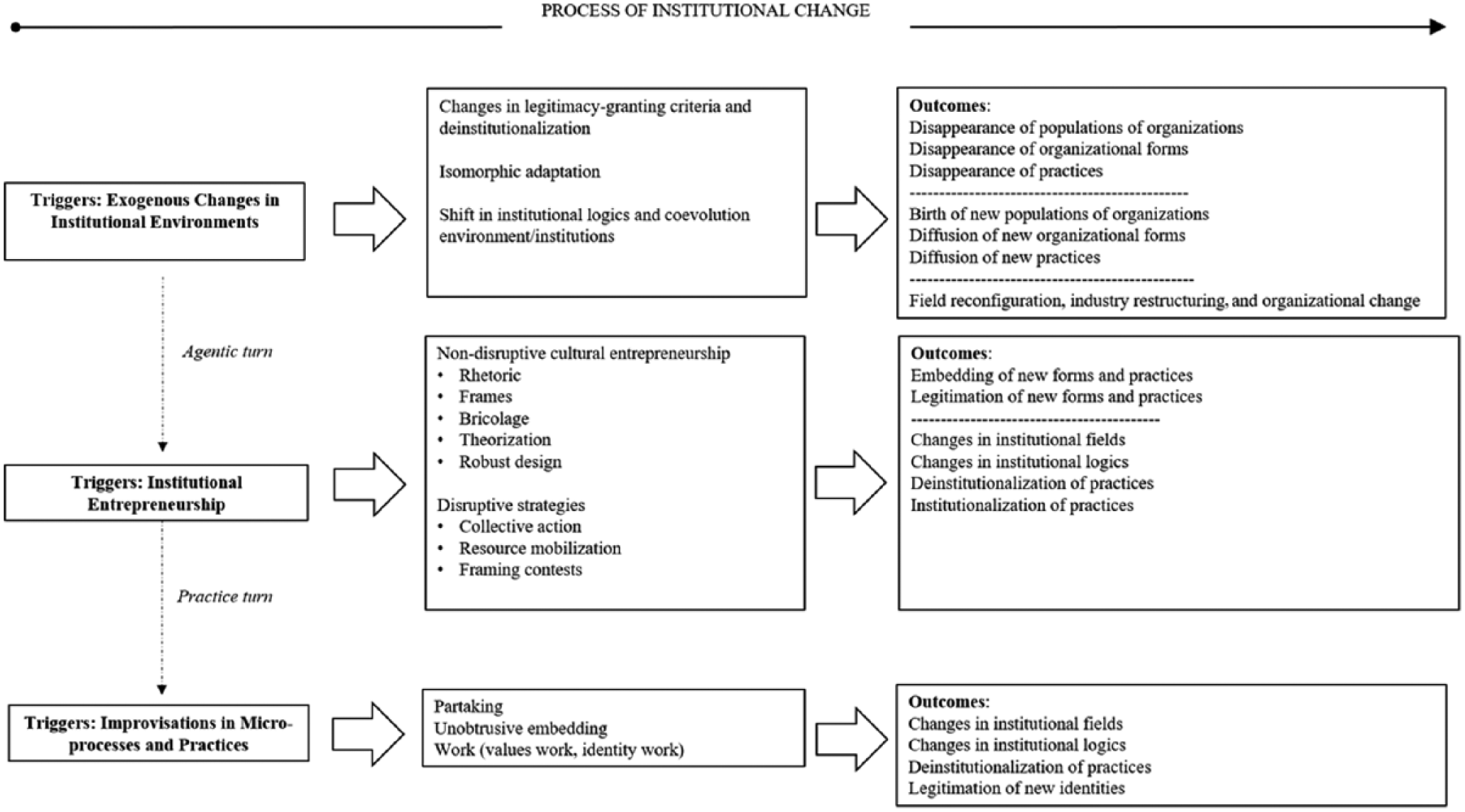
Processes of Institutional Change: A Review of the Literature
Unpacking Institutional Change
Figure 1 summarizes the agenda of research contained in the articles that we reviewed. At the left of the figure are the three different starting points of change processes (i.e., triggers) that have been emphasized in prior work. The earliest studies saw changes as arising from exogenous disturbances in the institutional context to which organizations responded. In effect, the imagery was of top-down change. Subsequently, a more endogenous and agentic approach was adopted and led to a focus upon institutional entrepreneurship, and the search for which and how particular organizations push for change. Finally, and more recently, attention has been given to bottom-up changes that arise from improvisations in the more mundane day-to-day practices within and between organizations.
We interpret such shifts in the target of interest and the extension of analytical focus across levels of analysis as a reflection of the improvement in scholarly ability to capture empirically the very nuanced concept of institutions. Scott’s definition (1995: 33) highlights the complexity of studying institutions: “institutions consist of cognitive, normative, and regulative structures and activities that provide stability and meaning to social behavior. Institutions are transported by various carriers—culture, structures, and routines—and they operate at multiple levels of jurisdiction.” As the literature on institutional change matured, the multifaceted character of this concept has been progressively embraced, rather than glossed over. Yet, as we will elaborate in a moment, the linkage between triggers and outcomes of change has not been systematically theorized in prior works.
Exogenous Changes in Institutional Environments
The first conceptualization of institutional change arose from the portrayal of institutions as durable sociocultural structures that provide stable sets of meanings, rules, and norms on which organizations depend for their understanding of appropriate behaviors. Thus, institutions are external to—and analytically distinct from—organizations. Starting from these premises, changes in the institutional environment were treated as instances of institutional change and studies sought to understand how exogenous events (or “jolts,” to use Meyer’s 1982 term) at the societal and field level, which fundamentally altered the environment of the organizations being studied, affected organizational fields and the organizations that comprise them (Clemens & Cook, 1999; Meyer, 1982).
A variety of macroenvironmental changes have been examined, such as shifts in political regimes in transitioning economies in the Czech Republic (Clark & Soulsby, 1995) and Hungary (Whitley & Czaban, 1998), and dramatic sociopolitical upheavals (e.g., wars, revolutions) that have been found to affect the strategies and survival of organizations (Allmendinger & Hackman, 1996). Other authors focused on competence-destroying technological changes and their effects (Romanelli & Tushman, 1994), the play of regulatory change (Bacharach, Bamberger, & Sonnenstuhl, 1996), and how crashing competitive pressure and resource scarcity can dramatically alter the fundamental rules of competition in established industries (Thornton & Ocasio, 1999).
Typically, as shown in Figure 1, emphasis is placed upon how macroenvironmental changes provide the impetus for processes of deinstitutionalization, and for transformations in legitimacy-conferring criteria (Davis, Diekmann, & Tinsley, 1994). The common prediction is that these changes profoundly affect existing organizations, but this theorized impact varies considerably. Research combining institutional and population ecology advance arguments that organizations are unable to adapt sufficiently quickly to modified environmental conditions (Ruef & Scott, 1998). From this vantage point, environmental changes trigger selection processes, leading to the disappearance of organizational forms and practices (Ahmadjian & Robinson, 2001) and the emergence of new ones through isomorphic diffusion (Lee & Pennings, 2002).
In contrast to ecological predictions, a second line of studies conceptualizes organizations as capable of adaptation and explores their successful responses to disruptive changes. For instance, studies have demonstrated that organizations can maintain a competitive edge by engaging in a metamorphosis of strategies and structures (Lamberg & Pajunen, 2010). Research on organizational responses has also shed light on the factors that affect the relative responsiveness of organizations to changes in institutional contexts, as well as the organizational characteristics and strategies that increase the likelihood of successful conversion (Allmendinger & Hackman, 1996) or that hinder strategic transitions (Kriauciunas & Kale, 2006).
A third line of research focuses upon shifts in field-level institutional logics (Thornton & Ocasio, 1999). The distinctive feature of this relatively new but highly influential focus on logics is the conceptualization of change as a complex and multifaceted process that is not reducible to selection or organizational adaptation processes (as implied in the above two research streams).
Importantly, defining institutional change as the replacement of one dominant logic by another provides a new vocabulary and conceptual tool by which to theorize how deeply-held values, beliefs, and cultural norms are historically contingent, and how shifts in logics profoundly change organizational fields (Greenwood, Raynard, Kodeih, Micelotta, & Lounsbury, 2011; Ocasio, Thornton, & Lounsbury 2017; Thornton et al., 2012). Moreover, in this line of theorizing, scholars emphasize the coevolution of organizations and institutions, as they mutually shape one another (Haveman & Rao, 1997). By focusing on shifts in logics, empirical research provided a higher-order explanation for a wide array of changes within fields, such as in the composition of governance structures (Reay & Hinings, 2005), the status of professional actors (Lounsbury, 2002), the dominant organizational archetype (Kitchener, 2002), and actors’ attention and commitment to meanings and identities (Meyer & Hammerschmid, 2006). As we discuss later, subsequent developments in the institutional logics perspective have enabled theory construction and empirical research that extends to other forms of institutional change, and has made this theory particularly supple (e.g., Wright & Zammuto, 2013; York, Hargrave, & Pacheco, 2016).
Institutional Entrepreneurship
In the 1990s, the call to bring back interest and agency in institutional analysis, and thus combine the old and new institutionalism (DiMaggio, 1988; Hirsch & Lounsbury, 1997), precipitated an agentic turn. The “paradox of embedded agency” (Holm, 1995), which asks how actors embedded in taken-for-granted institutional arrangements can reflect and act upon them (Garud, Hardy, & Maguire, 2007; Seo & Creed, 2002), was raised and captured attention. As a result, institutional theorizing turned to identification of which organizations are agents of change (and why) and, in particular, to understanding the disruptive strategies of would-be institutional entrepreneurs.
For the most part, in addressing the first of these questions (who are the institutional entrepreneurs), the institutional entrepreneurship literature focused on the structural position of actors, such as whether they are at the periphery (Leblebici, Salancik, Copay, & King, 1991) or core (Greenwood & Suddaby, 2006) of an institutional field (see Battilana et al., 2009, for a review). Prompted by Seo and Creed (2002), others have focused upon how a structural position at the interstice of different institutional logics can enable reflexivity. Attention has also been given to differences in the structures of the field in order to explore the proposition that some fields are more amenable to change. A common distinction drawn is between “emerging” and “mature” fields (Maguire, Hardy, & Lawrence, 2004), but alternative conceptualizations of field differences are emerging, such as Mair and Marti’s (2009) discussion of “institutional voids”—spaces that are institutionally less developed—and how they may provide opportunities for institutional entrepreneurship (see review by Zietsma, Groenewegen, Logue, & Hinings, 2016).
How changes are introduced has attracted much attention (for reviews, see Hardy and Maguire, 2008; Lawrence & Suddaby, 2006) and the increasing focus on the purposeful “institutional work” of actors provides a vocabulary to categorize tactics and strategies (e.g., practice work, boundary work, identity work). Interestingly, depending on to which theoretical streams they subscribe, scholars differ in their theorization of whether institutional change and its underlying processes are or are not infused with conflict and contestation. Some scholars have focused on changes achieved by nondisruptive means, such as presenting innovations as nonthreatening to the institutional order. Along these lines, various forms of cultural entrepreneurship (Lounsbury & Glynn, 2001) have been explored, including the use of bricolage (Rao, Monin, & Durand, 2005), robust design (Hargadon & Douglas, 2001), frames (Werner & Cornelissen, 2014), and theorization (Greenwood, Hinings, & Suddaby, 2002). These cultural entrepreneurial processes have enhanced our understanding of how new organizations gain legitimacy, persuade field-level audiences to offer their endorsement, and/or encourage other organizations to adopt the changes, yet without open conflict.
Other scholars have examined deliberately disruptive change strategies. Typically, these are initiated by social movements or social movement-like organizations (de Bakker, den Hond, King, & Weber, 2013; Hensmans, 2003). Change agents are “challengers” who contest existing institutions and seek to displace the powerful apparatus that supports social reproduction. They directly confront those who benefit from the status quo, that is, “incumbents.” As a result, institutional environments are portrayed as “battlefields” (Fligstein & McAdam, 2012). Informed by social movement research (Schneiberg & Lounsbury, 2008), these studies portray change agents as more likely to be outsiders or to reside at the periphery of the field (Maguire & Hardy, 2009). The analytical focus has been upon the use of adversarial frames and framing contests (Guérard, Bode, & Gustafsson, 2013) and highly contentious tactics, such as protests and boycotts, that are meant to stimulate responses by hitting incumbents where it matters (Zietsma & Lawrence, 2010).
Studies of which organizations will act as institutional entrepreneurs, and how they seek to do so, have greatly extended our understanding of institutional change. But several assumptions (often a consequence of the case study method) have resulted in “blind spots.” One blind spot is that change is consistently portrayed as the successful and intended outcome of the efforts of institutional entrepreneurs. Changes are depicted as those that the entrepreneurs set out to achieve, to the point where “institutional entrepreneurship,” “institutional work,” and “institutional change” are often treated as synonyms. We argue that this linguistic slip has distracted attention from the possibility that change agents may not succeed in their intended endeavor.
Even less is known about innovations that are introduced, yet fail to achieve institutional change because they never become institutionalized. In effect, “the activities involved in … institutionalizing change have been studied the least in the literature on institutional entrepreneurship” (Battilana et al., 2009: 86, emphasis added; see also Kahl, Liegel, & Yates, 2012; McGaughey, 2013). Examinations of proto-institutions are equally rare (Granqvist & Gustafsson, 2013; Zietsma & McKnight, 2009), and the initial interest in managerial fads and fashions, which could shed light on this issue, has seemingly disappeared (Perkmann & Spicer, 2008). There is, too, a relative dearth of studies that illuminate how and why institutional entrepreneurship may lead to institutional change, yet have unintended consequences (Khan, Munir, & Willmott, 2007).
In addition to these blind spots, one of the biggest complaints about the institutional entrepreneurship literature has been its unfortunate emphasis on “muscular” or “heroic” actors who somehow have remarkable capacity to transform institutions (Garud et al., 2007). To many, studies in this genre provided overly simplified narratives of change, with little appreciation for the complex (and typically collective) nature of institutional change. Despite efforts to elaborate a richer approach to institutional entrepreneurship that might address these shortcomings (Battilana et al., 2009), the field has largely moved on, and there is no theory unique to the label of institutional entrepreneurship.
Changes in Micropractices
In the wake of waning attention to institutional entrepreneurship, many have sought to more explicitly develop a richer approach to action by focusing on the microfoundations of institutions (Barley, 2008), the distributed—partaking—nature of agency (Dorado, 2005; Gehman, Treviño, & Garud, 2013), and a bottom-up perspective (Gray et al., 2015). One particularly important contribution in this direction is the recent effort to bridge practice-based and institutionalist approaches (Compagni, Mele, & Ravasi, 2015). Unlike exogenous shock and institutional entrepreneurship, a practice approach eschews the assumption that change is precipitated by dramatic environmental shifts or by the purposeful efforts of powerful actors. Instead, it may be inadvertently triggered by the “mundane activities of practitioners struggling to accomplish their work” (Smets et al., 2012: 877).
A sometimes forgotten requirement for micro-level studies is to explicitly show how local improvisations in practices concatenate to effect field-level dynamics and ultimately become institutionalized. Understanding how improvisations might change arrangements within an organization is theoretically interesting; yet an adequate understanding of institutional change requires that attention be given to how a larger and diverse set of actors may help propagate or dampen that initial impetus for change in meaning and practices (Vaccaro & Palazzo, 2015).
There have been a couple of notable efforts in this nascent research direction, which recent studies are building on. Lounsbury and Crumley (2007), for example, showed how the performativity of mutual funds led to problematic variations in mutual fund practices that were accommodated only through field-level restructurings in beliefs that would legitimate and accommodate new practices. Smets et al. (2012) showed how gradually and unobtrusively new practices introduced within an organization “moved up” to the level of the field and stimulated a shift in institutional logics. There was no exogenous shock, no heroic entrepreneur, little noise or contestation—yet change occurred and became institutionalized. As this study highlights, practice improvisations typically fly under the radar before gaining acceptance. Their low profile means that improvisations are less likely to raise resistance within the field (see also, Leung, Zietsma, & Peredo, 2013; Sauder, 2008; Vaccaro & Palazzo, 2015).
It is important to note that these and similar practice-oriented studies have dovetailed with two important trends: first, the growing interest in exploring opportunities for integration between institutional analysis and other micro-level perspectives (e.g., practice, identity, sensemaking, decision-making, framing); and second, the institutional logics perspective, which has explicitly focused attention on how cultural rules and macro systems of meaning affect practice and organizational dynamics at the meso and micro level of analysis (Thornton et al., 2012: chapters 4 and 6). There has been, in other words, an opening up of new opportunities to combine theoretical lenses in order to theorize multilevel change processes. Nonetheless, as noted by Gray et al. (2015: 136), “the institutional logics perspective is less comprehensive about how bottom-up interactional processes may also challenge extant logics or lead to the emergence of new ones.” Approaches such as the one proposed by Gray et al. (2015) (i.e., interactional framing) provide promising avenues to further elaborate the institutional logics perspective and the study of institutional change.
Towards an Integrative Framework
In our review, we have purposefully taken a chronological approach in order to show how sequential research streams have built on—or distanced themselves from—each other. Doing so highlights that one of the challenges in the change literature is that, as attention moved to different triggers of institutional change (from exogenous changes in institutional environments, to institutional entrepreneurship, to improvisations in microprocesses and micropractices), insights generated by previous efforts have been often left behind. To some extent, consistently building on previous studies is difficult because shifts in research focus entailed concomitant changes in ontological commitment. Nonetheless, this tendency has inhibited the nuancing and elaboration of theory across the literature, and we worry about throwing the baby out with the bathwater as we develop new ways to approach the study of institutional change.
Take, for example, the discernible differences in the way that agency has been conceptualized. From its inception, research on institutional change has aimed at providing a corrective to the notion of agency as habitual, repetitive, taken-for-granted enactment of scripts and rule systems that perpetuate constraining social structures (Colomy, 1998). For the past few decades, however, a key point of debate has been whether, how, and to what extent actors can enact change in a world dominated by institutions (the “paradox of embedded agency”). Today, scholars no longer dominantly subscribe to the position that change bursts into otherwise self-perpetuating institutional arrangements to dramatically alter them. Nevertheless, also the notion that actors may destroy and re-create institutions through purposeful and effortful actions is being reevaluated as scholars consider institutional changes that occur in structurally heterogeneous and complex institutional environments. More recently, the theorizing of substantial field-level change driven by micro-acts of agency has shifted the focus from purposeful and effortful (“projective”) forms of agency to more “pragmatic” ones (Emirbayer & Mische, 1998). This line of research has opened up fruitful areas of research, but still little is known about how micro-level, day-to-day changes scale up and the trajectories through which “improvisations” may aggregate, concatenate, accumulate, and/or escalate (Gray et al., 2015). Critically, the implications of such differences for our understanding of the way change processes unfold have not been systematically theorized. This is particularly evident in the limited effort devoted to understanding varied patterns of causality that underpin change processes (Durand & Vaara, 2009). Institutional scholars have relied primarily on implicit assumptions about a linear relationship between causes and effects that have, thus far, offered selective theoretical and analytical leverage.
Notably missing is also theoretical attention to the ways in which different triggers and forms of agency interplay with temporal variables such as pacing, sequencing, and duration to shape the trajectory and outcome of institutional change processes (Ancona, Goodman, Lawrence, & Tushman, 2001; Lawrence, Winn, & Jennings, 2001). Finally, we still lack a comprehensive understanding of how institutional pluralism, as a structural condition of fields, and institutional complexity, as the subjective experience of logic contradictions by organizations, may support or hinder different kinds of institutional change (Greenwood et al., 2011; Kraatz & Block, 2008; Thornton et al., 2012). In the next section, we address some of these limitations by offering a novel framework that integrates prior research, while also providing guidance for the development of new knowledge.
An Integrative Framework and Research Agenda
Figure 2 summarizes our framework, which offers a new way by which to understand the confusing array of studies on institutional change, and helps chart a more systematic way forward. Specifically, change processes are classified according to two dimensions—the scope and pace of change. We suggest that examining change processes through these two dimensions offers scholars the opportunity to address the limitations highlighted above and to develop new insights.

Pathways of Institutional Change: An Integrative Framework and Future Research Agenda
The y-axis accounts for the evolution in current institutional thinking by differentiating change pathways based on their pace (i.e., whether revolutionary or evolutionary) (Greenwood & Hinings, 1996). Institutional change is inherently a longitudinal process, and many core questions revolve around temporal dynamics (Ancona et al., 2001; Lawrence et al., 2001). Hence, it is surprising that the connections between agency and institutional processes (Battilana & D’aunno, 2009) and temporal variables (e.g., pace, sequence, linearity, readiness) in change processes (Amis, Slack, & Hinings, 2004) have been only tangentially explored in past institutional change research. In our view, a more comprehensive research program to understanding the temporal dynamics of institutional change is needed (see, for instance, Granqvist & Gustafsson, 2016), but a good starting point is to account more explicitly for the difference in pace between revolutionary and evolutionary change.
Revolutionary change processes are triggered by potent macro-level dynamics that interrupt institutional reproduction and challenge the institutional forces that preserve stability; they unfold through disruptive and forceful conflict and “institutional wars” (Hoffman, 1999: 352) between opposing players (e.g., challengers and incumbents) with asymmetrical power (de Bakker et al., 2013). From this vantage point, when change occurs, it does so in a relatively fast manner, driven by purposeless external shocks or the purposeful and effortful actions of change agents. Conversely, evolutionary change processes are typically slower, triggered by less hastened forces such as relatively slow societal changes and/or the intentional introduction by change agents of modest innovations. Change that unfolds through persuasive embedding and consensual “pragmatic collaborations” (Reay & Hinings, 2009: 631) is expected to be evolutionary. Likewise, the theorizing of micro-level acts of agency and mechanisms such as “unobtrusive diffusion” (Smets et al., 2012: 878) that result in field-level change suggests another potential source of evolutionary change. Increasing dialogue with the practice perspective and micro-interactionist approaches have led scholars to consider that micro-acts of agency may simply be pragmatic and not purposefully intended to achieve institutional change—even though that may be the outcome (Smets et al., 2012).
The x-axis differentiates change processes based on their scope—that is, whether transformational or developmental. The distinction of change processes based on their transformational or developmental nature has been theorized, to our knowledge, only in relation to changes in institutional logics (Thornton et al., 2012). In other streams of research, the prevailing assumption has been that any “difference in form, quality or state over time in an institution” (Van de Ven & Hargrave, 2004: 261) represents a transformative change, because, by definition, it involves institutions. Instead, as suggested by the institutional logics perspective, institutional change processes may be transformational or developmental.
Change is transformational when shared understandings, which define what is accepted and valued in the field, are overturned or significantly altered (for example, through replacement, blending, or segregation of institutional logics). Change is developmental when alterations are relatively narrow, and involves stretching rather than discarding institutionalized arrangements (for example, through contraction, assimilation, or elaboration of institutional logics). This axis provides a higher-order framework by which to assess whether changes at lower levels of analysis (e.g., changes in practices) are transformational or developmental because when the logic(s) governing a field change, so, too, do the values and associated beliefs that underpin the dominance of forms of organizing (“archetype”) and its associated practices (Scott, Ruef, Mendel, & Caronna, 2000).
The combination of the two dimensions distinguishes four pathways of change that, although implicit in prior works, have not yet been clearly articulated: (a) institutional displacement, (b) institutional alignment, (c) institutional accommodation, and (d) institutional accretion. Displacement processes are revolutionary in pace and transformational in scope; alignment processes are evolutionary in pace and developmental in scope; accommodation processes are revolutionary in pace and developmental in scope; and accretion processes are evolutionary in pace and transformational in scope. Recoding the papers that constituted our literature review highlights where research attention has been focused and which pathways of institutional change have been less attended. Our analysis indicates that prior research has focused on displacement (47 studies) or alignment (46 studies); conversely, noticeably fewer studies have analyzed the pathways of accommodation (15 studies) or accretion (11 studies). Figure 3 shows the distribution of studies over time.

Change Pathways in the Institutional Change Literature, 1990–2015
The predominance of the two pathways of displacement and alignment reveals how scholars have been thus far guided in their investigations by overly linear assumptions about the patterns of causality that underpin change processes. Revolutionary changes entail dynamics and mechanisms (e.g., shocks or highly contentious mobilization) that are expected to profoundly alter institutional arrangements (displacement); likewise, evolutionary changes are more likely to generate relatively less consequential alterations by embedding change into the existing institutional arrangements (alignment). The relatively less beaten pathways (accommodation and accretion), however, reveal that nonlinear paths are equally theoretically plausible, and potentially even more likely to be observed. Revolutionary changes may be slowed down as their strength is diminished by a wide array of “dampening” mechanisms (e.g., negative feedback loops, increasing negative returns, settlement, cooptation) as the accommodation pathway illustrates; along the same line, as the accretion pathway shows, evolutionary changes may be accelerated by similar “revamping” mechanisms (e.g., positive feedback loops, increasing positive returns, positive amplification, escalation). As research moves forward, more attention should be given to understanding the accommodation and accretion pathways. To do so, however, theories of change will need to incorporate more sophisticated patterns of causality that include nonlinear paths and mechanisms.
More broadly, our analysis reveals that there is an opportunity to (re)consider how we, as scholars, conduct empirical investigations of institutional change. An important issue, we believe, is to appreciate whether there is a healthy balance between studies that examine the “effects of causes” and studies that examine the “causes of effects” (Morton & Williams, 2010). Both are necessary to generate a comprehensive and robust theory of change. The former approach (“effects of causes”) begins with the identification of relevant causes of change and focuses attention on examining the effects that these causes may have. In our review, we have seen this approach used frequently, when scholars theorized the displacement effects of exogenous causes of change (e.g., change in regulatory, normative, and cognitive systems) in order to provide quantitative estimates of their causal effects or qualitative accounts of the effects of these changes upon organizations and fields. Likewise, accounts of institutional alignment have theorized the “effects” of evolutionary causes (e.g., institutional entrepreneurs) upon organizations and fields.
Over time, however, the latter approach (“causes of effects”) has increasingly become prominent in institutional change research. This approach begins with the observation of institutional change as a relevant effect (e.g., described by relevant outcomes) and theory has developed about variables and processes that can explain those effects. Supported by the growing interest in understanding the processual causal mechanisms that underpin field-level change (Davis & Marquis, 2005), the focus on the “causes of effects” is at the core of the emerging interest in the accommodation and accretion pathways and promises to develop rich and novel theoretical insights about who, how, and why institutional change occurs. A combination of these approaches is ideal to develop new theoretical insights on both the causes and effects of institutional change. As Scott (2010) acutely noted, focusing on known outcomes of institutional change risks losing the opportunity to envision and study equally relevant, but unexpected, outcomes, such as change efforts that result in unexpectedly unsuccessful outcomes. However, focusing on known causes and only extending knowledge on how and why different outcomes may occur is also detrimental, as it presents the risk of missing out on important new “causes” (triggers and processes) of institutional change.
Finally, it is evident from our review that institutional change research has begun to slowly incorporate the imagery of fields as pluralistic environments (Greenwood et al., 2011; Kraatz & Block, 2008; Thornton et al., 2012). Scholars recognize that the institutional environment may impose conflicting demands and offer diverse opportunities for change. Yet we need a systematic effort to translate extant theories of change developed in monistic environments into the current conceptualization of fields as plural, diverse, and heterogeneous environments. Recent developments associated with the institutional logics perspective, that focus on theorizing the sources and consequences of multiple logics, provide a promising foundation for future research in this direction. Hence, as we stated earlier, we draw extensively on the institutional logics perspective in elaborating possibilities for future research (Lounsbury & Beckman, 2015).
Three reasons underlie our choice: (a) the institutional logics perspective is an integrative lens that accounts for behaviors and phenomena occurring at different levels of analysis; thus, it captures nuances in the notion of institutions (micro to macro), agency at different levels of analysis (e.g., individual, organization, field), and can complement micro-level theories (e.g., practice theory); (b) in the institutional logics perspective differences in the kinds of change processes and, specifically, in scope (developmental versus transformational changes) have been successfully theorized (see Thornton et al., 2012: chapter 7); and (c) the institutional logics perspective has addressed the issue of institutional pluralism and complexity that we consider critical for pushing forward research on institutional change. We suggest that theory and research on the existence of multiple logics provide an opportunity to reexamine change pathways reported in the literature and to develop a new research agenda that integrates currently isolated streams of theorizing.
Quadrant 1: How Multiple Logics Affect Institutional Displacement
Thus far, displacement research has received considerable attention and, as Figure 2 shows, has emphasized (a) how revolutionary changes in institutional environments trickle down to transform fields, organizations, and practices and (b) how institutional entrepreneurs mobilize within and outside organizations to push change forward and diffuse the new arrangement. The assumption is that organizations operate in monistic environments, where the institutional logics prescribing and proscribing behaviors are shared and understood. But what has not been empirically examined is how the same processes might unfold in pluralistic environments, that is, those characterized by multiple institutional logics. For example, organizations are consistently affected by changes that are perceived as exogenous because they are outside their control (e.g., economic, financial, or humanitarian crises, regulations from transnational bodies), but these macro-changes may impact fields and organizations in different ways. Specifically, institutional pluralism at the field level and institutional complexity at the organizational level may moderate the effects of macro-changes.
Future theorizing would benefit from research into the following questions: (a1) “How does the multiplicity of logics at the level of the field affect organizational responses to revolutionary changes?” and (a2) “How do organizations, depending on the extent to which they experience institutional complexity, respond to revolutionary changes?” In addressing these questions, scholarship could incorporate the insight that multiple field-level logics ‘filter’ broader institutional demands for change (Greenwood, Díaz, Li, & Lorente, 2010; Lee & Lounsbury, 2015). Similarly, the idea that organizations differ in the extent to which they experience institutional complexity and apprehend institutional contradictions (Greenwood et al., 2011; Voronov & Yorks, 2015) could be fruitfully used to unpack the multiple ways by which organizations interpret and negotiate transformational change across and within organizations, as opposed to relying solely on isomorphic arguments.
The moderating effect of institutional pluralism at the level of the field could also be used to better contextualize the conditions under which disruptive change agents are able to stimulate divergent change that diffuses and transforms the field. As we noted earlier, the idea of institutional pluralism and contradictions between logics has typically been considered as an important enabling condition for institutional entrepreneurship (Seo & Creed, 2002). However, whereas the effects of the plurality of logics and their potential incompatibilities are accounted for in the initiation of change, they are forgotten in the later phases of institutional entrepreneurship, when diffusion and institutionalization of the change occurs. Again, as noted earlier, this last step has been glossed over (Battilana et al., 2009) but, in our view, is essential if we are to avoid using pluralism as an ad hoc explanation for reflexivity—that is, as a transient state convenient to explain how change can be conceived in conditions of institutional embeddedness, but that is bracketed away when trying to explain how new arrangements become institutionalized. If disruptive change agents benefit from becoming aware of the contradictions between multiple logics, we encourage scholars to examine how the same multiplicity affects their ability to mobilize, recruit allies, and finally institutionalize transformative changes.
To this end, it would be fruitful to explore the overarching question of: (b1) “How does field pluralism influence the actions of change agents and, in particular, the institutionalization of transformative changes?” We may find, for instance, that pluralism facilitates the institutionalization of divergent change because pluralistic fields offer the opportunity to more easily embed the change in some “pockets” and create “ambassadors” that can amplify the message and stimulate the broader diffusion of the change; or, alternatively, because it enables institutional entrepreneurs to leverage their “ability to build bridges between various institutional orders and constituencies” (Pache & Santos, 2013: 28). In contrast, however, the availability of multiple logics may hinder, and even block, the institutionalization of transformative changes. Plural contexts may slow the development of shared understanding, thus preventing the widespread diffusion needed for institutionalization to occur. It follows that our understanding of how disruptive agents change institutions, or fail to do so, could be much improved by the investigation of these alternative scenarios.
Quadrant 2: How Multiple Logics Affect Institutional Alignment
The second prominent pathway of change revealed by our typology is institutional alignment, which has developed primarily through investigations of (c) how institutional entrepreneurs embed changes into existing institutions and (d) how macro-environmental evolutions can entail gradual and piecemeal institutional transitions. Leveraging a wide array of cultural entrepreneurship strategies, change agents persuade other constituencies and legitimize innovations. Evolutionary adaptation unfolds through mechanisms that link adaptations at the macro and micro levels of analysis, may engage actors located in different social positions, but change occurs in a way that maintains the integrity of existing institutional arrangements. In consequence, the resulting change is developmental.
Similar to displacement, studies of alignment do not typically consider institutional pluralism or consider it as a transitory condition that provides opportunities for change agents to perceive and strategically exploit inconsistencies, but does not permanently affect the trajectory and outcome of change processes. However, the increasing recognition that changes in “constellations of logics” are strongly linked to institutional change (Goodrick & Reay, 2011) and that organizations may have to respond to contradictory prescriptions from different legitimizing audiences, calls for a reexamination of the pathway of alignment in pluralistic environments (Ocasio, Mauskapf, & Steele, 2016).
As a starting point, we suggest that institutional pluralism may be a structural condition in some contexts, and it is therefore important to examine how such a condition constrains or enables the activities of change agents. A guiding research question might be: (c1) “How does pluralism facilitate or hinder the embedding of innovation?” More specifically, the strategies that change agents use in noncomplex contexts may no longer be effective in fields whose multiple institutional logics are promoted by important conferrers of legitimacy. In these conditions, it is useful to ask: (c2) “How do change agents craft legitimation strategies and articulate frames for change that resonate with culturally heterogeneous audiences?” (Ocasio, Loewenstein, & Nigam, 2015). To us, conceptualizing institutional entrepreneurs as actors operating in pluralistic environments is a way to more explicitly consider the embeddedness and situatedness of agency—and would do so in a more compelling way. Further, it would offer a theoretical anchor to account for the neglected possibility that entrepreneurial endeavors, even nondisruptive ones, may fail to become institutionalized and might possibly generate unintended effects because of the moderating effect of the context.
The shift in focus towards pluralism has a further advantage. It will significantly expand our currently limited understanding of developmental changes driven by evolutionary processes that do not entail institutional entrepreneurship. By drawing on the notion of coexisting logics, studies have begun to show that the relationship between logics can be disturbed in various ways and that purposeful institutional work is not a necessary condition. For example, the actions of individuals experiencing institutional complexity may lead to behaviors that might eventually enable a logic’s assimilation even though such institutional effects were not wittingly promoted (Swan, Bresnen, Robertson, Newell, & Dopson, 2010). Similarly, actors located in different social positions can act according to their own interests and, by doing so, uniquely contribute to a progressively shifting of focus from one logic to another as they maintain alignment with societal changes (Wright & Zammuto, 2013).
This literature is still in its infancy, and it has much potential. Moving away from the imagery of a single dominant logic and of purposeful agentic behavior opens up a much more powerful set of analytical tools by which to address questions such as: (d1) “How does the balance among logics evolve in pluralistic fields?” (d2) “How do different actors experiencing complexity negotiate different logics and, in doing so, contribute to the maintenance of balance between the pressures of logics within the field?”
Quadrant 3: How Multiple Logics Affect Institutional Accommodation
Institutional accommodation is revolutionary in pace and developmental in scope. Research of this pathway naturally builds on the conceptualization of fields as fragmented social spaces where competing interests and power relations are contested and negotiated (Fligstein & McAdam, 2012). In line with this conflict-based perspective, change is portrayed as involving (e) revolutionary dynamics set in place by disruptive change agents who seek to profoundly reconfigure the redistribution of material and symbolic resources (i.e., power, authority, legitimacy, and status) within a field. However, as a result of accommodating incumbents and challengers, the resulting change is developmental, and revisions of dominant institutional arrangements are relatively incremental.
As noted earlier, the accommodation pathway is relatively understudied. Very few studies have given equal prominence to both the “challengers” and the “incumbents” and, thus, have failed to consider that institutional change could be driven by relational dynamics, rather than the actions of reflexive change agents (Gray et al., 2015; van Wijk et al., 2013; Zietsma & Lawrence, 2010). The accommodation pathway, however, provides an ideal setting to give the abstract idea of competition between logics a firmer and more nuanced empirical footing. We suggest two research questions to develop this line of research: The first is (e1) “How is the competition/coexistence between logics constructed and negotiated on the ground?” That is we need to really understand how actors in conflict do not just instantiate but construct logic incompatibilities by articulating and defending claims and instantiating these conflicts in patterned behaviors (Jarzabkowski, Smets, Bednarek, Burke, & Spee, 2013).
Our second suggested research inquiry arises from appreciation that accommodation typically does not radically change institutional arrangements and it will usually imply a “settlement” between opposite positions. There is, however, little theoretical and empirical research on how and why such settlements are reached (Helms, Oliver, & Webb, 2012; Rao & Kenney, 2008), but these studies suggest that pluralism is an important moderating factor. Yet many questions remain unanswered about the different forms that accommodation might take in pluralistic environments, where interactions might be fraught with additional uncertainty because of the differential complexity experiences of the negotiating parties. We offer two specific questions to guide future research in this direction: (e2) “How do opposing parties engage in accommodation processes in pluralistic environments?” and (e3) “How does institutional complexity experienced by organizations shape these interactions?” In raising these questions, we are encouraging scholars to dig into the motivations that may or may not bring opposing parties together, examine the way in which logics are prioritized during these interactions, and theorize the multilevel processes and mechanisms that enable or prevent settlements being achieved.
Quadrant 4: How Multiple Logics Affect Institutional Accretion
Institutional accretion has only begun to receive attention as accretion theorizes institutional change as (f) an evolutionary bottom-up process, driven by the accumulation of uncoordinated actions (Dorado, 2005; Leblebici et al., 1991), the embedding of seemingly inconsequential micro-level changes in practices (Ansari & Phillips, 2011; Smets et al., 2012), or the amplification of micro-level interactions (Gray et al., 2015) to spearhead field-level transformations. The theorization of this change pathway is still novel and offers many exciting opportunities to examine how institutional change may be triggered by micro-level events and pragmatic responses to institutional complexity.
Future studies can contribute by identifying novel multilevel processes, mechanisms, and dynamics through which accretion occurs. To do so, scholars can implement the suggestion to combine macro- and micro-strands of theorizing such as practice theory and ambidexterity (Jarzabkowski et al., 2013), institutional logics and institutional work (Zilber, 2013), identity work and institutional change (Creed, DeJordy, & Lok, 2010), and emotions and institutional work (Voronov & Vince, 2012). Importantly, while there is great value in integrating diverse theoretical perspectives in the attempt to enrich our theorizing of cross-level mechanisms of accretion, we encourage scholars to continue devoting efforts to the theorization of the contextual conditions in which accretion may be more likely to occur. Accretion processes have been shown to be contingent on the type of practice and/or micro-level change that initiate the process (Ansari & Phillips, 2011), the social position of organizations (Smets et al., 2012), and the characteristics of the field in which accretion occurs (Sauder, 2008). Once again, investigations tend to privilege enabling conditions, but research can develop more refined theory by examining both the enabling and the hindering dynamics of accretion by asking: (f1) “Under what conditions do micro-level acts of improvisations stimulate broader field-level transformations, and under what conditions can they not do so?”
A second interesting direction for development would be to further unpack the cross-level processes that link the perceived incompatibility between field-level logics (institutional complexity), the potentially different responses enacted by organizations (organizational change), and the potentially variegated effects of organizational changes upon the field (institutional change). For example, thus far the literature has suggested that changes in strategies and structures may be used to address institutional complexity—in particular, emphasis has been given to the ideas of ambidexterity and organizational hybrids, which translate well into field-level changes such as logics’ hybridization (Smets et al., 2012; York et al., 2016). Nonetheless, research is starting to show a wider array of responses that organizations can develop in order to address complexity. There is, therefore, an opportunity to more systematically examine: (f2) “Which organizational responses to complexity feedback to the field and are conducive to transformational change, and which are more likely to remain ‘local’?”
Discussion and Conclusion
Although the literature on institutional change has yielded important insights, we believe that much more work needs to be done to situate research vis-à-vis the wealth of knowledge accumulated over the past two and a half decades and that there is a clear need for a more systematic research agenda. Building on the institutional logics perspective, we have sought to contribute in this direction. While we acknowledge the value of alternative theoretical starting points, we believe the institutional logics perspective provides an overarching theory and toolkit that can usefully bring together diverse streams of research on institutional change, and that it can help guide progressive knowledge development into the future. Extending recent developments in the institutional logics perspective, we provide a novel typology using the pace and scope of change as key dimensions. We believe this framework situates our understanding of existing research on institutional change and helps chart future research directions that would elaborate and systematize our understanding of institutional change as well as contribute to the further development of the institutional logics perspective.
In addition, our review and discussion of future research reveal that the focus on in-depth qualitative process studies has stimulated selective theory development around processes of institutional change. Thus far, research has been dominantly process-driven, qualitative, and noncomparative, and the emphasis has been upon historical field studies and longitudinal embedded case studies. This impressive volume of research has contributed extensively to theory and understanding of institutional change. Qualitative researchers, moreover, have expanded their tools of data collection and analysis in order to cover those cross-level dynamics and processes. The use of heterogeneous data sources to conduct in-depth case studies (i.e., archival materials + interviews, archival material + organizational ethnography, archival material + interviews + observation) will, no doubt, continue to serve well in this endeavor. But we suggest that an interesting, yet nascent, development is offered by field-level ethnography (Lounsbury & Kaghan, 2001; Zilber, 2015). This ethnographic method applies well to the examination of change processes and may indeed combine the strengths of macro-level approaches—which identify the boundaries of a field and follow relevant indicators of field change over time (e.g., governance systems, logics, populations)—with the strengths of micro-level approaches—which appreciate the “messy” and “improvised” processes by which meanings and rules emerge, evolve, and are negotiated in multiple ways and at different levels.
There is, however, a tremendous opportunity to develop a more varied methodological approach to answer different questions and increase the breadth of scholarly investigations (see also Ocasio, Thornton, & Lounsbury, 2017). We emphasize the value of “bringing back” variance theory and quantitative studies into the examination of institutional change. Variance models are aligned with our suggestion that it is relevant to conceptualize institutional change as an outcome (a continuum between transformational and developmental) and to provide appropriate and comparable measures for this construct. Variance studies can assess relationships of causality between, for instance, the actions of institutional entrepreneurs and field-level change, institutional changes in the environment and their effects upon organizational and practice change, and the moderating effect of institutional pluralism and complexity. Recent advances in the quantitative measuring of institutional logics through vocabularies (Dunn & Jones, 2010), the assessment of direct and indirect effects of collective action (Schneiberg & Lounsbury, 2008), and multilevel analytical techniques (Hitt, Beamish, Jackson, & Mathieu, 2007) offer a new set of tools to appreciate and theorize the heterogeneity of change outcomes.
Finally, we suggest it would be fruitful to devote efforts to develop a systematic program of comparative research in institutional change. We appreciate the challenges of conducting comparative studies of field change, in particular if each study has to delve deeper into multilevel dynamics. Even though we hope that scholars will eventually take up the challenge, relying more frequently on multiple case studies of actors/organizations operating in the same field may be a more manageable way to strengthen institutional change research. The few institutional studies that provide comparisons of two or more organizations (for example, Battilana & Dorado, 2010; Bertels & Lawrence, 2016; Fox-Wolfgramm, Boal, & Hunt, 1998), in addition to the proficient use of multiple case studies in strategy research, demonstrate the value of this approach. In particular, comparative cases are essential if we are to develop a better understanding of how and why we observe some outcomes, but not others, given similar contextual conditions.
In conclusion, institutional change is a key topic in organizational institutionalism that continues to yield important insights about how institutions can be built, sustained, and displaced. In the past two decades, theory and research has primarily focused on how the institutional environment shapes organizations or the active role of change agents in shaping the environment they inhabit. There has been instead less attention to differences in the scope and pace of change across institutional fields. In this article, we have developed an integrative framework that highlights key differences between institutional change pathways that differ in scope and pace, and offered suggestions to incorporate the increasingly generative ideas associated with the institutional logics perspective to advance theorizing on institutional change. This represents a vibrant area for empirical and theoretical development, and there is still much to do!
Footnotes
Acknowledgements
We wish to express our gratitude to editor Sucheta Nadkarni and to the two anonymous reviewers for their invaluable suggestions and guidance. We also thank Bob Hinings, Trish Reay, Charlene Zietsma, Joel Gehman, Marvin Washington, and Namrata Malhotra for several helpful suggestions on earlier versions of the paper.