



Abstract
Much of organizational justice research has tended to take a static approach, linking employees’ contemporaneous justice levels to outcomes of interest. In the present study, we tested a dynamic model emphasizing the interactive influences of both justice levels and trajectories for predicting behavioral social exchange outcomes. Specifically, our model posited both main effects and interactions between present justice levels and past justice changes over time in predicting helping behavior and voluntary turnover behavior. Data over four yearly measurement periods from 4,348 employees of a banking organization generally supported the notion that justice trajectories interact with absolute levels to predict both outcomes. Together, the findings highlight how employees invoke present fairness evaluations within the context of past fairness trends—rather than either in isolation—to inform decisions about behaviorally reciprocating at work.
There is clear consensus that employees both value and demand justice from their employers (Cropanzano, Byrne, Bobocel, & Rupp, 2001). Organizational justice—the perceived adherence to rules that reflect appropriateness in decision contexts—has been shown to influence numerous important work-related criteria, including an individual’s job attitudes, task performance, citizenship, and deviance (Colquitt et al., 2013; Colquitt, Conlon, Wesson, Porter, & Ng, 2001) as well as unit-level outcomes (Colquitt, Noe, & Jackson, 2002; Naumann & Bennett, 2002).
One prominent lens to explain organizational justice effects in the workplace is social exchange theory (SET; Blau, 1964; Colquitt & Zipay, 2015), which emphasizes the reciprocal exchanges of resources over time (Cropanzano & Mitchell, 2005). At work, social exchanges often manifest via employer resource contributions, such as wages, promotions, and/or information (Foa & Foa, 1980), which employees reciprocate via their own resources, such as effort, goodwill, and performance. So long as employees believe decision outcomes are equitable (distributive justice; Adams, 1965), that the processes used to reach those decisions are fair (procedural justice; Thibaut & Walker, 1975), and that they are treated with respect (interactional justice; Bies & Moag, 1986), exchanges will be of high quality such that reciprocity will continue (Colquitt et al., 2013; Colquitt, Baer, Long, & Halvorsen-Ganepola, 2014).
Importantly, a central assumption of examining justice via SET is that exchanges recur over time. Indeed, justice, social exchange, and time are theoretically intertwined in ongoing interactions of mutual obligation (Cropanzano & Mitchell, 2005; Fortin, Cojuharenco, Patient, & German, 2014). For example, in his seminal writing, Blau emphasized how “exchange . . . involves favors that create diffuse future obligations, not precisely specified ones” (1964: 93). Colquitt and Zipay (2015: 11.5) more recently noted how exchanges necessarily require substantial “depth of investment” and therefore occur across a long-term, often open-ended, time frame.
Because of such ongoing reciprocity, rather than distilling a series of exchanges down to a single, fixed justice determination, theory suggests that justice perceptions regularly fluctuate across work experience and that this change information is meaningful (Fortin et al., 2014; Holtz & Harold, 2009; Matta, Scott, Colquitt, Koopman, & Passantino, 2017). An employee’s dynamic history of experienced justice—having improved, remained stagnant, or worsened over time—likely bears as much importance to workplace exchanges as does justice evaluated at any single instance. This is because one’s history of justice changes provides relative context to help interpret current justice levels and thus can offer additional, independent information useful for predicting future reciprocity. Although scholars have begun to study justice dynamics over time (e.g., Hausknecht, Sturman, & Roberson, 2011), we believe there is a conceptual imperative to also evaluate the joint effects of past justice trajectories in conjunction with present levels.
The purpose of the present study is to provide a key advance to research on social exchange and organizational justice: Namely, we propose that present justice levels and past justice trajectories (i.e., trends over time) interact to influence whether and how much employees reciprocate at work. Although SET explains the necessity of incorporating a dynamic aspect to justice, it does not fully account for why changing justice is useful to prediction in combination with absolute levels. To explain why employees are attentive to justice changes, and how they utilize this information to inform reciprocity decisions, we also describe how individuals consider gestalt characteristics of past and present treatment and show how this justice-related sensemaking is likely to inform the repeated resource investments required for social exchange. In doing so, we build on previous integrative theoretical work on reactions to change (e.g., Chen, Ployhart, Cooper-Thomas, Anderson, & Bliese, 2011, who explained how individual job satisfaction change predicted turnover intention change) to show how changing justice evaluations predict employee behavioral reciprocity (or nonreciprocity).
Our model, shown in Figure 1, explores the possibility that one’s most recently evaluated justice levels interact with past justice trajectories over time in predicting helping and voluntary turnover behavior, along with main effect influences. We examined these outcomes primarily because they represent key employee behavioral exchange indicators: Helping indicates one’s voluntary willingness to contribute to a relationship (Colquitt et al., 2013) and serves as “an employee’s currency for exchange” (Aryee, Budhwar, & Chen, 2002: 271), defining how or if employees will respond to fair treatment. On the negative pole, turnover signifies an ultimate act of no longer being willing to contribute to future workplace exchanges and is advantageous as an objective indicator of relationship dissolution (Aquino, Griffeth, Allen, & Hom, 1997).
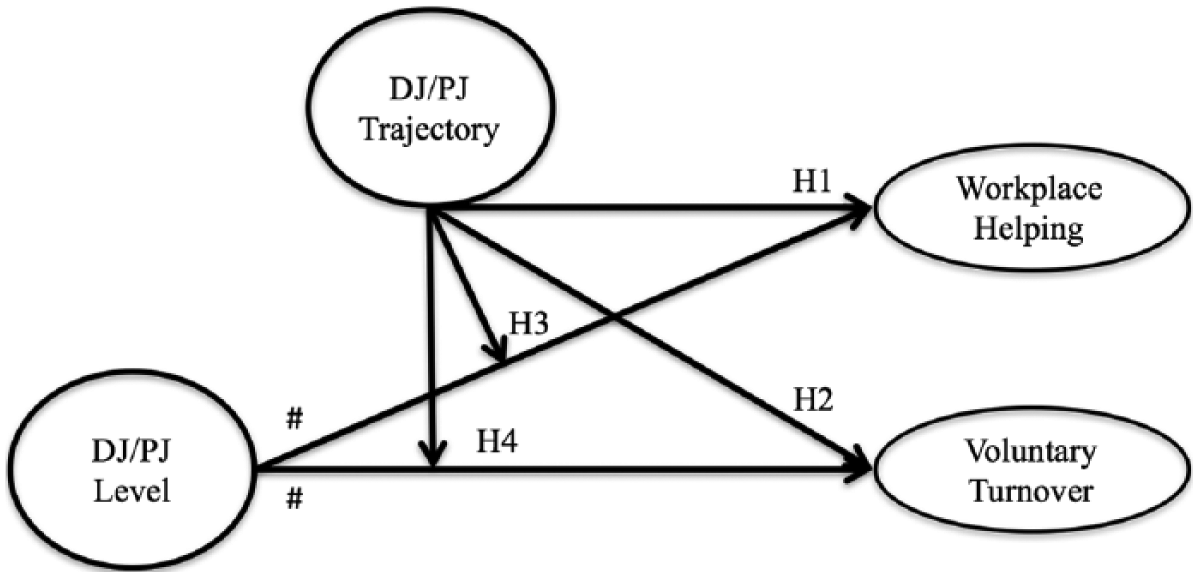
Conceptual Model
In this study, we focus primarily on distributive and procedural justice—rather than on interactional justice—given our interest in how employees respond to fairness associated with organizational systems, policies, and formal reward allocation decisions over the long term (our survey window spans once a year over 4 years). Studies show that compared with distributive and procedural justice, interactional justice tends to be experienced much more informally in the workplace, given the discretion managers often have in choosing to share information and/or being courteous or respectful to employees on a day-to-day basis (Matta et al., 2017; Scott, Garza, Conlon, & Kim, 2014). As such, the experience of interactional justice is typically more episodic and transient in nature and is therefore less appropriate for our study given the measurement time frame (Bies & Moag, 1986; Rupp & Cropanzano, 2002; Scott et al., 2014).
We contribute to theory by proposing and testing a dynamic, interactional model of justice and social exchange behaviors. We build on previous studies, such as Hausknecht et al. (2011), who, encouragingly, found that justice trajectories exhibited unique influence in predicting job attitudes (e.g., job satisfaction, organizational commitment, and turnover intentions). Relatedly, Park, Sturman, Vanderpool, and Chan (2015) offered a computer simulation of justice change and leader–member exchange. The present study contributes beyond these studies in three respects: First, this study is original insofar as we consider an interaction between justice levels and trajectories in predicting workplace exchange. Hausknecht and colleagues did examine justice trends but focused only on the predictive utility of trends independent of levels. Rather, we contend that any justice examination makes more sense when considering how levels are positioned jointly with past changes. For instance, two employees who rate their distributive justice levels as “moderate” may have altogether different turnover likelihoods if one perceives his or her justice as having declined over the past 2 years, whereas the other sees his or her justice as having improved. Similarly, any examination of justice trends is useful only to the degree that present, absolute levels are also considered. Two employees could both be experiencing a decline in their justice trajectory over time but might reciprocate differently if one is reaching now-moderate levels, whereas the other is reaching quite low levels.
Second, rather than predicting attitudes (as did Hausknecht et al., 2011), we study work behaviors, using an employee sample (in contrast to the Park et al., 2015, simulation). To date, studies have not yet examined temporal interplays of justice change and behavioral reciprocity.
Third, compared to the 1-year survey frame of Hausknecht et al. (2011), we surveyed a large sample of employees (N = 4,348) over four yearly waves, coinciding with employees’ annual performance appraisals and reward decisions. Importantly, this longer time frame allows more time for resource reciprocation and holds relevance to the annual appraisal approach common to many organizations (Korsgaard & Roberson, 1995; Meinecke, Lehmann-Willenbrock, & Kauffeld, in press). Moreover, SET emphasizes ongoing relationships, and it cannot be assumed that employees will—or can—reciprocate fair or unfair treatment immediately (Colquitt & Zipay, 2015; Jones & Skarlicki, 2013). Thus, our simultaneous study of levels and trajectories using “alternative timeframes and behavioral outcomes” (Hausknecht et al., 2011: 879) directly answers calls for research made by justice scholars (see also Holtz & Harold, 2009; Jones & Skarlicki, 2013; Lilly, Virick, & Hadani, 2010).
Conceptual Background
Organizational Justice, Social Exchange, and Time
Organizational justice is an important determinant of employee evaluations of their work environment (e.g., Colquitt et al., 2001, 2013). According to SET, justice perceptions affect work outcomes as employees come to develop obligations to reciprocate fair treatment, a symbolic resource, from decision-making authorities, in the form of positive attitudes, effort, and constructive work behaviors (Blau, 1964; Cropanzano & Byrne, 2000; Konovsky, 2000).
Social exchange research has long recognized that employees are simultaneously invested in multiple exchange relationships at work, both narrow (i.e., with supervisors) and broad (i.e., with the organization as a whole) (Settoon, Bennett, & Liden, 1996; Masterson, Lewis, Goldman, & Taylor, 2000). Levinson (1965) reasoned that employees engage in a process called “transference,” where one treats the actions of organizational agents as reflective of the organization itself. For instance, a supervisor’s fair implementation of procedures leads employees to think that their organization as a whole is fair, and such evaluations facilitate a future willingness to contribute and exert effort as a participating organizational member (Aryee et al., 2002; Colquitt & Zipay, 2015).
As patterns of reciprocity, exchange relationships also necessarily mature over time (Blau, 1964; Colquitt et al., 2013). When one party makes a favorable (i.e., just) contribution to another, such as rewards or recognition for commensurate effort, it creates a felt obligation in the receiving party to give back in the future (e.g., through continued effort and goodwill; Eisenberger, Huntington, Hutchinson, & Sowa, 1986; Gouldner, 1960). As just contributions are reciprocated in due fashion, relationships strengthen, trust increases, and future exchanges will occur more frequently and run more smoothly (Colquitt, LePine, Piccolo, Zapata, & Rich, 2012; Cropanzano & Byrne, 2000). Conversely, unfavorable (i.e., unjust) outcomes or treatment can create distress about when or if the relationship will get better. Employees may resent the authority for exploiting them and may respond by withdrawing, or even with deviant acts (Aquino et al., 1997; Folger & Cropanzano, 2001; Mitchell & Ambrose, 2007).
Though, naturally, employees will regard any given episode of just or unjust treatment with positive or negative valence, justice perceptions can also improve or degrade (Hausknecht et al., 2011; Jones & Skarlicki, 2013; Park et al., 2015). That is, justice can operate as a trajectory across exchange episodes. Justice could improve as one perceives his or her situation as becoming fairer (e.g., warranted pay increases, increased input into decisions), or it could worsen as one sees his or her situation becoming less fair (e.g., unjustified pay cuts, decreased input solicited). We therefore treat justice changes as systematically meaningful, not random, fluctuations (Chan, 1998; George & Jones, 2000) and therefore useful for prediction. Importantly, explanations for change hypotheses may be unique compared to static or absolute approaches, as change components often carry unique information (Chan, 1998; Hausknecht et al., 2011). As Liu, Mitchell, Lee, Holtom, and Hinkin (2012) illustrated, if Employee A’s job satisfaction increases from 2 to 4 and Employee B’s decreases from 7 to 5 on a 7-point scale, a static approach might lead one to infer that since Employee A’s average satisfaction (3 out of 7) is lower than is Employee B’s (6 out of 7), Employee A should be worse off. Yet a dynamic approach would yield the opposite conclusion, seeing Employee A’s satisfaction as improving while employee B’s worsens. In this circumstance, Employee A may therefore react more positively than will Employee B.
Employee Attention and Reactivity to Justice Change Over Time
Studies have shown that myriad organizational phenomena are subject to change, or dynamism (George & Jones, 2000). Conceptually, we propose that employees utilize gestalt characteristics of past and present treatment as they make sense of justice events. Additionally, we argue that employees draw upon justice change information to evaluate organizational authorities and help predict what the future will be like. Gestalt characteristics theory (Ariely & Carmon, 2000; Varey & Kahneman, 1992) describes the various aspects of experience episodes that individuals process when creating an experience profile, or a summary assessment across those discrete experiences. Rather than simply averaging across all experiences to make such a determination, individuals use heuristic, salient features of their experiences, or gestalts, to construct summary assessments and profiles. Specifically, Ariely and Carmon (2000) proposed that the end-state (i.e., most recent) ratings, trajectory (i.e., change over time) ratings, maximum/peak ratings, and average ratings are key gestalts utilized to construct an experience profile. Interestingly, however, in a study of hospital patients who rated experienced pain during their stay, only end-state and trajectory ratings significantly predicted overall pain evaluations, suggesting these are especially salient gestalts to which individuals attend and subsequently recall (Reb & Cropanzano, 2007). We similarly expect employees use end-state and trajectory gestalts to inform reciprocity decisions.
Relatedly, research on sensemaking in the context of change (e.g., newcomers adapting to entering a new job or role; Louis, 1980) suggests that because change is an out-of-the-ordinary deviation from one’s baseline, equilibrium, or homeostasis (a state of familiarity, or “staying the same”; Cannon, 1932), it will stand out as a distinguishing environmental feature against the general background (Köhler, 1947). Further, because change is often surprising and connotes uncertainty, Louis (1980) argued that individuals are consciously motivated to attribute meaning to the change and to determine an appropriate response (and perhaps also to modify future expectations to reduce further surprises). In this way, not only is change an inherently salient feature to which people attend, but individuals also seek to understand how changes will affect them personally and will make efforts to cope with the new state resulting from the change.
How are individuals likely to react to positive or negative changes from past to present fair treatment? Social exchanges require a willingness to make repeated resource investments in the exchange relationship over time. We theorize that employees utilize their perceptions of justice trajectories over time, in combination with their perceptions of present justice levels—as both are salient gestalt features (Ariely & Carmon, 2000)—to ascertain whether the future bodes poorly or well for reciprocated resource provisions to the exchange relationship. We propose that employees will interpret improving justice trajectories as offering reassurance about the positive quality of the relationship, leading them to be more likely to invest and reciprocate with effort, goodwill, and loyalty (Colquitt et al., 2013; Lind & Tyler, 1988). Conversely, justice declines are likely concerning to employees because they signal an intensifying threat to equitable resource exchange and potentially increasing future exploitation (e.g., more disproportionate rewards relative to effort, reduced input into decision making). Perceiving declining trajectories, with the possibility of even further deterioration, will lead employees to increasingly withdraw from the exchange relationship and to withhold their voluntary contributions.
Hypotheses
Main Effects of Justice Trajectories on Social Exchange Behaviors
We propose that present justice levels and past justice trajectories interact to predict social exchange behaviors. Before describing such interactions, however, main effects between justice trajectories and exchange behaviors are also hypothesized, in part because it is a foundational aspect of the interaction model but also because such links have not been previously studied. We do not hypothesize main effects for absolute justice levels and exchange behavior, however, because considerable research (see meta-analyses by Colquitt et al., 2013; Rubenstein, Eberly, Lee, & Mitchell, in press) has already demonstrated these effects. In this study, we focus on exchange outcomes of helping behavior and voluntary turnover behavior.
Helping behavior is a specific instance of organizational citizenship behavior (OCB; Organ, 1997), defined as voluntary, cooperative assistance that positively contributes to the knowledge, skills, and/or performance of another. Help is given with an instrumental means of benefitting other people, groups, or the organization (Grant & Mayer, 2009). Though people may hold various helping motivations, one central motive emphasizes helping as a result of the organization treating the employee fairly (Organ, 1990; Rioux & Penner, 2001).
Research has consistently demonstrated that justice is relevant to predicting workplace helping. Further, as helping is a type of deliberate, discretionary behavior, it is central to the reciprocative elements of social exchange and resource transaction, insofar as employees will feel obligated to respond to an employer’s fair treatment by offering to give their support to organizational members (Colquitt et al., 2013; Gouldner, 1960; Organ & Konovsky, 1989; Wang, Law, Hackett, Wang, & Chen, 2005).
What of the relationship between changing justice levels and helping behavior? Aryee and colleagues (2002) argued that whereas attitudes reflect positive or negative evaluations of social exchanges, behaviors provide a stronger test of theory by actually measuring the exchange of resources—that is, how employees choose to reciprocate. Colquitt and colleagues even went so far as to say helping and other similar OCBs are the “exemplar among social exchange outcomes” (2013: 201). Thus, our study offers a unique perspective compared to previous research on justice change focusing on job attitudes (Hausknecht et al., 2011).
Building on SET as well as our other theoretical approaches, we first hypothesize that if employees experience an historical upward fairness trajectory in the outcomes and treatment they have received, they will evaluate such a trend as a signal of improving employer resource contributions to the exchange relationship. Subsequently, this will elicit an increased willingness on behalf of employees to invest in the relationship by helping organizational members in the future (Adams & Jacobson, 1964; Gouldner, 1960). Conversely, if justice trends downward and negatively, we predict employees will commensurately be less inclined to give help. Further, we expect justice trajectory effects to predict helping over and above employees’ present (i.e., last reported) justice levels.
Hypothesis 1a: There is a positive relationship between distributive justice trajectories and workplace helping behavior.
Hypothesis 1b: There is a positive relationship between procedural justice trajectories and workplace helping behavior.
Second, we hypothesize that justice trajectories will predict turnover behavior (also beyond most recently reported levels). As with helping, because prior research has established a negative relationship between absolute fairness levels and turnover behavior (Griffeth, Hom, & Gaertner, 2000; Rubenstein et al., in press), we do not offer hypotheses for such main effects.
Specifically, we propose a negative relationship between justice trajectories and turnover behavior, such that employees who experience declining (i.e., worsening) trajectories will be more apt to ultimately respond by severing the employment relationship. In the other direction, those with increasing (i.e., improving) trajectories will be more likely to maintain employment. As individuals perceive gestalt trends of either increasing or decreasing valence, they will tend to extrapolate that such trends will keep moving in the same direction in the future (Ariely & Carmon, 2000; Lindsley, Brass, & Thomas, 1995). Those distressed by decreasing employer resource contributions will deem that their situation is expected only to grow worse, and so rather than further tolerating such inequity, we expect such employees will instead be more likely to withdraw entirely and quit. Meanwhile, an improving justice trajectory sends a positive signal to employees regarding what the future could be like. These individuals have arguably the most to gain in terms of mutually beneficial exchanges and subsequently will most likely continue to invest into the relationship and participate as an organizational member.
Hypothesis 2a: There is a negative relationship between distributive justice trajectories and turnover behavior.
Hypothesis 2b: There is a negative relationship between procedural justice trajectories and turnover behavior.
Interaction of Justice Levels and Trajectories
When thinking about their relationship with the organization, and deciding to continue to invest personal resources into the relationship, studies find that end-state information—one’s most recent, or current, evaluations—and trajectory/slope information are two particularly salient gestalts that employees reference to construct a unique experience profile (Ariely & Carmon, 2000; Reb & Cropanzano, 2007). However, beyond their independent influences, we also propose that employees jointly reference their recent justice levels (i.e., “How am I being treated right now?”) along with idiosyncratic histories of justice change (i.e., “Have I been treated better/worse/the same over time?”) when deciding to reciprocate an exchange relationship.
Beyond the social exchange explanation supporting why recent justice levels predict exchange behavior (Blau, 1964; Colquitt et al., 2013), we have argued that employees also utilize information about their history of justice changes to make decisions about future reciprocity, because such deviations from baseline levels hold relevance to future good-faith resource exchange or, alternatively, possible exploitation. In combination, however, we expect that employees will consider how their justice experience profile has changed over time in order to put present justice levels into relative context. For instance, two employees who perceive the same levels of current fairness may be differentially inclined to reciprocate if one’s perceptions have been improving over time (i.e., a positive trajectory) versus the other, who deems that he or she has progressively been treated worse (i.e., a negative trajectory). By evaluating only main effects, the conditional nature of such evaluations would be overlooked.
Specifically, we hypothesize that justice trajectories will interact with absolute levels to predict workplace helping and turnover behavior. Higher justice levels with stagnant trajectories signify that justice has not changed and has always been favorable, and thus represents a steady, high-quality exchange relationship and no surprise to make sense of. However, we expect higher justice levels along with improving (i.e., positive) trajectories will lead employees to be highly willing to contribute to their organization through workplace helping, for such individuals are in a favorable present position of appropriate reciprocity and perceive a history of increasingly equitable employer resource contributions, which employees will expect to continue—and continue to get better—in the future (Ariely & Carmon, 2000; Colquitt et al., 2013).
In contrast, more negative exchange outcomes (lower helping, higher turnover rates) are expected for employees with lower absolute justice levels contingent on stagnant, or worse, past declining (i.e., more negative), trajectories. Lower absolute justice levels signal a generally fractured exchange relationship, but along with declining trajectories, this depicts unfairness that has progressively intensified over time, which employees will also expect to continue to get worse. Similarly, lower absolute levels that have not changed will also likely produce more adverse exchange outcomes compared to those with a positive trajectory, because this represents an unfavorable exchange relationship that has been consistently exploitative over time.
Hypothesis 3a: The positive relationship between distributive justice levels and helping behavior levels is moderated by distributive justice trajectories, such that the relationship is stronger (i.e., more positive) for employees with more positive (i.e., improving) trajectories.
Hypothesis 3b: The positive relationship between procedural justice levels and helping behavior levels is moderated by procedural justice trajectories, such that the relationship is stronger (i.e., more positive) for employees with more positive (i.e., improving) trajectories.
Hypothesis 4a: The negative relationship between distributive justice levels and turnover behavior is moderated by distributive justice trajectories, such that the relationship is stronger (i.e., more negative) for employees with more positive (i.e., improving) trajectories.
Hypothesis 4b: The negative relationship between procedural justice levels and turnover behavior is moderated by procedural justice trajectories, such that the relationship is stronger (i.e., more negative) for employees with more positive (i.e., improving) trajectories.
Method
Data were collected from employees across 278 branches of a large banking organization in the mid-southern United States, through collaboration with the company’s human resource manager. At the start of data collection, the third author met with human resources department members to augment a voluntary questionnaire that was distributed yearly to all employees. Specifically, the questionnaire, initially composed of mostly in-house items, was augmented to include an additional set of academic measures to be used for research. It was these additional academic measures that were used in the present study, along with archival turnover records.
During August of each year from 2011 to 2014 (around the organization’s annual performance appraisal time), an organizationwide electronic link was sent to all employees, inviting them to participate. Supervisors encouraged responses within 2 weeks through reminders. Between 2011 and 2014, 5,508 individuals had responded to at least one survey variable. However, after listwise deletion due to missing respondent data on constructs of interest relevant to this study, our final analyzable sample consisted of 4,348 valid responses (a 78.9% response rate). The mean age of participants was 43.34 (SD = 11.67), mean organizational tenure was 10.65 years (SD = 9.92), and 65% were female. The majority (72%) identified as Caucasian, with the remainder identifying as African American (24%), Asian (2.3%), Hispanic/Latino (1.2%), or Other (1.2%). Comparison of removed respondents with those who were retained in analyses revealed no major demographic differences, although those who were retained in the final sample had slightly longer mean tenure (10.65 years vs. 8.96 years, p < .01).
The majority of employees (54%) were classified by the organization as “exempt” under the Fair Labor Standards Act, and nearly all (96%) were employed full-time. In terms of work performed, employees held various jobs, most commonly, bank tellers (37%), professionals (e.g., senior analysts) (27%), and customer service representatives (15%).
Measures
All survey items were assessed on 5-point Likert scales ranging from 1 = strongly disagree to 5 = strongly agree. Following recommendations for computing reliability of two-item scales (Eisinga, Grotenhuis, & Pelzer, 2013), we used Spearman-Brown estimates.
Distributive justice
We assessed distributive justice with two items from Colquitt (2001): “To what extent are your total rewards (benefits, pay, recognition, etc.) appropriate for the work you have completed?” and “To what extent do your total rewards (benefits, pay, recognition, etc.) reflect what you have contributed to the organization?” Spearman-Brown reliabilities were rS-B = .92, .93, .94, and .95 for 2011, 2012, 2013, and 2014, respectively.
Procedural justice
We assessed procedural justice with two items from Colquitt (2001): “To what extent have [company name]’s employment practices been free of bias?” and “To what extent have [company name]’s employment practices been based on accurate information?” Reliabilities were rS-B = .81, .86, .87, and .87 for 2011, 2012, 2013, and 2014, respectively.
Due to organizational concerns about survey length, we were constrained in terms of using the full four-item (for distributive justice) and seven-item (for procedural justice) scales from Colquitt (2001). To select those items to use, we first consulted past research reporting on the factor loadings of this scale (e.g., Skarlicki, Van Jaarsveld, & Walker, 2008) and chose the highest-loading items, also considering the relevance of each item to the organizational context in question. We further compared the correlations among justice dimensions and between justice and outcomes to those reported in the most recent broadscale justice meta-analysis (Colquitt et al., 2013). Ultimately, we found that such estimates were within range of both the confidence intervals of “true” population parameters and the credibility intervals of past studies.
Further, we collected validation evidence of our selected items within the full justice measures, along with collecting measures related to workplace social exchange. Using the Amazon Mechanical Turk data collection service, we obtained responses from 154 full-time (working ≥35 hours per week) employees, who were paid US$1.50 for completing a survey. Along with the full justice scales, we also gathered data on helping behavior (items shown below), perceived organizational support, social exchange quality, organizational commitment, and uncertainty (see Colquitt et al., 2014, for items). Although we do not present the full empirical results here (available from the first author by request), this effort yielded three main findings, thereby justifying the two-item scales. First, a confirmatory factor analysis of the justice and social exchange measures yielded acceptable fit whether we used the two-item or the full justice scales, and the two justice items ultimately selected from each scale again were among the highest-loading items in the full-item model (similarly showing high standardized factor loadings [≥.90] in a two-item-only model). Second, comparison of the two-item and full-scale justice measures yielded nearly identical scale reliabilities, and both were acceptable (≥.90). Third, we compared estimates from two structural equation models, one with the two-item scales and the other with the full scales, in predicting the social exchange outcomes. After regressing all social exchange outcomes on both justice dimensions, we found that the results were nearly identical in both models, with overlapping confidence intervals in all cases, lending support to the two-item justice measures as viable proxies for the full scale.
Workplace helping behavior
We assessed helping behavior with two items from Colquitt (2001): “I frequently help my teammates when they have heavy workloads” and “I put more effort into helping my teammates than is generally expected of me.” Reliability estimates were rS-B = .74, .81, .81, and .79 for 2011, 2012, 2013, and 2014, respectively.
Voluntary turnover
The human resources department maintained records of turnover (i.e., stay = 0, quit = 1, fired = 2) and reasons for leaving (noted in exit interviews). Turnover was classified by the organization as voluntary or involuntary in terms of whether the exit occurred due to the employee’s or employer’s decision. We first sorted the data based on employees’ qualitatively listed reasons for leaving. As previously noted, some employees left for involuntary reasons, such as firings or branch closures (203 employees, or 4.7% of the sample), or due to unavoidable voluntary reasons, such as regular retirement (3.5% of the sample)—these employees were treated along with stayers as a competing hazard against those employees whose exit was both voluntary and avoidable. That is, our sample contrasts those people who voluntarily quit due to dissatisfaction, alternative jobs, or some other avoidable cause against all other employees with usable survey data. Those who had not voluntarily quit by 1 year after the 2014 survey were treated as right-censored. By the censoring period, 478 individuals had voluntarily left the organization (voluntary turnover rate of 12%, total turnover rate of 19.2%).
Control variable: Organizational tenure
Because some individuals were hired before our data collection began, this could have affected employees’ perceptions of justice levels (i.e., longer-tenured individuals may have been exposed to more workplace inequity), degrees of justice change (i.e., justice evaluations may have stabilized for longer-tenured workers), helping behavior, or quitting likelihood, we controlled for employee’s organizational tenure in all analyses to isolate effects of the phenomena of interest. We obtained each employee’s date of hire from organizational records and subtracted this from the date of the first completed survey.
Analyses
We tested hypotheses using a combination of latent growth modeling (LGM; Chan, 1998; Chan & Schmitt, 2000) and structural equation modeling. The justice LGM was estimated using Mplus Version 7.2 (Muthén & Muthén, 2012). With LGM, items from each time period are used to create distinct latent intercept (i.e., initial status) and trajectory (i.e., slope, or change over time) factors, which can then be linked to other covariates.
To test the model, we first specified the two items for each variable at each time period to load as imperfect indicators of a single latent factor (e.g., “procedural justice Time 1 by Items 1 and 2”). Next, these first-order latent factors were themselves set as indicators of two second-order factors: One of these factors represents the construct intercept, and the other represents its slope. We specified the second-order intercept factor loadings to be set to 1, which signifies the 1st year of data collection, and the second-order trajectory factor loadings were set to increase from 0 to 3 over the 4 years of data collection, thereby representing linear change over time.
An important assumption underlying LGM is that one is measuring the same substantive constructs over time—termed measurement invariance. Following procedures outlined by Chan (1998), before conducting the LGM, we first compared fit statistics of two models. The first model freely estimates factor loadings for each variable at each time point (i.e., not specified to be any value, other than the initial factor set at 1, to set the scale). The second model estimated is invariant, or constrained, meaning that factor loadings for each indicator are fixed to be equal. Similar fit between the two models indicates support for invariance (Chan, 1998). In comparing comparative fit index (CFI), Tucker-Lewis index (TLI), and root mean square error of approximation (RMSEA) values, the two models showed near-equal fit, with any differences showing up around the third decimal place. Thus, we can be confident in measurement invariance over time for the two justice dimensions and helping behavior measure. 1
Before testing hypotheses, we next examined the fit of the procedural and distributive justice LGM. The linear change model fit as follows: χ2 = 2,833.70, df = 250; CFI = .95, TLI = .94, RMSEA = .05. We also considered an alternative model estimating nonmonotonic growth, where slope parameters at Times 2 and 3 were freely estimated. However, results suggested this model did not fit the data any better than did the more parsimonious linear model, χ2 =2,802.35, df = 238; CFI = .95, TLI = .94, RMSEA = .05. Thus, the linear model was retained.
Given that individuals were employed across 278 bank branches, we also assessed the degree to which nesting effects might have been operating in justice, helping, and turnover behavior. We computed intraclass correlations (ICC[1]) to determine the proportion of variance in each variable due to group (i.e., bank branch) membership (Bliese, 2000). We followed the formula from Bliese and Halverson (1998) to compute ICC(1) values for groups of unequal sizes, because not all branches had the same number of employees responding. The results averaged across the 4 years of data collection yielded mean values of ICC(1) of .049 for distributive justice, .046 for procedural justice, and .039 for helping behavior. Further, for turnover behavior (measured once), ICC(1) was .003. These values are quite low to justify meaningful branch-level variance (Bliese, 2000; James, 1982; LeBreton & Senter, 2008), so it appears that limited variation in study variables was influenced by branch membership.
Due to the excessively intensive amount of computing power needed to test multiple simultaneous latent interactions between second-order slope and end-state factors in predicting helping and turnover (and unsuccessful attempts to get such a model to converge), we tested hypotheses using employee factor scores. To obtain such scores, we first calculated an intercept and linear trajectory on each justice dimension for each employee and requested Mplus to save trajectory factor scores (using the SAVE=FSCORES command). This command returns a value for each employee regarding the amount of his or her justice change over the course of the survey period (i.e., positive as increasing, zero as stagnant, negative as decreasing). Following this, we next computed interaction terms for each employee based on the product of trajectory values and last reported justice levels. We used each employee’s last reported justice evaluation (rather than using 2014 [Year 4] values for all employees) because some employees quit before the last survey, so such end-state justice-level information would be missing. Before computing interaction terms, to reduce nonessential multicollinearity, we first mean-centered the main effects for both justice end-state levels and trajectories (Cohen, Cohen, West, & Aiken, 2003).
Because research suggests that procedural and distributive justice are jointly experienced and are often conditional upon one another (Brockner & Wiesenfeld, 1996; Folger & Konovsky, 1989), and in order to examine the incremental predictive validity of one justice form relative to another, we modeled justice main effects and interactions simultaneously in a single structural equation model. Relatedly, Mplus allows for joint modeling of continuous (i.e., helping behavior) and dichotomous (i.e., turnover) outcomes (Muthén & Muthén, 2012), so all outcomes—and therefore all hypothesis tests—were tested simultaneously.
It is possible that nonresponse bias may have affected the results, given that 1,160 employees did not complete the surveys. For instance, such individuals may have had more negative justice perceptions and may have not wanted to share their opinions. If this were the case, our mean justice ratings would be noticeably higher than the average found in past studies, because such missing responses would have brought the mean down. Relatedly, our correlations might also be somewhat biased. Following Newman’s (2009) suggestions about ascertaining whether data are missing at random, we evaluated whether the mean justice ratings were upwardly biased. Because Colquitt et al. (2013) did not report data on meta-analytic means for distributive or procedural justice, we performed a manual meta-analysis, searching Google Scholar, of the first 500 studies citing Colquitt (2001) whose authors reported mean justice ratings. As some of these studies used a different scale range (i.e., 1–7 vs. 1–5), we converted all values to a 1-5 scale to compute a grand mean. Across k = 110 distributive justice studies and k = 161 procedural justice studies, grand mean ratings were as follows: DJmean = 3.50 (SD = .44); PJmean = 3.58 (SD = .48) (where DJ = distributive justice and PJ = procedural justice). Converting this to an 80% credibility interval, we obtained a range of 2.94 to 4.06 for distributive justice, and 2.97 to 4.20 for procedural justice, which describes the range of means reported in primary studies. As shown in Table 1, our mean values of 3.59 and 3.92 are within these intervals, suggesting that the data were not significantly biased. Similarly, in comparing our correlations to those obtained by Colquitt et al. (2013), we again find that our results were not upwardly or downwardly biased. These results are consistent with Newman’s (2009) favorable condition that the missing survey-level data are most likely missing at random.
Descriptive Statistics, Reliability Information, and Observed Variable Intercorrelations

Note: Coefficient alphas are shown along the diagonal in italics. Correlations larger than |.03| are significant at p < .05.
Stayer = 0, leaver = 1.
Results
Descriptive statistics (e.g., means and standard deviations), intercorrelations, and reliability information among observed study variables are shown in Table 1.
Before testing hypotheses, we first examined parameter estimates of the growth model to test whether justice and helping significantly changed for employees over the course of the survey period. These results are presented in Table 2. The results show that the mean trajectories for distributive and procedural justice were not significant, indicating no significant mean change from Times 1 through 4 across all employees on these variables. Importantly, though, the between-person justice trajectory variance was significant, meaning that many individuals rated a significantly improving justice trajectory, others reported a worsening trajectory, and others reported a stagnant trajectory, even though this averaged to nonsignificant change across all employees. Also noteworthy, the procedural justice slope variance was larger than that of distributive justice, a point to which we return in the Discussion. Overall, however, this significant variance component shows that for many, justice did significantly change over time, thereby allowing for prediction.
Significance Tests for Latent Growth Model Parameters
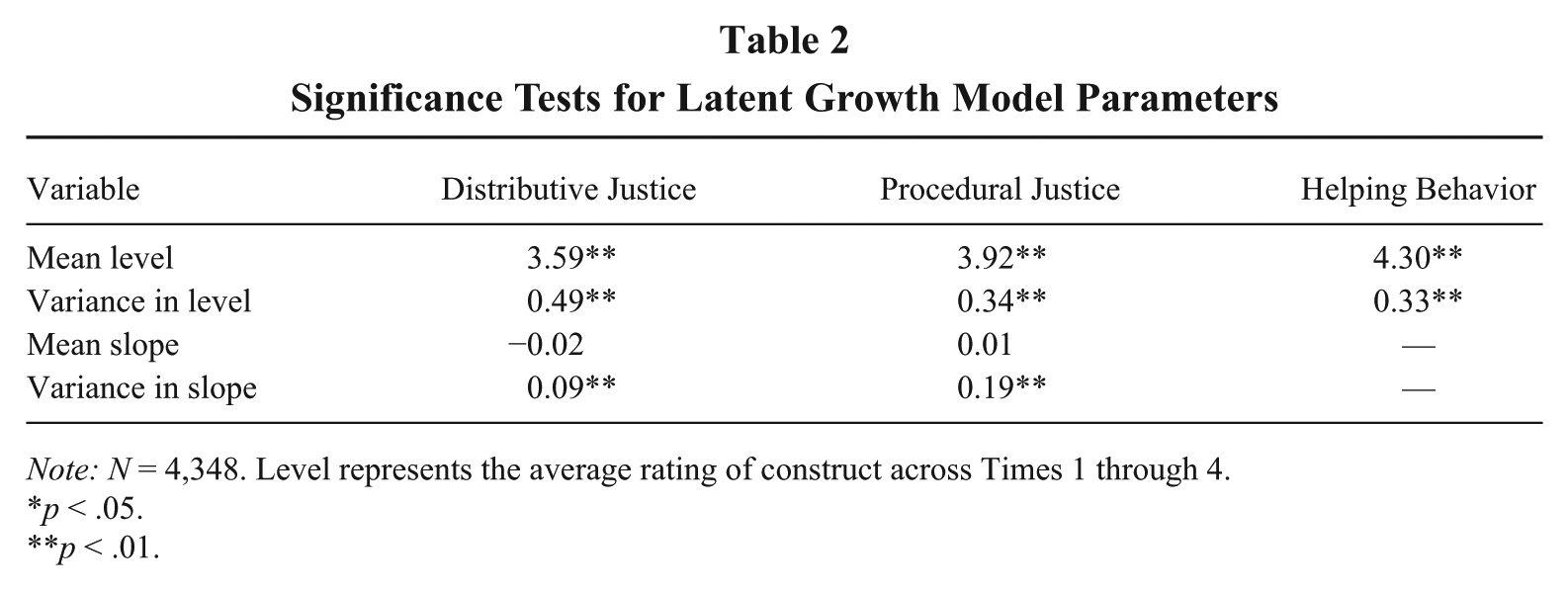
Note: N = 4,348. Level represents the average rating of construct across Times 1 through 4.
p < .05.
p < .01.
Hypotheses 1a and 1b linked the main effects for distributive and procedural justice trajectories, respectively, to helping behavior. Shown in Table 3, after controlling for organizational tenure and last reported justice levels, increases over time in both distributive and procedural justice were related to significantly higher levels of last reported workplace helping (DJslope: B = .03, t = 2.68, p < .01; PJslope: B = .04, t = 4.03, p < .01). Thus, Hypotheses 1a and 1b are both supported.
Results of Distributive and Procedural Justice Levels, Trajectories, and Interactions Predicting Time 4 Helping Behavior
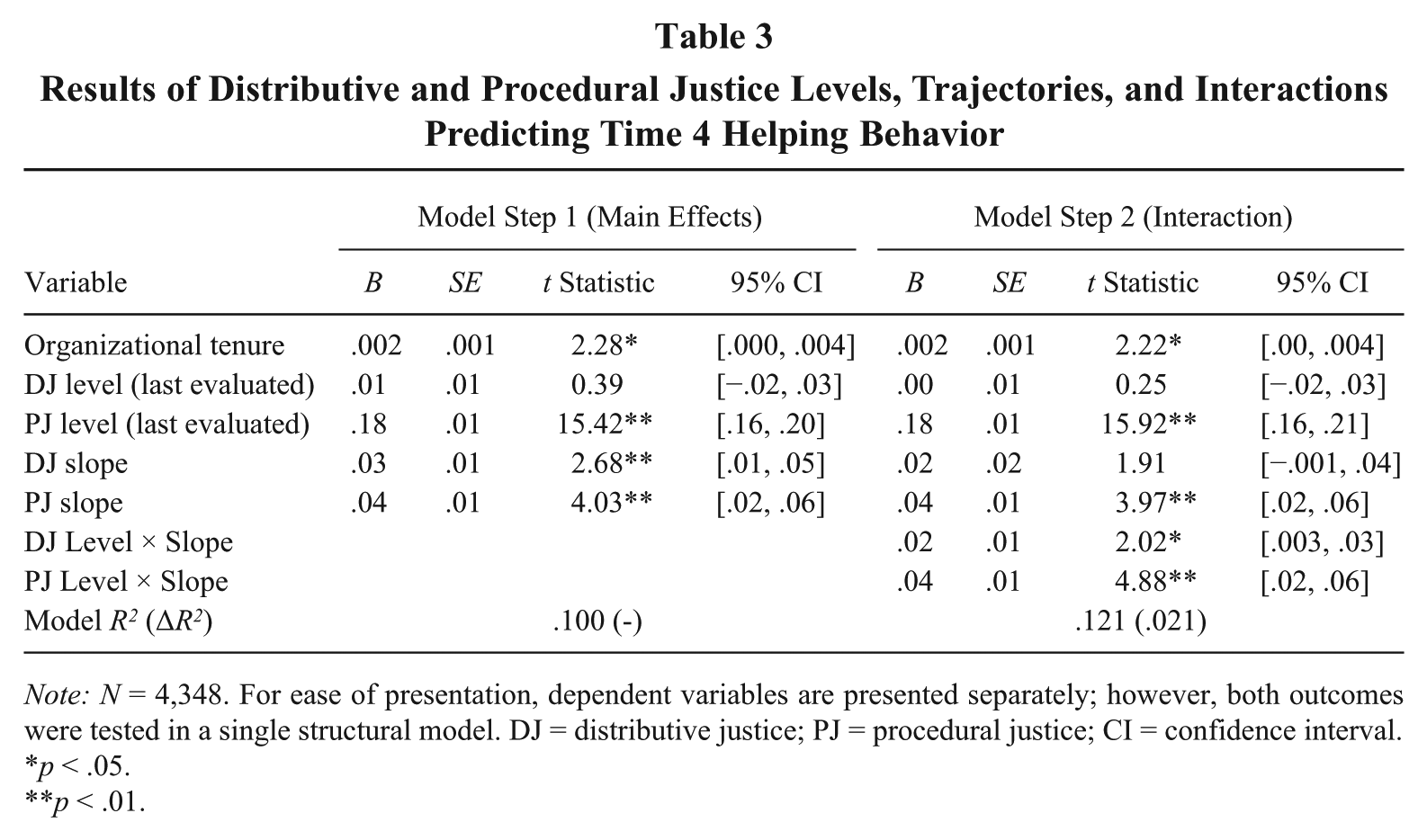
Note: N = 4,348. For ease of presentation, dependent variables are presented separately; however, both outcomes were tested in a single structural model. DJ = distributive justice; PJ = procedural justice; CI = confidence interval.
p < .05.
p < .01.
Hypothesis 2 concerned justice trajectories and turnover behavior. We report these results in Table 4. After controlling for last reported levels, the results show that procedural justice trajectories were a significant main effect predictor of turnover but that distributive justice was not (DJslope: B = −.03, z = −1.07, p > .05; PJslope: B = −.11, z = −3.29, p < .01). Thus, Hypotheses 2a is not supported, but Hypothesis 2b is supported.
Results of Distributive and Procedural Justice Levels, Trajectories, and Interactions Predicting Turnover Behavior

Note: N = 4,348. For ease of presentation, dependent variables are presented separately; however, both outcomes were tested in a single structural model. DJ = distributive justice; PJ = procedural justice; CI = confidence interval.
p < .05.
p < .01.
Hypotheses 3 and 4 addressed the interaction between justice levels and trajectories in predicting helping and turnover behavior, respectively. Results for Hypothesis 3 are shown in Table 3, while results for Hypothesis 4 are shown in Table 4. After adding interaction terms to the main effect model, we find significant interactions for both distributive and procedural justice in predicting helping (DJinteraction = .02, t = 2.02, p < .05; PJinteraction = .04, t = 4.88, p < .01). For turnover behavior, we also find a significant interaction for procedural justice levels by trajectories but not for distributive justice (DJinteraction: B = .05, z = 1.80, p > .05; PJinteraction: B = −.07, z = −2.15, p < .05).
Because our hypotheses specified that interactions would operate conditionally on specific justice trajectory values, we plotted conditional slopes of interaction terms at varying amounts of the trajectory moderators. Importantly, it is worth reiterating that across all employees, the mean reported trajectory was essentially zero for both distributive and procedural justice, signifying that results operating at the “mean justice trajectory” effectively represent a flat, or stagnant, slope. That is, those with a mean trajectory exhibited no significant justice change across the survey period. As seen in Figures 2 and 3, the highest levels of employee helping exist for employees with higher (+1 SD) distributive and procedural justice levels and positive (+1 SD) trajectories. As such, Hypotheses 3a and 3b are supported. For turnover rates, shown in Figure 4, lower rates were found for those with higher procedural justice levels, but this main effect is conditional upon justice trajectories. The lowest turnover exists for those with an improving (+1 SD) trajectory and higher absolute levels. Thus, Hypothesis 4b is supported, but Hypothesis 4a is not supported (as the distributive justice interaction was not significant).

Interaction of Distributive Justice Levels and Trajectories Predicting Helping Behavior

Interaction of Procedural Justice Levels and Trajectories Predicting Helping Behavior

Interaction of Procedural Justice Levels and Trajectories Predicting Turnover Behavior
Supplementary Analyses
As one reviewer suggested, given previous justice research finding evidence for process-by-outcome interactions, it is possible that procedural (distributive) justice levels might interact with distributive (procedural) justice trajectories to influence helping and/or turnover behavior. To test this, we conducted supplementary analyses. Interestingly, after accounting for main effects and organizational tenure, two interactions were significant, both predicting helping behavior: Distributive justice levels interacted with procedural justice trajectories (B = .05, t = 2.53, p < .05), and procedural justice levels interacted with distributive justice trajectories (B = .07, t = 3.62, p < .01). Interactions predicting turnover were not significant. These results lend further support to the idea that employees jointly evaluate justice processes and outcomes.
Discussion
Though the tenets of SET emphasize an ongoing interplay of reciprocal resource contributions, most studies to date have focused on whether contemporaneously higher or lower justice levels predict organizational outcomes, or on longitudinally separating justice measurement from outcomes (Colquitt et al., 2001, 2013). Comparatively, fewer studies have explicitly considered changing justice patterns over time and, in particular, how employees additionally take into account improvements or decrements over time in how they have been treated when considering whether and how much to reciprocate to an employment relationship.
The present study offered a test of this dynamic approach, examining how both justice levels and trajectories independently and interactively predict behavioral social exchange outcomes. We found a unique pattern of change effects, highlighting an important role for justice variation: One’s reactions to exchange episodes are contingent not only on that specific episode’s valence (i.e., fair vs. unfair) but also must be put into context, in terms of how such episodes fit into a broader pattern of past and expected future treatment and equitable resource allocation. Also, our 4-year, multiwave investigation offers a glimpse into the long-term nature of justice effects. Because pay raises (or cuts) or policy changes are not everyday occurrences (Colquitt, Scott, Judge, & Shaw, 2006; Sweeney & McFarlin, 1993), the time span considered here shows not only that experienced justice or injustice is felt proximally, as with transitory affective states, like anger and hostility (Barclay, Skarlicki, & Pugh, 2005; Rupp & Spencer, 2006), but also that such reactions can linger, with potent long-term consequences.
Our results showed that distributive and procedural justice trajectories both impacted social exchange outcomes, either in a main or in an interactive sense. Trends in both “what” outcomes employees get, as well as the procedures underlying “how” they get them, matter. Specifically, employees who noted improving procedural justice trajectories exhibited higher levels of helping behavior and lower likelihood of turnover behavior, and improving distributive justice trajectories were linked to higher levels of helping behavior. Further, we found a discernable pattern of interaction effects, where both absolute distributive and procedural justice–level effects were contingent upon justice trends to influence exchange outcomes.
Theoretical Implications and Future Research Directions
We have emphasized that a key component of understanding any construct is how it operates over time, not simply the predictive validity at any given time (George & Jones, 2000). In doing so, we contribute to emerging studies explicitly modeling construct fluctuation to increase prediction, rather than treating such variation as mere error. We believe temporal considerations are particularly relevant to justice theorizing, given that an SET perspective requires considering how justice, exchange, and time are intertwined. However, SET does not directly address the role of change vis-à-vis static levels of justice. We therefore extend justice theory by describing how gestalts and sensemaking help explain why and how employees utilize information about long-term changing treatment to determine their future reciprocation.
Consistent with our theorizing, the unique trajectory effects beyond those of justice levels, along with the significant level-by-slope interactions, suggest that employees invoke both present and past evaluations to help to project how they think they will be treated and/or rewarded in the future. This fairness experience profile is both dynamic and informationally rich—present evaluations vary in intensity in response to discrete work experiences and are contingent on how those experiences are put into context based on the past (Jones & Skarlicki, 2013). It is not, as previous research has modeled, contingent solely on one all-inclusive judgment determined at one point in time. A declining justice trajectory suggests that an employee observes his or her situation as becoming progressively bleaker (Ariely & Carmon, 2000; Lindsley et al., 1995); as a result, he or she becomes less invested at work and will withhold exchange resources.
Still, this is not to say that absolute justice levels do not matter—quite the contrary. Relatively speaking, across the board, some of the strongest effects were seen for levels, particularly for procedural justice. However, our main goal was to highlight the joint role of levels and trajectories impacting social exchange. We found that even if current justice ratings are favorable, employees’ helping and turnover decisions are also contingent on their perceived history of improving, stagnant, or declining justice trends. We would thus argue that the most theoretically meaningful justice insights occur when researchers have modeled present levels in conjunction with past trajectories.
Our study suggests several methodological challenges and opportunities related to these theoretical extensions. One, of course, is to incorporate dynamic justice perceptions along with levels into theoretical models. However, this suggestion raises questions about appropriate time frames and intervals to study changes in justice reactions (Hausknecht et al., 2011). SET posits an open-ended frame for mutual exchange (Colquitt & Zipay, 2015); here, we considered a relatively long frame (multiple years) with 1-year survey intervals. This frame likely matches well with and informs many important organizational decisions that contain changing distributive and procedural justice components, such as performance appraisals and reward allocation. Still, it may be that other processes would be expected to change at more frequent intervals, for example, work assignments or informal manager feedback (e.g., Matta et al., 2017). Thus, we encourage future tests of theory to carefully consider how temporal processes align to research questions, and to continue to take advantage of methodological advances providing for modeling of construct change over time.
Our study also has implications for theory regarding helping and withdrawal more broadly. Although consideration of temporal dynamics is growing, there are opportunities and challenges here as well. Consider the case of turnover research: A recent review documents that the vast majority of studies rely on what Steel (2002) called a static cohort research design, with independent variable measurement at one time followed by a lagged assessment of turnover (usually 1 year; Allen, Hancock, Vardaman, & McKee, 2014). Such designs fail to consider the likelihood that employee job perceptions, treatment, environment, and opportunities change, and provide no theoretical grounding for why 1 year is the most appropriate time frame. Future studies directly addressing the relative speed by which changes in predictors affect turnover decisions would be valuable (see also Rubenstein et al., in press, Recommendations 3–6).
We also believe it especially important to better understand the etiology of justice changes. If justice perceptions do change over time, why is this so? What factors lead justice to improve or worsen, and what factors have the most pronounced effects? In this study, we considered justice change as a predictor, but it is equally interesting to position it as an outcome (Scott, Colquitt, & Zapata-Phelan, 2007). In terms of distributive justice, a pay cut, a pay raise, or exposure to others’ wage information would likely affect justice perceptions to different degrees, with cuts perhaps demonstrating stronger absolute change effects compared to raises—losses tend to have more pronounced effects than gains (Kahneman, 2011). Procedurally, a change in supervisors who are more inclusive in decision making, or policy changes (e.g., formal conflict arbitration, increased decision accountability, improved feedback channels), could affect justice perceptions as well. Reduced voice or increased bias could occur if supervisors increasingly take advantage of conflict-avoidant subordinates. Or, supervisors may, over time, develop stronger relationships only with particular work group members, as has been proposed by some leader–member exchange theorists (Bolino & Hsiung, 2014; Graen & Uhl-Bien, 1995). As a result of such favoritism, some employees may become increasingly disadvantaged over time.
Practical Implications
The results suggest that justice trends, in addition to levels, play an important role in understanding behavioral reciprocity at work. Consistent with previous studies examining change processes (e.g., Liu et al., 2012), managers frustrated by high turnover or low employee effort might consider reevaluating their performance appraisal systems to ensure that evaluations are free from bias. Specifically, employees in our sample were evaluated on a yearly (rather than monthly or quarterly) basis, using general evaluation criteria. As such, managers may have been especially susceptible to recall errors, such as confirmation bias or recency effects, potentially leading some employees to question the accuracy of the evaluation. To mitigate such concerns and thereby improve justice perceptions, alternative appraisal methods might be recommended, such as behaviorally anchored rating scales or more results-oriented approaches.
Second, as we have emphasized, to properly understand employee justice evaluations, any given rating must be put into temporal context. When given a survey, three employees who rate the same justice levels may behave altogether differently, due to each employee’s unique trajectory. Employee A may have experienced improvement as he or she was given more voice into decisions, and Employee B may have experienced decline while Employee C experienced stagnation. As such, rather than single, perfunctory efforts to assess how fairly employees feel they have been treated, we would advise that organizations continually gauge justice levels. We expect such efforts to have twofold effects: First, they will allow organizations to get the responses they seek—that is, ongoing assessment of job attitudes, behaviors, and justice may help to identify those employees who are perceiving a downward spiral and who are perhaps imminently close to quitting or who might be engaging in counterproductive behaviors. Second, and perhaps even more useful, ongoing assessment will send a signal to employees that the organization cares about their welfare. It is possible that the act of soliciting an employee’s opinion about how he or she has been treated could strategically improve procedural justice perceptions (by giving the employee a voice). Of course, this recommendation necessarily comes with the caveat that employees must feel their responses will be taken seriously and, if surveys are not distributed anonymously, that there will be no negative repercussions if they were to express their true feelings.
Limitations and Additional Future Research Directions
One limitation concerns the somewhat limited variability seen in justice ratings over time. Although significant, this may partly be because the average employee tenure in the sample was over 11 years, and so for many, justice evaluations may have largely stabilized. Thus, future studies should consider other employee populations where justice levels are liable to fluctuate more greatly, to bolster the generalizability of our findings. For instance, in the growing service industry, there are often very high turnover rates (e.g., Ellingson, Tews, & Dachner, 2016; Peterson & Luthans, 2006), such that ongoing replacement of supervisors, each having different management styles, policies on employee involvement, or beliefs about outcome allocation (e.g., pooled vs. individual tipping, commission percentages, rewarding output vs. activity), may be associated with more fluctuation in justice perceptions (see also Holtz & Harold, 2009). As noted earlier, the procedural justice slope variance was larger than that of distributive justice, and it is possible this constrained our ability to detect some effects for distributive justice trajectories relative to procedural justice trajectories. Our sense is that some of the major outcomes likely to influence perceptions of distributive justice, especially commensurate with our yearly time frame, are somewhat constrained in absolute terms in this context. For example, the annual performance evaluation for most employees in this organization was conducted on a 3-point scale; thus, the opportunity for dramatic year-to-year fluctuations is constrained. Similarly, the opportunities for annual raises and bonuses were also relatively constrained in this context compared to others (e.g., for CEOs or hedge fund managers whose rewards could swing hundreds of thousands or millions of dollars from year to year). It may also be the case that there are meaningful differences in the ways individuals respond to changes in different types of justice, and future research addressing these issues is warranted.
A second limitation concerns our yearly measurement time frame, which may be considered somewhat coarse in the sense that justice-relevant events likely happen more frequently than at yearly intervals and that justice evaluations may also fluctuate over shorter time frames. Theory and research remain in their infancy when it comes to investigating construct trajectories, with only a handful of studies directly tackling these issues: Chen et al. (2011) studied job satisfaction change at 6-month intervals, Hausknecht et al. (2011) studied justice change and job attitudes at 3-month intervals, and Matta et al. (2017) used just a 3-week interval. There is, as of yet, no clear theoretical guidance as to what the optimum time frame for assessing justice change may be, and it is an empirical question as to the timing and resultant impact of justice fluctuations.
However, our yearly time frame does have theoretical and practical merit for studying justice trajectories. Organizational decisions that are likely to directly influence perceptions of just or unjust treatment, such as performance appraisal feedback, reward allocations, and job promotions, often occur in annual cycles (e.g., Korsgaard & Roberson, 1995; Meinecke et al., in press). In the case of our study, the organization conducts annual performance appraisals, typically makes reward (i.e., compensation and bonus) decisions annually, and surveys employee opinions annually, all around the same time of year. Thus, our yearly measurement strategy was appropriate as a reflection of the natural rhythms of organizational life and with important justice-related personnel decisions and activities—a rhythm that may vary across organizations, although we suspect that yearly intervals remains the mode spacing for many decisions. Clearly, though, many employees have long memories when it comes to instances of fair and unfair treatment. Thus, we believe it is meaningful to consider year-to-year fluctuations in justice perceptions in considering interactions among perceptions of current treatment and trajectories of past treatment to predict work behavior. This may be particularly true of behaviors, like turnover, that often require substantial planning and foresight before being enacted. Nevertheless, future research aimed at teasing out the nature and timing of justice fluctuations would be valuable.
Third, although distributive and procedural justice were the focal dimensions of interest in this study, we recognize other work that has suggested that interactional justice is also a key component of justice and social exchange. We might speculate that interpersonal treatment is at least as likely to fluctuate as other forms of justice (Hausknecht et al., 2011; Matta et al., 2017) and to be important for outcomes directly focused on managers, supervisors, or others in positions of influence. This is the first study to link justice changes to behaviors like helping and turnover, so studies would do well to build on our findings by linking the full range of justice dimensions, and their variation over time, to outcomes of interest.
Finally, although our primary focus rested on demonstrating whether justice trajectories interact with current justice levels to influence helping and turnover, in building our model, we relied on some arguments that we were unable to assess directly, due to survey length constraints. For example, we measured helping and turnover as behavioral examples of how individuals reciprocate in social exchange relationships; however, we did not directly measure perceptions of social exchange quality itself or affect as a result of justice change (Colquitt et al., 2013). Future research more directly examining these and other potential underlying processes—perhaps even manipulating justice trajectories in more controlled settings—would further improve our understanding of how and why the past and present are prologue when it comes to workplace fairness.
Footnotes
Acknowledgements
This article was accepted under the editorship of Patrick M. Wright. Along with the constructive help of the action editor and anonymous reviewers, the authors would also like to acknowledge the feedback of Drs. Sanghee Park, John Kammeyer-Mueller, and David Long on earlier versions of this manuscript. This article was accepted under the editorship of Pat Wright.