



Abstract
Building on behavioral decision-making theory, we study the extent to which current industry downsizing intensity, changes in future macroeconomic outlook, and a firm’s past performance trend influence the relationship between downsizing magnitude and investor response. Based on the analysis of a large-scale sample of downsizing announcements in the United States over a period of 12 years, our results indicate that negative investor responses to downsizings are amplified in periods of industry downsizing waves, in the face of changes in macroeconomic outlook, and subsequent to deteriorating firm financial performance. Additionally, our empirical results suggest that investors’ cross-level aggregation of these cues has a significant, negative compound effect on downsizing firms’ market valuations.
Workforce downsizing, defined as the intentional reduction in workforce to improve firm performance, is a frequently used practice by managers (Datta, Guthrie, Basuil, & Pandey, 2010). In recent years, downsizing has spread massively across the United States as well as other developed economies in response to industry downturns and wider economic crises (Datta & Basuil, 2015; U.S. Bureau of Labor Statistics, 2014). The prevalence of workforce downsizing as a managerial practice is somewhat astounding given the substantial ambiguity of evidence on the (financial) benefits of workforce downsizing. Research findings on the capital market–based performance outcomes of downsizings are largely equivocal. Short-window event studies around the days of the focal downsizing announcement have found evidence for both positive (e.g., Brookman, Chang, & Rennie, 2007; Marshall, McColgan, & McLeish, 2012) and negative (e.g., Lee, 1997; Nixon, Hitt, Lee, & Jeong, 2004) investor response. In contrast, longer-term performance evaluations suggest that investor sentiment might turn more positive in the aftermath of the downsizing (i.e., 1 to 3 years postdownsizing; e.g., Chen, Mehrotra, Sivakumar, & Yu, 2001; Wayhan & Werner, 2000).
The most recent reviews and studies on the topic purport that the failure to resolve these inconsistencies in findings on investor response to downsizing largely stems from prior work being “primarily focused on examining only the direct effects of downsizing” (Datta, Basuil, & Radeva, 2012: 213) and a neglect of prior work to consider the magnitude of downsizing (Brauer & Laamanen, 2014). To address these gaps, our work grounded in behavioral theory focuses on investor response to downsizings of different magnitude and analyzes how the relationship between downsizing magnitude and investor response is contingent on various multilevel (i.e., macro, industry, firm) factors as well as temporality (i.e., timing of the downsizing decision). Specifically, we aim to augment our current understanding of investor information processing in connection with downsizing announcements by examining how industry downsizing intensity, changes in macroeconomic outlook, and a firm’s performance trend individually and jointly influence the relationship between downsizing magnitude and investor response. Utilizing a sample of 687 downsizing announcements, we find that investors respond particularly negative to large-scale downsizings. Further, our results indicate that investors draw on multilevel informational cues and that the timing of the downsizing decision is an important determinant of investor response. We find that investor response becomes more negative if downsizings occur in periods of industry downsizing waves (i.e., concurrent downsizings by industry peers), in the face of negative macroeconomic outlooks, or subsequent to declines in firm financial performance. Additionally, our empirical results suggest that investors’ cross-level aggregation of these cues has a significant, negative compound effect on downsizing firms’ market valuations.
Together, the novel focus and findings of our study make several contributions to strategic human capital literature. First, our study helps explain the ambiguity of prior research findings in the workforce downsizing literature and expands the limited research on factors that moderate the relationship between workforce downsizing and capital market performance, as requested by Datta et al. (2012) in their review of downsizing literature. While prior work has generated numerous insights into how firm-level factors influence investor response to downsizing, it has largely failed to consider industry-level and macrolevel contingency factors. Guided by insights from behavioral theory about investor information processing and sensemaking, our empirical analysis considers industry-level and macrolevel contingencies and finds them to have a marked influence on investor response to downsizings of different magnitude. Hence, our main results clearly suggest that more encompassing multilevel contingency approaches are warranted to accurately model and assess investor response to firm downsizings. This conclusion is further substantiated by our finding that the compound effect of firm-level, industry-level, and macrolevel contingency factors on a firm’s capital market valuation goes beyond individual effects. Such self-reinforcing effects caused by contingency factors from multiple levels have not been considered previously in downsizing research. In total, our work is thus responsive to calls for greater contextualization (i.e., multilevel approaches) and requests for research narrowing the macro-micro gap in strategy research (e.g., Bamberger, 2008; Hitt, Beamish, Jackson, & Mathieu, 2007). Second, our work makes a conceptual contribution to workforce downsizing literature by being among the first studies to develop a behavioral theory–driven explanation for investor response to workforce downsizing. Drawing on the notion of bounded rationality in behavioral theory, our theorizing identifies the heuristics and biases that seem to affect investors’ information processing and sensemaking in the context of workforce downsizing. In particular, our theorizing and empirical results indicate that investor information processing is affected by pessimism and availability biases in industry downsizing waves, by their own negative sentiment in the face of declining macroeconomic outlooks, and by confirmation biases as well as representative heuristics in the aftermath of declining firm performance. A behavioral theory perspective thus offers a conclusive explanation for disparate consequences of downsizing in the short term and long term, given that biases commonly cause (negative) overreactions in the short term. Third, our findings stress the importance of timing for better understanding investor response to workforce downsizing. Specifically, our findings on industry downsizing waves indicate that managers should be well aware of concurrent downsizing activity by industry peers, while prior downsizing work has treated a focal firm’s downsizing decision as an independent and isolated event. Moreover, our findings suggest that managers should take downsizing decisions when their firms are still showing a positive performance trend and that managers should take a somewhat countercyclical approach to downsizing. In line with prior research on portfolio restructuring (Shi, Sun, & Prescott, 2012), our findings thus highlight the need for adopting a temporal perspective on workforce downsizing. Fourth, our study’s findings extend prior conceptual work arguing that managers’ shared belief in downsizing effectiveness leads to the emergence of industry downsizing waves (McKinley, Zhao, & Rust, 2000). Interestingly, our empirical results suggest that investors do not seem to adopt this managerial schema, and in fact assess in-wave downsizings less favorably. In total, our findings thus illustrate the potential consequences of schema discrepancies between managers and investors in restructuring contexts.
The remainder of the paper is structured as follows. In the next section we elaborate on investor information processing in general and in connection with workforce downsizing announcements in particular. Building on this, we develop our hypotheses, followed by an outline of our empirical research design. We conclude with a presentation and discussion of our results.
Theory and Hypotheses
Short-Term Investor Response to New Information
Traditional reasoning to explain investor responses to new information is based on the efficient-market hypothesis that originated from work in the field of financial economics (e.g., Fama, 1970). The efficient-market hypothesis builds on the assumption that investors value stocks rationally and incorporate all available information into their investment decisions (Fama, 1970). If the efficient-market hypothesis holds, stock prices will reflect the true underlying value of a firm. Accordingly, investor responses to new information are based on completely rational assessments of the impact of this information on the true underlying firm value. To account for privately held information that is not available to all investors, the semistrong form of the efficient-market hypothesis states that investor valuations of stocks reflect at least all publicly available information (Fama, 1970).
In contrast, behavioral theorists have argued and found that individual decision making is rarely based on rational assessments of all available information (Cyert & March, 1963; March & Simon, 1958). The concept of bounded rationality emphasizes that individuals are not able to optimize every decision due to their limited cognitive ability to access and process all information (Simon, 1947). Thus, when confronted with complex decisions and large amounts of information, individuals often rely on simplifying heuristics that lead to inferences, which are often systematically biased (Tversky & Kahneman, 1974).
In line with the notion of bounded rationality, researchers from the fields of finance (e.g., Hirshleifer, 2001), economic sociology (e.g., Zajac & Westphal, 2004), and strategy (e.g., Oler, Harrison, & Allen, 2008) have provided evidence that investors do not always respond efficiently and rationally, especially when confronted with complex decisions (e.g., acquisitions). Specifically, investor decision making has been found to be affected by various cognitive biases, such as the confirmation bias, an overvaluation of confirmatory evidence and undervaluation of contrary evidence (Nickerson, 1998); the representative bias, an incorrect assessment of the representativeness of information (Tversky & Kahneman, 1974); or the pessimism bias, an overreaction to negative information in a negative news environment (Kuhnen, 2015). Additional research on the topic shows that investors’ sensemaking and decision making is influenced by their sentiment (Shleifer & Summers, 1990) as well as the availability bias, which causes investors to perceive events that are easy to recall as being more common (Tversky & Kahneman, 1973). These biases can affect investor information processing and lead to overreactions to new information and corporate events.
In summary, behavioral decision-making theory and empirical behavioral strategy and finance research suggest that investor response to new information is rarely based on fully rational assessments of the impact of this information on firm value. Instead, investor reaction to new information seems largely influenced by various biases and social dynamics. In the following section we apply these insights from behavioral theory to the context of workforce downsizing and discuss how investors process workforce downsizing announcements, as one type of new information, and how the availability of additional informational cues affects the processing of these announcements.
Investor Response to Workforce Downsizing Announcements
Workforce downsizing announcements provide new information about a firm to investors. The announcements usually include the downsizing magnitude (i.e., the percentage of downsized employees) and thus give information about a firm’s current condition as well as information about expected future benefits and costs incurred by workforce downsizing that ultimately influence the firm’s future competitiveness and performance (Nixon et al., 2004). Consequently, the response of investors to downsizing announcements depends on their interpretation of this new information. Workforce downsizing announcements can be perceived by investors as positive or negative information about the firm’s current competitive and financial condition.
A positive interpretation of the announcement would be that the firm was able to find a more efficient and less labor-intense way to conduct its business operations (Chen et al., 2001; Hallock, 1998; Palmon, Sun, & Tang, 1997). This mainly refers to lower labor costs and organizational efficiency improvements through faster decision making, less bureaucracy, and/or smoother communication (Cascio, 1993).
On the contrary, investors could also interpret the downsizing announcement negatively. In this case, the announcement is perceived as a signal that the firm could be in unexpected financial trouble (Lee, 1997) or that the management expects an unfavorable change in the firm’s environment, for example, in form of declining future demand (Cagle, Sen, & Pawlukiewicz, 2009; Farber & Hallock, 2009; McKnight, Lowrie, & Coles, 2002), increased industry competition (Lee, 1997), or lower-than-expected investment and growth opportunities (Lin & Rozeff, 1993). Moreover, workforce downsizing announcements trigger future direct and indirect costs that might harm the firm’s competitiveness, especially in the long term. Direct costs are often easily visible and include, among others, future costs for severance payments, early-retirement plans, and outplacement services (Cascio, 2010). In contrast, indirect costs concern a firm’s human and social capital and are often not as visible as direct costs but are likely to have even greater negative consequences (Cascio, 2010). One of the most critical indirect costs is negative psychological effects on employees that remain in the company, the “survivors” (e.g., Brockner, Spreitzer, Mishra, Hochwarter, Pepper, & Weinberg, 2004; De Meuse, Bergmann, Vanderheiden, & Roraff, 2004). Workforce reductions are negatively perceived not only by “victims” (i.e., downsized employees) but also by survivors as a breach of a psychological contract between firm and employees. This breach leads to heightened uncertainty, decreased job satisfaction, and lower morale, loyalty, and commitment of survivors, ultimately resulting in decreased job performance (Brockner et al., 2004; De Meuse et al., 2004; Kets de Vries & Balazs, 1997). Additionally, workforce downsizing has been found to be associated with higher turnover rates (Trevor & Nyberg, 2008) and lower creativity (Amabile & Conti, 1999). Further indirect costs result from a loss of valuable knowledge that is embedded in the firm’s human capital and a lower ability to spread and diffuse this knowledge due to disrupted organizational routines (Brauer & Laamanen, 2014; Nixon et al., 2004).
As downsizings can vary in magnitude, it is further important to note that these indirect costs and their negative effects are expected to become more pronounced for greater extents of downsizing (Norman, Butler, & Ranft, 2013). In large-scale downsizings, firms suffer from more severe losses in intellectual capital by losing a substantial fraction of employees with critical knowledge and skills (Krishnan, Hitt, & Park, 2007; Nixon et al., 2004). Larger downsizings, however, are likely to be associated not only with greater losses in intellectual capital but also with greater disruptions of internal networks and routines (Brauer & Laamanen, 2014). This is primarily because large-scale downsizings are more likely to involve employees who serve as critical nodes in a firms’ internal network, which leads to reduced knowledge sharing and decelerated and distorted information exchange (Shah, 2000). Further, investors are likely to anticipate more negative outcomes because large-scale downsizing amplifies negative survivor effects (Krishnan et al., 2007). Employees perceive large downsizings as a particularly severe breach of the implicit contract with their employer, as evidenced by an increase in turnover rates following large-scale downsizings (Trevor & Nyberg, 2008). As a consequence of substantial know-how losses paired with lower productivity due to slumping employee morale, large-scale downsizings can even jeopardize firms’ ability to remain a going concern and increase bankruptcy likelihood (Norman et al., 2013). Based on the above conceptual arguments, we thus propose the following:
Hypothesis 1: Greater workforce downsizing magnitude leads to more negative investor response.
Moderating Influences on the Downsizing Magnitude–Investor Response Relationship
Despite compelling theoretical arguments and considerable empirical support for a negative investor response to workforce downsizing, research on workforce downsizing outcomes continues to be plagued by inconsistencies (see reviews by Datta & Basuil, 2015; Gandolfi & Hansson, 2011; and meta-analysis by Capelle-Blancard & Couderc, 2008). Prior reviews on the topic have concluded that the failure to resolve these inconsistencies largely stems from prior work being “primarily focused on examining only the direct effects of downsizing” and have pointed out that “it is quite likely that the wealth effects associated with downsizing are contingent on the context within which downsizing occurs” (Datta et al., 2012: 213).
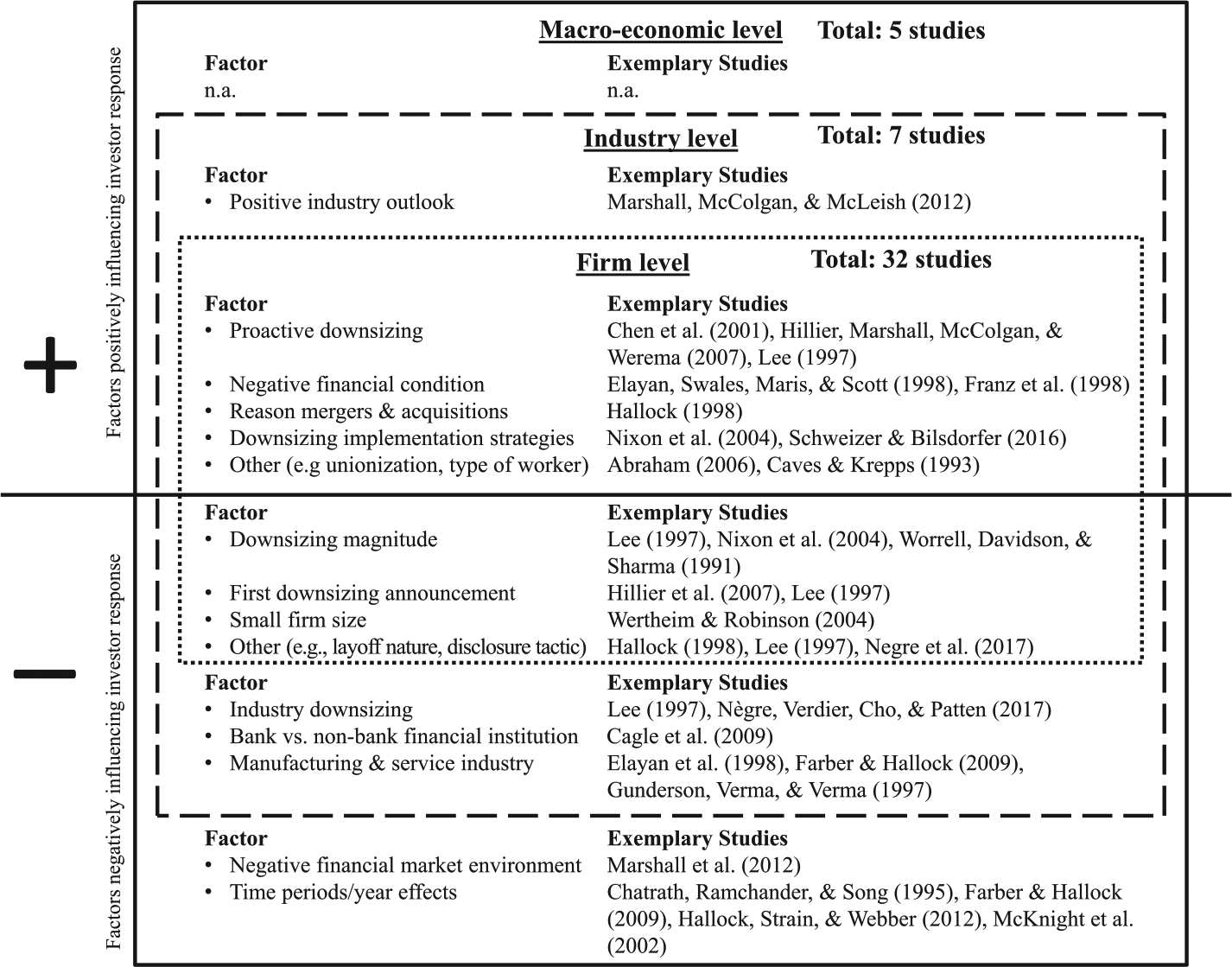
In support of this view, a number of studies have shed some light on the context sensitivity of investor response to workforce downsizing. Figure 1 provides an overview of prior work on short-term investor response to workforce downsizing and highlights the conditions under which investor response is likely to be more negative (see lower half of Figure 1) or more positive (see upper half of Figure 1). Collectively, this body of findings calls for much greater contextualization and attention to multilevel contingency factors in studies on investor response to workforce downsizing.
Literature on Short-Term Investor Response to Workforce Downsizing Announcements
So far, however, most studies have exclusively focused on selective firm-level factors that (directly) influence investor response to downsizing announcements, while research on industry-level and macroeconomic-level factors is still at its outset. Specifically, we find that 32 out of the 39 studies that we identified touch upon firm-level factors. Firm’s motivation to downsize and firm’s financial health are found to be the most prominently studied firm-level contingency factors. In this vein, studies have, for example, found that investors respond more positively to downsizings motivated by proactive reasons (e.g., as part of a broader strategy or restructuring plan) rather than reactive reasons (e.g., as a response to declining demand). Additionally, downsizings motivated by a recent acquisition are more favorably perceived by investors, given the obvious strategic intent to reduce redundancies (Hallock, 1998). Similarly, research suggests that investors react more positively to downsizings by distressed firms, since it is seen as necessary to cut costs and improve performance (Franz, Crawford, & Dwyer, 1998). In contrast, high extents of workforce downsizing magnitude (Nixon et al., 2004) and downsizings by relatively small firms have been found to be associated with negative investor response (Wertheim & Robinson, 2004).
In sum, Figure 1 illustrates that several important insights have been generated on how firm-specific factors condition investor response to workforce downsizing. In contrast, knowledge about industry-level and macroeconomic-level factors’ influence on investor response to downsizing is scarce. Only seven studies have incorporated industry-level factors in their research designs; merely five studies have taken macroeconomic factors into account. Findings from these studies suggest that investor response is contingent on factors such as industry type, industry downsizing intensity, and the nature of the market environment.
Collectively, it is puzzling to see that despite these individual findings on firm-level factors, industry-level factors, and macroeconomic-level factors, no study to date has adopted a multilevel perspective that incorporates contingency factors from all three levels. By focusing on a single level only, other relevant contingency factors are omitted. More critically, the exclusive focus on a single level misrepresents investors’ sensemaking that is construed from firm-level, industry-level, and macroeconomic-level factors (Datta et al., 2012). Further, it becomes apparent that only very few contributions have considered that investor response to downsizing may be not only situation contingent but also time contingent. Last but not least, it is important to note that the large majority of prior studies test for direct effects but do not adopt a true contingency perspective by analyzing how firm-level, industry-level, and macroeconomic-level factors actually moderate the relationship between downsizing magnitude and investor response.
To address these issues and to further help resolve the ambiguity of past research on investor response to workforce downsizing, our study of moderating factors cuts across all three levels. Thereby, we take into consideration that investors process informational cues from industry level, macroeconomic level, and firm level. Importantly, our multilevel approach further extends prior work by acknowledging that investors take the timing of the downsizing decision well into account. In particular, we propose that investors’ perception is contingent on whether the focal downsizing decision is taken in times of concurrent downsizing activity by industry peers, in the face of negative changes in macroeconomic outlooks, and subsequent to a negative firm performance trend.
Moderating Influence of Industry Downsizing Waves
While portfolio restructuring research has shown that the prevalence of same-type restructuring behavior (e.g., acquisitions, divestitures) by industry peers that leads to so-called waves strongly influences investor response to restructuring announcements (Brauer & Wiersema, 2012; McNamara, Haleblian, & Dykes, 2008), prior studies on workforce downsizing outcomes have failed to account for concurrent downsizing activity by industry peers (for an exception, see Lee, 1997). Research on downsizing motives that shows that investors respond more positively to downsizings motivated by proactive reasons, however, offers indirect support for the fact that the timing of downsizings is of considerable importance to investors. Further, consideration of concurrent downsizing activity by industry peers seems crucial to account for spillover effects that have been found to arise when industry peers engage in same-type restructuring activities (e.g., Clougherty & Duso, 2009; Clougherty, Gugler, Sørgard, & Szücs, 2014).
Strategy researchers mostly utilize an institutional perspective to explain the temporal occurrence of downsizing waves (e.g., Budros, 1999; McKinley, Sanchez, & Schick, 1995). Institutional theory claims that among managers, workforce downsizing becomes a norm, gains legitimacy, and thus leads to more and more workforce downsizing activity since managers start to imitate the downsizing behavior of their peers (McKinley et al., 1995). McKinley et al. (2000) expand the institutional perspective by unraveling the microlevel foundations of the institutionalization process of workforce downsizing. According to their sociocognitive perspective, the collectivation and reification of a “downsizing-is-effective” schema by managers induce the institutionalization of workforce downsizing. Importantly, the sociocognitive view put forward by McKinley et al. (2000: 237) purports that the institutionalization and “order generating capacity of a collective schema that defines downsizing as effective can operate independently of any empirical evidence that downsizing actually does improve organizational performance.” However, research on deinstitutionalization suggests that institutionalized structures, schemas, and behaviors are not stable but can erode or be rejected again (Dacin, 1997; Oliver, 1992). Thus, institutional rules and norms can vary in their presence and intensity over time, leading to the emergence of industry waves.
While institutionalization of workforce downsizing (in the form of industry waves) makes managers more assured of the effectiveness of workforce downsizing (McKinley et al., 2000), we argue that investors do not share this belief. As suggested by prior restructuring wave literature (Brauer & Wiersema, 2012; McNamara et al., 2008), investors are likely to view downsizings that occur in wave periods as driven by herding and imitative pressures rather than by rational strategic assessment and hence respond more negatively. Moreover, we argue that the negative news environment during workforce downsizing waves negatively biases investors’ perceptions of downsizings and thus leads to a more pronounced negative response.
Our argumentation is based on the fact that investors, just like other individuals, have limited cognitive resources and apply systematic heuristics to process and analyze information (Cyert & March, 1963; Simon, 1982). Accordingly, behavioral research has claimed that investor information processing and decision making is subject to various biases (e.g., Hirshleifer, 2001). One of these biases is the pessimism bias, making investors react overly pessimistic to unfavorable outcomes in times of negative news environments (Kuhnen, 2015). For instance, investors react more negatively to bad economic news in times of economic downturns relative to economic upturns and vice versa (Andersen, Bollerslev, Diebold, & Vega, 2007; Bollerslev & Todorov, 2011). Moreover, Kuhnen (2015) shows that investors form overly pessimistic beliefs about investment options if they were previously confronted with negative news or outcomes. In the context of workforce downsizing, industry wave periods constitute such a negative news environment. In wave periods, investors are faced with high frequencies of workforce downsizing announcements that are commonly negatively framed (Friebel & Heinz, 2014). Thus, we argue that investor information processing in industry wave periods is influenced by pessimism, which makes investors perceive workforce downsizing even more negatively. Consequently, we believe that the negative relationship between workforce downsizing magnitude and investor response is amplified in periods of industry downsizing waves.
Our argumentation is further supported by behavioral decision-making theory, which draws attention to decision makers’ tendency to apply availability heuristics. The availability bias refers to individual’s tendencies to assess the nature, frequency, and likelihood of events based on the ease with which occurrences can be remembered (Tversky & Kahneman, 1974). Just like other decision makers, investors have been found to apply this mental shortcut. Particularly, research in behavioral finance has shown that investors overreact to events if the focal event is accompanied by events of similar valence (positive/negative; Kliger & Kudryavtsev, 2010). In the context of workforce downsizing waves, this implies that investors respond more negatively to “in-wave” downsizing announcements since the “availability” (i.e., occurrence, frequency) of negatively perceived downsizing events is considerably higher. Based on this logic, we hypothesize the following:
Hypothesis 2: In industry downsizing waves, the relationship between workforce downsizing magnitude and investor response becomes more negative.
Moderating Influence of the Macroeconomic Outlook
In addition to information about concurrent downsizing activity by industry peers, we argue that investors also consider changes in the macroeconomic outlook at the time of the downsizing announcement in their decision making. So far, macroeconomic news has been rarely taken into account in prior downsizing research despite insights from behavioral decision-making literature that macroeconomic news may significantly shape investor response (L. Li & Hu, 1998). For example, Boyd, Hu, and Jagannathan (2005) find that investors respond to unemployment news with stock price adjustments and that the strength of investor response depends on whether the economy is expanding or contracting. Additionally, prior research has shown that the favorability of changes in macroeconomic conditions shapes investor sentiment and thus their response to new information (Baker & Wurgler, 2006; Kaplanski & Levy, 2010). An improved future macroeconomic outlook implies potential for increasing sales and for improved profitability and thus creates optimistic investor sentiment and elicits more positive response to new information. In contrast, a weaker macroeconomic outlook indicates a more challenging future competitive environment that negatively affects the firm’s earnings potential due to slowdowns in product demand and general declines in consumer spending behavior, leading to more negative investor sentiment and more negative response (Elayan, Swales, Maris, & Scott, 1998; Marshall et al., 2012). Correspondingly, research on earnings announcements has found that investors are more pessimistic about future cash flows and show higher sensitivity to negative earnings news announcements when their sentiment is low (Mian & Sankaraguruswamy, 2012).
When applying these prior findings to the context of workforce downsizing, this suggests that negative changes in future macroeconomic outlook at the time of the downsizing announcement amplify negative investor responses. This is because bleak macroeconomic outlooks lead to more pessimistic investor expectations about future cash flows and thus foster generally more negative investor sentiment. In the face of depressed future macroeconomic outlooks, investors are, on average, more sensitive to negative information since they are concerned that the firm might be affected by an upcoming economic slowdown. If firms announce workforce downsizing in times of dropping macroeconomic outlooks, investors will interpret this new information as a sign that the firm’s future cash flows are particularly exposed to the economic slowdown. Firms that downsize large parts of their workforce are expected to be hit exceptionally hard by a weaker economy. Thus, workforce downsizing is perceived not only as a signal for an unfavorable current competitive and financial condition but also as a sign for weaker future business prospects and cash flows. Based on the above reasoning, we hypothesize the following:
Hypothesis 3: In the face of deteriorating macroeconomic outlooks, the relationship between workforce downsizing magnitude and investor response becomes more negative.
Moderating Influence of Firm Performance Trend
Besides informational cues on industry and macroeconomic levels, investors process firm-level information in their response to workforce downsizing. Behavioral decision-making theory suggests that prior firm performance plays an important role in investors’ decision-making process, as investors tend to view corporate restructuring actions in the context of historical and present firm performance (Johnson, 1996). Thus, we argue that the negative relationship between downsizing magnitude and investor response is more pronounced if the downsizing decision is taken subsequent to a negative firm performance trend.
Our reasoning is again grounded in behavioral decision-making theory. Behavioral decision research suggests that investors react more strongly to consistent informational cues, for example, to a series of prolonged positive or negative news (Barberis, Shleifer, & Vishny, 1998; J. Li & Yu, 2012). This means that investors react more favorably (unfavorably) to new positive (negative) information if prior information is of the same direction (Miller, 2005, 2006). These findings can be explained with representative biases in information processing that makes decision makers view specific events as representative for a class of events (Tversky & Kahneman, 1974). Thus, when firms experienced negative events in the past, investors view these events as representative for the firm and overreact to further negative events. Similarly, overreactions to series of events can be explained by the confirmatory bias, which makes people overweight information that confirms an initial belief (Hirshleifer, 2001). In the context of workforce downsizing, these insights from behavioral decision-making theory suggest that representative and confirmation biases lead to amplified negative investor reactions to workforce downsizing announcements of firms that experienced a performance decline prior to the announcement. While declining firm performance gives investors a clue that the firm faces competitive and financial difficulties, a subsequent downsizing announcement verifies investors’ prior concerns about the firm’s condition. Essentially, workforce downsizing announcements provide confirmatory evidence that these performance problems are substantial (Lee, 1997). Investors believe that the firm is in a state of decline and might face serious financial trouble. The problems are perceived as particularly severe for firms that engage in large-scale downsizing since investors will interpret the extent of downsizing as a reflection of the severity of the firm’s condition and associate higher risks with it.
On the contrary, workforce downsizing can be expected to be perceived more favorably by investors when firms have shown a positive performance trend prior to the workforce downsizing announcement. Then, investors are likely to perceive workforce downsizing as a proactive action that is part of an overall strategy to further increase firm performance and operational efficiency. Since the firm is not pressured by a performance decline to engage in workforce downsizing, investors assume that the corresponding changes in the organization, such as routine changes, reallocation of personnel, and changes of networks, are well planned, ultimately leading to improved postdownsizing performance (Love & Nohria, 2005). Taking all of the above-mentioned arguments into account, we hypothesize the following:
Hypothesis 4: Following a downward trend in firm financial performance, the relationship between workforce downsizing magnitude and investor response becomes more negative.
Method
Data and Sample
Similar to prior work on downsizing (Budros, 2004; Wayhan & Werner, 2000), we draw on a sample of the largest 250 U.S. firms by revenue according to Fortune Magazine between 2001 and 2012. 1 To identify all the firms’ downsizing announcements and to determine exact announcement dates and downsizing magnitudes, we systematically searched the Wall Street Journal, Reuters Newswire, and Dow Jones Newswire using the Factiva database. We excluded announcements that had confounding events (i.e., dividend and mergers and acquisitions announcements) within 5 days before and after the workforce downsizing announcement (McWilliams & Siegel, 1997). This reduced our sample from initially 951 downsizing announcements to 753 announcements. Due to some missing data in Compustat and Thomson Worldscope on firm performance, firm diversification, and firm leverage, our final sample consists of 687 workforce downsizing announcements by 152 firms. On average, the firms in our final sample had a market capitalization of US$44.1 billion, downsized five times during the observation period, and announced the dismissal of 2,249 employees per downsizing.
Dependent Variable
In line with prior research (e.g., Brookman et al., 2007; Farber & Hallock, 2009; Hillier, Marshall, McColgan, & Werema, 2007; Lee, 1997; Nixon et al., 2004; Worrell, Davidson, & Sharma, 1991), we used an event study approach to assess short-term investor responses to workforce downsizing announcements. Stock market data were collected from the Center for Research in Security Prices (CRSP). We calculated cumulative abnormal returns (CARs) that represent the difference between the actual and expected return of a company in an event window surrounding the day of the workforce downsizing announcement (McWilliams & Siegel, 1997). 2 We used a 200-trading-day period ending 50 days prior to the respective announcement as the estimation period and took the Standard & Poor’s 500 Index as the respective market portfolio (McWilliams & Siegel, 1997). Next, we calculated CARs as the sum of the abnormal returns over a 3-day event window (−1, 1)—1 day before to 1 day after a workforce downsizing announcement. We chose a 3-day period to keep the event window as short as possible but still account for information leakage and delayed stock price adjustments (McWilliams & Siegel, 1997). Further, use of a 3-day window allows for comparability with previous studies (e.g., Farber & Hallock, 2009; Nixon et al., 2004).
Independent Variables
Downsizing magnitude
To operationalize workforce downsizing magnitude, we used the number of downsized employees as stated in the public workforce downsizing announcements and scaled it by the firm’s total number of employees in the year prior to the downsizing.
Industry downsizing wave
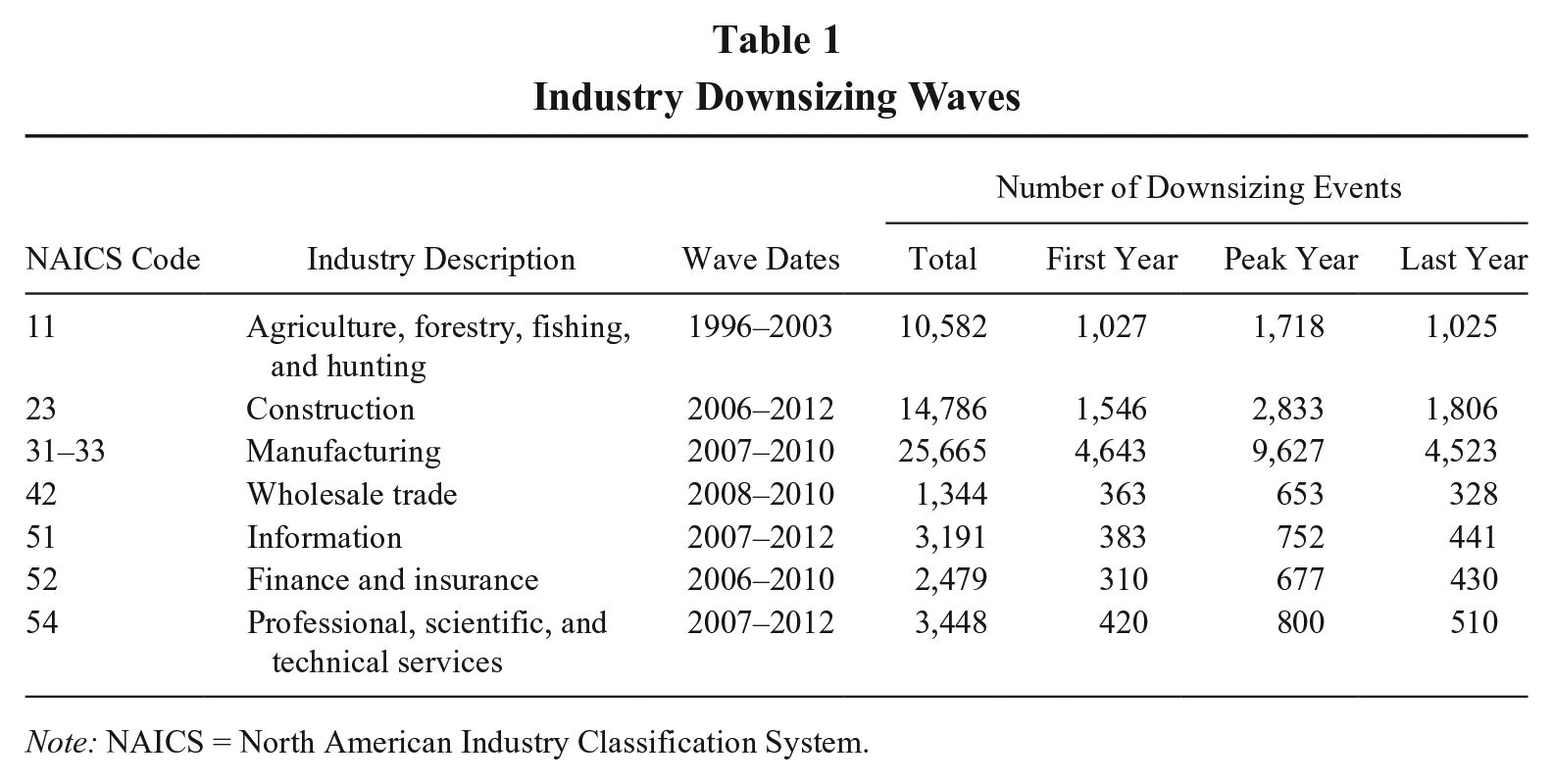
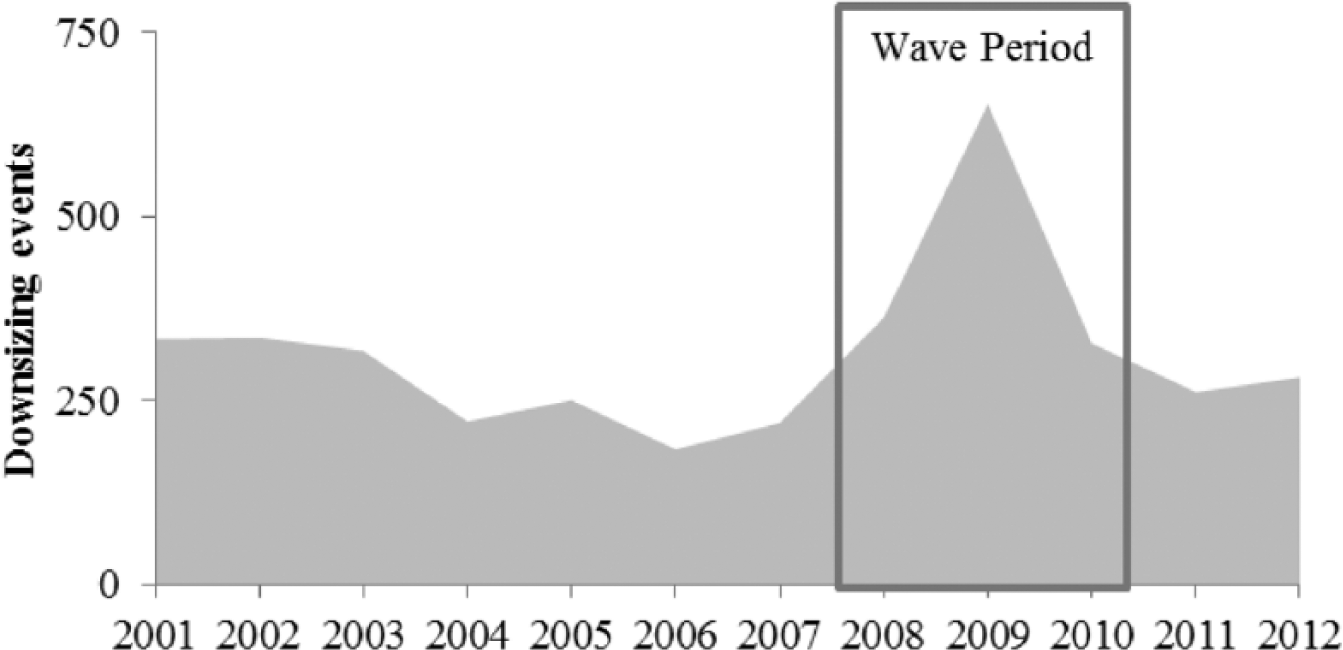
Since we are not aware of any study that has operationalized workforce downsizing waves before, we followed approaches used by previous portfolio restructuring research to identify industry waves and adapted them to our specific context (Brauer & Wiersema, 2012; Carow, Heron, & Saxton, 2004; Harford, 2005; McNamara et al., 2008). To identify industry downsizing waves, we used information by the U.S. Bureau of Labor Statistics that records all downsizings involving 50 or more employees in the United States and assessed yearly industry waves based on two-digit North American Industry Classification System (NAICS) codes. The year with the largest number of downsizing events marked the peak of an industry wave. The 1st year of an industry downsizing wave was determined by working backward in time until the number of downsizing events was less than two thirds of the number of downsizing events in the peak year. Equally, the last year of a wave was determined as the year in which the number of downsizing events fell below two thirds of the number in the peak year. Applying this procedure, we identified seven industry downsizing waves in our sample (see Table 1). Figure 2 illustrates shape and form of a typical industry downsizing wave using the example of the wholesale trade industry (NAICS 42). Downsizing announcements that occurred in such an industry wave were coded 1, and 0 otherwise. 3
Industry Downsizing Waves
Note: NAICS = North American Industry Classification System.
Shape of the Downsizing Wave for the Wholesale Trade Industry (NAICS 42)
Change in macroeconomic outlook
We used the change in the Consumer Sentiment Index by the University of Michigan to capture the change in macroeconomic outlook surrounding the focal workforce downsizing announcement. The Consumer Sentiment Index is based on monthly surveys among U.S. households conducted by the Survey Research Center at the University of Michigan. The index calculation is based on an average of five questions regarding the household’s past financial condition, the anticipated financial condition, the anticipated economic condition over the next year, the anticipated economic condition over the next 5 years, and the perception whether it is a good or bad time to buy major household items. Research from the field of finance and economics has shown that the Consumer Sentiment Index is a good predictor of business cycles (e.g., Lemmon & Portniaguina, 2006) and that the change in Consumer Sentiment Index is a good proxy for the sentiment of investors regarding macroeconomic development (e.g., Akhtar, Faff, Oliver, & Subrahmanyam, 2011). We assessed the improved-macroeconomic-outlook variable as the difference between the latest value of the Consumer Sentiment Index at the day of the workforce downsizing announcement and the corresponding second last value of the Consumer Sentiment Index. Positive scores indicate a positive change in macroeconomic outlook, while negative scores indicate a negative change in macroeconomic outlook.
Firm performance trend
We differentiate between firms that were able to increase their financial performance in the year prior to the workforce downsizing announcement and firms that were not able to do so. First, we calculated firm performance as the return on assets (ROA), measured as the earnings before interest, tax, depreciation, and amortization divided by the book value of total assets (e.g., Brookman et al., 2007; Hillier et al., 2007; Marshall et al., 2012). Then, we created a binary variable that we coded 1 for firms that were able to increase their ROA in the year prior to the downsizing announcement and 0 otherwise.
Control Variables
We control for several firm characteristics as well as characteristics of the workforce downsizing that could potentially influence investor response. Specifically, we control for firm size to capture differences in available resources across firms. Firm size is measured as the log transformation of total assets (e.g., Nixon et al., 2004). Additionally, we control for firm performance, measured as the return on assets in the year prior to the workforce downsizing announcement (e.g., Brookman et al., 2007; Hillier et al., 2007; Marshall et al., 2012). Further, we control for firm diversification, using the entropy measure by Jacquemin and Berry (1979). We also control for firm leverage, measured as the firm’s total debt divided by its total capital, in the year prior to the downsizing announcement. This is because workforce downsizing announcements resulting from financial distress have been found to be less positively received by investors (e.g., Worrell et al., 1991). In addition, we account for downsizing motives, as prior research findings indicate that the motives underlying workforce downsizing could influence investor response (e.g., Hillier et al., 2007; Palmon et al., 1997). Following the approaches by Farber and Hallock (2009) and Hillier et al. (2007), two independent raters classified each workforce downsizing announcement into one of the following seven categories based on the motives stated in the downsizing announcement: demand slump, cost issues, plant closure, reorganization, mergers and acquisitions, other, and missing. Interrater reliability was found to be high, with a Krippendorff’s alpha of 93% (Hayes & Krippendorff, 2007). Finally, we accounted for temporal differences across time by including year dummies into our regression analyses.
Data Analysis
We tested our hypotheses using pooled ordinary least squares (OLS) regressions with clustered Huber-White standard errors. This approach is favorable with our data since we do have an unbalanced panel data set, meaning that we do not have periodical observations for a set of firms but observe firms only when they announce workforce downsizing. The approach, like the random-effects technique, accounts for within-firm correlation in the error term but also calculates consistent estimates for many possible correlations (Cameron & Trivedi, 2009). To confirm that our approach is appropriate, we ran the Hausman test (Hausman, Hall, & Griliches, 1984) and the Breusch-Pagan Lagrange multiplier test (Breusch & Pagan, 1980). Both tests did not reject the null hypothesis on a 5% significance level, confirming that our approach is appropriate. Nevertheless, we reran all regressions using the random-effects and fixed-effects approaches, obtaining fully consistent results. To check for potential issues of multicollinearity, we calculated variance inflation factors (VIFs) for all models. We find that the maximum VIF value in our analysis is 3.46, suggesting that multicollinearity is not an issue in our analysis (O’Brien, 2007). To simplify interpretation of our moderating effects, we standardized the control variables.
Results
Table 2 presents the descriptive statistics and correlations of all variables included in the study, while Table 3 presents the pooled OLS regression results of the independent and control variables on investor response. The mean cumulative abnormal return for the 3-day event window (−1, +1) is −0.63%. This compares well with prior studies that reported average cumulative abnormal returns ranging from −0.41% to −0.81% (Hillier et al., 2007; Nixon et al., 2004; Worrell et al., 1991). We also find that the bivariate correlation between magnitude of workforce downsizing and investor response is clearly negative (r = –.34, p = .000), which provides initial support for Hypothesis 1.
Descriptive Statistics and Correlations

Note: N = 687. Correlations greater than .08 are significant at p < .05, and correlations greater than .10 are significant at p < .01. CAR = cumulative abnormal return.
Results of Pooled Ordinary Least Squares Regression Analysis Predicting Investor Response

Note: N = 687. Clustered Huber-White standard errors in parentheses; year dummies included; ΔR2 relative to Model 2.
p < .10.
p < .05
p < .01.
p < .001.
Hypothesis 1 predicted that greater workforce downsizing magnitude leads to more negative investor response. As shown by Model 2, this prediction finds support with downsizing magnitude being statistically significant (b = −0.62, p = .023) and strongly negatively related to short-term investor response.
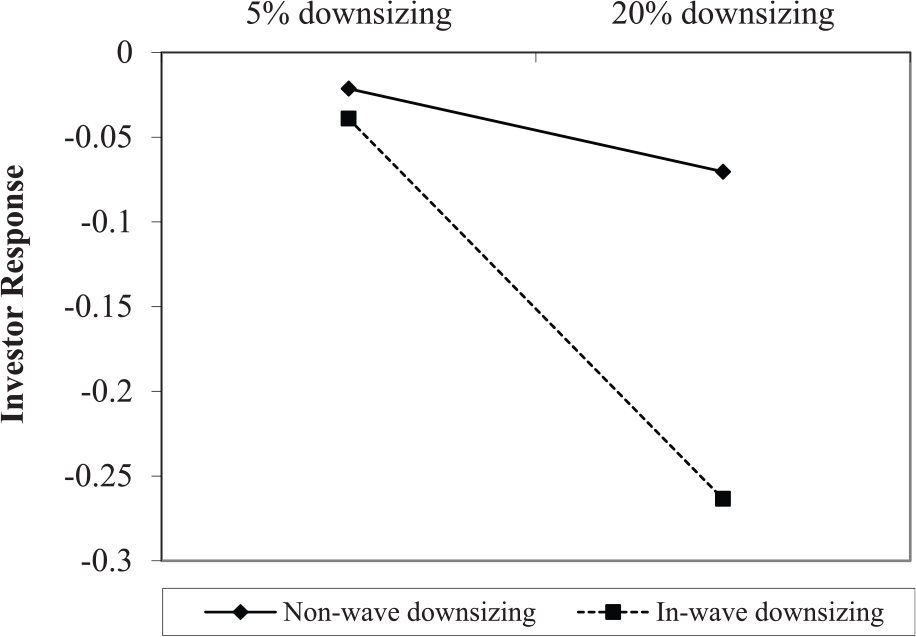
Model 3 provides a test for Hypothesis 2, which stated that the relationship between workforce downsizing magnitude and investor response is more negative in periods of industry downsizing waves. The coefficient of the interaction term is negative and statistically significant (b = −1.17, p = .018). Thus, Model 3 supports our theory that investors react more negatively to workforce downsizing announcements that occur in industry downsizing waves. Figure 3 graphically depicts the relationship between workforce downsizing magnitude and investor response and shows that the relationship is more negative in industry waves than outside of industry waves.
Effect of Industry Downsizing Waves on Investor Response
Model 4 shows results for Hypothesis 3, which predicted a negative moderating influence of a negative change in macroeconomic outlook on the relationship between workforce downsizing magnitude and investor response. The interaction term is positive and significant (b = 0.11, p = .000). Figure 4 provides a graphical illustration of the effect (change in macroeconomic outlook of one standard deviation above and below the mean). In times of improved macroeconomic outlooks, investor response to workforce downsizing announcements is almost zero. In contrast, investor response is considerably more negative if the downsizing decision is taken in times of declining macroeconomic outlooks.
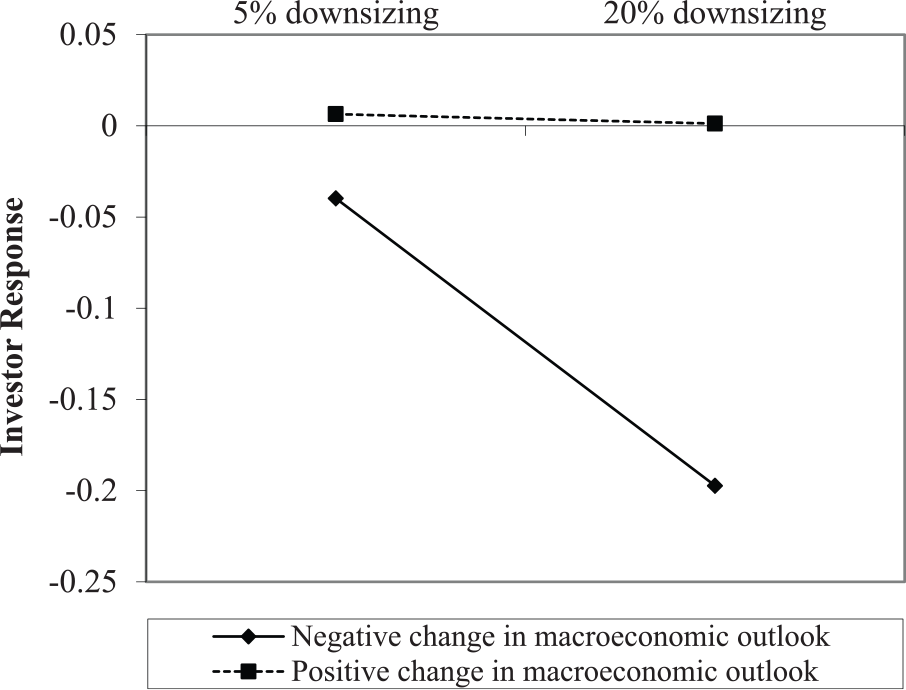
Effect of Change in Macroeconomic Outlook on Investor Response
Hypothesis 4 purported that the negative relationship between downsizing magnitude and investor response is more pronounced if a firm showed a negative performance trend prior to downsizing. As shown by Model 5, the interaction term is positive and marginally significant (b = 0.66, p = .068). Hypothesis 4 thus finds some support. As illustrated by Figure 5, different slopes provide evidence for an amplified negative workforce downsizing magnitude–investor response relationship if the downsizing decision is taken subsequent to a negative firm performance trend.
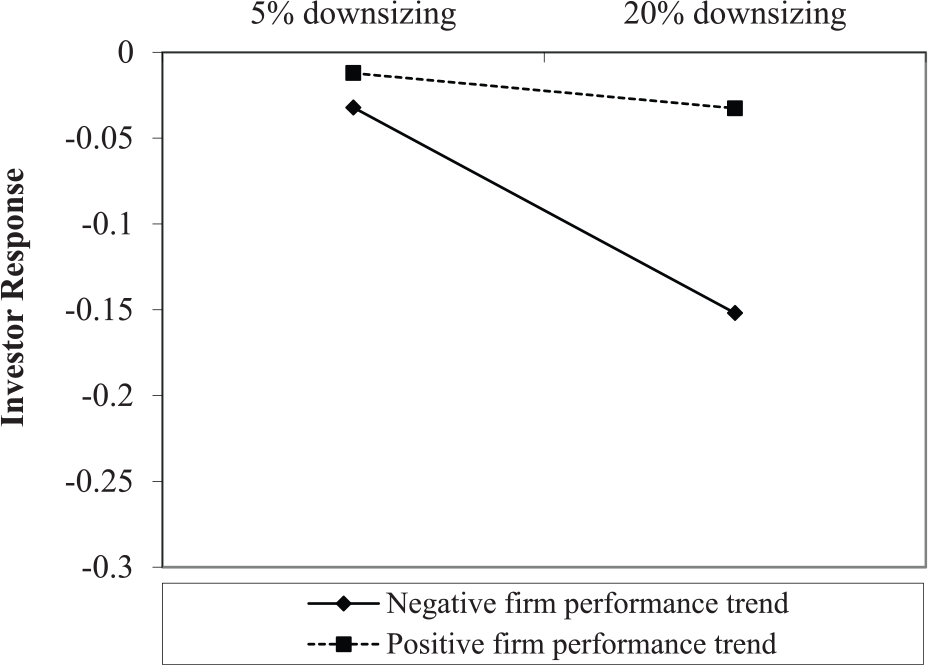
Effect of Firm Performance Trend on Investor Response
To test whether the effects above are complementary or to some degree substitutive, we also analyzed the full model (Model 6), including all interaction terms in one model. Regression results show that all moderating effects remain stable in the full model. Additionally, it shows that investors who include all three informational cues in their assessment of a downsizing announcement will (ceteris paribus) respond considerably more negatively to a downsizing. Figure 6 illustrates the complementary effects of the three moderating factors on firm market valuation. 4 In the worst case (i.e., industry wave, negative change in macroeconomic outlook, and prior performance decline), 5% workforce downsizing destroys US$2.7 billion in market valuation, while 20% downsizing destroys US$16.2 billion in firm market value. 5 On the other hand, workforce downsizing can lead to increasing market valuations of US$0.8 billion at levels of 5% and US$4.3 billion at levels of 20% if it is announced outside of industry waves, in times of favorable economic outlooks, and subsequent to a performance increase.
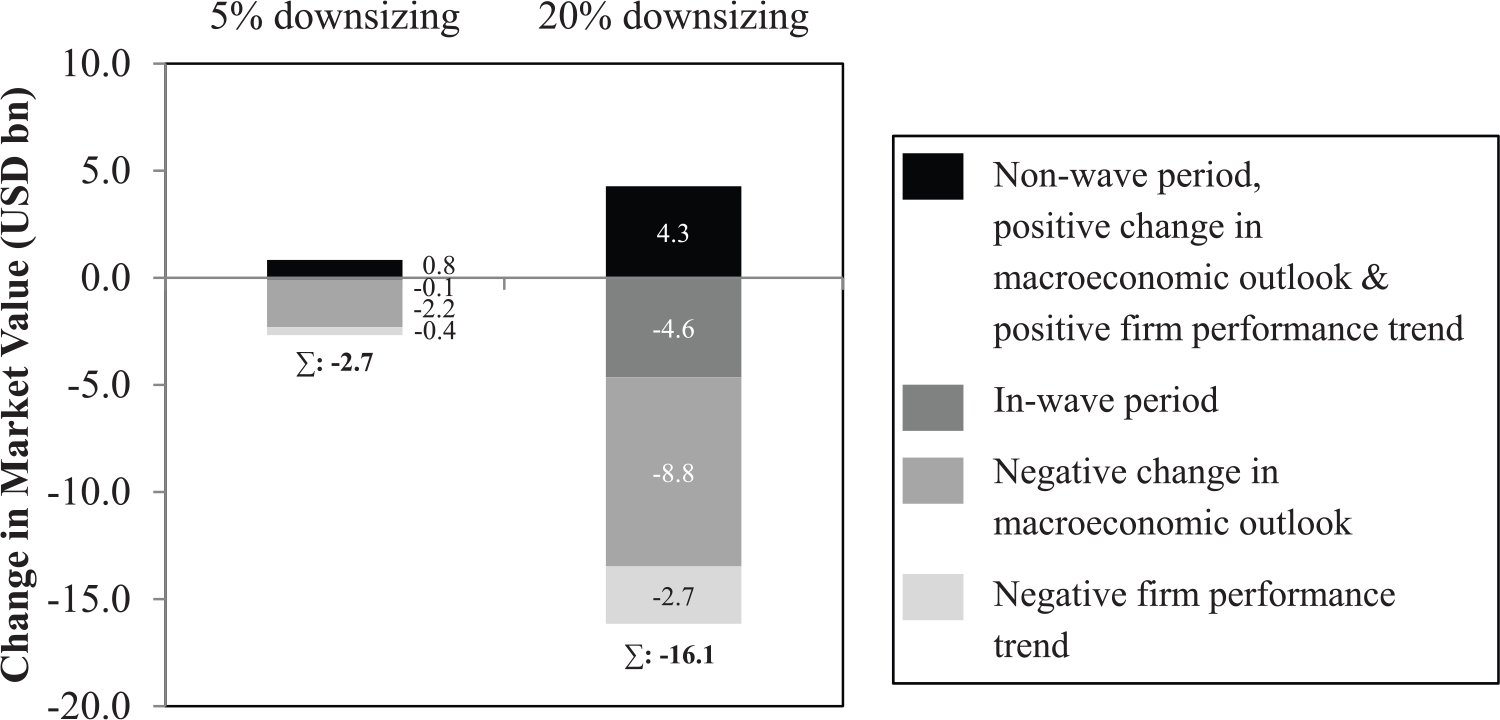
Effect of Workforce Downsizing on Market Valuation
Supplementary Robustness Checks
We performed several supplementary analyses to check the robustness of our results. First, we ran our analyses using a broader 5-day (–2, +2) event window. Our results remained consistent. Second, we tested, but did not find, a nonlinear relationship between downsizing magnitude and market reaction that was suggested by prior research (Lee, 1997; Nixon et al., 2004). Third, we followed the approach by Nixon et al. (2004) and eliminated all events with a downsizing magnitude of less than 0.5%, which, again, led to no remarkable differences in results. Fourth, we reran our analyses using alternative variable operationalizations. As a robustness check for our industry downsizing wave variable, we calculated short-term waves to confirm that our wave classification does not represent a long-term trend instead of a temporary phase. Thus, we defined short-term waves as a period of three or more consecutive months with industry downsizing being at least 50% higher than the average industry-level monthly downsizing. Running our analyses with short-term waves did not alter our findings. Additionally, we retested Hypothesis 4 using a firm performance trend variable based on industry-adjusted ROA and using a continuous performance measure, both generating consistent findings in support of Hypothesis 4. Using a binary instead of a continuous measure for firm leverage also did not alter our results. Further, our results remain largely unchanged when controlling for CEO characteristics (i.e., CEO tenure), which in our case are not found to have any independent explanatory power. In contrast, when assessing the goodness of fit of our main models, smaller scores for both Schwartz’s Bayesian and Akaike’s information criteria confirm that the inclusion of our moderating variables in the analyses lead to a significant increase in model fit. Furthermore, we assured that our analyses are not affected by sampling biases. Ahern (2009) has shown that event-study returns can be biased if firms are grouped by certain characteristics and suggests that a characteristics-based benchmark model (CBBM) produces the least biased results. Thus, we reran all analyses using 3-day abnormal returns (−1, +1) based on the CBBM as dependent variable. All of our results remain consistent. Additionally, we checked whether the exclusion of observations due to missing accounting data has biased our results. Rerunning our analyses on a larger sample of observations due to a more parsimonious set of control variables, however, leads to identical results. Furthermore, we checked whether the exclusion of confounding events influenced our results. We were particularly interested to assess if managers try to whitewash or neutralize negative investor response through bundling downsizing announcements with dividend, acquisition, or divestiture announcements. Conversely, our analysis suggests that downsizings that are announced together with acquisition, divestiture, or dividend announcements receive an even more negative investor response (CAR = −1.5%). Finally, we checked if investors might adjust their longer-term response to downsizings in the light of new information that suggests that downsizing is beneficial (or less detrimental) for a firm’s long-term (performance) development. Thus, we calculated 1 year buy-and-hold abnormal returns. In line with prior research (Chen et al., 2001; Wayhan & Werner, 2000), we find that these returns are slightly positive (1%). This finding indirectly supports our behavioral theory reasoning that investors might overreact in the short term due to decision biases and the use of overly simplistic heuristics.
Discussion and Implications
Workforce downsizing is a managerial practice whose importance has been acknowledged by prior academic research and is widely evident in today’s business environment (Datta & Basuil, 2015). Despite a substantial body of research on investor response to workforce downsizing announcements, the exact nature and facets of investors’ information processing in connection with workforce downsizings have not yet been closely studied. Essentially, we hold little knowledge about the informational cues on firm, industry, and macroeconomic levels that influence investor response to workforce downsizings and how time-contingent investors’ responses are. In our work, we thus explore how current downsizing intensity in an industry, the future macroeconomic trend, and firm’s past financial performance trend influence the relationship between magnitude of workforce downsizing and investor response. We find that investor response to workforce downsizings is more negative in periods of industry waves. Behavioral decision-making and information-processing theory suggest that investors are overly pessimistic and overreact to the high availability of negatively perceived downsizing announcements in these periods. In addition, we find that investors interpret workforce downsizing announcements more negatively in the face of depressed macroeconomic outlooks. In the face of bleak macroeconomic outlooks, investors’ sentiment is lower, making investors concerned that the firm might be affected by an upcoming economic slowdown, which ultimately leads to more pessimistic investor expectations about the firm’s future cash flows. Moreover, we find, albeit weaker, support for our hypothesis that investor response to downsizings is more negative if the downsizing firm shows a negative performance trend. Downsizings that occur subsequent to performance decreases seem to be perceived by investors as confirmatory evidence that a firm’s competitive and financial problems are substantial.
Theoretical Implications
Our study contributes to existing strategic human capital research in several ways. First, our study helps explain the ambiguity of prior work on the performance implications of downsizing outcomes by accounting for downsizing magnitude and by expanding the limited research on factors that moderate the relationship between workforce downsizing and investor response. While prior studies have primarily analyzed how firm-specific factors influence investor response to workforce downsizing, we propose and empirically show that investors in fact utilize informational cues from multiple levels (i.e., firm level, industry level, and macro level). Such a multilevel approach that cuts across micro and macro levels has been recognized to better capture the complexity of phenomena and to better integrate the context in which behavior occurs (Bamberger, 2008; Hitt et al., 2007). Importantly, rather than simply viewing each moderating effect in isolation, we show that joint consideration of these multilevel informational cues has a compound (negative) effect on a firm’s capital market valuation. No prior work on downsizing has yet shown how different moderating effects across levels may operate together or has explicated these effects in terms of capital market valuation. In total, our work is thus responsive to calls for greater contextualization (i.e., multilevel approaches) and requests for research narrowing the macro-micro gap in strategy research (e.g., Bamberger, 2008; Hitt et al., 2007).
Second, our work makes a conceptual contribution to strategic human capital literature by being among the first studies to develop a behavioral theory–driven explanation for negative investor response to workforce downsizing. Drawing on the notion of bounded rationality in behavioral theory, our theorizing identifies the heuristics and biases that seem to affect investors’ information processing and sensemaking in the context of workforce downsizing. In particular, our theorizing and empirical results indicate that investor information processing is affected by pessimism and availability biases in industry downsizing waves, by their own negative sentiment in the face of declining macroeconomic outlooks, and by confirmation biases as well as representative heuristics in the aftermath of declining firm performance. Such a behavioral theory–driven approach helps to unravel the microfoundations of investor response to workforce downsizing and to make more accurate predictions about investor response under varying contingencies. Further, a behavioral theory angle helps to explain disparate consequences of downsizing in the short term and long term, given that biases commonly cause (negative) overreactions in the short term.
Third, our findings stress the importance of time as research lens for better understanding investor response to workforce downsizing. Specifically, our findings suggest that managers should take downsizing decisions when their firm is still showing a positive performance trend. Moreover, our findings on industry downsizing waves indicate that managers should be well aware of concurrent downsizing activity by industry peers. Prior downsizing work has treated a focal firm’s downsizing decision as an independent and isolated event. However, our findings suggest that concurrent downsizing activity by industry peers seems to create negative spillover effects. Additionally, our findings on the macroeconomic environment suggest that managers should take a somewhat countercyclical approach to downsizing. Investors are found to perceive downsizings more negatively in the face of negative changes in macroeconomic outlook.
Fourth, our study’s focus and findings complement prior conceptual work grounded in institutional theory to explain the prevalence of workforce downsizing and its occurrence in waves. Prior conceptual work has argued that the institutionalization of workforce downsizing makes managers convinced of its inevitability and effectiveness (e.g., Budros, 1999; McKinley et al., 1995, 2000). Our results suggest that the managerial schema of downsizing being inevitable and effective is not shared or appreciated by investors, as evidenced by a more negative response to in-wave downsizings.
Practical Implications
Our empirical findings and supplementary analyses provide managers with several insights about the timing (when to downsize), implementation (how to downsize), and performance implications of workforce downsizing (to what effect). As to the question of when to downsize, our results advise managers to synchronize downsizings with the macroeconomic-, industry-, and firm-specific environment to avoid painful losses in market value. Specifically, our findings suggest that managers should consider downsizing only when their firm is still showing a positive performance development. Moreover, our findings on industry downsizing waves indicate that managers should be well aware of concurrent downsizing activity by industry peers and that managers should take a somewhat countercyclical approach to downsizing and take downsizing decisions when macroeconomic outlooks are improving. As to the question of how to downsize, our findings and supplementary analyses suggest that downsizing should ideally occur in a selective manner. Large-scale downsizings are found to be particularly negatively perceived by investors. Supplementary analyses further indicate that “bundling” downsizing announcements with dividend, acquisition, or divestiture announcements does not neutralize investor response. Conversely, we find that downsizings that are announced together with acquisition, divestiture, or dividend announcements elicit even more negative investor response (CAR = −1.5%). As to the question of to what effect downsizing helps improve firm performance, our results provide good news for managers if they pay attention to the situational and temporal contingencies. If downsizings are announced outside of industry waves, in times of favorable economic outlooks, and subsequent to a performance increase, substantial increases in (short-term) market value could be realized. In total, our findings thus highlight the potential consequences of schema discrepancies between managers and investors in restructuring contexts.
Limitations and Avenues for Further Research
Like any other study, our study is subject to a number of limitations. First, it is important to consider that our results are based on a sample of U.S.-based firms. While prior work set in other developed economies has found fairly similar effects of workforce downsizing on investor response (Hillier et al., 2007; Lee, 1997; Marshall et al., 2012), this might not necessarily hold for downsizings that occur in emerging economies. Consequently, future work on how institutional environments influence investor response to workforce downsizing seems warranted. Second, we strongly advocate that future work on downsizing outcomes considers firms not only from different institutional backgrounds but also with different ownership structures. To conduct event-study analysis, we sampled only publicly listed firms. Owners of small, private firms, however, may react differently to downsizing decisions. Specifically, the study of downsizing outcomes for family-owned firms constitutes an interesting avenue for future research. The theoretical notion of socioemotional wealth and empirical work (Block, 2010) suggests that family owners are much less likely to downsize. Thereby, downsizings by family firms might send a particularly negative signal to investors. Third, our results should be interpreted in the light of the standard variable operationalizations that we used. Alternative methodological approaches, such as the use of Fourier analysis, to discern industry downsizing waves, for instance, could be applied by future work. Based on our extensive set of robustness checks, which included variations in operationalizations for our dependent variable (i.e., use of CBBM), main predictor variables (i.e., industry-adjusted firm performance trend), and control variables (e.g., leverage), we are, however, fairly confident that our main findings hold regardless of variations in variable operationalization. Fourth, it is important to note that, for both theoretical and empirical reasons, our analysis focuses on short-term investor response. Although accurate long-term assessments of investor response to workforce downsizing are difficult due to the presence of many confounding events, it would still be interesting to find out whether investors’ negative short-term responses neutralize in the light of major performance improvements in the 3 to 5 years postdownsizing. Some prior work (Chen et al., 2001; Wayhan & Werner, 2000) and our own supplementary analysis on 1-year buy-and-hold returns offer some tentative support for this notion. In a related vein, we see a lot of potential in text-analytical research that examines more closely the impression management techniques that managers might use to “whitewash” downsizing decisions. It could be conjectured that managers try to neutralize negative investor response to downsizings by simultaneously announcing more positive information. Tentative results from our supplementary analysis, however, suggest that “bundling” downsizing announcements with announcements of other strategic decisions (i.e., dividend, acquisition, divestiture announcements) should be done with great care. Still, there seems a lot of merit in future research that considers how a focal downsizing decision aligns with other related restructuring decisions or the wider organizational strategy of the firm.
Conclusion
Workforce downsizing has become a frequently and widely used type of organizational restructuring. Knowledge about factors that condition investor information processing and eventually their response to workforce downsizings, however, is scarce. By theorizing about the behavioral characteristics of investor information processing and decision making in the context of workforce downsizing, and by completing a comprehensive empirical analysis on the multilevel contingencies influencing investor response to downsizings of different magnitude, we hope to have contributed to a more nuanced understanding of the determinants of downsizing outcomes.
Footnotes
Acknowledgements
This article was accepted under the editorship of Patrick M. Wright. We are grateful to associate editor Anne Parmigiani and our anonymous reviewers for their constructive comments and guidance.