




Abstract
On the basis of the observation that today’s executives increasingly possess significant international experiences, this study of foreign subsidiary executive staffing strategies looks beyond the local/expatriate dichotomy and shifts the theoretical and empirical focus from executive nationality to a more nuanced examination of subsidiary executives’ international experience portfolios. The intended contribution of this study is to explore the relationship between home country–host country institutional differences and the quantity and quality of subsidiary executives’ previous international experience. I draw on executive cognition theory and the literature on international experience to hypothesize that variety and specificity of previous educational and professional international experiences facilitate subsidiary executives’ abilities to manage liabilities of foreignness arising from institutional distance. The findings indicate a positive relationship between home country–host country institutional distance and the presence of subsidiary executives with higher duration, count, and variety of international experiences. However, the findings provide no statistical evidence of higher levels of institutional distance being associated with a higher presence of subsidiary executives with specific international experiences that are relevant to the home country–host country pair.
Keywords
Introduction
As first articulated by Hymer (1960/1976) and Kindleberger (1969), the idea that foreign subsidiaries face disadvantages compared to local firms when operating in a host country holds a prominent position in international business (IB) research and has received repeated empirical validation (e.g., DeYoung & Nolle, 1996; Mata & Freitas, 2012; Miller & Parkhe, 2002; Miller & Richards, 2002; Zaheer, 1995; Zaheer & Mosakowski, 1997). The sources of disadvantage are most often attributed to lack of familiarity and/or legitimacy in the host environment, lack of relational embeddedness in host-country knowledge networks and structures, costs of coordinating across spatial distances, or a combination thereof (Eden & Miller, 2001; Zaheer, 1995). Together, these disadvantages compose what are termed “liabilities of foreignness” (Zaheer, 1995) and are theorized to arise as institutional distance between the subsidiary host market and the parent company’s home market increases (Eden & Miller, 2004; Kostova & Zaheer, 1999; Kronborg & Thomsen, 2009; Stahl, Tung, Kostova, & Zellmer-Bruhn, 2016).
There is both anecdotal and empirical evidence suggesting that subsidiary executives may help forestall the liabilities of foreignness experienced by multinational companies (MNCs) in host markets (Ghemawat & Vantrappen, 2015; Mezias, 2002). However, research examining MNCs’ foreign subsidiary executive staffing strategies (e.g., Boyacigiller, 1990; Brock, Shenkar, Shoham, & Siscovick, 2008; Fang, Jiang, Makino, & Beamish, 2010; Gaur, Delios, & Singh, 2007; Gong, 2003; Harzing, 2001; Muellner, Klopf, & Nell, 2017; Tarique, Schuler, & Gong, 2006) largely assumes that individuals possess a single cultural profile (Thomas, Brannen, & Garcia, 2010). The hiring decision is thus typically framed as between parent-country nationals or host-country nationals—or in other words as a choice between expatriates or natives. Overall, findings have been mixed. While some scholars found that greater home country–host country differences along institutional dimensions are associated with more expatriates holding executive positions (Gaur et al., 2007; Gong, 2003), others found the opposite (Brock et al., 2008; Muellner et al., 2017).
To reconcile these contradictory findings and to answer the question of how subsidiary staffing strategies change relative to the liabilities of foreignness facing MNCs in host markets, this study examines the relationship between home country–host country institutional distance and quantity and quality of subsidiary executives’ previous international experiences. Drawing on international experience literature and the frameworks of Takeuchi, Tesluk, Yun, and Lepak (2005), I propose that with greater home country–host country institutional distance, MNCs will select individuals with greater duration, count, variety, and specificity of previous international experiences to mitigate the detrimental effects of liabilities of foreignness.
International experiences have widely been acknowledged as instrumental for developing managers’ cognition (Levy, Beechler, Taylor, & Boyacigiller, 2007), strategic thinking (Dragoni, Oh, Tesluk, Moore, VanKatwyk, & Hazucha, 2014), and abilities to navigate cross-cultural differences (Arora, Jaju, Kefalas, & Perenich, 2004; Caligiuri & Bonache, 2016; Murtha, Lenway, & Bagozzi, 1998). Prior research has shown that executives’ international experience is linked to performance and competitive advantage (Carpenter, Sanders, & Gregersen, 2001; Daily, Certo, & Dalton, 2000; Kim, Pathak, & Werner, 2015). Indeed, international assignments have been described as “the most powerful experience shaping the perspective and capabilities of effective global leaders” (Black, Gregersen, Mendenhall, & Stroh, 1999: 2), with firms investing substantial resources into the international development of their managers (Gupta & Govindarajan, 2002). However, the studies that have been performed on this topic in the international firm context have focused nearly exclusively on the experiential portfolios of MNC headquarters managers (e.g., Carpenter & Fredrickson, 2001; Greve, Nielsen, & Ruigrok, 2009). We know very little about the pervasiveness and nature of international experiences of executives in MNCs’ foreign operations. Considering that the value added by foreign subsidiaries composes 11% of global gross domestic product (GDP; United Nations Conference on Trade and Development, 2017), and given research which shows that subsidiary executives exercise significant power over their business units (Vora, Kostova, & Roth, 2007), the paucity of research on the experiential backgrounds of subsidiary executives represents an important gap in our understanding of executive selection and managerial human capital in international firms.
This study seeks to make two theoretical contributions to fill this gap. First, it provides empirical evidence of the conditions under which MNCs select subsidiary executives with greater quantity, variety, and specificity of previous international experiences. I hypothesize that MNCs choose individuals on the basis of the perceived fit between their observable human capital attributes and the organizational needs of the subsidiary and will therefore recognize variety of international experience (i.e., culture-general experience) as a signal of individual capacity for differentiating and integrating across cultures and will view specificity of international experience to the home country–host country pair (i.e., culture-specific experience) as a signal of individual capacity for bridging cultures. By examining the relationships between home-country and host-country institutional distance and the presence of individuals with culture-general experiences and culture-specific experiences, this study generates unique insights regarding the presence of cultural generalists and specialists in international settings.
Second, the study presents differences between expatriate and native executives’ experiential backgrounds. As highlighted by Caprar (2011), research on host-country nationals (or “natives”) is a neglected area in the literature. While we know a significant amount about the experience, development, and deployment of expatriates (for a review, see Caligiuri & Bonache, 2016), we know comparatively little about native executives’ experiential profiles or under which conditions MNCs use native human capital in foreign subsidiary executive teams.
In addition to the theoretical contributions highlighted above, this study offers the following empirical contributions. It presents one of the few multicountry samples of subsidiary staffing decisions and it informs our understanding of this phenomenon from the perspective of a broader set of home countries. 1 Second, unlike many studies that focus on the subsidiary CEO/general manager role (e.g., Gaur et al., 2007; Gong, 2003), this study takes a more comprehensive approach and examines individuals in the entire subsidiary top management team (TMT), providing insight into the experiential attributes of individuals with substantial decision-making power in the upper echelons of foreign subsidiaries.
In the rest of this paper, I first provide a theoretical overview and integration of the literatures on liabilities of foreignness, international experience, and subsidiary staffing. Next, I turn to the development of detailed hypotheses on the relationships between institutional distance and duration, count, variety, and specificity of subsidiary executives’ previous international experience. I then describe the geographical and industry context and its usefulness in testing these hypotheses. After describing the methodology, I present the results and conclude with implications for theory and practice.
Conceptual Background
Liabilities of Foreignness and Institutional Distance
The idea that foreign subsidiaries incur additional costs relative to local firms has been a foundational belief in IB research for many decades; however, it was not until the work of Zaheer (1995) that the concept received definitional structure. Early formulations highlighted foreign subsidiaries’ information disadvantages (Caves, 1972; Hymer, 1960/1976) and stigmas of foreignness (Vernon, 1977), but Zaheer also recognized the importance of social costs that foreign subsidiaries incur, namely, costs of coordinating with headquarters across spatial distances and costs arising from a lack of legitimacy in a host country. Together, unfamiliarity and costs of coordination and legitimacy compose “liabilities of foreignness” (Zaheer, 1995).
To conceptualize and measure liabilities of foreignness, scholars typically measure differences in country-specific attributes along formal and informal institutional dimensions (North, 1991; Scott, 1995). In international contexts, salient attributes are often differences in economic, political, and social structures between countries, and together, these are referred to as “institutional distance” (North, 1991). As institutional distance (along any dimension) increases, so do the liabilities of foreignness experienced by subsidiaries relative to their domestic rivals (Eden & Miller, 2004; Kostova & Zaheer, 1999).
Following Berry, Guillen, and Zhou (2010) and Ghemawat (2001), and in response to recent calls for scholars to use measures of distance in deliberate and appropriate contexts (Zaheer, Schomaker, & Nachum, 2012), I focus on three measures of institutional distance that are likely to influence foreign firms’ liabilities of foreignness in the context of multinational banking: economic distance, political distance, and cultural distance. 2 Differences in levels of economic development breed unfamiliarity for foreign subsidiaries in the banking industry and create uncertainty with respect to strategy-making in the host market. This not only makes it difficult to engage with customers, suppliers, and other relevant stakeholders but also makes it difficult for local actors to understand foreign firms, which creates problems of legitimacy (Kostova & Zaheer, 1999). Political distance adds another dimension to liabilities of foreignness. It represents differences in formal institutions such as regulation and government stability, which are especially important for the banking context (Miller & Eden, 2006; Miller & Parkhe, 2002). Differences in culture, values, or communication styles can also undermine foreign subsidiaries’ perceptions of legitimacy in host-country markets and impede the formation of relational ties.
Liabilities of Foreignness and International Experience
Much of the research on prior international experience focuses on its consequences, such as cross-cultural adjustment (for a review, see Takeuchi & Chen, 2013), firm internationalization (Hsu, Chen, & Cheng, 2013; Sambharya, 1996; Tihanyi, Ellstrand, Daily, & Dalton, 2000), and firm performance (Carpenter et al., 2001; Daily et al., 2000; Le & Kroll, 2017). This study focuses on the antecedents leading to the selection of individuals with previous international experience.
International experience by executives of foreign firms enables coordination of cross-border activities and recognition of opportunities, fosters greater productivity, and facilitates relationship-building in the host market environment (Daily et al., 2000; Tarique, Briscoe, & Schuler, 2016), helping to overcome the potential detrimental effects of liabilities of foreignness arising from institutional distance. On the basis of these insights, I propose hypotheses regarding the relationship between home country–host country institutional distance and the presence of individuals with previous international experience on subsidiary executive teams.
To conceptualize and structure the complex, multidimensional construct of international experience, I draw on the framework introduced by Takeuchi et al. (2005). The framework includes three components of international experience: (i) a time component, (ii) a domain component (work or nonwork), and (iii) a specificity component (country specific or general).
First, experiences have a time component (Shaffer, Harrison, & Gilley, 1999). Work experience scholars recommend using duration of previous experience as a starting point for inquiry (Quinones, Ford, & Teachout, 1995; Tesluk & Jacobs, 1998). Indeed, duration (or length) of experience is the most commonly used measure in the international experience literature (Le & Kroll, 2017; Takeuchi & Chen, 2013); therefore, I began my analysis by examining the influence of institutional distance on previous international experience duration. Takeuchi et al. (2005) also suggest differentiating between previous and current work experience. In this context, however, including current work experience would make expatriate executives’ and native executives’ experiential portfolios incomparable because by nature of the expatriate assignment, expatriates would have one additional international experience by default. Therefore, I examine only executives’ previous international experiences.
Second, experiences can be work or nonwork related (Greenhaus & Beutell, 1985; Takeuchi et al., 2005; Tesluk & Jacobs, 1998). In the taxonomy of international experience formulated by Takeuchi, Tesluk, and Marinova (2006), work-related experiences can be gained performing a particular task, through international assignments, while participating in multicultural teams, or while working in MNCs. Nonwork-related experiences include general cultural exposure, living, study, and travel abroad. This study includes both work- and nonwork-related international experiences, but due to the nature of the data gathering process (which is described in the Method section), it includes only international assignments (work) and study abroad (nonwork). Relative to the others, international assignments and study abroad are likely to be more cognitively challenging than merely working as part of an MNC or traveling or living abroad (Takeuchi & Chen, 2013) and, thus, more relevant as MNCs select whom to appoint to the subsidiary executive team. However, the lack of information on executives’ other kinds of international experiences is a limitation of this study.
Third, international experiences may or may not be country specific (Takeuchi et al., 2005) and can vary in both cultural generality and cultural specificity. Because different levels of institutional distance are likely to influence the quality of previous international experience demanded from subsidiary executives (whether it be greater variety, greater specificity, or both), this third component of international experience is the primary focus of the study.
Hypotheses
Institutional Distance and Amount of Previous International Experience
With each new international experience, individuals’ basic assumptions about how to react are challenged, triggering a conscious search of the new environment for cues (Kiesler & Sproull, 1982; Louis, 1980). As noted above, the most straightforward measure of international experience is length of time spent abroad. Time abroad provides individuals with deeper understanding of foreign business practices, political structures, and cultural norms (Maitland & Sammartino, 2015), and it also enables the development of relationships and professional networks (Mäkelä & Suutari, 2009). More time spent abroad has been shown to bolster individuals’ learning (Maddux, Adam, & Galinsky, 2010) and adaptation (Maddux & Galinsky, 2009) skills, which in turn have been linked to creative problem solving using uncommon perspectives and idea recombination (Maddux & Galinsky, 2009). With time, network ties to local actors become both stronger (Uzzi, 1996) and denser (Reagans & McEvily, 2003), facilitating access to local knowledge and resources. Indeed, studies have shown that with greater duration of international experience, managers acquire relevant knowledge and develop skills that are not only useful for MNC management but also tied to positive organizational outcomes (Carpenter, Sanders, & Gregersen, 2000). Therefore, I argue that in more institutionally distant subsidiary environments, MNCs seeking to manage liabilities of foreignness will make a strategic choice to select individuals with greater duration of previous international experience in order to take advantage of these individuals’ knowledge, skills, and network ties.
Another often-used measure of international experience is country count. Individuals with experience in multiple foreign countries become exposed to a broader range of ideas (Godart, Maddux, Shipilov, & Galinsky, 2015) and develop wider-reaching network ties (Reagans & McEvily, 2003). Individuals also become better equipped to address cross-country differences, as each additional experience generates a feedback loop that updates previous knowledge on doing business abroad (Maitland & Sammartino, 2015). This likely improves individuals’ management skills and abilities to interact across cultures (Ng, van Dyne, & Ang, 2009).
Overall, longer and more frequent exposures to foreign environments have been shown to increase both knowledge acquisition (Godart et al., 2015; Selmer, 2004) and general cognitive competencies (Maddux & Galinsky, 2009). These can be expected to be perceived by MNCs as increasingly beneficial in more institutionally distant environments. The aforementioned reasoning leads to the following basic hypotheses:
Hypothesis 1a: Institutional distance between the home country and the host country will be positively associated with subsidiary executives’ duration of previous international experience.
Hypothesis 1b: Institutional distance between the home country and the host country will be positively associated with subsidiary executives’ count of previous international experiences.
Institutional Distance and Variety of Previous International Experience
In addition to time spent abroad and country count, individuals’ cognitive responses depend on the level of dissonance experienced between the new international experience and existing knowledge structures. At low levels of cultural dissonance, individuals can suppress the negative emotions generated by not fitting in and can boost their own values instead, which is unlikely to result in complex thinking (Conway, Schaller, Tweed, & Hallett, 2001). However, when the new cultural experience is highly dissonant, that is, when cultural distance is high, strengthening one’s own cultural position is insufficient to relieve the tension being experienced. High cultural dissonance prompts the creation of new, more developed cultural schemas (Black & Gregersen, 2000; Fiske & Taylor, 1984; Lord & Hall, 2005), which guide individuals’ attention, interpretation, and action on the basis of cognitive inputs (Daft & Weick, 1984).
Although it may be possible for individuals with high-commitment experiences in few countries to keep cultural schemas for each country separate, individuals with increasingly diverse international experiences that occur in rapid succession (e.g., serial expatriates) engage in simplifying cognitive processes that reduce stress and facilitate sense-making (Lücke, Kostova, & Roth, 2014). With greater variety and complexity of international experiences (i.e., as an individual’s level of culture-general experience grows), individuals organize their acquired knowledge, searching for common patterns and exceptions to ease the demands on their interpretative processes (Caligiuri & Bonache, 2016; Houghton, 2005; Linn & Songer, 1991).
As information content is updated, the structures holding the information together shift from compartmentalization toward integration and differentiation (Bartunek, Gordon, & Weathersby, 1983). This shift has been linked to the development of cognitive complexity in individuals (Levy et al., 2007), which in turn has been tied to superior information-processing capabilities, including the ability to balance contradictions and deal with ambiguity (Streufert & Swezey, 1986), consider outside perspectives (Chang, 1995), hold multiple interpretations simultaneously, and engage in paradoxical thinking (Bartunek et al., 1983).
Individuals who achieve high levels of culture-general experience rely on being comfortable with cultural differences and operate by integrating across them. In other words, multiple, heterogeneous cultural experiences bring about a process of generalization (Houghton, 2005; Lücke et al., 2014), and the cognition processes are non–culture specific (Lücke et al., 2014). At the extreme, individuals who become culture generalists become “multicultural experts rather than experts in multiple cultures” (Lücke et al., 2014: 183). In practice, culture-general experience allows individuals to accurately interpret cultural cues in multiple environments.
Overall, individuals with culture-general experience possess a unique competence to interact across cultures, making them increasingly useful for managing operations in more institutionally distant environments where greater differences in economic, political, and/or cultural norms relative to the MNC home country can lead to a competitive disadvantage for foreign subsidiaries relative to local firms. As the organization looks for ways to manage cross-national differences and the resulting liabilities of foreignness experienced by a foreign subsidiary in its host market, executives’ perceived abilities to mediate across general and specific levels given their culture-general experience are likely to be more valuable and sought after by MNC decision makers. On the basis of this, I hypothesize:
Hypothesis 2: Institutional distance between the home country and the host country will be positively associated with subsidiary executives’ variety of previous international experience.
Institutional Distance and Specificity of Previous International Experience
In a subsidiary context characterized by greater levels of institutional differences between the home and host country, individuals with cultural experiences that are salient to both the home-country and the host-country environments are likely to be perceived by decision makers at headquarters as having great utility. Indeed, natives already possess an inherent understanding of the subsidiary-country environment and expatriates of the parent-country environment. However, in this context, specificity of previous international experience necessitates having familiarity with the “other” country in the parent–subsidiary country pair. (Operationalization of the specificity construct is provided in the Measures section; however, it may be useful to note here that this study regards specificity of international experience as a range, where experience from a “similar” country is considered more “specific” and relevant than experience from a “dissimilar” country. The level of dissimilarity is measured as the cultural distance between the individual’s country of international experience and the “other” country in the parent–subsidiary country pair, which for natives is the parent country and for expatriates is the subsidiary country.)
As an outcome of high-commitment exposure to both environments, such individuals can be expected to have accumulated expertise and know-how that is highly contextual and relevant (Argote & Miron-Spektor, 2011; Doz, Santos, & Williamson, 2001). In particular, it is likely that their experiences enable them to understand both the parent-country and the subsidiary-country business environments and their underlying sociocultural, economic, and political structures (K. L. Johnson & Duxbury, 2010). Since such individuals are also versed in the behaviors and norms that would be appropriate in the context of the home country–host country cultural pair, they are likely to be effective agents for information exchange (Black, Mendenhall, & Oddou, 1991; Hocking, Brown, & Harzing, 2004; Ruisala & Suutari, 2004).
In line with contact theory, interpersonal contact or exposure to people from both cultures boosts individuals’ abilities to act as liaisons. Through contact, people form affective ties to individuals (Pettigrew, 1998), which extend to others belonging to the same cultural group (Pettigrew & Tropp, 2006). Positive affect allows individuals to consider others’ perspectives as valid (Pettigrew, 1998). Although it is unclear at which point individuals with international experiences internalize a foreign culture (if at all), exposure alone to both the home country and the host country is likely to heighten individuals’ abilities to interpret correctly the actions of people in both countries, respond appropriately, and avoid conflict in their own interactions (J. P. Johnson, Lenartowicz, & Apud, 2006; LaFromboise, Coleman, & Gerton, 1993)—especially relative to individuals without home-country/host-country culture-specific experience. Furthermore, culture-specific experience may provide individuals with requisite knowledge to explain how and why an opposing group’s communication style differs, thereby diffusing tensions in cross-cultural communication and heading off potential conflict (Fitzsimmons, Miska, & Stahl, 2011).
On the basis of the evidence above regarding culture-specific experience enabling information exchange and facilitating interaction between the two cultures, I argue that individuals with higher levels of culture-specific experience can manage greater differences along economic, political, and cultural lines between the MNC home country and the subsidiary host country. Therefore, I advance the hypothesis that executives with higher levels of culture-specific experience will be selected by MNCs to manage foreign subsidiaries in more institutionally distant environments.
Hypothesis 3: Institutional distance between the home country and the host country will be positively associated with subsidiary executives’ specificity of previous international experience.
The Industry Context: Foreign-Owned Banks in Central and Eastern Europe
To test these hypotheses, I examined the international experience portfolios of executives in foreign-owned banks in Central and Eastern Europe (CEE). Before turning to the details of the sample and the methodology used, the following section provides information about the institutional environment, the evolution of the banking industry, the role of foreign-owned banks in the CEE region, and the usefulness of this context for analyzing subsidiary staffing strategy.
The fall of the Iron Curtain in 1989/1990 and the subsequent economic policy of “shock therapy” drew international investors to the CEE region. Investors in the banking industry were largely experienced global banks headquartered in Western European countries and in the United States. The target banks were often state-owned banks that were former monopolists in a subindustry, such as retail banking, corporate banking, or import/export financing. Prior to transition from centrally planned to market-based economies, the state-owned banks enjoyed nearly 100% market share in their segments and, thus, were exceptionally lucrative acquisition targets for global players.
However, integrating the acquired banks into the international network was not without its challenges. New owners needed to make substantial technological investments and transfer know-how to bring the new subsidiaries to international standards. This required building technological infrastructure and developing employees’ financial and managerial expertise. Expatriate assignments have long been considered an effective means of transferring knowledge across borders (Edstrom & Galbraith, 1977; Egelhoff, 1984; Martinez & Jarillo, 1989), and they were an integral component of Western investors’ internationalization strategies in the CEE banking sector.
The acquiring firms also inherited dense branch networks and a loyal, domestic clientele. Local customers, naturally, demanded localized strategies and financial products in local currencies calibrated to local economic and institutional conditions. This required MNCs to leverage the expertise of native managers and employees who understood the demand preferences of the banks’ retail and corporate clients, were able to navigate the national institutional environment, and were embedded in the professional network of the host country (Bartlett & Yoshihara, 1988; Gupta & Govindarajan, 1991). Not all MNCs entered the CEE market via acquisition. They instead developed greenfield operations and established a market presence by generating new business or attracting customers from the former monopolists.
For Western European and U.S. entrants into the CEE banking market, the attractiveness of the sector was predicated on expectations of high growth accompanied by regulatory convergence as the CEE countries prepared to enter the European Union. Indeed, as the first wave of CEE countries joined the European Union in 2004, 3 and the second wave joined in 2007, 4 accession was accompanied not only by political and economic convergence but also by inclusion in the European System of Central Banks, which develops regulatory guidelines and implementation standards across the European Union. 5 Concurrently, household lending in these accession countries was growing at double-digit pace, which was in stark contrast with the conservative growth rates displayed by the developed banking markets in the Euro area. CEE thus became a battleground for investors seeking to gain significant market share in the “new Europe.” With increasing competition came renewed demand for know-how, planning, and internal control procedures from Western owners.
When the financial crisis hit in 2008, banks in CEE exhibited comparative resilience to the global economic slowdown. Due to the cleanup that had occurred just years prior during privatization efforts, when governments and central banks cleared retail and corporate banks’ balance sheets of bad loans in preparation for sale, CEE banks were endowed with strong asset quality, a cautious approach to risk assessment, and conservative liquidity management going into the financial crisis. Indeed, in 75% of this study’s sample observations, CEE subsidiaries outperformed their parent firms in 2005 to 2010.
As a consequence of these developments, the banking industry in the region is composed of many international subsidiaries that vary in age, establishment mode, size, and profitability. The profiles of the parent banks vary greatly as well, with some having truly global footprints, while others are regional players focused on a small set of countries. There is also tremendous diversity in institutional differences between the home-country and host-country banking environments. While some parent banks are located in countries that are institutionally proximate to a given host country (such as Austrian banks operating in Hungary), other parent companies must find ways to overcome substantial institutional differences as they pursue operations in a foreign environment (such as U.S. banks operating in the Czech Republic).
Finally, this setting is characterized by reliable subsidiary-level data, enabling testing of the hypotheses introduced above with sufficient controls. In many geographic regions and industries, subsidiary executives’ professional profiles, subsidiary-level financial statements, and information about industry structure are not publicly available. However, the foreign-owned banks in the CEE region publish separate annual reports (in essence, subsidiary-level annual reports), which include subsidiary executives’ professional biographies as well as detailed information on the subsidiary unit. This allows for examination of company performance on a country-by-country basis instead of at the usual corporate level of consolidation. Details about industry structure, including market share information and market concentration, can be obtained by examining banking association publications and analyst reports.
Overall, the setting offers interesting variance in institutional distance and yields insight into the experiential backgrounds of subsidiary executives, allowing for the exploration of how MNCs utilize subsidiary executives with culture-general and culture-specific international experience to manage liabilities of foreignness in host-country environments.
Method
Data and Sample
The study sample included 1,322 executive–year observations from 50 subsidiaries of 19 U.S. and European banks 6 from 10 different home countries 7 located in 8 CEE host countries 8 during the period 2005 to 2010. The subsidiaries in this study are national-level entities. They are foreign-owned banks providing retail, private, and/or commercial banking services in their host country, and they maintain their own profit and loss statements. Most are wholly owned by their parent companies and the sample does not include any joint ventures, representative offices, or foreign branches because those are not subject to the same rules and regulations as local banks. Although all the subsidiaries in the sample are more than 50% owned by their parent firm, a few of these foreign-owned banks also have minority owners and/or have a portion of their stock traded as free float stock on local stock exchanges.
The unit of analysis in this study is the executive. I collected information on appointed subsidiary executives and their experiential backgrounds from manager biographies as presented in subsidiary-level annual reports or on company websites. To determine who qualifies as a member of the subsidiary executive team, I relied on self-reporting by the subsidiaries. By devoting time and space to present members of the subsidiary executive team and by providing biographical profiles in the annual report and/or on company web pages, the firms signaled these individuals’ high managerial status in subsidiary leadership. Most subsidiaries provided information on four to seven members of the management team.
The biographical profile of each subsidiary executive included the following types of information: the executive’s name and birth year, the institution(s) where he or she was educated, the degree(s) obtained, and a description of professional advancement until this point. On the basis of this explicit information, I was able to code the executive’s gender, age, and education level and how long he or she had been with the focal MNC, the focal subsidiary, and in his or her current functional role. Importantly, from the biographical profile, I was also able to gather the duration of each previous educational or professional experience and to formulate a list of countries where the individual had previously gained domestic and international experience prior to accepting his or her current post. After I compiled a database of the executives’ biographical and experiential backgrounds, I utilized LinkedIn to fill in additional information. The approach I used involved first ensuring that the information I had on the individual’s educational and professional background from the annual reports/company websites aligned with the information on the LinkedIn profile, and only then populating the database with additional experiential data. LinkedIn was particularly useful in determining the duration of each educational or professional experience, including international experience. The data gathering process, however, did not offer insight into these individuals’ international travel or cultural exposure apart from the executive’s education, professional experience, or country of origin.
The executive’s country of origin was often stated explicitly in the case of expatriates, and it was omitted for native executives. If the executive’s country of origin was not included in the biography, I used the executive’s first and last name to make an initial classification of his or her nationality. This approach utilized the region’s historical development and took into account that prior to 1989, citizens of countries in the Eastern Bloc had very limited migration opportunities, creating a very tight link between the name’s ethnicity and the individual’s nationality. After making this initial classification, I triangulated it against the executive’s first educational country and first country in which he or she gained work experience to ensure consensus. Using an example from the sample, if the executive’s name was Przemyslaw Gdanski (which suggests a Polish nationality), who was educated at the University of Gdansk (in Poland), and whose first job was at a bank in Poland, I classified his country of origin as Poland despite his biography not explicitly stating his nationality. The resulting database provides information about the executives’ demographic and experiential backgrounds at a relatively detailed level and provides information about the experiential portfolios of subsidiary executives at a much greater level of granularity than has previously been reported in the literature.
Measures
Previous international experience
Using the executive database described above, I created four measures of previous international experience: (i) duration, (ii) count, (iii) variety, and (iv) specificity of previous international experience.
Duration of previous international experience sums the length, in years, of each previous international educational or professional experience prior to the individual’s current role.
Count of previous international experiences represents a count of the instances of international educational or professional experience prior to the individual’s current role.
Variety of previous international experience captures the breadth of an individual’s accumulated international experience and the level of challenge associated with each cultural adaptation, while accounting for the time spent in each country. The level of challenge is likely to vary depending on the cultural distance between an individual’s country of origin and the country where the individual earned international experience (Takeuchi et al., 2005; Takeuchi et al., 2006; Takeuchi & Chen, 2013). Therefore, the variable is constructed using the following formula:

where k represents one of the K countries where individual i with country of origin j has earned educational or professional experience. Individuals who acquired educational and professional experiences in their country of origin have a variety value of 0. Individuals with one or more distinct international experiences are assigned a value based on the time-weighted sum of cultural distances between each foreign country and the individual’s country of origin.
Continuing with the example of Przemyslaw Gdanski, a member of the board and the Head of Corporate Banking at BRE Bank in Poland as of 2008 (which at the time of observation was part of the Commerzbank Group): after earning his master’s degree in Poland, he studied abroad in Great Britain for 1 year. Although most of his professional career was spent in Poland, he worked in Romania for 3 years and in the Netherlands for 1 year while employed by ABN AMRO. At the time of hiring to the executive leadership role at BRE Bank, Mr. Gdanski had three unique countries in his international experience portfolio and 5 years of previous international experience. The variety of international experience measure is calculated as the time-weighted sum of cultural distances between Poland and Great Britain, Poland and Romania, and Poland and the Netherlands. Unlike a simple count or the duration of international experience, the variety measure seeks to incorporate the notion of “challenge” associated with adapting to a different national culture. For example, working in Great Britain, Romania, and the Netherlands would be counted as three unique cultural experiences. However, the need for cultural adaptation between Poland and Romania is arguably less than between Poland and the Netherlands. By calculating a time-weighted sum of cultural distances between countries where the executive gained experience and his or her country of origin, I sought to capture the interaction between cultural experience accumulation and the cognitive effort involved in integrating disparate cultural experiences.
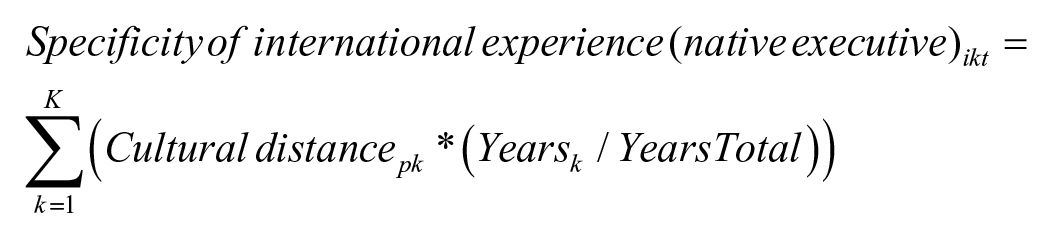
Although the measure captures variety of experience, it does not capture its specificity and potential usefulness for reconciling institutional differences between the MNC home country and the subsidiary host country. For that, I constructed the Specificity of international experience variable. The calculation is similar to the procedure for measuring variety of international experience but differs in two important respects. First, the reference country for calculating cultural distance is not the executive’s country of origin j. For native executives, the reference country is the MNC parent country p, and for expatriate executives, the reference country is the subsidiary country s. Second, I used a time-weighted average of cultural distances instead of a time-weighted sum to operationalize the construct. To understand why, consider the following: with a time-weighted sum approach, an individual with multiple, long, culturally similar international experiences (which are theorized to be highly desirable) would have a higher distance score than an individual with one, short, culturally dissimilar experience. To avoid this, I used a time-weighted average of cultural distances instead.
Formally, the specificity of native executive i’s international experience is operationalized by the time-weighted average of cultural distances between each country of international experience k and the MNC parent country p, as follows:
For expatriate executives, the reference country is the subsidiary country s, with specificity calculated as follows:

The first assumption underlying this approach to calculating specificity of international experience is that liabilities of foreignness arise out of differences between the parent–subsidiary country pair, which subsidiary executives strive to manage and reconcile by relying on culture-specific experiences earned during previous international experiences. The second assumption is that understanding the subsidiary-country environment is inherent for native executives, and understanding the parent-country environment is inherent for expatriates. However, what must be measured is the extent to which each executive understands the “other” country (from his or her point of view) in the parent–subsidiary country dyad. To assess familiarity with the “other” in the parent–subsidiary country pair, I measured the time-weighted average of cultural distances between international experience countries and the MNC parent country (for native executives) and the subsidiary country (for expatriates). Higher values indicated greater dissimilarity between an individual’s experiences and the “other” in the parent–subsidiary country pair, while lower values indicated greater similarity (i.e., specificity).
Using this classification, the specificity of Przemyslaw Gdanski’s international experience in Great Britain, Romania, and the Netherlands are measured against Commerzbank’s parent country of Germany, as Mr. Gdanski is a native executive in Commerzbank’s Polish subsidiary, BRE Bank. Mr. Gdanski’s time-averaged specificity score is 11.8. In contrast, the international experience of an expatriate executive, such as Ronald Malak of Bank BPH in Poland (which at the time of observation was owned by General Electric), is measured relative to the subsidiary country. After being stationed in Germany with the U.S. Army for 6 years, Mr. Malak earned his bachelor’s degree at Kent State University and his master of business administration at Thunderbird School of Global Management. Prior to joining Bank BPH, he worked in Slovakia for 4 years and in the Czech Republic for 2 years. Mr. Malak’s time-averaged specificity score is 13.9. Overall, although the variable was calculated with a different reference point for the two groups of executives, the measurement is a fair proxy for specificity across both groups.
Liabilities of foreignness
To operationalize liabilities of foreignness, this study uses Mahalanobis indexes compiled by Berry et al. (2010). The Berry et al. measures vary over time, which not only increases the accuracy of the metrics but also provides variance year on year, which is important given that this study utilizes a panel data set during a time period of institutional convergence. The distance measures are described below.
Cultural distance integrates power distance (respect for authority), uncertainty avoidance (interpersonal trust), individualism (independence and role of government), and masculinity (importance of family and work) as measured in the World Values Survey. Political distance captures differences in political stability, democracy, and political interconnectedness between two nations. The measure has five component variables (source in parentheses): political stability (Political Constraint Index; POLCONV), democracy score (Freedom House), government consumption (percent of GDP) (World Development Indicators; WDI), membership in the World Trade Organization (WTO), and membership in the same trading bloc (WTO). Economic distance captures differences in economic development and is composed of four component variables, which are sourced from WDI: GDP per capita, inflation, exports, and imports of goods and services.
Control variables
I controlled for a set of factors that are also expected to influence subsidiary executive staffing and demand for previous international experience (sources in parentheses). First, the analyses control for MNC-level variables (MNC annual reports). The number of countries in which the MNC operates is taken as a proxy of MNC multinationality. The number of countries in the CEE region in which the MNC operates is taken as a proxy of MNC regional agglomeration. MNC host-country experience is measured as the duration in years of the MNC’s operations in the host country. Next, I controlled for subsidiary-level variables (Bureau Van Dijk Bankscope). Entry mode (or establishment mode) is a binary variable set equal to 1 if the subsidiary was an acquisition and set equal to 0 if the subsidiary was established as a greenfield. Subsidiary size is measured in terms of balance sheet assets (in USD billion). Subsidiary performance is the profitability of a subsidiary in the previous year measured in terms of return on average assets (in percentage points). Subsidiary market share is the subsidiary’s share of the banking market in the host country measured in terms of assets. Next, I controlled for the level of competition in the host country’s banking industry (industry reports). Host market concentration ratio is the market share of the country’s five largest banks. I also included measures for the relative costs of staffing subsidiaries with expatriates or native citizens, which are likely to influence the proportion of expatriates in the subsidiary executive team. Cost of living for native inhabitants and Cost of living for expatriates are the costs of living for each group in the capital of the host country, indexed relative to New York City (K. G. Tan, Tan, Yuan, & Nguyen, 2014). Finally, I included Year-level fixed effects because strategies regarding subsidiary executive staffing could be driven by general developments, such as the state of the global economy, which influences all firms but may differ year to year. Including these fixed effects accounts for the potential of global trends influencing the presence of executives with previous international experience, independently of institutional distance or the control variables.
Estimation method
Estimating the relationship between institutional distance and subsidiary executives’ previous international experience requires multilevel analysis that explicitly accounts for the nested, hierarchical structure of the data (Hitt, Beamish, Jackson, & Mathieu, 2007). The unit of analysis is the executive–year, yet each executive is nested within a foreign subsidiary, which in turn is nested within an MNC. As a consequence, I estimated the hypothesized relationships using a hierarchical linear model with three levels of variables: executive level, subsidiary level, and MNC level.
Results
Summary Statistics
Although there is general awareness that today’s executives have significant international experience, statistics on the nature of subsidiary executives’ previous international experience have rarely been reported in the literature. The descriptive statistics presented in Table 1 provide novel insights into both the quantifiable and the qualitative components of native and expatriate executives’ previous international experience.
Summary of Executives’ Previous International Experiences
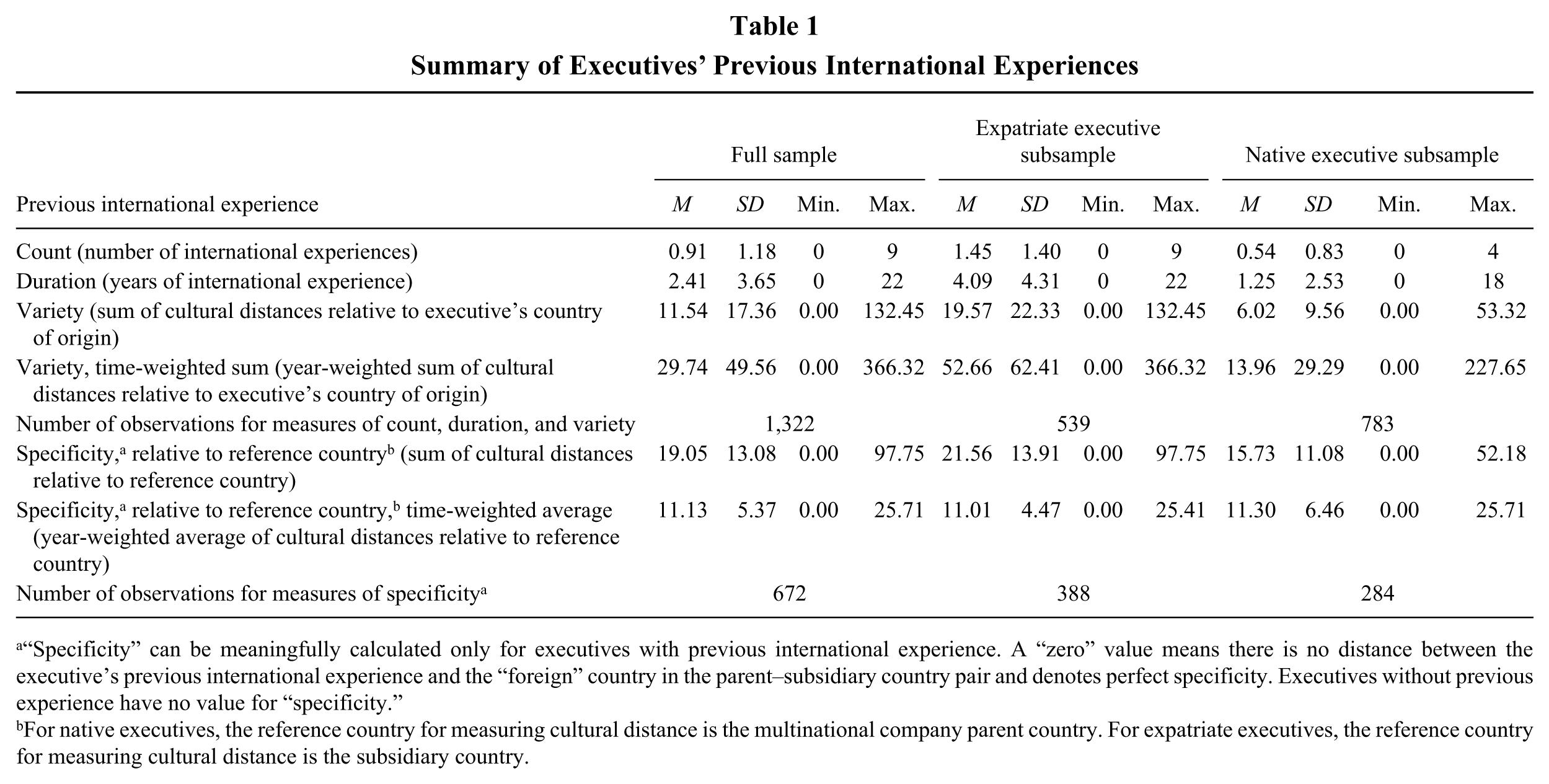
“Specificity” can be meaningfully calculated only for executives with previous international experience. A “zero” value means there is no distance between the executive’s previous international experience and the “foreign” country in the parent–subsidiary country pair and denotes perfect specificity. Executives without previous experience have no value for “specificity.”
For native executives, the reference country for measuring cultural distance is the multinational company parent country. For expatriate executives, the reference country for measuring cultural distance is the subsidiary country.
Across the sample, 49% of executives do not possess any previous international experience, and this percentage is higher among native executives (64%) than among expatriate executives (28%). The average count of previous international experiences is 0.91 and the average duration of previous international experiences is 2.41 years. For the average expatriate executive in the sample, variety of previous international experience is 3 to 4 times greater than that of the average native executive. However, there is considerably less of a difference between expatriate and native executives’ specificity of previous international experience. The time-weighted average of cultural distances between the average expatriate executive’s countries of previous experience and the subsidiary country is nearly equal to the time-weighted average of cultural distances between the average native executive’s countries of previous experience and the MNC parent country: 11.01 versus 11.30, respectively. Overall, the data illustrate that expatriate executives are much more likely than native executives to bring breadth of international experience to their leadership role. However, among executives who possess previous international experience, both expatriate and native executives are equally equipped to navigate the country-specific institutional gap between the parent country and the subsidiary country.
The descriptive statistics for all variables and their pairwise correlations are reported in Table 2. Before testing hypotheses, I mean-centered all nonbinary and nonordinal variables at 0. Collinearity diagnostics were not suggestive of multicollinearity, as the maximum variance inflation factor (VIF) score was 5.7 and the mean VIF was 2.8 when all variables were included in the model, which is well below the suggested threshold of 10.0 (Belsley, Kuh, & Welsch, 1980).
Correlations, Means, and Standard Deviations
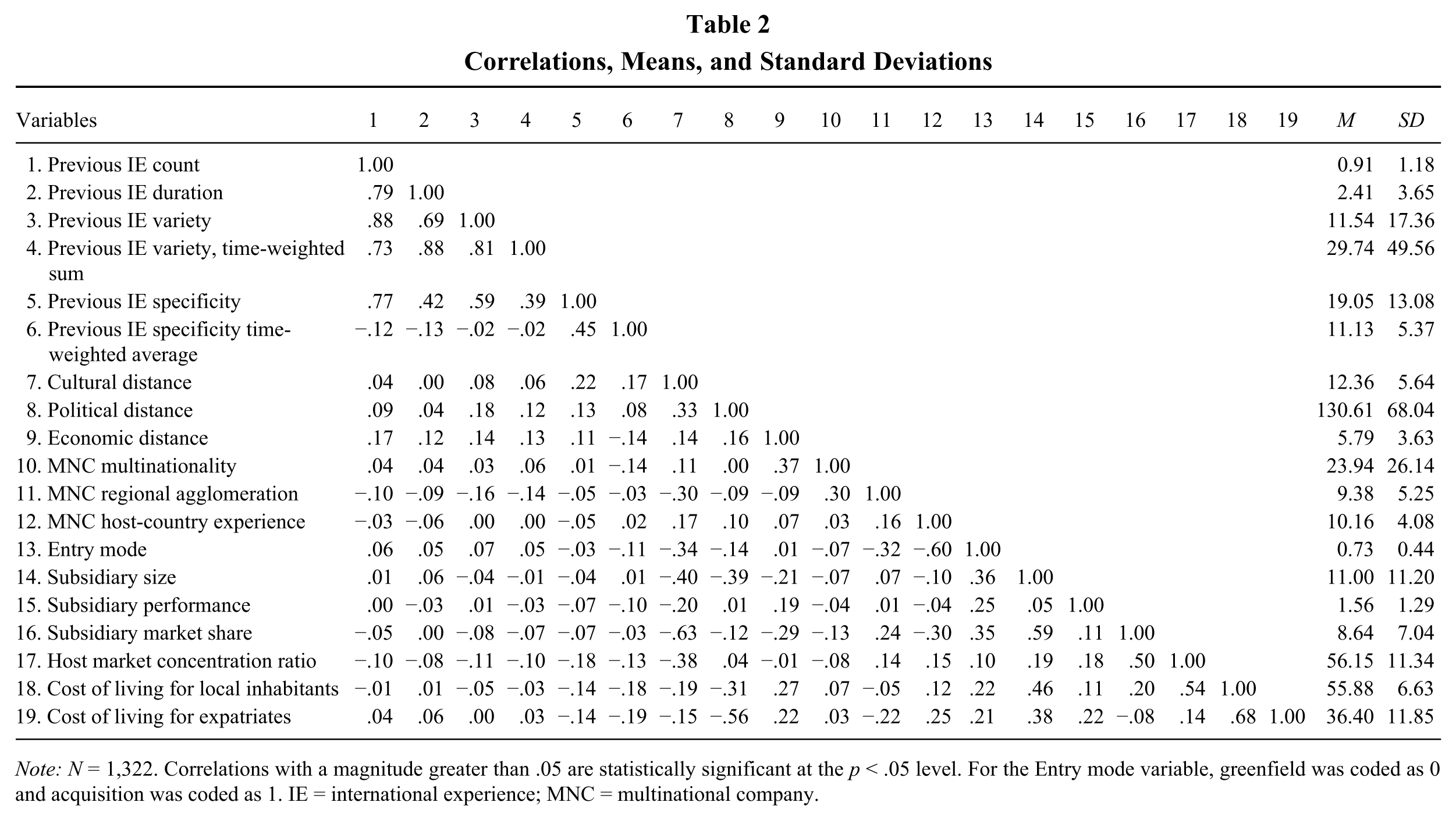
Note: N = 1,322. Correlations with a magnitude greater than .05 are statistically significant at the p < .05 level. For the Entry mode variable, greenfield was coded as 0 and acquisition was coded as 1. IE = international experience; MNC = multinational company.
Regression Results
Hypothesis 1a predicts that greater institutional distance is associated with greater duration of previous international experience. Table 3 presents a series of models to test this prediction. Model 1 is the baseline model and includes only control variables, but none of these are statistically significant in predicting duration of previous international experience. Models 2, 3, and 4 sequentially introduce the three dimensions of institutional distance and show that political distance (Model 3, β = 0.65, p = .003) and economic distance (Model 4, β = 0.71, p = .000) are positively and significantly related to duration. The fully specified model shown in Model 5 provides further support for these findings, and the results suggest that in line with Hypothesis 1a, greater institutional distances along the political and economic dimensions are positively and significantly related to duration of a subsidiary executive’s previous international experience.
Relationship Between Institutional Distance and Duration of Previous International Experience
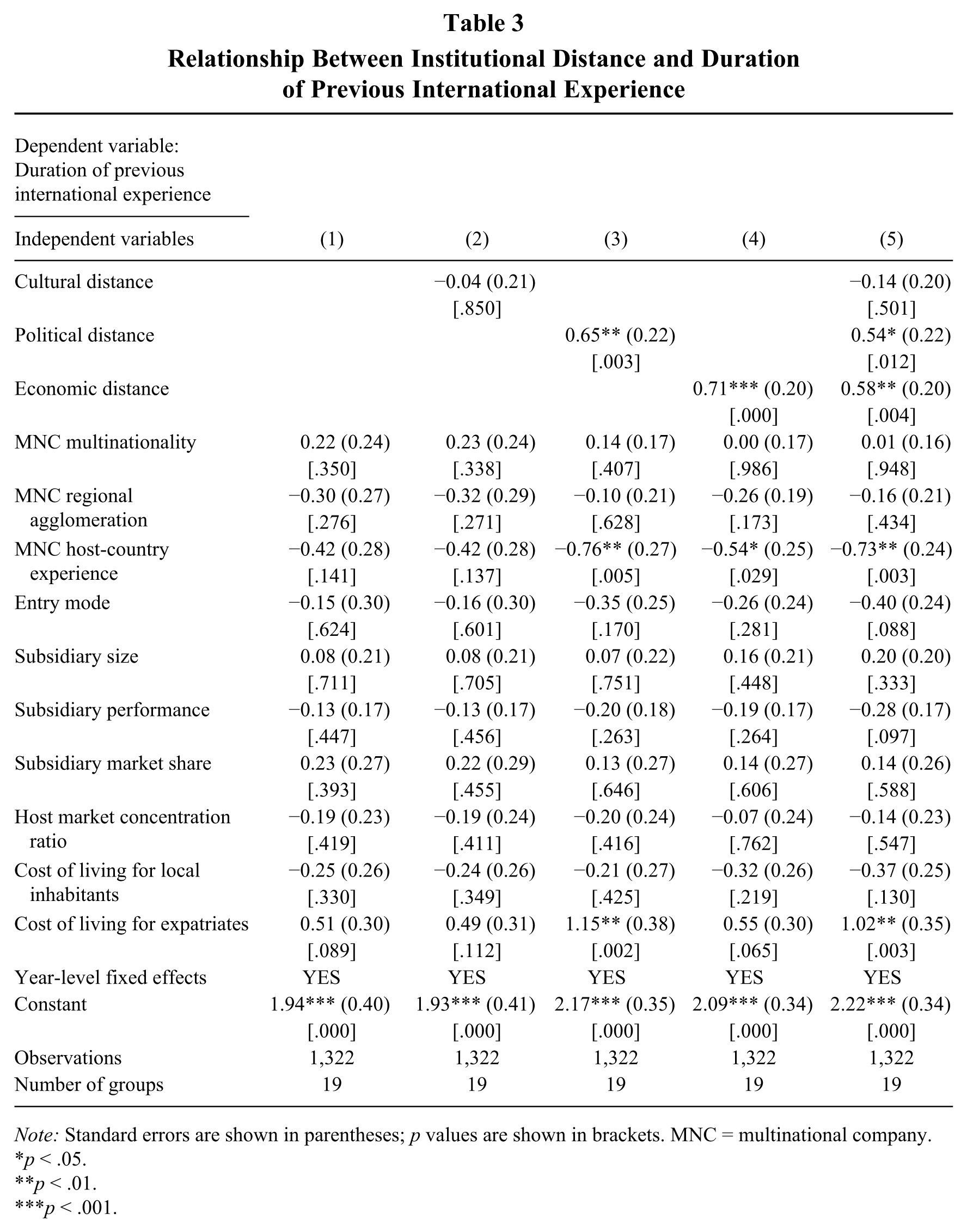
Note: Standard errors are shown in parentheses; p values are shown in brackets. MNC = multinational company.
p < .05.
p < .01.
p < .001.
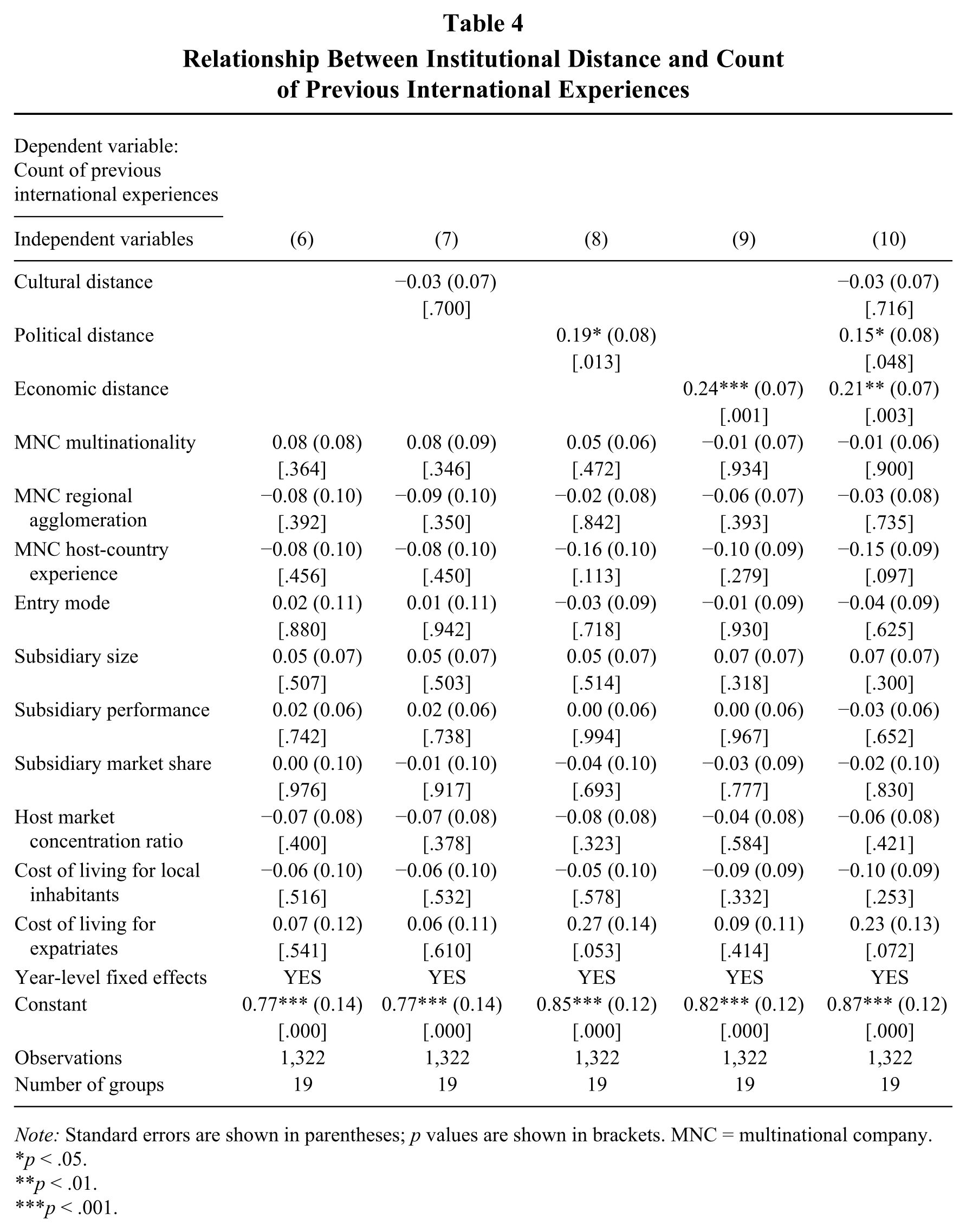
Hypothesis 1b anticipates that greater institutional distance is associated with a higher count of previous international experiences. The results of these regressions are presented in Table 4. Again, the dimensions of institutional distance are introduced sequentially. Models 6 through 10 all suggest that increases in political and economic distances are positively and significantly associated with an executive’s count of previous international experiences, providing support for Hypothesis 1b.
Relationship Between Institutional Distance and Count of Previous International Experiences
Note: Standard errors are shown in parentheses; p values are shown in brackets. MNC = multinational company.
p < .05.
p < .01.
p < .001.
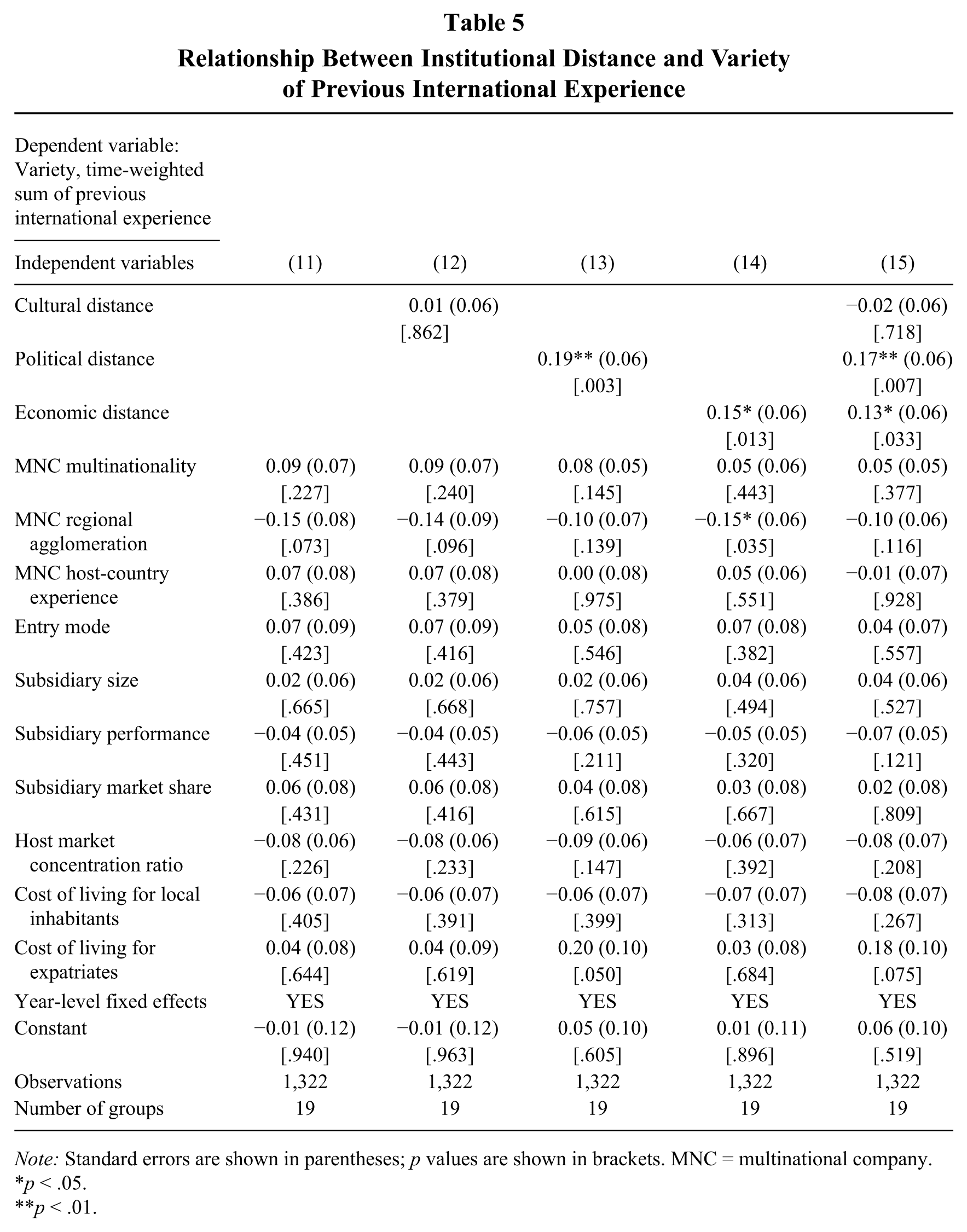
Turning to the qualitative components of previous international experience, I next examined the relationship between institutional distance and variety of previous international experience, measured as the time-weighted sum of cultural distances between (i) countries where the executive earned international experience and (ii) his or her country of origin. Hypothesis 2 predicts that greater institutional distance is linked to greater variety of previous international experience, and the results of these regressions are presented in Table 5. Again, the predicted relationship is positive and statistically significant for the political and economic dimensions of institutional distance (Model 15, political distance: β = 0.17, p = .007; economic distance: β = 0.13, p = .033), providing support for Hypothesis 2.
Relationship Between Institutional Distance and Variety of Previous International Experience
Note: Standard errors are shown in parentheses; p values are shown in brackets. MNC = multinational company.
p < .05.
p < .01.
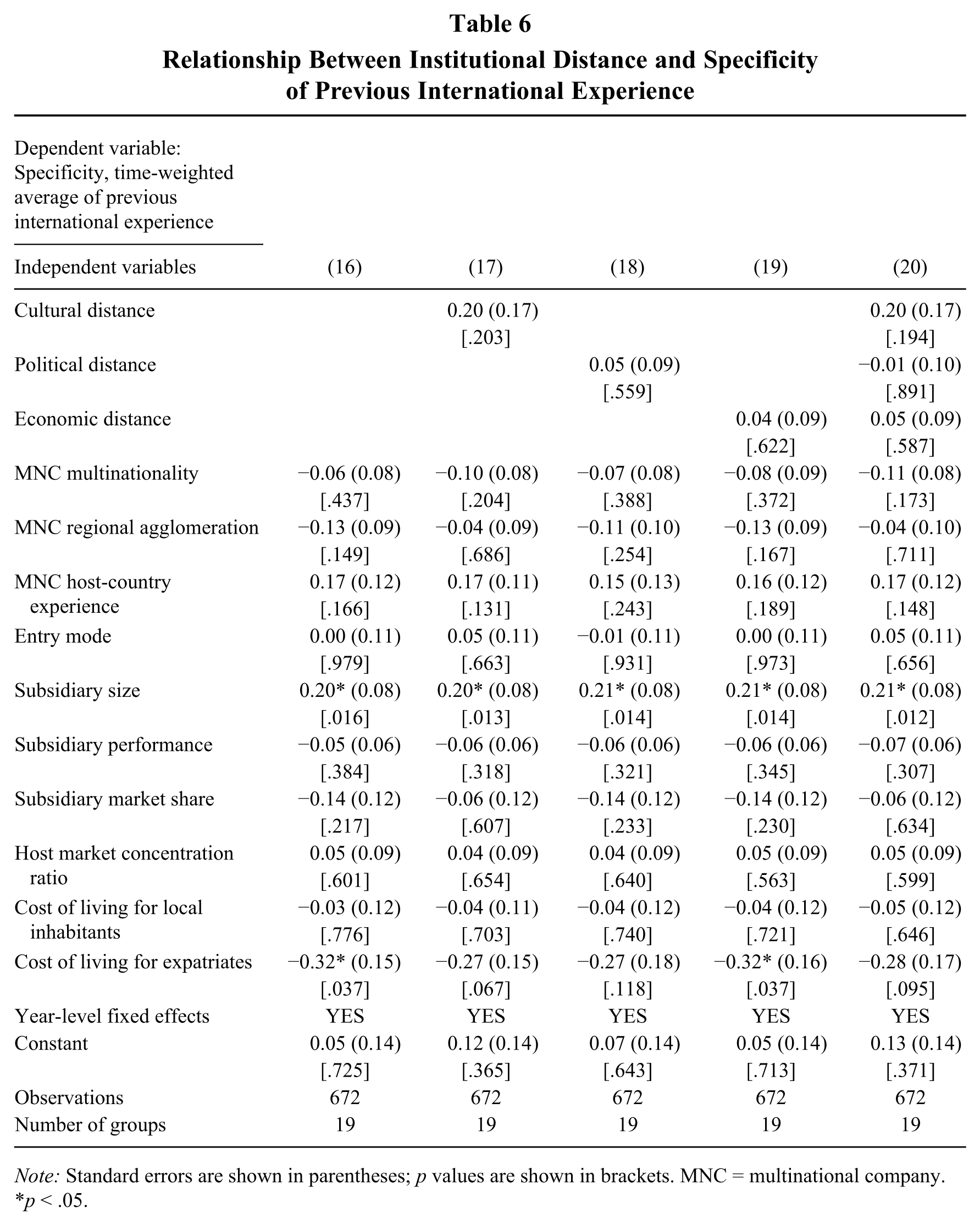
Hypothesis 3 predicts that greater institutional distance will be positively associated with specificity of previous international experiences (relative to the parent–subsidiary country pair). The results of the regressions presented in Table 6 do not offer support for this hypothesis. It is important to note that as a result of the construction of the specificity variable, the regression examines only the predicted relationship among executives who possess previous international experience. By examining the relationship only for executives with previous international experience, the results offer a conservative test of this association and strongly suggest that institutional distance is unrelated to specificity of previous international experience because nearly half of the sample has no previous international experience and therefore is nonspecific by default.
Relationship Between Institutional Distance and Specificity of Previous International Experience
Note: Standard errors are shown in parentheses; p values are shown in brackets. MNC = multinational company.
p < .05.
Overall, the results provided support for Hypotheses 1a and 1b and for Hypothesis 2—but only for the political and economic dimensions of institutional distance. Hypothesis 3 was unsupported.
Post Hoc Analysis and Robustness Tests
Although focusing on executives’ demographic variables and functional roles was outside the scope of the study, the data gathering process uncovered different patterns in expatriate and native executives’ backgrounds as well as in previous international experience by role. These data provide additional insights to our knowledge of subsidiary staffing and are available in the online supplemental material in Tables 7 and 8.
Further analysis examined whether splitting the sample by native and expatriate executives provides additional insights into the statistically insignificant result for specificity of previous international experience. Comparing the results presented in Tables 9 and 10 (available in the online supplemental material) shows that for both subgroups, the relationship between institutional distance and specificity of previous international experience is statistically insignificant, and this holds across all dimensions of institutional distance.
I also performed numerous robustness tests to check that the chosen measures were consistent with other possible measures of the variety and specificity constructs. As will be recalled, in the study I measured variety of previous international experiences as the time-weighted sum of cultural distances between each executive’s countries of previous international experience and his or her country of origin. In Table 11 (available in the online supplemental material), I present results which replicate the test for Hypothesis 2 but where the measure of previous international experience is instead an unweighted, simple sum of cultural distances. The results were qualitatively the same as those using the time-weighted measure of variety reported above. Lastly, I replicated the test for Hypothesis 3 by measuring specificity using the duration and count of previous experiences in the “foreign” region from the perspective of the executive (see Table 12, Models 36 and 37, respectively; available in the online supplemental material). For native executives, depending on where the MNC was headquartered, the region was defined as either Western European countries or North American countries. For expatriate executives, the “foreign” region was defined as countries in CEE. The “foreign” region was defined quite coarsely to see whether there are any indications of a relationship between institutional distance and specificity of previous international experience. Despite the purposely loose construction of these alternate specificity measures, the results do not show any statistically significant relationship that would support Hypothesis 3.
Discussion
Overall, the results of this study contribute to a deeper understanding of the presence of subsidiary executives with culture-general and culture-specific experience in MNC subsidiaries. Empirical results provided evidence of the following broad patterns. With increasing institutional distance along political and economic dimensions, there was an accompanying increase in the presence of subsidiary executives with greater duration, count, and variety of previous international experiences, that is, higher levels of culture-general experience. This was true not only among expatriates but also for native executives and provided the first important insight from this study. This suggests that MNCs recognize individuals’ exposure to broader, more disparate sets of international experiences as a positive signal in institutionally distant host environments.
Contrary to expectations, however, greater institutional distance was unrelated to the presence of subsidiary executives with culture-specific experience. Given that expatriate and native executives had approximately the same average levels of experience specific to the parent–subsidiary country pair in their experiential portfolios (as noted in the Summary Statistics section), MNCs are hiring individuals with culture-specific experience. But the results indicate that MNCs are not strategically allocating individuals with culture-specific experience to manage higher levels of cross-national differences that may give rise to liabilities of foreignness.
Theoretical Implications
My study offers a number of contributions that have theoretical implications for research on global work, international human resource management (IHRM), and international experience. I examine each of these in turn. Global work experiences refer to situations where workers are collaborating across national boundaries (Hinds, Liu, & Lyon, 2011). For MNCs, some of the most challenging cross-national collaboration occurs at the foreign subsidiary level, where subsidiary executives with diverse cultural backgrounds interpret and address the demands of the local external environment within the constraints of a global organizational strategy as they strive to compete against other MNCs and local rivals. One of the unanswered questions in this research stream concerns “how to get work done despite the landmines of potential misunderstandings and incompatibilities littering the work environment” (Hinds et al., 2011: 158). Taken together, the juxtaposition of my two main findings provides valuable insights about the strategies that MNCs utilize to organize global work, given the systemic differences that exist between countries.
This study’s findings suggest that in more institutionally distant environments, MNCs turn to generalists over specialists. In such instances, the presence of individuals with broader experiential portfolios indicates that MNCs value these executives’ abilities to process and integrate cultural information (Fiske & Taylor, 1984; Gupta & Govindarajan, 2002) and to think strategically (Dragoni et al., 2014), while maintaining a healthy level of detachment from the local culture (Rowland, 2016). Instead of relying on executives with higher levels of knowledge about the context-specific differences between the home country and the host country, MNCs are tapping executives with experiences that are suited to holding multiple simultaneous interpretations, to considering outside perspectives, and to dealing with ambiguity.
The lack of empirical support for the relationship between institutional distance and executive culture-specific experience is somewhat surprising. However, the result is consistent with the findings of prior studies, which show that (i) while previous culture-general experience is a significant moderator of cross-cultural adjustment, previous culture-specific experience is not (Takeuchi et al., 2005); (ii) greater cultural distance between international experiences and not cultural specificity of executives’ past international experiences contributes to strategic thinking (Dragoni et al., 2014); and (iii) greater international experience variety is most effective for evaluating and managing liabilities of foreignness (Maitland & Sammartino, 2015). Overall, MNCs appear to select individuals with experiences oriented toward conceptualization rather than contextualization. This contributes to insights regarding the utility of cultural generalists and specialists in global work settings and provides support to the notion that generalists are valued more highly than specialists at the highest managerial levels (Custodio, Ferreira, & Matos, 2013).
In line with recent calls in the global work literature to consider an “embedded system view” of culture (Hinds et al., 2011), this study examines the presence of subsidiary executives with previous international experience relative to institutional differences between the home and the host country along cultural, political, and economic dimensions. Interestingly, the results indicate that greater political distance and greater economic distance are both associated with the presence of executives with a higher count, longer duration, and greater variety of previous international experiences—while greater cultural distance is not. A potential explanation may be that in the financial industry, economic and political differences represent a more serious threat to the stability of foreign banking operations than cultural differences, and these differences are thought to require the presence of a more internationally experienced executive in the subsidiary TMT. In particular, greater differences in political stability and in democracy scores, or not belonging to the same trading bloc, may be perceived as a greater risk for a bank operating abroad than differences in power distance, uncertainty avoidance, individualism, and masculinity. Similarly, economic differences may demand greater management-led adjustments to a bank’s product offering, credit scoring systems, and marketing tactics when operating abroad than would differences in cultural values and beliefs. Another potential explanation for cultural distance not being a significant predictor of observed demand for executives with particular types of previous international experience is that the cultural differences between the home countries (United States and Western European) and the host countries (CEE) in the sample are simply not substantial enough to prompt a shift in executive staffing strategy. Testing the explanatory power of these alternate explanations would require expanding the sample to other industries and to a broader set of host countries.
The results of this study also have important implications for research in IHRM. First, they reveal a challenge as well as an opportunity to extend and reorient the focus of subsidiary staffing research toward a more granular conceptualization of human capital. Thus far, the literature on subsidiary staffing has largely framed the hiring decision as being between expatriates and natives (e.g., Brock et al., 2008; Gaur et al., 2007; Gong, 2003; Harzing, 2001; Muellner et al., 2017; D. Tan & Mahoney, 2006), treating them as two separate groups with distinct knowledge bases, social networks, and affiliations (Bartlett & Yoshihara, 1988; Bonache & Brewster, 2001; Gupta & Govindarajan, 1991; Harzing, 2001; Tsang, 2001). The results of studies on subsidiary staffing have been mixed, with some showing a greater presence of expatriates in executive positions as host market uncertainty increases (Gaur et al., 2007; Gong, 2003), while others show the opposite (Brock et al., 2008; Muellner et al., 2017). Evidence from this study indicates that a possible path to reconciliation of the above findings may be achieved with a more granular conceptualization of human capital.
Second, this study underscores the importance of not treating expatriates or natives as homogeneous groups (Black & Gregersen, 1992; Caligiuri & Bonache, 2016; Caprar, 2011). The high-level findings show that 36% of native executives and 72% of expatriate executives in this sample have previous international experience. Furthermore, within both groups, there is tremendous diversity in breadth and depth of international experiences. This has important implications for subsidiary staffing research because it brings into question the often-used assumption that expatriates act as agents of headquarters, that native executives represent local interests (Gong, 2003; Martinez & Jarillo, 1989; O’Donnell, 2000; D. Tan & Mahoney, 2006), and that organizational allegiances form along national lines (Gregersen & Black, 1992). Future research in international staffing can capitalize on the insights offered in this study by going beyond an expatriate–native classification to also include an analysis of individuals’ backgrounds.
In addition to extending prior work in IHRM beyond the expatriate–native dichotomy, this study offers much needed insight into native executives’ experiential backgrounds. Research on expatriates has held a prominent place in IB literature over the last 50 years, but examinations of native executives, their profiles, and perspectives has remained sparse until recently with the ethnographic study of Caprar (2011) on host-country nationals in Romanian subsidiaries of U.S. corporations. The descriptive statistics provided in the online supplemental material in Tables 7 and 8 provide the first multicountry, large-sample investigation of native executives’ demographic, educational, and functional role backgrounds and offer concrete empirical evidence of variety with respect to levels of international experience, educational experience, and organizational experience. The evidence presented here supports the proposition that locals may have substantial international experience that MNCs utilize to manage headquarters–subsidiary relationships (Haas, 2006).
Finally, I also contribute to the international experience literature in the following ways. While much of the previous research focuses either on the relationship between previous international experience and cross-cultural adjustment (see Takeuchi & Chen, 2013, for review) or on the relationship with performance (Carpenter et al., 2001; Daily et al., 2000; Le & Kroll, 2017), the focus of this study is on the antecedents leading to the selection of individuals with previous international experience. This aspect has so far been understudied. As a consequence, my findings contribute to the literature on international experience by laying a foundation for future research on the antecedents to executive selection and hiring strategy in MNCs.
My second contribution to the international experience literature stream is in the particular conceptualization and operationalization of the international experience variety and specificity constructs developed in this paper. In line with the literature encouraging researchers to consider international experience as a multidimensional construct (Takeuchi & Chen, 2013; Tesluk & Jacobs, 1998), this study includes previous international experiences acquired through professional assignments (work) and through study abroad (nonwork) and measures both the quantitative and the qualitative components of these experiences. While distance concepts are increasingly being invoked to measure international experience variety, the construct has thus far been operationalized as the maximum cultural distance (Dragoni et al., 2014), the mean psychic distance (Maitland & Sammartino, 2015), or the sum of absolute values of cultural distances (Godart et al., 2015) between the individual’s country of origin and his or her countries of work experience. This study further refines the measure of international experience variety by incorporating time spent in each location to generate time-weighted sums and time-weighted averages of cultural distances, thereby improving the empirical evidence linking international experience to firm behavior.
Implications for Practice
This study’s findings also offer implications for executive development and selection. While internationally experienced managers are considered indispensable for today’s firms (Farndale, Scullion, & Sparrow, 2010), a central concern in IHRM is that there is a shortage of managers who possess the requisite skills and experience to effectively manage business units in institutionally distant or otherwise uncertain markets (Dragoni et al., 2014). The scarcity of qualified management is particularly acute in the BRIC countries of Brazil, Russia, India, and China, as well as in CEE markets (Bhatnagar, 2007), which represent the empirical context for this study. However, what these “requisite skills” actually are is currently being debated in the literature (Farndale et al., 2010).
While this study is quite descriptive in orientation and largely focuses on what MNCs in various contexts do, the data also provide some clues that allow for speculation regarding what MNCs should be doing. Upon splitting the sample into two groups based on whether an executive’s subsidiary is above or below the sample mean for financial performance, there is a statistically significant difference in mean levels of previous international experience between executives working for higher and lower performing subsidiaries. Executives in subsidiaries with financial performance above the mean have a higher average count (p = .00) and a greater average variety (p = .09) of previous international experiences than executives in subsidiaries that perform below the mean. The difference in means between the two groups is not statistically significant for duration (p = .24) or specificity (p = .13) of previous international experience.
Importantly, after reducing the sample to include only executives working in locations with levels of institutional distance above the sample means, I found that executives in subsidiaries with above-mean performance have a higher average count of previous international experiences than executives in subsidiaries with below-mean performance (economic distance: p = .00; political distance: p = .00; cultural distance: p = .01). Although the results of these two-sided t tests do not provide any information regarding causality, they do suggest that higher performing subsidiaries have executives with greater breadth of international experience to manage markets characterized by higher levels of institutional distance. What is even more interesting is that the opposite results emerge for specificity of international experience. Among institutionally distant subsidiaries, executives in subsidiaries with above-mean performance have lower average specificity of previous international experiences than executives in subsidiaries with below-mean performance (economic distance: p = .00; political distance: p = .00; cultural distance: p = .01). Together, these findings provide initial indications that MNCs need not be seeking talent with context-specific previous international experience to be successful in institutionally distant markets, but they do need to attract, develop, and retain individuals with breadth of international experience, and that this experience can be unrelated to the host market.
Limitations and Future Research Directions
There are certainly several limitations to this study that give rise to future research questions. First, although the reporting requirements in the banking industry in CEE facilitated access to subsidiary-level information on executives and firm characteristics, focusing on a single industry limits the study’s generalizability. It would be useful to explore whether the staffing patterns found here hold more generally across industries and in other parts of the world. Second, the sample consisted of MNCs from more developed countries operating in comparatively less developed countries. It would be interesting to examine whether these results apply to emerging-market MNCs operating in developed markets. Next, as a consequence of the data gathering process, this study could not address the full range of possible international experiences as conceptualized by Takeuchi et al. (2006), some of which may not or would not appear on an executive biography or LinkedIn profile. Examples include short-term assignments, frequent international commuting, and cultural exposure to foreigners through participation in international project teams, through domestic work experience in other MNCs, through personal life, or through travel abroad as tourists (Collings, Scullion, & Morley, 2007). Indeed, the international experience construct is complex and fully capturing it is difficult. But broadening the data to include additional types of international experience would yield further insights into the global work experience portfolios of individuals as well as into how firms deploy individuals with particular kinds or combinations of international experience.
A meaningful extension of this study that would contribute further to our understanding of global work would be to use the international experience lens to examine team composition. For example, future research may examine whether there is evidence of complementarity or substitution between the experiential portfolios of expatriates and native executives within a subsidiary team. The issue of complementarity or substitution may also be addressed in the context of executive succession, after a new member has been appointed to the subsidiary TMT. Given the differences in average levels of previous international experience among various functional roles that were uncovered in this study (see the online supplemental material), it may be worthwhile to examine team configuration from a functional role perspective.
Conclusion
I began this study with an interest in understanding whether MNCs use executives with culture-general and culture-specific previous international experience to a greater extent in more institutionally distant environments. I pursued this analysis on the basis of the observation that today’s executives increasingly have international experiences, which may make them better able to manage liabilities of foreignness that MNCs experience while operating abroad. However, prior to this work, we knew little about MNCs’ preferences for subsidiary executives with particular experiential portfolios—or even how prevalent certain experiences actually were. To address these questions, I collected a data set that not only provided insight into the backgrounds of subsidiary executives but also allowed for deeper examination of the conditions under which MNCs leverage individuals’ international experiences.
Upon examining these relationships, the following conclusions can be made. This study revealed a positive relationship between MNC parent country–subsidiary host country institutional distance and variety of previous international experiences among subsidiary executives, both native and expatriate. However, the results did not support a relationship between institutional distance and specific previous international experience relevant to the parent–subsidiary country pair among subsidiary executives. This result was consistent across both native and expatriate executives. Given the resources at MNCs’ disposal to invest in individuals’ on-the-job training or to select individuals whose experiential backgrounds fit organizational needs, these results strongly indicate that as MNCs seek to manage liabilities of foreignness arising from institutional distance, breadth and variety of executives’ previous international experiences are more valued by MNCs in subsidiary management contexts than the specificity of those experiences to the parent–subsidiary country pair.
Supplemental Material
JOM748745_OnlineSupplement.docx – Supplemental material for Cultural Generalists and Cultural Specialists: Examining International Experience Portfolios of Subsidiary Executives in Multinational Firms
Supplemental material, JOM748745_OnlineSupplement.docx for Cultural Generalists and Cultural Specialists: Examining International Experience Portfolios of Subsidiary Executives in Multinational Firms by Marketa Rickley in Journal of Management
Footnotes
Acknowledgements
This article was accepted under the editorship of Patrick M. Wright. I would like to thank David G. Allen and two anonymous reviewers for their constructive comments and suggestions throughout the revision process. I would also like to thank Maria Kraimer and Mauro Guillen for helpful ideas on earlier versions of this manuscript, as well as the participants of the Wharton Multinational Management Seminar for ideas and comments.
Supplemental material for this article is available with the manuscript on the JOM website.

Notes
References
Supplementary Material
Please find the following supplemental material available below.
For Open Access articles published under a Creative Commons License, all supplemental material carries the same license as the article it is associated with.
For non-Open Access articles published, all supplemental material carries a non-exclusive license, and permission requests for re-use of supplemental material or any part of supplemental material shall be sent directly to the copyright owner as specified in the copyright notice associated with the article.
