



Abstract
This research investigates whether and when a job applicant’s unemployment status (i.e., employed, short-term unemployed, or long-term unemployed) affects the probability of receiving an interview request by examining interview request rates in the presence of versus absence of unemployment status antidiscrimination legislation. In response to 3,335 fictitious resumes sent to 1,237 online job postings in Los Angeles and New York City, we received an overall interview request rate of 10.37. Long-term unemployed applicants were less likely to receive an interview request than short-term unemployed applicants in Los Angeles but not in New York City, which has unemployment status antidiscrimination legislation. These findings are supplemented with self-report survey data about perceptions of the unemployed from 200 hiring personnel in New York City and Los Angeles. Practical and theoretical implications are discussed for the unemployment, job search, and selection literatures.
No unemployed candidates will be considered at all
Introduction
Being unemployed is a stressful life event (McKee-Ryan, Song, Wanberg, & Kinicki, 2005). In addition to the financial impact of being without work, the process of looking for a job is a challenging task (Wanberg, Basbug, Van Hooft, & Samtani, 2012). Job search, typically viewed as a self-regulated process (Kanfer, Wanberg, & Kantrowitz, 2001), depends not only on the individual’s skills, abilities, and motivation but also on opportunities or constraints that may be outside an individual’s control (van Hooft, Born, Taris, van der Flier, & Blonk, 2004). For example, beyond the labor market’s need for employees, employers have been shown to make employment decisions on the basis of non-job-related factors (e.g., age, race, religion, gender, sexual orientation; Barron & Hebl, 2013; Bertrand & Mullainathan, 2004; Derous, Ryan, & Serlie, 2015; Hebl, Foster, Mannix, & Dovidio, 2002; King & Ahmad, 2010; Tilcsik; 2011; Wanberg, Kanfer, Hamann, & Zhang, 2015).
But do unemployed job seekers have to worry that being unemployed might limit their chance of securing a new position? Sony Ericsson attracted media attention by openly excluding jobless applicants in a job posting (National Employment Law Project, 2011). Following Sony Ericsson’s job posting, National Employment Law Project uncovered that many other companies were using similar exclusions. In a 4-week review of online postings on Career Builder, Monster, Indeed, and Craigslist, 150 advertisements were identified that noted unemployed individuals should not apply (National Employment Law Project, 2011). This discovery launched extensive discussion online (Wilkie, 2014) and in the media (Hu, 2013; Pear, 2011; Stinson, 2014), and the Equal Employment Opportunity Commission (EEOC) held a formal hearing to discuss the issue (EEOC, 2011).
Given the widespread public concern, and because not hiring qualified unemployed individuals may result in adverse impact against minorities and individuals with disabilities, a few states (i.e., New Jersey and Oregon) and cities (i.e., New York City, New York; Madison, Wisconsin; Chicago, Illinois; District of Columbia) have passed legislation to protect the unemployed in the hiring process (Banjo, 2012; Skibitsky, 2013; Williams, 2013). The unemployed are those who do not have a job, have actively looked for work in the prior 4 weeks, and are currently available for work (Bureau of Labor Statistics [BLS], 2015). While the legislation protection encompasses both short-term and long-term unemployed, a key motivation in passing antidiscrimination legislation is to protect “the long-term unemployed who are increasingly becoming victims of discrimination as companies screen out candidates on the basis of their unemployment status” (Minniti & Goldstein, 2015: para. 1). The long-term unemployed refer to individuals who have been looking for work for 27 weeks (about 6 months) or more (BLS, 2014). We know from some economic research that the long-term unemployed have significantly lower chances of being invited to job interviews (e.g., Ghayad, 2014; Kroft, Lange, & Notowidigdo, 2013), yet other studies have not supported this conclusion (e.g., Farber, Silverman, & von Wachter, 2017; Nunley, Pugh, Romero, & Seals, 2017).
As a result of the importance of this issue, mixed findings, and legislation that is being passed, there has been a call for more research to establish whether unemployed individuals are discriminated against in the job search process (Adams, Greig, & McQuaid, 2000; McQuaid & Lindsay, 2002; Williams, 2013). Highlighting the need for documenting and extending extant research on this topic, written testimony to the EEOC on behalf of the Society for Human Resource Management (SHRM) suggests that employers do not use employment status in their decision-making. Specifically, this testimony stated, SHRM is unaware of a widespread practice or trend to exclude unemployed individuals from consideration for available jobs. Employers, in SHRM’s experience, whether operating in the currently challenging economy or in more robust times, are focused on finding the right people for the job, regardless of whether or not they are currently employed. (EEOC, 2011: “Conclusion,” para. 1)
To the extent that research supports this statement, there would be no need for unemployment status antidiscrimination legislation. At the same time, the passage of legislation makes it important to examine the efficacy of this type of legislation. The passage of legislation to protect unemployed individuals against discrimination in the hiring process is monumental; such legislation is not passed easily, as demonstrated by countless states that have tried and failed to pass unemployment status antidiscrimination legislation (e.g., Arizona, California, Colorado, Connecticut, Florida, Hawaii, Indiana, Iowa, Maine, Maryland, Massachusetts, Michigan, Minnesota, New Hampshire, Ohio, Pennsylvania, South Dakota, Tennessee, Virginia; National Conference of State Legislatures, n.d.). Data that can shed light upon the effectiveness of legislation related to discrimination in the employment context are highly useful, so that we can learn whether this avenue of addressing discrimination works (Barron & Hebl, 2013). Finally, there is an extensive literature that is focused on factors associated with the impact of job applicant characteristics on the speed of reemployment in the micro/psychological literature. Yet unemployment status and antidiscrimination legislation are unmentioned in comprehensive reviews covering the individual experience of job search and unemployment (e.g., Saks, 2005; Wanberg, 2012). Following the recommendations of Ruggs et al. (2013), we suggest this topic is one that should interest, and draw the contributions of, industrial psychologists and management scholars.
In this study, we draw upon economic perspectives as well as stereotype content theory (Cuddy, Fiske, & Glick, 2008; Fiske, Cuddy, Glick, & Xu, 2002) and the justification-suppression model of prejudice suppression (Crandall & Eshleman, 2003) to propose hypotheses about the roles that unemployment status and antidiscrimination legislation play in receiving interview requests from employers. Using a field experiment and following best practices for what are known as “resume audit studies” (e.g., Bertrand & Mullainathan, 2004; Lahey & Beasley, 2009), we sent fictitious resumes to 1,237 job openings in the two largest cities in the United States: New York City and Los Angeles. The two cities represent job markets that differ in legislative protections for unemployed job seekers—New York City has legislation that has added unemployment status as a protected class and Los Angeles does not. On the resumes, we manipulated applicants’ unemployment status (i.e., employed, short-term unemployed, and long-term unemployed) and then examined the extent to which the fictitious applicants received interview requests. We compare the long-term unemployed (i.e., applicants out of work for more than 6 months) to the short-term unemployed (i.e., applicants out of work for less than 6 months) and the currently employed to understand whether the legislation protects the unemployed in the job seeking process. We supplement our findings with self-report survey data from 200 hiring personnel in New York City and Los Angeles. This supplemental study allowed us to measure hiring personnel perceptions of applicants’ employment status as well as gain insight into these professionals’ awareness and use of antidiscrimination legislation.
Our study provides significant empirical and applied contributions. Beyond providing a well-designed field experiment to examine whether employers discount long-term unemployed applicants, our study is novel in examining the effects of unemployment status antidiscrimination legislation. Studying the effectiveness of legislation is complex and comes with imperfect internal and external validity of findings, but contributions to the collection of evidence are critical to society (Bussmann, 2010). We also extend theory within the unemployment, job search, and selection literatures by introducing a new set of dimensions (unemployment status and antidiscrimination legislation) as factors that may affect the job finding process.
Unemployment Status and Interview Requests
A job seeker’s reemployment success, defined as finding work quickly and/or finding a good job (Wanberg, 2012), depends on labor market needs, the job seeker’s human and social capital, characteristics of the individual’s job search (search intensity and quality), situational and self-imposed constraints (e.g., having to work in a particular region or setting a high level of desired pay), the job seeker’s financial need to work, and employer discrimination (Wanberg, Hough, & Song, 2002). Although Wanberg and colleagues (2002) acknowledge employer discrimination may affect job-seeker reemployment success, unemployment discrimination specifically has not been studied in the management/psychological job search literature.
A number of field studies have been published in economics that examine the relationship between unemployment status and the probability of receiving a “callback,” or interview request, by an employer. About half of these studies find that not having a job, in comparison to being currently employed, negatively affects the likelihood of receiving an interview from an employer (Blau & Robins, 1990; Eriksson & Lagerström, 2006; Ghayad, 2014), with Farber et al. (2017) and Nunley et al. (2017) as exceptions. A few studies have found that employers do not treat contemporary short-term unemployment differently from current employment (e.g., Eriksson & Rooth, 2014; Kroft et al., 2013) or in some cases, may even prefer the short-term unemployed to applicants with a job, given these individuals may be available immediately (Oberholzer-Gee, 2008). To explain mixed findings, authors have examined additional factors including local labor market conditions (Kroft et al., 2013), skill level of the job (Eriksson & Rooth, 2014), underemployment (Nunley et al., 2017), timing of unemployment (i.e., whether it is a past spell or a current spell; Eriksson & Rooth, 2014; Nunley et al., 2017), age (Farber et al., 2017; Shore & Tashchian, 2013), and length of the unemployment spell (Eriksson & Rooth, 2014; Ghayad, 2014; Kroft et al., 2013; Oberholzer-Gee, 2008).
A predominant finding of this research is that when it comes to getting a callback, the length of one’s unemployment spell seems to matter. Specifically, studies suggest that the likelihood of receiving an interview is lower the longer an applicant is unemployed (Eriksson & Rooth, 2014; Ghayad, 2014; Kroft et al., 2013; Oberholzer-Gee, 2008). Audit studies conducted by both Kroft et al. (2013) and Ghayad (2014) suggest that applicant callbacks appear to be the lowest after 6 months of unemployment. The Kroft et al. (2013) study, for example, involved sending out 12,054 fictitious resumes to 3,000 job openings in sales, customer service, and administration. The unemployment status and length on each submitted resume ranged from 1 to 36 months. Applicant details such as gender and names were randomly assigned to resumes. The results from Kroft et al. (2013) show that callbacks decreased with length of unemployment, with an inflection point of 6 months, that is, applicants unemployed for more than 6 months received fewer callbacks than individuals unemployed for less than 6 months. Ghayad (2014) also found a sharp drop-off in the number of interview requests after 6 months. He reasoned that more than 6 months of unemployment might be a signal to the employer of an unmotivated applicant who has not found a job even after the typical duration of unemployment insurance benefits runs out, which last on average around 26 weeks. The generalizability of the finding that unemployment length matters in the job application process was supported in Sweden by Eriksson and Rooth (2014) and Oberholzer-Gee (2008). Collectively, this research suggests that examining employer preferences via a conceptualization of applicant status as simply “employed” versus “unemployed” masks a potentially important nuance: that as applicants are unemployed longer, they may attract less employer interest. To explain these findings and to form hypotheses regarding the expected role of unemployment status in the application process, it is valuable to integrate both psychological and economic perspectives.
The psychological literature addresses employer use of an applicant’s group membership in decision-making as a form of cognitive bias. Specifically, when employers make an assumption about an applicant based upon the applicant’s membership in a specific group (such as ethnicity, sexual orientation, or in our case, unemployment status) rather than objective information, they are relying on a category-based stereotype. Extant theories of the resume screening process (e.g., Bertrand & Mullainathan, 2004; Derous et al., 2015; Kulik, Roberson, & Perry, 2007) suggest that category-based information processing and stereotypic generalizations are common. Stereotypic generalizations help perceivers to make sense of a situation with less effort (McGarty, 2002) and occur frequently within applicant review contexts, given the large quantity of resumes that employers must review over short time periods (Aigner & Cain, 1977).
Stereotype content theory (Fiske, Cuddy, & Glick, 2007; Fiske et al., 2002) suggests that two primary dimensions underlie stereotypes individuals make of one another: warmth (the person’s intent, including evaluations of a person’s friendliness, trustworthiness, and kindness) and competence (i.e., the person’s capability, including evaluations about skill, confidence, efficacy, creativity, and intelligence). In the hiring context, where the focus of most organizations is to recruit, select, and maintain a highly competent workforce, competence judgments take primacy over warmth judgments (Cuddy, Glick, & Beninger, 2011). Judgments about one’s competence are inferred in part from perceived status, with lower status groups perceived as less competent than higher status groups (Cuddy et al., 2008). Research has suggested that the unemployed are viewed as a low-status group (Karren & Sherman, 2012) and are stereotyped as lower on competence in comparison to employed individuals (Ho, Shih, Walters, & Pittinsky, 2011). Research furthermore suggests that groups perceived as incompetent are more likely to be excluded or ignored by others (Cuddy, Fiske, & Glick, 2007).
Extant economic perspectives complement stereotype content theory to suggest that perceptions of competence among the unemployed will be particularly amplified among those who have been unemployed longer, such as over 6 months (Ghayad, 2014). Employer screening explanations suggest that employers use length of unemployment as a signal about the worker’s lack of productivity (Lockwood, 1991; Vishwanath 1989), which is also an inference about an employee’s competence. Specifically, if a job seeker is still unemployed after several months, it must be the case that he or she has been screened and discarded by other employers. The human capital model suggests that employers avoid long-term unemployed individuals because they expect such workers have experienced depreciation in their skills over time (Acemoglu, 1995). Together, stereotype content theory and economic perspectives suggest that employers will use applicant unemployment status, particularly if it is of a long duration, in decision-making. On the basis of these perspectives, we expect that employers will prefer employed and short-term unemployed job seekers over long-term unemployed job seekers.
Hypothesis 1: Employed and short-term unemployed applicants will be more likely to receive an interview request than long-term unemployed applicants.
The Role of Unemployment Status Legislation in Receipt of Interviews
Unlike women or members of ethnic minority groups, unemployed individuals are not protected from discrimination by U.S. federal law. However, a few states and cities have passed legislation to protect the unemployed in the hiring process (Banjo, 2012; Skibitsky, 2013; Williams, 2013). These laws fall within three categories: Advertising-only prohibition, in which job postings are prohibited from including language that requires applicants to be employed in order to be considered for a position; protected class status for the jobless with no private cause of action, in which employers are prohibited from overtly discriminating in job ads and the jobless are granted protected class status, but may not sue an employer for discrimination in private court; and protected class status for the jobless with private cause of action, in which the jobless are considered a protected class and may sue employers in private court (Kelsaw, 2013).
The third category of legislation offers the most protection to unemployed individuals. In 2013, New York City adopted this version of the law. Under the section titled “Unlawful discriminatory practices,” the legislation prohibits discrimination based on an individual’s unemployment: an employer, employment agency, or agent thereof shall not: (a) because of a person’s unemployment, represent that any employment or position is not available when in fact it is available; or (b) base an employment decision with regard to hiring, compensation or the terms, conditions or privileges of employment on an applicant’s unemployment. (New York City Commission on Human Rights, 2017: § 8-107(21)(1))
Under this law, individuals can seek damages, punitive damages, injunctive relief, and attorneys’ fees, and organizations may face civil penalties up to $125,000 or for willful acts of discrimination, up to $250,000.
The extent to which legislation can be effective in situations where employers have cognitive biases against particular groups is an important question (Barron & Hebl, 2013). To the extent that employers have a cognitive bias against individuals who are unemployed, how might legislation produce an impact? We leverage the justification-suppression model of prejudice expression (Crandall & Eshleman, 2003), which extends the perspectives provided by stereotype content theory, to address this question. Similar to stereotype content theory (Cuddy et al., 2008), the justification-suppression model acknowledges that people engage in negative evaluations of (and actions toward) individuals on the basis of their memberships in stigmatized groups (Crandall & Eshleman, 2003). The justification-suppression model extends the perspectives provided by Cuddy et al. (2008) by describing conditions under which cognitive biases may be expressed versus suppressed. On one hand, when individuals have reasons that they believe justify their prejudice (as in the case of employers believing that longer term unemployment is a signal of lower competence), they are more likely to express and act on their prejudice. However, even when they feel their prejudice is justified, when cultural norms or political value systems discourage the expression of prejudice toward a group, individuals become more motivated to avoid expressions of prejudice and are more likely to suppress these prejudices (Crandall & Eshleman, 2003; Crandall, Eshleman, & O’Brien, 2002). Amplifying individuals’ feelings of empathy, accountability, and personal standards can also lead to suppression of prejudice (see, e.g., Shapiro & Neuberg, 2008). Empirical research supports the notion that motivation to control bias affects category activation and inhibition and, subsequently, behavior (Derous et al., 2015; Kulik et al., 2007; Ziegert & Hanges, 2005). For example, decision makers are sensitive to social norms or rules regarding how appropriate it is to express bias and will inhibit activation of categories for which there is clear normative pressure or rules on not to use such categories in decision-making (Brief, Dietz, Cohen, Pugh, & Vaslow, 2000).
On the basis of the justification-suppression model, we suggest that unemployment status antidiscrimination legislation provides an impetus for decision makers to suppress their bias when it might otherwise be activated, for example, when faced with the decision whether to extend a job interview request to a qualified candidate who is currently unemployed. In support of this premise, research on employment discrimination against gay/lesbian applicants found that employers in states and counties with sexual orientation antidiscrimination legislation were significantly less likely to engage in discrimination (Barron & Hebl, 2013; Tilcsik, 2011).
The mechanisms by which legislation reduces the expression of discrimination remain theoretical and are categorized as instrumental and symbolic (Hebl, Barron, Cox, & Corrington, 2016). First, antidiscrimination legislation makes a given behavior illegal, and employers who violate the law are punished with legal fees and fines. Second, antidiscrimination legislation also works through the amplification of social norms and moral rules of conduct that inform decision makers about what is acceptable behavior. Thus, antidiscrimination legislation provides symbolic expectations in addition to “simply a fear of punishment” (Hebl et al., 2016: 454). Paired with the justification-suppression model of prejudice expression (Crandall & Eshleman, 2003), legislation is likely to directly and indirectly create pressures on decision makers to suppress their prejudice against the long-term unemployed. On the basis of the foregoing, we propose:
Hypothesis 2: The presence of unemployment status antidiscrimination legislation moderates the association between unemployment status and interview requests such that the employed and short-term unemployed are more likely to receive interview requests relative to the long-term unemployed when unemployment status antidiscrimination legislation is not present, compared to when such legislation is present.
Method
Following best practices for resume audit studies (e.g., Bertrand & Mullainathan, 2004; Lahey & Beasley, 2009), we created and sent 3,711 fictitious resumes to 1,237 administrative, customer service, and sales job postings between November 2014 and August 2015. We excluded 376 resumes for which the job posting closed or the posting could not be traced to a unique or real company. This left us with a total of 3,335 resumes for our analysis.
Choice of Location
Our field experiment takes place in New York City and Los Angeles. New York City is the largest city in the United States and, at the time of the study design, the only jurisdiction with legislation identifying the unemployed as a protected class with private cause of action. Los Angeles is the second largest city in the United States and was the closest comparison city to New York City over other large cities, such as Chicago and Houston, on a number of criteria, including unemployment rates, population growth, mean age, household size, demographic composition of the labor force, industry representation, cost of living, number of Fortune 500 company headquarters, crime rate, best cities for job seekers, job trends/job market competition, and regional association with antidiscrimination laws (i.e., North vs. South; see, e.g., BLS, 2016a). Although New York City and Los Angeles are not exact matches on all of these characteristics, they are closely aligned, which makes them an optimal choice compared to a broader state-by-state comparison where these factors likely would vary considerably. There is also precedence for comparing these two cities in the existing literature: New York City and Los Angeles are often used in empirical comparisons (e.g., Halle & Beveridge, 2013; Logan, Zhang, & Alba, 2002; Milkman, González, & Ikeler, 2012). In addition, these two cities have been chosen as contrast cities in other resume audit studies (e.g., Tilcsik, 2011), comparisons of employment and labor law violations (Bernhardt, Spiller, & Polson, 2013), and side-by-side comparisons in mainstream media (Mills, 2015).
Sources of Job Postings
Job postings were identified on three job search sites—CareerBuilder, ZipRecruiter, and Monster—within the five boroughs of New York City (Manhattan, Queens, Brooklyn, the Bronx, and Staten Island) and the five counties in Los Angeles defined by the U.S. Census Bureau (2012) as the Greater Los Angeles Area (Ventura, Riverside, Los Angeles, Orange, and San Bernardino). We used preselected search terms to identify entry-level positions in administrative/clerical, customer service, and sales. For example, we used the following search terms to identify sales positions: sales representative, sales assistant, sales account executive, salesperson, sales specialist, entry-level account manager, entry-level sales, sales associate, sales professional, sales apprentice, and sales coordinator. Postings were eliminated if they failed to provide a company name, were older than 7 days, were removed before we could apply, were over 30 miles away from the city center, were unpaid or internship positions, were independent or outside sales positions, required managing others, or specified higher level requirements (e.g., over 5 years of experience, education level greater than a bachelor’s degree, or specific certifications). If the job posting passed the set of criteria, we saved the job posting information in our database to ensure that we did not send the resumes more than once to a specific job posting. We focused on these positions because they compose a large amount of the United States labor market (26%; BLS, 2017) and are comparable in skill level, educational requirement, and need for prior experience. Additionally, these positions are often used in resume correspondence studies because they are “typically filled on the basis of cursory overviews of applicants and limited personal contact” (Pager, 2007: 126), thus reducing the burden or potential waste of time on the part of the employer with extending an interview invitation to a fictitious applicant. Finally, because these positions are entry level, it would be difficult for an employer to argue that unemployed applicants have decayed skills, meaning that continuous or nearly continuous job experience in previous jobs is a bona fide job requirement.
Application Procedure
We electronically sent three fictitious resumes in random order to each job posting over a span of 3 days with 1 day separating each application. Unemployment status was indicated on a resume via the end date associated with the most recent work experience. Out of the three resumes sent to a single job posting, one was from an employed applicant, one was from a short-term unemployed applicant, and one was from a long-term unemployed applicant.
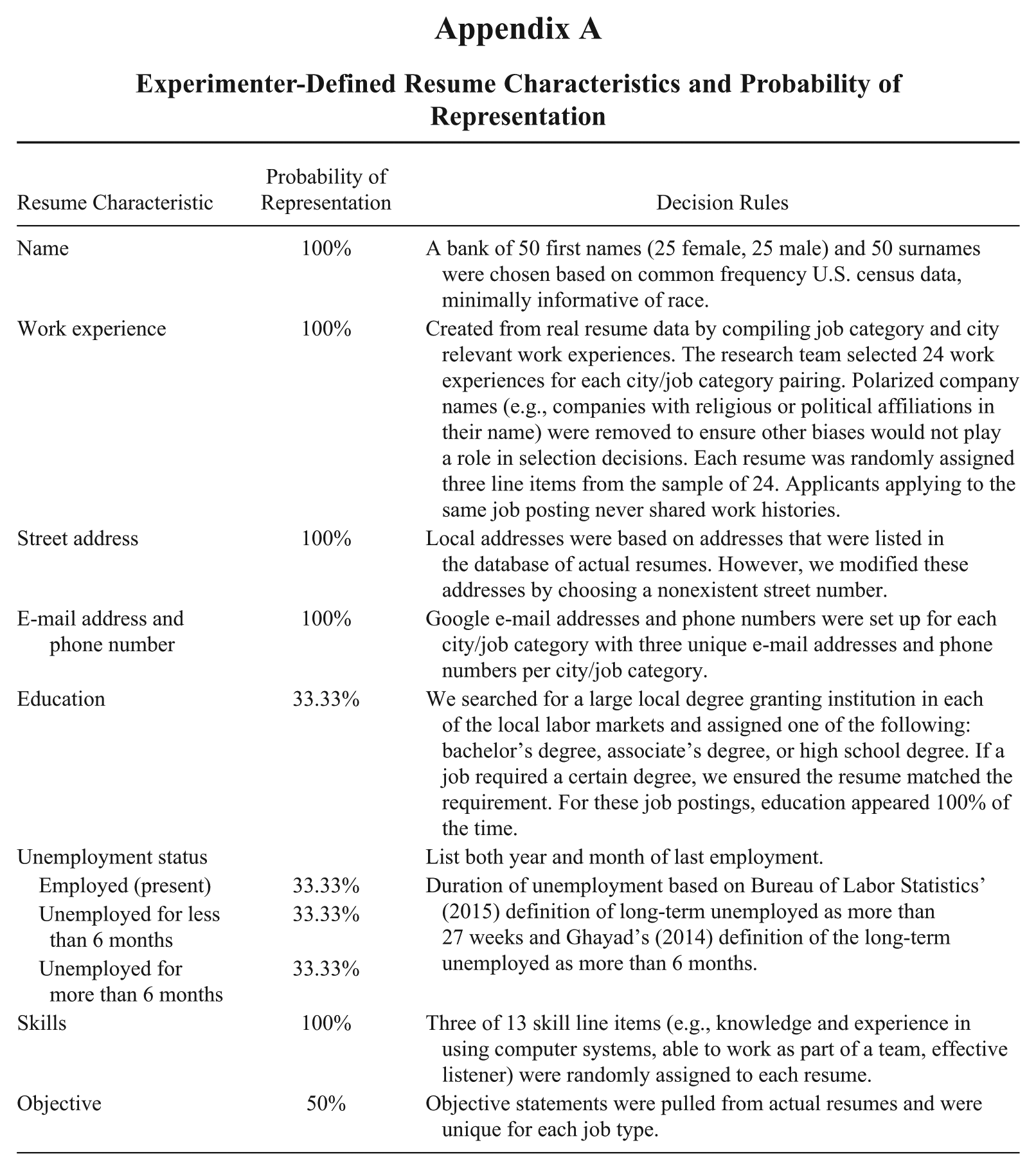
The experimental design required that the resumes be randomized on all other characteristics (Lahey & Beasley, 2009). We randomly selected content of each resume for the following fields: applicant name based on frequently occurring names (U.S. Census Bureau, 2014), e-mail address, mailing address, phone number, education, place of work experience, skills, and objective. Random selection was based on a bank of job- and city-specific items that we collected from 150 real job seekers with resumes posted on CareerBuilder.com or Indeed.com with experience in administrative, customer service, and sales positions in New York City and Los Angeles. These real resumes were used to create decision rules on the type and frequency of content of the fictitious resumes, as detailed in Appendix A.
Once we had identified the type and frequency of content, a computer programmer hired for our study created a computerized bank of resume components, drawing upon the program created by Lahey and Beasley (2009). Within each job-specific resume field (e.g., sales-related work experience), we selected a group of resume items that were parallel in nature. In other words, we determined a set of work history items to choose from that had equivalent but different characteristics (e.g., the same or similar job title at different companies). For example, for the field “work experience” on a resume for an applicant applying to a sales job, items were equalized as closely as possible on job title (e.g., sales floor team member and sales representative), industry, and location (e.g., excluded nonregionally located work experience). Each resume had a total of three work experiences listed with the total amount of work experience not exceeding 6 years. The resumes were designed to have a similar type and level of relevant work experience across conditions.
After creating sample fictitious resumes using various programs and examining their quality, including the program designed by Lahey and Beasley (2009), we decided to use an online resume maker (http://cvmkr.com/) that featured six format styles (i.e., executive, elegant, bold, literateur, finesse, and metro) because the resumes looked the most realistic. A research assistant conducted quality checks for every resume to ensure that it appeared highly authentic and that no two resumes were too similar in the set of three resumes that were sent to each identified job posting. Refer to Appendix B for an example of a fictitious resume.
Google e-mail addresses and Google Voice phone numbers were created for each city and job category with three unique e-mail addresses and phone numbers per city and job category. If the employer requested an interview, we promptly replied via e-mail that the job applicant was no longer seeking employment. Expediting the responses to interview requests minimizes the potential for negative impact on the employer, since with resume correspondence studies it is not possible to obtain informed consent (Pager, 2007).
Finally, we performed a priori power analysis (Cohen, 1988) using the logistic regression function and a binomial distribution for unemployment status in G*Power 3.1 (Faul, Erdfelder, Lang, & Buchner, 2007) to determine our target sample size. On the basis of existing literature (Ghayad, 2014), we set power equal to .80 and the mean response rate to 14.66% for employed and 10.09% for unemployed to inform our estimates of interview request probabilities. On the basis of our analysis, we designed our experiment to send between 1,734 and 2,268 resumes (latter estimate based on Bertrand & Mullainathan, 2004). To ensure we had enough power, we exceeded this number by sending out a total of 3,711 resumes.
Study Variables
Our outcome variable was interview request. This variable took the value 1 if the applicant received a voice or e-mail message from an employer asking to set up an interview or 0 if the applicant did not receive such a message. Following prior audit studies (e.g., Ghayad, 2014; Kroft et al., 2013), we treated not hearing back as a decline for an interview request. We monitored e-mail accounts for the duration of the study and categorized a sent application as declined if we did not hear from an employer by 3 weeks after our study’s end date.
Our independent variable was unemployment status, which consisted of three categories: long-term unemployed, short-term unemployed, and employed. The reference group was the long-term unemployed, defined here as applicants who have been out of work for 6 or more months. We used 6 months as a cutoff value based on both the BLS’s (2015) definition of long-term unemployed (at 27 weeks or more) and Ghayad’s (2014) reasoning that 6 months is an appropriate cutoff, given that is when unemployment insurance benefits expire and the most likely time for when employers screen out the long-term unemployed. To corroborate these categorizations, we asked 111 U.S.-based human resource professionals recruited through LinkedIn and a posting on the SHRM’s website what they considered as the minimum and maximum length of unemployment for a short-term and a long-term unemployed applicant. The minimum length to be considered short-term unemployed, on average, was 3.32 months (SD = 2.66), while the maximum length was 4.37 months (SD = 2.11). For the long-term unemployed, the minimum length, on average, was 9.05 months (SD = 2.94) and the maximum length was 11.03 (SD = 2.06). These numbers lend support to our cutoff value. We tracked the end date of the top-most line of experience and calculated the number of days the applicant was unemployed by subtracting the end date from the date the application was submitted. Resumes with the value of 0 were coded as employed, resumes with a value of greater than 0 but less than 182 days (about 6 months) were coded as short-term unemployed, and resumes with a value greater than 182 days were coded as long-term unemployed.
We included several control variables in our analysis. First, we controlled for position type by creating two dummy variables: administrative assistant (1 = yes, 0 = no) and customer service (1 = yes, 0 = no). The third position type, sales, was used as the reference group in our analysis, and so a binary variable was not created for this category. To gather data on occupation-specific supply and demand factors, we matched job titles to the BLS’s occupation titles. Second, consistent with prior research (Baert, Cockx, Gheyle, & Vandamme, 2015; Kroft et al., 2013), our study controlled for whether the occupation was in low or high demand to assess how difficult it was to fill. We assess this by examining the concentration of jobs for each resume’s assigned administrative, sales, or customer service position within the city to which it was sent. This variable is known as the location quotient and was coded from the BLS, using occupational employment statistics. The location quotient variable ranges from 0.36 to 4.14, with higher values indicating the area has proportionately more workers in that occupation. For example, secretaries and administrative assistants have a location quotient of 0.88 in Los Angeles and 1.21 in New York City. In this scenario, New York City has a higher concentration of secretary and administrative assistant jobs than Los Angeles. We controlled for this since it would directly affect callback rates. Finally, we controlled for the average monthly unemployment rate for Los Angeles and New York City at the time of each resume submission. These estimates were gathered from local area unemployment statistics housed by the BLS (2016b) and helped to control for demand side explanations.
Results
Descriptive Data
We received 346 interview requests from 3,335 submitted resumes for an overall interview request rate of 10.37%. This rate is similar to what other studies report, supporting the authenticity of our applications (4.7%, Kroft et al., 2013; 8%, Bertrand & Mullainathan, 2004; 8.3%, Ghayad, 2014; 9.4%, Tilcsik, 2011). The average number of days it took for an interview request to be issued was 5.39 (SD = 11.67) for the overall sample, 6.12 (SD = 9.82) for applicants in Los Angeles, and 4.95 (SD = 12.64) for applicants in New York City. Table 1 presents the number of resumes submitted in each condition (i.e., city and unemployment status) as well as the mean and standard deviation of interview requests. Figure 1 shows these data in visual form. Table 2 provides descriptive statistics for control variables by interview requests.
Descriptive Statistics: Average Interview Request Rates and Standard Deviations by City
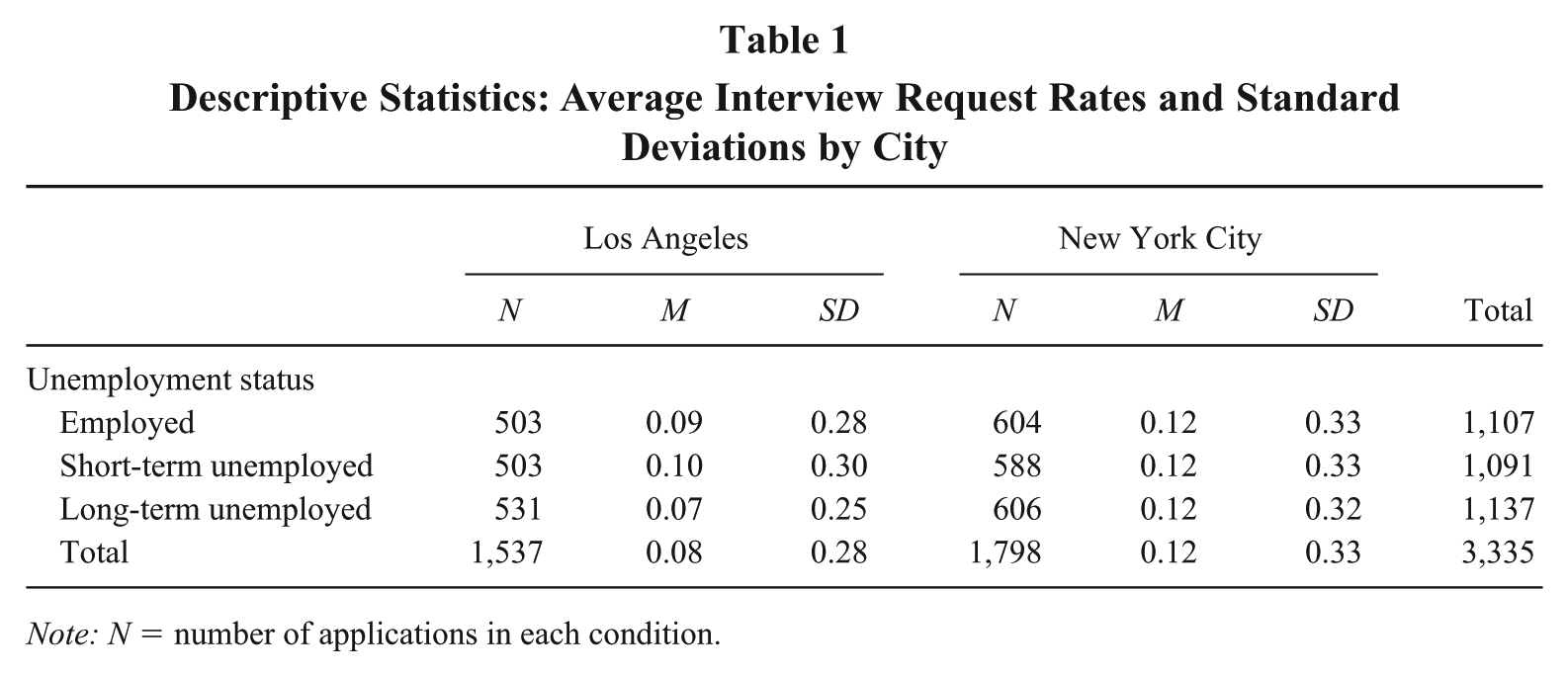
Note: N = number of applications in each condition.

Average Interview Request Rates by City
Descriptive Statistics for Controls by Interview Request.

Note: N = number of applicants in each condition.
Unemployment Status and Callbacks
In Hypothesis 1, we predicted that employed and short-term unemployed applicants would be more likely to receive an interview request than long-term unemployed applicants. To test this hypothesis, we pooled the data from New York City and Los Angeles. We used the probit function and clustered the standard errors by firm, given that there may be multiple observations for one firm. We used the margins command in STATA and report the average marginal effect for short-term unemployed or employed in comparison to long-term unemployed while holding binary control variables at zero and continuous control variables at their mean. We used the delta method to obtain the appropriate standard errors of the fitted model parameters.
As shown in Model 1 of Table 3, in comparison to the omitted reference group of long-term unemployed, short-term unemployed (dy/dx = .02, SE = .01, p = .041) were more likely to receive interview requests. There was a trend for the employed (dy/dx = .01,SE = .01, p = .086) to receive more interview requests than the long-term unemployed, but the effect was not significant. Overall, in partial support for Hypothesis 1, the results suggest that for two otherwise-average applicants (where average is defined as having the mean value for the other independent variables in the model), the short-term unemployed job applicant’s predicted probability of receiving an interview request (8.9%) would be 1.6 percentage points higher than the long-term unemployed job applicant’s predicted probability (7.3%).
Probit Analysis Portraying Predictors of Interview Requests by City
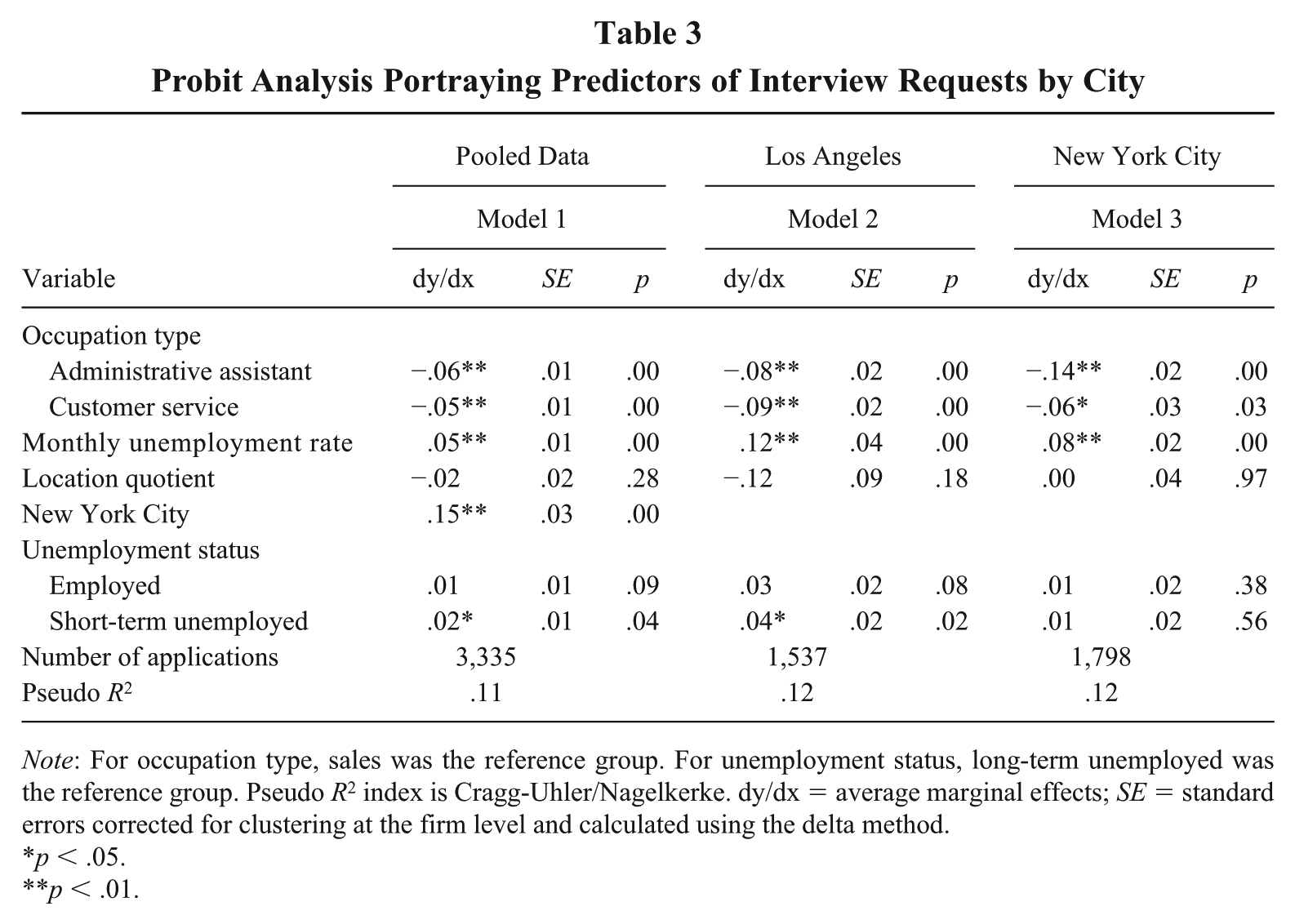
Note: For occupation type, sales was the reference group. For unemployment status, long-term unemployed was the reference group. Pseudo R2 index is Cragg-Uhler/Nagelkerke. dy/dx = average marginal effects; SE = standard errors corrected for clustering at the firm level and calculated using the delta method.
p < .05.
p < .01.
Unemployment Status, Antidiscrimination Legislation, and Callbacks
We next examined the moderating effect of the presence of unemployment status antidiscrimination legislation, as predicted in Hypothesis 2. Thus, we are interested in comparing marginal effects of receiving a callback for long-term unemployed applicants versus short-term unemployed or employed applicants across cities. Empirically examining moderating effects in binary choice models with dummies indicating group membership (i.e., city) is difficult to detect and interpret because the model is nonlinear and because the two groups may have unequal unobserved variance (Hoetker, 2007b). We structure our analysis and presentation of results on the basis of best practice recommendations for comparing coefficients across groups and using interaction terms with probit models (Hoetker, 2007b). First, we split our sample by city and estimate separate equations to compare the statistical significance of the marginal effects. This is an important first step for “ease of accurate interpretation” (Lee, Hoetker, & Qualls, 2015: 1542) because splitting the sample avoids the assumption that each group has the same residual variation. An analysis that only pools the data together and presents an interaction of “the variables of interest with dummies indicating group membership” (Hoetker, 2007b: 342) is not recommended because this analysis does not consider whether unobserved heterogeneity across groups differs and therefore may violate a key assumption. Violating the assumption of equal unobserved heterogeneity across groups can lead to unwarranted conclusions that do not accurately reflect the underlying relationship (Hoetker, 2007b). Thus, the first way that we estimate Hypothesis 2 is by using a split-sample approach since it avoids the unobserved heterogeneity assumption altogether. Comparing the statistical significance of the coefficients across groups using separate estimations for each group avoids the assumption because “the coefficients and standard errors are consistent within each group” (Hoetker, 2007b: 338).
Our split-sample results are illustrated in Models 2 and 3 of Table 3. Using Los Angeles data only, where there is no unemployment status antidiscrimination legislation, we find, as shown in Model 2 of Table 3, that in comparison to long-term unemployed, short-term unemployed applicants were more likely to receive an interview request (dy/dx = .04, SE = .02, p = .019). This model also shows that in comparison to long-term unemployed, there was a trend for employed applicants to be more likely to receive an interview request, but the results were nonsignificant (dy/dx = .03, SE = .02, p = .082). In contrast, Model 3 shows that when the resume was submitted to an employer in New York City, where legislation exists, the marginal effects were not significant for the comparison of short-term unemployed to long-term unemployed applicants (dy/dx = .01, SE = .02, p = .563) or the comparison of employed to long-term unemployed applicants (dy/dx = .01, SE = .02, p = .380). These findings partially support Hypothesis 2, illustrating that under the condition of no legislation, the long-term unemployed were less likely to receive interviews than the short-term unemployed, but not in comparison to the employed.
The second way we examine Hypothesis 2 is with an interaction term. However, it is important to first test whether the unobserved heterogeneity was roughly equal across groups before we can engage in meaningful cross-group comparisons using interaction terms in which dummy variables were used to create groups. Before using an interaction term, we tested for equivalence of unobservable heterogeneity across groups (Allison, 1999; Hoetker, 2007a) by examining the hypothesis “that the values of the underlying coefficients are the same across groups, but that the residual variation differs” (Hoetker, 2004: 10). We examined whether delta for our city variable was significantly different from zero with a Wald chi-square test—χ2(1, N = 3,335) = 2.52, p = .113. We found no evidence that unobservable heterogeneity varied meaningfully across cities. Thus, we were able to engage in cross-group comparison using an interaction term. However, in nonlinear models, the interaction effect is unable to be determined from the probit coefficient’s sign or significance (Hoetker, 2007b; Huang & Shields, 2000). As such, we interpret the interaction term by examining contrasts of predictive margins for each of the three job types: sales, customer service, and administrative assistant.
Sales
We first calculated predictive margins for sales jobs at the area’s average unemployment rate with the average location quotient. In Los Angeles, the average unemployment rate was held at 7.42 and the location quotient at 1. The only significant contrast of predictive margins is the one contrasting short-term unemployed relative to long-term unemployed in Los Angeles: Contrast = .03, SE = .01, 95% confidence interval (CI) = [.008, .061]. In New York City, the contrast of predictive margins for sales jobs contrasting short-term unemployed and long-term unemployed was not significant (Contrast = .01, SE = .02, 95% CI = [–.030, .049]). This analysis showed that short-term unemployed sales applicants in Los Angeles received an interview request rate of 15.2% (SE = .02) compared to the long-term unemployed in Los Angeles who received an interview request rate of 10.4% (SE = .02; difference of 4.8%).
Customer service
The only significant contrast of predictive margins is the one contrasting short-term unemployed relative to long-term unemployed applicants in Los Angeles (Contrast = .02, SE = .01, 95% CI = [.003, .029]). In New York City, the contrast of predictive margins for customer service jobs contrasting short-term unemployed and long-term unemployed was not significant (Contrast = .01, SE = .01, 95% CI = [–.019, .032]). Customer service applicants who were short-term unemployed in Los Angeles received an interview request rate of 6.8% (SE = .01) compared to the long-term unemployed in Los Angeles who received an interview request rate of 4.3% (SE = .01; difference of 2.5%).
Administrative assistant
The only significant contrast of predictive margins is the one contrasting short-term unemployed relative to long-term unemployed in Los Angeles (Contrast = .01, SE = .004, 95% CI = [.001, .017]). In New York City, the contrast of predictive margins for administrative assistant jobs contrasting short-term unemployed and long-term unemployed was not significant (Contrast = .004, SE = .009, 95% CI = [–.014, .022]). Administrative assistant applicants who were short-term unemployed in Los Angeles received an interview request rate of 3.8% (SE = .01) compared to the long-term unemployed in Los Angeles who received an interview request rate of 2.3% (SE = .01; difference of 1.5%).
On the basis of the split-sample approach and the interaction method comparing contrasts of predictive margins, we find similar results that partially support Hypothesis 2.
Supplemental Study
Our field experiment findings offer evidence that long-term unemployed job applicants in Los Angeles, but not in New York City, experience discrimination in the form of receiving fewer interview requests than applicants who are short-term unemployed. On the basis of stereotype content theory, we suggest that employer preferences for short-term unemployed are likely due to associations employers make between unemployment duration and competence. On the basis of justification-suppression perspectives, we suggest that unemployment status antidiscrimination legislation likely works via feared consequences of breaking the law as well as through the amplification of social norms and moral rules of conduct. The resume audit design does not allow us to measure hiring personnel’s underlying perceptions of these applicants or whether and how legislation informs these perceptions and their resulting behavior. Therefore, we collected additional self-report data via an online survey to supplement the field experiment results. To allow greatest comparability to our field experiment, we focused our supplemental survey on professionals with hiring experience in New York City and Los Angeles.
We recruited 200 full-time employed adults (100 from New York City and 100 from Los Angeles) from an online Qualtrics panel to participate in the study. Participants were prescreened to ensure they had directly participated in recruiting, hiring, and/or resume review within the last 3 years and passed multiple attention/validation checks once in the survey. On average, our sample reviewed 268.3 resumes in the past year (SD = 983.40) or a total of 53,660 resumes as a group. Our participants worked in organizations that ranged in size, with 30.5% working for organizations with 1 to 49 employees, 38% for organizations with 50 to 999 employees, 8% for organizations with 1,000 to 4,999 employees, and 23.5% for organizations with 5,000 or more employees. Our participants were highly educated, with 86.5% holding a bachelor’s degree or higher, and had an average of 19.59 years of experience (SD = 13.20).
First, we examined whether respondents’ perceptions of applicants based on their unemployment status aligned with our prior theorizing using stereotype content theory, that is, that hiring personnel would perceive long-term unemployed applicants as less competent than short-term unemployed or employed applicants. We asked participants the following question, “In general, how competent (i.e., their ability, intelligence, skill, efficacy, or efficiency) do you think each group is?” Participants evaluated employed applicants, short-term unemployed applicants, and long-term unemployed applicants on a scale ranging from 1 (extremely incompetent) to 4 (neither competent nor incompetent) to 7 (extremely competent). Stereotype content theory would suggest that irrespective of being in a location governed by legislation, participants would view unemployed individuals (especially long-term unemployed individuals) as being less competent. Supporting this premise, the 200 participants in our supplemental study rated employed applicants (M = 5.16, SD = 1.27) as more competent than short-term unemployed applicants (M = 4.88, SD = 1.23; t = 4.16, df = 199, p < .001,d = 0.29) and long-term unemployed applicants (M = 4.38, SD = 1.41; t = 7.92, df = 199, p < .001, d = 0.56). Within the unemployed group, participants rated short-term unemployed applicants (M = 4.88, SD = 1.23) as more competent than long-term unemployed applicants (M = 4.38, SD = 1.41; t = −6.35, df = 199, p < .001, d = 0.45). These results support the application of stereotype content theory in that decision makers have lower perceptions of competence for the long-term unemployed. Ratings of competence for all three groups were, however, above the midpoint of the scale.
Next, we examined whether legislation acts as a suppressor of prejudice. In order for legislation to act as a suppressor and have “an instrumental effect on a given individual” (Barron & Hebl, 2013: 194), the actor must first be aware of and know about the legislation. We asked the 200 individuals in our sample “Does your city have legislation that prohibits the use of unemployment status in the decision of who to call for an interview?” Of our participants based in New York City, where legislation exists, 27% indicated “yes,” 18% indicated “no,” and 55% indicated “I don’t know.” Of our participants based in Los Angeles, where legislation does not exist, 14% indicated “yes,” 27% indicated “no,” and 59% indicated “I don’t know.” Giving support to the idea that suppression was more likely to be a factor in New York City than in Los Angeles, participants in New York City were more likely to respond yes to this question than individuals in Los Angeles (χ2 = 5.18, p = .023). Yet these responses indicate there is a substantial lack of awareness about legislation in both cities. Given there is no legislation that prohibits the use of unemployment status in Los Angeles, it is interesting to note that 14% of respondents thought (or guessed) that there was legislation in that city. Also, the percentage of our sample based in New York City that is aware of the legislation (27%) is very low.
Justification-suppression theory suggests that under conditions of legislation, hiring personnel will become more motivated to avoid expressions of prejudice, that is, discriminate against long-term unemployed applicants. To examine this, we compared the responses of all participants who believed there was legislation (n = 41), regardless of city, to those who believed there was no legislation (n = 45) or didn’t know whether their city had legislation (n = 114) on a modified version of the external motivation to suppress prejudice scale (Plant & Devine, 1998).
First, participants completed five items to assess whether they withhold prejudice as a result of external pressures stemming from social norms (alpha = .89). Sample items include, “I try to hide any negative thoughts about unemployed people in order to avoid negative reactions from others,” “I attempt to appear non-prejudiced toward unemployed people in order to avoid disapproval from others,” and “I try to act non-prejudiced toward unemployed people because of pressure from others”; response options ranged from 1 (strongly disagree) to 7 (strongly agree). Second, we created two items to assess whether individuals withhold prejudice as a result of external pressures from legislation (alpha = .80). The two items were “To prevent potentially costly legal or financial consequences such as being fined, I try to appear non-prejudiced toward unemployed people” and “Because of today’s legislation standards, I try to appear non-prejudiced toward unemployed people.” We averaged responses for each separate subscale. We examined whether participants who believed their city had legislation (n = 41) differed on these scales compared to participants who believed their city did not have legislation or did not know (n = 159).
For the external pressures emanating from social norms, the group that believed their city had legislation (n = 41) had a mean of 4.48 (SD = 1.39) on this measure, while the group that believed their city did not have legislation or did not know (n = 159) had a mean of 3.77 (SD = 1.41; t = −2.89, df = 198, p = .004, d = 0.40). This suggests that individuals believing in legislation were more likely to report they withhold their prejudice as a result of social norms or moral rules of conduct. We found similar results when we examined the external pressures emanating from legislation. The group that believed their city had legislation (n = 41) had a mean of 4.54 (SD = 1.64) on this measure, while the group that believed their city did not have legislation or did not know (n = 159) had a mean of 3.81 (SD = 1.69; t = −2.47, df = 198, p = .015, d = 0.34). Finally, we found no difference in means between the two external pressure to reduce prejudice scales (t = 0.53, df = 199, p = .600, d = 0.04). These results indicate support for our positioning of unemployment status antidiscrimination legislation as an external suppressor of prejudice that stems from social norms and the punitive consequences of failing to follow legislation.
Discussion
In a two-part study involving a field experiment and a survey of 200 professionals with experience in recruiting, interviewing, or hiring, we examined the relationship between unemployment status, unemployment status antidiscrimination legislation, and interview requests. Drawing on economic perspectives and stereotype content theory (Fiske et al., 2002), we suggested unemployment status is linked to perceptions of competence that result in stereotypes about the long-term unemployed and fewer interview requests. Using the justification-suppression model of the expression and experience of prejudice (Crandall & Eshleman, 2003), we highlighted antidiscrimination legislation as a suppressor of this prejudice.
Findings from our field experiment showed that long-term unemployed applicants were less likely to receive an interview request than short-term unemployed applicants within Los Angeles, a city without unemployment status antidiscrimination legislation. In contrast to these findings, we found no difference in interview requests between long-term unemployed applicants and short-term unemployed or employed applicants in New York City, a city with unemployment status antidiscrimination legislation. Contrary to our predictions, we failed to find meaningful differences in interview requests between the long-term unemployed and the employed in Los Angeles.
Supporting stereotype content theory, our survey of individuals with recent experience in recruiting, interviewing, or hiring in these cities showed that on average, employers see unemployed applicants, and especially long-term unemployed applicants, as less competent than short-term unemployed and employed applicants. Showing some support for the justification-suppression model, survey responses indicated that when individuals believed such legislation existed, they were more externally motivated to appear nonprejudiced toward the unemployed. Yet the survey also exposed a lack of knowledge about the presence of unemployment status antidiscrimination legislation.
Study Contributions and Implications
Our study provides important empirical, practical, and theoretical contributions. The question of whether employers prefer employed or short-term unemployed job seekers over long-term unemployed job seekers, and whether legislation can make a difference, is an important one. This issue has been discussed extensively by states and cities, the EEOC, and the SHRM, with a heavy reliance on anecdotal rather than structured empirical examination (see, e.g., EEOC, 2011). Our study is unique in its examination of employer responses to unemployed applicants in legislated and nonlegislated contexts and contributes initial insight into the efficacy of unemployment status legislation. Our second study complements this inquiry by illuminating employer beliefs about the unemployed and their awareness of legislation.
Practically, our research has implications for job seekers, employers, and legislators. For job seekers, an implication is that those who are unemployed longer may get fewer interview requests. We found long-term unemployed received 1.5% to 4.8% fewer interview requests in comparison to short-term unemployed, a finding similar in effect size to studies of other stereotyped attributes. For example, a 3.2% callback gap was reported between White and African American names (Bertrand & Mullainathan, 2004), a 3% gap between Whitened and non-Whitened first names for Black applicants (Kang, DeCelles, Tilcsik, & Jun, 2016), and a 4.3% callback gap between gay and not gay applicants (Tilcsik, 2011).
As another way of looking at the extent being unemployed would affect a job seeker, our results based on our Los Angeles data suggest a long-term unemployed sales applicant would have to apply to 10 job postings to receive one interview request, while a short-term unemployed sales applicant would only have to apply to about 7 postings. This finding translates into the long-term unemployed applicant having to apply for additional jobs. Because of this, the employment of long-term applicants may be further disadvantaged because they have to wait longer for additional job postings to appear (Bertrand & Mullainathan, 2004). This added time may have detrimental consequences, as the longer the unemployed are out of work, the more likely it is that they will face a stereotype of being less competent. On the basis of these findings, we suggest that job seekers who have longer spells of unemployment find ways to amplify signals about their competence. For example, they could note whether they are engaged in skill building to avoid employer perceptions of outdated skills. Support for this approach comes from research by King and Ahmad (2010) in a study of Muslim job applicants. Specifically, they found that job seekers who provided stereotypically inconsistent information to potential employers received more positive reactions. Job seekers with long spells of unemployment may also use resume formats that emphasize skills and competencies, and possibly duration of experience, rather than chronologically listing each position with months and dates of employment.
Our findings also have implications for employers. While the use of unemployment status information in decisions of whom to interview is not illegal in Los Angeles, such practices may have adverse impacts on minorities, individuals with disabilities, or other protected groups if these groups have higher levels of unemployment (EEOC, 2011). If this is the case, using unemployment status in decisions of whom to interview may indirectly translate into violating the law. One assumption of employers might be that the experience of unemployment is job related or predictive of job performance. For example, an assumption on the part of employers might be that there is skill decay that occurs among applicants when they are unemployed. However, applicants may be engaging in continuous education or other activities to avoid such decay, and it is also unlikely that skill decay occurs quickly (i.e., within less than a few years) or at all for many jobs. It is especially unlikely, for example, that skill decay occurs for individuals who are applying for entry-level positions, the focus of this study. Another assumption employers might make is that unemployed individuals are “beaten down” and have lower well-being (Wilkie, 2014) and, by extension, their performance on the job will suffer. While there is an association between unemployment and lower mental health, individuals recover once employed (McKee-Ryan et al., 2005), and there is no evidence that we are aware of that shows individuals who experience unemployment are lower performers. Therefore, unemployment status information should be used in decision-making only if it can be shown to identify individuals who will be more likely to be successful in the focal job (EEOC, n.d.). On the basis of our results and other findings of bias in the application process (e.g., Hebl et al., 2002; King & Ahmad, 2010), we suggest employers be proactive about minimizing the use of stereotypes in the selection process.
Our findings also have implications for states, cities, and legislators. In our supplemental study, we found that only 27% of participants from New York City were aware that their city had unemployment status antidiscrimination legislation. This lack of awareness suggests that hiring personnel must better embrace their professional responsibility to stay up to date on their knowledge of employment law and points to an opportunity for government officials to improve the timing, content, and delivery of communications about employment-related legislation. Coupled with the results from our field experiment, in which we do not find evidence of unemployment status discrimination in the presence of legislation, these findings are consistent with Barron and Hebl’s (2013) assertion that antidiscrimination legislation can affect behavior even when awareness is lacking. They theorized that legislation may indirectly influence individuals via exposure to the changing discourse and attitudes toward protected groups that often builds over time from the presence of these laws. Thus, even though awareness of the legislation in New York City was likely far from universal at the time our data were collected, our study provides stakeholders with useful information about their legislative environments that can help guide future policy and outreach efforts.
With respect to theory, our study provides insights to the unemployment, job search, and selection literatures by introducing unemployment status and antidiscrimination legislation as important factors that may affect the job finding process. This literature, while well developed in an overall sense (e.g., see Wanberg, 2012), has paid less attention to factors such as legislation and biases that may hamper job seekers. Additionally, our study extends stereotype content theory by exploring stereotypes of the unemployed. Our study is an important departure from prior work focusing on demographic-based stereotypes (e.g., gender, race, and ethnicity; e.g., Eagly, Wood, Diekman, & Trautner, 2000). Furthermore, we explored stereotypes within a category (short-term vs. long-term unemployed) and show that perceptions of competence may vary not only between categories but also within (e.g., Derous et al., 2015). Finally, our study sheds light on the justification-suppression model of the expression and experience of prejudice (Crandall & Eshleman, 2003) by examining antidiscrimination legislation as an additional reason for suppression above and beyond social norms. While our study does not allow us to untangle the interplay between the two, it highlights the importance of considering them in future work.
Limitations and Future Research Directions
Our study provides insight into rather than proves the effectiveness of legislation, as proving legislative effectiveness is extremely difficult (Bussmann, 2010). It is possible, for example, that the public discussion and awareness of the issue that was raised in New York City had an influence on the use of unemployment status in the hiring process, rather than the legislation itself. Future research examining the extent to which unemployment status antidiscrimination legislation reduces discrimination directly via a deterrent effect or by improving public opinion (Klawitter & Flatt, 1998; Tilcsik, 2011) would be useful.
It is also possible that employers in New York City do not systematically discriminate against the unemployed in the application process and, therefore, the legislation was not necessary. It would be useful to identify locations in which unemployment status antidiscrimination legislation will soon be passed in order to measure pre- and postinterview request rates among individuals with different levels of unemployment status. A pre/post combined design would provide an additional piece of information required to demonstrate the extent to which legislation can reduce unemployment status preferences, as would studies over time to examine the persistence of this effect within different unemployment rate contexts and across additional job categories.
Our findings regarding the effectiveness of unemployment status antidiscrimination legislation amount to observing a null effect in New York City. A criticism often directed toward null findings is that design or methodological problems—for example, contaminated variable measures, sampling problems, and low statistical power—explain the lack of effect, rather than the phenomenon of interest (Cortina & Folger, 1998; Greenwald, 1993). We made an effort to minimize these concerns through careful planning and design. Our focal variable measures were designed to clearly indicate unemployment status by varying the date associated with the top-most experience listed on the resume, and the resumes we sent to the job postings were designed to look realistic and professional. Although we were unable to obtain information about the hiring personnel who evaluated the resumes and made the interview requests, given that we followed the submission directions exactly for each job posting, our fictitious resumes were likely received and reviewed in a manner similar to real applicants’ resumes. Furthermore, if a nontrivial relationship between unemployment status and interview requests in the presence of legislation existed, we had sufficient statistical power to observe it, given our sample size.
The generalizability of our findings is limited by our focus on entry-level administrative, customer service, and sales occupations. These positions (office and administrative support occupations and sales and related occupations) represent roughly 26% of the U.S. labor market and are comparable in skill level, educational requirement, and need for prior experience (BLS, 2017). Our findings can be viewed as generalizable to occupations with similar characteristics; however, we are limited in the extent to which we can conclude that our study results would also apply to higher skilled, higher status occupations. Given evidence that employers’ hiring strategies differ for highly skilled versus less skilled jobs (Eriksson & Rooth, 2014; King, Madera, Hebl, Knight, & Mendoza, 2006), occupational status and its relationship with unemployment discrimination and legislation effects should be examined more closely in future research. For example, since holding a high-status occupation likely signals strong productivity and achievement, perceptions of a long-term unemployed applicant as a competent candidate might be even more incongruent with a higher status job than a lower status job. Long-term unemployed individuals applying for high-status positions, therefore, might be even more prone to experiencing discrimination.
Our study is a first step in positioning unemployment status antidiscrimination legislation as an external motivator that suppresses prejudice and discriminatory behaviors against unemployed job applicants. Additional research is needed to clarify how such legislation influences more distal job search outcomes, such as offer rates, as well as other micro/psychological and interpersonal experiences during the job search process. For example, long-term unemployed candidates may experience negative interpersonal treatment, such as incivility, during an interview. Future research could examine whether the presence of unemployment status antidiscrimination legislation suppresses only specific discriminatory behaviors or whether its protective effect extends to other negative, but not necessarily illegal, behaviors directed toward unemployed job candidates. It is also valuable to assess to what extent, and in what occupations, being out of work is related to on-the-job performance once hired.
Our supplemental survey-based study of hiring personnel complemented our field experiment design with additional insights into the nature of hiring personnel’s stereotypes about unemployed applicants and their use of unemployment status and legislation in their decision-making processes. Significant opportunity remains, however, for researchers to delve deeper into how stereotype expression and suppression undergirds the job finding process for unemployed individuals. For example, future work could focus in-depth on the interplay between competence-based and warmth-based stereotypes in interview request decisions. The behaviors from intergroup affect and the stereotypes map framework (Cuddy et al., 2007) could be helpful in understanding whether the unemployed are seen as a pitied group (warm, incompetent) or with contempt (cold, incompetent) and could help further connect the link between emotions and behaviors. It could also be valuable to determine whether the effectiveness of legislation as a behavioral suppressor is contingent upon these emotional attributions made about unemployed applicants. Furthermore, the competence versus warmth perceptions may play different roles at different stages of the selection process, suggesting a temporal nature to stereotype expression during the interview and hiring process. The competence dimension may be relied upon more heavily during the resume screening process, while the warmth dimension may surface during the interview stage. In short, while our use of separate studies to examine interview-offer outcomes and hiring personnel’s perceptions of applicants limits the extent to which we are able to examine such contingencies, we see an integration of these topics into future research designs as an important step in continuing to advance knowledge in this area.
While we found evidence in our supplemental study that employer’s competence perceptions differed significantly between employed and long-term unemployed applicants, we did not find evidence in our field experiment that the long-term unemployed were at a disadvantage relative to employed job seekers. Thus, our empirical evidence provides mixed support for stereotype content theory. Kroft and colleagues (2013) offer plausible alternative explanations for why firms may pass over employed applicants, such as perceived seriousness of the applicant and cost of hire (e.g., time, wage). Given the nature of our jobs (i.e., entry level, higher demand), starting immediately may be particularly relevant. Specifically, hiring professionals may perceive that employed applicants may not be able to start immediately, given the norm of a 2-weeks’ notice. Future research could further explore alternative perceptions (e.g., perceptions on speed of hire or seriousness) of the employed, short-term unemployed, and long-term unemployed beyond competence; doing so would add richness to the continued study of the role of stereotypes in employment discrimination and job search processes.
Conclusion
Our research addresses an important phenomenon. Within Los Angeles, we find that long-term unemployed applicants were less likely to receive an interview request than short-term unemployed applicants. However, we find no such disadvantage for long-term unemployed applicants in New York City, in the presence of unemployment status antidiscrimination legislation. Our supplemental study lends support to the notion that differences in interview requests may be a function of perceived competence of the long-term unemployed and that legislation may be acting as a suppressor of this underlying prejudice. While the question remains as to the generalized effectiveness of legislation as a remedy to employment status preferences, we hope this study will trigger further research on this topic.
Footnotes
Appendix
Experimenter-Defined Resume Characteristics and Probability of Representation
| Resume Characteristic | Probability of Representation | Decision Rules |
|---|---|---|
| Name | 100% | A bank of 50 first names (25 female, 25 male) and 50 surnames were chosen based on common frequency U.S. census data, minimally informative of race. |
| Work experience | 100% | Created from real resume data by compiling job category and city relevant work experiences. The research team selected 24 work experiences for each city/job category pairing. Polarized company names (e.g., companies with religious or political affiliations in their name) were removed to ensure other biases would not play a role in selection decisions. Each resume was randomly assigned three line items from the sample of 24. Applicants applying to the same job posting never shared work histories. |
| Street address | 100% | Local addresses were based on addresses that were listed in the database of actual resumes. However, we modified these addresses by choosing a nonexistent street number. |
| E-mail address and phone number | 100% | Google e-mail addresses and phone numbers were set up for each city/job category with three unique e-mail addresses and phone numbers per city/job category. |
| Education | 33.33% | We searched for a large local degree granting institution in each of the local labor markets and assigned one of the following: bachelor’s degree, associate’s degree, or high school degree. If a job required a certain degree, we ensured the resume matched the requirement. For these job postings, education appeared 100% of the time. |
| Unemployment status | List both year and month of last employment. | |
| Employed (present) | 33.33% | Duration of unemployment based on Bureau of Labor Statistics’ (2015) definition of long-term unemployed as more than 27 weeks and Ghayad’s (2014) definition of the long-term unemployed as more than 6 months. |
| Unemployed for less than 6 months | 33.33% | |
| Unemployed for more than 6 months | 33.33% | |
| Skills | 100% | Three of 13 skill line items (e.g., knowledge and experience in using computer systems, able to work as part of a team, effective listener) were randomly assigned to each resume. |
| Objective | 50% | Objective statements were pulled from actual resumes and were unique for each job type. |
Acknowledgements
We are grateful for the feedback and guidance of our action editor, Christopher C. Rosen, and two anonymous reviewers. The authors would also like to acknowledge John Kammeyer-Mueller for his helpful comments on an earlier version of this manuscript.
