




Abstract
Patents play an important, and increasingly influential, role in management scholarship. In this study, we conduct a broad and systematic review of patent-based empirical work in the management field, which involves mapping the ways in which scholars are using patent-based measures to represent concepts and assessing this usage based on measurement principles. With respect to mapping, our review identifies the different types of measures that researchers have constructed based on different types of patent data (e.g., patent counts, backward citations) as well as delineates the classes of theoretical concepts that are being represented by those measures. In terms of assessing, as a complement to prior surveys of patent-based research that have assessed patents as indicators based on features of patents, patenting, and patent offices, we develop a framework that is based on measurement principles. Using this framework, our assessment of patent-based research in management reveals important patterns surrounding foundational measurement issues, i.e., method bias, validation threats, model misspecification. Our review makes two core contributions: one centering on summarizing how patents have been used in management research and one focusing on guiding management scholars in terms of common measurement issues for patent-based indicators. These contributions have important implications for future scholarly work in management.
Keywords
Patents play an important, and increasingly influential, role in management scholarship. Issued for inventions, patents are property rights granted to inventors that enable them to exclude others from making, using, or selling an invention for a set period of time (U.S. Patent and Trademark Office, 2019). Our look at leading journals in the field of management reveals that patent-based research (i.e., empirical studies that contain patent-based measures) has increased by 614% between 2000 and 2017. Moreover, according to our estimates, the volume of patent-based research in leading management journals is now equivalent to that in leading journals in economics, a field in which scholars have long been interested in the role of patents (e.g., Schmookler, 1950). 1 Table 1 and Figure 1 depict the growth of patent-based research in management journals through 2017.
Number of Patent-Based Studies in Management Journals (3-Year Intervals)

Note: AMJ = Academy of Management Journal; ASQ = Administrative Science Quarterly; JIBS = Journal of International Business Studies; JMS = Journal of Management Studies; JOM = Journal of Management; MS = Management Science; OS = Organization Science; RP = Research Policy; SMJ = Strategic Management Journal.
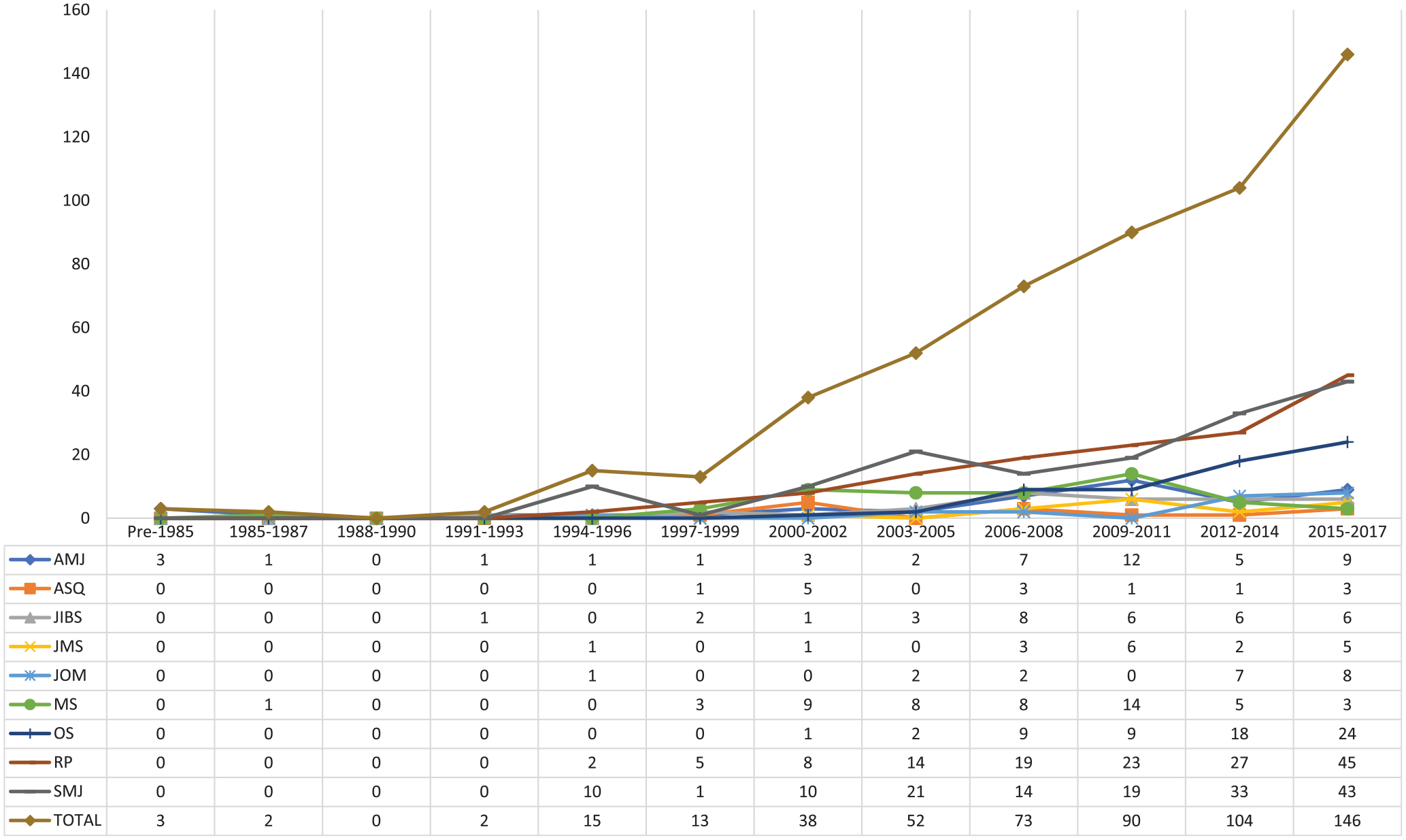
Number of Patent-Based Studies in Management Journals
The increasing attention on patents in management research reflects greater scholarly consideration of strategic issues involving patents, such as patent strategy, and the increasing utilization of patent data as indicators of concepts (e.g., innovation, learning, novelty). Management scholars have begun to take stock of the strategic issues involving patents, such as in literature assessments that examine patent strategy and the strategic use of patents (Somaya, 2012) and the role of patents in value capture by firms (James, Leiblein, & Lu, 2013; R. Ziedonis, 2008). Less attention, however, has been directed to assessing the ways in which patents are being used to represent concepts in management research. This is an important omission given anecdotal evidence suggesting that patent data are being used to represent an increasingly diverse range of concepts in increasingly complex ways, which can heighten the risk of measurement problems (e.g., validation threats, biased results).
While management scholars have given less attention to assessing the use of patent data as a means of representing concepts, economists have long sought to better understand the potential of patents as indicators (Schmookler, 1950). Consistent with this interest, they have conducted a number of literature surveys that identify corresponding opportunities and challenges (e.g., Griliches, 1990; Nagaoka, Motohashi, & Goto, 2010). While these surveys offer considerable insight, particularly in terms of capturing inventive and innovative activities, they are limited with respect to the scope and basis of their assessment. In terms of scope, the literature surveys have focused largely on empirical studies in economics, and they have concentrated on selective works (e.g., those that are highly cited). With respect to basis, they have assessed the challenges of using patents as indicators based on the features of patents, patenting, and patent offices (e.g., heterogeneity in the value of patents, differences in patenting propensity across industries, differences within and across national patent offices). By contrast, we have not identified any literature assessments that focus on empirical studies in the field of management, that provide a broad and systematic review of the empirical work, and that assess the usage of patents based on principles of measurement (e.g., validation threats, method bias). Such an assessment can provide important insights given the large and growing popularity of patent data in management research, the growth in the breadth of concepts that patent data are being used to represent, the increase in the range of measures being constructed based on patent data, and the potential for such trends in the use of patent data to result in considerable measurement problems. Such problems, if left unaddressed, suggest a path ahead whereby management researchers increasingly draw inappropriate inferences from their empirical models and in turn increasingly develop flawed understanding.
Thus, the purpose of this study is to provide a broad and systematic review of patent-based work in the management field, summarize how patents have been used to represent concepts, and provide guidance for avoiding corresponding measurement problems (i.e., method bias, validation threats, model misspecification). We provide management scholars using patent data with a map that brings together insights from the many areas within management that employ patents as indicators. Our review highlights how management researchers are using patent data to represent important concepts in the field; it also shows how this representation has evolved over time and provides a picture of novel and emerging uses of patent data in management research. Moreover, we offer guidance for management scholars working with patent data in the form of advice and practices based on measurement principles, which can help researchers to make effective measurement decisions and reach valid conclusions, as opposed to making decisions that result in inappropriate conclusions due to common measurement problems. Further, because management research draws from a range of social sciences (e.g., economics, psychology, sociology) and spans multiple levels of analysis, examining patent-based empirical work in management may provide a unique window into understanding the range of ways in which patent data are being used to represent concepts and assess theory in the social sciences more broadly.
In the next section, we provide a brief overview of extant survey assessments of patent-based research. The subsequent section presents our review of the use of patent-based measures in management research. This review focuses on presenting the ways that particular types of patent data are being used as indicators of concepts and employs a measurement-based framework for assessing the corresponding operationalizations. Overall, we develop an overarching framework that summarizes the core ways in which management scholars are using patent data for conceptual representation, assess this usage based on measurement principles, and provide guidance for scholars as to how to avoid corresponding measurement problems.
Overview of Prior Surveys of Patent-Based Research
In the field of management, scholarly efforts to assess the literature involving patents have largely focused on the strategic aspects of patenting. Based on his focused review of patent strategy research, Somaya (2012) proposed a set of generic patent strategies that are based on firms’ patent-related actions and their efforts to develop and sustain competitive advantage. This review also considered implementation issues that follow from generic patent strategies as well as the activity domains in which such strategic actions are undertaken (i.e., acquiring, maintaining, licensing, and enforcing patents). Drawing from her survey of intellectual property research, R. Ziedonis (2008) emphasized how the strategic value of patents depends not only on the institutional (e.g., legal) environment but also on how individual firms are positioned for appropriating the benefits of innovation without patent protection. In a subsequent literature survey, James et al. (2013) delved deeper into this strategic value, as they reviewed work on patents as a core value-capture mechanism for firms along with secrecy, lead time, and complementary assets, and considered the external conditions (e.g., institutions, industries) that affect firms’ selection of these mechanisms. James et al. also identified a number of costs and benefits associated with firms’ use of patents, which vary based on contextual conditions. Consistent with R. Ziedonis (2008), they suggest that value-capture approaches that leverage firm-specific appropriability may be more effective than those that rely on patents alone, particularly given that in many contexts patents provide at best limited legal protection.
While management scholars have begun to take stock of the strategic issues involving patents, economists offer assessments that identify drawbacks and possibilities of using patents as indicators. The focus of these literature surveys by economists have covered two eras: an early era, from the mid-1980s to early-1990s, and a more recent era, from 2008 to 2019.
In the early era of literature surveys, economists selectively assessed key works and topics surrounding the use of patent data as an indicator of inventive and innovative activities (Archibugi, 1992; Griliches, 1990; Pavitt, 1985; Scherer, 1992). These surveys focused on a similar set of challenges associated with using patent data, with particular attention directed to three issues. The first emphasized challenges pertaining to classification, particularly in terms of how patents—which are based primarily on technological principles—should be allocated to firms and industries (Griliches, 1990; Pavitt, 1985). The second issue focused on what stages of the invention and innovation process were best reflected in patent data, with these surveys concluding that patent counts can be an appropriate indicator of both inventive inputs and inventive outputs (Archibugi, 1992; Griliches, 1990; Pavitt, 1985). The third issue was concerned with challenges associated with using patent data as an indicator of inventive and innovative activities, focusing on features of patents, patent offices, and patenting behavior. While this early era of taking stock of research efforts was primarily focused on economists’ use of patent data in the form of patent counts, some surveys also noted other emerging and novel uses, particularly in terms of using patent citations as indicators of quality or research-and-development (R&D) spillovers (Griliches, 1990; Narin & Olivastro, 1988; Pavitt, 1985).
The more recent era of survey assessments has seen the scope of assessment broaden as the use of patent data as indicators has also broadened. For example, rather than focusing primarily on patent counts as an indicator of invention/innovation, the concepts of principal interest have included invention/innovation and knowledge spillovers/flows, with data of particular interest spanning patent counts and patent citations. Further, the disciplines of interest have begun to expand beyond economics to include corporate finance, law, and management (Jaffe & de Rassenfosse, 2019; Lerner & Seru, 2017; Nagaoka et al., 2010; R. Ziedonis, 2008). As one example, a recent survey by Lerner and Seru (2017) takes an empirically-driven approach in investigating the challenges of working with patent data in corporate finance and finds evidence that many of the popular methods used to account for biases at the patent level do not fare well when aggregated to the firm level. Based on these findings, as well as considering other empirical issues (e.g., accounting for selection and endogeneity effects), the authors provide a checklist of questions for researchers to have in mind when working with patent data.
While broader in scope, this recent era of surveys is similar to the early era in two important regards. First, they continue to be based on selective assessments of key works, for example, focusing on highly cited articles. Second, in assessing the challenges with using patent data as indicators, they have continued to concentrate on the attributes of patents, patenting, and patent offices (e.g., heterogeneity in the value of patents, differences in patenting propensity across industries, differences in patent offices across countries/regions).
In looking across these literature assessments, we find that critical shortcomings remain in terms of comprehending and assessing the use of patent data as indicators for management concepts. First, we have not identified any literature assessments that focus on empirical studies in the field of management. Second, since prior assessments are based on selective works and issues, we still lack a broad and comprehensive review of the ways in which researchers are using patent data as indicators. Last, while prior literature surveys provide considerable insight into understanding the challenges of using patents as indicators based on features of patents, patenting, and patent offices, we do not have a generalizable framework for assessing the use of patent data as indicators based on principles of measurement. Addressing these shortcomings is imperative, given the important and increasingly influential role of patents in management research, the growing breadth of concepts being represented by patent data, the growing ways in which measures are being constructed based on patent data, and the potential for considerable measurement problems to arise from these trends, which can produce inappropriate inferences and flawed understanding.
Our review of patent-based management research allows us to map the current state of the art in terms of concepts and corresponding measures. We identify what concepts have been examined in the field, highlight those that have been recently explored (and potentially underexplored), and chart the variety of ways in which these have been measured. For existing researchers in the field, we hope this mapping facilitates a more comprehensive and concise way to understand the cumulative science concerning patents. For researchers new to the field, we offer an understanding of where the field has been and insights on how to develop measures for concepts yet to be examined.
Reviewing the Use of Patent-Based Indicators in Management
We employed a structured approach to systematically identify and analyze patent-based research in the management field. Following the approach of prior structured literature analyses (e.g., Cardinal, Kreutzer, & Miller, 2017), we first identified journals that publish empirical studies based on management and organizational theories and that publish high-quality studies. To achieve this goal, we selected journals from the management list in Thompson’s Web of Science that exceeded a threshold of 4.00 for 5-year impact and focused on the use of patents with management theories. This led to a focus on the following eight journals: Academy of Management Journal, Administrative Science Quarterly, Journal of International Business Studies, Journal of Management, Journal of Management Studies, Management Science, Organization Science, and Strategic Management Journal. We did not include Academy of Management Annals or Academy of Management Review as these journals focus exclusively on conceptual or review-style papers. We also included Research Policy as it prominently features patent work and many of the relevant management papers utilizing patent-based measures are published therein. Our choice of journals met our review goals in terms of emphasizing an important and diverse body of management scholarship.
To identify how researchers utilized patent data, we performed a search for related articles that encompassed the entire history of each journal in our set. For each of the journals, we first searched its articles for use of the term “patent” in its title, abstract, or full text. Then we manually screened the identified articles by reading the abstract, key terms, and methods sections of each paper to exclude papers that merely mentioned the term “patent” without utilizing patent data or having a related conceptual focus on patents or patenting, our inclination leaning to avoid Type II errors. 2 This produced 989 articles across the nine journals.
For the formal review, we decided to focus on operationalization instances whereby patent-based measures were used for explanatory (independent, moderator) or dependent variables. This resulted in our removing articles that did not explicitly link a patent-based measure to a management concept, such as articles that employed those measures only as control variables (94 articles). This decision reflects our focus on the linkages between measures and concepts, and takes into consideration the many occasions when management researchers include patent-based measures as controls but do not indicate a corresponding theoretical concept. While this bounds the scope of our review, we would expect similar insights to be revealed if control variables were included. For our final sample, there were 538 articles that used patent-based measures and a total of 1,388 operationalization instances within those articles. Next, we provide a descriptive mapping of the usage of patent-based measures to represent concepts in management research, followed by a more critical assessment of their use.
Mapping the Linkages Between Measure Families and Concept Families
Our review of operationalization instances in patent-based research in management is structured according to measurement categories. These categories are based on the dominant patent data feature that underlies a set of measures; this feature often corresponds to a particular section of the patent document. 3 Specifically, our review identified five measurement categories: patent counts (31%), forward citations (16%), backward citations (16%), technology class (15%), and inventors (11%). A small number of other operationalization instances (11%) are presented later as emerging measures.
We used our review of patent-based research in management to generate a list of the concepts that were operationalized with patent data. From that list, we identified 10 concept families representing core categories of concepts utilized by management scholars in patent-based research. The concept families are not intended to be a mutually exclusive and collectively exhaustive set; rather, we strove for parsimony in identifying families, focusing on the most active domains of scholarly activity. Table 2 presents these families—innovation/invention, knowledge assets and capabilities, innovation impact, novelty, relatedness, diversity, technological environment, learning, knowledge flows, and collaboration—along with a number of illustrative concepts for each family.
Concept Families
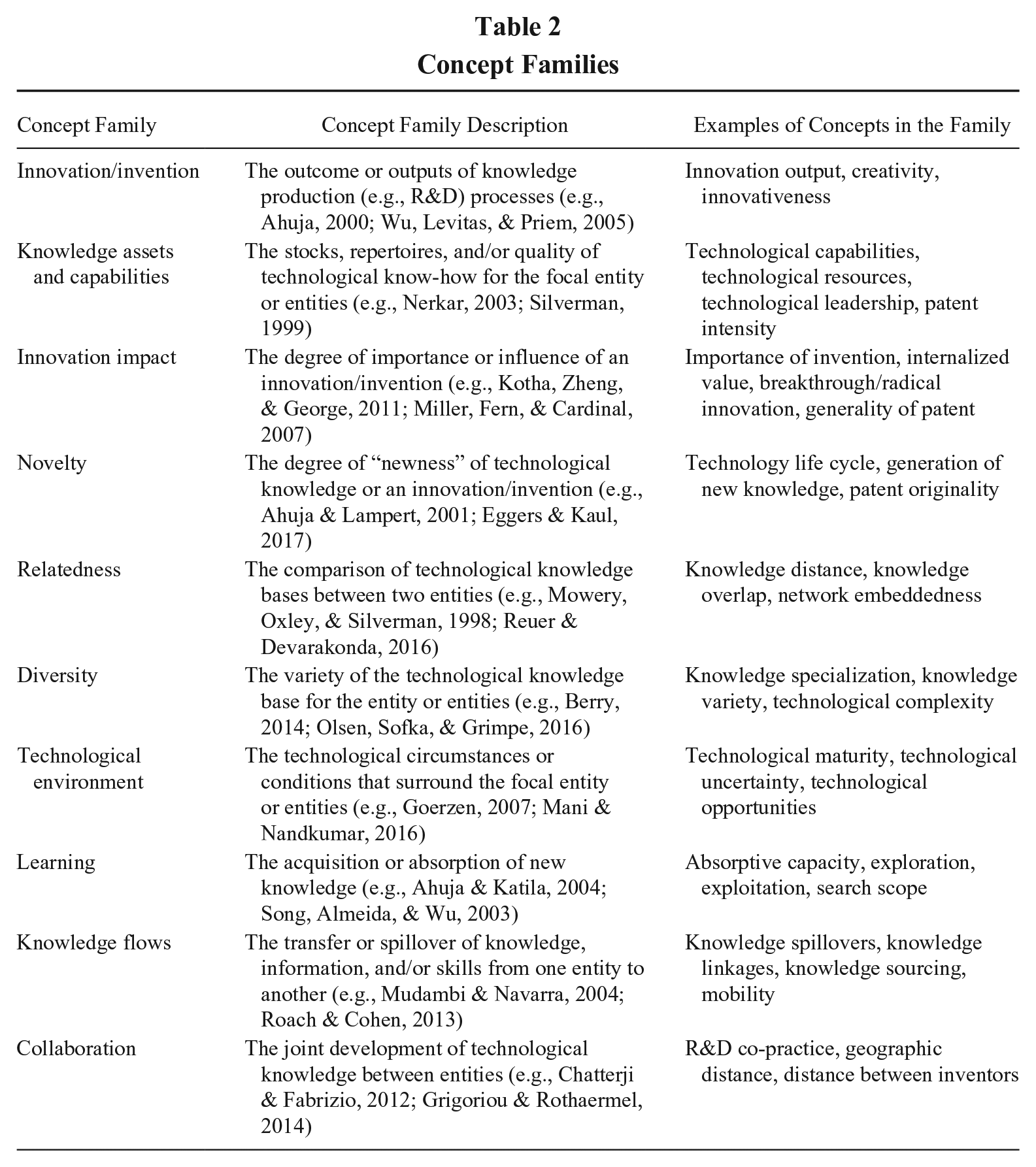
Table 3 provides an overview of the evolution of patent-based indicators in management research. Consistent with Table 1 and Figure 1, Table 3 shows the considerable growth in the use of patent data as indicators but also highlights more fine-grained patterns. In examining the use of patent data by concept family, we see long-term growth in their use as indicators of innovation/invention, although that growth has flattened in recent years. Similarly, while there is long-term growth in areas like learning and knowledge flows, there is less growth in recent years; by contrast, we see more recent growth in the use of patent data as indicators of concepts like diversity, collaboration, and relatedness. And in focusing on the use of patent data by measurement category, while there is considerable usage in traditional areas, like patent counts and backward citations, we see signs of strong recent growth for technology class and inventors.
Number of Operationalization Instances by Concept Family and Measurement Category

Of the full set of 1,388 operationalization instances in the concept-measure mapping, 56 are concepts that are not captured in the 10 main concept families.
Of the full set of 1,388 operationalization instances, 166 (11%) are measures that are not captured in the five main measurement categories.
We next examine each of the measure families, which are core categories of patent-based measures based on the most salient patent data feature. Similar to concept families, measure families are not intended to be mutually exclusive and collectively exhaustive; rather, they focus on groupings of measures with similar features. Table 4 lists summary information for each of the five measurement categories and depicts the linkages between measure families and concept families in greater detail.
Summary of Measurement Categories: Mapping the Linkages Between Measure Families and Concept Families

Note:
Measurement category: Of the 1,388 operationalization instances, 166 (11%) have measures that are not captured in the five main measurement categories (e.g., patent counts, forward citations). These measures are considered to be emerging patent measures (see Table 6).
Breakdown by concept family: Specific percentages of concept families are listed if they represented more than 5% of the operationalization instances.
Unweighted Counts Measures that are based on a simple counting of patents, backward citations, or forward citations. The counts may be normalized by logging, averages, depreciation or year specification.
Entity Specific and Individual Specific Measures that are based on patent counts or unweighted counts citation by a second entity specific variable, such as the number of employees, R&D expense, and so on. For inventor-based measures, the entity is the inventor.
Relationship Specific Measures that are based on comparing patent counts or citation counts of an entity, technology class, industry, or country with those of another entity, class, industry, or country; for the technology class measures, measures that compare portfolios of technological class between two entities or measures that look at the co-occurrence of subclasses and combination of subclasses.
Type of Citations Measures that differentiate different types of citations, such as self-/non-self-citations, new, old, scientific, or of specific technological classes.
Change in Classes Measures that are based on changes in technology classes (for example, entry into a new class, the number of patents in a new class, etc.).
Variety of Classes Measures that capture the variety or diversity of a firm’s technology classes in its patent portfolio or of the technology class itself.
Location Specific Measures that are based on movements of inventors across different locations—nationally or internationally, within regions, or among firms.
Our first measurement category, patent counts, includes measures primarily based on counts of patents as opposed to any particular section within a patent document. Our review identified three measure families: unweighted counts (representing 62% of all patent count operationalization instances), entity specific counts (24%), and relationship specific counts (14%). Unweighted counts comprise measures based solely on counts of patents, such as the number of patents for a focal firm (Patel & Pavitt, 1991) or for a focal scientist (Ding, Murray, & Stuart, 2013). Within the entity specific measure family are patent count-based indicators, which also have weighting by another measure that is internal to the entity. As an example, X. Liu, Lu, Filatotchev, Buck, and Wright (2010) operationalized innovative performance as the number of patents per employee. Relationship specific counts include measures that compare the patent counts of an entity, technology class, or industry with those of another entity, class, or industry. For instance, Adegbesan and Higgins (2011) captured superior patent portfolios with the count of patents for a firm relative to the firm in that industry with the fewest patents in that time period. As highlighted in Table 4, management scholars have used unweighted counts and entity specific counts primarily to represent concepts involving innovation/invention and knowledge assets and capabilities. By contrast, relationship specific counts have been used largely for capturing knowledge assets and capabilities and technological environment concepts.
Our second measurement category, forward citations, encompasses the measures that are constructed primarily based on future patents that cite the focal patent (i.e., as prior art); thus, the core patent data feature is the references-cited area of the patent front page for future patents. Our review identified the following measure families: citation counts (57%), entity specific (27%), and relationship specific (16%). The citation counts family includes measures based on counts of forward citations without differentiating the type or relationship of the citation; an example is the total number of forward citations made to a focal patent as an indicator of invention importance (Chatterji & Fabrizio, 2012); it also includes the common “citation based patent count” measure, which typically counts the number of citations for the patents of a firm or individual. The entity specific family includes measures that focus on a particular unit of analysis (e.g., individual, organization) and are based on different types of citations (e.g., self-citations, recent citations). As an example of an entity specific measure, Berry (2014) operationalized the subsequent development of knowledge for a firm with the ratio of its forward self citations to its total citations. Within the relationship specific family are measures that are based on citations between two or more entities (e.g., between two firms, citation rankings within a set of entities). As an example, Di Lorenzo and Almeida (2017) captured relative performance with the difference between an inventor’s innovative performance and that of co-patentors, using patent counts weighted by forward citations as the indicator of innovative performance. Across all families, forward citations typically capture innovation impact, innovation and invention, knowledge flows, and knowledge assets and capabilities.
Our third measurement category, backward citations, includes measures constructed primarily from references to prior art; thus, the core patent data feature is the references-cited area of the front page for the focal patent(s). Within this type, our review identified the following as measure families—citation counts (10%), relationship specific (28%), and type of citations (62%). Citation counts include measures that are based on counts of backward citations without differentiation as to the type of citation; an example is the number of backward citations in a patent (A. Ziedonis, 2007). Relationship specific backward citations are measures based on citations between two or more specific entities (e.g., between two firms, between subsidiaries and headquarters). For instance, as a learning capability gap indicator, Yang, Zheng, and Zaheer (2015) used the number of citations for a focal firm to an alliance partner divided by the total citations received by the alliance partner. Type of citations comprises measures that are differentiated with respect to the type of citations (e.g., self, recent, or scientific publication citations). 4 For example, Bierly and Chakrabarti (1996) operationalized science linkage using the number of backward citations to scientific literature in the patents of a firm. Scholars have most commonly used backward citations to represent learning, knowledge flows, and novelty.
Our fourth measurement category, technology class, includes measures based on technological content (i.e., the subject matter classification area of the patent front page). Within this measurement class, our review identified the following as measure families: change in classes (12%), variety of classes (47%), and relationship specific (41%). Change in classes comprises measures based on the movement of an entity’s technology classes over time. For instance, Ahuja and Lampert (2001) captured novel technologies based on the number of new technology classes entered by a firm, identified by comparing classes of new patent applications against prior patenting activity for the firm. The variety of classes family includes measures capturing heterogeneity across technology classes for the patent portfolio of an entity; an example is the Herfindahl index of the concentration of technology classes of the patents held by members of a consortium (Olsen, Sofka, & Grimpe, 2016). The relationship specific family includes measures that compare technology classes between two entities. An example comes from Joshi and Lahiri (2015), who captured the technological distance between potential partners in an alliance with the Euclidean distance between their patent portfolios. As shown in Table 4, management scholars have been fairly specialized in their use of two of the technology class measure families, with variety measures being used primarily to capture diversity and relationship specific measures being utilized largely as an indicator of relatedness. Management researchers have also commonly used the set of technology class-based measures for capturing learning, novelty, and knowledge assets and capabilities.
Our fifth measurement category, inventors, includes measures deriving from information on inventors as well as that of assignees. Our review identified the following as measure families: location specific (25%), individual specific (19%), and relationship specific (56%). The location specific family includes those measures based on location of inventors (e.g., within/across regions, among firms). For example, Tallman and Phene (2007) captured knowledge transferring between clusters if the inventor location of the citing patent was different from that of the original patent. Individual specific measures are indicators that qualify a specific attribute or type of inventor, such as lead inventor or an inventor with expertise. As an example, Singh and Fleming (2010) operationalized diversity in experience as the number of technology classes the inventor had patented in previously. The relationship specific family includes measures that are based on patenting among inventors or inventor teams or networks, as in K. Liu (2014), who used the number of co-inventors to indicate social collaboration. We observed greater specialization in the use of measures for the inventors measurement category. Specifically, management researchers have used individual specific measures most frequently as an indicator of knowledge assets and capabilities, relationship specific measures largely as a means of capturing collaboration, and location specific measures primarily for representing knowledge flows and collaboration.
Last, Table 5 provides an overview of the most common concepts and measures in the management literature. Within each of the 10 concept families, we have highlighted the two most common concepts used in the literature as well as typical measure(s) employed for the concepts. Through this table, we are further able to illustrate the ways in which management researchers have employed patent data to investigate key questions in the field of management.
Common Concepts and Measures for the Concept Families
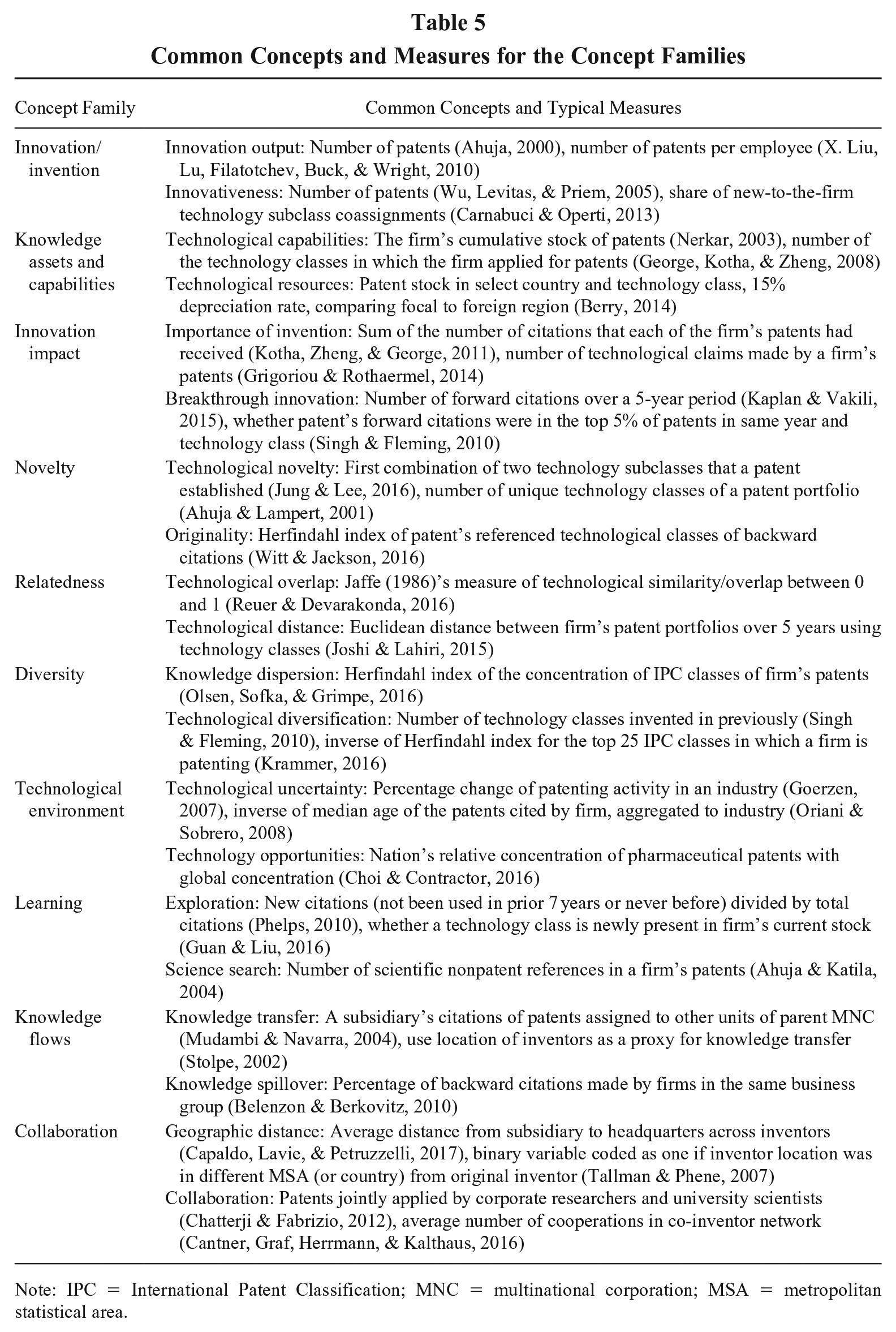
Note: IPC = International Patent Classification; MNC = multinational corporation; MSA = metropolitan statistical area.
Summarizing the Use of Patent Data for Conceptual Representation in Management
We developed Figure 2 as a framework to summarize the ways in which management scholars have commonly used patent data to represent important concepts in the field. Through our review, we observed that management studies employing patent data typically have strong connections with knowledge-based phenomena—specifically the acquisition, production, and/or utilization of knowledge. The concepts of core interest in these studies tend to align with one or more of these phenomena, and these concepts are then operationalized through measures based in patent data. This framework therefore brings together the central features of empirical research—phenomena, concepts, measurement—for patent-based work in the management field.
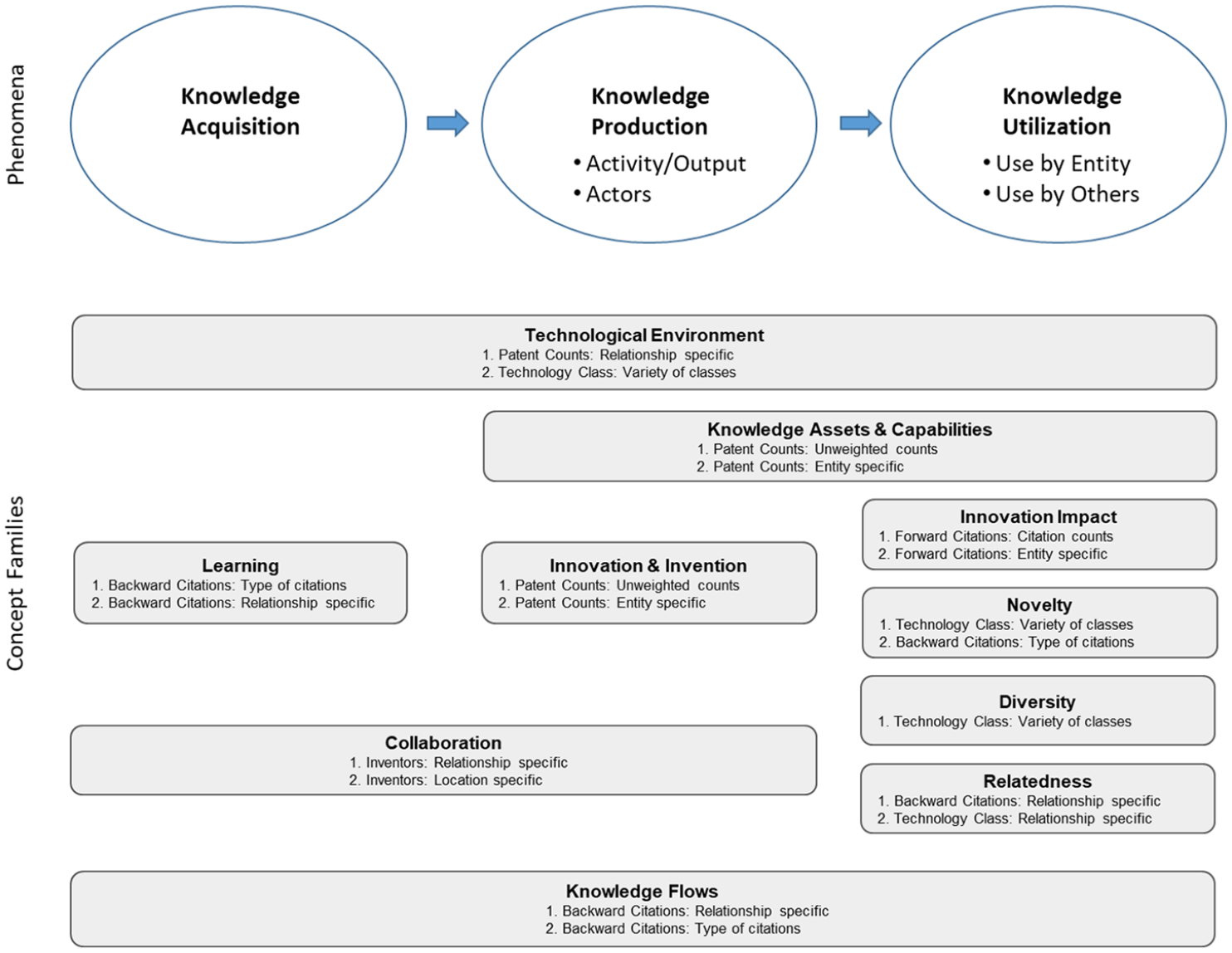
Overarching Framework of Patent Usage in Management
While our review casts a wide conceptual net, we highlight that our framework aligns favorably with extant work on invention and innovation. For example, it parallels the knowledge production foundation for much of the patent-based research in economics. As Griliches (1990) describes, at a high level, a knowledge production function can be viewed in terms of resources invested in inventive activity, the production of knowledge through inventive activity, and the benefits arising from knowledge production. In turn, our framework illustrates the broad ways in which management scholars use patent data to capture resources invested (i.e., acquired knowledge); knowledge production in terms of activities, actors, and output; and the utilization/leveraging of knowledge by the producing entity as well as others. Similarly, our framework aligns with knowledge-based models of technology development; Grant (2016), for example, depicts a development trajectory for technology from basic knowledge through invention and innovation to diffusion.
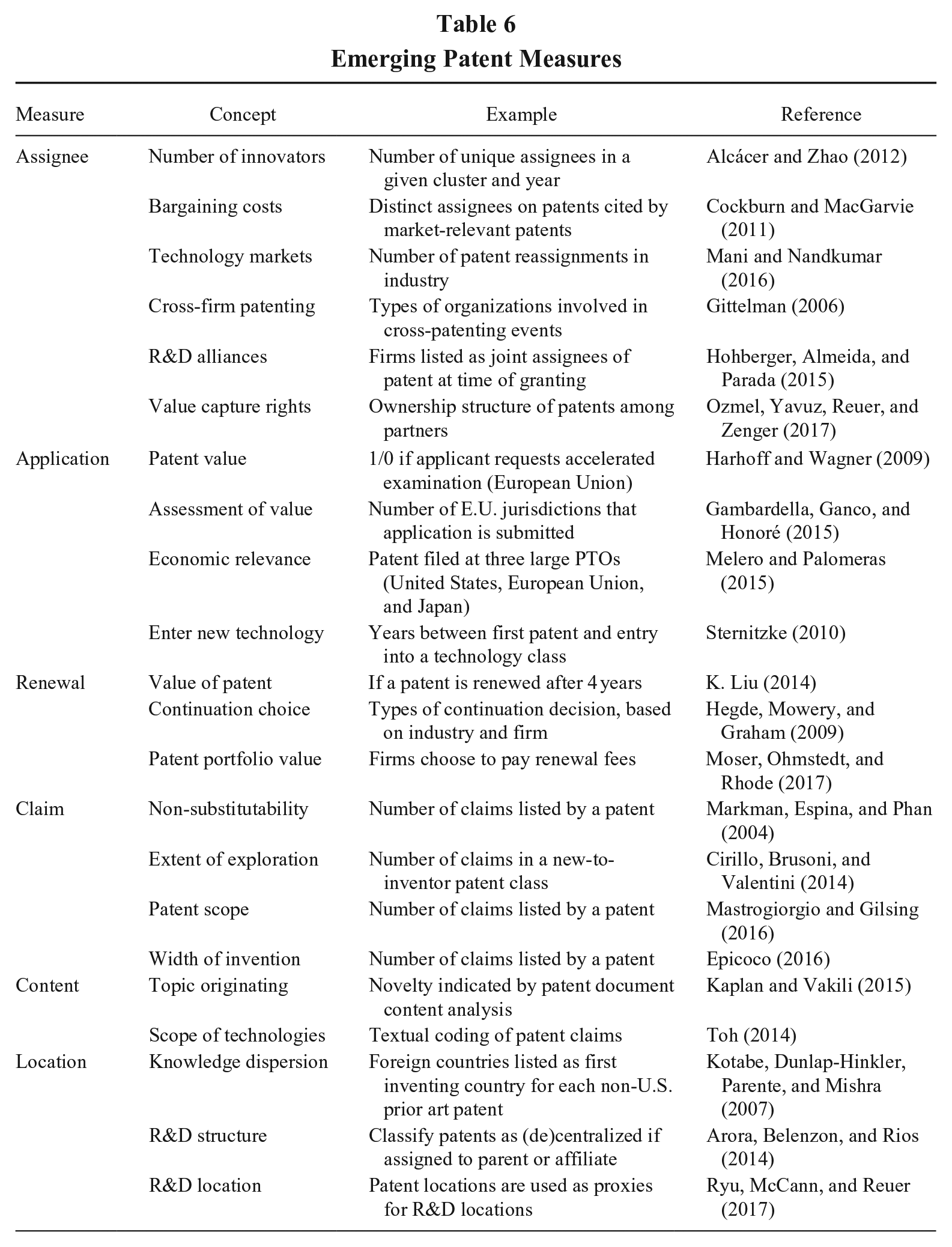
We also observed a number of patent measures that were used infrequently in the management literature and extend beyond the five core measurement categories (e.g., patent counts, forward citations). As shown in Table 6, these patent-based measures, which we term “emerging,” utilize patent data as diverse as patent assignee type, patent application details, patent renewal decisions, patent claims, patent document content, and patenting locations. While these types of patent data have historically been utilized infrequently across the management literature, their usage is increasing. The measures tend to be used for distinct conceptual purposes, for example, patent claims as a proxy for the scope of an invention. And these relatively untapped data resources offer opportunities for capturing a range of phenomena and concepts. For example, patent claims, including both the number and content of the claims, have significant potential to shed light on topics as broad as exploration and innovativeness (e.g., Mastrogiorgio & Gilsing, 2016). Other patent data features, such as patent locations and assignees, can potentially be used for capturing firm structure and knowledge flows across boundaries and for gaining insight into firm R&D operations (e.g., Arora, Belenzon, & Rios, 2014). Emerging usages also include patent renewal and continuations procedures; these data provide researchers with the ability to capture firms’ strategic use of patents (e.g., real-time adjustments to their technology portfolio; Hegde, Mowery, & Graham, 2009) and go beyond counts and citations to measure the long-term impact of patents to the firm.
Emerging Patent Measures
Assessing Measurement Issues in Patent-Based Measures
Following our descriptive mapping of the use of patent-based indicators in management research, we next turn to a more critical assessment of this usage, focusing our attention on core principles of measurement. Measurement error has long been seen as a serious problem for researchers. While measures serve as proxies for theoretical concepts, measurement error is present at all times (Bagozzi, Yi, & Phillips, 1991). Measurement error encompasses both random and systematic error. Random error tends to reduce the ability for sample data to predict the relationships between concepts, and creates errors in inference. However, systematic error can lead to biased inferences that impede the cumulative progression of scientific enquiry (Carlson & Hatfield, 2004).
A number of causes of systematic measurement error have been identified in patent-based research. For example, the strategic nature of patent-related decisions (e.g., the number and scope of claims and/or citations, whether to protect the technology via patent vs. secrecy) leads to systematic error in patent-based measures, such as citations as a proxy for knowledge flow or patent novelty (Roach & Cohen, 2013; Somaya, 2012). Scholars have also found that patenting propensity increases with firm size (Nagaoka et al., 2010). Apart from firm strategy and size, the technological characteristics of an innovation and the location of patent filing can impact measurement error for patent-based measures (Corsino, Mariani, & Torrisi, 2019). In addition, measurement error—caused by issues such as truncation in patent citations or differential patterns of patent citations across technology classes—substantially challenges our ability to interpret results based on patent data (Lerner & Seru, 2017). 5
While the aforementioned systematic measurement errors are fairly well documented in the literature, there has been less attention directed to understanding the prevalence of central measurement issues in patent-based research in the field of management. To assess these issues in greater depth, we created a subsample of the patent-based measures identified in our full review of the use of patents as indicators in management research. To establish the subsample, we focused on the most common utilized concept within each of the 10 concept families and identified all the studies in our sample that included a patent-based measure for that concept. This resulted in a subsample of 383 articles, representing a little over 70% of our full sample of articles. For each of these articles, we examined all of the operationalization instances involving a patent-based measure, which resulted in 1,100 instances (79% of our full sample). Our review of patent-based research in the management field pointed to several central measurement issues—method bias, validation threats, and model misspecification—whose prevalence is summarized in Table 7. We focused on these issues based on current practice in patent-based research in management (e.g., Ketchen, Ireland, & Baker, 2012; Priem, Lyon, & Dess, 1999; Richard, Devinney, Yip, & Johnson, 2009) and on our view that further examination of these issues can help advance patent-based work in the management field.
Summary Statistics of Measurement Issues

Measurement issue test applied at a measure level (n = 1,100 instances).
Measurement issue test applies only to citation-based measures (n = 434 instances).
Method Bias
This measurement issue is based on the method of measurement. As Spector (2006: 223) describes, “If the same method is used to assess two variables, if those two variables share a common source of bias, the correlation will likely be inflated, depending on how strongly related the two sources are.” 6 More specifically, method bias is defined as the variability in a measure that is due to the characteristics of the measurement approach, such that multiple measures in a single empirical model share systematic error variance, resulting in inflated estimation of relationships (Brannick, Chan, Conway, Lance, & Spector, 2010). Systematic error shared between explanatory variables has been found to lead to multicollinearity concerns, potentially skewing results by inflating relationships among variables whose measurement is based on a common method (Bagozzi et al., 1991). This issue is quite salient for patent-based research, as creating multiple measures from the same data source can cause the measures to develop correlated measurement errors, leading to problematic inferences.
We therefore examined the potential for method bias by tracking the degree to which researchers used multiple patent-based measures in the same empirical model. As our first indication, we counted the number of articles in which multiple patent-based measures from different measurement classes were employed in the same empirical model and found that 65% included more than one type of patent-based variable; as described earlier, this can produce multicollinearity concerns. We also examined the degree to which researchers utilize patent-based data for both dependent and explanatory variables. Employing patent-based measures drawn from a similar source on both sides of an equation can result in bias and inconsistency in coefficient estimates (Roach & Cohen, 2013), which may extend beyond the focal variables to affect other variables of interest (Bound, Brown, & Mathiowetz, 2001). We found that 42% of our studies employed a model with patent-based measures as both explanatory and dependent variables. While inclusion of multiple variables from a single source does not necessarily result in bias, it does signal that additional analysis, and perhaps even alternative measures, should be considered. This may be especially likely in articles where the large majority (i.e., greater than two-thirds) of variables in the model are derived from patent data; we found this to be the case for 30% of our sample.
Validation Threats
Validation encompasses the degree to which a measure represents the theoretical concept that it is intended to represent and is not associated with another concept (Carmines & Zeller, 1979; Singleton & Straits, 1999; Venkatraman & Grant, 1986). Our examination centers on two aspects pertaining to validation: content validity and face validity.
To examine content validity, the core issue is whether the measure represents the full range of the elements or facets of a concept (Singleton & Straits, 1999; Venkatraman & Grant, 1986). For patent-based researchers, consideration of content validity for a measure requires a deep understanding of the boundaries and elements of the concept. To assess how researchers dealt with issues of content validity, we first identified whether alternative/nonpatent data (e.g., new products, interviews) were used to support validity. We found that evidence-based justification and/or triangulation was seldom utilized, as 72% of the measures were not corroborated by interviews or case support and/or involved nonpatent measures as support for the patent-based measure. We also examined whether a rationale was provided to support the use of the measure as appropriate for the concept, finding that no rationale of some form was given for 20% of the measures. As a breakdown for the 80% that offered rationale, we observed the following three ways that measures were justified: (a) researchers offered their own rationale (31%), (b) they indicated that the measure had been used for that purpose in a previous study (48%), or (c) they used expert opinion in their justification (1%).
To assess face validity, the key issue is whether the measure appears to represent the concept it is claimed to measure (Singleton & Straits, 1999). With patent data, an example of making the case for face validity could be a researcher arguing that patent counts are a good measure of the “firm innovation” concept because innovative firms are expected to patent more than noninnovative firms. To assess this, we examined whether a definition was given for the focal concept, the degree of clarity of the definition, and whether the concept definition was consistent with the measure definition. In 74% of the cases we observed, we concluded that the concept definition was not clear and/or was not consistent with the operational definition of the concept. As further detail, we observed that (a) 52% of the operationalizations offered ambiguous definitions for the concept and/or measure, making it difficult to understand how well the measure fit the concept, and (b) for 22% of the measures, definitions were not provided by the researchers.
As part of validation, we also considered how researchers combined and manipulated patent elements to create complex measures. As one form of complexity, many patent measures combine two or more patent-based elements (e.g., patent counts, backward citations). As another form, many patent measures use multiple manipulations, that is, any mathematical operation that changes the distribution of a variable, such as squaring, log, ratio, division, and summation. For example, the patent generality measure (Hall, Jaffe, & Trajtenberg, 2001) has two components, patent counts and citations, and two manipulations, squaring and summation. Our review identified that 56% of the patent measures combined two or more patent-based elements and employed two or more manipulations. Complex measures per se are not problematic as long as sufficient justification and validation are provided. However, extra attention should be given when understanding the relationships of variables and interpreting the findings. For example, ratio measures can produce coefficients that are essentially capturing interaction effects in models that exclude the constituent main effects (Wiseman, 2009), and the dispersion of the denominators can change results (i.e., produce spurious results) even when the underlying relationships among unscaled variables remain constant (Certo, Busenbark, Kalm, & LePine, 2018).
Model Misspecification
While misspecification errors occur when statistical errors are introduced by the methods chosen for testing the relationships of interest in a study, they can also arise as the result of decisions made to create measures that do not fit the expected distributions in the design of statistical tests—that is, the measure’s design creates error terms in the model which violate model assumptions. These errors can arise in myriad ways in patent-based research in management, such as not accounting for skewness in model selection, biases introduced due to time lag/window selections, and/or selecting measures (e.g., citation timing) based on the criterion of statistical significance.
To understand the distribution of patent-based measures, researchers often examine the boundaries of the measures and their relationships with other measures in the study and provide statistical descriptives, such as minimums, maximums, correlations, and variation. But more is often needed in patent-based research given the “black swan” nature of the patenting process (i.e., a few patents often account for a large proportion of the citations; see the online supplement), which encourages the reporting of quartiles, skewness, and/or outlier measures. This is admittedly a high standard for empirical work, but it can be a critical issue. For example, when looking at forward citations, anywhere between 11% and 20% of patents, depending on the field, do not receive a single forward citation (Singh & Fleming, 2010). In our review, we observed that 57% of studies reported only means and correlations. Further, we found that only 3% of the studies had explicit discussion of their means, standard deviations, skewness, and correlations with other variables and outliers in the data.
A second element of model misspecification is whether differences in variation for or across explanatory and dependent variables are considered. Limited-range dependent variables (Wiersema & Bowen, 2009) can create model misspecification concerns, and narrowly dispersed explanatory variables result in high coefficient variance (Neter, Wasserman, & Kutner, 1983), leading to an increased probability of failing to support hypothesized relationships and possibly leading to the field ending the pursuit of such relationships in future studies. Narrowly dispersed variables can be a result of poor measurement decisions (i.e., dichotomizing a continuous variable) or appropriately measured homogeneous constructs. In our review, 67% of articles failed to discuss or control for issues with respect to variation for and between dependent and explanatory variables.
Another element that can pertain to model misspecification in patent-based research is how time (i.e., time lags, time windows) is considered in measures. In his classic article about the threats to the validity of quasi experiments, Campbell (1957) identified how theory often speaks only about the “cause” and the “effect” but neglects to define the temporal span between these. For instance, while R&D efforts and commercialization take time, there has been little systematic development in patent-based research in terms of understanding of how long it takes for innovative efforts to translate into innovative outcomes. Relatedly, when using forward-citation counts as an indicator for the impact and quality of a patent, the choice of time windows or cutoff points in counting citations can be important to the cumulative progression of scientific enquiry. In the studies we examined, however, 56% of patent measures did not provide justification for the time lags/windows selected for the measures. Moreover, patent lags are frequently defended because they result in the “best” empirical results.
A final measurement issue is the presence of third-party added citations and self-citations. Forward-citation-weighted patent counts are a significant measurement class and are often employed in management research to represent concepts such as firm innovativeness, innovation impact, or patent novelty. However, these citations may arise for reasons wholly unrelated to innovation, impact, or novelty. Many citations result from (a) attorneys, who tend to cite early patents and add self-citations; (b) patent examiners, who have been found to add a significant percentage of citations (between 20% and 60%) and who often add citations of patents that they had worked on previously (e.g., see Corsino et al., 2019); and (c) the firm, as part of managerial strategies to possibly increase the captured value for their entity. In our analysis, 44% of articles did not discuss or control for examiner-added citations and/or an entity’s own citations.
Summary and Recommendations for Using Patent-Based Measures
Before we discuss ways in which scholars can mitigate and/or avoid the three measurement issues in patent-based research, it is important to understand how the nature of patent data creates a situation where method bias, validation threats, and model misspecification are especially prevalent. The nature of patent data contributes to these systematic measurement errors because it can present an illusion of objectivity and consistency within an archival data set when, in fact, the data are neither objective nor consistent. Instead, each element of patent data (e.g., inventor’s location, citations of prior art, claims, assignee designations) represents a deliberate decision by diverse decision makers both inside and outside of the focal firm (or within/outside the focal inventor). Seemingly straightforward decisions, such as the appropriate technology classification or prior citations, are affected by diverse motivations, disciplines, and backgrounds. As detailed by Somaya (2012), even the initial decision to utilize a patent to protect an innovation is a strategic decision involving many decision makers with diverse goals and objectives. Furthermore, these decisions are affected by the classification of the technology and industry life cycle stage (Corsino et al., 2019). Other publicly available and widely used data sets, such as Compustat, suffer considerably less systematic error due to the consistency demanded by regulatory, auditing, and training standards (i.e., Generally Accepted Accounting Principles, Auditing Standards Board).
The nature of publicly available patent data exposes patent-based research to measurement issues of method bias and validation threats (see Table 7). For instance, considerable use of patent-based measures in empirical models subjects this research to possible method bias: Correlated measurement error among explanatory variables results in biased and inconsistent coefficients (Bagozzi et al., 1991; Bound et al., 2001; Roach & Cohen, 2013). Furthermore, correlated measurement error between dependent and explanatory variables tends to overreport the effects of patent-based explanatory variables (Bagozzi et al., 1991; Bound et al., 2001; Roach & Cohen, 2013). In addition, the availability of patent data—and their widespread use—has resulted in many management scholars neglecting to employ alternative/nonpatent variables and failing to provide sufficient justification and/or clarity in the use of patent data as measures for the concepts. Moreover, the ease with which different elements of patent data can be manipulated has also resulted in a proliferation of novel variables that are difficult to understand. Further, in combination, the nature of patent data (i.e., the highly skewed nature of patent citations) and scholars’ infrequent support (i.e., adequate descriptive statistics) weaken our field’s ability to generalize findings. Finally, patent-specific variable issues, most notably, time lags/windows and third-party added citations, obfuscate the relationship between key concepts (e.g., novelty, learning).
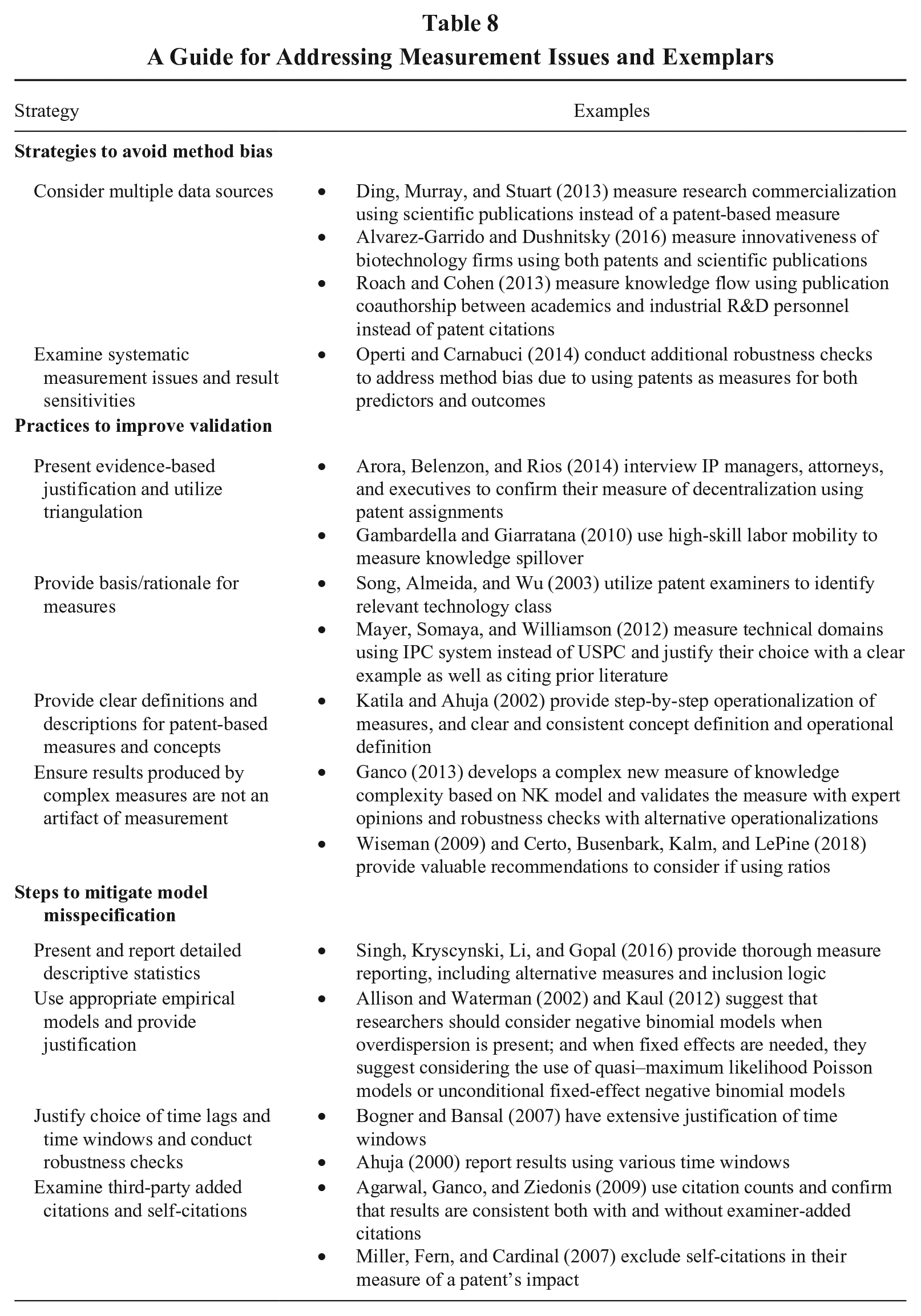
In order to advance the knowledge base within management, we have created a guide for addressing measurement issues in patent-based research (Table 8) with a list of exemplars for handling the various issues assessed earlier. Research involves trade-offs, and no single paper can be expected to provide the final answer to important questions in the field; however, we believe that greater attention to these measurement practices can improve patent-based research and better facilitate the accumulation of insights and understanding.
A Guide for Addressing Measurement Issues and Exemplars
Strategies to avoid method bias
As method bias is more likely when multiple measures in an empirical model are drawn from the same measurement category of patent data, we suggest that, where possible, researchers use different sources of data for their dependent and explanatory variables. As examples, Ding et al. (2013) develop a measure of research commercializability of a scientific patent by using keywords of journal articles published by the scientist instead of using patents as a proxy for commercial interest; scholars can also use new product introductions as a viable alternative measure of firm innovation (Nerkar & Roberts, 2004; Zahra & Nielsen, 2002). Under conditions where method bias is likely, one suggestion is for researchers to improve robustness by utilizing related measures from alternative sources; for example, Alvarez-Garrido and Dushnitsky (2016) measure innovativeness of biotechnology firms using both patents and scientific publications, and Roach and Cohen (2013) use publication coauthorship between academics and industrial R&D personnel instead of patent citations to measure knowledge flow. As another example of an article identifying the need to mitigate method bias, Operti and Carnabuci (2014) develop a measure of spillover networks using backward citations; not only did they explicitly discuss and address the possibility of method bias, given that patent data were used to construct both explanatory and dependent variables, they also conduct various robustness checks, such as removing examiner-added citations.
Practices to improve validation
Our review and assessment also identified a number of exemplar studies of management researchers providing content and face validity by presenting the steps they have taken to ensure their measures are representing the concepts they are intended to represent. For instance, Arora et al. (2014) interview intellectual property managers, attorneys, and high-level executives in order to validate that assigning patents to affiliates proxies the delegation of authority in R&D decisions. As another example, Song, Almeida, and Wu (2003) draw on the expertise of patent examiners to identify the technology classes in which semiconductor patents fall, rather than relying upon their own perspective. Katila and Ahuja (2002) not only conduct interviews with industry experts to confirm their selection of sample companies; they also provide clear definitions and descriptions of both concepts and operationalizations. 7
Where possible, we encourage scholars to address measure complexity in several ways. First, scholars employing patent-based measures involving ratios (e.g., citation-weighted patent counts, patent counts by R&D expenses) should rule out the possibility that their observed findings are artifacts of measurement, because using ratios as dependent variables may exaggerate relations of interest and lead to biased and unstable results. As an example, rather than using a complex measure involving a ratio, researchers can often employ the numerator as the indicator and include the denominator as a control variable; this “component approach” prioritizes simplicity for the measure and captures complexity through the model with the construction of appropriate coefficient tests (Wiseman, 2009). In addition, it is important to ensure the measures of a concept can be distinguished from other theoretically distinct concepts, with this issue becoming more of a concern as patent data are being utilized to represent an increasingly diverse array of concepts as well as represent related or intertwined ones.
Steps to mitigate model misspecification
Resolving concerns of model misspecification significantly improves the development of cumulative understanding in the field of management. Our review highlights the importance of providing thoughtful consideration and support for the corresponding decisions pertaining to measurement and models and examining robustness and sensitivities related to these decisions. 8 In this area, we would point scholars to Singh, Kryscynski, Li, and Gopal (2016), who provide thorough measure reporting, including a table providing all measures, their descriptions, and the logic for their inclusion; they also construct alternative measures for a focal concept (inventor innovative performance) and conduct various robustness tests involving different time windows and excluding self-citations. In addition, our review highlights the value in checking to see whether overdispersion is present when using patent counts and citation counts as dependent variables. When overdispersion is present, researchers should consider using a negative binomial model rather than the Poisson model (Hausman, Hall, & Griliches, 1984) or a quasi–maximum likelihood Poisson model (e.g., Kaul, 2012). When dealing with panel data, researchers should also see if unconditional negative binomial models (Allison & Waterman, 2002) may be more appropriate than conditional fixed-effect negative binomial models (e.g., Schilling & Phelps, 2007).
We also strongly encourage scholars to justify their choice of time windows and inclusion of firm or third-party citations. For example, when using forward-citation counts as an indicator for the impact and quality of a patent, researchers have commonly used 3-year or 5-year time windows (Alnuaimi & George, 2016). However, Jaffe, Trajtenberg, and Henderson (1993) found that forward citations received by a cited patent peaked by the end of the 6th year. As exemplars, Ahuja (2000) conduct several sensitivity tests on different time windows; Bogner and Bansal (2007) have extensive discussion and justification of their choice of 6-year time lags. We also encourage scholars to account for third-party and self-citations, as examiner-added citations are typically unrelated to improved performance of the invention (Moser, Ohmstedt, & Rhode, 2017) and self-citations may represent a different underlying concept (Miller et al., 2007). For example, Agarwal, Ganco, and Ziedonis (2009) confirm that results are consistent both with and without examiner-added citations.
Conclusion
Management scholars have increasingly turned to patent data as a resource for empirical work, recognizing its value in helping to answer important questions in the field. Motivated by this growing utilization of patent data, there has been increasing interest in taking stock of what is known about the use of patent data in empirical work. In this study, we provide the first systematic review of patent-based research in the field of management. This review makes two core contributions—one centering on summarizing how patents have been used in management research and one focusing on guiding management scholars in the appropriate use of patent-based indicators—that have important implications for future scholarly work in management and the social sciences more generally.
Taking Stock and Moving Forward
Our first contribution lies in summarizing how management scholars have used patent data to develop measures and represent concepts. While prior surveys of patent-based research have been conducted, they have been limited in their domain and scope—most notably, these assessments have taken the form of literature surveys that focus on selective works and issues in economics. By contrast, our systematic review of patent-based research in management has enabled us to provide a broad-based mapping of the concept families that are associated with phenomena of central interest for management scholars and the families of measures based on patent data that represent them. This review has resulted in the development of a summarizing framework (Figure 2) along with common examples of concepts and measures (Table 5) that contribute to mapping the typical ways in which management scholars have utilized patent data for conceptual purposes. In addition, our review sheds light on emerging uses of patent data in the field (Table 6). This review can provide a unique window into understanding the range of ways in which scholars are using patent data to represent concepts and assess theory, particularly given that management research draws on a range of social sciences.
Our second contribution lies in the development of a framework for assessing measurement issues involving patent data and providing guidance to address these issues (Tables 7 and 8). While prior surveys of patent-based research have based their assessments on features of patents, patenting, and patent offices, we develop and apply a framework that is based upon measurement principles. Using this as the basis for assessment, our review of patent-based research in management reveals important patterns surrounding key measurement issues, i.e., method bias, validation threats, model misspecification. From the view of guiding future research, our study sheds light on the prevalence of such issues in patent-based research, which we hope encourages scholars to devote greater attention to core measurement issues, and highlights that researchers may need to rule out the possibility that their observed findings are artifacts of measurement.
Specifically, we observed that in patent-based research in the field of management, a number of questions can be raised regarding the appropriate use of patent-based indicators. For many operationalizations, we observed that little information or justification is provided to support construct validity; method bias can be a warranted concern given the tendency for researchers to use multiple patent-based measures in the same model; frequent use of complex patent-based measures, as well as infrequent justification of measure timing, can raise questions in terms of model specification and introduce interpretation challenges. While some of these instances may reflect inadequate attention to important measurement issues, at other times, scholars’ decisions may be based on thoughtful consideration in the face of competing tensions (e.g., choosing to use complex measures in efforts to capture more nuanced concepts, represent established concepts in a more accurate way, or address empirical estimation issues, like multicollinearity or heteroscedasticity). Our assessment also encourages researchers to consider more thoroughly the impact of possibly non-normal distributions for the measures, such as fat-tailed probability distributions, which Bettis and Blettner (2020) argue are best handled by statistical modeling using Gaussian distributions. These statistical properties frequently need to be presented, and in many instances, the skewness of the measures should be discussed.
Recommendations for Future Research
Our review highlights several important issues of concern for patent-based research that we were not able to address. One aspect of validation involves testing for discriminant validity, capturing whether and how the measure of a concept diverges from measures of other theoretically distinct concepts (Singleton & Straits, 1999; Venkatraman & Grant, 1986). Because discriminant validity is focused on conceptual distinctions, it is of notable salience, as management scholars have frequently used the same or similar patent-based measures to represent different concepts. As an example, technological resources and capabilities are theoretically distinct concepts; while the former refers to the stock or portfolio of technological assets, the latter refers to a firm’s ability to leverage the resources to create value. Yet studies use patent counts to measure both technological resources (e.g., Berry, 2014) and technological capabilities (e.g., Nerkar, 2003). As another example, our review revealed instances of a Herfindahl index of technological patent classes being used to represent concepts such as technological specialization (Melero & Palomeras, 2015), resource depth (Andrevski & Ferrier, 2016), knowledge dispersion (Olsen et al., 2016), patent basicness (Stolpe, 2002), and originality (Witt & Jackson, 2016), yet knowledge resources, diversity, and novelty are considered theoretically distinct. Because the aim of our review was focused on mapping the various concepts and measures involved in patent-based research, we did not assess the numerous examples of the same measures being used to represent different concepts. Focusing further attention on discriminant validity appears to be an important issue/opportunity for patent-based research.
Relatedly, developing a new patent-based measure should be viewed as a thorough undertaking to ensure that a strong foundation is laid, for both the focal work and subsequent research; this can include careful attention to defining, describing, and validating the measure, including how the measure differs from conceptually distinct measures. Our measurement-based framework can be used to guide appropriate development and usage of patent-based measures as indicators. We also encourage scholars to draw on the wealth of methodological insights and guidance already provided in the field of management and related disciplines with respect to proper usage of patent data (e.g., Lerner & Seru, 2017). In addition, we advise management scholars to be aware of novel measures being developed and utilized (Table 6). Future research and guidance are needed in order to better enable management scholars to build upon and validate prior measures—especially, novel measures—so as to better build upon these results without falling prey to overinterpreting them (Carlson & Hatfield, 2004).
Further, we believe that future research is needed to understand important relationships that have been examined with patent data. In a recent commentary, Ketchen et al. (2012) recommend that researchers provide clear logic and empirical validation when using archival data proxies, including patent data. Moreover, they argue that researchers need to demonstrate the accuracy of their particular use of a proxy in comparison with the other ways in which that proxy has been used in the literature. Additionally, care is needed in utilizing quasiexperimental design when studying relationships involving patents. For instance, while R&D efforts and commercialization take time, there has been little systematic development in patent-based research in terms of understanding of how long it takes for innovative efforts to translate into innovative outcomes. While our review has highlighted the frequent lack of rationale for time lags/windows, it is also worth noting that empirical researchers have frequently not helped in building such an understanding by the various practices sometimes used in developing and presenting patent-based measures.
While our review focuses on how patents have been used to represent concepts in management and offers counsel for preventing corresponding method bias, validation threats, and model misspecification problems, there are several important matters worthy of further examination. For instance, the breadth of patent usage revealed by current research (see Table 3 and Table 5) brings to mind that future research could investigate how interfirm and intrafirm relationships and strategies, such as diversification, mergers and acquisitions, firm interlocks, and rivalry, relate to patents. As an example, extant work suggests that merger and acquisition activity has a mixed relationship with firm patent quality (Valentini, 2012) and varies depending on the prior relatedness level of the two firms (Cassiman, Colombo, Garrone, & Veugelers, 2005; Rao, Yu, & Umashankar, 2016). Similarly, recent research indicates that firms’ relationships (via alliances, board interlocks, etc.) are intertwined with their patent portfolios (Howard, Withers, & Tihanyi, 2017). Future research can provide new insights into how patents relate to firms’ strategic actions.
Last, we highlight that our review has important implications for the use of patent data that extends beyond the field of management. Because management research draws from a range of social sciences (e.g., economics, psychology, sociology) and spans multiple levels of analysis, examining patent-based empirical work in management can provide a unique window into understanding the ways in which patent data are being used to represent concepts and assess theory in the social sciences more broadly. Our mapping framework can help scholars in management and related disciplines to identify a range of possibilities in terms of types of measures for representation purposes. We also put forward our measurement-based framework to help guide scholars in determining appropriate uses of patent data as indicators. And we hope that social scientists will be able to draw on our measurement-based framework, ideally in combination with other complementary resources (e.g., Lerner & Seru, 2017), as a guide for making important decisions in regards to developing and determining the most appropriate patent-based measures for their purposes.
Supplemental Material
JOM916233_Supplemental_material_CLN – Supplemental material for Mapping Patent Usage in Management Research: The State of Prior Art
Supplemental material, JOM916233_Supplemental_material_CLN for Mapping Patent Usage in Management Research: The State of Prior Art by Jeff P. Savage, Mengge Li, Scott F. Turner, Donald E. Hatfield and Laura B. Cardinal in Journal of Management
Footnotes
Acknowledgements
We would like to thank associate editor Anne Parmigiani and two anonymous reviewers for their constructive and supportive guidance throughout the review process. This research received partial support from the SmartState Center for Innovation + Commercialization at the Darla Moore School of Business at the University of South Carolina.
Supplemental material for this article is available with the manuscript on the JOM website.

Notes
References
Supplementary Material
Please find the following supplemental material available below.
For Open Access articles published under a Creative Commons License, all supplemental material carries the same license as the article it is associated with.
For non-Open Access articles published, all supplemental material carries a non-exclusive license, and permission requests for re-use of supplemental material or any part of supplemental material shall be sent directly to the copyright owner as specified in the copyright notice associated with the article.
