



Abstract
We propose that CEOs are more likely to engage in financial misconduct after the media names them as being among the best business leaders. We theorize this occurs because winning such an award is a meaningful event that increases the CEO’s self-worth but also increases the CEO’s sense of psychological entitlement, including the freedom to break rules. We test our ideas by examining scenarios where award-winning CEOs feel especially entitled and therefore are most likely to commit misconduct. Using a sample of award-winning CEOs from Chinese publicly listed firms, we find that award-winning CEOs are more likely to commit financial misconduct in the post-award period than in the pre-award period. In addition, the effect of winning a CEO award on financial misconduct is stronger when CEOs are underpaid or from industries in which awards are rare and therefore more special. We also validate aspects of our theory that are difficult to observe. First, we use bivariate probit models with partial observability to confirm that our results hold when accounting for unobserved misconduct. Second, we use survey data that capture the psychological entitlement of a subsample of CEOs to confirm the mediating effect of psychological entitlement on the relationship between winning an award and committing financial misconduct.
Reining in financial misconduct is a critical concern for shareholders and policy makers and, as a result, a core topic within management research (Gomulya & Boeker, 2016; Koch-Bayram & Wernicke, 2018). It is important because financial misconduct can destroy firm value and investor confidence. Researchers have focused on the CEO as a key determinant of misconduct (Ndofor, Wesley, & Priem, 2015; Schnatterly, Gangloff, & Tuschke, 2018; Zhang, Bartol, Smith, Pfarrer, & Khanin, 2008). The CEO is the most crucial decision maker in the company (Marcel, Barr, & Duhaime, 2011). Scholars, therefore, have examined factors such as CEO demographic characteristics, backgrounds, and personality traits, showing how they influence financial misconduct (Koch-Bayram & Wernicke, 2018; O’Connor, Priem, Coombs, & Gilley, 2006; Rijsenbilt & Commandeur, 2013).
This line of study, however, largely focuses on characteristics of the CEO (i.e., who they are), devoting less attention to events that might cause CEOs to start thinking they could engage in nefarious behavior (Graffin, Wade, Porac, & McNamee, 2008). This is an important shortcoming in the literature because an individual’s decisions and behaviors are influenced not only by who they are but also what they have been through (Morgeson, Mitchell, & Liu, 2015). The characteristics of CEOs account for only a certain amount of variance in behavior, so we need to consider other important determinants, such as external events or situations in which CEOs might find themselves. In this study, we consider an event that might trigger such a change among CEOs. When CEOs are ranked among the best business leaders of their time by the business media, it is a recognition of their vast accomplishments. These awards are organized by media outlets such as Forbes and are conferred on CEOs who have done great things for their companies (Malmendier & Tate, 2009; Wade, Porac, Pollock, & Graffin, 2006). CEOs who receive prestigious CEO awards experience a sharp increase in social recognition and prominence (Hayward, Rindova, & Pollock, 2004). We suggest, however, that prestigious awards could change CEOs’ attitudes toward their companies and even have adverse effects.
We theorize that winning a prestigious CEO award increases the likelihood of financial misconduct because of an increased sense of entitlement. Psychological entitlement refers to the belief that one deserves more than others and more than what they are currently receiving because of an outsized assessment of themselves and their contributions (Campbell, Bonacci, Shelton, Exline, & Bushman, 2004; Vincent & Kouchaki, 2016). Individuals with a strong sense of psychological entitlement feel they are above the rules, so they may engage in morally questionable behavior (Schurr & Ritov, 2016; Vincent & Kouchaki, 2016; Yam, Klotz, He, & Reynolds, 2017). Winning prestigious CEO awards can induce feelings of uniqueness and entitlement. We thus argue that receiving a prestigious award can lead to CEOs’ engaging in financial misbehavior in the post-award period.
Award-winning CEOs may differ in their inclination to engage in financial misconduct because there are various scenarios where psychological entitlement might be especially prominent for different CEOs. One scenario derives from what CEOs are actually receiving in terms of compensation: Award-winning CEOs who are underpaid relative to their peers may rationalize their fraudulent behavior and are more likely to engage in misconduct than those who are fairly compensated or overpaid (Schnatterly et al., 2018). Another scenario derives from what CEOs feel they deserve: When a CEO is the only award winner in the industry, or one of very few, they would likely experience especially strong feelings of entitlement, again making our results stronger.
We find support for these ideas. Using a sample of Chinese-listed firms, we see in the marketplace that awards have the hypothesized effect on financial misconduct, and the moderating influences of CEO underpayment and industry rarity operate as expected. We also validate the unobserved aspects of our ideas in two ways. First, we use bivariate probit models with partial observability to confirm that our results hold when accounting for unobserved financial misconduct. Second, we use survey data that capture the psychological entitlement of a subsample of CEOs to confirm the mediating effect of psychological entitlement on the relationship between winning an award and committing financial misconduct.
Our study contributes to management research in several ways. First, our work provides unique insight into the antecedents of financial misconduct. Prior research attests to the influence of CEO characteristics (Rijsenbilt & Commandeur, 2013; Troy, Smith, & Domino, 2011) and compensation (O’Connor et al., 2006; Zhang et al., 2008). Our study builds on these by theorizing about the role of a meaningful event and how it affects a CEO’s feelings. Second, prior studies suggest that high-status actors may engage in deviant behavior to meet external performance expectations (Mishina, Dykes, Block, & Pollock, 2010; Trompeter, Carpenter, Desai, Jones, & Riley, 2012). Our study adds to this body of work by demonstrating that psychological entitlement may be a key reason why high-status actors engage in deviant behavior. Third, our study advances recent research on the dark side of awards (Lovelace, Bundy, Hambrick, & Pollock, 2018; Malmendier & Tate, 2009) by extending this concept to firm-level financial misconduct.
Conceptual Background
Research on award giving in the organizational context offers a number of fundamental insights. Organizational awards can range from orders and medals to decorations and prizes. They are typically granted to honor individuals who exemplify the norms and beliefs upheld by the award giver, who may be internal or external to the corporation (Frey & Gallus, 2017). Awards provide feedback to individuals (and groups) about their competency (Neckermann & Frey, 2013). Winners are deemed competent and nonwinners less so (Weiner, Russell, & Lerman, 1979).
Organizational awards serve as a retrospective response to past behavior, but they are also indicative of prospective behavior (Gallus & Frey, 2016). Individuals recognized for their competence want to maintain that image, so arguably award winners could be more motivated to achieve than nonwinners (Frey, 2006). For example, recipients of prestigious academic awards have higher subsequent research productivity than nonrecipients with similar pre-award research performance (Chan, Frey, Gallus, & Torgler, 2014). Winners of symbolic awards are found to contribute more public good on the Internet because winning the awards makes them feel increased responsibility toward society (Gallus, 2016).
Recent studies have also observed a “dark side” to winning an award. Award winners sometimes become focused on pursuing their own interests after receiving an award because they feel they have earned the right to do as they please (Frey & Neckermann, 2008; Neckermann & Frey, 2013). A good example is seen in Field Medal recipients in mathematics, who allocate less attention to research in their own discipline and more to unfamiliar topics after receiving their award (Borjas & Doran, 2015). Similarly, some award-winning CEOs not only spend more time on public and private activities outside of their companies after winning an award but also engage in more earnings management to ensure strong financial performance (Malmendier & Tate, 2009). Award-winning CEOs may also take additional risks by paying a high premium for acquisitions to maintain their social status when their firms are performing poorly (Cho, Arthurs, Townsend, Miller, & Barden, 2016). Scholars also suggest that some CEOs experience sociocognitive and behavioral constraints after winning a prestigious award (Hayward et al., 2004; Lovelace et al., 2018).
Winning a prestigious award is a meaningful event in the life of a CEO. Morgeson et al. (2015) describe meaningful events as those that are novel, disruptive, and critical. Winning a prestigious CEO award is novel because it is rare; most CEOs will never win one. It is disruptive because it brings newfound public recognition and social prominence. It is critical because it is a signal of the CEO’s quality that can improve career prospects (Connelly, Certo, Ireland, & Reutzel, 2011). In short, CEO awards are highly consequential to award winners (Gallus & Frey, 2016; Hayward et al., 2004).
Winning an award, therefore, can change the way CEOs feel about themselves and their role in the company. CEOs are constantly comparing themselves to others (Fredrickson, Davis-Blake, & Sanders, 2010; Seo, Gamache, Devers, & Cappenter, 2015). Awards provide a platform for social comparison by setting up competitive tournaments (Connelly, Tihanyi, Crook, & Gangloff, 2014). Only a small percentage of highly touted CEOs are ever ranked among the best business leaders of their time, which is what makes these awards so highly valued. The award distinguishes winning CEOs from their peers, resulting in an elevated sense of self. The award retrospectively recognizes a CEO’s achievements but prospectively allows them to stand out from the crowd.
Hypotheses
We develop specific hypothesis about the influence of awards on financial misconduct, which includes such actions as falsifying financial statements, asset fabrication, providing illegal guarantees, and share price manipulation (Cumming, Leung, & Rui, 2015). We focus on financial misconduct because CEOs have ultimate accountability for the firm’s finances, and shareholders hold them responsible for wrongdoing (Arthaud-Day, Certo, Dalton, & Dalton, 2006; Gangloff, Connelly, & Shook, 2016). This is especially relevant to strategy research because financial misconduct can bring about substantial economic and reputational costs for firms (Fich & Shivdasani, 2007).
Scholars have devoted considerable attention to unpacking the role of top executives in financial misconduct (Dunn, 2004; Schnatterly et al., 2018; Zahra, Priem, & Rasheed, 2005) but less to understanding how important events can affect such behavior. For example, some have found that demographic characteristics (e.g., gender and age) and backgrounds (e.g., education and military experience) predict misbehavior (Benmelech & Frydman, 2015; Daboub, Rasheed, Priem, & Gary, 1995; Koch-Bayram & Wernicke, 2018). Others investigate the role of top executives’ personality traits (Rijsenbilt & Commandeur, 2013) and compensation (Shi, Connelly, & Sanders, 2016). This body of work, though, largely overlooks the role of consequential external events (Morgeson et al., 2015). Meaningful events, such as the death of a social peer (Shi, Hoskisson, & Zhang, 2017), dismissal of a competitor CEO (Connelly, Li, Shi, & Lee, in press), and CEO awards (Shi, Zhang, & Hoskisson, 2017), can shape managerial decisions.
The literature offers a range of views about how an award might affect the likelihood that a CEO will engage in misconduct (Mullen & Monin, 2016). For example, it could be that the award winner has more at stake after winning an award. By engaging in misconduct, they put their reputation at risk and so might avoid misconduct when they view their reputation as strong. Greve, Palmer, and Pozner (2010: 63) observe that those with a weak reputation are “more likely to commit misconduct because they have less to lose.” Support for this perspective may also be derived from strain theory (Agnew, Piquero, & Cullen, 2009), which suggests that receiving an award relieves CEOs from the strain of not performing up to standards and thus reduces their felt need to narrow the achievement gap by cutting corners (Harris & Bromiley, 2007).
We, however, argue that award-winning CEOs are more likely to engage in financial misconduct in the post-award period. One reason is that award winners might resort to illegal or unethical behavior to meet elevated expectations after winning an award (Cho et al., 2016). Consistent with this view, studies suggest firms that outperformed industry peers are more likely to engage in misconduct because of pressure from elevated investor expectations (Mishina et al., 2010; Trompeter et al., 2012). In addition, winning prestigious awards can significantly increase a CEO’s social status, so they become less dependent on their firms (Hayward et al., 2004; Malmendier & Tate, 2009). We suggest, therefore, that the primary mechanism at work after a CEO wins an award is psychological entitlement (Harvey & Martinko, 2009).
Psychological entitlement is a form of self-perception that changes over time and is contingent on social recognition (Poon, Chen, & DeWall, 2013; Zitek, Jordan, Monin, & Leach, 2010). Having their uniqueness externally validated may induce award winners to experience an elevated sense of self and expect better treatment or outcomes. This may be accompanied by feelings of entitlement, where award-winning CEOs feel they deserve more than what they are currently receiving in terms of resources, compensation, respect, privileges, or perks (Campbell et al., 2004). Individuals who feel entitled expect favored treatment and believe they should be given special dispensations (Snow, Kern, & Curlette, 2001). In fact, one of the determinants of psychological entitlement is social comparison (Major, 1994). As a result, Schurr and Ritov (2016) find that winning a competition creates feelings of entitlement, and we expect the same to occur among award-winning CEOs.
Feelings of entitlement that CEOs experience could lead to organizational misbehavior. As suggested by equity theory, individuals who find themselves in inequitable relationships experience distress and attempt to overcome this distress by restoring equity (Adams, 1963; Walster, Walster, & Berscheid, 1978). Individuals who feel entitled believe that it is only fair that they receive preferential treatment because they believe themselves to be more special than others. As a result, entitled individuals demand special treatment and may even resort to misbehavior to restore equity. This follows from research showing that individuals who feel entitled often think of themselves as above the rules and are hence more inclined to break them (Schurr & Ritov, 2016; Vincent & Kouchaki, 2016). For instance, experimental evidence suggests that highly entitled individuals are socially irresponsible and often refuse to help others (Zitek et al., 2010). In controlled settings, high levels of psychological entitlement have been found to predict lying and stealing behaviors (John, Loewenstein, & Rick, 2014; Poon et al., 2013). Findings by Yam et al. (2017) indicate that feelings of psychological entitlement can act as a moral credential that allows employees to feel that they can engage freely in deviant organizational behavior.
Following this logic, we argue that CEOs are more likely to engage in financial misconduct after they receive a prestigious award. Entitled individuals believe they deserve greater returns for the same level of input as others (Huseman, Hatfield, & Miles, 1987) and will seek to obtain those returns even if it means breaking the rules (Harvey & Martinko, 2009). Financial misconduct, such as falsifying information about a firm’s performance and lying about facts, can boost the firm’s stock price (Baucus & Near, 1991) so that CEOs can obtain their due (e.g., better analyst ratings, higher compensation, and respect from peers). Psychological entitlement justifies rule violation, and award-winning CEOs may convince themselves that behaviors that are unacceptable for others are acceptable for them (Schurr & Ritov, 2016). On the basis of these arguments, we hypothesize the following:
Hypothesis 1: Winning a prestigious external award (i.e., being named one of the best business leaders by the media) increases the likelihood that a CEO will engage in financial misconduct.
The degree to which a CEO feels psychological entitlement from winning an award may vary depending on the circumstances. The greater the inequity perceived by the CEOs, the more distressed they will feel and the harder they will try to restore equity (Adams, 1963). This works in two directions: (a) when an award-winning CEO’s perception of how they are being treated is especially low and (b) when their perception of how they should be treated is especially high.
Thus, in our first moderating hypothesis, we consider a scenario where the award-winning CEO might not feel they are being treated as well as they should be treated. Compensation is perhaps the most important aspect along which CEOs wish to be treated well (Hitt & Haynes, 2018). CEOs judge the fairness of their pay based on how well peers are compensated (Wade, O’Reilly, & Pollock, 2006). This has spawned a wealth of research on CEOs’ feelings about what they earn compared to what others earn (Fredrickson et al., 2010; Seo et al., 2015). These studies show that CEOs are acutely aware of whether their pay lies above or below that of their peers (Fong, Misangyi, & Tosi, 2010).
When award-winning CEOs are underpaid, we expect our main hypothesized effect to be especially strong. This is because the award changes the CEOs’ perception of what they deserve to be paid. If they are already overpaid, then the award simply confirms their beliefs about how much compensation they deserve. If they are underpaid, however, then winning the award inflates their sense of self and amplifies their feelings of entitlement because they are not getting what they believe they ought to be getting. There is thus a chasm between the compensation they believe they deserve (which is now high owing to the award) and the compensation they are receiving (Shin, 2016).
In other words, award-winning CEOs who are underpaid are more likely to rationalize their misbehavior than those who are overpaid (Schnatterly et al., 2018). When award-winning CEOs are overpaid, they refrain from actions that are harmful to the firm, knowing that it treats them well. When award-winning CEOs are underpaid, however, they seek ways to restore fairness (Greenberg, 1993). Elevating pay through financial misconduct could be an appropriate response in the CEOs’ view, because financial misconduct can artificially improve the firm’s bottom line, which would have an immediate impact on their bonuses and stock options and a near-term impact on their salary. This leads us to hypothesize the following:
Hypothesis 2: CEO underpayment moderates the positive effect of winning an award on a CEO’s likelihood of engaging in financial misconduct. The effect is stronger when the CEO is underpaid than when they are not underpaid.
For a second moderator, we consider a scenario where the sense of uniqueness associated with winning an award is especially pronounced. Specifically, we examine what happens when few or no one else in the industry has also won an award. Industry peers are a primary point of reference in a CEO’s social comparison (Fiegenbaum, Hart, & Schendel, 1996). Firms within an industry compete against one another directly and often have similar resource endowments, so they are appropriate targets for comparison (Fiegenbaum et al., 1996). CEOs are aware of the structure and strategy of firms operating in their own industry (Chen, 1996), so they can make defensible arguments to shareholders and stakeholders about why CEOs of those firms serve as suitable referents.
If many of their peers have won similar awards, then the award has diminishing value to the CEO because it is commonplace and does not set them apart. If a CEO is recognized as one of the best business leaders, but many other CEOs in the industry have also been recognized as such, then the distinction is hollow. In contrast, if a CEO is the sole award winner in their industry or one of a select few, then they will attach great value to the award and thus experience a sharp increase in self-worth. Psychological entitlement will be stronger in this latter scenario, so there will be more of the observed behavior (i.e., financial misconduct). This leads to the following hypothesized moderation effect:
Hypothesis 3: Rarity of awards in an industry moderates the positive effect of winning an award on a CEO’s likelihood of engaging in financial misconduct. The effect is stronger when awards in the industry are rare than when they are relatively common.
Method
Sample
The sample for our study consists of award-winning CEOs from listed firms in China between 2005 and 2015. We choose to test our hypotheses using a sample of Chinese rather than U.S. firms for several reasons. First, the data from China give sufficient instances of financial misconduct committed by award-winning CEOs to allow for meaningful statistical analyses (Cumming et al., 2015). In our data, over 12% of award-winning CEOs in China committed financial misconduct. Second, scholars have already devoted much attention to unpacking the role of CEOs in financial misconduct in the U.S. context (Schnatterly et al., 2018), but we know less about what drives misconduct in other contexts. Studying misconduct by Chinese CEOs, therefore, adds to the empirical body of work on financial misconduct (Shi, Aguilera, & Wang, 2020). Last, China constitutes the world’s second largest economy, so it seems reasonable to extend research on organizational misbehavior to this country.
We obtain data from the China Stock Market and Accounting Research (CSMAR) database, which provides detailed information and has been widely adopted in management studies (Greve & Zhang, 2017; Luo, Wang, & Zhang, 2017; Sun, Hu, & Hillman, 2016). We identify CEO awards from 2005 to 2015 granted by the China Business News (“Best Business Leaders in China”), Forbes (“Best CEOs of Chinese Listed Companies”), and Fortune (“Most Influential Business Leaders in China”). The awards from China Business News and Fortune were established in 2005 and those from Forbes in 2006.
We impose a few sample selection restrictions. First, we consider only the first instance of winning an award. This is because our proposed conceptual mechanisms revolve around increased feelings of self-worth associated with winning an award, but we expect the increase to be smaller with each subsequent award. The greatest increase in self-worth would be afforded by the first award, although we also consider follow-on awards in a post hoc analysis. Among the three lists of award-winning CEOs, 39% were first-time winners. The first award that a CEO wins in our sample is the actual first award the CEO has ever won because no CEO awards were granted by influential media in China before 2005. Second, we drop 47 award-winning CEOs who are not from publicly listed companies due to the lack of available data on their companies. The CEOs we dropped are not demographically different in terms of age and gender from those included in our sample. This strategy yields 309 CEOs of Chinese publicly listed firms who have won an award for the first time.
Empirical Strategy
The goal of our study is to examine whether CEOs are more likely to commit financial misconduct after winning an award. To mitigate biases from potential time trends within firms, we use difference-in-differences (DID) regressions (Bertrand, Duflo, & Mullainathan, 2004; Chang, Chung, & Moon, 2013). To do so, we identify control firms led by CEOs who have not won awards during our sample period. We adopt a nearest-neighbor logistic propensity score strategy (Rosenbaum & Rubin, 1983) to match award-winning and control CEOs along a set of relevant, observable characteristics measured in the year prior to the award. To estimate the propensity score, we use logistic regression in which the dependent variable is 1 when a CEO has won an award in a given year and 0 otherwise.
For this logistic regression, we use several firm- and CEO-level variables to predict whether a CEO has won an award. At the firm level, we use firm size measured as the natural logarithm of the number of employees. We use firm performance, measured with industry-adjusted return on assets (ROA), because CEOs of large firms and firms that perform well are more likely to win awards (Hayward et al., 2004). We measure industry-adjusted ROA as the ratio of net income to total assets adjusted by the industry mean, using two-digit industry codes categorized by the China Securities Regulatory Commission (CSRC) to define industry (Sun et al., 2016). We also use firm age because a young firm may be associated with less legitimacy.
At the CEO level, we use CEO duality and tenure because external stakeholders are likely to perceive CEOs who also chair the board and those who have been with the firm for a long time as being responsible for firm performance. These individuals are thus more likely to win a CEO award than those who are not a chairperson or who are relatively new to the firm (Hayward et al., 2004). We use CEO gender (1 for female) because female CEOs are less likely to win awards than their male counterparts (Eagly, Johannesen-Schmidt, & Van Engen, 2003). On the basis of these predictors, we calculate an award-winning propensity score.
We identify control firms that differ the least from treatment firms in terms of the calculated propensity score. We also require that each pair of control and treatment firms belong to the same industry, be listed on the same stock exchange (i.e., Shanghai or Shenzhen), and share the same ownership structure (i.e., state vs. private). To implement DID regressions, we construct a sample consisting of the observations of treatment firms (those run by award-winning CEOs) and control firms from 3 years before to 3 years after the focal CEO wins their first award (i.e., [–3, +3]). To ensure the award-winning CEO was at the helm when financial misconduct occurred, we drop observations from before the CEO joined and after the CEO left the firm. In Table 1, we show descriptive statistics of treatment and control firms for the matching variables.
Comparison of Treatment and Control Firms

Note: N = 3,931. The table presents the descriptive statistics in means, standard deviations, and medians for treatment (2,040 observations) and control firms (1,891 observations).
DID regressions work only if they meet the parallel trend assumption, which requires treatment and control firms to display similar pre-award trends in misconduct. We conduct a diagnostic test to ensure this assumption is valid. In the first diagnostic test, we compare treatment and control firms in terms of the 1-year growth rate of the probability of financial misconduct before an award is announced. The difference is not statistically significant (b = 0.01, t = 0.50, p = .308), suggesting there is no observable difference in the growth trend of misconduct between these two groups of firms. In the second diagnostic test, we plot (in Figure 1) the average probability of financial misconduct for treatment and control firms over a period of 7 years, centered at the award year. Figure 1 shows that the two lines move in parallel in the years prior to the award year. Subsequent to the award year (including the award year), the line representing control firms maintains the same trend, whereas the line representing treatment firms moves upward, suggesting that treatment firms are more likely to commit misconduct in the post-award period. These two diagnostic tests together indicate that our data very likely satisfy the parallel trend assumption required for DID regressions.

Comparing the Misconduct of Treatment and Control Firms Before and After the Award Year
Measures
Dependent variable
The dependent variable is financial misconduct. The types of financial misconduct in our sample include reporting inflated profits, asset fabrication, issuing misleading statements, asset embezzlement, insider trading, illegal share buybacks, stock price manipulation, and providing illegal guarantees. Financial misconduct receives a value of 1 if a firm has committed misconduct in a given year and 0 otherwise. This approach is consistent with prior research (Chen, Firth, Gao, & Rui, 2006; Cumming et al., 2015; Yiu, Xu, & Wan, 2014).
Independent variables
We are interested in the significance level and magnitude of the difference estimator in our DID regressions, which is the interaction of treatment and post-award period. Treatment receives a value of 1 for firms with award-winning CEOs and 0 for control firms. Post-award period is 1 for the years of and after a CEO wins an award and 0 for years before the award. Control firms are matched to treatment firms for this variable. Thus, the difference estimator captures whether the likelihood of misconduct changes in the aftermath of winning an award for treatment firms as opposed to control firms.
Moderating variables
We capture CEO underpayment using residuals from the regression of CEO compensation on important determinants of CEO pay (Seo et al., 2015; Wade, O’Reilly, et al., 2006; Wowak, Hambrick, & Henderson, 2011). CEO compensation is the sum of a CEO’s salary, bonus, and total value of their stock. We regress CEO compensation on the following predictors: firm size (natural logarithm of employees), performance (industry-adjusted ROA), total sales revenue, sales growth rate, the cumulative number of CEO awards, CEO duality, and the CEO’s tenure, gender, age, educational level, and functional background. Sales growth rate is measured as the percentage change in the total sales revenue in the current fiscal year from the previous year. CEO educational level is measured on a 5-point scale based on the highest degree earned as follows: 1 for high school, 2 for college, 3 for undergraduate degree, 4 for master’s degree, and 5 for doctoral degree (Zhang & Rajagopalan, 2010). CEO functional background is a dummy variable, which equals 1 if the CEO has dominant functional experience in production and operations, process research and development, and accounting and equals 0 if the CEO has dominant functional experience in marketing, human resource, management, finance, and law (Zhang & Rajagopalan, 2010). Cumulative CEO award is the cumulative number of awards the CEO has won by year. We also include year, industry, and province fixed effects in the regressions. Following Seo et al. (2015), CEO underpayment is then the reverse of the residual value from the above regression if the residual is negative and 0 if the residual is positive.
Industry award rarity is the total number of awards granted to CEOs at firms in the same industry (excluding the focal firm) in a given year based on their CSRC two-digit industry, multiplied by −1 to reflect rarity (i.e., reverse coded).
Control variables
We include several control variables that could influence the likelihood of financial misconduct. At the firm level, we control for firm size (natural logarithm of the number of employees), age (years), and performance (industry-adjusted ROA). We control for debt ratio, which is the ratio of debt to the book value of total assets in a year, because firms with a large amount of debt could engage in misconduct to alleviate financial constraints.
At the board level, we control for board size, which is the number of directors, and independence, which is the percentage of outsiders, because these could affect governance quality (Beasley, 1996). We also control for the percentage of CEO-appointed directors because they could play a less active governance role than other directors (Coles, Daniel, & Naveen, 2014).
At the CEO level, we control for CEO duality, CEO tenure, CEO ownership, and CEO compensation because prior studies have shown these variables to influence the likelihood of financial misconduct (Beasley, 1996; Dunn, 2004; Loebbecke, Eining, & Willingham, 1989). CEO ownership is the percentage of shareholdings and CEO compensation is the natural log of total compensation. We also include CEO overconfidence, measured as CEO compensation relative to the compensation of the second-highest-paid non-CEO executive (Hayward & Hambrick, 1997). When testing the moderating effect of CEO underpayment, we find similar results if we exclude CEO compensation as a control.
In addition, we control for the level of state ownership because firms with a high percentage of state ownership are more likely to commit misconduct (Shi, Aguilera, & Wang, 2020). We control for ownership concentration, which is the sum of squares of ownership by the five largest shareholders, because a concentrated ownership increases the level of monitoring (McKendall & Wagner, 1997). We include analyst recommendation to control for performance pressure from financial analysts, which is the average value of ratings from all analysts covering a firm in a year. The rating from each analyst is a categorical variable ranging from −2 to 2, with large values representing favorable recommendations. We control for the influence of an additional award, which is the number of additional awards a CEO has won since the first award. Last, we control for year fixed effects.
To mitigate the influence of outliers, we winsorize continuous variables at the 1% level at both tails. Results are substantively the same if we do not winsorize continuous variables.
Analyses
To test our hypotheses, we use CEO fixed-effects ordinary least squares (OLS) regressions (Christensen, 2015; Parsons, Sulaeman, & Titman, 2018), which allow us to investigate the change in the likelihood of financial misconduct for a CEO over time. This approach controls for time-invariant CEO heterogeneity (e.g., hubris, overconfidence, and narcissism). We estimate the following CEO fixed-effects models:

where i indexes CEO and t indexes time. Yit is the dependent variable, α t denotes year fixed effects, δ i denotes CEO fixed effects, and ε it is an error term. Xi,t−1 is a vector of control variables. This specification includes year fixed effects and CEO fixed effects, so it is not necessary to include noninteracted treatment and post-award period dummy variables (Low, 2009). In this model, β captures the influence of winning an award on the likelihood of financial misconduct. In Table 2, we report descriptive statistics and correlations of all the variables used to test our hypotheses.
Descriptive Statistics and Correlations

Note: N = 3,931.
Industry award rarity is the total number of awards granted to CEOs at firms in the same industry (excluding the focal firm) in a given year (based on China Securities Regulatory Commission two-digit industry), multiplied by −1 to reflect rarity (i.e., reverse coded).
p < .05
p < .01
p < .001
Results
In Table 3 we show the results of our analyses. Model 1 shows the influence of our control variables on financial misconduct. In Model 2, we add the interaction of treatment firm and post-award period (Treatment × Post-Award Period). The coefficient estimate of this interaction is positive (β = 0.05, p < .05), supporting Hypothesis 1. In terms of magnitude, the likelihood of financial misconduct increases by 5.0% after a CEO wins an award.
CEO Fixed-Effects Ordinary Least Squares Regressions (Dependent Variable: Financial Misconduct)

Note. Robust standard errors are given in parentheses (clustered by CEO). All control variables have been lagged for a year.
Treatment is omitted because it is time invariant and we have already controlled for CEO fixed effects. Post-award period is omitted because we have already controlled for year fixed effects.
Our results are similar if we exclude CEO compensation as a control in Model 3.
p < .10
p < .05
p < .01
p < .001 (two-tailed tests)
We test Hypothesis 2 in Model 3 by adding the triple interaction of treatment firm, the post-award period, and the level of CEO underpayment (Treatment × Post-Award Period × CEO Underpayment). The coefficient estimate of this triple interaction is positive (β = 0.02, p < .05), consistent with Hypothesis 2. In terms of magnitude, when the CEO is relatively underpaid (i.e., underpayment is one standard deviation above the mean), the likelihood of financial misconduct increases by 9.2% after the CEO wins an award. When the CEO is not underpaid (i.e., underpayment equals 0), the likelihood of financial misconduct increases by 5.0% after the CEO wins an award. Figure 2 shows the moderating effect of CEO underpayment: The positive relationship between post-award period and financial misconduct is stronger when CEO underpayment takes a high value (solid line) than when CEO underpayment takes a low value (dotted line).
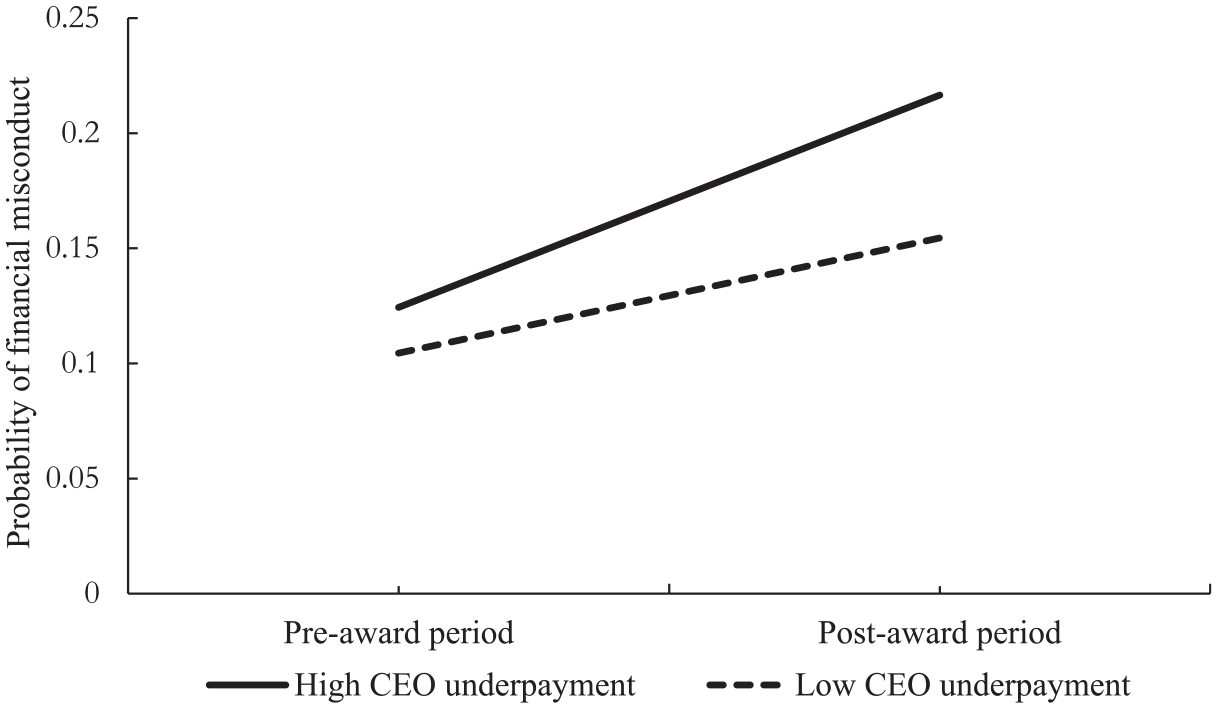
The Effect of Winning a CEO Award on Financial Misconduct Under Different Levels of CEO Underpayment
In Model 3, we test Hypothesis 3 by adding the triple interaction of treatment firm, the post-award period, and rarity of awards in the industry (Treatment × Post-Award Period × Industry Award Rarity). The coefficient estimate of this triple interaction is positive (β = 0.02, p < .05), supporting Hypothesis 3. In industries where the CEO is the only award winner in that year (i.e., industry award rarity equals 0), the likelihood of financial misconduct increases by 6.0% after the CEO wins an award. In industries with many award winners (i.e., industry award rarity one standard deviation below the mean), the likelihood of financial misconduct decreases by 1.7% after the CEO wins an award. Figure 3 shows the moderating effect of industry award rarity: When industry award rarity takes a low value (dotted line), we observe a negative relationship between post-award period and financial misconduct. When industry award rarity takes a high value (solid line), the relationship between post-award period and financial misconduct turns positive.

The Effect of Winning a CEO Award on Financial Misconduct Under Different Levels of Industry Award Rarity
Robustness Check
Given that the dependent variable is binary, we check the robustness of our results using logistic regressions. This allows us to include the first-order effect of the interaction of treatment and post-award period in the regressions. We also include industry and year fixed effects. In unreported results (all unreported results are available on request), the coefficient estimate of Treatment × Post-Award Period is positive and statistically significant (β = 0.49, p < .05), supporting Hypothesis 1. The coefficient estimate of the triple interaction of Treatment × Post-Award Period × CEO Underpayment is positive and statistically significant (β = 0.25, p < .05), consistent with Hypothesis 2. The coefficient estimate of the triple interaction of Treatment × Post-Award Period × Industry Award Rarity is also positive and statistically significant (β = 0.46, p < .05), supporting Hypothesis 3. These results are consistent with our main findings.
Supplementary Investigations
Elevated Expectation
There could be a concern that misconduct is more likely in the post-award period than in the pre-award period because CEOs face elevated expectations from investors (Mishina et al., 2010; Trompeter et al., 2012). After winning awards, CEOs will be burdened with elevated expectations from investors, analysts, and the public. To investigate whether our findings are driven by elevated performance expectations, we test the moderating effect of firm performance and analyst recommendation. If award-winning CEOs are committing misconduct to meet performance expectations, the effect of winning an award should be stronger when they fail to meet performance expectations (i.e., a negative moderating effect of firm performance and analyst recommendations). In contrast, if award-winning CEOs commit misconduct because they feel entitled, the effect of winning an award should be stronger when performance meets or beats expectations (i.e., a positive moderating effect of firm performance and analyst recommendations).
In unreported results of CEO fixed-effects regressions, the coefficient estimate of the triple interaction term (Treatment × Post-Award Period × Firm Performance) is positive and statistically significant (β = 0.32, p < .05), indicating a positive moderating effect of firm performance. In addition, the coefficient estimate of the triple interaction term (Treatment × Post-Award Period × Analyst Recommendation) is positive and marginally significant (β = 0.03, p < .10), showing a positive moderating effect of analyst recommendation. These results suggest the effect of winning an award on financial misconduct is stronger when CEOs have exceeded performance expectations, lending support to the psychological entitlement mechanism as opposed to that of elevated expectations.
CEO Culpability
For misconduct, we can investigate specific instances where the CEO is especially guilty. Specifically, CSMAR sometimes (but not always) calls out the wrongdoing of particular individuals. We create an alternative dependent variable, CEO misconduct, which is 1 if a CEO is named in a CSMAR report and 0 otherwise. In unreported results using CEO fixed-effects regressions, the coefficient estimate of the interaction of treatment firm and the post-award period (Treatment × Post-Award Period) is positive and significant (β = 0.02, p < .01). The coefficient estimate of the triple interaction term for Hypothesis 2 (Treatment × Post-Award Period × CEO Underpayment) is positive and significant (β = 0.01, p < .01). The coefficient estimate of the triple interaction term for Hypothesis 3 (Treatment × Post-Award Period × Industry Award Rarity) is also positive and significant (β = 0.01, p < .01). These results are consistent with our main findings.
Follow-On Awards
Winning an award for the first time is a more novel, disruptive, and critical event than winning a second, third, or fourth award. CEOs who have previously won awards will have already gained many of the social and career benefits associated with winning awards, so winning more awards offers diminishing returns. Thus, if our theory is correct, CEOs should experience a greater increase in psychological entitlement after winning their first award than after winning subsequent awards. If so, we should expect the effect on misbehavior to be less strong for follow-on awards than for the first award.
We test this using a sample of post-award observations that include follow-on CEO award winners. In this analysis, the variable multiple awards receives a value of 1 for observations where the CEO receives their second or later award and 0 for observations where the CEO receives their first award. For this analysis, we estimate the following CEO fixed-effects OLS regression:

where i indexes CEO and t indexes time. Yit is the dependent variable, α t denotes year fixed effects, δ i denotes CEO fixed effects, and ε it is an error term. Xi,t−1 refers to a vector of control variables. β is the estimate of the effect that winning multiple CEO awards has on financial misconduct. In unreported results of CEO fixed-effects regressions, the coefficient estimate of multiple awards is negative and statistically significant (β = −0.10, p < .05). This supports our argument that the positive effect of winning an award on a CEO’s likelihood of engaging in financial misconduct is stronger for the first award than for subsequent awards.
Time Effect of Awards
To confirm that award winning is a meaningful event, we consider the extent to which the impact of the event diminishes over time. We construct four new variables: post-award period(t+0), post-award period(t+1), post-award period(t+2), and post-award period(t+3). Post-award period(t+n) is coded as 1 if the observation occurs in the nth year after the award year and 0 otherwise. We generate the interaction of each of the post-award period variables with treatment and add these interactions into CEO fixed-effects OLS regressions. In unreported results, the coefficient estimates of each individual interaction term (modeled separately) are positive and statistically significant. In addition, the coefficient estimates decrease in magnitude as they get further away from the award year. The results show that the effect of winning a CEO award on financial misconduct is strongest in the award year, weaker at t + 1, weaker still at t + 2, and weakest at t + 3. The results of the full model, with all interaction terms, shows that only the coefficient estimate of the interaction term Treatment × Post-Award Period(t+0) is positive and statistically significant (β = 0.06, p < .05), and other interaction terms are not statistically significant. This again supports the notion that the effect of an award on misconduct decreases over time.
Conceptual Validations
Financial Misconduct
We theorize about, but do not measure, CEOs who engage in misconduct but are not yet caught. Therefore, using alternative analyses, we attempt to confirm that our results hold when we account for this group. The outcome of financial misconduct depends on two distinct but latent processes: commitment and detection of misconduct. If the detection process is imperfect, then the probability that misconduct is detected would be different from the probability it is committed. To empirically account for misconduct that is committed but not yet detected (i.e., those who are cheating and getting away with it), we use a bivariate probit model with partial observability. This approach attempts to infer the probability of committing misconduct by using data on misconduct that is detected. The bivariate probit model thus allows us to develop an approximation of the two latent probabilities of interest using only observed data (i.e., misconduct that is detected).
To create bivariate probit models with partial observability, for each firm i, we denote Fi as its incentive to commit misconduct and Di as its potential for getting caught, conditional on committing misconduct. We consider the following reduced-form model:


where xF,i is a row vector with elements that explain firm i’s incentive to commit misconduct, and xD,i contains variables that explain the firm’s potential for getting caught. The terms ui and vi are zero-mean disturbances with a bivariate normal distribution. Their variances are normalized to unity because the variances are not estimable. The correlation between ui and vi is ρ. Instead of directly observing the realizations of Fi and Di, we observe Zi = Fi*Di, where Zi = 1 if firm i has committed misconduct and has been detected, and Zi = 0 if firm i has not committed misconduct or has committed misconduct but not yet been detected. Let Φ denote the bivariate standard normal cumulative distribution function. The empirical model for Zi is as follows:


Thus, the log-likelihood function for the model is as follows:

The above model can be estimated using a maximum-likelihood method.
To achieve identification for bivariate probit regressions with partial observability, two conditions must be fulfilled (Poirier, 1980). First, variables associated with detecting and committing misconduct should not be the same. Second, predictors should have significant variation. Accordingly, continuous variables are preferred over binary variables (Shi, Connelly, & Hoskisson, 2017; Wang, 2013). The bivariate probit model can help solve the partial observability problem only when the two conditions are met. Therefore, we leave out CEO fixed effects and year dummy variables for these models because including them would result in model estimation failure. In addition, we only use the bivariate probit model to test our main hypothesis because the inclusion of triple interaction terms also leads to estimation failure.
To model detection of misconduct, we use firm size and age because misconduct by large and established firms is more likely to be detected given that they attract investor attention (Khanna, Kim, & Lu, 2015). We use industry-adjusted stock performance and stock return volatility because stock market performance can affect detection (Johnson, Nelson, & Pritchard, 2006). Industry-adjusted stock performance is the buy-and-hold stock returns in a fiscal year minus the industry mean, and volatility is the standard deviation of daily stock returns. We use board independence, CEO-appointed directors, and audit committee independence (i.e., percentage of independent directors on the audit committee) because these variables capture the intensity of internal monitoring, which can affect detection (Khanna et al., 2015). We use the percentage of institutional ownership because institutional investors can play an important role in detecting misconduct (Lin, Cai, & Li, 1998). We use CEO duality and tenure because they could influence internal monitoring and, in turn, detection (Westphal & Zajac, 1995). We use state ownership and board political connections because political ties with the government could influence whether or not misconduct is detected (Luo et al., 2017). Board political connections is the ratio of outside directors with political connections to board size (Chizema, Liu, Lu, & Gao, 2015). As important information intermediaries, securities analysts can also affect the detection of misconduct (Wang, 2013). We therefore use analyst coverage, which is the number of analysts following a firm. Last, we use industry misconduct intensity because external stakeholders may pay greater attention to firms in industries in which misconduct is common. We cannot include industry dummy variables in bivariate probit regressions, so instead we use industry dynamism, which is the variability in industry revenues, measured as the standard error of the regression coefficient of sales over time divided by the industry mean (Dess & Beard, 1984). We also use industry average ROA, which is the mean ROA of all firms in the industry.
In Table 4, we show the results of our bivariate probit regressions using a sample of all Chinese-listed firms from 1990 to 2015. The main predictor is the interaction of treatment firm and the post-award period (Treatment × Post-Award Period). In Model 1, which estimates P(F), the coefficient estimate of Treatment × Post-Award Period is positive and statistically significant (β = 0.34, p < .01). This result confirms our main conceptual argument that firms are more likely to engage in misconduct (whether or not they are eventually caught) after their CEOs win an award.
Bivariate Probit Regressions (Dependent Variable: Financial Misconduct)

Note: The table presents the bivariate probit regressions using all Chinese-listed firms (18,545 firm-year observations) from 1990 to 2015. Robust standard errors are given in parentheses (clustered by firm). All control variables have been lagged for a year.
We cannot include treatment and post-award period in bivariate probit regressions because they are both dummy variables.
p < .10
p < .05
p < .01
p < .001 (two-tailed tests)
In addition, in Model 2, which estimates P(D|F), the coefficient estimate of Treatment × Post-Award Period is negative and statistically significant (β = −0.55, p < .01). In other words, among firms that commit misconduct, the misconduct is less likely to be detected after the CEO wins an award. This suggests that our model is not likely to be biased by unobserved misconduct.
Psychological Entitlement
We also theorize about, but do not measure, psychological entitlement. Therefore, using primary survey data from CEOs, we attempt to verify that psychological entitlement is the underlying mechanism for the proposed relationships. The survey we use was conducted by the China Association for Public Companies (CAPCO) under the supervision of the CSRC. A total of 2,141 Chinese-listed firms (i.e., two-thirds of all Chinese-listed firms) have joined CAPCO, which is mainly responsible for providing training and assistance to help members understand and implement government regulations. Most CEOs of Chinese-listed firms are keen to participate in activities organized by CAPCO because through these activities they gain access to officials of the CSRC and other governmental agencies.
In 2017, CAPCO and Sun Yat-sen Business School jointly conducted a survey to collect information about CEOs’ psychological characteristics (including psychological entitlement) during one of CAPCO’s meetings. These CEOs were not informed about the purpose of the research. The questionnaire used a nine-item scale developed by Campbell et al. (2004) to measure psychological entitlement. This scale has been widely used in the management literature (e.g., Qin, Chen, Yam, Huang, & Ju, 2020; Vincent & Kouchaki, 2016). Items were scored on a 5-point scale ranging from 1 (strongly disagree) to 5 (strongly agree). The items included (a) “I honestly feel I’m just more deserving than others”; (b) “Great things should come to me”; (c) “If I were on the Titanic, I would deserve to be on the first lifeboat”; (d) “I demand the best because I’m worth it”; (e) “I do necessarily deserve special treatment”; (f) “I deserve more things in my life”; (g) “People like me deserve an extra break now and then”; (h) “Things should go my way”; and (i) “I feel entitled to more of everything.”
We conducted an exploratory factor analysis (EFA) of the data for these nine items. Results of the EFA indicate that only one factor is extracted with an eigenvalue of 5.58 (larger than 1) as the threshold, suggesting a single-factor structure. Existing literature typically considers this measurement of psychological entitlement as a single-factor construct (Campbell et al., 2004; Qin et al., 2020). Therefore, we use a single-factor structure for this nine-item scale (α = .93).
A total of 538 CEOs of publicly traded Chinese companies provided valid data. We examined whether these 538 CEOs (i.e., respondents) and other CEOs of Chinese publicly traded companies (i.e., nonrespondents) differed significantly on key individual- (i.e., CEO age, gender, tenure, compensation, and board-chair duality) and firm-level characteristics (i.e., firm size, performance, and age) using the Kolmogorov-Smirnov test (Westphal, 1999). Results show that the distribution of these variables for respondent and nonresponding CEOs are not significantly different (the p values ranged from .197 to .684), suggesting they come from the same population.
We merged the CEO psychological entitlement data from this survey with the CEO award, misconduct, and other information using the names of the CEOs and their firms. With this new sample, we were able to examine the mediating effect of psychological entitlement on the relationship between winning a CEO award and committing financial misconduct. The independent variable is CEO award, which receives a value of 1 if the CEO has won an award in the past 3 years (i.e., during the period from 2014 to 2016) and 0 otherwise. The dependent variable financial misconduct is also a dummy variable that receives a value of 1 if the firm has committed misconduct in or after 2017. We use the average of the nine items in the questionnaire to measure psychological entitlement (i.e., the mediator). We include all control variables described in our prior analyses. In addition, we control for industry fixed effects. The data are cross-sectional, so we cannot include year or CEO fixed effects. With psychological entitlement as the dependent variable, we use OLS regressions. With financial misconduct as the dependent variable, we use logistic regressions. Results are shown in Table 5.
Mediating Effect of Psychological Entitlement

Note: Standard errors are given in parentheses. All control variables have been lagged for a year.
p < .10
p < .05
p < .01
p < .001 (two-tailed tests)
In Model 1, we find that the coefficient estimate of CEO award is positive and statistically significant (β = 1.26, p < .001), suggesting that CEOs who have won an award have a higher level of psychological entitlement than those who have not won an award. In Model 2, the coefficient estimate of CEO award is positive and statistically significant (β = 1.12, p < .01), consistent with our prior analyses. In Model 3, the coefficient estimate of psychological entitlement is positive and statistically significant (β = 0.45, p < .01), showing a positive effect on financial misconduct. In Model 4, the coefficient estimate of psychological entitlement is still positive and statistically significant (β = 0.41, p < .05), while the coefficient estimate of CEO award is now insignificant (β = 0.37, p = .526). We further apply the software package RMediation to examine the indirect effect of winning a CEO award on financial misconduct via psychological entitlement. Results reveal that the indirect effect is positive and statistically significant (estimate = 0.52; 95% confidence interval = [0.16, 0.90]), supporting the mediating effect of psychological entitlement.
Discussion
We find that CEOs are more likely to engage in financial misconduct after winning a prestigious award from the media. In addition, the likelihood of their committing financial misconduct is stronger when they are underpaid or work in industries in which awards are rare. We develop arguments about the extent to which winning a prestigious media award can elevate CEOs’ feelings of psychological entitlement, which increases the likelihood of financial misconduct at the firms they oversee. We also attempt to confirm the unobservable aspects of our ideas, in two ways. First, we cannot measure financial misconduct that goes undetected, so we model unobserved misconduct using a bivariate probit regressions with partial observability. Second, we cannot measure psychological entitlement for all the CEOs and years in our study, so we confirm the mediating role of psychological entitlement using survey data from one year in our sample.
Our findings contribute to the literature on organizational misbehavior by drawing attention to the role of important events experienced by CEOs in shaping the occurrence of financial misconduct. Prior research in this arena has demonstrated the influence of CEOs’ stable characteristics and traits (Koch-Bayram & Wernicke, 2018; Rijsenbilt & Commandeur, 2013) as well as compensation structures (O’Connor et al., 2006). Our study, however, adds a previously overlooked antecedent in the form of important life events. This moves the discussion about the antecedents of financial misconduct from relatively stable constructs (e.g., demographic variables) to externally driven triggers (Morgeson et al., 2015). We believe this is an important shift because CEOs’ decisions and behaviors are driven not only by who they are but also who others perceive them to be. Studies show that people adopt certain behaviors in response to how others view them (Brophy, 1983). We combine that with research on psychological entitlement to develop new ideas about misbehavior among the managerial elite. In addition, we contribute to research on social status and misconduct by introducing the mechanism of psychological entitlement. Our study demonstrates that those with social acclaim are more likely to engage in misbehavior after gaining social approval because of an increased sense of entitlement that allows them to rationalize their behavior and hence break the rules.
Understanding how social status affects deviant behaviors has been a long-standing focus of research in sociology (Piff, Kraus, Côté, Cheng, & Keltner, 2010; Robins, Gyman, & O’Neal, 1962). This stream of research suggests that high-status actors tend to deviate from group norms (Graffin, Bundy, Porac, Wade, & Quinn, 2013; Krishnan & Kozhikode, 2014) because they resort to deviant behaviors to meet heightened expectations and maintain their status (Mishina et al., 2010). Yet, high-status actors may think they have more freedom to deviate from norms because others would surely give them the benefit of the doubt (Piff, 2014). We contribute to this research by uncovering psychological entitlement as the mechanism behind why high-status actors engage in deviant behavior.
An emerging set of studies on the dark side of awards has revealed several important consequences of executive awards. Our study enriches this rapidly growing body of work. Scholars have shown, for example, that CEOs may choose to pursue a quiet life (Malmendier & Tate, 2009) or become concerned about maintaining their celebrity status (Cho et al., 2016) after winning an award. Others have found that award-winning CEOs may engage in high-premium acquisitions to maintain their social status when firm performance is undesirable (Cho et al., 2016). We build on these studies by considering a negative externality of CEO awards that could have far-reaching consequences. Although the media is likely well intentioned, it has probably not occurred to them (or others) that CEO awards could effectively trigger misbehavior. Our study suggests that an award could put a CEO and their firm in peril as it may give way to undue privilege.
Relatedly, our findings contribute to the growing research on upper echelons (Gupta, Briscoe, & Hambrick, 2018). Upper-echelons research has showed that top executives’ demographic and psychological characteristics affect strategic choices and performance (Finkelstein, Hambrick, & Cannella, 2009). More recent studies have unpacked the relationship between managerial upper echelons and organizational misbehavior (Koch-Bayram & Wernicke, 2018; Wowak & Hambrick, 2010). A separate line of study, however, has begun to investigate the consequences of important external events that CEOs have been through and how these events might shape their motivation and decision making (Dahl, Dezső, & Ross, 2012; Shi, Hoskisson, et al., 2017; Shi, Zhang, et al., 2017). This, in fact, led to a recent call for systematic research on how meaningful events influence CEOs and the firms they manage (Liu, Fisher, & Chen, 2018). Our study responds to this call by developing ideas that reside at the intersection of upper-echelons theory, misbehavior, and the literature on important events.
Our findings also have important practical implications. First, our results indicate that financial misconduct can be triggered by important events experienced by CEOs that heighten their sense of psychological entitlement. Therefore, the board of directors and external governance actors (such as institutional investors and securities analysts) should pay attention to such events. Second, CEOs should bear in mind that winning prestigious awards could change them in ways they may not anticipate. Last, our findings offer value to regulators. We find that financial misconduct committed by award-winning CEOs is less likely to be detected than that committed by non-award-winning CEOs. Therefore, regulators may need to scrutinize more closely firms managed by award-winning CEOs so that any misconduct will be detected in a timely manner.
Our study is not without limitations. First, CEOs’ propensity for financial misconduct can be a function of their psychological traits (e.g., level of self-control, narcissism, and hubris). We used CEO fixed-effects regressions to partial out the influence of such traits, but future research could explore how various psychological traits change the effects of winning an award. Second, we focused exclusively on financial misconduct, partly because it clearly harms the interests of investors and firms. Future research, however, might investigate the influence of CEO awards on investment decisions, such as those related to corporate social responsibility. On one hand, after winning an award, CEOs may become less concerned about the consequences of engaging in socially irresponsible behavior. On the other, awards could motivate CEOs to invest in socially responsible behavior to further strengthen their external visibility. Third, our data are limited to one country, China. Future work might examine the extent to which our results hold in other institutional contexts.
Footnotes
Acknowledgements
The authors are grateful to Junsheng Zhang in Sun Yat-sen Business School and Xiaojian Tang in Nanjing Agricultural University for their research support and to the China Association for Public Companies (CAPCO) for their kind assistance in the survey study. The authors also wish to acknowledge the constructive suggestions provided by action editor Taco Reus and two anonymous reviewers throughout the review process. The authors are also grateful for the financial support from the National Natural Science Foundation of China (Grant Nos. 71902197, 71810107002, 71672196, and 71802007).
