




Abstract
Extant diversity climate research has been based primarily upon the Interactional Model of Cultural Diversity (IMCD). While prior research has supported the beneficial effects of prodiversity climates (i.e., work environments that employees view as fair and socially integrative of all personnel) on worker attitudes and behaviors, less is known about the potential boundary conditions of diversity climate-outcome relationships. To address this concern, we conducted a meta-analysis of diversity climate using 109 independent samples from 94 studies. Meta-analytic results indicate that diversity climate–outcome relationships are moderated by climate measure type, outcome type, demographic diversity, climate strength, and measurement source. These findings show that diversity climate is more strongly related to outcomes when measured as inclusion climate (vs. diversity climate), for attitudinal outcomes compared to performance and withdrawal criteria, when work contexts are more racially and ethnically diverse, when personnel exhibit stronger versus weaker agreement in their diversity climate perceptions, and when diversity climate and outcome data are collected from the same source versus different sources. The theoretical and practical implications of our findings are noted and discussed.
Research on diversity climate, defined as “the degree to which a firm advocates fair human resource policies and socially integrates underrepresented employees” (McKay, Avery, & Morris, 2008: 352), has proliferated considerably since Cox (1994) published the first and most comprehensive diversity climate theoretical framework (Interactional Model of Cultural Diversity; IMCD). Additionally, scholars sought explanations for the mixed results diversity had on organizational outcomes within the literature (Roberson, Holmes, & Perry, 2017). Grounded in social identity theory (SIT; Tajfel & Turner, 1986), Cox intended the IMCD to be applicable to various cultural identity groups (e.g., racioethnic, sex, religion, etc.) but did not intend it to be a general theory about diversity or heterogeneity (e.g., educational or functional background, etc.). SIT posits that individuals classify themselves and others into certain social identity groups and that this identification has implications for advancing the interests of in-group members relative to out-group members (Tajfel & Turner, 1986).
Recognizing that these social identities play an important role in people’s work experiences, the IMCD posits that (1) human resource (HR) practices that foster fairness and the social integration of all employees promote supportive diversity climates and (2) diversity climates influence employees’ affective (e.g., satisfaction, commitment, etc.) and achievement outcomes (e.g., performance, organizational citizenship behaviors, etc.), which, in turn, have implications for employees’ withdrawal behaviors (e.g., turnover, disengagement, etc.). Despite the comprehensiveness of the IMCD, diversity climate research does not offer scholars and practitioners enough clarity to theorize about or manage diversity climate. A major reason for this is that diversity and inclusion are often referenced together and used interchangeably in prior research (cf. Shore et al., 2011). Although the IMCD supports their integration, some scholars argue that diversity and inclusion are distinct constructs and their unique influences on work-related outcomes should be examined to allow for theoretical and practical advancements in these literatures (Nishii, 2013; Roberson, 2006; Shore et al., 2011).
Despite being multilevel, the IMCD explicitly assumes the emergence of analogous relationships between variables across levels of analysis, whereas Nishii’s (2013) climate for inclusion theoretical framework implies it is only a unit-level construct. Moreover, most diversity and inclusion climate researchers have assumed homology across different levels of analysis with little theoretical or empirical guidance to support that assumption (Chen, Mathieu, & Bliese, 2015; Oh, Kim, & Van Iddekinge, 2015). Accordingly, some researchers aptly note the atheoretical manner some scholars study diversity climate at the individual level (i.e., psychological) or at aggregate levels (e.g., team, firm, community, etc.) (Dwertmann, Nishii, & van Knippenberg, 2016). When scholars investigate diversity climate at the individual level, each respondent’s perceptions are analyzed to determine their relationship with the outcome variables. However, when investigated at the aggregate level, scholars assess within-group agreement. If there is sufficient agreement within groups, respondents’ perceptions are aggregated to form unit-level diversity climate ratings, which are analyzed to determine their relationship with the outcome variables. That is, although individual-level diversity climate studies are most prevalent within the literature, some scholars argue that diversity climate should only be measured at the aggregate level (James et al., 2008). As such, ambiguity abounds concerning when it is appropriate to theorize and operationalize diversity and inclusion climate at the individual level, aggregate level, or both.
In addition to these issues, recent reviews underscore several theoretical gaps and potential boundary conditions of diversity climate–outcome relationships that warrant exploration (Dwertmann et al., 2016; McKay & Avery, 2015). The IMCD proposes diversity climate impacts performance via attitudinal perceptions, but investigators have largely ignored this proposition and theorized direct relationships. If this aspect of the model is correct, then diversity climate should exhibit significantly stronger effects on attitudes (as a more proximal outcome) than performance (a more distal outcome). Furthermore, current research is relatively silent on how variation in employee demographic diversity (i.e., the extent of variety among employees on demographic dimensions such as race-ethnicity, gender, age, etc.; Harrison & Klein, 2007) and climate consensus might influence diversity climate–outcome relationships. Moreover, there is evidence that climate effects on firm outcomes are amplified when employees strongly agree that a company emphasizes a particular climate referent such as service or safety as a strategic imperative (Dickson, Resick, & Hanges, 2006). However, climate strength, or the extent that personnel form consensual perceptions of the climate of a work environment (Dickson et al., 2006), has yet to be examined as a potential moderator of diversity climate effects on worker/firm outcomes. These issues seriously constrain full understanding of diversity climate’s impact on organizations and impede scholars’ abilities to move this literature forward.
Despite these scholarly limitations, Catalyst (2005) reported that the median annual investment by organizations to improve their diversity climate is $1.2 million. Another industry survey indicated that 35% of organizations planned to increase their diversity and inclusion financial investments, 62% planned to maintain current investment levels, and only 3% planned to decrease their investment levels (Talley, 2017). Without greater precision concerning when diversity climate effects will be more or less pronounced, organizations have little evidence-based guidance on how to maximize the returns from their diversity investments.
To address the above limitations, we conducted a meta-analysis to test key boundary conditions (i.e., climate type, climate level, outcome type, demographic diversity, and climate strength) of the diversity climate–outcomes relationship (See Figure 1). As such, our investigation makes four contributions to the literature. First, we answer Shore et al.’s (2011) and Nishii’s (2013) call to explicitly investigate possible differences in the diversity climate and inclusion climate constructs. Our study demonstrates that not all diversity climate constructs are equivalent in their relationship with organizational outcomes. Given the increased importance that leaders, policy makers, and employees are placing on diversity, our study advances an evidence-based understanding of the potential promises and limitations of fostering supportive diversity and inclusion climates within organizations. This investigation will also determine whether diversity and inclusion climate should be integrated as the IMCD suggests or viewed as distinct as some inclusion climate theories suggest. Second, by determining the relative magnitude of effects on attitudinal and behavioral outcomes, we shed light on the process through which diversity climate affects various employee outcomes. Third, we attempt to extend the IMCD by assessing whether diversity climate–outcome relationships are moderated by aspects of the organizational context such as racioethnic/gender diversity, climate strength, and level of analysis (i.e., diversity climate measured at the individual vs. aggregate level). Such inquiry should enhance clarity regarding the conditions under which diversity climate is maximally related to outcomes.

Theoretical Model of the Moderators of the Relationships Between Diversity Climate and Organizational Outcomes
Finally, we test level of analysis as a moderator for both bivariate and multivariate diversity climate–outcome relationships. By doing so, we address researchers’ calls for explicit tests of homology for multilevel organizational phenomena with multilevel theoretical frameworks (Chen et al., 2015). Taken together, our meta-analysis will demonstrate the impact of (a) operationalizing climate as diversity or inclusion, (b) studying it as an individual or collective phenomenon, (c) testing its effects in more homogenous or heterogeneous samples, (d) examining attitudinal or behavioral outcomes, and (e) the degree of consensus among those assessing the climate. Observed differences would indicate that the results of scholarly inquiry could vary depending on how researchers consciously conceptualize, select, and define their constructs, samples, and outcomes when designing and executing diversity climate research.
Theory and Hypothesis Development
The IMCD proposes that an organization’s diversity climate is determined by four individual-level (personal identity structures, prejudice, stereotyping, and personality type), three intergroup (cultural differences, ethnocentrism, and intergroup conflict), and four organizational context (organizational culture and acculturation processes, structural integration, informal integration, and institutional bias) factors. Ultimately, the individual-level, intergroup, and organizational-level diversity factors affect employees’ affective and achievement outcomes (e.g., job/career satisfaction, organizational identification, job performance, promotion, etc.) and organizational effectiveness outcomes (e.g., attendance, turnover, work quality, market share, innovation, organizational goals, etc.; Cox, 1994). Across these levels, work contexts that perpetuate prejudices and stereotyping will breed intergroup conflict, thereby culminating in an organizational climate of discrimination and exclusion. Consequently, negative diversity climates result in less favorable worker attitudes and performance, increased employee withdrawal, and subsequently reduced firm- (or unit) level performance. In contrast, positive diversity climates coincide with fewer incidences of discriminatory treatment (Boehm et al., 2014) and should be viewed as fair and inclusive by personnel, leading to improved work attitudes and performance and reduced worker withdrawal and, by extension, enhanced unit or firm performance.
As a complement to the IMCD, social exchange theory (Blau, 1964) proposes that employees and employers interact through a series of social exchanges governed by the norm of reciprocity (Gouldner, 1960). Employees view a firm’s actions as personifications of its goodwill toward them and reciprocate in kind the treatment they receive. Generally, personnel who perceive their organizations as supportive of their welfare and well-being report higher job satisfaction, organizational commitment, lower turnover intentions and voluntary turnover, and exhibit higher job performance (Rhoades & Eisenberger, 2002). Likewise, employees reciprocate firms’ efforts to maintain a prodiversity climate by reporting more favorable work attitudes, performing better, and ultimately enhancing firm or unit performance (McKay, Avery, Liao, & Morris, 2011; McKay et al., 2007; McKay et al., 2008).
Moderators of Diversity Climate–Outcome Relationships
Although the diversity climate literature has established the generally favorable effects of prodiversity work climates on worker attitudes and behaviors and business-level outcomes, the IMCD has been less informative regarding potential boundary conditions of diversity climate–outcome relationships. In response, our current meta-analysis will examine five prospective moderators of diversity climate effects on outcomes: (a) climate type, (b) level of analysis, (c) outcome type, (d) demographic diversity, and (e) climate strength.
Climate type
The IMCD (Cox, 1994) suggests diversity and inclusion are interrelated as it argues prerequisites for a positive diversity climate are fair treatment and effective structural and social inclusion of all employees, particularly those from historically disadvantaged identity groups. However, Nishii (2013) distinguished diversity climate and inclusion climate by arguing that diversity climate simply focuses on the fair treatment of historically disadvantaged groups, whereas inclusion climate emphasizes the effective integration of all employees’ diverse skills and insights. In practical terms, managers solely focused on creating positive diversity climates (as opposed to both positive diversity and inclusion climates) might successfully reduce bias in their organizations yet fail to produce any new capabilities or synergies among employees (Holmes, Lopiano, & Hall, 2019; Nishii, 2013). Along these lines, optimal distinctiveness theory (ODT; Brewer, 1991) suggests that people are most productive when they are included and accepted by others, and they are respected for their individuality and unique contributions. Therefore, managers who foster inclusive climates satisfy both employees’ belongingness and uniqueness needs, thus enabling their personnel to unlock their full potential and participation within organizations (Shore et al., 2011). Considering inclusion climate’s broader nature and expressed focus on effectively leveraging employees’ diverse capabilities, we hypothesize that inclusion climate will exhibit a stronger effect on outcomes than will diversity climate.
Hypothesis 1: Climate type moderates the relationships of diversity climate with organizational outcomes such that measures of inclusion climate exhibit more positive relationships with organizational outcomes than do measures of diversity climate.
Level of analysis
Homology assumptions involve the expectation that relationships between variables posited at one level of analysis (e.g., individual level) will hold at another level of analysis (e.g., the unit or department level). Typically, diversity climate scholars have made analogous predictions regardless of whether they measured diversity climate and its outcomes at the individual or unit level (McKay & Avery, 2015). Rousseau (1985) cautions scholars against endorsing these potential cross-level fallacies and Chen, Bliese, and Mathieu (2005: 376) contend that “scholars must consider whether processes and relationships among variables at one level (e.g., the individual) are consistent with analogous processes and relationships at another level (e.g., the team) [and] . . . explicit tests of homology help to highlight domains where inferences of homology are warranted and domains where they are not.”
Organizational climate theory states that climates can be inferred only to the extent that there is sufficient agreement among employees in their valuations of workplace events, procedures, reward structures, etc. (Chan, 1998). Accordingly, many climate scholars argue that diversity climate is most accurately conceptualized as an aggregate-level construct. High agreement on diversity climate may signify the presence of a “modal personality or value” in a work context (Schneider, Salvaggio, & Subirats, 2002) that could limit variation in responses to diversity climate measures among members in the same unit. Reduced variance, by eliciting within-unit homogeneity (or range restriction), should lower predictor–criterion relationships within units or at the individual level (Schmidt & Hunter, 2015). However, reduced within-unit variance can enhance predictor–criterion relationships across units by facilitating between-unit heterogeneity (Oh, Han, Holtz, Kim, & Kim, 2018). Furthermore, aggregation increases reliability by allowing a broader sampling of information relevant to the construct of interest (Schmidt & Hunter, 2015). Based on this rationale, we hypothesize that diversity climate–outcome relationships should be stronger at the unit level than the individual level.
Hypothesis 2: Level of analysis moderates the relationships of diversity climate with organizational outcomes such that the relationships are more strongly positive at the unit as opposed to individual level.
Outcome type
According to the IMCD, diversity climate influences two distinct yet related sets of outcomes (Cox, 1994). The first type are proximal outcomes involving individual career criteria and perceptions thereof. These include attitudinal measures that are direct consequences of diversity climate such as job satisfaction, organizational commitment, and engagement. Conversely, the latter type are more distal, performance-oriented outcomes at the individual, group, and firm levels of analysis. Cox (1994) predicted that diversity climate effects on distal (e.g., performance) outcomes are indirect through workers’ attitudes. The notion of attitudes influencing performance is supported by theory and evidence on the attitude-engagement model (Harrison, Newman, & Roth, 2006). As such, an organization’s diversity climate fosters workplace experiences that, in turn, affects employees’ work efforts and performance through enhanced or worsened attitudes rather than impacting their actual knowledge, skills, and abilities. Because people reciprocate exchanges that maximize their benefits and minimize their costs (Blau, 1964), a favorable diversity climate is likely to improve their attitudes motivating them to work more productively. In contrast, a negative diversity climate is likely to worsen their attitudes, motivating them to decrease their work efforts. Based on the IMCD, we expect diversity climate to have significantly stronger relations with more proximal attitudinal (e.g., satisfaction) and cognitive (e.g., withdrawal cognitions) outcomes than with behavioral outcomes (e.g., performance).
Hypothesis 3: Outcome type moderates the relationships of diversity climate with organizational outcomes such that diversity climate exhibits more positive relationships with attitudinal outcomes than with behavioral outcomes.
Demographic diversity
Although most employees stand to benefit from an organization ensuring fair treatment and inclusion, the returns they experience may be contingent upon the level of demographic diversity present. For instance, in homogenous workplaces (e.g., low racioethnic or gender diversity, etc.), it is doubtful that identity-related issues of fairness and inclusion are as salient (Holmes, Whitman, Campbell, & Johnson, 2016). This is probable because there is relatively little variance among personnel along the dimensions that most strongly influence people’s perceptions of workplace mistreatment (Avery, McKay, & Wilson, 2008). When greater demographic diversity is present, however, concerns regarding fair treatment and inclusion may be heightened. In addition, greater demographic diversity often involves the presence of more women and minorities, groups that traditionally have been disparaged to a greater extent than men and Whites (Avery, Volpone, & Holmes, 2018). As such, the effects of congenial diversity climates on outcomes should be stronger in contexts where members of disadvantaged demographic groups are more numerous. Though we could find no explicit tests of this premise, some preliminary support can be gleaned from Gonzalez and DeNisi (2009). They found interactive effects of demographic diversity and diversity climate on unit financial performance but interpreted these effects by positioning diversity as the independent variable and diversity climate as the moderator. This can also be interpreted as diversity moderating the effects of diversity climate. The preceding logic and related finding both suggest the impact of diversity climate on organizational outcomes is contingent on demographic diversity in the following manner:
Hypothesis 4: Demographic diversity moderates the relationships of diversity climate with organizational outcomes such that the relationships are more strongly positive in samples containing greater (a) racioethnic or (b) gender diversity than in those containing less diversity.
Climate strength
Climate strength refers to “the degree to which there is agreement among an organization’s (unit’s) members regarding the practices and policies characterizing that organization (unit)” (Dickson et al., 2006: 352). Studies indicate that relationships between climate and team-, unit-, and firm-level outcomes are stronger when climates are also strong (Dickson et al., 2006; Koopman, Lanaj, & Scott, 2016). Schneider et al. (2002) explained these effects as a function of the relationship between climate strength and situation strength. Namely, stronger situations prompt individuals to interpret events more uniformly, resulting in clearer dictates for appropriate behaviors than weaker situations (Mischel, 1976). Consequently, higher consensus among organizational members concerning rewarded work behaviors invokes them to behave more consistently in line with organizational goals. Similarly, Whitman, Caleo, Carpenter, Horner, and Bernerth (2012: 780) argued that because strong climates, like strong situations, result in lower variability in workers’ responses to organizational events and policies, “this diminished variability is likely to result in more predictable outcomes.” Applying the preceding climate strength logic to diversity climate suggests stronger facilitative effects of diversity climate on outcomes when employees have more consensual views that their work contexts support diversity. Because these work environments are perceived to strongly endorse fairness and inclusion, we expect employees to reciprocate such organizational goodwill by exhibiting more favorable work attitudes, performing better, and being less inclined to consider withdrawing from their work units (McKay et al., 2007, 2008).
Hypothesis 5: Climate strength moderates the relationships of diversity climate with organizational outcomes such that the relationships are more positive when climates are stronger as opposed to weaker.
Method
Literature Search
We conducted an extensive electronic and manual literature search to identify both published and unpublished primary studies relevant to our research hypotheses. Because Cox’s (1994) IMCD is the first comprehensive diversity climate theoretical framework, we used it as the starting point for including diversity and inclusion climate studies to June 2019 in our meta-analysis. Relevant articles, theses, and dissertations were identified in the electronic databases using “diversity,” “inclusion,” and “climate” as keywords. Also, we checked the references cited in each source for additional papers, searched the programs from the Academy of Management (AOM) and Society for Industrial and Organizational Psychology annual conferences, and the table of contents and in-press articles of management, applied psychology, and diversity journals. Finally, we solicited unpublished papers (via list-serv) from the Gender and Diversity in Organization, Human Resources, and Organizational Behavior Divisions of AOM and contacted primary authors to provide necessary additional information.
Inclusion criteria
We used five inclusion criteria. First, we included primary studies that reported sufficient quantitative information necessary to compute correlations between diversity climate and at least one organizational outcome. Second, we included only primary studies based on working adults to generalize our findings to the general workforce population. Third, we selected only studies that measured diversity and inclusion climate in actual organizational settings. Fourth, we selected the most relevant, single sample when the same sample was used in multiple studies (e.g., Gonzalez, 2002; Gonzalez & DeNisi, 2009). However, when a primary study included multiple independent samples, we coded them separately (e.g., Triana, García, & Colella, 2010). The above criteria resulted in the inclusion of 109 independent samples (k) from 94 studies. Finally, consistent with prior meta-analyses (e.g., Oh, Wang, & Mount, 2011), we reported a meta-analytic result only when the k was at least three, as sound empirical evidence starts to emerge when at least three different studies on the same topic/relationship are conducted by at least two different researchers and synthesized via meta-analysis (Chambless & Hollon, 1998). 1 It is noted that meta-analytic results (in particular, true standard deviation estimates) based on smaller numbers of studies (e.g., k < 5) are more subject to second order sampling error (sampling error still left even after removing first-order sampling error; see Schmidt & Oh, 2013 for more details). As such, meta-analytic results based on small ks should be regarded as tentative, and caution should be exercised when drawing a conclusion from such results.
Coding procedures
From each primary study included in the current meta-analysis, we coded correlations between diversity climate and other variables of interest (see below), reliabilities, sample sizes, and moderator variables. Using this coding scheme, the first two authors coded all primary studies and checked the accuracy of coding by cross-checking all the codes. Given the nonsubjective nature of the coding (e.g., reliabilities), the initial inter-rater agreement rate was high at 99% (i.e., agreement on 1,803 out of 1,820 total cells). All remaining discrepancies were resolved by double-checking the primary studies in question and/or several rounds of discussion among the coders. The main codes for the meta-analysis are provided in the supplemental file.
Main Variables of the Meta-Analyzed Relationships
Diversity and inclusion climate
Because we want to compare diversity climate and inclusion climate in their relationships with outcome variables, we include both diversity climate and inclusion climate in our analyses. Diversity climate is defined as employee perceptions of the extent that their employer is fair and inclusive of personnel irrespective of demographic group membership (McKay et al., 2008). It should be noted that, operationally, diversity climate measures often include some inclusion-oriented items (e.g., “The organization value diverse perspectives”). Inclusion climate is defined as how strongly employees feel that their unique backgrounds, knowledge, skills, and perspectives are integrated in a work environment (Nishii, 2013). Therefore, studies were coded as inclusion climate if the measures focused more on the integration of insights and skills of all employees, and studies were coded as diversity climate if the measures focused more on fair HR diversity practices. All studies included in the current meta-analysis assessed diversity climate and inclusion climate via self-report. Studies varied in whether they analyzed scores at the individual or aggregate level.
Attitudinal and behavioral outcomes
In our meta-analysis, we focused on five types of outcome variables given the inclusion criterion concerning the minimum number of primary samples: job satisfaction, organizational commitment, engagement, employee withdrawal, and performance. Job satisfaction reflects employees’ overall satisfaction with their jobs (e.g., Nishii, 2013). Organizational commitment represents the emotional bond between employees and their organizations and indicates the extent to which employees identify with the organization and internalize organizational values and goals (e.g., Gonzalez & DeNisi, 2009). Engagement reflects employees’ physical, cognitive, and emotional investment of themselves in job performance (e.g., Downey, 2012). Employee withdrawal refers to the extent to which employees intend to withdraw from their jobs (e.g., turnover intentions) or actually withdraw from their current organization (e.g., voluntary turnover at the individual level, turnover rates at the unit level). Finally, performance outcomes at the individual level include job-relevant work behaviors, such as task-specific behavior (e.g., Volpone, 2013) and organizational citizenship behaviors (e.g., Triana & Garcia, 2009). At the unit level, performance outcomes include aggregate performance as well as operational and financial performance, such as customer satisfaction (e.g., McKay et al., 2011) and percentage change in sales volume (e.g., McKay et al., 2008).
Meta-Analysis Procedures
To statistically synthesize correlations across the primary studies, we adopted psychometric random-effects meta-analytic procedures (Schmidt & Hunter, 2015) and conducted analyses using Schmidt and Le’s (2015) software program. When a primary study provided multiple effect sizes for the same relationship, we used Hunter and Schmidt’s (2004: 435-439) formula to create a composite effect size for each relationship within a single primary study. That is, we maintained statistical independence by retaining only one data point (correlation) per sample for a given meta-analyzed relationship. We corrected each correlation for unreliability in both variables to estimate construct-level relationships. For variables measured at the individual level or at the unit level without aggregation (e.g., objective unit performance), we corrected for unreliability using local estimates of internal consistency reliability (i.e., Cronbach’s α). For variables that were measured initially at the individual level and then aggregated to the unit level (i.e., diversity climate and collective job satisfaction), we corrected for unreliability using ICC(2), the reliability estimate for unit-level mean following previous meta-analyses (e.g., Whitman et al., 2010). 2 For primary studies that did not provide reliability information, we imputed the missing reliability estimates with the average reliability estimated from other primary studies that examined the same variable at a commensurate level. The mean reliabilities for diversity climate, job satisfaction, organizational commitment, engagement, turnover intentions, and performance outcomes were .87, .84, .87, .89, .84, and .88, respectively, at the individual level and .78, .87, .80, .81, .94, and .83 at the unit level, respectively.
We computed 95% confidence intervals (CIs) around the estimated mean-corrected correlation, which quantify the accuracy of the meta-analytic mean estimate; if the 95% CI includes zero, then the estimated mean-corrected correlation is not different from zero and thus not statistically significant (p > .05) (Oh, 2020). Also, we computed the variability or dispersion of corrected correlations across studies/samples by calculating 80% credibility intervals (CRs). If the 80% CR around a positive mean-corrected correlation estimate excludes zero, then at least 90% of the corrected correlations included in the meta-analysis are positive, and the focal relationship is generalizable in most cases (Oh, 2020; Schmidt, 2017). In particular, a wider 80% CR greater than .11 (Koslowsky & Sagie, 1993: 698) suggests the existence of some potential moderator(s), although theoretical reasons should also be considered when examining moderators in order not to be purely data driven (Koslowsky & Sagie, 1993). Further, the narrow CR should not be interpreted as a moratorium on examining moderators especially when based on small numbers of primary studies (Schmidt & Hunter, 2015).
Moderator Testing Procedures Using Meta-Regression
Our moderation hypotheses involved multiple moderators at both the effect-size level (e.g., climate measurement type and outcome type) and the sample/study level (e.g., level of analysis and sample demographic diversity). Meta-regression can help overcome the limitations of subgroup analysis as long as the total number of effect sizes is sufficiently large. 3 In a meta-regression model, the effect sizes from primary studies are used as a dependent variable in weighted regression analysis and potential moderators serve as independent variables (Gonzalez-Mulé & Aguinis, 2018). More specifically, we used the omnibus multilevel meta-regression analyses where individual effect size estimates are nested within samples (Raudenbush, 2009). For example, a study may report the relationship between diversity climate and performance outcome and the relationship between diversity climate and job satisfaction. Both effect sizes come from the same sample and are influenced by the same sampling error (Schmidt, 2017). Therefore, this nesting should be considered to avoid violating the independence assumption in regression analysis. We followed Gonzalez-Mulé and Aguinis’s (2018) suggestion to use the metafor package in R (Viechtbauer, 2010) to conduct the multilevel, multivariate meta-regression analyses with all moderators except climate strength. We used the reliability-corrected effect sizes as the dependent variable and examined simultaneously how the proposed moderators were associated with effect sizes. To evaluate the fit of multilevel models, the metafor package provides a likelihood ratio test based on the comparison in log-likelihood index. A significant likelihood ratio indicates that the model with predictors explains a significant amount of variance in the dependent variable than a null model without any predictors. We also reported the test statistics for the tests of heterogeneity (i.e., QE), decrease in Q statistics compared with a null model (i.e., ΔQE), and Akaike information criterion (AIC) as well as Bayesian information criterion (BIC). However, when examining the moderating effect of climate strength, we adopted a subgroup comparison method because only a relatively small number of studies reported ICC(1) for climate measures.
Moderators of the Meta-Analyzed Relationships
We coded moderators as follows. First, we dummy-coded the type of climate measure (a moderator in Hypothesis 1) with 0 representing an inclusion climate measure and 1 representing a diversity climate measure. Second, we dummy-coded the level of analysis (a moderator in Hypothesis 2) with 0 representing an individual-level relationship and 1 representing a unit-level relationship. Work units included in the current meta-analysis take various forms such as work teams, departments, retail stores, bank branches, hotels, and hospitals. Third, we dummy-coded the type of outcome measure (attitudinal vs. behavioral; a moderator in Hypothesis 3) by creating two dummy variables to indicate the two distinctive types of behavioral outcomes—employee withdrawal (1 = a withdrawal outcome, 0 = otherwise) and performance (1 = a performance outcome, 0 = otherwise). That is, the reference group was a broad category of attitudinal outcomes including job satisfaction, organizational commitment, and engagement. 4 The coefficients of the two dummy variables can indicate whether the relationships between diversity climate and the two types of behavioral outcomes are significantly different from the relationship between diversity climate and attitudinal outcomes. Fourth, we coded the percentage of racioethnic minorities and the percentage of women (two moderators in Hypothesis 4) in the sample for each relationship. Then we used the Blau’s index of heterogeneity (Blau, 1977) to calculate the degrees of racioethnic diversity and gender diversity of the sample. Fifth, when examining the moderating effect of climate strength, we used ICC(1) values as the indicator of climate strength. 5 We considered using rwg instead of ICC(1) given that both are regarded as measures of within-unit agreement/consensus. We decided to use ICC(1) on the basis of data availability (i.e., only a few studies reported rwg for diversity climate) and arguments by Schmidt and Hunter (1998) and Schneider et al. (2002: 223), who preferred ICC(1) to rwg for statistical issues with rwg (e.g., no consideration of sampling error, the nature and form of the null distribution). Finally, previous research has shown that a relationship tends to be stronger when both the independent and the dependent variables are reported by the same source (N. P. Podsakoff, Whiting, Welsh, & Mai, 2013). In addition, it has been suggested that published studies tend to report more significant results than unpublished studies (Rothstein, Sutton, & Borenstein, 2005). Therefore, we dummy-coded whether diversity climate and outcome variables were collected from the same source (0 = different sources, 1 = same source) and whether an independent sample was from a published journal article (0 = nonpublished study, 1 = published study) as two control variables in the moderation tests.
Results
Relationships Between Diversity Climate and Outcomes
Table 1 presents the relationships between diversity climate and organizational outcomes at the individual level and the unit level of analyses. We report the mean sample size weighted uncorrected correlations (
Meta-Analytic Results of the Relationships Between Diversity Climate and Organizational Outcomes a
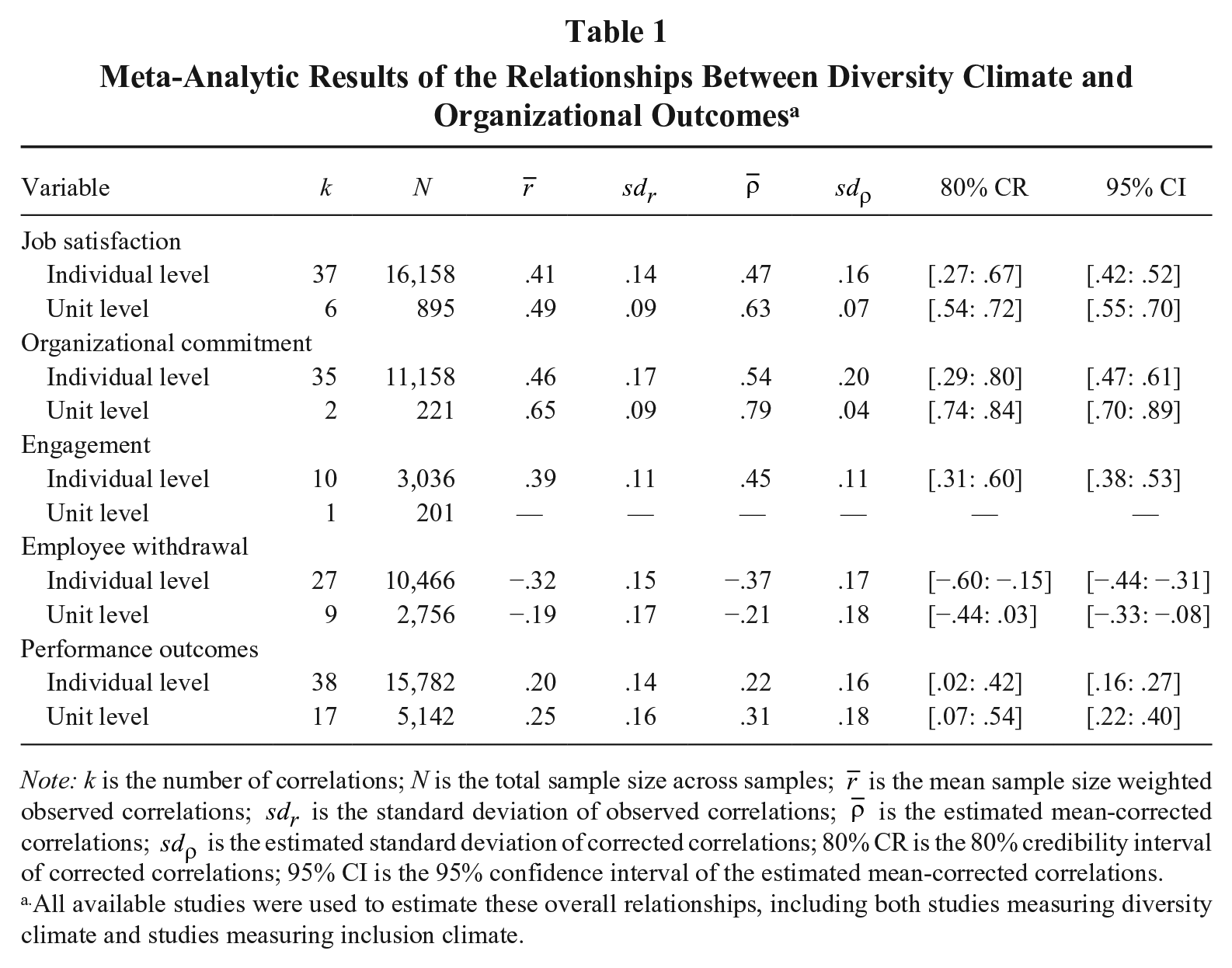
Note: k is the number of correlations; N is the total sample size across samples;
All available studies were used to estimate these overall relationships, including both studies measuring diversity climate and studies measuring inclusion climate.
As shown in Table 1, when focusing on individual-level relationships corrected for measurement error, diversity climate was positively and significantly related to job satisfaction (
Multilevel Meta-Regression Moderating Results of the Relationship Between Diversity Climate and Organizational Outcomes

Note: For climate type, 0 = inclusion climate and 1 = diversity climate; for level of analysis, 0 = individual level and 1 = unit level; for withdrawal outcome, 0 = not a withdrawal outcome and 1 = a withdrawal outcome; for performance outcome, 0 = not a performance outcome and 1 = a performance outcome; for racioethnic diversity and gender diversity, the Blau’s index of heterogeneity was calculated; for rating source, 0 = different sources and 1 = same source; for publication status, 0 = nonpublished study, 1 = published study. QE = test statistics for the tests of heterogeneity. ΔQE = difference in QE between a model without predictors and a model with predictors. AIC = Akaike information criterion; BIC = Bayesian information criterion. k is the number of correlations. Values out of the parentheses are regression coefficients and values in parentheses are standard errors of the coefficients.
p < .05. **p < .01.
Results of Moderating Effects
In this section, we tested simultaneously the potential study/sample- and effect-size-level moderators of diversity climate–organizational outcome relationships. We reverse-coded the effect sizes of the diversity climate–withdrawal outcomes relationship so that all the effect sizes would be in the same direction. Specifically, we conducted a series of multilevel meta-regression analyses to regress unreliability-corrected correlations between diversity climate and organizational outcomes on all of the hypothesized moderators except climate strength.
As shown in Model 1 of Table 2, we first included all moderators except climate strength as predictors of the corrected effect sizes. We found that the beta coefficient for measurement type was negative and significant (b = –.09, se = .02, p < .05). The negative coefficient indicates that inclusion climate exhibits a more positive relationship with an outcome by .09 than diversity climate if the other moderator conditions are held constant (ceteris paribus). Therefore, Hypothesis 1 was supported. We also found that the beta coefficient for level of analysis was positive but nonsignificant (b = .11, se = .06, p > .05). It suggests that the diversity–outcome relationships are not significantly more positive at the unit- as opposed to individual-level ceteris paribus; thus, Hypothesis 2 was not supported. Moreover, we observed that the beta coefficients of the dummy variables of withdrawal outcome (b = –.07, se = .02, p < .05) and performance outcome (b = –.07, se = .02, p < .05) were both negative and significant. The results are consistent with our Hypothesis 3 that the diversity–outcome relationships are more positive by .07 when the outcome is attitudinal rather than behavioral while holding the other predictors constant. In addition, we found that the beta coefficient for the Blau’s index of racial diversity (b = .29, se = .14, p < .05) was positive and significant, whereas that for the Blau’s index of gender diversity was nonsignificant (b = –.12, se = .15, p > .10). The results suggest that diversity climate–outcome relationships are more positive in samples containing greater racioethnic diversity. For example, while holding the other moderators constant, the diversity climate–outcome relationship is more positive by .15 for a sample with 50% minority and 50% majority employees (Blau’s index is .50) than for a racially homogeneous sample (Blau’s index is zero). Thus, Hypothesis 4a was supported, but Hypothesis 4b was not. Finally, we found that the beta coefficient for rating source was positive and significant (b = .39, se = .04, p < .05), whereas that for publication status was slightly positive yet nonsignificant (b = .06, se = .05, p > .05). The results reveal that there is a percept–percept inflation (i.e., common method bias) in the relationships between diversity climate and organizational outcomes, but publication status does not influence these relationships.
To reduce multicollinearity concerns in the multiple regression model, we included the proposed moderators separately in Models 2 to 5 of Table 2 to triangulate the results in Model 1. In those models, we used the two outcome dummy variables, rating source, and publication status as the control variables. As shown in Models 2 to 5, the significance levels of all moderators were consistent with those in Model 1 except for the moderating effect of level of analysis (b = .19, se = .04, p < .05, Model 3 of Table 2), which became significant. Taken together, the results in Models 2 to 5 increase our confidence in the more conservative, omnibus multilevel meta-regression analysis results in Model 1.
When examining the moderating effect of climate strength in Hypothesis 5, we only found 30 unit-level effect sizes with the available ICC(1) information, including seven effect sizes about attitudinal outcomes (e.g., collective satisfaction and collective commitment), six about withdrawal outcomes (e.g., collective turnover intention and actual turnover rate), and 12 about performance outcomes (e.g., unit performance). 6 If we included this moderator in the above-mentioned multilevel meta-regression analysis, then k = 30 is the sample size and thus the beta coefficients of other moderators would be untrustworthy and mostly nonsignificant given a huge amount of sampling error. Thus, we decided to test this moderator using subgroup analysis as Schmidt and Hunter (2015) suggest. The median of all available ICC(1) was .11, with a range from .03 to .38. Therefore, we used this median value to divide the effect sizes into strong climate and weak climate subgroups for each type of outcomes. We meta-analyzed the correlations between diversity climate and each of the three outcomes within the above noted subgroups. Then, for each outcome, we compared the two subgroups using the independent sample z test (see Chiaburu, Lorinkova, & Van Dyne, 2013: 306 for statistical equations).
Table 3 shows the results of subgroup analyses. We found that the unit-level relationship between diversity climate and attitudinal outcomes was significantly more positive in studies with stronger diversity climates (
Moderating Effects of Strengths of Diversity Climate
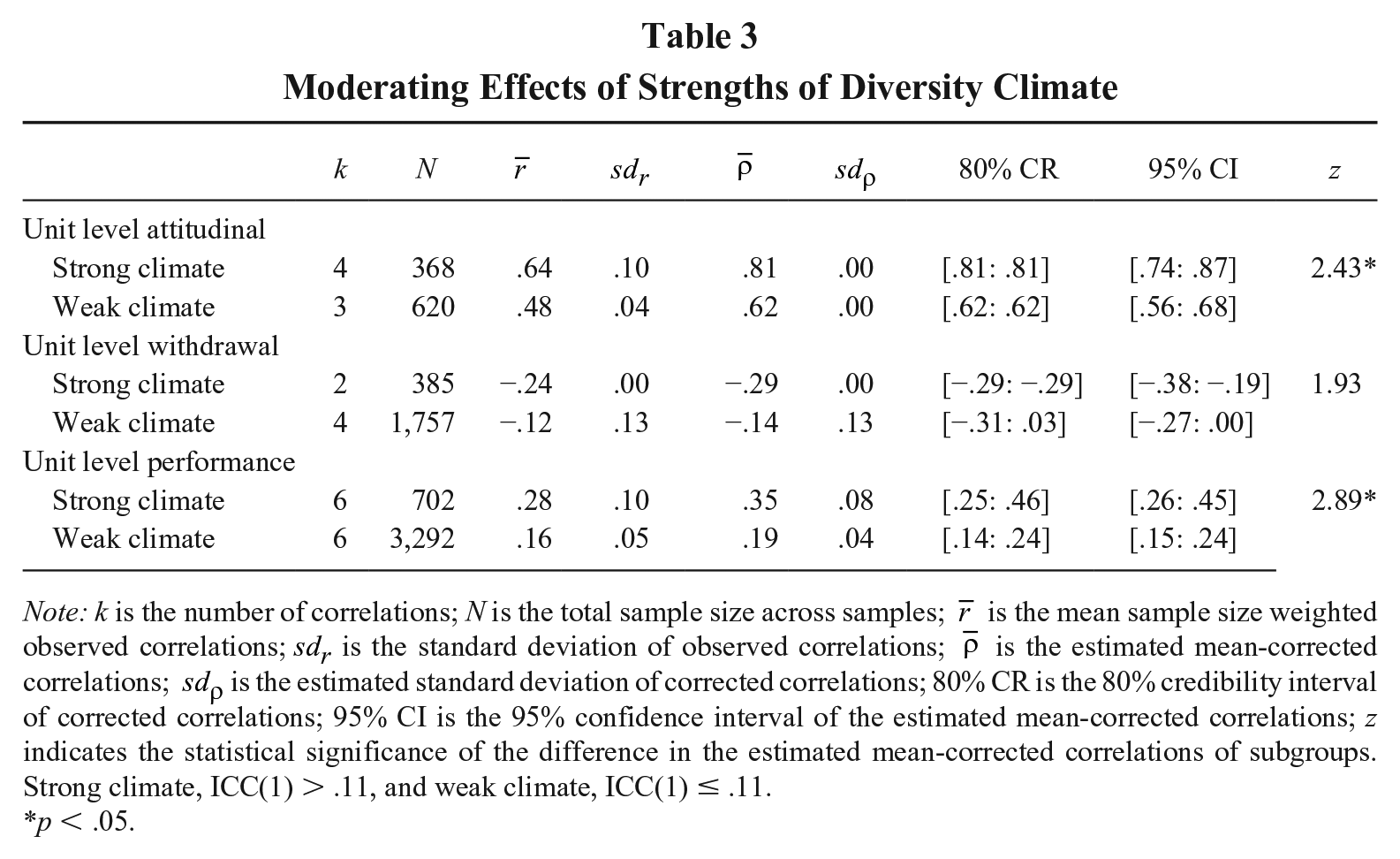
Note: k is the number of correlations; N is the total sample size across samples;
p < .05.
Discussion
Drawing from the IMCD (Cox, 1994), we conducted a meta-analytic study to examine the boundary conditions of diversity climate–work outcome relationships. We estimated the diversity climate–outcome relationship across 109 independent samples (k) from 94 studies, and the following key results emerged. First, diversity climate–outcome relationships are significantly stronger for inclusion climate versus diversity climate measures. Second, diversity climate has significantly stronger correlations with attitudinal outcomes than performance and withdrawal outcomes. Third, diversity climate is more strongly associated with outcomes in studies that included greater versus lower racioethnic diversity. Fourth, diversity climate-outcome relationships are significantly stronger when climate strength is high rather than low. Finally, diversity climate effects on outcomes are significantly stronger when diversity climate and outcome measures are gathered from the same source.
Theoretical Implications
A primary research implication of our results is that diversity climate and inclusion climate vary in their relationships with outcomes. As Nishii (2013) and Dwertmann et al. (2016) suggest, inclusion climate measures may better capture employees’ perceptions of the extent that firms integrate their unique characteristics and differences than conventional diversity climate measures. This could explain why inclusion climate exhibited significantly stronger relationships with outcomes than diversity climate. Another potential explanation builds on Roberson’s (2006: 231) conclusion that “the concepts of diversity and inclusion may potentially represent another iteration of the identity-blind versus identity-conscious debate.” Diversity climate explicitly includes diversity, common social identity group markers, and even some commonly underrepresented groups in its conceptualization and operationalization. For instance, seven of the nine items in the McKay et al. (2007) diversity climate scale explicitly include the terms diverse or diversity, whereas not a single item in Nishii’s (2013) climate for inclusion scale contains these terms. Likewise, five of the items in the organizational subscale of the Mor Barak, Cherin, and Berkman’s (1998) diversity climate measure explicitly refer to specific identity forms (e.g., race, age, sex) or groups (e.g., women or minorities). None of Nishii’s (2013) or Chung et al.’s (2020) inclusion items do so in reflecting the largely identity-blind nature of inclusion. Moreover, there continues to be healthy debate about whether identity-conscious or identity-blind approaches are more effective ways to manage diversity with proponents on each side. A recent meta-analysis (Leslie, Bono, Kim, & Beaver, 2020) revealed that both can be effective and found the most consistent effect on prejudice, discrimination, stereotyping, and policy support was associated with multiculturalism, which is identity-conscious. Thus, whereas the attitudes and behaviors we examined were more strongly associated with the more identity-blind form of climate, Leslie et al. seemed to find evidence of the opposite for the outcomes they examined. Importantly, both meta-analyses indicated potential upside associated with identity-blind and conscious approaches, which leads us to feel that making a simple statement about the relative superiority of one versus the other is inappropriate. Nevertheless, scholars should recognize that empirical results may be impacted by their choice of climate type and select the type that is most consistent with their theorizing.
An additional implication of our results is that diversity climate is a stronger predictor of employee attitudinal outcomes than performance and withdrawal criteria. This finding corroborates Cox’s (1994) IMCD, which suggests that the nature of organizational diversity climate (or perceptions thereof) influences employees’ feelings about their work and the organization. Extant theories of performance postulate that performance (P) is a multiplicative function of both ability (A) and motivation [M; i.e., P = f (A × M)] (Campbell, McCloy, Oppler, & Sager, 1993). Likewise, various theories of voluntary turnover are based upon the work of March and Simon (1958), who proposed that employee exit is a function of (a) the perceived desirability of leaving and (b) the perceived opportunity for leaving (Griffith & Hom, 2001). By contrast, organizational dependability (i.e., workers’ beliefs that organizational actions serve their best interests) has been proposed as a stronger driver of employee attachment to firms (Allen & Meyer, 1990). Because prodiversity climates ensure fair treatment for and social integration of all personnel, it should be expected that diversity climate is more strongly related to worker attitudes than employee behaviors and withdrawal for firms. Drawing from Kopelman, Brief, and Guzzo’s (1990) climate model of productivity, we portend that diversity climate may be indirectly related to employee behaviors through their work attitudes. Additional work is necessary to better elucidate the mechanisms through which diversity climate relates to employees’ behaviors.
Furthermore, there are intergroup implications of our finding that diversity climate effects on criteria are stronger in contexts with higher racioethnic but not gender diversity. Theoretically, this could point to the varying content of stereotypes held about racioethnic minorities versus women with the former being viewed as less competent and warm than the latter (Cuddy, Fiske, & Glick, 2007). Consequently, racioethnic minorities might experience more disparate treatment on the job than their White female counterparts, perhaps explaining their stronger reactions to congenial diversity climates at work. Societally, there is greater separation, residentially, between racioethnic versus gender subgroups, especially among Blacks (Massey, 2007). In fact, Brief et al. (2005) demonstrated that the proximity to Blacks moderated the negative racioethnic diversity–quality of working relationship linkage among White personnel. The relationship was significantly more negative when Whites reported high versus low proximity to Blacks. By extension, it stands to reason that the importance of diversity climate to racioethnic minorities is heightened in highly racioethnically diverse work environments. Additional research is needed to further delineate the mechanisms underlying the stronger diversity climate–outcome relationships in diverse contexts.
Our findings for measurement source have implications for methodological considerations in diversity climate research. Most notably, we found that diversity climate relationships with outcomes were significantly larger when climate strength was high rather than low. This result coincides with Dickson et al.’s (2006) theory and findings that high climate scores are associated with less variability between scores within a particular work context. Broadly speaking, our findings dovetail with Bowen and Ostroff’s (2004) theory of human resource management (HRM) system strength. These authors proposed that firms with strong HRM systems transmit clear signals to employees regarding its key organizational strategic objectives (e.g., diversity). Such systems are likely to foster more consensual views of a firm’s culture than those firms with weaker HRM systems. Tentatively, we surmise that work units with lower variability in diversity climate scores are apt to place stronger value on diversity as a strategic initiative than units with greater variability in climate scores.
Furthermore, the findings for measurement source indicate that diversity climate effects on outcomes are stronger when data are collected from the same versus a different source. Conversely, publication status did not emerge as a moderator of diversity climate–outcome linkages. Methodologically, it appears that same-source bias somewhat inflates diversity climate relationships with criteria (Crampton & Wagner, 1994), particularly for attitudinal outcomes. This may not be problematic as a focal employee is the best source of reporting her/his/their perceptions of diversity climate and attitudes about the workplace. Beyond percept–percept concerns, we can be confident that published diversity climate results do not vary appreciably from those reported in unpublished studies. Accordingly, we feel that our meta-analysis provides a relatively conservative yet unbiased rendering of diversity climate effects on work criteria to date. We encourage further research to uncover additional methodological factors of relevance to diversity climate–outcome relationships.
Practical Implications
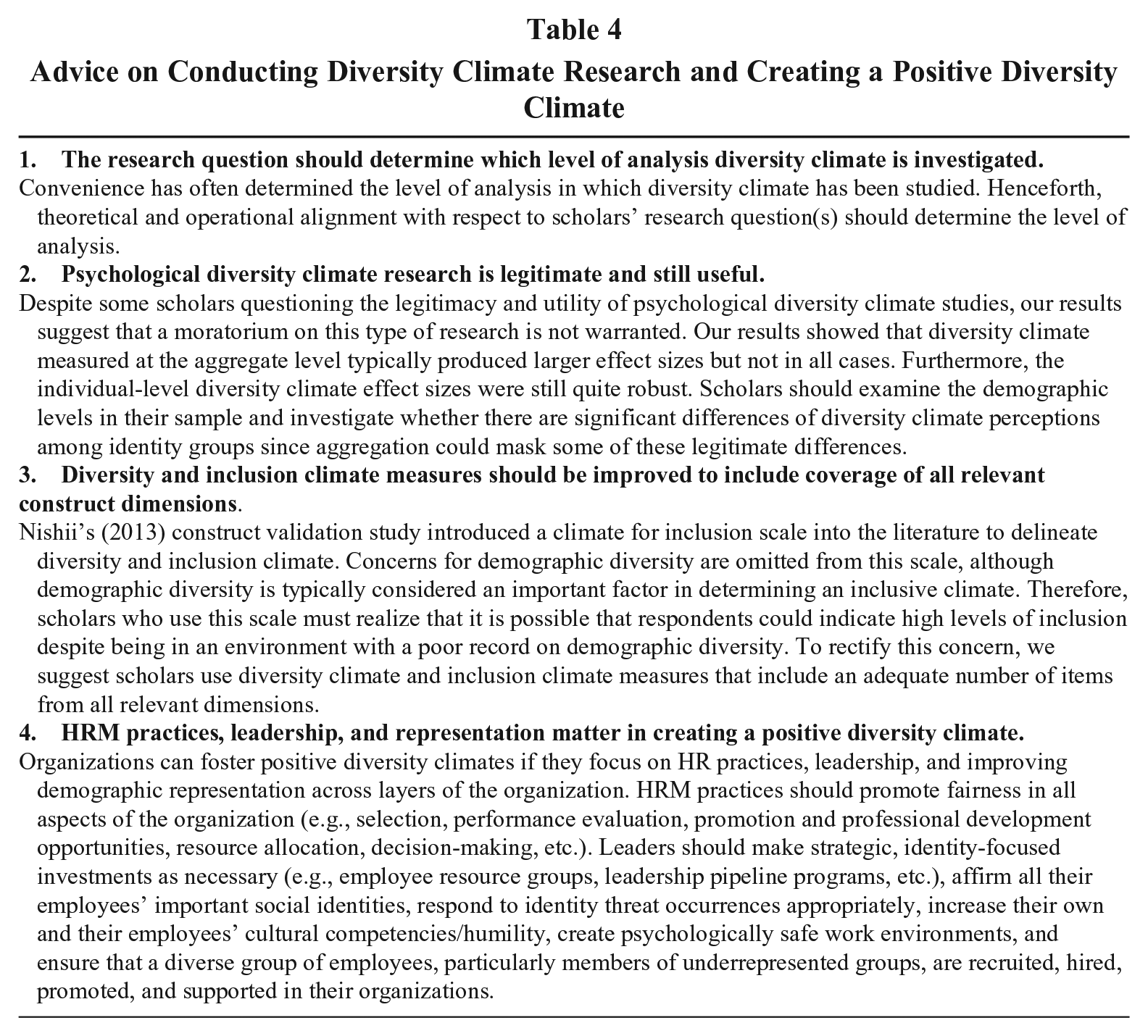
Our findings have practical implications for diversity management (see Table 4). Our study shows that diversity climate has consistently positive effects on a variety of important workplace outcomes. Hence, organizations that value diversity would be wise to make or increase investments in diversity management initiatives. As part of such initiatives, the senior leadership in firms must endorse diversity as a strategic objective, adopt policies that ensure fair treatment and inclusion of all personnel, allocate resources toward maintaining prodiversity work climates, and hold management personnel accountable for diversity-related outcomes (Cox, 1994; McKay & Avery, 2005). The failure to fully invest in effective diversity management could result in the failure of diversity initiatives, explicit and implicit bias in personnel systems and decision-making, and even worse, firm vulnerability to lawsuits (McKay & Avery, 2005).
Advice on Conducting Diversity Climate Research and Creating a Positive Diversity Climate
A related practical implication involves our finding that diversity climate–outcome relationships were stronger in more versus less racioethnically diverse work contexts. Fundamentally, this result suggests that companies need to follow through when it comes to their pursuit of diversity as a strategic emphasis. Research has shown that racioethnic diversity is associated with lower quality working relationships (Brief et al., 2005), higher task and emotional conflict in work environments (Pelled, Eisenhardt, & Xin, 1999), and higher reports of racial discrimination (Boehm et al., 2014). Owing to these concerns, organizations must realize that numerical, demographic diversity does not readily translate into prodiversity work climates (Kossek, Zonia, & Young, 1996). Instead, the pursuit of diversity should be preceded by diversity audits that assess the extent of diversity in key organizational positions and the existing diversity climate in the firm (Cox, 1994; McKay & Avery, 2005). If a company does not maintain a work climate that is conducive to diversity, then it should embark upon efforts to enhance its diversity climate before initiating diversity recruitment. Possibly, organizations with less favorable diversity climates could engage in supplication, whereby they apologize for their poor track record in fostering inclusive environments and commit the necessary resources to improve. In addition, such firms should atone for their previous missteps by instituting policies, procedures, and initiatives that clearly demonstrate their commitment to diversity (Avery & McKay, 2006).
Limitations and Future Research
As with all studies, our meta-analysis has some limitations that should be addressed in additional research. Notably, some of our meta-analytic estimates were based upon few studies (e.g., diversity climate–outcome relationships with unit-level work attitudes and withdrawal rates). This problem was especially acute for our moderation analyses of level of analysis and climate strength. Among the 35 effect sizes reported at the unit level, only four did not report ICC(1) information for their diversity climate measure. Therefore, we are confident that most of the diversity climate studies measured at the unit level have taken within-unit variance into account. With respect to ecological fallacy concerns (Robinson, 1950), however, our multilevel meta-regression results might be partially biased by not controlling for within-study variance for each unit-level study (e.g., assuming that such variance is the same across unit-level studies) given the limited availability of such data [e.g., ICC(1) or rwg]. Owing to these concerns, our conclusions regarding these moderation effects should be regarded as tentative.
First, there is a clear need for more research looking at antecedents of diversity climate. Although the IMCD identifies various individual-level, intergroup, and organizational contextual factors believed to influence diversity climate perceptions, there were too few primary studies available for robust tests of these relationships meta-analytically. In addition, we strongly urge scholars to consider investigating the independent and interactive effects of prospective antecedent factors on diversity climates. Also, researchers should continue the trend of studying variables outside the organization that predict diversity climate within firms (e.g., Pugh, Dietz, Brief, & Wiley, 2008).
Second, additional inquiry on moderators of diversity climate is needed. Though we examined five theoretically derived moderators, there are other plausible moderating variables that we were unable to study. For instance, factors like organizational reputation or community diversity climate could influence diversity climate–outcome relationships (Brief et al., 2005). Observed relationships between diversity climate and outcomes may be stronger for firms with more positive reputations and in locales with more favorable diversity climates. Some experimental research has demonstrated the importance of leadership in reducing the incidence of discriminatory decision-making (e.g., Umphress, Simmons, Boswell, & Triana, 2008; Ziegert & Hanges, 2005). Perhaps, the perceived moral character of leaders influences the effects of diversity climate, such that effects are more pronounced when leaders are of suspect character and less so when leaders are considered highly ethical. Such a finding would be consistent with evidence indicating that the impact of diversity climate on turnover intentions is contingent upon the organization’s ethical climate (Stewart, Volpone, Avery, & McKay, 2011), which is likely to be impacted by employee perceptions of leaders. Finally, an anonymous reviewer rightfully suggested that it is possible that other contextual variables such as HR practices, CEO leadership, or organizational culture could influence both diversity climate and organizational outcomes as well as the relationships between the two, particularly at the unit level. These possibilities should be examined in future research.
Third, our finding that diversity climate–outcome relationships are stronger for data collected from the same versus different sources indicates that percept–percept inflation may be a methodological limitation of extant diversity climate research (Crampton & Wagner, 1994). Namely, the bulk of studies at the individual level were cross-sectional such that predictor and outcome measurements were gathered from single surveys. Accordingly, diversity scholars are advised to insert time lags between the collection of diversity climate and outcome measures. Optimally, longitudinal investigations should be conducted to determine how diversity climate relates to criteria over time. Such studies would allow researchers to determine the time horizon over which diversity climate effects occur. Knowledge of the temporal dynamics of diversity climate–outcome linkages could help managers determine when the rewards of organizational prodiversity initiatives are most likely to emerge.
Fourth, additional research is needed to explore the nature of the diversity climate–inclusion climate interplay with outcomes. Kuenzi and Schminke’s (2009) summary of organizational climate research called for further research to examine the interactive effects of multiple climates. Applied to diversity climate and inclusion climate, theorizing could be formulated to predict the resulting effects of both climates on outcomes. Such effects could be additive (i.e., a high summative score across items for both climates are better), compensatory (e.g., higher diversity or inclusion climate can compensate for lower diversity or inclusion climate), or multiplicative (i.e., high diversity climate and high inclusion climate scores are associated with better outcomes than low levels of both climates, or high levels of one climate and low levels of the other climate). To the extent that diversity climate and inclusion climate represent distinct constructs, the potential exists for each climate to augment the other in relation to outcomes.
Finally, despite calls from some climate scholars to abandon psychological diversity climate research as well as our finding that effect sizes generally tended to be larger for unit-level diversity climate than individual-level diversity climate, we are not calling for a moratorium on individual-level diversity climate studies. Importantly, our individual/unit-level moderator hypothesis was not supported, and we found the magnitudes of diversity climate–outcome linkages were higher at the individual level than unit level for the relationship with withdrawal outcomes. This may be because most unit-level studies examined withdrawal behavior (actual turnover rate), whereas all individual-level studies examined only withdrawal cognitions (turnover intentions). Thus, we call for more individual-level studies that examine the relationship between diversity climate and various withdrawal behavior (e.g., lateness, absenteeism, voluntary turnover, job search behavior).
In addition, we encourage three trends for future research. The first is to place greater emphasis on investigating diversity climate at the unit level to achieve a greater degree of balance in the literature. The second is to allow theory to dictate whether it is more appropriate for the particular investigation to examine diversity climate at the individual or unit level of analysis. For instance, our analyses indicated that climate strength (i.e., level of agreement about climate level) moderated the effect of unit-level diversity climate on performance. Given that mean-level perceptions of diversity climate often vary as a function of rater demographic identity (e.g., McKay et al., 2007), climate strength is likely to correlate with the demographic diversity within a group. Accordingly, in highly diverse contexts, it may be more appropriate to operationalize diversity climate as psychological as opposed to consensual to ensure that relationships are not artificially suppressed by diversity-driven disagreement about the organization’s climate.
Conclusion
We conducted the present meta-analytic study to contribute to the diversity climate literature by uncovering the boundary conditions of diversity climate relationships with work-related outcomes. Our main meta-analysis (i.e., wider CRs) and multilevel meta-regression results indicated that diversity climate–outcome linkages are moderated by type of measure, outcome type, demographic diversity, climate strength, and measurement source.
Supplemental Material
Appendix_for_Online_Supplemental_File – Supplemental material for A Meta-Analysis Integrating 25 Years of Diversity Climate Research
Supplemental material, Appendix_for_Online_Supplemental_File for A Meta-Analysis Integrating 25 Years of Diversity Climate Research by Oscar Holmes, Kaifeng Jiang, Derek R. Avery, Patrick F. McKay, In-Sue Oh and C. Justice Tillman in Journal of Management
Supplemental Material
References_For_Online_Supplemental_File – Supplemental material for A Meta-Analysis Integrating 25 Years of Diversity Climate Research
Supplemental material, References_For_Online_Supplemental_File for A Meta-Analysis Integrating 25 Years of Diversity Climate Research by Oscar Holmes, Kaifeng Jiang, Derek R. Avery, Patrick F. McKay, In-Sue Oh and C. Justice Tillman in Journal of Management
Footnotes
Acknowledgements
The authors would like to thank the action editor and the two anonymous reviewers for their constructive feedback on the development of this manuscript. Additionally, the authors would like to thank Quinetta Roberson Connally and Chester Spell for their encouragement and feedback on earlier versions of this manuscript and all of the primary authors who responded to our email queries and provided us with the information we needed to conduct additional analyses.

Notes
References
Supplementary Material
Please find the following supplemental material available below.
For Open Access articles published under a Creative Commons License, all supplemental material carries the same license as the article it is associated with.
For non-Open Access articles published, all supplemental material carries a non-exclusive license, and permission requests for re-use of supplemental material or any part of supplemental material shall be sent directly to the copyright owner as specified in the copyright notice associated with the article.
