




Abstract
While physical activity is widely recognized to be relevant to employee well-being and organizational health care costs, the management literature has yet to clarify when, how, and why employee physical activity influences job performance. Therefore, the goal of this review is to provide a cross-disciplinary synthesis of evidence surrounding the implications of physical activity for job performance. After first conducting an emergent systematic review of the management literature to verify our assertion that this research base has inadequately addressed the relationship between physical activity and job performance, we performed a cross-disciplinary review of six key disciplines (sports sciences, public environmental occupational health, general medicine internal, physiology, neuroscience, and psychology/psychiatry) to develop a resource-based framework that serves to identify how physical activity relates to job performance. This unifying framework is intended to guide future research on employee physical activity. As an initial application of this framework, we provide a set of future research directions centered on empirically evaluating proposed mechanisms, boundary conditions, and temporal factors that can inform physical activity research in organizational contexts.
The workforce is changing, with a general movement away from manual labor jobs and an increase in the use of efficient and automated technologies (Church et al., 2011). One undesirable consequence of these changes is an epidemic of sedentary workers who fail to meet recommended physical activity levels (World Health Organization, 2018). Low rates of physical activity have been linked to obesity, diabetes, and cardiovascular disease (CVD; Bielenda, Knapik, & Wright, 1993; Heraclides, Chandola, Witte, & Brunner, 2009). Organizations have recognized the negative impact of sedentary work (Calderwood, Gabriel, Rosen, Simon, & Koopman, 2016), with two-thirds of U.S. employers now offering wellness programs (Valet, 2015), over 70% of which contain a physical activity component (Mattke et al., 2013).
Physical activity represents musculoskeletal movement that requires energy expenditure (Caspersen, Powell, & Christenson, 1985). 1 Physical activity offers intuitive advantages to employee well-being and health care costs (Ganster, Fox, & Dwyer, 2001; Parks & Steelman, 2008), but scholars have yet to firmly establish whether and how physical activity relates to job performance. This lack of understanding of the performance implications of employee physical activity is surprising, as job performance reflects the expected value that an employee’s behavior adds to an organization (Motowidlo, 2003), and thus methods to improve performance have organizational financial implications (Campbell & Wiernik, 2015; Huselid, 1995). However, to date, potential organizational benefits extending from employee physical activity have largely been viewed through the lens of health care cost savings (e.g., Wang, McDonald, Champagne, & Edington, 2004), rather than job performance improvement. Critically, the limited management research on this topic has typically cast physical activity as a recovery activity (e.g., Feuerhahn, Sonnentag, & Woll, 2014; Oerlemans & Bakker, 2014; Rook & Zijlstra, 2006; Sonnentag, 2001; Sonnentag & Natter, 2004) that may offer subsequent performance benefits (i.e., physical activity enhancing recovery and next-day work engagement; Ten Brummelhuis & Bakker, 2012b). However, implications of physical activity for actual job performance remain unclear. This narrow focus is limiting because physical activity has been shown to predict performance-related criteria (e.g., enhanced mental processing speed, memory storage and retrieval, cognitive multitasking) in other fields of study (e.g., sports science, medicine, neuroscience; Lambourne & Tomporowski, 2010; Raichlen & Alexander, 2017). We contend that the fracturing of the physical activity literature across disciplines has hindered progress in understanding the physical activity–job performance relationship, which has precluded the development of theory to explain the performance implications of physical activity in organizational contexts.
Our goal is to provide a cross-disciplinary review and synthesis of research to enhance understanding of how, when, and why physical activity influences job performance. In doing so, we make numerous contributions to the management literature. First, we offer a state-of-the-art review of empirical evidence for the relationship of physical activity with job performance. We begin with an overview of management research that has considered employee physical activity. We then identify the most robust conclusions regarding the performance implications of physical activity from literatures outside of management and integrate these findings with conclusions from our review of management research. Synthesizing research from across disciplines provides organizational scholars with an informed view of the different ways in which researchers have evaluated performance criteria in relation to physical activity and what the implications of physical activity for those criteria are. Our review therefore helps answer the simple, yet crucial, question for employees and employers: Is physical activity beneficial for job performance?
Second, we provide a theoretical foundation to explain the process through which physical activity influences job performance. To date, the theoretical basis of management research on physical activity extends largely from extrapolations of work recovery models (e.g., effort-recovery model [ERM]; Meijman & Mulder, 1998). These recovery frameworks may be too narrow to account for how physical activity has been observed to influence job performance in disciplines beyond management (e.g., medicine, physiology, neuroscience), including the impact of this activity on physical health (e.g., cardiovascular health), mental health (e.g., depression), and cognition (e.g., memory). Moreover, recovery theories have largely been applied to explain daily (Sonnentag, Eck, Fritz, & Kühnel, 2019) or weekly (Fritz & Sonnentag, 2006) processes and may be less suitable for explaining how physical activity influences job performance in the long term. We instead apply resource-based theories (e.g., Hobfoll, 1989; Ten Brummelhuis & Bakker, 2012a) to the employee physical activity–job performance relationship, which yields predictions that are consistent with the cross-disciplinary literature regarding how being more active influences performance. Resource-based theories are particularly helpful because they differentiate between long-term and short-term processes and identify boundary conditions surrounding these processes (Ten Brummelhuis & Bakker, 2012a).
Third, our theoretical framework can serve as the basis for future physical activity research by management scholars. Importantly, we offer a tiered research agenda that explicates the most immediate versus more long-term research goals that should be met to increase our understanding of how physical activity relates to job performance. In addition, we provide specific methodological guidance to identify ideally suited approaches to understand the short- and long-term implications of employee physical activity for job performance.
To accomplish these goals, we first conducted an emergent systematic review (Cooper, Hedges, & Valentine, 2019) of the management literature to identify what is known and unknown about the employee physical activity–job performance relationship within this area of scholarship. Finding extant management research to be inadequate to sufficiently explain this relationship, we then performed a cross-disciplinary review, benefiting from knowledge in other disciplines on how physical activity informs human performance or close precursors of performance. We applied conclusions drawn from six disciplines—sport sciences, public environmental occupational health, general medicine internal, physiology, neuroscience, and psychology/psychiatry—about physical activity to the management context to enhance understanding of the mechanisms through which employee physical activity influences job performance. The main insights taken from both the management and cross-disciplinary reviews are then synthesized into a resource-based model that (a) explicates the pathways through which employee physical activity may influence job performance and (b) identifies boundary conditions surrounding these pathways. Following this theoretical integration, we then offer a guide for future research on employee physical activity that is broadly informed by management scholarship and the other literatures included in our review.
Emergent Systematic Review of the Management Literature
To evaluate extant management research on employee physical activity, we conducted a systematic review (Cooper et al., 2019) in which we identified all articles on the topics of exercise or physical activity within the highest impact factor journals in management. These journals were identified by applying the “Management” category filter in Web of Science’s Journal Citations Report and selecting the 50 highest impact factor journals from this list, as well as an additional 14 journals that have management applications from the top 50 highest impact factor journals within the “Psychology, Applied” category. Our search terms consisted of “exercise” or “physical activity” and “[Journal Title 1]” or “[Journal Title 2]” . . . or “[Journal Title 64].” This process yielded 977 unique abstracts. Articles were excluded from our review if they (a) did not report empirical results (e.g., narrative commentaries; n = 315), (b) did not sample employees (e.g., firm-level data; n = 346), (c) did not mention physical activity (n = 259), or (d) focused only on health care cost projections (n = 3). Fifty-four articles (k = 54) were retained.
Our management review yielded four distinct research themes, which encompassed (a) employee physical activity correlates (k = 20), (b) employee physical activity in relation to work recovery (k = 15), (c) employee physical activity as a moderator of stressor–strain relationships (k = 5), and (d) physical activity interventions (k = 14). Articles included in each of these research themes are summarized in Tables A1 through A4 of the supplemental online appendix, which includes a column labeling the primary theoretical foundations (if any) that were drawn on in each article. Next, we report key findings from our review of each of these themes, and we discuss the theoretical foundations of physical activity research in the management literature.
Physical Activity Correlates
Although physical activity has been investigated as both a criterion and a predictor in relation to work-relevant correlates, measures of job performance have been completely absent from this literature. In general, efforts to identify predictors of employee physical activity have focused on individual differences and job characteristics, finding factors as varied as emotional intelligence (Tsaousis & Nikolaou, 2005), work-related social support (Evans & Steptoe, 2001), and work stressor exposure (Johnson & Allen, 2013) to covary with physical activity. Unfortunately, these disparate predictors of physical activity have not yet been included within a single study, making their relative and unique contributions difficult to determine. Furthermore, our search indicated that no theoretical framework has been consistently applied to explain these relationships. The exception to this statement is that two studies (Payne, Jones, & Harris, 2002; Shukri, Jones, & Conner, 2016) have applied the theory of planned behavior (Ajzen, 1991) to explain employee exercise, demonstrating that employee exercise attitudes and norms predict exercise intentions and subsequent exercise behaviors. However, job performance has not been integrated into this more theoretically grounded subset of physical activity predictor research.
When modeling employee physical activity as a predictor, management scholars have emphasized physiological and subjective correlates. Greater physical activity covaries with a lower resting heart rate (Sliter & Sliter, 2014) and plasma concentration of the inflammation marker C-reactive protein (S. Tsai, Lai, Shih, Lin, & Liou, 2014), which may partially explain associations linking physical activity to reduced health complaints (Hecht & Boies, 2009; see Ganster & Rosen, 2013). Higher levels of physical activity also relate to lower employee stress perceptions (Burtscher, Meyer, Jonas, Feese, & Tröster, 2018; Sliter & Sliter, 2014). However, similar to research on predictors of physical activity, no theoretical framework has been consistently applied when examining criteria associated with employee physical activity. Thus, the study of correlates of employee physical activity is quite theoretically underdeveloped.
Physical Activity and Work Recovery
There is a well-developed tradition of evaluating implications of physical activity for the replenishment of cognitive and energetic resources during time away from work, a process known as work recovery (Meijman & Mulder, 1998). In a foundational study on work recovery, Sonnentag (2001) suggested that leisure-time physical activity enhances off-job well-being by facilitating distraction from work-related concerns and enhancing positive physiological and psychological states, with the distraction-based pathway explained through the ERM (Meijman & Mulder, 1998) and the state–enhancement pathway framed within Conservation-of-Resources (COR) theory (Hobfoll, 1989). These predictions have received consistent support, with leisure-time physical activity linked to more positive affect (Bakker, Demerouti, Oerlemans, & Sonnentag, 2013), lower fatigue (Rook & Zijlstra, 2006), and better recovery (Sonnentag & Jelden, 2009) postwork. Psychological detachment is commonly found to underlie these associations (Cho & Park, 2018). Van Hooff, Benthem de Grave, and Geurts (2019) further contextualized these relations by suggesting that more strenuous physical activity is necessary to unlock the detachment potential of exercise, which could explain failures to detect a physical activity–recovery association in some studies (e.g., Volman, Bakker, & Xanthopoulou, 2013).
While the potential of physical activity to covary with better recovery may have downstream consequences for job performance (Trougakos & Hideg, 2009), only two studies have considered whether physical activity–related recovery gains relate to performance-relevant criteria. Ten Brummelhuis and Bakker (2012b) found off-job physical activity to positively associate with next-day work engagement via next-morning vigor, while Sianoja, Syrek, De Bloom, Korpela, and Kinnunen (2018) found a within-workday park walking break to positively associate with afternoon concentration via enjoyment. However, as these criteria are precursors or proxies of performance, further research on physical activity and job performance is needed.
Physical Activity as a Moderator
The stress-buffering potential of physical activity has been most commonly framed within COR theory (Hobfoll, 1989), with the prediction being that physical activity buffers against personal resource loss and facilitates personal resource gain, which then mitigates strain reactions (e.g., Sawhney, Jennings, Britt, & Sliter, 2018; Sliter, Sinclair, Cheung, & McFadden, 2014). The stress-buffering role of physical activity has been demonstrated using a range of stressors (e.g., general occupational stressors, workload, supervisor undermining) and strain reactions (e.g., mental health symptoms, diminished life satisfaction, impaired sleep quality; Barber, Taylor, Burton, & Bailey, 2017; Sawhney et al., 2018; Sliter et al., 2014). In a three-wave longitudinal study, Toker and Biron (2012) further suggested that a stress-buffering role of physical activity holds for reciprocal relationships between different strain reactions as well, demonstrating that higher physical activity attenuates the influence of changes in job burnout on depression and vice versa. Unfortunately, the implications of these stress-buffering relationships for job performance are unclear, given complexities in the relationships between stressors, strains, and performance. More specifically, different categories of stressors (e.g., challenge vs. hindrance) may induce different forms of stress (e.g., eustress vs. distress) that have opposite effects on job performance (Crawford, LePine, & Rich, 2010). Physical activity might therefore be particularly effective in reducing anxiety induced by hindrance stressors but may be less needed when an employee tackles a motivating challenge stressor (Rosen, Chang, Djurdjevic, & Eatough, 2010). However, predictions of this nature have not yet been empirically tested.
Physical Activity Interventions
The only stream of management physical activity research to formally measure performance criteria has been the study of physical activity interventions, although theorizing underpinning these intervention studies has been piecemeal in nature. Management physical activity intervention studies can be categorized into quasi-experimental studies (e.g., company gym members vs. nonmembers; Daley & Parfitt, 1996), comparisons of physical activity interventions against other interventions (Bruning & Frew, 1987), and randomized controlled trials of physical activity interventions (Lennefer, Lopper, Wiedemann, Hess, & Hoppe, 2020). Physical activity has been shown in these studies to benefit productivity (Gubler, Larkin, & Pierce, 2018) and reduce long-term absenteeism (Kerr & Vlaswinkel, 1995), as well as to influence correlates of performance, including stress reactions (Clark et al., 2014), somatic complaints (Patterson, Bennett, & Wiitala, 2005), and job satisfaction (Daley & Parfitt, 1996).
Three factors temper this positive view of physical activity interventions. First, postintervention benefits relevant to performance have been inconsistently observed at follow-up assessments (e.g., 1 month, 3 months, 1 year; Clark et al., 2014; Lennefer et al., 2020). Second, physical activity interventions show comparable gains to other types of wellness interventions (e.g., management skills, meditation, team awareness training; Bruning & Frew, 1987; Patterson, Bennett, & Wiitala, 2005). Third, physical activity is rarely manipulated in isolation in interventions, often being coupled with an interpersonal component (e.g., health education counseling, online coaching, team-based exercise; Atlantis, Chow, Kirby, & Singh, 2006; Lennefer et al., 2020; Ranby, MacKinnon, Fairchild, Elliot, Kuehl, & Goldberg, 2011), making it impossible to disentangle the unique effects of physical activity. Thus, methodological artifacts and intervention design characteristics have obscured knowledge of the physical activity–job performance relationship in intervention studies.
Theoretical Foundations of Employee Physical Activity
After reviewing employee physical activity research in management, we conclude that the theoretical foundations of this literature rest on a synthesis of the ERM (Meijman & Mulder, 1998) and COR theory (Hobfoll, 1989). The ERM posits that time away from work provides the opportunity to recover from work demands. Physical activity is theorized to enhance this recovery by facilitating distraction from work-related concerns (Yeung, 1996) and increasing positive physiological (e.g., enhanced endorphins) and psychological (i.e., enhanced positive affect) states that improve well-being and health (Sonnentag, 2001). These processes are typically explained through COR theory, with physical activity framed as an investment of energetic resources that prevents further resource loss caused by work activities (e.g., Sliter et al., 2014) and/or facilitates personal resource gains, such as increases in positive affect and feelings of mastery (e.g., Oerlemans, Bakker, & Demerouti, 2014). In recent years, management scholars have supplemented this synthesis of the ERM and COR theory with a wider incorporation of self-regulation theory (Muraven & Baumeister, 2000) and self-determination theory (Ryan & Deci, 2000). More specifically, researchers have argued that exposure to job demands can draw down self-regulatory resources necessary to support engagement in physical activity (e.g., Sonnentag & Jelden, 2009), while also reasoning that the recovery potential of physical activity is enhanced when this activity fulfills basic psychological needs (e.g., Feuerhahn et al., 2014) or is intrinsically motivated (e.g., Ten Brummelhuis & Trougakos, 2014).
Summary
Our review of the management literature confirms our initial assertion that organizational scholars have generated limited knowledge about the physical activity–job performance relationship, with formal performance measures obtained in only three quasi-experimental studies in our review (Daley & Parfitt, 1996; Gubler et al., 2018; Kerr & Vlaswinkel, 1995). However, given threats to internal validity in this research design (Campbell, 1957) and the lack of consideration of mechanisms, firm conclusions are difficult to draw from these investigations. Instead, these studies evidence a tendency to evaluate physical activity interventions before understanding underlying functional relationships (Calderwood et al., 2016).
As the theoretical foundations of employee physical activity research are partially grounded in broader resource loss and gain processes from COR theory (Hobfoll, 1989, 2001), we contend that a process model of the physical activity–job performance relationship should consider how being physically active may alter resources that have implications for job performance. Our review of the management literature offers various examples of resources that are generated by physical activity, which are largely drawn from physical (e.g., lower resting heart rate; Sliter & Sliter, 2014), affective (e.g., positive affect; Bakker et al., 2013), and cognitive (e.g., improved attention; Wollseiffen et al., 2016) categories. In addition to the emergent evidence gleaned from our review, job performance has been theorized to depend on the investment of physical, emotional, and cognitive energy (W. Kahn, 1990; Rich, LePine, & Crawford, 2010), which maps closely onto the aforementioned resource categories. Thus, based on our review of the management literature, we preliminarily conclude that employee physical activity has the potential to alter physical, affective, and cognitive resources that could have implications for effective job performance (see Figure 1). However, management research (a) has not provided evidence to support theory that explains why physical activity relates to these intervening resources and (b) has provided little insight into potential boundary conditions that may influence physical activity–resource associations. We start the cross-disciplinary portion of our review with these limitations of the management literature in mind and examine if evidence from other disciplines can enhance our understanding of why, how, and when physical activity associates with physical, affective, and cognitive resources that are relevant to job performance.
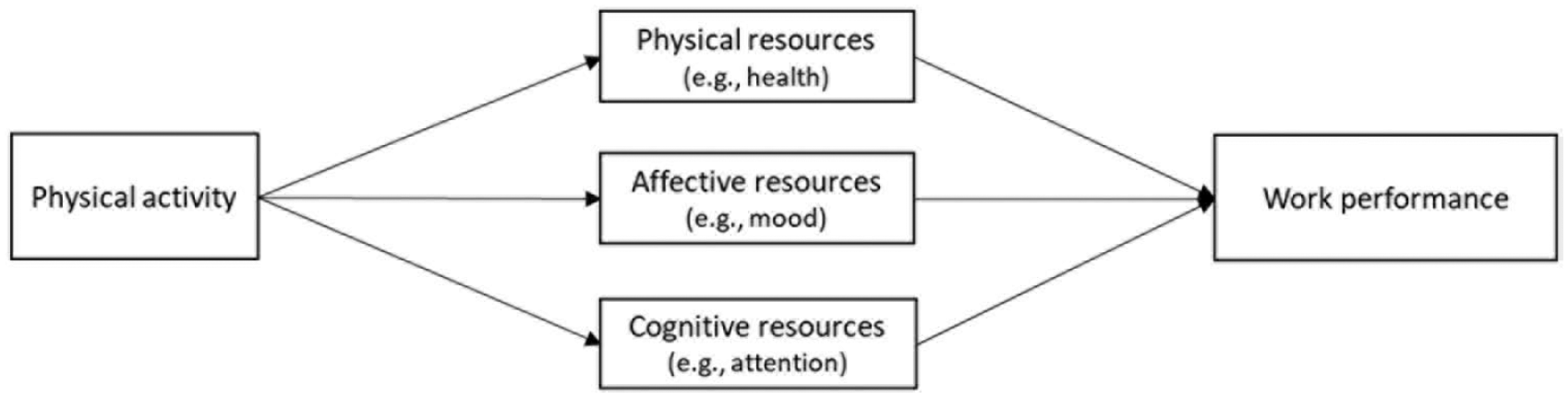
Basic Model of Physical Activity and Job Performance
Cross-Disciplinary Review of Physical Activity Research
We extended our literature search beyond management journals in an effort to better understand physical activity and its implications for physical, affective, and cognitive resources that may be relevant to job performance. We used the same search terms as in our management literature review (i.e., “exercise” or “physical activity”) and selected the six core disciplines that yielded the largest number of articles: sport sciences, public environmental occupational health, general medicine internal, physiology, neuroscience, and psychology/psychiatry. Because our goal was to learn the most important, robust, and impactful insights from these fields, we narrowed our search by including only review articles. Accordingly, we selected within each domain the 10 most frequently cited articles that reviewed research on exercise or physical activity in adults, excluding reviews focused on interventions designed specifically for populations with a diagnosed disease (e.g., cancer patients). This approach yielded 60 articles (k = 60), with citation counts ranging from 160 to 3,035. The major conclusions from reviews in the six disciplines are summarized in Tables A5 through A11 of the supplemental online appendix.
From our cross-disciplinary review, five themes emerged: physical health, psychological well-being, cognitive functioning, physical activity conditions, and physical activity interventions. The first three themes align with physical, affective, and cognitive correlates of physical activity identified in our management review. The fourth theme informs the relations of physical activity with physical, affective, and cognitive resources by suggesting boundaries of physical activity on these resources. The fifth theme offers insight into potentially effective physical activity interventions. We discuss the findings of each theme in the order listed above.
Physical Health
CVD and diabetes
The most frequently researched health outcomes of exercise are CVD and diabetes. Regular physical activity associates with reduced risk, symptoms, and mortality caused by these diseases (Berlin & Colditz, 1990; Reiner, Niermann, Jekauc, & Woll, 2013; Roberts & Barnard, 2005; Warburton, Nicol, & Bredin, 2006), with numerous reviews reporting that regular exercise is effective in reducing hypertension (Pescatello, Franklin, Fagard, Farquhar, Kelley, & Ray, 2004), coronary heart disease (Powell, Thompson, Caspersen, & Kendrice, 1987), and diabetes (Bassuk & Manson, 2005; Goodyear & Kahn, 1998).
Various reviews have identified mechanisms responsible for the protective effects of habitual exercise for CVD and diabetes. Exercise enhances insulin sensitivity, such that frequent exercise increases the responsiveness of muscle glucose uptake to insulin, lowering glucose in the bloodstream (Bassuk & Manson, 2005; Goodyear & Kahn, 1998). Exercise protects against chronic diseases associated with low-grade inflammation (e.g., diabetes, CVD) as it produces anti-inflammatory cytokines (e.g., IL-6) that regulate immune responses and improve immune functioning (Pedersen & Hoffman-Goetz, 2000; Petersen & Pedersen, 2005). Regular weekly exercise also alters blood lipids at low training volumes, increasing high-density lipoprotein cholesterol (HDL-C; Kodama et al., 2007) while also reducing low-density lipoprotein cholesterol (LDL-C) and total cholesterol (Durstine et al., 2001). Other mechanisms for health benefits of exercise include improved endothelial functioning (e.g., Seals, DeSouza, Donato, & Tanaka, 2008), which leads to delayed atherosclerosis, weight loss, reduced blood clotting, and enhanced myocardial electrical stability (Powell et al., 1987; Roberts & Barnard, 2005).
General health
Six reviews discussed exercise or physical activity in relation to other health outcomes beyond CVD or diabetes. One review found that physical activities that generate relatively high-intensity-loading forces (e.g., gymnastics, high-intensity resistance training) are beneficial for bone health (Kohrt, Bloomfield, Little, Nelson, & Yingling, 2004). Another review of 43 randomized controlled trials (Hayden, Van Tulder, & Tomlinson, 2005) concluded that exercise therapy that includes stretching or strengthening may improve pain and functionality in individuals with chronic nonspecific low-back pain. Evidence from a third review suggests that physical activity improves health-related quality of life (Bize, Johnson, & Plotnikoff, 2007). Further, two reviews of randomized controlled trial results (Driver & Taylor, 2000; Kredlow, Capozzoli, Hearon, Calkins, & Otto, 2015) evaluated exercise and sleep, revealing both acute and long-term effects. Small acute effects of exercise on sleep include increases in total sleep time (d = .22) and sleep efficiency (d = .25) and a reduction in sleep onset latency (d = .17). Small-to-medium long-term effects of regular exercise on total sleep time (d = 25), sleep efficiency (d = .35), and sleep onset latency (d = .35) were also reported, whereas a large beneficial effect was found for sleep quality (d = .75; Kredlow et al., 2015). Finally, Samitz, Egger, and Zwahlen (2011) reviewed 80 studies to assess the association of exercise with all-cause mortality. Using combined risk ratios, they conclude that total physical activity and leisure physical activity were associated with reduced mortality risks of 36% and 26%, respectively.
Psychological Well-Being
Depression and anxiety
Five reviews focused on the relationship between exercise, depression, and anxiety, concluding that regular exercise reduces the incidence of depression (Mammen & Faulkner, 2013; Ströhle, 2009), depressive symptoms, anxiety symptoms, and panic disorders (Paluska & Schwenk, 2000; Scully, 1998). Vigorous-intensity physical activity seems more strongly associated with a reduced likelihood of depression than lower intensities of physical activity (Teychenne, Ball, & Salmon, 2008), but even low doses of physical activity may be protective (Mammen & Faulkner, 2013). 2 In addition, relative to anaerobic exercise (e.g., heavy weight lifting), aerobic exercise (e.g., running, biking, swimming) seems more effective in reducing depression (Scully, 1998). Proposed psychological mechanisms for the effects of exercise on mental health are distraction, self-efficacy, mastery, and improved social relationships; physiological mechanisms include enhanced transmission of monoamines (e.g., dopamine, serotonin), noradrenaline, and endorphins (Paluska & Schwenk, 2000). 3
Mood
There is convincing support for a positive relationship between acute exercise and positive mood (Reed & Ones, 2006; Salmon, 2001; Yeung, 1996). Exercise has been shown to improve mood immediately after exercise in regular exercisers in studies using experimental designs (Salmon, 2001). However, exercise of a higher combined intensity and duration is less likely to improve mood and may worsen it. Indeed, a meta-analysis of 158 studies (Reed & Ones, 2006) suggested that exercise consistently improved postexercise positive mood for low-intensity exercise and moderate durations (up to 35 min), whereas smaller effect sizes were found for higher intensities and longer durations. 4 Ekkekakis, Parfitt, and Petruzzello (2011) even conclude that exercise at intensities above the lactate threshold increases postexercise negative affect. Suggested mechanisms of the positive effect of exercise on mood are enhanced endorphins, elevation of body temperature, distraction, and feelings of mastery (Yeung, 1996).
Other psychological correlates
Two reviews (Salmon, 2001; Scully, 1998) suggest that regular exercisers (i.e., at least three exercise episodes per week for longer than 21 min) experience less life stress. These reviews suggest that regular exercisers may have a better stress response; their heart rate and blood pressure during recovery from a stressor are lower. Neurochemical processes through which exercise might improve stress responsivity include enhanced norepinephrine and activation of opioid systems (Salmon, 2001), which have calming effects on the body. Finally, exercise reduces cigarette cravings (Taylor, Ussher, & Faulkner, 2007) and is associated with improved body image (Hausenblas & Fallon, 2006).
Cognition
Cognitive performance
We identified nine reviews of experimental studies that evaluated the impact of exercise on cognitive functioning in a working-age population. The majority of these reviews concluded that exercise improves cognitive performance, including attention and processing speed, executive function, and memory (Chang, Labban, Gapin, & Etnier, 2012; Etnier, Salazar, Landers, Petruzzello, Han, & Nowell, 1997; Hillman, Erickson, & Kramer, 2008; Kramer & Erickson, 2007; Smith et al., 2010). Despite these findings, the authors of two review studies (i.e., Etnier, Nowell, Landers, & Sibley, 2006; Voss, Nagamatsu, Liu-Ambrose, & Kramer, 2011) critically remarked that there is a general void in the literature regarding the role of anaerobic exercise (i.e., resistance training) in promoting cognitive and brain functioning in younger (i.e., working age) adults and that cross-sectional studies of the association of aerobic exercise with cognitive functioning in this group show mixed findings. However, studies that use neuroimaging do seem to support a positive association between aerobic fitness and brain function (i.e., attention focus, monitoring of conflict, and error awareness; Voss et al., 2011).
Relatedly, Tomporowski and colleagues conducted several reviews (Lambourne & Tomporowski, 2010; Tomporowski, 2003; Tomporowski & Ellis, 1986) of research using experimental designs to elucidate doses and modes of exercise that improve cognitive functioning. They concluded that submaximal aerobic exercise—exercise below the individual’s maximum work capacity—improves response speed, response accuracy, problem solving, and goal-oriented action. Extended exercise—exercise longer than 60 min—on the other hand, leads to dehydration that compromises both information processing and memory functions (Tomporowski, 2003). Lambourne and Tomporowski (2010) further found that during the first 20 min of exercise, cognitive task performance was impaired, but otherwise, exercise-induced arousal enhanced performance on tasks that involved rapid decisions and automatized behaviors. Chang et al. (2012) also mention that the cognitive benefits of exercise are larger for fitter individuals and that higher-intensity exercise yields more enduring effects. Finally, Lambourne and Tomporowski (2010) found that the mode of exercise mattered for cognitive functioning: Whereas cycling related to enhanced performance during and after exercise, treadmill running led to impaired performance during exercise and a small improvement in performance postexercise.
Brain processes
We identified six reviews that have considered brain processes that may be responsible for the impact of exercise on cognitive functioning. Mechanisms that explain this effect include the generation of new neurons (neurogenesis), growth of new blood vessels in the brain (angiogenesis), and the production of neurotransmitters that facilitate neuroplasticity, the process by which the human brain adapts to changing demands by altering its functional and structural properties, resulting in learning and skill acquisition (Hötting & Röder, 2013). Exercise-induced neurogenesis has also been explained by the induction of central and peripheral growth factors (e.g., brain-derived neurotrophic factor) and growth factor cascades, which instruct downstream structural (i.e., increased synaptic pathways) and functional (i.e., higher quality synaptic pathways) changes (Cotman & Engesser-Cesar, 2002; Szuhany, Bugatti, & Otto, 2015). As described by Van Praag (2008), both acute and chronic voluntary exercise also upregulate the glutamatergic system—a fast-signaling system for information processing in neuronal networks of the neocortex and hippocampus—and downregulate the GABA system, which inhibits or reduces activity of the neurons or nerve cells. Due to angiogenesis, aerobic exercise may also induce beneficial effects on brain functions via changes in blood flow and vascularization, which would lead to an overall better oxygen and nutrition supply in the brain. Finally, physical activity can affect neurotransmitters by increasing serotonin, noradrenalin, and acetylcholine or by enhancing cortical choline uptake and dopamine receptor density. Through the aforementioned molecular and cellular processes, physical activity can contribute to cognitive ability (e.g., executive functioning, relational memory) and real-world functioning (e.g., job performance, driving). These physical activity–linked processes also serve to delay and/or prevent neurodegenerative diseases (Voss, Vivar, Kramer, & van Praag, 2013).
Physical Activity Conditions
In addition to the relationship of physical activity with physical, psychological, and cognitive functioning, we identified a cluster of research that has considered various boundary conditions of these associations, including the dose, mode, and motivation for physical activity.
Physical activity dose
Research on the dose of physical activity—frequency, duration, and intensity—has been conducted to formulate public recommendations for exercise. The U.S. Department of Health and Human Services (2019) advises that adults should do at least 150 min to 300 min a week of moderate-intensity or 75 min to 150 min a week of vigorous-intensity aerobic physical activity, as well as muscle-strengthening activities that involve all major muscle groups on two or more days a week. The duration and frequency of physical activity are widely agreed upon—longer and more frequent physical activity (within the body’s capacity) is better for health—but there is some disagreement regarding intensity. The recommendation for moderate- to vigorous-intensity exercise is from physiology research advising relatively intense activity to obtain health benefits (e.g., Morris & Hardman, 1997; Samitz et al., 2011). However, epidemiological studies observe a linear dose–response relationship between physical activity and health, suggesting that moderate-intensity activity can be beneficial for sedentary and unfit individuals (Blair, Kohl, Gordon, & Paffenbarger, 1992).
Recommendations for exercise at lower intensity levels are further supported by a review (Ekkekakis et al., 2011) that suggested that individuals experience increased positive affect during and after exercise at exercise intensity levels below the lactate threshold (i.e., when lactate starts to accumulate in the blood). Above this threshold, individuals experience negative affect during exercise. Because of this, Ekkekakis and colleagues (2011) suggest that it might be wise to include lower-intensity exercise in exercise guidelines to increase exercise for less fit individuals. Two other reviews (Etnier et al., 2006; Powell, Paluch, & Blair, 2011) concluded that a change from no activity to some activity yields the greatest gains in health benefits. For sedentary individuals, low-intensity physical activity may therefore yield some benefits; for fit individuals, vigorous activities become more important (Etnier et al., 2006).
Physical activity mode
A well-rounded exercise program includes resistance and aerobic training, as well as flexibility exercises (Pollock et al., 1998). Powell et al. (2011) specify that aerobic activities maintain metabolic systems to provide energy and the cardiorespiratory systems to circulate raw materials (e.g., oxygen, glucose, fat). In contrast, anaerobic activities (i.e., resistance training) maintain the strength and function of muscles and bones.
Various reviews provide suggestions for more specific forms of physical activity that aid in health risk reduction. In a meta-analysis of eight studies, active commuting (i.e., walking or cycling to work) was found to reduce cardiovascular risk by 11% (Hamer & Chida, 2008). High-intensity interval training has been proposed as another path to metabolic improvement (Gibala & McGee, 2008), as some metabolic adaptations (e.g., peak oxygen uptake) associated with high-volume endurance training can be induced faster via a small volume of this training. Walking is the most accessible mode of exercise and can yield benefits related to muscle strength, improved metabolism, weight loss, and better insulin/glucose dynamics (Morris & Hardman, 1997). However, in terms of preventing risks associated with a sedentary lifestyle, Blair et al. (1992: 120) note, “It does not matter what type of physical activity is performed: Sports, planned exercise, household or yard work, or occupational tasks are all beneficial. The key factor is total energy expenditure.”
Motivation for physical activity
Three reviews (Ekkekakis et al., 2011; Teixeira, Carraça, Markland, Silva, & Ryan, 2012; Vallerand & Losier, 1999) emphasized the importance of autonomous motivation for exercise. A systematic review of 66 empirical studies by Teixeira et al. (2012) reported that individuals with more autonomous forms of motivation for exercise are more likely to engage in exercise. Identified regulation (i.e., finding exercise to be an important goal or in line with one’s values) was most crucial to the short-term decision to exercise, whereas intrinsic motivation (i.e., engaging in sports for enjoyment or because exercise is in line with one’s values) was predictive of long-term exercise adherence. Ekkekakis et al. (2011) found individuals were able to exercise for longer time periods at higher intensity levels when exercise intensity was self-selected. Vallerand and Losier (1999) also suggested that exercisers with intrinsic motivation, unlike exercisers with extrinsic motivation (i.e., engaging in exercise to obtain an extrinsic reward or to avoid punishment), are more likely to obtain positive affective, cognitive, and behavioral outcomes when engaging in exercise.
Interventions
The final category that emerged from our cross-disciplinary review includes research on interventions (type and effectiveness) designed to promote physical activity and health.
Type of intervention
Three reviews (Bravata et al., 2007; Davies, Spence, Vandelanotte, Caperchione, & Mummery, 2012; E. Kahn et al., 2002) provided insights into the types of exercise interventions that yield favorable health results. E. Kahn et al. (2002) evaluated numerous interventions (e.g., exercise coach, physical education, prompts to encourage stair use, enhancing access to spaces to perform physical activity) and found all of these interventions to enhance physical activity. Bravata et al. (2007) found pedometers, especially when programmed with a daily step goal of 10,000, to be an effective intervention, with pedometer use associated with a significant increase in physical activity (26.9% over baseline) and significant decreases in body mass index (–0.38) and blood pressure (3.8 mmHg). Finally, internet-based interventions can change physical activity behaviors (Davies et al., 2012), although the effect size estimate surrounding changes in physical activity for this modality was small (d = 0.14).
Intervention effectiveness
Multiple reviews considered the effectiveness of exercise interventions in enhancing physical activity or downstream outcomes. 5 Two meta-analytic reviews concluded that physical activity interventions have small-to-moderate effects on self-reported physical activity (d = .21/d = .28) and aerobic fitness (d = .57/d = .52; Conn, Hafdahl, Cooper, Brown, & Lusk, 2009; Foster, Hillsdon, Thorogood, Kaur, & Wedatilake, 2005). Four reviews focused on CVD-related outcomes, reporting exercise program participation to reduce hypertension, blood pressure, body weight, triglycerides, and fasting glucose and to enhance HDL-C (Conn et al., 2009; Lakka & Laaksonen, 2007; Pescatello et al., 2004; Shaw, Gennat, O’Rourke, & Del Mar, 2006). The one review on workplace physical activity interventions encompassed in our cross-disciplinary review (Conn et al., 2009) found these interventions to have small effects on enhanced work attendance (d = .19) and reduced job stress (d = .33).
A Resource-Based Model of Physical Activity and Job Performance
Our cross-disciplinary review yields knowledge on how physical activity affects physical, psychological, and cognitive functioning and specifies what kinds of activity (e.g., duration, mode, intensity) and what types of interventions are most likely to have a beneficial impact. The first three themes from our cross-disciplinary review—physical health, psychological well-being, and cognitive functioning—closely match our preliminary suggestion from our review of the management literature that physical, affective, and cognitive resources may act as mechanisms through which physical activity impacts job performance. The fourth theme—physical activity characteristics and conditions—specifies boundary conditions of these processes, whereas the fifth theme provides leads for effective physical activity interventions. Next, we summarize the mechanisms and boundary conditions that follow from our review, and we draw from these insights to build a theoretical model that explains the physical activity–job performance link. We then build on insights about interventions in our agenda for future research.
Mechanisms
Physical resources
Our cross-disciplinary review indicates that physical activity is effective in reducing risk for and symptoms of diabetes and CVD, which are leading causes of death in the United States (Heron, 2019). Other benefits of physical activity include reduced back pain, higher quality of life (e.g., maintaining physical, emotional, intellectual, and social functioning), and better sleep. Physical activity, therefore, seems to provide physical resources (e.g., fitness, improved health and sleep) relevant to organizations. In the long term, healthier personnel can yield reduced absenteeism and turnover rates as well as enhanced work engagement and productivity (Merrill et al., 2013; Wolfe, Parker, & Napier, 1994). In day-to-day life, physical resources help employees cope with job demands and work-related stressors, reduce errors, and improve performance (Barnes & Spreitzer, 2015; Christian & Ellis, 2011; Swanson, Arnedt, Rosekind, Belenky, Balkin, & Drake, 2011).
Affective resources
Research on psychological well-being shows that physical activity lowers depressive feelings and anxiety while improving stress perceptions and the stress response and enhancing positive mood and body image. Physical activity thus seems to replenish and increase affective resources (e.g., positive affect, self-esteem) that may be needed at work. Long-term implications of reduced depression and anxiety include lower absence (Kessler & Frank, 1997; Lo Sasso, Rost, & Beck, 2006) and higher productivity (Martin, Blum, Beach, & Al, 1996; Stewart, Ricci, Chee, & Al, 1999). Reduced stress and optimized stress management can also reduce burnout (Taormina & Law, 2000), which may have implications for job performance (Bakker, Demerouti, & Verbeke, 2004), employee retention (Rahim & Cosby, 2016), and absence rates (Borritz, Rugulies, Christensen, Villadsen, & Kristensen, 2006). Physical activity can also affect job performance via affective resources more acutely, as postworkout positive affect may result in enhanced creativity (Amabile, Barsade, Mueller, & Staw, 2005), prosocial behavior (George, 1991), and task performance (W. Tsai, Chen, & Liu, 2007).
Cognitive resources
Our cross-disciplinary review revealed that physical activity is associated with enhanced cognitive functioning, although this relationship depends on factors such as exercise intensity and the individual’s general fitness level. The immediate effects of physical activity on the brain include improved information processing, reaction time, attention, error recognition, executive function, memory, and decision making. Thus, the brain works faster and better after physical activity, yielding enhanced cognitive resources (e.g., attention, reaction time) that can be used at work. These insights suggest that physical activity provides employees with cognitive resources needed for task performance. Whereas some cognitive resources (e.g., attention, memory) may mediate the relationship between physical activity and task performance (Lanaj, Chang, & Johnson, 2012), other aspects of cognitive functioning (e.g., improved decision making and error recognition) may be more directly representative of job performance in some jobs (e.g., air traffic controller).
Boundary Conditions
Physical activity intensity
Drawing from our review, we identified four boundary conditions that influence the relationships between physical activity and physical, affective, and cognitive resources. First, physical activity intensity was frequently identified as a moderator that influences the effectiveness of physical activity in improving physical and mental health (e.g., Powell et al., 2011; Teychenne et al., 2008) and cognitive functioning (e.g., Tomporowski, 2003). Whereas some reviews concluded that higher exercise intensities yield more beneficial outcomes than low-intensity workouts (e.g., Chang et al., 2012; Teychenne et al., 2008), other reviews highlighted possible detrimental effects of high-intensity exercise (e.g., Ekkekakis et al., 2011). One possible conclusion is that the “sweet spot” for intensity might lie in the middle, suggesting a possible curvilinear effect. Alternatively, intensity of physical activity may have different consequences for different resources: Whereas vigorous exercise might distract more and enhance affective resources (Van Hooff et al., 2019), extended bouts of vigorous exercise might reduce cognitive resources (Tomporowski, 2003) and thus could hinder performance.
Physical activity mode
A second characteristic that may determine the implications of physical activity is physical activity mode. The articles from our cross-disciplinary review predominantly discussed the benefits of aerobic exercise (e.g., biking, walking, running), whereas various review studies (Etnier et al., 2006; Voss et al., 2011) concluded that there is a void in research that examines the impact of anaerobic exercise (e.g., weightlifting). When both modes of physical activity were discussed, aerobic exercise seemed to have a stronger beneficial effect than anaerobic exercise (e.g., Scully, 1998). Differentiating aerobic and anaerobic physical activity when examining the impact of physical activity on the aforementioned mechanisms and job performance thus seems wise.
Motivation for physical activity
Numerous reviews (Ekkekakis et al., 2011; Teixeira et al., 2012) have highlighted motivation for physical activity as a third possible boundary condition on physical activity–resource associations, suggesting that the beneficial impact of physical activity on outcomes (e.g., positive affect, memory, performance) is stronger when the individual has autonomous versus controlled motivation to exercise. Likewise, in management, recovery research has shown that postwork physical activity results in experienced recovery only when employees have intrinsic motivation to exercise (Ten Brummelhuis & Trougakos, 2014). The review study from Vallerand and Losier (1999) further specified that controlled motivation for exercise can result in impaired outcomes, such as anxiety, negative affect, and lack of persistence. On the basis of this research, we recommend considering the employee’s exercise motivation when evaluating the physical activity–job performance relationship.
Regular physical activity
A fourth boundary condition, which was implicitly interwoven within several reviews, is the fitness of the exerciser. Two review studies concluded that regular exercisers benefit more from physical activity. Szuhany et al. (2015) found that regular exercise intensified the effect of an exercise episode on growth factors in the brain that foster cognition, which is in line with the observation by Chang et al. (2012) that the benefits of a 20-min bout of physical activity on cognitive performance are larger for fit individuals. These reviews indicate that the acute effects of physical activity on cognitive resources are more pronounced in regular exercisers.
A Model of Physical Activity and Job Performance
The articles included in our cross-disciplinary review are solidly built on models from other disciplines but rarely are integrated with theories that are familiar to management scholars, with the exception of some incorporation of self-determination theory (Ryan & Deci, 2000) in research on exercise and motivation. The themes that arose from the cross-disciplinary review, however, fit well with COR theory (Hobfoll, 2002), which has served as one of the major theoretical foundations for management physical activity research, though this theory has not been previously applied to explain how and why physical activity may influence job performance. The main tenet of COR theory is that individuals are motivated to protect and accumulate resources because resources are valuable—their worth differs per person and situation—and they may serve to buffer against stress (Hobfoll, 2002). COR theory further suggests that “people must invest resources in order to protect against resource loss, recover from losses, and gain resources” (Hobfoll, 2001: 349) to successfully cope with stressors and prevent strain (e.g., Sliter et al., 2014). Other resource theories, such as the work–home resources model (Ten Brummelhuis & Bakker, 2012a), have added that resources can be used to obtain worthwhile goals and to perform well in various life domains.
Although some researchers have criticized COR theory because of a lack of specificity—technically, anything that is of value to an individual can be defined as a resource (Halbesleben, Neveu, Paustian-Underdahl, & Westman, 2014)—more recent resource models offer a detailed categorization of the resources (objects, personal characteristics, conditions, or energies) originally introduced by Hobfoll (1989). Based on the dimension of the “source” of the resource, Ten Brummelhuis and Bakker (2012a) explain that resources can either be close to the self (e.g., self-efficacy), referred to as personal resources, or found in one’s context (e.g., social support), referred to as contextual resources. The “transience” dimension further categorizes personal and contextual resources into volatile resources that are temporal or fleeting—once they have been used, they cannot be used again—and structural resources, which are more durable and can be used multiple times or are relatively stable over time (Ten Brummelhuis & Bakker, 2012a).
The insights from resource theories are relevant for physical activity research, as our review indicated that physical activity has the potential to generate valuable personal resources (i.e., physical, affective, and cognitive resources). Building on the core tenets of resource theories (Hobfoll, 1989; Ten Brummelhuis & Bakker, 2012a), we maintain that physical activity offers employees an opportunity to replenish or collect personal resources that can be used in the work domain to the betterment of job performance. Importantly, the categorization into volatile and structural resources further informs the possible time frames of this process. Volatile resources can explain short-term effects, such as a workout increasing mood, which then enhances same-day work performance. Structural resources can explain long-term benefits of physical activity, such as having better working memory to support decision making at work due to regular physical activity. Thus, we propose that physical activity improves job performance in the short and the long term through gains in volatile (e.g., mood, attention) and structural (e.g., health) personal resources, respectively.
Summarizing, our review suggests that physical activity can positively affect job performance through the accrual of physical, affective, and cognitive personal resources. Our model (see Figure 2) specifies that acute physical activity can have short-term effects on daily performance via changes in volatile resources, such as physical energy, positive affect, and attention. Parallel to these short-term effects are the long-term effects of regular physical activity on structural resources, such as physical health, self-esteem, and memory. Finally, the boundary conditions of intensity, mode, motivation for physical activity, and the influence of regular physical activity on acute physical activity–resource relations are depicted. 6
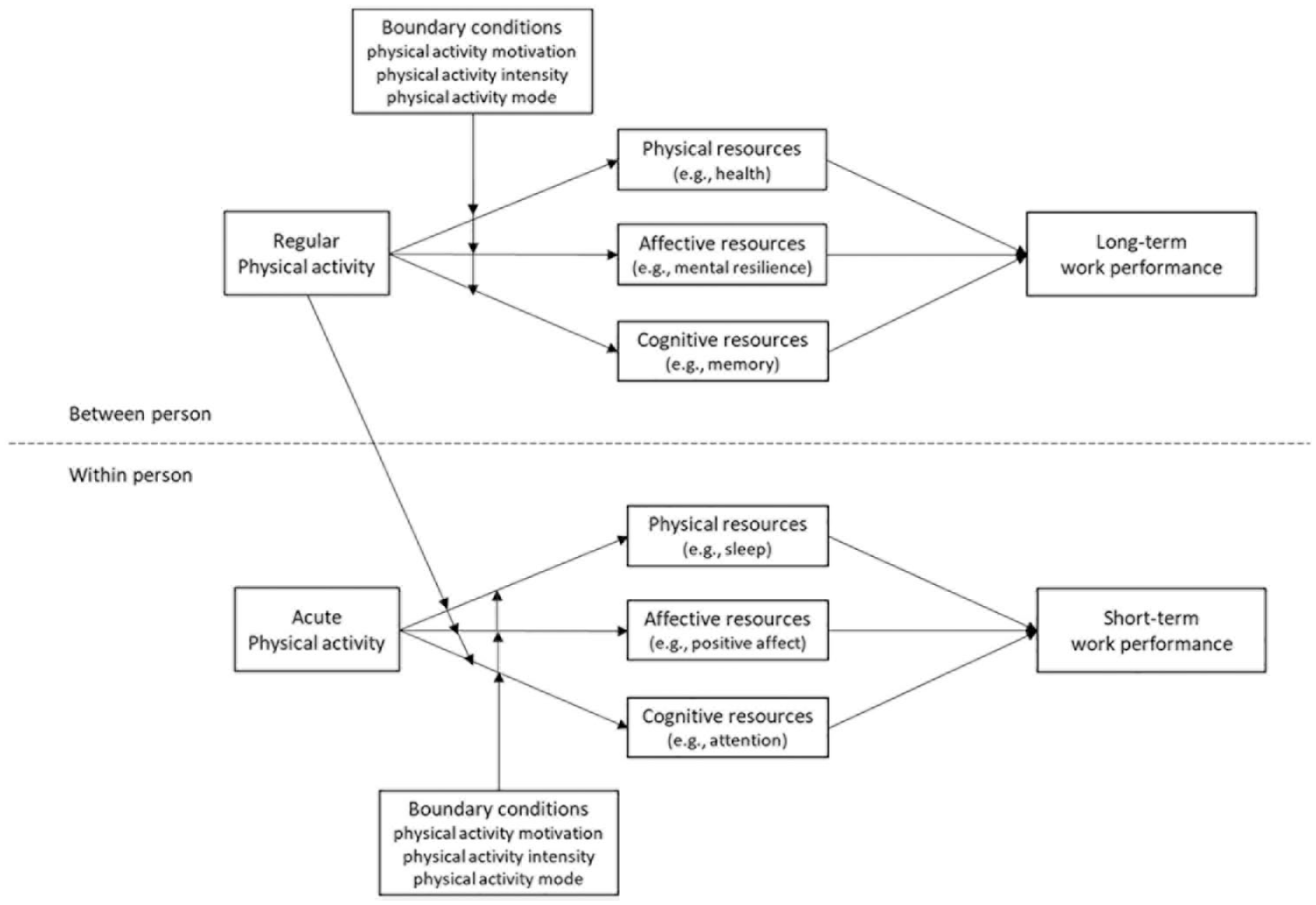
A Resource-Based Model of Physical Activity and Job Performance
Future Research Recommendations
Our review highlights the potential benefits of employee physical activity but also illustrates the need for more work to unpack how physical activity relates to job performance. In this section, we propose a research agenda. In an effort to prioritize research in this domain, we distinguish between research topics and questions that require more immediate attention versus those that are less pressing and thus offer avenues for longer-term initiatives.
Short-Term Research Agenda
On the basis of our review, we believe that there are several research questions that should be a top priority for organizational scholars in the near term. In particular, although various studies in the physical activity literature report effect sizes (e.g., Foster et al., 2005; Reed & Ones, 2006), this crucial information is often missing, making it hard for researchers and organizations to assess the relevance of physical activity to desired outcomes. Therefore, critical next steps in this research area are (a) to consistently report effect sizes surrounding associations of physical activity with physical, affective, and cognitive resources and (b) to examine effect sizes linking physical activity and these resources to job performance. If physical activity does have a considerable impact on performance, organizations have added reasons—beyond improving employee health, keeping and attracting talent, and minimizing health care costs—to facilitate employee physical activity.
It will next be important to examine the acute and more chronic implications of physical activity for performance as proposed in our model. To better understand acute (e.g., episodic or daily) implications, studies are needed to assess which volatile resources (e.g., endorphins, positive affect, attention) are particularly responsible for favorable effects of physical activity on performance. In addition, scholars could adopt a lifespan career perspective to develop greater understanding of how physical activity relates to job performance over longer time frames. For instance, research could investigate which physical (e.g., cardiovascular health), affective (e.g., mental health), and cognitive (e.g., better memory) outcomes may intersect with physical activity to support employees in maintaining performance and/or remaining in the workforce longer (Van Solinge & Henkens, 2010). Furthermore, evaluating how employee physical activity patterns change in response to cyclical (e.g., seasonal changes; Tucker & Gilliland, 2007) and major life events (e.g., changing jobs, having children; Engberg, Alen, Kukkonen-Harjula, Peltonen, Tikkanen, & Pekkarinen, 2012), and whether these changes have implications for the physical activity–job performance relationship, would be a valuable avenue to evaluate the intersection of volatile and structural aspects of this relationship.
With this understanding of the physical activity–job performance relationship across different time scales in place, the relevant boundary conditions we identified can then be formally tested. Our review suggested that the motivation to pursue physical activity is relevant to associations with physical, affective, and cognitive mechanisms that relate to job performance. Research is particularly needed to pinpoint whether physical activity increases job performance to a greater degree when employees enjoy exercise and less so when employees dislike exercise. It would also be interesting to explore if motivation for physical activity is a stable trait (i.e., one’s chronic tendency to be motivated to engage in physical activity for autonomous or controlled reasons) versus a fluctuating motivational state.
Aside from physical activity motivation, other boundary conditions include exercise intensity and mode. Research on how exercise intensity affects exercise–outcome relationships is mixed. We therefore suggest exploring nonlinear relationships, whereby exercise at medium intensity levels, versus very low and extremely high intensity levels, may have the greatest magnifying effect on the proposed mediating resources and job performance. We also call for more research that specifically compares the implications of aerobic versus anaerobic exercise modes on job performance through physical, affective, and cognitive resources.
Once the process and boundary conditions of the physical activity–job performance relationship are better understood, researchers can then turn their attention to the causal effects of physical activity on job performance. Interventions have had success in improving criteria such as physical activity levels and corresponding health criteria outside of the organizational sciences (Shaw et al., 2006). Yet, because employee exercise interventions often include components designed to facilitate wellness (e.g., coaching, team building), the specific relevance of the exercise component of interventions in organizational settings remains unclear. Only one review article (Conn et al., 2009) in our cross-disciplinary review included a performance criterion when evaluating exercise interventions, and though results are promising—exercise programs reduced employee absences—strong experimental designs (i.e., randomized controlled trials) are needed to conclusively establish the potential causal effects of physical activity on job performance.
Long-Term Research Agenda
Once researchers have generated a basic understanding of the physical activity–job performance relationship, more nuanced research questions can be addressed. To begin with, the time scale by which acute physical activity influences physical, affective, and cognitive resources relevant to performance is unclear. Based on insights from our review—as well as theorizing surrounding the unfolding of physical, affective, and cognitive reactions (see, for example, Schachter & Singer, 1962)—acute physical activity may influence some categories of resources (e.g., mood vs. attention) earlier or for a longer duration than other categories. It is also worth exploring whether the intensity and duration of resource gains extending from acute physical activity depend on baseline fitness levels (e.g., more pronounced, longer-lasting effects for more fit individuals vs. less pronounced, shorter-lasting effects for less fit individuals). Addressing these questions could help with the generation of practical recommendations surrounding the optimal dose of physical activity for employees with different physical fitness levels.
Scholars could also take the within-person standard deviation of physical activity across the time course of a within-person study and treat this as a person-level moderator of daily effects to compare consistent levels of physical activity (i.e., a low within-person standard deviation) to bursts of physical activity (i.e., a high within-person standard deviation). This would allow researchers to address theoretically important questions about the effects of physical activity on performance as they unfold over time while incorporating person-level differences.
We also encourage researchers to examine differences in acute and chronic physical activity in relation to job performance. A classic example often reviewed in within-person research is the relation between physical activity and an individual’s heart rate. Within person, enactment of physical activity and heart rate are positively related, but between person, the relationship becomes negative, such that more physically active people have lower heart rates (which tends to benefit health outcomes). Drawing an analogy to the study of physical activity and performance, it could be the case that acute physical activity temporarily draws down resources needed for immediate job performance but that regular physical activity generates a larger pool of resources that benefit job performance more broadly (Gabriel et al., 2019). A multilevel focus surrounding the effects of physical activity on job performance could clarify the short- and long-term performance effects of physical activity.
Methodological Recommendations
We offer several suggestions for suitable methods to capture the performance implications of acute and regular physical activity. Within-person designs seem most suitable for exploring the implications of acute physical activity on job performance. Experience-sampling investigations (Gabriel et al., 2019) would allow scholars to assess the amount of physical activity a person engaged in each day of a study before, during, and after work. With person-mean centering (Gabriel et al., 2019), researchers could focus on how physical activity benefits individuals’ job performance relative to their own personal baseline of physical activity across the course of the study. In within-person designs, combining self-reports with other ratings would be advisable to obtain data on the employees’ resources (e.g., mood and energy) and performance criteria (e.g., task focus and helping behavior).
Longitudinal panel data would be better suited for examining the long-term implications of physical activity for job performance. In longer-term designs, wearables (e.g., actigraphs) could be combined with organizational records (e.g., performance evaluations) to assess the link between physical activity and performance. Measurement techniques that could be used in both short- and long-term study designs include blood pressure readings (e.g., Bono, Glomb, Shen, Kim, & Koch, 2013), actigraphs (e.g., Barber et al., 2017), and other wearable sensors (Matusik, Heidl, Hollenbeck, Yu, Lee, & Howe, 2019). Longer-term panel designs may be particularly well suited to the evaluation of how changes in exercise motives, modes of pursuing exercise, and physical fitness alter physical activity–job performance associations over time.
Conclusion
Our emergent systematic review of the management literature indicated that relatively little organizational research has thoroughly considered the job performance implications of employee physical activity and that a coherent theoretical framework that explains why, how, and when physical activity might affect this performance is thus far lacking. However, extant management research did suggest that physical activity has physical, affective, and cognitive consequences for employees. Our cross-disciplinary review served to bolster this conclusion, indicating that physical activity generates physical, affective, and cognitive resources that can influence various performance criteria. Both reviews offered the building blocks for our resource-based model, which explains short-term and long-term physical activity–performance processes through gains in volatile and structural personal resources. Further, our cross-disciplinary review shed light on important boundaries of the aforementioned relationships (physical activity dose, mode, motivation, and fitness level). Overall, the evidence, conclusions, and resource-based model presented here provide the foundation for scholars to conduct programmatic research aimed at enhancing understanding of the implications of physical activity for employees and organizations alike.
Supplemental Material
Supplemental_Online_Appendix – Supplemental material for Employee Physical Activity: A Multidisciplinary Integrative Review
Supplemental material, Supplemental_Online_Appendix for Employee Physical Activity: A Multidisciplinary Integrative Review by Charles Calderwood, Lieke L. ten Brummelhuis, Amanda S. Patel, Trevor Watkins, Allison S. Gabriel and Christopher C. Rosen in Journal of Management
Research Data
Responses_to_Reviewer_Comments_FINAL – Research Data for Employee Physical Activity: A Multidisciplinary Integrative Review
Research Data, Responses_to_Reviewer_Comments_FINAL for Employee Physical Activity: A Multidisciplinary Integrative Review by Charles Calderwood, Lieke L. ten Brummelhuis, Amanda S. Patel, Trevor Watkins, Allison S. Gabriel and Christopher C. Rosen in Journal of Management
Footnotes

References
Supplementary Material
Please find the following supplemental material available below.
For Open Access articles published under a Creative Commons License, all supplemental material carries the same license as the article it is associated with.
For non-Open Access articles published, all supplemental material carries a non-exclusive license, and permission requests for re-use of supplemental material or any part of supplemental material shall be sent directly to the copyright owner as specified in the copyright notice associated with the article.
