



Abstract
This article reviews 86 studies and uses meta-analytical methods to investigate how perceived corporate social responsibility (CSR) impacts employee attitudes and behaviors and to identify the mediating mechanisms and boundary conditions. An initial review of this body of research finds a multitude of mediators but a limited focus on CSR typology as a potential moderator. Drawing upon social exchange theory, we develop and test two multivariate mediation models to integrate and synthesize three most-studied mediating mechanisms: organizational justice, organizational trust, and organizational identification. Meta-analyses find that while all three mechanisms within the parallel mediation model are equally significant in mediating the effect of perceived CSR on organizational commitment and job satisfaction, organizational identification is superior to organizational justice and organizational trust in mediating the effect of CSR perceptions on organizational citizenship behavior (OCB) and turnover intention. It is also found that although both mediation models adequately represent the accumulated empirical data, the sequential model is statistically superior to the parallel model. Although meta–structural equation modeling analyses reveal minimal differences between the broadly defined internal and external CSR perceptions, significant heterogeneity exists between perceived CSR and the outcome variables. The additional analyses suggest that significant differences exist between more specific stakeholder CSR types. In summary, this article extends our understanding of how employees perceive and respond to CSR through multiple sociopsychological mechanisms in additive and sequential fashions and how such responses could differ depending on the specific stakeholder subgroups targeted by CSR. Theoretical contributions and future research directions are also discussed.
Keywords
In recent years, research concerning the psychological microfoundations of corporate social responsibility (CSR), also known as micro-CSR research, has gained significant attention. Scholars have increasingly recognized the potential of this line of research to provide new insights enhancing our understanding of CSR and its impact (Rupp, Ganapathi, Aguilera, & Williams, 2006; Rupp & Mallory, 2015). Numerous studies have examined how employees perceive, interpret, react, and participate in CSR and documented a diverse set of sociopsychological mechanisms and employee-related outcomes (for a review, see Gond, El Akremi, Swaen, & Babu, 2017). This line of fruitful research also raises interesting questions regarding what, why, and how these mechanisms account for the relationship between CSR and employee outcomes. More comprehensive and systematic examinations of these questions are needed for the following reasons.
First, theories addressing the mechanisms associating CSR with employee-related outcomes remain fragmented. Although a variety of mediating factors have been proposed (Gond et al., 2017), most studies examine only one mediation mechanism through which perceived CSR affects employee outcomes. Considering multiple mechanisms simultaneously and examining their relationships allow us to not only examine how these mechanisms individually and collectively account for the effect of CSR but also provide insights into various theoretical perspectives regarding the nature and significance of CSR.
Second, previous studies have appealed to different mechanisms to explain different employee outcomes; however, how CSR is associated with different but related outcomes, such as proximal outcomes (e.g., job satisfaction and organizational justice) and more distal outcomes (e.g., turnover intention and organizational citizenship behavior [OCB]), remains unclear. Therefore, investigating whether CSR exerts similar or different effects on different employee outcomes (Rupp & Mallory, 2015) and the underlying psychological mechanisms is important.
Third, it remains unclear whether different forms of CSR have differential effects on employees. CSR is conceptually viewed as an umbrella construct (Aguinis & Glavas, 2012), and many empirical studies accordingly have examined only CSR’s overall effects on employees (e.g., Gond et al., 2017; Rupp & Mallory, 2015). However, there has been research on different forms of CSR that allows us to assess the heterogeneous effects of different forms of CSR.
To address these unresolved issues, we adopt social exchange theory (Blau, 1964; Cropanzano & Mitchell, 2005) accompanied by a meta-analytic approach to develop two mediation models to integrate previous research concerning the effects of CSR. One model is a parallel mediation model in which the key mechanisms affect employee-related outcomes independently in a competing or an incremental fashion. The other is a sequential mediation model in which the same mechanisms form a causal chain to predict the outcome variables. We conduct meta–structural equation modeling (SEM) procedures to test the two mediation models with perceived CSR as the independent variable; organizational justice, organizational trust, and organizational identification as the mediators; and job satisfaction, organizational commitment, OCB, and turnover intention as the outcomes. 1 Meta-SEM and other meta-analytical procedures are also used to examine the extent to which different typologies of CSR, especially that of internal-external CSR, moderate the two mediation models.
A few issues regarding the meta-analytical models are noteworthy. First, consistent with the micro-CSR literature (Rupp et al., 2006), our analyses focus on the impacts of perceived CSR. Second, we choose the three mediators and four employee-related outcomes because these constructs are the most widely studied constructs in previous micro-CSR research. Finally, we exclude studies investigating CSR effects on prospective employees because our focus is on incumbent employees. 2
Through this meta-analytical study, we seek to make three important contributions to the current micro-CSR literature. First, by proposing the parallel and the sequential mediation models on the basis of social exchange theory (Blau, 1964) as applied to multiple stakeholder relationships (Freeman, 1984), we integrate three major mechanisms and provide a comprehensive understanding of the influence of CSR on employees. Our integrative models add new insights into how the mechanisms are related to each other as well as to their antecedents and outcomes. Furthermore, our comparative tests of the parallel versus sequential mediation models suggest that the sequential mediation model represents a superior overarching theoretical framework for explaining the effects of employee CSR perceptions as documented in the previous literature. Finally, although our study finds that the two broad forms of employee CSR perceptions (i.e., perceived internal CSR and perceived external CSR) have equal effects on most employee-related outcomes, the additional analyses suggest that alternative typologies of CSR have moderating effects. These results contribute to the dialogue and debate among CSR scholars regarding the extent to which employees are morally concerned with the wellbeing of stakeholders other than themselves (Farooq, Rupp, & Farooq, 2017).
CSR, Employee CSR Perceptions, and Micro-CSR Research
Definitions and Categories of CSR
Scholars have studied CSR for decades using numerous, diverse definitions (Aguinis & Glavas, 2012). Early studies often consider CSR a firm’s obligation beyond economic and legal requirements (Davis, 1973). However, Carroll (1979) argues that CSR incorporates not only ethical and discretionary responsibility but also economic and legal responsibility. More recent studies tend to agree with the more expansive definition and adopt a stakeholder perspective (Rupp et al., 2006). For example, Aguinis and Glavas (2012) defines CSR broadly as organizational actions and policies that take into account stakeholders’ expectations and the triple bottom line of economic, social, and environmental performance. Following prior micro-CSR studies, our study adopts this definition of CSR.
Previous studies have also classified CSR into multiple categories. As noted, Carroll (1979) classifies CSR into four categories. CSR is also classified as strategic versus responsive CSR (Porter & Kramer, 2006). The former emphasizes using CSR to obtain a competitive advantage, whereas the latter refers to a firm’s responses to stakeholder demands, which may or may not be related to firm performance. A similar category is embedded versus peripheral CSR (Aguinis & Glavas, 2013) as follows: Embedded CSR relies on a firm to integrate CSR into its strategy, routines, and operations, while peripheral CSR focuses on activities unrelated to these issues.
Among the several categories, the category that is the most highly relevant to our meta-analysis is internal versus external CSR (Rupp & Mallory, 2015). Specifically, internal CSR refers to an organization’s actions and policies directed toward employees. For example, organizational programs providing additional benefits to employees can be categorized as internal CSR. In contrast, external CSR refers to those organizational actions and policies toward other stakeholders, such as customers, suppliers, communities, governments, the environment, and so on. For instance, donations to local communities, efforts to reduce carbon emissions, offering more energy-efficient products to customers, and compliance with governmental regulations are considered external CSR. Despite the conceptual distinction, scholars differ on its effect on outcomes, with some (e.g., Aguinis & Glavas, 2013) contending for its significance and others (e.g., Rupp et al., 2006) for its insignificance.
Micro-CSR Research and Employee CSR Perceptions
While numerous CSR studies are organizational-level studies that examine CSR’s influence on firm performance (Zhao & Murrell, 2016), more recent research has studied how CSR influences employees at the individual level (Rupp et al., 2006). These studies are considered micro-CSR research and focus on how employees perceive, evaluate, and react to their organizations’ CSR (El Akremi, Gond, Swaen, De Roeck, & Igalens, 2015). This stream of research has demonstrated that employees’ CSR perceptions are critical antecedents of their attitudinal and behavioral reactions because how employees perceive CSR can actually have more direct and stronger implications for their subsequent reactions than actual CSR of which employees may or may not be aware (Rupp et al., 2006).
CSR perceptions reflect employees’ views regarding not only the extent to which their organizations engage in CSR but also the impact of their organizations on various stakeholders (Glavas & Godwin, 2013). Therefore, employee CSR perceptions is a multidimensional construct (De Roeck & Maon, 2016). Of significant relevance to our meta-analysis is the perceived internal versus perceived external distinction: Perceived internal CSR refers to employees’ perceptions of CSR aimed at benefiting employees, whereas perceived external CSR refers to employees’ perceptions of CSR aimed at benefiting stakeholders outside the organization, such as customers, suppliers, and society (Aguinis & Glavas, 2013). As noted earlier, our meta-analysis examines the debate regarding whether perceived internal CSR has a stronger influence than perceived external CSR.
Theoretical Framework and Hypotheses
Brief Review of Major Mechanisms in Micro-CSR Research
Micro-CSR research has studied numerous mechanisms explaining why and how employees react to CSR cognitively or behaviorally (Rupp & Mallory, 2015). Of these mechanisms, the following three have been studied the most frequently: organizational justice (e.g., De Roeck, Marique, Stinglhamber, & Swaen, 2014), organizational trust (e.g., Farooq, Payaud, Merunka, & Valette-Florence, 2014), and organizational identification (e.g., Farooq et al., 2017). Among the 86 empirical articles included in our meta-analysis, more than 80% use at least one of the three mechanisms. This finding is also consistent with previous theoretical reviews (e.g., Gond et al., 2017). Below, we offer a brief review of each mechanism.
Organizational Justice
Organizational justice refers to employees’ perceptions of how they are treated by their employing organization on the basis of outcomes, procedures, and social interactions (Colquitt, Conlon, Wesson, Porter, & Ng, 2001). To the extent that CSR reflects an organization’s treatment of various stakeholders, CSR provides employees with critical information by which employees judge the fairness of the organization (Rupp et al., 2006). In other words, employees use CSR as a heuristic to gauge organizational justice (Collier & Esteban, 2007) such that more CSR leads to stronger perceived organizational justice, which generates more positive attitudes and behaviors and inhibits negative ones.
Organizational Trust
Trust is defined as “the willingness of a party to be vulnerable to the actions of another party based on the expectation that the other party will perform a particular action important to the trustor irrespective of the ability to monitor or control that other party” (Mayer, Davis, & Schoorman, 1995: 712). Employee CSR perceptions can foster employees’ trust because CSR provides benefits to employees and other stakeholders and, thus, is positively related to the trustworthiness of the organization (El Akremi et al., 2015). Furthermore, employees view CSR as evidence that the organization recognizes and appreciates the contributions of various stakeholders and is willing to fulfill its obligations. Therefore, perceptions of CSR further strengthen norms of reciprocity between employees and the organization, resulting in a higher level of organizational trust, which in turn affects attitudes and behaviors.
Organizational Identification
Organizational identification is employees’ cognitions and feelings of oneness with or belongingness to their organization (Ashforth & Mael, 1989). The strength of organizational identification is a function of the attractiveness and status of the organization and value congruence between the employees and the organization. Companies more actively engaging in CSR are more attractive to employees because such companies are viewed as more responsible employers. Therefore, perceptions of CSR lead to stronger employee identification with the organization (Opoku-Dakwa, Chen, & Rupp, 2018), thereby influencing attitudes and behaviors.
Social Exchange Theory and Mediating Mechanisms
How do these multiple mediating mechanisms relate to each other? This question is important as addressing it could shed light on how the various mediators individually and collectively relate to different types of CSR on the one hand (e.g., perceived internal vs. external CSR) and a host of outcome variables on the other hand. We adopt social exchange theory as the overarching theory to address this question.
As a foundational theory of human behavior, social exchange theory regards social interactions as the exchange of rewards and costs, and treats the exchange of benefits as the basis of cultivating and maintaining social relationships (Blau, 1964). The theory reveals processes through which interacting parties initiate and reciprocate economic, social, and psychological resources that are mutually benefiting, leading to sustainable long-term social relationships. Organizational research has documented numerous positive consequences of constructive exchange relationships in the workplace (for a review, see Cropanzano & Mitchell, 2005). As such, a social exchange perspective has the potential to deepen our understanding of CSR as well as illuminate how the various mediating mechanisms connect CSR perceptions and employee responses.
CSR initiatives are a company’s actions that recognize and reciprocate the support and benefits received from its stakeholders, including employees (Rupp et al., 2006). In turn, employees’ responses to CSR can be viewed as fulfilling their obligation to pay back what they have received from the company and other relevant stakeholders. It is no coincidence that the antecedents (perceived corporate engagement in socially responsible activities), mediators (regarding employee–organizational relations), and outcome variables (e.g., organizational commitment and OCB) are all predominantly relational constructs about the processes and qualities of bilateral and multilateral relationships. A closer review of social exchange theory further illustrates the centrality of the three mediating constructs. Organizational justice has been studied as the very foundation of positive social exchanges, including employee–organizational exchange relationships (Colquitt et al., 2001). Similarly, trust and trustworthiness are studied as central constructs enabling cooperation at all levels of organizational operations (Mayer et al., 1995). Social identity and organizational identification have been studied as powerful drivers of interpersonal and intergroup relationships within organizations (Ashforth & Mael, 1989). Finally, organization scholars have extended social exchange theory to study networked relationships involving multilateral relationships (e.g., Granovetter, 1973). Although our focus is on employee attitudes and behaviors as responses to CSR, the company’s relationships with other stakeholders may still affect the dynamics of the focal relationship as antecedents or moderators.
Given the theoretical pertinence of social exchange theory, we proceed to first develop a parallel mediation model (Figure 1) regarding how CSR perceptions affect employee attitudes and behaviors through multiple paths, each of which exercises unique effects, and then a sequential mediation model (Figure 2) regarding how CSR perceptions activate a chain of psychological mechanisms that serially affect the outcome variables.
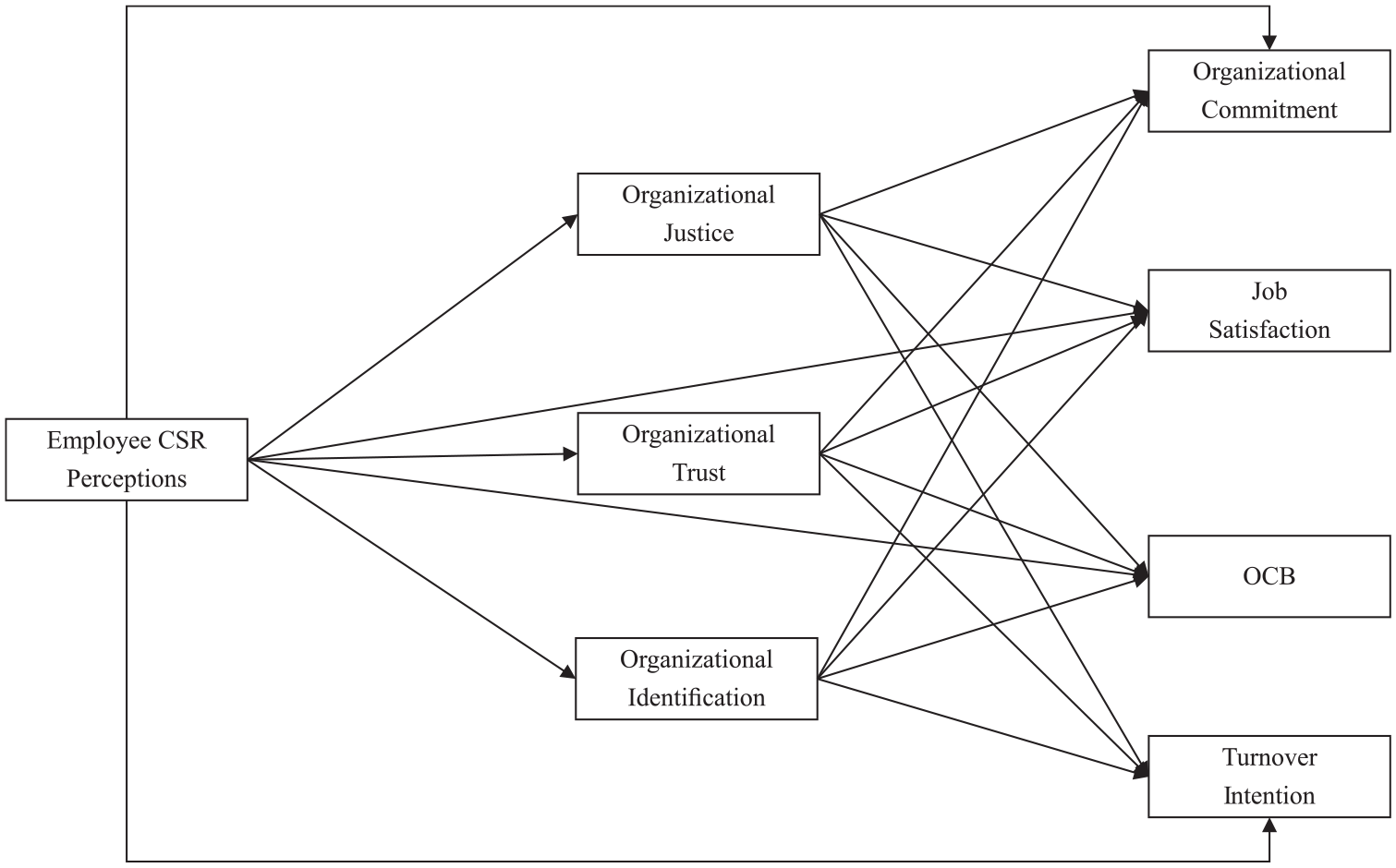
Parallel Mediation Model

Sequential Mediation Model
Parallel Mediation Model
A parallel mediation model assumes that each mechanism is independent and separate, accounting for the unique and incremental effects of the independent variables on given dependent variables (Rosen, Ferris, Brown, Chen, & Yan, 2014). From the social exchange theory perspective, a firm’s CSR activities may drive certain employee attitudes and behaviors by activating and enhancing multiple positive psychological states simultaneously. More specifically, such activities may enhance employees’ perceptions that the company is fair and trustworthy and represents the core values and identity of the employees. Some previous studies have used a parallel mediation model to explain the effects of employee CSR perceptions. For example, Farooq et al. (2014) find that the influence of employee CSR perceptions on organizational commitment is independently mediated by organizational identification and organizational trust. Similarly, Hofman and Newman (2014) suggest that the effect of employee CSR perceptions on organizational commitment is independently mediated by organizational identification and organizational justice. However, we find no studies that include all three mediating variables.
Notably, although the three mechanisms all originate from CSR perceptions, they are conceived as independent and separate pathways leading to the outcome variables. Thus, the parallel model allows us to assess the unique effect explained by each mediator and the total effects explained by the mediators collectively. More specifically, in the parallel mediation model, each of the three mechanisms is hypothesized to significantly account for an additional effect netting the effects of the other two mechanisms. Formally, we propose the following hypothesis:
Hypothesis 1: The relationship between employee CSR perceptions and employee attitudinal and behavioral outcomes is mediated in parallel by organizational justice, organizational trust, and organizational identification.
Relative Superiority of the Mediators in the Parallel Model
While the three mechanisms are hypothesized to independently explain the effects of employee CSR perceptions, it would be interesting to examine the extent to which their mediation effects are equal in effect size. Theoretically, the three mechanisms have been conceived by organizational researchers as independent constructs, all of which exert a potent influence on outcome variables; however, to the best of our knowledge, thus far, no micro-CSR research has studied their differential impact on the outcome variables included in the current meta-analysis. On what theoretical grounds do we propose such differences? As mediators, these constructs represent affiliative cognitions and sentiments toward the organization that are engendered by the companies’ CSR initiatives and, in turn, serve as drivers of downstream attitudes and behaviors. Thus, the more strongly a mediating construct represents a cognitive (and affective) affiliation with the organization, the stronger its mediating potency. Based on our review of the conceptions of the three mediators, we posit that organizational identification represents a stronger affiliation with the organization than the other two mediators. Notably, organizational identification refers to organizational members’ perception of oneness with the organization, implying a merging of identities, values, and well-being between employees and the employing company (Ashforth & Mael, 1989; Dutton, Dukerich, & Harquail, 1994). We suggest that such cognitions and sentiments of interdependence are much stronger than organizational justice (the perception that the company is a fair player when transacting with its various stakeholders) and organizational trust (the perception of the trustworthiness of the company and, hence, the willingness to be vulnerable when interacting with the company). While both organizational justice and organizational trust indicate a fairly strong positive employment relationship (Colquitt et al., 2001; Kramer & Tyler, 1996), organizational identification psychologically binds the employees to the organization most strongly, rendering employees committed to the organization (Knippenberg & Schie, 2000). We therefore expect organizational identification to have a greater mediating effect than either organizational justice or organizational trust. However, convincing arguments and research evidence suggesting differential mediation effects between organizational justice and organizational trust are lacking. We thus hypothesize the following:
Hypothesis 2: Organizational identification has a stronger mediating effect than either organizational justice or organizational trust on the relationship between employee CSR perceptions and employee attitudinal and behavioral outcomes.
Sequential Mediation Model
Relative to the parallel mediation model, according to Rosen et al. (2014), the sequential mediation model has the advantage of incorporating multiple theoretical mechanisms into a comprehensive and integrative model, thereby providing a coherent explanation of the effects of given independent variables. In search of such integration, a justice-based perspective of social exchange theory has been proposed by some scholars (e.g., Aryee, Budhwar, & Chen, 2002; Cropanzano & Mitchell, 2005; Cropanzano & Rupp, 2008; Rupp & Cropanzano, 2002) to study organizational behavior. Of greater relevance to the current study is De Roeck and colleagues (De Roeck et al., 2014; De Roeck & Maon, 2016), who explain how CSR affects employee responses from a justice-based perspective of social exchange theory. This theoretical perspective emphasizes fairness as the foundation of social relationships in businesses and organizations and the principal criterion by which exchange activities are interpreted and responded to. The norm of fairness is considered intricately related to the norm of reciprocity, that is, returning benefits to instead of taking advantage of or causing harm to providers (Colquitt et al., 2001). Therefore, perceptions of justice in social exchanges are essential for initiating and sustaining mutually beneficial relationships. In contrast, perceptions of injustice discourage people from entering exchange relationships, prompt relation breakup, and motivate tit-for-tat retaliation (Blau, 1964).
Our review of empirical micro-CSR research further suggests the utility of the justice-based perspective of social exchange theory. Indeed, following this perspective, De Roeck and Maon (2016) develop a theoretical model in which the influence of employee CSR perceptions on job satisfaction and other individual-level outcomes is mediated sequentially in the order of organizational justice, organizational trust, and organizational identification. However, this model has not been empirically tested. Therefore, our four-step sequential mediation model of the effects of perceived CSR on employee responses is the first model to be explored, and such exploration is possible using meta-analytic methods applied to a large body of accumulated empirical data. Next, we present arguments suggesting how employee CSR perceptions generate a series of psychological mechanisms step by step that lead to changes in employees’ attitudes and behaviors.
Employee CSR Perceptions Enhance Organizational Justice
As previously discussed, the social exchange view frames a company’s CSR activities and practices as initiating and/or reciprocating beneficial relationships with various stakeholders. The more a company is perceived to engage in such prosocial behaviors, the more that company is perceived by employees as a fair employer, partner, and corporate citizen. Therefore, CSR perceptions generate perceptions of organizational justice by employees (Collier & Esteban, 2007).
Organizational justice enhances organizational trust
To the extent that CSR initiatives are viewed as fair treatments of various stakeholders, employees are more likely to view the organization as trustworthy, leading to trust in the organization (Collier & Esteban, 2007). Organizational trust research has produced abundant evidence consistent with this prediction. Organizations and managers who display distributive, procedural, or interactional justice are trusted more by employees (Brockner & Siegel, 1996; Chen, Chen, & Xin, 2004; Kramer & Tyler, 1996).
Organizational trust enhances organizational identification
Organizational trust has been identified as a critical mediating mechanism explaining the relationship between organizational justice and organizational identification (Aryee et al. 2002; Cropanzano & Rupp, 2008). Employees are more likely to form bonds that foster identification when they trust their organization (Schaubroeck, Peng, & Hannah, 2013).
Organizational identification as the most proximal antecedent of employee attitudes and behaviors
Meta-analyses of organizational identification (Lee, Park, & Koo, 2015; Riketta, 2005) have shown its significant effects on employee attitudes and behaviors, such as job satisfaction, organizational commitment, OCB, and turnover intention (Edwards & Cable, 2009; Jones, 2010; Knippenberg & Schie, 2000). Furthermore, in previous research involving the co-presence of the three variables, organizational justice and organizational trust have been studied as antecedents of organizational identification (Aryee et al., 2002; Cropanzano & Rupp, 2008), and meta-analyses (e.g., Lee et al., 2015; Riketta, 2005) have also found organizational identification to be as a key mediator between organizational justice/trust and individual attitudes and behaviors. These all suggest that organizational identification is the most proximal predictor of the outcome variables.
In summary, there are theoretical and empirical reasons to propose that employee CSR perceptions affect employee organizational commitment, job satisfaction, turnover intention, and OCB through serial mediations in which organizational justice engenders organizational trust, which in turn fosters organizational identification that finally affects employee attitudes and behaviors. Therefore, we hypothesize the following:
Hypothesis 3a: Organizational justice mediates the relationship between employee CSR perceptions and organizational trust.
Hypothesis 3b: Organizational trust mediates the relationship between organizational justice and organizational identification.
Hypothesis 3c: Organizational identification mediates the relationship between organizational trust and employee attitudinal and behavioral outcomes.
Appropriateness of Parallel Versus Sequential Mediation Models
Hypotheses 3a to 3c raise the question, which mediation model is more appropriate for explaining the effects of CSR perceptions? As argued earlier, the sequential mediation model has a greater potential to provide an integrative framework. Here we further contend that it has the advantage for exploring emergent social exchange relationships. When two newly acquainted parties initially develop a collaborative relationship, that is, when there is no substantive preexisting mutual identification or trust (as strangers or in an arm’s-length relation), initiating other-benefiting activities (e.g., CSR) will most likely first generate perceptions of justice, which provide a foundation for fostering trust, which in turn cultivates identification.
Admittedly, CSR is typically launched with existing stakeholders and is, hence, embedded in existing relationships. However, to the extent that CSR policies and activities represent a new stakeholder paradigm beyond the traditional shareholder paradigm of profit maximization (Freeman, 1984), the sequential model could be more appropriate than the parallel model for depicting how CSR initiatives generate higher levels of organizational justice, further enhancing organizational trust and fostering stronger organizational identification, which eventually increases positive and pro-organizational attitudes and behaviors and decreases negative ones. Thus, we hypothesize that the sequential model is more effective in capturing the effect of perceived CSR on employee attitudes and behaviors.
Hypothesis 4: The sequential mediation model is superior to the parallel mediation model in predicting the relationships between CSR perceptions and employee attitudinal and behavioral outcomes.
Note that Hypothesis 4 is based on the assumption of newly emerging or emergent company–stakeholder relationships. One caveat is that there may be significant cross-company variance in such company–stakeholder relationships. If such variance exists, the parallel model may be more appropriate for examining the effects of CSR practices because in more established positive relationships, continuous mutually benefiting acts generate positive attitudinal and behavioral responses through multiple (parallel) psychological mechanisms that feed each other in iterative and reciprocal fashions. For example, people trust the organizations with which they identify more and perceive more fairness in organizations that they trust more. Therefore, the unidirectional causal chain of mediation relationships among justice, trust, and identification in emerging social exchanges may be replaced by multiple paths that are mutually reciprocal. In such, and other, similar situations, researchers may be interested in assessing the overall validity of a parallel model and the unique and incremental effects of each mediating mechanism rather than the causal sequence of CSR perceptions influencing outcomes. In these studies, the parallel model could be more appropriate, and we considered this possibility while developing Hypothesis 1.
Moderating Effect of Types of Employee CSR Perceptions
The debate regarding whether perceived internal CSR has a stronger influence than perceived external CSR is ongoing. On the one hand, as recipients, employees may care more about and respond more strongly to internal CSR due to self-interest concerns (Farooq et al., 2017). On the other hand, employees may care equally about external CSR due to their general moral concerns and because external CSR influences the reputation and status of the organization (Farooq et al., 2017). Because these competing views are based on different philosophical assumptions of human self-interests and moral concerns, developing compelling a priori hypotheses would require more complex theorization regarding human nature and more extensive data to test such hypotheses, which is beyond the scope of this review. Nevertheless, without hypothesizing them, we will conduct meta-analytic analysis to explore the moderating effects of different CSR typologies and suggest other moderating factors for future research.
Methods
Literature Search
Several search methods were employed to find previous empirical studies that examine CSR perceptions and their impact on employees. First, we conducted multiple computer-based literature searches using databases, such as PsycINFO, Web of Science, Business Source Complete, Google Scholar, and ProQuest. To include as many relevant articles as possible, we searched for articles (including online versions) published from January 1990 to April 2018. To search for relevant studies, we used the following keywords: “corporate social responsibility,” “corporate social performance,” “social responsibility,” “social performance,” “stakeholder,” “stakeholder management,” and “stakeholder relations.” Then, we manually searched the Academy of Management Journal, Organization Science, Journal of Organizational Behavior, Journal of Applied Psychology, Journal of Management, Human Resource Management, Personnel Psychology, Journal of Management Studies, Group & Organization Management, Journal of Business Ethics, and Business Ethics Quarterly during the same time period to find studies that were not included in the computer-based literature search. In addition, we checked the reference lists of previous conceptual reviews of CSR (e.g., Gond et al., 2017; Rupp & Mallory, 2015). Finally, we sent e-mails to Academy of Management e-mail lists to request full versions of working and unpublished papers.
Criteria for Inclusion
Our literature search yielded hundreds of articles. This is not surprising because CSR has been intensively studied for several decades (Aguinis & Glavas, 2012). Since we were interested in employee CSR perceptions and their outcomes, we adopted five criteria to carefully identify studies for inclusion in our meta-analysis. First, the included studies must be studies focusing on the relationship between employee CSR perceptions and employee-related outcomes. Thus, studies addressing organizational-level antecedents and outcomes of CSR were excluded. Second, our meta-analysis primarily focuses on incumbent employees and studies examining how CSR influences prospective employees and job applicants were excluded. The third criterion required the studies to be empirical studies with numerical data. Therefore, conceptual and qualitative studies were excluded. Fourth, the studies must report at least one correlation between employee CSR perceptions and employee-related outcomes; studies without statistical information were excluded. Fifth, if a study used two or more independent samples, the studies were coded separately, but if a sample was used in two or more studies, only the study that offered more information was included. After applying the above five criteria, we retained 104 studies in 86 published articles with a sample size of 50,607.
Data Coding and Operationalization of Variables
In the coding procedure, we coded the information of each study for (a) the basic information of the study, including the author(s) and year of publication; (b) employee CSR perceptions and their measures; (c) employee-related outcomes and their measures; (d) sample size; (e) the reliability (i.e., Cronbach’s alpha coefficient) of each variable; and (f) the correlation coefficients between employee CSR perceptions and the outcome variables.
Employee CSR Perceptions
In micro-CSR literature, perceptual measures were used to operationalize employee CSR perceptions, perceived external CSR, and perceived internal CSR. Thus, we first coded all perceptual measures as employee CSR perceptions (regardless of the CSR foci). Then, we classified the CSR perceptions into three types to test the potential moderating effects of the perceived CSR types. The first type is perceived internal CSR, which focuses on employees’ perceptions of CSR practices that directly benefit employees (e.g., Farooq et al., 2017). The second type is perceived external CSR, which measures employees’ perceptions of CSR practices directly benefiting other stakeholders, such as customers, suppliers, the local community, and the natural environment (e.g., Farooq et al., 2017). The third type does not specify either the internal or external focus of the CSR perceptions (e.g., El Akremi et al., 2015).
Employee-Related Outcomes
Our meta-analysis includes multiple employee-related outcomes. For each outcome, we employed the measures used in the original studies. Following previous meta-analyses (e.g., Jiang, Lepak, Hu, & Baer, 2012), in Online Appendix B, we list all articles included in our meta-analysis and the measures of the employee-related outcomes used in each article. Online Appendix B also contains information regarding the three types of CSR perceptions. This information is critical for future studies to replicate and extend our meta-analysis (Aguinis, Pierce, Bosco, Dalton, & Dalton, 2011).
Meta-Analytic Procedure
The primary goals of this meta-analysis were to (a) quantify the effect size of the relationships between employee CSR perceptions and employee-related outcomes, (b) test the parallel mediation model and sequential mediation model through which employee CSR perceptions could affect outcomes, and (c) examine the moderating effects of the CSR typology. For the first goal, we relied on Hunter and Schmidt’s (2004) method, which allowed us to correct any sampling and measurement errors and quantify the effect size of the relationships between employee CSR perceptions and the outcomes. More specifically, sampling errors were addressed by calculating the sample size–weighted correlations, and measurement errors were corrected by adopting the Cronbach’s alpha coefficients reported in the original studies. In cases in which the Cronbach’s alpha coefficient of a particular measure was not reported, a weighted average value calculated from the remaining studies using the same measure (i.e., the artifact distribution method) was used. This method also enabled us to examine the variability in the relationships and compute the credibility intervals and confidence intervals. A sample size–weighted and reliability-corrected correlation is viewed as significant if the confidence interval does not contain zero. We also computed the Q statistic to test the homogeneity of the correlations across original studies.
For the second goal, we used meta-SEM techniques in the R software package (i.e., lavaan; Rosseel, 2012) to examine the parallel mediation model and the sequential mediation model (e.g., Bilgili, Calderon, Allen, & Kedia, 2017; Downes, Reeves, McCormick, Boswell, & Butts, 2020). In this meta-SEM analytic procedure, we first computed the corrected correlation matrix of the variables in our theoretical models (Viswesvaran & Ones, 1995). Then, the correlation matrix was entered in the meta-SEM analysis in the R software package to empirically examine the mediating paths we proposed. The effective sample size used was the harmonic mean. On the basis of the results of the meta-SEM analysis, we computed the direct and indirect effects and compared the three independent mechanisms in the parallel mediation model (Preacher & Hayes, 2008).
For the third goal, we also applied meta-SEM techniques. Here, we used only perceived internal CSR and perceived external CSR in the meta-SEM models. Then, Preacher and Hayes’s (2008) procedures were applied to compare the direct/indirect/total effects between the two types of CSR perceptions. We also used Hunter and Schmidt’s (2004) method to calculate the bivariate correlations between the employee CSR perceptions and outcomes grouped by CSR typology.
Hypothesis Testing Results
Correlations Between Employee CSR Perceptions and Outcomes
Table 1 summarizes the correlations between employee CSR perceptions and the outcomes included in our theoretical models (Figures 1 and 2). After correcting for sampling errors and measurement errors, employee CSR perceptions are generally positively related to the three key mediators, including organizational justice (r = .48, ρ = .57), organizational trust (r = .51, ρ = .60), and organizational identification (r = .47, ρ = .54). Moreover, employee CSR perceptions are positively related to employee outcomes, such as organizational commitment (r = .45, ρ = .53), job satisfaction (r = .44, ρ = .48), and OCB (r = .32, ρ = .39) but negatively related to turnover intentions (r = −.36, ρ = −.42). The meta-analysis of the outcomes not included in the two mediation models (Figures 1 and 2) is reported in Online Appendix A (Table A1).
Correlations Between CSR Perceptions and Employee-Related Outcomes Included in Meta-SEM Models

Note: CSR = corporate social responsibility; OCB = organizational citizenship behavior; SEM = structural equation modeling; k = number of studies; N = combined sample size; r = mean sample size–weighted observed correlations; SDr = sample size–weighted standard deviation; ρ = mean sample size–weighted corrected correlation; SDρ = standard deviation of average corrected effect size; CV = credibility interval; CI = confidence interval; Q = chi-square statistic for the homogeneity of corrected correlations (ρ) across studies.
Table 1 also reports the 80% credibility interval (CV), the 95% confidence interval (CI), and Q statistics with p values. These results suggest that the relationships between employee CSR perceptions and the outcomes are largely heterogeneous across studies, suggesting the existence of potential moderating factors. Our moderating analyses of the CSR types represent an attempt to explore such heterogeneity.
Testing the Parallel Mediation Model
Using the correlations of all variables summarized in Table 2, we applied meta-SEM analysis to estimate the parallel mediation model depicted in Figure 1. The model fit statistics of the estimated meta-SEM model are as follows: χ2 = 247.25, root mean square error of approximation (RMSEA) = 0.23, comparative fit index (CFI) = 0.93, and standardized root mean square residual (SRMR) = 0.06. Table 3 reports the results of the meta-SEM model, including the standardized path coefficients, standard errors, z statistics, and p values.
Correlations Among Variables in the Meta-SEM Analysis

Note: CSR = corporate social responsibility; OCB = organizational citizenship behavior; SEM = structural equation modeling; k = number of studies; N = combined sample size; CI = confidence interval around the mean sample size–weighted corrected correlation.The mean sample-size-weighted correlation (r) and mean sample size–weighted corrected correlation corrected for attenuation due to unreliability (ρ) are presented.
Meta-SEM Results (Parallel Mediation Model)

Note: CSR = corporate social responsibility; OCB = organizational citizenship behavior; SEM = structural equation modeling.
Independent and Unique Effects of the Mediating Mechanisms
First, as shown in Table 3, employee CSR perceptions are positively associated with organizational justice (b = 0.49, p = .00), which, in turn, is positively related to organizational commitment (b = 0.12, p = .00), job satisfaction (b = 0.20, p = .00), and OCB (b = 0.13, p = .00) and negatively related to turnover intention (b = −0.11, p = .00). Employee CSR perceptions are also positively related to organizational commitment (b = 0.29, p = .00), job satisfaction (b = 0.17, p = .00), and OCB (b = 0.10, p = .00) and negatively related to turnover intention (b = −0.09, p = .00). Therefore, these results indicate that the relationships between employee CSR perceptions and the outcomes are partially mediated by organizational justice.
Second, employee CSR perceptions are positively associated with organizational trust (b = 0.51, p = .00), which in turn is positively related to organizational commitment (b = 0.13, p = .00), job satisfaction (b = 0.18, p = .00), and OCB (b = 0.11, p = .00) and negatively related to turnover intention (b = −0.10, p = .00). As noted already, there is a direct effect between employee CSR perceptions and the outcome variables. Therefore, the results indicate the partial mediation effect of organizational trust.
Third, employee CSR perceptions are positively associated with organizational identification (b = 0.48, p = .00), which in turn is positively related to organizational commitment (b = 0.16, p = .00), job satisfaction (b = 0.18, p = .00), and OCB (b = 0.21, p = .00) and negatively related to turnover intention (b = −0.20, p = .00). As noted already, there is also a direct effect between employee CSR perceptions and the outcome variables. Therefore, these results indicate the partial mediation effect of organizational identification.
In summary, our meta-SEM analysis provides empirical evidence suggesting that all three mediating mechanisms uniquely account for the effects of employee CSR perceptions on the outcome variables in a parallel fashion, providing support for Hypothesis 1. Furthermore, as shown in Table 3, the three mediating mechanisms combined account for 41% of the total effects of employee CSR perceptions on organizational commitment, 61% of the total effects of employee CSR perceptions on job satisfaction, 69% of the total effects of employee CSR perceptions on OCB, and 70% of the total effects of employee CSR perceptions on turnover intention. Given that the parallel mediation model includes all four outcome variables, we conducted supplemental analyses in which each outcome variable is entered into meta-SEM analysis separately. Tables A3 through A6 in Online Appendix A report the results, demonstrating that Hypothesis 1 remains supported.
Relative Effects of the Mediating Mechanisms
Hypothesis 2 suggests that in the parallel mediation model, organizational identification has a stronger effect on the outcome variables than organizational justice and organizational trust. To test Hypothesis 2, we examine the utility of each mechanism on each outcome variable in the parallel mediation model (Rosen et al., 2014). Following the method described by Preacher and Hayes (2008), we computed and compared each mechanism’s indirect effect. Table 4 reports the results, including the indirect effects of each mechanism, the difference in the indirect effects between two mechanisms, and the 95% CI of the difference. As suggested by Preacher and Hayes, a 95% CI including a zero indicates that the two mechanisms do not significantly differ in effect size.
Contrasts of the Mediating Effects in the Relationship of CSR Perception and Four Employee-Related Outcomes

Note: CSR = corporate social responsibility; DV = depended variable; OCB = organizational citizenship behavior; Mediator1 = mediating effect of the first mediator; Mediator2 = mediating effect of the second mediator; Diff = difference of indirect effects between two mediators; CI = confidence interval.
Organizational commitment
The mediating effect of organizational identification does not differ from that of organizational trust (Diff = 0.01, 95% CI = [−0.02, 0.05]) or organizational justice (Diff = 0.02, 95% CI = [−0.02, 0.05]). The mediating effect does not differ between organizational trust and organizational justice (Diff = 0.01, 95% CI = [−0.03, 0.04]). Thus, the three mechanisms are equal in accounting for the effects of employee CSR perceptions on organizational commitment.
Job satisfaction
The mediating effect of organizational identification does not differ from that of organizational trust (Diff = −0.01, 95% CI = [−0.04, 0.03]) or organizational justice (Diff = −0.01, 95% CI = [−0.04, 0.03]). The mediating effect does not differ between organizational trust and organizational justice (Diff = 0.00, 95% CI = [−0.04, 0.03]). Therefore, the three mechanisms are equal in accounting for the effects of employee CSR perceptions on job satisfaction.
OCB
The mediating effect of organizational identification significantly differs from that of organizational trust (Diff = 0.05, 95% CI = [0.01, 0.09]) and organizational justice (Diff = 0.04, 95% CI = [0.01, 0.07]), suggesting that organizational identification (indirect effect = 0.10) represents a stronger mediating mechanism than either organizational justice (indirect effect = 0.07) or organizational trust (indirect effect = 0.06). However, the mediating effect of organizational trust does not differ from that of organizational justice (Diff = −0.01, 95% CI = [−0.05, 0.03]).
Turnover intention
The mediating effect of organizational identification differs from that of organizational trust (Diff = −0.05, 95% CI = [−0.09, −0.01]) and organizational justice (Diff = −0.04, 95% CI = [−0.08, −0.01]). These results suggest that organizational identification (indirect effect = −0.10) represents a stronger mediating mechanism than either organizational justice (indirect effect = −0.06) or organizational trust (indirect effect = −0.05). However, the mediating effect of organizational trust does not differ from that of organizational justice (Diff = 0.01, 95% CI = [−0.03, 0.04]).
In summary, we found that organizational identification accounted for the greater effect of employee CSR perceptions on OCB and turnover intention than either organizational justice or organizational trust. However, no such differences were found for organizational commitment and job satisfaction. Organizational justice and organizational trust did not differ in their mediation effects on any of the outcome variables. Therefore, Hypothesis 2 is partially supported and the relative superiority of organizational identification in accounting for the effects of CSR perceptions seems to depend on the type of outcome variable.
Testing the Sequential Mediation Model
We also applied the correlations of all variables summarized in Table 2 to meta-SEM analysis to test the sequential mediation model shown in Figure 2. The model fit statistics of the estimated meta-SEM model are as follows: χ2 = 32.36, RMSEA = 0.14, CFI = 0.99, and SRMR = 0.02. Table 5 reports the results of the meta-SEM model.
Meta-SEM Results (Sequential Mediation Model)

Note: CSR = corporate social responsibility; OCB = organizational citizenship behavior; SEM = structural equation modeling.
Hypothesis 3a predicts that organizational justice mediates the relationship between employee CSR perceptions and organizational trust. The results show positive associations between employee CSR perceptions and organizational justice (b = 0.49, p = .00) and between organizational justice and organizational trust (b = 0.22, p = .00). As employee CSR perceptions are also directly and positively related to organizational trust (b = 0.41, p = .00), organizational justice has partial mediation effects, providing support for Hypothesis 3a.
Hypothesis 3b predicts that organizational trust mediates the relationship between organizational justice and organizational identification. As shown in Table 5, although there is a positive association between organizational trust and organizational identification (b = 0.29, p = .00), there is no significant direct association between organizational justice and organizational identification. Therefore, these results indicate a full mediation effect of organizational trust and provide support for Hypothesis 3b.
Hypothesis 3c predicts that organizational identification mediates the relationship between organizational trust and employee attitudes and behaviors. Table 5 reports associations between organizational identification and organizational commitment (b = 0.16, p = .00), job satisfaction (b = 0.18, p = .00), OCB (b = 0.21, p = .00), and turnover intention (b = −0.20, p = .00). As organizational trust is also directly and positively related to organizational commitment (b = 0.13, p = .00), job satisfaction (b = 0.18, p = .00), OCB (b = 0.11, p = .00), and turnover intention (b = −0.10, p = .00), organizational identification seems to exert partial mediation effects, providing support for Hypothesis 3c.
Given that the sequential mediation model includes all four outcome variables, we conducted supplemental analyses in which each outcome variable is entered into the meta-SEM analysis separately. Figures A7 through A10 in Online Appendix A report the results, demonstrating that Hypotheses 3a through 3c remain supported.
Comparing the Parallel and Sequential Mediation Models
As demonstrated earlier, the effects of employee CSR perceptions could be explained by either of the two mediation models; the remaining question is which model fits the data better. Hypothesis 4 suggests that the sequential mediation model is superior to the parallel mediation model in predicting the relationship between CSR perceptions and employee attitudes and behaviors. Following MacCallum and Austin (2000), we examined the chi-square difference. The chi-square difference is 214.89 (p = .00), suggesting that the sequential mediation model fits the data better than the parallel mediation model. Moreover, we compared the two models’ other fit statistics, including Akaike information criterion (AIC), Bayesian information criterion (BIC), RMSEA, CFI, and SRMR. For the parallel mediation model, AIC = 33,087.44, BIC = 33,259.57, RMSEA = 0.23, CFI = 0.93, and SRMR = 0.06. For the sequential mediation model, AIC = 32,876.52, BIC = 33,059.41, RMSEA = 0.14, CFI = 0.99, and SRMR = 0.02. Thus, we conclude that in terms of the representation of the data collected from prior studies, the sequential mediation model seems to be superior to the parallel mediation model in explaining the effects of employee CSR perceptions. Therefore, Hypothesis 4 is fully supported.
Results of the Moderation Analyses
The moderating analyses include two parts. First, we applied meta-SEM analysis to examine whether these effects differ between perceived external CSR and perceived internal CSR in both theoretical models. To test the differential effects of perceived internal CSR and perceived external CSR, we followed the procedure suggested by Preacher and Hayes (2008). We did not use interactive terms to test the moderating effects because interactive terms could not be used in the meta-SEM procedure to properly assess the interaction effects (Bergh et al., 2016). Please also note that because our primary objective is to compare the effects of perceived external CSR and perceived internal CSR and empirical research concerning the moderating effect of other CSR types is limited and insufficient for a meta-SEM analysis (Bergh et al., 2016), these analyses did not include other types of CSR perceptions.
Second, we used Hunter and Schmidt’s (2004) meta-analysis method to examine the moderating effect of the CSR typology. Specifically, we computed the bivariate correlations between the employee CSR perceptions and each outcome variable grouped by the types of employee CSR perceptions. Please also note that we did not use interactive terms to test the moderating effects because using interactive terms is not the standard procedure in Hunter and Schmidt’s meta-analytical method. In addition, this analysis did not differentiate between the parallel mediation model and the sequential mediation model because as noted earlier, Hunter and Schmidt’s meta-analysis method reported bivariate correlations.
Effects of the Perceived CSR Typologies
To test the differential effects of perceived internal CSR and perceived external CSR, we apply meta-SEM analysis to the parallel mediation model and the sequential mediation model. In both models, perceived internal CSR and perceived external CSR are included instead of employee CSR perceptions. Then, we compute the effect difference between the two CSR types and the 95% CIs of the difference. A 95% CI including a zero indicates a significant difference (Preacher & Hayes, 2008).
Perceived Internal and External CSR Moderate the Parallel Mediation Model
Table 6 reports the results of the comparisons of the effects of perceived internal CSR and perceived external CSR on the outcome variables for the parallel mediation model.
Comparing the Effects of Perceived Internal CSR and Perceived External CSR (Parallel Mediation Model)

Note: CI = confidence interval; CSR = corporate social responsibility; Diff = difference of effects between two mediators; DV = dependent variable; IV = independent variable; OCB = organizational citizenship behavior.
Perceived internal CSR and perceived external CSR have equal effects on the three mediators as follows: organizational justice (Diff = 0.02, 95% CI = [−0.05, 0.09], organizational trust (Diff = 0.04, 95% CI = [−0.03, 0.11]), and organizational identification (Diff = 0.04, 95% CI = [−0.05, 0.12]).
Perceived internal CSR and perceived external CSR have equal effects on job satisfaction in terms of direct effects (Diff = 0.01, 95% CI = [−0.07, 0.09]), indirect effects (Diff = 0.02, 95% CI = [−0.02, 0.07]), and total effects (Diff = 0.03, 95% CI = [−0.06, 0.12]). For OCB, perceived internal CSR and perceived external CSR have equal effects in terms of direct effects (Diff = 0.03, 95% CI = [−0.05, 0.11]), indirect effects (Diff = 0.02, 95% CI = [−0.02, 0.06]), and total effects (Diff = 0.05, 95% CI = [−0.04, 0.14]). Regarding turnover intention, perceived internal CSR and perceived external CSR have equal effects in terms of direct effects (Diff = −0.01, 95% CI = [−0.09, 0.08]), indirect effects (Diff = −0.01, 95% CI = [−0.05, 0.03]), and total effects (Diff = −0.02, 95% CI = [−0.11, 0.07]).
Organizational commitment was an exception, that is, perceived internal CSR has stronger direct (Diff = 0.18, 95% CI = [0.10, 0.25]) and total effects (Diff = 0.19, 95% CI = [0.11, 0.28]) but equal indirect effects (Diff = 0.02, 95% CI = [−0.02, 0.05]). The stronger direct effect of perceived internal CSR on organizational commitment suggests that the difference lies in employee CSR perceptions rather than the mediating mechanisms.
In summary, the analyses suggest that perceived internal CSR and perceived external CSR have equal effects on the three mediators and the outcome variables except for organizational commitment in the parallel mediation model, suggesting the absence of significant moderating effects between perceived external CSR and perceived internal CSR.
Perceived Internal and External CSR Moderate the Sequential Mediation Model
Table 7 reports the results of the comparisons of the effects of the perceived internal CSR and perceived external CSR on the outcome variables for the sequential mediation model.
Comparing the Effects of Perceived Internal CSR and Perceived External CSR (Sequential Mediation Model)

Note: CI = confidence interval; CSR = corporate social responsibility; Diff = difference of effects between two mediators; DV = dependent variable; IV = independent variable; OCB = organizational citizenship behavior.
Perceived internal CSR and perceived external CSR have equal effects on organizational justice (Diff = 0.02, 95% CI = [−0.05, 0.09]). Perceived internal CSR and perceived external CSR have equal effects on organizational trust in terms of direct effects (Diff = 0.04, 95% CI = [−0.03, 0.11]), indirect effects (Diff = 0.00, 95% CI = [−0.02, 0.02]), and total effects (Diff = 0.04, 95% CI = [−0.04, 0.12]). Similarly, perceived internal CSR and perceived external CSR have equal effects on organizational identification in terms of direct effects (Diff = 0.03, 95% CI = [−0.04, 0.10]), indirect effects (Diff = 0.02, 95% CI = [−0.01, 0.03]), and total effects (Diff = 0.04, 95% CI = [−0.04, 0.12]).
Furthermore, perceived internal CSR and perceived external CSR have equal effects on job satisfaction in terms of direct effects (Diff = 0.01, 95% CI = [−0.07, 0.09]), indirect effects (Diff = 0.01, 95% CI = [−0.04, 0.05]), and total effects (Diff = 0.02, 95% CI = [−0.07, 0.11]). Similar results are obtained for OCB and turnover intentions. Perceived internal CSR and perceived external CSR have equal effects on OCB in terms of direct effects (Diff = 0.03, 95% CI = [−0.06, 0.11]), indirect effects (Diff = 0.00, 95% CI = [−0.04, 0.05]), and total effects (Diff = 0.03, 95% CI = [−0.06, 0.13]) and turnover intention in terms of direct effects (Diff = −0.01, 95% CI = [−0.09, 0.08]), indirect effects (Diff = 0.00, 95% CI = [−0.05, 0.04]), and total effects (Diff = −0.01, 95% CI = [−0.11, 0.09]).
Organizational commitment are an exception. Specifically, perceived internal CSR had a stronger effect than perceived external CSR in terms of direct effects (Diff = 0.18, 95% CI = [0.10, 0.25]) and total effects (Diff = 0.17, 95% CI = [0.08, 0.26]). However, perceived internal CSR and perceived external CSR had equal indirect effects (Diff = −0.01, 95% CI = [−0.04, 0.04]). In summary, these analyses suggest that perceived internal CSR and perceived external CSR have equal effects on the three mediators and the outcome variables in the sequential mediation model, except for organizational commitment.
Bivariate Correlations With the Outcome Variables
Here, we use Hunter and Schmidt’s (2004) meta-analysis method to compute the correlations grouped by the type of employee CSR perception. Please note that this analysis calculates only the bivariate correlations between employee CSR perceptions and each outcome variable, and thus, this analysis does not differentiate between the parallel mediation model and the sequential mediation model. Table 8 reports the results. The effect sizes of the correlations vary to some extent between perceived internal CSR and perceived external CSR. For example, perceived internal CSR (r = .25, ρ = .28) seems to be more strongly correlated to OCB than perceived external CSR (r = .12, ρ = .14), while both CSR types have similar correlations with turnover intention (r = −.30, ρ = −.37 vs. r = −.28, ρ = −.33).
Correlations Between Employee CSR Perceptions and Employee-Related Outcomes by the Type of Employee CSR Perceptions

Note: CSR = corporate social responsibility; OCB = organizational citizenship behavior; k = number of studies; N = combined sample size; r = mean sample size–weighted observed correlations; SDr = sample size–weighted standard deviation; ρ = mean sample size–weighted corrected correlation; SDρ = standard deviation of average corrected effect size; CV = credibility interval; CI = confidence interval; Q = chi-square statistic for the homogeneity of corrected correlations (ρ) across studies.
Carroll’s CSR Typology as a Moderator
The Q statistics and p values shown in Table 8 suggest that the relationships are still heterogeneous when considering both perceived internal and external CSR. Thus, further exploration of the moderating effects of the alternative CSR types is needed. Accordingly, we perform moderating analyses of other CSR categories. First, some studies operationalize employee CSR perceptions based on Carroll’s (1979) CSR categorizations. The results are reported in Table 9. Note that organizational identification and OCB are not included in Table 9 because these variables have not been included as outcomes in studies using Carroll’s CSR categorizations.
Correlations Between Employee CSR Perceptions and Employee-Related Outcomes, Categorized by Carroll’s (1979) CSR Categorizations

Note: CSR = corporate social responsibility; k = number of studies; N = combined sample size; r = mean sample size–weighted observed correlations; SDr = sample size–weighted standard deviation; ρ = mean sample size–weighted corrected correlation; SDρ = standard deviation of average corrected effect size; CV = credibility interval; CI = confidence interval; Q = chi-square statistic for the homogeneity of corrected correlations (ρ) across studies.
As shown in Table 9, the associations between employee CSR perceptions and employee outcomes do not substantially vary across Carroll’s (1979) CSR categories. For instance, organizational commitment is nearly equally associated with economic CSR (r = .51, ρ = .59), ethical CSR (r = .50, ρ = .58), legal CSR (r = 0.51, ρ = .59), and discretionary CSR (r = 0.49, ρ = .56). Similar results are observed in the other employee outcomes in Table 9.
Perceived Internal CSR and Perceived CSR Targeting a Specific Stakeholder
Although there is a lack of a significant moderating effect of the broad internal-external typology, we explore the potential moderating effects of perceived internal CSR in contrast to specific stakeholder groups, which are previously grouped under the general category of perceived external CSR. Here, the correlations with perceived external CSR are divided into external stakeholder groups, such as the community, customers, the environment, the government, shareholders, and suppliers. The results are reported in Table 10. Please note that because employees have not been further differentiated in previous research, “employee” in Table 10 equals “perceived internal CSR.”
Correlations Between Perceived Internal/External CSR and Employee-Related Outcomes, Categorized by Stakeholder Groups

Note: CSR = corporate social responsibility; OCB = organizational citizenship behavior; k = number of studies; N = combined sample size; r = mean sample size–weighted observed correlations; SDr = sample size–weighted standard deviation; ρ = mean sample size–weighted corrected correlation; SDρ = standard deviation of average corrected effect size; CV = credibility interval; CI = confidence interval; Q = chi-square statistic for the homogeneity of corrected correlations (ρ) across studies.
As shown in Table 10, the associations between employee CSR perceptions and a particular employee-related outcome vary across stakeholder groups. For instance, organizational trust is more strongly associated with employees’ perceptions of CSR practices targeting employees (r = .56, ρ = .62) than with their perceptions of CSR practices targeting the environment (r = .17, ρ = .19). Given this finding, it may be more fruitful to examine the differential effects of internal stakeholders and specific external stakeholder groups.
Altogether, the additional analyses of the alternative categorizations of the CSR types indicate that although the broad internal-external CSR typology does not seem to have moderating effects, more refined typologies of CSR may have such effects, and future studies should explore these CSR categories more comprehensively.
Discussions and Implications for Future Research
Theoretical Implications
Our findings have important implications for future research investigating how, why, and under what conditions CSR perceptions affect employee attitudes and behaviors. Next, we discuss these implications in terms of the mediating and moderating mechanisms.
Implications for Studying the Mediating Mechanisms
The meta-analytical approach allows us to uncover the underlying mediation patterns about how CSR perceptions affect employee attitudinal and behavior outcomes. Specifically, this study provides some insights into the processes by which CSR perceptions affect some core employee attitudes and behaviors toward their job and organization, namely, job satisfaction, organizational commitment, turnover intention, and OCB.
First, there are multiple psychological pathways connecting CSR perceptions to employee outcomes, of which three are the most prominent: organizational justice, organizational trust, and organizational identification. However, employee CSR perceptions may affect outcomes through other mechanisms associated with jobs, stakeholders, and CSR itself, such as the meaningfulness of work (Aguinis & Glavas, 2019), identification with an external stakeholder, and anticipated CSR impact (Opoku-Dakwa et al., 2018). Furthermore, researchers should pay more attention to affective and emotional mechanisms (e.g., organizational pride; Edwards & Kudret, 2017) that have been largely ignored in previous micro-CSR research (Ng, Yam, & Aguinis, 2019). Although we call for studies investigating new mediating mechanisms, we also encourage researchers to consider the value added in the selection and testing of any new mediators against the three well-established mediators included in this meta-analysis.
The second insight this study provides is broadly related to the patterns of mediation that reveal not only the relationship between the antecedent and outcome variables but also relationships among the three key mediators. While interrelated, the three mechanisms may constitute separate, simultaneous paths that incrementally account for the impact of perceived CSR on the one hand or form a chain to serially affect the outcomes on the other hand. The parallel and sequential mediation models provide CSR scholars with two viable alternative patterns of configurations for investigating the relationships among the mediators even though our analyses find that the sequential model is statistically more appropriate. Regarding the parallel mediation model, organizational identification is found to account for more effects of employee CSR perceptions than organizational justice and organizational trust on behavioral outcomes but not on attitudinal outcomes. This finding has two implications for future research. The first is obvious; that is, the relative impact of a given mediating mechanism depends on the nature of the outcome variables. The second implication is that organizational identification is the most powerful predictor of pro-organizational behaviors. Regarding the sequential mediation model, organizational justice is found to be most likely activated by CSR perceptions, but organizational identification is the most proximal force that ultimately affects employee attitudes and behaviors. The sequential model suggests a causal chain, which would call for longitudinal and/or experimental research to demonstrate the dynamic processes by which CSR perceptions affect employee attitudes and behaviors.
In view of the finding that the sequential model is statistically superior to the parallel model in explaining the data, scholars could conduct studies to replicate or refute it. However, we acknowledge that the appropriateness or superiority of one model over the other model depends on certain boundary conditions. In the following section, we discuss the general boundary conditions necessary for the effects of CSR. Here, we posit that the parallel and sequential mediation models can be effective for different purposes. For the purpose of comparing the relative effects of multiple competing mechanisms of well-established CSR practices, the parallel mediation model is more appropriate, whereas for the purpose of exploring the processes through which new or emergent CSR practices affect employee attitudinal and behavioral outcomes, the sequential mediation model is more appropriate.
In summary, the present study makes important contributions to research investigating perceived CSR and its effects on employee attitudes and behaviors by identifying multiple key mediating mechanisms and their configuration patterns. The parallel and sequential mediation models can guide future research in (a) identifying and selecting additional mediators, (b) developing and testing parallel models of multiple mediators to examine the relative impacts of competing mechanisms, and (c) developing and testing sequential models to examine multiple-step processes through which CSR affects employee attitudes and behaviors.
Implications for Studying the Boundary Conditions
Despite the finding that one type (i.e., perceived internal vs. perceived external CSR) does not exert differential effects in either the parallel or the sequential mediating model, we find significant heterogeneity across previous empirical studies, suggesting potential moderating effects of other CSR typologies. The field is wide open for exploring the boundary conditions responsible for the effects of CSR perceptions. We suggest that the boundary conditions could be classified on the basis of (a) the CSR types or CSR initiative characteristics, (b) CSR-related organizational factors, and (c) the characteristics of employees.
First, CSR is a loaded construct that can be further differentiated and specified in many ways. Although we concur that perceived CSR may matter more than actual CSR practices, we believe that objectively defined and measured CSR is also important. To the extent that the alignment or consistency between perceived CSR and actual CSR practices varies, the two types of CSR may interact such that greater alignment leads to more positive effects on employee outcomes. Furthermore, it is noteworthy that our attempt to explore the moderating effects of the CSR types is limited to a broad stakeholder typology with both the internal group and the external group undifferentiated. As our more fine-grained analyses suggest, differential effects may emerge if subgroups among the internal stakeholders (e.g., diversity initiatives aiming to protect women and minorities) or external stakeholders (shareholders and communities) are clearly specified. In addition to the stakeholder-based typology, it is possible that the performance- or criterion-based typologies of CSR, such as economic, legal, ethical, and discretionary responsibilities (Carroll, 1979), may significantly moderate the effects of perceived or actual CSR. Even more specific are CSR initiative characteristics. The effect of either internal or external CSR may depend on the design characteristics of particular CSR initiatives (Opoku-Dakwa et al., 2018).
Second, CSR-related organizational factors, such as the strategic alignment between the organizational mission and CSR initiatives and CSR organizational support, could moderate the effectiveness of CSR (Opoku-Dakwa et al., 2018). Third, the characteristics of the employees, such as their motives and moral identities, may moderate their responses to CSR (Rupp, Shao, Thornton, & Skarlicki, 2013). In summary, the present study calls for more future research to investigate the moderating effects of the CSR types (actual or perceived), CSR initiative design characteristics, and employee characteristics.
Practical Implications
Our study has important practical implications. Despite the differences in their model fit, both the parallel and sequential mediation models consistently demonstrate that employee CSR perceptions lead to a set of favorable attitudes and behaviors. Therefore, our study provides direct evidence encouraging organizations and managers to engage in CSR. Furthermore, these positive outcomes result from employee perceptions of CSR, highlighting the importance of feedback and communication regarding CSR practices. Organizations need to not only engage in CSR but also communicate their CSR activities and their meaningfulness to employees to have an impact in a timely and effective fashion. Finally, the parallel and serial mediation mechanisms linking CSR perceptions and positive employee responses highlight the importance of organizations and managers building and maintaining enduring mutually beneficial relationships with all stakeholders. Such fundamentals apply to not only CSR but also other organizational practices in the current fast-changing and uncertain business environment.
Limitations and Future Research
One obvious limitation of this study lies in that despite the large accumulated body of micro-CSR research, some interesting and important outcomes and moderating variables were not included in our meta-analysis simply because they have not received a sufficient number of empirical studies to warrant inclusion. Future research could use the insights provided in the present study to advance knowledge regarding CSR by including new outcomes and mediating and moderating variables. We have already identified various mediating and moderating factors in the discussion of the theoretical implications. Here, we call for more research investigating new behavioral outcome variables, such as employee CSR engagement, employee creativity, and work performance. Given that the independent variable (CSR perceptions) is perceptual and most of the mediating mechanisms and some outcome variables are also subjective in the extant literature, future research also needs to address potential same-source biases by employing triangulating measurements and methods.
The second limitation of the present study is that it does not establish causality despite the consistent mediation (parallel or sequential) relationships revealed in our analyses. Future research aiming to obtain greater validity could employ longitudinal laboratory and field experiments to test the theoretical models. Finally, we applied the meta-SEM method to examine the moderating effect of perceived external CSR and perceived internal CSR, but other types of CSR were not included because empirical research concerning the moderating effect of other CSR types is limited and insufficient for a meta-SEM analysis (Bergh et al., 2016). In addition, we resorted to bivariate meta-analysis correlations in the assessment of the moderating effects of CSR perceptions because interactive terms could not be used in the meta-SEM procedure to properly assess the interaction effects (Bergh et al., 2016). Future studies need to find more rigorous methods to test the interaction effects between the perceived CSR types, between actual and perceived CSR, and between CSR (actual or perceived) and other antecedents and moderators.
Supplemental Material
online_supplement_document_06-20-2020 – Supplemental material for The Influence of Corporate Social Responsibility on Incumbent Employees: A Meta-Analytic Investigation of the Mediating and Moderating Mechanisms
Supplemental material, online_supplement_document_06-20-2020 for The Influence of Corporate Social Responsibility on Incumbent Employees: A Meta-Analytic Investigation of the Mediating and Moderating Mechanisms by Xiaoping Zhao, Chuang Wu, Chao C. Chen and Zucheng Zhou in Journal of Management
Footnotes
Acknowledgements
We thank Anne S. Tsui, Haijiang Wang, Katsuhiko Yoshikawa, and Yuan Jiang for their comments on an early draft of this article. We appreciate feedback from the participants of the research seminars at Shanghai Jiao Tong University. An earlier version of the article was presented at the 2018 Annual Meeting of the Academy of Management and the 2018 Annual Meeting of the International Association for Business and Society. The work in this article was supported by the National Social Science Fund of China (No. 19BGL086) and the National Natural Science Foundation of China (No. 71632007). We are grateful to our action editor, Dr. Christopher C. Rosen, and three anonymous reviewers for their helpful and developmental feedback.

Notes
References
Supplementary Material
Please find the following supplemental material available below.
For Open Access articles published under a Creative Commons License, all supplemental material carries the same license as the article it is associated with.
For non-Open Access articles published, all supplemental material carries a non-exclusive license, and permission requests for re-use of supplemental material or any part of supplemental material shall be sent directly to the copyright owner as specified in the copyright notice associated with the article.
