



Abstract
An expanding number of methodological resources, reviews, and commentaries both highlight endogeneity as a threat to causal claims in management research and note that practices for addressing endogeneity in empirical work frequently diverge from the recommendations of the methodological literature. We aim to bridge this divergence, helping both macro and micro researchers understand fundamental endogeneity concepts by: (1) defining a typology of four distinct causes of endogeneity, (2) summarizing endogeneity causes and methods used in management research, (3) organizing the expansive methodological literature by matching the various methods to address endogeneity to the appropriate resources, and (4) setting an agenda for future scholarship by recommending practices for researchers and gatekeepers about identifying, discussing, and reporting evidence related to endogeneity. The resulting review builds literacy about endogeneity and ways to address it so that scholars and reviewers can better produce and evaluate research. It also facilitates communication about the topic so that both micro- and macro-oriented researchers can understand, evaluate, and implement methods across disciplines.
Keywords
If models are misspecified, causal variables or paths omitted, or there is systematic error in measures of focal constructs, model estimates will be biased; together, these effects have been grouped under the broad heading of endogeneity (e.g., Bascle, 2008; Bergh et al., 2016; Bliese, Schepker, Essman, & Ployart, 2020; Hamilton & Nickerson, 2003; Semadeni, Withers, & Certo, 2014). While more prominently used in macro research, this term has recently gained traction in the micro literature (e.g., Antonakis, Bendahan, Jacquart, & Lalive, 2010; MacKinnon & Pirlott, 2015) to label similar concerns discussed with different terminology (e.g., control variables, common method variance [CMV]). Formally defined, endogeneity occurs when a predictor (independent variable, explanatory variable, regressor) correlates with the unexplained residual (disturbance, error term) of the outcome (dependent variable) in a predictive model (for clarity, we utilize the terms predictor, residual, and outcome in the paper). 1 What makes endogeneity particularly pernicious is that the bias cannot be predicted with methods alone and the coefficients are just as likely to be overestimated as underestimated. As such, endogeneity is often noted as one of the greatest threats to management researchers’ ability to correctly specify models and make causal claims (e.g., Antonakis, Bendahan, Jacquart, & Lalive, 2014; Certo, Busenbark, Woo, & Semadeni, 2016; Clougherty, Duso, & Muck, 2016; Shaver, 1998; Wolfolds & Siegel, 2019).
Such a dire threat to the veracity of research claims warrants serious attention, and papers increasingly discuss and attempt to address endogeneity concerns with a combination of research design, theoretical logic, and statistical analysis. Further, some journals now explicitly instruct authors to address endogeneity, and concerns over the issue are a “frequent reason for manuscript rejection” (Semadeni et al., 2014: 1070). If one reads the resulting empirical papers, it may seem the increased awareness means that the endogeneity problem is in hand: It is widely seen as problematic, institutional safeguards have been or are being implemented, and researchers are attempting to address the problem with design, theory, and analysis. As such, researchers often claim endogeneity does not affect their results and/or that any problems have been mitigated.
At the same time, a series of reviews, commentaries, and best practices papers question how well endogeneity concerns are addressed in published work. For example, Wolfolds and Siegel (2019) found only 33% of articles they reviewed in top management journals correctly use Heckman’s method to address endogeneity; Antonakis et al. (2010; 2014), Certo et al. (2016), and Clougherty et al. (2016) document problems in applying and explaining other methods used to address endogeneity; and Semadeni et al. (2014: 1071) point to “alarming inconsistencies” in approaches and remedies to endogeneity. Our question is: Why is there such a disconnect between practices for addressing and claims about the effects of endogeneity in empirical work compared to the methodological and technical literature on endogeneity?
An analogy may help explain the situation. Endogeneity is a disease (problem) that infects an unknown portion of empirical studies in management. Various medicines (methods) can treat the disease, so with increasing concern about the disease, more people are using the medicines either to treat a known problem or reduce concerns about the disease. Medical experts (i.e., methodologists) have studied how various medicines are being used and have found they are often administered incorrectly (e.g., Antonakis et al., 2010; Certo et al., 2016; Semadeni et al., 2014; Wolfolds & Siegel, 2019). As a result, many of the papers thought to be “cured” are in fact not cured due to inappropriate use of methods to treat endogeneity. Future research may then build on the “uncured” paper by applying the method in a similar fashion, resulting not only in the accumulation of biased findings but also in the spread of the incorrect practice. We believe that, despite the evidence of methods often being misapplied, there is already sufficient information available about how to correctly use the medicines; thus, our review is not intended to be yet another tutorial on dosages and prescriptions. Rather, in the next four sections, we seek to address a more fundamental question, which is how researchers can talk about the endogeneity disease in a way that allows others to understand whether the disease is present, what the specific strain of the disease is, what ways it can be treated, and what the most appropriate prognosis is.
The first section is devoted to understanding endogeneity as an important threat to valid research conclusions that arises from four distinct causes. Micro and macro researchers often use different terms to refer to the causes and associated concerns (Bliese et al., 2020). The lack of consistent and specific terminology presents a hurdle for understanding, not just for those new to the topic but also for more experienced scholars who still struggle to match specific endogeneity sources with appropriate methodological and statistical remedies (e.g., Certo et al., 2016; Clougherty et al., 2016; Semadeni et al., 2014). More specifically, using different terms both hinders communication about endogeneity, especially between micro and macro domains, and obscures links to methodological papers offering strategies to address various endogeneity issues. Thus, the first section of our review is intended to help researchers better understand endogeneity and present it in a way that improves communication between micro and macro researchers. We draw on Wooldridge (2010), who separates four causes of endogeneity (omitted variable, simultaneity, measurement error, and selection) to argue that endogeneity is really four different strains of the overarching problem, or disease, that each bias results in different ways.
The second section reviews how scholars discuss endogeneity. Building on the typology presented in the first section, we reviewed 435 papers in top management journals that discuss endogeneity trying to answer two questions: (1) Do the authors simply acknowledge endogeneity as a threat, or do they address it through design, analysis, or post hoc robustness tests? And (2) what specific cause of endogeneity are the authors concerned about and what method do they use if they address it? We diverge from prior reviews (e.g., Antonakis et al., 2010; Certo et al., 2016; Wolfolds & Siegel, 2019) that focused on whether particular methods are used correctly but which do not speak to the larger, holistic issue of how empirical researchers are interpreting and applying their understanding of endogeneity in their theorizing, design, and analysis. Our review shows that, independent of methods being used incorrectly, many studies are unclear in discussing endogeneity. For example, we find studies often use a method to address endogeneity without explaining why endogeneity is a concern, justifying how the method used addresses that concern, or providing adequate statistical evidence that supports the use of the approach.
In the third section, we again use our typology to review the methodological literature and organize it into a map of causes and associated solutions. It is not our intent to provide detailed coverage of every method. Instead, we describe the reasoning behind each cause of endogeneity, explain various associated methods used to address each cause of endogeneity, and point to the appropriate sources for more detailed information. To do so, we identified and reviewed over 250 methodological sources and over 40 review articles about endogeneity. We organize key articles to help future scholars find methodological resources relevant to the specific cause in their research. 2 This section is intended to help researchers identify potential causes of endogeneity, determine appropriate remedies, and apply them correctly.
Our fourth section sets an agenda for future scholarship by offering advice to researchers and gatekeepers about how to identify, discuss, and report evidence related to endogeneity.
The Problem of Endogeneity and Why It Matters
Researchers are often interested in causal questions. Perhaps the clearest way to establish causality is with an ideal randomized trial where the causal effect of x (a predictor variable) on y (an outcome variable) is isolated through random assignment. That is, random assignment to different levels of the predictor variable x ensures that, with adequate sample sizes and when idealized conditions are met, exposure to the experimental effect (among those in the study) is uncorrelated with omitted factors (for a review, see Krause & Howard, 2003). Randomized trials are not without problems, but in principle, they can counteract various causes of endogeneity (as we detail below). Yet randomized trials are not always feasible or desirable, so researchers often use alternatives like archival data, quasi-experiments, or survey data where random assignment is not possible. In analyzing these kinds of data, the question is whether we can view an estimated coefficient as approximating the causal effect that might be determined in an ideal experiment. For causal inferences to be valid, assumptions of the analytical approach (e.g., ordinary least squares [OLS] regression, structural equation modeling [SEM]) must be met. Of concern here is the exogeneity assumption (i.e., no endogeneity)—that is, the residual in the model has an expected value of zero given any instance of the predictor variable so that there is no correlation between a predictor variable and residual (Wooldridge, 2010).
To aid presentation, we use an example equation with one outcome y and one predictor x where a is a constant (intercept) in the model, B is the estimated coefficient, and u is the residual: y = a + Bx +u. Endogeneity is formally defined as the observed predictor x correlating with the unobserved residual u (see Figure 1 embedded in Table 1). Wooldridge (2010) calls addressing u the most important component of any analysis because u contains myriad unobservable factors that can affect y. The difficulty in capturing and defining this relationship is that understanding u is inherently a theoretical exercise since u is defined by all the information not captured by x. Much of this review focuses on the many ways to address the specific forms of endogeneity, but we emphasize that defining the source of endogeneity and determining an appropriate remedy must always be accompanied by a theoretical rationale of variables or events that would cause x to be related to u. When researchers cannot use random assignment in an ideal format to dismiss alternate explanations, they must present both logical or theoretical support alongside empirical support for the contention that x is unrelated (i.e., orthogonal or exogenous) to u.
Depictions and Descriptions of Endogeneity

Note: Solid lines represent modeled paths, dotted lines represent unmodeled paths. While we present just a single x and y variable, the subscript i denotes that the same considerations hold for multiple predictors x1, x2,. . .xi and outcomes y1, y2, . . . yi.
See Dodge (2006) for a full glossary of similar and related terms.
Our typology draws from Wooldridge (2010), who separates the causes of endogeneity into four categories: omitted variable, simultaneity, measurement error, and selection. Table 1 depicts and describes these causes as well as links each to synonymous terms as a means of aiding communication about specific endogeneity issues. Figure 1 depicts the broad definition of endogeneity noted above—x correlating with the residual u. The conditions that give rise to this correlation are summarized by the four causes. The first cause of endogeneity is an omitted variable. Most studies have omitted variables, but bias is created when a variable not included in the model is related to both x and y. Figure 2 depicts an omitted variable q, which relates to both x and y. The second cause of endogeneity is simultaneity. The estimate of how x affects y is biased if y also affects x, as the omitted path from y to x in Figure 3 depicts. The third cause of endogeneity is measurement error. Bias is created if any error in measuring x, resulting in
To further explain and align the four categories across micro and macro research, Table 2 lists the causes of endogeneity as well as examples of thought experiments that, if asked, may help identify whether or not a cause of endogeneity is present in a given study (we provide both micro and macro examples). To illustrate, omitted variable endogeneity may also be discussed as a missing or confounding variable, among other terms (see Table 1). When thinking about whether omitted variable endogeneity may affect results, one can conduct a thought experiment, asking what other predictors or constructs might be included in the residual u and also relate to the focal predictor x. A micro example of such an issue is if one proposes that job satisfaction leads to higher job performance without accounting for negative affect. Negative affect is likely correlated with both variables; when it is not included as a variable in the model, the effects will be captured by the residual u for job performance, which will then correlate with job satisfaction. A macro example is if one proposes that advertising intensity leads to higher sales without accounting for firms’ industry. Again, the correlation of firms’ industry with the predictor and residual is a source of endogeneity. This four-part typology of causes (omitted variable, simultaneity, measurement error, selection) is used to organize the next two sections.
The Four Causes of Endogeneity
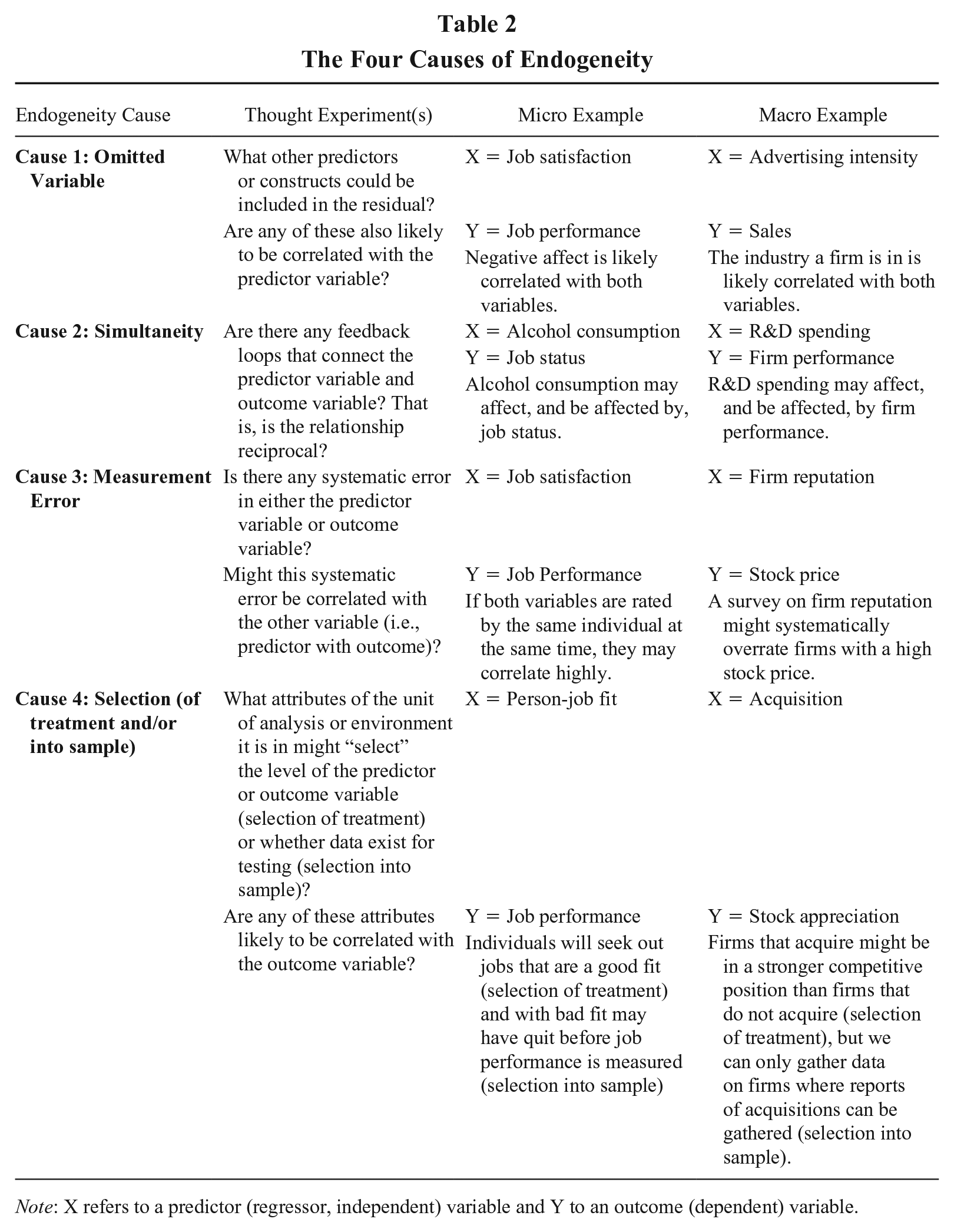
Note: X refers to a predictor (regressor, independent) variable and Y to an outcome (dependent) variable.
How Scholars Discuss Endogeneity
To document how management research identifies, describes, and addresses endogeneity, we reviewed empirical articles across micro and macro domains. We first identified and coded articles in top tier journals in both broad-based (i.e., Academy of Management Journal, Administrative Science Quarterly, and Journal of Management) and specific domains (i.e., Journal of Applied Psychology, Strategic Management Journal) with the keywords endogeneity and endogenous over the 5 years preceding submission (2014–2018). The sole inclusion criterion was that the article discussed endogeneity in the context of designing or interpreting a study. This excluded editorials, review articles, meta-analyses, and a large number of articles—mostly at the micro level—discussing “endogenous” latent variables in a SEM context without reference to endogeneity as a validity threat. This rendered a sample that included 435 articles.
After identifying articles, we first coded if endogeneity was (1) acknowledged as a viable concern (usually as a study limitation), (2) addressed with design or analysis in the main analysis, or (3) tested through post hoc robustness tests. For articles that addressed endogeneity or reported robustness tests, we also coded whether (a) the results were affected once endogeneity was accounted for, (b) an instrumental variable method was used, and (c) the instrumental variables were explained (summarized in Table 3). Instrumental variables, often abbreviated as simply instrument(s), are exogenous variable(s) introduced in different analytical models to address certain types of endogeneity concerns (Semadeni et al., 2014). We elaborate on this definition, applicable methodologies, and assumptions related to instrumental variables later in the paper.
How Sampled Articles Discuss Endogeneity
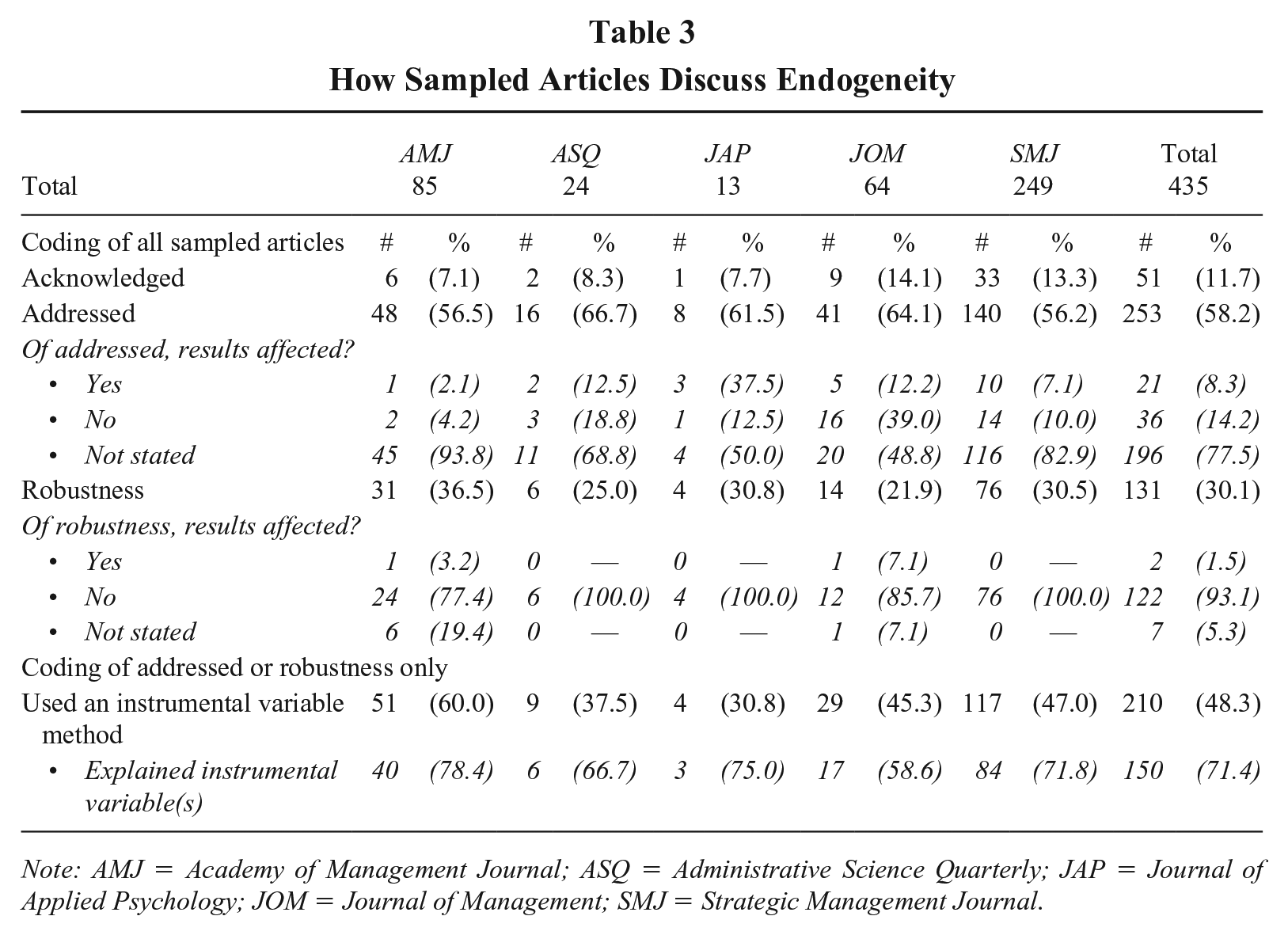
Note: AMJ = Academy of Management Journal; ASQ = Administrative Science Quarterly; JAP = Journal of Applied Psychology; JOM = Journal of Management; SMJ = Strategic Management Journal.
Our first finding echoes past reviews that there seems to be a disconnect in the literature: Empirical papers largely present endogeneity as an issue that has either been addressed or has not affected results. Of the 435 articles mentioning endogeneity, most (k = 253; 58.2%) use a method to address suspected concerns in the main analysis, while a smaller portion (k = 131; 30.1%) use robustness tests (i.e., report results and then assess if the results may be biased by endogeneity). Based on the robustness tests, only 1.5% (k = 2) of the articles offer evidence the results differ from the primary analysis after addressing endogeneity. Taken together, we find that published papers often present endogeneity as an issue that is important enough be addressed as a methodological concern, but once addressed, the results tend to remain unchanged.
To ensure the representativeness of our sample and categorization, we performed two robustness checks. First, our focus is on both micro and macro research, but the initial search returned a disproportionate number of articles appearing in a macro-focused journal: Strategic Management Journal. As such, to achieve a representative sample of articles for the other journals, we extended our search back to 1998 to coincide with Shaver’s (1998) seminal article on endogeneity. We coded an additional 140 articles from our sampled journals but did not identify any unique approaches for addressing endogeneity used more than twice, suggesting our sample is representative of the approaches used in the field. Second, we recognize that articles may address specific causes of endogeneity but not use the term endogeneity, particularly in micro journals where we had the fewest number of studies (k = 13 in Journal of Applied Psychology). To confirm that our findings were applicable to both micro and macro research, we repeated our search using all of the similar and related terms listed in Table 1 (rather than endogenous/endogeneity) across all sampled journals in the years 2014–2018. We coded the largest subgroup of articles, which was from Journal of Applied Psychology, consisting of 636 different uses of these terms in 351 articles. After removing terms inconsistent with our use of the concept of endogeneity (e.g., use of interdependence to describe team characteristics rather than a methodological concern) and nonempirical work, the final sample included 251 unique uses of these terms in 141 articles (an average of 1.78 terms per paper). In our additional coding, 75 (30%) acknowledged endogeneity bias could affect results, 156 (62%) addressed endogeneity through design or analysis, and 20 (8%) used robustness tests for endogeneity bias. 3 Taken together, these additional searches resulted in more articles, but not more solutions or unique approaches to addressing endogeneity, which increases confidence in our sample coding.
Contrary to the evidence in these published papers, multiple reviews (e.g., Antonakis et al., 2010; Certo et al., 2016; Clougherty et al., 2016; Semadeni et al., 2014) note how statistical techniques are often misapplied and/or not adequately explained and justified. We assessed whether papers using an instrumental variable method (the most commonly used approach; k = 210, 48.3%) adequately justified and explained how the approach dealt with a given endogeneity threat. We view it as good news that a majority of the articles did offer some explanation of the variables (k = 150, 71.4%), yet similar to findings in prior reviews, in many cases, explanations lacked enough information to determine the exact cause of endogeneity or the theoretical rationale behind the instrumental variable(s). So even though published papers often state that endogeneity is not a concern, vague explanations of analytical techniques and choices hinder readers’ ability to assess those claims. These issues give rise to two significant problems. First, if the only published papers are those reporting endogeneity tests when results are unaffected, a rose-tinted literature skewed by publication bias may result. Second, misconceptions about endogeneity and unclear reporting standards may encourage particularly weak tests, creating the endogeneity equivalent of p-hacking where, for example, statistical techniques are applied not based on their appropriateness or quality but on their proclivity to leave results unchanged.
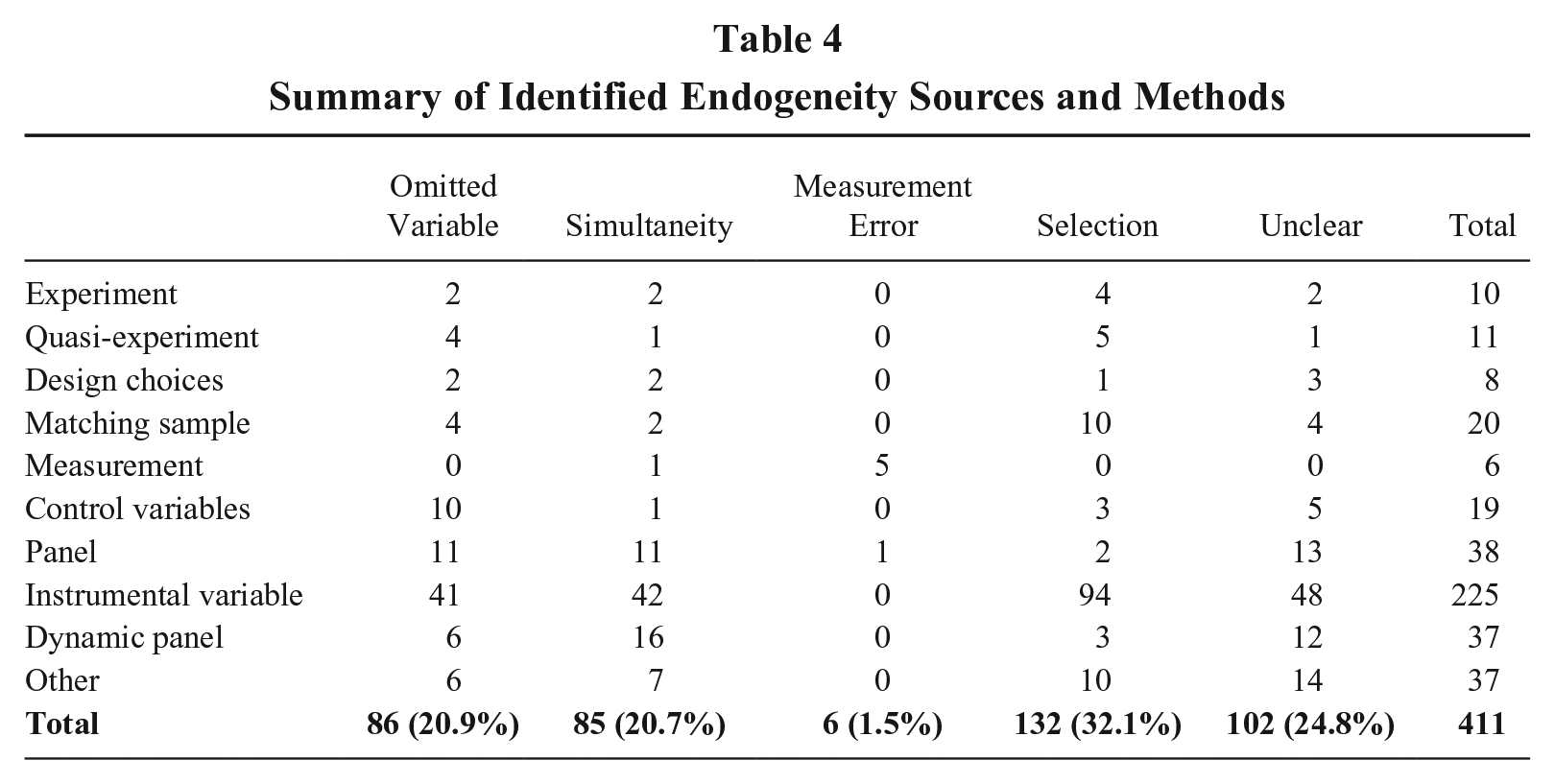
To further explore how well researchers are explaining specific endogeneity threats, we coded the 384 articles that addressed endogeneity (k = 253) or used robustness tests (k = 131) based on our typology: omitted variable(s), simultaneity, measurement error, and selection. In 26 articles, more than one cause of potential endogeneity was noted, so we coded each cause and method. Thus, the total number of endogeneity causes and methods, summarized in Table 4, is 411. The coding revealed two insights. First, of those articles identifying a specific cause of endogeneity, selection is most often noted (k = 132, 32.1%). This may not be surprising since several authors (e.g., Hamilton & Nickerson, 2003; Shaver, 1998) argue selection is a constant threat as it is hard to disentangle the outcomes of decisions from the drivers of those decisions. Second, the next largest subset of articles (k = 102; 24.8%) do not clearly identify a source of endogeneity but instead discussed it in more generic terms. These articles generally made broad statements along the lines of “our results may be affected by endogeneity” without specifying a concern over omitted variable(s), simultaneity, measurement error, and/or selection. This ambiguity regarding the cause(s) of endogeneity impairs readers’ ability to assess if the approach used in the study alleviated endogeneity or exasperated the problem (Semadeni et al., 2014).
Summary of Identified Endogeneity Sources and Methods
Beyond our formal coding, we noted some practices that were hard to quantify but worth mentioning. First, we found more recent articles often discuss methodological details in an online appendix and/or note unpublished results are available from the author(s). We applaud this rigor but stress that addressing endogeneity is a meaningful part of the research and should not be seen as an exercise tangential to the main analysis. If addressing endogeneity is only seen as tangential, it becomes harder to accumulate knowledge with multiple studies as is advocated (e.g., Shaver, 2019; Wolfolds & Siegel, 2019); thus, we argue that addressing endogeneity must be seen as a meaningful part of the main research design and analysis. Second, we found many articles that cite prior empirical work to justify a choice of methodology. Methodological work can be daunting to wade into, and it is understandable to cite approaches and rationales of prior work published in the journals in which authors aspire to publish. This practice of citing prior empirical work to justify a method presents two challenges, however. One is that it is difficult to determine the exact percentage of papers that are appropriate or not, as it can be hard to follow the chain of citations. Another is that since multiple papers both identify methodological mistakes in prior empirical work and note that methodologies are frequently inadequately explained and justified (e.g., Antonakis et al., 2010; Certo et al., 2016; Semadeni et al., 2014), the practice of citing prior empirical work rather than then methodological source papers sometimes leads to a “telephone problem” where approaches are not justified in following a prior empirical paper and/or errors in prior empirical papers are repeated and magnified over time.
In addition to reviewing empirical papers, we also identified and reviewed over 250 methodological sources and 40 review articles offering advice on endogeneity. As with our coding of the empirical papers, this “review of the reviews” yielded insights that were hard to quantify but which return us to the fundamental divide in the literature: Why have efforts to address endogeneity been so problematic despite the increasing number of methodological and review articles published on the topic (many in our top journals)? Our tentative answer to that question builds on our observation of a “telephone problem” where some papers adopt practices from prior empirical research rather than recommendations from methodological articles. If one draws conclusions about endogeneity from empirical research only rather than from methodological research, it might be said that (1) endogeneity is a broad and ambiguous issue often encountered but rarely explained in detail—especially if prior empirical work can serve as precedent; (2) the ways endogeneity is addressed or tested for are too technical to be explained adequately in empirical work; and/or (3) while endogeneity is often discussed, it almost never affects the results. We emphasize that we do not think these are useful conclusions to draw, so we now turn to a review of the methodology literature as a way to clarify terminology, point researchers to good methodological advice, provide some recommendations for improving both research, and perhaps more importantly, communication about research practices.
Endogeneity: Causes and Associated Solutions in the Literature
Much of the early concern over endogeneity in management research originated in macro domains, likely due to the prevalence of nonexperimental studies where firm actions (e.g., entry mode, acquisitions) are not randomly assigned (Shaver, 1998). Concerns over endogeneity, as an explicit concern, have since expanded to nonexperimental studies in micro domains (e.g., Antonakis et al., 2010; MacKinnon & Pirlott, 2015; Maydeu-Olivares, Shi, & Fairchild, 2020; Sajons, 2020; Schmidt & Pohler, 2018), although related methodological issues have a somewhat longer history (e.g., CMV, omitted variables, etc.; see list of related terms in Table 1). Scholars in related fields (e.g., marketing, Shugan, 2004; accounting, Larcker & Rusticus, 2010) also recognize the threat of endogeneity and offer recommendations to address it. In reviewing the literature related to endogeneity, we find that knowledge is fragmented by the use of different terms and conceptualizations of endogeneity (Bliese et al., 2020), the different fields in which it is discussed and addressed, and the fact that efforts to address issues related to endogeneity often focus on a “particular subdimension of the greater endogeneity problem” without necessarily addressing other forms (Clougherty et al., 2016: 287).
To address this fragmentation and increase the accessibility of the methodological literature, we do three things. First, we provide an annotated bibliography of primary contributions to this literature so that researchers new to the topic can acquaint themselves with the material relevant to their research domain (see Online Appendix A). Second, we organize the most used methods according to the previously discussed typology of causes. For each method, we provide links to corresponding resources that offer further details. Third, we offer linkages to related terms (see Table 1), often used as synonyms, to facilitate communication about endogeneity (which, as we note in Section 4, can help guide authors and reviewers).
Our review of empirical papers revealed that many studies refer to “endogeneity” broadly rather than to specific causes. Focusing on the specific mechanism causing endogeneity rather than a general endogeneity problem is important for two reasons. First, many of the methods to address endogeneity only apply to a specific cause of endogeneity. Second, multiple causes of endogeneity may affect the same variable in a single study. We are encouraged by the fact that 26 articles in our sample address more than one cause of endogeneity, but we do not want to signal to authors or gatekeepers that every paper must address every possible cause of endogeneity. Instead, we emphasize there is no generic way to address general endogeneity concerns, but there is an extensive toolbox of methods that can be used to address specific causes of endogeneity. Much of the confusion and misapplication of methods in the literature noted by others (e.g., Antonakis et al., 2010; Certo et al., 2016; Clougherty et al., 2016; Semadeni et al, 2014) stems from addressing an endogeneity concern without specifying the exact cause. As a result, subsequent research may precisely replicate the method for addressing endogeneity but not address the problem because the study suffers from a different cause of endogeneity.
As we discuss the causes of endogeneity, we point out how multiple causes can affect a single estimated relationship. Endogeneity may occur between many predictor and outcome variables in a single analysis, but we primarily use one micro and one macro example with one predictor and one outcome to aid exposition: how job satisfaction (x) affects job performance (y) and how firm reputation (x) affects firm performance (y). As we delineate these causes, we also highlight associated solutions to address each source of endogeneity (summarized in Table 5).
Techniques That Offer Solutions to Help Remedy Endogeneity
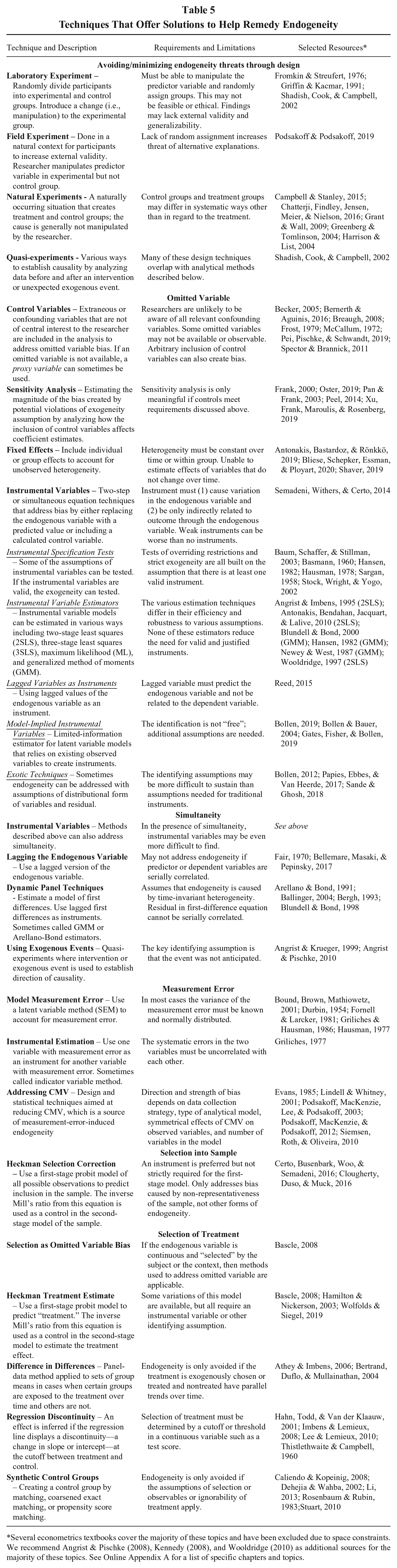
Several econometrics textbooks cover the majority of these topics and have been excluded due to space constraints. We recommend Angrist & Pischke (2008), Kennedy (2008), and Wooldridge (2010) as additional sources for the majority of these topics. See Online Appendix A for a list of specific chapters and topics.
Cause 1: Omitted Variables Endogeneity
Perhaps the most intuitive cause of endogeneity is omitted variable bias (found as a cause of endogeneity 20.9% of articles reviewed; see Table 4). As Figure 2 in Table 1 shows, for an omitted variable q to bias estimates, it must affect the outcome y (resulting in the new equation: y = a + Bx + q + u). If we know q affects y but we do not have q in our model, the unexplained part of our model is q + u rather than just u. The exogeneity requirement is that x is uncorrelated with the unexplained part of the model; thus, an endogeneity problem from an omitted variable q exists if x correlates with q and q relates to y. For example, variables related to job performance and correlated to job satisfaction might be the level of rewards a worker receives or the worker’s ability. Variables related to firm performance and correlated to firm reputation might be the firm’s market share and/or capability in public relations or public perceptions of the industry. If any of these variables are omitted in regressing y on x, the coefficient B will be biased.
Perhaps the most direct way to address an omitted variable problem is to include it in the study, yet researchers cannot always do so. For example, there are many variables that can potentially relate to x and y, so the process of adding additional variables (or worrying about potential endogeneity from this cause) has to stop at some point. As Frank (2000: 149) notes, “the simple question, ‘yes, but have you controlled for xxx’ puts social scientists forever in a quandary” both for design (e.g., collecting a large number of alternative variables is limited by survey length) and analysis reasons (e.g., adding variables ad nauseum causes other issues; Bernerth & Aguinis, 2016; Spector & Brannick, 2011). Another reason is measuring a given omitted variable is not always possible. For example, a worker’s true ability or a firm’s true capability may not be directly observable. If a researcher is concerned about a specific omitted variable (or multiple omitted variables) but unable to include the variable(s) in the study, there are multiple approaches to address this type of endogeneity, as we detail below.
Solutions to Omitted Variable Endogeneity
Solution 1: Design
Among the 86 studies that identified omitted variable(s) as the cause of endogeneity (see Table 4), eight addressed the issue with an experiment, quasi-experiment, or research design choice. Experimental trials can avoid omitted variable endogeneity by randomly assigning participants to treatment and control conditions; random assignment ensures that in idealized format (i.e., adequate sample sizes, effective manipulations, etc.; Krause & Howard, 2003), any omitted variable is evenly distributed across both conditions (thus, the predictor will not display systematic variation with the residual). To illustrate, if it were possible to randomly assign people (firms) to different levels of job satisfaction (firm reputation), we could reasonably assume all omitted variables (e.g., rewards, worker ability; market share, public relations ability) are evenly distributed across treatment groups. In turn, there is no systematic relationship between x and u; thus, omitted variable endogeneity is not present with this design.
Random assignment may not always be possible and is not problem free (Krause & Howard, 2003), but at times a sample can be defined where an omitted variable does not vary significantly. If the concern is unobserved ability, a study design may use a cohort of workers (firms) promoted at the same time (having the same public relations event), as it may be argued that any unobserved effect of ability is not dissimilar across workers (firms) and thus does not affect the outcome. The “not dissimilar” logic also underlies the use of matched samples to derive “treatment” and comparison groups (see Dehejia & Wahba, 2002). Key to avoiding endogeneity through design is to anticipate the most important omitted variables in advance, measure what is possible, and design the sample to reduce the variance in variables that cannot be measured.
Solution 2: Control and proxy variables
Ten of the 86 articles that identified omitted variables as the cause of endogeneity noted using control variables to address the concern. If a control variable perfectly measures the omitted variable, that source of endogeneity is removed. However, if the variable is not available and cannot be ignored, another way to address this is to find a proxy for the omitted variable (thus replacing an unobserved variable q with a proxy
The distinction between controlling for an omitted variable and using a proxy variable depends on how well the measured variable reflects the conceptualized omitted variable, which may be hard to assess. Pei, Pischke, and Schwandt (2019) note the hazards of poorly measured control variables, while Spector and Brannick (2011) discuss how arbitrarily including extra controls can also create bias. Frank (2000) and Pan and Frank (2003) develop a procedure to estimate an impact threshold of a confounding variable (ITCV) that offers promise in this area. ITCV addresses how likely it is that an omitted variable is biasing results by calculating how correlated an omitted/confounding variable would have to be with both the outcome variable and focal predictor variable to change the original inference. The ITCV procedure has only appeared recently in management journals, so best practices are not yet established. For now, we offer a few observations. First, ITCV can be a way to gain added insight into whether the inclusion of an additional variable improves the model estimates. In addition to looking at how the inclusion of the variable affects coefficient estimates, one can use ITCV to see if the potential for omitted variable bias has been reduced. Second, ITCV may be a more principled way to decide when to stop including more control variables. It may be possible to imagine additional variables that are correlated with both the predictor variable and outcome variable, but ITCV gives some guidance on both what that variable would need to look like in terms of relationship to the outcome and predictor to alter inference and whether additional control variables would change the results. Finally, a note of caution: ITCV changes the focus from establishing the assumptions necessary to obtain an unbiased estimate of a coefficient to a focus on whether a result would still be statistically significant in the face of a confound (e.g., an omitted variable is included). Such a shift in focus may be problematic if ITCV becomes another tool in the p-hacking arsenal; thus, as with other approaches, it is necessary to appropriately justify the use of ITCV.
Solution 3: Fixed effects
Eleven of the 86 articles that identified omitted variables as the cause of endogeneity discussed the use of panel data, which implied the use of a fixed effect to address unobserved heterogeneity. If an omitted variable is not available or directly observable but theory or evidence suggests it is constant within a group or invariant over time, estimating a model with individual or group fixed effects can address the issue. Fixed effects add a constant ci for each entity i in the analysis (yi = a + ci + Bxi + u). For example, leadership style (perception of an industry) may be the same for all workers (firms) with the same supervisor (in the industry). If this is so, a fixed effect for supervisors (industries) would address this concern. Similarly, if a researcher had longitudinal data and there is theory or evidence to suggest an omitted variable of concern (e.g., worker ability, firm capability) does not change significantly over time, then an individual or firm fixed effect would address this concern.
A few caveats of fixed effects are notable. First, fixed effects do not fix all endogeneity concerns, but they do work in situations where the omitted variable is constant for all observations with the same fixed effect (Antonakis, Bastardoz, & Rönkkö, 2019). Second, fixed effect analyses assess within effects not between effects (for a discussion, see Certo, Withers, & Semadeni, 2017). For example, fixed effects can explain how changes in job satisfaction (firm reputation) affect job performance (firm performance); they cannot explain why some workers (firms) perform differently than others. Bliese et al. (2020) offers a thorough review of the limits and potentials of fixed effects, while also noting how random effects models coupled with the group mean (i.e., the average of all workers or firms in a group) of the predictor variable offer three alternatives that allow for unbiased coefficients and testing of both within and between effects. First, the “hybrid” approach involves “demeaning” or group mean-centering the predictor xi j (for each entity i [e.g., individual worker or firm] grouped by j [e.g., time, work group, industry, etc]) by subtracting the group mean
Solution 4: Instrumental variables
Omitted variable endogeneity is often addressed with a method dependent on instrumental variables. There may be a concern about omitted variables, but measuring or proxying the variables is not viable. Instrumental variables offer an avenue for unbiased estimates in such cases, but their use requires assumptions based on theory (Wooldridge, 2010). Specifically, instrumental variables require an additional variable z that predicts the endogenous variable x in what is often called “the first stage” (x = ax + Bx z + ux) but is unrelated to the unexplained portion of the model uy in what is often called “the second stage” (y = ay + By x + uy; subscripts indicate that coefficients and residuals differ in the two equations). Here, the instrumental variable z predicts job satisfaction x (firm reputation) but is not related to job performance y (firm performance) except via the effect on job satisfaction (firm reputation).
It can be hard to find acceptable instrumental variables as they must meet two conditions. First is relevance, which implies that an instrumental variable is related to the endogenous predictor(s) x. The assumption that the instrumental variable z affects x can be tested directly (Stock, Wright, & Yogo, 2002). Second is exogeneity, which implies that z is uncorrelated with the residual u of the outcome y, meaning the only effect z has on y is through x. This second assumption—that z is exogenous—cannot be tested directly; rather, a researcher must provide conceptual arguments for why the instrumental variable is uncorrelated with the residual in the second stage of the regression (Bascle, 2008). So-called overidentifying restriction tests (e.g., Sargan-Hansen or Sargan’s-J) can test the exogeneity condition but only if a researcher has more instruments than are needed. These tests are based on the assumption that the model is correctly identified (Kennedy, 2008). A Hausman test can determine if an instrumental variable estimation method is needed but only if the instrumental variable is valid (Semadeni et al., 2014).
Methods that rely on instrumental variables require both (1) additional theoretical justification because the exogeneity condition cannot be tested directly and (2) empirical justification to establish the strength of the instruments. Weak instruments are variables that are poor predictors of the endogenous variable. Using weak instruments can be a case where the cure for endogeneity is worse than the disease (Semadeni et al., 2014), leading to bias in both estimates and standard errors (and the resulting confidence intervals). Often, the bias gets worse if additional weak instruments are added (Bascle, 2008; Conley, Hansen, & Rossi, 2012; Stock et al., 2002). Given the hazards associated with instrumental variables, it is concerning that 28.6% of the articles we reviewed did not explain what instrumental variables were used (see Table 3).
Considering the oft-noted difficulty in identifying instrumental variables (e.g., Larcker & Rusticus, 2010; Semadeni et al., 2014), it may be natural to ask if there are sound strategies to identify them. There are indeed strategies available, but none of the strategies eliminate the need for theory, and in fact, some of the strategies require even more restrictive and difficult-to-justify assumptions than traditional instrumental variables. One strategy to identify instrumental variables is to look for random processes that affect the endogenous variable x. In the micro example, a context where an aspect of the job related to job satisfaction is randomly assigned (e.g., a firm may give better parking spots in a random drawing). In the macro example, social media events involving firms that go viral might serve as an instrumental variable (if the events’ publicity is theoretically or empirically shown to be random and unrelated to firm performance).
Another strategy to identify instrumental variables is to use prior period data (often called “lagged variables”). Prior job satisfaction (firm reputation) might affect current job satisfaction (firm reputation) but not directly relate to current job performance (firm performance), yet the lagged variables must still meet the requirements of an instrumental variable. It is usually not hard to argue that a lagged variable of x is related to its current value, but it is likely harder to argue the lagged variable is not related to the residual. For example, a researcher may have concerns about an omitted variable like mental (innovation) capability in testing the relationship between job satisfaction (firm reputation) and job (firm) performance. Prior mental (innovation) capability might be a proposed instrumental variable for current mental (innovation) capability, but a researcher would need to argue the lagged value is not related to the residual in current job (firm) performance. Using deeper lags increases the likelihood that the instrumental variable is unrelated to the residual in the outcome variable but likely also decreases the strength of the relationship to the endogenous variable. Estimation techniques like Arellano and Bond (1991) build on the assumption that taking first differences (subtracting the lagged value from current value of a variable) eliminates unobserved heterogeneity and serial correlation of the residual. If these assumptions hold, the lagged first differences can serve as valid instrumental variables.
Several emerging methodologies, many from outside the management literature, have been proposed for instrumental variable approaches (e.g., Maydeu-Olivares et al., 2020). One is using instrumental variables in SEM contexts through model-implied instrumental variables (MIIVs; Bollen, 1996; 2019). Typical instrumental variables are external to the model—what Bollen (2012) calls auxiliary variables. In contrast, MIIVs are derived from variables already in the model, so there is no need to add variables to the model. In general, if an SEM is identified, enough MIIVs can be derived to estimate each equation. There are additional methods based on assumptions about the distributional form of variables and various residuals such as Gaussian copula (Papies, Ebbes, & Van Heerde, 2017), simulated maximum likelihood estimator (Villas-Boas & Winer, 1999), Garen’s two-step-model (Zaefarian, Kadile, Henneberg, & Leischnig, 2017), polychoric instrumental variables (Bollen, 2012), and De Blander’s estimator (Sande & Ghosh, 2018). While these methods may avoid theoretical specification of an instrumental variable, they rely on strong assumptions that only apply to specific situations.
Instrumental variables models can be estimated with various techniques like two-stage least squares (2SLS), three-stage least squares (3SLS), maximum likelihood, generalized method of moments (GMM), and SEM. Variations of these methods like two-stage predictor substitution and two-stage residual inclusion (Terza, Basu, & Rathouz, 2008) are also proposed. While comparing these methods is beyond the scope of our paper, important to note is that any technique still requires identifying the cause of endogeneity and justifying the instrumental variable(s). The validity of any approach depends on assumptions built into that approach, and thus, it is important to explicitly specify the assumptions required. Studies should explain the relevance of the instrumental variable(s) and estimation technique, show “first-stage” or similar analyses, and provide relevant tests for any approach used (Semadeni et al., 2014).
Cause 2: Simultaneity
A second mechanism that can cause endogeneity is simultaneity, which is sometimes also labeled reverse causality. Simultaneity was identified as the cause of endogeneity in 20.7% of the works we reviewed (Table 4). So far, our focus has been on how a predictor variable x affects an outcome y. When the reverse is also true, so y affects x, simultaneity exists (see Figure 3 in Table 1). For example, testing how job satisfaction (firm reputation) affects job (firm) performance may be intended, but job (firm) performance may also affect job satisfaction (firm reputation). Thus, one way to view simultaneity is as a type of omitted variable problem: Prior performance may be an omitted variable in any study when it is correlated with both current performance as an outcome y and the predictor variable x (e.g., job satisfaction, firm reputation). However, with simultaneity between a predictor x and outcome y, there are no controls that can be added to the model to fix the problem, so control variable and proxy variable solutions noted above are not applicable but instrumental variables are (as we further detail below; e.g., Bhave, 2014).
The most common context where researchers address simultaneity bias is in longitudinal or panel data, where there are repeated measures on multiple units (e.g., individuals, firms). While such models have long been common for macro researchers, the adoption of longitudinal models for micro researchers has increased substantially in the last decades (e.g., growth models, experience sampling methodologies, etc.; Bliese et al., 2020; Fisher & To, 2012). Part of the motivation for adopting such strategies in micro studies is a desire to take steps toward causal claims that are not possible in single-measurement data. Drawing from Kenny’s (1979) prescription that justification of causality comes from establishing three conditions (a relationship—x is related to y; temporal precedence—x must precede y in time; and nonspuriousness—no third variables cause both x and y), if the effects of prior levels of the outcome variable can be statistically controlled, this can bring us closer to establishing temporal precedence and potentially narrow the range of variables that may create spurious relationships.
Some argue that, in some cases, simultaneity (or reverse causality) does not create endogeneity if the variables do not affect each other at the same time—that is, if there is a time lag (or temporal spacing) in the study design. Here, if past x (time t – 1) affects current y (time t) and current y (time t) affects future x (time t + 1), then one can control for previous events. However, this argument does not necessarily eliminate the endogeneity concern (Bellemare, Masaki, & Pepinsky, 2017). A main assumption of regression-based analyses is independence of residuals; that is, u1 at t – 1 and u2 at t are expected to have a correlation of 0. Yet in longitudinal data, both the variables and the residual for adjacent observations are likely correlated (referred to as autocorrelation, serial correlation, or serial dependency; Dodge, 2006; Wooldridge, 2010).
Variables can be autocorrelated for many reasons. For example, prior performance (of a worker or a firm) is a good predictor of current performance since many performance predictors are similar over time. Performance may also be self-reinforcing (a good performing worker/firm receives feedback, resources, and experience that enables future performance as in the Matthew effect). Residuals can also be autocorrelated for several other reasons. One case may be if variables are left out of the model in the present period (time t) and were also left out of the model in the last period (time t – 1) and those variables do not change over time. For example, failing to measure depression in the relationship between job satisfaction and job performance or failing to measure the strength of the economy (e.g., a recession) in the relationship between firm reputation and firm performance. Another case may be when the value of the last period’s variable (time t – 1) is directly related to the present period’s (time t) outcome variable in a cyclical fashion. For example, data collected on an hourly basis may reflect within-day cycles (e.g., ups and downs in performance), while data collected less frequently can reflect seasonal, quarterly, or yearly cycles. In both these cases, the outcome variable is autocorrelated, and since the cause of the autocorrelation is not included in the model, the residual is autocorrelated.
Solution 1: Design
Experimental trials address simultaneity by manipulating a predictor variable. When a researcher can assign or otherwise manipulate levels of x in a treatment group and not in a control group in an ideal experimental setting, the variation in y can be attributed to the manipulation and not the simultaneous effects of y on x (assuming adequate sample size and the mitigation of all threats to internal validity). Some quasi-experimental designs offer a solution if researchers can design questions around exogenous events (i.e., events that occur naturally that have nothing to do with the proposed model) to mimic a true experiment. For example, consider a firm receiving unexpected recognition for being the best place to work. The subsequent media attention might increase worker satisfaction (firm reputation), so a comparison of job (firm) performance before and after the event may eliminate the simultaneity bias. True experiments of this kind are often not feasible and exogenous events may be few and far between, so researchers often must use analytical techniques to make causal inferences.
Longitudinal designs also offer a solution if the observed data are not autocorrelated; thus, sound diagnostics should be utilized for any analyses. Though beyond our scope, West and Hepworth (1991: 626) offer a nice primer, both noting how ignoring autocorrelation (and thus assuming there is no serial dependency between x and y) “leads to biased standard errors for all significance tests and biased estimates” and comparing the merits of various specification tests. As with all techniques, we again emphasize justifying their application (Wooldridge, 2010).
Solution 2: Instrumental variables
The solution to the simultaneity problems using instrumental variables is essentially the same as the solution to omitted variables endogeneity. If one considers simultaneity as two simultaneous equations, then y = ay + By x + uy at the same time that x = ax + Bx y + ux (where subscripts indicate each equation has separate coefficients and residuals). At least one exogenous instrumental variable is needed to estimate the coefficient for each endogenous variable. Important here (as noted above) are (1) theoretical grounding (i.e., the instrumental variable must be related to the endogenous variable but unrelated to the unobserved residual) and (2) appropriate analyses (i.e., conducting and reporting appropriate tests).
Cause 3: Measurement Error Endogeneity
Measurement error is a third mechanism that creates endogeneity but is rarely identified as such (1.5%, see Table 4), yet rather than indicating a lack of a problem, the rarity may be due to the fact that, as Kennedy (2008: 160) speculates, most econometric models work best with the assumption of zero measurement error. As Figure 4 of Table 1 shows and consistent with Classical Test Theory, when x is imperfectly measured as
Viewing CMV as a special case of measurement error may help clarify this point. When not modeled, the variance associated with a referent (e.g., all self-report) or study format (e.g., all scales measured on a 5-point Likert-type scale) may bias the coefficients; that is, a common method may affect responses (e.g., answering high or low, avoiding extremes) that bias the estimates of predictor x on outcome y. The parallel between CMV and endogeneity is seen in the analogous ways each are addressed statistically (Schaller, Patil, & Malhotra, 2015).
Macro researchers may feel they do not have measurement error problems since they use surveys less frequently and instead rely on objective data, yet ratio variables (like R&D intensity and return on assets) are often used and there is growing awareness that these variables face their own measurement challenges (Wiseman, 2009). Recently, Certo, Busenbark, Kalm, and LePine (2020) framed these concerns in terms of endogeneity by arguing that a ratio predictor variable is necessarily endogenous when the outcome variable is also a ratio with the same denominator.
Solution 1: Design
A main design principle to avoid measurement error endogeneity is using measures free of systematic bias. If primary data are collected, common ways to do this are using validated measurement instruments (Greco, O’Boyle, Cockburn, & Yuan, 2018) and survey designs that reduce spurious correlations (e.g., vary scale anchors, separate measures by time; Podsakoff, MacKenzie, & Podsakoff, 2012). If archival data are used, similar tenets apply; measures should have sound validity (i.e., measure what it intends to measure and not something else) and steps should be taken to reduce design-induced errors. While archival data may limit researchers’ ability to address certain aspects of design, one advantage is it often allows for using multiple existing measures. Multiple measures can offer evidence that the results are not due to error in a given measure, assuming the measures exhibit convergent validity (e.g., Bromiley, Rau, & Zhang, 2017; Hill, Kern, & White, 2012, 2014).
Experimental design, while desirable in many ways, does not rule out measurement error endogeneity. For example, if a researcher manipulates the effect of job satisfaction (firm reputation) on job performance (firm performance) in an experiment, the outcome y may be poorly measured such as if performance is operationalized as performance on a single task or through error associated with supervisor or external ratings. If the unmeasured portion of y—that is u—is related to the manipulated predictor variable x, then endogeneity is still present.
Solution 2: Account for measurement error
Methods exist to address measurement error by directly modeling it like SEM, but these techniques are generally only applied in latent variable models (more common in micro, but applicable to macro; Bergh et al., 2016; Shook, Ketchen, Hult, & Kacmar, 2004). One benefit of SEM and related approaches is that researchers can model correlations between residuals among both the indicators and latent variables; however, methodologists have emphasized the need to craft strong a priori reasons for doing so as it easy to capitalize on chance (e.g., Cole, Ciesla, & Steiger, 2007; Cortina, 2002; Landis, Edwards, & Cortina, 2009). Another technique is a marker variable (Williams & O’Boyle, 2015), which calls for using a theoretically unrelated variable measured with the same or similar scale, valence, referent, etc. Since its relationship with the predictor x and outcome y are assumed to be zero, any observed covariation is assumed to be a function of CMV. As a marker variable is exogenous, the method variance is then addressed, or “covaried out.” This functionally is the same as an instrumental variable’s requirement of being exogenous. As noted above, using multiple measures to address limitations in a measure may offer evidence that estimated relationships are robust to measurement error if the measures converge.
Cause 4: Selection
The final mechanism that can create endogeneity is selection (identified as the cause of endogeneity in 32.1% of articles; Table 4), which occurs through two separate mechanisms. First, bias is created when observations are not randomly sampled but instead “selected” through choices of the researcher or participants (Cause 4a). For example, data are only available from workers who responded to a survey (e.g., conscientious or neurotic ones, only those with a job have an observable job satisfaction or job performance) or certain firms (e.g., not all firms appear on a stock market but stock price is used to measure firm performance). We label this “selection into sample” (Cause 4a). For many micro researchers, selection effects may be understood within the framework of indirect range restriction (Beatty, Barratt, Berry, & Sackett, 2014; Hunter, Schmidt, & Le, 2006). As an example of hiring, job applicants may be hired or “selected” based on a variety of characteristics including previous experience, relevant skills, and fit with the organization. If a researcher is interested in whether person-organization fit predicts job performance, the analysis is limited because applicants with lower levels of expected fit were screened out and the resulting coefficient between fit and performance may be biased.
Second, bias is created when the level of the endogenous predictor variable is “selected” (Cause 4b). For example, participation in training is not random but determined by a supervisor, and various firm strategies that affect performance are not randomly determined but chosen by the firm. We call these various examples “selection of treatment.” When the level of the endogenous variable is not randomly created, the potential bias means that the estimated coefficient cannot generalize to a larger population (i.e., it is an artifact of selection).
Cause 4a: Selection Into Sample
Solution 1: Design
Randomly assigning study participants can counteract endogeneity concerns from selection into the sample, but such designs are not failproof (Krause & Howard, 2003). For example, even if participants are randomly selected into training in a firm, the workers have all been selected into that firm, so effects of training on performance is indicative of only job-holding individuals who have been selected into that firm rather than the full population of potential workers (as is a common criticism of using undergraduate students to represent working adults, for example; the effects of the two groups may not be equal). Likewise, attrition from randomized studies may be nonrandom. If individuals self-select into or out of a treatment or control in a nonrandom fashion, then endogeneity may still be a concern.
Solution 2: Heckman selection model
If selection into a sample cannot be randomized, another approach is needed. For example, consider Heckman’s (1976) comparison of female workers’ hours and wages to their male counterparts. An endogeneity concern in this study is that choosing to work or not is not random (similarly, workers reporting job satisfaction and firms having publicly available financial data may not represent a random sample). Many factors may lead women to choose to work (firms to choose to be publicly listed), meaning the observed data do not fully represent women (firms), only women choosing to work (firms choosing to be publicly listed). If unmeasured factors (e.g., family or personal factors for workers, industry or financial factors for firms) affect the binary choice to act and also influence the focal outcome (e.g., wages, job or firm performance), an endogeneity concern exists that cannot be simply addressed by including the unmeasured factors (there are no data on wages of women choosing not to work or firms choosing to be private, so these variables are unobservable for a portion of the population). Thus, we can estimate how job satisfaction (firm reputation) affects job (firm) performance only for those workers (or firms) we can observe. It is important to distinguish this cause from other causes of endogeneity where the sample is representative of the population and the full range of the outcome is available (e.g., we can observe wages and job performance for union and nonunion members or firm performance of publicly traded and privately held firms; what is missing are the factors leading to the self-selection of the level of the predictor).
The Heckman selection model is akin to an instrumental variable method, addressing an omitted variable bias arising from a specific sample selection issue (Certo et al., 2016; Clougherty et al., 2016). In a Heckman model, a first-stage probit model estimates the likelihood of entering the sampling condition, and a transformation of the predicted value in the first stage (the inverse Mills ratio, or IMR) is derived to represent the selection hazard of entering the sample. Using the IMR in a second-stage model of interest provides an estimate of the selection hazard, yielding consistent estimates of the predictor on the outcome. Like instrumental variable methods, a third variable w (referred to as an exclusion restriction) is needed, and this variable w should affect the probability of being in the sample (i.e., be related in the first-stage probit) but be “excluded,” hence the name, from the second-stage model based upon theoretical logic for why w does not affect the outcome (Wooldridge, 2010). Here again, then, researchers must rely on theory and also should asses the underlying assumptions; Shaver, (1998), Hamilton and Nickerson (2003), Certo et al. (2016), and Clougherty et al. (2016) offer thorough discussions.
Cause 4b: Selection of Treatment
Solution 1: Design
As with selection into sample endogeneity, randomly assigning the participants to treatment conditions can counteract selection of treatment concerns in the ideal situation; yet again, the design is not failproof. In particular, it is often impractical to assign a meaningful number of participants to varying levels of the treatment while determining what the meaningful levels are (e.g., how much training); in turn, conclusions drawn may apply only to those levels (e.g., an hour of training versus five) rather than more broadly (e.g., more training, generally). As such, identifying designs where different treatments or levels of treatment either are possible, or occur naturally, can help address selection of treatment endogeneity concerns.
Solution 2a: Omitted variable techniques
We first consider when there is a treatment that is not randomly assigned and, therefore, selected. If the endogenous predictor variable that is selected is not dichotomous and instead is continuous (e.g., years of education or advertising spending) or ordinal (e.g., a worker having an associate, bachelor, or master degree or a firm choosing an acquisition, joint venture, or greenfield), this is similar to omitted variable endogeneity and all solutions discussed above are appropriate.
Solution 2b: Heckman treatment model
If the treatment is a dichotomous variable (like participating in training or making an acquisition), then 2SLS and related instrumental variable methods are inappropriate, and instead, a method such as a Heckman treatment effect should be used (again, see Certo et al., 2016; Clougherty et al., 2016; Hamilton & Nickerson, 2003; Shaver, 1998). The Heckman treatment model is similar to the Heckman selection model except that the first-stage model is a prediction of treatment rather than a prediction of inclusion in the sample. A second complication is created by a dichotomous selection of treatment in which the estimated coefficient is a “treatment effect” with many possible interpretations. For example, studies of how training affects job performance may want to determine: How much the average worker would benefit from training, whether those receiving training benefited, or how would workers that did not have training benefit if they had it? Depending on the mechanisms that determine who is trained, these different forms of the “treatment effect” might all be different (Blundell & Dias, 2009). Further complications are posed by categorical variables (e.g., different trainings, strategic choices), thus requiring unique estimation models and care with a “treatment effect” given categories (e.g., Bollen & Maydeu-Olivares, 2007).
Solution 2c: Estimating average treatment effects
Selected, dichotomous treatment is common in many fields. Many methods have been developed to address this by estimating what is called the average treatment effect (e.g., Angrist & Imbens, 1995; Wooldridge, 1997) or how much the average treated participant benefits versus the average nontreated participant. These approaches can be split into two categories: (1) Difference-in-Differences approaches calculate how much participants (workers, firms) improve after treatment and compare the improvement to how much nonparticipants improved in the same period (e.g., Athey & Imbens, 2006; Bertrand, Duflo, & Mullainathan, 2004), and (2) Synthetic control group approaches (e.g., matched sample, propensity score methods, coarsened exact matching) compare treated entities to nontreated entities that are similar on observables or have similar likelihood of treatment (e.g., Caliendo & Kopeinig, 2008; Rosenbaum & Rubin, 1983). In general, methods estimating an average treatment effect do not address endogeneity; rather, they rely on assumptions (labeled ignorability of treatment, selection on observables, or the conditional independent assumption) that endogeneity is not a concern based on the logic that sampled entities may differ on a treated variable but are otherwise about equal (or at least not dissimilar); thus, the claim of unbiased estimates rests on the assumption that unmeasured variables affect all sampled groups equally (Dehejia & Wahba, 2002; Li, 2013). This is not to say these methods are not important, as they address important problems other than endogeneity. Like all techniques, they require theoretical and empirical justification regarding solving a given problem and are not “catch all” cures.
Solution 3: Regression discontinuity designs (RDDs)
One final way to address dichotomous selection is an RDD (Lee & Lemieux, 2010), which can be considered a quasi-experimental approach (Angrist & Pischke, 2010). The basic idea of RDD is that there may be existing environmental conditions, which create an arbitrary threshold or cutoff point that can approximate random assignment. The observations just below and just above the threshold should be approximately equal on all omitted variables (similar to random assignment), yet they are categorized by researchers as being in different treatment groups based on falling above or below the arbitrary threshold. Returning to our training example, if workers are selected into training based on poor performance ratings, where only those with a rating of 2.5 or below on a 5-point scale are sent to training, a researcher may consider that workers with ratings of 2.4 who qualify for training and workers with rating of 2.6 who do not qualify for training are functionally the same in terms of performance. Thus, one could test the effect of training in the trained versus untrained population as in a true experiment. Complications in RDD can arise in selecting the number of units to include around the treatment effect (e.g., from 2.4 and 2.6 or 2.3 and 2.7?) and issues related to contamination from those receiving the treatment with those not receiving the treatment (Imbens & Lemieux, 2008; Thistlethwaite & Campbell, 1960).
The Possibility of Multiple Causes of Endogeneity
In delineating the causes of endogeneity, we highlight how one study may have multiple endogeneity problems (e.g., how job satisfaction affects job performance or how firm reputation affects firm performance). There are two ways in which multiple endogeneity issues may arise in a single study. First, a variable can be endogenous due to multiple causes (i.e., omitted variables, measurement error, simultaneity, and selection). Notably, addressing one cause does not address other causes (e.g., simultaneity in job satisfaction and job performance, omitted variable bias in firm reputation on firm performance). Second, a study can have multiple endogenous variables. Imagine a study on job satisfaction also looking at how training affects job performance (or a study of firm reputation also investigating how acquiring affects firm performance). Effects of both predictors are likely subject to different omitted variables, but addressing the endogeneity of one variable does not address endogeneity from the other. To make matters worse, endogeneity in one variable biases all coefficient estimates, not just a coefficient for the endogenous variable (Wooldridge, 2010). As such, scholars must turn to theory and analyses to identify endogeneity for all predictors and address each cause for each variable. York, Vedula, and Lenox (2018) is an example, arguing economic incentives, social movement pressure, and market intermediaries all affect the adoption of green building practices. The paper addresses possible simultaneity by estimating a model in which each variable is predicted by a separate exogenous variable. Certo et al. (2016) also provides guidance on addressing multiple sources of endogeneity.
Summary of causes
Table 1 outlines and depicts the causes of endogeneity, while Table 5 maps those causes to associated solutions to remedy them and provides key source material. Although we do not include the entirety of the copious endogeneity discussion happening across related fields, we contend our review and summary accurately reflect the relevant endogeneity discussion as it pertains to management research at all levels of analysis and content areas.
Recommendations to Bridge the Methodology-Practice Gap
Our review aims to enhance understanding of endogeneity - an issue that poses serious implications for interpretation of study outcomes - by organizing the vast literature on the sources of bias and methodological solutions (e.g., Antonakis et al., 2019; Bhave, 2014; Maynard, Luciano, D’Innocenzo, Mathieu, & Dean, 2014). As we outlined above, definitional and terminology differences across this literature hinder direct comparisons on the term endogeneity alone. In this paper, we first reviewed how researchers discuss and address endogeneity and then mapped the extensive methodological literature on how to treat the associated problems. Doing so has reaffirmed prior reviews documenting divergence between best practices and actual practices and has also shown that this divergence is not caused by a lack of relevant methodological resources. Building on our review, we offer a set of recommendations for both authors and gatekeepers that may help reduce the disconnect between the methodological and empirical literatures.
To better illustrate our recommendations, we again use the metaphor of endogeneity as a disease and extend it to physicians treating patients. If endogeneity were a disease, we would want those treating it to (1) offer a clear diagnosis, (2) justify the technique used in treatment, and (3) be transparent in prognosis of the result. Our review of empirical work, like others (e.g., Antonakis et al., 2010; Certo et al., 2016; Semadeni et al., 2014; Wolfolds & Siegel, 2019), shows actual practices often deviate from best practices: Diagnoses of endogeneity are not clearly connected to causes, treatments for endogeneity are not clearly justified, and the concluding prognoses are usually that endogeneity has been addressed or cured. Our recommendations leverage the desired practices, but they cannot be achieved by researchers alone. Reviewers and editors must adopt them as well. Finally, just as there is no such thing as unequivocal perfect health, there is no such thing as the perfect study; thus, authors and gatekeepers must accept that tradeoffs are often needed. We elaborate on each of these points below, while Table 6 summarizes our recommendations and serves as a guide for authors and gatekeepers regarding endogeneity.
Recommendations for Authors and Gatekeepers Regarding Endogeneity
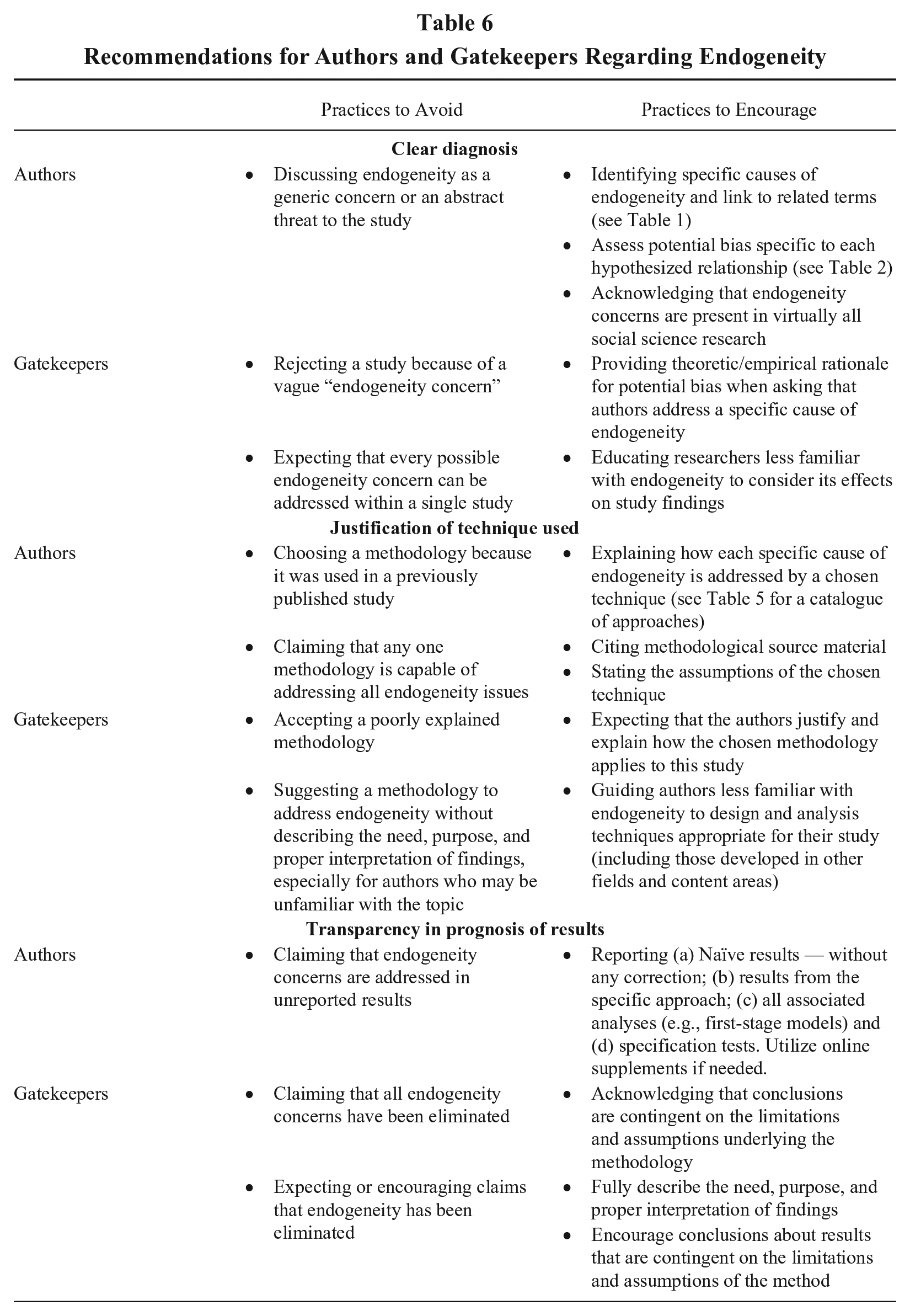
Clear Diagnosis of Endogeneity
Without a clear diagnosis of the cause of endogeneity, wrong treatments may be given, which either will not address the actual cause or may even exacerbate the problem (Semadeni et al., 2014). Thus, we first recommend exercising greater care in diagnosis—that is, in establishing if and why a specific cause of endogeneity may exist. Here, we offer three specific action items.
First, to identify if and why a specific cause of endogeneity exists, thinking through possible causes of endogeneity is a key step in study design. To this end, Table 2 provides a set of thought experiments for each cause of endogeneity that can be used prior to data collection and analyses. Identifying a possible cause of endogeneity can allow scholars to design around endogeneity threats rather than trying to analyze through them alone. Researchers may also realize there are multiple potential causes of endogeneity, each one requiring a separate diagnosis (see Table 1). Thorough and specific diagnosis is essential not only to prescribing a treatment but also to clarifying the specific causation implied by the hypotheses and theoretical models.
Second, the typology of causes of endogeneity in Table 1 can help authors and reviewers to “speak the same language” when communicating about endogeneity. Specifically, we suggest any endogeneity concern be stated in terms of a specific cause (omitted variable, simultaneity, measurement error, selection into sample, or selection of treatment) with as much specificity and theoretical rationale as possible. That is, comments akin to “we addressed endogeneity” should be replaced by the specific cause (e.g., simultaneity) of endogeneity and rationale for why that cause may be present in the specific relationships of the study. Like our first suggestion, this requires identifying possible endogeneity causes (and, as we note below, also requires authors to diagnose, with justified techniques, if a specific cause of endogeneity is in fact present).
The recommendation of a clear diagnosis has implications for gatekeepers as well. This means that endogeneity cannot be cast as a lurking “boogieman.” Authors share frustration that endogeneity both often seems to be a cudgel for gatekeepers to strike down any paper that by design or analysis is not problem free and, relatedly, that such cudgeling may move us toward irrelevance as we cannot advance knowledge in any way for fear the advancement is not perfect (Frank, 2000; Shugan, 2004). We recommend critiques and any solutions given in the review process should also speak to a specific cause of endogeneity bias rather than a general concern about endogeneity (Shaver, 2019). Focused statements such as “although you utilize an instrumental variable approach, you have not clearly defined the source or type of endogeneity that this approach addresses” or “it is possible that your sample suffers from selection into sample endogeneity because of . . . you may consider using a Heckman selection model to address this type of endogeneity” provide clearer guidance to authors about potential causes and also help inform possible solutions. At the same time, such specificity limits the likelihood that authors choose a method that may address endogeneity “in general” (e.g., instrumental variables) but that also leaves results unchanged (i.e., p-hacking). To this end, gatekeepers can also help ensure papers provide clear diagnostics and, in doing so, help establish norms about specifying the form of endogeneity and linking to related terminology. Tables 1, 2, 5, and 6 may also serve as guides to reviewers. The specific causes, diagrams, terminology, and thought experiments can inform comments with greater diagnostic precision that point to appropriate techniques, which we elaborate on below. We thus hope our review facilitates a more productive conversation between authors and reviewers focused on specific causes rather than vague concerns.
Third, and building on the earlier points, clear diagnosis and associated communication about it can be enhanced by linking related terms, especially as it applies to communication across micro and macro domains. As others have identified, different terminology is at times understandable as research traditions evolve but nonetheless “produces confusion . . . that impede(s) the ability of members of a research community to communicate with each other or to accumulate knowledge” (Suddaby, 2010: 352; see also Pfeffer, 1993). Thus, we also suggest authors and reviewers make explicit linkages to related terms (e.g., noting how omitted variable endogeneity is also called left out variables, missing variables, etc.) to aid communication with those more familiar with alternative terms. There are at least two benefits of this common lexicon: (1) It expands the methodological toolbox for researchers so that they can apply novel methodologies to a particular endogeneity concern, and (2) it enables clearer understanding across domains, as micro and macro researchers, or even authors and gatekeepers therein, can more easily interpret methodological approaches and findings from disparate realms.
Justify the Technique Used to Address Endogeneity
As scientific researchers, we operate using a common compendium of knowledge (here, the methodological source material). Citing how prior empirical papers addressed endogeneity cannot supplant specific justification of design and analyses grounded in the methodological literature. There is value in seeing how peers have addressed endogeneity, but relying solely on prior empirical studies rather than the source material is inadequate for two reasons. First, prior empirical studies may be flawed (as evidenced by the numerous methodological reviews) or even out of date as the literature on ways to address endogeneity is quickly evolving. Second, every methodological choice must be made for a specific research context. An instrumental variable used in one study does not mean that it is appropriate in another study with a different predictor variable, different outcome variable, or different cause of endogeneity, for example. When researchers properly justify and explain their methodological choices, they build awareness of the compendium of knowledge. We offer four interrelated steps to justify a technique used to address endogeneity. Further, a summary of techniques, requirements and limitations, and selected methodological sources appear in Table 5 and the annotated bibliography in Online Appendix A as resources to help authors and reviewers with the recommendations below.
First, given that using a technique to address endogeneity that is not correct can be worse than the problem itself (Semadeni et al., 2014), we first need to justify that the issue needs to be addressed—here, our diagnostics from Step 1 are important, but analyses can help establish if the specific problem diagnosed is present. Second, once a specific endogeneity cause is established, we suggest greater detail in justifying whether the technique utilized to address it is appropriate, building on relevant methodological source material (Table 5 may be helpful in linking specific causes of endogeneity to appropriate remedies and methodological source material). Justification cannot be by mere citation alone—as seen in statements such as “following Paper X . . .”. Instead, it is important to establish methodological justification for why a remedy is appropriate for addressing the specific source of endogeneity in the context of the focal study building on source material. Doing so can help avoid the “telephone problem” identified in our review, where papers follow prior empirical work rather than the methodological article, as well as misapplication of techniques. Third, justification should also be explicit about the assumptions of the technique. Clarifying the assumptions are worth specific note, as it is possible that a technique could be well-justified but not offer readers clarity regarding the assumptions on which the technique is based. Fourth, clear justification requires greater reporting of information relevant to endogeneity, including appropriate detail of analyses, so others are able to tell both if the methodology was needed in the first place and adequate for the purpose and context it was used for. Specifically, then, the naïve results—without any correction—should be presented alongside the results from the approach that attempted to address the specific form of endogeneity as well as any associated analyses (e.g., first-stage models) and specification tests (see Semadeni et al., 2014).
The recommendation for better justification of methods used to address endogeneity will require the cooperation of reviewers and editors. When gatekeepers observe a study using precedent (e.g., following Paper X. . .) to justify the methods used, they should advise authors to instead clearly justify the technique following the aforementioned steps. To this end, Table 6 may serve as a guide for explanation of the methodology. At the same time, additional reporting of the results showing how much results were affected by methods to address endogeneity may also require more journal space. If space constraints do not allow, we encourage gatekeepers to ask for the information during the review process and encourage researchers to use online supplemental materials. We further encourage journals to maintain these for the purpose of posterity and access rather than asking individual scholars to find ways to share them widely. Of course, creating space for the discussion of one topic may be thought to come at the expense of another, and we realize that detailed explanations and associated tables that are recommended (e.g., producing the first-stage model) are often cut for length reasons. Beyond our recommendation of supplements that can be stored online, we hope that our review spurs conversations among gatekeepers on changing norms to help advance our knowledge. Numerous authors from different fields (Angrist & Pischke, 2010; Antonakis et al, 2010; Shaver, 2019) have argued that establishing causality is a demanding process, so maybe the justification of a chosen method deserves as much attention as the justification of hypotheses.
Transparency in the Prognosis of Results
We also recommend greater transparency in the resulting prognosis. As mentioned earlier, endogeneity is a complex problem for which there is no blanket solution. Multiple studies that build on each other may be needed to address the various endogeneity issues. Including an additional control variable does not address all omitted variable bias and certainly does not address simultaneity. In a research paper, the discussion of results is where the prognosis is given. Rather than blanket statements such as “we controlled for endogeneity” or “endogeneity was found not be a problem in a previous publication,” we instead encourage statements such as “these conclusions are robust to the alternative explanation that Z is the causal mechanism of both X and Y” or “our design reduced concerns over simultaneity.” Precise claims about the conclusions that can be drawn from the analysis help future researchers to correctly build on the findings and highlight areas where future research could further clarify the results. As with the aforementioned suggestions, gatekeepers can help here by taking steps to establish this norm.
A Final Recommendation
Beyond our best practices that build on the medical example of needing clear diagnosis, justification of the treatment, and transparency in the prognosis, we have a final recommendation that applies equally to our field and medicine. This recommendation, stated directly, is “authors and gatekeepers should realize it is impossible for any one study to fully mitigate all endogeneity concerns.” In other words, no study is perfect, and if we hold that ideal, we may not advance understanding in a systematic way and thus miss important knowledge. This recommendation may be difficult, as norms in management research have tended to coalesce around more unequivocal statements of findings (which will also affect whether more transparent prognoses become the norm as well). Thus, we repeat others in suggesting that journals allow an accumulated body of knowledge to emerge on a specific research question through multiple studies (e.g., Shaver, 2019; Wolfolds & Siegel, 2019). Only through repeated studies of a research question using different designs and analyses can we gain confidence that a specific endogeneity threat is fully addressed. Even the idealized experiment requires triangulation with different designs, samples, and operationalization of variables before causal claims free of any validity threat can be made. In micro research, it has long been common to have separate studies that (1) introduce a new construct (perhaps in a theoretical article only), (2) establish a valid measure of the construct, (3) identify antecedents, (4) consequences, (5) mediators, and (6) moderators of the construct. Similarly, progress on some research questions will require multiple studies that address different aspects of endogeneity. One study may identify valid instrumental variables to account for simultaneity, while another may use a given exogenous event to rule out viable alternatives.
Conclusion
Based on our review of empirical research, the process of building knowledge through many studies is hindered by the lack clarity related to endogeneity in terms of diagnosing the cause, justifying the techniques used, and reporting of results. We are optimistic future research will allow building knowledge in a body of research if the practices of researchers and gatekeepers in addressing endogeneity provide (1) clear diagnosis, (2) justification of techniques used to address endogeneity, and (3) transparency in the prognosis. To this end, this paper offers tools that can help achieve these goals. Moreover, we are hopeful our field can cumulatively agree no study is perfect and therefore take steps toward building systematic knowledge.
Supplemental Material
JOM960533_Supplemental_Material_CLN – Supplemental material for Endogeneity: A Review and Agenda for the Methodology-Practice Divide Affecting Micro and Macro Research
Supplemental material, JOM960533_Supplemental_Material_CLN for Endogeneity: A Review and Agenda for the Methodology-Practice Divide Affecting Micro and Macro Research by Aaron D. Hill, Scott G. Johnson, Lindsey M. Greco, Ernest H. O’Boyle and Sheryl L. Walter in Journal of Management
Footnotes
Acknowledgements
The authors would like to thank Associate Editor Karen Schnatterly and two anonymous reviewers for their constructive feedback and guidance during the revision process.
Supplemental material for this article is available with the manuscript on the JOM website.

Notes
References
Supplementary Material
Please find the following supplemental material available below.
For Open Access articles published under a Creative Commons License, all supplemental material carries the same license as the article it is associated with.
For non-Open Access articles published, all supplemental material carries a non-exclusive license, and permission requests for re-use of supplemental material or any part of supplemental material shall be sent directly to the copyright owner as specified in the copyright notice associated with the article.
