



Abstract
Barney’s presentation of the resource-based view (RBV) profoundly shaped the trajectory of management scholarship. This article considers the RBV’s impact specifically on the field of strategic human capital resources. Although Barney is still highly relevant, I suggest that research has not sufficiently appreciated the role that individual and collective performance behavior and outcomes play in linking human capital resources to competitive advantage. An alternative, what might be called RBV2.0, posits that research needs to recognize that human capital resources are distinct from performance behavior and outcomes. Such an observation raises the question, “Resources for what?” Answering this question leads to several important insights. First, a given type of human capital resource is only important to the extent it is related to performance behavior and outcomes that contribute to competitive advantage. Second, performance behavior is largely strategy-specific and thus firm-specific. Third, firm specificity is not a characteristic of human capital resources but rather a function of the proximity of the resource to firm-specific performance behavior and outcomes. Consequently, “Performance” is the answer to the question, “Resources for what?” This emphasis on understanding human capital resource-performance relationships adds considerable precision into the RBV, helps resolve puzzles in the strategic human capital literature relating to firm specificity and performance mobility, and promotes a deeper understanding hiding latent within Barney’s original view.
There is no question that the resource-based view (RBV) transformed management scholarship. Barney’s (1991) paper, in particular, strongly influenced 30 years of theory and empirical research. The paper is still heavily cited and continues to stimulate multiple areas of research. The paper has an enduring impact because it offers a powerful insight: Between-firm heterogeneity in resources contributes to heterogeneity in firm competitive advantage. Therefore, firms seeking to develop competitive advantage should create capabilities to effectively acquire, develop, deploy, combine, or divest of their key resources (Sirmon, Hitt, & Ireland, 2007). To say it bluntly, resources matter.
The emphasis on resources helped fundamentally shape the growing field of what today is called strategic human capital resources (Nyberg & Moliterno, 2019; Nyberg, Moliterno, Hale & Lepak, 2014). Although the study of human capital originated in economics (e.g., Becker, 1964; Pigou, 1928), it was the introduction of the RBV (Barney, 1991) that gave attention to human capital as a resource that could contribute to a firm’s competitive advantage. In this manner, the RBV provided a conceptual bridge between key insights from human capital theory (primarily individual-level firm-specific and generic human capital) to the strategic management of firms. Conceptualizing human capital in terms of resources changes the equation; human capital resources have the potential to be strategically impactful (e.g., Chi, 1994) and contribute to firm-level competitive advantage. Further, the fact that human capital resources tend to be particularly difficult to substitute and/or costly to imitate (the classic valuable, rare, inimitable, and nonsubstitutable conditions) generated considerable enthusiasm for studying such resources that continues to this day (see Nyberg & Moliterno, 2019).
The decades between Barney (1991) and current times have been productive and theoretically expansive. Research in the 1990s focused primarily on understanding linkages between human capital resources and firm outcomes and how various management and human resource (HR) practices may contribute to such relationships (e.g., Barney & Wright, 1998; Coff, 1997; Wright, McMahan, & McWilliams, 1994). Criticisms and critiques of the RBV ensued (e.g., Priem & Butler, 2001), some of which still remain (e.g., Kraaijenbrink, 2011; Kraaijenbrink, Spender, & Groen, 2010). However, the 2000s saw the introduction of research on the microfoundations of human capital resources (Barney & Felin, 2013; Coff & Kryscynski, 2011; Foss, 2011) and the fusion of psychological research within the broader RBV framework (e.g., Ployhart, 2006; Ployhart & Moliterno, 2011). Extending the RBV with psychological microfoundations is a natural progression: The RBV emphasizes resources internal to the firm, human capital resources are among the most important internal firm resources, and human capital resources are based on psychological characteristics. Both the RBV and organizational psychology emphasize resources, but the RBV emphasizes firm-level resources within the context of competitive advantage, while psychology primarily emphasizes individual- and group-level resources within the context of competitive parity (Ployhart, Nyberg, Reilly, & Maltarich, 2014). Together, however, the approaches are highly complementary, and research conducted within the last 10 years has begun to answer a number of more precise questions relating to how and why human capital resources may emerge and contribute to operational and strategic performance (Campbell & Kryscynski, 2019; Eckardt & Jiang, 2019; Wright, Coff, & Moliterno, 2014). Indeed, a powerful but scarcely recognized implication of the RBV is that it offers a means to integrate psychology and economics.
Thirty years since Barney (1991), we see that the basic tenets of RBV are very much alive and well in many scholarly conversations. However, there is still plenty to learn about human capital resources and, by extension, the RBV. It is time for human capital resource scholarship to embrace the most important insight from the RBV—heterogeneity in resources is linked to heterogeneity in outcomes—and give resources their proper focus and attention. Yet in doing so, the field must address the question, “Resources for what?” It is time to better understand the function of resources, and this requires taking a more careful view of the types of performance behaviors and outcomes that intervene between resources and competitive advantage. A closer examination of performance, across individual and collective levels, will contribute to a better understanding of human capital resources and take the RBV in exciting new directions that may further unite different scholarly disciplines. It will also help address a number of puzzles, paradoxes, and problems found in the strategic human capital literature, most notably around the meaning of firm-specific human capital resources and the performance portability paradox. Addressing these topics also does much to advance the practical impact of human capital resources, which is a topic that demands more attention.
Resources Derive Their Importance from Performance
Organizations care about resources to the extent they contribute to performance that creates competitive advantage. The answer to the question, “Resources for what?” is “Performance!” Consequently, one must first understand performance if one is to understand the role of resources.
Barney’s (1991) treatment of the RBV was most concerned with understanding how resources contribute to competitive advantage. Consequently, the article devotes attention to describing how resources that are valuable and rare contribute to competitive advantage and those that are also inimitable and nonsubstitutable contribute to sustained competitive advantage. The emphasis on logics underlying sustained competitive advantage still strongly shape the application of the RBV to human capital resources research. For example, the field continues its fascination with the nature and consequences of firm-specific human capital resources because such resources are expected to underlie competitive advantage (Nyberg, Reilly, Essman, & Rodrigues, 2018).
Competitive advantage is obviously important and arguably the ultimate dependent variable in strategic management. However, organizations compete, develop, and monitor strategy operationalized in terms of key performance behaviors and outcomes (e.g., Richard, Devinney, Yip, & Johnson, 2009). Indeed, HR practices related to performance management emphasize alignment between the firm’s strategy and goals, with employee behaviors and outcomes that span levels from the individual to the firm (DeNisi & Smith, 2014). Although it is beyond the scope of this paper to develop a cohesive, multilevel, and multidisciplinary treatment of performance, Figure 1 blends strategic management and HR disciplines to offer a heuristic perspective suitable for the purposes of this paper.
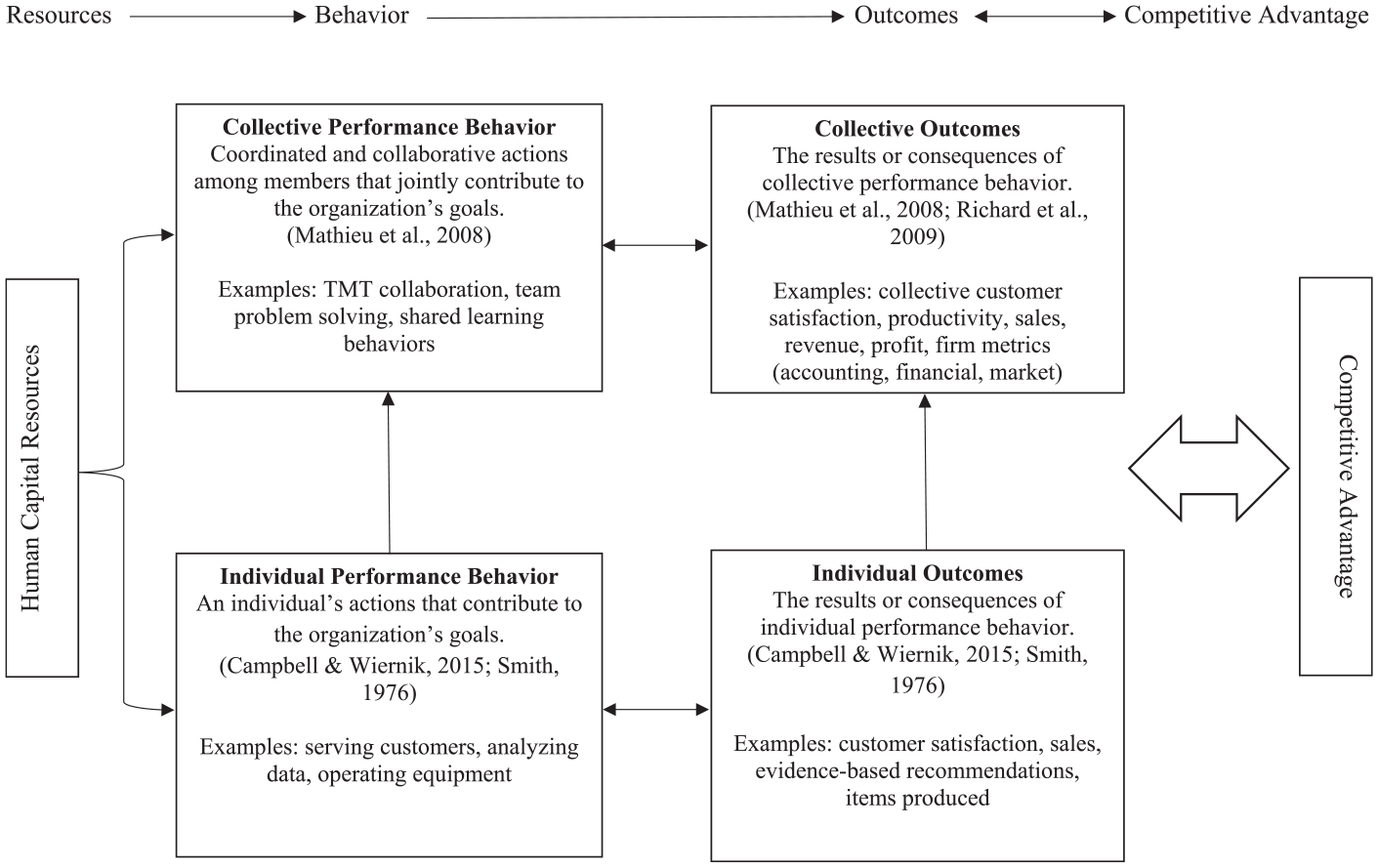
Heuristic Performance Framework Linking Human Capital Resources to Competitive Advantage
There are three key points to recognize in the figure. First, there is a distinction between performance behavior and the outcomes of that behavior. Behavior is what a person or collective does in pursuit of the organization’s goals, while outcomes are the results or consequences of that behavior (Campbell & Wiernik, 2015; Smith, 1976). For example, a salesperson may contact 100 potential customers (the behavior) but only obtain sales from five of them (the outcomes). Likewise, at the collective level, a top-management team may exhibit higher quality learning and collaboration behaviors, which result in greater productivity, revenue, or profit outcomes. The distinction between behavior and outcomes is a critical and longstanding one (Smith, 1976), although micro research tends to focus more on performance behaviors and macro research tends to focus more on outcomes (e.g., profit, Tobin’s Q, productivity).
Second, there is a distinction between individual and collective (unit) levels. The antecedents and consequences of individual performance behavior (or outcomes) differ from those at the collective level (Kozlowski & Bell, 2013). Teamwork, for example, requires behavioral coordination and collaboration not found at the individual level. The emergence of collective performance behavior and outcomes from individual-level origins remains one of the grand challenge questions facing management (DeNisi & Smith, 2014; Goodman & Rousseau, 2004; James, 1973). Fortunately, for our purposes, it is only important to recognize that performance behavior and outcomes exist at multiple levels and that they may be similar but are rarely identical.
Finally, there are different types of performance behaviors (Campbell & Wiernik, 2015). These different types include in-role task performance behavior (prescribed behaviors formally monitored and evaluated by the firm), discretionary performance behavior (e.g., organizational citizenship behavior), and counterproductive work behaviors (e.g., theft, sabotage) (e.g., Call & Ployhart, in press). Collective performance behaviors also differ in their nature, including teamwork behaviors and taskwork behaviors (Kozlowski & Bell, 2013).
To illustrate these concepts, consider Home Depot. The company is an industry leader in building and garden supplies, but its consumers are increasingly nonprofessionals who pursue their projects for personal satisfaction. Such consumers tend to do more online research to create customized solutions reflecting their unique preferences. As a result, the company introduced “One Home Depot” to provide a shopping experience that is seamless across digital and physical interactions. A core part of this strategy is to ensure retail associates have the knowledge of both home repair and how to use the company’s products. In this example, individual performance behavior reflects interacting with customers to ensure their unique needs are met in a timely and knowledgeable manner. The outcomes of these performance behaviors are customer satisfaction and loyalty, sales, and cross-sales. Stores that better encourage, monitor, and support these performance behaviors should manifest higher collective customer outcomes but also higher accounting and financial metrics. Encouraging discretionary customer service behaviors are likely to be particularly impactful in generating sales. In this example, Home Depot seeks to differentiate itself with an engaging in-person customer experience, and hence store-level outcomes (e.g., collective customer satisfaction, net sales), and the performance behaviors that drive such metrics, are the operational indicators tracking their strategy implementation.
Note that describing the relationships between performance behaviors and outcomes, with competitive advantage, is also important but not the focus in this paper. While I recognize there is theory arguing competitive advantage leads to performance behaviors and outcomes, here I assume they are reciprocally related and so emphasize performance behavior and outcomes as mediators between human capital resources and competitive advantage. I adopt this emphasis because it provides a means to synthesize strategic management, HR, and organizational psychology/OB frameworks.
Performance behaviors and outcomes are important for operational and strategic purposes and contribute to a firm’s competitive parity. However, the RBV and human capital research have not given much attention to differences among these performance behaviors and outcomes (Moliterno & Ployhart, 2011). Consequently, the field knows little about when or why different human capital resources are related to different performance behaviors (e.g., innovation) or outcomes (e.g., ROA, customer satisfaction). This is important, as different types of performance behaviors and outcomes relate differently to competitive advantage. By focusing on resources and competitive advantage, the field has not given sufficient attention to understanding how different types of performance provide the mediating explanation for how and why resources may contribute to competitive advantage. Applications of RBV to human capital resources need to explicitly recognize substantive differences across different performance behaviors and outcomes and, in doing so, will introduce greater theoretical precision.
One can look at the history of research on personnel selection as an example to illustrate how the RBV may be applied in new ways by explicitly recognizing different types of performance. The field of personnel selection is fundamentally concerned with identifying the knowledge, skills, abilities, and other characteristics (KSAOs) needed for effective individual performance. Personnel selection researchers recognized early on that the strength and magnitude of KSAO-performance relationships change if the performance variable changes (Nagle, 1953). For example, the KSAOs needed for effective performance behavior as a retail associate will to some degree differ from the KSAOs needed for effective performance behavior as an operations manager. Likewise, the weights (i.e., relative importance) of different KSAOs may change across different types of performance behaviors. For example, cognitive ability is a stronger predictor of task (in-role) performance while personality is a stronger predictor of discretionary (citizenship) behavior (e.g., Borman, Penner, Allen, & Motowidlo, 2001; Schmitt, 2014). Finally, performance behavior is frequently only moderately correlated with performance outcomes (Bommer, Johnson, Rich, Podsakoff, & MacKenzie, 1995).
Therefore, when developing a selection process, one first identifies the critical job requirements, then identifies the critical KSAOs needed for performance behaviors, and thus, hiring is based on those “selection KSAOs” (Schmitt & Chan, 1998). In this manner, only the KSAOs needed for effective performance behaviors are used as part of the hiring process. To the extent jobs differ in their requirements, different KSAOs may be used for hiring. Or even if the same KSAOs are used, different weights will be applied to the KSAOs. [Note the similarity to Lazear’s (2009) “skills-weights” approach to firm-specificity. The logic is nearly identical to the approach used in personnel selection for nearly a century.] The personnel selection model concludes a firm should hire those individuals scoring highest on the job-relevant KSAOs.
The critical insight from the personnel selection literature is that predictors get their importance from performance (Nagle, 1953; Wallace, 1965). Change the performance construct, and the KSAO resources related to performance change as well (or similarly, the relative weights between each KSAO and performance change). Therefore, KSAO resources are not valuable in and of themselves; they are valuable to the extent they relate to individual performance behavior or outcomes. If the nature of job performance changes due to temporal or contextual influences, the relationship between the resources and performance can change as well. The prominence of performance underscores an important but frequently neglected fact: The outcome (dependent) variable is the most important variable of interest in any scholarly study (Campbell, McCloy, Oppler, & Sager, 1993). The predictors may get all the scholarly attention, but it’s the dependent variable we really care about.
This logic carries through to the RBV and human capital resources. If one accepts the fact there are multiple types of human capital resources (as there must, given they are based on individual KSAOs; Ployhart et al., 2014), then one must realize that different types of performance behaviors and outcomes, individually and collectively, will be influenced by different types of human capital resources. For example, Home Depot may focus more on hiring and developing the KSAOs that drive service performance behaviors and product knowledge than competitors who emphasize only e-retail or low cost. Thus, different performance behaviors and outcomes will be monitored in each firm, as determined by the company’s strategy (DeNisi & Smith, 2014). This logic underlies the strategic use of HR practices and talent management more generally (e.g., Kryscynski, Coff, & Campbell, 2021; Ulrich, Younger, Brockbank, & Ulrich, 2012). For example, Lepak, Liao, Chung, and Harden (2006) present a framework specifying different constellations of HR practices that contribute to different types of collective performance behavior and outcomes. Different types of selection, training, compensation, and performance management practices will be used depending on whether the outcome is high performance, commitment, safety, or customer service. This is certainly true as one compares the HR practices of Home Depot to competitors emphasizing low cost (e.g., Amazon or Walmart).
Calls for better understanding the performance domain of RBV scholarship have been made before. The issue has been raised by Coff (1999), Peteraf and Barney (2003), Armstrong and Shimizu (2007), and Barney (2018), among others. Moliterno and Ployhart (2011) raised this very issue when they considered the “criterion problem” in the RBV and compared and contrasted different ways of conceptualizing the RBV’s “criterion space.” Crook, Todd, Combs, Woehr, and Ketchen (2011) provide some evidence that choice of performance outcome matters, as their meta-analysis found that human capital resources were more strongly related to operational performance outcomes than overall performance outcomes. Future research should take heed of these earlier works and build from them. But the argument offered here takes this prior work a step further to consider what differences in performance mean for (human capital) resources. As developed in Ployhart and Hale (2014), I call for a functionalist view of human capital resources where the relevance of resources is determined by the strength of relationships with different types of performance. The implications are intriguing:
There are multiple types of individual and collective performance (e.g., Campbell & Wiernik, 2015; Richard et al., 2009). These may be distinguished between behavior (what is actually done) and outcomes (the results of behavior).
Different types of individual and collective performance will determine the types of human capital resources that are relevant (valuable). Some human capital resources are relevant to a given type of performance; some are not (Ployhart & Hale, 2014).
As performance changes over time, so does the relationship (and relevance) of human capital resources with performance. The relationship between any given human capital resource and performance may change in magnitude over time and become positive, negative, or nonexistent (Barney, 1991; Helfat & Peteraf, 2003).
Performance Behavior Is Largely Firm-Specific
The RBV offers a means for understanding firm-specific strategies and actions for achieving competitive advantage. But if one broadens the view of performance as argued in the prior section and also considers different types of performance behavior and outcomes that are important for operationalizing a firm’s strategy (e.g., Ployhart & Hale, 2014; Richard et al., 2009), then one recognizes that these types of performance are likewise firm-specific. For example, Home Depot associates are expected to have meaningful conversations with customers that go beyond simply explaining where a product is located.
Kryscynski and Ulrich (2015: 364) provide a thoughtful examination of this issue, using the topic of firm-specific human capital as an illustration. Among their many insights, the most powerful is perhaps the simplest: “. . . Managers attempt to find people with skills that will help the organization accomplish its business goals. These skills are more tailored to the strategy of the firm than to the firm itself.” However, strategy is specific to a firm at a given time and context, and how a firm performs to implement its strategy is likewise firm-specific. Which aspects of performance behaviors and outcomes a firm chooses to prioritize, monitor, reward, and punish is unique to the firm and its strategy (Nyberg & Reilly, 2019). Yet as firm strategy changes, so too will the types of performance a firm will emphasize. For example, as Home Depot implements its “One Home Depot” strategy, the manner in which performance behavior is monitored changes to provide greater emphasis on the customer experience.
Consider that a firm’s performance outcomes are substantially shaped by the individual and collective performance behaviors of its employees (at all levels, from CEO to front-line), within the context of its competitive environment. Performance behavior is largely firm-specific because it is based on actions the firm prioritizes, monitors, and rewards (Campbell et al., 1993; Motowidlo & Kell, 2013). Although many firms may evaluate “customer service,” each firm will operationalize customer service behavior in different ways. Home Depot may reward behaviors focusing on meaningful, high-quality customer interactions, while competitors may focus on speed of service delivery. Within similar building supply retailers, Home Depot may weight performance behaviors differently than Lowe’s in accordance with different customer expectations. Even within Home Depot, different managers may weight performance behaviors differently because there are idiosyncrasies in how managers perceive and evaluate behavior (Pulakos, Mueller-Hanson, & Arad, 2019). Rater training can reduce such idiosyncrasies, but it does not eliminate them. Hence, firms differ with respect to the performance behaviors they expect and reward (Campbell et al., 1993; Campbell & Wiernik, 2015). The behaviors that are expected and rewarded are determined by the firm’s strategy, as noted by Kryscynski and Ulrich (2015), and monitored by middle- and lower level managers (Kehoe & Han, 2020).
Note an important distinction is being made between performance behavior and human capital resources. Human capital resources and performance behavior are frequently confounded when using the RBV to develop the theoretical framing of human capital research. However, failing to distinguish between resources and behavior is failing to distinguish between cause and effect. Resources are not behavior; they are capacities for such behavior (Ployhart et al., 2014). Human capital resources do not create value directly; they create value indirectly to the extent they contribute to prescribed and discretionary performance behaviors (Call & Ployhart, in press). It is the prescribed and discretionary behavior of employees that implements the firm’s strategy and contributes to value creation. On the other hand, performance behavior is not revenue, productivity, customer satisfaction, or related outcomes. Performance behavior contributes to these outcomes, but they are independent conceptually and empirically (Bommer et al., 1995; Smith, 1976). Performance behavior creates value, but value creation is distinct from value capture (Call & Ployhart, in press).
Unfortunately, performance behavior tends to be ignored in the human capital resource literature. There are a few exceptions, however. For example, Campbell, Coff, and Kryscynski (2012) identify conditions where employees will be willing to make voluntary, discretionary performance contributions. Kryscynski et al. (2021) theorize that firms may invest in employment practices and experiences that lead employees to stay with the firm and demonstrate greater prescribed and discretionary performance. Kryscynski (2021) offers empirical support for the importance of firm-specific incentives influencing employee behavior. This research is exciting because it offers a fresh perspective on a different means of influencing firm performance and creating competitive advantage. Notably, the theorized causes have less to do with resources and more to do with performance behaviors.
Preliminary evidence also suggests performance outcomes differ in their firm specificity. For example, DeOrtentiis, Van Iddekinge, Ployhart, and Heetderks (2018) examined the “build versus buy” question relating to human capital. A unique aspect of their study was an examination of two types of strategic business unit (SBU) performance: customer satisfaction and productivity (i.e., sales per labor hour). They found managers promoted internally contributed to SBUs demonstrating greater customer satisfaction, but there was no difference between internal and external hires for productivity. The theorized reason was that internal hires know more about the SBU’s customers, as customer satisfaction is closely tied to the SBU and its employees, so what those customers expect are to a degree SBU-specific.
Overall, past applications of the RBV do not fully recognize the importance of performance behavior or outcomes because the outcome of interest is competitive advantage. (Note it is inaccurate to claim the RBV doesn’t care about performance; the behavior and choices of managers are widely recognized as important. Rather, the critique is that applications of the RBV and human capital research don’t consistently recognize that resources and performance behavior are different.) Hence, there are theoretical and empirical insights to be gained by recognizing the explanatory role that performance behavior and outcomes play in understanding resources and competitive advantage:
Strategy is firm-specific.
Performance behavior is the operationalization and implementation of the firm’s strategy.
Performance behavior is firm-specific.
Performance behavior is multidimensional, including prescribed and discretionary components.
Performance outcomes (e.g., financial, accounting, operational, customer) are influenced, in large part, by performance behavior.
What Makes a Resource Firm-Specific Is Proximity to Firm-Specific Performance
The RBV considers firm specificity as a characteristic of resources. Resources that are valuable, rare, inimitable, and nonsubstitutable have the characteristics needed to create sustained competitive advantage. Some types of human capital resources are theorized to have these features. Firm-specific resources are those that are not transferrable to other firms (they are inimitable). Firm-specific resources are not exchangeable within a factor market and thus become a potential source of competitive advantage. On the other hand, generic human capital resources are those that can be deployed at other firms. Generic human capital resources cannot underlie competitive advantage because, so long as factor markets are efficient, the value of such resources will be offset by their acquisition and retention costs (Barney, 1986b; Chadwick, 2017). No other topic in human capital resource research has generated as much interest as the nature and consequences of firm-specificity (e.g., Nyberg et al., 2018; Raffiee & Coff, 2015).
The specific-generic conceptualizations map pretty closely to Becker (1964), and in fact, human capital theory is often invoked along with the RBV to develop the theory of firm-specific resources. On the surface, the integration is sensible, and early research tended to employ the specific-generic distinction reasonably well (Hatch & Dyer, 2004; Hitt, Bierman, Shimizu, & Kochhar, 2001). However, Becker’s (1964) human capital theory was never about understanding competitive advantage, and attempts to integrate human capital theory with the RBV are poorly aligned. Indeed, recent research on firm specificity has challenged many of the assumptions of the RBV and human capital theory. For example, Campbell et al. (2012) reconsider assumptions about mobility constraints to suggest prior emphases on firm-specific human capital are likely overstated. Morris, Alvarez, Barney, and Molloy (2017) suggest that employee investments in specific human capital are actually signals about their generic human capital. Coff and Raffiee (2015) find that employee perceptions of firm specificity are inconsistent with theorized predictions. Kryscynski and Ulrich (2015) argued that practitioners do not perceive or care so much about firm-specific human capital; they simply want employees with the KSAOs to perform the job effectively. Nyberg et al. (2018) go so far as to suggest we should stop making dichotomous distinctions between generic and specific human capital resources.
Applying the RBV (Barney, 1991) to address these issues is frequently a struggle because the RBV is fairly agnostic to the nature of resources and considers competitive advantage as the primary outcome. However, recognizing that human capital resources are KSAOs that differ in their relationships to different types of performance behaviors and outcomes offers a means to conceptualize these issues in new ways—to offer greater precision. Human capital resources originate in the KSAOs of individuals (Ployhart et al., 2014). Some KSAOs, like cognitive ability, intelligence, and personality, are broadly applicable to many different types of performance and contexts and tend to be fairly stable through adulthood. In human capital theory language, these are generic resources. Other KSAOs, like knowledge and skill, can be more tied to a specific context (or a job, occupation, or work domain) and are malleable. These KSAOs can be recognized as firm-specific (context-specific) resources.
However, the manner in which human capital resources are classified as generic or specific is generally not based on psychological principles. Rather, the generic-specific distinction so ingrained within the human capital resource and the RBV literatures is based on whether the resources can be exchanged on a strategic factor market and the efficiency of the factor market. But this approach poses several challenges. First, factor markets are frequently not as efficient as theorized (Campbell et al., 2012; Coff & Raffiee, 2015). For example, employees stay with firms even though they can earn more at competing firms. Second, employees make discretionary investments in the firm that are often not visible to competitors (Call & Ployhart, in press). Third, collective resources of any type are likely firm-specific due to processes that contribute to the aggregation, coordination, and deployment of collective KSAOs (Ployhart et al., 2014). Finally, firms seek to poach talent from competitors based on their firm-specific performance outcomes—but performance behaviors may not be portable (cf., Bidwell, 2011). These findings present theoretical puzzles not easily resolved within the RBV.
A better way to think about resource specificity is in terms of the resource’s conceptual and empirical proximity to a specific type of performance. Resources get their importance based on their relationships with performance behaviors and outcomes. Thus, to the extent a resource is closely linked to a given type of performance (i.e., a proximal determinant of performance), the resource is more firm-specific. Resources further removed and indirect from performance behaviors and outcomes are more distal and thus more generic. Human capital resources like cognitive ability, intelligence, and personality tend to be more distal to performance behaviors and outcomes. They are generic in the sense that these KSAOs may be deployed in any organization or context (in the personnel selection model, they have validity that generalizes).
However, as illustrated in Figure 2, these distal KSAOs are foundational and influence the development of more proximal and malleable KSAOs, such as knowledge and skill (Sackett, Lievens, Van Iddekinge, & Kuncel, 2017; Schmitt, Cortina, Ingerick, & Wiechmann, 2003). Those with greater cognitive ability, and greater conscientiousness, tend to learn more, learn more quickly, and apply their knowledge more broadly (Jensen, 1998). Personality can influence one’s job preferences, adaptability, and motivation (Barrick, Mount, & Li, 2013). Therefore, there are multiple types of KSAO resources that lie on a continuum from distal to proximal (in relation to performance behaviors and outcomes). These resources are causally related to each other, such that distal (generic) resources tend to influence the development of proximal (specific) resources. As an example, consider the product knowledge of a retail associate at Home Depot. Moving from distal to proximal, there is knowledge of basic construction materials, knowledge of materials sold at Home Depot, and knowledge of how and where to use those materials specific to a local customer’s project (which requires even more specific knowledge about local construction codes, climate zones, etc.). Job knowledge is one of the strongest predictors of job performance behavior (Hunter, 1983), but other forms of knowledge are also important (see Tesluk & Jacobs, 1998, for a framework linking experience to knowledge). Almost all of these forms of knowledge are to varying degrees transferrable to other organizations; the more distal the KSAO, the more transferrable it is to other contexts. Yet all forms of knowledge are largely determined by cognitive ability (Hunter, 1983), which means those with greater ability will acquire knowledge and use it more effectively regardless of the organizational context (although see Chadwick, 2017, for some important caveats). It is important to recognize that two generic KSAOs, cognitive ability and conscientiousness, are related to job performance in nearly all contexts. However, this does not mean the relationships will be of equal magnitude in different jobs or occupations. For example, relationships between cognitive ability and performance behavior tend to become stronger as the complexity of the job increases.
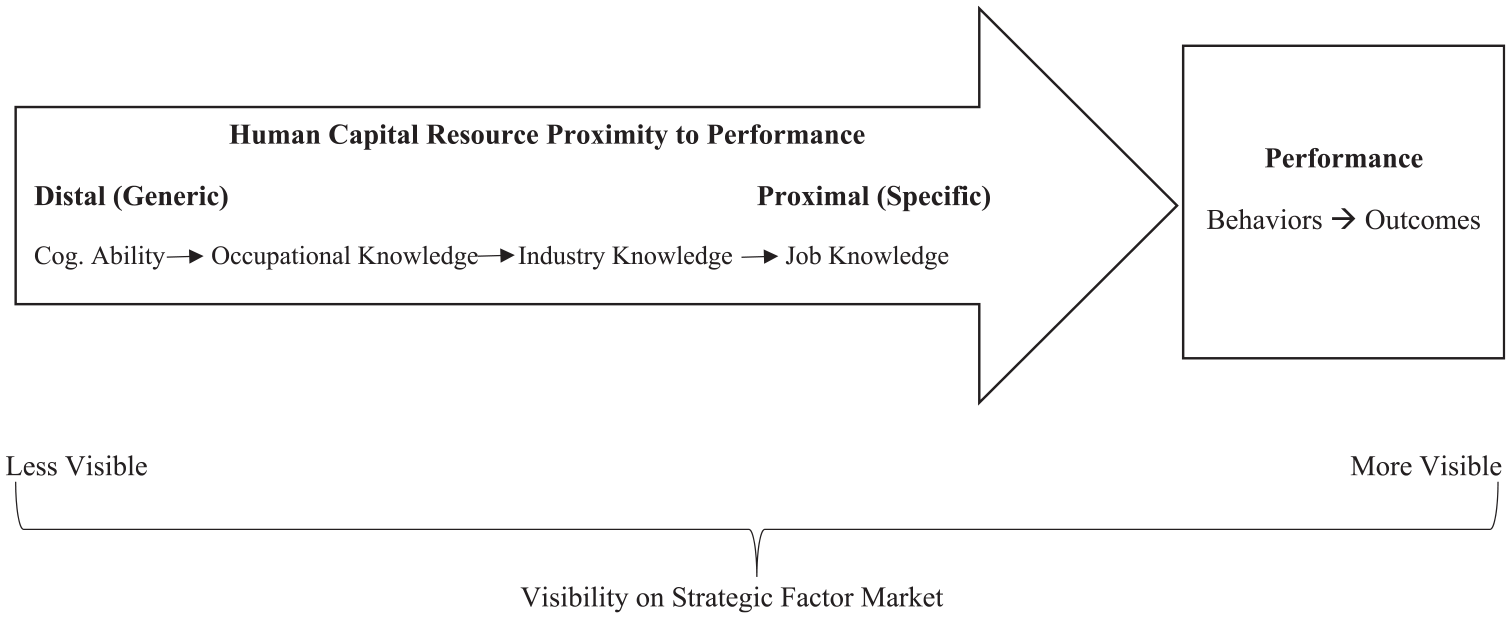
A Distal-Proximal Performance Framework for Understanding Resource Specificity
Thus, in contrast to RBV logic, human capital resource specificity is really more about its distance to firm performance behaviors and outcomes (and the type of performance) than it is a characteristic of the resource itself. Resources lie on a distal-proximal continuum from performance behaviors and outcomes. Resources more proximal to performance are more contextually embedded and thus more strongly related to performance—they are more firm-specific but only because they are more closely linked to firm-specific performance behaviors and outcomes. On the other hand, notice in Figure 2 that visibility on strategic factor markets is greatest for performance outcomes and behavior. Thus, research examining the performance portability paradox needs to recognize the distinction between human capital resources and performance and understand that both need to be explicitly addressed in the theorizing. The question of whether performance will be “portable” to the new firm is mainly determined by how similar the expected performance behaviors are between the two firms.
Like others have proposed (Nyberg et al., 2018), it’s time to put the specific-generic resource distinction to rest. There is not much about human capital resources that is truly firm-specific. Truly firm-specific resources are probably limited to knowledge of physical layouts (e.g., in which aisle a product is located), people (the personalities and working styles of coworkers and customers), proprietary technology (Home Depot’s product tracking system), or culture (how things get done here) (Barney, 1986a; Lazear, 2009; Ployhart, 2015). Such human capital may be important but only because of its proximity to firm-specific performance behaviors and outcomes.
More proximal human capital resources are more strongly related to performance behaviors and outcomes (conceptually and empirically).
Distal human capital resources contribute to the formation of proximal human capital resources.
Firm specificity is not a characteristic of the resource but based on a resource’s proximity to performance behaviors and outcomes.
A Call for RBV2.0
Barney (1991) sought to explain how firm resources may contribute to sustained competitive advantage. Resource-based research absolutely should continue to consider competitive advantage. However, this paper argues there will be many important insights to be gained by considering the intervening constructs and processes between resources and competitive advantage, of which the most prominent are performance behaviors and outcomes. Thus, a functionalist perspective on human capital resources may be especially useful, as it can resolve a number of inconsistencies, puzzles, and paradoxes that are currently found in the literature.
Adopting the perspective offered here enables theory and research to become much more precise. Research needs to consider what types of human capital resources most contribute to different types of performance (Crook et al., 2011) and for how long such relationships last under different competitive and contextual environments. Oddly enough, following this approach may provide more actionable guidance for practice, because it is prescriptive and identifies which specific resources matter for which specific types of performance behaviors and outcomes and specifies how long such relationships last. Barney (1991) is still very relevant, but it is time to expand RBV version 1 (RBV1.0) to consider a broader range of performance criteria (called RBV2.0). RBV2.0 seeks to answer the question, “Resources for what?”
A Parting Thought about Barney (1991)
What I respect most in Barney (1991) is the paper’s directness and parsimony. Rather than reproducing the complexity of the phenomenon, it offered a scientifically parsimonious understanding of resources. It offered an internal perspective different from the dominant external focus of the time (e.g., Porter, 1985) and provided a roadmap for future research to travel. This is what science is all about. But what the article did not offer is just as important for understanding its impact. Barney (1991) did not provide a complicated approach that tried to address all contingencies. The article’s breadth is what has allowed it to unite multiple areas of scholarship and multiple disciplines of science. Indeed, providing a bridge to integrate psychology with economics is no minor achievement! Further, the article was actionable in the sense that it gives a practicing manager a way to frame and understand complex issues. Barney (1991) is a rare blend of science and practice.
Contrast this article to the expectations for publication at most journals today. Articles like Barney (1991) would face considerable challenge in the review process because of their breadth. Yet history shows the field has benefitted tremendously from such papers because they hit the right balance of breadth, generalizability, and parsimony, to change the trajectory of scholarly attention (e.g., Weick, 1979). They offer a fresh vision—a different but compelling point of view that invites scholarship from different disciplines to understand issues grounded in contemporary business challenges. Thus, as long as firms compete based on their resources, Barney (1991) will continue to provide such a view for understanding human capital resource research and practice.
Footnotes
Acknowledgements
I sincerely thank Dave Ketchen, Lynn McFarland, Tom Moliterno, Anthony Nyberg, Fred Oswald, and DJ Schepker for their helpful comments on this paper and/or discussions that contributed to this paper. I also thank Sam Strizver for his assistance in preparing this manuscript.
