




Abstract
Existing categories often blend together to form new categories. To date, research has explored noncontroversial forms of category blending, such as smartphones and nanotechnology, even though category blending can frequently represent a highly contentious activity. Through an inductive field study of collegiate-licensed beer, we develop a theoretical model of contentious category blending. We show that contentious category blending related to and invoked tradition in three important ways. First, as contentiousness arises primarily from the participants involved in the category, opponents framed tradition narrowly—around those for whom the category was contentious (e.g., university students). Conversely, proponents framed tradition more broadly by incorporating stories of alumni, farmers, local craft breweries, and community members. By shifting the emphasis on tradition away from the actors for which the category was contentious and toward actors for which the category was appropriate, category proponents were able to establish a more lenient category and success in blending the categories. Second, whereas theory indicates that members of new categories generally seek to illustrate their novelty and distinctiveness from existing categories, we find the opposite among contentious category proponents. Instead, as contentiousness arouses questions about whether a product should exist, proponents draw from history, heritage, and tradition to demonstrate how elements of the product already exist. Third, we find the importance of tradition, culture, and community mean the legitimacy of a blended category does not so easily transfer but instead extends only to those communities that can uniquely stand on the traditions of their own community to gain support.
Categories are classification mechanisms that serve as the cognitive and normative interface among parties; in a market context, they allow for product evaluation, enable exchanges, and bring order to organizational interactions and existence (Granqvist, Grodal, & Woolley, 2013; Hsu, Hannan, & Koçak, 2009; Pontikes, 2012; Rao, Monin, & Durand, 2005; Wry, Lounsbury, & Jennings, 2014). Although categories serve a critical function in markets (Cattani, Porac, & Thomas, 2017), they are not always stable. Destabilization comes about due to category formation, dissolution, or blending. Category formation entails the development of new market categories, often to accommodate novel products or technologies (Navis & Glynn, 2010). Category dissolution happens when a market category disappears, either because it loses salience as its boundaries become vague (Rao et al., 2005) or because its boundaries are excessively constraining, resulting in declining membership over time (Kuilman & van Driel, 2013). Category blending takes place when two categories are purposefully combined to bring about a new categorical classification, yet the original categories also remain intact (Lo & Kennedy, 2015). Category blending may be used as a means to “recombine elements of multiple areas of knowledge or expertise” (e.g., smartphones, nanotechnology) (Lo & Kennedy, 2015: 119) or to differentiate products in unique ways (e.g., vitamin water, energy bars) so as to expand opportunities for producers (see Figure 1). 1
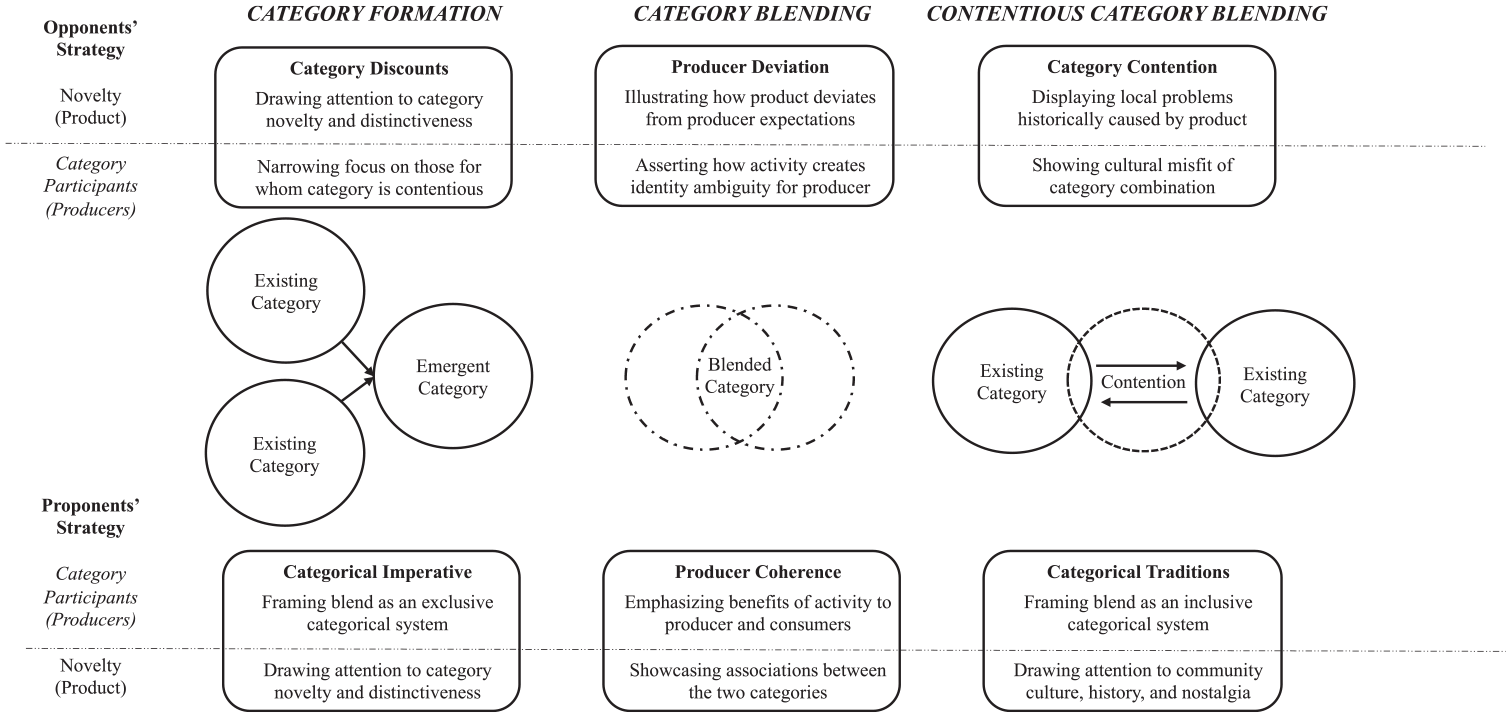
Distinguishing Contentious Category Blending from Other Category Spanning Conceptualizations
Across these different forms of category destabilization, category formation has garnered significant research attention (see Durand & Khaire, 2017 for a review). Category dissolution has garnered less, but some, research attention (Kuilman & van Driel, 2013; Rao et al., 2005). Category blending has garnered very limited research attention (Lo & Kennedy, 2015). Yet, as illustrated by the few examples mentioned above, category blending is quite prevalent in contemporary markets (Wry et al., 2014). Furthermore, it is theoretically interesting because it invokes Zuckerman’s (1999) “categorical imperative,” where market concepts are devalued “when, all else equal, companies combine, or ‘blend,’ businesses in unfamiliar ways” (Lo & Kennedy, 2015: 120). The challenges associated with category blending are even greater when producers attempt to combine categories that do not naturally fit together; in some cases, their combination may even create significant controversy (Quinn & Munir, 2017).
Such examples have long existed. For instance, while churches and insurance preexisted, the Catholic Church’s blending of the two categories by selling indulgences, a form of after-life life insurance, generated such controversy that it sparked the Protestant Reformation in the early 16th century. More recent, less extreme examples of controversy stemming from category blending include the creation of for-profit online colleges and equity crowdfunding. We label this contentious category blending. Contentious category blending may offer a means for organizations to unlock new sources of value, but it is also controversial and can be met with resistance, confusion, and negativity from critical stakeholders. While prior research has examined less contentious forms of category blending (e.g., nanotechnology) (Lo & Kennedy, 2015), here we study a much more contentious category blend: collegiate beer.
Contentious category blending is theoretically and practically interesting and puzzling all at the same time; it layers in the uncertainty of category destabilization with the challenge of doing something that is generally perceived to deviate from normative expectations. Yet in some instances, these hurdles are overcome, and a new (initially) contentious category is established by blending two (or more) unlikely categories together. What enables actors to do this? We currently lack an understanding of the mechanisms that facilitate contentious category blending. Therefore, we explore the elements of contentious category blending in the context of collegiate beer, a blended category that came about when universities partnered with craft breweries to create their own “brand” of beer while combatting claims that universities and beer should not be associated with each other. Our study thus examines how producers overcome opponents’ claims of deviance as such producers engage in contentious category blending.
From this, we make a few important contributions. First, we introduce the concept of contentious category blending and develop a theory about the elements that allow producers to combine categories that initially create contention when brought together. Because contentious category blending is often morally and ethically controversial, it prompts audiences to question the “social appropriateness” of the producers’ actions (Vergne & Wry, 2014: 77). We find that producers moved beyond rational arguments for blending two categories; instead, they embraced and espoused much richer, deeper, and more nuanced cultural arguments for category blending. For collegiate beer, this entailed invoking tradition—“consciously transmitted beliefs and practices expressing identification with a shared past” (Dacin, Dacin, & Kent, 2019: 356)—and combining it with specific references to culture and community as a critical reason for blending two seemingly disparate categories. Although tradition may not always play a role in contentious category blending, we propose that it is one of the mechanisms that can help to overcome resistance and establish cultural relevance and acceptance for a blended category.
We show that successful contentious category blending efforts invoked tradition in three important ways. First, as contentiousness arises primarily from the participants involved in the blended category, opponents framed tradition narrowly—around those for whom the blended category was more contentious (e.g., university students). Conversely, proponents framed tradition more broadly. They focused on traditions of the university community, incorporating stories of alumni, farmers, local businesses/craft breweries, and community members. By shifting the emphasis on tradition away from the actors for which the blended category was contentious and toward actors for which the blended category was appropriate, proponents were able to establish a more lenient category—one with blurrier boundaries and less definite meaning (Pontikes & Barnett, 2015)—which helped achieve success in category blending.
Second, whereas existing theory indicates that once numerous category members achieve legitimacy, a new categorical classification becomes broadly accepted, enabling others to more easily follow (Durand & Khaire, 2017; Rindova, Petkova, & Kotha, 2007), we find the importance of tradition, culture, and community mean the legitimacy of a blended category does not so easily transfer but instead extends only to those communities who can uniquely stand on the traditions and culture of their own community to gain support. Thus, we theorize that when contentious category blending depends on tradition as a mechanism for bringing two disparate categories together, it unfolds more slowly than most other forms of category destabilization.
Third, whereas theory indicates members of a newly established category generally seek to illustrate their novelty and distinctiveness (Rosa, Porac, Runser-Spanjol, & Saxon, 1999; Suarez, Grodal, & Gotsopoulos, 2015), we find the opposite in contentious category blending. Instead, as contentiousness arouses questions about whether a blended category should exist, proponents can draw from history, heritage, and tradition to demonstrate how elements of the blended combination already exist. Thus, proponents may leverage nostalgia and tradition to downplay novelty.
Legitimacy and Category Blending
Market Category Blending
Categories group and separate entities by providing a meaningfully updated “conceptual system” that explains to audiences the shared physical or material features of a set of products or services (Navis & Glynn, 2010; Rosa et al., 1999). In recent decades, scholars have explored the vital role categories play in shaping how we understand markets and organizations (Durand & Khaire, 2017; Vergne & Wry, 2014). Many scholars suggest that the criticality of categories to organizations reflects a “categorical imperative” (Zuckerman, 1999). Research on the categorical imperative suggests mixing elements of multiple categories can create confusion and ambiguity about an organization, leading audiences to overlook, discount, or penalize organizations who deviate from category expectations (Carnabuci, Operti, & Kovács, 2015; Durand & Paollela, 2013; Zuckerman, 1999). These disadvantages can limit the degree to which organizations exhibit characteristics or engage in activities that do not align with audiences’ expectations of their respective category, as extending beyond a single category can carry various economic and social consequences for organizations (Durand & Khaire, 2017; Hannan, 2010).
Still, many organizations engage in category-spanning activities and new categories often emerge as a result. Studies have explored the process of category blending, or hybridization, 2 across a variety of contexts, including how the impact investing category blends features of “social” and “economic” markets (Quinn & Munir, 2017), nanotechnology blends “science” and “technology” (Wry et al., 2014), microfinance blends “banks” and “development agencies” (Battilana & Dorado, 2010), and yacht-makers blend “design firms” and “naval yards” (Delbridge & Edwards, 2008). Therefore, in contrast to arguments for the categorical imperative—and the importance of clearly focusing on a singular category—evidence indicates that numerous organizations find ways to blend multiple categories (Lo & Kennedy, 2015).
And yet studies exploring blended categories have primarily focused on contexts in which the combined categories appear relatively congruent (e.g., smartphones, nanotechnology) with little exploration on contentiously blended categories. As Quinn and Munir (2017: 113) suggest, “categories are generally viewed as benign organizing devices that bring order to social life even though they can be contentious political and social productions, especially when they are blends/hybrids.” We build on their work to examine the unexplored elements associated with category acceptance when combining two disparate categories that generate contention when coupled together—with many audiences arguing the two categories should never blend. Figure 1 illustrates how this blending differs from previously explored category conceptualizations.
Market Category Legitimacy
A large body of research demonstrates that legitimacy is critical to new market categories, including those formed through the combining of two existing categories (Lo & Kennedy, 2015; Schultz, Marin, & Boal, 2014). Market category legitimacy concerns “the perceived appropriateness of an organization [or class of organizations] to a social system in terms of rules, values, norms, and definitions” in which “rules, values, norms, and definitions reflect regulatory, pragmatic, moral, and cultural cognitive criteria for evaluating legitimacy” (Deephouse, Bundy, Tost, & Suchman, 2017: 32-33). Although social evaluations of legitimacy can target individuals, organizations, or groups, an important feature of such evaluations is that they reflect an aggregated, generalized perception held among a collective (Bitektine & Haack, 2015: 50). At the category level, these audiences make legitimacy judgments about the category that influence resource allocation and support for members of that market category, thereby impacting category survival and growth (Bitektine & Haack, 2015; Navis & Glynn, 2010; Überbacher, 2014).
New categories face the challenge of having to be perceived as legitimate, but certainly, some new categories must overcome different and potentially more difficult legitimacy challenges compared to others, especially when they involve blending two seemingly distinct and opposed categories (Quinn & Munir, 2017). In category blending, two categories are purposefully combined to bring about a new categorical classification (Lo & Kennedy, 2015), yet producers’ blending efforts can be viewed as highly contentious (Quinn & Munir, 2017). For instance, during the early 20th century, funeral home directors—blending features of “healthcare” and “transportation”—became one of the first purveyors of “ambulance services.” However, audiences began to question the seeming conflict of interest between this combination, ultimately deeming them incompatible for funeral homes, whereas hospital-based ambulance services proved a more sensible cognitive fit, resulting in an enduring blended category. Put simply, while blending to create the category of ambulance services gained legitimacy, evaluations differed based on which entity—hospitals versus funeral homes—engaged in blending efforts.
Thus, judgments of the blended category and its organizational participants might differ based on how and who engages in the blending. Theory suggests that prior knowledge of particular categories and how their features fit together drive audience evaluations of whether the blended category makes sense (Cohen & Murphy, 1984; Murphy & Medin, 1985) and, accordingly, whether the category elicits positive and/or negative audience evaluations. Thus, while blending can certainly result in many disadvantages by diluting a clear category-focused identity, theory suggests it is not only if categories blend together but also how they do so that matters for the success of the category and the organizations engaged in such efforts (Wry et al., 2014). Because the combination of actions and actors in contentiously blended categories is controversial, they prompt audiences to question the “social appropriateness” of the category as a whole (Vergne & Wry, 2014: 77)—that is, whether creating the category represents the “right thing to do.” Yet we lack an understanding into the elements underlying the creation of contentiously blended categories. Accordingly, our study focuses on how producers overcome opponents’ claims of deviance as such producers engage in contentious category blending.
Methods
To study contentious category blending, we examined attempts on the part of universities and craft breweries to blend together to create collegiate beer—beer branded with a university’s name and trademark. Collegiate-licensing programs represent an important source of revenue for many American colleges and universities (Gaines, 2017). In such programs, a school grants producers the right to use its likeness and trademarks on items from apparel, merchandise, or gifts in exchange for a percentage of revenue. To demonstrate support for their schools, alumni, students, and others purchase licensed items. Traditionally, these products have been largely noncontentious and mostly taken-for-granted (e.g., shirts). However, attempts to produce collegiate-licensed beer gave rise to pressing questions, with opponents claiming that collegiate beer undermines the values of a university and promotes underage drinking. Even though the product (beer) and the entities producing it (breweries and universities) are largely noncontentious independently, the proposal to combine them raised serious concerns and brought forth significant, vocal opposition. Thus, proponents of collegiate beer have sought to counter these claims in an effort to legitimize this newly blended category.
Research Context and Data: Collegiate-Licensed Beer
This study began as part of another line of research, initiated in 2011, on the craft beer industry in which the lead author became well-acquainted with a Louisiana craft brewery and its owner, who was on the forefront of creating collegiate-licensed beers. The lead author’s connection with the first craft brewery owner to develop a collegiate-licensed beer predated the brewery’s involvement with collegiate-licensed beer. This owner served as a regular guest speaker in the author’s classes, and the author and owner engaged in numerous informal discussions and interactions about the effort to create a collegiate-licensed beer followed by many more structured interviews that spanned from 2011 to the present. This unique relationship directly exposed the lead author to the challenges and opportunities pertaining to collegiate beer legitimation and to the attempted creation of the contentious category of collegiate beer. It also sparked systematic discussions with others seeking to establish collegiate beers. Thus, our preexisting relationships with a select group of craft brewery owners at the forefront of collegiate-licensed beers provided a unique and privileged perspective for this study.
We began the study with Louisiana brewery owners. Then, the data collection effort expanded to include structured interviews with brewery owners, university administrators (e.g., athletic directors), and licensing representatives (e.g., IMG employees) who facilitated the licensing of the collegiate beer across the United States. We interviewed representatives from the complete population of breweries and universities that had developed collegiate-licensed beers (n = 17), as of early 2019. These three actor groups—universities, breweries, and licensing companies—represent the primary groups involved in collegiate beer. Although we often refer to them collectively as producers, proponents, and/or category creators, we also acknowledge that their motivation for the category differed slightly and thus offer specific identifiers for each data point. In addition to the many informal interactions with these proponents, we conducted 46 structured interviews, which we recorded and transcribed, resulting in over 300 pages of single-spaced text.
We also sought alternate viewpoints (opponents of college beer) to balance our account, maintain independence in the research process, and better understand the back-and-forth dynamics at play in the creation of collegiate-licensed beers. We discovered that there was indeed a great deal of contention and resistance to the collegiate beer concept in almost every community it was introduced. As such, the contentious category of collegiate beer needed to overcome the detriment perceived among many members of society who believed that combining universities and craft beer undermined the ethical values of a university and promoted underage drinking. Illustrative of this perspective, a Louisiana state representative noted, “It struck me deep in my heart. This [collegiate beer] is wrong. Why would we have wanted to officially license and brand and tie an alcoholic beverage to a school?” Through a collection of secondhand interviews, media coverage, and university meeting reports, we gathered data from politicians, university employees, students, community members, and others who voiced great concern over the proposal of a collegiate beer, seeking to prevent its acceptance. We refer to these individuals and entities collectively as category opponents.
In addition to the 17 schools who gained approval, we also collected secondary data regarding schools in seven states that attempted to obtain approval for a collegiate beer but failed to do so over the study period (i.e., did not achieve approval over 2 years) and six schools that approved beer after our primary data collection efforts. We performed an exhaustive search of articles written about collegiate-licensed beer, focusing especially on views that expressed opposition to collegiate beer; this search returned roughly 150 unique articles from 2011 to the present, which included stories from national news outlets as well as more localized news coverage. We read and analyzed (discussed below) these sources. We also received notes and documents from the official university meetings in which collegiate beer was discussed and decided upon. For example, these data included a PowerPoint “pitch deck” used in a presentation to the university’s Board of Trustees; notes from a local news reporter, who attended a series of University Council meetings; and letters submitted between a university’s licensing and legal departments. We leveraged these data to gain an audience (i.e., opponent) perspective, including the claims put forth to oppose efforts to create the category. Our primary research question concerns creating the blended category (i.e., developing a collegiate beer); hence, consumers’ response to the actual taste of the beer is beyond the scope of our study.
We reached theoretical saturation in understanding the category-blending elements between proponents and opponents around the eighth collegiate beer. However, given the relatively small number of members in this newly created category as of early 2019, we elected to continue interviewing to obtain and analyze data from the complete population of category participants (n = 17). Table 1 displays information about the breweries and universities that make up our sample, and thus, all breweries and universities that had developed collegiate-licensed beers at the time of our study. Figure 2 provides a timeline highlighting major events and discourse that unfolded in the creation of the category.
List of Universities and Breweries With Collegiate-Licensed Beers
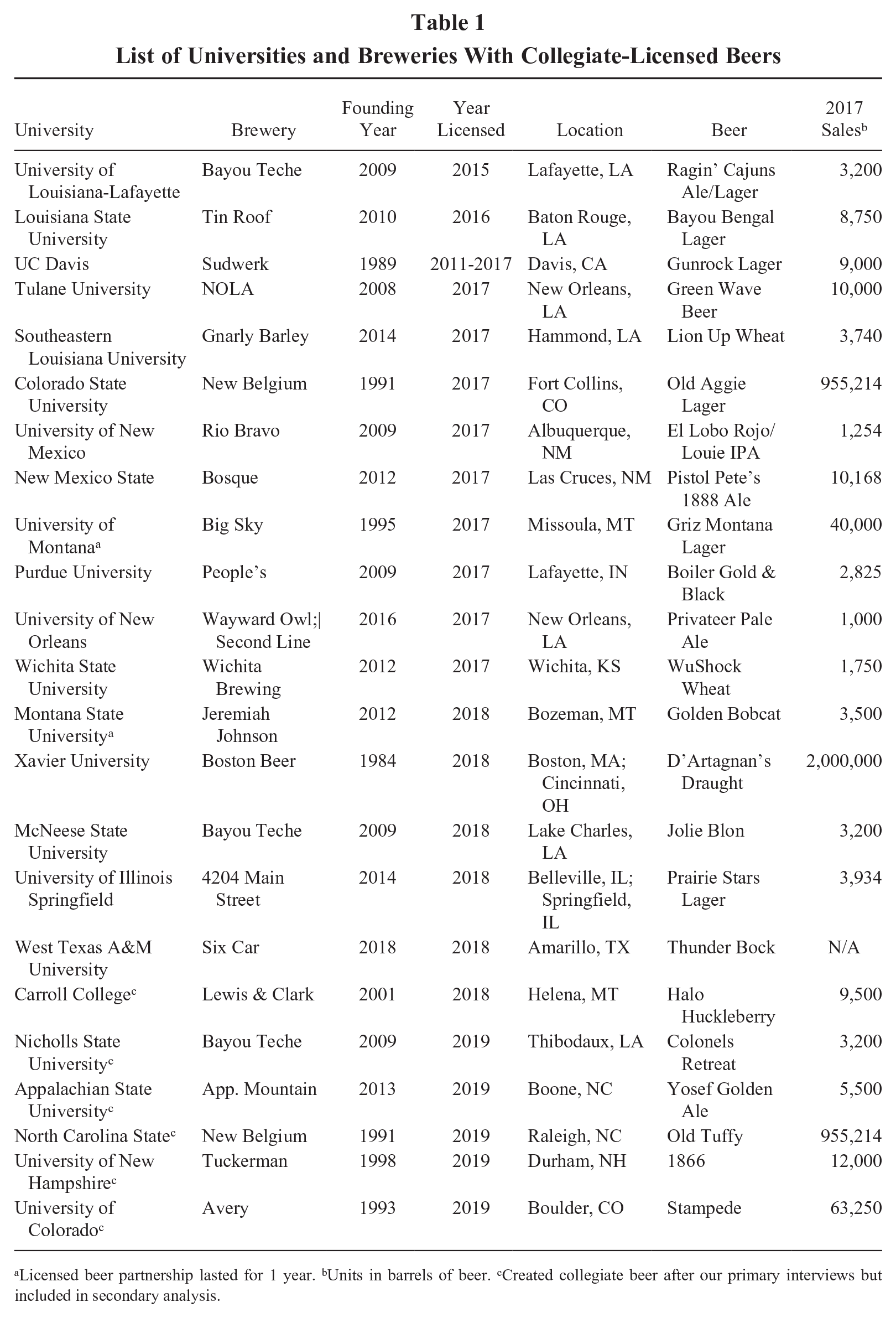
Licensed beer partnership lasted for 1 year. bUnits in barrels of beer. cCreated collegiate beer after our primary interviews but included in secondary analysis.

Timeline of Events in Contentious Category Blending to Create Collegiate Beer (2010-2019)
We adopted a historical approach by collecting primary sources from the time in which they were created, avoiding retrospective reconstructions as much as possible (Wadhwani, Kirsch, Welter, Gartner, & Jones, 2020). We achieved this in various ways. First, our privileged position among the craft brewer community allowed us access to brewery owners, licensing directors, and university officials before, during, and after collegiate beer was approved. Second, we collected primary documents—for example, meeting minutes, slide decks, and formal licensing applications—used on the part of proponents to gain category approval. Third, we obtained secondary data (e.g., reporters’ accounts of university council meetings or state government committee meetings) in which opponents and proponents debated the adoption of a collegiate beer. We were able to triangulate data from all these different historical data sources (Eisenhardt, 1989). In spite of these efforts, we still depend to some extent on retrospective interviews and accounts to supplement the data generated at the time of each event. Table 2 provides an overview of our data sources.
Data Sources

Data Analysis
Given the exploratory orientation of our research question, we followed inductive approaches devised for the development of theoretical concepts (Strauss & Corbin, 1998). Although such efforts are inherently nonlinear—as we alternated between coding, data, and emerging theoretical insights—we progressed through a number of analytical stages. These stages are consistent with foundational scholarship on grounded theory (Langley, 1999; Strauss & Corbin, 1998) and in line with recent developments in qualitative research (e.g., Grodal, Anteby, & Holm, 2020; Hsu & Grodal, 2021; Kroezen & Heugens, 2019; Raffaelli, 2019). Though analyzing data reflects a “live” and iterative process (Locke, Feldman, & Golden-Biddle, 2015; Grodal et al., 2020), this was especially true in our context, as we embarked on this project prior to the first collegiate beer gaining approval, and we then closely followed the category for 5 years after its creation. Thus, we continually updated our data and revisited our analysis as new information became available. Figure 3 shows the steps we took in the progression (or “theoretical leap”) from raw data to a theoretical model.
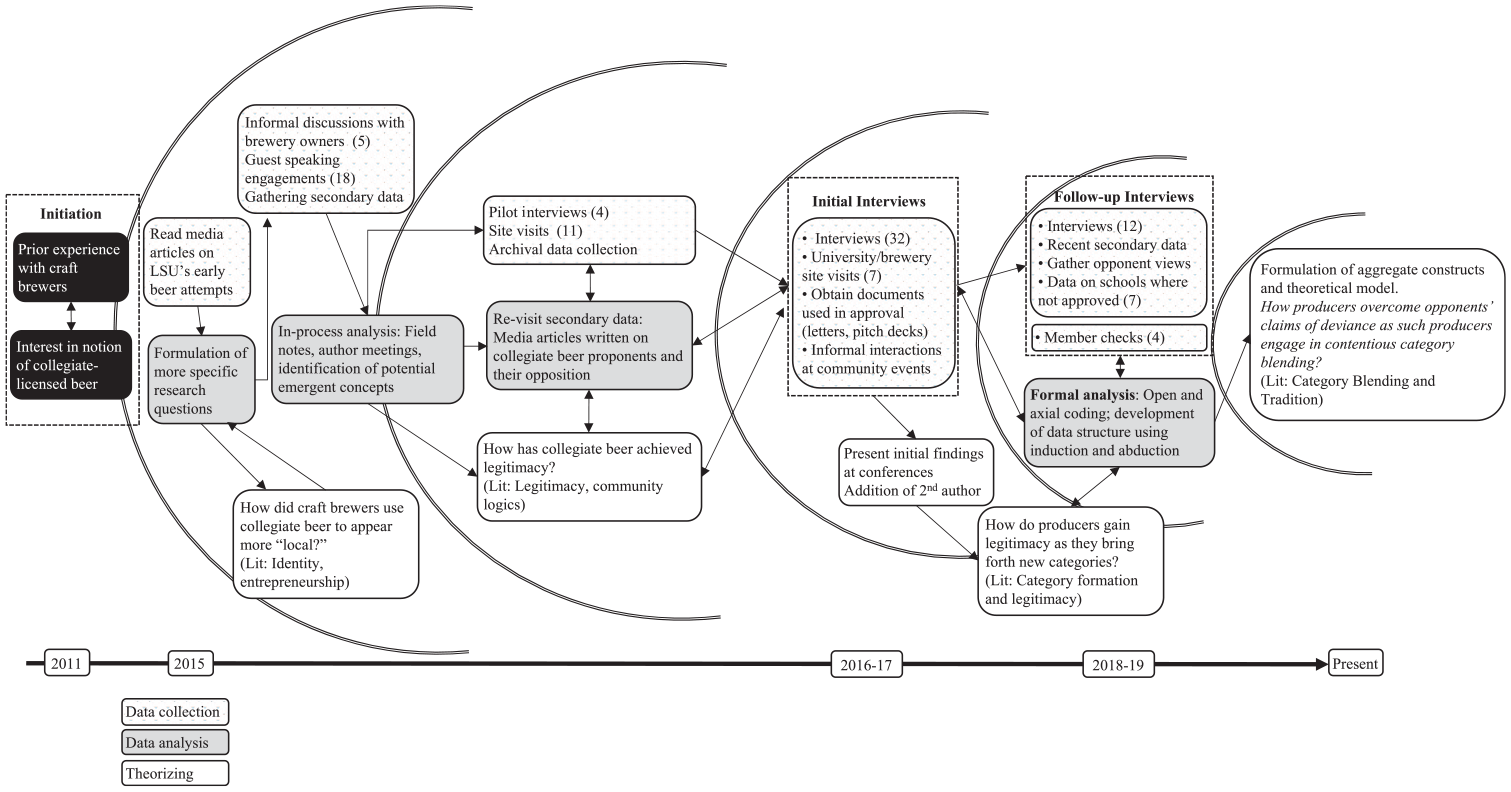
Illustration of Inductive Research Process
Exploring and analyzing initial puzzles
In recent qualitative exemplars (e.g., Hsu & Grodal, 2021; Raffaelli, 2019), scholars begin with a historical reconstruction of events to create a timeline as they take a process approach to theory building (Kahl & Grodal, 2016; Langley, 1999). Though the blending process unfolded during our data collection, we began our analysis by first reading through and reconstructing the events that had unfolded prior to our primary interviews. This largely involved creating a timeline of Louisiana State University’s (LSU) initial failed attempts at bringing forth a collegiate beer. However, our exposure to and observations of the University of Louisiana’s (UL) attempt to bring forth a collegiate beer significantly differed. Guided by the advice that theoretical insights often emerge from focusing on puzzles (Golden-Biddle & Locke, 2006; Grodal et al., 2020), we focused our analysis on why LSU initially faced such impenetrable resistance to beer and what allowed category proponents at UL to overcome these challenges.
Open coding
To address this puzzle, we read through secondary data and our initial primary interview transcripts multiple times. We then began identifying and categorizing the generalized approaches through which craft breweries and universities sought to blend together elements of their respective organizations to establish the contentious category of collegiate-licensed beer. We used an open coding approach to capture informant statements (first-order codes) about developing collegiate beer. Gioia, Corley, and Hamilton (2013: 20) explain that open coding involves adhering closely to informant terms with little attempt to distill categories into a limited or restricted number of categories. Thus, during this stage, we remained open to allow a wide array of categories to emerge and the data to guide our groupings. In so doing, we identified several unanticipated concepts that repeatedly surfaced during our initial interviews. For example, we found unexpected ties to “agriculture” with the collegiate beer, which guided us to ask more detailed questions about how (or if) proponents leveraged this industry as part of the collegiate beer story. We thus recalibrated our interview questions before embarking on our full set of interviews and observations. As we iterated between data and coding, the “data [were] broken down into discrete parts, closely examined, and compared for similarities and differences” (Strauss & Corbin, 1998: 102) until we felt confident we captured our informants’ perspectives (i.e., first-order, informant-centric codes). For example, illustrating our unexpected code of “agriculture,” one of our first interviewees noted, “It [collegiate beer] was made with rice, and I know that rice is kind of frowned upon by the craft beer industry . . . But rice is very much a local crop here.” Another emergent idea reflected proponents’ perceived inability to borrow the legitimacy achieved for collegiate beer in other locations to gain approval at their respective university. As an interviewee informed us, “Just because it’s accepted somewhere else doesn’t mean it should be accepted here.”
Axial coding
We then compared first-order codes among all informants to synthesize and explain larger segments of the data. We did this through axial coding: “a set of procedures whereby data are put back together in new ways after open coding, making connections between categories” (Strauss & Corbin, 1998: 96). During this comparative process, we identified numerous first-order codes that appeared across interviews and began clustering them into meaningful groupings (Gioia et al., 2013). As we iterated between these second-order themes and our emergent theory, we continually asked ourselves, “What is this a case of?” This question allowed us to explore the range of conceptual possibilities provided by the data (Grodal et al., 2020). As our Figure 3 illustrates, this involved continually refining and altering our research question, which guided us to focus on themes around bringing forth the category and dropping second-order themes that had little connection to these concepts, such as consumers’ evaluation of the product quality. For example, in the quote above about rice, we assigned this a second-order theme of “connecting to agricultural community.”
Theoretical coding
During the final stage, we engaged in theoretical coding: where we analyzed how axial codes fit (or did not fit) together into broader theoretical dimensions that might form part of an integrated theory. We first abstracted axial codes into aggregate theoretical dimensions (Strauss & Corbin, 1998). Then, we sought to understand how those aggregate codes might relate to one another. Admittedly, this was an inherently “messy” process that involved considerable trial-and-error (Pratt, Sonenshein, & Feldman, 2020). We developed nearly 20 process models during the course of the research process, beginning with a process of community logics and moral legitimacy before eventually arriving at our current process model (Figure 4). Therefore, we constantly revisited our data from a theoretical perspective as we refined the connections among our themes to develop our aggregate, theoretical dimensions.
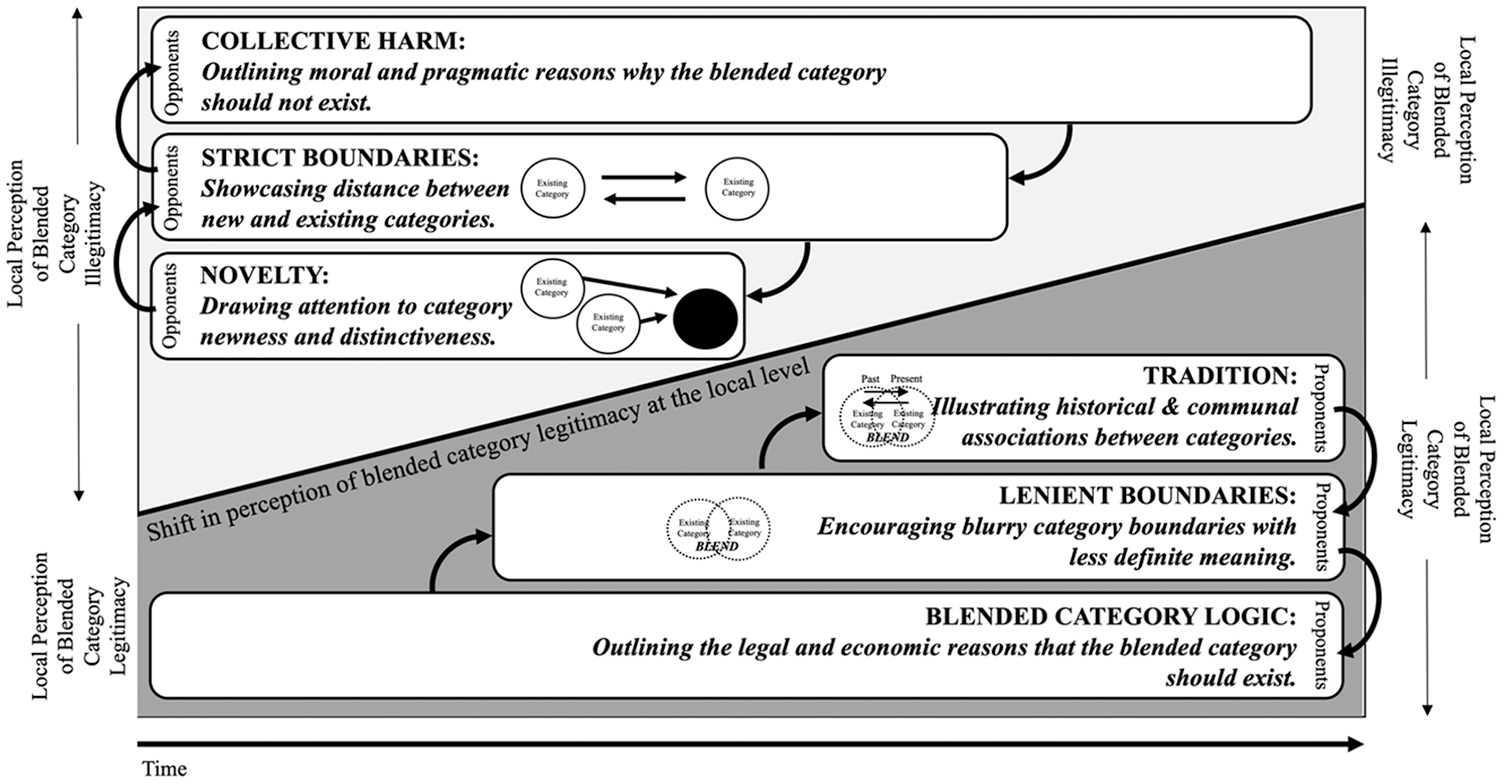
Elements of Contentious Blended Category Legitimation at the Local Level
To illustrate, we applied the aforementioned quote on rice the theoretical label “category leniency via traditions,” which illustrates how proponents framed collegiate beer as a lenient category that built on university traditions by involving a broad range of community participants (e.g., farmers). Together, these aggregate dimensions serve as the basis of our conceptual model and theoretical contribution. Through this process, we arrived at the current framework (Figure 4) that, we believe, best captures both the experiences of our informants and the theory providing answers to our research questions. While Table 3 provides the data structure, we include Figure 3 to illustrate the complexity of the analysis process and how not all concepts that emerged neatly fit into our ultimate theoretical model. Instead, we made myriad decisions during the research process that led us to “select-out” concepts or questions that deviated from our core focus (Pratt et al., 2020). In other words, though we adopt elements of a well-established qualitative template and present them in a simplified data structure (e.g., Gioia et al., 2013), we caution readers from assuming this structure resulted from a straightforward process.
Data Structure of Proponents’ Strategies to Blend Categories

Trustworthiness of the analysis
We employed two techniques to ensure the trustworthiness of our data analysis. First, we engaged in “member checks” with both brewery owners and university directors by revisiting with several of our interviewees, sharing our interpretation of the data (Locke & Velamuri, 2009). Second, we engaged in peer debriefing; while one of the authors focused on initial data collection and analysis, a second, outside researcher became involved later in the project to provide an “outside” perspective and discuss emergent themes in the data, as noted above (Lincoln & Guba, 1985). This outsider’s perspective arguably led to greater precision in the data analysis. Jointly, these efforts enhance the credibility of our analysis, but given our inductive, interpretive approach, we acknowledge others might draw different insights from our data. Figure 4 situates the key concepts we identified and their interrelationships into a theoretical model that serves as a roadmap for our findings.
Findings
Initial Claims: Offering Quantifiable Benefits
People want to legislate morality, which is BS, you can’t do that. (Incubator Director, LSU, Interview)
In July 2011, LSU announced that “this fall, the university in conjunction with Tin Roof Brewing Co., will sell a blonde ale that will be available in cans and draught and ready just in time for football season.” As the concept emerged, proponents offered supportive arguments primarily focused on the most obvious and foundational benefits of this new category—a new stream of licensing revenue. For example, in states facing difficult fiscal scenarios with declining state contributions toward higher education, such as Louisiana, proponents emphasized the university’s precarious financial situation and the benefits of additional income. A Louisiana brewery owner suggested, “The licensing fee is 12 to 15%, depending on the school. It’s a win-win for them [the school]. They’re desirous and in need of the money.” The president of LSU offered a similar sentiment: “We have a brewery who gives us 15 percent on one of the ales they sell. I don’t find a problem with that at all.” Even Louisiana’s lieutenant governor weighed in, supporting the category by noting in The Advocate (primary local newspaper), “We are in Louisiana. At a time when universities need money, we have local entrepreneurs wanting to work together.” Given the resource-constrained university environments, proponents initially justified collegiate beer by claiming it helped support the university’s financial needs. Such arguments emphasized the economic benefits to the university.
More students are coming to university and increasing needs. So how do we pay for that? I don’t think we’re going to pay for the university on a cake sale or a beer sale, but if we can offset some of the student costs, then we can take care of ourselves a little (Head of Food Sciences, Purdue, Interview)
Yet it quickly became clear that not all audiences supported this decision. Opponents attacked efforts to bring forth the new category as they highlighted that the mission of universities was “the generation, preservation, dissemination, and application of knowledge” (LSU, 2012), and in their view, universities’ creation of a collegiate beer significantly deviated from this mission, calling the move “short-sighted,” “nonsense,” “mindless,” and “shameful.”
Many frequently cited the “inappropriateness” of a university’s connection to alcohol (field notes). Many opponent claims hinged on reducing collegiate beer to a senseless act of creating an additional revenue stream, thereby effectively combatting proponents’ economic-based arguments. As one opponent, a university professor, asserted, “It’s money, right? There’s big money behind all of this and it’s extremely tempting to universities to capitalize on that.” Similarly, another opponent—a university athletic director at a school where collegiate beer was ultimately denied—noted, “It’s all about the money, period. It doesn’t matter if it’s the right thing or the wrong thing anymore. It’s all about the revenue. . . . Schools avoided it [beer] historically because it didn’t fit the culture on campus, but money has flipped all that. It shouldn’t be that way, but it’s the world we live in.” The efforts of opponents often delayed and, at some universities, altogether thwarted producers’ attempts to create a collegiate beer. In fact, it was more than 5 years from LSU’s widely broadcast announcement—not until late 2016—that the school would gain approval to produce and sell a collegiate beer. So, what happened?
Alternate Claims: Tradition, Community, and Culture
Our informants asserted that the claims typically used to bring forth new categories were inadequate to overcome the category’s contentiousness and legitimize the product (field notes). As a Louisiana brewery owner informed us, the revenue component was “not enough” and “the biggest thing is to figure out how this benefits other than having alcohol—that really can’t be your focus because it’s hard to get people on board with that idea.” Instead, proponents eventually responded to opponents’ claims by taking their economic arguments and focusing their supportive claims on community, tradition, and culture to achieve two aims: enhance category leniency and downplay product novelty. Proponents asserted they needed to uniquely align and “stand on their own” within their specific cultural contexts.
[UL’s licensing director] gets calls all the time from other universities, like, what do you do? Who do you talk to? How do you do it [create a licensed beer]? But at the end of the day, each state’s different, so they kind of approach each collegiate beer differently (Brewery Owner, UL, Interview) No, [we didn’t point to other schools where this has been done] because their business model was their business model, and the hoops and complexities that they had to wrangle with internally, locally, socially, and culturally, they are different from ours. . . . Every university is a different culture. So to say that school did it so it makes it okay for us isn’t a thing. We need to stand on our principles and ethics and question how we do things. Is it the Purdue way? (Head of Food Sciences, Purdue, Interview) Just because it’s been done somewhere else, doesn’t make it a right fit. You have to make the claim that, “It fits our culture and who we are. Just because it’s accepted somewhere else doesn’t mean it should be accepted here. We have to assess our own values.” (Licensing Director, Purdue, Interview)
In most new category scenarios, once numerous similar organizations have achieved evaluative approval from recognized actors (e.g., corporate elites, investors), the category becomes broadly accepted (Durand & Khaire, 2017; Rindova et al., 2007). However, we found that the creation of the contentious collegiate beer category unfolded differently as proponents primarily leveraged tradition and culture and emphasized connections to community as a means to overcome contention. As proponents invoked tradition and culture, their arguments for a product’s acceptance did not easily extend to communities where traditions and cultures differed. For example, the LSU business incubator director suggested that although collegiate-licensed beer existed elsewhere, the distinct values and traditions of their community greatly influenced their ability to gain approval, thus rendering the product’s acceptance more (or less) challenging depending on the community (interview notes). As he exclaimed:
A very close friend of mine runs the Purdue Research Park, and they are promoting the hell out of this Boilermaker [Gold]; whereas, here it’s not being promoted. It’s the religious culture of Louisiana. It’s two different cultures. Up there, you’ve got a big blue-collar workforce, and they’re beer drinkers in the Midwest. They may be slow to get to the fine wines, but they drink their beer.
A Montana licensing director echoed this sentiment, noting that approval “is all about the community your institution is in, the fan base, the administration, and how comfortable they feel with it.” An Illinois athletic director suggested the need to “brand [the product] as part of the Springfield and central Illinois community”; similarly, a New Mexico athletic director stated, “We tried to make it [collegiate beer] as unique to us as we could. From the naming and the design, it was all about tying to the university and the community.” Indeed, across every case where collegiate beer gained approval, our respondents indicated that although they learned from universities that had previously gained acceptance, a product’s acceptance elsewhere was not a sufficient condition for its acceptance here (in the local community). Table 4 offers additional quotations to support this assertion.
Blending Elements Differ (Reoccur) in Each Community

Although we consider collegiate beer a single blended category, as our interviewees considered themselves part of the group of “universities/brewers with collegiate beers” and they leveraged one another for advice to gain approval, we found that blending universities and beer to create the collegiate beer category was not a single, universal event. Instead, category proponents invoked strategies putting forth claims about the specific benefits of a collegiate beer for their respective community and its extension of existing traditions and beliefs of the area. We turn next to exploring the details behind how and why proponents leveraged tradition, culture, and community to overcome opponents’ claims and create the blended collegiate beer category in each community. In particular, we focus on two strategies of contentious category proponents—using tradition to enhance category leniency and downplay novelty.
Strategy of Enhancing Category Leniency
Opponents: Constraining the category with strict boundaries
The contentiousness of the collegiate beer category arose less from the activity of beer production and more from the participants involved in the category—universities and, more specifically, current students. As such, the core arguments opponents levied against collegiate beer focused on the category as constraining, putting strict boundaries around the range of activities and actors of a category (Glynn & Navis, 2013; Pontikes & Barnett, 2015). To emphasize these constraints, opponents framed the blended category as a “university pursuing beer.” First, opponents asserted how a university producing a collegiate beer would likely garner negative associations and have a damaging effect on the reputation of the school.
It’s inappropriate for the university to associate itself with an alcoholic beverage. . . . As a longtime member of the LSU Board of Supervisors, I am philosophically opposed to Tin Roof Brewery being granted the licensing for Bayou Bengal Beer to become the official beer of LSU. I feel no references to alcohol should be used in conjunction with our university label. (University Board Member, LSU, email to university leaders) We’re trying to combat the alcohol problems we have. It looks bad that the university has its own beer. Celebration is always great, but it doesn’t always have to focus around alcohol. When we normalize alcohol is such a big part of our culture, it’s a concern. (University Director, media interview)
While opposition to collegiate beer came from a number of expected sources, such as leaders and members of DUI task forces and alcohol awareness groups, it also came from a diverse range of outspoken adversaries, including university board members, student body presidents, and political officials. As the legal counsel at Montana State University explained in the university’s monthly council meeting:
I’ve received about 15 emails in the past month on the proposed policy change [approving collegiate beer], more than any recent topic, and the majority are passionately opposed.
Many argued that a university simply “had no place in beer” (field notes). Opponents emphasized how a collegiate beer would promote underage drinking among college students, including the University of Connecticut president, who issued a public statement declaring that “the university cannot appear to endorse drinking among our students.” The university followed suit by denying the introduction of a collegiate beer. Others pointed to the drinking issues and social costs that they suggested would inevitably result from the introduction of a collegiate beer, particularly by encouraging excess student drinking on campus.
In his attempt to justify college-branded and sanctioned beer, [LSU President] Alexander ignores all of the college student specific data regarding underage consumption, binge drinking, alcohol fueled sexual and physical assaults. . . . Lawmakers are taking a very short-sighted view. What they gain in short-term tax revenue they are losing in long-term police costs, emergency room costs, and work-force readiness costs. (Louisiana State Representative, Letter to LA House Committee) It is opposition at the highest level, and that opposition is because of a very real or perceived perception against it [beer]. “What is a university doing in beer?” . . . We all acknowledge there is a drinking problem on campuses. Nobody discounts that. (University Professor, Purdue, Interview) We know from studying this for a long time. . . . This is a classic example of privatizing the profits and socializing the costs . . . the university and the community are ultimately going to bear the cost of the disease, the injury, the crime, the violence. (Alcohol Center Director, Johns Hopkins, Media Interview)
Together, we discovered that an important part of what made collegiate beer contentious was who was involved in the category—universities and their students, many of whom are under the legal drinking age. Opponents, therefore, cast the collegiate beer as a constraining category, one that involved universities (and their students) participating in a category (beer) in which they did not belong. Thus, they focused narrowly on these category participants, which they deemed as inappropriate members of this proposed blended category.
Proponents: Recombining the blended categories
Given these arguments, proponents recognized that they needed to shift the conception of the blended category away from these actors for which the product was viewed as contentious and toward a broader constituency. To this end, they blended the category in unique ways by encompassing a greater range of organizational actors involved in the blending. In other words, rather than universities (Category A) entering into beer (Category B) to form collegiate beer (Category AB) as argued by opponents, proponents demonstrated how beer/brewers (Category B) came from universities (Category A), thereby illustrating the combination of Category BA. In addition, proponents also involved other groups, such as agriculture (Category C) and community beer culture (Category D), to showcase the flexibility and fit of various groups as part of the collegiate beer category.
To illustrate flexibility and fit, proponents first emphasized the brewer(s) and their historical university connections. At UL—the first school to create a collegiate beer—they highlighted how a partnership emerged with an authentic, local brewer, who already produced beers reflective of the university and local culture. Proponents emphasized how the focal brewery had values aligned with the values of the university—thus highlighting the brewery’s embodiment and embeddedness in their respective university community. They pointed to specific historical factors connecting the brewer to the university community, including the brewery’s location and the brewery owner’s alumni status.
We wanted it to be culturally relevant [to our community]. We wanted it to be authentic. We wanted it to be a local brewer, using local ingredients. We thought if we could find an alum to work with, that would be a preference. We found all of those things in [brewery]. (University Licensing Director, UL)
Likewise, the producer of the Ragin’ Cajuns beer for UL emphasized how his brewery’s identity aligned with the culture and traditions of the university community, noting that the name of the brewery as well as the beers reflected local landmarks or cultural events (interview notes). Illustrating the fit with the culture of the university, he recited his brewery’s mission statement: “to craft beers that complement the cuisine and lifestyle of Cajuns.” He indicated that since his brewery’s inception he had focused on improving the local community. He also highlighted how his deep personal connections to the school helped garner support for the product: I went there. . . . My dad actually was a teacher at UL for years. All my family, my aunts, uncles, my brothers all have degrees from there. That’s a real tie-in there. . . . My grandfather was a sharecropper, so my dad was the first one to actually get a high school education and a college degree, so I feel kind of indebted to UL. If it wasn’t for them, I’d be a sharecropper. (Interview)
As additional schools proposed this category, they borrowed many of the claims and strategies that proved effective at UL, but with different brewers and community connections as the focus of their approach. From interviews with various local reporters and media outlets to statements from university leaders, category proponents embraced the brewer and the brewery as, in the words of one respondent, “one of its own.” These claims positioned collegiate brewing as a natural extension of the well-established relationship between a brewer(y) and the university.
I pride Louisiana taking it to the next level by using local breweries, and local breweries only. That’s very important. It’s a local business supporting a local university, not Anheuser-Busch coming in here and sponsoring a football team or a stadium and just throwing money at it. It’s a lot more intertwined and there is actually a relationship there. (Brewery Owner, UNO, Interview) Our roots at Colorado State University run deep. New Belgium’s donations have facilitated creation of CSU’s Brewing Science and Fermentation Program, where our brewing science coworkers are heavily involved as adjunct professors and student mentors. We have also opened specific opportunities for student internships throughout our Fort Collins brewery and are proud to call over 100 CSU graduates our co-owners. (Brewery, Pitch Deck for CSU Leaders)
In response to the proposed state House Bill 610 raised by lawmakers and supported by some community members to forbid collegiate-licensed beer in the state of Louisiana, a university president appealed to the state government, emphasizing the strong and long-standing associations between the brewer and the university and pointing to the traditions of the school supporting its alumni. In the state of New Mexico, a university chancellor and president responded similarly to critics, offering claims that demonstrated past connections between the brewer and the university.
We license lots of products; we’ll help you do that. Here, we have a local business, run by an alumnus who we helped get started in our business incubator. (University President, LSU, PR Announcement) The thing that was attractive to us was . . . most of all, we’re licensing to a company that was formed by [alums]. (University Chancellor and President, NMSU, Media Interview)
Proponents learned that having an alumnus of that respective school brew their beer allowed them to draw attention to the long-standing ties and support the brewery and its respective owners had historically provided to the university. University leaders and licensing affiliates pointed to the support the brewery had provided the school in the past.
[Brewery] was already invested as a sponsor of the athletic department for years. . . . A lot of the executives and founder over at [brewery] had gone to [school] or had passionate ties to it. (IMG Rep., Tulane, Interview) It’s a recipe devised by one of our great alums, uses a prime local raw material and is being brewed by the longest lasting craft brewery in the region. (University Rep., UC Davis, Media Article) [Brewery] helped us out with fundraisers well in advance of [beer] becoming a product. Certainly, anybody can brew a beer, but what makes it extra cool is these guys are alums. (Licensing Director, SELA, Interview)
In turn, brewery owners/employees validated university claims of tradition by expressing their emotional attachment to the university community, highlighting the extensive relationship between themselves and the university. In Colorado, a brewery’s sponsorship manager noted, “The biggest difference between this and other partnerships is the depth of the relationship, just in that we’ve been living and working in the same community for 25-plus years, and so those ties, both personal and business ties, go back a really long way.” Such claims invoked a deep and meaningful emotional connection between the two entities forging the blended category.
I love the school. Not only is it where I graduated from, but I feel like it instilled a lot of my business acumen. . . . I graduated from [university]; I grew up a die-hard fan. . . . My wife and I have been married 27 1/2 years, and we’ve been big Lobos supporters the whole time. (Brewery Owner, UNM, Interview) We were in the homecoming parade a few weeks ago. We’re really close to the university, so it would have been a bit of a shock if someone else got the beer. . . . We are on the university board. Also, last year, they awarded my wife and I as young alumnus of the year. (Brewery Owner, SELA, Interview)
Brewery owners also highlighted an authentic sense of appreciation for the university partnering with them on their collegiate beer, suggesting it was an honor to represent their school. They expressed that the collegiate beer was more than a product they produced on behalf of the university but an opportunity to collaborate with an institution that served as an important part of their past and identity. They recalled stories from their undergraduate experiences, their support and sponsorship of university education and athletics, and their rituals of regularly attending school events (interview notes). For instance, one brewery owner noted, “We make a beer for the [university]. We couldn’t be prouder of it!” Another suggested he had been a “diehard [school] athletics supporters since he could remember.” He mentioned attending games since he was a child and continuing to do so as he attended the university. He told us he would have been “really bummed” had the university not chosen his brewery for the collaboration. Other brewers offered similar sentiments, stating they would have been “sad,” “disappointed,” or “hurt” had their respective universities not selected them. Brewery owners used the terms “partnership,” “deep ties,” and “relationship” to describe their feelings toward and connections with the university as they narrated their stories for developing their school’s beer.
We anchored ourselves here. . . . Being in partnership with the university, it’s more of that tighter, more solidified, more concrete, anchored community. Ever since I moved back to [state], that’s all we wanted, is to be anchored as tightly down as we can into the community, that’s why we opened [here]. . . . The more research on the history [of the university] I did, the more intrigued I became. . . . With the beer, there is a tie [with the school] that couldn’t have been manufactured. . . . This partnership, I’ve been smiling since May, thinking, ‘Wow this is so cool.’ (Brewery Owner, UNO, Interview)
Together, university proponents found that partnering with a long-standing school supporter and alumnus as well as a brewery strongly embedded in the community (often the oldest brewery in the area) helped generate “a story” that resonated with audiences (interview notes), while brewers unveiled their own histories and emotional connections to the university, such as the producer of Montana State’s beer, who told us: My brewery is Jeremiah Johnson, but it’s also my name. People are like, ‘No, your name is not really Jeremiah Johnson?’ I go, ‘Yeah, it is.’ Everybody in Montana knows the story of the actual Jeremiah Johnson, and then of course the movie. It’s a very Montana name. . . . So, I wanted to tell that story—I care deeply about Great Falls, and to tell the story for the community. (Interview)
This allowed proponents, in part, to shift the focus from the more contentious notion of a “university getting into beer” by incorporating the story of those less contentious actors involved in the category—the brewer and the brewery—those for which making beer represents a common and well-accepted activity. As a New Mexico brewery owner explained, “You’re going to have the people that are teetotalers, and they’re going to find any reason [to oppose it]. . . . But, I mean that’s what we do, right? We make beer. Our fans don’t really care. I don’t think they really thought about it in those terms.”
Proponents: Connecting to agricultural community
Despite these efforts, some opposed to the category combatted these claims that tied the brewer(y) to the university, such as one Florida newspaper, which suggested that an “institution of higher learning forming an alliance with a beer purveyor represents a dance with the devil.” Therefore, proponents sought to enhance category leniency by also including local agriculture as part of the collegiate beer story. For instance, Louisiana turned to rice—a major state crop. This allowed UL to also effectively weave agriculture and farmers into the collegiate beer story.
It [beer] was inspired by rice, a staple ingredient grown in Louisiana. (UL Website) I’m sure a lot of people cringed and were like, “Why would you make a rice beer as your first beer?” But rice is very much a local crop here. . . . We wanted it to be authentic. That was all part of our story. (UL, Licensing Director, Interview)
Other schools adopted this approach as they illustrated the locally sourced nature of ingredients used in the production of the beer, demonstrating the connection of the beer to local crops and farmers. The Daily Democrat newspaper, commenting on the locally grown rice for UC Davis’ Gunrock Lager beer, concluded that “Everything about the [UC Davis] beer, from its inception to delivery, represents its Northern Californian region.” In Montana, respondents indicated that the university’s agricultural heritage and the connection to agriculture in the community represented the most important driver for the creation of their collegiate beer: #1, there is a connection to the agriculture in our community. We thought it would be a great tie-in to our ag heritage. [Our state] is one of the top three suppliers of barley. (Licensing Director, MSU, Interview)
An article published in the Sports Business Journal, announcing NC State’s approval of a collegiate beer, cited the university’s “land-grant” status as a critical component for why the collegiate beer gained approval and noted that the majority of the collegiate beers created came from land-grant universities. In both the article and our primary interviews, proponents asserted that the initial purpose behind “land-grant institutions” centered on the creation of knowledge and teaching to benefit agriculture (field notes). According to their arguments, collegiate beer did just that—support agriculture. Schools proudly promoted these agricultural traditions in the approval, development, and subsequent marketing of the beer. Montana State highlighted its use of Montanan 2-row pale malt barley and local honey in its Golden Bobcat Pale Ale, Purdue noted its use of Indiana hops and malts, and Wichita State featured local wheat in its WuShock Wheat. Illustrating the frequent co-occurrences and associations between the university and its agricultural traditions extended not only to gaining approval for the beer but also to marketing efforts, using associations with agriculture to “tell the story” of the beer (interview notes).
On the can it says, “A portion of the proceeds go back to agriculture to support research.” We’re here for the people of the state, largely agriculture, and to support that enterprise . . . it [beer] is a direct correlation to the [agriculture] industry. (Head of Food Sciences, Purdue, Interview)
Yet not all were so impressed with the tie-in to the school’s agriculture heritage. In fact, despite strong associations with agriculture, at the University of Montana and Montana State, dissent from faculty, advocacy groups, and student representatives in an ongoing series of university council meetings led to limiting the product to only a one-year, anniversary licensed beer. An article published in the Bozeman Daily Chronicle entitled “Commissioning of Bobcat Beer an Insult to Farmers” offered harsh criticism of the beer: As a fifth generation Montanan, I love my state’s agricultural history. I’m proud my family are farmers and producers in our state’s economy, but as an MSU student, I am troubled as President Cruzado cheapens these sentiments in order to promote her commissioned beer . . . and Montana State University cashes in on the romanticized image of “supporting the local farmer.” . . . Using our state’s proud agricultural background to profit on the sale of alcohol is unsettling. (University Student)
Proponents: Situating in cultural geographic context
Thus, to even further enhance the category’s leniency, proponents also pointed to the physical geographical community in which the university was embedded, asserting how beer fit with the traditions, culture, values, and beliefs of the area. Many respondents, particularly those at Tulane and Louisiana-Lafayette, pointed to the beer culture of the geographic region. As UL’s licensing director informed us, “On the bottom of it [the package], there’s a story. . . . We had all these factors that we knew, culturally, beer is definitely part of the culture here in Cajun country.” Later entrants to the category, such as those in Cincinnati, Ohio or Fort Collins, Colorado, similarly leveraged such claims and strategies, highlighting the popularity and fit with the craft beer culture of the area, thereby combining community brewing traditions with collegiate beer.
Well, look, this is Fort Collins. I mean, we are a beers, bikes, and bands town. I mean, that’s who we are, right? So, this idea of serving watered Coors Light just doesn’t really fit with who we are and who our culture is. (VP of External Relations, CSU, Interview) I don’t know how familiar you are with the history of beer in the city. Probably back to the early 1900s, it was probably one of the largest beer manufacturers in this country. I think that all probably contributed to it [creation]. I think we’ve got one of the most robust craft beer cultures in the country. (Athletic Director, Xavier, Interview)
Taken together, in most categories, new entrants can point to existing category members to help legitimate and gain acceptance for their product. Yet we found that the contentious nature of collegiate beer altered this process by promoting category leniency while “toning down” elements linking the university to the beer, as noted in the New Orleans Advocate in 2017: Tin Roof Brewery, founded in 2010, has been working on a LSU beer deal practically since its inception. . . . This beer was sidelined, however, over concerns from some university leaders of linking LSU with an alcoholic beverage. Bandit Blonde became simply Blonde Ale, and its team-themed packaging was toned down.
At the same time, they elevated its local, community-based elements and connections. As the brewer of LSU’s beer noted 4 years after initially unveiling the idea, “We wanted the beer to represent the LSU community. We wanted it to appeal to a broad spectrum of people.” Similarly, the UL licensing director informed us in 2015:
You have to create a story. The whole part about how we came about making it, using Louisiana ingredients; the artwork was done by an alum of the university; we put a Cajun French phrase on it. All that was part of the story to the beer instead of just throwing a logo on something. . . . We take great pride in the local connections [of the beer] to the community.
At UC Davis, a brewer recalled the initial difficulties in gaining approval. This time around, however, he explained how proponents enhanced their story of the beer, drawing varied and meaningful community connections: “There was definitely a contingent of faculty and staff that was concerned because it was alcohol-related and on campus in spring of 2011. . . . As far as the story goes [in 2018], we definitely have it much more dialed in than last time. The recipe is developed by a former UC Davis alumni. Then, we’re getting this local rice a few miles from the brewery, grown by UC Davis alumni. The yeast is a proprietary lager strain, but we bank it at White Labs. Chris White is a UC Davis grad, and then Charlie Bamforth [renowned UC Davis brewing expert] is still onboard and endorsing the beer and all its Aggie connections.”
Thus, rather than assess whether the organization/product should exist and audiences, namely consumers, legitimize the category by virtue of purchasing the product (as is the case in most new categories), the blending to create collegiate beer inherently invoked a wide range of community evaluations, including university officials, alumni, students, faculty, parents, community members, local organizations, farmers, advocacy groups, and many others assessing the appropriateness of the category. As such, while opponents focused their claims on those for whom the category was deemed contentious, proponents broadened their claims and strategies to accommodate these varied constituents—weaving the entire community into “the story” of collegiate beer. Proponents argued how the beer represented a tool for generating solidarity, fostering collective identity, and unifying the community around something that is “ours.” In other words, producers claimed that the beer did not belong solely to the brewery, the school, the alumni, or the residents of the geographical area but that it was a “mutual thing” that belonged to everyone who identified with the university (interview notes).
Still, this appeared to slow category blending, as proponents had to appeal to a wide range of constituents and overcome the unique challenges specific to their community.
There are a lot of conversations that are going to be had. People start to realize that one donor who is affiliated with Mothers Against Drunk Driving and sits on the [university] board. It takes one person, one donor, one person of influence who says, “Look, I just don’t feel comfortable. I give you $5 million a year. I don’t feel comfortable with us putting a product out that could be dangerous to underage drinking.” I just think that so many people have to approve it and give their blessing that it’s going to be challenging to actually get these things off the ground. (IMG Licensing Representative, Louisiana)
Supporting this view, a news reporter, commenting on the collegiate beer category in the Sports Business Journal in 2019, suggested: “By 2017, a half-dozen schools had licensed their marks to breweries and that number has nearly doubled since then. Still, college-licensed beer has not taken off in the last two years like some predicted it would.” Based on the vast number of inquiries about how to develop a collegiate-licensed beer, one university licensing director concluded that “a possible eruption of college licensed beers is bubbling just below the surface” but indicated that we have yet to see this eruption, in part because proponents cannot rely on acceptance elsewhere but must uniquely speak to the members and cultural traditions of their respective community (field notes).
Downplaying Product Category Novelty Via Tradition
In addition to the debate over who combined to be a part of the blended category, we also discovered that proponents and opponents waged a battle over the novelty of the blended category. In late 2011 and early 2012, numerous national news outlets picked up LSU’s announcement proclaiming the introduction of a collegiate licensed beer, including ESPN, The New York Times, The Wall Street Journal, Business Week, Associated Press, and many others as well as more regional media outlets. Each article featured interviews with the (alumni) brewery owners, LSU officials, and other proponents of the category pronouncing the “novelty” of the product and how it would be “exciting to see the university in this new [licensed beer] format” (media reports). The sheer quantity and reach of outlets covering this event suggested that this was indeed new and newsworthy. In this way, though not necessarily proponents of the category, the media no doubt played a role in heightening its initial perceived “novelty” and “excitement.”
In reflecting on this time period, an LSU director informed us, “Well, before they [LSU] got it approved, The Wall Street Journal covered it, USA Today covered it, ESPN did a feature, ‘LSU is going to license a beer. For Tiger Stadium tailgaters, you’re going to be able to buy the LSU beer!’ It went viral all over the country. We got so much publicity and people wanting to buy it from all over the country.” Many of our Louisiana interviewees who supported the beer indicated that the “newness” and “coolness factor” garnered considerable initial interest and excitement from their fan base before the product was even launched (interview notes).
Opponents: Emphasizing novelty
However, as the title of the 2012 Wall Street Journal article suggested—“You can’t spell ‘Lush’ without L-S-U”—this publicity also proved a double-edged sword as not all viewed the idea so positively. And as news of a collegiate beer spread, tensions arose and a second battle erupted. The seeming novelty of the product led opponents in Louisiana to claim: “We’ve never done that before. We don’t license alcoholic beverages” (interview notes). At various schools in Louisiana, Montana, and Indiana, opponents pointed to existing university policies that banned using university symbols to promote alcohol. At university council meetings, opponents argued how this new product would force major policy changes, disrupt the status quo, and create new problems (field notes), with a popular Louisiana news outlet concluding that “alcohol consumption by college students is a problem. Licensing an official beer or wine or any alcoholic beverage isn’t a good solution.” These statements centered on collegiate beer as something that had never, and should never, be done.
In addition, at LSU—the first school to propose a licensed beer—opponents attacked the category by suggesting that beer’s approval would usher in new and even more contentious products. Many university parents and community residents implored the university to reconsider, indicting licensed beer’s creation as a “slippery slope” product (field notes). As one community resident claimed in an LSU public forum, “It’s truly a sorry state of affairs when a ‘high class’ university resorts to alcohol sales for funding. They don’t allow alcohol sales in the stadium, so why use it for advertising money? Why not a university cigarette or vape? Draw the line!” At a House Education Committee meeting, a Louisiana state representative made a passionate speech accompanied with visuals (see Figure A.1) illustrating this claim. He implored committee members to reconsider the beer’s approval, arguing it sets a dangerous precedent that would lead to more contentious products.
If this, why not the official lottery ticket game of the various universities across the state? Let’s have the Mike the Tiger Pick 3 card. . . . [Beer] opens the door to ‘Big Mike’s Malt Liquor.’ And if the malt liquor is okay, then if you know about the smooth enjoyment of a black and mild (cigar), why not set your evening off with a ‘Big Mike’s Purple and Wild’? (LA State Representative)
Proponents: Linking to preexisting activities
Across most new categories, proponents seek to illustrate their newness and distinctiveness from existing products. Initially, proponents employed this strategy to generate heightened attention for a licensed beer, gladly agreeing to interviews with renown media outlets and emphasizing the novelty of this product (field notes). However, following verbal attacks on the newness and inappropriateness of collegiate beer, early Louisiana proponents altered course. Rather than demonstrate novelty, collegiate beer proponents began to seek the opposite—displaying collegiate beer as something that was not new but had long existed as a key tradition of the university community, illustrating that collegiate beers would not change anything about activities already occurring on their college campuses. As an early entrant indicated: I don’t know what kind of rock they [category opponents] have been under, but people have been drinking at [school] football games and on campus for 400 years [sic]. You can’t blame anything on us starting this. . . . Beer is legal. People are going to buy it. (Incubator Director, LSU, Interview)
Accordingly, proponents sought connections between preexisting categories and collegiate beer to showcase how society had already accepted highly similar products. In so doing, they shifted from category formation, which entails the development of new market categories to accommodate novel products or technologies (Durand & Khaire, 2017), to category blending, in which two categories are purposefully combined to bring about a new categorical classification while downplaying its material novelty (see Figure 1). At UL, a university respondent grouped collegiate-licensed beer with other consumable products at the university, notably wine. He suggested this helped pave the way for their collegiate beer.
The alumni association came to us [a few years ago] and they wanted to put the university’s name on a wine. A whole bunch of vineyards decided to start convincing universities to do a wine label. It was mostly sold as an alumni association thing, not necessarily as a licensed product, per se. So one, we had already ventured into alcohol, in a sense, by doing the wine. (Licensing Director)
Likewise, in a formal letter submitted to the Board of Supervisors at LSU in 2016, proponents provided a list of all the schools that produced wine and noted that “over 30 universities have signed licensing agreements with wineries” (field notes). In the letter, they drew comparisons between the two categories by showing that both categories promoted education (viniculture compared to brewing) while producing alcohol (wine compared to beer). Although proponents insisted that they needed to “stand on their own” and not rely on the actions of other universities, they sought to illustrate how collegiate beer exhibited little difference from the preexisting category of collegiate wine. As an interviewee at LSU told us:
Oregon State was producing wine and working with Willamette Valley and Cal-Davis was doing it way before that because they were dealing with Napa. And there were isolated cases around the country that a university had an alcoholic product. So that helped push it [collegiate beer] along.
Numerous universities borrowed this strategy. An informant at the University of Montana noted how they “looked at several schools, LSU being one of them, and several schools that were having success with the beer.” In seeking approval, they too emphasized how they had produced a licensed wine for their 100th anniversary, using it as justification for venturing into beer (interview notes). Similarly, an informant from Xavier University indicated that their history with wine aided the introduction of beer: “It helped that we have a licensing agreement with a wine company—it’s a collegiate licensed product.”
Though proponents at most schools attempted to shift the focus away from the university and its students, universities with established brewing programs, including UC Davis, Purdue, and Colorado State, were able to emphasize how the collegiate beer aligned with their traditions in brewing education. For example, when asked what allowed university officials to approve the collegiate beer, a California brewery owner pointed to his respective school’s—UC Davis—long-established brewing programs: “They’ve been doing it [masters brewing program] for over 20 years. Maybe that’s the biggest part of it [approval], is that there is so much tied into education, and this history of putting out the best brewers in the world. Charlie Bamforth and Dr. Michael Lewis living in Davis and developing this program that made it so much easier, even though look how long it took [approval], still.” Indeed, these universities pointed to their prominent fermentation science programs and degrees, illustrating their rich educational traditions of students learning to brew beer on campus.
Our [brewing] program here includes courses in the history and cultural aspects of fermentation and that’s important. . . . Our history in understanding microbial sterility and fermentation dates back to around 1880, give or take, almost at the birth of Purdue. (Licensing Director, Purdue) Having a brewing program helped make the on-campus conversation easier than probably what it is at some other places . . . obviously, this kind of tradition that certainly lends itself to [collegiate beer] being ‘a thing’ and not just being a test thing. (Marketing & Licensing Director, UC Davis) We’ve had brewers teach coursework there. We supported the College of Fermentation Science, which is one of just a few in the country at a higher learning institution. Our cofounder personally donated $500,000 to the College of Fermentation Science. (Sponsorships Manager, New Belgium)
Proponents: Activating nostalgia
In addition, as producers began to develop and position the beer in the market, they attended to historic, cultural elements they perceived would resonate with intended audiences—namely, alumni. Category supporters designed and marketed the beer so as not to invoke feelings of modernness or newness, which they perceived could be interpreted as an attempt to appeal to current underage college students, which opponents might use against them. Instead, they used artifacts of historical and cultural significance to invoke tradition among university alumni (interview notes). To do so, producers resurrected old mascots, vintage logos, original colors, and historic slogans, hoping to foster nostalgia. As a UL director suggested:
Part of what we purposely did, and that ties into why we did the look the way we did, there are no official logos on the beer packaging at all. We deliberately used the name Ragin’ Cajuns [but not the university logo] so that it didn’t sell as a student beer . . . we didn’t use our exact school colors. We kind of muted our colors. So, it’s not just somebody throwing a logo on a bottle. I advise people [at other schools] that you’ve got to build a story if you’re going to go into beer.
Others followed UL’s approach. As a California brewery owner suggested, “it is more about the nostalgia and the campus connection and the community. . . . Our beer is going to be called Gunrock, his parents were Gunpowder and Roxanne. These are historic horses on the UC Davis campus from back in the early 1900s. It’s interesting because most people say, ‘Gunrock? What is that?’ Well, that’s the name of your mascot! It’s good we’re educating UC Davis on their mascot. The goal is to bring the mascot back to life.” At Tulane University, a licensing representative informed us that the revival of an “old-school, retro logo,” an angry green wave, for their collegiate beer resonated so much with the university community that they adopted it for all their varsity sports. New Mexico State asserted that “Pistol Pete’s 1888 Ale pays homage to the Aggies’ popular gun-slinging mascot and recognizes the year the university was founded.” And others acknowledged similar efforts and outcomes as they sought to invoke tradition and nostalgia and appeal to audience emotions through the design and development of the product: They [brewery] worked with us and looked back into our history, and found some old fashioned, retro-looking mark from 1954. It has a retro, throwback feel. We took something that evokes the institution and the history of the institution. . . . People love the mark. It uses what we call our pumpkin and alfalfa, which used to be our colors back in the day. (VP of External Relations, CSU, Interview)
As producers discussed bringing their collegiate beer to fruition, a common theme was developing and designing the beer to serve as a source of prideful heritage. As a director at UC Davis noted, “we weren’t going to slap our school logo all over it. . . . I felt like it was just an opportunity to pay homage to [historical event]. That’s why it’s named Gunrock, after the school’s original mascot. We wanted to make sure that we had a tie-in to our history.” In another university’s pitch deck, a slide was devoted to how the beer can was specifically designed to invoke the heritage of and nostalgia for the school, with the first words on the can referring to it as “The Original” and the color scheme harkening back to the school’s original colors. At McNeese State, a press release announcing the launch of Joli Blon, the official McNeese beer, offered up the history on its name: “Joli Blon is the official McNeese song. It has been played at McNeese football games since 1951 and it became the university’s official song in 1970. . . . The name was a natural connection, and it will remind McNeese fans everywhere of one of the most time-honored traditions of Cowboy football.” Likewise, proponents designed the McNeese beer with midcentury artwork that invoked the school’s past (field notes). Together, our data suggest proponents downplayed the novelty of the product and leveraged tradition as they sought to blend beer and the university together by making the university’s past a central theme in the collegiate beer story.
Proponents: Symbolizing pride
Then, as schools began selling their beers, numerous producers asserted that the response from audiences had been tremendous. One university respondent noted, “it has definitely boosted pride and school spirit among alumni and supporters,” while almost every interviewee in our sample described regularly fielding phone calls from alumni across the country inquiring about how they could get their school’s beer. As neighboring schools began developing collegiate beers, many noted how it would help add to, or renew, the tradition of friendly rivalry between schools, in turn fostering further identification among university supporters. One brewery owner, in discussing getting officials on board with the beer mentioned invoking this rivalry, said, “We [UNM and NMSU] are absolutely rivals . . . so I thought it would be fun if we eventually have contests and have both of them [NM beers] on tap at our locations and see which one sells better the day the two teams are playing.” Indeed, proponents at numerous schools argued that the presence of a collegiate beer would help strengthen university loyalty and revive competitive traditions between schools (field notes).
Many local news outlets helped proliferate this idea of reviving rivalries through collegiate beer—publishing articles that predated the beer’s approval but announcing the potential for such activities. Once approved, they promoted competitions between rival schools via the beers. For example, The Denver Post published the “Rocky Mountain Showdown of Beer” between the University of Colorado’s Stampede beer and Colorado State’s Old Aggie beer (Nguyen, 2019). In New Mexico, an article entitled “Craft Beer: The New Weapon in New Mexico Sports Rivalry,” discussed how the University of New Mexico and New Mexico State’s beers would serve as “a unique touchpoint for fans” and “another way of identifying with the university” (field notes). Proponents thus positioned the beer as a source of collective identification that enhanced community cohesion and connected collective members to the university’s history. They crafted a story that deeply connected all aspects of a collegiate beer’s development to evoke feelings of nostalgia, renew historic rivalries, and enhance memories and collective identification with the university’s storied history through the product (interview notes). Table A.3 provides details on the strategies used across each school in our primary sample.
In summary, part of what makes categories “contentious” is their perceived deviation from social norms and acceptability; that is, audiences view the category’s products or services as so different from existing offerings that they challenge the category’s social appropriateness (Vergne & Wry, 2014). Universities faced considerable opposition that this new idea for a collegiate beer significantly deviated from their existing activities. Although traditional category members seek to highlight boundaries and distinctions between the new blended category and existing categories, we found proponents of collegiate beer sought the opposite. Proponents framed collegiate beer as an activity that connected to familiar and preexisting university activities, beliefs, and actions, and they drew upon rich traditions and the school’s history to cast the collegiate beer as something that was not new or different. Thus, we discovered that rather than focus on differences to what exists, collegiate beer proponents focused on similarities with and connections to past activities—how the category compares to and merely builds upon tradition. Figure 5 provides further evidence of how the claims surrounding collegiate beer changed over time within published media articles—shifting from a focus on a constrained to a lenient category as well as from a focus on the product as a novelty to the product as a tradition.
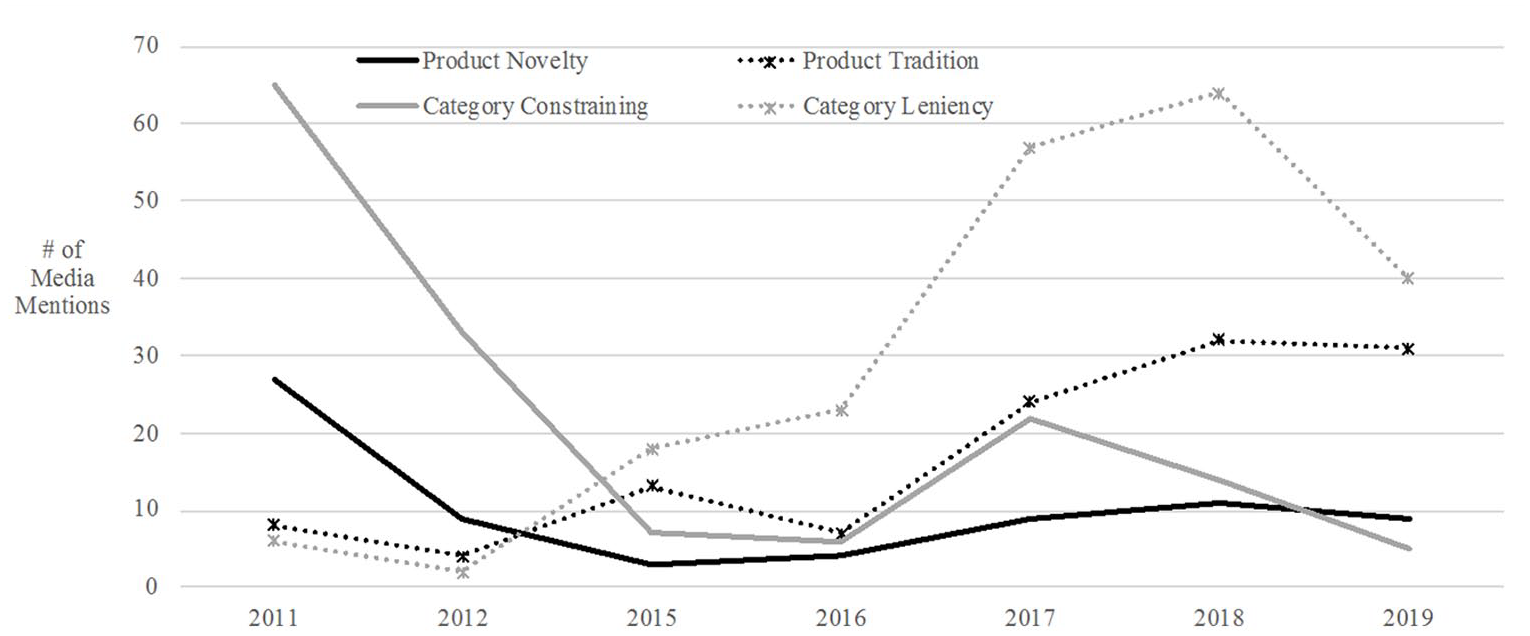
Claims Used in Media Articles Over Time
Discussion
Although several streams of research have focused on market category formation (see Durand & Khaire, 2017), much less attention has been given to market category blending. Blended categories raise the potential for controversy and contention (Quinn & Munir, 2017), yet the limited number of studies that explore category blending have focused on its less contentious forms (Lo & Kennedy, 2015). Leveraging the context of collegiate beer, our study provides an important first step in theorizing the elements of contentious category blending.
First, building on category leniency (Pontikes & Barnett, 2015), we show that producers can attenuate the contentiousness of the category by fitting the blended category with other, less contentious actors. Collegiate beer’s contentiousness arose primarily from its reflection on the university. Thus, rather than the university spanning into beer, proponents illustrated how the product (brewing science) and producers (brewers) emerged from the university. They also illustrated its fit with other actors, including agriculture and the geographical community. This resulted in a broader category that focused on less contentious lead actors behind the category—those outside the current university context, such as brewers, farmers, and alumni.
In addition, whereas category promoters often focus on new and crisp attributes to bring forth new categories, we found the opposite for a contentiously blended category. Instead, we found that deeply rooting the blended product category in rich historical traditions of the preexisting categories allowed proponents to downplay product novelty, enhance its connection to the past, and accordingly, attenuate the category’s perceived contentiousness. Together, these efforts—category leniency and product tradition—helped proponents successfully bring forth a new blended category. We integrate these findings into a generalizable model, illustrated in Figure 4.
Contentiousness Category Blending
Existing research generally focuses on controversy that emerges from the proposed activity of new categories (i.e., MMA, men’s bathhouses, global arms: Helms & Patterson, 2014; Hudson & Okhuysen, 2009; Vergne, 2012). In contrast, we focus on an alternative form of controversy that arises when multiple existing categories come together that audiences regard as an inappropriate combination. We discover that contentious category blending differs from prior research in a few theoretically important ways.
First, in other category formation contexts, category proponents often proudly announce the distinct and novel attributes of the new categories they bring forth. We found this initially true in our context, as proponents, along with major news outlets, positioned collegiate beer as a new product—the first of its kind. Thus, in hopes of garnering attention, they positioned collegiate beer as a material novelty, or as new category formation (Durand & Khaire, 2017). However, opponents used this to their advantage, positioning collegiate beer as a distinctive and novel product that deviated from existing categorical understandings of the producers (universities). In turn, category proponents changed strategy, positioning collegiate beer not as a new product with new physical attributes but as a product with preexisting connections to producer attributes and features. We theorize that contentious category blending can render history, rituals, and tradition highly salient because category creators seek to draw from and build upon existing categories, systems, and structures. In conceiving of collegiate beer as a historical relic by resurrecting old mascots, logos, phrases, and colors, proponents downplayed the material novelty and attenuated the contentiousness of the category, which helped overcome the arguments that collegiate beer was “something that had never been done before.” This helped shift the focus away from moral or normative attributes (Is collegiate beer right or wrong?) to more positive attributes (Is collegiate beer new or old/pre-existing?), which are more well-defined, measurable, observable, and comparable (Arjaliès & Durand, 2019). Thus, when critics assert that blending to create a new category represents an act of deviance, proponents can leverage the past and tradition to reformulate audience perceptions about the newness of the category. By highlighting this, we build on Durand and Khaire’s (2017: 104) call to explore categories and deviance by showing how paying homage to one’s past helps in the development of new categories.
Second, while both opponents and proponents leveraged tradition in their arguments and strategies, how they invoked tradition differed. Opponents invoked tradition constrainingly. They focused on the university, current students, and how a collegiate beer did not fit with the traditions of the university. Conversely, proponents invoked tradition more leniently. Rather than an organization (a university) deviating from its normative expectations, they focused on the university community, incorporating alumni, farmers, local businesses/craft breweries, and community residents, making them a part of collegiate beer’s history. By shifting the emphasis on tradition away from the actors for which the blended category was contentious (university, students) and toward actors for which the blended category was appropriate (alumni, farmers, brewery owners), proponents were able to achieve success in blending the category.
In doing so, collegiate beer became more than a deviant organizational action but a beer created by and for the greater “university community.” By conceiving the category in this way, proponents were better able to culturally align the new category with the values of the community. Similar to Grimes, Williams, and Zhao (2019)’s notion of abstracting, wherein organizations broaden their identity claims to address perceived deviations of their mission, universities leveraged prior associations with other groups of individuals (e.g., alumni brewers, farmers) and entities (e.g., breweries) to broaden their identity claims—focusing on the blended category’s fit within the community rather than solely on its fit with the organization. We propose that organizations might deflect contention and address perceived drift (Grimes et al., 2019) by enhancing the leniency of who represents the creators and intended audiences of the category.
We theorize that contentious category blending involves framing tradition around an appropriately bounded set of actors. Contentious category arguments may be most effective when proponents avoid (or shift) claims and strategies that apply tradition too narrowly (university students, gamblers, recreational marijuana users) or too broadly (the United States should legalize collegiate beer, gambling, marijuana) but carefully navigates between the two, offering claims that uniquely apply to community traditions. Together, our theoretical model provides a pathway for overcoming contention that arises from the combination of multiple categories. Although we found similar mechanisms at play as universities have sought other revenue-seeking opportunities (e.g., the sale of alcohol at athletic events), we encourage future research to explore the validity of our findings beyond the university context.
Legitimacy and Tradition Among Community-Embedded Organizations
We extend knowledge of tradition, culture, and community and their relevance to category blending. Recent studies highlight that research has paid little attention to “community-level variations that influence how audiences interpret and evaluate a category” (Lee & Lounsbury, 2015: 862; Lounsbury, 2007). In response, our theory illustrates that contentious category blending possesses unique characteristics and legitimation hurdles as category members must not only convince audiences that a product or service should exist but that it should exist here (within a specific community). We find differences in the social values, beliefs, norms, and culture of communities can lead to significant variations in how contentious an audience perceives a blended category. Scholars suggest that once an increasing number of firms within a new category acquire legitimacy, it helps legitimize the entire category (Lee, Hiatt, & Lounsbury, 2017; Vergne & Wry, 2014). However, we discover nascent category members can face variation in the perceived contentiousness of a blended category as a community’s traditions and culture can dramatically impact the legitimacy hurdles faced by organizations. We found that collegiate beer raised societal-level questions that guided communities to decide on a blended category’s appropriateness in their respective community.
Our findings differ from existing theory on categories by showing that the creation of collegiate beer reflected achieving approval at the community level. We maintain that this could be partly explained by our unique context—universities reflect organizations intimately embedded within their local context and location. Indeed, many of the locations in our sample represent “college/university towns,” wherein the community is dominated by its university population and the school serves as a beacon or greater representation of the community. At the same time, numerous towns and cities throughout the world are similarly dominated (or at least greatly influenced) by large and long-established companies (e.g., Nike and Beaverton, OR; Hershey and Hershey, PA; Phillips and Eindhoven, Netherlands). Here, organizational actions and concerns, such as potentially contentious acts, can likely become community concerns because the organization serves as a reflection and representation of the area.
In such situations, we maintain that legitimacy extends only when actors have demonstrated the contentious category culturally fits in the community. We theorize that when an organization plays a central role in the community, the legitimation of a contentious product category will unfold at a more geographically localized level, as organizations must demonstrate alignment of the category with the community. Although we anticipate many universities will unveil collegiate beers in the coming years, of the more than 4,000 colleges and universities in the United States, only 23 had adopted collegiate beers between 2011 and 2019, despite the widely reported popularity and success of the beers. We propose this slow rate of adoption underlies the legitimation elements we uncover—that acceptance will occur gradually as proponents overcome concerns to show the blended category fits with and advances community traditions.
Thus, we extend work examining the explicit associations between tradition and “place” (Dacin & Dacin, 2018; Siebert, Wilson, & Hamilton, 2017) by theorizing how contentious category proponents leverage these associations to create categories. Our study indicates that category blending appears more likely to succeed when proponents can take allegedly contentious activities and curate them around strong traditions in the place/community in which they are brought forth. Through the resurrection of old university mascots and logos, a renewed rivalry with an in-state competitor, or the revival of an old brewing recipe, proponents leveraged the claims of regeneration and reemergence to bring forth the contentious category. Accordingly, we build from recent work on regenerative change and tradition that emphasizes how categories can reemerge from dormancy (Howard-Grenville, Metzger, & Meyer, 2013; Kroezen & Heugens, 2019; Raffaelli, 2019). By strategically framing the category around place and tradition, proponents can develop contentious products or services in such a way that audiences perceive them as “ours,” enhancing collective identification with the community via the product/service. In so doing, we add to the “tradition-as-resource” view (Dacin et al., 2019). We do not, however, assert that tradition will always be relevant in contentious category blending, as we anticipate contexts in which it is less meaningful for overcoming opposition, yet we find it is a powerful concept that proponents of a contentious blended category might well consider.
Category Blending and Optimal Distinctiveness
Scholars have long theorized that there is a tension between being similar to other firms for legitimation while also being distinctive from other firms for competitiveness (Deephouse, 1999; Zhao, Fisher, Lounsbury, & Miller, 2017). This occurs at both a category level, as new categories illustrate their distinctiveness from existing categories, and over time at a firm level, as firms illustrate their distinct position from others in the category (Barlow, Verhaal, & Angus, 2019; Durand, Rao, & Monin, 2007). We contribute to the literature on optimal distinctiveness by theorizing how this unfolds differently for contentious category blending. The very nature of a contentious act suggests a deviation from how audiences expect an existing firm (or set of firms) to behave. Our findings indicate producers creating contentious blended categories may leverage claims and approaches that emphasize their similarity to rather than their differences from preexisting products and activities, thereby trying to normalize their activities.
The community-based nature of contentious category blending supports the notion of deemphasizing distinct differences from firms offering similar products or viewing those firms as “rivals,” as the contentious product is distinctively developed with the unique cultural perspectives, beliefs, and desires of the area in mind (i.e., Purdue’s Boiler Gold does not “compete” with UL’s Ragin’ Cajuns). Though both similarity and distinctiveness are important, we propose those behind contentious category blending will place much greater emphasis on similarity, as they seek to demonstrate “alignment” to existing products, cultures, and traditions.
Limitations and Future Research
Although our study focuses on category blending to create a new category, we acknowledge it involves a contentious category still in the relatively early development stages. As the category develops, it will be interesting to witness the extent to which the contentiousness around the category decreases and whether acceptance across university communities becomes increasingly taken-for-granted (Hsu & Grodal, 2015). We anticipate religious-based universities as well as states with more conservative drinking views may employ different claims and/or come to a different set of decisions, suggesting the category remains open to judgment for many communities. Whether collegiate beer paves the way for universities to form licensing deals with entrepreneurs proffering even more taboo products, such as spirits or marijuana, remains to be fully seen. Early indications suggest it might. In 2020, New Mexico State University followed up their Pistol Pete’s Ale with Pistol Pete’s Six-Shooter Whiskey—the nation’s first collegiate-licensed spirit. In addition, we acknowledge that the limited data on the “unsuccessful” instances of collegiate beer restricts our ability to fully theorize about why certain schools/states have been unable to gain approval. We encourage future research to explore this question in a different empirical setting in which data on unsuccessful contentious blending are more readily available.
In addition to category leniency and product tradition, alternative explanations for the blended category’s success may also exist. Building on Quinn and Munir (2017), we posit the changing economic landscape also presented a “political opportunity” or an “open moment” for policy and regulatory change to allow the blended category to emerge (Kennedy, Lo, & Lounsbury, 2010). In 2011 (when collegiate beer was first proposed), the state of Louisiana had a nearly balanced budget, yet in 2015 (when collegiate beer was first created), the annual budget deficit had ballooned to $1.6 billion—attributed partially to depressed oil prices. Thus, the dire economic landscape likely provided a key moment for proponents to seek the approval of collegiate beers in Louisiana. We encourage future research to further explore how timing, and these “open moments,” create opportunities to bring forth contentious categories.
Like most qualitative studies, our study also possesses limitations with respect to generalizability. We admit the partnership between universities and breweries in creating a blended category is unique. At the same time, as consumers increasingly value community and as organizations benefit from engaging with those communities (Fisher, 2019; Howard-Grenville et al., 2013; Solomon & Mathias, 2020), we expect the notions of community traditions and culture will play increasingly important roles in blended category creation. Yet the extent to which our findings hold in other contentious blended categories remains an open question.
Conclusion
Although the study of categories represents a growing area of scholarly inquiry, contentious category blending has garnered less attention. Our study highlights how legitimation of the contentious category blending occurs quite differently from the creation of most new categories by underscoring the importance of blurring category boundaries—via combining with other categories and illustrating connections to tradition rather than novelty. In an increasingly complex society where the “right thing to do” is often obscure, we expect similar contentious category dynamics to occur in the coming years. We hope our study encourages future research to better understand contentious category blending.
Footnotes
Appendix
Strategic Elements Used Across Population

| Category Leniency Via Tradition | Product Category as Tradition | ||||
|---|---|---|---|---|---|
| Blend | Brewer(y) | Agriculture/Industry | Geographic Community | Brewing/School Traditions | Product Design |
| Bayou Teche & University of Louisiana-Lafayette | • Brewer and family alumniLocal breweryOldest craft brewery in region (3rd in state)Cajun-based company mission | • Louisiana riceLouisiana honey | • Cajun identityFestival/drinking cultureNot promoting it on campus | • Beer already sold at football gamesHad done a university wine | • Cajun French phrase on bottleMuted colorsNo university logoAcadiana flagArtwork by alum |
| Tin Roof & Louisiana State University | • Brewery started via school’s incubator | • Provide mash for cattle feed to school | • South LA Catholics and drinking | • Football and tailgating traditions | • Beer named after 1958 football team |
| Oldest craft brewery in city | • Internships with School of Nutrition and Food Sciences | • Promoted as state economic development | • Prominent student & food-based incubators | • Community tasting panel to pick beer | |
| • Local brewery | • No use of LSU name | ||||
| • Alumni brewers | |||||
| • Owners regularly speak on campus | |||||
| Sudwerk & University of California-Davis | • Head brewer alumnusOldest craft brewery in regionLocal breweryBrewery hosts brewing course | • Uses local rice grown by alumniProprietary lager strain from local lab owned by alumnus | • History of brewing West Coast lagersProximity to wine country and making alcohol | • Masters Brewers Program decades oldBeer made for years for school fundraiserAlcohol already at sporting events | • “Gunrock Lager” named for historic horses and beloved but forgotten mascotAlumni-devised recipe |
| NOLA & Tulane | • Long-time sponsor of universityOldest existing craft brewery in cityLocal breweryExecutives and founders alumni | • “Buy-in from local bars and restaurants” to carry beer | • “New Orleans has a reputation for drinking”Targeted to alumniNo on-campus advertising | • Beer already sold at football events | • Retro angry Green Wave logo since adopted by all sports programs |
| Gnarly Barley & Southeastern Louisiana | • Awarded young alumni of the yearLong-time supporter of universityLocal breweryOwners (married) met at universityIdentified as school “ambassadors” | • “Tight-knit community” that supports local businesses | • “Progressive” city“Culture of the area certainly helped” | • Gnarly Barley beer already sold at athletic eventsBrewed only in fall for football season | • “Lion Up” reflects statement that only locals knowDidn’t “dumb it down” for the general public |
| New Belgium & Colorado State | • 100+ employee alumni, inc. founderLocal breweryBrewers teach courseworkSchool sponsorship goes back 25+ years | • Donating licensing revenue to school fermentation science programPromoting craft beer industry in area | • Fort Collins known as a craft beer townNew Belgium one of the biggest employers in area“Local activation” of partnership via community events | • Renown fermentation science programPartnered on New Belgium Porch at football stadium ($5M)New Belgium already sold at football games | • “Old Aggie” the school’s mascot during the early 20th centuryUse of the term “The Original” on canRetro logo (ram’s head) from 1954Historic colors - pumpkin/alfalfa |
| Rio Bravo & University of New Mexico | Founder alumnus | • Promoting local businesses (beer debuted via events promoting local bars) | • “At GABF, NM has won as many medals per capita as anywhere”Community United Blood Services Program | • Renew rivalry tradition with NMSU via beerAlcohol already sold at athletic eventsHistory of licensing salsa/food products | • Lobo Rojo a cherry wheat to match school colorsLobo Louie IPA uses retro logo (wolf)Historic school color – turquoise (IPA) |
| • Local brewer | |||||
| • Owners had other licensing agreements | |||||
| • Diehard Lobo fans | |||||
| • Brewery hosted school events | |||||
| Bosque & New Mexico State | • Founders alumniLocal presenceRegularly donates beer for fundraisers“Diehard Aggie athletics supporter” | • “Supports small local businesses”Created student internships and potential jobs | • Beer distributed to alumni bars around the state“Bosque has a vested interest in the university/community” | • Renew rivalry tradition with UNM via beerAD researched all licensed beers to build university/community ties | • Named “1888” after founding year of institutionHistoric fight song on back of can |
| Big Sky & University of Montana | • Brewery started via business plan at schoolFounders alumniLocal breweryBig Sky brand tightly linked to MontanaLargest and one of the oldest MT breweriesSupports various departments on campus | • Promoting craft beer industry in areaTouting the quality of Montana water | • Strong craft beer culture in Missoula“Made to appeal to UM alumni”Brewer donated over $500K back to charities in MT communities | • Beer part of celebration of 125 years of historyRenew rival tradition with MSU via beerWine done for school’s 100th ann.History of licensing food products | • Graphic design by UM alumniVideo featuring beer enjoyed in Montanan outdoor traditions |
| People’s & Purdue | • Most everyone involved alumniClasses hosted at breweryLocal breweryOrigins of Purdue relationship dates back to origins of breweryOngoing research projects with school | • Both beers use Indiana hops and Indiana maltsProceeds to food/fermentation science programLocal farmers test hops at Purdue University | • Community growing and testing their own hops and barleyAgriculture orientation of the communityMet with local law enforcement | • Strong history of brewing educationHistory of licensing ag-related productsTaproom on campusBeer already sold at football gamesWine already produced at school | • Used vintage logo“Didn’t want to put Purdue in big, bold letters. Made it a little subtle that it’s a college beer” |
| Wayward Owl/Second Line & University of New Orleans | • Many owners and friends alumniLocal brewery | • Promoting brewery education to hire local brewers rather than out-of-statersOpen up new manufacturing jobs | • Drinking culture of New OrleansPromoted at alumni events (40K+ alums in greater NO)Iconic community landmark resurrected by brewery | • Brewing education occurring at schoolBeer already sold at athletic events | • N/A |
| Wichita Brewing & Wichita State University | • Local breweryHead brewer alumni (former baseball player) | • Local ingredients (wheat)Supporting local farmers | • “The epitome of a hometown beer” | • Beer just approved (2017) to be sold at athletic events | • N/A |
| Jeremiah Johnson & Montana State | • Alumni owner“His (owner’s) actual name is Jeremiah Johnson - that’s definitely a Montana brewery”Regional brewery | • Supports robust barley/ag industry - premier wheat and barley producerMajor local barley malting facilityLocal Montana 2-row pale malt barleyLocal honey | • “Story about state economic development”“Montanans love beer” | • Beer part of celebration of 125 years of historyRenew rival tradition with UM via beerSchool’s agriculture heritage | • Designed to “tie into the heritage and mystique of being in Montana”Local elements/ingredients displayed on can |
| Boston Beer & Xavier University | Jim Koch (founder) from Cincinnati | • Supports city’s long and storied brewing industry | • “German influence” of area led to beer culture | • Alcohol already sold at basketball games | • Beer named through fan/community submissions |
| • Boston Beer brewed locally since 1992 | • Wine already licensed | ||||
| • Original recipes from father, who grew up 3 miles from campus | |||||
| Bayou Teche & McNeese State University | • Brewer already produces a college beerLong-established local (LA) brewer | • “Distributor family-owned and Lake Charles based for more than 60 years” | • Lake Charles has lots of CajunsBeer style fits with LA weather | • Renew rival tradition with UL via beerAlcohol already sold at football games | • “Jolie Blon” named after official fight song played since 1951Retro-feel design that evokes school historyBeer label states “a crafted tradition” |
| 4204 Main Street & University of Illinois Springfield | • Brewer’s daughter played soccer for schoolIllinois brewer | • Historical university connections between local restaurants carrying beer | • 30% of workforce in Springfield are UIS alums“It’s a blue collar, beer drinking area” | • Not a “campus town,” so beer draws greater connection between the city and the school | • N/A |
| Six Car & West Texas A&M | • Local brewerAlumni connectionFits brewer’s community focus | • N/A | • Served only at breweryBrewery in heart of bar district, not on campus | • Agriculture heritage of school | • Beer named through fan/community submissionsStyle on label “West Texas Bock” |
Acknowledgements
We would like to acknowledge the help and guidance of our editor, Pursey Heugens, and two anonymous reviewers. We would also like to thank Chad Navis and Trent Williams for feedback on earlier drafts of the manuscript as well as assistance from Rachel Mathias and Debbie Fisher. We sincerely thank all of our participants who shared their insights to make this study possible, especially Karlos Knott of Bayou Teche Brewing.
