



Abstract
Disasters (e.g., natural catastrophes, pandemics/epidemics, mass violence events, and human/technological errors) are becoming increasingly common due to factors such as growing population density and accelerated climate change. Exposure to any type of disaster is damaging for both individuals and organizations. Disasters deprive individuals of their livelihoods, alter how employees perform their work, and harm individual well-being. For organizations, disasters compromise functioning and profitability, often resulting in organizational failure. As a result, there is growing interest in research linking disaster events to the workplace. Based on an analysis of 260 disaster articles, we offer a comprehensive, systematic, interdisciplinary review of the disaster literature with organizational implications. Employing a resource-based perspective, embedded within an ecological systems framework, we suggest that disaster exposure depletes (or prompts investment of) individual, team, and organizational resources and subsequently impacts organizational outcomes. This theoretical framework can be used to identify the critical research gaps that exist in the literature and offers a promising agenda for future research.
Keywords
As the world's population surges and becomes more geographically dense, the risk of disaster exposure continues to increase (Brooks, Amlôt, Rubin, & Greenberg, 2020). On average, a disaster (e.g., a flood, an earthquake, or a pandemic) now occurs somewhere in the world each day (Aon, 2020). For example, the COVID-19 pandemic, to date responsible for over 5.3 million deaths worldwide, continues to have a significant negative impact on the labor supply worldwide, affecting both the lives and the livelihoods of billions of individuals around the globe (Bureau of Labor Statistics, 2021; ILO, 2020; World Health Organization [WHO], 2021). In 2020 and 2021 there have also been devastating natural disasters. There were cataclysmic fires in both the United States and Australia, record heatwaves, devastating floods in Europe and Asia, and in 2020 for only the second time in history, the official alphabetical list of hurricane names was used up during the record-breaking Atlantic hurricane season (forecasters had to move to the supplementary list of Greek letter names; Thomson, 2020). Regardless of type, being exposed to disasters has a range of negative consequences for both organizations and working individuals.
The reason that disasters are so impactful for organizations is not only the fact that they can cause significant damage to individuals and communities; they are also systemic in their disruption and deplete resources within social systems (e.g., organizations) (Kohn et al., 2012; Mendonça & Wallace, 2004; Sadiq & Graham, 2016). According to the WHO (2019), a disaster is a sudden event that severely disrupts the functioning of a community or a society causing widespread human (e.g., psychological, relational), material, economic, or environmental losses, which exceed the ability of the affected community or society to cope using their own resources (WHO, 2019). It is not the extreme wind or a storm surge that makes a hurricane a disaster; these are potential sources of damage (Perry, 2007). Rather, hurricanes are disasters due to the disruption and resource loss they cause. This disruption can be localized to a single community like the damaging EF4 tornado that struck Beauregard, Alabama, in 2019 (Blinder & Stevens, 2019), or the devastation can be as widespread as the global COVID-19 pandemic. However, regardless of whether a disaster affects one or multiple communities, disasters have grave consequences for organizations and for the individuals working within them (e.g., Komuro et al., 2019; Trougakos, Chawla, & McCarthy, 2020).
Despite their deleterious consequences, organizational scholars and practitioners do not have a comprehensive understanding of the workplace implications of disaster exposure for a number of reasons. This is because while reviews of disaster have been undertaken over the last 20 years, these reviews tended to be narrow in both their focus and scope. For example, prior disaster reviews have focused on specific types of disasters (e.g., terrorism; DiMaggio & Galea, 2006), specific employee groups impacted by disasters (e.g., public health/safety workers; Benedek, Fullerton, & Ursano, 2007), or specific disaster victim outcomes (e.g., mental health; Kõlves, Kõlves, & De Leo, 2013). Additionally, previous disaster reviews tended to draw from only one specific field of research (e.g., medicine, Ghanbari et al., 2019; mental health, Goldmann & Galea, 2014; or operations, Bealt & Mansouri, 2018), restricting their disciplinary breadth and depth.
Further, prior reviews of disaster have had only tenuous links to work and were undertaken in fields outside of the organizational sciences. As examples, in just the last 5 years, different reviews have highlighted the use of big data in disaster management (Akter & Wamba, 2019), how humanitarian operations can manage disasters (Goldschmidt & Kumar, 2016), the psychological impact on responders providing victim support (Guilaran, de Terte, Kaniasty, & Stephens, 2018), and ethical responses to disasters (Leider, DeBruin, Reynolds, Koch, & Seaberg, 2017). While informative, their usefulness to both organizational scholars and practicing managers is hindered because they do not highlight the types of organizational outcomes typically studied and relevant to the field of management (e.g., absenteeism, commitment, turnover, firm performance).
Our overarching goal is to provide an interdisciplinary review to enrich our understanding of how and when disaster exposure impacts numerous work-related outcomes. In doing so, we make three important and unique contributions to the management literature. First, we offer a synthesis of empirical evidence for the impact of disasters on various work-related outcomes across levels of analysis and in disciplinary areas beyond management and the organizational sciences. In this review, in addition to literature within our field (e.g., Birkeland, Nielsen, Hansen, Knardahl, & Heir, 2017; Hochwarter, Laird, & Brouer, 2008), knowledge is also drawn from disciplines including community and public health (e.g., Gudmundsdottir, Hultman, & Valdimarsdottir, 2019), medical sciences (e.g., Gjerland, Pedersen, Ekeberg, & Skogstad, 2015), clinical and occupational health psychology (e.g., Dietch et al., 2019), and economics (e.g., Åslund & Rooth, 2005). As such, we bridge disciplinary divides that can further stimulate empirical scholarship and advance research methods (Molloy, Ployhart, & Wright, 2011). This evidence-based knowledge can also be used by organizational leaders to prepare for, respond to, and understand the potential damage caused by disasters.
Second, we offer a multilevel theoretical framework to help understand the processes through which disaster events impact work outcomes. Our model considers two important components of the disaster definition proffered by the WHO (2019). First, exposure to a disaster disrupts entire social (organizational) systems. As such, disaster exposure has spillover effects within and between organizational levels. To understand these pervasive effects, we take an ecological systems perspective (Bronfenbrenner, 1979; 1992) that recognizes the impact of disaster exposure across entire social systems. 1 Second, disasters are events that result in losses that exceed the ability of communities (e.g., individuals and organizations) to cope using their own resources. This part of the WHO (2019) definition suggests that resource-based theories may be particularly useful in the study of disasters because they explain how resources are impacted at both the individual (e.g., conservation of resources [COR]; Hobfoll, 1989) and organizational levels (e.g., resource-based view [RBV]; Barney, 1991). We integrate these two theoretical perspectives into an overarching theoretical framework and use this model to classify studies of disaster and interpret their impact on organizational resources across levels (see Figure 1).

An Ecological Systems Perspective of the Effects of Disaster Exposure
Finally, applying this multilevel theoretical framework not only allows us to interpret and understand the effects of disaster exposure for organizations, but it also makes a third contribution. This contribution is to identify research gaps and underexplored areas in the existing disaster literature. Based on our theoretical framework, we propose important future research directions that can increase scholarly and practical understanding of the effects of disasters within and between organizational levels. We also provide recommendations for methodological refinements to identify appropriate study designs and data collection approaches that are suited to understand these effects over time and across levels of analysis.
To achieve these novel contributions, we first conducted an interdisciplinary systematic review of the disaster literature to investigate what is known and unknown about the consequences of disasters and boundary conditions across levels of analysis. The empirical insights derived from our interdisciplinary review were then integrated into a multilevel theoretical framework to identify how disaster exposure depletes (or prompts investment of) individual, team, and organizational resources and subsequently impacts organizational outcomes. Following this theoretical integration, we discuss a path forward for disaster research.
Literature Search
We conducted a methodical search of the disaster literature with relevance to work and organizations published any time prior to 2021. 2 We searched seven databases (CrossRef, EBSCO, Google Scholar, Scopus, PsycINFO [ProQuest], Web of Science, and WorldCat Discovery) using the following keywords related to disasters and work: “disaster”, “terror*”, “mass violence”, “bombing”, “mass shooting”, “pandemic”, “covid*”, “epidemic”, “earthquake”, “famine”, “eruption”, “wildfire/bushfire”, “avalanche”, “landslide”, “blizzard”, “flood”, “heat wave”, “tornado”, “cyclone”, “hurricane”, “typhoon”, “tsunami”, “explosion”, “drought”, “work*”, “organization”, “employ*”, “leader*”, group*”, “team*”, and “unit*”. This initial search yielded 8,190 articles on disaster from various disciplines.
We screened this large initial pool for inclusion by reviewing abstracts. To be included in the final review, the available research had to meet the following criteria: (1) It focused on (any type of) disaster/s that would fit the WHO definition of disaster and linked to work outcomes, (2) it was empirical, (3) it had samples drawn from adult (working) populations, (4) it had data collected in response to a real disaster or disasters (as opposed to hypothetical scenarios), and (5) it was published in a peer-reviewed journal. Within the bounds of this inclusion criteria, we aimed to be as comprehensive as possible. If a study sampled from an adult population and had outcomes that were relevant to human functioning (which are likely to affect individual work-related outcomes), it was included. A detailed summary of our literature search is provided in Table 1 (for a similar search approach and best practices, please see Siddaway, Wood, & Hedges, 2019; Simsek, Fox, & Heavey, 2015). At the conclusion of our search process, a total of 260 research articles published between 1976 and 2020 met our inclusion criteria and form the basis of this review (see Appendix 1, Online Supplement). Included studies were drawn from a range of disciplinary areas including disaster, emergency, health sciences, public-health, psychiatry, and psychology, in addition to management (see Table 2).
Summary of Review Procedures
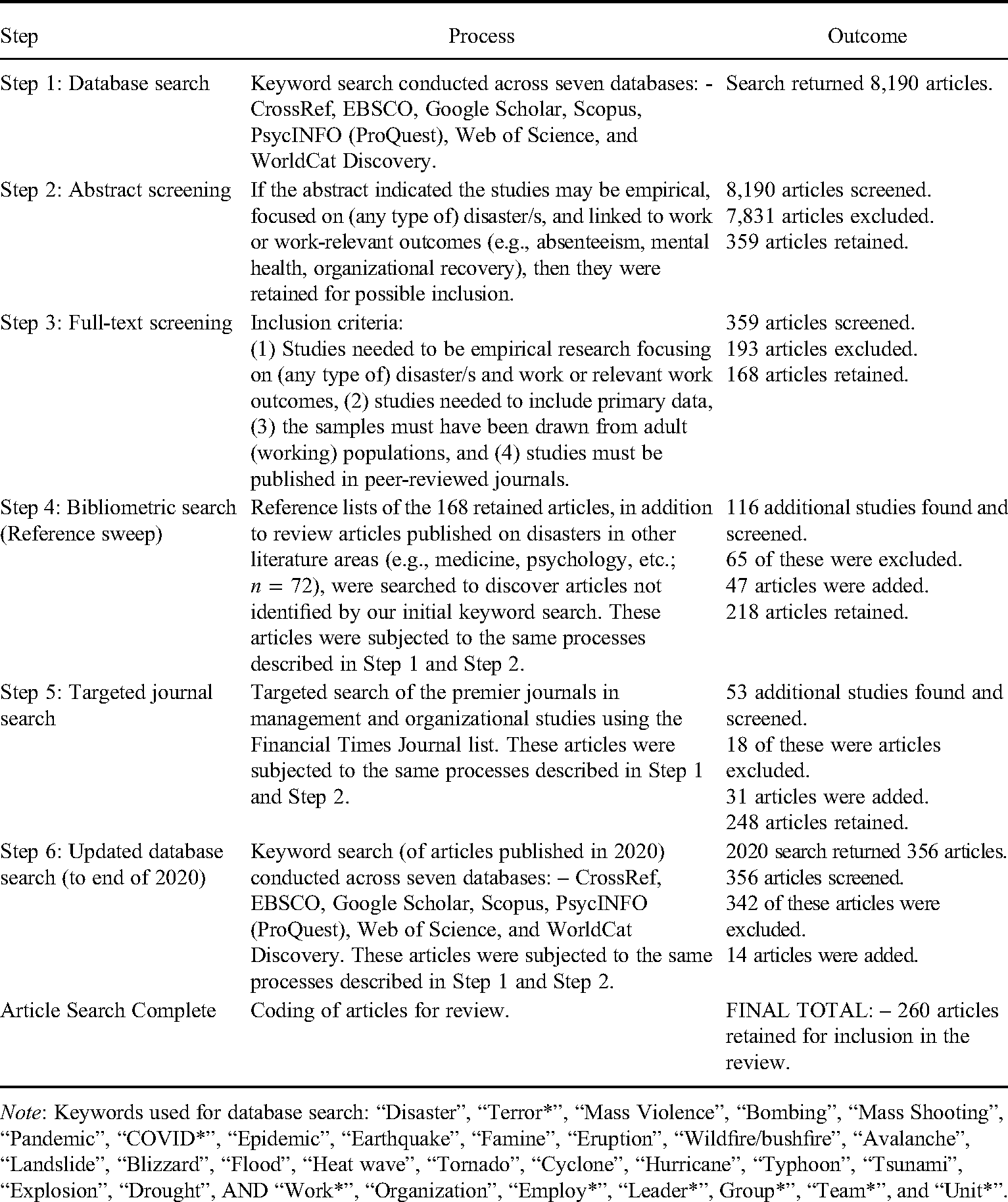
Note: Keywords used for database search: “Disaster”, “Terror*”, “Mass Violence”, “Bombing”, “Mass Shooting”, “Pandemic”, “COVID*”, “Epidemic”, “Earthquake”, “Famine”, “Eruption”, “Wildfire/bushfire”, “Avalanche”, “Landslide”, “Blizzard”, “Flood”, “Heat wave”, “Tornado”, “Cyclone”, “Hurricane”, “Typhoon”, “Tsunami”, “Explosion”, “Drought”, AND “Work*”, “Organization”, “Employ*”, “Leader*”, Group*”, “Team*”, and “Unit*”.
Summary of Disciplines in the Review

Definitions and Scope
There is currently no dominant definition of disaster in the scholarly literature, and to date, multiple definitions have been utilized (e.g., Bates & Peacock, 2008; Bibby, 2005; O’Leary, 2006; Quarantelli & Perry, 2005; Sundnes & Birnbaum, 2003). However, our review specifically focuses on disaster events that fit within the WHO (2019) definition of disaster. The WHO definition of disaster—“a sudden event that severely disrupts the functioning of a community or a society causing widespread human, material, economic, or environmental losses, which exceed the ability of the affected community or society to cope using their own resources”—is a connotative definition of disaster. 3 This definition is unambiguous and is more comprehensive in scope than the other definitions of disaster offered by prior scholars. 4 While parts of the definitions offered by prior scholars feature components of the WHO (2019) definition (e.g., that disasters are systemic [Sundnes & Birnbaum, 2003], sudden [Whybark et al., 2010], and deplete resources [Dynes, 1998]), none are as complete as the WHO definition in scope. Given that the WHO’s (2019) definition is an amalgam of the best descriptions of disaster offered, there is no reason to offer our own definition of disaster or attempt to situate disasters as phenomena that are unique to the workplace. Interestingly, while all the articles we reviewed investigated events that fit the WHO definition of disaster and linked to work outcomes (the majority used the term disaster in the publication title or in their keywords), only 14 (or 5.38%) out of the 260 articles offered a definition of disaster. This suggests that disaster scholars assume that their audience understands what a disaster is (or is not).
By using the WHO definition, we follow the logic of scholars who differentiate disasters from crises and/or hazards (e.g., Boin, 2005; Quarantelli & Perry, 2005; Shaluf, Ahmadun, & Said, 2003). Disentangling a crisis from disaster is nuanced and complex, because some scholars have used these terms interchangeably (e.g., Le Coze, 2013; Perrow, 2011). Yet while both disasters and crises are low-probability, high-impact events, a crisis may affect a single individual (e.g., an employee or leader being accused of misconduct), a team (e.g., the loss of a team member that creates dysfunction), or organization (e.g., a corporate scandal or product failure), and these types of crises do not necessarily have the same systemic effects as a disaster (James, Wooten, & Dushek, 2011; Pearson & Clair, 1998). Conversely, disasters are pervasive and typically result in unprecedented damage to many individuals, families, communities, and organizations, in terms of lives lost, destruction of property, disruption, and financial ruin (Perry, 2007; Tilcsik & Marquis, 2013). Exposure to a disaster typically results in a long-term breakdown of life-sustaining functions in a social system (Shaluf et al., 2003; WHO, 2019). In short, all disasters are crises, but not all crises are disasters unless they have a widespread impact on a social system (Boin, 2005; Perry, 2007; Quarantelli & Perry, 2005). As such, using the WHO definition of disaster as a criterion for inclusion in this review did not exclude studies of “crises” that were caused by disaster events impacting a broader social system.
To ensure this review is necessary and meaningfully contributes to the continuing scholarly conversation about the organizational consequences of disasters, we assessed prior reviews on disasters (e.g., Ghanbari et al., 2019; Kõlves et al., 2013), crisis (e.g., Ererdi, Nurgabdeshov, Kozhakhmet, Rofcanin, & Demirbag, 2020), and crisis management (e.g., Bundy, Pfarrer, Short, & Coombs, 2017). There is no doubt that some research on disasters and their impacts on organizations have been included in prior reviews. However, like prior reviews of disaster, existing reviews of crisis do not broadly capture the effects of disaster exposure for organizations. This is because some of these reviews focused predominantly on internal crises (i.e., crisis events that occur within the organization, such as service failures, product harm crises, corruption, discovery of unethical acts; Bundy et al., 2016; James et al., 2011; Khamitov, Grégoire, & Suri, 2020; Wang & Laufer, 2020) or specific types of events (e.g., specifically economic crises, natural disasters, and political uncertainty [Ererdi et al., 2020] and human/technological disasters [Wang & Laufer, 2020]).
While other crisis reviews did capture a broader range of disaster and/or crisis events, these reviews tended to be focused on a specific discipline (e.g., entrepreneurship in Doern, Williams & Vorley, 2019; tourism and hospitality in Wut, Xu, & Wong, 2021), context (e.g., the behaviors of public leaders in crisis [Jong, Dückers, & Van der Velden, 2016], the role of leadership in a crisis [Wu, Shao, Newman, & Schwarz, 2021]), or organizational reactions (e.g., crisis management [Linnenluecke, 2017], crisis resiliency [Williams, Gruber, Sutcliffe, Shepherd, & Zhao, 2017]). Finally, with a few exceptions (e.g., Williams et al., 2017), prior reviews also lack an overarching theoretical framework to explain the processes through which disaster exposure influences organizational outcomes. We contend that the fracturing of the disaster and work literature within a specific discipline, context, or at a single level of analysis (or within a particular social system) may have hampered progress in understanding the multilevel consequences of disaster exposure, thereby impeding theory development to explain the individual, team, and organizational implications of disaster exposure. This appraisal of other disaster and crisis reviews 5 gives us confidence that our interdisciplinary review of the disaster literature is unique, and our proposed multilevel framework offers a novel contribution to the field.
Study Characteristics
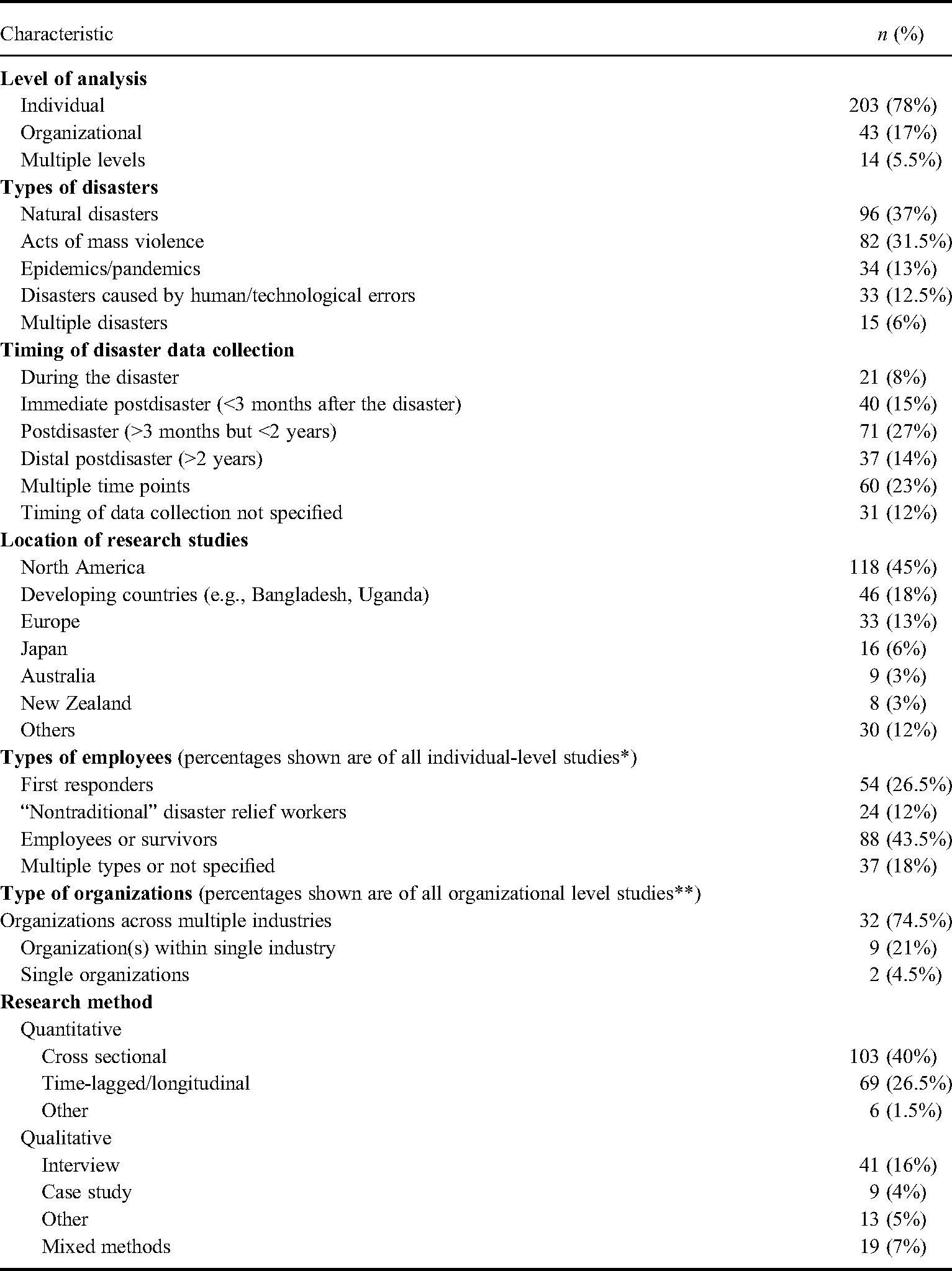
Prior to reviewing the consequences of disaster for organizations and explaining our proposed multilevel framework, we first briefly describe the characteristics of the empirical studies included in our review (see Table 3).
Characteristics of Reviewed Empirical Studies
Levels of Analysis
An overwhelming amount of the research on disasters included in this review was undertaken at the individual level of analysis. In fact, of the 260 studies in this review, 203 articles (78%) were at this level. In contrast, there were no studies specifically focused on the effects of disasters for work teams, and only 43 articles (16.5%) examined disaster exposure at the organizational level. In addition, there were a small number of studies (k = 14, 5.5%) that investigated the effects of disaster for organizations across multiple levels.
Types of Disasters
We coded the included studies for disaster type based on the categorization by Norris et al. (2002). We extended their work to include a new category for epidemics/pandemics, as these events meet the WHO (2019) definition of disaster. Of the 260 reviewed articles, 245 (94%) were coded and assigned into one of the four distinct categories, as follows: The most prominent category was natural disasters (k = 96, 37%), followed by acts of mass violence (k = 82, 31.5%), epidemics/pandemics (k = 34, 13%), and disasters caused by human/technological error (k = 33, 12.5%). 6 A further 15 studies (6%) outlined the consequences of more than one type of disaster, and while we do not categorize them by type here, we do consider their findings about disaster consequences in subsequent sections (see Appendix 2).
Timing of Disaster Data Collection
Given the inclusion criteria for our review, most of the studies we reviewed collected data in the aftermath of a disaster (k = 231, 89%), as opposed to during a disaster. Studies that collected data during a disaster event itself (k = 21, 8%) were mostly recent studies of COVID-19. Slightly more studies collected data in the immediate aftermath of a disaster (i.e., less than 3 months postdisaster, k = 40, 15.5%). However, the most common time frame for data collection was more than 3 months but less than 2 years post-disaster (k = 71, 27.5%). Other studies collected data 2 or more years post-disaster (k = 37, 14%). All remaining studies collected their data at multiple time points, used archival data, or did not specify when their data were collected.
While 40% of the reviewed studies collected data at only one point in time (i.e., were cross-sectional in nature), other research designs collected data at different time points. Of these, only 6% (k = 16) used a longitudinal design with data collected at multiple points in time after the disaster. The other studies, using data from different time points, collected pre-disaster data from archival sources (k = 23, 9%), utilized employee data collected before a disaster and compared it to data collected postdisaster (k = 6, 2%), or were qualitative studies that involved interviews conducted at different times (k = 39, 15%). There were also a small number of qualitative studies (k = 8, 3%) that did not specify precisely when data were collected.
The timing of data collection is an important consideration when reviewing studies of any social phenomena (McGrath & Kelly, 1992). In disaster research, the timing of data collection is likely to affect the conclusions drawn about the effects of disaster exposure. For example, Galatzer-Levy, Huang, and Bonanno (2018) estimate that approximately two in every three individuals exposed to a traumatic event (like a disaster) require no treatment (e.g., have no physical injuries and do not require psychological counseling). Yet most of the studies included in their review collected data immediately following a traumatic event. Other research shows that the effects of disaster exposure may last a lifetime. For example, victims of the Vajont Dam disaster in Italy demonstrate these long-term effects (Favaro, Zaetta, Colombo, & Santonastaso, 2004). That is, even 36 years after this disaster, victims continued to experience PTSD and depressive disorders.
Where Disaster Research Has Been Undertaken
Disasters occur frequently across the globe, affecting both developed and developing nations (Hallegatte, Vogt-Schilb, Rozenberg, Bangalore, & Beaudet, 2020). However, some countries are more vulnerable to disasters than others. Most of the lives lost or gravely affected by natural disasters are in developing countries, and economically disadvantaged individuals are disproportionally impacted by disasters (Hallegatte et al., 2020; Zorn, 2018). Despite this reality, only 17.5% (k = 46) of the reviewed studies collected data in developing countries (e.g., Bangladesh [Dwivedi, Shareef, Mukerji, Rana, & Kapoor, 2018], Uganda [Englert, Kiwanuka, & Neubauer, 2019]). In contrast, most of the studies reviewed (k = 187, 72%) were undertaken following a disaster in countries belonging in the top 30 of the most developed nations 7 (United Nations, 2020). The majority of these studies were conducted in North America (k = 118, 63% of these studies), Europe (e.g., France: Oliver, Calvard, & Potočnik, 2017; Italy: Ramaci, Barattucci, Ledda, & Rapisarda, 2020, k = 33, 17.5%), or other developed countries (e.g., Japan, k = 16, 8.5%; Australia, k = 9, 5%; New Zealand k = 8, 4%). 8
Types of Employees and Organizations Reviewed
As expected, many of the employees represented in the reviewed studies worked in occupations that involve responding to a disaster. The individual-level studies sampled from first responders (e.g., healthcare or emergency services, k = 54, 26.5% of individual-level studies) as well as other “nontraditional” disaster responders, such as utility workers, or those engaged in demolition and/or postdisaster clean-up (k = 24, 12%). However, other individual-level studies drew from outside of these categories, with samples including disaster survivors, employees of organizations directly impacted by disaster, and adults in the general population (k = 88, 43.5%). The remaining individual-level studies drew from multiple samples or used archival data.
At the organizational level, the majority of the 43 studies examined the consequences of disaster for organizations across multiple industries, entire industries (e.g., U.S. coal mining industry, Madsen, 2009; U.S. airline industry, Gittell, Cameron, Lim, & Rivas, 2006), or listed on financial indices such as the Dow Jones Index (k = 32, 74%). The firms studied after being exposed to disaster were often large and publicly traded (e.g., U.S. Fortune 500; Muller & Kräussl, 2011; multinational corporations, Zhang & Luo, 2013). Two studies focused on the impact of disaster on a single organization (American Airlines, Downing, 2007; and an unnamed financial services firm, Malinen, Hatton, Naswall, & Kuntz, 2019). There was only one organization-level study that collected data from smaller organizations (local sports clubs, Wicker, Filo, & Cuskelly, 2013). This may be because smaller organizations are less likely to survive a disaster than larger organizations because they have less resources available.
Methodologies Utilized in Disaster Research
Most of the studies in our review employed quantitative methodologies (k = 178, 68.5%). Over half (k = 103, 58%) of these quantitative studies were cross-sectional in nature, while other studies (k = 69, 39%) were time-lagged/longitudinal. Qualitative studies (k = 63, 24%, of all included studies) were mostly based on interviews (k = 41, 65% of qualitative studies), utilized one or multiple case studies (k = 10, 16% of qualitative studies), or used archival sources (k = 6, 9.5% of qualitative studies). The remaining studies employed mixed methods for data collection (k = 16, 6% of all studies).
Theoretical Foundations
To provide a comprehensive analysis of how theory has been utilized to study disaster consequences for organizations, a recent typology of theory types was applied to categorize each included article. In their typology, Sandberg and Alvesson (2021) suggest that not all theories can be classified as explaining theories—those that fit the traditional view that theories are meant to explain phenomena (Bacharach, 1989; Shepherd & Suddaby, 2017). Other types of theory that can assist scholars in interpreting and understanding organizational phenomena include comprehending, ordering, enacting, and provoking theories (Sandberg & Alvesson, 2021). Table 4 presents a summary of the different theory types represented in our review.
Theory Types
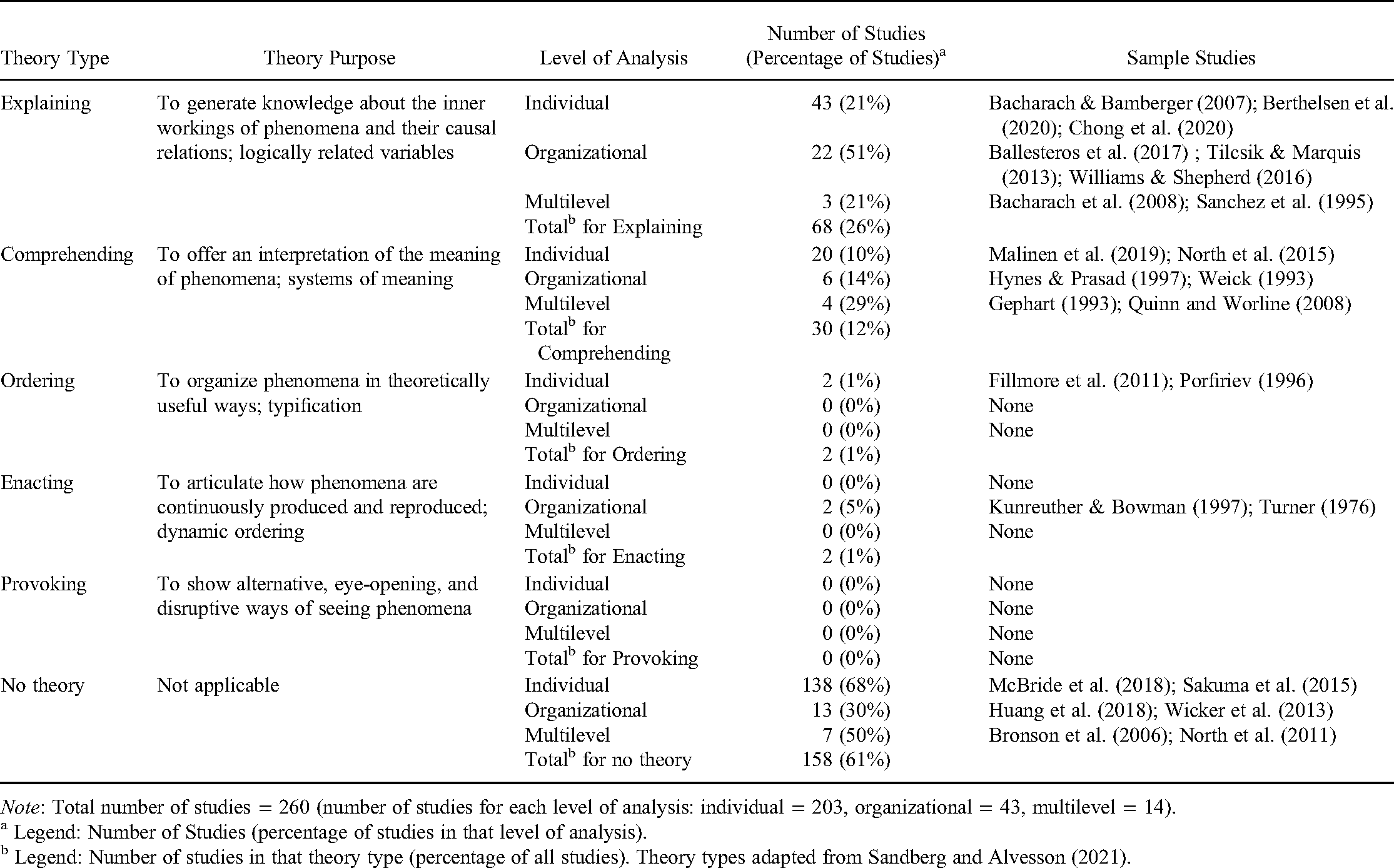
Note: Total number of studies = 260 (number of studies for each level of analysis: individual = 203, organizational = 43, multilevel = 14).
a Legend: Number of Studies (percentage of studies in that level of analysis).
b Legend: Number of studies in that theory type (percentage of all studies). Theory types adapted from Sandberg and Alvesson (2021).
Despite employing Sandberg and Alvesson’s (2021) typology to categorize the reviewed studies that enabled more studies to be classified as employing theory, the majority of this research was atheoretical (e.g., Lebowitz, 2016; Sezgin & Punamäki, 2016; Üstün, 2016). In fact, out of the 260 studies, only 102 (39%) could be classified as having any type of theoretical underpinning. Of the studies aimed at the individual level of analysis, only 65 articles (32% of all individual-level studies) used theory to guide their empirical research. In contrast, a larger proportion of studies at the organizational level of analysis (k = 30, 70% of all organizational-level studies) used a theoretical foundation. For the studies in our review that did use an explaining theory, there were 36 separate theories employed (see Appendix 3). This highlights the fact that disasters have been viewed through numerous theoretical lenses and that no single theoretical perspective has dominated the disaster and work literature.
That said, in studies at the individual level of analysis, there were two theories that were used more frequently compared to others: COR theory (k = 10; Hobfoll, 1989) and the transactional model of stress and coping (TSC, k = 5; Lazarus & Folkman, 1984). These two theories are highly relevant to the study of disasters, as both revolve around responses to stressful events. COR posits that loss of resources (i.e., objects, states, and/or conditions valuable to an individual) will increase individual stress (Hobfoll, 1989; Hobfoll, Halbesleben, Neveu, & Westman, 2018), while TSC highlights how individuals evaluate sources of stress, and how they use their coping resources to respond to the stressful events (Lazarus & Folkman, 1984). At the organizational level, an even broader range of theories was applied, with no specific theory being used in more than three studies. The three theoretical lenses most often applied were a community resilience framework (Bruneau et al., 2003), organizational learning theory (OLT; Fiol & Lyles, 1985; both used in 7% of organizational-level studies; k = 3), and RBV (Barney, 1991; used in k = 2, 5% of organizational-level studies).
A Resources Perspective of Disaster Consequences Across Levels
Organizational theorists have offered various typologies that classified and interpreted existing literatures using a resources perspective. For example, a resources perspective has been employed to understand work conditions (e.g., job security, social network), constructive resources in the workplace (e.g., control, resilience), social support at work (e.g., instrumental and emotional support from significant others and coworkers), and workplace energies (e.g., physical and cognitive energy, and mood; Halbesleben, Neveu, Paustian-Underdahl, & Westman, 2014; Hobfoll et al., 2018; ten Brummelhuis & Bakker, 2012). Given the definition of disaster proffered by the WHO (2019)—disasters are events resulting in losses that exceed the ability of communities (e.g., individuals and organizations) to cope using their own resources—and given that resource theories have been used at both the individual (e.g., COR; Hobfoll, 1989) and organizational levels (e.g., RBV; Barney, 1991), it makes theoretical sense to employ a resource perspective to interpret the consequences of disaster exposure.
As would be expected following a disaster, most of the studies we reviewed focused on resource depletion. Depletion refers to the loss of resource/s due to self-exertion or a willful act to manage a stress-inducing event, such as disaster exposure (Halbesleben et al., 2014; Hobfoll et al., 2018). A small number of studies also examined resource investment, which refers to the acquisition of resources that may help offset or recoup the depletion of resources, resulting in better functioning (Hobfoll, 1989). The idea of resource investment is one of the central, but understudied, tenets of COR theory. Following a stressful event, resources may be invested to help recover from resource losses and to protect against further resource loss (Hobfoll, 2001). Although studies of disasters focus mostly on resource depletion, we argue that the investment of resources following a disaster is also critical, as renewing the resources depleted by exposure to a disaster leads to positive outcomes and sustains human fortitude (see Hobfoll, 2001).
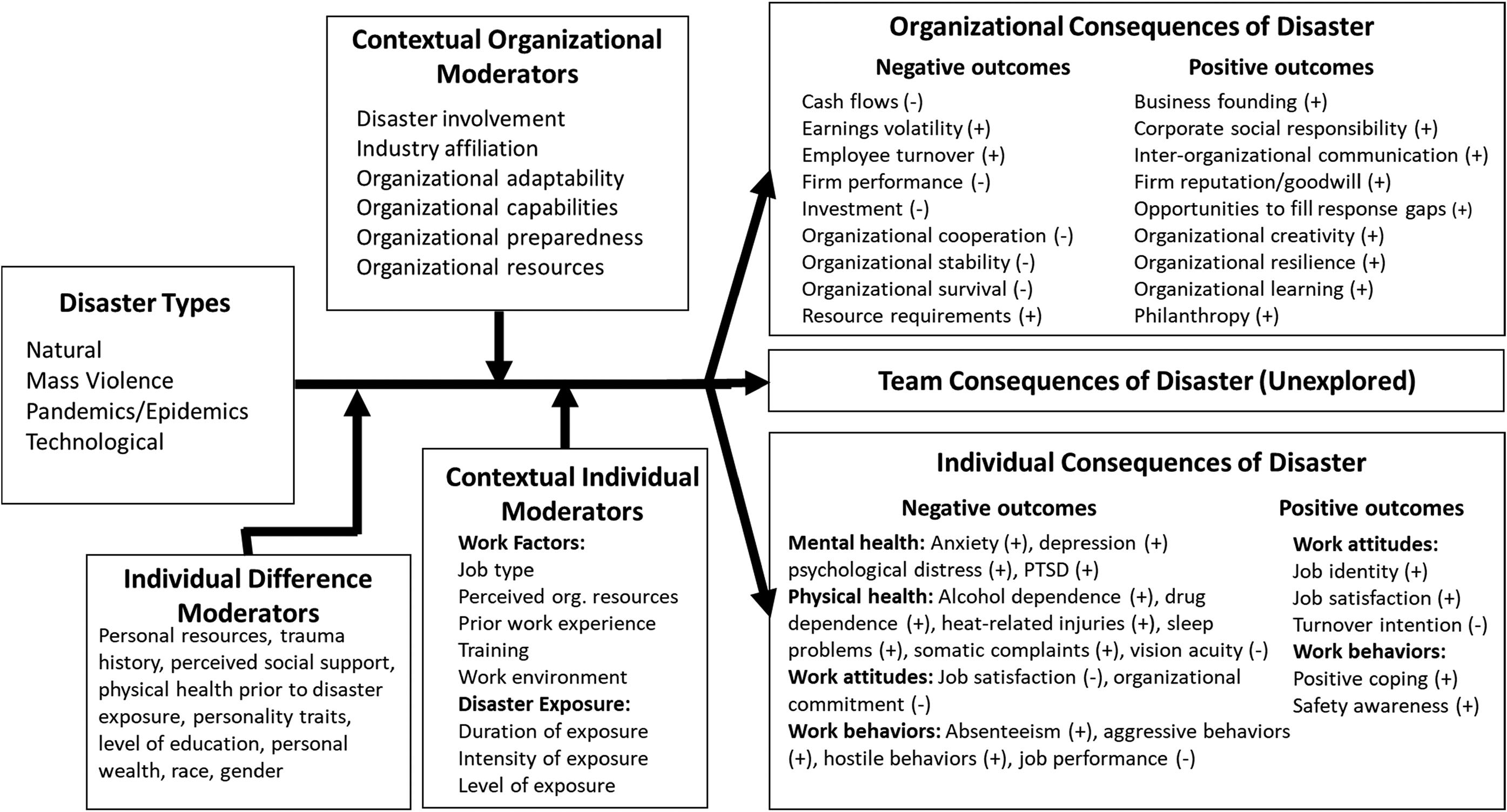
Moreover, since disasters impact individuals within social systems, we also examine these disaster consequences across levels of analysis—individual, organizational, and multilevel 9 —framing them from a resource perspective. Our summary of the research findings is presented in an organizing framework (see Figure 2). This summary was used as a launching pad to apply a resource perspective within an ecological systems framework to guide future research on the consequences of disasters for organizations.
A Conceptual Organizing Framework—Current Disaster Literature
Disaster Exposure at the Individual Level
Hobfoll (2002: 307) defined individual resources as “entities that either are centrally valued in their own right (e.g., self-esteem, close attachments, mental health, and inner peace) or act as a means to obtain centrally valued ends (e.g., income, social support, and credit).” Along with an individual's attributes and skills, Lyubomirsky, King, and Diener (2005) propose that these types of individual resources help people thrive at work, succeed in relationships, and have better health. Our review of disaster studies shows that exposure to disasters depletes these individual resources. Specifically, as outlined next, we primarily find that disasters affect employee psychological resources (i.e., mental health) and physical resources, 10 which subsequently impacts their work-related attitudes and behaviors.
Psychological Resource Depletion and Boundary Conditions
The effects of disaster exposure for individual's mental health were the most studied outcome across individual-level studies reviewed 11 (k = 106, 52% of all individual-level studies). Disaster exposure was found to deplete psychological resources in various ways. For example, individuals exposed to a disaster event suffered from PTSD (e.g., Alvarez & Hunt, 2005; McBride et al., 2018), anxiety (e.g., Lowe et al., 2016), depression (e.g., Lowe et al., 2016; West et al., 2008), stress (e.g., Fawaz & Samaha, 2020), as well as general psychological distress (e.g., Sakuma et al., 2015). This depletion of psychological resources led many survivors to attempt to cope by engaging in maladaptive behaviors (discussed in the next section). Studies reviewed also examined individual moderating factors that increased the likelihood that individuals exposed to disasters would suffer psychological resource depletion. These can be classified into factors that were related to (1) intensity of disaster exposure, (2) risks that were related to the type of work an individual did, and (3) risks that were person-related (i.e., individual differences such as gender and personality).
The impact of disasters on individual's psychological resources was dependent on an individual's intensity of disaster exposure. This intensity of exposure is determined by factors such as whether an individual sustained physical injury, was bereaved, or suffered property or other personal losses (e.g., Favaro et al., 2004; North, Barney, & Pollio, 2015). In general, individuals who had higher intensity disaster exposure experienced worse psychological outcomes (e.g., Bacharach & Bamberger, 2007; Sezgin & Punamäki, 2016). For example, individuals directly exposed to a disaster site (vs. those beings who were indirectly exposed) suffered from worse depression (e.g., Fullerton, Ursano, & Wang, 2004). In addition, an individual's duration of exposure to a disaster/postdisaster environment also affected their likelihood of experiencing psychological resource depletion (e.g., Luceno-Moreno, Talavera-Velasco, Garcia-Albuerne, & Martin-Garcia, 2020; Perrin et al., 2007).
Work factors also mitigated the level of psychological resource depletion that an individual may suffer. For example, individuals who had prior work experience with disasters (e.g., whether individuals had previously worked in a disaster/postdisaster environment; Nagamine et al., 2018) or received prior training to prepare them for disaster experienced less psychological strain than others without equivalent experience or training (Alvarez & Hunt, 2005; Hagh-Shenas, Goodarzi, Dehbozorgi, & Farashbandi, 2005). Organizational resources could also buffer the negative effects of disaster exposure for individuals. For example, individuals with access to tactile resources like protective equipment were found to be better equipped to cope mentally when required to work in postdisaster environments (Lai et al., 2020; Song, Wang, Li, Yang, & Li, 2020).
Job type also influenced psychological resource depletion postdisaster, with some jobs being a risk factor in experiencing diminished mental health and other job types being a protective factor. Some studies showed that medical workers (Sakuma et al., 2015), construction workers, engineers, sanitation workers, and volunteers (Perrin et al., 2007) are at greater risk of experiencing psychological resource depletion when working in postdisaster environments. However, studies also showed that psychological resources are less likely to be exhausted among individuals in certain occupations, such as police, firefighters, and paramedics. This could be due to relevant training, the perception that their occupations are important during disasters, and/or their job is perceived to be their calling (e.g., Kim & Kang, 2020; Malach-Pines & Keinan, 2007).
An individual's perception of their work environment also impacts their level of psychological health following a disaster. Individuals exposed to a disaster who felt they had effective leadership (Birkeland et al., 2017), perceived they were part of a highly functioning team, had positive job recognition, and had high levels of job satisfaction were less prone to suffer from mental illness (van der Velden, van Loon, Benight, & Eckhardt, 2012). In contrast, individuals who described their workplace as having poor communication had an increased risk of psychological resource depletion after returning to work following a disaster (Ueda et al., 2017).
The support received by individuals post-disaster is also important. In a study involving hurricane victims, Sanchez, Korbin, and Viscarra (1995) investigated how organizational relief services (e.g., providing tangible support and social support) could mitigate an individual's psychological distress postdisaster. They found that employer-sponsored support was associated with decreased depletion of psychological resources for employees following a disaster. Support can also be provided by sources outside of work. Individuals who felt they had low social support from family, friends, and significant others postdisaster were at higher risk of developing PTSD (Fekih-Romdhane, Chennoufi, & Cheour, 2017). In contrast, individuals who perceived high social support were at less risk of adverse mental health outcomes (Alvarez & Hunt, 2005; McBride et al., 2018).
Finally, there were several individual difference moderators that affected the likelihood of experiencing psychological resource depletion after disaster exposure. For instance, females exposed to a disaster were found to be at higher risk of developing PTSD (e.g., Favaro et al., 2004), depression (e.g., Nagamine et al., 2018; Richman, Wislar, Flaherty, Fendrich, & Rospenda, 2004), and anxiety (e.g., Luceno-Moreno et al., 2020) when compared to males. Additionally, immigrants were found to be more prone to develop PTSD than nonimmigrants (De Bocanegra, Moskalenko, & Kramer, 2006; Kung et al., 2018), as were individuals with poor health (e.g., insomniacs, Sakuma et al., 2015; those with respiratory conditions, Tak, Driscoll, Bernard, & West, 2007). Individuals with higher levels of psychological distress predisaster (Tanisho et al., 2016) and those with lower (other-focused) dispositional empathy were also more likely to succumb to psychological resource depletion postdisaster (Nagamine et al., 2018). In contrast, individuals in good health (McBride et al., 2018), those with high trait resiliency and/or high trait optimism (Luceno-Moreno et al., 2020; Song et al., 2020), those in high-income brackets (Lowe et al., 2016), and/or those with higher levels of educational attainment (Kung et al., 2018) were less susceptible to experiencing (various forms of) psychological resource depletion (e.g., PTSD, depression).
Physical Resource Depletion and Boundary Conditions
Studies (k = 18, 9% of all individual-level studies) also investigated how disaster exposure is detrimental to individual's physical resources. Disaster exposure was linked to sleep problems (Dietch et al., 2019), vision acuity issues (Berríos-Torres et al., 2003), poor skin health (Tak et al., 2007), and other somatic complaints (Song et al., 2020; Trougakos et al., 2020). Following a disaster, outdoor workers (e.g., firefighters, utility workers) are also at higher risk of heat-related injuries (e.g., burns, heat stroke, etc.) and experienced more occupational wounds, lacerations, amputations, and accidents (e.g., chemicals, moving objects; Xiang, Bi, Pisaniello, Hansen, & Sullivan, 2014). Several studies found that workers employed to assist in rescue and recovery efforts at the World Trade Center (WTC) following 9/11 suffered respiratory infections and musculoskeletal conditions. For example, these workers were more likely than the general population to report new-onset respiratory symptoms, worsened respiratory functioning, and/or developed asthma in the months following their WTC work (Wheeler et al., 2007). The 9/11 cleanup workers were also much more likely to seek medical assistance for fractures, sprains, strains, and other ongoing conditions (Berríos-Torres et al., 2003).
Several individual factors exacerbated the probability of physical resource depletion. For example, medical staff working in a postdisaster work environment are exposed to a higher risk of infection during epidemics (e.g., Khalid, Khalid, Qabajah, Barnard, & Qushmaq, 2016) and pandemics (e.g., Semple & Cherrie, 2020). This risk of infection, in turn, affects their willingness to work during the disaster (e.g., Gottberg, Krumm, Porzsolt, & Kilian, 2016). Yet in terms of infection, healthcare professionals are not the only workers whose level of risk increases by going to work. Another recent study (Lan, Wei, Hsu, Christiani, & Kales, 2020) identified other occupational groups at increased risk of COVID-19 infection, specifically individuals working in sales, customer service, transportation services, janitorial services, domestic occupations, and/or public safety.
Individuals exposed to a disaster were also found to be more likely to engage in maladaptive behaviors. For example, after disaster exposure, individuals were found to consume more alcohol (Geisz-Everson, Dodd-McCue, & Bennett, 2012; Komuro et al., 2019; North et al., 2002) and increase their use of prescription drugs (De Bocanegra et al., 2006; Slottje et al., 2008) and tobacco (Komuro et al., 2019), when compared to others not exposed to a disaster. In one study, male employees were found to be more susceptible to increased alcohol dependence than women following disaster exposure (Richman et al., 2004). However, the opposite effect was found in a recent study by Pollard, Tucker, and Green (2020), who found that women have been drinking alcohol in much greater volume since the start of the COVID-19 pandemic. Various types of unhealthy habits, adopted after disaster exposure, were found to lead to negative physical health outcomes (e.g., smoking; van der Velden, Kleber, & Koenen, 2008).
Consequences of Resource Depletion for Work-Related Attitudes and Behaviors
Many disaster-related studies also documented the negative impact that resource depletion (resulting from disaster exposure) has on a host of work-related attitudinal and behavioral outcomes. Studies of work-related attitudes postdisaster were the second most studied individual disaster outcome (k = 25, 12% of all individual level studies). The most studied work attitude was job satisfaction. In a programmatic series of studies, Hochwarter et al. (2008) showed that hurricane-induced psychological resource depletion had a negative impact on job satisfaction, especially for those with fewer perceived personal resources (e.g., having a supportive work environment) to cope with the disaster. More recently, COVID-19 exerted a negative influence on the job satisfaction of health care providers, due to the psychological resource depletion caused by role stigma, discrimination, fear, and decreased self-efficacy (Ramaci, Barattucci, Ledda, & Rapisarda, 2020). In another study, Vaziri, Casper, Wayne, and Matthews (2020) found that individuals who suffered psychological resource depletion when forced to work from home during COVID-19 had reduced job satisfaction and higher turnover intentions.
We note that there were two studies that reported only minor or null effects for the impact of disaster exposure on work attitudes. For example, no significant difference in job satisfaction or organizational commitment was found between two equivalent groups of employees who were exposed and who were not exposed (natural control group) to a factory blast outside Johannesburg (Barling, Bluen, & Fain, 1987). Similarly, in a sample of employees at a multinational manufacturing organization, Ryan, West, and Carr (2003) reported only a negligible difference in employees’ job satisfaction pre- and post-9/11. However, this may be a product of collecting their data from a multinational corporation in which many individuals had minimal direct exposure to 9/11 as they were physically located around the globe.
There was also a subset of studies that examined work behaviors (k = 12, 6% of all individual-level studies). These studies found employees exposed to a disaster are also more prone to absenteeism, reported a decreased willingness to return to work (especially in studies relating to pandemic/epidemics), and were more likely to leave their organization (Bader, Reade, & Froese, 2019). Disaster exposure, or even the threat of exposure, was found to impact an individual's job preferences, including their occupational choice, type of organization they work for, and work location preferences (Lieb, 2003; Üstün, 2016; Wang & Bu, 2004).
A collection of studies also examined the impact of disaster events on job performance. Due to psychological and physical resource loss, employees’ job capabilities after disaster exposure were considerably reduced, which has a negative impact on effective role performance (Evirgen, Savas, Motor, Onlen, & Yengil, 2014; Nakayama, Kato, & Ohkawa, 2019; VanDevanter, Raveis, Kovner, McCollum, & Keller, 2017). Resource loss through disaster exposure was found to negatively impact performance as a function of reduced engagement (e.g., Chong, Huang, & Chang, 2020; Vaziri et al., 2020) and well-being (Trougakos et al., 2020). Following a disaster, individuals were also more likely to engage in workplace mistreatment (e.g., sexual harassment, van Heugten, 2018; generalized work abuse, Kulwicki, Khalifa, & Moore, 2008). This may be because the self-regulatory resources that stop individuals engaging in deviant behaviors are depleted by disaster exposure (McAllister & Perrewé, 2018; Muraven & Baumeister, 2000).
Psychological Resource Investment and Work-Related Attitudes and Behaviors
While the majority of studies demonstrate the deleterious effects of disaster exposure on individual resources and work-related outcomes, there were two studies that showed counterintuitive effects—demonstrating that in some circumstances, resources are invested following disaster exposure. Song et al. (2020) analyzed Chinese employees’ work attitudes following their return to worksites after strict COVID-19 lockdowns were lifted in their region. They found that most returning employees had an elevated level of job satisfaction and reduced turnover intentions. The authors attributed this to individual's psychological resources being enriched due to the fact that their employment had continued despite the pandemic and acknowledgment that quitting their job would be likely to introduce additional risk into their lives. In another study, Israeli police officers who were surveyed during a period of Palestinian uprisings (Intifada) that necessitated them working in response to acts of insurgent terrorism reported psychological enrichment as they perceived their job as more important and as a result felt more satisfied with their work (Malach-Pines & Keinan, 2007).
There were also a handful of empirical studies (k = 4, 2%) that demonstrated positive changes in employee behaviors following a disaster. Investment in psychological resources helps with coping (Hobfoll, 2001), and in these studies of positive behaviors, these resources augmented safety behaviors. Following the Chernobyl Nuclear Power Plant meltdown, some exposed individuals were found to engage in positive coping behaviors (e.g., lifestyle changes, Gresko, Marazziti, Piccinni, Mucci, & Loganovsky, 2018). Positive effects were also observed in response to workplace initiatives following disaster exposure. For example, Boscarino, Figley, and Adams (2004) revealed that worksite crisis interventions offered by employers in the aftermath of the 9/11 terror attacks curbed a variety of maladaptive behaviors, including binge drinking and alcohol dependence. With regards to safety behaviors during a pandemic, medical staff were found to be more aware and diligent in their use of protective equipment (e.g., Evirgen et al., 2014; Lai et al., 2020). Although studies highlighting positive individual outcomes in response to disasters are sparse, they do provide a glimpse into some possibilities for how individuals can personally grow and adapt following exposure to a disaster.
Disaster Exposure at the Organizational Level
Similar to the individual level, disaster exposure depletes resources at the organizational level of analysis. Organizational resources are scarce, valuable, and imperfectly imitable and are proposed as the only factors capable of creating sustained performance differences among competing firms (Kraatz & Zajac, 2001). As a result, an organization's resources are vital to its financial and strategic health (Barney, 1991; Pek, Oh, & Rivera, 2018). Due to the damage, uncertainty, ambiguity, and stress they cause, being exposed to a disaster threatens the existence of many organizations (Williams & Shepherd, 2016). This is because disaster exposure limits the range, amount, duration, and quality of things organizations can do within their current capabilities (Farjoun & Starbuck, 2007). It is estimated that 4 out of every 10 firms affected by a major disaster event do not survive, while organizations that do survive endure tremendous financial and strategic hardships (Duncan, Yeager, Rucks, & Ginter, 2011; Williams & Shepherd, 2016).
Financial Resource Depletion and Boundary Conditions
Several organizational-level studies (k = 16, 37%) demonstrated how disaster exposure has a negative impact on firm resources and subsequently their performance and firm investment. For example, Lin, Zhao, Ismail, and Carley (2006) examined the performance of 80 organizations faced with various technological disasters and found that both external (measured as market share) and internal (measured as accuracy and timeliness in decision-making) performance metrics suffered after disaster exposure. Due to the resources lost in dealing with these technological disasters, these organizations were less attractive to foreign investors (Oh & Oetzel, 2011; Pek et al., 2018). Other research has also showed that multinationals exposed to human-made disasters (i.e., both technological disasters and acts of mass violence) were also likely to see decreased foreign investment (Oh & Oetzel, 2011).
Organizations exposed to natural disasters and pandemics/epidemics face a significant drain on their financial resources. Using data from publicly traded firms in 55 countries over 20 years, Huang, Kerstein, and Wang (2018) found that if organizations were exposed to a natural disaster, or even just faced an increased risk of disaster exposure, it increased the likelihood that those firms would experience lower cash flows, show volatile earnings, and be forced to hold more resources in reserve (e.g., cash, inventory). Drawing from archival data to study the negative organizational effects of the Spanish Flu (1918–1920) pandemic, Rao and Greve (2018) showed how this type of disaster reduced financial resources by weakening organizational cooperation and reducing the formation of new cooperatives.
Strategic Resource Depletion and Boundary Conditions
Most of the organizational-level studies 12 looked at various forms of strategic resource depletion resulting from being exposed to one or multiple disasters (k = 35, 81.5% of organizational-level studies). Strategic resources are resources that are valuable, rare, and difficult to imitate or substitute (Barney, 1991). They can include assets such as an organization's competence in technology (e.g., R&D capability), marketing, and management (Chi, 1994). Disasters push organizations beyond the limits of their available resources, impacting not only their financial resources but also their strategic resources. For example, Oliver et al. (2017) discussed this in their study of the Air France Flight 447 disaster, explaining that even organizations that are highly reliable in typical operating conditions are susceptible to catastrophic outcomes when exposed to a disaster because disasters cause unforeseeable, complex problems beyond the normal scope of typical organizational resource capacities. Disasters disrupt how the human resources in an organization can perform together.
The studies reviewed showed various types of strategic resources that were depleted after a firm was exposed to a disaster. Disaster exposure makes it difficult for information to be shared and therefore leads to diminished intra- and interorganizational collaboration (Corbacioglu & Kapucu, 2006). A lack of information postdisaster makes organizational responses to disaster often calamitous and can harm disaster victims (Mills & Weatherbee, 2006). Disaster exposure also leads organizations to experience diminished current and potential human resources. For instance, turnover was found to be above average after disaster exposure, due to the financial burdens placed on firms, while many organizations struggle to fill available jobs postdisaster, as potential job candidates leave or focus on rebuilding after falling victims to a disaster (Gittell et al., 2006; McFarland, Reeves, Porr, & Ployhart, 2020).
Financial and Strategic Resource Investment
Most of the research at the organizational level treated the negative financial effects of disaster exposure as a given outcome (e.g., Mithani, 2017; Williams & Shepherd, 2016). However, there were some studies that tried to identify organizational factors that can mitigate financial resource depletion via resource investment. Disasters prompt organizations to respond with new initiatives to alleviate victims’ suffering (Williams & Shepherd, 2016) and to act as a catalyst for new ventures to be formed in response to gaps in disaster recovery systems (Mills & Weatherbee, 2006). While on the surface this altruistic investment seems to be a source of strategic and financial resource depletion, when organizations help in this way, it not only assists their communities, but it also builds firm reputation, goodwill, and creativity. As such, organizational resources may be enriched in the medium to long term (Madsen & Rodgers, 2015; Williams & Shepherd, 2016).
Disasters also garner significant media attention, encouraging organizations to be more socially responsible and to increase their charitable giving (Zhang & Luo, 2013). For example, research shows that in collaboration with nongovernmental organizations and affected communities, organizations are more likely to make direct or in-kind donations, make pledges, and sponsor organized disaster relief initiatives following disaster events (Madsen & Rodgers, 2015). Many of the large firms studied at the organizational level were expected to engage in increased corporate philanthropy, and while this is initially a drain on their own firm's financial resources, Muller and Kräussl (2011) found that this type of philanthropy ultimately sent investors positive signals about the organization's ability to survive a disaster, therefore enhancing trust among key stakeholders and helping organizations gain resources.
If an organization survives a disaster, it can bolster its strategic resources because it fosters resilience, creates learning opportunities, builds interorganizational communication, and improves preparedness for future catastrophes (Wicker et al., 2013). Analyzing organizations from seven different industries, Whitman et al. (2014) found that if organizational employees were able to recover quickly by investing in coping strategies and therefore reporting above average well-being, it positively influenced organizational cash flows and customer retention postdisaster. Equally, Bronson, Faircloth, and Valentine (2006) found a (weak) positive relationship between business owner optimism and firm recovery after a disaster. Organizations adapt their resources and outputs in response to an altered environment (Albert, Kreutzer, & Lechner, 2015). The organization-level studies reviewed in this section demonstrate how adaptation of resources investment can help build financial and strategic resources over time.
Disaster Exposure Across Multiple Levels
Only a handful of studies examined how disasters may impact resources across various levels of analysis simultaneously (k = 14, 5.5% of all reviewed studies). For example, Gephart's (1993) sensemaking study examined how employees, supervisors, district managers, the organization, the inquiry board, and the public were impacted by the 1985 Western Pipelines disaster. At each level, resources were depleted, and this impacted other levels. In another qualitative example that focused on the 2015 Nepal earthquake, Penta, DeYoung, Yoder-Bontrager, and Suji (2016) used informal conversations, photographs, and observations, which enabled rich insights into not only individuals and their organizations but also the much wider context. They found that if organizations provided their employees with psychosocial support (e.g., counseling services) postdisaster, it may assist the organization's ability to recover their financial resources and evolve following a disaster. In their examination, they were also able to discover the complexities of the broader cultural and social systems (i.e., the caste structure in Nepal, migrant populations), and the impact of globalization (i.e., humanitarian logistics) on individual employees and organizational outcomes.
All but one of the multilevel studies reviewed was qualitative. In the only quantitative study, Gallagher et al. (2019) collected longitudinal data from individuals affected by the 2009 Victorian bushfires in Australia to examine individual- and community-level effects. They aimed to learn how involvement in community groups (e.g., sporting clubs, religious groups, civic organizations) influenced postdisaster psychological resources (i.e., mental health outcomes). Using multilevel methods, they discovered that if individuals were moderately involved in social groups after their disaster exposure (boosting their coping resources), it was beneficial to their mental health. Conversely, individuals who did not participate in social groups, as well as individuals who were highly involved in social groups, had a higher risk of psychological resource depletion. At a community wide level, however, over a longer time frame, communities with higher median levels of group involvement reported lower levels of overall psychological resource depletion. The multilevel approach used by Gallagher et al. (2019) enabled insights that would otherwise have been missed. Unfortunately, there is a limited amount of multilevel research on disaster exposure. This constrains our understanding of many likely complex and interconnected outcomes.
Applying an Ecological Systems and Resources Framework (ESRF) to Study the Organizational Consequences of Disaster
Employing an ESRF allows us to suggest consequences of disaster across multiple levels. This overarching theoretical framework demonstrates how resources at one level are likely to have spillover effects at another level (as illustrated by the arrows in Figures 3 and 4), influencing individuals, teams, and organizations. By so doing, we can address many research questions and provide novel insights about the consequences of disasters across multiple levels and subdisciplines in management (e.g., OB, strategy, international business). Before we present our application of the ESRF, we discuss its theoretical foundations, show how it can be applied at each organizational level, and suggest areas currently unexplored in the disaster literature.

An Ecological Systems Perspective of Resource Depletion after Disaster Exposure

An Ecological Systems Perspective of Resource Renewal After Disaster Exposure
Disasters and Their Systemic Impact
Our interdisciplinary review of the existing literature showed an observable dearth in empirical knowledge about the consequences of disasters from an ecological systems perspective (i.e., the lack of team and multilevel research), which is inconsistent with the WHO definition of disasters. Taking an ecological systems approach to disasters recognizes the interconnectedness among social systems: individuals (e.g., employees), groups (e.g., work teams), and organizations (e.g., employers, suppliers, customers etc.). Each of these systemic components are closely intertwined and can reciprocally influence each other. This is consistent with the notion of trickle effects (e.g., Wo, Schminke, & Ambrose, 2019), an ecological viewpoint that emphasizes the “ripple” effect that exposure to a disaster may have across different levels of analysis. For example, we know that individuals exposed to a disaster are more susceptible to diminished physical and mental health (e.g., McBride et al., 2018). However, the negative fallout of disaster exposure is also likely to make individuals less effective members of the work team to which they belong (see Kalish, Luria, Toker, & Westman, 2015) and can hinder organizational performance if they are less productive at work (see Montano, Reeske, Franke, & Hüffmeier, 2017). Given how negative and pervasive the effects of disaster exposure often are, any cross-level effects caused by a disaster may be more akin to a tsunami than a “ripple.”
Disasters and Their Effect on Individual Resources
Similarly, while EST is useful in understanding the cross-level effects of a disaster, it does not provide a clear explication of the types of resources that may be depleted and/or invested in each social system. Embedding resource-based theories (Barney, 1991; Hobfoll et al., 2018; Pfeffer & Salancik, 1978; ten Brummelhuis & Bakker, 2012) within EST can help understand the linkages between the different levels of the social system and differentiate the types of resources that are depleted and/or invested in at each level after a disaster. By their nature, disasters deplete resources of those who are impacted by them (WHO, 2019). As demonstrated in our review, disasters deplete the physical and psychological resources of victims. COR theory (Hobfoll, 1989) suggests this depletion occurs because people have a finite set of valued resources that are personal (e.g., self-esteem, resilience) and/or contextual (e.g., social network, work) that help them achieve a variety of goals (Halbesleben et al., 2014). At an individual level, disaster exposure, a stressful experience, is initially likely to result in resource losses that will negatively affect the victim's performance, crossing over levels to harm organizational performance in the long term (Westman, Hobfoll, Chen, Davidson, & Laski, 2004). Since these resources are finite and valued, people are motivated to retain and build new resources if they are victims of a disaster.
While the salience of resource loss and depletion is typically emphasized after disaster events, COR also offers a paradox. That is, although resource loss is more potent than resource gain, the importance of resource renewal increases under situations of resource loss (Hobfoll, Johnson, Ennis, & Jackson, 2003). As such, a disaster event that causes loss (e.g., destruction of property, reduced mental health) may also result in gains in other resources, such as increased social support or psychological hardiness if one were to adaptively cope with disaster-related challenges. Thus, based on a COR perspective, while disaster exposure may typically result in resource loss and loss spirals, in some cases, exposure to a disaster may prompt investment that results resource gains and gain spirals over time (Halbesleben et al., 2014; Hobfoll et al., 2018).
Disasters and Their Effect on Team Resources
While our review of the disaster literature demonstrated that disaster exposure may deplete the available resources of individuals and organizations (and may necessitate investment to ensure resource renewal), there was a noticeable absence of disaster studies conducted at the team level. This is despite the prevalence of teams within organizational settings (Kozlowski, 2018). Teams are important parts of most organizations, and team processes have performance implications for organizations (Kozlowski, 2018; Kozlowski & Bell, 2013; Thielsch, Röseler, Kirsch, Lamers, & Hertel, 2021). Yet while teams are used to respond to disaster (e.g., Oldenburger, Baumann, & Banfield, 2017; Zhang, Guo, Zhu, Yu, & Li, 2017) and are relied on to respond to disasters effectively (e.g., Thielsch et al., 2021), in our literature search there were no studies of how disaster exposure impacted teams.
Teams, their processes, functionality, and efficacy are undoubtably affected by disaster exposure. This is because depletion of resources at the individual level (i.e., psychological, physical, and economic resources) is likely to lead to a depletion of team human resources (Hobfoll et al., 2018). This “crossover” interindividual transfer of resources suggests that there are mechanisms by which emotions, experiences, and knowledge are transferred within organizational (social) contexts, like teams (Hobfoll et al., 2018). For example, team members exposed to a disaster may become less engaged and experience greater psychological strain. This, in turn, may impact their ability to perform their roles within the team (e.g., Baranski et al., 2007). Similarly, if the organization is exposed to disasters, it may need to lay off or reallocate its staff, and in turn, a team within that organization may lose members and subsequently lose access to the unique skills, knowledge, and abilities that a (now) missing team member contributed (e.g., Christian, Pearsall, Christian, & Ellis, 2014).
Disasters and Their Effect on Organizational Resources
At the organizational level, resource theories can be applied to help understand the potential outcomes of disaster exposure for organizations. Two resource theories from the strategy literature can explain how factors internal (RBV; Barney, 1991) and external (RDT; Pfeffer & Salancik, 1978) to organizations affect firm performance. RBV explicitly looks at how organizations employ their internal resources to achieve a sustainable competitive advantage over rival firms and aims to explain why organizations in the same industry might differ in performance (Kraaijenbrink, Spender, & Groen, 2010). A central proposition of RBV is that if an organization is to achieve sustainable competitive advantage, it must control (or be able to acquire) valuable, rare, inimitable, and nonsubstitutable resources and/or capabilities and be able to apply them (Barney, 1991; Barney, Wright, & Ketchen, 2001). Disaster exposure is likely to reduce a firm's ability to control resources and/or diminish their ability to use them to perpetuate a sustainable competitive advantage.
RDT has also been broadly applied in the strategic management literature to explain how organizations act to reduce (external) environmental interdependence and uncertainty. It posits that in environments with high levels of interdependence and/or uncertainty, there is an increase in interorganizational arrangements—for example, alliances, joint ventures, mergers, and/or acquisitions (Drees & Heugens, 2013). A disaster is a high-impact event that increases environmental uncertainty and depletes resources. Based on RDT, there may be more collaboration between organizations within an affected community after a disaster. For example, if an organization had suffered a significant financial loss (i.e., financial resource depletion), after a disaster, it may look to merge with another organization or seek investment to ensure its survival. The effects would impact not only the organizations themselves but also the teams and individuals working within them.
Out of the Disaster Zone: Future Research Recommendations
Although we identified 260 empirical disaster studies with resource implications for organizations and the individuals who work within them, there is still a lot that remains unknown about the consequences of disaster exposure across levels. A lot of the existing research on disasters is disorganized, is undertheorized, and uses simple methodological designs. As a result, there are opportunities for both theoretical and methodological advancement. Given the growing importance of disaster mitigation as a social issue with both significant financial and human implications (Brooks et al., 2020; Chong et al., 2020), we propose the following recommendations to guide future research. We focus on research gaps identified by comparing the current literature on disasters to our proposed overarching theoretical framework as well as key methodological issues emerging from our review. Table 5 outlines several specific research questions and proposes methodological approaches that can be used to test them.
Future Research Directions and Questions
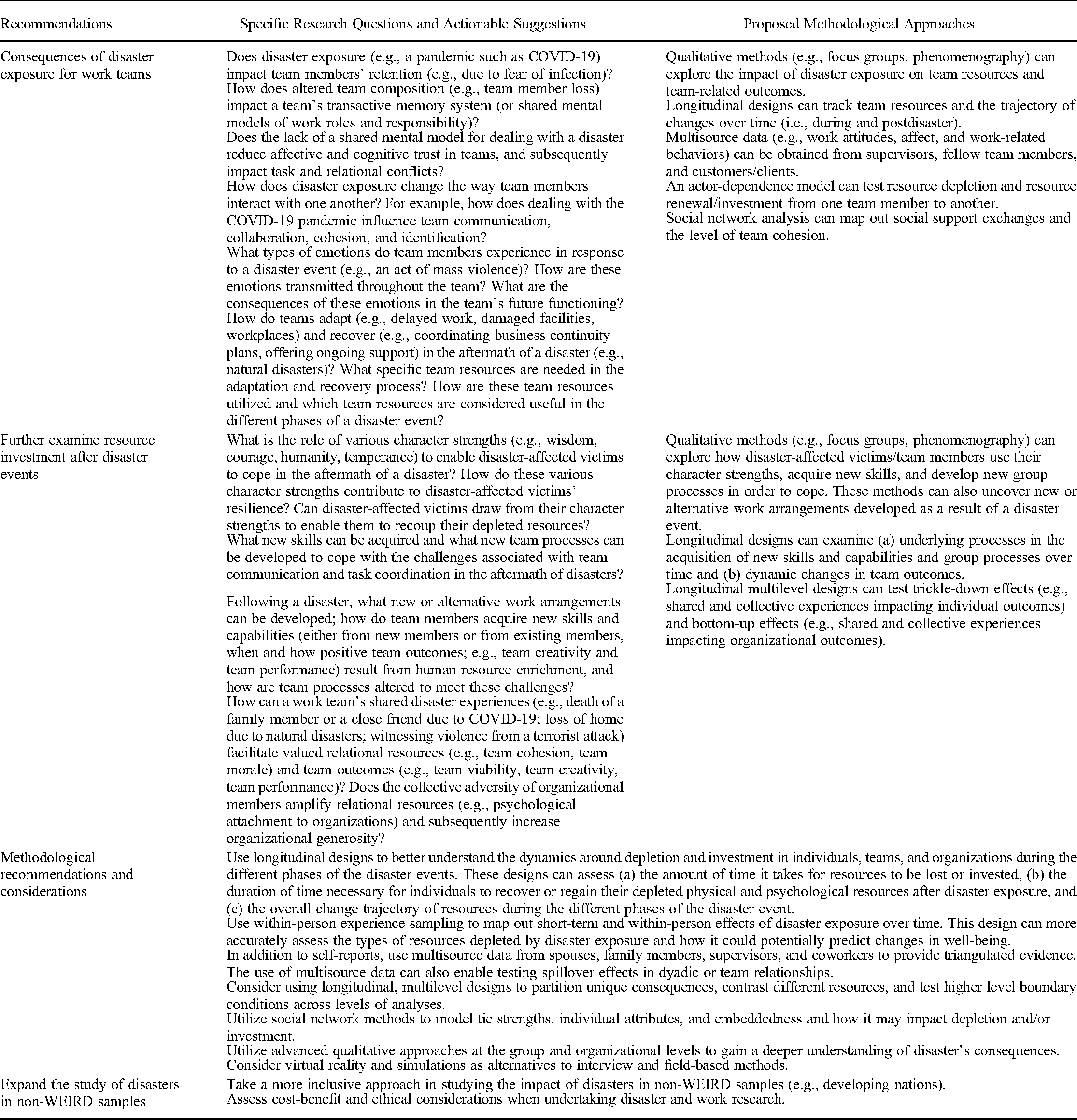
Recommendation 1: Investigate the Consequences of Disaster Exposure for Work Teams
As identified earlier, the majority of the studies in our review focused on the implications of disaster exposure for individuals and/or organizations. Markedly absent were any studies examining disaster exposure and its resulting consequences at the team level. Drawing from our overarching framework, future research should investigate how team resources and team-related outcomes are impacted by disaster exposure.
There are many examples of the types of disaster impacts that could be investigated in team settings during the current COVID-19 pandemic. Since the start of the pandemic in February 2020, it is estimated that nearly one in every five healthcare workers quit their job (Galvin, 2021). Team-based care is prevalent throughout the healthcare industry (Hui, Hannon, Zimmermann, & Bruera, 2018; Tehrani et al., 2019). Losing team members who unexpectedly quit working robs a team of access to their unique knowledge and/or abilities. Altered team composition has been found to negatively impact team transactive memory systems (see Christian et al., 2014) and the development of shared mental models of work roles and responsibilities (Mohammed, Klimoski, & Rentsch, 2000). This lack of shared understanding can reduce cognitive trust (e.g., beliefs about a team member's dependability and competence) and affective trust (e.g., team member's concern) in teams, resulting in task and relational conflict. Hence, the disruption in an individual's resources caused by exposure to a disaster is likely to affect the relational resources of any team they belong to and should be explored.
Disasters can also change the way team members interact with each other. For example, COVID-19 has significantly changed how team members communicate and collaborate with one another to achieve team goals. The rapid transition to employing virtual teams has come with unique challenges for work teams, impacting team member relationships and performance (Wildman, Nguyen, Duong, & Warren, 2021). Disaster exposure may negatively impact team cohesion and team identification, especially if team members have limited contact with each other after the disaster. Relatedly, a specific facet of relational resources is the formation of workplace relationships, which is strongly influenced by affective events (like disasters). If a team member experiences strong negative emotions (e.g., fear) in response to an act of mass violence (e.g., a terrorist attack), their negative affect may spread via emotional contagion to other team members and ultimately impact their future team functioning (Cropanzano, Dasborough, & Weiss, 2017; Tse & Dasborough, 2008). On the positive side, team members can also be a source of social support, showing empathy for each other and generating positive emotions in the team, such as gratitude, hope, and love (Fredickson, Tugade, Waugh, & Larkin, 2003). Future research should examine how disaster exposure impacts team member relationships and their ability to perform team tasks.
Finally, given that adaptation is a central concept in EST (Bronfenbrenner, 1992), the interaction of person-environment relationships should be investigated in a team context. Team adaptation suggests that team members go through two phases when dealing with change events (Burke, Stagl, Salas, Pierce, & Kendall, 2006; Kozlowski, Gully, Nason, & Smith, 1999). The first phase—disruption—occurs abruptly (if not instantaneously) after the change event. A disaster can be conceptualized as a disruption because work routines are interrupted, and performance of work tasks is hindered (Ishtiaque & Nazem, 2017; Woodbury, 2020), thereby resulting in performance decline. The second phase—recovery—involves the capacity to reconfigure and alter processes to improve performance after the initial disruption. Future research can integrate our overarching theoretical framework with team adaptation research to examine aspects of disruption in the aftermath of disasters (e.g., delayed work, damaged facilities and workplaces) as well as the process of recovery in teams (e.g., coordinating business continuity plans, offering ongoing support). Future research could attempt to answer questions such as the following: What specific resources are required by teams in the event of a disaster? Are these resources different depending on the type of disaster faced? How should resources be utilized by teams who have been exposed to disasters? The lack of team-level research in the literature means that there is room for exploration of team processes and outcomes after a disaster.
Recommendation 2: Further Examine Resource Investment After Disaster Events
Our review reveals that, as expected, most disaster research deals with the detrimental consequences of disaster exposure on resources. Yet there were some potential sources of resource renewal through investment too, particularly in studies conducted at the organizational level. Examples of this are increased organizational philanthropy and charitable giving (Zhang & Luo, 2013), growth in organizational learning (Baum & Dahlin, 2007), and resilience gains (Torres, Marshall, & Sydnor, 2019). Given these positive organizational outcomes, we propose several research avenues in which individuals and teams may be able to thrive and experience silver linings, despite facing adversity due to disaster events.
First, within the realm of positive psychology, personal resources such as character strengths play a vital role in responding to disaster events (Ai, Hall, Pargament, & Tice, 2013; Peterson & Seligman, 2003). Character strengths can serve as a buffer or source of protection, offer a different lens in viewing life events, and help (re)build resources to thrive and bounce back from life's adversities. We believe that there are opportunities to integrate character strengths research in the context of disaster events. Future research could address the following questions: What is the role of character strengths—such as wisdom (i.e., acquisition of information in the service of a good life such as perspective, judgment), courage (i.e., the willpower to overcome opposition and adversities such as bravery, persistence), humanity (i.e., involves characteristics that manifest in interpersonal relations, such as kindness and love), and temperance (i.e., involves characteristics that protect us from excess and overindulgence such as self-regulation, humility and prudence)—in enhancing psychological resources, including adaptive coping and resilience after disaster events? Can disaster-affected victims draw from their character strengths to provide them additional resources to recoup their depleted resources?
Second and relatedly, work teams may also invest in new resources as a means of adapting to the aftermath of a disaster. In managing the aftermath of a disaster, we question what new skills can be acquired by team members and what new group processes can be developed to cope with the challenges associated with team communication and task coordination. For example, what new or alternative work arrangements do teams need to adopt? How do team members acquire new skills and capabilities? Does the acquisition of new skills and capabilities happen in the same way as it does in nondisaster settings (e.g., from new members or from existing members, Levine, Choi, & Moreland, 2003; Summers, Humphrey, & Ferris, 2012)? There are many questions about when and how positive team outcomes (e.g., team creativity and team performance) may result from the human resource enrichment and investment necessary following disaster exposure.
Finally, sharing distressing experiences or shared adversity can also enrich team relational resources because team members experience the ordeal arising from the disaster event as a community. As such, it becomes a powerful trigger of group solidarity and shared identity (e.g., Penner, Dovidio, Piliavin, & Schroeder, 2005; Vezzali, Cadamuro, Versari, Giovannini, & Trifiletti, 2015). Following this perspective, future research should explore whether a work team's shared disaster experiences (e.g., death of a family member or a close friend due to COVID-19, loss of home due to natural disasters, witnessing violence from a terrorist attack) facilitate valued relational resources (e.g., team cohesion, team morale) and team outcomes (e.g., team viability, team creativity, team performance). It is also important to understand how team-level resources might augment available resources amid disaster exposure. For example, teams may bolster coordinating efforts to gain resources to cope with the loss of a team member or develop new relationships or further strengthen existing relationships with other teams amid a disaster.
Moreover, it is plausible that shared disaster experiences at the team level can have bottom-up effects. That is, the collective adversity of organizational members can amplify relational resources (e.g., psychological attachment to organizations), which may increase organizational generosity. It can also shape norms and organizational practices around facilitating recovery assistance and coordinating volunteer efforts. This, in turn, enhances financial and strategic gains, ultimately resulting in organizational philanthropy. In sum, there is substantial scope for future work linking disaster events and silver linings.
Recommendation 3: Consider What Methods Are Best Employed to Study Disasters
Given the findings in the review, we offer several methodological recommendations that can be employed to gain additional understanding of the consequences of disaster exposure for organizations. First, our review of extant research on disasters suggests that most studies utilizing a quantitative empirical design were predominantly cross-sectional. However, disaster events are not static; they have an enduring impact, and as such the cross-sectional designs employed cannot adequately capture the consequences of disaster events on resource depletion (and renewal/investment). Longitudinal designs (e.g., cross-lagged modelling, latent growth modelling, and latent change score modelling, Liu, Mo, Song, & Wang, 2016; McFarland et al., 2020) are better suited to help understand the dynamics around resource depletion and investment among individuals, teams, and organizations during the different phases of disasters. For example, in the case of disruption and damage caused by natural disasters (e.g., an earthquake, a hurricane), what is the amount of time it takes for an individual team's resources to be lost or renewed postdisaster? What is the duration of time necessary for individual team members to recover or regain their depleted physical and psychological resources? Do psychological resources recover faster than physical resources? What is the overall change trajectory of these resources during and postdisaster? Such long-term study designs are particularly useful to assess how fluctuations and changes in both individual and team resources can alter individual- and team-related outcomes, respectively.
Other research methods, such as within-person experience sampling, are also well-suited for mapping out the short-term within-person effects of disaster exposure over time and accounting for individual differences. A key advantage of experience sampling over other more traditional longitudinal survey designs is that data can be obtained in the individuals’ natural setting and assessed on a daily basis or several times a day (Ohly, Sonnentag, Niessen, & Zapf, 2010). In doing so, within-person experience sampling offers a unique opportunity to capture “life as it is lived” (Bolger, Davis, & Rafaeli, 2003: 597). Depending on the type of disaster, participants could report on their experiences at fixed, predetermined intervals (i.e., interval-contingent design). For example, disaster-affected individuals’ psychological states can be assessed in the morning, afternoon, and evening. Alternatively, using an event-contingent design, disaster-affected individuals can report each time a particular event in question occurs postdisaster (e.g., measuring their psychological states that occur during aftershocks that ensue after the main shock of an earthquake sequence) (Ohly et al., 2010; Wheeler & Reis, 1991). From a resource perspective, within-person designs could assess the types of physical and psychological resources that are depleted by disaster exposure and how these resources impact well-being.
Second, most of the reviewed individual-level studies have relied exclusively on disaster victims’ self-reported physical and psychological health. To address this limitation, studies employing self-report methods might collect additional data from spouses and family members (e.g., physical and psychological health) and supervisors and coworkers (e.g., work engagement and performance) to provide triangulated evidence for disaster victim/self-reported well-being and work-related behaviors across disaster types. Collecting multisource data may also offer opportunities to examine spillover effects in dyadic or team relationships (e.g., a couple, supervisor-subordinate, team member-leader, coworker dyads, an employee, a family member). For example, an actor-partner interdependence model enables us to examine how a team member experiencing psychological and physical resource depletion (or contagion effects) affects his/her coworkers within the team (Kenny & Ledermann, 2010; Kenny, Mannetti, Pierro, Livi, & Kashy, 2002).
Third, in line with our overarching framework, it is important to consider the interdependencies within the social system. While a large proportion of the research reviewed was undertaken at the individual level, the impacts of disaster events trickle down from organizations to teams working within them, and ultimately to the individual employee, and vice versa. Longitudinal, multilevel research designs can directly test our proposed overarching framework. More specifically, this approach can test trickle-down and bottom-up effects. It can also disentangle the unique consequences across the individual, team, and organizational levels; contrast the different resources across levels; and consider higher level boundary conditions that can mitigate or exacerbate the impact of disaster exposure. Given that multiple actors (e.g., individual employees, team members, and organizational leaders) are embedded within an organizational network, social network analysis might be used in future disaster studies. Employing social network analysis allows the integration of multiple levels of analysis and enables a simultaneous examination of the whole, as well as the parts (Kilduff & Brass, 2010). For example, researchers could examine how victims’ social relationships (i.e., weak vs. strong ties), individual attributes/characteristics, and embeddedness may influence the depletion (or investment) of their psychological resources at work.
Fourth, we found that less than a third of the reviewed studies utilized qualitative approaches. Many of these studies relied on exploratory interviews with disaster victims. We recommend that scholars move beyond the individual level and use more advanced qualitative approaches at the group (e.g., focus groups, North et al., 2013) and organizational levels to gain a more in-depth understanding of disasters’ consequences. For example, no study in our review applied phenomenography (e.g., Dasborough, Lamb, & Suseno, 2015) to examine the collective lived experience of those affected by disasters and how these collective disaster experiences impact organizational recovery. Qualitative methodologies such as this are well-suited to the study of disaster and resource depletion because it enables researchers to connect to the adversity, empathize with disaster victims’ suffering, and potentially seek to alleviate their pain (e.g., Cunliffe & Karunanayake, 2013).
While we advocate the use of more rigorous and sophisticated study designs, we recognize that it may not always be realistic or feasible to implement these approaches in postdisaster environments. Data gathering during and postdisaster is difficult and presents unique logistical challenges because disasters are, by nature, sudden, unexpected, and (often) highly localized (Norris et al., 2002). As such, researchers need to consider several factors when determining their methodological choices, such as access to the disaster location, navigating political conflicts and bureaucracy, dealing with cross-cultural barriers and communication (Morton & Levy, 2011), while also ensuring the researchers’ personal safety (Morgan & Pink, 2018). It may be difficult to recruit disaster-affected individuals to participate in the research. For example, a hurricane may cut power and communication and make it unfeasible for disaster-affected participants to complete surveys using online data collection platforms (e.g., MTurk, Qualtrics; Vaziri et al., 2020) or on social media (e.g., Facebook, Twitter; see Spence, Lachlan, & Rainear, 2016; Trougakos et al., 2020). For other disasters (like a pandemic), this type of data collection may be preferable. Different disasters will present unique logistical challenges, and to address these logical hurdles (e.g., gaining participant access), researchers may need to establish a collaborative relationship with locally based researchers, gatekeepers (e.g., community leaders, community residents), and gatekeeping agencies (e.g., community-based nonprofit organizations, local government units).
Finally, the use of virtual reality and simulations (e.g., Gamberini et al., 2021) may also offer accessible, cost-effective, and less intrusive alternatives to interview- and survey-based methods. These methods can simulate natural disaster scenarios (e.g., an earthquake and a hurricane) along with accompanying visual and auditory cues, enabling participants to fully immerse and respond to imminent threats within a controlled and risk-free research environment (e.g., Farra, Miller, Timm, & Schafer, 2013). While effective, these simulations have been predominantly used in disasters such as floods, earthquakes, and terrorist attacks and rarely utilized in other types of disasters (i.e., extreme cold or hot weather conditions and/or epidemics/pandemics; Hsu et al., 2013; Solinska-Nowak et al., 2018).
Recommendation 4: Expand the Study of Disasters to Non-WEIRD Samples and Be Ethical
The acronym WEIRD was first coined by Henrich, Heine, and Norenzayan (2010) to highlight the fact that most research in the behavioral sciences comes from samples of individuals in Western, educated, industrialized, rich, and democratic societies and thus may be unintentionally limited in its applicability to different regions of the world. This trend of drawing from WEIRD samples is just as prevalent in the study of disasters. For example, out of the 260 articles we reviewed, not one was about Typhoon Haiyan, which devastated parts of South-East Asia, particularly the Philippines, in November 2013. This is despite the enormous impact of this disastrous storm, which left more than 6,000 people dead, 4 million displaced, and affected over 16 million individuals (WHO, 2014).
Our review also revealed that 72% of the included studies were based on findings from highly developed nations and thus may be unintentionally limited in its applicability and generalizability to different regions of the world. We encourage future research to take a more inclusive approach in studying the impact of disasters in non-WEIRD samples because, while disasters have impacted billions of people over the last 25 years, low- and lower middle-income countries are disproportionately affected (UN, 2020). This is demonstrated by the fact that while 33% of countries that experienced disasters are classified as low- to lower middle-income, 81% of fatalities were from one of these countries (UN, 2020).
Beyond these recommendations, studying disaster-affected individuals also presents ethical challenges. Research participants (e.g., victims and their immediate families, disaster workers) may have to relive or recall the disaster, which can further aggravate their trauma and sense of loss. As such, researchers must consider the ethical principles of beneficence and justice vis-à-vis nonmalfeasance (i.e., avoiding harm) and autonomy when considering the ethical aspects of their research (Greenwood, 2016). Scholars must clearly state the benefits of their research and describe how they intend to minimize harm among prospective participants. Second, researchers need to maintain the mindset that their prospective participants are vulnerable. As such, they will benefit from expert recommendations from those with experience in collecting data from vulnerable populations (see Ellard-Gray, Jeffrey, Choubak, & Crann, 2015; Restubog, Deen, Decoste, & He, 2021), while also overcoming barriers to research participation.
Conclusion
In sum, we have reviewed and integrated empirical work linking disaster events and work from diverse disciplines. While disasters have typically been studied at single levels of analysis (i.e., at an individual or organizational level), when a disaster strikes, it affects entire social systems. Disasters are complex phenomena, and there is still a lot that we do not know about how they deplete resources across organizational levels and what mechanisms link between these levels. Therefore, we propose an ESRF that can capture the reality of disasters and their consequences for organizations as well as assist in generating ideas for future empirical studies. Although disasters cause great upheaval to individuals, teams, and organizations, we hope that our review will motivate scholars to conduct theory-driven and methodologically rigorous studies to investigate ways to renew valuable resources that are depleted after these devastating events.
Footnotes
Acknowledgments
The authors wish to thank Associate Editor Pursey Heugens for his invaluable input and support as well as the two anonymous reviewers for their insightful and developmental feedback throughout the review process. Supplemental material for this article is available with the manuscript on the JOM website.
Supplemental material for this article is available with the manuscript on the JOM website.
Declaration of Conflicting Interests
The author(s) declared no potential conflicts of interest with respect to the research, authorship, and/or publication of this article.
Funding
The author(s) received no financial support for the research, authorship, and/or publication of this article.

Notes
References
Supplementary Material
Please find the following supplemental material available below.
For Open Access articles published under a Creative Commons License, all supplemental material carries the same license as the article it is associated with.
For non-Open Access articles published, all supplemental material carries a non-exclusive license, and permission requests for re-use of supplemental material or any part of supplemental material shall be sent directly to the copyright owner as specified in the copyright notice associated with the article.
