



Abstract
In this article, we build upon the buffering hypothesis within the job demands–resources framework to develop a coevolutionary explanation to untangle the process by which emotional job demands, work-based social networks, and employee performance are associated over time. We integrate ideas from the social contagion and social network dynamics literatures to support our coevolutionary theory. To test our theory, we collected longitudinal data at three time points from 135 employees in a customer-facing research-and-development department. We employ a stochastic actor-oriented model that allows the simultaneous modeling of changes in work-based social network ties, emotional job demands, and employee performance. We find a social contagion effect whereby employees are more at risk of an increase in their emotional job demands, the more reciprocal work-based social relationships they have with colleagues who have high emotional job demands. In addition, individuals with high emotional job demands change their networks in two notable ways: They have a positive tendency for having work-based social ties, that is, sociability, and for having ties with others with high emotional job demands, that is, homophily. However, despite the unintended consequence of these network tendencies making employees more susceptible to the contagion effect of emotional job demands, we also find support for the buffering hypothesis. The negative effect of high emotional job demands on performance is lower for employees who have more work-based social ties.
Understanding how one employee performs better than another within an organization is one of the critical questions that management and organizational scholars seek to answer. One body of literature in this debate examines two countervailing phenomena: On the one hand, there are job demands—that is, “things that have to be done” (Schaufeli & Bakker, 2004: 296)—that impact the psychological states of employees in the form of emotional or cognitive demands, and on the other hand, there are job resources within the workplace, such as social support (Bakker & Demerouti, 2007). The buffering hypothesis within the job demands–resources (JD-R) model (Schaufeli & Bakker, 2004) suggests that when there are more job resources than job demands, it can benefit performance, engagement, and well-being (Bakker, Demerouti, & Verbeke, 2004; Schaufeli & Bakker, 2004). This buffering process is central to other balance models of work, such as the job demands–control model (Karasek, 1979) and the effort–reward imbalance model (Siegrist, 1996).
Initial theorizing of the buffering hypothesis in the JD-R model portrayed job demands as being negative and job resources as being positive with regard to various outcome measures (Demerouti, Bakker, Nachreiner, & Schaufeli, 2001; Schaufeli & Bakker, 2004). Later theorizing added more complexity to the model, with job demands being divided into job challenges, which have a motivational component and have been shown to positively affect work engagement (Van den Broeck, De Cuyper, De Witte, & Vansteenkiste, 2010), and job hindrances, being stressors that have negative effects. While the combined effects of job resources and job demands on various outcomes have been extensively examined (Bakker & Demerouti, 2007, 2014), the direct effect between job resources and job demands has seen little attention (Bakker & Demerouti, 2017). Aligned with calls for further research on the dynamics of the JD-R model (Schaufeli & Taris, 2014), we theorize that the direct relationship between certain types of job demands and job resources can coevolve over time. For example, it is possible for job resources themselves to increase job demands and that high job demands can result in employees seeking additional job resources. This aligns with research on job crafting, which theorizes that individuals are not just passive actors but that they actively make changes in their work environment to address high job demands (Tims, Bakker, & Derks, 2013; Wrzesniewski & Dutton, 2001). Overall, this suggests that there is a dynamic process underlying the buffering hypothesis; however, to date, the dynamics of the buffering hypothesis have seen little theorizing and empirical examination.
The JD-R model is a heuristic model that at its heart examines two conditions in the workplace: the job demands that employees face and the job resources that they have some control over (Bakker & Demerouti, 2007, 2017). As such, the scope of the JD-R model is very broad, and theoretically it can incorporate all job demands and job resources in the workplace. For example, Schaufeli and Taris (2014) identified over 30 different demands and resources that have been empirically examined. To test the buffering hypothesis within the JD-R model, it is necessary to more narrowly define the specific demand, the resource, and the outcome. In this article, we examine one type of job demand, that is, emotional job demands; one type of resource, specifically, the work-based social relationships that employees have; and one outcome measure in employee performance. We justify our selection of job demands, job resources, and outcome in the next section of the article. The research question we address in this article is: How are emotional job demands, work-based social networks, and employee performance associated over time? Our explanation of the association between job demands and job resources in the JD-R model is different from previous research because we examine the direct relationship between job demands and job resources and develop a coevolution theory that integrates the explanatory mechanisms of complex social contagion (Borgatti & Foster, 2003; Centola, 2018; Centola & Macy, 2007; Zhang & Centola, 2019) and network dynamics (Kalish, Luria, Toker, & Westman, 2015; Šašovová, Mehra, Borgatti, & Schippers, 2010; Snijders, Van de Bunt, & Steglich, 2010; Tröster, Parker, Van Knippenberg, & Sahlmüller, 2019). Further, we examine this direct relationship between job demands and job resources in the context of a specific outcome: employee performance.
Social contagion occurs when behaviors, cognitions, and affects flow from one person to another (Marsden & Friedkin, 1993). For example, direct interaction between two individuals can result in the transfer of ideas through a conversation (Centola & Macy, 2007) or the transfer of emotions (Barsade, 2002). These are examples of simple contagion. Research suggests, however, that direct interaction between two individuals does not always trigger social contagion; in some cases, social contagion is a complex process that requires multiple relational pathways (Centola, 2018). We theorize that in the case of emotional job demands, the more social relationships an employee has with colleagues who have high emotional job demands, the more likely a complex contagion effect will occur. This results in the focal employee being at higher risk of having an increase in their own emotional job demands. We also draw from recent research on the microdynamics of social networks that highlights network ties between people change over time (Tasselli, Kilduff, & Menges, 2015). Individuals have been shown to change their networks as a result of both positive and negative stimuli. For example, positive performance feedback results in the creation of new ties, whereas negative feedback, when people feel under threat, results in decreasing interactions with people whom an individual feels may not be supportive and increasing interactions with others whom they deem as being more supportive (Parker, Halgin, & Borgatti, 2016). Similarly, research on stress indicates that individuals with higher levels of stress maintain current ties but do not reach out to create new ties (Kalish et al., 2015). In addition, research on depression indicates that individuals with higher levels of depression reduce their number of social ties over time, leading them to become more marginalized in the network (Schaefer, Kornienko, & Fox, 2011).
We theorize that even if negative stimuli, such as emotional job demands, can travel through positive ties (i.e., work-based social relationships), the benefits that work-based social ties bring, including support and the opportunity to vent, outweigh the costs. Employees with high emotional job demands will continue to seek out work-based social relationships. Even though these relationships bring with them further emotional job demands, they simultaneously act as a buffer to those emotional job demands and can have a positive effect on employee performance. To test our coevolution theory, we collected longitudinal data at three time points from 135 employees in a customer-facing research-and-development (R&D) department. We employ a stochastic actor-orientated model that allows the simultaneous modeling of changes in work-based social network ties, emotional job demands, and employee performance (Snijders et al., 2010).
Our research makes contributions to two literatures. First, we add to the literature on job demands and job resources (Bakker & Demerouti, 2017; Bakker et al., 2004; Demerouti et al., 2001) by examining the direct relationship between the two concepts. We integrate ideas from the social contagion and social network dynamics literatures to develop a coevolution model that explains the dynamic relationship between job demands and job resources and their joint impact on employee performance. In contrast to previous research on job demands and job resources, our findings suggest that job resources in the form of work-based social ties are a double-edged sword. While job resources, that is, work-based social ties, do act as a buffer to emotional job demands with respect to employee performance, they also have a negative direct effect, specifically due to contagion, on emotional job demands. We further add to the JD-R literature by examining employee performance as an outcome in a dynamic process, as previous research has focused more on employee well-being, and engagement (Bakker & Demerouti, 2007; Bakker, Demerouti, de Boer, & Schaufeli, 2003; Bavik, Shaw, & Wang, 2020; Demerouti et al., 2001). Overall, our article adds to the JD-R literature by examining the direct effects between job demands and job resources as well as adding a process perspective. In so doing, we help strengthen the theoretical implications of the buffering hypothesis.
We also add to the microfoundations literature that is becoming more prevalent in the field of social networks research (Tasselli et al., 2015; Tasselli & Kilduff, 2021). Specifically, we add to the literature on the coevolution of network dynamics and changes in behaviors, attitudes, or outcomes in organizations (Kalish et al., 2015; Schulte, Cohen, & Klein, 2012; Snijders, Steglich, & Schweinberger, 2007; Tröster et al., 2019). We go beyond previous research by not just specifying how networks affect a specific stimulus and that the same stimulus can affect networks but also showing that social ties can simultaneously increase emotional job demands through a contagion effect (a negative outcome) and decrease the negative effect of emotional job demands on employee performance (a positive outcome), based on a buffering effect.
Theory and Hypotheses
JD-R Model
We use the JD-R model as a conceptual framework because it is a useful heuristic with regard to the association between job demands and job resources and how they jointly affect individual outcomes (Schaufeli & Taris, 2014). At its heart, the JD-R framework is a balance model where job resources balance job demands. In its original framing, this balance limited the strain from work that can have negative health outcomes. In early versions of the model, job demands were conceptualized as cognitive, emotional, and quantitative, with job resources being social support, autonomy, and feedback (Demerouti et al., 2001). The JD-R model has developed into a research program with numerous conceptual developments to the model. These include the addition of engagement, whereby if job resources were more abundant than job demands, it would not only decrease strain but also increase engagement, which would ultimately result in positive outcomes, such as performance (Schaufeli & Bakker, 2004). Later versions of the model have incorporated additional concepts, such as personal resources, for example, self-efficacy, job crafting, and self-undermining (Bakker & Demerouti, 2017). In addition, many different demands and resources have been tested. In a review of the literature, Schaufeli and Taris (2014) indicate that 30 job demands, 31 job resources, and 23 outcomes have been examined.
In this article, we examine work-based social relationships over other job resources because research has shown the benefits of social relationships within organizations for employee performance (Baldwin, Bedell, & Johnson, 1997; Shah, Parker, & Waldstrøm, 2017). In addition to providing employees with information to do their job, social relationships also provide individuals with social support. However, in the social network literature, there has been limited focus on how job demands, a critical aspect of the work people do, affect the association between social relationships and employee performance. We examine emotional job demands over other types of job demands because they are by definition relational and are therefore likely to influence and be influenced by social ties. In addition, emotional job demands have generally been considered to have a negative effect on work outcomes as they are job hindrances rather than job challenges, which can be motivational and can positively affect work engagement (Van den Broeck et al., 2010). We define emotional job demands as being the felt or experienced response that occurs as a result of workplace interactions, such as when colleagues vent about the negative behaviors of employees as well as the sharing of personal problems (Xanthopoulou, Bakker, & Fischbach, 2013). As such, they are perceptions of emotional job demands emanating from interactions with others at work. Finally, we examine employee performance due to its intrinsic importance for organizations (Motowidlo & Kell, 2013).
Social Contagion of Emotional Job Demands
Theories of social contagion are grounded in social influence processes, such as how the attitudes, feelings, and behaviors of individuals spread to those around them (Marsden & Friedkin, 1993). Social contagion effects have been established for various work-related phenomena, such as emotional exhaustion (Bakker, Demerouti, & Euwema, 2005; Zagenczyk, Powell, & Scott, 2020), stress (Bolger, DeLongis, Kessler, & Wethington, 1989), and emotional states (Westman, 2001). Social contagion is based upon social contact between individuals (Ugander, Backstrom, Marlow, & Kleinberg, 2012), such as having work-based social ties. At a fundamental level, work-based social ties between individuals occur due to the need individuals have for belongingness and attachment to other individuals (Baumeister & Leary, 1995). People have choices regarding whom they develop work-based social ties with, and they often occur when two individuals identify with, value, and trust each other (Kilduff, 1990). Therefore, it is likely that reciprocal work-based social ties result in a common understanding between two individuals and the sharing of thoughts and emotions.
The process of social contagion can take multiple forms. First, social contagion can result in individuals becoming more similar to those around them, that is, assimilation (Snijders et al., 2007). In this scenario, the focal individual becomes similar with regard to the behaviors or attitudes of those they have social relationships with, no matter the focal individual's original behavior or attitude. The second form of social contagion is one of influence (Snijders et al., 2007). In this scenario, an individual's attitudes or behaviors are affected by the attitudes or behaviors held by those around them; that is, they would increase if those around them have higher levels of a behavior or attitude, but the focal individual's behavior or attitude does not necessarily become the same as those around them. For both assimilation and influence, the effect can be based on the average behavior or attitude of those they are connected to or the aggregated behavior or attitude (Snijders et al., 2007). In the former, the size of the network does not affect the likelihood of social contagion. There can be a high average behavior of those around the focal individual, regardless of the number of people in the focal person's network. In the case of aggregated behavior, the size of the network does matter, as the likelihood of social contagion is greater when there are more people in an individual's network, as this allows for a higher aggregate effect.
The interaction between colleagues who have reciprocated work-based social ties can have numerous positive benefits, such as the exchange of information or innovative ideas about work. The common understanding between two individuals, based upon having a reciprocated work-based social tie, also gives individuals the opportunity to discuss problems or vent frustrations about the work they are doing, their access to resources, the hours they must work, or problematic interactions with other colleagues (Behfar, Cronin, & McCarthy, 2020; Carver, Scheier, & Weintraub, 1989; Kowalski, 1996). This type of discussion between two work colleagues has been shown to have negative effects for the individual who is listening to the concerns of their colleague (Shah, Cross, & Levin, 2018), and it can affect the perceptions the listener has regarding their own emotional job demands. We theorize, however, that it is more likely that social contagion of emotional job demands will occur—whereby an individual reassesses their perceptions of their own emotional job demands—when there are interactions with more than one person. This is what Centola and Macy (2007) term “complex contagion,” and it requires multiple pathways. When an individual has more work-based social ties, the greater the potential aggregated effect of emotional job demands on the focal individual, and the more likely it is for a contagion effect to occur. For example, one person venting to the focal person about emotionally demanding issues will not necessarily change the focal individual's perception of their own emotional job demands. If a second person shares with them a similar view, the more likely it is that the focal individual will reconsider their perspective about the emotional job demands in the workplace. If a third person shares similar views, it further increases the likelihood of social contagion occurring. Overall, the likelihood of an individual changing their perception regarding emotional job demands increases as more people in their reciprocal work-based social network discuss emotional job demands with the focal individual, especially if those people have high levels of emotional job demands.
In sum, we theorize that for the social contagion of emotional job demands to occur, there are three important factors. First, individuals need to have reciprocal work-based social ties that allow for a common understanding between two individuals and facilitate the sharing of thoughts and emotions. Second, the contagion effect is based upon aggregated emotional job demands of everyone in an individual's network, as opposed to the average level across an individual's network. Individuals with a small number of colleagues in their network who have high job demands are not necessarily subject to the weight of emotional job demands, compared with those with many people in their network. This aligns with Centola and Macy (2007), who indicate that some phenomena diffuse only as a result of complex contagion, such as through multiple pathways, with the more pathways, the more likely that social contagion is to occur. Third, we theorize that for the contagion of emotional job demands, influence, rather than assimilation, occurs. The more people hear about the high emotional job demands of others, the more they are likely to think about their own emotional job demands and to reassess them. Rather than necessarily equating them with what others are saying, which may result in a large jump in their perception of emotional job demands, they reassess their emotional job demands at a higher level than they currently are. On the basis of the aforementioned arguments, we hypothesize the following:
Emotional Job Demands and Sociability
Emotional job demands are felt or experienced responses regarding the workplace that occur as a result of dealing with emotionally disturbing work situations and helping with others’ personal work problems (Kristensen, Bjorner, Christensen, & Borg, 2004; Kristensen, Hannerz, Høgh, & Borg, 2005), even in fields outside of human services (Maslach & Leiter, 2000). Individuals who perceive their emotional job demands to be high can feel a loss of energy and motivation (Bakker et al., 2005) and a general feeling of negativity. This will increase their need to belong (Baumeister & Leary, 1995), which results in a positive tendency for having work-based social ties. In addition, being able to ask colleagues for help has been shown consistently to result in social support that increases people's energy and vigor at work (e.g., Bakker et al., 2005; Schaufeli, Salanova, González-Romá, & Bakker, 2002). Work-based social ties can provide positive affect, companionship, and “information that a person is esteemed and accepted” (Cohen & Wills, 1985: 313). Positive feelings of esteem and acceptance can offset the negative feelings brought on by emotional job demands. Additionally, work-based social ties give individuals the opportunity to vent the emotional frustrations that go hand in hand with emotional job demands, which may be a useful strategy to alleviate negativity (Behfar et al., 2020; Gibbons, 1986; McCance, Nye, Wang, Jones, & Chiu, 2013) and increase positive feelings (Carver et al., 1989). Accordingly, having work-based social ties likely increases energy and the vigor with which people engage in their work (Halbesleben, 2010) and offsets feelings of negativity brought on by emotional job demands.
Of course, work-based social relations not only provide but also require outlays of emotional support, which have been shown to drain energy resources (Toegel, Kilduff, & Anand, 2013), even in small doses, such as during lunch breaks (Trougakos, Hideg, Cheng, & Beal, 2014). Since work-based social ties may be contributing to emotional job demands (Kristensen et al., 2004, 2005), involvement in them may be costly to an individual's energy resources. We expect, however, that people will focus on the support benefits of work-based social ties and overlook the costs of them. That is, employees will be more likely to have a positive tendency for work-based social ties when their emotional job demands are higher. Alternatively, when employees have lower emotional job demands, they have less need to reach out to others for social support, or to vent, and hence have a lower tendency for work-based social ties.
Emotional Job Demands and Homophily
Individuals in organizations have the tendency to make work-based social ties with those who are similar to them, as opposed to those who are different from them (Lawrence & Shah, 2020). This is known as the homophily principle. While homophily is often examined in connection to gender or race/ethnicity, research suggests that many other similarities result in homophilous work-based social ties. These include education (Louch, 2000), occupation (Kalmijn, 1998), and extraversion (Feiler & Kleinbaum, 2015). We theorize that people are likely to seek out similar others to commiserate and vent their frustrations with regarding emotional job demands. Specifically, we suggest that individuals with high emotional job demands will seek out others with high emotional job demands.
The tendency for homophilous work-based social ties with regard to high emotional job demands has multiple drivers. Others experiencing similar situations of high emotional job demands can provide advice based upon their own experience regarding how to address the issue (Kulik & Mahler, 1993; Schaefer et al., 2011). In addition, being similar makes it easier to understand other people and to communicate with them (Festinger, 1957; Werner & Parmelee, 1979). Furthermore, others in a similar situation have been shown to be less critical (M. Baker, Milich, & Manolis, 1996). For example, those with high emotional job demands most likely need an opportunity to vent in order to decrease their level of pent-up emotion concerning people and events, and those in a similar situation are likely to be more amenable to this venting. In addition, homophily has also been shown to occur because similar people elect to put themselves in similar situations (Feiler & Kleinbaum, 2015; Feld, 1981), which increases the opportunity for interaction. In the case of individuals with high emotional job demands, this desire to vent could result in their choosing to socialize with others over coffee, lunch, or after-work activities.
The occurrence of homophily ties has been unpacked by Schaefer et al. (2011) in their examination of depression and social networks in a study of adolescents. They suggest that homophily has three mechanisms: first, homophily through withdrawal, whereby individuals have a tendency to drop ties with non-homophilous others; second, homophily by avoidance, whereby others do not initiate new social relationships with the focal individual and hence the individual is left with social relationships similar to them; and third, homophily by choice, whereby an individual selects social relationships with others based upon their being similar. Our earlier arguments suggest that high emotional job demands homophily occurs through choice. The rationale for our sociability hypothesis (Hypothesis 2) suggests that people with high emotional job demands choose to have work-based social ties, as opposed to shying away from work-based social ties, as they focus on the support benefits of these relationships and overlook the costs of them. If this hypothesis is supported, then the withdrawal explanation does not hold. Avoidance by others is possible, but research suggests that it is not easy to break ties (Burt, 2000; Gargiulo & Benassi, 2000). Therefore, based upon the preceding arguments, we hypothesize that individuals with high emotional job demands have a tendency to develop work-based social ties with similar others.
Effect of Work-Based Social Relationships and Emotional Job Demands on Employee Performance
Up to this point, we have examined the coevolutionary relationship between emotional job demands and work-based social relations. To further develop the applicability of this association in the workplace, we now examine how emotional job demands and work-based social relations jointly affect changes in employee performance. Various studies have shown that having work-based social ties can be advantageous for employee performance. For example, Baldwin et al. (1997) show that there are performance benefits to being central in a friendship network among MBA students. Likewise, Shah et al. (2017) show in a study of a financial institution, as well as a separate study of MBA students, that having more socially focused relationships leads to higher performance. In addition, the high level of resources in the form of work-based social ties results in a feeling of belonging within an organization (Baumeister & Leary, 1995) and an increase in relational energy, that is, energy and vigor generated in social interactions (Baker, 2019). Overall, having work-based social ties results in a positive effect on engagement with work and, ultimately, an increase in employee performance.
Having high emotional job demands can detract from performance because employees feel strain and a reduction in motivation. Building on Hockey's (1997) state regulation model of compensatory control, Schaufeli and Bakker (2004) suggest that in challenging situations, individuals have to put in more effort to maintain their current performance. This extra effort is energy depleting. While putting in additional effort is possible in the short term, in the long term, individuals will often adopt a passive coping mode whereby they decrease their performance expectations (Schaufeli & Bakker, 2004). However, energy depletion can be offset by an individual's social network, that is, as a result of positive relational energy (Baker, 2019).
On the one hand, work-based social ties provide relational energy (Baker, 2019) through the provision of social support as well as an opportunity for venting (Behfar et al., 2020) and can increase engagement and performance (Methot, Lepine, Podsakoff, & Christian, 2016). On the other hand, if our social contagion hypothesis (Hypothesis 1) is supported, there is a negative side to work-based social ties in that they also bring with them increases in perceived emotional job demands for the focal individual. However, engaged employees are more likely to activate or even create additional resources (Bakker & Demerouti, 2014), such as more work-based social ties. While this might in turn bring about contagion of emotional job demands, we theorize that the joint effect of social support and increased energy from work-based social ties outweighs the negative aspect of the contagion of emotional job demands through work-based social ties. Overall, we would expect the buffering effect to hold and that having a large number of work-based social ties would moderate the effect of high emotional job demands, resulting in a positive effect on employee performance. Whereas individuals with few work-based social ties but high emotional job demands do not benefit from the buffering effect that social ties play with respect to social support or from the positive effect on energy provided by work-based social ties.
Method
Research Setting
We tested our hypotheses on the coevolution of emotional job demands and work-based social ties and their joint effect on employee performance in an R&D department of a large manufacturing company located in Denmark. The department consisted of managers, engineers, and technicians who developed large-scale industrial and commercial cooling or refrigeration installations that frequently required tailor-made solutions in design, manufacturing, and servicing in close collaboration with customers. The tight customer deadlines, endless readjustments, latent threats of legal conflicts with customers, and need for collaboration between members of the R&D department make for opportunities where employees feel emotional job demands. Throughout the period of the study, there was limited personnel turnover and the department was not subject to larger organizational changes. While emotional job demands have often been studied in work environments such as nursing (Gonge, Jensen, & Bonde, 2002), education (Bakker, Hakanen, Demerouti, & Xanthopoulou, 2007), and customer-related roles (Hochschild, 1983), they have also been studied in electronics firms (Xanthopoulou, Bakker, Demerouti, & Schaufeli, 2009), private-sector organizations (Idris & Dollard, 2014), and a sample of the general working population (Johannessen, Tynes, & Sterud, 2013). Therefore, we believe the context of our study to be appropriate with respect to developing a better understanding of the coevolution of emotional job demands, work-based social networks, and employee performance.
We used two different questionnaires to collect information. First, we surveyed members of the R&D department three times over a 13-month period, with the second survey being administered after 6 months. Our network data were collected by a roster method, as described later in the section on network measures (Marsden, 1990). In addition, we asked work environment questions based primarily on the Copenhagen Psychosocial Questionnaire (COPSOQ), used widely in research on job demands (Pejtersen, Kristensen, Borg, & Bjorner, 2010). Second, at each time point, we surveyed the supervisor of each member of the R&D department and asked them to answer performance-related questions of each employee (see later section for further details). Using multiple informants allowed us to avoid common-method bias.
The R&D department consisted of 118 employees at Time 1 (T1), 119 at Time 2 (T2), and 126 at Time 3 (T3). Taking into account those who left and joined the department, there were 135 employees during the 13 months in which we collected data. The response rate was between 93% and 96% over the three data collection points (nt1 = 110; nt2 = 114; nt3 = 115). The company provided us with demographic information about each employee. The employees in the department were 70% male and 30% female, had an average age of 48, and had 15 years of experience (tenure) in the organization. In the department, 33% were classed as managers (this was not necessarily a supervisory role as people in this role could also be account managers for key clients), 55% were engineers, and 12% of employees were technicians. The department was divided into 15 job functions, such as engineering, logistics, and manufacturing (min. = 2, max. = 24) that were all located on the same site. The number of supervisors ranged from 23 to 24 over the three time periods, and the average number of people they supervised ranged from 4.9 to 5.4 (min. = 1, max. = 15). In some cases, a supervisor would oversee individuals from one job function and one role, for example, engineer, but in other cases individuals were drawn from multiple job functions and roles.
Analysis
As we examine the coevolution over time of work-based social networks, emotional job demands, and employee performance, typical regression-based analytical techniques are not appropriate. Therefore, we conducted our analysis using the actor-based Simulation Investigation for Empirical Network Analysis (SIENA) modeling framework in the RSiena software package (Ripley, Snijders, Boda, Vörös, & Preciado, 2021). This stochastic actor-based model assesses whether the probability of network change is explained by network structural tendencies, such as reciprocity or degree distributions, that is, a tendency for some people to have more ties than others. It also accounts for the extent to which individual demographics, such as tenure, influence changes in the network. In addition, the model assesses whether network measures result in an increase or decrease in behaviors, attitudes, cognitions, or outcomes, which in our case are emotional job demands and employee performance.1 As such, there are two parts to the model, one part predicting changes in network ties and one part predicting changes in behavior (emotional job demands and employee performance).
The SIENA framework is ideal for our theoretical questions, since a central assumption in this agent-based simulation model is that changes in network or behavioral tendencies are oriented around the focal individual. Therefore, changes in network ties (creating, terminating, or maintaining relationships) and behavior occur based upon an individual's attributes, the attributes of others, and an individual's position in the network (Kalish, 2020; Snijders et al., 2010). The model assumes the change in relationships and behavior is continuous, it is the function of a Markov process (Snijders et al., 2007), and that one actor, probabilistically selected, can change only one tie or their behavior at a time. Therefore, people cannot coordinate network or behavior changes (e.g., reciprocated love at first sight). An underlying assumption is that each person can be a potential network tie. Therefore, this analytical method functions best with samples like ours, of less than a few hundred individuals (Snijders et al., 2010).
SIENA change model
The change opportunity process and the change determination process are modeled in the SIENA framework for both the network and for behavior. Change opportunity refers to the expected rate of change in individuals’ relationships or behavior and is modeled as a rate function for each pair of successive waves in the study. Including this rate-of-change variable in the model controls for how often each actor can change their ties or behavior as a function of their position in the network, their individual attributes, and so on. Change determination refers to the probability of individuals changing their network or behavior in a certain way. These changes are modeled as microsteps (i.e., as one relational or behavioral change at a time) and are specified as objective functions (Kalish, 2020; Snijders et al., 2010).
In the network part of the model, for each microstep, a randomly selected actor examines all possible changes to his or her network—for example, dropping an existing tie, adding a tie, or doing nothing—regarding maximizing his or her objective function. The objective function for the network is as follows:

In Equation (1), i is the focal individual and ƒ i (β,x) is the objective function for person i, with x being the work-based social network. The function Sik(x) accounts for the effects on the work-based social network from the perspective of the focal individual i, for example, the endogenous tendency of ties in a network to be reciprocal or the exogenous tendency of people with a certain individual characteristic—for example, tenure—to maintain, create, terminate, or not create a tie. Last, β k is the statistical parameter in the model, or the weight. If, for example, the individual tenure parameter is positive, then it suggests that people with greater tenure in the organization will have higher probability of engagement versus disengagement with work-based social ties. The significance of a parameter is calculated by comparing the t ratio (estimated parameter divided by standard error) to a standard normal distribution.
The objective function for the behavioral part of the model is as follows:

In Equation (2), i is the focal individual and ƒ i (β,x,z) is the objective function for i, with x being the network and z being behavior. The function Sik(x,z) is the effects on behavior from the perspective of individual i as well as their network position and the behavior of others in the focal individual's network. Last, β k is the statistical parameter in the model, or the weight.
Missing data in SIENA models
There are eight nonrespondents in T1, five in T2, and 11 in T3; in all three time periods, the number of nonrespondents is below the 10% threshold where missing data are likely to be a cause for concern (Huisman & Steglich, 2008). We allow SIENA to apply its standard internal procedure whereby for the simulations, missing values are imputed, but for the calculation of the target statistics, missing data are not used. Individuals who left the R&D department—either to another department or by leaving the firm—or those who joined the R&D department were coded as structural zeroes for the time periods when they were not part of the department. Structural zeros ensure that in the analysis, individuals can neither change ties to others nor can people change ties with them; they also do not affect behaviors.
Measures and Variables
Network measures
The changing work-based social network is one of the three dependent variables in the coevolutionary model (Snijders, 2001). To prompt individual responses for the work-based social network question, we used a roster method listing all members of the R&D department (Marsden, 1990). Our measure of the work-based social network is adapted from Šašovová et al. (2010), and we asked each respondent to indicate whether each of the members of the R&D department “is a person you have enjoyed spending breaks with or participating in other social activities.” Answer options were 0 = didn’t spend breaks/not at all, 1 = to a small extent, 2 = to a moderate extent, and 3 = to a very large extent. Our network question examines the extent to which individuals have work-based social ties. This measure follows suggestions by Leik and Chalkley (1997) to assess ties based on importance, not just the presence or absence of a tie (see also Marsden & Campbell, 1984). The work-based social network question was asked at each of the three time points. The SIENA modeling framework requires network data to be binary. Since our theoretical argument rests on relationships serving as salient and valuable resources for individuals, we dichotomized each response at 2 and above. As this is a coevolutionary model, we use the network measure to create network variables in both the network and behavior parts of the model, which we describe later.
Previous research indicates that there is often a high correlation between affective networks, such as work-based social relationships, and instrumental networks (Schulte et al., 2012; Tröster et al., 2019), and when examining one, it is important to control for the other. To account for this, we include an instrumental network that examines whom individuals go to in order to discuss creative ideas. This has particular relevance for employees in an R&D department, who develop tailor-made solutions concerning design, manufacturing, and servicing of products. Specifically, we asked, “In the past 6 months, I have sought out this person for creative ideas and new ways of working.” Answer options were 0 = never, 1 = less than once a month, 2 = a few times a month, 3 = a few times a week, and 4 = daily. Again, we take into account suggestions by Leik and Chalkley (1997) to assess ties based on importance, not just the presence or absence of a tie, and dichotomized the creative-ideas network so that a tie was indicated for interactions that occurred a few times a month or more frequently. We use the creative-ideas network to create a dyadic covariate that controls for instrumental ties between employees in the R&D department.2
Emotional-job-demands measure
Emotional job demands is the second of our dependent variables in our coevolutionary model; specifically, it is a behavior outcome variable. We measured emotional job demands at each of the three time points. The emotional job demands scale contains four items: “Does your work put you in emotionally disturbing situations?” “Do you have to relate to other people's personal problems as part of your work?” “Is your work emotionally demanding?” and “Do you get emotionally involved in your work?” Answer options range from 1 = never/hardly ever to 5 = always/almost always. The scale is from the second version of the COPSOQ (Pejtersen et al., 2010). The construct validity of the COPSOQ2 survey questions—including emotional job demands—was tested on a representative sample of 3,517 working Danes (Bjorner & Pejtersen, 2010; Pejtersen et al., 2010). We chose to use this measure of emotional job demands because it has been validated on a sample of working Danes, which aligns with our research setting.
A factor analysis of the emotional job demands items at each time point was conducted, and the items loaded on one factor. We tested the interitem correlations of the emotional job demands items using Cronbach's (1951) alpha for each time period (T1, α = .79; T2, α = .77; and T3, α = .77). For each time period, the items show an appropriate level of relatedness. The behavioral part of the model requires a categorical variable for the dependent variable in the analysis with up to 10 categories (Ripley et al., 2021). Therefore, we added together each of the answers for the four items, divided by 2, and rounded to the nearest whole number (range = 1–10). This allowed us to maintain an appropriate distribution without losing too much information. Emotional job demands is also used as a covariate (detailed later) in the network part of the model. We used the same transformed variable for the network part of the analysis.
Performance
Performance is the final dependent variable in our coevolutionary model, specifically, a behavior outcome variable. We measured performance at each of the three time points. The performance scale contains six items taken from Mehra, Kilduff, and Brass (2001): (a) “the degree to which this person promoted and championed work-related ideas to others,” (b) “the likelihood that you would pick this person to succeed you in your job,” (c) “the overall job performance of this person,” (d) “the degree to which this person generated creative work-related ideas,” (e) “the degree to which this person promoted and championed work-related ideas to others,” and (f) “the degree to which this person searched out new technologies, processes, techniques, and/or product related ideas.” The latter three items relate to innovation, which is relevant in the context of the work conducted in the R&D department. The three innovation items were originally developed by Scott and Bruce (1994). Answer options varied by item, but each had five options, including 1 = very unlikely to 5 = very likely, 1 = poor to 5 = excellent, and 1 = not at all to 5 = to an exceptional degree. The interitem relatedness of the six-item scale, measured using Cronbach's alpha, was .86 (T1), .87 (T2), and .87 (T3). A factor analysis of the data at each time point indicated all six items load on one factor. The behavioral part of the analysis requires a categorical variable with up to 10 categories (Ripley et al., 2021). Therefore, we transformed the variable by adding the values for the six items, dividing the number by 3, and then rounding it to the nearest whole number. This way we were able to maintain an appropriate distribution without losing too much information. We also use the transformed performance measure in the network part of the model as a covariate.
Variables in the Model Predicting Work-Based Social Network Dynamics
Emotional job demands
In the network part of the model, we generated three different network covariates for emotional job demands in SIENA. First, the “emotional job demands ego” covariate accounts for the extent to which focal individuals’ perception of their emotional job demands affect changes in the network over time. A positive and significant parameter indicates a tendency for individuals with higher emotional job demands to create or maintain ties (i.e., engagement), whereas a negative and significant sign indicates a higher tendency for termination or not creating ties (i.e., disengagement). Second, the “emotional job demands alter” covariate accounts for the number of work-based social network nominations from others in the network. A positive parameter indicates that a higher perception of emotional job demands by the focal individual engenders a higher tendency to be sought out as a work-based social tie by others (i.e., alters), whereas a negative parameter means the individual is less sought out as a work-based social tie. Third, an “emotional job demands similarity” covariate accounts for the tendency for individuals with similar levels of emotional job demands to create ties with each other.
Time period controls
SIENA models include rate-effects variables, which account for the extent to which there are opportunities for change in the network. We model them for changes between T1 and T2 as well as between T2 and T3 to account for the possibility of differences in the opportunities for change between the time periods (Kalish, 2020; Snijders et al., 2010).
Structural network tendency variables
These variables account for interaction tendencies that are endogenous to network change processes. We include an outdegree variable to control for the overall tendency for individuals to have work-based social ties to other colleagues in the R&D department. A parameter of zero indicates that, on average, people are connected to 50% of others in the network (Snijders et al., 2010). We also control for reciprocity to account for the well-established tendency for people who are sought out for work-based social relationships by others to reciprocate this relationship (Blau, 1964). In addition, we include several variables to account for the tendency for triadic effects to occur in a network. First, our “transitive triads” variable controls for the propensity for closure to occur in networks, whereby an individual has a tendency to have a work-based social tie with a colleague of a colleague (Davis, 1970). More formally, if i has a tie to h and h has a tie to j, then it increases the likelihood of i forming a tie to j. The more paths from i to j, the more likely i is to have a tendency to develop a work-based social tie with j. Second, our “transitive reciprocated triplets” variable controls for the tendency for person i to connect to person h, person h to connect to person j, and finally, person i to have a reciprocated tie with person j (Block, 2015). Third, we include the geometrically weighted edgewise shared partners (GWESP) effect, specifically the reciprocated GWESP (where the number of paths is weighted, we use the suggested parameter weighting = 69). Additional details on these variables are available in Ripley et al. (2021).
Network position controls
We next control for effects associated with individuals’ preexisting network positions, as cumulative advantage and preferential attachment effects may determine how the network changes. Our variable indegree popularity accounts for the tendency for popular individuals to continue to maintain existing incoming ties and attract additional work-based social ties to them (Barabási & Albert, 1999). The variable outdegree popularity accounts for the tendency of individuals who seek out many of their colleagues to also have many colleagues wanting to have work-based social ties with them. We also control for outdegree activity to account for individuals who already have many work-based social relationships and continue to expand the number of social relationships they have with colleagues. As recommended by Ripley et al. (2021), to achieve a better-fitting model, we include the popularity and activity degree distribution variables using a square root term.3
Individual attribute controls
We account for attributes that may enhance work-based social relationship interaction opportunities, for example, tenure. As part of the SIENA model, we create attribute control variables, including ego variables, which account for individuals with high measures of an attribute to have a tendency for outgoing work-based social ties. We also create alter variables, which account for the tendency for individuals with high measures of an attribute to be sought out by others (incoming ties) for work-based social ties. Accordingly, we include the variable tenure alter and tenure ego, since an individual who has been with an organization for a long time is more likely to be sought out as a work-based social relationship by others or to seek a work-based social tie with other employees, respectively (Rollag, 2004). Tenure is based upon the number of months that the individual has worked with the organization. We control for gender ego and gender alter, since previous research has shown that gender can affect the likelihood of having more work-based social ties or being sought out by others (Brands & Mehra, 2019). We also control for the job characteristics of the employees, as individuals with similar job characteristics may make similar network choices. The sample consists of technicians, engineers, and managers, and we created technician alter, engineer alter, technician ego, and engineer ego variables to control for job characteristics. We use manager as the reference category. We also control for extraversion ego and extraversion alter, as extraverts have been shown to seek out more work-based social ties and to attract more work-based social ties (Feiler & Kleinbaum, 2015). We used the 10-item Extraversion scale from the International Personality Item Pool (Goldberg, 1992), with each participant being asked to complete the survey questions the first time they completed the survey. Responses were averaged to create the extraversion variable (α = .88). Finally, we control for performance ego and performance alter, as employee performance can affect network choices (Parker et al., 2016).
Since people have a tendency to have work-based social relationships with others who are similar to them (Lawrence & Shah, 2020), we also account for tenure similarity, same gender, same technician, same engineer, extraversion similarity, and performance similarity.
Finally, we create two dyadic covariate controls. One is based upon job function, and the other is based upon whom an employee has as a supervisor. For job function, we created a matrix where there is a 1 if two employees are in the same job function and a 0 otherwise. We created a similar matrix for having the same supervisor. In the network part of the model, this allows us to control for the likelihood of two employees in the same function, or who share the same supervisor, having a tendency to have ties with each other. We also use the job-function and same-supervisor dyadic covariate in the behavioral part of the model.
Variables in the Model Predicting Emotional Job Demands
We include a rate effect, which indicates the opportunity for changing behaviors at each time point. The model also includes an effect for the linear shape of the tendency of an employee for a specific behavior, which takes into account if an employee's emotional job demands are on average increasing or decreasing (Snijders et al., 2010). As the dependent variable emotional job demands is not dichotomous, we also include a quadratic shape effect. When the quadratic effect is positive, it signifies that changes in behavior are self-reinforcing and a push toward higher values will become larger over time, and when it is negative, it signifies that changes in behavior are self-correcting, with a push toward higher values becoming smaller over time (Snijders et al., 2010). We also control for the effect that gender, tenure, technician, engineer, extraversion, and performance might have on emotional job demands. In addition, we control for outdegree, as having many colleagues whom a person has work-based social relationships with could affect emotional job demands. We also control for the likelihood that individuals in the same job function, or who have the same supervisor, have shared emotional job demands. To do this, we include an average similarity effect for the job-function and same-supervisor dyadic covariate. We specifically use a similarity effect because we expect people in the same job function, or who share a supervisor, to be subject to similar emotional job demands. We use the average similarity effect, rather than the aggregated (total) similarity effect, because we wish to control for average emotional job demands in a job function or where there is a shared supervisor as opposed to having an effect that is weighted by the number of people in the job function or who share the same supervisor.
Our hypothesized effect is “total reciprocated alter,” which indicates that individuals who have reciprocated ties to others who have higher emotional job demands will themselves have an increase in their emotional job demands. This effect is the aggregation of the emotional job demands of all an individual's work-based social ties.
Variables in the Model Predicting Employee Performance
The variables we include to predict employee performance change are very similar to those for predicting change in emotional job demands. By default, there are rate, linear shape, and quadratic shape variables. We control for the effects of gender, tenure, technician, engineer, and extraversion. We also control for the effect of outdegree, emotional job demands, and performance total reciprocated alter. The latter indicates that individuals who have reciprocated ties to colleagues, who in the aggregate have higher performance, will have an increase in their performance. This measure is the aggregation of employee performance of all an individual's work-based social ties. In addition, we include an average similarity effect for the job-function and shared-supervisor dyadic covariates. This accounts for the possibility that people in the same job function, or who share the same supervisor, have similar levels of performance. Our hypothesized effect is outdegree × emotional job demands. It is an interaction of outdegree (the number of outgoing work-based social ties an employee has) and the emotional job demands of the individual employee.
Results
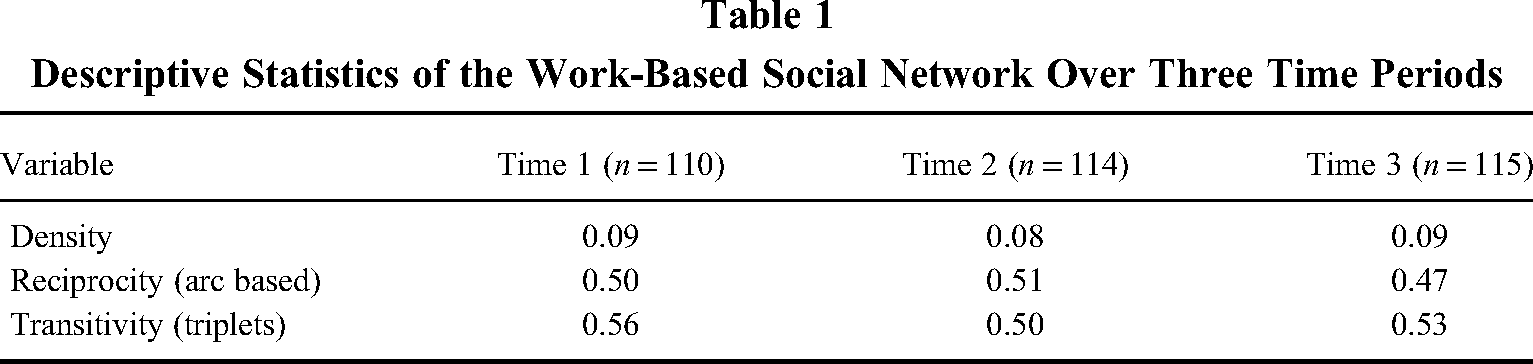
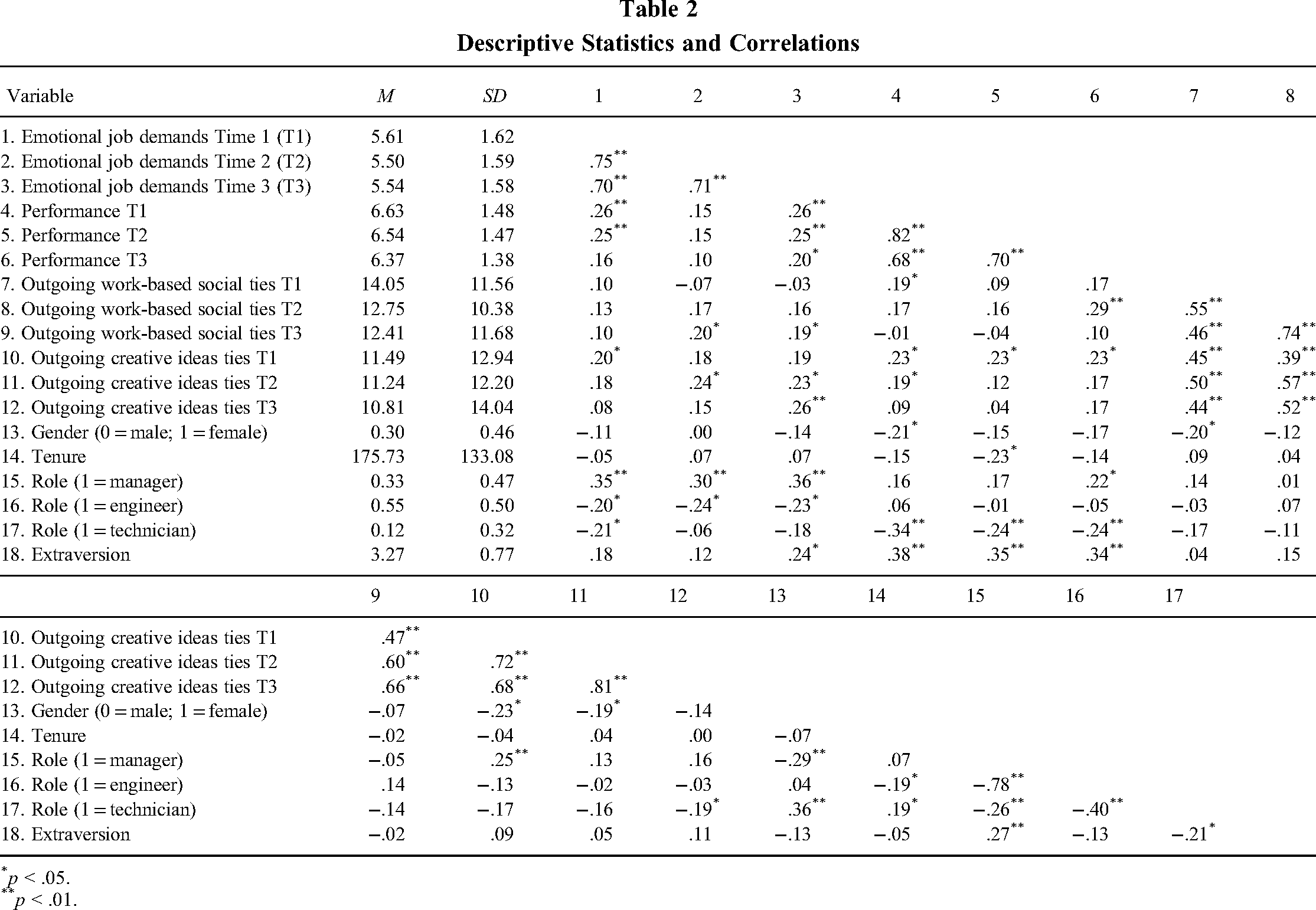
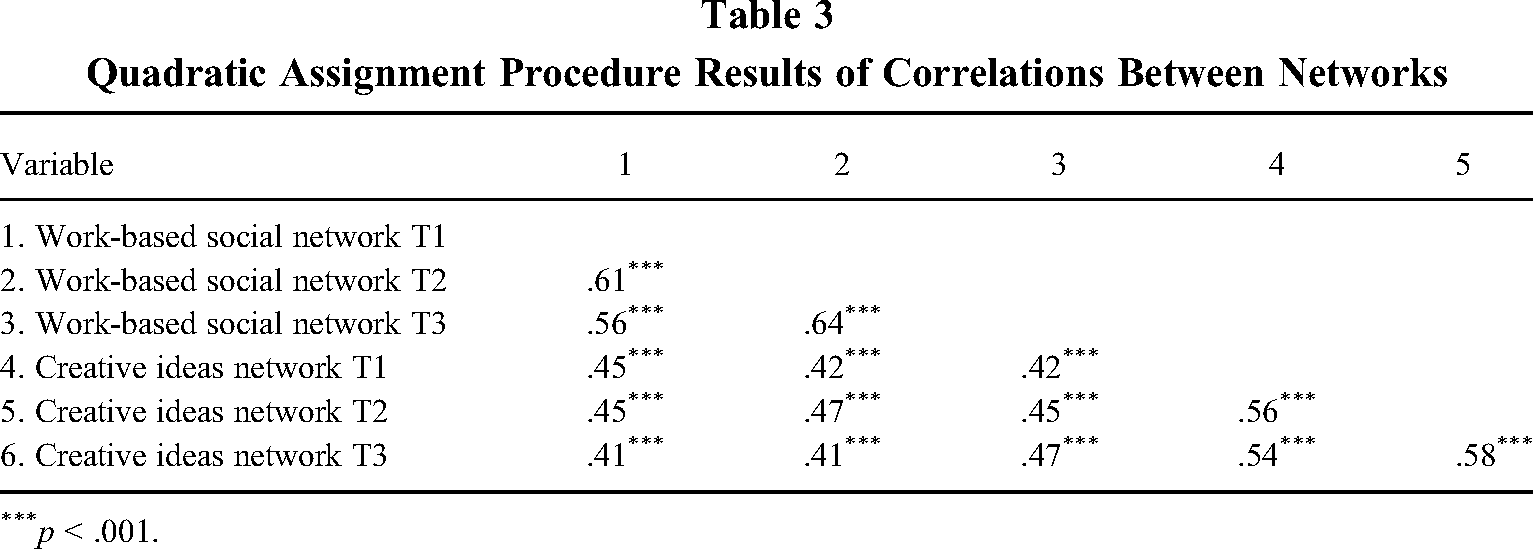
Table 1 includes the network descriptive statistics for each of the three time periods. As our network-level statistics show, people are slightly less connected in T2 in the work-based social network than in T1 and T3 (average density of 0.09 in T1, 0.08 in T2, and 0.09 in T3). As shown in Table 1, the statistics for reciprocity and transitivity are similar across the three time periods. In Table 2, we detail the descriptive statistics and correlations for the variables. As expected, the variables measured at the three different time points are highly correlated. In addition, the two network variables are also correlated. This is confirmed in Table 3, where we detail quadratic assignment procedure correlations for the two networks. This is to be expected and is not a cause for concern when using the SIENA analytical framework.
Descriptive Statistics of the Work-Based Social Network Over Three Time Periods
Descriptive Statistics and Correlations
p < .05.
p < .01.
Quadratic Assignment Procedure Results of Correlations Between Networks
p < .001.
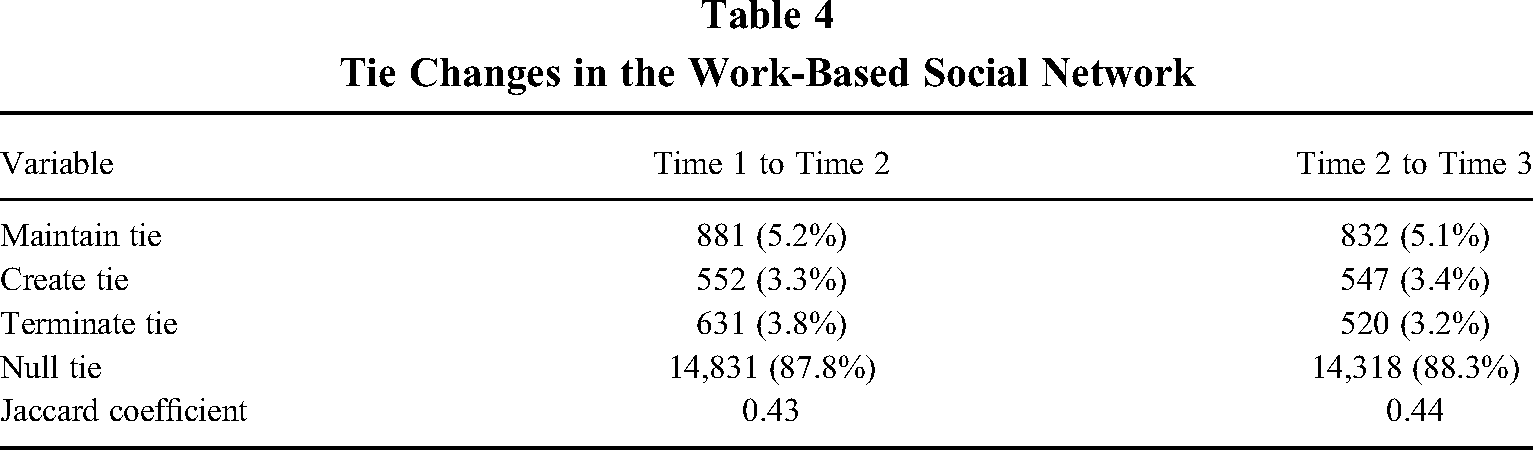
Table 4 details tie changes over time in the work-based social network. The percentage of dyads that have no tie between them is 88% in both waves of the data. Ties created are 3% and ties terminated ranges from 3% to 4%. The remaining 5% of ties are maintained over time. The extent to which the network changes over the three periods is measured by the Jaccard coefficient (Snijders et al., 2010). The coefficients values are 0 if all ties change and 1 if all ties remain the same. The Jaccard coefficients are 0.43 and 0.44 for Wave 1 and Wave 2, respectively. This is within the acceptable range for SIENA models (Ripley et al., 2021).
Tie Changes in the Work-Based Social Network
To ensure that our model appropriately represents our data, we checked for convergence. The absolute values of our convergence t ratios are all <0.06, which is less than the suggested absolute value of 0.1, and the overall maximum convergence ratio is 0.17, which is below the maximum suggested value of 0.25 (Ripley et al., 2021). We also ran goodness-of-fit tests, notably, indegree, outdegree, and geodesic distributions of the work-based social network, and we found that our statistical estimation is a good fit for the actual changes in the data. Specifically, the Monte Carlo Mahalanobis distance test p values are all above .05 (Ripley et al., 2021).
The parameter estimates in the SIENA modeling framework are log-odds ratios, indicating the probability of a person changing their network or their behavior in a particular way. In the network part of the model, a positive log-odds ratio for any of the variables in our model indicates a higher probability of keeping an existing work-based social tie or building a new work-based social tie, that is, a higher tendency for network engagement. Alternatively, a negative value represents a tendency for dropping, or not creating, work-based social relationships, that is, a higher tendency for network disengagement. In the behavioral part of the model, a positive value indicates an increase in the specific behavior, that is, emotional job demands or employee performance, and a negative value a decrease in the behavior.
Emotional Job Demands Dynamics
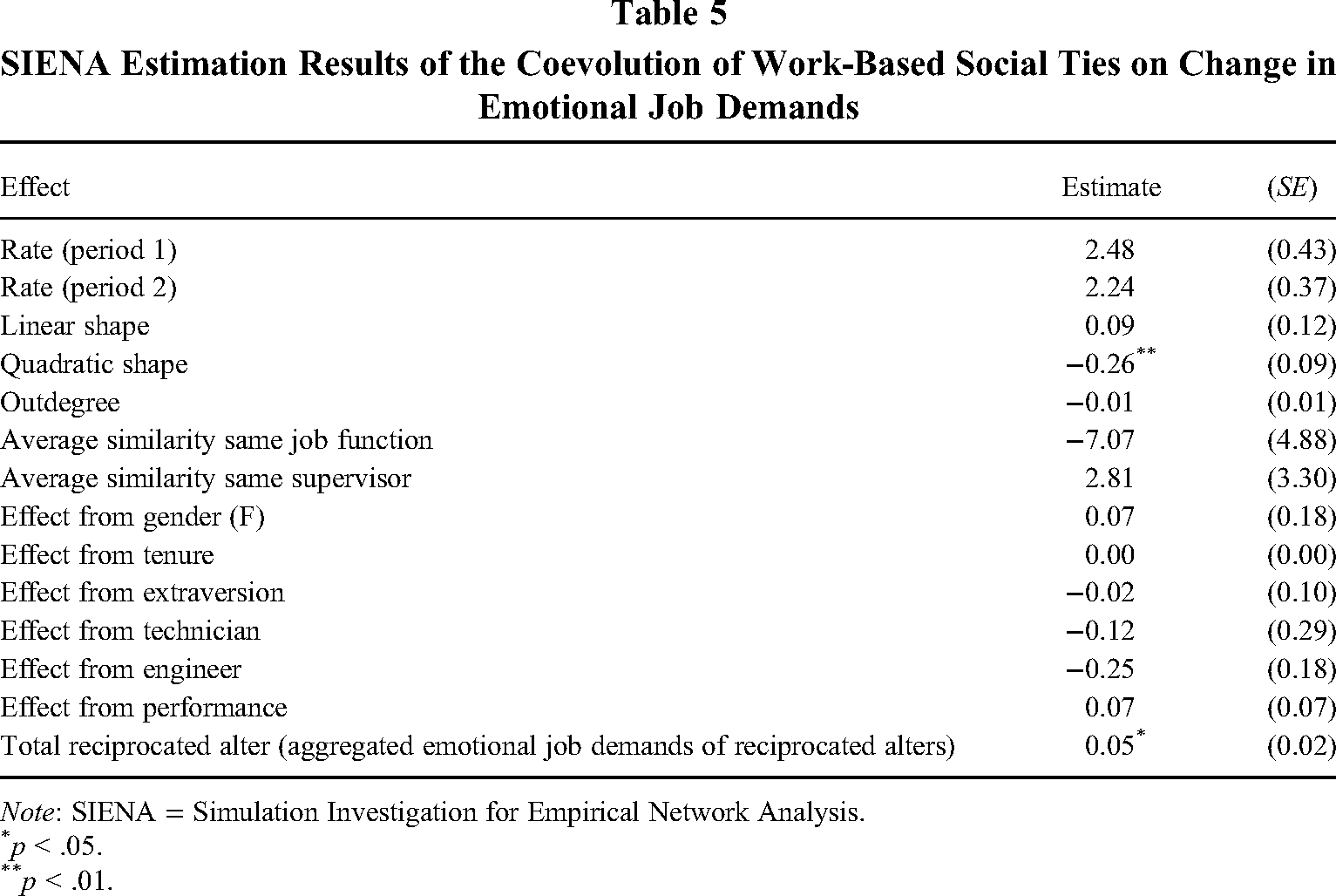
In the part of the model predicting change in emotional job demands, detailed in Table 5, the rate function is lower for T2-T3 than for T1-T2, indicating less opportunity for behavioral change in the second wave of data.4 The linear shape effect is positive but not significant, and the quadratic shape is negative and significant. Overall, this suggests an inverse U-shaped curve with the rate or growth of behavior declining as it gets to higher levels, indicating that there is self-regulation with respect to emotional job demands. The other controls are not significant.
SIENA Estimation Results of the Coevolution of Work-Based Social Ties on Change in Emotional Job Demands
Note: SIENA = Simulation Investigation for Empirical Network Analysis.
p < .05.
p < .01.
The total reciprocated alter effect is positive and significant (β = 0.05, SE = 0.02, p = .016), indicating that the higher the aggregated emotional job demands of individuals that a person is reciprocally connected to, the more likely an employee is to have an increase in their emotional job demands. This provides support for Hypothesis 1 and suggests that social contagion does occur for emotional job demands.
Work-Based Social Network Dynamics
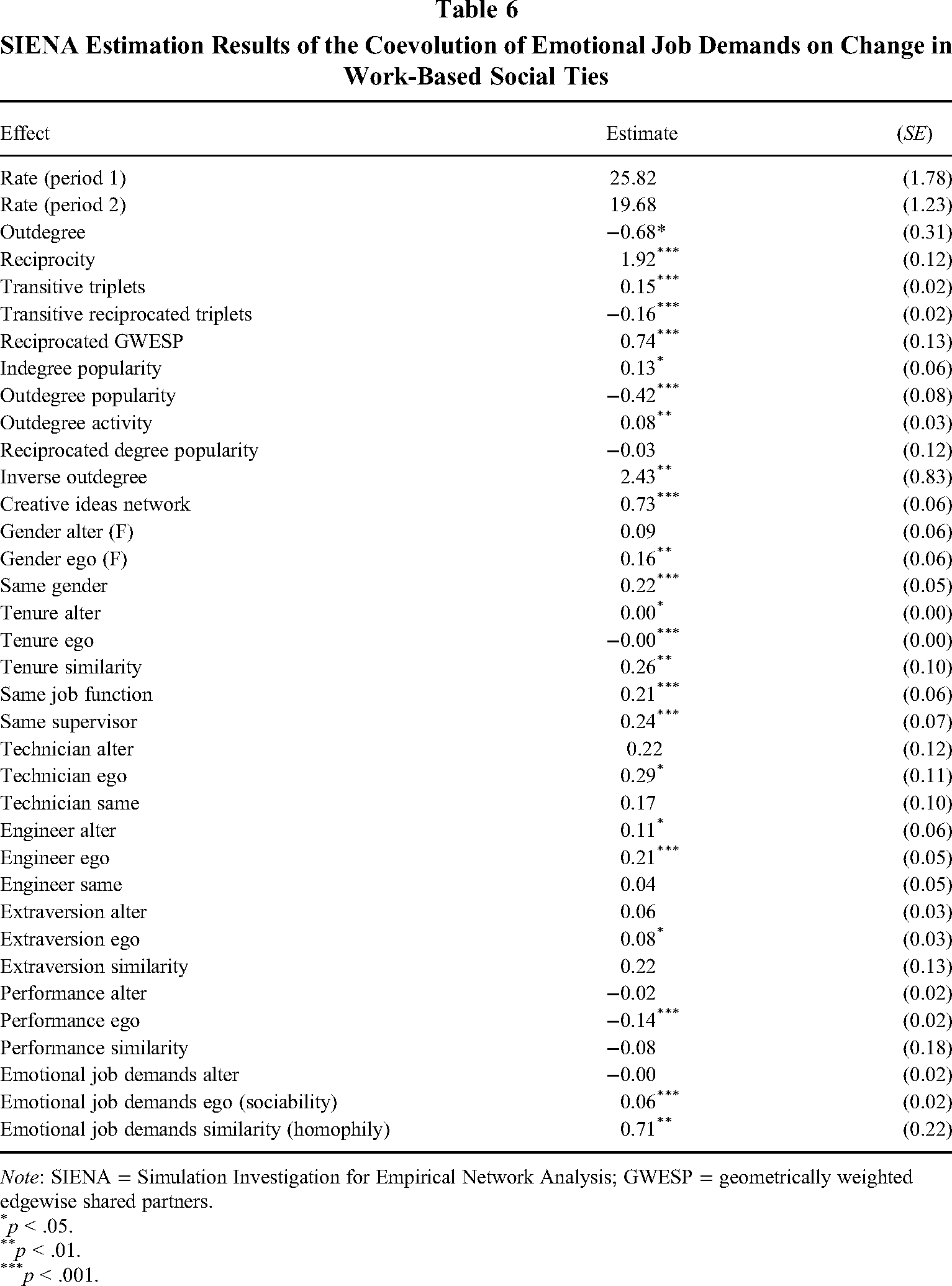
In Table 6, we detail the SIENA model for predicting the changes in the work-based social network. The rate parameter figure is 25.82 for the first wave and then 19.68 for the second wave, indicating over time a decrease in the average number of opportunities for network change. The outdegree parameter is, as expected, negative and significant, as people have work-based social ties with less than 50% of others in the network. The reciprocity parameter is positive and significant, indicating that in general, work-based social relationships are reciprocated within dyads. This is as expected, as work-based social relationships will often fade away if both individuals do not see a reciprocation of work-based social ties. Our transitive triplets parameter is also positive and significant, indicating a tendency for closure in the network. Again, it is not surprising that people introduce their work-based social ties to each other within an organization. Our reciprocated GWESP parameter is positive and significant, suggesting a tendency for closure where the paths between the focal individual and the work-based social colleague of a colleague are reciprocated. However, our transitive reciprocated triplets parameter is negative, indicating that reciprocity does not necessarily occur between the focal individual and the work-based social colleague of a colleague. In our degree-related measures, indegree popularity has a positive and significant parameter, suggesting that people with a large number of others who seek them out as work-based social ties continue to be sought out over time. Outdegree activity is also positive and significant, as those who seek many work-based social ties continue with this tendency over time. However, the negative outdegree popularity parameter indicates that those who seek many work-based social ties are not necessarily sought out by others.
SIENA Estimation Results of the Coevolution of Emotional Job Demands on Change in Work-Based Social Ties
Note: SIENA = Simulation Investigation for Empirical Network Analysis; GWESP = geometrically weighted edgewise shared partners.
p < .05.
p < .01.
p < .001.
Our creative ideas dyadic covariate is positive and significant, indicating that employees who seek each other out for creative ideas also have work-based social ties. Of the individual covariate measures in Table 6, we find same gender to be positive and significant, suggesting a homophily effect by gender. There is also a significant homophily effect for tenure similarity. In addition, our dyadic covariates same job function and same supervisor are positive and significant; this suggests that employees have a tendency to make work-based social ties with people within their own job function or who have the same supervisor. Of the ego and alter effects, we find that females have a higher tendency for work-based social ties compared with males (gender ego [F]). People who have higher tenure have more people who seek them out as work-based social ties (tenure alter), but they seek fewer others out for work-based social ties (tenure ego). Extraversion ego is positive and significant, indicating extraverts have a higher tendency for work-based social ties. Performance ego is negative and significant, suggesting that employees with higher performance have a lower tendency to make work-based social ties. This was surprising, and we revisit this in the Discussion. Finally, the ego effects for technicians and engineers indicate that compared with managers, engineers and technicians have a tendency for more outgoing work-based social ties. This is not surprising, as combing a managerial role and work-based social relationship can complicate reporting relationships.
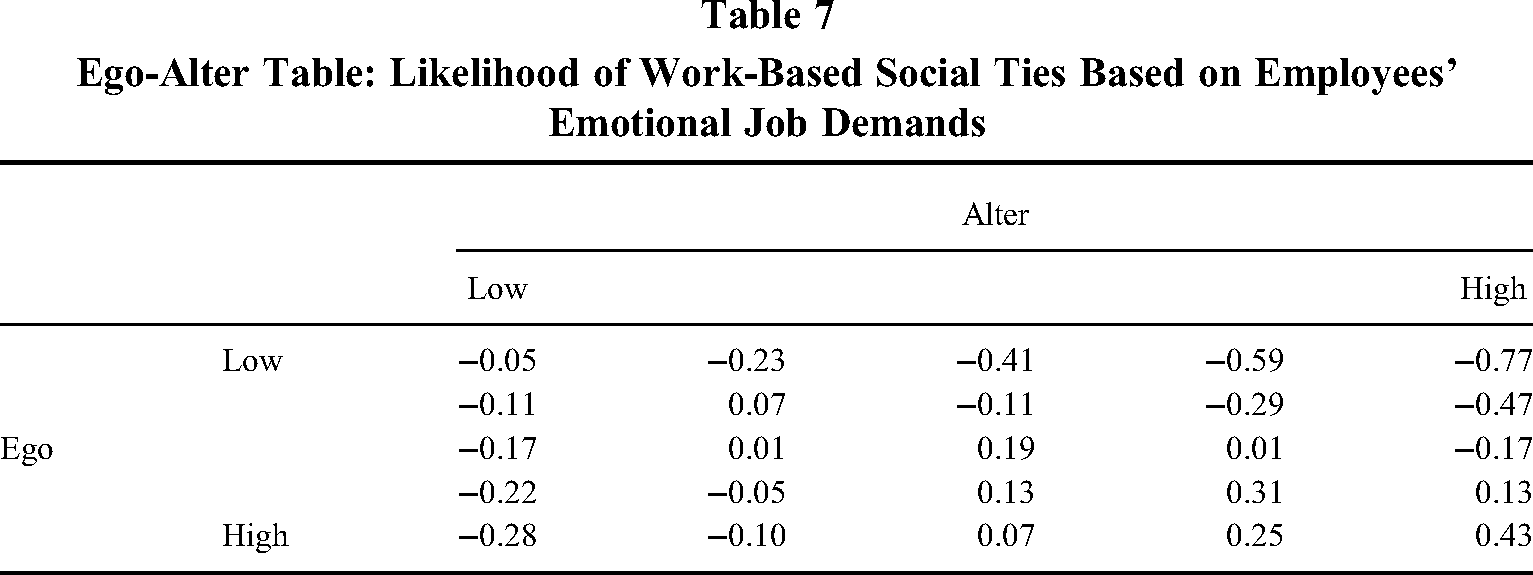
We find that emotional job demands ego is positive and significant (β = 0.06, SE = 0.02, p = .001), which provides support for Hypothesis 2. Individuals with higher emotional job demands have a greater tendency for sociability, that is, more work-based social ties, than individuals with lower emotional job demands. Emotional job demands homophily (emotional job demands similarity) is also positive and significant (β = 0.71, SE = 0.22, p = .001). To understand the homophily effect for individuals with high emotional job demands, we created an ego-alter table (Snijders et al., 2010). Table 7 shows that individuals with high emotional job demands have a positive tendency for work-based social ties with others who also have high emotional job demands (bottom right of the table). This provides support for Hypothesis 3.
Ego-Alter Table: Likelihood of Work-Based Social Ties Based on Employees’ Emotional Job Demands
Performance Dynamics
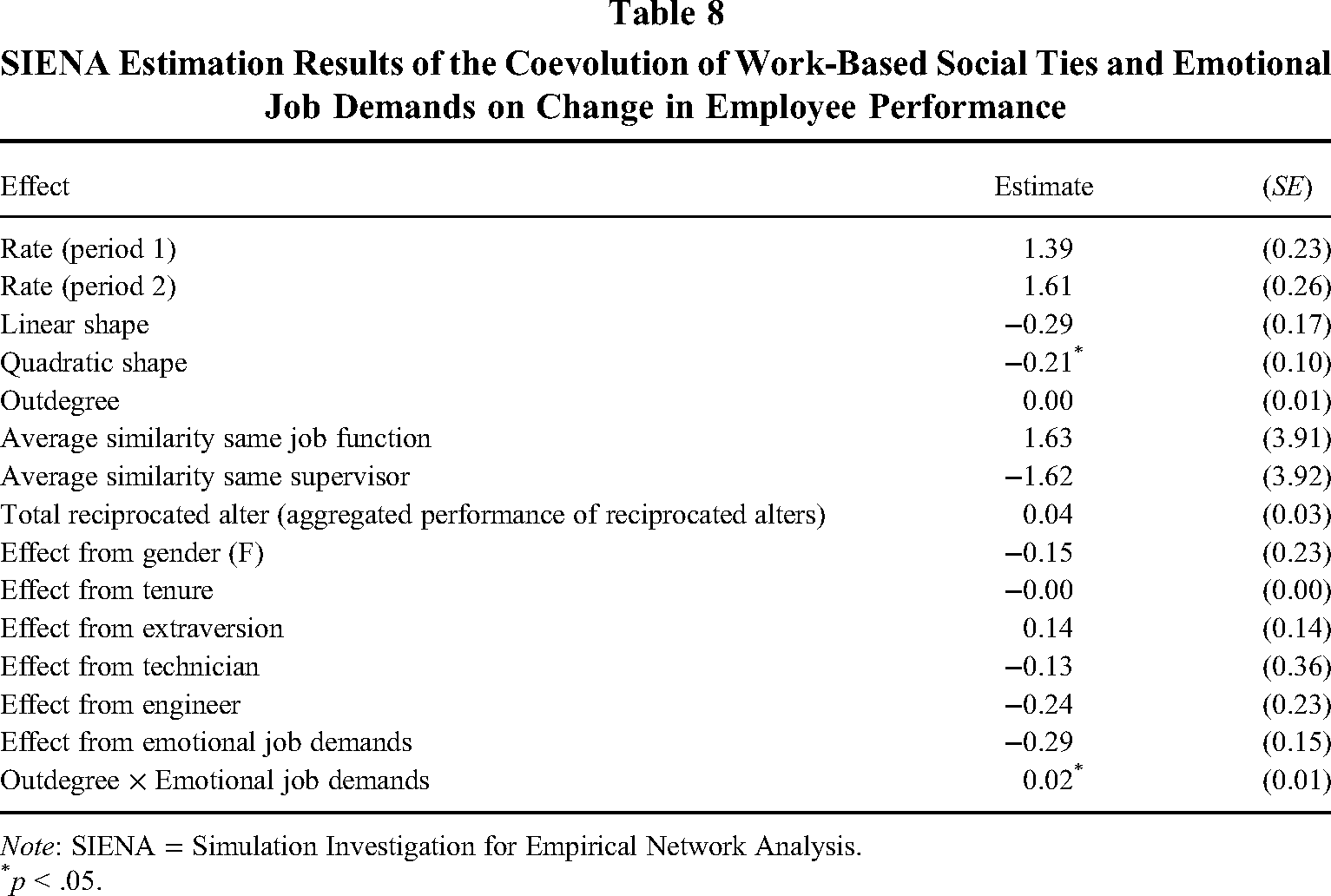
In Table 8 we detail our results predicting changes in employee performance. The rate function is slightly higher for T2 to T3 than for T1 to T2, indicating more opportunity for performance change in the second wave of data. The linear shape effect is negative but not significant, and the quadratic shape is negative and significant. This suggests an inverse U-shaped curve, with the rate or growth of performance declining as it gets to higher levels, indicating that in general, there is self-regulation with respect to performance. The various controls are not significant.
SIENA Estimation Results of the Coevolution of Work-Based Social Ties and Emotional Job Demands on Change in Employee Performance
Note: SIENA = Simulation Investigation for Empirical Network Analysis.
p < .05.
The effect for emotional job demands is negative but not significant (β = −0.29, SE = 0.15, p = .856), while the effect for outdegree is positive and not significant (β = 0.00, SE = 0.01, p = .056). Importantly, the effect for outdegree × emotional job demands is positive and significant (β = 0.02, SE = 0.01, p = .046). We plotted the simple slopes at plus and minus one standard deviation of the mean of emotional job demands to investigate the interaction. Figure 1 shows that emotional job demands has a weaker negative effect on change in employee performance when the number of work-based social ties was high (θ = −.08, p = .567) and a stronger negative effect when the number of work-based social ties was low (θ = −.50, p = .001). Our findings provide support for Hypothesis 4 and suggest that work-based social ties act as a buffer to the potential negative effects of emotional job demands. The negative effect of high emotional job demands on performance is lower for employees who have more work-based social ties.
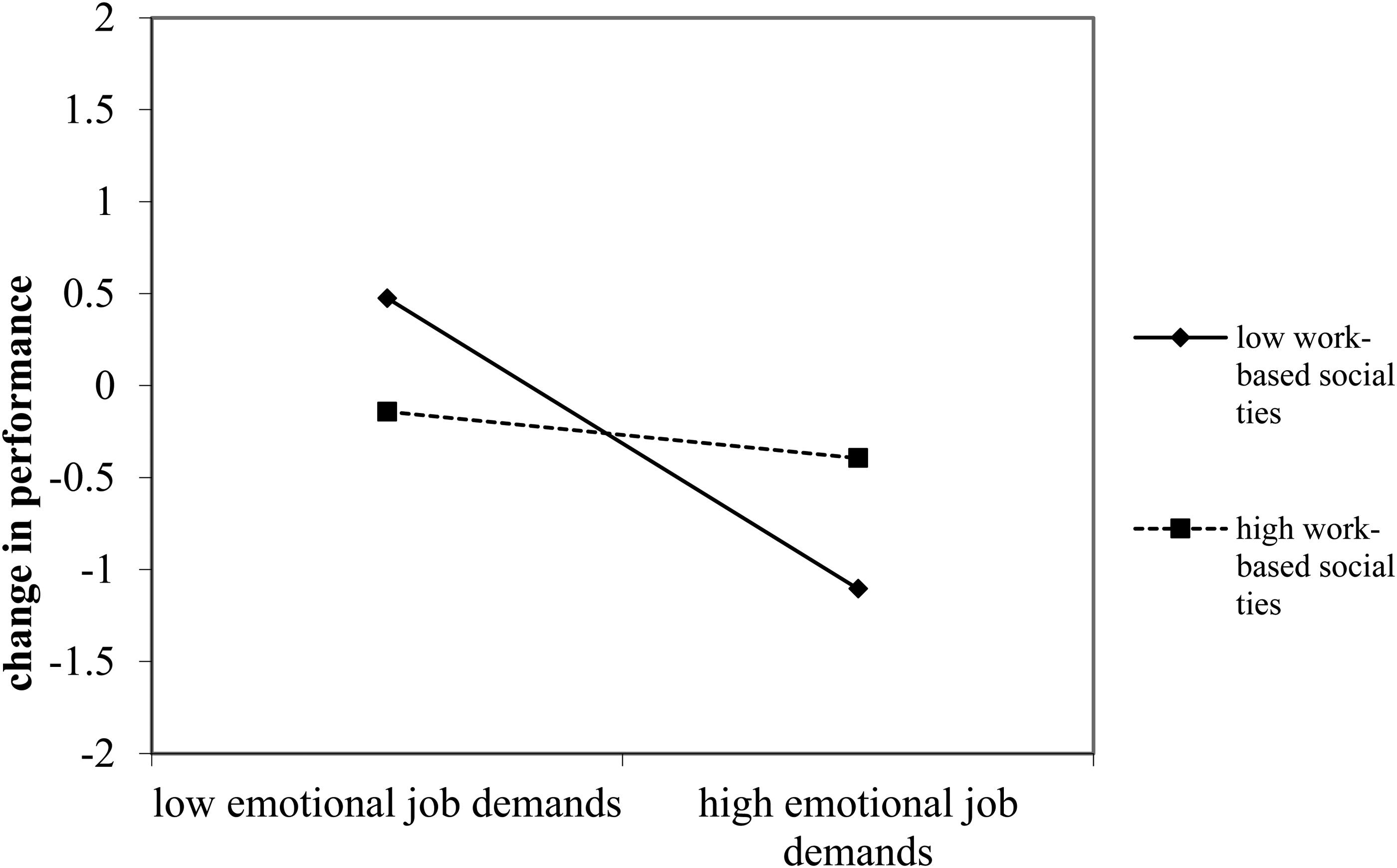
Effect of Emotional Job Demands and Work-Based Social Tie Outdegree on Change in Employee Performance
Discussion
Our results support our coevolutionary theory. There is social contagion of emotional job demands through work-based social ties. In addition, the level of emotional job demands that an individual has influences the way in which they craft their work-based social network. Specifically, individuals with higher emotional job demands have a positive tendency for work-based social ties and to have work-based social ties to others who have higher emotional job demands. However, the negative effect of high emotional job demands on performance is lower for employees who have more work-based social ties; that is, work-based social ties have a buffering effect. Taken together, these results indicate that individuals balance the negative effects of emotional job demands with respect to performance through work-based social ties, even if these ties result in an emotional job demands contagion effect.
Implications for Theory
Our findings add to research on a specific aspect of the JD-R model (Bakker & Demerouti, 2007; Demerouti et al., 2001; Schaufeli & Bakker, 2004). Notably, we examine the buffering hypothesis within the JD-R model and theorize that there is a direct effect between job demands and job resources, an aspect of the JD-R model that has received little attention (Bakker & Demerouti, 2017). Notably, we examine the direct effect between job demands and job resources from a dynamic perspective. We integrate theories of social contagion (Borgatti & Foster, 2003; Centola, 2018; Centola & Macy, 2007; Zhang & Centola, 2019) and social network dynamics (Kalish et al., 2015; Šašovová et al., 2010; Snijders et al., 2010; Tröster et al., 2019) to show how the association between job demands and job resources evolves over time. Specifically, when we examine emotional job demands and the resource of work-based social ties, we find that they coevolve. We also find that having work-based social ties is a double-edged sword with both positive and negative consequences. On the one hand, work-based social ties can transmit emotional job demands through a social contagion process. On the other hand, the negative effect of high emotional job demands on performance is lower for employees who have more work-based social ties. Taken together, these results indicate that work-based social ties act as a buffer to the negative effects of emotional job demands, even if these work-based social ties can diffuse additional emotional job demands. We add to existing literature by showing that the buffering hypothesis (Bakker & Demerouti, 2007) does still hold in the context of our dynamic model. In addition, we add to JD-R theory by examining employee performance as an outcome in a dynamic process. This is different from much of the prior research on job demands and job resources, which has focused on well-being or engagement outcomes (Crawford, LePine, & Rich, 2010). Overall, our research helps to strengthen the theoretical implications of the buffering hypothesis within the JD-R framework.
Our findings also add to network research in general and the growing microfoundations and agency literature (Tasselli et al., 2015; Tasselli & Kilduff, 2021) as well as the coevolutionary view of networks (Kalish et al., 2015; Schulte et al., 2012; Snijders et al., 2007; Tröster et al., 2019). We demonstrate that there is an intertwined association between employee performance, emotional job demands, and work-based social ties. This has interesting implications for issues of endogeneity, that is, whereby factors seen as causing a certain outcome are also partly dependent on the outcome (Borgatti & Halgin, 2011; Steglich, Snijders, & Pearson, 2010). In this article, we theorize and model this feedback loop, as opposed to trying to ascertain causality, which is difficult to discern outside of a laboratory setting. Whereas previous research has tried to tease out the difference between social selection and social influence, for example, through examinations of smoking and drinking and how they relate to network ties (Steglich et al., 2010), we show that a dual process occurs whereby positive work outcomes, such as increases in employee performance, can occur even though negative stimuli, such as emotional job demands, diffuse through work-based social relationships.
One surprising finding in our results is that the performance ego effect is negative and significant, suggesting that employees with higher performance have a tendency for fewer work-based social ties. It is possible that high-performing employees do not see a benefit in work-based social ties or that they face a situation of relational overload (Cross, Rebele, & Grant, 2016) and have chosen to have fewer work-based social ties. High-performing employees often have social networks that span departments (Teigland & Wasko, 2003), and it is possible that, although they may not have a tendency for work-based social ties within the R&D department, they reach out across the organization for work-based social ties.
Future Research
The JD-R model is a heuristic model that is very flexible with regard to what can be tested within its framework. We purposefully chose a job demand, a job resource, and an outcome that we believed would coevolve together over time. There is an opportunity to build upon the ideas in this article and examine other types of demands, relational resources, and outcomes from a dynamic perspective. For example, instrumental ties, such as advice seeking, are different from social ties in that they convey information or knowledge with minimal social content as they are transactional in nature. They could result in feelings of high job demands, but these are more likely to be quantitative demands—for example, needing information as soon as possible—or cognitive demands—for example, having to work on multiple tasks simultaneously. Therefore, emotional job demands are less likely to diffuse through them, although quantitative or cognitive demands may do so. Likewise, there is likely to be minimal effect of high emotional job demands on instrumental network choices, as having instrumental ties does not result in social support or the opportunity to vent. Having high quantitative or cognitive demands may result in changes in instrumental ties. Information and knowledge ties have been shown to result in higher performance (Cross & Cummings, 2004; Sparrowe, Liden, Wayne, & Kraimer, 2001), although they are unlikely to buffer the effects of emotional job demands with respect to employee performance. We conjecture that the association between different types of job demands, different networks, and different work-related outcomes may vary. However, we have no reason to believe that the findings we find support for in this article concerning the association between emotional job demands, work-based social ties, and employee performance would not hold in other work settings.
While we did control for extraversion in our model, we suggest that social networks and JD-R scholars consider topics that bridge these literatures to consider the role of personal resources. For example, personal resources, such as self-efficacy, belongingness, and personality traits, have been incorporated into the JD-R model, and such issues could be examined to see if they moderate the effects we have specified or whether they moderate other job demands, resources, and outcomes. For example, a greater need for belongingness (Baumeister & Leary, 1995) could result in individuals with a tendency for creating more work-based social ties further buffering emotional job demands but also increasing the contagion effect. In addition, when faced with performance demands, individuals may buffer these demands by reaching out to others for advice to help them improve their performance. In this case, having more advice ties (especially with people who themselves have high levels of performance) could result in a performance contagion effect.
Our research raises additional areas for further research. We bounded the network at the department level of this organization, since scholars have shown that support is most valuable when directly relevant to the associated need (Cohen & Wills, 1985). However, a more broad view of people's network may reveal that people also utilize relationships outside of the department or organization for support or venting (Demerouti, Bakker, Geurts, & Taris, 2009; Sonnentag, 2001). For example, research could examine how individuals might increase their number of nonwork social relationships to buffer against different types of work demands, such as emotional job demands or performance demands, and how this relates to outcomes, such as job performance or life satisfaction. In addition, it could be fruitful to examine work–life conflict and how people might increase their number of work-based or non-work-based social relationships to buffer against this type of demand on outcomes, such as life satisfaction.
Practical Implications
We find that there is a tendency for individuals to be influenced by the emotional job demands of those in their work-based social network, and those who have higher emotional job demands have a tendency to seek more ties, particularly to those who have high emotional job demands. However, individuals with high emotional job demands are able to use their work-based social ties as a buffer to the negative effects of emotional job demands on employee performance. This suggests that work-based social ties are a double-edged sword. While the social support that work-based social relations give is beneficial, it is possible that in some cases the negative side of social relationships outweighs the positive (Gargiulo & Benassi, 1999). Job rotation is one tool that managers can use to break apart unproductive relationships. Changes in an employee's role can help restructure a network that an individual might find themselves trapped in. In addition, our research suggests that managers need to think about teams and groups, rather than just individuals, when developing ways in which to decrease the negative outcomes of emotional job demands in the workplace. It is not necessarily just one person in an individual's network who creates a contagion effect but the combined effect of all people in an individual's network. Therefore, moving one person through job rotation may not be effective. Finally, self-awareness or personal effectiveness training can also be beneficial for employees, as this training can create greater understanding of how actions and behaviors can affect those around an individual (Demerouti, Van Eeuwijk, Snelder, & Wild, 2011).
Conclusion
Research on the JD-R model has shown that job resources can act as a buffer with respect to the negative effects of job demands. In this article, we show that there is a coevolutionary association between one type of job demand—that is, emotional job demands—and one type of resource—specifically, work-based social ties. We have utilized social network and social contagion theories to explain this coevolution, and we found support for the role that social ties play in mitigating the negative effects of emotional job demands on employee performance. We hope future research will continue to integrate network theories with issues pertaining to the JD-R framework and the implications this has for employees and organizations.
