



Abstract
Prior research emphasizes the paradoxical nature of coopetition and the need for specialized capabilities—coopetition capability—to deal effectively with opportunities and challenges stemming from the simultaneous pursuit of cooperation and competition and to create superior value. However, we know little about the underlying conceptual properties of coopetition capability (construct clarity) and lack a reliable and valid scale to measure it (construct validity). We conduct a study in three phases to address this critical gap. First, building on paradox literature, we conceptualize coopetition capability as a multidimensional construct reflected by three underlying dimensions: coopetition mindset, analytical acumen, and executional skills. Second, we develop a 15-item psychometrically valid scale using a sample of 647 coopetitive alliances in high-technology sectors. Finally, using a matched sample of 536 coopetitive alliances, we extend the focal construct's nomological network by examining two relationships: coopetition experience's impact on coopetition capability and the effect of coopetition capability on the relationship between the coopetition paradox and value creation. Overall, our paper lays a foundation for deeper theory development and empirical research on coopetition by providing much-needed construct clarity and psychometrically valid measures for coopetition capability.
Firms often engage in relationships that involve simultaneous cooperation and competition with an intent to create value (Gnyawali & Ryan Charleton, 2018; Ketchen, Snow, & Hoover, 2004; Rai, 2016). Contrary to a traditional view in alliance research that considered competition among alliance partners harmful as it could weaken cooperation, limit resource exchange, and increase instability and risk of alliance failure (Das & Teng, 1998, 2000; Hamel, 1991; Kale, Singh, & Perlmutter, 2000; Khanna, Gulati, & Nohria, 1998; Park & Ungson, 2001), more recent perspectives—horizontal alliances (e.g., Belderbos, Gilsing, & Lokshin, 2012; Luo, Rindfleisch, & Tse, 2007; Nault & Tyagi, 2001) and coopetition (e.g., Bengtsson & Kock, 2000; Gnyawali, He, & Madhavan, 2006; Ketchen et al., 2004)—suggest that such behaviors are important and even necessary for managing opportunities and challenges brought about by rapid technological changes, competitive pressures, and demand uncertainties (Ansari, Garud, & Kumaraswamy, 2016; Burgers, Hill, & Kim, 1993; Gnyawali & Park, 2011). However, the simultaneity of the opposing logics of cooperation and competition (Chen, 2008; Gnyawali, Madhavan, He, & Bengtsson, 2016) invariably leads to greater tensions between the alliance partners because of the need to tactfully balance common and private benefits (Gnyawali & Ryan Charleton, 2018). Consequently, managing these relationships effectively is inherently more challenging and demanding (Ansari et al., 2016; Hannah & Eisenhardt, 2018; Hoffmann, Lavie, Reuer, & Shipilov, 2018).
In this respect, scholars have argued that firms need a specialized set of capabilities—coopetition capability—that would help them effectively manage opportunities and challenges stemming from coopetition (e.g., Bengtsson, Raza-Ullah, & Vanyushyn, 2016; Gnyawali et al., 2016; Raza-Ullah, 2020). While existing research has provided several views on the nature of coopetition capability, we lack a strong conceptual and empirical foundation for coopetition capability as a construct (Hoffmann et al., 2018). Accordingly, Hoffmann et al. (2018: 3044) argue that “despite some preliminary qualitative research . . . , little is known about firms’ approaches to managing the tension between competition and cooperation.” Put differently, coopetition capability lacks “construct clarity,” which Suddaby (2010) suggests is critical for any systematic conceptual and empirical research. An equally important and inseparable issue is the lack of a scale that precisely and accurately operationalizes and measures coopetition capability, or what is commonly called “construct validity” (Bacharach, 1989; Bagozzi, Yi, & Phillips, 1991; MacKenzie, Podsakoff, & Podsakoff, 2011). Construct validity is necessary for researchers to “synthesize research and develop normative guidelines for managers” (Boyd, Bergh, Ireland, & Ketchen, 2013: 3). Considering these gaps, we ask the following research questions: (a) What unique features constitute coopetition capability (construct clarity)? and (b) How is coopetition capability operationalized and measured (construct validity)?
We address these questions by drawing on the paradox literature (e.g., Lewis, 2000; Smith & Lewis, 2011; Smith & Tushman, 2005; Poole & Van de Ven, 1989). Among the various approaches to deal with paradoxes (see Lewis, 2000; Lewis & Smith, 2014; Poole & Van de Ven, 1989; Smith & Lewis, 2011 for more details), coopetition research emphasizes adopting the integration approach to deal with paradoxical tensions inherent in coopetition (e.g., Bengtsson et al., 2016; Chen, 2008; Gnyawali et al., 2016). Such an approach entails viewing the opposing forces of cooperation and competition as a duality—“interdependent [as opposed to independent and separate]—both contradictory and complementary” (Farjoun, 2010: 203)—and the interplay of these opposing forces as “interwoven and synergistic” (Andriopoulos & Lewis, 2009: 697). As a result, the integration approach offers an opportunity to combine the paradoxical elements synergistically (Gnyawali et al., 2016; Lado, Boyd, & Hanlon, 1997). However, it also invariably exacerbates the intensity of paradoxical tensions as the inherent contradictions gain more salience when the opposing forces are juxtaposed (Smith & Lewis, 2011). Keeping this in mind, we conceptualize coopetition capability as a firm-level capability that helps firms adopt the integration approach to realize two objectives: leverage the positive potential of the cooperation–competition paradox and manage the resulting paradoxical tensions.
We conduct our study in three phases. First, building on prior literature and drawing insights from managers’ interviews and a focus group, we explicate the conceptual domain of coopetition capability. We posit coopetition capability as a second-order construct reflected by three underlying first-order organizational-level capabilities: coopetition mindset, analytical acumen, and executional skills. Second, we use primary data from 647 coopetitive alliances in high-technology sectors to develop a 15-item psychometrically valid scale for measuring coopetition capability. In the final phase, we use a matched sample of 536 coopetitive alliances to examine coopetition capability in its broader nomological network. Specifically, we show that coopetition experience influences coopetition capability positively and that coopetition capability moderates the relationship between the coopetition paradox and value creation positively.
This paper addresses a critical research gap underscored by Hoffmann et al. (2018: 3037) that “we know little about the unique capabilities required for managing the interplay of competition and cooperation.” We make three important contributions to the literature. First, we provide much-needed construct clarity to the coopetition capability construct by systematically conceptualizing it as a multidimensional construct with unique microlevel processes and organizational routines. Second, we pave the way for more in-depth theorizing and nuanced empirical research on coopetition by developing a psychometrically valid scale that captures the most salient elements of the construct. Finally, we extend the focal construct's existing nomological network and thereby advance a long-standing discussion regarding the nature of coopetition and its role in value creation (Gnyawali et al., 2006; Gnyawali & Ryan Charleton, 2018; Hoffmann et al., 2018; Ketchen et al., 2004; Rai, 2016).
Conceptual Underpinnings for Coopetition Capability
Horizontal Alliances and Coopetition Research: Key Insights and Overlaps
Research on strategic alliances has traditionally viewed cooperation and competition as “separate modes of interaction among firms” (Hoffmann et al., 2018: 3034) and suggests that competitive tension between alliance partners is harmful as it could weaken cooperation, limit resource exchange/knowledge transfer, aggravate risk of opportunistic behavior, and increase instability and susceptibility to alliance failure (Arslan, 2018; Das & Teng, 1998; 2000; Hamel, 1991; Kale et al., 2000; Khanna et al., 1998; Park & Russo, 1996; Park & Ungson, 2001). More recently, however, two overlapping but distinct streams of research have evolved, arguing that alliance partners often cooperate and compete simultaneously to generate mutually beneficial outcomes (Hoffmann et al., 2018): horizontal alliances, referred to as “alliances between competitors” operating at the same level in the industry value chain (Belderbos et al., 2012: 1813; also see, Burgers et al., 1993; Gimeno, 2004; Luo et al., 2007; Nault & Tyagi, 2001; Oxley, Sampson, & Silverman, 2009), and coopetition, referred to as “simultaneous competition and cooperation among firms with value creation intent” (Gnyawali & Ryan Charleton, 2018: 2513; also see Bengtsson & Kock, 2000; Gnyawali et al., 2006; Ketchen et al., 2004).
Both streams of research generally agree on the motivations for forming such interfirm relationships (Belderbos et al., 2012; Gnyawali & Ryan Charleton, 2018; Lado et al., 1997). Specifically, firms enter into such alliances for developing new technologies and products in response to the convergence of technologies, shortened product life cycles, and emergence of new technologies (Belderbos et al., 2012; Burgers et al., 1993; Gnyawali & Park, 2011), learning and gaining access to critical resources and capabilities (Burgers et al., 1993; Gnyawali & Park, 2009), entering new markets and reducing uncertainty (Burgers et al., 1993; Gnyawali & Park, 2009), mitigating competitive pressure due to decline or maturity of an industry (Luo, 2007), improving competitive position (Gnyawali & Park, 2009), and/or reducing costs and sharing risks (Fernandez, Le Roy, & Chiambaretto, 2018; Gnyawali & Park, 2011).
Similarly, despite these advantages, both research streams also agree that pursuing such interfirm relationships is inherently more challenging (Gnyawali & Ryan Charleton, 2018; Hamel, 1991; Hannah & Eisenhardt, 2018; Hoffmann et al., 2018). The reason is that simultaneity of the contradictory forces of cooperation and competition—cooperation facilitates alignment of objectives while competition promotes the pursuit of private agendas (Gnyawali & Park, 2009; Kale et al., 2000; Khanna et al., 1998)—invariably results in greater tensions between the alliance partners (Ansari et al., 2016; Das & Teng, 2000; Hamel, 1991; Hoffmann et al., 2018; Luo et al., 2007). Such relationships are more susceptible to failure (Park & Russo, 1996) as they face greater risks of opportunistic behavior, including appropriation of a partner's critical resources (Das & Teng, 1998; Lavie, 2006) and undesirable knowledge spillovers, reduced commitment, limited resource sharing, misalignment of incentive structure, and/or free ridership (Belderbos et al., 2012; Gnyawali & Park, 2009; Kale et al., 2000; Khanna et al., 1998).
Therefore, how firms manage the tensions that stem from the pursuit of simultaneous cooperation and competition is a matter of central concern in both streams of research (Hoffmann et al., 2018). In this respect, prior research has identified two broad approaches to managing the tensions in such relationships: separation or integration of contradictory elements (Poole & Van de Ven, 1989). In the separation-based approaches, partners may pursue (a) organizational separation where alliance partners employ different organizational units or teams to engage in cooperation and competition elements. For example, in the Apple-Samsung relationship, while the sales teams of both firms compete fiercely to capture greater smartphone market share, the supply chain teams of both firms simultaneously collaborate to facilitate the timely supply of components from Samsung to Apple (Brandenburger & Nalebuff, 2021). Next, partner firms may pursue (b) domain separation, where they engage in simultaneous competition and cooperation but these activities take place in different domains (e.g., product lines, geographical markets, or value chain activities). For example, in 2013, Ford and GM agreed to share the transmission technologies at the R&D stage but competed in manufacturing operations (Brandenburger & Nalebuff, 2021). Finally, there is (c) temporal separation, where partners switch between cooperation and competition over time. For example, Volkswagen follows a cooperative approach with a preferred supplier while designing and developing a part but induces price competition among its global suppliers while procuring it (Wilhelm & Sydow, 2018).
Scholars, however, argue that separation-based approaches suffer from one major limitation. Even if firms employ organizational, domain, or temporal separation for buffering competitive elements from collaborative elements of the relationship, the top management still needs to integrate and coordinate their contradictory demands at higher levels, which causes tension (Bengtsson et al., 2016; Eisenhardt, Furr, & Bingham, 2010; Gnyawali et al., 2016). Therefore, scholars recommend the integration approach, which involves combining the contradictory elements of cooperation and competition as interdependent opposites (e.g., Chen, 2008; Hoffmann et al., 2018; Smith & Lewis, 2011). Although the notion of interdependence between cooperation and competition is a key concept in horizontal alliance literature for explaining various outcomes (e.g., formation of countervailing alliances [Gimeno, 2004] or effect on firms’ value in alliances with rivals [Oxley et al., 2009]), this stream of literature has surprisingly paid little attention to examining the integration approach for managing tensions stemming from the simultaneity of cooperation and competition. Next, we describe how recent coopetition research is beginning to address this gap (e.g., Bengtsson et al., 2016; Gnyawali et al., 2016).
Paradoxical Tensions in Coopetitive Alliances
Drawing from paradox literature (e.g., Lewis, 2000; Poole & Van de Ven, 1989; Smith & Lewis, 2011; Smith & Tushman, 2005), coopetition scholars suggest that coopetition at its core involves a cooperation-competition paradox (Bengtsson et al., 2016; Gnyawali et al., 2016; Raza-Ullah, 2020), where a paradox consists of “contradictory yet interrelated elements that exist simultaneously and persist over time” (Smith & Lewis, 2011: 382). Moreover, the central concept in any paradoxical situation is tension, which emerges because contradictory elements “seem logical when considered in isolation, but irrational, inconsistent, and even absurd when juxtaposed” (Smith & Lewis, 2011: 387). Thus, the key to managing these relationships is to understand and address this paradox and the resultant paradoxical tension for realizing the potential opportunities of synergistic value creation (Arslan, 2018; Gnyawali & Ryan Charleton, 2018; Lado et al., 1997; Park & Ungson, 2001) and for minimizing any increased susceptibility to alliance failure and value destruction (Gnyawali & Ryan Charleton, 2018; Hoffmann et al., 2018; Park & Russo, 1996).
In this respect, alliance partners may adopt an integration approach that involves “developing a wholly new conception” that supersedes the oppositional elements (Poole & Van de Ven, 1989: 573) and emphasizes synergistic combination. Specifically, integration requires that managers view seemingly opposing forces as a duality: “while [the individual elements are] conceptually distinct [and contradictory], [they] are no longer separate but, rather, are interdependent and potentially compatible—mutually enabling and a constituent of one another” (Farjoun, 2010: 205). Such an approach is potentially more rewarding as it enables firms to explore interdependencies and complementarities between the contradictory elements, leveraging the “energizing potential” of a paradox (Andriopoulos & Lewis, 2009: 702). However, it also invariably accentuates the paradoxical tension because the inherent contradictions between the opposing forces gain more salience when such forces are juxtaposed (Smith & Lewis, 2011). As a result, firms would likely find that integration is “cognitively and administratively taxing” and adopting it successfully is far from a straightforward process (Hoffmann et al., 2018: 3043).
For these reasons, prior coopetition research argues that a set of specialized capabilities—coopetition capability—is required to help firms adopt the integration approach effectively (e.g., Bengtsson et al., 2016; Gnyawali et al., 2016). A question may arise at this point: why is coopetition capability necessary when a well-established construct of alliance capability already exists? Although alliance capabilities (Schilke & Goerzen, 2010) are important in coopetition alliances, they are not specifically purposed or equipped to help firms understand and manage the coopetition paradox, particularly with respect to the integration approach. We argue that coopetition capability with its underlying routines and mechanisms would fill this critical need, thus enabling alliance partners to leverage the cooperation-competition paradox in a way that creatively “captures both extremes” (Eisenhardt, 2000: 703) and manages the resultant paradoxical tensions (Bengtsson et al., 2016; Gnyawali et al., 2016). A body of work has begun to give shape to the coopetition capability construct along these lines. However, we still lack a clear understanding of coopetition capability's underlying conceptual properties (Hoffmann et al., 2018). Next, we provide a critical review of extant research on coopetition capability and build on this review to systematically develop the construct.
Phase I: Conceptualizing Coopetition Capability
Coopetition Capability: A Review and Assessment of Existing Research
Gnyawali and Park (2011) first introduced the concept of coopetition capability, noting the role of coopetition mindset, coopetition experience, and superior and complementary resources. Building on these notions, Gnyawali et al. (2016) then conceptualized coopetition capability as paradox management capability consisting of two dimensions: analytical capability and executional capability. Analytical capability enables firms to understand the coopetition paradox cognitively, and executional capability helps to deal with the paradox. Relatedly, Bengtsson et al. (2016: 22) conceptualized coopetition capability as a unidimensional construct and defined it as “the ability to think paradoxically and to initiate processes that help firms attain and maintain a moderate level of tension, irrespective of the strength of the paradox.” In a more recent work, Bengtsson, Raza-Ullah, and Srivastava (2020: 3) broadened the concept by arguing that coopetition capability is “a firm's ability to (a) understand the paradoxical nature of coopetition, (b) develop a repertoire of alternative strategies, and (c) make timely and accurate strategic decisions to balance the contradictory demands.” Similarly, Raza-Ullah (2020: 6) conceptualized it as a two-dimensional construct: “emotional capability (i.e., the organizational ability to recognize, accept, and embrace conflicting emotions) and balancing capability (i.e., the organizational ability to balance competing demands without jeopardizing the common objectives).” For details on existing studies on coopetition capability, see Table A1 in the online supplement. Table 1 provides an index of all the supplementary material available at http://xxx.sagepub.com/supplemental.
Index of Material in the Online Supplement
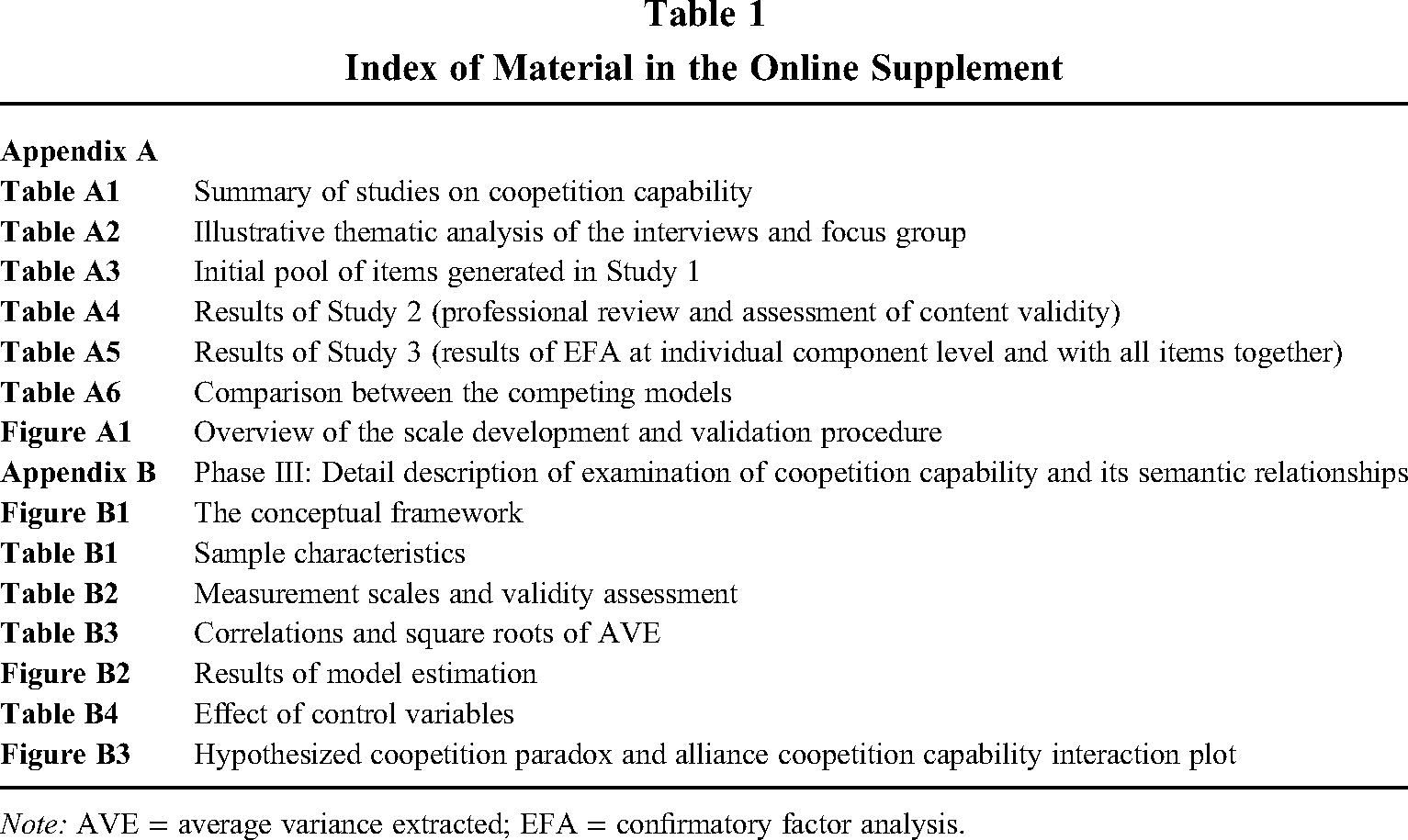
Note: AVE = average variance extracted; EFA = confirmatory factor analysis.
These prior works provide useful insights in understanding coopetition capability, but existing definitions and conceptualizations are ambiguous and often contradictory, thereby undermining construct clarity. For example, while prior experience is often viewed as an antecedent of alliance capability (Heimeriks & Duysters, 2007; Kale, Dyer, & Singh, 2002; Schilke & Goerzen, 2010), Gnyawali and Park (2011) and Bengtsson et al. (2016) view prior coopetition experience as part of coopetition capability. This contradicts the idea that the construct definition should not incorporate antecedents or outcomes (Suddaby, 2010). Similarly, confusion exists whether coopetition mindset is a distinct element (Gnyawali & Park, 2011), is a part of analytical capability (Gnyawali et al., 2016), or is at all an element of coopetition capability (Bengtsson et al., 2016). Furthermore, whereas Raza-Ullah (2020) conceptualized balancing capability as a combination of analytical capability and executional capability, Gnyawali et al. (2016) considered analytical and executional capability as distinct elements. Besides, Raza-Ullah (2020) draws from emotional ambivalence literature to conceptualize emotional capability as a specific component of coopetition capability. However, emotion could be a part of cognition per the paradox literature (Smith & Lewis, 2011; Smith & Tushman, 2005), which is consistent with the coopetition mindset as conceptualized by other researchers (e.g., Gnyawali & Park, 2011; Bengtsson et al., 2020). Finally, superior and complementary resources noted initially as a part of coopetition capability (Gnyawali & Park, 2011) are not really unique to coopetition or the integration approach, as they are important even in the context of strategic alliances (Lambe, Spekman, & Hunt, 2002; Madhok & Tallman, 1998).
As such, existing conceptualizations of coopetition capability are loose and fragmented. The overall confusion about the definitions, nature, and dimensions of coopetition capability implies that it lacks what Suddaby (2010) calls construct clarity. This lack of clarity, in turn, impedes the design and conduct of empirical research, hindering confidence in empirical findings related to the construct (Ketchen, Ireland, & Baker, 2013), which also highlights the issue of construct validity (Bacharach, 1989; Bagozzi et al., 1991; MacKenzie et al., 2011). In what follows, we systematically address the issue of coopetition capability's construct clarity by providing a precise definition, laying out its scope conditions, and specifying semantic relationships with related constructs in its nomological network. In doing so, we also address the issue of construct validity by developing a valid and reliable scale to measure coopetition capability (Bacharach, 1989; Bagozzi et al., 1991; MacKenzie et al., 2011).
Conceptual Domain and Definition of Coopetition Capability
We conceptualize coopetition capability as a three-dimensional construct: coopetition mindset, analytical acumen, and executional skills. We develop this conceptualization by building on (a) the insights from the literature review and (b) qualitative analysis of several practitioners’ semistructured interviews (with 13 senior executives: 4 from the pharmaceutical industry and 3 each from the power and energy, telecommunication, and information technology industries) and a focus group (with four senior executives) during August to October 2014. Interviews help researchers gain a better understanding of a relatively undefined and ambiguous phenomenon (Suddaby, Bruton, & Si, 2015). Our analysis revealed a match between the aspects of coopetition capability discussed in prior literature and those that emerged from the qualitative analysis: the pursuit of coopetition entails having an appropriate mindset to recognize and accept the paradox, readiness and ability to evaluate the paradoxical situation and devise appropriate strategic actions, and ability to choose and implement the most appropriate response and adapt as the paradoxical situation changes. (Table A2 in the online supplement presents central themes that emerged from the qualitative data analysis).
Coopetition mindset
Coopetition mindset is about having a shared firm-level mental model that recognizes and embraces the paradox at the core of coopetition (Gnyawali et al., 2016). Such shared mental models are instrumental in channeling and distributing top management's attention (Ocasio, 1997) and shaping firms’ behavior in two important ways. First, mental models that view the simultaneous pursuit of competing forces as interdependent and potentially compatible (Farjoun, 2010; Smith & Lewis, 2011)—as opposed to irreconcilable opposites—help develop a more comprehensive view of underlying opportunities and challenges. Second, such models may also help in accepting the paradoxical tensions and seemingly conflicting goals and objectives pursued by the coopetition partners (Lado, Boyd, Wright, & Kroll, 2006; Luo, 2007), which may in turn spur creative thinking and lead to superior outcomes. In sum, coopetition mindset helps firms exploit synergies and create win-win situations by “combating natural, often counterproductive tendencies to over rationalize or avoid tensions” (Andriopoulos & Lewis, 2009: 709).
A chief operating officer of a large telecommunication firm describes such a mindset: Initially, the team members had serious doubts about the feasibility of this project. . . . They were not sure whether to collaborate or compete. However, our top management was fully convinced that collaboration with this particular competitor offers us advantages even though there may be greater risks. . . . Collaboration with other non-competitor firms could not offer such advantages. The CMD asked us to be prepared to face the tensions that would come up in this alliance.
Building on these insights, we define coopetition mindset as the ability of a firm to recognize and accept cognitively the paradoxical nature of coopetition. Coopetition mindset is akin to paradoxical cognition, which has two elements—cognitive processes and paradoxical frames (Smith & Tushman, 2005). While cognitive processes relate to how managers perceive, interpret, and act on information (Smith & Tushman, 2005), paradoxical frames provide “a foundation for cognitive processes that can handle inconsistencies” (Smith & Tushman, 2005: 527). The key elements in this definition are “paradoxical nature,” “recognize,” and “accept.” We have described in detail the “paradoxical nature” of coopetition. So, we now turn our attention to the latter two elements. Recognition entails an understanding that coopetition is about exploring the potential for interdependencies, complementarities, and interrelatedness between cooperation and competition (Gnyawali et al., 2016), whereas acceptance is about knowingly embracing cooperation and competition as a duality; that is, the paradoxical elements are contradictory but also mutually enabling and inseparable (Chen, 2008; Farjoun, 2010).
Analytical acumen
Coopetitive alliances are highly dynamic relationships, requiring the alliance partners to constantly evaluate emerging situations and develop alternative response strategies so that unproductive conflict and paradoxical tensions are mitigated. Since the competing demands result in paradoxical tensions that persist throughout the life of an alliance (Hannah & Eisenhardt, 2018), addressing such tensions requires ongoing responses rather than one-time resolution (Lewis, 2000). Thus, analytical acumen is about the firm's ability to perform an in-depth examination of the paradoxical situations, explore ways of dealing with them, and develop appropriate creative strategies to manage the paradoxical tensions.
A senior executive in the Alliance Function of a large pharmaceutical firm observed: In this alliance, we are collaborating with a competitor on an innovation project. We entered into this relationship knowing well that it is ridden with tensions and difficulties. However, there is no point in merely appreciating that tensions exist. . . . We realized early on that it was better to constantly analyze why these tensions emerged and how to address them.
Building on these insights, we define analytical acumen as the ability of a firm to evaluate the coopetition situation and develop alternative strategic choices to address the paradoxical tensions. The key elements in this definition are “evaluate” and “develop alternative strategic choices.” Coopetitive relationships entail pursuing cooperative and competitive strategies simultaneously, yet maintaining and implementing such coopetitive strategies in an ongoing manner is challenging and costly (Lado et al., 1997). Therefore, we suggest that analytical acumen consists of mechanisms and processes that facilitate systematic evaluation of paradoxical situations and development of a deeper understanding of ways in which the opposing forces influence coopetitive relationships. Furthermore, because the demands from competition and cooperation are contradictory and often changing, analytical acumen is also about exploring various options and developing a more diverse repertoire of creative strategies (Gnyawali & Ryan Charleton, 2018; Lado et al., 1997). Since tensions persist throughout the life of a coopetitive alliance (Hannah & Eisenhardt, 2018), analytical acumen is also about constantly monitoring and evaluating the response patterns (Lewis & Smith, 2014) and developing strategic choices to resolve these tensions on a continuous basis (Lewis, 2000).
Executional skills
Coopetitive alliances are highly dynamic, risky, and challenging, requiring firms to make strategic choices per the evolving situation and implement these strategies effectively to manage the paradoxical situation. Thus, executional skills are about the ability of the firm to make appropriate strategic choices from a set of available alternatives and develop organizational routines and processes to implement the chosen strategy. Executional skills complement coopetition mindset and analytical acumen. In essence, executional skills enable firms to “achieve a dynamic balance (or syncretism) between cooperation and competition strategies” (Lado et al., 1997: 122).
A CEO of a large power and energy firm explained: We are not used to such relationships. . . . We experience high tensions and conflicts. We have different routines and processes. So, we developed new organizational routines and formalized processes to work together. It involved both formal and informal processes. . . . Sometimes because of unforeseen situation, we choose new value creating strategies. We even modified the scope of our relationship.
Building on these insights, we define executional skills as the ability of a firm to make appropriate strategic choices to manage the paradoxical tensions, develop and use routines and processes to implement the strategic choices, and adapt to changing conditions. The key elements in this definition are “make appropriate choices,” “routines and processes,” and “adapt.” Executional skills refer to the ability of firms to make the best possible choice from a repertoire of alternative strategies to address the paradoxical tension (Bengtsson et al., 2020). Firms also build organizational routines and processes—essential building blocks, which form a capability when bundled (Eggers & Kaplan, 2013)—to implement these strategic choices effectively. These routines are geared toward managing mechanisms that are unique to coopetition's “mutual pursuits, resource leverage, safeguarded resources, and relevant commitments” (Gnyawali & Ryan Charleton, 2018: 2514). The consequences of these mechanisms, however, depend on the navigation of simultaneity, which entails maintaining “appropriate intensity of competition and cooperation, and balance between these competing logics” (Gnyawali & Ryan Charleton, 2018: 2514). Thus, executional skills are also about developing organizational routines and processes that help “achieve a dynamic balance between cooperation and competition strategies” (Lado et al., 1997: 122). Since the scope and content of coopetitive relationships are likely to change over time because of the environmental conditions and interaction between the alliance partners (Bengtsson et al., 2020), executional skills include firms’ ability to adapt to evolving situations by developing routines and processes that facilitate change in the structure, scope, and content of alliances (Bengtsson et al., 2016; Gnyawali et al., 2016).
The three capabilities—coopetition mindset, analytical acumen, and executional skills—discussed here are individual elements of coopetition capability. Since “capabilities are complex, structured and multidimensional” (Winter, 2003: 992), we posit that these capabilities fit together coherently in a synergistic manner and contribute to a distinct higher-order capability—coopetition capability. The overall construct of coopetition capability is a blend of cognition (mindset) and behavior. Coopetition capability, because of the interrelated, mutually reinforcing nature of its dimensions, is difficult to buy, imitate, assemble, substitute, or replace (Hunt, 1999: 152). As such, we define coopetition capability as a higher-order capability that enables firms to adopt an integration approach to manage the paradoxical tensions inherent in coopetition.
Coopetition Capability: Scope Conditions and Its Relationship With Alliance Capability
Since no construct is universally applicable, it is important for achieving construct clarity to delineate the contextual conditions under which a given construct will apply (Suddaby, 2010). Although coopetition has been conceptualized and defined in several ways, its key characteristic is the simultaneity of cooperation and competition between two or more actors, giving rise to paradoxical tensions. A paradox and paradoxical tensions will emerge only when there is temporal simultaneity between cooperation and competition that persists over time and the alliance partners intentionally and deliberately instigate such a simultaneity (Smith & Lewis, 2011). However, “not all temporal overlaps between competition and cooperation are the same, nor will they have similar consequences” or result in similar levels of paradoxical tensions (Gnyawali & Ryan Charleton, 2018: 2520). The intensity of paradoxical tension is therefore crucial; it will be high when the intensity of cooperation and competition is simultaneously high (Gnyawali & Ryan Charleton, 2018). In such situations, the coopetition capability construct will assume more salience in managing coopetitive relationships.
Given this understanding, we specify coopetition capability's scope or boundary conditions in terms of the constraints of “space, time, and value” (Suddaby, 2010: 349). Regarding the constraint of space, coopetition may take place across multiple levels: project (e.g., Fernandez et al., 2018), interfirm (e.g., Bengtsson & Kock, 2000; Gnyawali & Park, 2011), portfolio (Bengtsson & Kock, 2014), network (e.g., Gnyawali et al., 2006), and industry ecosystem (e.g., TiVo alliances within US TV industry ecosystem; Ansari et al., 2016). The coopetition capability construct is applicable to all coopetitive relationships where cooperative and competitive activities are identifiable, and the simultaneity between cooperation and competition is manifested between the same actors. It is most salient in the case of interfirm dyadic relationships, as such relationships involve a more complex, direct, and intimate interaction between partners (Gnyawali & Park, 2011). Nevertheless, it would have limited applicability in contexts such as the US TV industry ecosystem (Ansari et al., 2016) where coopetition occurs indirectly (e.g., Actor A cooperating with Actor B and competing with Actor C), resulting in comparatively lower intensity of paradoxical tensions.
Regarding the constraints of value and time (Suddaby, 2010), the coopetition capability construct would be applicable to alliances both horizontal (e.g., joint venture [S-LCD] between Samsung and Sony; Gnyawali & Park, 2011) and vertical (e.g., alliance between Dell and Lenovo [ex-IBM]; Ross & Robertson, 2007), as long as the choice to enter into such a relationship is intentional and deliberate and the competition and cooperation occur simultaneously. By contrast, it would have limited applicability in the context of the value-net models (Brandenburger & Nalebuff, 1996), where the simultaneity of cooperation and competition is rarely with the same firm. Similarly, our coopetition capability construct will not be applicable to other kinds of paradoxical tensions such as the “learning paradox” or “belonging paradox” (Smith & Lewis, 2011: 383) because cooperation and competition are not simultaneous in such cases.
Furthermore, for achieving construct clarity, we clarify the roles of coopetition capability and alliance capability in managing coopetitive relationships. Alliance capability is a higher-order capability comprising organizational routines that enable a firm “to purposefully create, extend, or modify the firm's resource base, augmented to include the resources of its alliance partners” (Helfat et al., 2007: 66). As discussed, coopetition capability is a specialized set of capabilities that enable firms to adopt an integration approach and manage the paradoxical tensions. Thus, the two sets of capabilities serve two different albeit complementary purposes: while alliance capability helps in effecting change in the resource base, coopetition capability enables partners to manage the paradoxical tensions, thus leveraging the benefits and minimizing the risks of pursuing simultaneous cooperation and competition. Although interorganizational coordination routines (Schilke & Goerzen, 2010) help to mitigate the heightened risks of a partner's opportunistic behavior and facilitate exchange of resources by devising appropriate governance mechanisms, coopetition capability plays a different role in helping firms maintain “appropriate intensity of competition and cooperation, and balance between these conflicting logics” (Gnyawali & Ryan Charleton, 2018: 2514). Consequently, as the intensity of paradoxical tensions increases, coopetition capability gains greater salience in helping firms effectively navigate the simultaneity of cooperation and competition by managing these paradoxical tensions to a moderate level (Bengtsson et al., 2016).
Phase II: Scale Development and Validation
We now address the issue of construct validity by developing a psychometrically valid scale (Bacharach, 1989; Bagozzi et al., 1991; MacKenzie et al., 2011) for coopetition capability. We followed the procedures outlined by MacKenzie et al. (2011) and conducted four studies to construct a scale for coopetition capability (Figure A1 in the online supplement provides an overview of the steps).
Study 1: Item Generation
We adopted a deductive approach to develop an initial pool of items that fully represents the conceptual domain of the coopetition capability construct (Churchill, 1979; MacKenzie et al., 2011). Following prior guidelines on scale development (Hinkin, 1995; MacKenzie et al., 2011), we used insights from the existing research on the focal construct and a qualitative study to develop an exhaustive list of items. We also sought the opinions of practitioners and experts (MacKenzie et al., 2011) and modified several items to ensure face validity. We developed 31 items indicating various dimensions of coopetition capability: coopetition mindset = 10 items, analytical acumen = 11 items, and executional skills = 10 items (Table A3 in the online supplement provides the details of the initial pool of items generated in Study 1).
Study 2: Professional Review, Assessment of Content Validity, and Measurement Model
Professional review
Following MacKenzie et al. (2011), we provided the items and a description of coopetition capability to nine academics familiar with coopetition research and 15 coopetition alliance managers. We requested them to classify the items in three groups: retain without modification, retain but modify, and drop. We also encouraged them to suggest new items. As a result, we added seven new, modified four, and dropped seven items, leaving us with 31 items: coopetition mindset = 12, analytical acumen = 11, and executional skills = 8.
Assessment of content validity
To assess the content validity of the items retained after the professional review, we performed two tasks. In Task 1, we presented 31 items and definitions of various coopetition capability dimensions to a new set of six coopetition researchers and eight coopetition alliance managers. We requested them to assign the items to one of the three dimensions of coopetition capability. As coopetition capability is a relatively new construct and has a limited empirical base, we followed Anderson and Gerbing's (1991) procedure to compute two indices on these sorted data: the proportion of substantive agreement (PSA) and substantive validity coefficient (CSV). We retained only those items that had PSA and CSV values ≥ 0.5 (Anderson & Gerbing, 1991).
In Task 2, following the procedures outlined by Hinkin and Tracey (1999), we asked the experts to rate the appropriateness of each item on a 7-point Likert-type scale ranging from 1 (very strongly disagree) to 7 (very strongly agree). Then, we applied a repeated one-way analysis of variance to each item to examine whether the item had the highest score on its posited domain, and we conducted pair comparison tests to assess the domain with the highest appropriateness value. Finally, we compared the results of Tasks 1 and 2, which showed that 12 items—coopetition mindset (5 items), analytical acumen (4 items), and executional skills (3 items)—did not exhibit adequate content validity. After dropping these 12 items, we were left with 19 items that are presented in Table 2. (Table A4 in the online supplement provides the results pertaining to only Study 2).
Items Retained After Studies 1 and 2
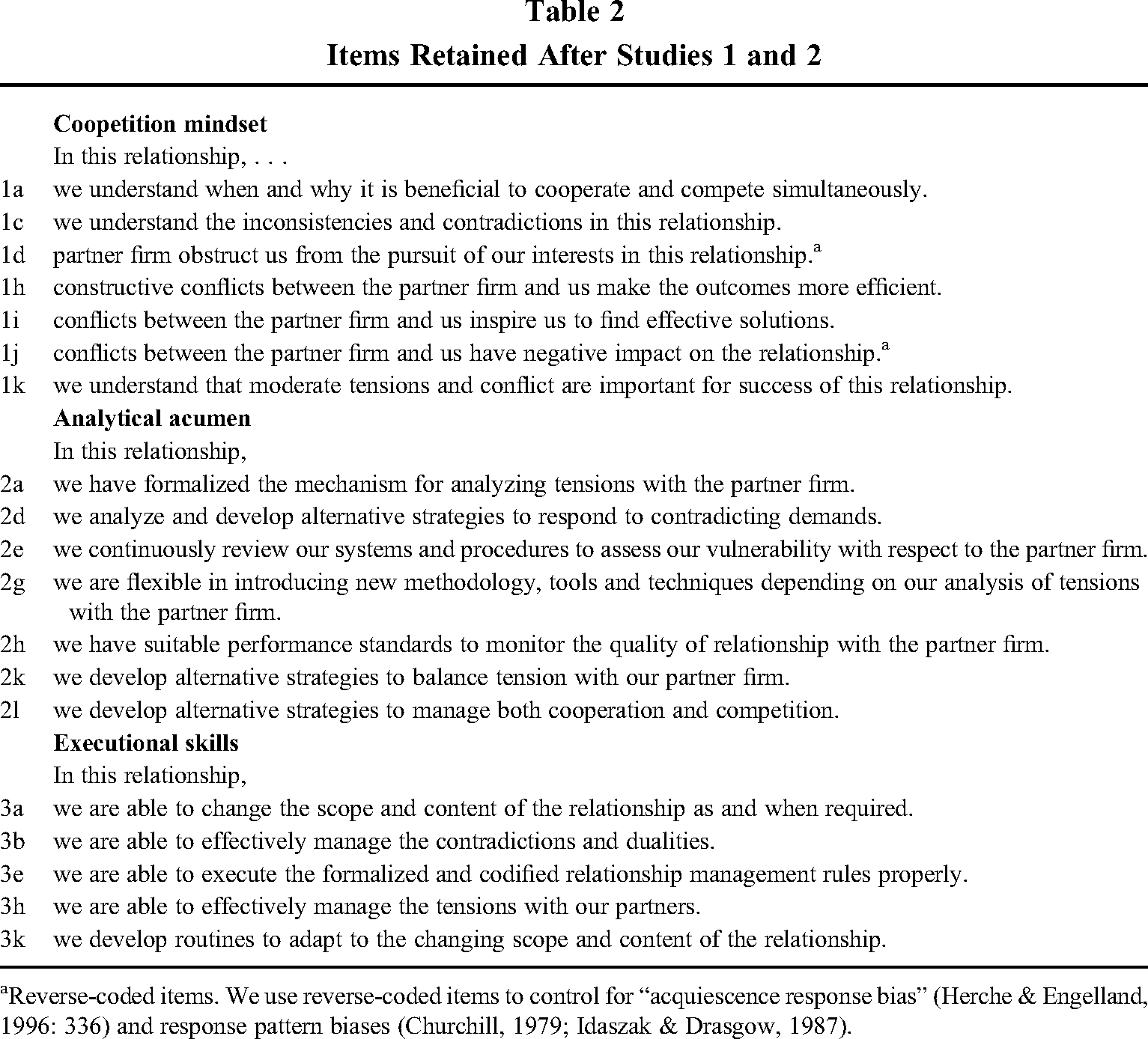
Reverse-coded items. We use reverse-coded items to control for “acquiescence response bias” (Herche & Engelland, 1996: 336) and response pattern biases (Churchill, 1979; Idaszak & Drasgow, 1987).
Measurement model specification
Law, Wong, and Mobley (1998) assert that a newly developed multidimensional construct must specify its relationship—as either reflective or formative (Jarvis, MacKenzie, & Podsakoff, 2003; MacKenzie et al., 2011)—with respect to its dimensions. Correct specification of the dimensions is critical for appropriate operationalization and development of psychometrically valid measures (Bollen, 1989; MacKenzie et al., 2011). Hence, following Jarvis et al. (2003), we model coopetition capability as a second-order reflective-reflective Type I construct reflected by three first-order reflective constructs—coopetition mindset, analytical acumen, and executional skills. We model coopetition capability as such because it is a holistic concept with highly correlated and reinforcing dimensions. Moreover, a second-order reflective-reflective construct captures the complementarities among the three first-order dimensions by accounting for their interactions and covariations (see Jarvis et al., 2003, for further details on second-order reflective-reflective Type I constructs).
Study 3: Scale Construction
Study 3 involved four steps: questionnaire design, data collection, data purification, and scale construction and refinement.
Questionnaire design
We used the 19 items retained at the end of study 2 to design a questionnaire. We used a 7-point Likert scale (1 = very strongly disagree; 7 = very strongly agree) for measuring the items of coopetition capability. We conducted a pilot test and in-depth interviews with a new set of 22 alliance managers familiar with coopetition alliances to refine the questionnaire (MacKenzie et al., 2011).
Data collection
For examining coopetition capability, we used dyadic alliances as the unit of analysis following previous alliance studies (e.g., Kale et al., 2000; Lambe et al., 2002; Rai, 2016; Raza-Ullah, 2020). Although coopetition capability is a firm-level capability and may subsist within a firm outside of an alliance context, we observe its effects or manifestations only in alliance context. Moreover, interactions between the alliance partners in a dyad are more complex, direct, and intimate (Gnyawali & Park, 2011). As such, dyadic alliances allow better capturing of the inherent tensions and complexities in the coopetitive relationship (e.g., Bengtsson & Kock, 2000; Rai, 2016). Similarly, we chose high-technology industries as our empirical setting because coopetitive alliances are mostly formed for the purposes of R&D, exchange of technology/codevelopment of technology, and/or product innovation (e.g., Ansari et al., 2016; Gnyawali et al., 2006; Ketchen et al., 2004; Luo, 2007).
We collected data in India in three stages. First, we obtained contact information of the initial list of 2,053 firms in four industrial sectors—pharmaceuticals, telecommunication, power and energy, and information technology—using the Prowess Release 3.1 database from the Centre for Monitoring Indian Economy (Rai, 2016). Second, we contacted each firm by phone or email to inquire whether it was currently engaged in a coopetition alliance (Schilke & Cook, 2015). A direct contact was necessitated as there is no ready-to-use database for coopetitive alliances and alliance managers (Rai, 2016). We clearly explained the meaning and characteristics of coopetition alliances. We preferred to collect data from ongoing coopetition alliances as the informant's response is more reliable on relatively recent matters (Homburg, Klarmann, Reimann, & Schilke, 2012).
Third, we administered the survey from January to April 2015. In total, 457 firms agreed to participate in our study. We released multiple surveys (2,763 surveys in total) to potential informants within a participating firm because a firm may engage in multiple coopetitive alliances with the same partner or with different partners (Rai, 2016). We sent the surveys to the CEOs or managing directors and requested them to nominate an appropriate informant who was conversant with the alliance activity to complete the survey and share the details of the informant with us. We then wrote to each nominated informant and requested that she completes the survey with a particular dyadic coopetitive alliance as a reference point. In the survey, we explained the meaning and characteristics of a coopetitive alliance with a few typical examples. We released the surveys using two modes—web enabled (online survey) and e-mail (offline survey). In addition to the items for the coopetition capability construct retained after the substantive validity test, the survey contained items for other explanatory variables and control variables (see phase III for details of these variables).
Researchers recommend collecting data from both alliance partners because such data allow assessing the perceptual agreement and validity testing (Anderson, Zerrillo, & Wang, 2006). Moreover, alliance outcomes are contingent upon each partner's behavior. Accordingly, we tried to collect data from both partners. However, out of 457 focal firms that were part of our study, only 109 (23.85%) disclosed the details of their partners. Furthermore, out of these 109 partner firms, only 31 agreed to participate in the study. Thus, owing to the difficulty in collecting data from both alliance partners and following other studies involving dyadic relationships (Lambe et al., 2002; Rai, 2016), we adopted the “proxy-report” approach and collected data only from the focal firm. Proxy-report implies an informant “speaking” on behalf of the partnership and answering questions about dyadic relationships (Menon, Bickart, Sudman, & Blair, 1995: 77). Previous studies found theoretical and empirical support for proxy-report when there is joint participation in an event, such as alliances (Menon et al., 1995). Our approach is also consistent with several studies on alliance capability that collected data only from one partner (e.g., Heimeriks & Duysters, 2007; Kale et al., 2002; Lambe et al., 2002; Schilke & Goerzen, 2010).
We used the key informant approach and collected data from informants responsible for coopetitive alliance activities (Phillips, 1981; Rai, 2016). The underlying assumption of the key informant approach is that informants, because of their position in the organizational hierarchy (Phillips, 1981) and the specific function they perform (Homburg et al., 2012), are able to provide opinions and perceptions that are valid reflections of other key decision makers. We assessed the suitability of the key informants by asking about their self-reported knowledge about the coopetitive alliance activities on a 7-point Likert-type scale (1 = not very knowledgeable, 7 = very knowledgeable) and eliminated responses of informants who reported their knowledge <5 (Phillips, 1981; Rai, 2016). Since the key informants in our study were senior executives with experience in managing coopetition alliances, they were well versed with the terms used in the survey. Overall, 98.37% of the informants had experience in handling a coopetitive alliance for 2 years or longer (M = 6.11; SD = 0.85). In cases where an informant completed a survey for multiple coopetitive alliances, we retained the survey for only one such alliance. Finally, we received 647 usable responses from 195 firms, reflecting a response rate of 23.42%, which is consistent with earlier studies using experienced managers as key informants (e.g., Rai, 2016; Schilke & Cook, 2015; Schilke & Goerzen, 2010).
Data purification
We performed several tasks to ensure that the collected data were robust and unbiased. First, we did not detect any outliers using Hair, Black, Babin, and Anderson's (2013) univariate approach. Next, Little's (1988) MCAR test (missing completely at random) showed that the missing data were completely random. Finally, we tested for nonresponse bias in three ways. One, we used Armstrong and Overton's (1977) procedure to assess nonresponse bias by comparing early informants (first quartile) and late informants (last quartile) of the received surveys for significant differences across means for each theoretical construct. The results of the t tests indicated no significant differences between early and late respondents (p > .05). Two, we used Dickson and MacLachlan's (1996) procedure to compare 223 responses received through a web-based survey with 424 responses received through e-mail, and the Mann-Whitney U tests found no significant difference between these responses (p > .05). Three, we followed Schilke and Cook's (2015) procedure to examine whether the nonresponding firms differed from the responding firms in terms of size and industry segment using information from the Centre for Monitoring Indian Economy database and found no significant differences (p > .05).
Since surveys with self-reports as the sole method of data collection may cause common method bias, we employed both ex-ante and ex-post approaches as recommended by Podsakoff, MacKenzie, and Podsakoff (2012) to address this issue. We used several ex-ante approaches. First, as noted earlier, we excluded ambiguous, vague, and unfamiliar terms during the survey design. Second, we clearly defined the terms used in the survey but took care not to offer any clues about the actual relationships under investigation. Third, each informant received a letter from the CEO/managing director and us assuring full confidentiality. We also assured informants that there were no right or wrong answers and that they should answer the questions as honestly as possible. Fourth, we used reverse-coded (negatively worded) items. Finally, we provided clear guidelines and changed the order of the survey items.
We also used three ex-post approaches to assess common method bias. First, we conducted Harman's single-factor test and found that the highest variance explained by the single factor was 41.70%. Second, following Williams and Anderson (1994), we conducted the common latent factor test, which showed the unstandardized regression coefficient from the common latent factor as 0.27, indicating that common shared variance is 7.29%. Finally, we applied Lindell and Whitney's (2001) correlation marker procedure and used the tenure of alliance managers as the marker variable. The correlations between the marker variable and items of other latent constructs were nonsignificant and <1%. All these tests showed that common method bias is not an influencing factor in the study.
Scale construction and refinement
We randomly split the 647 usable responses into two parts: the calibration sample (300 cases) and the validation sample (347 cases; Hair et al., 2013). We used the calibration sample for scale construction and refinement (Churchill, 1979). We followed the procedures outlined by Rai (2016) to examine dimensionality and reliability. We first conducted the exploratory factor analysis (EFA) at the individual construct level (using varimax rotation and extraction criterion of eigen value > 1.00), which showed that the first-order dimensions of the coopetition capability construct provided a single-factor solution, explaining variances in the range of 68.63% to 79.60%. We deleted four items—coopetition mindset (two items) and analytical acumen (two items)—as their loadings on the designated construct were <0.5. Second, we aggregated the retained measurement items and conducted EFA again to verify that the cross-loading of items was not ≥0.35 on two or more factors (Hinkin, 1995). All the items appropriately loaded on their respective designated construct. Ultimately, we retained a total of 15 items. Table A5 in the online supplement presents the results of EFA at the individual construct level and on aggregated items.
Next, we assessed the reliability of the set of indicators at the construct level by examining internal consistency reliability—that is, whether the Cronbach's alpha (α) is >0.70 (Nunnally, 1978). The reliability of all dimensions of coopetition capability show values above the required thresholds of 0.7 (all were ≥ 0.87; see Table A5 in the online supplement) (Fornell & Larcker, 1981; Nunnally, 1978). Therefore, the scales demonstrate internal reliability.
Study 4: Scale Validation
Construct validity of the first-order constructs
We used the remaining 347 cases as a validation sample to validate the scale. The confirmatory factor analysis results showed that the fit indices for each measurement model of the first-order constructs of coopetition capability were within the acceptable limits, and the factor loadings of the items were above the threshold limit of 0.5 (all were ≥ 0.81; Bagozzi et al., 1991). In addition, the composite reliability of all the first-order constructs was >0.60 (all were ≥ 0.89; Bagozzi et al., 1991) and greater than the average variance extracted (AVE; Fornell & Larcker, 1981). Thus, the first-order constructs demonstrated adequate convergent validity.
We then assessed the discriminant validity of all the first-order constructs in two ways. First, we calculated the AVE and shared variance between the constructs for each multi-item construct and found that AVE was above the threshold value of 0.5 for all three dimensions (all were ≥ 0.61), as reported in Figure 1 (Fornell & Larcker, 1981; Hair et al., 2013). We also found that the AVE measure of each construct is larger than the squared correlation of that construct with other constructs. Second, we assessed discriminant validity by running pairwise χ2 difference tests for the multi-item factors (Anderson & Gerbing, 1988). These tests compared a model in which the factor correlation is fixed at 1 with an unrestricted model. Every restricted model exhibited a significantly worse fit as compared with the unrestricted model. Overall, our results demonstrate adequate discriminant validity for each first-order construct.
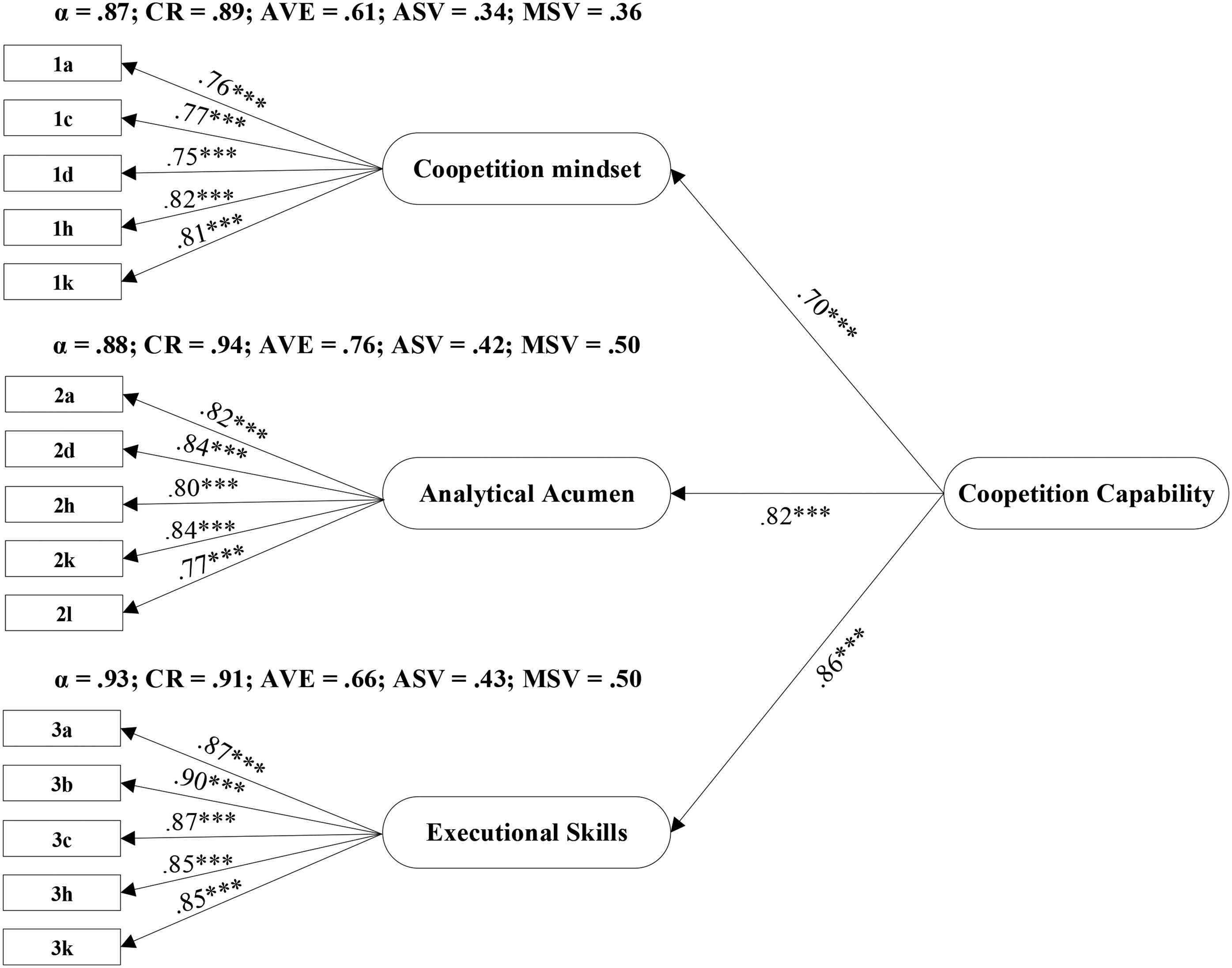
Confirmatory Factor Analysis of the Validation Sample (Study 4)
Construct validity of the second-order construct
Next, we tested the hypothesized structure of the coopetition capability construct by estimating another confirmatory factor analysis model with the three first-order constructs (coopetition mindset, analytical acumen, and executional skills) as indicators of coopetition capability (Byrne, 2001). The loadings of the second-order construct on its three respective dimensions are coopetition mindset (0.70), analytical acumen (0.82), and executional skills (0.86), all of which are higher than the threshold value of 0.4 (as depicted in Figure 1). The global fit criteria indicated a good overall model fit for the measurement model of the second-order reflective-reflective Type I construct of coopetition capability: χ2/df = 2.17, goodness of fit index (GFI) = 0.93, normed fit index (NFI) = 0.95, Tucker-Lewis index (TLI) = 0.97, comparative fit index (CFI) = 0.97, root mean square error of approximation (RMSEA) = 0.06, standardized root mean squared residual (SRMR) = 0.03 (Hair et al., 2013). Furthermore, its composite reliability of 0.84 coupled with the AVE of 0.64 indicates that coopetition capability as a higher-order construct has good construct validity. Thus, the conceptualization of coopetition capability as a reflective-reflective Type I construct is valid.
Final Coopetition Capability Scale
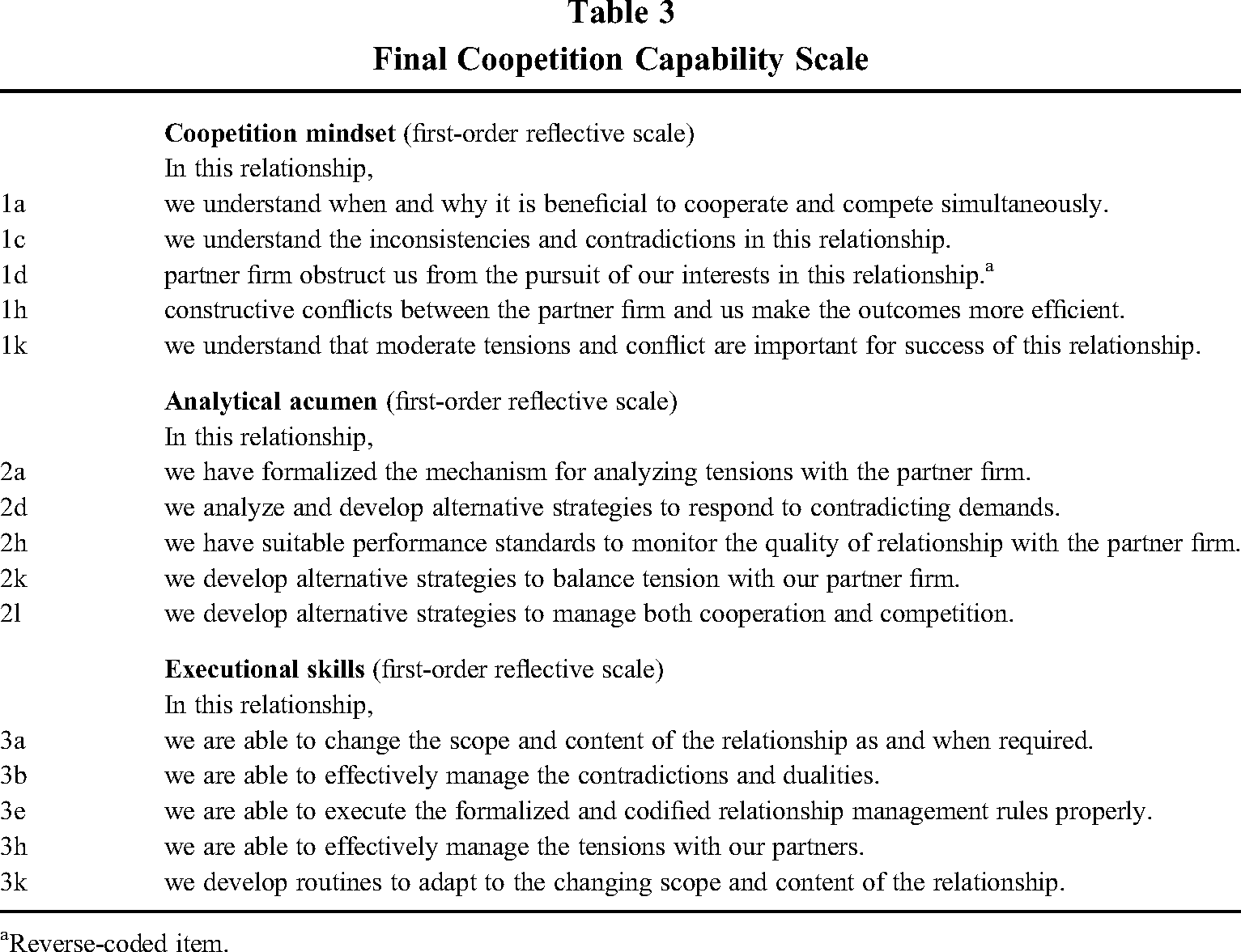
Reverse-coded item.
The newly constructed psychometrically valid multidimensional scale for coopetition capability consisted of 15 items: coopetition mindset = 5, analytical acumen = 5, and executional skills = 5. Table 3 presents the final coopetition capability scale.
Measurement Scales and Validity Assessment
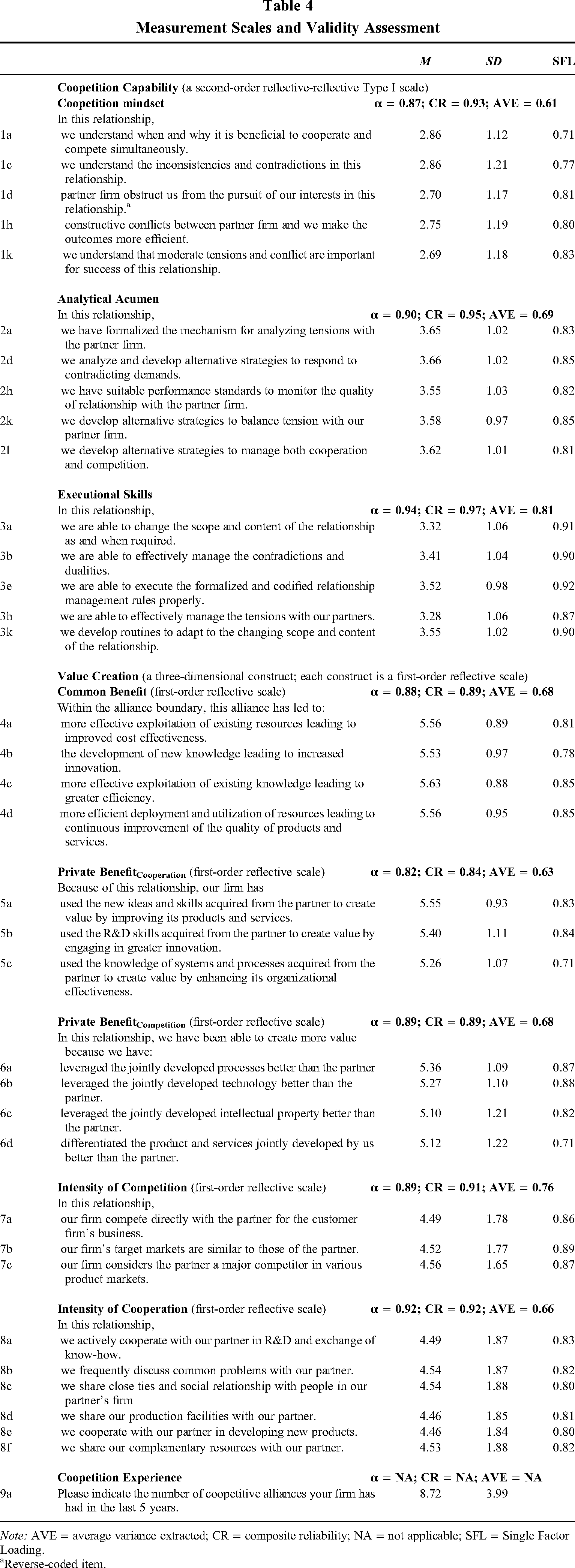
Note: AVE = average variance extracted; CR = composite reliability; NA = not applicable; SFL = Single Factor Loading.
Reverse-coded item.
Additional analyses
We conducted two tests to confirm the validity of the new scale. First, we compared the validity of the hypothesized measurement model with rival measurement models. Following Rai (2016), we adopted a three-step approach to evaluate the suitability of the three-dimensional model in comparison with four competing models. We present the results in Table A6 in the online supplement. In step 1, we compared various fit indices, including χ2/df, p value, GFI, NFI, TLI, CFI, RMSEA, SRMR, Akaike information criterion (AIC), and Bayesian information criterion (BIC; Bollen, 1989). The three-dimensional model (Model 1) fits the data better than the unidimensional and two-dimensional models (χ2/df for all the rival models was >3), and the values for the AIC and BIC are lesser than all rival models, suggesting that Model 1 is the optimal choice (Burnham & Anderson, 2004). In Step 2, we determined whether the hypothesized model achieved a better fit regardless of the probably acceptable overall fit in Step 1 by using the χ2 difference test (Bollen, 1989; Hair et al., 2013). Again, Model 1 is a better fit than Models 2 to 5. Finally, we examined the component fit (factor loadings) of the measurement models (Bollen, 1989). Factor loadings of the items are significant for all the competing measurement models, indicating that this criterion is not useful for assessing the hypothesized model. Overall, the results indicate that a three-dimensional construct (Model 1) is more valid than other models proposed in prior studies, such as a unidimensional construct (Model 2; e.g., Bengtsson et al., 2016, 2020) or a single construct (Model 3) that does not distinguish coopetition mindset and analytical acumen as two distinct constructs (Gnyawali et al., 2016).
Next, we used the focal construct's existing nomological network to assess the validity of multidimensionality. In the coopetition literature, top management commitment (TMC; Bengtsson & Kock, 2000; Lado et al., 1997) and coopetition experience (Park, Srivastava, & Gnyawali, 2014) are regarded as important drivers of coopetition capability (Bengtsson & Kock, 2000; Lado et al., 1997). Since we used coopetition experience to examine the focal construct's nomological validity, we used TMC to assess the validity of multidimensionality. Following the procedure outlined by MacKenzie et al. (2011), we examined whether TMC has direct effects on the subdimensions of coopetition capability over and above the indirect effects that TMC has through the focal construct. We measured TMC using four items from Lambe et al. (2002). The results show that the direct path coefficient of TMC to the coopetition capability is higher (β = 0.59, p ≤ .001) than the path coefficients of TMC to individual lower-order dimensions of coopetition capability (coopetition mindset: β = 0.11, p ≤ .01; analytical acumen: β = –0.03, not significant; and executional skills: β = −0.09, p ≤ .01). The indirect path coefficient of TMC to the individual lower-order dimensions of coopetition capability were significant (coopetition mindset: β = 0.43, p ≤ .01; analytical acumen: β = 0.51, p ≤ .01; and executional skills: β = 0.55, p ≤ .001).
Phase III: Coopetition Capability and Its Semantic Relationships
Construct clarity involves identifying the focal construct's semantic relationships with other related constructs (Suddaby, 2010). Following procedures outlined by MacKenzie et al. (2011), we accomplish this in two steps. First, we established the nomological validity of the focal construct (i.e., the new conceptualization of coopetition capability). Second, we extended the existing nomological network of the focal construct by examining a previously unexplored relationship. In doing so, we advance theoretical understanding of the critical role of coopetition capability in value creation. Equally important, we demonstrate the usefulness of developing a new scale beyond merely helping to confirm existing relationships (Anderson, Eshima, & Hornsby, 2019). Such an empirical examination would not have been possible in the absence of the new psychometrically valid scale. Given the space constraints, we present the summary of theoretical arguments, methods, and results here and discuss the details in Appendix B of the online supplement.
Nomological Validity
To establish nomological validity, we examined whether the focal construct relates in a similar way to previously established relationships among other theoretically related constructs (MacKenzie et al., 2011). We identified two variables—coopetition experience, a key antecedent variable, and value creation, a key outcome variable—whose relationships with coopetition capability are well established in the coopetition literature. We then tested the association between the focal construct and the two variables. We found that the relationships were as predicted, which establishes the nomological validity (for a detailed explanation and results, see Appendix B in the online supplement).
Examining New Relationships: Extending the Existing Nomological Network
MacKenzie et al. (2011) recommend that besides establishing nomological validity, researchers should demonstrate the utility of the newly conceptualized construct by examining previously unexplored relationships and thereby extend its existing nomological network. To this end, we proposed that the coopetition paradox—an index capturing the intensity of cooperation and competition—positively influences value creation and that coopetition capability positively moderates the relationship between coopetition paradox and value creation (for a detailed theoretical explanation about the proposed relationships among coopetition paradox, value creation, and the coopetition capability construct, see Appendix B in the online supplement). Accordingly, we specified a structural equation model integrating the proposed relationships of coopetition capability with coopetition experience, coopetition paradox, and value creation (Figure 2).

The Conceptual Framework
We collected data on value creation (outcome variable) after a lag time of 3 years in February 2018 to May 2018 through a separate survey of the same firms considered in Studies 3 and 4. We introduced a 3-year lag for data collection for two reasons. First, such a design helps to examine the causal effect of explanatory variables on outcome variables (Rindfleisch, Malter, Ganesan, & Moorman, 2008). Second, a 3-year lag is likely to mitigate the potential common method bias hazard because we avoid collecting data for explanatory and dependent variables at the same time (Podsakoff et al., 2012). We received 536 matched usable surveys from 176 firms belonging to four high-technology sectors—pharmaceuticals, power and energy, information technology, and telecommunication—across the time span of Surveys 1 and 2. We ensured that each key informant completed only one survey and that only one survey was used for each alliance (see Appendix B in the online supplement for details about data collection efforts, sample characteristics [Table B1], and measures used to operationalize the theoretical constructs). Table 4 presents the measurement items and validity assessment, and Table 5 presents the means, standard deviations, and bivariate correlations for all variables.
Correlations and Square Roots of AVE
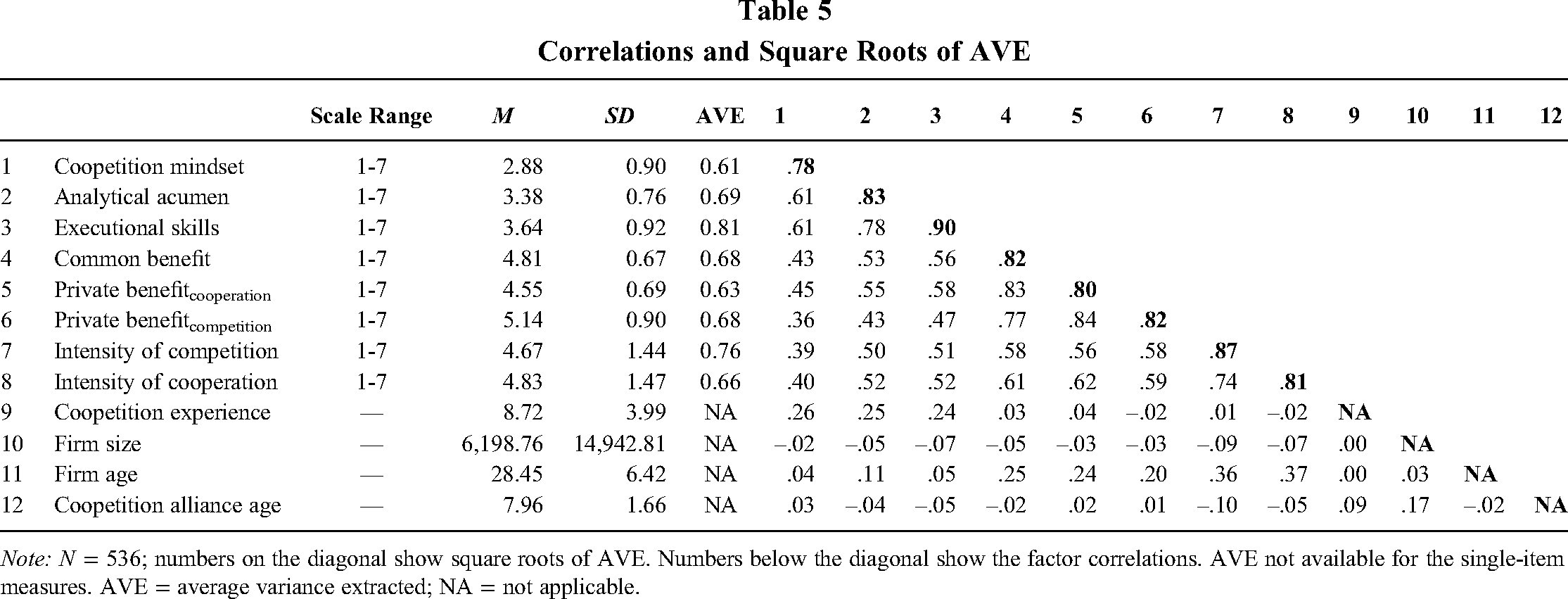
Note: N = 536; numbers on the diagonal show square roots of AVE. Numbers below the diagonal show the factor correlations. AVE not available for the single-item measures. AVE = average variance extracted; NA = not applicable.
We applied the covariance-based structural equation modeling maximum likelihood procedure using AMOS 25.0 software to examine the latent variables within their causal structure. The fit measures for our structural equation model showed satisfactory values: χ2/df = 2.41; GFI = 0.99, NFI = 0.99, TLI = 0.97, RMSEA = 0.05; and SRMR = 0.04. Our results confirm the focal construct's nomological validity as we find that coopetition experience has a significant positive effect (β = 0.31, p ≤ .001) on coopetition capability. Similarly, we find that coopetition capability has a significant positive effect (β = 0.36, p ≤ .001) on common benefit, a significant positive effect (β = 0.38, p ≤ .001) on private benefitcooperation, and a significant positive effect (β = 0.14, p ≤ .001) on private benefitcompetition.
Our results also confirm the positive moderating effect of coopetition capability on the relationship between coopetition paradox and value creation. We find that the coopetition paradox has a significant positive effect on all three dimensions of value creation: common benefit (β = 0.47, p ≤ .001), private benefitcooperation (β = 0.45, p ≤ .001), and private benefitcompetition (β = 0.64, p ≤ .001). We also find a significant positive effect of the interaction term (Coopetition Paradox × Coopetition Capability) on all three dimensions of value creation: common benefit (β = 0.37, p < .001), private benefitcooperation (β = 0.37, p < .001), and private benefitcompetition (β = 0.40, p < .001). Figure 3 presents the results of the full model estimation. Furthermore, the interaction plots (Figure 4) illustrate that firms with higher coopetition capability have a greater impact on all the components of value creation when the coopetition paradox is high.

Result of Model Estimation

Hypothesized Coopetition Paradox and Coopetition Capability Interaction Plot
We also assessed the strength of the moderating effect of the focal construct on all three dimensions of value creation by using Cohen's (1988) formula f2 = (R2model with moderator – R2 model without moderator) / (1 – R2 model with moderator). We found that the moderating effect of coopetition capability on all dimensions of value creation is large (common benefit = 0.58, private benefitcooperation = 0.39, and private benefitcompetition = 0.55).
Discussion and Implications
Coopetition research focuses on understanding the paradoxical nature of coopetition, resultant tensions, and impact on value creation (Gnyawali et al., 2006; Gnyawali & Ryan Charleton, 2018; Hoffmann et al., 2018; Rai, 2016). As Ketchen et al. (2004: 787) argue, “co-opetition potentially can lead to competitive advantages if it is designed in such a way that its negatives are minimized.” At the heart of this discussion is coopetition capability, which helps to address paradoxical tensions and realize benefits from coopetition. Despite some existing research, coopetition capability lacks construct clarity and validity, both of which are critical for theory building and empirical research (Bacharach, 1989; Suddaby, 2010). We motivate our study to address this important gap.
Contributions and Implications
Our paper contributes to the literature in three ways. First, our systematic development of the construct with a clear definition, boundary conditions, and relationships with related constructs provides much-needed construct clarity. Conceptually, we explain how coopetition capability helps integrate contradictory elements into a holistic approach to dealing with paradoxical tension. We articulate how firms can not only realize greater benefits by exploring interdependencies, complementarities, and synergies between cooperation and competition but also alleviate the risks by managing the resultant tensions. Accordingly, we explain how coopetition capability is a necessary complement to alliance capability for creating superior value in coopetition.
Second, by developing a psychometrically valid scale, we help coopetition researchers overcome three key challenges that confront them in empirical research. The first challenge is developing and operationalizing new constructs that “capture similar nomological relationships to the existing constructs” but with more accurate and reliable measures that “are easier to specify in causal models” (Anderson et al., 2019: 200). The second is isolating causal relationships and building predictive theories that require alignment between what has been theoretically conceptualized and what is being measured (Anderson et al., 2019; Bagozzi, 2011). Last, our reliable, valid, and ready-to-use scale provides a concrete basis for empirically examining coopetition capability, saving time and effort for future researchers. Overall, our paper establishes a common ground for synthesizing, integrating, and meaningfully comparing previous empirical research that will enable more robust and impactful future research on the topic (Boyd et al., 2013).
Third, the newly conceptualized construct is useful beyond revisiting relationships in the existing nomological network; it is an opportunity to examine previously underresearched relationships of the construct (MacKenzie et al., 2011). We demonstrate such utility by showing that coopetition capability serves as a moderator between the coopetition paradox and value creation. Furthermore, we show that coopetition experience is an important antecedent of coopetition capability. Consequently, future researchers can use our conceptualization of coopetition capability to distinguish it a priori from its antecedents or consequences in their research design (Eisenhardt, 1989), thereby pushing the boundary of the construct's nomological network.
Limitations and Directions for Future Research
Like most studies, our study has a few limitations that future research may address. First, we use the proxy-report approach to account for alliance partners’ perceptions. Future researchers may collect data from alliance partners, calibrate the perceptions of both sides, and generate richer insights. Second, we have developed our scales in the context of dyadic alliances. Future researchers may adapt these scales for other coopetitive relationships, such as project, alliance portfolio, network, or industry ecosystem levels, ensuring that the specific items accurately capture these contexts’ unique characteristics. Third, despite the growing interest and publication of several studies, there is no consensus yet on measuring alliance performance or success (Ariño, 2003; Schilke & Goerzen, 2010). Although we have used a well-established measure for value creation as an indicator of alliance success (Rai, 2016), future research may examine how the coopetition capability construct relates with other such indicators. Finally, our empirical context was high technology firms in India, and it is unlikely that the construct will be unique to the Indian context. Since our research design and methods are replicable and the survey is adaptable to different settings, we encourage researchers to test the scale in other locations (MacKenzie et al., 2011).
Implications for Practice
Our study informs managerial practice in three ways. First, we illuminate how coopetition can be a double-edged sword for managers as it can be both rewarding and challenging. Accordingly, we provide a basis for managers to understand and build coopetition capability, enabling firms to effectively navigate the simultaneity—to achieve an appropriate level of intensity of cooperation and competition for maximizing the benefits from each opposing element (Gnyawali & Ryan Charleton, 2018) and to counterbalance the challenges of the opposing elements (Das & Teng, 2000; Lado et al., 1997). Second, we describe the processes and routines for building these capabilities. Equipped with this knowledge, managers will understand how to foster the coopetition mindset, analytical acumen, and executional skills necessary for managing coopetition alliances effectively. Finally, since our study shows that coopetition experience leads to coopetition capability, we demonstrate how firms can benefit from intentionally engaging in coopetition and gain experience, thus enhancing their readiness for future coopetition and subsequent value creation.
In conclusion, our theory-based conceptualization, well-specified measurement model, and psychometrically valid scale provide much needed construct clarity and validity to the coopetition capability construct. Since the conceptually broad multidimensional construct allows researchers to better articulate theories and investigate broader questions (MacKenzie et al., 2011), our paper provides a strong foundation for more rigorous and robust theoretical and empirical research (Boyd, Gove, & Hitt, 2005; Eisenhardt, 1989) on coopetition. We believe that our paper equips researchers to build more refined and nuanced predictive theories in coopetition and conduct in-depth empirical research with more rigor and confidence.
Supplemental Material
sj-docx-1-jom-10.1177_01492063221107873 - Supplemental material for Walking the Tightrope: Coopetition Capability Construct and Its Role in Value Creation
Supplemental material, sj-docx-1-jom-10.1177_01492063221107873 for Walking the Tightrope: Coopetition Capability Construct and Its Role in Value Creation by Rajnish Rai, Devi R. Gnyawali and Himanshu Bhatt in Journal of Management
Footnotes
Acknowledgments
This work was funded by the Indian Institute of Management Ahmedabad. Our special thanks to Srinath Jagannathan and Manoj Motiani, whose careful reading and helpful comments helped improve the manuscript significantly. We sincerely thank two anonymous reviewers for providing constructive and developmental comments, which greatly helped us rework our thoughts and arguments. We also thank the action editor Tieying Yu for her editorial guidance at different stages of the manuscript, which helped us improve it. Supplemental material for this article is available with the manuscript on the JOM website.

References
Supplementary Material
Please find the following supplemental material available below.
For Open Access articles published under a Creative Commons License, all supplemental material carries the same license as the article it is associated with.
For non-Open Access articles published, all supplemental material carries a non-exclusive license, and permission requests for re-use of supplemental material or any part of supplemental material shall be sent directly to the copyright owner as specified in the copyright notice associated with the article.
