



Abstract
Constructive voice is a type of communicative act involving both voicers and managers. However, research on constructive voice has developed in two separate streams, with studies adopting either a voicer- or a manager-centric perspective, thereby failing to provide a holistic understanding of constructive voice. This unilateral approach results in missed opportunities for scholars to understand the dyadic and dynamic nature of constructive voice. To address this limitation, we draw on social exchange theory to introduce a four-phase (felt voice, expressed voice, managerial responses to voice, and relational voice outcomes) dyadic model of constructive voice. By conceptualizing constructive voice as a dyadic exchange between voicers and managers, we detail the ongoing processes in which employees initiate voice and managers subsequently endorse and/or implement voicers’ input. We also introduce feedback loops to highlight the dynamic nature of constructive voice over time and explain the consequences of repeated constructive-voice exchange processes on relational outcomes. Finally, we review the literature, summarize gaps and opportunities, and provide directions for future research.
Constructive voice refers to employees’ upward communication of ideas or suggestions intended to improve the work unit or the organization (Morrison, 2011). Although employees may engage in a variety of voices within the organization, such as supportive (i.e., supporting current practices), defensive (i.e., opposing changes to current practices), and destructive (i.e., antagonizing current practices with aggression; Liang, Farh, & Farh, 2012; Maynes & Podsakoff, 2014), we focus on constructive voice given its beneficial effect on organizational effectiveness (Van Dyne & LePine, 1998) and performance (C. Farh, Oh, Hollenbeck, Yu, Lee, & King, 2020; Kolbe et al., 2012; Lam & Mayer, 2014; A. Li, Liao, Tangirala, & Firth, 2017; Mackenzie, Podsakoff, & Podsakoff, 2011). We also focus on constructive voice expressed to managers rather than peers because managers can implement a voiced suggestion (Burris, Rockmann, & Kimmons, 2017), acquire resources for enacting improvement (Detert, Burris, Harrison, & Martin, 2013; Dutton, Ashford, O’Neill, & Lawrence, 2001), and advocate for further implementation of employees’ suggestions to top management teams (Burris, 2012), which ultimately improves workgroup or organizational effectiveness (Detert et al., 2013; Hussain, Shu, Tangirala, & Ekkirala, 2019).
Given the benefits of employees’ constructive upward voice, research has been predominantly voicer-centric (Van Dyne & LePine, 1998), meaning that it has focused on understanding why employees (i.e., voicers) engage in voice. Factors such as individual characteristics (Crant, Kim, & Wang, 2011), attitudes and perceptions (Frazier & Fainshmidt, 2012), contextual factors (Morrison, Wheeler-Smith, & Kamdar, 2011), and emotions (Harvey, Martinko, & Douglas, 2009) have all been studied as predictors of voice (Morrison, 2014). More recently, scholars have begun to recognize the pivotal role played by managers in bringing change-initiating suggestions to light. Manager-centric research has started to explore how factors such as the type of voice (Burris, 2012), communication styles (Lam, Lee, & Sui, 2019), and managerial perceptions of the content of the suggestions voiced by employees (Burris et al., 2017) influence whether managers endorse and/or implement voice.
Despite the burgeoning development of these two streams of research, voicer- and manager-centric research streams remain largely disconnected, each developing in its own silo. This lack of integration between voicer-centric and manager-centric research is problematic for two reasons. First, because managers have the power and authority to endorse and implement employee voice (Detert et al., 2013), research focusing solely on voicers without considering managerial responses to their constructive voice fails to capture whether voice achieves its intended purpose of improving workgroup effectiveness. Likewise, research focusing solely on managerial responses, without considering how employees feel and react to managerial responses to voice, overlooks opportunities to understand voicers’ subsequent decisions to speak up, a point that has important implications for explaining voice behavior over time. As such, voice research currently lacks a holistic understanding of the voice process as a whole and would benefit from a model that integrates both voicer- and manager-centric perspectives.
Second, a lack of integration between the two perspectives results in studies focusing on outcomes related to either the voicer or the manager. For example, voicer-centric research has mainly focused on voicer-centric outcomes that include voicers’ status (Bain, Kreps, Meikle, & Tenney, 2021; McClean, Martin, Emich, & Woodruff, 2018), performance evaluation (Hsiung, Tsai, & Chen, 2013; Podsakoff, Whiting, Podsakoff, & Mishra, 2011), or perceptions of agency and communion (Weiss & Morrison, 2019). Manager-centric research, on the other hand, has mainly focused on manager-centric outcomes, such as managerial depletion (Sessions, Nahrgang, Newton, & Chamberlin, 2020), managers’ sense of efficacy to implement change (Fast, Burris, & Bartel, 2014), and managerial effectiveness (Gyensare, Arthur, Twumasi, & Agyapong, 2019). The lack of integration between voicer- and manager-centric research results in missed opportunities to develop insight into dyadic outcomes, such as relational quality, a critical yet understudied area in the voice literature. We contend that although the effect of a successful voice exchange (i.e., voicers speak up and managers respond positively) on relational quality may be small, repeated successful voice exchanges may build, enrich, and enhance voicer-manager relational quality. In turn, high relational quality may induce employees to engage in constructive voice automatically while also positively inducing managers to endorse employee voice automatically over time.
To integrate the voicer- and manager-centric perspectives, we draw on social exchange theory (Cropanzano, Anthony, Daniels, & Hall, 2017; Cropanzano & Mitchell, 2005) and conceptualize voice as an ongoing dyadic exchange between voicers and managers. According to social exchange theory, an actor initiates a social exchange relationship by taking initial actions toward a target individual, which in turn encourages the target to respond by taking actions toward the actor (Cropanzano et al., 2017; Cropanzano & Mitchell, 2005). Social exchanges continue to occur between two individuals over time as long as they respond positively to each other (Cropanzano & Mitchell, 2005; Gergen, 1969; Gouldner, 1960). Applying a social exchange lens to the voice context, we contend that employees express constructive voice as a means to initiate and develop a social exchange relationship with their manager. Managers then endorse and/or implement constructive voice as a means to maintain and further develop the social exchange relationship. As managers respond to constructive voice with endorsement and/or implementation, employees are likely to respond with subsequent constructive voice behavior to continue developing their relationship with their manager, which in turn contributes to the development of cyclical voice exchanges, or what we refer to as feedback loops. Over time, repeated successful voice exchanges facilitate the development of relational mutuality—the shared belief between voicers and managers that the other party trusts, is committed to, and is respectful of them (Lewis, 1999)—which further induces automatic voice (for employees) and responses to voice (for managers) over time.
Our integrative review makes two contributions. First, prior review articles tend to be heavily voicer-centric and mostly focus on predictors and consequences of employee voice. For example, Morrison (2011, 2014) focused on the predictors and outcomes associated with diverse conceptualizations of employee voice, and Bashshur and Oc (2015) reviewed the theoretical frameworks used to explain the outcomes of employee voice across different levels of the organization (i.e., individual, group, organizational). Additionally, Klaas, Olson-Buchanan, and Ward (2012) explored how different determinants discourage or encourage diverse forms of voice, and D. Butler and Whiting (2019) reviewed how voice behavior influences voicers and their organization. Moving beyond such voicer-centric reviews, our dyadic model aims to recenter the current research pendulum by integrating voicer-centric and manager-centric perspectives. In doing so, we provide an integrative framework that offers a more balanced picture of voice while capturing the full and dyadic exchange of speaking up and being heard. Importantly, this enables us to explore new research questions that would have been inconceivable without conceptualizing voice as a dyadic exchange between employees and managers. For example, our dyadic integration encourages scholars to investigate the role of dyadic characteristics, such as dyadic fit (e.g., examining how the dyadic fit influences voice exchanges), thereby allowing researchers to better understand the dyadic nature of constructive voice (Krasikova & LeBreton, 2012).
Second, extant work has portrayed constructive voice as a one-off, terminal event, with scholars focusing on the initial experience of either the employee speaking up or the manager responding to voice. In reality, however, voice exchanges involve long-term bidirectional dynamics that have the potential to result in high-quality relationships (i.e., relational mutuality) via repeatedly successful voice exchanges between voicers and managers. This is important because the extant literature has often described voice as an interpersonally risky behavior for employees and a threat for managers (Burris, 2012; Isaakyan, Sherf, Tangirala, & Guenter, 2021). As a result, voice has been suggested to trigger negative responses from managers and hinder the relationship between voicers and managers (Burris, 2012; Morrison, 2011). Departing from this trend, our dyadic model suggests that voice behavior, over time, has the potential to build a more positive relationship from the employee’s and manager’s perspectives. As such, our conceptualization of voice as a dyadic social exchange process suggests that voicers and managers develop mutually committed, trusting, and high-quality relationships that may help explain why voicers engage in voice or why managers endorse voice more automatically over time (Lam, Rees, Levesque, & Ornstein, 2018).
A Dyadic Model of Constructive Voice Based on Social Exchange Theory
A key tenet of social exchange theory is that individuals engage in repeated exchanges of various resources to develop high-quality relationships over time (Cropanzano et al., 2017; Cropanzano & Mitchell, 2005). The theory holds that an actor starts a social exchange relationship by taking positive actions toward a target individual, which leads the target to reply in kind by engaging in positive behaviors (Cropanzano et al., 2017; Cropanzano & Mitchell, 2005). The social exchanges between two parties are not specified, nor are they guaranteed in advance. Because of such uncertainties, each party involved in the exchange relies on the principle of reciprocity (Cropanzano & Mitchell, 2005; Gouldner, 1960; Meeker, 1971). As long as each party fulfills their reciprocal obligation, a positive reciprocity—the extent to which each positive exchange feeds back into the relationship to reinforce it even further—develops (Cropanzano & Mitchell, 2005; Gergen, 1969; Gouldner, 1960). Over time, repeated social exchanges contribute to the development of positive reciprocity and high-quality relationships (Cropanzano et al., 2017; Cropanzano & Mitchell, 2005).
Social exchange theory is particularly appropriate for our dyadic model because constructive voice, similar to social exchange, involves two parties, namely, a voicer and their manager (Morrison, 2011). Social exchange theory also theorizes the risks involved in social exchange and how people initially calculate the potential costs and benefits of engaging in a social exchange within a dyad. This corresponds to the calculative processes that are considered by employees and managers when deciding to speak up (Morrison, 2014) or respond to voice (Burris, 2012; Burris et al., 2017), respectively. Last, consistent with our conceptualization of feedback loops and the relational consequences of repeated voice exchanges between voicers and their managers over time, social exchange theory offers insights concerning the long-term relational effects of repeated social exchanges via positive reciprocity (Cropanzano et al., 2017).
Drawing from social exchange theory, our dyadic model suggests that employees initiate social exchange relationships with managers via voice while managers respond with endorsement and/or implementation to further develop the social exchange relationship initiated by voicers. We also suggest that repeated experiences of successful voice exchanges contribute to a mutually high-quality relationship between voicers and managers via feedback loops (Cropanzano et al., 2017; Gouldner, 1960). Specifically, our integrative framework explains constructive voice as a dyadic and cyclical process that occurs via four different phases: (1) felt voice, (2) expressed voice, (3) managerial responses to voice, and (4) relational voice outcomes (see Figure 1).

A Dyadic Model of Constructive Voice
Felt Voice Phase
In the felt voice phase, employees make decisions on whether to initiate a social exchange relationship with their manager via voice behavior. According to social exchange theory (Cropanzano et al., 2017; Cropanzano & Mitchell, 2005), any exchange between two parties involves risk because one party’s positive behaviors do not guarantee positive reactions from the other during the initial social exchange process. Therefore, one first evaluates the potential risks and benefits before initiating a social exchange relationship (Lawler, 2001). This closely resembles the calculative processes that employees engage in when initially deciding to express constructive voice (Morrison, 2014). For example, on the one hand, expressing constructive voice can help managers solve issues of malpractice and inefficiency (Gyensare et al., 2019). This can benefit voicers by helping them establish a more favorable relationship with managers (Cheng, Lu, Chang, & Johnstone, 2013; Lapierre & Hackett, 2007). Managers may also perceive voicers as competent and helpful (L. Chen, Li, Wu, & Chen, 2020; Weiss & Morrison, 2019), thereby enhancing voicers’ status within the team (Chamberlin, Newton, & LePine, 2017; Whiting, Maynes, Podsakoff, & Podsakoff, 2012). On the other hand, given the challenging nature of constructive voice, managers may perceive employee voice as a threat to their image (Isaakyan et al., 2021), competence (Fast et al., 2014), and authority (Burris, 2012). As a result, constructive voice can incur risks for voicers (Ng, Shao, Koopmann, Wang, Hsu, & Yim, 2022).
Given such potential benefits and risks, our dyadic model suggests that voicers evaluate both motivators (i.e., driving factors that increase the potential benefit of social exchange through voice) and inhibitors (i.e., restraining factors that increase the potential risk of social exchange through voice) when determining whether to initiate social exchange relationships with their managers via expressing constructive voice. For example, employees experiencing higher levels of leader–member exchange (LMX) with managers are more likely to engage in constructive voice because higher levels of LMX lead employees to believe that their constructive voice will be received positively by their manager and increase their likelihood of obtaining the benefits associated with expressing constructive voice (Duan, Lapointe, Xu, & Brooks, 2019). In contrast, negative supervisory behaviors, such as abusive supervision (Peng, Schaubroeck, Chong, & Li, 2019), not only damage voicers’ relationship with their manager but can also increase the risks associated with voice and reduce employees’ motivation to speak up (Peng et al., 2019) as abusive supervisors are not expected to respond positively to employee voice (C. Farh & Chen, 2014; Rafferty & Restubog, 2011). Ultimately, employees will speak up when they calculate that the perceived motivators of engaging in the initial voice behavior outweigh the perceived inhibitors.
Expressed Voice Phase
Once employees decide to express constructive voice and initiate a social exchange, the voice exchange process enters the expressed voice phase. This phase involves employees’ actual engagement in voice behavior. Employees consider various voice tactics for expressing their suggestions. For example, they consider whether to include solutions that address issues in their suggestions (Whiting et al., 2012), the degree of politeness in the tone of voice (Krenz, Burtscher, & Kolbe, 2019; Lam et al., 2019), and whether to speak up in public or private (Isaakyan et al., 2021).
Importantly, we theorize that employees’ choices of voice tactics will be governed by a social exchange logic of minimizing potential risks and maximizing potential benefits. Specifically, when employees engage in constructive voice as a means to initiate a social exchange relationship with their manager, they are motivated to speak up in ways that maximize their chances of getting their manager to endorse and/or implement their ideas while maintaining a positive relationship with their manager. For example, in their initial expressions of constructive voice, employees are likely to offer solutions to help managers solve problems (Whiting et al., 2012). As a result, voicers may have a greater chance of getting their managers to listen to their suggestions. Moreover, providing a solution can reflect voicers’ sincere intention to help managers solve work-related issues. Similarly, when voicers use polite and considerate language to speak up with change-oriented suggestions (Lam et al., 2019), and do so in private rather than in public (Isaakyan et al., 2021), they communicate their ideas in ways that minimize the likelihood of managers feeling threatened and thus establish a more positive exchange relationship with their manager.
Another important tenet of social exchange theory is that people look for social cues that signal reception or acceptance from the other party during social exchanges (Lawler & Thye, 1999). Building on this, our dyadic model suggests that voicers “read the wind” (Dutton, Ashford, O’Neill, Hayes, & Wierba, 1997: 419) and gauge their managers’ interest when speaking up (Landau, 2009). For example, if voicers sense that their managers are interested in their suggestions, they may persist in their voice effort in the hope of receiving a positive response from them. In contrast, voicers may refrain from pushing their suggestions further in order to preserve their social exchange relationship (Dutton et al., 1997) with managers if they sense a lack of managerial interest.
Managerial Responses to Voice Phase
After employees express constructive voice, the voice exchange process enters the managerial responses to voice phase, which takes two possible forms: attitude-oriented responses of managerial endorsement and action-oriented responses of voice implementation. While extant work has often not distinguished between these two constructs (Burris, 2012), we differentiate managerial endorsement—the positive attitudes of recognizing the value or validity of employees’ suggestions, advocating the suggestions to higher levels of management, and providing support for further implementation of the suggestions (Burris, 2012; Isaakyan et al., 2021)—from voice implementation—the actual allocation of resources and the execution of suggestions (Da Silva & Oldham, 2012; C. Farh et al., 2020). Although managerial endorsement reflects a manager’s positive attitude and a certain level of willingness to implement employee suggestions (Burris et al., 2017; He, Han, Hu, Liu, Yang, & Chen, 2020), implementation may be difficult for reasons beyond managerial control, such as organizational budget or policy constraints. As such, we make this distinction as managerial endorsement may not always result in voice implementation.
Just as employees evaluate the potential risks and benefits of engaging in constructive voice behavior to initiate a social exchange relationship, so do managers evaluate the potential risks and benefits of endorsing and/or implementing constructive voice. For instance, although implementing employee-suggested changes may benefit the manager by improving managerial effectiveness (Grant, Parker, & Collins, 2009), it may also signal an acknowledgment of current malpractice and inefficiencies, thereby jeopardizing the manager’s credibility within the workgroup or the organization (Dutton & Ashford, 1993; Liang et al., 2012; Menon, Thompson, & Choi, 2006).
Given the potential risks and benefits of endorsing and/or implementing employee constructive voice during the initial stage of voice exchange, our dyadic model suggests that managers also consider motivators (i.e., driving factors that motivate social exchange through endorsement and/or implementation) and inhibitors (i.e., restraining factors that increase the risk of social exchange through endorsement and/or implementation) of endorsement and/or implementation. For example, managers are more likely to endorse voice that they perceive to be important for their unit (Burris et al., 2017; E. Xu, Huang, Ouyang, Liu, & Hu, 2020). When constructive voice is perceived to help solve workgroup issues, which is a manager’s core duty, they are likely to perceive that endorsement will be beneficial and rewarding to them, thereby promoting managerial endorsement and/or implementation. Further, managers are more likely to endorse suggestions made by a credible source (Lam et al., 2019; X. Li, Wu, & Ma, 2021). Given that more credible voicers are likely to express more constructive and high-quality suggestions, the likelihood of benefiting from endorsing and/or implementing their suggestions is potentially higher. As a result, managers would be more motivated to endorse and/or implement their constructive voice. In contrast, when managers perceive that their image will be threatened by voice (Burris, 2012), they are unlikely to endorse it. For example, voice that is expressed in public rather than in private might threaten managers’ image (Isaakyan et al., 2021). Managers want to be perceived as capable in front of others. As a result, endorsing and/or implementing such voice may be too risky to their image, thereby reducing managerial endorsement and/or implementation. Like voicers, managers weigh the motivators and inhibitors and will endorse (Burris, 2012; Burris et al., 2017) and/or implement (Agarwal & Farndale, 2017) employee voice when the perceived motivators outweigh the perceived inhibitors.
Feedback Loops
Social exchange theory suggests that the relationship between two parties is dynamic over time (Blau, 1964; Cropanzano & Mitchell, 2005). That is, social exchange relationships, like voice exchange, are unlikely to be one-time events and therefore should be conceptualized as a continuum of actions repeated over time (e.g., Lawler, 2001). Furthermore, as past exchanges are expected to carry over and influence subsequent exchanges, social exchange theory suggests that positive reciprocity develops in which the two parties feel mutually rewarded by past social exchanges (Cropanzano & Mitchell, 2005). Accordingly, so long as both parties adhere to the norm of reciprocity (Cropanzano et al., 2017; Cropanzano & Mitchell, 2005), voice exchanges can be viewed as a self-reinforcing cycle of positive exchanges.
Building on how social exchanges develop over time (Cropanzano & Mitchell, 2005), we introduce feedback loops to theorize how a series of positive voice exchanges between employees and managers can create a self-reinforcing cycle over time. Specifically, we argue that managerial endorsement and/or implementation should create a sense of reciprocity in which employees’ positive behavior—constructive voice—is reciprocated by their managers’ positive responses in the form of endorsement and/or implementation. Based on the notion of positive reciprocity, employees should reciprocate by engaging in constructive voice again (L. Li, Zheng, & Zhang, 2022). Managerial endorsement and/or implementation is especially critical for the development of positive reciprocity during initial voice exchanges because it sets up expectations and creates the momentum necessary to fuel subsequent voice behavior (Janssen & Gao, 2015). In contrast, a lack of managerial endorsement and/or implementation of initial voice leads employees to believe that their constructive voice is not reciprocated by their manager. As a result, employees are unlikely to reciprocate by speaking up again, thereby preventing a positive feedback loop from developing (De Vries, Jehn, & Terwel, 2012; Landau, 2009).
Not all initial voices can be endorsed and/or implemented. Managers may maintain a positive social exchange relationship with voicers despite non-endorsement and/or non-implementation. Even in non-endorsement and/or non-implementation situations, managers who exhibit more positive receptive behaviors to voice, such as paying attention to employees when they speak up (Urbach & Fay, 2018), giving initial voice serious consideration (J. Zhang, Akhtar, Zhang, & Rofcanin, 2019), engaging in discussion (Sijbom, Janssen, & Van Yperen, 2015a, 2015b; Sijbom & Parker, 2020), expressing gratitude (Belkin & Kong, 2018), or showing respect and concern (King, Ryan, & Van Dyne, 2019), are more likely to preserve the opportunity to develop a positive exchange relationship with the voicer. Such behaviors signal that managers still value and respect employees’ input, despite their non-endorsement and/or non-implementation of employee voice, and can motivate voicers to advance the social exchange process through constructive voice again in the future (King et al., 2019).
Feedback loops may also develop for managers. When voicers reciprocate initial managerial endorsement and/or implementation with subsequent constructive voice responses, it creates a positive experience for managers whereby they can expect additional positive outcomes (i.e., future constructive voice) from the voicers when endorsing and/or implementing employee constructive voice. Thus, a positive voice exchange can increase a manager’s confidence that voicers will continue to reciprocate with constructive suggestions in the future (Ferrin, Bligh, & Kohles, 2008). As a result, managers are more likely to endorse and/or implement subsequent voice than initial voice.
Relational Voice Outcome Phase
The final phase of our dyadic model involves relational outcomes of trust, commitment, and LMX—important outcomes of social exchange (Colquitt et al., 2013) that are relatively less explored in the extant voice literature (cf. Welsh, Outlaw, Newton, & Baer, in press). According to social exchange theory, a series of successful social exchanges would contribute to positive feedback loops that ultimately enhance the quality of the relationship between two exchange parties (Colquitt et al., 2013; Cropanzano et al., 2017; Cropanzano & Mitchell, 2005; Molm, 2000, 2003). As Cropanzano and Mitchell (2005: 890) stated, “Relationship development is not a matter of a single stimulus-response. It is more analogous to climbing a ladder. As one ascends, the rung for which one was originally reaching becomes a foothold for one’s next step.” Thus, a successful initial exchange of voice is foundational in enhancing relationship quality.
Extending this insight to our dyadic model, we posit that repeated successful voice exchanges (i.e., initial voice to initial endorsement and/or implementation to subsequent voice to subsequent endorsement and/or implementation, and so forth) result in relational mutuality—a shared belief that the relational quality between voicer and manager is positive and symmetric (Korsgaard, Brower, & Lester, 2015). Theorizing how voicer and manager achieve relational mutuality is important because the relational quality between two parties may not always converge to mutuality (Brower, Lester, Korsgaard, & Dineen, 2009; J. Butler, 1983, 1991). For example, while a voicer may perceive their relationship with their manager to be positive after speaking up, their manager may be offended by the employee’s voice behavior and come to view their relationship as neutral or even negative.
Once voicer and manager establish relational mutuality, it can alter the characteristics of future voice exchanges in the voicer-manager dyad (Erdogan & Liden, 2002; Uhl-Bien, Graen, & Scandura, 2000). First, the presence of mutually trusting, committed, and favorable dyadic relationships indicates a strong sense of positive reciprocity, which can motivate employees to engage in subsequent voice more automatically (Lam et al., 2018; Lam, Johnson, Song, Wu, Lee, & Chen, in press; Lord, Diefendorff, Schmidt, & Hall, 2010). That is, the presence of a voice opportunity might be sufficient to prompt voicers to speak up without deeply evaluating the motivators and inhibitors dominant during the early voice social exchange process. Furthermore, although it may appear dangerous to those who do not experience relational mutuality with their manager, voicers with higher levels of relational mutuality should feel more comfortable expressing their voice directly and in public even if their constructive voice is potentially threatening to their manager. Similarly, managers embedded in a mutually high-quality relationship with voicers may develop a more automatic response, whereby they listen to them rather than worrying about the intentions underlying their constructive voice. This should facilitate endorsement and/or implementation, further reinforcing the relational quality between voicers and managers.
Scope of the Review
Next, we present a qualitative review of articles that integrates voicer- and manager-centric research to support our conceptualization of voice as a dyadic exchange. Our literature review comprises articles that (a) were published within the past 30 years; (b) examine the antecedents and outcomes of employee and relational voice, and managerial endorsement and/or implementation as a focal construct; and (c) were published in English.
The following steps were taken to identify relevant articles. First, given the wide range of potential variables capturing constructive voice behavior (e.g., voice, challenge-oriented organizational citizenship behavior [OCB], change-oriented OCB, idea promotion, initiative taking, upward communication, issue selling, etc.), we conducted a manual scan of major journals that publish research on voice. Second, using terms derived from the articles identified in the first step, we conducted a broad keyword search in major journal databases (e.g., PsycInfo, Business Source Complete, and Education Research Complete). Finally, we examined the reference lists of articles identified by the first two steps to find further relevant articles that fit our selection criteria.
After identifying a set of articles that fit the aforementioned criteria, we further refined our review of constructs that fit the definition of voice behavior, managerial endorsement, and/or implementation. Our focus on direct, informal communicative processes between voicers and their managers led us to exclude studies that examine other related constructs, such as whistleblowing (external; Klaas et al., 2012), principled dissent (formal; Klaas et al., 2012), taking charge (action oriented; Chamberlin et al., 2017), and the voice dimension of procedural justice (organizational policies or procedures offering perceived opportunities to voice; Lind, Kanfer, & Earley, 1990). We also excluded studies that investigated voice by coworkers and managers and upward communication without a clear target (e.g., matters of petitioning or ombudsman-related procedures). Additionally, we excluded articles that investigate voice and managerial endorsement and/or implementation at the group level. We also excluded articles that examine silence—the withholding of work-related ideas and suggestions (Van Dyne, Ang, & Botero, 2003)—as it has a nomological network distinct from that of voice (Detert & Edmondson, 2011; Sherf, Parke, & Isaakyan, 2021; Van Dyne et al., 2003). Finally, given our focus on proximal and situated reactions of managerial endorsement and/or implementation specific to the voice domain, we excluded articles on general managerial reactions that are not voice specific. For example, we excluded studies that link employee voice to performance evaluations, a construct that tends to be distal and representative of general reactions that spread across various domains and may result from constructive behaviors other than voice (e.g., helping; Van Dyne & LePine, 1998).
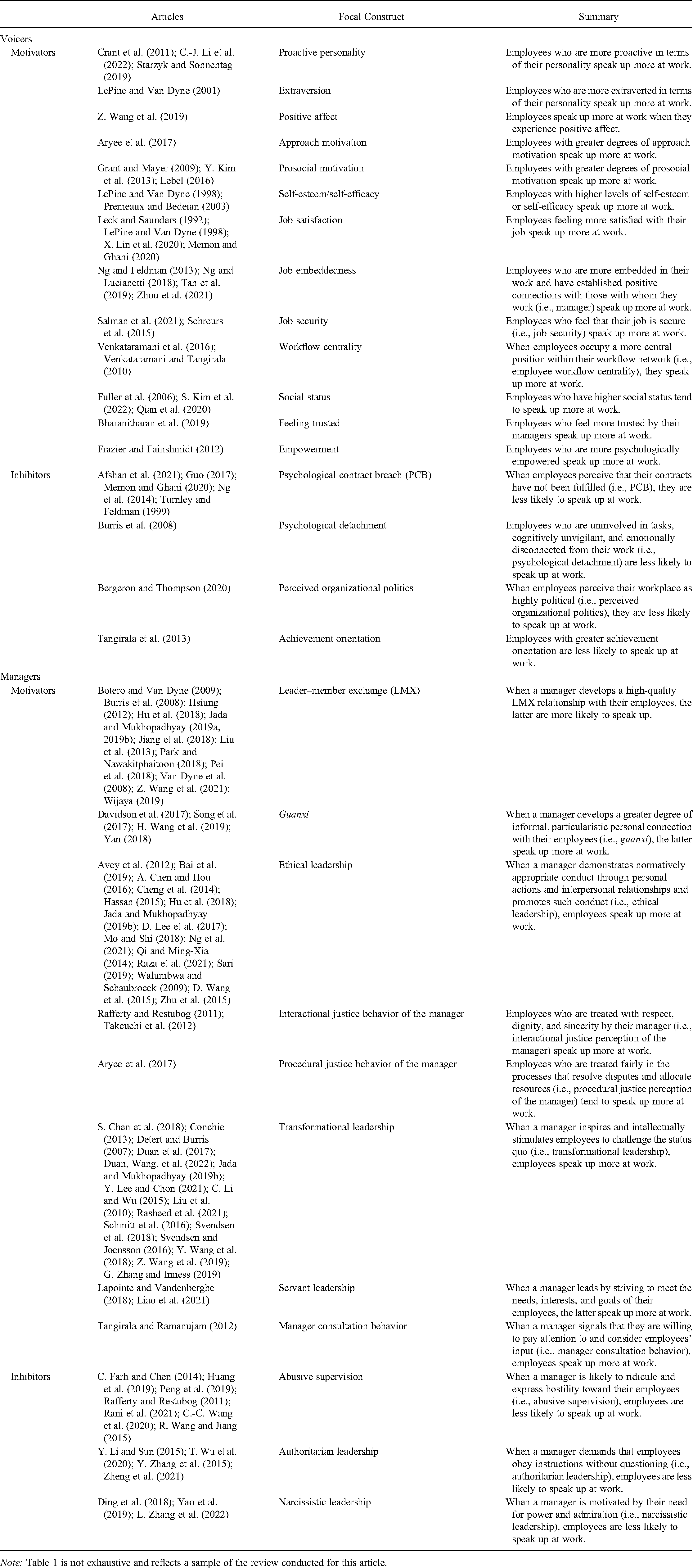
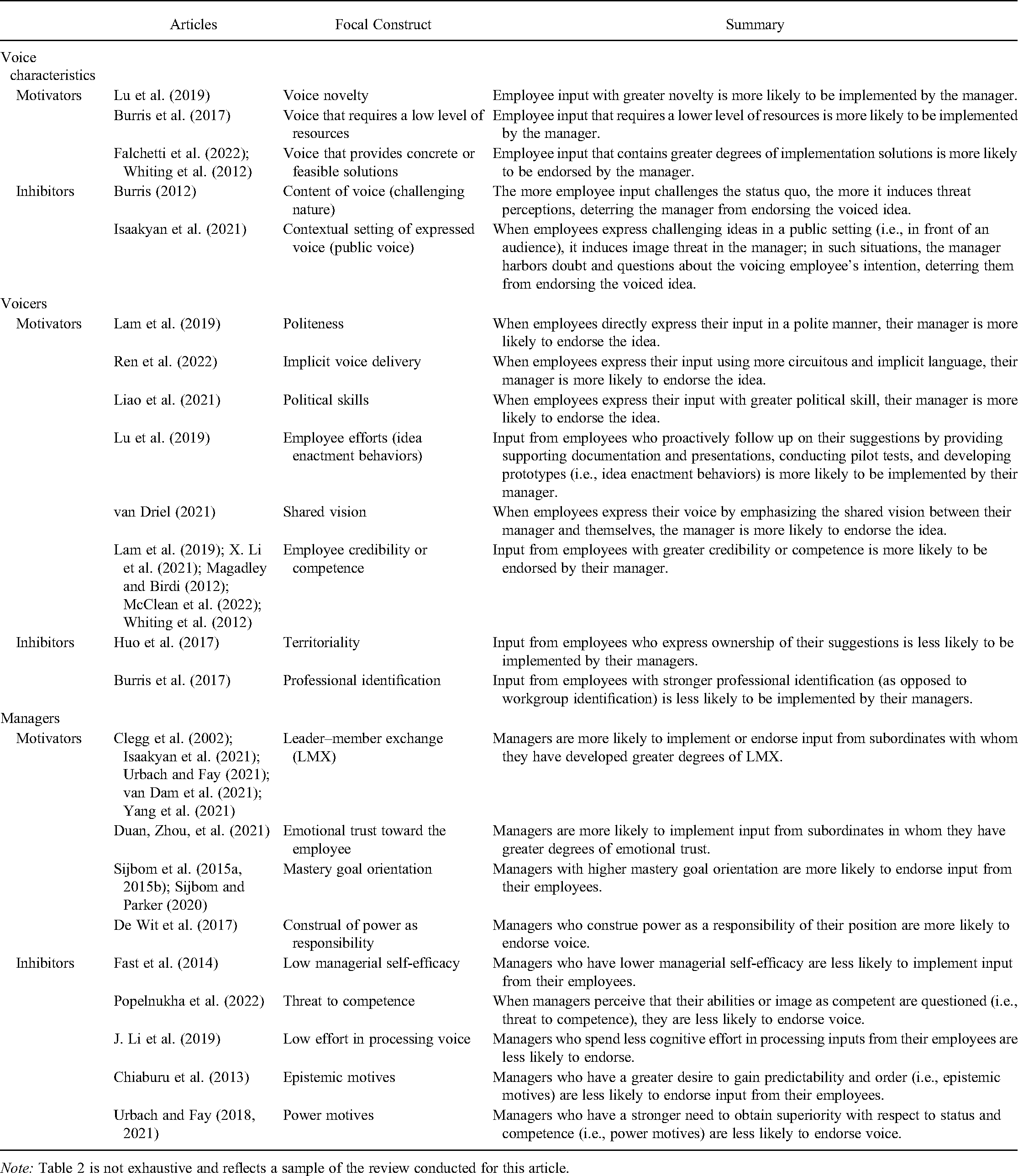
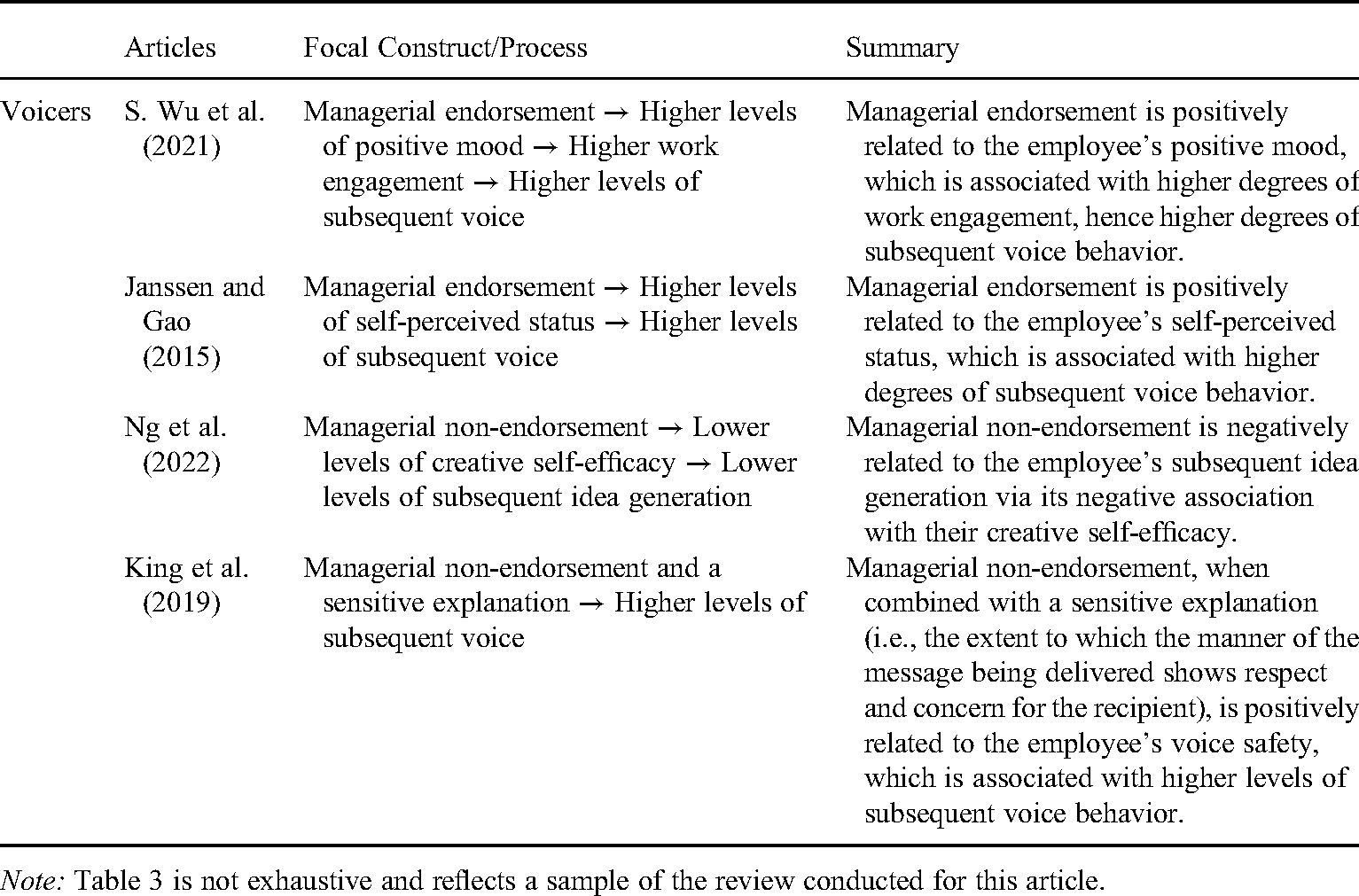
In the following sections, we review past voice research relevant to the paths connecting the four phases described by our dyadic model. According to our dyadic model, employees engage in voice behavior to initiate a social exchange relationship with their manager. Moreover, given that voicers consider the risks and benefits of engaging in voice behavior, we used a 2 (motivators vs. inhibitors) × 2 (voicers vs. managers) framework (see Table 1) to categorize the antecedents of constructive voice. We then explored the antecedents of managerial response to voice (i.e., endorsement and/or implementation). Our dyadic model also suggests that managers consider the potential risks and benefits associated with managerial endorsement and/or implementation. Accordingly, we applied a social exchange perspective to identify predictors associated with voicers and managers relevant to managerial responses to the voice phase. Moreover, we identified voice characteristics as a dimension of antecedents of managerial responses and adopted a 2 (motivators vs. inhibitors) × 3 (voice characteristics vs. voicers vs. managers) framework to categorize the antecedents of managerial endorsement and implementation (see Table 2). Finally, our dyadic model shows that feedback loops and relational mutuality between voicers and managers develop over time. Accordingly, we categorized articles on feedback loops and relational outcomes of voice for voicers and managers (see Tables 3 and 4).
Predictors of Constructive Voice
Note: Table 1 is not exhaustive and reflects a sample of the review conducted for this article.
Predictors of Managerial Responses to Constructive Voice (Endorsement and/or Implementation)
Note: Table 2 is not exhaustive and reflects a sample of the review conducted for this article.
Feedback Loops
Note: Table 3 is not exhaustive and reflects a sample of the review conducted for this article.
Relational Outcomes of Constructive Voice

Note: Table 4 is not exhaustive and reflects a sample of the review conducted for this article.
Mapping Past Research Onto A Dyadic Model of Constructive Voice
In the following sections, we review past voice research to identify what we know about our dyadic model of constructive voice.
Predictors of Employee Voice (Path A in Figure 1)
Voicers. Strong empirical evidence demonstrates how employees evaluate the potential benefits and risks of expressing constructive voice. For example, employees with certain dispositional traits or states are more eager to utilize voice as a means to initiate a social exchange relationship with their manager. Employees who are more proactive (Crant et al., 2011; C.-J. Li, Li, Chen, & Crant, 2022; Starzyk & Sonnentag, 2019), extraverted (LePine & Van Dyne, 2001), or higher on positive affectivity (H. Wang, Wu, Liu, Hao, & Wu, 2019) tend to be more approach oriented (Aryee, Walumbwa, Mondejar, & Chu, 2017) and prosocial (Grant & Mayer, 2009; Y. Kim, Van Dyne, Kamdar, & Johnson, 2013; Lebel, 2016). As such, they are likely to view approaching their managers via voice as more beneficial and thus speak up more at work. Similarly, employees who are high in self-esteem or efficacy based on their work are more capable of expressing their ideas or suggestions to their managers and thus feel more confident of reaping the benefits associated with entering a social exchange relationship with their managers via voice, resulting in more expression of constructive voice (LePine & Van Dyne, 1998; Premeaux & Bedeian, 2003).
Further, employees who are more satisfied with their job, more embedded in their organization (Ng & Feldman, 2013; Ng & Lucianetti, 2018; Tan, Loi, Lam, & Zhang, 2019; Zhou et al., 2021), or more committed at work (Burris, Detert, & Chiaburu, 2008; Lapointe & Vandenberghe, 2018) are more likely to see the benefits and good chances of success in initiating a social exchange relationship with their managers, who are likely to respond positively to their constructive voice. Specifically, their positive work attitudes make them trust managers (Guzman & Fu, 2022) and believe that their voice exchange with their managers will also be safe and beneficial and thus speak up more (Leck & Saunders, 1992; LePine & Van Dyne, 1998; X. Lin, Lam, & Zhang, 2020; Memon & Ghani, 2020). Similarly, employees who experience higher levels of job security should perceive that their position within their organization is unlikely to be influenced by an expression of constructive voice and may also feel valued by their manager. As a result, they are more likely to initiate a social exchange relationship with their manager through expressing constructive voice (Salman, Ahmed, & Jahangir, 2021; Schreurs, Guenter, & De Cuyper, 2015).
The position that employees occupy within a network may also influence the extent to which they are motivated to initiate a social exchange relationship with their manager through constructive voice. Specifically, employees who occupy a more central position (Venkataramani & Tangirala, 2010; Venkataramani, Zhou, Wang, Liao, & Shi, 2016) or enjoy greater status (S. Kim, McClean, Doyle, Podsakoff, Lin, & Woodruff, 2022; Qian, Li, Song, & Wang, 2020) are likely to receive more attention from their managers (Bharanitharan, Chen, Bahmannia, & Lowe, 2019; Fuller, Marler, & Hester, 2006; S. Kim et al., 2022) and be granted more autonomy (Lam & Mayer, 2014; Tangirala & Ramanujam, 2008) and trust (Bharanitharan et al., 2019) and are more likely to feel empowered by their manager (Frazier & Fainshmidt, 2012). As a result, they are more likely to perceive that initiating a social exchange relationship with their manager through constructive voice will be positive and beneficial and therefore speak up more (Bharanitharan et al., 2019; Fuller et al., 2006; S. Kim et al., 2022; Liang et al., 2012; Venkataramani et al., 2016).
Employees may also consider inhibitors that deter constructive voice. For example, psychological contract breach, defined as the extent to which an employee perceives that a manager has failed to fulfill their obligations at work (Rousseau, 1989, 1995; Turnley, Bolino, Lester, & Bloodgood, 2003), signals to employees that their manager is unable to keep his or her promises (Griffeth, Hom, & Gaertner, 2000; Kahn, 1990; Tett & Meyer, 1993). As a result, voicers may come to believe that they are unlikely to reap the benefits of voice even if their manager endorses and/or implements it, which increases the perceived risk of initiating voice. Consequently, employees who experience psychological contract breach are less likely to engage in constructive voice (Afshan, Serrano-Archimi, & Lacroux, 2021; Guo, 2017; Memon & Ghani, 2020; Ng, Feldman, & Butts, 2014; Turnley & Feldman, 1999). Similarly, psychologically detached employees are unlikely to value, and are unmotivated to initiate, a social exchange relationship with their managers (Griffeth et al., 2000; Kahn, 1990; Tett & Meyer, 1993), which prevents them from speaking up (Burris et al., 2008).
Another factor that could inhibit constructive voice is organizational politics, or the presence of illegitimate, self-serving activities intended to pursue personal interests (Bergeron & Thompson, 2020). When employees perceive their workplace to be highly political, they may feel that their manager will exploit their relationship by taking credit for their voice or using their suggestions for their own personal benefit, thereby increasing the risk of engaging in voice (Zhou, Liao, Liu, & Liao, 2017). Furthermore, high levels of organizational politics may also make employees feel uncertain about whether managers would respond positively to their suggestions (Detert & Edmondson, 2011; Fuller et al., 2006; C. Li, Liang, & Farh, 2020; Zheng, Graham, Farh, & Huang, 2021). This uncertainty further increases the risk of initiating a social exchange relationship with their manager, thereby inhibiting constructive voice (Duan et al., 2019).
Finally, certain characteristics of employees may also lead them to believe that engaging in constructive voice is not a viable way to initiate a social exchange relationship with their manager. For example, employees with achievement orientation or aspirations of getting ahead (Costa & McCrae, 1992) tend to focus on behaviors that guarantee career rewards. Given that constructive voice may potentially embarrass or threaten their manager, employees with higher levels of achievement orientation are likely to be particularly concerned about jeopardizing their relationships with managers and opportunities for career advancement (Tangirala, Kamdar, Venkataramani, & Parke, 2013), resulting in lower levels of constructive voice.
Managers. Our review suggests that managers play a critical role in motivating employees to initiate a social exchange relationship through constructive voice. For example, higher levels of LMX (Graen & Uhl-Bien, 1995) encourage employees to believe that constructive voice will enjoy positive reactions from their manager and increase the perceived likelihood of obtaining benefits from expressing constructive ideas, thereby heightening their motivation to speak up (Botero & Van Dyne, 2009; Burris et al., 2008; Hsiung, 2012; Hu et al., 2018; Jada & Mukhopadhyay, 2019a, 2019b; Jiang, Le, & Gollan, 2018; Liu, Tangirala, & Ramanujam, 2013; Park & Nawakitphaitoon, 2018; Pei, Pan, Skitmore, & Feng, 2018; Van Dyne, Kamdar, & Joireman, 2008; Z. Wang, Shi, & Wang, 2021; Wijaya, 2019). Similarly, guanxi—an informal personal connection between two individuals unique to Chinese culture (X. Chen & Chen, 2004)—also emerges as a motivator of constructive voice. Employees with more positive guanxi are more attached to each other (Shaw & Mao, 2021) and thus driven to establish social exchange relationships with their managers via constructive voice (Davidson, Van Dyne, & Lin, 2017; Song, Wu, Hao, Lu, Zhang, & Liu, 2017; Z. Wang, Xu, Sun, & Liu, 2019; Yan, 2018).
Another managerial behavior type that motivates constructive voice is ethical behavior (Avey, Wernsing, & Palanski, 2012; Bai, Lin, & Liu, 2019; A. Chen & Hou, 2016; Cheng, Chang, Kuo, & Cheung, 2014; Hassan, 2015; Hu et al., 2018; Mo & Shi, 2018; Ng, Wang, Hsu, & Su, 2021; Raza, Liu, Zhang, Gul, Hassan, & Aboud, 2021; Walumbwa & Schaubroeck, 2009; D. Wang, Gan, Wu, & Wang, 2015; Zhu, He, Treviño, Chao, & Wang, 2015). Ethical managers are likely to treat their employees with respect, fairness, concern, and integrity (Brown & Treviño, 2006). Employees thus come to believe that their voice will be considered in a fair manner, which encourages them to initiate a social exchange relationship with their managers through expressing constructive voice. Consistent with this argument, studies show that managers who treat their employees with respect and dignity (Rafferty & Restubog, 2011; Takeuchi, Chen, & Cheung, 2012) and employ fair policies and processes (Aryee et al., 2017) are more likely to motivate constructive voice.
Some leadership behaviors can also promote the initiation of social exchange via employee constructive voice. For example, managers who exhibit transformational leadership behaviors can inspire and intellectually stimulate employees to challenge the status quo. Developmental and nurturing care from managers signals to employees that their voice will be valued, thereby increasing the potential benefits of speaking up (S. Chen, Wang, & Lee, 2018; Conchie, 2013; Detert & Burris, 2007; Duan, Li, Xu, & Wu, 2017; Duan, Wang, Janssen, & Farh, 2022; Jada & Mukhopadhyay, 2019b; Y. Lee & Chon, 2021; X. Li & Wu, 2015; Liu, Zhu, & Yang, 2010; Rasheed, Shahzad, & Nadeem, 2021; Schmitt, Den Hartog, & Belschak, 2016; Svendsen & Joensson, 2016; Svendsen, Unterrainer, & Jønsson, 2018; Y. Wang, Zheng, & Zhu, 2018; Z. Wang et al., 2019; G. Zhang & Inness, 2019). Also, managers exhibiting servant leadership are oriented toward meeting the needs, interests, and goals of their employees while leading the workgroup (Eva, Robin, Sendjaya, van Dierendonck, & Liden, 2019), even to the point of sacrificing their own interests (Liden, Wayne, Zhao, & Henderson, 2008). Such managers are generally more attentive to and receptive of employee suggestions. As a result, employees are more likely to initiate a social exchange relationship with managers who exhibit servant leadership via constructive voice (Lapointe & Vandenberghe, 2018; Liao, Liden, Liu, & Wu, 2021).
Managers can also encourage employees to develop a social exchange relationship with them by engaging in managerial consultation or soliciting suggestions on work issues from employees (Tangirala & Ramanujam, 2012). Managerial consultation signals to employees that managers are willing to pay attention and are open to employee input (Ashford, Ong, & Keeves, 2017; Detert & Burris, 2007), which increases the likelihood of constructive voice benefiting employees. Moreover, as a type of recognition of, or positive feedback on, employees’ roles, abilities, and influence at work (Edmondson, 2003; W. Lee, Choi, & Kang, 2021), managerial consultation can lead employees to expect positive responses from managers. As a result, managerial consultation can motivate employees to initiate a social exchange relationship with their manager through voice behavior.
In contrast, some leadership behaviors are likely to increase the risks associated with constructive voice and to inhibit employees from initiating a social exchange relationship with their manager via voice. For example, managers exhibiting high levels of abusive behaviors increase the risks associated with voice, as abusive managers are likely to ridicule and express hostility toward employee voice (C. Farh & Chen, 2014; Huang, Su, Lin, & Lu, 2019; Peng et al., 2019; Rafferty & Restubog, 2011; Rani, Shah, Umrani, Syed, & Afshan, 2021; C.-C. Wang, Hsieh, & Wang, 2020; R. Wang & Jiang, 2015). Similarly, it is highly risky to provide change-oriented suggestions to authoritarian leaders who demand that their subordinates follow instructions without questioning (J. Farh & Cheng, 2000), and employees can expect such managers to respond negatively, inhibiting voice (Y. Li & Sun, 2015; T. Wu, Liu, Hua, Lo, & Yeh, 2020; Y. Zhang, Huai, & Xie, 2015; Zheng et al., 2021). Finally, managers exhibiting narcissistic leadership, a leadership style in which they pursue their own interests via deceptive behaviors and disregard their subordinates’ needs or inputs (Chatterjee & Hambrick, 2007; Morf & Rhodewalt, 2001), can create expectations of being ignored and even punished for speaking up. This increases the risk of initiating a social exchange relationship with narcissistic managers and inhibits constructive voice behavior (Ding, Li, Quan, & Wang, 2018; Yao, Zhang, Liu, Zhang, & Luo, 2019; Zheng et al., 2021).
Predictors of Managerial Responses to Voice (Path B in Figure 1)
Voice characteristics. The characteristics of constructive voice—such as its quality, content, and publicity—greatly influence managerial responses to voice. For instance, high-quality and novel ideas (Brykman & Raver, 2021) are likely to benefit a manager, which increases their motivation to develop positive relationships with the voicer by endorsing and/or implementing their suggestions (Lu, Bartol, Venkataramani, Zheng, & Liu, 2019). The content of voice also matters for voice endorsement and/or implementation. For example, suggestions that are easy to implement (Dutton & Dukerich, 1991) provide managers a means for successful change, which in turn increases managers’ perceived benefits of endorsing and/or implementing constructive voice (Burris et al., 2017). Constructive voice that contains feasible solutions (Whiting et al., 2012) with concrete ideas (Falchetti, Cattani, & Ferriani, 2022) also signals to managers that voicers are willing to make an effort to help them resolve issues or problems in the work unit. As a result, managers may be more inclined to develop social exchange relationships with helpful voicers by endorsing and/or implementing their constructive voice (Liao et al., 2021; Whiting et al., 2012). In support of this idea, research shows that voicing solutions that benefit the work unit is positively associated with managerial endorsement, as opposed to voicing mere problems, issues, or concerns without solutions (Lam et al., in press; Liao et al., 2021).
Our review of the literature also suggests several voice characteristics that inhibit positive managerial responses to voice. For example, when employees make suggestions that challenge their manager’s ideas or existing practices, the latter may feel their status, power, and position of authority threatened, which may inhibit managers from endorsing and/or implementing employee voice (Burris, 2012) and building a positive social exchange relationship with the voicer. Moreover, when voice is expressed in a public setting (i.e., in front of an audience), managers can be concerned about being viewed as an incompetent leader by others (Popelnukha et al., 2022). If managers perceive voice as a threat to their image, they may shy away from endorsing and/or implementing employee voice (Isaakyan et al., 2021) and responding positively to voicers’ initiation of a social exchange relationship.
Voicers. Several voicer-related factors can also motivate managers to endorse and/or implement constructive voice. First, the extent to which voicers express their suggestions with interpersonal skill can influence whether managers endorse and/or implement constructive voice. When political skills (Liao et al., 2021) are used to express voice politely (Lam et al., 2019), implicitly (Ren, Ma, Chen, Wang, & Ju, 2022), or with appropriate emotions (Grant, 2013), it can show respect and sincerity and signal that the employee’s underlying motives for speaking up are not to embarrass their manager but to help them. As such, this leads managers to be more open to listening to and subsequently endorsing and/or implementing constructive voice.
Second, the amount of effort made by voicers appears to be an important signal to managers evaluating whether to build or maintain a positive social exchange relationship with them through voice endorsement and/or implementation. For example, employees who reach out to their network (Baer, 2012), proactively follow up on their suggestions with supporting documentation and presentations (Lu et al., 2019), share long-term directions, and utilize inspirational and persuasive appeals to demonstrate the value of their suggestions are more likely to see their suggestions endorsed (van Driel, 2021) and implemented (Lu et al., 2019). As such, when voicers are perceived to be proactive during the voice process, managers are more likely to benefit from endorsing employee voice, and therefore their suggestions are more likely to be endorsed and/or implemented by managers.
Finally, managers are more likely to endorse and/or implement voice that is expressed by employees with higher levels of credibility (Hovland & Weiss, 1951). Voicer credibility is an important predictor of endorsement and/or implementation because voice from credible voicers ensures high-quality input (Brykman & Raver, 2021) that is more likely to translate into positive outcomes for managers and increase the perceived benefits of endorsing and/or implementing employee voice (McClean, Kim, & Martinez, 2022). In support of our argument, a multitude of studies show that employee competence or credibility is associated with higher levels of voice endorsement and/or implementation (Ashford et al., 2017; Lam et al., 2019; X. Li et al., 2021; Magadley & Birdi, 2012; Whiting et al., 2012).
Voicer-related factors can also inhibit managerial endorsement and/or implementation. For example, voicers who are more territorial about their suggestions (i.e., feel strong ownership) are less likely to collaborate collegially with their manager to develop their suggestions. Managers may find relationships with such voicers to be risky and thus be reluctant to endorse and/or implement their constructive voice (Huo, Yi, Men, Luo, Li, & Tam, 2017). In addition, voicers who identify more with their profession than with their work unit tend to speak up offering suggestions that are more aligned with their professional standards than the interests of their work unit. Given that addressing issues centered on helping employees’ professions is not a core duty of managers, they are less likely to endorse and/or implement ideas suggested by voicers with professional identification (Burris et al., 2017).
Managers. Various managerial factors can motivate managers to build a positive relationship with voicers through endorsement and/or implementation. First, perceived relationship quality with voicers is critical in motivating positive responses from managers. For example, managers who have higher levels of LMX with voicers are more likely to perceive the underlying motives of employees’ change-oriented suggestions to be prosocial and as intended to benefit managers (Urbach & Fay, 2021). Such perceptions are likely to motivate managers to respond positively and endorse employee suggestions (Clegg, Unsworth, Epitropaki, & Parker, 2002; Isaakyan et al., 2021; van Dam, Caniëls, Cools-Tummers, & Lenaerts, 2021; Yang, Lee, Zheng, & Johnson, 2021). Similarly, managers who have higher levels of emotional trust in voicers will have more positive affective bonding with them, which can further motivate managers’ willingness to strengthen their social exchange relationship with voicers through endorsing and/or implementing constructive voice (Duan, Zhou, & Yu, 2021).
Individual differences also matter. For instance, managers who exhibit higher levels of mastery goal orientation, or the desire to develop and gain competence by acquiring new skills and mastering new situations (Dweck, 1999), can view employee input as an opportunity to improve their own skills and abilities rather than as a threat. Such managers should be more open to constructive voice and therefore be more willing to endorse and/or implement employees’ suggestions (Sijbom et al., 2015a, 2015b; Sijbom & Parker, 2020). In addition, managers who construe power as a responsibility, as opposed to an opportunity for personal gain, tend to view employee voice as a valuable resource in fulfilling their managerial responsibilities. Such managers are more likely to perceive constructive voice as a means for employees to help them fulfill their managerial responsibilities and as a result should be more willing to endorse and/or implement constructive voice (De Wit, Scheepers, Ellemers, Sassenberg, & Scholl, 2017).
Our literature review also identified several manager-related inhibitors that deter managers from endorsement and/or implementation. For example, managers with a low sense of efficacy—that is, perceived lack of ability to meet the elevated expectations of competence associated with managerial roles (Cuddy, Glick, & Beninger, 2011; Fiske, Cuddy, Glick, & Xu, 2002)—are particularly protective of their ego (Burris, 2012). Such managers are likely to interpret employee voice as a reflection of their lack of self-efficacy (Fast et al., 2014) and a threat to their competence (Popelnukha et al., 2022) and would be unable to process employee voice fully (J. Li, Barnes, Yam, Guarana, & Wang, 2019). As managers with low self-efficacy are likely to view changes to the status quo to be risky, they may be more reluctant to endorse and/or implement constructive voice (Burris, 2012).
In addition, managers with higher levels of epistemic motives prefer predictability and ordered, established structures and tend to stick with existing procedures (Jost, Glaser, Kruglanski, & Sulloway, 2003; Neuberg & Newsom, 1993). Given that voice involves challenging the status quo, managers with epistemic motives are likely not to value employee voice and to view it as an unnecessary risk, thus reducing the chances that they will endorse and/or implement constructive voice (Chiaburu, Farh, & Van Dyne, 2013). Similarly, managers with high levels of power motives have a strong need to obtain and maintain superiority with respect to status and competence (McClelland, 1985, 1987). As a result, such managers may feel threatened by constructive voice, thereby reducing managerial endorsement and/or implementation of employee voice (Urbach & Fay, 2018, 2021).
Feedback Loops (Path C in Figure 1)
Voicers. Few studies have examined the presence of feedback loops in this context, but it is generally assumed that positive managerial responses to employee voice provide a foundation that motivates employees to engage in voice behavior again (i.e., the development of a feedback loop; Clegg et al., 2002). When suggestions are endorsed by managers, employees feel positive (i.e., mood) and more engaged in their work, which motivates subsequent voice (S. Wu, Kee, Li, & Ni, 2021). Positive managerial responses can also enhance employees’ self-perceptions of status or capability (C.-J. Li et al., 2022), which motivate subsequent voice behavior (Janssen & Gao, 2015). These studies suggest that a positive voice exchange experience with managers is foundational in establishing a self-reinforcing form of reciprocity in which employees willingly speak up to engage in voice behaviors again in future.
There is initial evidence that employees may still engage in voice despite managers not endorsing and/or implementing their initial voice. Non-endorsement and/or non-implementation are inevitable due to different types of constraints, and how managers express non-endorsement can affect employees’ willingness to initiate a social exchange process through constructive voice in the future (Ng et al., 2022). For example, managers who convey respect for and appreciation of voicers by highlighting the strengths of their suggestions and providing detailed explanations of why their suggestions were not endorsed and/or implemented can motivate subsequent voice (Weiss & Zacher, 2022). This is consistent with King and colleagues’ (2019) empirical findings that managers’ communication of respect and concern provides employees a sense of security that encourages them to speak up again in the future despite their initial suggestions not being endorsed.
Relational Outcomes of Employee Voice (Path D in Figure 1)
Voicers. Recently, research has begun to show that employee voice may produce positive relational outcomes, such as higher levels of LMX (Cheng et al., 2013; Lapierre & Hackett, 2007). For example, when employees pitch ideas that improve organizational effectiveness and functioning (Stamper & Van Dyne, 2001), managers are more likely to allocate resources and support to them, which may contribute to the development of a more positive relationship between voicers and managers (Fuller, Barnett, Hester, Relyea, & Frey, 2007; Graen & Uhl-Bien, 1995). The manager’s attribution of prosocial and impression management motives can also affect the relationship between employee voice and positive relationships (Cheng et al., 2013). When managers perceive that the underlying interests of employee voice behavior are intended to help (i.e., prosocial) rather than to impress, managers are more likely to offer support and resources to voicers. This in turn is likely to motivate employees to invest more in developing a high-quality LMX relationship with their managers (Kwon, Farndale, & Park, 2016).
Other studies have shown that voice behavior enhances voicers’ affective (i.e., emotional attachment) and normative (i.e., moral obligation) commitment (Farndale, van Ruiten, Kelliher, & Hope-Hailey, 2011; Rashid, Dastgeer, & Kayani, 2018) as well as trust in their manager (Rees, Alfes, & Gatenby, 2013). Employees who express constructive voice may appreciate the opportunity to provide meaningful input that can help their unit be successful. As a result, employees may sense higher levels of affective and normative commitment to (Farndale et al., 2011; Rashid et al., 2018), and trust in (Rees et al., 2013), their manager, factors that are foundational for the development of high-quality relationships.
Managers. Managers may also experience positive relational outcomes from voice exchanges with employees. For example, they may develop an appreciation for voicers who speak up with challenging but constructive suggestions, especially when it improves the effectiveness of their own managerial performance (Gyensare et al., 2019). Furthermore, such outcomes can foster liking (Whiting et al., 2012), enhance perceptions of communion (Weiss & Morrison, 2019), and raise levels of trust and relationship quality with voicers (Liang & Yeh, 2019; A. Xu, Loi, & Cai, 2021).
Summary of Prior Research
Our review of employee voice and managerial responses to voice shows how employees evaluate the potential benefits and risks of initiating a social exchange relationship via constructive voice. Factors such as voicers’ proactive personality (Crant et al., 2011), extraversion (LePine & Van Dyne, 2001), LMX (Van Dyne et al., 2008), job satisfaction (X. Lin et al., 2020), job embeddedness (Ng & Feldman, 2013), justice (Rafferty & Restubog, 2011), ethical leadership (Ng et al., 2021), and transformational leadership (Detert & Burris, 2007) can motivate employees to initiate a social exchange relationship through engaging in constructive voice. Alternatively, factors such as achievement orientation (Tangirala et al., 2013), psychological detachment (Burris et al., 2008), perceived organizational politics (Bergeron & Thompson, 2020), abusive supervision (C. Farh & Chen, 2014), and authoritarian leadership (Zheng et al., 2021) can prevent employees from initiating a social exchange relationship with their manager via constructive voice.
Upon receiving employee constructive voice, managers also influence the development of social exchange relationships by evaluating the potential benefits and risks associated with endorsing and/or implementing employee voice. Our review identified motivators, such as voicing with solutions (Whiting et al., 2012), voice politeness (Lam et al., 2019), voicers’ political skills (Liao et al., 2021), managers’ trust in voicers (Duan, Wang, et al., 2022), and managers’ mastery goal orientation (Sijbom et al., 2015a, 2015b). We also identified inhibitors, including voice publicity (Isaakyan et al., 2021), voicers’ territoriality (Huo et al., 2017), and managers’ lack of self-efficacy (Fast et al., 2014), as factors that influence managers’ decision to endorse and/or implement employee voice.
When managers respond to initial voice with endorsement and/or implementation, positive feedback loops are established whereby voicers feel more motivated to speak up with constructive suggestions again (Janssen & Gao, 2015; S. Wu et al., 2021). Alternatively, positive feedback loops can develop and motivate subsequent constructive voice when managers express respect, appreciation (Weiss & Zacher, 2022), and concern to voicers (King et al., 2019). As a result of positive feedback loops and successful voice exchanges, voicers can establish positive relationships with managers characterized by higher levels of LMX (Cheng et al., 2013; Lapierre & Hackett, 2007), commitment (Rashid et al., 2018), and trust (Rees et al., 2013). Similarly, voice exchanges lead managers to experience positive relational outcomes with voicers, such as liking (Whiting et al., 2012), higher levels of communion (Weiss & Morrison, 2019), and higher levels of relationship quality with voicers (Liang & Yeh, 2019; A. Xu et al., 2021).
Although prior studies have contributed to expanding our understanding of voice, critical knowledge gaps remain in the voice literature. First, as we highlight in the introduction, there is a dearth of studies examining voice from a dyadic perspective, with very few studies that include both employee voice and managerial responses to voice in the same study. Due to the lack of a dyadic perspective, investigation of dyadic factors that might influence employee constructive voice expression and managerial responses to voice has been limited. Additionally, our review suggests that the temporal aspect of voice is also highly understudied. Despite the call for more longitudinal studies (Bashshur & Oc, 2015), our review shows that voice is often conceptualized as a single voice exchange, and methodological approaches involving cross-sectional designs predominate in the current voice literature (for an exception, see A. Li & Tangirala, 2021). This lack of research on the temporal dynamics of voice may explain why there are so few studies on the development of feedback loops and the relational outcomes of voice. As such, very little attention has been paid to the dyadic and dynamic nature of employee constructive voice.
In response to such limitations, we present our dyadic model that conceptualizes voice as an ongoing and dyadic exchange relationship between voicers and managers. First, we highlight the dyadic aspect of voice exchanges by integrating voicer-centric research with studies on managerial responses to voice, two streams of research that have developed separately and without integration. Applying a social exchange perspective to voice not only merges these two streams, but more importantly, it also provides a more holistic view of the voice process. Specifically, we conceptualize constructive voice as a social exchange process that considers both (a) the employee’s evaluation of the potential benefits and risks of using constructive voice to initiate social exchange with their manager and (b) the manager’s evaluation of the potential risks and rewards of endorsing and/or implementing employee suggestions as a means to build a positive social exchange relationship with the voicer. In doing so, our dyadic model indicates important future research directions, such as considering dyadic factors (i.e., dyadic fit) that might influence voice exchanges between voicers and managers.
Second, our model sheds new light on the dynamic nature of constructive voice by introducing how feedback loops and relational mutuality develop via repeated successful voice exchanges. Feedback loops are crucial as they link initial exchanges of voice to future exchanges. When a positive voice exchange occurs in which employees initiate voice and managers endorse and/or implement it, it creates positive reciprocity that motivates both employees and managers to engage in voice exchanges again in the future. The development of positive feedback loops then fosters a mutually trusting, committed, and favorable dyadic relationship between voicers and managers, which we refer to as relational mutuality. In turn, relational mutuality can induce employees and managers to engage in automatic and noncalculative social exchanges of voice and response over time. Importantly, doing so enables us to reconcile two seemingly contrasting views on employee voice: one that is deliberative (Morrison, 2011, 2014) and another that is automatic (Lam et al., 2018, in press). That is, our conceptualization of constructive voice theorizes how automatic voice can be viewed as an extension of deliberative voice. As employees are responsible for initiating social exchange relationships with managers, voicers tend to be more deliberative when deciding to voice. However, with repeated successful voice exchanges and the development of relational mutuality, we assert that voicers eventually engage in automatic voice over time.
Directions for Future Research
Our dyadic model integrates voicer-centric and manager-centric research to offer a more dyadic and dynamic view of voice behavior over time, and in doing so, we identify avenues for future studies. In this section, we offer conceptual and methodological directions for future research to further explore the dyadic and dynamic nature of employee constructive voice.
The Dyadic Nature of Constructive Voice
A central premise of our dyadic model is its emphasis on the dyad involved in voice exchange, namely, the voicer and their manager. As relationships are shaped by dyadic characteristics (Krasikova & LeBreton, 2012; Neyer & Voigt, 2004), exploring how various dyadic characteristics influence the voice exchange relationship may help better understand the dyadic nature of constructive voice. One particularly promising characteristic is dyadic fit (Jansen & Kristof-Brown, 2006). When the dyadic fit between employees and managers is supplementary (i.e., similarities attract; Muchinsky & Monahan, 1987), the values, orientations, or personalities of voicers are aligned with those of their manager (Guzman & Fu, 2022; Kammeyer-Mueller, Schilpzand, & Rubenstein, 2013; Shaw & Mao, 2021). In such situations, employees would expect their managers to be more open to their suggestions, thereby increasing the likelihood of employees initiating a social exchange relationship via voice behavior (Bao, Han, Liao, Liao, & Deng, 2021). A supplementary fit between voicers and managers should increase the likelihood of managerial endorsement and/or implementation as the suggestions raised by employees are likely to be more consistent with the values and orientations of their manager. A supplementary dyadic fit can therefore facilitate positive dyadic voice exchanges by encouraging employee voice and managerial endorsement and/or implementation. This is consistent with A. Li and Tangirala’s (2021) demonstration that congruence between employee and manager proactive personality has positive implications for voice exchanges.
Another dyadic fit relevant to our dyadic model is complementary fit (Muchinsky & Monahan, 1987) between employees and managers, or the notion that certain employee (or manager) characteristics offset those of the other party (Cable & Edwards, 2004; Kristof-Brown, Barrick, & Stevens, 2005). For example, complementary fit in extraversion may facilitate higher levels of employee voice and managerial endorsement. When managers are relatively introverted, extraverted employees may a have greater chance of initiating voice. This is because introverted managers are likely to be less dominant and therefore more willing to listen to the ideas raised by extroverted employees, who are more talkative, dominant, and likely to take the initiative to lead the discussion (Sherf, Sinha, Tangirala, & Awasty, 2018). As a result, extroverted voicers may naturally speak up more to introverted managers. Once such employees initiate voice, communication in the dyad can be expected to be smooth and face only minor interruptions (Tost, Gino, & Larrick, 2013), which in turn can contribute to a more meaningful discussion (e.g., Grant, Gino, & Hofmann, 2011) and increase the likelihood of managerial endorsement.
Alternatively, when voicers and managers are equally extraverted, both may want control over the conversation. Additionally, extraverted managers may prefer to work with more compliant employees (Kiesler, 1983) and may not appreciate extraverted employees speaking up proactively. Such preferences may deter voicers from speaking up; if employees do speak up, they can create power struggles between managers and employees as both parties are inclined to dominate the conversation. As a result, managerial endorsement is more (or less) likely to occur when a complementary (or supplementary) fit of extraversion between voicers and managers exists.
Given such opposed predictions, exploring the unique effects of supplementary and complementary dyadic fit may provide important implications worth additional research. Specifically, we suggest that the effect of supplementary and complementary dyadic fit may be content specific, meaning that the content of the fit matters. For example, a supplementary dyadic fit of proactive personality may encourage employee voice and managerial endorsement, as may a complementary dyadic fit of extraversion (Guay, Kim, Oh, & Vogel, 2019; Hartnell, Kinicki, Lambert, Fugate, & Corner, 2016). Extending this idea, future scholars may consider various individual attributes (i.e., values, goals, interests, etc.) as well as personality traits and explore which dyadic fit (supplementary vs. complementary) matters in driving employee voice and managerial endorsement and/or implementation.
Besides dyadic fit, dyadic interdependence may also influence voice exchanges between voicers and their managers. As our dyadic model suggests, once dyads achieve relational mutuality via the experience of successful voice exchanges, voicers become more automatic in their decision to voice (Lam et al., 2018, in press). Accordingly, one avenue for future research is to examine how the levels of dyadic interdependence affect the development of relational mutuality and automatic voice exchanges between voicers and managers. When they share higher levels of dyadic interdependence, meaning that employees and managers interact closely for the completion of their tasks (van Vijfeijken, Kleingeld, Tuijl, Algera, & Thierry, 2002), we expect voicer–manager dyads to value their relationships for instrumental reasons. That is, when dyadic interdependence is high (vs. low), a preexisting common dyadic identity and rapport between voicer and manager can allow relational mutuality to be established easily and automatic voice to occur quickly after only a few successful voice exchanges.
Furthermore, while the establishment of relational mutuality can induce voicers and managers to engage in voice exchanges automatically, there are also times when both parties need to reassess and/or abandon their automatic voice exchanges. As such, we argue that automatic voice exchanges may be disrupted when dyads encounter major disturbances in their relationships that alter their dyadic interdependence. For example, when a manager moves to another department, their dyadic reciprocity with a voicer may be disrupted (Methot, Lepak, Shipp, & Boswell, 2017) as the dyadic interdependence and automatic voice exchanges can no longer be maintained. As such, exploring the effects of different dyadic characteristics, such as dyadic interdependence, may help us understand when relational mutuality and automatic voice exchange are established and/or interrupted and therefore warrants future research.
The Dynamic Nature of Constructive Voice
While scholars have recently started to take an interest in different delivery modes, researchers have often considered voice modes to be static over time. In reality, however, voicers may vary their mode of delivery when speaking up. Accordingly, our dyadic model posits that voicers carefully choose a variety of delivery methods, such as politeness (Lam et al., 2019) or speaking up in private (Isaakyan et al., 2021), when voicing to initiate a positive social exchange process with their managers. Future research may extend our conceptual model and explore how managers respond to changes in voice delivery mode. As relational mutuality develops, voicers may become less concerned about their delivery mode when communicating with their manager (S. Kim et al., 2022) and, as a result, express their voice frankly as it becomes more automatic over time. For example, voicers may feel comfortable speaking up in public or in a more direct manner (Lam et al., 2019) if they believe that managers will not be offended by their lack of tact (Ferrin et al., 2008). Thus, our dyadic model predicts that, on the one hand, managers may not be offended by change in voice delivery mode due to the development of relational mutuality between voicer and manager. On the other hand, given how managers are hierarchically positioned above the voicer, they may still expect a certain degree of tact during a voice exchange in order to preserve relational mutuality. In sum, exploration of how employee voice delivery modes influence managers’ perceptions and the development of social exchange relationships over time may provide additional insight that further contributes to our proposed conceptual dyadic model of constructive voice.
Exploring how managerial endorsement and implementation distinctively facilitate the development of feedback loops over time may also offer insights. Although extant work often neglects the conceptual difference between endorsement and implementation (Burris, 2012), considering endorsement and implementation as distinct constructs may be an insightful way to investigate voice behavior over time. Specifically, implementation may be more beneficial and elicit greater reciprocity for voicers than endorsement because it involves actual changes that are easily recognized by others, whereas endorsement represents attitudinal agreement that may or may not be translated into actual changes. For example, when speaking up with concerns about heavy workloads and high work pressure, employees would want their managers to not only agree with their concerns (i.e., endorsement) but also take action to improve the situation (i.e., implementation). Implementation improves the status quo and creates feedback loops in which employees engage in subsequent voice exchanges. Alternatively, when employee suggestions are merely endorsed without implementation, over time employees may come to think that managers are not taking their voice seriously. Employees may be reluctant to engage in subsequent voice, a situation in which the development of a feedback loop will likely be inhibited. As such, we encourage future research to investigate how managerial endorsement and implementation influence the reciprocal exchanges of voice via feedback loops.
Exploring factors that counter the expectations of how managerial endorsement and/or implementation is presumed to facilitate subsequent voice may also offer insight. For example, when managers delay their endorsement and/or take a long time to implement suggested changes, voicers may interpret the delay negatively, even if their ideas are eventually endorsed and/or implemented. Moreover, managers may delay their endorsement and/or implementation until another subordinate expresses a similar suggestion or their own superiors push for change. In such situations, voicers may perceive delay as an indication of distrust. Voicers may also question managers’ intentions in endorsing and/or implementing their suggestions and therefore be reluctant to engage in subsequent voice in the future. Accordingly, we encourage scholars to explore situations in which managerial endorsement and/or implementation does not contribute to the development of positive feedback loops and employees engaging in future voice.
Extending the Dyadic Model to Organizational Level
Social exchange theory (Blau, 1964; Molm, Schaefer, & Collett, 2007) posits that a direct social exchange occurs when party A provides benefits to party B, as a result of which party B feels an obligation to reciprocate the benefits to party A in future (Blau, 1964; Deckop, Cirka, & Andersson, 2003; Lyons & Scott, 2012). Drawing on this notion, our dyadic model focuses on this direct type of exchange relationship between voicers and managers. However, employees also participate in what Blau (1964: 259) refers to as “indirect chains of exchange,” whereby party A (i.e., workgroup or organization) provides benefits to party B (employees), while party B provides benefits to party C (managers) instead of party A. For example, when work units treat employees positively (e.g., providing control and autonomy over personal schedules and work duties; Seibert, Silver, & Randolph, 2004), employees may be more willing to initiate a social exchange relationship with their managers via constructive voice as managers tend to be perceived as agents for the work unit (Sluss & Ashforth, 2008; Vandenberghe, Bentein, & Stinglhamber, 2004). As such, indirect chains of voice exchange may also occur in the workplace.
Exploring the effects of work unit–related factors can be important because it can offer theoretical explanations for the conditions in which employees are more likely to engage in constructive voice and managers are more likely to endorse and/or implement voiced ideas. Accordingly, future scholars could extend the scope of our dyadic model by examining motivators and inhibitors associated with work units or the organization. Of the various unit-related factors, top-management openness has received attention from voice scholars (Premeaux & Bedeian, 2003) and therefore may provide new avenues for research. For example, top-management openness at the organizational level can have trickle-down effects (Bass, Waldman, Avolio, & Bebb, 1987; Mayer, Kuenzi, Greenbaum, Bardes, & Salvador, 2009), create clear role expectations, and help foster a supportive and open work environment for employees (Premeaux & Bedeian, 2003). In such open environments, managers may be perceived to be more attuned to and receptive of employee suggestions, thereby stimulating employee voice (Yuan, Wang, Huang, & Zhu, 2019) and managerial endorsement (Ashford et al., 2017).
Future scholars can also investigate how top-management openness restrains the influence of employee openness and manager openness on employee voice and managerial endorsement, respectively (Tett & Burnett, 2003). For example, when top-management openness is high, employees infer that there are more benefits and less risk in making suggestions regardless of their own or their manager’s level of openness. When top-management openness is high, managers are also more likely to endorse employee suggestions, even when they are less open to employee suggestions, to build and maintain good relationships with top management. Thus, exploring work unit factors, such as top-management openness, can provide additional insight into how the social exchange of voice unfolds in the workplace.
Methodological Issues
The use of different methodological approaches also requires attention when conceptualizing voice as a dyadic and dynamic process. Among the few studies that employ a longitudinal design, the time frames are mostly limited to a certain number of days (Lam et al., in press; S. Lin & Johnson, 2015) with two measurement points for voice. This time frame may be insufficient to fully detect the voice exchange process, capture the development of positive feedback loops, and examine the establishment of relational mutuality over time. Thus, extending the time frame to examine voice over longer periods (weeks or months; e.g., A. Li & Tangirala, 2021) with multiple dyadic measurement points may be more appropriate to capture the voice exchange process and the development of relational mutuality more accurately. Additionally, examining relational mutuality requires dyadic data, which involves obtaining information from both employees and managers. Measuring relational quality from one party’s (i.e., the employee’s or manager’s) perspective without consideration of that of the other is problematic as relational qualities between two parties do not necessarily converge equally (Brower et al., 2009; Korsgaard et al., 2015). Therefore, researchers should consider obtaining appropriate dyadic data and accounting for potentially unequal convergence.
While quantitative methodologies using survey tools can be insightful, qualitative approaches, such as open-ended questions or interviews (e.g., Mowbray, Wilkinson, & Tse, 2022; Satterstrom, Kerrissey, & DiBenigno, 2021), can provide additional rich information that traditional survey tools do not capture. Indeed, adopting a mixed-method approach can be fruitful, providing a more accurate investigation of how voice exchanges evolve over time. Specifically, dyadic data collected with event-identifying open-ended questions (i.e., recording employees’ experiences of speaking up and managers’ responses to specific voice experiences; Krasikova, Green, & LeBreton, 2013) and traditional survey tools with both voicers and managers on voice and managerial responses along with relational outcomes, such as trust, LMX, and commitment, can enhance the precision and richness of the data collected, thereby allowing a more accurate illustration of voice as an exchange between voicers and managers. More importantly, adapting such methodological practices can allow researchers to theorize and test novel research questions (e.g., how many successful voice exchanges are necessary to establish relational mutuality between voicers and managers over time) that may have not been possible with previous methodological approaches.
Examining the dyadic and dynamic nature of voice exchanges over time may also require the usage of sophisticated analytic approaches. For example, latent growth modeling (Methot et al., 2017; Nahrgang, Morgeson, & Ilies, 2009) allows researchers to model both linear and curvilinear effects. This is important because if the linear components of a latent growth analysis help detect positive or negative changes in relational qualities over time (e.g., relational qualities increase over time; Kenny, Kashy, & Cook, 2006; Nahrgang et al., 2009; Singer & Willett, 2003), the quadratic components allow researchers to detect the acceleration or deceleration of change in relational qualities (e.g., the increase in relational qualities stabilizes over time). Utilizing latent growth modeling can therefore allow researchers to capture precisely changes of relational qualities over time.
Scholars may also consider using the actor–partner interdependence model (APIM; Kenny et al., 2006) in future studies. To elaborate, dyadic data lacks independence because it correlates the perceptions or attitudes of the two dyad members. APIM may be an appropriate solution to this dyadic non-independence, as it allows intercepts and errors between employee and manager ratings to correlate (Krasikova & LeBreton, 2012). In addition, APIM separates actor effects (i.e., the intrapersonal effects of employee characteristics on employee voice or manager characteristics on managerial responses) from partner effects (i.e., the interpersonal effects of employee characteristics on managerial responses or manager characteristics on employee voice; Overbeck, Neale, & Govan, 2010). In sum, researchers can utilize APIM to appropriately analyze dyadic data and explore specific research questions, such as “Are employee characteristics more influential than manager characteristics in driving voice, while manager characteristics are more influential than employee characteristics in driving managerial responses to voice?” That is, APIM allows employee and manager characteristics to covary (i.e., it allows intercepts to correlate) while simultaneously allowing employee voice and managerial responses to covary (i.e., allows errors to correlate). Importantly, APIM also allows researchers to investigate who (employee vs. manager) is more responsible for driving voice exchange.
Conclusion
We have offered a summary of the voice literature to present a four-phase dyadic framework grounded in social exchange theory that conceptualizes constructive voice as a communicative and ongoing exchange of employee voice and managerial responses to voice over time. By illustrating the dyadic and dynamic process of constructive voice, we integrate two perspectives of voice research (voicer- and manager-centric) that have developed in isolation and provide new insight into the temporal nature of constructive voice. Our integrative framework extends the voice literature by showing that voice exchanges can be influenced by dyadic factors (i.e., dyadic fit) and by successful voice exchanges that span multiple episodes via feedback loops to create relational mutuality, which leads constructive voice to evolve from a deliberative to an automatic mode of decision-making on voice. We hope that our review will spawn new, more nuanced, and dynamic avenues of research that further our understanding of constructive voice as an ongoing dyadic exchange between employees and managers.
