



Abstract
Entrepreneurial action can be directed toward identifying, generating, and exploiting potential business opportunities that can cause harm to others. Over and above the “rules of the game” of the economic system, we theorize on destructive entrepreneurial actions that result from entrepreneurs’ impaired regulation of their decision making. Specifically, we build on the entrepreneurial action literature and draw on regulation theories of goal attainment and moral disengagement to develop an impaired-regulation model of destructive entrepreneurial actions. This model contributes to the entrepreneurship literature by providing new insights into (a) why some entrepreneurs are more susceptible to engaging their ventures in destructive entrepreneurial actions, (b) everyday entrepreneurs (the “who”) engaging in destructive entrepreneurial actions (i.e., the “how” and “why”), and (c) when and why some entrepreneurs respond to their destructive entrepreneurial actions by becoming repentant do-gooders while others grow into serial offenders.
Entrepreneurs can create value for themselves and others. For example, relative to traditional employment, an entrepreneurial career offers a high upside for family income (Carter, 2011) and enhanced psychological well-being (Shir, Nikolaev, & Wincent, 2019). Likewise, entrepreneurial actions can benefit society by contributing to the vitality of local economies (McGrath, 1999; Schumpeter, 1934), helping those who are disadvantaged, struggling, or suffering (Peredo & Chrisman, 2006), and preserving the natural environment (Meek, Pacheco, & York, 2010). While it is not surprising that entrepreneurship scholars have focused on wealth creation via productive entrepreneurship, there is a small but essential research stream acknowledging that entrepreneurial actions can also be destructive (Antony, Klarl, & Lehmann, 2017; Collins, McMullen, & Reutzel, 2016; Dutta & Sobel, 2016).
A destructive entrepreneurial action refers to a behavior directed toward identifying, exploring, and exploiting a potential opportunity that causes more harm than benefit to society (consistent with Baumol’s [1996] notion of a “net reduction in social well-being” [Minniti, 2016: 218] but distinct from the questionable value of unproductive entrepreneurship, which involves the distribution but not the destruction of a society's welfare [Baumol, 1996; Minniti, 2008, 2016]).1 Importantly, given our micro focus, this “more harm than benefit” refers to the net effects of a particular action rather than of a venture's many actions and activities as a whole. Indeed, many destructive entrepreneurial actions occur within the context of productive venturing, including those of social ventures (e.g., Andersson & Ford, 2015).
Previous microlevel work suggests that destructive entrepreneurial actions result from one of three sources. First, destructive entrepreneurial actions can occur when entrepreneurs select inherently destructive opportunities (Aronowitz, 2009; Subedi, 2013). For example, some new ventures engage in purposefully destructive entrepreneurial actions that hurt people directly (e.g., human trafficking; Aronowitz, 2009) or harm them indirectly via the destruction of the natural environment or institutions (e.g., logging; Casson & Obidzinski, 2002). Second, entrepreneurs’ extreme pursuit of financial gain increases the likelihood of destructive entrepreneurial actions (Haynes, Hitt, & Campbell, 2015; Weitzel, Urbig, Desai, Sanders, & Acs, 2010), especially when the perpetrators believe they can avoid (self- and others’) sanctions (Baron, Zhao, & Miao, 2015; Theoharakis, Voliotis, & Pollack, 2021). Third, the literature explores trait-based explanations for destructive entrepreneurial actions (e.g., Hmieleski & Lerner, 2016). For example, the dark triad of personality traits (narcissism, psychopathy, and Machiavellianism) has been tied to destructive entrepreneurial actions (for a review, see Brownell, McMullen, & O’Boyle, 2021).
While we acknowledge that destructive entrepreneurial actions can result from entrepreneurs who select destructive opportunities, are highly motivated by the promise of financial gain, and have specific enduring characteristics, we are interested in explaining how destructive entrepreneurial actions arise from entrepreneurs’ engagement in common entrepreneurial processes. We focus on entrepreneurs’ engagement in common entrepreneurial processes because many businesspeople encounter ethical dilemmas in the pursuit of fulfilling general customer needs (Robinson, Davidsson, & Van der Mescht, 2007) and performing typical tasks in the entrepreneurial context (Harris, Sapienza, & Bowie, 2009; McVea, 2009). Indeed, the discovery of unethical business conduct often raises the question of how “usually honest, intelligent, compassionate human beings could act in ways that are callous, dishonest, and wrongheaded” (Gellerman, 1986: 85). Thus, destructive actions may occur in everyday venturing by everyday entrepreneurs who find themselves succumbing to the temptation to take an action inconsistent with their moral codes—internalized guiding principles about what it means to be a good person (Shu & Gino, 2012).
Additionally, engaging in a destructive action may increase the chances an entrepreneur will take another destructive action either to cover up the previous action or as a result of normalizing the action (Bandura, 2016; Detert, Treviño, & Sweitzer, 2008; Moore, 2015; Shepherd, Patzelt, & Baron, 2013). Taking a process perspective of destructive entrepreneurial actions is worthwhile because such actions can cause significant distress for entrepreneurs and others (e.g., Joffe-Walt & Spiegel, 2012; Kolk & Van Tulder, 2004), often run counter to personal predictions (Khan & Dhar, 2007; Koehler, White, & John, 2011), and represent a departure from the dominant view of destructive actions as arising from the harmful long-run goals of entrepreneurs who have enduring characteristics that make them “bad apples” (Baron et al., 2015; Urbig, Weitzel, Rosenkranz, & van Witteloostuijn, 2012). Therefore, we ask, (a) why do some entrepreneurs engage in destructive entrepreneurial actions that go against their moral codes while others do not, and (b) what impact do these destructive entrepreneurial actions have on subsequent entrepreneurial actions?
To address our research questions, we build on the entrepreneurial action framework of entrepreneurs’ knowledge and motivation (McMullen & Shepherd, 2006; for a review, see Townsend, Hunt, McMullen, & Sarasvathy, 2018) and draw on regulation theories of goal attainment (Carver & Scheier, 1981; Kruglanski et al., 2012) and moral disengagement (Bandura, 2016; Detert et al., 2008; Moore, 2015) to develop an impaired-regulation model of destructive entrepreneurial actions and responses to the resulting destruction. In developing this model, we make three primary contributions to the entrepreneurship literature.
First, the literature on destructive entrepreneurship highlights that the rules of the game provide incentives for entrepreneurs to engage in unproductive and destructive behaviors (vis-à-vis productive entrepreneurship) (Baumol, 1996; Lucas & Fuller, 2017; Minniti, 2008). However, this research stream does not explain why some actors within an economic system engage in destructive entrepreneurial actions while other similarly motivated actors within the same system do not. We complement this literature by providing insights into why some entrepreneurs are more susceptible to engaging their ventures in destructive entrepreneurial actions and how entrepreneurs respond to this destruction.
Second, previous micro work on destructive actions highlights that motivation for financial gain (Baron et al., 2015; Haynes et al., 2015) and enduring characteristics and traits (e.g., belonging to disadvantaged groups; Baron, Tang, Tang, & Zhang, 2018; the dark triad of narcissism, psychopathy, and Machiavellianism; Hmieleski & Lerner, 2016; Klotz & Neubaum, 2016) lead entrepreneurs to engage in unethical decision making that results in the selection of inherently harmful opportunities. Thus, destructive actions are often explained as stemming from bad actors with harmful goals. However, many entrepreneurial actors who do good are also motivated by financial gain, and many who harm others do not set out to do so. By explaining how the core elements of the entrepreneurial action process (McMullen & Shepherd, 2006) can lead to a destructive entrepreneurial action, our theorizing offers a view of destruction as a special case of the regular entrepreneurial process. This departure from previous work is essential because it expands the potential predictors underlying destructive entrepreneurial actions to include previously beneficial factors, such as multitasking and passion. Therefore, we provide new insights into everyday entrepreneurs (the “who”) engaging in destructive entrepreneurial actions (i.e., the “how” and “why”).
Finally, we advance our understanding of destructive entrepreneurship's dynamics by theoretically linking the pressures and demands of entrepreneurial decision making (Boyd & Gumpert, 1983; Uy, Foo, & Song, 2013) to the diminished availability of personal resources for self-control that leads to lapses in judgment and how the resulting destructive entrepreneurial actions can lead entrepreneurs to different responses to avoid possible sanctions for their actions. We complement the stream of work on entrepreneurs’ moral disengagement (Baron et al., 2015; Shepherd et al., 2013) by theorizing on the sources of entrepreneurs’ responses to their destructive actions and the consequences of those responses, some of which hinder and some of which facilitate subsequent destructive actions. Thus, our theorizing advances our understanding of when and why some entrepreneurs respond to their destructive entrepreneurial actions by becoming repentant do-gooders while others grow into serial offenders.
Theoretical Foundations
The Entrepreneurial Context Heightens the Potential for Destructive Actions
Entrepreneurs operate in challenging ethical contexts (Harris et al., 2009; Hannafey, 2003; McVea, 2009). Indeed, the entanglement between creativity and transgressive behaviors (Brenkert, 2009), the high stakes associated with innovation (Harris et al., 2009; McVea, 2009), and a lack of oversight (Ravid & Spiegel, 1997) all contribute to a taxing ethical climate. Although entrepreneurs can operate within existing organizations, we focus on entrepreneurs creating new ventures because venture creation is distinctively entrepreneurial and central to entrepreneurship (Gartner, 1985).
Overall, the entrepreneurial context increases the likelihood that entrepreneurs will engage in a destructive action (vis-à-vis managers) in at least three ways. First, creativity is inherent to an entrepreneurial action (Amabile, 1997); however, creativity often arises from ethically questionable practices, such as breaking rules, violating standards, and taking risks (Brenkert, 2009), all of which increase the potential for destruction. Second, innovating on the edge of what is technologically possible can create new ethical dilemmas (e.g., human genome sequencing, facial recognition, and self-driving cars). The resulting innovations can cross into uncharted moral territory, have potentially severe and widespread consequences, and pose significant challenges for entrepreneurs to navigate (McVea, 2009). Finally, entrepreneurs often take personal financial and psychological risks (e.g., they put their houses and well-being on the line; Shepherd, 2003) and have considerable autonomy (Shir et al., 2019) and embedded agency (Grimes, McMullen, Vogus, & Miller, 2013). The subsequent increased temptations (e.g., to avoid personal loss), coupled with reduced oversight (Posen & Chen, 2013) and moral guidance (Hannafey, 2003), can increase entrepreneurs’ likelihood of impaired regulation concerning their moral codes. Overall, we focus our theorizing on the destructive actions of entrepreneurs of new ventures because creative transgressions, innovation, and lack of oversight contribute to a context in which destructive entrepreneurial actions are particularly likely.
Destructive Entrepreneurial Actions
A destructive entrepreneurial action encompasses social, environmental, and/or economic harm as outcomes of the entrepreneurial process that are greater than the social, environmental, and economic benefits generated (i.e., a net negative impact on society; Baumol, 1996; Desai & Acs, 2007; Minniti, 2008, 2016). Although destruction may occur when entrepreneurs pursue inherently harmful opportunities (e.g., human trafficking; Leman & Janssens, 2013; slash-and-burn agriculture; Desai & Acs, 2007), it may also occur during the pursuit of traditional or even social opportunities (Andersson & Ford, 2015). For example, a destructive action can occur by cutting corners in production that endangers consumer safety (Dawar & Pillutla, 2000) or using suppliers known to exploit child labor or pollute the environment (Kolk & Van Tulder, 2004). Indeed, entrepreneurs can cause substantial harm (vis-à-vis value created) while operating within the rules of the game (Baumol, 1996). For example, bringing large groups of tourists to idyllic spots of natural beauty can destroy the ecosystem and, eventually, a region's tourist industry (Wigger & Shepherd, 2020).
In general, people try to act consistently with their view of morality—“a culturally transmitted set of normative values and rules that enable people to live together (more or less) in harmony” (Hofmann, Meindl, Mooijman, & Graham, 2018: 286). Indeed, entrepreneurs often demonstrate adherence to the principle of harm avoidance in their decisions and behaviors (McVea, 2009; Urbig et al., 2012). However, entrepreneurs sometimes engage in manifestations of destructive entrepreneurial actions, often despite their good intentions, that violate the primary moral foundation of “avoiding harm to others,” a key tenet of morality for many individuals and societies (Haidt & Joseph, 2004) and the underlying principle of utilitarian theories of moral behavior.
The drivers of a destructive entrepreneurial action are complex because entrepreneurs may or may not be aware of their potential destruction until after taking an action, indicating either a failure to refrain from knowingly causing destruction or a failure to pay attention to the consequences of their actions, respectively. Further, destructive entrepreneurial actions do not appear to result from a lack of entrepreneurial capability. Indeed, high entrepreneurial self-efficacy is associated with the disengagement of one's prosocial values, which can lead to a destructive entrepreneurial action (Shepherd et al., 2013; Urbig et al., 2012), suggesting that more efficacious entrepreneurs may be more likely to transgress and cause destruction.
Alongside these studies of destructive entrepreneurial actions, there is also a relevant stream of work on entrepreneurs’ ethical decision-making processes (unethical decisions do not necessarily harm; e.g., Morris, Schindehutte, Walton, & Allen, 2002). Although entrepreneurs’ “powerful bias for action” can contribute to a lack of ethical consideration (Bhide, 1996: 130), entrepreneurs also display a greater tendency than managers to engage in moral imagination when faced with ethical dilemmas (McVea, 2009). Scholars have proposed numerous mechanisms underlying entrepreneurs’ unethical decision making. For example, framing a problem as a business problem rather than an ethical one increases the likelihood of unethical behaviors by increasing engagement in cost-benefit analysis, lessening concern for others, and promoting concrete rather than abstract thinking (Rees, Tenbrunsel, & Diekmann, 2021).
Overall, these studies on entrepreneurs’ ethical decision making make significant inroads in explaining destructive entrepreneurship. However, they largely compare entrepreneurs to managers, assume entrepreneurs are aware of the ethical issues associated with their behaviors a priori, and suggest that a destructive entrepreneurial action arises from largely stable properties of the focal entrepreneur and opportunity. Therefore, there is a need for a theoretical explanation for destructive entrepreneurial actions that encompasses benign opportunities and “common” people who are not inherently “bad apples,” does not require moral awareness (but can accommodate it), and can explain both between- and within-entrepreneur differences.
Destructive Entrepreneurial Actions: Building on the Entrepreneurial Action Framework
We use the entrepreneurial action framework (McMullen & Shepherd, 2006; for a review, see Townsend et al., 2018) to guide the variables under consideration in our theorizing. Adapting the framework enables us to explain why and how destructive entrepreneurial actions can arise from entrepreneurial actors’ enactment of classic entrepreneurial factors that are usually associated with generating productive outcomes. Specifically, the entrepreneurial action framework (McMullen & Shepherd, 2006) explains an entrepreneurial action as a function of an entrepreneur's knowledge and motivation. The model proposes that an entrepreneurial action is driven by an entrepreneur's assessment of the feasibility and desirability of a potential opportunity in light of the perceived uncertainty associated with such an action and the entrepreneur's willingness to bear that uncertainty. Feasibility refers to whether the desired end state “can be achieved in the manner envisioned,” and desirability refers to “whether its attainment will fulfill the motive for which it is being sought” (McMullen & Shepherd, 2006: 141). Feasibility assessments are affected by an entrepreneur's existing knowledge and capacity to exercise that knowledge. Desirability assessments are affected by an entrepreneur's motivation to exploit an opportunity (Krueger et al., 2000)—the greater the motivation, the more willing the entrepreneur is to bear the potential opportunity's uncertainty. Perceptions of uncertainty and willingness to bear such uncertainty shape entrepreneurs’ feasibility and desirability assessments (McMullen & Shepherd, 2006).
Pursuing potential opportunities often involves unpredictable and dynamic environments, which pressure entrepreneurs’ cognitive resources and decision-making capabilities (Baron, 1998; Busenitz & Barney, 1997). Given the strain entrepreneurs operate under (Cardon & Patel, 2015; Stephan, 2018), they must periodically disengage from venturing activities to recover (e.g., through sleep, hobbies, and spending time with family; Murnieks et al., 2020; Stephan, 2018). In addition to straining entrepreneurs’ cognition, the unique challenges of uncertainty (Aldrich, 1999) push entrepreneurs to engage with stakeholders (Burns, Barney, Angus, & Herrick, 2016). Indeed, entrepreneurs of new ventures often hustle to engage stakeholders for support (Fisher, Stevenson, Neubert, Burnell, & Kuratko, 2020). Stakeholders help entrepreneurs by providing new information about changes in the environment (i.e., reducing uncertainty) and providing resources needed for opportunity exploitation (i.e., enhancing feasibility) (Burns et al., 2016). As such, engaged stakeholders collaborate with and monitor entrepreneurs (and their investments). Therefore, managing the uncertainty inherent in entrepreneurial actions necessitates both the (temporary) disengagement of entrepreneurs and the engagement of stakeholders.
In developing a theory on destructive entrepreneurial action, we make the following assumptions. First, we assume that the focal entrepreneur has already overcome radical uncertainty. The entrepreneur has a general interest in addressing a particular business goal and has recognized a possible course of action (McMullen & Shepherd, 2006). Second, we apply the constructs of knowledge and motivation related to forming an initial personal-opportunity belief (McMullen & Shepherd, 2006) to ongoing efforts to exploit the potential opportunity, applying the framework to the level of individual action post–opportunity selection. Specifically, we focus on variance in entrepreneurs’ regulation of decision making related to distinct actions involved in opportunity exploitation (rather than initial assessments in forming an opportunity belief). Therefore, we assume that the focal entrepreneur's initial belief is that the potential opportunity is personally feasible and desirable; otherwise, the entrepreneur would delay taking an entrepreneurial action until believing they had an opportunity worth acting on. Finally, following work on destructive leadership (Krasikova, Green, & LeBreton, 2013), we assume the entrepreneur is not necessarily aware of the destructive consequences of the action under consideration a priori nor necessarily intends to cause harm.
An Impaired-Regulation Model of Destructive Entrepreneurial Action
We present the impaired-regulation model of destructive entrepreneurial action in Figure 1. Consistent with our view of destructive entrepreneurship as arising from everyday actions, we theorize that rather than having categorically different antecedents to a productive action, a destructive action tends to occur when a typical entrepreneurial approach is taken to an extreme, placing greater pressure on the focal entrepreneur while simultaneously reducing their capacity to manage that pressure. We begin with heightened manifestations of the entrepreneurial action framework's notions of knowledge and motivation (McMullen & Shepherd, 2006). Specifically, while many entrepreneurs employ specialized knowledge (Åstebro & Thompson, 2011), some entrepreneurs take a jack-of-all-trades approach, leveraging their knowledge of many varied entrepreneurial tasks (Lazear, 2005). Similarly, while many entrepreneurs are motivated by a passion for aspects of the entrepreneurial task (Cardon, Zietsma, Saparito, Matherne, & Davis, 2005, 2009), some entrepreneurs experience obsessive passion, whereby they feel they have to engage in the specific activity no matter what (Ho & Pollack, 2014; Seguin-Levesque et al., 2003). We suggest that the more an entrepreneur is a jack-of-all-trades and obsessively passionate, the more they face impaired regulation (via the mechanisms of increased temptations and decreased personal resources), which enables a destructive entrepreneurial action.
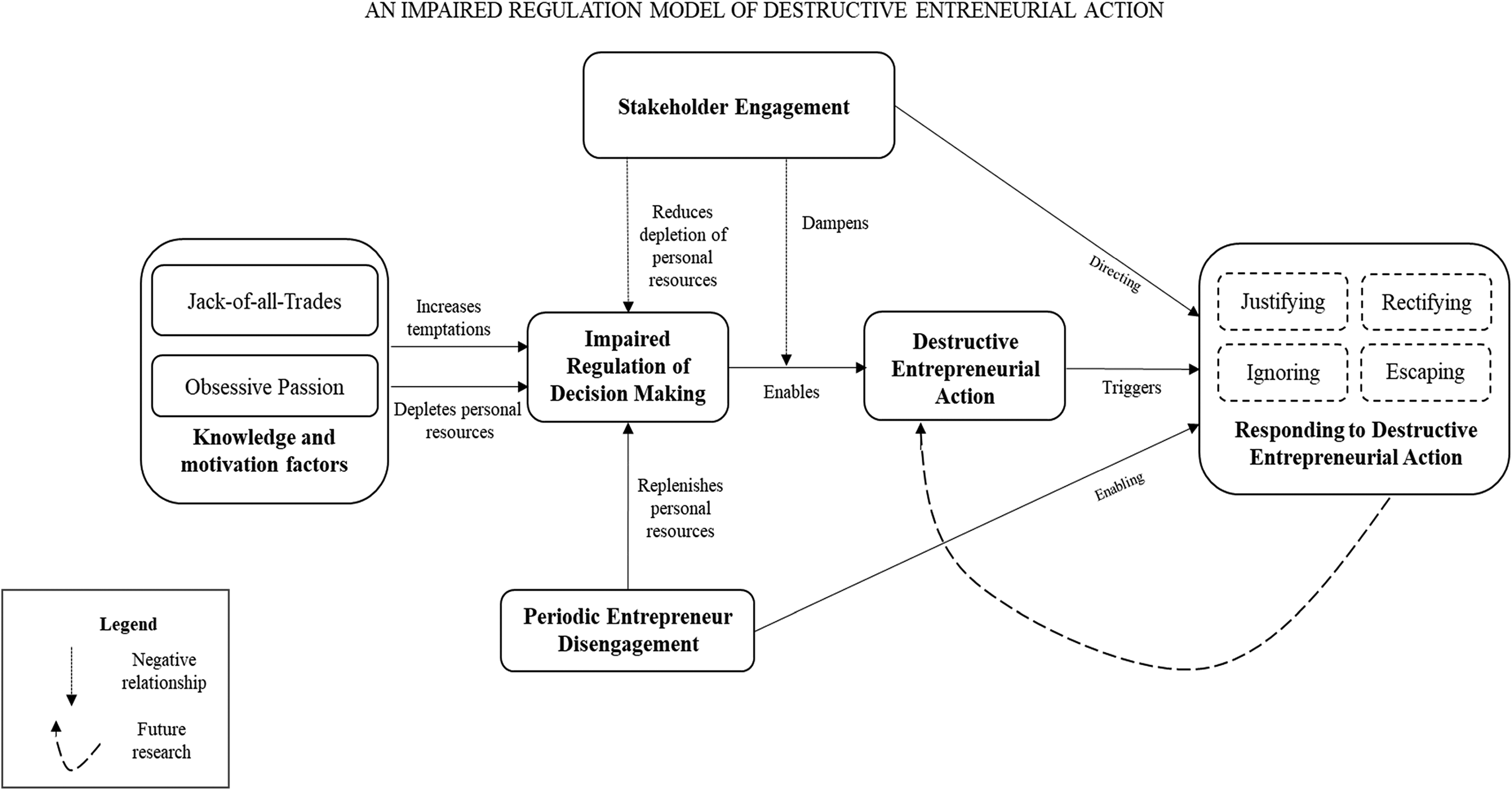
An Impaired Regulation Model of Destructive Entrepreneurial Action
Because stakeholder engagement and periodic entrepreneur disengagement are central to managing the uncertainty inherent in an entrepreneurial action (as discussed in the previous section), we next consider the impact of these constructs on an entrepreneur's regulation of decision making and subsequent destructive action. Specifically, we theorize that periodic entrepreneur disengagement and stakeholder engagement with the entrepreneur can replenish personal resources to resist temptations and directly impact the entrepreneur's response to their destructive entrepreneurial action. Further, stakeholder engagement can reduce the lure of temptations. Finally, the entrepreneur may respond to destructive entrepreneurial action by ignoring or rectifying the situation or by morally disengaging through justifying or escaping it.
Entrepreneurs, Impaired Regulation, and Destructive Entrepreneurial Actions
Given the constant resource investment required to maintain awareness of the potential consequences of one's actions (Baumeister & Juola Exline, 1999; Gino, Schweitzer, Mead, & Ariely, 2011) and the substantial personal gain that can accompany harming others (Baron et al., 2015; Qin et al., 2020), actively refraining from a destructive action requires self-regulation (Uziel & Baumeister, 2017). However, self-regulation consumes finite personal resources (i.e., fuel for effortful cognitive operations; Muraven & Baumeister, 2000). Individuals need to invest personal resources to exert self-control over each decision, which means they may not have sufficient personal resources to regulate subsequent decisions. Maintaining self-regulation is particularly difficult but essential in the entrepreneurship context, which places extreme demands on activities related to choice—decision making, judgment, and preferences (Baron, 1998; for a review, see Shepherd et al., 2015). An indication of the demands on entrepreneurs’ decision making (vis-à-vis managers) is their greater reliance on heuristics (Busenitz & Barney, 1997) to speed up the decision-making process. Thus, entrepreneurs must continuously navigate the entrepreneurial context and invest personal resources to exercise self-control to make swift decisions for their ventures that both are competitive and minimize harm to others.
Despite their best efforts, entrepreneurs often exhaust their personal resources for self-control and experience impaired regulation of their decision making. Impaired self-regulation refers to the obstruction of an entrepreneur's ability to “resist temptations, regulate emotions, control cognitions, and adjust behavior” (Uziel & Baumeister, 2017: 693). Temptations are urges to engage in an activity that is beneficial in the short run but costly in the long run. They have “strong hedonic and motivational value (e.g., feeling of desire), become salient through stimuli in the environment (e.g., walking by an ice-cream parlor), and conflict with an overriding goal (e.g., weight loss)” (Milyavskaya & Inzlicht, 2017: 604). Individuals typically must forgo a short-run benefit for themselves (i.e., a temptation) to do the right thing for others (and themselves) in the long run.
For example, some customers of the Honest Company experienced skin irritation after exposure to a toxic substance found in the company's laundry detergent and other personal care products—a substance the company “guaranteed” was not present (Tassin, 2017). In response to public outcry, the Honest Company recalled its product “over concerns it could cause skin or eye infections” (Horowitz, 2017), stopped labeling the products at issue as being “natural,” and stopped using the phrase “no harsh chemicals, ever!” on products that contained significant amounts of methylisothiazolinone or cocamidopropylamine oxide (Tassin, 2017). For the Honest Company entrepreneurs, doing the right thing by excluding potentially harmful ingredients (and remaining consistent with the company's original product labeling) was likely to be costly. Avoiding harmful ingredients from the beginning also would have required more research and better quality control, and the associated products may not have worked as well as before, all of which likely increased costs and reduced demand, making the decision economically unattractive in the short run. Hence, entrepreneurs face temptations to cut corners for short-run profitability (e.g., through a destructive entrepreneurial action), which they can overcome by regulating their decision making concerning their moral codes to avoid harm.
In the next sections, we theorize that despite their best efforts, entrepreneurs who adopt a jack-of-all-trades approach and entrepreneurs who are obsessively passionate may find themselves depleted of personal resources in the face of temptations and, as a result, experience impaired regulation of their entrepreneurial decision making, thereby enabling a destructive entrepreneurial action.
Adopting a jack-of-all-trades approach
New ventures lack the formal and social structures and routines of more established organizations to reduce top decision makers’ cognitive and attentional loads (Stinchcombe, 1965; Yang & Aldrich, 2017) and thus are subject to impaired regulation. The attentional load is particularly high in entrepreneurs who adopt a jack-of-all-trades approach to venturing (Åstebro & Thompson, 2011: 637; Lazear, 2005). Jack-of-all-trades entrepreneurs are generalists who make decisions on various tasks (Åstebro & Thompson, 2011; Lazear, 2005; Souitaris, Peng, Zerbinati, & Shepherd, in press) instead of hiring managers or employees to delegate decision making to such as specialist entrepreneurs (and managers of established organizations). Jack-of-all-trades entrepreneurs multitask “across a wide range of duties, such as fundraising, operations, human resource management, customer and supplier relations, etc.” (Paik, 2014: 257). Sometimes, taking on these many and varied roles (throughout their ventures’ development and over a day; Mathias & Williams, 2017) seems like the only option for entrepreneurs as they cannot afford to hire others. However, it often appears to be a choice as jack-of-all-trades entrepreneurs are more inclined to rely on their own work and skills than to delegate roles to specialist employees even as their organizations grow (Souitaris et al., in press).
Entrepreneurs’ multitasking can be beneficial for accessing insightful information (Souitaris & Maestro, 2010), recognizing opportunities (Gruber, MacMillan, & Thompson, 2013), obtaining resources (Vissa, 2012), and knowing tasks sufficiently well to select quality employees for these tasks in the future (Lazear, 2005). However, this improved access to information and ability to recognize opportunities might also introduce more temptations—namely, revealing a course of action that seems attractive but does not promote ventures’ long-run goal attainment and causes more social harm than benefit. We argue that because jack-of-all-trades entrepreneurs are likely to spread themselves too thin, they are likely to experience broader exposure to temptations across different areas and increased perceived short-term benefits of giving in to temptations (because doing so frees up energy for use in other areas). For example, the entrepreneurs most likely to engage in parallel bricolage—working on many projects simultaneously, often pursuing short-term gains at the expense of their ventures’ long-run growth (Baker & Nelson, 2005)—are those with different troves of knowledge, broad skills, disregard for codes and structures, a multiplex of ties, and an understanding of a broad set of challenges (Baker & Nelson, 2005), all of which are characteristics consistent with a jack-of-all-trades (see Davidsson, Baker, & Senyard, 2017).
Moreover, there are cognitive costs to a jack-of-all-trades approach to entrepreneurship. Entrepreneurs have diverse and demanding roles and responsibilities (Teoh & Foo, 1997) that require their attention and other cognitive resources (especially for jack-of-all-trades entrepreneurs; Mathias & Williams, 2017) vis-à-vis specialist entrepreneurs who recruit others early on and delegate some responsibilities to them. Therefore, jack-of-all-trades entrepreneurs invest more personal resources to regulate a variety of decisions, which means they have fewer personal resources to invest in subsequent decisions—namely, to monitor their behaviors and potential consequences in comparison to their moral codes (Baumeister, Heatherton, & Tice, 1994; Carver & Scheier, 1981). In other words, jack-of-all-trades entrepreneurs have more difficulty paying sufficient attention to every role (i.e., “a jack of all trades and master of none”; Penney, Combs, Gaffney, & Sexton, 2018) and face a high cognitive load (Mathias & Williams, 2017). Such efforts to deal with many uncertain (Kruglanski et al., 2012), complex (Schmeichel et al., 2006), and otherwise cognitively demanding tasks (Mrazek et al., 2018) are likely to deplete personal resources. This depletion can impair decision-making regulation and lead to a destructive entrepreneurial action. Based on the above reasoning, we offer the following:
Proposition 1: Jack-of-all-trades entrepreneurs (vis-à-vis specialist entrepreneurs) have more impaired regulation of their decision making and, in turn, are more likely to engage in a destructive entrepreneurial action.
Obsessive passion
Entrepreneurs are often passionate about their ventures, some going as far as referring to their ventures as their “babies” or “children” (Cardon et al., 2005; Shepherd, 2003). Entrepreneurial passion refers to “consciously accessible, intense positive feelings experienced by engagement in entrepreneurial activities associated with roles that are meaningful and salient to the self-identity of the entrepreneur” (Cardon, Wincent, Singh, & Drnovsek, 2009: 517). This passion can drive entrepreneurial actions (Murnieks, Mosakowski, & Cardon, 2014) and improve entrepreneurial performance (Cardon et al., 2009), especially when it manifests as harmonious passion. Harmonious passion is “an autonomous internalization that leads individuals to choose to engage in the activity that they like” (Seguin-Levesque et al., 2003: 756). As such, individuals engage in a focal activity because they want to. “Want-to” goals reflect “a person's genuine interest and values and are personally important and meaningful” (Milyavskaya, Inzlicht, Hope, & Koestner, 2015: 679) and therefore provide few temptations and require little cognitive effort that would deplete personal resources for performing tasks (Shah, Friedman, & Kruglanski, 2002).
However, passion can also become obsessive; obsessive passion refers to “a controlled internalization of an activity in one's identity that creates an internal pressure to engage in the activity that the person likes” (Seguin-Levesque et al., 2003: 756). People with an obsessive passion for a task feel they have to engage in the activity no matter what—the activity is not within the focal individual's control (Ho & Pollack, 2014; Seguin-Levesque et al., 2003). Specifically, entrepreneurs with obsessive passion experience negative affect and rigid persistence. In other words, such entrepreneurs feel they cannot help but engage in running their ventures and that nothing can come between them and their obsession. In the common scenario that a venture hits hard times, this pressure can tempt entrepreneurs to cut ethical corners to keep their ventures (and themselves) going.
These “have-to” goals also require regulation to stay on track and deplete personal resources (Milyavskaya et al., 2015). Indeed, obsessive passion generates conflict with other aspects of an individual's life (Seguin-Levesque et al., 2003) and can lead to psychological distress (Vallerand, 2010) and obstruction of in-task cognition (Curran, Hill, Appleton, Vallerand, & Standage, 2015). Most importantly, this pressure to continue at all costs (Seguin-Levesque et al., 2003) is tiring and depletes personal resources. This depletion can eventually impair regulation, leading to a destructive entrepreneurial action. Based on the preceding reasoning, we offer the following:
Proposition 2: More obsessively passionate entrepreneurs (vis-à-vis less obsessively passionate entrepreneurs) have more impaired regulation of their decision making and, in turn, are more likely to engage in a destructive entrepreneurial action.
Periodic entrepreneur disengagement from ventures
After individuals invest their personal resources in regulating decision making, they eventually need to replenish their personal resources (Lanaj, Foulk, & Erez, 2019; Tice, Baumeister, Shmueli, & Muraven, 2007). However, this rejuvenation process requires time and necessitates that entrepreneurs temporarily disengage from venturing activities. Despite the highly demanding decision-making efforts involved in starting and running a new venture, entrepreneurs often report difficulty psychologically detaching from their ventures at home in the evenings (Wach, Stephan, Weinberger, & Wegge, 2020). By “psychologically detaching from their ventures,” we refer to entrepreneurs’ sense of being away from their businesses (based on Etzion, Eden, & Lapidot, 1998). Many people have difficulty stepping away from work activities (Sianoja, Kinnunen, Mäkikangas, & Tolvanen, 2018). Such people who cannot psychologically detach from their work at home in the evenings are more likely to experience ruminations (Sonnentag & Fritz, 2015) and psychosomatic health issues (Taris, Geurts, Schaufeli, Blonk, & Lagerveld, 2008), both of which consume personal resources and inhibit resource replenishment. Consequently, fewer personal resources can be invested in regulating future venture decision making, thus impairing regulation and leading to a destructive entrepreneurial action.
Furthermore, venturing worries and risks can reduce the quality and quantity of entrepreneurs’ sleep (Kollmann, Stöckmann, & Kensbock, 2019). Sleep refers to “a state of immobility with greatly reduced responsiveness . . . [and] rapid reversibility” (Siegel, 2005: 1264). Indeed, entrepreneurs frequently report that their ventures are so important to them and require so much attention that they do not receive enough sleep (Murnieks et al., 2020). For example, Elon Musk reported getting “no sleep” while working 120-hr weeks at Tesla, saying, “There were times when I didn't leave the factory for three or four days—days when I didn't go outside” (Bever, 2018). However, sleep is essential for restoring self-control-related personal resources (Baumeister & Alghamdi, 2015; Murnieks et al., 2020). Further, lack of sleep is associated with the risk of engaging in unethical behaviors (Barnes, Schaubroeck, Huth, & Ghumman, 2011). For example, lack of sleep can lead to abusive (Barnes, Lucianetti, Bhave, & Christian, 2015) and deviant (Lanaj, Johnson, & Barnes, 2014) work behaviors, absenteeism (Westerlund et al., 2008), and lower psychological well-being (Gunia, 2018). When entrepreneurs receive less sleep, they cannot fully recuperate from investing personal resources to self-regulate their decision making. In summary, detaching from work and sleep are daily activities that can help replenish entrepreneurs’ personal resources. Based on the preceding reasoning, we offer the following:
Proposition 3: Entrepreneurs who disengage from their ventures more when at home in the evenings and receive more sleep have less impaired regulation of decision making and, in turn, are less likely to engage in a destructive entrepreneurial action than those who psychologically detach from their ventures less and receive less sleep.
Stakeholder Engagement and Regulation Impairment
Entrepreneurs of new ventures typically rely on potential stakeholder resources to exploit opportunities and grow their organizations (Burns et al., 2016). Stakeholders are individuals or groups who affect or are affected by a focal venture (Freeman & McVea, 2001; McVea & Freeman, 2005). Entrepreneurs must ensure stakeholder engagement since new ventures depend on external resource acquisition. Although engaged stakeholders require some investment of an entrepreneur's personal resources (vis-à-vis passive stakeholders), stakeholders provide collaboration and monitoring (Burns et al., 2016; Fisher et al., 2020), which likely save more of the entrepreneur's personal resources than they consume. Stakeholder collaboration involves external stakeholders working directly with an entrepreneur to support the pursuit of a goal “that would be otherwise difficult to achieve internally” (Desai, 2018: 220). Stakeholder monitoring refers to how stakeholders engage “in activities that entail oversight of the firm and seek to control managerial opportunism” (Post & Byron, 2015: 1547).
In general, entrepreneurs tend to have minimal collaboration with and oversight from others (Cable & Shane, 1997), so regulating their own actions is critical for new-venture management. However, there is variation in how entrepreneurs are supported and monitored by other people (Sonnenfeld, 2002; Westphal & Zajac, 2013). Further, individuals are less likely to transgress when relying on others to help them navigate difficult situations or when they know they will need to justify their decisions to third parties (Bellé & Cantarelli, 2017; Colvin, Cullen, & Ven, 2002). Indeed, even believing that strangers are watching them can reduce individuals’ bad behaviors (Mol, van der Heijden, & Potters, 2020) and increase their prosocial behaviors (Filiz-Ozbay & Ozbay, 2014). The next paragraphs elaborate on how stakeholder collaboration and monitoring could affect regulation impairment and the likelihood of a destructive entrepreneurial action.
Stakeholders can collaborate with entrepreneurs in creating and running new ventures. For example, informal stakeholders work with entrepreneurs to construct opportunities by helping them probe markets, probe technologies, raise issues, develop prototypes, make entrepreneurial decisions, and advocate for their ventures (Seyb, Shepherd, & Williams, 2019). Indeed, active stakeholders are an important source of knowledge, competencies, and relationship ties to complement an entrepreneur's resources to collaboratively create value for customers (Shams & Kaufmann, 2016). This collaborative process (between the entrepreneur, venture, and stakeholders) helps entrepreneurs perform important tasks to create a win-win for themselves and their stakeholders (Shams & Kaufmann, 2016).
Stakeholders can also provide the impetus for moral decision making. Interestingly, there is evidence that entrepreneurs are likely to deem passive stakeholders as having no (or little) moral importance, considering them abstract notions and primarily separated from the entrepreneurial decision-making process (McVea & Freeman, 2005). Such a decision-making context enables entrepreneurs to ignore their moral responsibilities (McVea & Freeman, 2005). In contrast, active stakeholders are more “proximal” to entrepreneurs and therefore encourage more value-creating strategies (Jones, 1991) that take into consideration those who may be affected by their decisions and actions (Donaldson & Preston, 1995; McVea & Freeman, 2005). Furthermore, active stakeholders can monitor entrepreneurs and steer ventures toward value-laden moral outcomes (Eesley & Lenox, 2006). In this way, active stakeholders can check in on entrepreneurial decision making to influence venture activities (Eesley & Lenox, 2006) so that entrepreneurs do not succumb to temptations that lead to a destructive entrepreneurial action.
Specifically, a board of directors can simultaneously collaborate with and monitor an entrepreneur (Sonnenfeld, 2002; Westphal & Zajac, 2013). For example, board members may provide specialized advice (Rosenstein, Bruno, Bygrave, & Taylor, 1993), offer moral and informational support (Westphal & Zajac, 2013), and can sometimes step in to prevent poor decision making (Sonnenfeld, 2002). With the benefit of decision-making support, advice, and other help in goal pursuit from board members, an entrepreneur needs to expend fewer personal resources on decisions and thus has more personal resources available for subsequent decisions, thereby reducing the depletion of personal resources needed for regulating decision making. Furthermore, if a venture has a board of directors, the focal entrepreneur must inform and convince them of a decision's appropriateness before embarking on the proposed action (Westphal & Zajac, 2013). Convincing stakeholders of a decision to engage the venture in an action represents a possible obstacle to pursuing a temptation (acting as a “cold shower”; Wallace, 1999), which could stop the entrepreneur's impaired regulation from leading to a destructive entrepreneurial action. More specifically, non-executive board members (i.e., independent directors and investor representatives) are likely to take a more independent view of these decisions. Therefore, independent directors would likely need even more convincing to allow the venture to engage in a destructive action (Gutiérrez & Sáez, 2013) than executive directors who are close colleagues, friends, or relatives of the entrepreneur.2
Entrepreneurs may also collaborate with and receive monitoring from mentors whom they can confide in and who can act as moral compasses for their decisions (Vyakarnam, Bailey, Myers, & Burnett, 1997). Such mentors have to speak their minds freely and could be a life partner, a particular employee, an external advisor, or another individual. For example, a trusted former colleague who engages in frequent unprompted check-ins could help support an entrepreneur's regulation without placing additional information or cognitive burden on the entrepreneur. Indeed, individuals who do not have stakes in the outcomes of decisions and who will not hurt entrepreneurs with disclosure may be particularly likely to aid decision-making regulation (Vyakarnam et al., 1997). However, while entrepreneurs tend to believe such relationships would be beneficial, many report lacking such a confidant (Vyakarnam et al., 1997). Nevertheless, we suggest that entrepreneurs who engage mentors in their decision making are likely to have more robust regulation and that mentors obstruct those with impaired regulation from acting on a temptation that could lead to a destructive entrepreneurial action.
In summary, we propose that stakeholders who take an active role in venturing (Bellé & Cantarelli, 2017) can enhance the regulation of entrepreneurial decision making by collaborating with entrepreneurs, which reduces the depletion of the entrepreneurs’ personal resources, and by monitoring entrepreneurs, which obstructs impaired regulation from leading to a destructive entrepreneurial action (by reducing temptations). Based on the preceding reasoning, we offer the following:
Proposition 4a: Entrepreneurs with more engaged stakeholders (vis-à-vis more disengaged stakeholders) have less impaired regulation of decision making and, in turn, are less likely to engage in a destructive entrepreneurial action than those with less engaged stakeholders. Proposition 4b: More engaged stakeholders (vis-à-vis more disengaged stakeholders) dampen the positive relationship between entrepreneurs’ impaired regulation of decision making and the likelihood of a destructive entrepreneurial action.
Responding to Destructive Entrepreneurial Actions
Entrepreneurs must engage stakeholders and periodically disengage from venturing to manage their perceptions of uncertainty and willingness to bear it (Burns et al., 2016; Murnieks et al., 2020). We proposed earlier that entrepreneurs can face more or less engaged stakeholders and are more or less capable of detaching themselves from work. These conditions influence the impairment of an entrepreneur's decision making and, ultimately, the likelihood of a destructive entrepreneurial action. However, these conditions that lead to a destructive entrepreneurial action can also influence the focal entrepreneur's response to that destruction.
Being responsible for a destructive outcome can threaten an entrepreneur's moral self-regard, necessitating a response from the entrepreneur after engaging in a destructive entrepreneurial action. Moral self-regard refers to an individual's “personal moral standing at any given moment” (Monin & Jordan, 2009: 341). Building on moral disengagement theory (Bandura, Barbaranelli, Caprara, & Pastorelli, 1996; Moore, 2015), we theorize four different responses to a destructive entrepreneurial action based on stakeholder engagement and entrepreneur disengagement. We illustrate these relationships in Figure 2 and explain them in the following sections. Figure 2 simplifies these relationships by dichotomizing the constructs—via a 2 × 2 matrix based on stakeholder engagement (active vs. passive) and entrepreneur disengagement (high and low capability)—to explain differences in entrepreneurs’ responses to their destructive entrepreneurial actions. Although moral disengagement theory is typically used to explain an individual's initial decision to engage in an unethical action (e.g., Baron et al., 2015; Shepherd et al., 2013), we focus on its postdestruction influence on how entrepreneurs deal with the destruction they have caused.

Entrepreneurs’ Responses to Destructive Entrepreneurial Action
Rectifying destructive entrepreneurial actions (active stakeholder engagement and high entrepreneur capability to disengage)
By acknowledging a breach of the moral code of “avoiding harm to others,” entrepreneurs might face diminished moral self-regard. In such a situation, individuals can attempt to rectify the destruction caused. Rectifying refers to rebuilding moral self-regard after a destructive entrepreneurial action through a subsequent action that attempts to make amends for the problem caused by reversing some of the damage, providing benefits to those negatively impacted or “doing good” for those unaffected by the initial focal destructive entrepreneurial action. For example, the shoe company TOMS faced public outcry when it was revealed that its “buy-one-give-one” model was destroying small businesses by introducing unpredictable shocks to local economies through a sudden influx of free shoes. Outrage mounted as stories spread about increasing numbers of local cobblers and other footwear sellers going out of business in impoverished communities. TOMS took several steps to try to rectify this situation, beginning with implementing local manufacturing (i.e., manufacturing one-third of its shoes in countries that were the focus of its giveaway programs) and ultimately deciding to abandon the buy-one-give-one model in favor of giving one-third of the company's profits to local community-focused organizations.
Individuals assess their moral self-regard in terms of an equilibrium—namely, the level of moral self-regard they want to maintain or exceed (Zhong, Liljenquist, & Cain, 2009). This desired level is achieved over time and does not need to be reached for every event. Therefore, while a destructive entrepreneurial action can lead to a dip in self-regard, this dip can be compensated for by subsequent prosocial behaviors—“acts that promote/protect the welfare of individuals, groups, or organizations” (Bolino & Grant, 2016: 599). Prosocial behaviors can create value for others that may rectify the previous destruction. Specifically, entrepreneurs can rectify a destructive entrepreneurial action through moral payback. When an entrepreneurial action lowers an entrepreneur's moral self-regard to a level below their desired moral equilibrium, the entrepreneur can engage in good deeds to equilibrate. For example, after profiting from substantial logging around a village, an entrepreneur may believe they can pay back the bad deed with the good deed of building a new school in the area.
We suggest that entrepreneurs with more engaged stakeholders are more inclined to rectify a destructive entrepreneurial action. Engaged stakeholders are likely to appraise a greater threat to their reputations (or external audiences believe they are more blameworthy) for facilitating (through collaboration) and allowing (though insufficient monitoring) a destructive entrepreneurial action to occur. These engaged stakeholders are likely motivated to rectify the situation (to diminish damage to their reputations). They can do this by encouraging and supporting the focal entrepreneur in undertaking a subsequent prosocial entrepreneurial action. Indeed, stakeholders (including boards of directors) can play a major role in helping an organization repair its damaged reputation (Marciukaityte et al., 2006; Rhee & Valdez, 2009). In contrast, passive stakeholders are less likely to appraise a threat to their reputations from a destructive entrepreneurial action, given their minimal engagement. Further, these passive stakeholders previously trusted the focal entrepreneur to “do the right thing.” Because the entrepreneur breached that trust, these stakeholders are unlikely to invest further resources in the venture based on the entrepreneur's assurance of rectifying the destruction.
We also suggest that periodic entrepreneur disengagement from the venture (to replenish personal resources) can increase the likelihood of a rectifying response by an entrepreneur. Rectifying a destructive entrepreneurial action can be costly for an entrepreneur, and their venture as taking responsibility for the destruction affects the entrepreneur's self-esteem and social standing. There are also direct costs associated with rectifying that can harm a venture's future performance. Indeed, good deeds (to restore moral self-regard) often require the investment of personal resources in prosocial behaviors (Gailliot, 2010) to rectify the situation. For example, entrepreneurs may need to make many decisions in an uncertain (and perhaps hostile) environment to identify and exploit a potential opportunity to generate benefits for others. Therefore, entrepreneurs who can temporarily disengage from their ventures are more likely to have the personal resources necessary to invest in rectifying their destructive entrepreneurial actions.
Justifying destructive entrepreneurial actions (passive stakeholder engagement and high entrepreneur capability to disengage)
When stakeholders are passive, there is less external pressure to rectify destructive outcomes. In such cases, entrepreneurs who can periodically disengage from their ventures can rejuvenate their personal resources necessary to justify their destructive entrepreneurial actions and promote continued support. Justifying a destructive entrepreneurial action involves applying cognitive mechanisms to harmful behaviors in a way that maintains the focal individual's moral equilibrium. When justifying a destructive action, entrepreneurs experience only a minor disruption (or no disruption) to their current level of self-regard despite taking an action that is inconsistent with their moral codes (Qin et al., 2020; Shepherd et al., 2013). In justifying a destructive action, individuals can use cognitive mechanisms to disengage their moral codes from their behaviors to avoid distress (Bandura, 1986). For example, those responsible for a destructive action sometimes shift blame (Perrow, 2011; Rhee & Haunschild, 2006). Blame shifting refers to a deliberate attempt by an actor to attribute the responsibility for a negative outcome to one stakeholder group to influence another stakeholder group's sensemaking (adapted from Park, Park, & Ramanujam, 2018).
Further, when faced with pressures from the liabilities of newness, entrepreneurs can embellish their stories with legitimacy lies (Pollack & Bosse, 2014; Theoharakis et al., 2021)—that is, intentionally misrepresent facts about their ventures to build legitimacy with (potential) stakeholders (Rutherford, Buller, & Stebbins, 2009). Justifying their legitimacy lies, entrepreneurs may make the case (to themselves and others) that “we have a responsibility towards our employees . . . and to each other to do whatever it takes” (Theoharakis et al., 2021: 6). Constructing narratives of an alternate reality and convincing people of this deception are effortful (i.e., require the investment of more personal resources) (Burgoon, 2015) but can separate an entrepreneur's moral code from the destruction caused to maintain moral self-regard. Practices such as blame shifting and legitimacy lies, which are inherent in a justifying response to a destructive entrepreneurial action, require mental and emotional effort and the investment of personal resources, so we suggest that temporary entrepreneur disengagement from the venture can lead to justifying.
Such efforts at justifying a destructive entrepreneurial action are less likely to succeed with engaged stakeholders—stakeholders who have gained information as they have collaborated with and monitored an are likely to respond through rectifying. In contrast, passive stakeholders rely less on information about and control over an entrepreneur and instead rely more on trust. Suppose these stakeholders attribute a destructive entrepreneurial action to the focal entrepreneur. In that case, trust is likely broken, and these passive stakeholders will likely be unwilling to invest additional resources in the venture going forward. Therefore, entrepreneurs are motivated to maintain passive stakeholders’ trust by attributing blame elsewhere.
Moreover, passive stakeholders may be more susceptible to an entrepreneur's efforts to justify a destructive entrepreneurial action (e.g., the persuasiveness of misleading communications about an organization's environmental practices; Marquis, Toffel, & Zhou, 2016). These passive stakeholders need less convincing about the venture's action, have less information to disconfirm the entrepreneur's justification, and are more likely to go along with the focal entrepreneur's story. Therefore, it appears that the more passive a venture's stakeholders are, the more opportunities the focal entrepreneur has to (successfully) justify a destructive entrepreneurial action to avoid sanctions from (at least some of) the venture's stakeholders.
Escaping from destructive entrepreneurial actions (active stakeholder engagement and low entrepreneur capability to disengage)
When entrepreneurs cannot rectify or justify their destructive entrepreneurial actions, their moral self-regard is likely diminished. Engaged stakeholders are likely to be motivated and well informed enough to blame an entrepreneur for the destruction an entrepreneurial action caused. This internal and external pressure exposes entrepreneurs to potential sanctions from themselves and others. Self-sanctions occur when individuals experience a negative self-reaction after violating their moral codes (Bandura, 1991; Bandura, Caprara, Barbaranelli, Pastorelli, & Regalia, 2001), which can cause these individuals considerable distress. For example, self-sanctions include feelings of shame (Syed, 2008), guilt (DePalma, Madey, & Bornschein, 1995), and other aversive states (Syed, 2008). Some people can detach psychologically from negative events, avoid ruminations, and move on with their lives (Sanz-Vergel, Demerouti, Bakker, & Moreno-Jiménez, 2011; Sonnentag, Mojza, Binnewies, & Scholl, 2008). Indeed, we argued earlier that entrepreneurs’ ability to psychologically detach from work when at home and obtain sufficient sleep helps reduce the impairment of decision-making regulation that leads to a destructive entrepreneurial action (through personal resource replenishment). This ability to psychologically detach and obtain sufficient sleep likely facilitates entrepreneurs’ separation from the destruction caused by their entrepreneurial actions. Psychologically detaching from work means that individuals can diminish awareness of their work (Etzion et al., 1998), a critical element of separating themselves from any negativity (Dixon & Baumeister, 1991).
However, entrepreneurs who cannot detach from their destructive entrepreneurial actions are likely to experience negative thoughts and emotions arising from the destruction they caused (Haidt, 2003; Tangney, Stuewig, & Mashek, 2007). Specifically, entrepreneurs who have difficulty detaching from work in the evenings and obtaining sufficient sleep are likely to find it difficult to detach from their work's destructive outcomes. In such cases, engaged stakeholders likely feel their reputations have been tarnished and look to these entrepreneurs to find some solution by rectifying or justifying. However, depleted (and insufficiently replenished) entrepreneurs lack the personal resources to rectify the situation or construct and “sell” a justification, thereby making them vulnerable to the pressures and criticisms of engaged stakeholders. With condemnations from themselves and others and lacking the personal resources to deal with the consequences of their destructive entrepreneurial actions, these entrepreneurs face considerable negativity. This negativity can cause individuals to hit rock bottom—namely, “when negativity is brought to a climax . . . [and there is a] belief the future is likely to contain much of the same” (Bauer, McAdams, & Sakaeda, 2005: 1182). When self-sanctioning generates an emotional crisis, the focal individual wants to escape the situation (Jacobs, 1984; Paternoster & Bushway, 2009). Escaping involves reducing self-awareness and meaningful thought by putting oneself in a numb state (Dixon & Baumeister, 1991: 364). For example, entrepreneurs can escape by avoiding stakeholders’ requests and not responding to their questions, introducing a go-between to create distance from stakeholders, and creating a commission to investigate the issue at hand (Lehtinen, Aaltonen, & Rajala, 2019). Entrepreneurs may also try to avoid some of the personal labor-market consequences stemming from negative information about their ventures’ actions by jumping ship—that is, by voluntarily exiting their ventures (Semadeni, Cannella , Fraser, & Lee, 2008).3 While escaping can be effective in the short run, the continued need to escape can lead to drug use (Patterson, Bennett, & Wiitala, 2005) and even suicide (Baumeister, 1990).
Ignoring destructive entrepreneurial actions (passive stakeholder engagement and low entrepreneur capability to disengage)
While the other entrepreneurial responses arise from active stakeholders (i.e., rectifying or escaping) or the availability of an entrepreneur's personal resources coupled with passive stakeholders being more susceptible to potential justifications of a destructive entrepreneurial action, the final combination of factors for a response involves low external pressure coupled with low personal resources. In these cases, entrepreneurs do not face engaged stakeholders demanding action, nor do they have the personal resources to engage in moral disengagement activity. Instead, they ignore the destruction they have caused by putting the destruction out of their minds (i.e., choosing not to think about it rather than forcing themselves not to think about it as in the case of escaping) (Tsai, Lysaker, & Vohs, 2010). Based on the preceding reasoning, we offer the following:
Proposition 5a: In response to a destructive entrepreneurial action, entrepreneurs are more likely to rectify when they have a high capability to disengage from their ventures when at home in the evenings and sleep poorly at night, and their stakeholders are actively engaged. Proposition 5b: In response to a destructive entrepreneurial action, entrepreneurs are more likely to justify when they have a high capability to disengage from their ventures when at home in the evenings and sleep poorly at night, and their stakeholders are passively engaged. Proposition 5c: In response to a destructive entrepreneurial action, entrepreneurs are more likely to escape when they have a low capability to disengage from their ventures when at home in the evenings and sleep poorly at night, and their stakeholders are actively engaged. Proposition 5d: In response to a destructive entrepreneurial action, entrepreneurs are more likely to ignore when they have a low capability to disengage from their ventures when at home in the evenings and sleep poorly at night, and their stakeholders are passively engaged.
Discussion
On the one hand, destructive entrepreneurial actions can arise from the behaviors of “bad apples” who intentionally set out to derive personal profit at other people's expense (Baron et al., 2015; Urbig et al., 2012). On the other hand, many entrepreneurs who have generated destruction report feeling shame and guilt, and people who know them suggest such behaviors are out of character (Gellerman, 1986; Joffe-Walt & Spiegel, 2012). Our theorizing helps resolve this tension by explaining how a destructive entrepreneurial action can arise from impaired regulation. Common entrepreneurial actors’ enactment of classic factors usually associated with generating productive outcomes can instead result in destruction. We believe this model offers three primary contributions to the entrepreneurship literature.
First, we move the conversation away from economic incentives and toward microlevel determinants of destructive entrepreneurial actions. While prior literature highlights that the rules of the game provide incentives for entrepreneurs to engage in unproductive and destructive behaviors (Baumol, 1996; Lucas & Fuller, 2017; Minniti, 2008), this research stream does not explain why some actors within an economic system engage in destructive entrepreneurial actions while other actors within the same system and with similar incentives do not. We complement this literature by providing insights into why some entrepreneurs are more susceptible to engaging in a destructive entrepreneurial action and how they subsequently respond to the destruction they have caused.
Second, our model extends entrepreneurial action theory (McMullen & Shepherd, 2006; for a review, see Townsend et al., 2018) by explaining how common microlevel factors that trigger an entrepreneur to engage in opportunity pursuit can also impair the regulation of decision making about subsequent actions related to exploiting that opportunity, leading to a destructive outcome. While some previous work on destructive entrepreneurship has begun to explore the conditions under which typically positive factors can lead to destruction (e.g., entrepreneurial alertness; Hall, Matos, Sheehan, & Silvestre, 2012; creativity; Qin et al., 2020), most work continues to position destructive entrepreneurial actions as arising from the enactment of stable negative characteristics (Hmieleski & Lerner, 2016; Klotz & Neubaum, 2016; Urbig et al., 2012) that are independent of a given entrepreneurial activity or embedded within an opportunity (e.g., Baron et al., 2015; Haynes et al., 2015). We offer a contrasting perspective to this “bad apples” view by explaining how destructive actions can be embedded in integral entrepreneurial processes often assumed to contribute to productive outcomes. Specifically, by theorizing on the role of personal resources and temptations in contributing to entrepreneurs’ impaired regulation, we offer new mechanisms through which an entrepreneurial action can lead to destruction. Our theoretical model explains how a destructive entrepreneurial action can arise from impaired regulation of decision making by generally well-intentioned actors. We argue that impaired regulation of entrepreneurial decision making provides a different (and perhaps more common) representation of the reality of destructive entrepreneurial actions than one driven by entrepreneurs with inherently self-interested moral codes (e.g., criminal masterminds or people high in the dark triad). We suggest this emphasis on impairment not to shift responsibility from the focal entrepreneurs who cause destructive outcomes but rather to increase the richness of our understanding of the many factors that likely underlie this destruction.
Third, we advance our understanding of how a destructive entrepreneurial action unfolds by theorizing about the process rather than simply the outcome. We suggest that a destructive entrepreneurial action can unfold from impaired regulation of entrepreneurial decision making and impaired regulation of the response to the initial destructive action. This approach is an important departure from previous work representing destructive entrepreneurship as a cross-sectional outcome (e.g., Hmieleski & Lerner, 2016). We offer a new way of thinking about destruction (as a step-by-step process often comprising small early missteps that eventually escalate to a more harmful action). Destructive entrepreneurial actions can lead entrepreneurs to different responses to avoid possible self-sanctions for their actions (i.e., rectifying, justifying, escaping, or ignoring).
We suggest that rectifying as a response to destructive entrepreneurial action restores an entrepreneur's sense of self-control, and they can use their capability to replenish their personal resources, reducing their chances of recidivism. In contrast, justifying responses reinforce a minimization of the destruction (in the entrepreneur's mind and to the venture's passive stakeholders), leading to the continuation of the original action or another destructive entrepreneurial action. Similarly, ignoring the destruction and “getting away with it” because of passive stakeholders’ insufficient attention allows these entrepreneurs to continue with destructive entrepreneurial action unencumbered by thoughts of the consequences of their action or to engage in subsequent destructive entrepreneurial action knowing that they are likely to again “get away with it.”
The relationship between escaping and subsequent destructive entrepreneurial action is likely more nuanced than for the other responses. On the one hand, escaping may require the investment of personal resources such that the entrepreneur is more vulnerable to cognitive impairment for their next entrepreneurial action and, thus, more prone to destructive entrepreneurial action. On the other hand, while the entrepreneur may escape the venture, their active stakeholders may still extract some form of punishment (e.g., reputation damage) that reduces the temptations of future destructive entrepreneurial action.
By exploring the sources of entrepreneurs’ cognitive responses to their ventures’ destructive actions and the consequences of those responses (some of which hinder and some of which facilitate a subsequent destructive entrepreneurial action), we complement the stream of work on entrepreneurs’ moral disengagement (Baron et al., 2015; Shepherd et al., 2013), Thus, our theorizing advances our understanding of why some entrepreneurs become repentant do-gooders while others grow into serial offenders.
Future Research Directions
In addition to the opportunities mentioned already, future research could build on our theorizing in several ways. First, future research on the different types of destructive outcomes may prove fruitful. For example, do particular antecedents of impaired regulation lead to a specific type of destructive entrepreneurial action? Similarly, do some types of destructive entrepreneurial actions lead to rectifying responses, other types to justifying, and still other types to escaping or ignoring? Moreover, we need more theorizing on external audiences’ reactions to destructive entrepreneurial actions. For example, how do audiences’ perceptions of the relative impact of personal resource depletion (which suggests inattentiveness) and temptations (which suggests intentionality) affect how they respond to destructive entrepreneurial actions? Relatedly, the stated mission of a venture may play a role. For example, social entrepreneurs may be more likely to try to rectify their actions to bring themselves back into alignment with a particular moral code and to address audiences’ concerns (i.e., social ventures may be judged by external audiences more harshly because doing good is such an integral part of their business models).
Additionally, future research can extend the current model by exploring the nuances of entrepreneurial passion. For example, we focused on the constant influence of obsessive passion on impaired regulation of entrepreneurial decision making. However, passion may vary in important ways across entrepreneurial role identities (e.g., inventor, founder, and developer; Cardon et al., 2009), social identities (e.g., Darwinians, Communitarians, and Missionaries; Fauchart & Gruber, 2011), or identity centrality (see Murnieks et al., 2014) (for a review, see Cardon & Murnieks, 2020). Perhaps obsessive passion is high for the founder role identity but low for the subsequent developer role identity. Obsessive passion is also likely to differ across the different social identities. These differences may impact the number and attractiveness of the temptations entrepreneurs face and the depletion of personal resources that contribute to impaired regulation of decision making. Investigating differences in entrepreneurial role identities, social identities, and identity centrality will likely increase our understanding of the microdrivers of destructive entrepreneurial actions. Also, while we focused on how entrepreneurs with obsessive passion have more impaired regulation, we did not explore the reverse—how those with personal resources for self-regulation can avoid obsessive passion. We hope future research explores the potentially mutually causal relationship.
Moreover, consistent with an implicit assumption in ethical-decision-making research (Gino et al., 2011; Treviño, Den Nieuwenboer, & Kish-Gephart, 2014), we suspect that impaired regulation (breeching entrepreneurs’ moral codes) is a prevalent cause of destructive entrepreneurial actions vis-à-vis greed (lacking or have a low moral code). We argued this position theoretically based on the ubiquity of occasions in which an entrepreneur must demonstrate good judgment and a high potential for impaired regulation due to the complexity of entrepreneurial decision-making contexts. However, future research needs to investigate this suspicion empirically. Furthermore, we explored the generation of and responses to a single destructive entrepreneurial action. We hope future research explores serial destructive entrepreneurial actions. For example, how does an entrepreneur change their approach to managing the venture (e.g., delegate more of the decision making, detach more from the venture to replenish personal resources, and engage stakeholders more)? Alternatively, under what conditions does an entrepreneur change their moral code to align it with a (or undertake a series of) destructive entrepreneurial action(s)? We hope future research explores these dynamic relationships over time.
Furthermore, this article focused on the entrepreneur's moral code because the entrepreneurial-action framework emphasizes the entrepreneur's beliefs driving action. However, future research can explore the match or mismatch between the moral code of entrepreneurs and those of their ventures and different stakeholder groups. For example, do stakeholder groups with codes of lower morals offer the temptations for the entrepreneur to engage in destructive entrepreneurial action? Perhaps the moral codes of stakeholders influence the entrepreneur's response to destructive entrepreneurial action. For example, we theorized that with active stakeholders, the entrepreneur is more likely to use their ability to replenish and invest personal resources in rectifying a destructive entrepreneurial action than with passive stakeholders. However, this proposition assumes the stakeholders have a strong moral code. However, there is likely heterogeneity across ventures in their stakeholders’ moral codes and within a venture across its stakeholder groups. There are many opportunities to explore the moral interrelations of entrepreneurs and stakeholder groups in the antecedents and responses to destructive entrepreneurial action.
Finally, while Baumol (1996) often bundles unproductive and destructive entrepreneurship, there are opportunities to make more of their distinction, and we hope this study provides a basis for doing so. In particular, Baumol (1996: 3) implies that crime represents unproductive entrepreneurship. We propose that many crimes are more detrimental to society than the “questionable value” that defines unproductive entrepreneurship. Indeed, we agree with studies arguing that organized crime (Champeyrache, 2018), corruption (Collins et al., 2016), and fraud (Box, Gratzer, & Lin, 2020) represent destructive forms of entrepreneurial actions. We hope that future research explores the destructive nature of some illegal ventures and perhaps also the productive entrepreneurship arising from other illegal ventures.
Conclusion
Societies often laud entrepreneurs as value creators; however, a growing stream of literature explores their potential to engage in destructive actions. Our impaired-regulation model offers a microlevel explanation of destructive entrepreneurial action that centers on the extreme pressures and demands placed on entrepreneurs and the varied ways in which they and their ventures’ stakeholders manage those pressures and demands. Specifically, we advance our understanding of the who, why, and how of a destructive entrepreneurial action and, in doing so, hope to stimulate future (productive) research in this important area. Overall, we suggest that common entrepreneurial factors—often when brought to the extreme—can impair the regulation of entrepreneurial decision making and lead to destructive entrepreneurial action.
