




Abstract
Adopting a practice lens, this study contributes to debates on the reproduction of religious inequalities in the workplace by going beyond the literature's dominant focus on the role of discourse in the regulation of employees’ religion. Drawing on interviews with Muslim employees in Belgium, this study offers a practice-based theorization of religious inequality at work, focusing on the role of the rhythms, objects, spaces, and bodies of work practice in the regulation of religion and on religious employees’ different performances directly negotiating these aspects of work practice. Based on this practice-based understanding, we identify contributions to several debates on religion at work. First, we show the role of work practice in imposing a secular order that selectively embraces cultural and religious practices that have historically dominated the Global North. Second, we add to studies on Muslim employees by showing how solely focusing on Islamophobic discourses and discursive practices overlooks the interplay between these discourses and work practice in the regulation of religion and Muslim employees’ negotiation of the rhythms, objects, spaces, and bodies of work practice. Third, contributing to debates on (in)visibility, we expose that the (in)visibility of religion is shaped by its relation to work practice and that religious employees can negotiate work practice through invisibly performing religious practice. Fourth, adding to our understanding of the inclusion of religious employees, we emphasize the importance of the flexibility of work practice and the role of other employees in enabling religious employees to better align work and religious practice.
Despite increased attention to workplace diversity, the issue of religion in the workplace has remained relatively underexplored in management and organization studies (Essers & Benschop, 2009; Gebert et al., 2014; Gümüsay, 2020; Héliot, Gleibs, Coyle, Rousseau, & Rojon, 2020; Tracey, 2012). Nevertheless, a small stream of studies has shown that religious employees in the Global North can be confronted with invisible religious inequalities. Specifically, as organizations tend to be infused with specific secular norms regulating the expression of religion (Asad, 2003; Ashforth & Vaidyanath, 2002; Casanova, 1994; Gebert et al., 2014; Tracey, 2012; Wasserman & Frenkel, 2020), religious employees can become faced with the challenge of either conforming to these dominant norms by keeping an important element of who they are invisible or risking potential discrimination when visibly displaying their religion. Especially employees whose religion is not easily confined to the private sphere and is viewed as particularly “deviant” or “strange” in relation to dominant societal norms might be exposed to these processes of inequality (Gebert et al., 2014; Ryan & Gardner, 2021; Wasserman & Frenkel, 2020).
An important religious minority group that has been shown to face such inequality processes in workplaces in the Global North are Muslim employees (Berger, Essers, & Himi, 2017; Forstenlechner & Al-Waqfi, 2010; Ghumman & Ryan, 2013; Mahadevan & Kilian-Yasin, 2017; Tariq & Syed, 2018). One reason for this is the societal pervasiveness of Islamophobic discourses that, reflecting historic constructions of Islam, present Muslims as essentially different from the Global North's self-positioning as “secular,” “modern,” and “rational” (Asad, 2003; Mahmood, 2016). A small stream of organization studies shows how such discourses cause Muslims to face exclusion and various forms of discrimination in the workplace and the labor market. This especially occurs when their religion is made visible, which often leads them to hide it (Forstenlechner & Al-Waqfi, 2010; Syed & Pio, 2010; Tariq & Syed, 2018).
Overall, these studies have provided important insights concerning the role of discourses in the regulation of religion in the workplace, the reproduction of religious inequalities, and the marginalization of Muslim employees. However, the literature on lived religion (e.g., Ammerman, 2020, 2021; Knibbe & Kupari, 2020) argues that fully capturing the politics of religion requires us to look beyond the realm of discourse. The reason for this is that the “doing” of religion in everyday life is not merely discursive in nature but also involves embodied and material rituals, such as praying or fasting. This means that to fully capture the processes involved in the regulation of religion and the reproduction of religious inequalities, we should also expose the role of more material and practical constraints (Ammerman, 2021).
This study aims to move the theorization of the processes involved in the regulation of religion and the reproduction of religious inequalities beyond a focus on the role of discourses by adopting the concept of practice. This refers to “a routinized way in which bodies are moved, objects are handled, subjects are treated, things are described and the world is understood” (Reckwitz, 2002: 250) that gives “the world of humans its visible orderliness” (Reckwitz, 2002: 251). By imposing a specific order and a particular understanding of how activities are to be performed, practice supports or constrains certain actions and ways of being and reflects and reproduces particular relations of power (Gherardi, 2009; Janssens & Steyaert, 2019; Nicolini, 2012; Nicolini & Monteiro, 2017; Watson, 2016).
Drawing on the lens of practice, this study analyzes how work practice interferes with, and thereby regulates, the way religious practice can be performed. As studying religion enables us to shine a light on the manifestations of secularism that aim to regulate it (Asad, 2003), exploring the experiences of religious employees also allows us to expose the invisible ways in which different aspects of work practice impose a secular way of “doing” the workplace. However, as employees are never determined by practice (Ammerman, 2021; Gherardi, 2009; Janssens & Steyaert, 2019; Nicolini & Monteiro, 2017; Reckwitz, 2002), it also allows us to understand how religious employees negotiate, and possibly disrupt, this regulation, thereby potentially opening up alternative ways to perform work. Specifically, based on interviews with Muslim employees of Turkish or Moroccan descent in Belgium, this study answers the following two research questions: (1) How can work practice in organizations interfere with Muslim employees’ adherence to religious practice? (2) How do Muslim employees negotiate the way that work practice interferes with adherence to religious practice?
Answering these questions, this study offers a practice-based theorization, focusing particularly on secular workplaces in the Global North, of religious inequality at work. We offer an understanding of the role of the rhythms, objects, spaces, and bodies of work practice in the regulation of religion, as well as of the performances involved in religious employees’ negotiation of these aspects of work practice. This practice-based understanding contributes to different debates on religion at work. First, we add to debates on secularism in the workplace by showing the role of work practice in imposing a secular order that selectively embraces cultural and even religious practices that have historically dominated the Global North. Second, we contribute to debates on Muslim employees by showing the interplay between work practice and Islamophobic discourses in the regulation of religion as well as by identifying Muslim employees’ performances directly negotiating the rhythms, objects, spaces, and bodies of work practice. Third, we add to debates on the role of (in)visibility in religious inequalities by showing that the (in)visibility of religion is shaped by its relation to work practice and that religious employees’ negotiation of work practice can involve invisibly performing religious practice. Fourth, we contribute to the literature by stressing the importance of the flexibility of work practice and of the role of other employees in advancing the inclusion of religious employees.
Religious Inequality in Secular Workplaces in the Global North
Despite its importance for so many employees throughout the world, religion has been largely understudied in management and organization studies (Gebert et al., 2014; Gümüsay, 2020; Héliot et al., 2020; Tracey, 2012). A possible explanation for this is that workplaces in the Global North tend to be approached as inherently secular settings that are supposedly organized around “rational” and “objective” rather than religious norms (Ashforth & Vaidyanath, 2002; Gebert et al., 2014; Tracey, 2012; Wasserman & Frenkel, 2020). This reflects broader discourses of secularism in the Global North that impose and normalize a particular social order through drawing boundaries between different spheres of life and regulating the place for the expression of religions in them. These discourses argue that the public sphere should be guided by secular norms, which are presented as “neutral” and “rational.” In turn, religious values, norms, and expressions seen as interfering with the functioning of society according to prescribed secular values are to be confined to the private sphere, which is considered the proper place for religion. Through normalizing this view, these discourses regulate religion and reproduce religious power relations, and, rather than being “neutral,” reflect particular types of “Western liberal Enlightenment” principles and their approaches to religion (Asad, 2003; Mahmood, 2016).
An aspect of the public sphere that has particularly been presented as in need to be “freed” from religion is the economy, thereby allowing it to function solely according to a capitalist logic (Asad, 2003; Casanova, 1994). A small stream of organization studies has shown that organizations in the Global North tend to be infused with secular ideals, which results in the regulation of religion and the reproduction of religious inequalities at work (Ashforth & Vaidyanath, 2002; Gebert et al., 2014; Gümüsay, 2020; Héliot et al., 2020). Specifically, deviating from secular norms by openly displaying religion at work can cause employees to experience religious discrimination. Meanwhile, keeping religion invisible to conform to these norms involves a form of assimilation in which individuals have to suppress an important element of who they are (Gebert et al., 2014; Héliot et al., 2020). Secular discourses can therefore be said to entail a form of identity regulation (Alvesson & Willmott, 2002; Mahmood, 2016), which can lead religious employees to suppress their religious identity at work.
The dilemma of whether or not to keep religion invisible might be especially experienced by employees adhering to religions that have not historically dominated the Global North, such as Judaism, Islam, Sikhism, or certain forms of Christianity. These religions might be perceived as especially “strange,” “deviant,” or “exotic” by coworkers and are therefore more likely to result in discrimination (Gebert et al., 2014; King, Bell, & Lawrence, 2009; Ryan & Gardner, 2021). Moreover, discourses of secularism were strongly shaped by, and hence are more easily reconcilable with, strands of Christianity historically dominating the Global North. Meanwhile, other religious traditions might not be that easily restrained by their imposed boundaries between the public and private spheres (Asad, 2003; Mahmood, 2016). For example, some religions involve visible displays outside of the private sphere, such as the practice of wearing of a hijab by Muslim women, a kippah by Jewish men, or a turban by Sikh men.
One group that might especially be confronted with these processes of religious inequality in organizations in the Global North is Muslim employees. The reason for this is that societal discourses in the Global North about Islam and Muslims have, especially since the turn of the century, become increasingly negative, hostile, and Islamophobic. These discourses are, however, only the most recent version of a long tradition of Orientalism (Asad, 2003; Said, 1997, 2003). Specifically, it has been argued that the Global North's understanding of what it means to be secular, and its self-image as “developed,” “humane,” and “superior,” was developed through its relation to Islam, which served as its fundamental Other. These Islamophobic discourses have firmly cemented the idea of Muslims as an inherently backward and menacing Other, who is irrational, inferior, and fundamentally driven by a religious doctrine that is constructed to be antithetical to the Global North and to “symbolize terror, devastation, the demonic, hordes of hated barbarians” (Said, 2003: 59) (Asad, 2003; Mahmood, 2016; Said, 1997).
Recent studies have highlighted the role of Islamophobic discourses in regulating Muslim employees in the Global North and in reproducing inequalities in the labor market (Essers & Benschop, 2009; Essers & Tedmanson, 2014; Forstenlechner & Al-Waqfi, 2010; Ghumman & Ryan, 2013; Mahadevan & Kilian-Yasin, 2017; Pio & Syed, 2018; Syed & Pio, 2010; Tariq & Syed, 2018). Reflecting broader insights into the role of (in)visibility in religious inequalities, these studies have shown how Muslim employees risk especially becoming faced with discrimination when their religion becomes visible. While studies have mainly shown how wearing a headscarf causes Muslim women to encounter labor market discrimination (Forstenlechner & Al-Waqfi, 2010; Ghumman & Ryan, 2013; Syed & Pio, 2010; Tariq & Syed, 2018), some have also given illustrations of Muslim employees receiving Islamophobic reactions when engaging in other common religious practices in the sphere of work. These include daytime fasting during Ramadan (the ninth month of the Islamic calendar); adhering to rules governing what is halal (permissible) and haram (forbidden) (such as eating pork or drinking alcohol); and engaging in prayer, which is traditionally performed five times throughout the day—the timing of which depends on the day of the year and one's geographical location—and once in congregation on Friday afternoon (Forstenlechner & Al-Waqfi, 2010; Mahadevan & Kilian-Yasin, 2017; Van Laer & Janssens, 2011, 2014). As a result, individuals might keep their religious identity invisible—for example, by refraining from talking about their religious views or from reacting to the Islamophobia they encounter (Berger et al., 2017; Forstenlechner & Al-Waqfi, 2010; Van Laer & Janssens, 2014).
On the whole, these previous studies have clearly analyzed how discourses infusing organizations contribute to regulating religion and reproducing religious inequalities. However, by primarily focusing on the role of discourse, we might overlook other important aspects of the operations of power involved. As Said (2003) argued, the structures of Orientalism do not simply involve negative discourses but an entire constellation of connected institutions and practices. Similarly, the sociology of religion reminds us that we cannot capture how religion is “done” and constrained in everyday life by solely focusing on the role of discourse. The reason for this is that religion traditionally involves engaging in rituals that are embodied and material in nature (Ammerman, 2020, 2021; Knibbe & Kupari, 2020; McGuire, 2008). This is also the case for Islam, which is connected to a number of material and bodily practices that might permeate the organizational sphere.
Without offering in-depth analyses of their role in the reproduction of power relations between Muslim and non-Muslim employees, some previous studies have given examples of why acknowledging embodiment and materiality is important to understand religious inequalities. For example, Berger and colleagues (2017) give illustrations of the materiality of the workplace affecting Muslim employees, for example showing individuals not being able to pray at work due to the lack of a prayer room or faced with the challenge of dealing with alcohol at work-related receptions. Similarly, Arifeen and Gatrell (2020) give an example of how the presence of alcohol might interfere with Muslim women's participation in networking events. Equally, when discussing Muslim employees experiencing discrimination, some have shown how Muslim women might resort to embodied reactions, such as refraining from wearing a headscarf to improve their employment opportunities (Forstenlechner & Al-Waqfi, 2010; Syed & Pio, 2010). However, despite giving these examples of material and embodied experiences, these studies, in line with the dominant focus on discourse, mainly explore how these employees reconcile these experiences with their personal interpretations of their religion.
Recognizing that solely focusing on the operation of discourse might leave important aspects of the way religion is regulated and religious inequalities are reproduced unacknowledged, this study aims to contribute to the literature on religious inequalities by adopting a practice lens, which “allows researchers to examine dynamic interactions between discourse and materiality” (Putnam, 2015: 713).
A Practice Lens to Study the Regulation of Religion
In recent years, the practice lens has drawn growing interest in many fields, including the sociology of religion (e.g., Ammerman, 2020; Knibbe & Kupari, 2020), management and organization studies (e.g., Gherardi, 2009; Nicolini & Monteiro, 2017) and studies on workplace diversity (e.g., Janssens & Steyaert, 2019; Mathieu, 2009). A practice lens assumes that the “basic unit of analysis for understanding social and organizational phenomena is practices and their nexus with other practices” (Janssens & Steyaert, 2019: 523). Practice traditionally refers to routinized ways of conducting a set of activities focused on a certain goal, organized in a particular sequence and according to specific temporal patterns. It assumes that it is through the recurrent performance of these practices that the social world gains its order and becomes reproduced (Gherardi, 2009; Janssens & Steyaert, 2019; Nicolini & Monteiro, 2017; Reckwitz, 2002).
Although some practice approaches pay less explicit attention to this issue (Janssens & Steyaert, 2019; Watson, 2016), we understand practices to be connected to power, as they impose a certain normative order on everyday life and signify how activities are expected to occur in a specific setting. In doing so, they incite and empower certain courses of action while constraining and discouraging others, thereby reflecting and reproducing particular relations of power (Gherardi, 2009; Janssens & Steyaert, 2019; Nicolini & Monteiro, 2017; Reckwitz, 2002; Watson, 2016). As individuals enact the world according to a particular practice, they contribute to reproducing this order and become visible to others as displaying acceptable or “normal” behavior. For example, explorations of the link between practices and organizational inequality have argued how male-dominated settings tend to require employees to conform to a masculine practice to be seen as “competent” and “belonging” (Gherardi & Poggio, 2001; Mathieu, 2009). Similarly, studies on class have shown how individuals often unconsciously reproduce specific routinized class rules on demeanor or way of dressing that signify their legitimate membership of that class and maintain the difference to other classes (Gray & Kish-Gephart, 2013; Nicolini & Monteiro, 2017). However, as practices (just like discourses) are never devoid of inconsistencies and always leave room for creativity, resistance, and change, they never fully determine individual performances. In other words, individuals have agency and can engage in performances deviating from dominant practices. While this can cause them to be judged as acting in an unacceptable manner, such nonconforming behavior also challenges the dominant order and might over time lead to the normalization of alternative ways to be in the world (Ammerman, 2021; Butler, 2007; Gherardi, 2009; Janssens & Steyaert, 2019; Nicolini & Monteiro, 2017; Reckwitz, 2002).
A core feature of a practice approach is that it does not privilege discourse in its analyses of the way the social world is ordered and power inequalities are reproduced. Rather, it considers practices as “accomplished through the connection between bodies, tools and artefacts, and discursive resources” (Janssens & Steyaert, 2019: 524–525). Specifically, practices are enacted through bodies and tend to prescribe a “correct” way to use and present these bodies. For example, female employees might feel compelled to dress less “feminine” as they aim to conform to masculine practices (Gherardi & Poggio, 2001). In performing practices, bodies not only enter into interaction with other human and nonhuman bodies but also with objects. These objects participate in a practice by shaping, enabling, or limiting the activities in which they are involved. For example, adhering to the practice of elite workplaces might require individuals to display signs of an upper-class taste, such as driving expensive cars (Gray & Kish-Gephart, 2013). Moreover, practice always takes place in particular spaces. These can impact the way particular activities can (not) be performed and shape the meaning of performances occurring in them (Nicolini & Monteiro, 2017; Reckwitz, 2002). For example, because of their spatial features, open-plan offices might become characterized by different communication practices than other types of spaces (Dale, 2005). Together, this means that while discourses and discursive resources are recognized as contributing to practices by assigning meaning and intent to them, they do not hold a privileged position in a practice approach. Rather, they become one aspect in a wider network of elements that come together to order the world in a way that reflects and reproduces particular interests (Janssens & Steyaert, 2019; Nicolini & Monteiro, 2017; Reckwitz, 2002).
One way to expose how a practice privileges certain interests and imposes a particular order is “to inquire into the dialectic of practices, i.e., the co-evolution, conflict, and interference of two or more practices” (Nicolini & Monteiro, 2017: 121). Specifically, everyday life is always characterized by a nexus of different practices that might be aligned—and operate in harmonious and mutually supportive ways—but that can also exist in conflict and interfere with, and even undermine, each other (Nicolini, 2012; Nicolini & Monteiro, 2017; Reckwitz, 2002). Focusing on the interference of one practice by another specifically allows us to interrogate dominant practices (Nicolini & Monteiro, 2017) and therefore expose the way particular workplace practices make religious practice more or less impossible and thereby regulate its performance.
In this study, we explore the way work practice invisibly reproduces religious inequalities by interfering with adherence to religious practice. We approach workplaces as characterized by work practice, which itself can be seen as a constellation of different practices that together structure organizational life. Although there are many ways to approach religion we, in line with the lens of lived religion, understand religion as practice. This implies that individuals or institutions constitute and reproduce themselves as religious and attain a religious identity (e.g., Muslim) through engaging in particular religious practices. In line with other practices, religious practice can be understood as involving routinized ways of how to “do” a religion. Although religious practice operates similarly to other practices, it also has a spiritual dimension, for example, as it involves interactions with a deity (Ammerman, 2020; Knibbe & Kupari, 2020). As is true for any practice (Nicolini & Monteiro, 2017; Reckwitz, 2002), religious practice can shape the way individuals perform that religion but never determine them. This is not only because different religious discourses exist on how to adhere to a particular practice but also because individuals can develop individualized approaches to the performance of religious practice. Therefore, religious performances are neither simple reflections of some institutionalized doctrine nor completely improvised. Rather, they emerge in the context of different repertoires and constraints as individuals attempt to “do” religion in their everyday lives (Ammerman, 2020; McGuire, 2008; Pio & Syed, 2018).
Method
Research Context
To contextualize our findings (Lincoln & Guba, 1985, 2013), we will first provide information on the research context. Belgium is a country with strongly negative societal views on Islam and the performance of religious practice by Muslims in the public sphere. Historically, it has been characterized by little religious diversity and a strong dominance of Catholicism. This is, for example, still visible in the existence of Catholic schools and hospitals—next to non-denominational ones. Since the sixties, because of a process of secularization, the impact of the Catholic Church on public life strongly declined—for example, many Catholic institutions became “culturally Christian” and do no longer strictly adhere to religious rules. It is in this same period of apparent secularization that Belgium's Muslim population started to steadily increase, especially because of the arrival of large groups of labor migrants attracted from Turkey and Morocco. Particularly since the eighties, and further aggravated by the 9–11 attacks in 2001, societal views on Muslims have become more and more hostile. Muslims in Belgium have become increasingly constructed as in Islamophobic ways religious extremists, potential terrorists, and opposed to the “Western way of life,” whereas Muslim women also became seen as victims to be “saved” from Muslim men oppressing them. Anti-Muslim views thereby increasingly contributed, together with racism and anti-immigrant sentiments, to the disadvantaged societal and labor market position of Muslim immigrants and their (grand)children. These evolutions further resulted in the legal prohibition to wear a face veil in public, in the banning of the headscarf in many organizations, and in broad opposition to Muslims performing religious practice in the workplace, based on the argument that these religious expressions violate the principle of “neutrality” (Bousetta & Jacobs, 2006; Coene & Longman, 2008; Dobbelaere, 2010; Fadil, 2013). Arguably the clearest evidence of this opposition to religion at work comes from a large newspaper survey with 2481 respondents (Soenens, 2012) that showed that 79% of respondents felt that there is no place for religious symbols and practices at work; 78% considered prayer rooms unacceptable (with 50% considering them highly unacceptable); and 75% considered visible religious symbols (such as headscarves) unacceptable (with 38% considering them highly unacceptable).
The Interviews
Our sample consists of 30 interviewees of Turkish or Moroccan descent who self-identify as practicing Muslims. Potential interviewees were asked whether they self-identified as practicing Muslims without further specifying the exact meaning of “practicing Muslim.” This reflects the idea that studying the everyday “doing” of religion requires a focus on how individuals perform it rather than on specific ideas on what they are assumed to do according to (some interpretations of) religious doctrines (McGuire, 2008). Moreover, this allowed our research to capture the experiences of individuals with different views on what it means to be a “practicing Muslim.” This not only addresses calls to acknowledge the diversity within the group of Muslims (Pio & Syed, 2018) but is also important in terms of trustworthiness (Lincoln & Guba, 1985, 2013). Our sample includes 15 individuals of Turkish and 15 individuals of Moroccan descent because much of the current Belgian Muslim population are (the children or grandchildren of) labor immigrants coming from Turkey and Morocco. Our sample is further diverse in terms of gender (including 15 men and 15 women), age (ranging from 23 to 52), and occupation (including individuals holding a wide array of high-skilled and low-skilled jobs in the public and private sectors). Table 1 provides an overview of the interviewees, who were given pseudonyms.
Overview of the Interviewees

Before the interviews, the interviewees were informed about the research goal, their rights as participants, with whom their personal information would be shared, and how the interviews could be used. They all agreed to the interview being recorded. The semistructured interviews were organized around four themes informed by the existing literature on Muslim employees and the performance of religious practice at work. The first theme was the personal and professional background of the interviewees, including a discussion of the significance of religion in their lives. The second one was the way interviewees perform religion at work. The third involved interviewees’ relations at work, focusing for example on the reactions of coworkers to their religion. The final theme explored organizational policies regarding religion. However, the interviewees were provided ample room to introduce topics they felt were important to their situation thereby also ensuring they were not constrained by any potential preconceived ideas implicitly present in the interview guide (Lincoln & Guba, 1985). The interviews had an average length of about one hour and took place at a location chosen by the interviewees.
The Process of Analysis
The analysis of the interviews followed an iterative approach (Tracy, 2013; von Krogh, Rossi-Lamastra, & Haefliger, 2012) involving a back-and-forth between interviewees’ stories and the practice lens adopted in this article. The first step of the analysis involved a close reading of the transcribed interviews and the identification and coding of relevant fragments (Braun & Clarke, 2006). In this stage, all fragments in which interviewees talked about the link between work and the performance of religious practice were identified. Each of these fragments was given two initial codes: one indicating the specific religious practice involved (e.g., praying or wearing a headscarf), and one indicating the link between work and its performance (e.g., using an empty office to pray, or not working in organizations forbidding headscarves). We identified relevant fragments in all 30 interviews, which highlighted that our analysis is grounded in the experiences of our diverse group of interviewees (Lincoln & Guba, 1985, 2013).
The second step in the analysis included comparing and clustering the different work-related elements interfering with the performance of religious practice. This process involved an interpretative back-and-forth between the identified fragments and codes and sensitizing concepts (Braun & Clarke, 2006; Tracy, 2013) derived from the adopted theoretical framework. To understand the interference by work practice of adherence to religious practice, this process focused on aspects of work that made the performance of religious practice more difficult or even impossible. Comparing the statements from the different interviews (Braun & Clarke, 2006) again showed that all 30 interviewees recounted experiences with specific aspects of work practice interfering with the performance of religious practice. The interview fragments were then clustered according to the primary aspect of work practice involved, which resulted in the identification of four categories. The first category involved “when” work activities are expected to be performed, which resulted in the overarching code of the rhythms of work practice. The second category involved “what” employees are expected to interact with during their work, which resulted in the overarching code of the objects of work practice. The third category involved the characteristics of “where” work takes place, which resulted in the overarching code of the spaces of work practice. The fourth category involved “how” individuals are expected to look and physically interact, which resulted in the overarching code of the bodies of work practice. When analyzing the aspects of religious practice to which adherence was interfered with by these aspects of work practice, it became clear that they corresponded to the rhythms (of prayers, the congregational prayer on Friday, fasting during Ramadan, and celebrating religious holidays), the (halal) objects, the spaces (required for praying), and the bodies (how to look and interact with other bodies) of religious practice. After having identified these aspects of practice, we examined the potential role of other social identities in them. We identified a link between gender and the bodies of work and religious practice. This aspect of practice includes ways to interact with bodies of the opposite sex and (the regulation of) the religious practice of wearing a headscarf, which was extensively discussed by female interviewees.
The third step of the process of analysis involved using the conclusions from the second step to again explore all the statements identified in the first step, as to understand how interviewees negotiate, and potentially disrupt, the identified regulation by work practice of religious practice. This led to the identification of two strategies for each of the four aspects of work practice. Regarding the rhythms of work practice, we identified conforming to the rhythms of work practice and creating time for religious practice. Regarding the objects of work practice, we identified avoiding objects of work practice and introducing objects for religious practice. Regarding the spaces of work practice, we identified conforming to the spaces of work practice and claiming spaces for religious practice. Regarding bodies of work practice, we identified conforming to the bodies of work practice and embodying religious practice. To conclude the third phase, we further examined how interviewees constructed their own attempts to negotiate these interferences. After having identified these negotiations, we examined the potential role of other social identities and identified the role of class and gender. Relating to class, we found that different types of occupations provided interviewees with different options to create time and claim spaces for religious practice. Meanwhile, female interviewees extensively discussed the headscarf in negotiating the bodies of work practice.
During this process of analysis, records containing the identified interview quotes, the coding, and the structure of the identified categories were compiled (Lincoln & Guba, 1985) by the first author, who was primarily responsible for the analysis described previously. In line with common techniques to ensure trustworthiness (Lincoln & Guba, 1985, 2013), these records were shared with the second author at various times during the analysis. The second author studied these separately to critically evaluate the steps taken and the decisions made throughout the analysis and to assess the quality of the categories and the interpretations (Lincoln & Guba, 1985, 2013). Both authors then thoroughly discussed the material, the second author's questions, comments and criticism and refined the interpretations and coding. The categories were refined through several such iterations until they were able to capture all the identified fragments (Lincoln & Guba, 1985, 2013), and the authors reached a consensus on them. The final analyses of the interviews were discussed with one of the interviewers (discussed below), thereby ensuring that the authors avoided misinterpreting any cultural or religious elements because of a lack of “insider knowledge” (Lincoln & Guba, 1985, 2013).
Reflexivity
Both authors of this study self-identify as agnostic, which means they are neither convinced of the existence of a deity or deities nor of their nonexistence. Accordingly, they do not believe they can judge or evaluate the validity of the teachings of different religions or the beliefs held by those practicing these religions. In line with a practice approach to religion (Ammerman, 2020; McGuire, 2008), it is therefore not our intention to make claims about whether or not Islam prescribes a (specific way to perform a) particular practice. Rather, this research is driven by the observation that the context under study is, perhaps more than some other countries in the Global North, characterized by very negative views on Islam and by organizational policies disadvantaging Muslim employees. It aims to expose the way organizations reproduce religious inequalities and to identify ways to perform work differently, which is the first step toward workplaces and societies that are inclusive of all religions.
The interviews were done by two Muslim interviewers, who, together with the first author, devised the interview guide and prepared the interviews. Given the Islamophobia plaguing society, we deemed involving Muslim interviewers would create an interview situation characterized by trust, which is important to ensure the credibility of qualitative research (Lincoln & Guba, 1985, 2013). Still, this might have also created the feeling among interviewees that they could become judged as not sufficiently religious by the interlocutor. The interviewers and the first author reflected on how to avoid such potential distortions (Lincoln & Guba, 1985, 2013). The interviewers adopted the strategy of not hiding being Muslim, while at the same time remaining neutral about their personal religious views and stressing that they aimed to understand the diverse ways to be Muslim in a context plagued by Islamophobia and guided by secularism. The involvement of two interviewers further ensures the trustworthiness of our research (Lincoln & Guba, 1985, 2013), as it meant their perspectives could inform the interview guide and they could exchange reflections on their interview experiences. They also discussed the main findings of their interviews with the first author, who was primarily responsible for the in-depth analysis described previously. This meant their initial interpretations, as both an interviewer and a Muslim, could be considered in this process.
Findings
This section gives an overview of our findings, which are further illustrated by additional excerpts from the interviews provided in Table 2.
Additional Excerpts from the Interviews
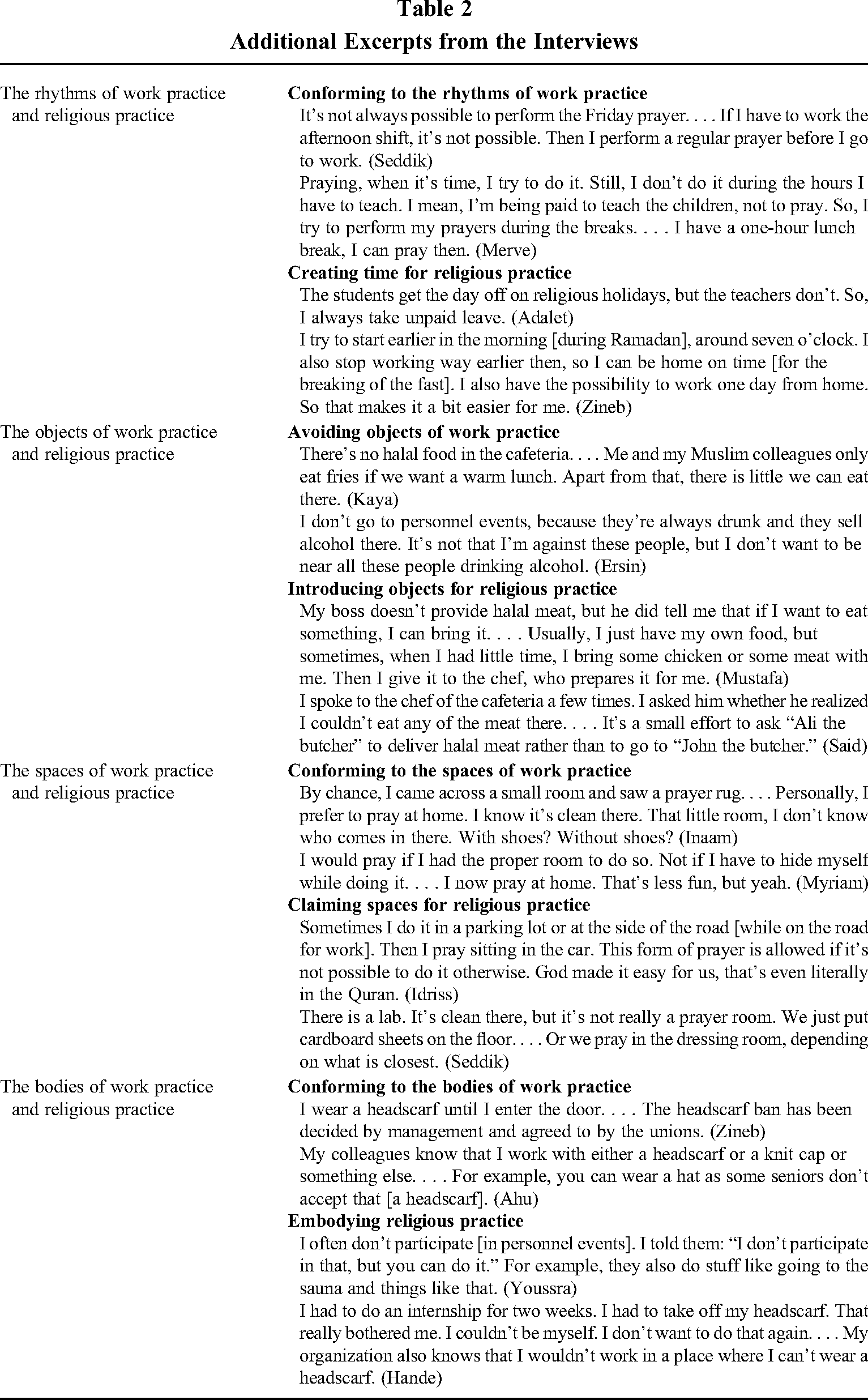
The Rhythms of Work Practice and Religious Practice
One aspect of work practice that can interfere with Muslim employees’ ability to adhere to religious practice is its rhythms. This refers to the rhythms according to which work activities are expected to be performed throughout the day, the week, and the year. The interviews showed how these rhythms can interfere with adherence to the rhythms of praying, attending the congregational prayer on Friday, daytime fasting during Ramadan, and celebrating religious holidays.
Muslim employees experiencing this interference can negotiate it by conforming to the rhythms of work practice. This can involve not performing (elements of) religious practice or deviating from its rhythms. An example of the former is given by Onur, a male technician of Turkish descent: I once asked to start an hour earlier on Friday, and take a longer lunchbreak [to attend the congregational prayer]. . . . They said: “No, we’re not going to do this, because then others will come with other things.” I accepted that. But now, I see people getting exceptions. Like people going home earlier on Wednesday because they have kids at home. . . . I don’t have a problem with that, but when they then tell me that they are not going to allow that [for the congregational prayer].
Onur describes how the rhythms of work practice, which are organized around the Christian calendar with Sunday as the day of the congregational prayer, conflict with the timing of the Islamic congregational prayer on Friday afternoon. He wanted to resolve this by performing work practice according to alternative rhythms to adhere to the rhythms of religious practice. He constructs the rejection of this resolution as particularly unfair because other employees are allow to perform work practice according to alternative rhythms for nonreligious reasons.
While conforming to the rhythms of work practice can make the performance of some elements of religious practice, such as attending the congregational prayer, impossible, other elements sometimes become performed according to adapted rhythms. For example, some interviewees described adapting the rhythms of prayer to the rhythms of work practice, for example, by performing them after work or as soon as their work or (lunch) breaks allow it. This former option was discussed by Youssra, a female health-care worker of Moroccan descent: You can’t just say: “now it's time to pray, so I’m going to pray.” . . . I don’t like it, because when I get home, I have to do the entire Salah [prayers], and it's midnight when I’m done. . . . But I'm not going to start getting angry about it. Because I don't think there's a point in that or in asking to get permission.
Youssra describes how the rhythms of work practice force her to temporally rearrange the performance of prayers. Although she dislikes being forced to postpone praying, she feels she has no other choice than to conform to the rhythms of work practice, as she will never be given the time by her employer to perform work differently, according to the rhythms of prayers.
However, interviewees also described negotiating this interference by adapting the rhythms of work practice to create time to adhere to the rhythms of religious practice. Some interviewees described having some flexibility to determine the rhythms of work, which enables them to create time for the performance of religious practice—for example, by performing their breaks in accordance with the rhythms of prayer. Interviewees further described strategically taking days off—for example, to make it easier to adhere to the rhythms of daytime fasting during Ramadan, the congregational prayer, or religious holidays that, unlike major Christian holidays such as Christmas, Easter, All Saints’ Day or Assumption Day, are not official holidays. Soufian, a male security officer of Moroccan descent, gave the following example: I regularly take the day off on Friday, to be able to perform the Friday prayer. Or I switch with someone to do the evening shift. . . . You’re entitled to your days off. You just take them. You don’t need to explain why you take them.
By taking the day off or switching shifts, Soufian can create time to adhere to the rhythms of religious practice without being forced to make it particularly visible. A similar example of attending the congregational prayer was given by Murat, a male public servant of Turkish descent: I don’t think that will be a problem, as we don’t have fixed working times. We have a flexible schedule, so I could take my lunch break later. . . . These flexible hours offer a lot of possibilities. . . . It does happen that I can’t go because of a meeting.
Whereas the production environment where Onur performs his blue-collar job offers little possibility to create time for religious practice, the rhythms of work practice in Murat's more senior white-collar job are more flexible. This sort of flexibility enables employees to better align the rhythms of their work and their private life and allows Murat to create time for religious practice. However, this is often only possible to a limited degree, as Murat cannot reschedule all meetings, and interviewees only have a limited number of vacation days. Therefore, some, such as Ersin, a male blue-collar worker of Turkish descent, sometimes create time for religious practice without formal permission: The entire year, people can or do eat on the shop floor. A piece of chocolate or a waffle or something. And nobody says anything. But when it's Ramadan, then suddenly they start announcing that it's not allowed [to take some time to eat]. We don’t complain, otherwise we’re again the bad guys. . . . Of course I’m going to eat something. . . . They know you eat, but they can’t check it.
This illustration shows Ersin being constrained by the rhythms of work practice, which provide lunch breaks but no breaks adapted to the rhythms of Ramadan. Moreover, his employer only forbids interrupting work to eat during Ramadan, while allowing more temporal flexibility when it involves non-Muslims' nonreligious practice. Ersin, therefore, feels it is fair to sometimes claim the same rights to also perform work practice according to different rhythms and create time to eat according to the rhythms of Ramadan. However, he tries to do so without making this performance too visible, as this might result in negative reactions.
The Objects of Work Practice and Religious Practice
A second aspect of work practice that can interfere with Muslim employees’ ability to adhere to religious practice is the objects with which employees are expected to interact during formal and informal professional activities. Particularly the involvement in work practice of only (or mainly) non-halal objects (such as alcohol or particular types of meat) can make it challenging to adhere to both work practice and the religious practice of only consuming and/or handling halal (permissible) products.
The main way in which Muslim employees experiencing this interference described negotiating it is by attempting to avoid objects of work practice they consider forbidden. An illustration of this was given by Leila, a female administrative staffer of Moroccan descent: I don’t like going to work parties. . . . If you go out to dinner with colleagues, then they drink alcohol, and then you constantly get the question: “Oh you don’t drink alcohol?” . . . I can’t say: “at this table, there will be no alcohol.” That's also one of the reasons why I don’t go.
Leila does not like going out to dinner with coworkers, an informal aspect of work practice that always involves a lot of alcohol. Not only because she prefers not to be near alcohol and intoxicated coworkers but also because her performance of the practice of not drinking alcohol becomes very visible at these events and her coworkers show a negative attitude toward. However, many interviewees felt not attending such events could (further) endanger their inclusion at work. They therefore often perform them without interacting with non-halal objects, as described by Said, a male public servant of Moroccan descent: When there's a party or something, I’m in a position where I can’t afford not to be present. . . . But I behave as a Muslim. . . . With my own practices and religious principles. . . . People drink what they want, alcohol or something else. . . . Those who do want to drink alcohol can do that. There are colleagues, good colleagues and friends even, I’ll offer a ride home if they drank too much. Because I’m concerned about their safety.
Said combines performing the informal work practice of going to parties with religious practice by avoiding non-halal objects and using available non-alcoholic objects that are acceptable in both work and religious practice. Although this makes him visibly different, he believes his atypical performance of work practice might benefit his non-Muslim coworkers, as it allows him to keep them safe. However, the example of Damla, a female financial controller of Turkish descent, shows that it is not always easy or possible to turn to alternative objects to perform informal work practice: I had a boss once. We went out to dinner. She knew I was Muslim and that I didn’t eat everything. She said: “just eat what you find tasty.” We were at a dinner with 20 people. I had to send back one plate after another. . . . It has nothing to do with tasty. It's whether it's halal or not. If they really don’t want to take that into account, you just don’t eat.
This example shows Damla being forced to openly reject objects involved in work practice, which makes her performance of the religious practice of only eating halal very visible and shows a lack of understanding for it from her coworkers.
Faced with the fact that work practice remains organized around non-halal objects, interviewees also described attempting to resolve this by introducing objects for religious practice, as illustrated by Youssef, a male manager of Moroccan descent: Once a year, our organization has a barbecue. I think it's important to be there with my team. So, I bring my own meat from home. They’ve never had a problem with that. I give my meat to the chef. . . . I don’t think my employer is obliged to provide halal meat. . . . I asked him [another Muslim employee] that day: “did you bring meat?” And he said: “no.” I said: “you know what, I do have meat for you.” I explained it to him, and he liked it. The following year he started bringing meat from home.
As the work practice of barbecuing does not involve food in line with religious practice, Youssef introduced halal meat. By introducing more diverse objects into this informal element of work practice, he and Muslim colleagues can combine adhering to religious practice and participating in this informal barbecue without having to ask their employer for halal meat. Others were able to ensure the introduction of more diverse food options by asking their employer, as was the case for Hande, a female social worker of Turkish descent: If there were sandwiches, you mainly had sandwiches with meat and very few vegetarian ones. We reacted to that by asking to also take Muslims into account. . . . I reacted to that, and colleagues did as well. Because there are multiple Muslims working in our organization. . . . They never provided halal food. Usually, it's fish or vegetarian. But really halal, no.
Rather than halal options, Hande and her Muslim colleagues were able to have more vegetarian objects introduced into work practice. This not only makes it easier for them to combine work practice with religious practice but also offers more opportunities for others who do not consume the traditionally provided meat options. However, openly asking for halal objects can lead to Islamophobic reactions, as shown by the example of Rachida, a female team leader of Moroccan descent who explicitly asked halal chicken to be introduced into an organizational event: For me, it really needs to be halal. And I really say that. A Moroccan colleague was like: “don’t be so difficult, you shouldn’t tell them that.” Because then they’re like: “it's always the same with you people.” Then I just smile and stay chill. I just say: “I want my meat slaughtered in a certain way, period.” And then they’re like: “you’re really difficult.”
The Spaces of Work Practice and Religious Practice
A third aspect of work practice that can interfere with Muslim employees’ ability to adhere to religious practice is its spaces. This refers to (the characteristics of) the locations involved in work practice, which are, next to its rhythms, a second main aspect that can hamper the performance of the practice of praying, which requires a clean and quiet place. Although some interviewees described having neither the time nor the place to pray, some (like Youssra, who was mentioned in the section on the rhythms of work practice) have a place to pray but are not given the time to do so, whereas others have the time but lack a space to pray.
One way that interviewees experiencing this interference can negotiate it is by conforming to the spaces of work practice by not performing the practice of prayer at work, thereby spatially relocating the performance to outside the work context. Leila, a female administrative staffer of Moroccan descent, said the following: Praying, we don’t have the opportunity to do that. If they said: “we’re going to make a separate space where you can pray,” I would really like that. . . . There is no place to pray. I perform all my prayers when I get home. . . . It's frustrating, like: “pfff, when I get home, I still need to [do all prayers]” . . . I don't really get any satisfaction from that. Then you kind of do that reluctantly.
Although Leila feels it might be possible to create time to pray, for example, because coworkers are allowed to take frequent smoke breaks, the spaces of work practice make it impossible to pray. As her organization will never provide a place to pray, she does so at home, which heavily impacts her sense of religious fulfillment. Burak, a male blue-collar worker of Turkish descent, similarly described not being able to pray because he is disallowed a proper space: The boss said that it's not allowed to pray in the work area. . . . On the shop floor, that's difficult. Because you have to recite your prayer, bow, and people will pass by. . . . The area where I now work is unfortunately a racist section. There are only three or four ethnic minority workers there. If I did it there, there would be trouble. So, I don’t. . . . I feel everyone should respect each other. If a Christian or a Jew started praying, I wouldn’t have the slightest problem with that.
Although Burak feels organizations should enable employees from all religions to perform prayers, he is not permitted to do so. One characteristic of work practice that makes it impossible is that the shop floor where work occurs does not allow any privacy and would make performing prayers too visible and, therefore, result in Islamophobic reactions.
However, rather than conforming to the spaces of work practice, interviewees also described claiming spaces for religious practice, turning a space of work practice into a space for prayer. This is the easiest for those with their own offices or rooms, as illustrated by Selin, a female teacher of Turkish descent: Prayers, I can do those in my classroom. As long as I do it in my classroom, they don’t have a problem with that. . . . I never told anyone. They also haven’t asked me about it. And they’ve never seen me do it. I don’t think it would be a problem if they knew.
Unlike Burak, Selin has access to a private space that allows her to perform prayers invisibly, without asking for formal permission. Similarly, Cemal, a male manager of Turkish descent, described the following: I asked him [his boss] whether I could pray, but he said “no.” I don’t know whether that's the real reason, but his argument was that there might be some colleagues who vote for extreme-right parties, or right-wing parties. . . . I think that if they [his co-workers] were Christians, or real Catholics, it would be easier. . . . But we have a fitness downstairs, where you can take a shower. So, I take a shower and do my wudu [ritual purification]. You can quickly perform a prayer there. You can lock the door.
Although praying is considered unacceptable by his manager because of potential Islamophobia from his coworkers, which Cemal links to their lack of religiosity, he uses his ability to exercise at work to claim a space to perform at least some prayers invisibly. Sometimes, claiming spaces in secret is done in a way that is visible to some—for example, Onur is allowed by labor union members to secretly claim their office as a space to pray. Meanwhile, Kaya, a male blue-collar worker of Turkish descent, and his Muslim colleagues secretly claimed a gym to pray together. After they were found out and denied the introduction of an official place for all religions into the spaces of work practice, the labor union helped them secure this gym as a place to pray: Some colleagues prayed during the lunch break in a gym. Supervisors told them they couldn’t do that. . . . We talked to the labour union about that. . . . We said: “we would like a neutral room, with white walls and some carpeting.” We asked that for all religions. . . . So that Christians or Jews, or other religions, could also perform their religion. But that wasn’t allowed. But now we have a designated place [the gym], so we’re already happy.
The Bodies of Work Practice and Religious Practice
A fourth aspect of work practice that can interfere with Muslim employees’ ability to adhere to religious practice is its bodies. This refers to the ways bodies are expected to look and interact at work. The interviews showed how female interviewees were more likely to experience these interferences, as different interviewees discussed policies regulating the wearing of headscarves, which were often introduced based on the argument of “neutrality.” Meanwhile, some interviewees of both genders experienced challenges related to bodily interactions with coworkers of the opposite sex, such as kissing when greeting them or when celebrating specific occasions.
One way that Muslim employees experiencing this interference negotiate it is through conforming to the bodies of work practice. Myriam, a female administrative staffer of Moroccan descent, described being forced to work without a headscarf: When I arrive, I take off my headscarf. They all know I wear a headscarf. . . . I work for the government, that's why I can’t wear my headscarf. I can’t show my religious beliefs. . . . You have to choose: “do you really want to work?” Then that [a headscarf] is a problem. Sometimes I do think: “you know how I work, what difference would it make if I worked with a headscarf?”
While Myriam constructs this as unfair and very painful, she feels that to keep her government job, she has no choice but to conform to the idea that bodies of work practice need to be “neutral.” A similar example was given by Adalet, a female teacher of Turkish descent: At some point, they decided to ban religious symbols, both for students and teachers. They wanted neutral teachers and neutral students. . . . They eventually said: “okay, you can wear a headscarf, except when supervising students [outside the classroom]. Then you can wear a knit cap but have to remove your headscarf.” . . . Religious symbols were allowed while teaching [religion], in the corridors, and in the teachers’ lounge. It felt like the times of Hitler. Here, you’re allowed to be with a headscarf. There, you can’t be when wearing a headscarf.
Constructing the demand for “neutrality” as racist, Adalet was forced to adapt her body to the bodies of work practice. Although she was ultimately still allowed to perform the practice of wearing a headscarf while teaching religion, she had to switch to wearing a knit cap, considered more “neutral,” when performing other parts of work practice. Some interviewees further described feeling the pressure to conform to bodily interactions of work practice. The following example was given by Damla, a female financial controller of Turkish descent: Like with birthdays, you think: “I don’t want you to kiss me.” But I have to tell them every time. So, you sometimes struggle with these kinds of things. . . . I won’t talk about religion easily. Simply because I don’t know whether I can trust them. . . . I had this colleague from Antwerp [a place in Belgium]. They have the custom there to kiss each other every time they see each other. I’ve tried to carefully shield myself from that. But sometimes it still happens. I try to be subtle about it, because you know there's little understanding for that.
Damla, who also described not being allowed to wear a headscarf, attempts to avoid performing the practice of kissing. However, she fears negative reactions when she visibly performs the practice of not kissing individuals of the opposite sex. Therefore, she feels sometimes forced to conform to this bodily aspect of informal work practice.
However, Muslim employees experiencing these interferences can also negotiate the bodies of work practice by rejecting demands placed on their bodies and openly embodying religious practice while engaging in work practice. Dine, a female health-care worker of Turkish descent, described rejecting demands from a recruiter to take off her headscarf to get a job: She said: “you know you can’t wear a headscarf?” I said: “I won’t do that.” She answered: “what do you mean, you’re looking for work, right?” I said: “yes, but without headscarf, I’m really not doing it.”
Dine rejects conforming to the bodies of work practice, even if adhering to the religious practice of wearing a headscarf means she is excluded from certain organizations. Nevertheless, some interviewees made small changes to their performance of wearing a headscarf to become visible to their coworkers as “less extreme”—for example, by wearing a headscarf with bright colors or one that does not cover one's shoulders. Interviewees, such as Youssef, a male manager of Moroccan descent, further described avoiding interactions with bodies expected in work practice. Although this is not always successful, he openly attempts to embody religious practice and interact differently with other bodies than prescribed by work practice: They know I don’t kiss. I think almost everyone knows that. They still always shake my hand. But I don’t have a problem with that. . . . Sometimes mistakes have been made; I should be honest about that. Sometimes you have people almost jumping on you.
Discussion
Based on interviews with Muslim employees in Belgium, this study advances a practice-based understanding of religious inequality at work, which offers contributions to different debates on religion at work.
A Practice-Based Theorization of Religious Inequality at Work
Based on our findings, this study offers a practice-based theorization—focusing particularly on secular workplaces in the Global North—of religious inequality at work. As practices impose an order that reflects and reproduces particular power relations but are never able to determine individual performances (Gherardi, 2009; Janssens & Steyaert, 2019; Nicolini, 2012; Nicolini & Monteiro, 2017), understanding religious inequality through the lens of practice requires an understanding of two core elements—namely, the role of work practice in the regulation of religion and the negotiation by religious employees of this regulation of religion by work practice.
The role of work practice in the regulation of religion at work. A key component in a practice-based understanding of religious inequality at work is the role of work practice in the reproduction of religious inequalities. In line with the idea that practices enforce a particular order reflecting particular power relations (Gherardi, 2009; Janssens & Steyaert, 2019; Nicolini & Monteiro, 2017), work practice contributes to the regulation of religion as it imposes an ordering that reflects religious inequalities and particular views on religion and its place in the public sphere. In turn, it disadvantages (certain) religious employees by interfering with their ability to adhere to religious practice and align it with work practice. We expose different aspects of work practice involved in this reproduction of religious inequalities, identifying the role of the rhythms, objects, spaces, and bodies of both formal (e.g., the organization of work) and informal (e.g., the organization of social events) work practice.
In this study, we offer an understanding of the way that the rhythms, objects, spaces, and bodies of work practice materialize a secular order that regulates religion and reproduces religious inequalities. Reflecting the idea that secularism establishes specific boundaries between the public and the private sphere (Asad, 2003; Mahmood, 2016), this occurs as secular work practice establishes specific boundaries between performances allowed at work and those to be relegated to the nonwork sphere. Secular work practice privileges nonreligious employees by selectively embracing nonreligious aspects of practice dominating the private sphere while not doing the same for similar aspects of religious practice. Examples include the way work practice is made flexible to align it with the practice of childcare or becomes shaped by cultural practice historically characterizing the private sphere in the Global North (e.g., drinking alcohol or kissing others when greeting them). In this way, aspects of work practice and nonreligious, nonwork practice are allowed to become aligned. Meanwhile, this selective blurring of boundaries disadvantages religious employees by potentially interfering with the performance of religious practice (e.g., not drinking alcohol or kissing people of the opposite sex) and not occurring for similar aspects of religious practice (e.g., as flexibility is not allowed for prayer or as halal food is not served). Moreover, reflecting the idea of secularism in the Global North as strongly influenced by Christianity (Asad, 2003; Mahmood, 2016), secular work practice can even reflect aspects of religious practice that historically dominated the Global North (e.g., as the rhythms of Christianity infuse the rhythms of work practice). In this way, secular work practice can reproduce religious inequalities by selectively embracing cultural and even religious practices historically dominating the Global North while interfering with (certain) religious employees’ ability to adhere to religious practice and relegating its performance to the nonwork sphere.
In this process of regulation, work practice operates in tandem with discourses of religious difference. Work practice affects the exposure to these discourses as the (in)visibility of religion is shaped by its relation to the rhythms, objects, spaces, and bodies of work practice. For example, adherence to the practice of praying might be more or less visible depending on whether the spaces of work practice afford individuals privacy to perform it. Conversely, seemingly invisible elements of religious practice, such as not kissing bodies of the opposite sex or not drinking alcohol, can become visible because of aspects of work practice, such as the expectation to kiss colleagues or the presence of alcohol at informal events. By shaping the (in)visibility of religion, work practice affects religious employees’ exposure to the regulatory effects of negative discourses of religious difference (Gebert et al., 2014; Héliot et al., 2020). Together, this practice-based understanding of religious inequality hence argues that the regulation of religion occurs through combinations of work practice, which imposes a particular order and threatens to make the performance of religious practice visible, and discourses of religious difference, which incite employees to adhere to the order imposed by work practice by constructing visible performances of religion as deviant and negative.
Negotiating work practice's regulation of religion at work. A second key component in a practice-based understanding of religious inequality at work is religious employees’ negotiation of the regulation of religion by work practice. In line with the idea that practices always leave room for agency (Gherardi, 2009; Nicolini & Monteiro, 2017; Reckwitz, 2002), religious employees are never determined by the order imposed by work practice but can engage in different types of performances directly negotiating the rhythms, objects, spaces, and bodies of work practice. This can involve conforming to the regulation of religion by refraining from adhering to religious practice at work. These performances reproduce the imposed boundary (Asad, 2003; Mahmood, 2016) between the work sphere, guided by secular work practice, and the private sphere, where religious practice can be performed. However, this can also involve resisting the regulation of religion by work practice through performances such as creating time for religious practice, introducing objects for religious practice, claiming spaces for religious practice, or embodying religious practice through the way they look or interact with other bodies. These performances blur the imposed boundaries between the secular public sphere and the private religious sphere (Asad, 2003; Casanova, 1994; Mahmood, 2016).
The specific power effects of these performances negotiating work practice are shaped by (in)visibility. The negotiation of work practice not only involves the options of visibly performing religious practice or of keeping religion invisible by not performing it but also the possibility of invisibly performing religious practice. Negotiating work practice through invisible performances of religious practice combines some of the potential effects of the other two options. Both performances conforming to work practice and invisible performances of religious practice protect religious employees from negative discourses of religious difference. Moreover, like visible performances of religion, invisible performances allow alignments of work and religious practice. As performing religious practice has an important emotional component (Ammerman, 2020, 2021), this protects religious employees from the sorrow and pain connected to not being able to adhere to religious practice. However, performing religion visibly might over time potentially contribute to normalizing alternative practice (Ammerman, 2021; Gherardi, 2009; Janssens & Steyaert, 2019; Nicolini & Monteiro, 2017; Reckwitz, 2002), thereby fundamentally altering work practice and opening up alternative ways to perform work. Meanwhile, invisible performances of religious practice, just like conforming to work practice, do not challenge the dominant order and the boundaries it imposes (Asad, 2003; Casanova, 1994; Mahmood, 2016).
Furthermore, two factors can be identified as having an important impact on religious employees’ possibilities of aligning work and religious practice: the flexibility of work practice and other employees. In line with the idea that practices can offer individuals different degrees of agency and avenues to adhere to them (Nicolini, 2012; Nicolini & Monteiro, 2017), work practice might be characterized by more or less flexibility in terms of its rhythms, objects, spaces, and bodies. Flexibility opens up different ways to do work and thereby affects religious employees’ possibilities to (invisibly) align work and religious practice. For example, our study showed employees being able to better align work and religious practice by having more freedom in terms of when to work, by a greater variety of food options, or by access to locations that can enable privacy. A second important factor impacting the possibility of religious employees to align work and religious practice is other employees. Although their support might contribute to normalizing the performance of religious practice at work, they, as the judges of acceptability (Ammerman, 2021; Janssens & Steyaert, 2019; Nicolini & Monteiro, 2017; Reckwitz, 2002), can also play a key role in defending the dominant order by drawing on discourses of religious difference to construct the performance of religious practice in negative terms.
Contributions to Debates on Religion at Work
The practice-based theorization of religious inequality at work advanced in the previous section has implications for different debates on religion at work.
Debates on secularism in the workplace. First, our practice-based understanding of religious inequalities contributes to recent debates on secularism in the workplace. Previous studies on religion at work have highlighted the secular nature of workplaces in the Global North as well as the role of negative discourses of religious difference in enforcing it (e.g., Ashforth & Vaidyanath, 2002; Gebert et al., 2014; Gümüsay, 2020; Héliot et al., 2020). This study identifies the specific way work practice contributes to imposing a secular way of “doing” the workplace. Moreover, it exposes that by embracing cultural and even religious practices historically dominating the Global North, secular workplaces might not only reproduce inequalities between religious and nonreligious employees but also between employees from different religions. Specifically, in line with the argument that the idea of what it means to be secular in the Global North is compatible with historically dominant forms of Christianity, yet constructed in opposition to Islam (Asad, 2003; Mahmood, 2016), secular work practice might reject certain religions (in this case, Islam) but implicitly embrace historically dominant versions of Christianity.
Debates on Muslim employees. Second, our practice-based approach contributes to debates on (the negotiation of) the inequalities between Muslims and non-Muslims in organizations. Previous studies on this topic have focused mainly on the role of Islamophobic discourses in regulating religion, as well as on Muslim employees’ discursive practices in negotiating them (Essers & Tedmanson, 2014; Ghumman & Ryan, 2013; Mahadevan & Kilian-Yasin, 2017; Pio & Syed, 2018; Syed & Pio, 2010). This study's practice-based understanding contributes to these debates by highlighting that solely focusing on Islamophobic discourses downplays their interplay with work practice in inciting Muslim employees’ adherence to the dominant order of workplaces in the Global North. Moreover, by going beyond a focus on discursive practices and identifying performances directly negotiating the rhythms, objects, spaces, and bodies of work practice, this study adds to our understanding of how Muslim employees can navigate inequalities. In line with findings from earlier studies (Forstenlechner & Al-Waqfi, 2010; Syed & Pio, 2010), these performances can involve conforming to work practice by not adhering to religious practice (e.g., by removing a headscarf). However, by identifying performances negotiating work practice that resist the regulation of religion, our study also offers novel insights in the strategies Muslim employees use to adhere to religion at work.
Debates on (in)visibility. Third, our practice-based approach contributes to debates on the role of (in)visibility in (the negotiation of) religious inequalities in organizations. Previous studies have highlighted that visibility exposes religious employees to discrimination, which seemingly results in an either/or choice between either maintaining religious invisibility by not performing religious practice at work or being exposed to discrimination by visibly performing religious practice (Arifeen & Gatrell, 2020; Berger et al., 2017; Forstenlechner & Al-Waqfi, 2010; Gebert et al., 2014; Héliot et al., 2020; Syed & Pio, 2010). This study's practice-based approach contributes to such debates by showing that the (in)visibility of religion is not merely a characteristic of a particular religious practice or of individuals’ decision (not) to perform it. Rather, by identifying how work practice shapes the (in)visibility of religion, it shows that performances of religious practice might be more or less (in)visible depending on the context in which they occur. Recognizing this also highlights the possibility of invisibly performing religious practice at work, which presents a third option that combines some of the effects of the traditional either/or choice of not adhering to religious practice or visibly performing it at work.
Debates on the inclusion of religious employees. This practice-based understanding of religious inequalities contributes to the literature by identifying specific elements that can enable religious employees to better align work and religious practice. Previous studies on diversity management have largely ignored the issue of religion, whereas studies focusing on religion have mainly explored the reproduction of religious inequalities (Gebert et al., 2014; Gümüsay, 2020; Héliot et al., 2020; Tracey, 2012). This study adds to the literature by stressing the importance of the flexibility of work practice and the role of other employees in opening up alternative ways to perform work and improve the inclusion of religious employees. Our study highlights how ensuring that work practice is characterized by flexibility in terms of its rhythms, objects, spaces, and bodies can enable religious employees to better align work and religious practice. However, reflecting the idea that flexibility and autonomy are mainly afforded to employees in white-collar, managerial, and professional jobs (Gray & Kish-Gephart, 2013), the opportunity to perform work in different ways might be distributed unevenly among different religious employees. Highlighting that class inequalities can affect religious inequalities, we for example found that those working in managerial and professional jobs tended to be afforded more flexibility than those in blue-collar jobs (which are often performed in spaces with little privacy according to highly regulated rhythms) or care- and service-oriented jobs (whose rhythms are determined by clients). This study further adds to debates on the inclusion of religious employees by identifying how the support of other employees can contribute to enabling religious employees to better align work and religious practice. We highlight the importance of ensuring religious diversity in organizations, as this can contribute to mutual support among religious employees and to the normalization of the performance of religious practice. Moreover, we also highlight the importance of the support of nonreligious employees. To ensure this support, the performance of elements of religious practice (e.g., not eating non-halal meat) can become tied to practices performed by nonreligious employees (e.g., not eating meat), which might be more easily allowed to pass the boundary between the work and the nonwork sphere. The negotiation of work practice by religious employees to better align work and religious practice might thereby contribute to changes in work practice (e.g., more flexible working hours or more food options) that allow it to become more inclusive of both religious and nonreligious employees.
Limitations and Future Research
This study has several limitations, which in turn highlight avenues for future research. First, this study points to the need for exploring intersections between inequalities. Given our findings, future research could pay more in-depth attention to the connection between religious and class inequalities. This might include exploring whether Muslim employees in the upper echelons of organizations might be able to use their position to disrupt work practice. This study is unable to make clear claims about this. However, this might be connected to the strength of Islamophobic discourses or the relative scarcity of Muslims in such positions in the context under study. Moreover, our study again highlights the importance of acknowledging gender when studying religious inequalities. Although we uncovered little differences in terms of age or descent, it is important for future research to also continue to explore the intersections between religion and these social identities. Second, although differences in the performance of religious practice can reflect different individual interpretations of religion, they might also be connected to differences between Islamic schools and movements. Future research could explore such differences within the group of practicing Muslims. Third, our findings are based on interviews with Muslim employees in Belgium, which is a context characterized by a specific understanding of neutrality, particularly negative discourses on Islam, and a strong opposition to the performance of religious practice in the public sphere. As other contexts are characterized by different approaches toward certain aspects of religious practice, such as wearing a headscarf at work, it seems relevant to complement our conclusions with research in other countries. Fourth, future research could explore whether other religions, such as Judaism, Hinduism, or Buddhism, are similarly regulated in workplaces in the Global North. Finally, future research should explore organizational and societal interventions to ensure work practice can be made inclusive of religious diversity.
Footnotes
Acknowledgements
The authors would like to thank the two interviewers and the interviewees involved in this study. We also gratefully acknowledge all the colleagues who provided feedback on earlier versions of this paper. We specifically thank the anonymous reviewers and the action editor involved in the peer-review process for their supportive and helpful comments.
