



Abstract
How private firms can overcome their unique governance challenges remains an important but understudied topic. Using novel data on more than 28,000 private firms in India from 1988 to 2017, we examine whether private firms can improve their survival prospects by having board interlocks with public firms and, specifically, interlocks whereby a public firm director subsequently joins the private firm's board. In our data, we found a U-shaped relationship between the number of incoming board interlocks and the probability of private firm exit. We also found that board interlocks formed by public firm directors of public firms audited by Big Four companies improve private firms’ survival more than other interlocks, consistent with the notion that such interlocks improve monitoring at private firms. Overall, our study points toward the importance of considering the role of incoming board interlocks when explaining private firm survival.
Keywords
Introduction
Private firms are as important as public firms—if not more so—for the generation of employment and wealth (e.g., Banghøj, Gabrielsen, Petersen, & Plenborg, 2010; Brav, 2009). Understanding the determinants of private firms’ survival has thus been a central objective of prior research (e.g., Lyles, Saxton, & Watson, 2004; Wilson, Wright, & Scholes, 2013). While much of the research in this domain has focused on the role of resources and capabilities in explaining private firm survival (e.g., Carney, Van Essen, Gedajlovic, & Heugens, 2015; Durand & Vargas, 2003), a related stream of work has also emphasized the role of managerial self-control, adverse selection in factor markets, and owner opportunism (e.g., Fiegener, Brown, Dreux, & Dennis, 2000; Schulze, Lubatkin, Dino, & Buchholtz, 2001) in explaining private firms’ exit. In this regard, governance scholars have specifically drawn attention to the role of the board as the “primary governance mechanism” (Garg, 2013: 90; see also Garg & Eisenhardt, 2013; Garg & Furr, 2017) in private firms. However, despite its prominence in the broader corporate governance domain (e.g., Davis, 1996; Johnson, Schnatterly, & Hill, 2013; Mizruchi, 1996; Zona, Gomez-Mejia, & Withers, 2018), extant research offers limited insights into the role of board interlocks. As a result, the question of how board interlocks influence private firm survival remains largely unanswered. Indeed, this omission is all the more surprising given that there is reason to believe that such board interlocks may be even more consequential for private firms (Peng & Luo, 2000), especially if these ties are formed between a private firm and a public firm.
There are most likely multiple reasons why public firm directors may serve on a private firm's board. For instance, a public firm may send directors to a private firm to infiltrate the private firm's board with the objective of influencing its decision-making in order to secure access to critical resources that this firm provides (Pfeffer & Salancik, 1978). Similarly, the public firm director may “scout” the private firm as a potential acquisition target by gathering insider information on that private firm (Casciaro & Piskorski, 2005; Pfeffer & Salancik, 1978). The public firm directors may also simply seek to offer their expertise to the private firm (Boivie, Withers, Graffin, & Corley, 2021; Garg, 2013). Regardless of the reasons for public firm directors to join a private firm's board, the interlocks that are established in these cases can bring important knowledge to the private firm—knowledge that would otherwise be difficult to access (Garg, 2013). In this regard, although it is reasonable to assume that some of this knowledge may help to improve the private firm's core resource base—for example, by offering technological know-how that can inform the private firm's innovation strategy (Li, 2019)—there is reason to believe that such interlocks can also improve the probability of private firm survival by improving monitoring at that private firm.
Specifically, while public firm directors may see themselves as mainly fulfilling an advice-giving function (Boivie et al., 2021; Garg, 2013), or as being sent by the public firm to infiltrate or scout the private firm, being associated with a private firm also carries some reputational risks, especially in contexts characterized by institutional voids (Luo & Chung, 2013). The reason for this is that, given that private firms on average have lower governance standards, these firms also tend to fail more frequently due to severe governance oversights (Badertscher, Shroff, & White, 2013). This is problematic for public firm directors who are serving on the private firm's board, as being associated with a private firm that fails due to governance oversights may tarnish these directors’ reputations and diminish their future human capital (e.g., Fich & Shivdasani, 2007; Harrison, Boivie, Sharp, & Gentry, 2018). Our discussion suggests that board interlocks between private and public firms are most likely consequential, especially when it comes to private firm survival—a possibility that has not been fully considered in prior research.
In this paper, we start to address this conceptual lacuna by examining the effect of private firms’ board interlocks with public firms on private firm exit (or survival). To that end, we integrate research on director reputation with the combined agency–resource-dependence perspective to argue that public firm directors also use their superior governance knowledge to fulfill a monitoring function at the private firm. However, deviating from traditional models of the diffusion of governance practices (e.g., Gulati & Westphal, 1999; Haunschild, 1993; Shipilov, Greve, & Rowley, 2010, 2019; Shropshire, 2010), we argue that the reason for this is the reputational risk that these public directors face due to the possibility that the private firm on whose board they serve will fail due to severe governance oversights. Improved monitoring should initially be reflected in a lower probability of private firm exit. However, we also expect that, at some point, the monitoring-related benefits may not outweigh the costs associated with maintaining such interlocks. We further argue that the U-shaped relationship should be steeper if these board interlocks are established by directors who are members of the tied-to firm's auditing committee, or if the tied-to firm is audited by a Big Four firm.
We test our theoretical framework in the context of private firms in India. More than 99% of the registered firms in India are private firms, but existing databases do not capture their board data. We overcame data limitations that typically prevent large-scale studies of private firms’ board interlocks by combining data on board composition obtained from India's Ministry of Corporate Affairs website with firm survival data on more than 28,000 private firms from CMIE's Prowess dataset. Our unique dataset allows us to map the board interlocks of private firms comprehensively. We found that each additional incoming public firm director leads to a 6% lower hazard of private firm exit. We also found evidence for quadratic effects, and that this effect is steeper if the tied-to firm is audited by a Big Four firm.
The main contribution of our paper lies in providing evidence that board interlocks between public and private firms influence private firm survival. While research on private firms’ boards is not unprecedented in the literature, much of this work has focused on board structure or directors’ characteristics (e.g., Daily & Dalton, 1992, 1993; Garg, 2013; Wilson et al., 2013). In contrast, little is known about the consequences of board interlocks on private firm survival. Departing from this approach, our study demonstrates the importance of the ties the private firm can form with public firms through its board. Specifically, our findings document the benefits—in terms of private firm survival—of adding directors who already serve on the board of a public firm prior to their appointment to the private firm's board. By doing so, our study also advances research on the differentiation between incoming and outgoing board interlocks (e.g., Tuschke, Sanders, & Hernandez, 2014; Yildiz, Morgulis-Yakushev, Holm, & Eriksson, 2023) by highlighting that this differentiation is also consequential when ties across organizational fields are considered. Moreover, in contrast to a recent study by Yildiz and colleagues (2023), who argue that outgoing board interlocks are more consequential, we show that incoming ties are also consequential when it comes to explaining private firm survival.
Lastly, our study extends prior research that has pointed toward the need to go beyond director ability when examining the effect of board interlocks on monitoring (e.g., Arora, 2018; Hambrick, Misangyi, & Park, 2015). Specifically, we argue and provide suggestive evidence for reputation risk as an important determinant of incoming public firm directors’ motivation to monitor the focal private firm. The focus on motivation also has implications for prior research adopting a microfoundations perspective on board interlocks (e.g., Ang, Benischke, & Hooi, 2018). For policymakers, our findings suggest that policies which facilitate incoming board interlocks between private and public firms could have positive effects on private firm survival.
Theoretical Background
An important difference between private and public firms is that private firms should face fewer principal–agency problems that typically arise from the separation of ownership and control (Belenzon, Patacconi, & Zarutskie, 2016; Garg, 2013; Steier, Chrisman, & Chua, 2015; Pieper, Smith, Kudlats, & Astrachan, 2015; Li, Wu, & Song, 2017). In fact, prior work suggests that the main agency problem in private firms relates to the expropriation of minority shareholders by the controlling shareholders, as opposed to the governance problems between managers and shareholders that are common among public firms (Asker, Farre-Mensa, & Ljungqvist, 2015; Banghøj et al., 2010; Gao, Harford, & Li, 2017; Nagar, Petroni, & Wolfenzon, 2011; Schulze, Lubatkin, & Dino, 2003a, 2003b). At the same time, there is strong evidence suggesting that problems of managerial self-control persist for private firms even in the absence of separation of ownership and control (Belenzon et al., 2016; Fiegener et al., 2000; Schulze et al., 2001; Van den Heuvel, Van Gils, & Voordeckers, 2006). This has led to calls for further research on monitoring in private firms (Krause & Bruton, 2014), and, specifically, to study the role of the board of directors in private firms as the “primary governance mechanism” (Garg, 2013: 90). Prior studies in this area have documented the relatively lower levels of board independence in private firms compared to public firms (e.g., Banghøj et al., 2010), and uncovered that boards tend to side with controlling shareholders when views between controlling and minority shareholders diverge (Villalonga, Trujillo, Guzman, & Caceres, 2019).
In contrast, the role of boards in governing private firms and, specifically, the governance impact of board interlocks, remains underexplored. Indeed, most of the prior research examines interlocks between two public firms (e.g., Ang et al., 2018; Zona et al., 2018). This work has focused on the “embeddedness of corporate governance in social structures” (Davis, 1996: 156), conceptualizing board interlocks as a conduit through which governance practices diffuse within an organizational field (e.g., Gulati & Westphal, 1999; Haunschild, 1993; Shipilov et al., 2010, 2019; Shropshire, 2010). However, existing models of the diffusion of governance practices may not be well adapted to explain the role of interlocked directors in explaining monitoring at the focal private firm (Krause, Wu, Bruton, & Carter, 2019). Specifically, while the governance-related institutional pressures with which firms are confronted significantly differ across public and private firms (Garg, 2013; Garg & Eisenhardt, 2017; Garg & Furr, 2017), the diffusion of practices should eventually have resulted in the use of more similar practices in both fields (Krause et al., 2019); however, the aforementioned differences in governance standards between private and public firms have persisted over time.
The differences in social context may also mean that the role of interlocked directors differs across interlocks between two public firms and interlocks between private and public firms. In particular, board interlocks between two public firms are often established to maintain social cohesion in the corporate elite (Davis, Yoo, & Baker, 2003; McDonald & Westphal, 2010, 2013; Withers, Howard, & Tihanyi, 2020). This is explicated, for example, in public firm directors’ interpretation of their role as supporting the CEO and offering their advice to the firm's strategic leaders (Boivie et al., 2021; McDonald & Westphal, 2010, 2013). In contrast, given that public firm directors that serve on the board of a private firm will be exposed to a different social context (Krause et al., 2019), it is likely that these directors will pursue a different objective when accepting such an appointment. This suggests that, while existing theory can explain the diffusion of governance practices when interlocks between two public firms are considered, there is reason to believe that such traditional institutional processes may be less consequential when such interlocks span across institutional domains (Krause et al., 2019), such as, for example, when interlocks are established between private and public firms.
Private Firm Governance and Board Interlocks With Public Firms
When considering the expertise, and specifically the motivation of interlocked directors (Hambrick et al., 2015), it is important to differentiate between two broad categories of interlocks that can be established between private and public firms (Tuschke et al., 2014): (1) interlocks whereby the director first serves on the board of the focal private firm before subsequently joining the board of the public firm, defined as “outgoing interlocks”; and (2) interlocks whereby the director first serves on the board of a public firm before subsequently joining the board of the focal private firm, defined as “incoming interlocks.” 1 Consistent with our theory, we focus on incoming interlocks for the following interrelated reasons.
First, the motivations for public firm directors to subsequently join a private firm's board will most likely differ from situations in which they accept an appointment to another public firm's board. As noted above, public–public board interlocks are mainly seen as a mechanism to maintain social cohesion within the corporate elite. In contrast, the motivations of incoming directors to accept an appointment to a private firm's board are often more material. For instance, public firm directors can be sent to the private firm to influence that private firm's decision-making (Hallen & Eisenhardt, 2012). This may allow the focal public firm to secure important inputs that the private firm provides (Hillman, Withers, & Collins, 2009). Similarly, public firm directors may either be sent to or be invited to serve on the private firm's board to “scout” that private firm as a potential acquisition target. Some public firm directors may also have an intrinsic or extrinsic (e.g., additional income) motivation to offer counsel to the private firm (Garg, 2013). In contrast, when private firms establish connections with public firms by having one of their board members join a public firm's board (outgoing interlocks), the purpose of this tie is primarily to access that public firm's superior financial and non-financial resources and capabilities (Garg, 2013, 2014). For example, research in related domains suggests that private firms ally with public firms to gain legitimacy (Tsang, 1994). Hence, there is an asymmetry in the motivations behind board interlock formation between public–public and private–public firms.
Second, as a result of the asymmetry in motivations for public firm directors to subsequently join a private firm's board (incoming interlocks), the reputational risk with which these directors are confronted also differs. The reason for this is that being involved in the failure of a private firm due to a governance oversight will significantly damage incoming public firm directors’ reputations, and thus their future human capital (Fich & Shivdasani, 2007; Naumovska, Wernicke, & Zajac, 2020). Given that the motivations for incoming public firm directors are often different, it is likely that these reputational concerns are particularly salient for these directors. Consistent with this argument, Harrison and colleagues (2018) show that directors are indeed sensitive to such potential reputation damage.
While this may also be true for private firm directors joining a public firm board (outgoing interlocks), the probability of firm failure due to governance oversights is much higher in private firms (Behn, Carver, & Neal, 2013). The main reason for this is that private firms—on average—have lower governance standards than public firms. Hence, by voluntarily joining the private firm's board, the incoming public firm director self-selects into a higher reputational risk—relative to, for example, when they accept an appointment to another public firm's board. In contrast, due to their direct affiliation with the private firm as board members, private firm directors who subsequently join a public firm board (outgoing interlocks) would face such reputational damage regardless of the “tie” with the public firm. That is, there is a difference in the marginal increase in reputational risk due to the possibility of private firm failure between outgoing and incoming directors, given that the decision to join the private firm's board exposes that incoming director to that risk in the first place. 2
In sum, we have argued that the motivations behind directors’ decisions to join another firm's board will differ between public–public and private–public interlocks. We have also suggested that incoming directors will be cognizant of the reputational risk that is associated with such an appointment. Based on this discussion, we argue that—in addition to any other roles that incoming public firm directors will fulfill when joining a private firm's board (Garg, 2013)—there is reason to believe that such incoming board interlocks will also result in improved monitoring by the board. This is because incoming directors will have not only the expertise to monitor but also the motivation to use that knowledge, both of which are necessary conditions for effective board monitoring (Hambrick et al., 2015). To further probe our arguments regarding public firm directors’ expertise and motivation to monitor, we spoke to several industry experts who are familiar with our research context. In line with our arguments, one such informant pointed out the following: The external director adds to the private company's focus and thinking in terms of a public-listed company. In addition, as liabilities of independent directors have increased, and [are] not compensated enough for the risks taken by being a director, the IDs [independent directors] demand greater compliance from the companies.
Below, we combine research on director reputation (e.g., Fich & Shivdasani, 2007; Harrison et al., 2018; Naumovska et al., 2020) with prior work that has started to integrate agency and resource-dependence theories (e.g., Hillman & Dalziel, 2003; Zona et al., 2018) to argue that a consequence of public firm directors joining a private firm's board is improved board monitoring at that private firm, leading to a lower overall probability of private firm exit.
In terms of motivation, we expect that public firm directors will have a strong incentive to use that governance knowledge. These public firm directors will most likely be conscientious about the fact that private firms tend to fail more frequently due to governance oversights (Badertscher et al., 2013). As noted above, being associated with a private firm that fails due to governance oversights would tarnish these directors’ reputations and diminish their future human capital (Fich & Shivdasani, 2007; Harrison et al., 2018; Naumovska et al., 2020). In fact, misconduct or involvement in malpractices that, in the worst case, lead to private firm failure, may also reflect negatively on others who share connections with the interlocked director (Devers, Dewett, Mishina, & Belsito, 2009; Kang, 2008), meaning that the reputational risk and associated loss of human capital as a result of being involved in a failing private firm due to governance oversights extends to the interlocked public director's personal network. This creates a strong incentive for these directors to effectively monitor management to minimize the risk of governance oversights. In support of this argument, Arora (2018) illustrated the importance of director motivation in influencing firm outcomes. In terms of behavior, this should be reflected in a greater probability that interlocked public firm directors will actively engage in monitoring at the focal private firm.
In order to theorize about the effect of board interlocks with public firms on private firm survival, it is important to differentiate the costs and benefits of greater monitoring at the focal private firm as the number of incoming public directors increases. Regarding benefits, it is likely that problems of managerial self-control would be reduced in private firms with incoming board interlocks to public firms (Ciampi, 2015; Daily & Dalton, 1994a, 1994b). Similarly, it is likely that owner opportunism would be lower in private firms with relatively stronger governance practices (e.g., Chrisman, Chua, Kellermanns, & Chang, 2007) and would most likely also face lower risks of adverse selection in factor markets (Schmid, 2013).
At the same time, an increased focus on monitoring due to the addition of public firm directors to the private firm's board comes at a cost. For example, in addition to the direct costs (e.g., compensation, incentives) associated with attracting and retaining incoming public directors, public firms must often divert significant amounts of human and financial resources to meet regulatory demands (Sneller & Langendijk, 2007; Zhang, 2007). Boardroom dynamics may also become more dysfunctional as the focus shifts toward monitoring. This can, among other outcomes, result in a situation whereby boardroom conversations increasingly focus on governance issues, leaving little room for discussing strategy. For example, in examining the consequences of intense board monitoring, Faleye, Hoitash, and Hoitash conclude that “negative advising effects outweigh the benefits of improved monitoring” (2011: 160) because “intense monitoring increases managerial myopia, leading to less innovation and eroding the firm's competitive advantages” (2011: 173), meaning that the firm may forgo important opportunities that would improve the firm's survival prospects (Guldiken & Darendeli, 2016). Similarly, Garg argues that excessive monitoring may have negative effects on private firm performance because it is likely to divert “executives’ attention from substantive tasks” (2013: 101). Evidence from related studies supports the notion that too much monitoring may have adverse effects on firm outcomes, such as underinvestment in research and development (e.g., Bertoni, Meoli, & Vismara, 2023; Guldiken & Darendeli, 2016; Masulis & Zhang, 2019). As such, prior research suggests that a greater focus on governance and monitoring as the number of interlocked public firm directors on the private firm's board increases also results in real and opportunity costs that may be reflected in certain firm outcomes. 3
Relatedly, although monitoring practices are most likely somewhat standardized among public firms, an increasing number of incoming board interlocks also increase the probability of conflict, given that these directors may offer different perspectives on monitoring and governance-related issues. This may increase coordination challenges and conflicts in the boardroom (Wilson et al., 2013). In the context of our study, this suggests that, as the number of interlocked directors increases, there is a risk that board stability will decrease. Thus, these conflicts further increase opportunity costs.
In sum, we have argued that private firms with incoming interlocks to public firms have greater access to governance knowledge than private firms that do not have such interlocks. We have also argued that interlocked public directors are likely to utilize this knowledge due to reputational and human capital-related concerns, meaning that it can result in improved monitoring. Importantly, the governance-related benefits are likely to dimmish at some point because of duplication of governance knowledge (Masulis & Zhang, 2019). At the same time, at high levels of incoming board interlocks with public firms, it is also likely the costs associated with excessive monitoring will escalate (Faleye, Hoitash, & Hoitash, 2011). That is, once a certain threshold is reached, the costs associated with excessive monitoring will dominate the benefits of improved governance. 4 Following Haans, Pieters, and He (2016), we therefore expect a U-shaped relationship between board interlocks with public firms and firm exit for private firms:
The relationship between the incoming board interlocks with public firms and the probability of private firm exit has a U-shape.
Taken together, the above arguments suggest that interlocked public firm directors that serve on the auditing committee of the tied-to public firm have (1) more firsthand governance knowledge and (2) an even greater incentive to use this knowledge in the boardroom of the private firm. This suggests that the firm-specific benefits of having board interlocks with public firms due to improved monitoring are stronger if these interlocks are established by public firm directors who are members of the tied-to public firm's auditing committee. We thus expect the U-shaped relationship to be steeper for board interlocks established by independent directors vis-à-vis non-independent directors (Haans et al., 2016):
The U-shaped relationship between the incoming board interlocks with public firms and the probability of private firm exit is steeper if these board interlocks are established by directors who are members of the tied-to public firm's auditing committee.
It is likely that tied-to public firms that use one of the Big Four auditing firms have established stronger governance practices. There are two explanations for this. First, the auditing quality of Big Four firms is generally higher (Eshleman & Guo, 2014; Francis & Krishnan, 1999; Teoh & Wong, 1993), and the clients of these firms can, in turn, develop better governance practices. Second, it may be possible that those firms that select a Big Four auditing firm are also the firms whose audit committees have already implemented higher governance standards (Lawrence, Minutti-Meza, & Zhang, 2011). Irrespective of the underlying causal mechanisms, these studies suggest that clients of a Big Four auditing firm tend to have higher governance standards. It follows that those private firms that have board interlocks with public firms using one of the Big Four auditing firms should have access to qualitatively different governance knowledge. Thus, we expect that the private firm's benefits associated with improved monitoring are even more beneficial if the tied-to public firm is audited by a Big Four firm.
More importantly, the fact that the tied-to public firm signals its commitment to high governance standards would make the reputational damage for any interlocked public firm director even more visible should the private firm fail due to governance oversights. Hence, analogous to our arguments above, interlocked directors who are tied to public firms that use a Big Four auditing firm have access to even higher quality governance knowledge and a greater incentive to use this knowledge, meaning that the interlocked public firm director will more likely act as an effective monitor. We therefore expect the U-shaped relationship to be steeper for board interlocks with a public firm using a Big Four auditing firm vis-à-vis board interlocks with public firms using another auditing firm. Formally:
The U-shaped relationship between the incoming board interlocks with public firms and the probability of private firm exit is steeper if the tied-to public firm is audited by one of the Big Four firms.
Data and Methods
Research Context
We tested our framework in the context of private firms in India. India is a useful context in which to study private firms for several reasons. First, India has more than a million firms registered with the Ministry of Corporate Affairs, and over 99% of these are private, allowing us to study a potentially large sample of such firms, although prior literature largely focuses on samples of public firms (see Table A1, Panel A for a sample of such published articles in strategic management and international business literature). Among the million private firms in India, the CMIE Prowess database contains data on a subsample of private firms that file an annual audited profit-and-loss statement and balance sheet with the Ministry of Corporate Affairs. We exploit the data on more than 28,000 such private firms in our analyses. Ayyagari, Dau, and Spencer note that “the vast majority of companies contained in the Indian Registrar of companies that are not in Prowess are companies that exist only on paper (no official records or financial statements), or investment companies with sales less than Rs. 100,000” (2015: 1877). Therefore, we expect the Prowess dataset to cover a significant fraction of the relevant private firms in India, which Prowess estimates to be 40% of the overall assets of all firms in India—that is, public and private firms combined. 5
Second, information on the board composition of private firms is generally not available, even within the CMIE Prowess database. We overcame this challenge by complementing the CMIE data for private firms with longitudinal data on board composition obtained directly from the Ministry of Corporate Affairs website, allowing us to break new ground in terms of the analysis of the impact of board interlocks on the performance of private firms.
Third, while boards at small firms in many countries can be either advisory or governing in nature, in our empirical context, boards have a clear governance role as mandated by the law. Specifically, in India, the law requires private limited companies to constitute a board with a minimum of two directors and a maximum of 15 directors (maximum of 20 for public firms), and board meetings of private firms require a quorum of at least two persons.
Sample Construction
Each firm in our database is associated with a 21-digit company identification number (CIN) issued by the Government of India at the time of registration. The first letter of the CIN identifies whether a firm is private or public. Each CIN also contains the year of registration, the state in which the firm is registered, the industry classification, and the registration number of the firm. We began the compilation of our dataset with a census of 1.4 million CINs issued to registered firms in India up to 2018. We excluded less than 2% of the firms that were categorized as neither public nor private (e.g., state-owned firms). We focused our study on private limited companies, which formed the sample of private firms, and public limited companies, or public firms. We then matched these nearly 1.4 million CINs to the CINs covered in the CMIE and arrived at 5,999 public firms and 28,344 private firms, with 252,033 firm-year observations between 1988 and 2018 (see Table A1, Panel B for additional details of the sample used in our study).
Measures

Endogeneity is a concern in this study. The concern relates to the possibility that firms selectively add members to their boards (Hermalin & Weisbach, 1998). This suggests that our results could be driven by unobserved factors that would simultaneously influence the decision to add a director with ties to public firms to the board, as well as private firm exit. One possible approach to addressing this concern would be first to estimate a Heckman selection model that explains why some private firms engage in interlocks with public firms and then to correct for this self-selection in our analyses. To do so, we identified an exclusion restriction (also known as an instrumental variable in the Heckman selection literature) that predicts the likelihood of a private firm forming a director interlock with a public firm in the first stage, and then we corrected for this in the survival analyses. Although Heckman selection models can be run without an exclusion restriction, recent literature indicates that doing so might introduce additional bias rather than correcting any preexisting bias (Wolfolds & Siegel, 2019). Therefore, we identified the fraction of directors serving on public firm boards in a region in a year in an industry defined at the five-digit industry code (as a proportion of the total number of directors serving on any public or private firm in the same region in the same year) as the exclusion restriction. We expect that a greater availability of directors serving on public firm boards within a region increases the likelihood of a local private firm forming an interlock with a public firm, but that private firm exit is not directly affected by the availability of such directors except through their selection to the focal private firm board. Our main results therefore address endogeneity concerns using Heckman selection, but we also report naïve regression results in the appendix (see the online supplemental materials).
Further, to limit the role of outliers, we censored observations with more than 10 director interlocks in the data, given that the average board size in our full sample was 3.82 (see Table A2 for descriptive statistics for the full sample) and a standard deviation of 2.18. The threshold we chose is reasonable as 10 is three standard deviations from the mean board size. We also show the robustness of our results when we use 20 as the threshold for board size, which is the legal limit in the Companies Act of 2006. The results remain qualitatively similar when we use 15 as the threshold for board size. Full sample estimates without censoring are also reported in the appendix. The distributions of director interlocks with censoring without censoring are shown in Figure A1.
Results
The descriptive statistics for the subsample of observations excluding outliers, defined as observations with 10 or more director interlocks, are shown in Table 1, and correlations among variables are shown in Table 2. 8 Our main analyses are based on a sample of 27,447 private firms and 148,973 private firm-year observations. As shown in Table 1, on average, 2.68 directors at our focal firms share interlocked directorships with public and private firms. Among them, on average, private firms account for nearly 2.03 interlocks, and public firms account for 0.64 interlocks. Half the interlocks with publicly listed firms are incoming with an average of 0.32 interlocks. A focal private firm, on average, has 0.11 interlocks with public firms’ audit committees, and 0.08 interlocks with public firms audited by a Big Four auditor. The firms in our sample have an average board size of approximately 3.5. 9 Correlations among director interlocks with public firms and the probability of firm exit are negative, consistent with our expectations.
Overview of the Data on Private Firm Boards in India
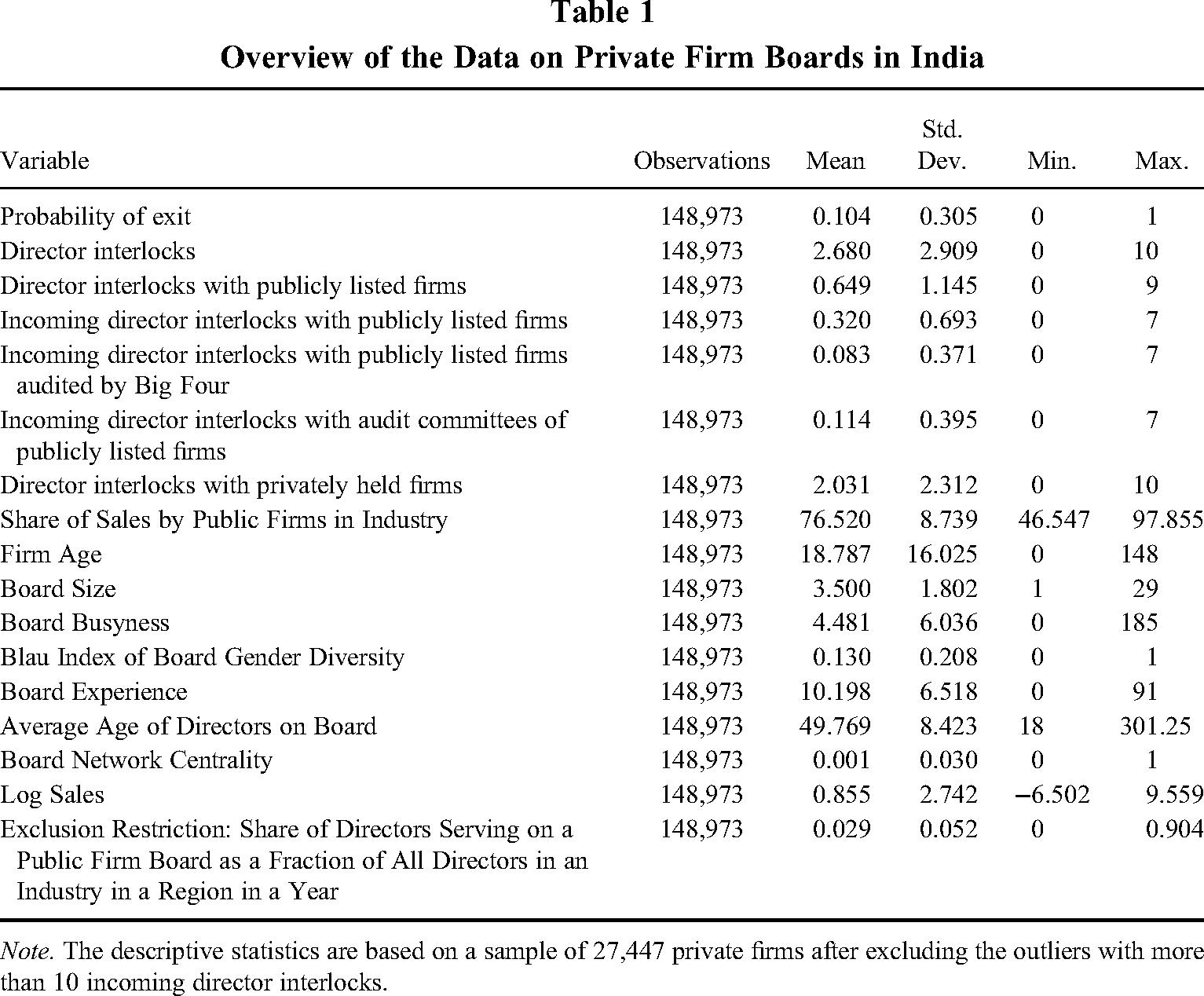
Note. The descriptive statistics are based on a sample of 27,447 private firms after excluding the outliers with more than 10 incoming director interlocks.
Correlation Table
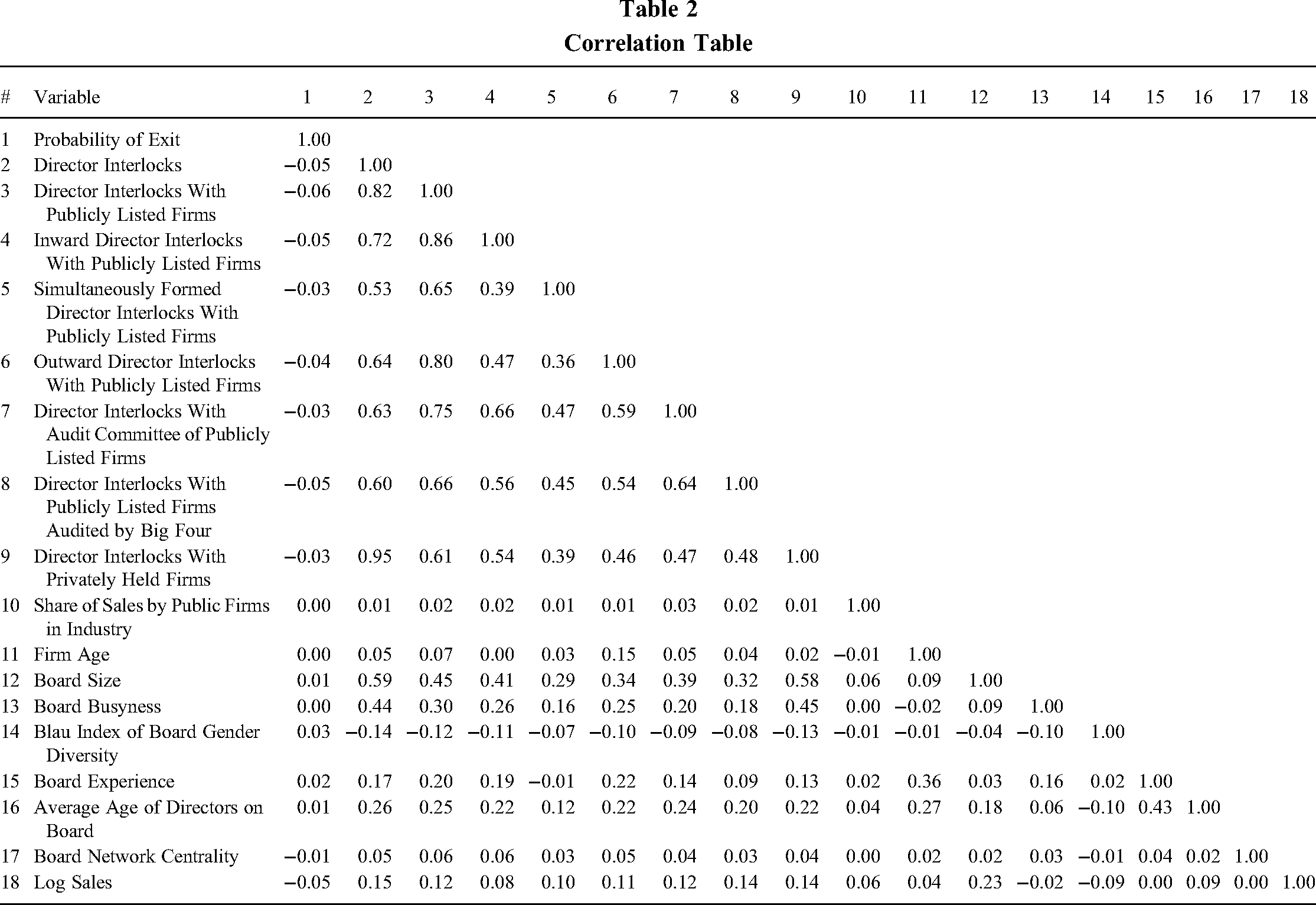
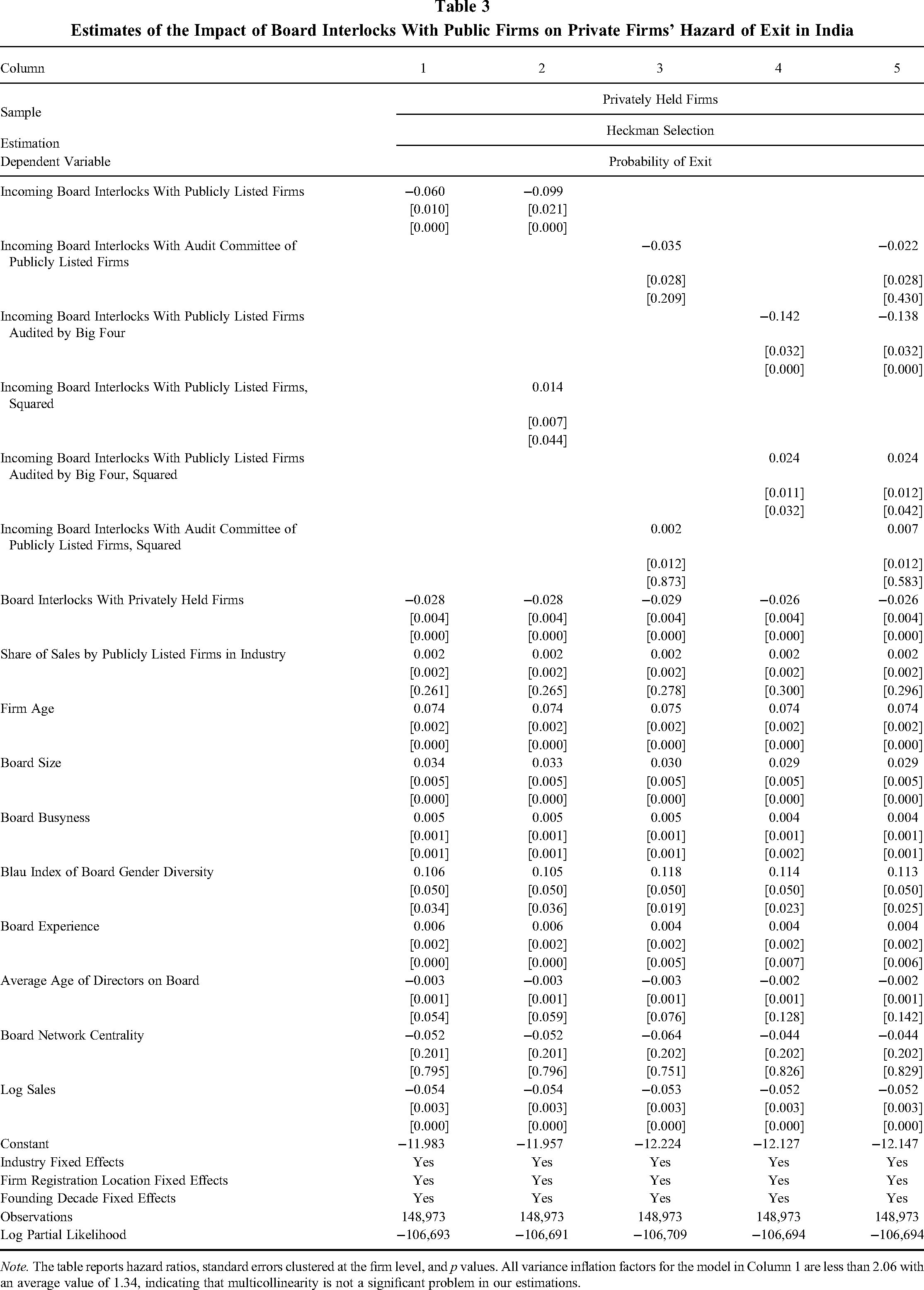
Table 3 reports the results of Cox proportional hazard regression estimates for Equation 1. The coefficient estimate of incoming director interlocks with publicly listed firms in Column 1 is negative (β = –0.060, standard error (SE) = 0.010) and statistically significant (p < .001), indicating that incoming board interlocks lower the hazard of firm exit. Specifically, each additional incoming director interlock leads to an
Estimates of the Impact of Board Interlocks With Public Firms on Private Firms’ Hazard of Exit in India
Note. The table reports hazard ratios, standard errors clustered at the firm level, and p values. All variance inflation factors for the model in Column 1 are less than 2.06 with an average value of 1.34, indicating that multicollinearity is not a significant problem in our estimations.
Hypothesis 1 predicts a U-shaped relationship between incoming director interlocks with public firms and private firm exit. In Column 2, we introduce the quadratic term for incoming director interlocks to examine the U-shaped relationship and found that the coefficient estimate was positive and significant (β = 0.014, SE = 0.007, p = .044), indicating that the marginal effect of each additional director interlock is diminishing. This lends preliminary support to Hypothesis 1. To illustrate the quadratic effects visually, to locate the turning point and the slopes at the lower and upper ends of the data range, we followed the suggestions by Haans and colleagues (2016) and plotted, in Figure 1, the predicted values of firm exit at different values of board interlocks with public firms for Column 3 of Table 3. The turning point of the quadratic relationship is given by
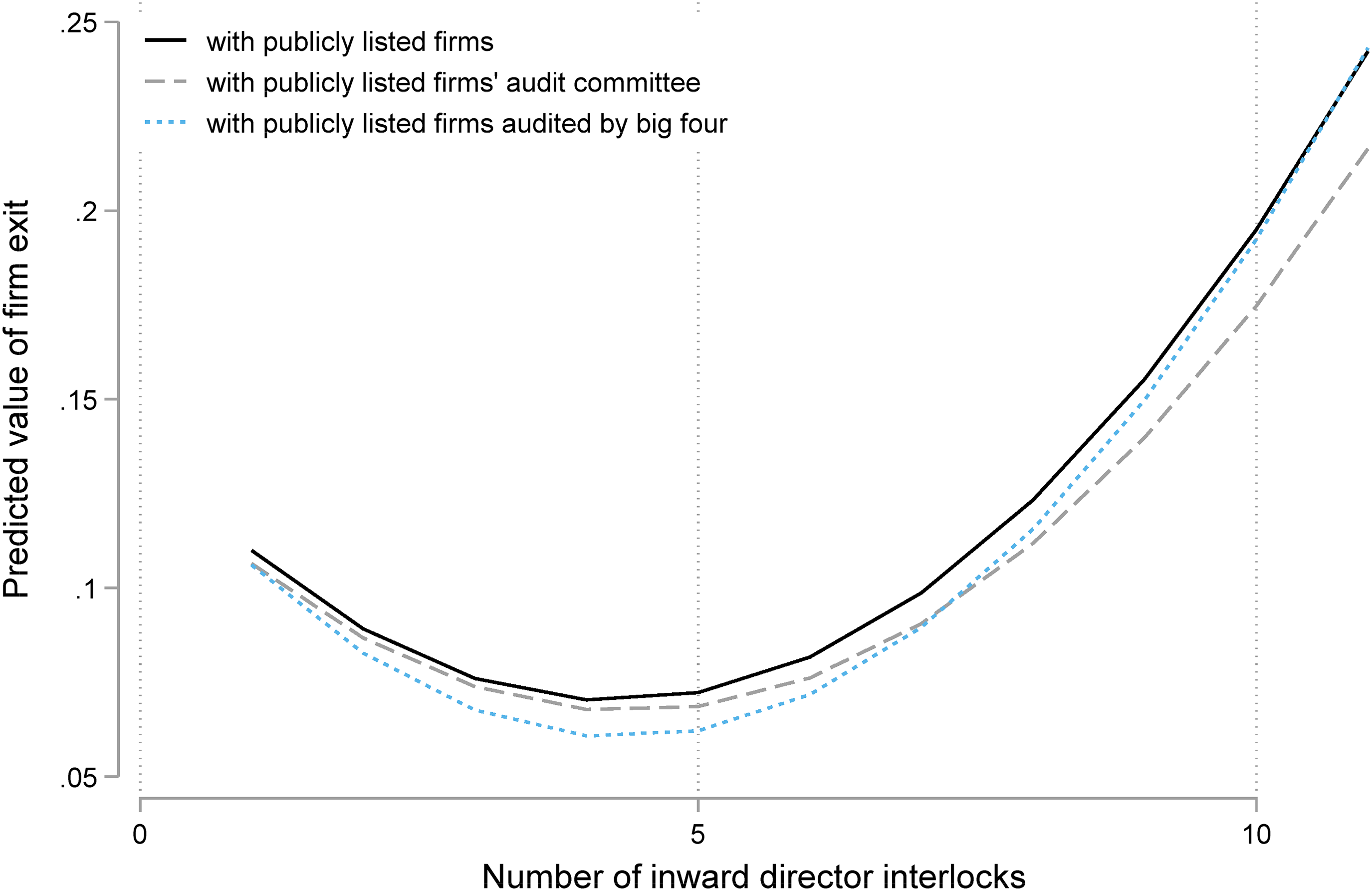
Visual Representation of Quadratic Effects of Board Interlocks With Public Firms on Private Firms' Hazard of Firm Exit
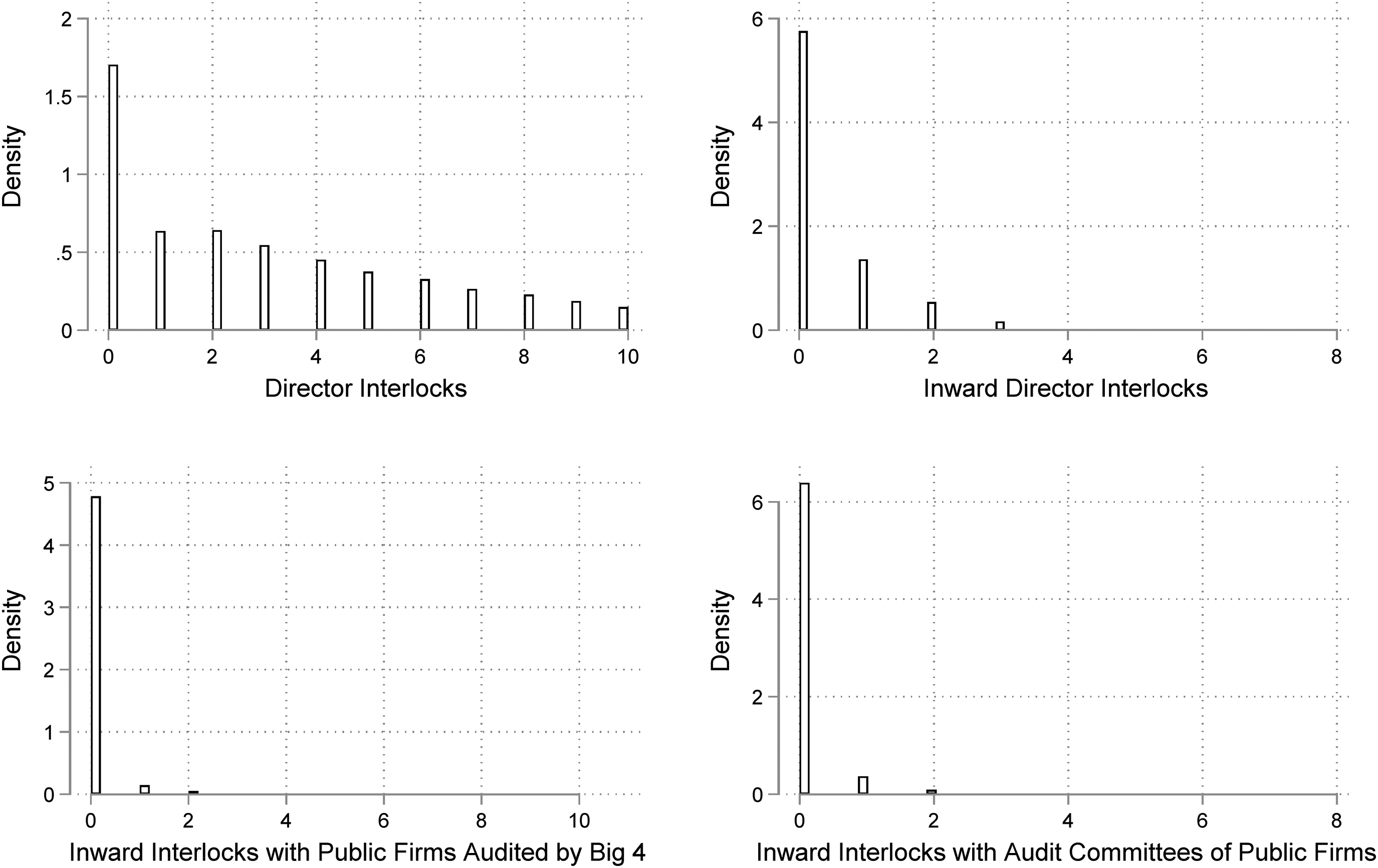
Distributions of Director Interlocks Between Publicly Listed and Privately Held Firms
To examine Hypothesis 2, which states that the U-shaped relationship between the number of incoming director interlocks with public firms and private firm exit is steeper if these interlocks are established by incoming directors who are members of the tied-to public firm's auditing committee (vis-à-vis interlocks with public firms established by incoming directors not serving on the public firm's audit committee), in Column 3 of Table 3 we introduce incoming director interlocks with the audit committee of public firms and its squared term. The coefficient estimate of the linear term for firms tied to audit committees of public firms is negative and insignificant (β = –0.035, SE = 0.028, p = .209) and the quadratic term is positive and insignificant (β = 0.002, SE = 0.012, p = .873). These results are inconsistent with Hypothesis 2.
In Hypothesis 3, we predict that the U-shaped relationship between the number of incoming director interlocks with public firms and private firm exit is steeper if the tied-to public firm is audited by one of the Big Four companies. We test Hypothesis 3 in Column 4 of Table 3. The coefficient estimate of the linear term for firms audited by the Big Four is negative and significant (β = –0.142, SE = 0.032, p < .001) and the quadratic term is positive and significant (β = 0.024, SE = 0.011, p = .032). These results are consistent with Hypothesis 3 and indicate an inflection point of 2.95, which remains within the range of our data. We include both types of incoming interlocks in Column 5 and find continued support for Hypothesis 3 but no support for Hypothesis 2. Overall, the diminishing returns begin to emerge after around 2.95 such interlocks (based on Column 4 of Table 3), which, while still within the range of the data, is significantly large compared to the mean of 0.083 and standard deviation of 0.371, indicating that the negative returns apply in a small number of firm-year observations (548 out of 148,973 observations or 0.3%). These observations correspond to 232 privately held firms among the sample of 27,447 firms (0.8%).
Robustness Tests
While our results provide support for our predicted U-shaped relationship (Hypothesis 1) and moderation of that relationship (Hypothesis 3), our analyses also reveal that the negative returns apply in a small number of firm-year observations. To examine if our results are driven by the inclusion of the squared terms of our incoming board interlock measures, we repeate our analyses with only the main effect of incoming board interlocks. We found that (1) incoming board interlocks with publicly listed firms, (2) board interlocks with an audit committee of publicly listed firms, and (3) board interlocks with publicly listed firms audited by a Big Four firm, have a negative and significant effect on the probability of private firm exit. 10
Moreover, we examined the robustness of our results by incorporating not only incoming director interlocks but also simultaneously formed and outgoing interlocks. The results of this analysis are reported in Columns 1, 2, and 3 of Table 4. The results are similar to those obtained in Table 3 for incoming interlocks, but the coefficient estimate for simultaneously formed interlocks is negative but insignificant (β = –0.025, SE = 0.016, p = .126). The coefficient estimate for outgoing interlocks is negative and significant, but a Wald test (
Estimates of the Impact of Board Interlocks With Public Firms on Private Firms’ Hazard of Exit in India
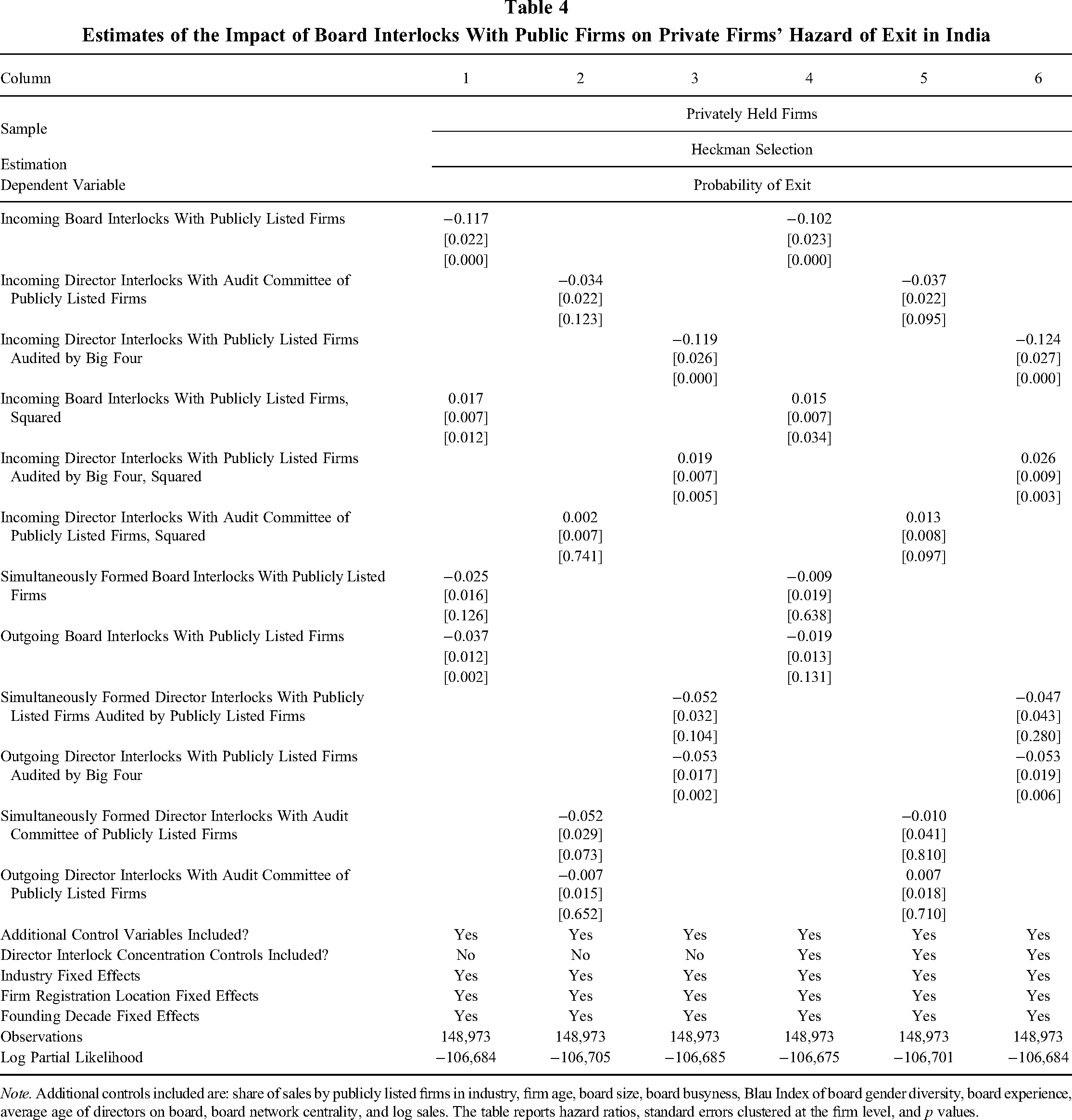
Note. Additional controls included are: share of sales by publicly listed firms in industry, firm age, board size, board busyness, Blau Index of board gender diversity, board experience, average age of directors on board, board network centrality, and log sales. The table reports hazard ratios, standard errors clustered at the firm level, and p values.
We report the robustness of our results using the subsample in which we exclude outliers with board size above the legal limit of 20 in Columns 1 to 5 of Table A3. The results indicate that the relationships we observed in Table 3 are replicated in the full sample, although the inflection points for the U-shaped relationship are closer to 5 and inside the range of the data. The results using the Heckman selection procedure, shown in Columns 6 to 10, also indicate qualitatively similar results as in our main analyses. For completeness, we also report the results using the full sample (without censoring) in Table A4. The results are qualitatively similar, but the inflection points are closer to 10 and outside the range of the data.
An additional concern may relate to the possibility that private firms that perform better may self-select into their legal status. That is, some better-performing private firms may decide not to go public. To address this possibility, we implemented the nearest neighbor matching estimator. Ideally, we would compare the probability of exit of a public firm with a private firm that is identical except in its listing status. Following Asker et al. (2015), we thus adopt a matching strategy to identify pairs of public and private firms that are similar on observables. We match public and private firms on their industry category, location as captured by the state of incorporation in India, and total assets to estimate matched sample regressions. Although these are a small number of matching variables, Asker and colleagues (2015) note that their preferred matching strategy involves matching on size and industry, the two dimensions on which public and private firms differ the most. We used the nearest neighbor matching with replacement to maximize the match rate and quality. Figure A3 shows that public and private firms in our sample had similar firm size distributions after matching. While matching is often employed in the literature comparing public and private firms, a disadvantage of this procedure is that the analysis is typically limited to a subsample of private firms that are comparable to public firms. Nevertheless, finding evidence in favor of our hypotheses in a sample of private firms comparable in size to public firms would lend further support to our results.
The results of the estimation are reported in Table A5. The coefficient estimate of incoming director interlocks with public firms in Column 1 is negative and significant (β = –0.019, SE = 0.002, p < .001), indicating that, on average, such interlocks lower firm exit for both private and public firms. Next, we interacte this variable with a dummy for private firms. The coefficient estimate of the interaction term is negative and significant (β = –0.005, SE = 0.003, p < .052), indicating that, compared to the average effect, board interlocks with public firms further lower the hazard of exit for private firms. These results are consistent with Hypothesis 1, although the effect sizes are smaller because we estimate linear probability models.
Additional Tests for Gaining Insight Into Mechanisms
If, as we argue, some incoming director interlocks join the private firm's board in order to help public firms scout for acquisition opportunities, we would expect incoming interlocks to be more positively correlated with “exit by acquisitions” compared to outgoing interlocks, which are arguably formed for different reasons. We examine these patterns in Table 5 and found results consistent with these expectations. The coefficient estimate of incoming director interlocks in Column 1 of Table 5 is positive and significant (β = 0.234, SE = 0.031, p < .001), indicating a higher probability of acquisition. We further examine the role of incoming director interlocks with audit committees of public firms and with public firms audited by Big Four auditors in Columns 2 and 3, respectively. We find results consistent with our expectations: Incoming director interlocks with audit committees of public firms are positive and significant (β = 0.249, SE = 0.042, p < .001) in Column 2, and public firms audited by Big Four auditors are also positive and significant (β = 0.277, SE = 0.047, p < .001). These results remain robust in the fully saturated model reported in Column 4 of Table 5.
Estimates of the Impact of Board Interlocks With Public Firms on Private Firms’ Probability of Acquisition in India
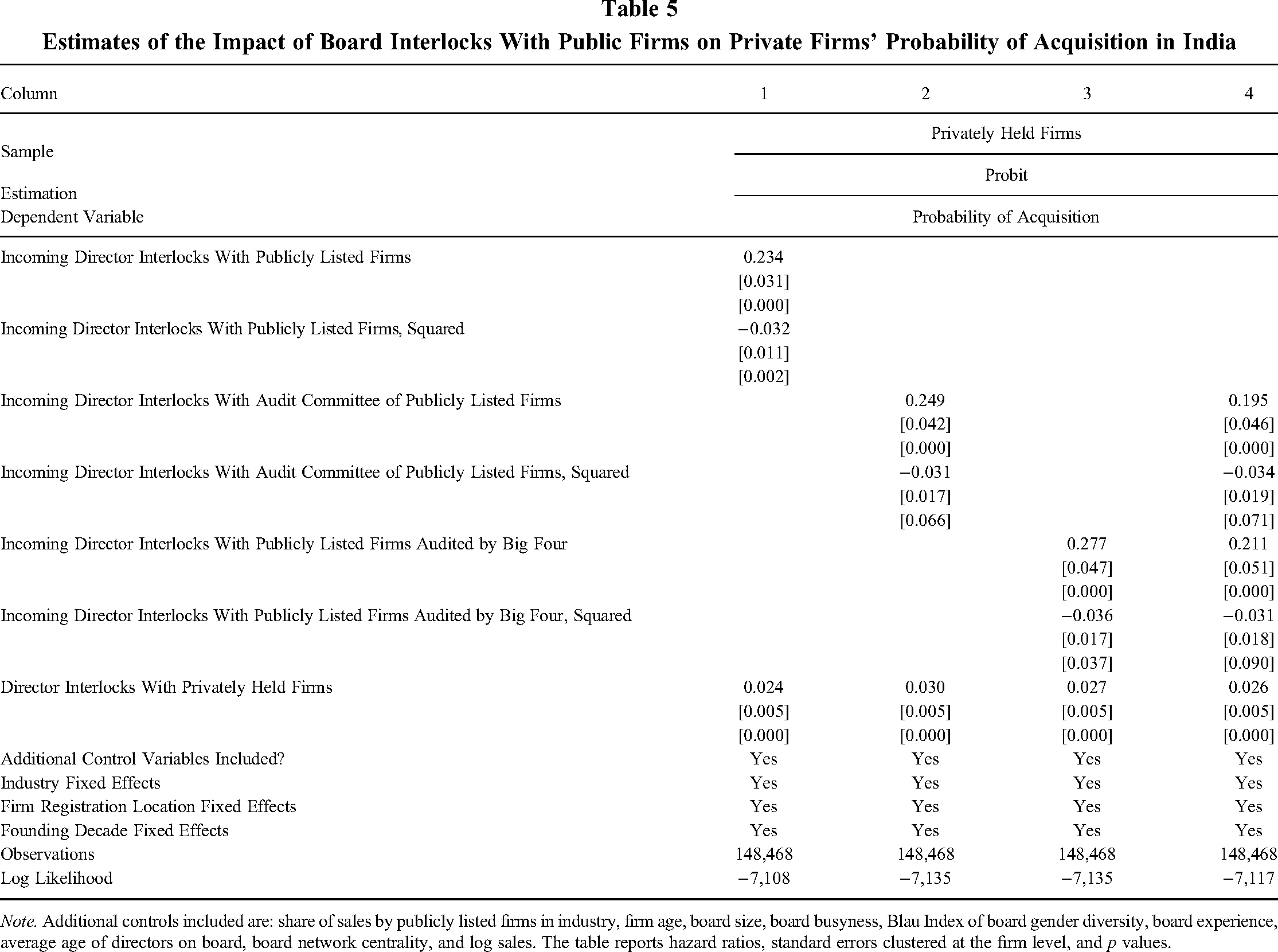
Note. Additional controls included are: share of sales by publicly listed firms in industry, firm age, board size, board busyness, Blau Index of board gender diversity, board experience, average age of directors on board, board network centrality, and log sales. The table reports hazard ratios, standard errors clustered at the firm level, and p values.
Moreover, our logic is based on the reputation-maintenance argument. This argument implies a temporality in monitoring by these incoming directors. Specifically, the reputation-maintenance argument implies that a contemporaneous association with public firms is needed, otherwise the reputational concerns may be less salient to those directors. Hence, we examine whether having directors with prior public board experience has a similar beneficial effect as those benefits due to directors currently serving on public firms’ boards. If our results primarily reflected alternative arguments—such as pure resource-dependence theory reasoning—we would expect that those incoming directors who previously served on public firms’ boards but currently do not would reduce the focal private firm's exit rates. The reason for this is that these directors would still be able to share important knowledge with the focal private firm, and probably still be able to draw on the networks that these directors have established when serving on public firms’ boards in the past (ability). Instead, our theory suggests that an ongoing tie with the public firm is important because it influences the motivation of these directors to utilize their knowledge and engage in greater monitoring. The results of our analysis, reported in Table A6, show that having incoming interlocked directors who previously served on public firms’ boards does not improve the chances of firm survival (β = –0.022, SE = 0.022, p = .316 in Column 1). Similarly, we found that the effect of incoming interlocks on private firm survival disappears once the interlock is broken. 11 This further supports our argument that interlocked directors seek to protect their reputations when joining a private firm's board.
Next, we further examine the robustness of our Cox proportional hazard results by limiting the sample of private firms to those founded during our study period. We do so because the motivations for young ventures and established firms to form director interlocks with public firms can be very different. The results, shown in Table A7, are qualitatively similar but stronger compared to our baseline results reported in Table 3. Specifically, we find support for Hypotheses 1 and 3 in Column 5. Although we controlled for firm age in our main analyses, using additional robustness checks we also examined the moderating role of firm age. These analyses are reported in Table A8. Our main insight from these analyses is that, while incoming interlocks seem to benefit all private firms, outgoing interlocks appear to be more beneficial for older private firms, as indicated by the negative and significant coefficient estimate of “outgoing director interlocks with publicly listed firms × firm age” in Column 3 of Table A8.
In addition, using sales and sales growth as dependent variables, we provided an additional test to rule out the resource-provision logic as an alternative explanation. The results, shown in Table A9, indicate that firms with public interlocks are larger but grow slower, and, as shown before, survive longer. Finally, we report the results for the subsample of public firms in Table A10. These results show that board interlocks with other public firms increase the hazard of exit for the focal public firm, as predicted by agency theory, but private board interlocks do statistically significantly lower the hazard of exit.
Discussion
The objective of this study was to examine the implications of incoming board interlocks with public firms for private firms’ probability of exit. Based on a unique, large-scale dataset of private firms in India, our results suggest that the relationship between incoming interlocks with public firms and private firms’ exit rates is curvilinear. We further found that this relationship is steeper if the tied-to public firm is audited by a Big Four firm. In additional robustness tests, and consistent with the overall premise of our study, we also found that the effect of these board interlocks is temporary (as long as the public firm director simultaneously serves on a public and private firm board) and is negatively related to firm growth. We believe that our findings have important implications for theory and practice.
Most notably, our findings point toward the importance of incoming board interlocks in explaining private firm exit. Most prior studies on private firm governance have focused on board structure or directors’ characteristics (e.g., Daily & Dalton, 1992, 1993; Garg, 2013; Wilson et al., 2013); we deviate from that approach and document the effect of incoming board interlocks on private firm exit. Our results suggest that scholars need to consider the consequences of the ties that a private firm can form through its board when examining private firm exits. We focused on one particular type of interlock, namely incoming interlocks. As such, our results complement a study by Krause and colleagues (2019) by providing suggestive evidence that supports the notion that improved board monitoring can also result from interlocks across organizational fields—in our context, between private and public firms. However, our study takes this research one step further by showing that, from the vantage point of the focal private firm, it is primarily incoming board interlocks that result in improved board monitoring. Given that there are different types of interlocks, future research may further unpack the roles of these interlocks in determining private firm outcomes, including exit.
Importantly, while prior research offers consistent evidence that there could be “too much” monitoring (e.g., Faleye et al., 2011; Guldiken & Darendeli, 2016), this work has focused on public firms. It may be possible that the benefits of incoming director interlocks with public firms continue to dominate potential costs at higher levels of monitoring due to the fact that the marginal benefit of improving monitoring in private firms is greater than in public firms. While our results are clearly documenting the expected benefits of adding public firm directors to the board for private firms, we caution that the results regarding the U-shaped relationship have to be interpreted with this caveat in mind.
Second, our reputation-maintenance arguments, which imply that the monitoring benefits of incoming board interlocks are temporary since they require an active interlock (i.e., the incoming public firm director needs to simultaneously serve on the board of a private and a public firm), may explain the persistence of different governance standards between private and public firms. Specifically, although the governance-related institutional pressures with which firms are confronted significantly differ across public and private firms (Garg, 2013; Garg & Eisenhardt, 2017; Garg & Furr, 2017), traditional models of the diffusion of practices through interlocks would suggest that, over time, differences in governance standards will disappear (or at least become smaller; Krause et al., 2019). Yet, the aforementioned differences in governance standards between private and public firms have persisted over time. Our study provides a possible explanation for this, namely that the monitoring benefits associated with such interlocks are never fully “institutionalized” at the focal private firm. Instead, these directors directly engage in monitoring themselves, rather than transferring governance practices to the private firm. Once the reputational concerns become a secondary consideration (in our study, this would be the case if the interlock was broken), these directors will reduce their monitoring efforts.
Third, our study also has important implications for research examining board interlocks from a microfoundations perspective (e.g., Ang et al., 2018; Spadafora, Giachetti, Kumodzie-Dussey, & Elango, 2023; Yildiz et al., 2023). Much of this literature has assumed that the focal firm can readily tap into the knowledge and experience of the interlocked director. However, as our mechanism checks reveal, in our research context, an active board interlock is necessary for incoming public firm directors to be willing to use their governance knowledge to improve monitoring at the focal private firm. These findings suggest that interlocked directors’ knowledge and experience do not necessarily translate into firm-specific routines and capabilities at the focal private firm, as implied by prior research (e.g., Ang et al., 2018). As such, the findings presented in this study also extend prior work that has suggested that directors’ knowledge and experience (or ability) are a necessary but not sufficient condition for the focal firm to benefit from such ties (e.g., Arora, 2018; Hambrick et al., 2015) by drawing attention to reputation risk as an important determinant of incoming directors’ motivation to use their knowledge and experience to the benefit of the focal private firm.
Lastly, our study contributes to the literature on firm governance in emerging economies characterized by institutional voids. While comparative corporate governance research has pointed out the unique governance challenges faced by firms located in markets with weak institutions and market intermediaries (e.g., Young, Peng, Ahlstrom, Bruton, & Jiang, 2008), it focuses on public firms (e.g., Helmers, Patnam, & Rau, 2017; Singh & Delios, 2017). Extant research has rarely linked board interlocks across organizational fields (private vs. public firms) to firm exit in these contexts. Our results provide evidence for the possibility that interlocks with public firms may allow private firms to overcome some of the challenges associated with operating in emerging economies characterized by institutional voids, which often result in considerable regulatory uncertainty (Benischke & Bhaskarabhatla, 2024; Mallon, Guldiken, Benischke, Dong, & Nguyen, 2022). At the same time, our focus on India also means that the results presented in this study have to be interpreted in light of the institutional context in which Indian private firms are embedded. Specifically, India's economy is characterized by a large number of family-owned firms. Moreover, India follows English common law, meaning that our results can most likely be applied to countries with a similar legal system. Similarly, due to a number of corporate governance reforms that have been introduced with the objective of enhancing transparency, accountability, and fairness in the functioning of listed companies, India's corporate governance landscape has also progressively become more similar to that of more developed countries.
Policy Implications
Although policymakers are increasingly aware of the importance of monitoring in private firms, improving governance standards in private firms through policy interventions has proven difficult. Our study suggests that, in countries characterized by institutional voids, policymakers may be able to exploit a ripple effect that will result in the spillover of board monitoring from public to private firms. As such, policymakers may focus their efforts on further improving and enforcing high governance standards among public firms and, additionally, facilitating ongoing links between public and private firms through interlocks. Our findings suggest that this may improve overall monitoring among private firms without further regulating them.
Limitations and Future Research
As with any empirical study, ours is not free of limitations. First, we focus on a context that allows us to collect large-scale data on board interlocks. In India, private firms are mandated by law to form a board, yet this is a feature that is somewhat unique to our context. While we believe that India serves as an ideal laboratory to test our framework, we encourage others to replicate it in other contexts.
Second, we do not have information on private firm ownership structure, and therefore one limitation that our dataset shares with other studies in the Indian context is that we are unable to directly observe whether a private firm is a member of a business group. In fact, even reports on business groups in India acknowledge that “no comparable comprehensive listing of groups and their companies has been done since the 1960s” (Mazumdar, 2008: 14), and they tend to provide only metadata instead of firm-level data. However, even though we are unable to directly discover private firms’ business group memberships, if an interlocked director were on the board of another public firm within the same business group, it is unlikely that the interlocked director would influence governance practices at the focal private firm. This suggests that our results are more conservative in the sense that we find evidence that these interlocked directors have a material impact, whereas the business group literature suggests that these directors would merely be a symbolic addition to the private firm's board.
Third, we do not have information on the functioning of boards in private firms. For example, we do not know how often these boards meet, whether the directors attend board meetings, whether work is organized in committees, as in public firms, whether minority shareholders are active, and, more generally, the quality of their auditors and engagement by various stakeholders.
Fourth, although we show some heterogeneity in the benefits of incoming and outgoing interlocks between private firms, our main arguments that focus on the general governance benefits of incoming interlocks remain broadly supported in these tests. We believe that heterogeneity across private firms’ interlocks is a fruitful area for future research. Lastly, while we provide a substantial number of tests and analyses that collectively support our proposed arguments and mechanisms, we are unable to directly observe board monitoring by incoming directors. We encourage future research—potentially using different methodologies—to explore whether our proposed mechanisms are indeed the ones that influence private firm survival (exit).
Conclusion
We have provided a novel framework that considers the role of board interlocks in enhancing private firms’ survival prospects. This paper can therefore serve as a platform for scholars interested in understanding the governance of private firms, with a focus on the role of incoming board interlocks with public firms, especially in countries characterized by institutional voids.
Supplemental Material
sj-docx-1-jom-10.1177_01492063231164971 - Supplemental material for The Effect of Incoming Board Interlocks With Public Firms on Private Firms' Survival: Large-Scale Evidence From India
Supplemental material, sj-docx-1-jom-10.1177_01492063231164971 for The Effect of Incoming Board Interlocks With Public Firms on Private Firms' Survival: Large-Scale Evidence From India by Mirko H. Benischke, Ajay Bhaskarabhatla, and Rajani Singh in Journal of Management
Footnotes
Acknowledgements
We thank Action Editor Sali Li and two anonymous reviewers for their excellent and constructive comments throughout the review process. This paper has greatly benefited from comments from Shivaram Devarakonda, Ilaria Orlandi, and Daniel Zyung as well as seminar participants at the Rotterdam School of Management. Any errors remain our own.
Supplemental material for this article is available with the manuscript on the JOM website.
All authors contributed equally and are listed in alphabetical order.

Notes
References
Supplementary Material
Please find the following supplemental material available below.
For Open Access articles published under a Creative Commons License, all supplemental material carries the same license as the article it is associated with.
For non-Open Access articles published, all supplemental material carries a non-exclusive license, and permission requests for re-use of supplemental material or any part of supplemental material shall be sent directly to the copyright owner as specified in the copyright notice associated with the article.
