



Abstract
Gender equity and inclusion has taken center stage in business, science, and policy making. We reflect on three systemic challenges that might hinder the rise of qualified women scholars to leadership positions in business schools: (a) The masculine social structure of business schools, (b) a muddled approach to performance evaluation, and (c) an under-representation of research topics that affect women in the workplace. Drawing on the extant science in gender bias and gender equity combined with the collective expertise and experience of the author team, we offer 12 actionable solutions for gender-inclusive leadership in business schools. We believe that addressing these challenges could benefit all members, not just women, because it could signal more equitable pathways to multiple business school stakeholders and intended beneficiaries, such as students, donors, practitioners, and policy makers.
We write this article at a time when diversity, equity, inclusion, and social justice have taken center stage in government, corporations, and science. Gender bias, in particular, has been well studied and often leads to workplace discrimination and inequality. However, little attention has been paid to the so-called academic glass ceiling, especially in business schools (cf. Treviño, Gomez-Mejia, Balkin, & Mixon, 2018). For example, Kossek and Lee (2021, p. 2) noted, “Although shining a light on societal gender equality gaps is ‘big business for business schools,’ most are rarely the model employers that they exhort other employers to be . . . business schools’ gender inequality gaps (and higher education more generally) receive far less media scrutiny than those in Silicon Valley or STEM workplaces, or in CEO, Board, and C-suite representation.”
Longitudinal demographic data from AACSB International (2005–2021) of business school professors across the world suggests that there is slow yet steady increased representation of women in various faculty ranks and leadership positions (e.g., high-ranked administrative positions; chaired and endowed professorships). Still, women represented only 23.5% of all business school full professors in the most recent AACSB report (2021). Women could face systematic barriers that lead to rising levels of gender inequity on their upward trajectories in business schools (cf., Kossek & Lee, 2021; Treviño et al., 2018). Such patterns raise two fundamental questions: Why the gender discrepancy in business schools? How do we close this leadership gap for women?
We adopt the American Association of University Women's (AAUW) definition of leadership roles as including full professors, named professorships, journal editors, deans, and university presidents. Not seeing enough women in these types of leadership roles could deter the advancement of doctoral students and early/mid-career stage women who cannot see a path forward in a masculine-gendered context. Our call for gender equity aligns with the aspirational values of our professional associations (e.g., Academy of International Business, Academy of Management, Strategic Management Society, Southern Management Association) as well as journals, including the Journal of Management.
This commentary has two goals: first, to spark conversations about meaningful, actionable ideas for change within business schools—not to “level the playing field” but rather to rethink the playing field; second, to dispel the myth that the dearth of women leaders reflects their lesser interest in, or aptitude for, such roles. Instead, we suggest that systemic barriers contribute substantially to the unequal rise of women scholars. To remove these barriers, we discuss three significant challenges along with actionable solutions for decision makers at various levels (e.g., department chairs, review committees, deans; see Table 1). In addition, we created an online supplement with additional resources that is available at https://osf.io/ywta8/?view_only=c2dba2686a9046668168fa5cdf6cada4. This supplement includes a curated, non exhaustive collection of gender equity resources from research on gender biases and collective guidelines from the National Academies of Science, National Institutes of Health, and National Science Foundation in overcoming such biases. This collection is organized by the available scientific evidence related to each section in this commentary.
Summary of Solutions for Gender-Inclusive Leadership in Business Schools
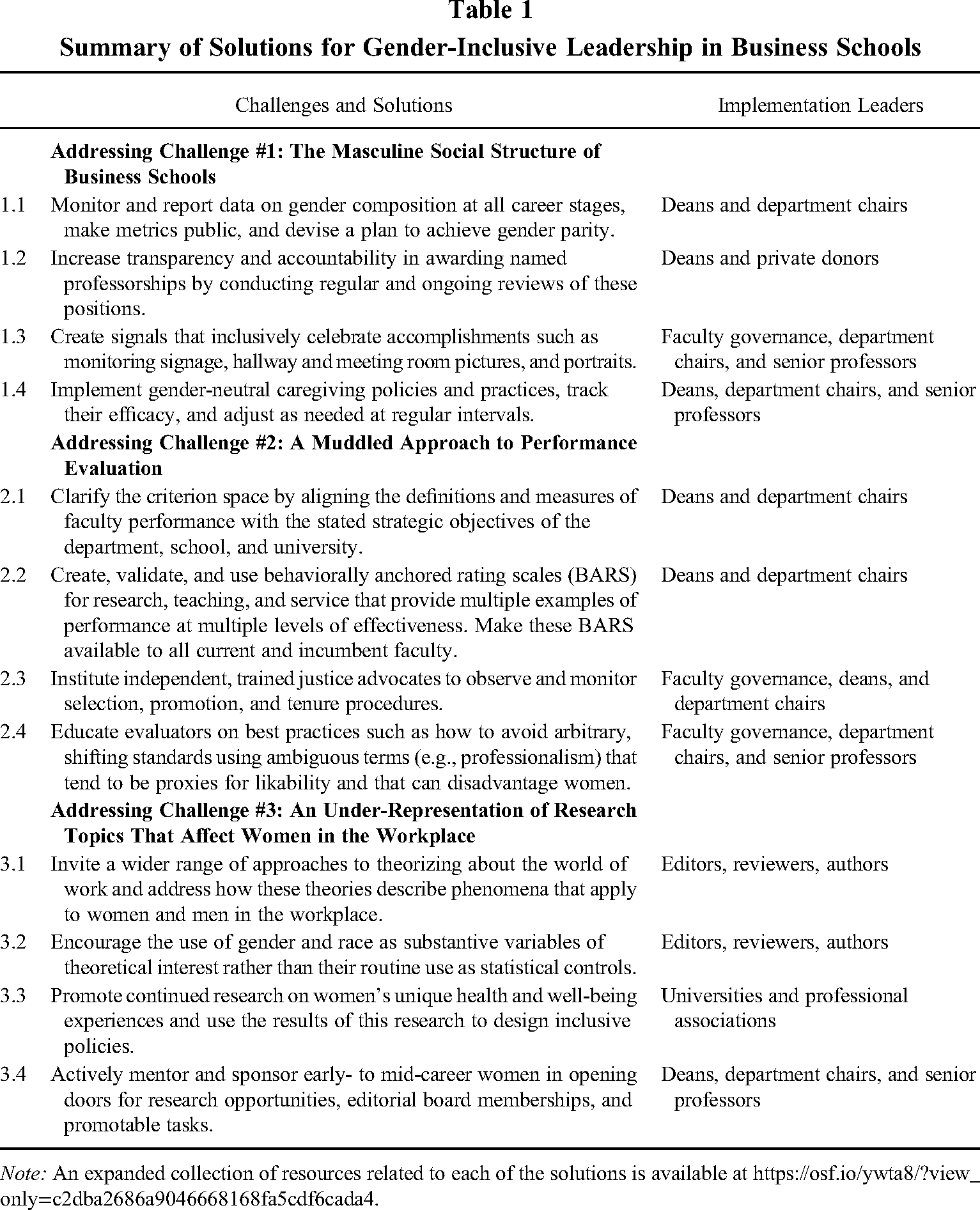
Note: An expanded collection of resources related to each of the solutions is available at https://osf.io/ywta8/?view_only=c2dba2686a9046668168fa5cdf6cada4.
In terms of process, we draw on our collective expertise in leadership, diversity and inclusion, organizational justice, ethics, social responsibility, discrimination, and performance management. Given the vast professional, editorial, and academic leadership experience of the authorship team, the Journal of Management has afforded us extra leeway to share our opinions and describe the state of business school affairs as we see it. We hope that this commentary will influence systemic changes that make systems fairer, more equitable, and beneficial for all.
Challenge #1: The Masculine Social Structure of Business Schools
Like all institutional cultures, business school cultures are socially constructed—with said construction largely driven by those in power. Given that business schools originated from a trade-school model, their social structures are inherently masculine. As a result, the power and influence in business schools tends to be concentrated in a select few individuals, which leads to underrepresentation and tokenism of women at elite performance levels (see Challenge #2 below), amplifies intersectional tokenism (e.g., being a token woman of color), and may exacerbate caregiving challenges.
The gendered, masculine organizational structure of many business school environments is reflected in numerous ways. For instance, chaired professorships are dominated by men (Treviño et al., 2018), and women are greatly underrepresented at star-player performance levels (i.e., higher levels of productivity; Aguinis, Ji, & Joo, 2018). When women do rise to leadership positions, they are highly visible and are often tokenized in largely male-dominated committees and masculine subcultures within departments. Regardless of women's structural power within their institutions, tokenism can lead to isolation of and retaliation against them, particularly when women advocate on behalf of others or raise moral objections (e.g., diversity, equity, and inclusion concerns; work-life imbalance concerns). Finally, when women leaders embody the same behaviors used by successful men leaders, they are often labeled with adjectives (e.g., bossy, aggressive, difficult, tough, direct) that directly contradict proscriptive feminine stereotypes (i.e., what women ought to do). These gender-role violations can lead to formal and informal social sanctions.
Such negative reactions to women in business schools may be especially pronounced for high-potential junior women who are hired, trained, and mentored in early- to mid-career stages but who, later, are punished for defying gender role prototypes as they rise into predominantly masculine spaces. This phenomenon, known as the pet to threat phenomenon, is particularly pronounced for women of color, arguably because of stronger negative stereotypes that occur due to intersecting marginalized race and gender identities and lower representation in leadership positions (Thomas, Johnson-Bailey, Phelps, Tran, & Johnson, 2013). Although it can be tempting to point out women deans or full professors (particularly those of color) as evidence of progress in business schools, this ignores the precariousness of being tokens in such positions. Women in these positions often must tread carefully lest they attract too much attention that may create additional bias for engaging in agentic behaviors that are stereotypically seen as masculine.
Masculine business school cultures can also have a chilling effect on women's childbearing decisions and work-family experiences. Gabriel et al. (2023) comprehensively addressed early caregiving challenges, and these challenges often persist throughout women's careers. During early- and mid-stage careers, childbirth and caring for young children disproportionately impact women. For late-stage careers, women disproportionately provide caregiving for elderly family members. Greater time investments in caregiving subsequently reduce the time and resources women have for research and publishing.
Solutions
1.1 Monitor and report data on gender composition at all career stages
Track gender parity, beginning at the recruitment and selection stages and continuing throughout the promotion ladder. Additionally, make metrics public (e.g., through the college website) and devise a plan to achieve gender parity across leadership levels within a specific timeframe (e.g., the percentage of chaired women professors matches the total percentage of business school women faculty).
1.2 Increase transparency in the awarding of chaired professorships
Review and renew professorships at regular intervals (e.g., every 6 years) to promote accountability for sustained performance against relevant targets. Intentionally seek to increase inclusion of women of color faculty in positions of power and other highly valued positions, such as chaired professorships.
1.3 Create signals that inclusively celebrate accomplishments
These signals can be physical and/or psychological. For example, within buildings, monitor the diversity of hallway pictures and portraits to ensure that they are not dominated by men's accomplishments. To combat the masculine ethos, overrepresent women's research in electronic signage and monitors, newsletters, and websites.
1.4 Implement gender-neutral caregiving practices
Practices may include providing sick childcare financial support, flexible course scheduling, reduced service obligations, family-welcome work events, and foster-care support and resources, in addition to support services such as lactation rooms and parental tenure extension policies (see Gabriel et al., 2023, for an in-depth discussion of options). Be mindful, however, that gender-neutral tenure extension policies can unintentionally exacerbate productivity gaps. Thus, it is important to track the efficacy of such policies as they relate to increasing gender parity.
Challenge #2: A Muddled Approach to Performance Evaluation
A second challenge to gender equity in business school leadership is how performance is evaluated. Some business school performance evaluation practices are muddled due to inconsistencies in what is considered successful performance; dated perspectives on what is considered high impact; and, in some situations, closed-door, nontransparent practices for evaluating performance. We consider the evaluation of research, teaching, and service through this lens.
Research
Whereas research performance is largely evaluated as the number of publications in a select set of journals, there is no consensus across (and at times within) institutions on what constitutes a top-tier journal as a basis of evaluation. Many business schools have a journal list that defines how they perceive journal quality at a certain point in time. However, these lists are sometimes used inconsistently (e.g., they may be used differently to evaluate annual performance versus promotion and tenure), and such lists do not always reflect journals that have high impact in the field or in high-impact specialty areas of the field. Transparency also varies across institutions, and lists may change as faculty work toward tenure and promotion. Unclear and shifting standards combined with dated journal lists in evaluating research productivity can serve the status quo because they create room for subjective judgment calls that are more open to biases and create complex challenges in evaluating research productivity fairly (e.g., Aguinis, Cummings, Ramani, & Cummings, 2020), a reality that may disproportionately affect the career outcomes of women and those from other historically underrepresented demographic subgroups. Indeed, research has shown that relative to men, women faculty who meet performance standards tend to experience less favorable promotion outcomes (e.g., receiving tenure, promotion to full professor, chaired professor appointments; cf. Treviño et al., 2018).
Teaching
Likewise, teaching performance is often evaluated in narrow and unreliable ways. Typically, a central focus is placed on student evaluations of teaching, which have been shown to be heavily biased against women (Hall, Schmader, Aday, & Croft, 2019). Specifically, women instructors can be penalized in course evaluations for proscriptive norms (Hall et al., 2019). In addition, students often expect women professors (and mentors) to nurture, care, and manage emotions in ways that are not expected of men professors. These gender penalties may be compounded for women whose identities (e.g., women of color) are even more distant from that of the prototypical business school professor (i.e., white men). Further, the extent to which teaching influences overall performance evaluations often varies from instructor to instructor within colleges, which may allow gender biases to be exacerbated for female instructors who receive less than stellar student evaluations compared to male instructors who receive similar evaluations.
Service
When it comes to evaluating service, lack of clarity about definitions and measurement may disadvantage women more than men. Women are expected to engage in more communal, helping behaviors than men and receive more requests for help than do men (e.g., Babcock, Recalde, Vesterlund, & Weingart, 2017). However, women are rewarded less than men for helping behaviors, and they may face negative repercussions when they do not help. In business schools, such communal work includes engaging in nonpromotable tasks (e.g., higher service load; Babcock et al., 2017), mentorship, and advocacy. In the absence of clear standards of service performance, women may also be judged on arbitrary and unrelated criteria, such as professionalism and collegiality, which are often not defined or standardized as clear performance criteria. In fact, the American Association of University Professors states that given the subjectivity inherent in assessing professionalism and collegiality, these are not valid measures of performance unless documented in annual performance reviews. Women of color may face unique challenges with such arbitrary and nonstandardized criteria, as they are often stereotyped in ways that go against idealized standards of professionalism and collegiality. For instance, Black women are stereotyped as angry, aggressive, and overly assertive whereas Asian women are stereotyped as submissive and less assertive. Such stereotypes may be more likely to be activated and used when nonstandardized (rather than standardized) criteria are used in evaluation processes.
Women faculty of color often face other forms of bias such as devaluing of their scholarship and additional service burdens in which they are expected to assist others of the same race, a phenomenon known as cultural taxation. This can be an intense responsibility given that women of color faculty are often the only racial minority in their department and, in some cases, among the few in the entire business school. Tokenism can lead to increased invisible labor in the form of serving as the diversity representative on service committees, and it can also create high visibility, which is positively related to increased performance pressure and scrutiny. Paradoxically, many women faculty of color can therefore feel both overexposed and invisible (Smith, Watkins, Ladge, & Carlton, 2019). Such experiences can make it more difficult for these faculty members to thrive at their institutions.
Solutions
2.1–2.4 Clarify the criterion space
For research, teaching, and service, clearly define criteria and allow multiple pathways for showing impact. Incorporate multiple indicators that are directly related to the strategic direction and goals of the department, school, and university. For example, if a goal is to engage MBAs, build community engagement, create societal impact, and/or mentor graduate students, then measurements of performance could align with such goals.
Use behaviorally anchored rating scales
Create behaviorally anchored rating scales (BARS) for research, teaching, and service that provide multiple examples of performance at multiple levels of effectiveness. Create and validate these tools following psychometric principles. Make these BARS fully transparent and available to all current and new faculty.
Institute independent third-party observers
Appoint independent, trained justice advocates to observe and monitor selection, promotion, and tenure procedures, which are often closed-door and may be disproportionately composed of majority group members. Justice advocates are individuals whose primary role on committees is to ensure that fair and equitable practices are followed and that bias is confronted and counteracted throughout the process.
Educate evaluators on best practices
Implement training programs for search, annual review, and promotion/tenure/renewal committees per the recommendations made in the National Academies report titled “Promising Practices for Addressing the Underrepresentation of Women in Science, Engineering, and Medicine.” These recommendations include (among many others) the avoidance of arbitrary, undefined standards such as professionalism, which tend to be proxies for likability and may disadvantage women.
Challenge #3: An Under-Representation of Research Topics That Affect Women in the Workplace
We call for research that moves us toward a more gender-inclusive science with equitable content, such as those suggested by the American Psychological Association (2023). As scholars, consumers, and reviewers of research, and as decision makers (i.e., associate editors and editors), we could pause and reflect on whether the study designs we use and the knowledge we create advance scientific knowledge for as many stakeholders and beneficiaries as possible.
Research topics that affect women in general, and women of color in particular, may be viewed as being less rigorous or scientific (King, Avery, Hebl, & Cortina, 2018). Exemplar topics include pregnancy discrimination, women's health and well-being (e.g., menstruation, maternity, and menopause), sexual harassment, and work–family–life issues. Further, there is a broad range of unique experiences, challenges, and leadership needs based on women's intersecting identities, such as race, religion, sexual orientation, age, and class. Although many funding agencies and journals are prioritizing research in these areas, there is evidence of subtle biases in the treatment of such works by reviewers (King et al., 2018).
In addition, research in well-established content domains could be reexamined with a more gender-inclusive lens. For example, many ideas in leadership science date back to the conclusion of the two world wars when (white) men dominated leadership positions. Although gender is extensively included as a moderator or statistical control in current leadership studies and analyses, current conceptualizations of leadership are skewed toward extraordinary power and influence. There is a growing corpus of research on women in leadership; however, our understanding of, and perhaps more importantly practical realization of, leadership and other management topics is still heavily gendered and male dominated.
Another example of research that could benefit from a gender-inclusive lens is the conceptualization of what constitutes justice and injustice in organizations. Decades of organizational justice research has been pivotal in crafting our understanding of the wide impact of employees’ perceptions of workplace fairness, the foci of fairness perceptions, and the stakeholders held responsible for acts of injustice (cf. Rupp, Shapiro, Folger, Skarlicki, & Shao, 2017). Yet by and large, this vast literature has paid scant attention to historically marginalized and/or underrepresented demographic subgroups. It is not uncommon for empirical research in this area to control for race and gender within statistical analyses, meaning that any fairness-related phenomena that may be tied to this sort of group membership is masked (Rupp et al., 2017). This has led to a call for solution-based organizational justice research that focuses on the differential work experiences of women and persons of color in addition to disabled workers, LGBTQ+ employees, and members of other historically marginalized demographic subgroups (cf., Avery, Hall, Preston, Ruggs, & Washington, 2023). Examples of such research include the development and validation of new job analysis and job evaluation methods that allow for the detection of differences in how work is perceived, distributed, and rewarded within and between positions (Strah & Rupp, 2022).
Solutions
3.1–3.4 Invite a wider range of approaches to theorizing
This can include editors encouraging theorizing and empirical research that draws on scholars’ sensitivity and reflexivity when engaging in theory building and testing as scholarly conversations. Editors could also encourage scholars to consider the broader implications of their work with respect to gender inclusion.
Encourage the use of gender and race as substantive variables of theoretical interest
Often, demographic variables are entered into models as statistical controls without much consideration in text for the relevance or inclusion of these identities to how people experience their workplaces (Bernerth & Aguinis, 2016). Scholars and editors could consider how, when, and why identity might meaningfully shape processes and experiences more intentionally instead of partialing out their effects as “noise.”
Promote application of research on women's unique health and well-being experiences
Decision makers in business schools can use research to inform evidence-based, gender-inclusive practices to implement solutions regarding Challenges #1 and #2 as described earlier.
Actively mentor and sponsor early- to mid-career women
Senior scholars might include early- to mid-career women in their research collaborations, editorial board recommendations, and faculty recruitment efforts.
Conclusion
Women are underrepresented in research and academic leadership ranks in business schools. We outlined three systemic structural factors that might hinder gender-inclusive leadership and, importantly, provided actionable solutions to reducing these systemic barriers. We acknowledge that our article, and the pursuit of equity in general, may cause some discomfort and uncomfortable emotions (e.g., anxiety, fear, anger, defensiveness). However, the pursuit of equity is not about staying in our comfort zones. This temporary discomfort could eventually birth new ways of seeing and doing. To quote the legendary Beatle, John Lennon, “you may say I'm a dreamer but I'm not the only one.” A gender-inclusive business school environment might seem utopian, but it ultimately benefits everyone, not only the qualified women. As such, we are stronger together in business schools when we include women in leadership across the field.
Footnotes
Acknowledgements
We are grateful to the numerous colleagues and students who shared experiences and scientific research related to this article and ultimately inspired us to write it. We are also grateful to the Southern Management Association's Annual Meetings sessions (2021, 2022) on Allyship in Science. We acknowledge Jessie Cannon, George Mason University, and Andrew McBride, University of North Carolina, Charlotte, for feedback and comments on earlier drafts.
