



Abstract
“Exceptions” refers to data obtained from a nontraditional context and/or data that emerge during data analysis that substantially deviate from other data present within a study. Both qualitative and quantitative research acknowledge exceptions; however, approaches for handling and discussing exceptions vary across these two perspectives and are rarely integrated. We provide a two-decade review of exception usages across 930 empirical articles in six leading management journals. Through our review, we identify two types of exceptions: planned and emergent. “Planned exceptions” describes unique data or phenomenon used to motivate a study design. “Emergent exceptions” describes nonconforming data that arise during data analysis. We review on-diagonal and off-diagonal patterns in exception uses across qualitative and quantitative research, pointing to varied ways that exceptions are used to further management theory. Based on insights gleaned from our review, we provide suggestions for researchers in handling exceptions across different phases of the research process: study design, data analysis, and findings presentation.
Over the past several decades, scholars have sought to bridge the divide between qualitative and quantitative organizational research (Lincoln & Guba, 1985; Miles & Huberman, 1994; Pratt, 2008) through fruitful scholarly dialogue (Aguinis & Solarino, 2019; Gioia, Corley, & Hamilton, 2012; Shah & Corley, 2006). Yet, much work remains to be done, including opportunities to share methodological insights across these two perspectives to advance theory, such as through the topic of this article: the concept of exceptions. By “exceptions,” we refer to data obtained from a nontraditional context and/or data that emerge during data analysis that substantially deviate from other data present within a study (Eisenhardt, 1989; Gibbert, Nair, Weiss, & Hoegl, 2021; Hällgren, Rouleau, & de Rond, 2018; Lincoln & Guba, 1985). To date, methodological discussion of exceptions has tended to occur in silos, with little conversation between qualitative and quantitative research domains.
An integrative review of exceptions holds promise not only to enhance the dialogue between qualitative and quantitative research but also to foster greater attention toward the value of exceptions for furthering theory within the organizational sciences. Both scholars and practitioners have long urged greater attention toward exceptions as a way to gain theoretical and practical insights (Bailyn, 1977; Daft & Lewin, 1990; Gore, 2022). For example, the Institute for Outlier Research in Business at the University of Southern California (https://www.marshall.usc.edu/institutes-and-centers/institute-for-outlier-research-in-business) pays special attention to phenomena that deviate from the status quo and their implications for organizations. Further, unicorn ventures, which refers to start-ups valued at over $1 billion, are often spotlighted for their extreme success compared with other start-ups (Kotha, Shin, & Fisher, 2022), much like “stars” or exceptionally high performers within organizations (Call, Nyberg, & Thatcher, 2015). Scholarly attention toward exceptions spotlights extreme phenomena or deviant data points (Aldrich & Ruef, 2018; Kuckertz, Scheu, & Davidsson, 2023); given this, scholars are challenged to balance potential generalizability concerns against the notion that exceptions can promote novel ideas that push management theory forward (Starbuck & Nystrom, 1981). As George, Haas, and Pentland (2014: 323) pointedly state,
In many situations, averages are very important, and often revealing about how people tend to behave under particular conditions. But, in the vastness of a big data universe, the outliers can be even more interesting: critical innovations, trends, disruptions, or revolutions may well be happening outside the average tendencies.
This article provides a comprehensive review of exceptions and their uses that is inclusive to both qualitative and quantitative organizational research. We use the term “qualitative research” to indicate an exploratory approach that primarily relies upon textual data and takes an interpretive stance focused on theory generation. The term “quantitative research” refers to a confirmatory approach that primarily uses numeric data to test theory via a positivistic or post-positivistic stance. In general, whereas qualitative research aims to explore novel patterns, quantitative research strives to confirm a preconceived conceptual model. We recognize that these labels are simplistic and that nuances to these classifications exist. For instance, qualitative text analysis involves transforming textual data to gather numerical insights and may encompass a positivistic research paradigm (e.g., Audia, Rousseau, & Stimmler, 2023). Exploratory research on numeric data may be used in an interpretive fashion (Walsh, Holton, Bailyn, Fernandez, Levina, & Glaser, 2015). Some analytical approaches, such as qualitative comparative analysis (QCA), may also inherently bridge qualitative and quantitative domains (Ragin, 2008). We use these broad terms—“qualitative” and “quantitative”—as placeholders to represent general differences in ontological, epistemological, and methodological perspectives (Bailyn, 1977; Pratt, 2008; Walsh et al., 2015), to align with management journals’ existing tendencies of classifying empirical research within these two camps (Gephart, 2004; Hansen, Elias, Stevenson, Smith, Alexander, & Barros, 2023; Plowman & Smith, 2011), and to provide a basis for synthesizing articles included in our review.
Through a review of 930 empirical articles that noted 964 exceptions across two decades, we identify two primary types of exceptions: planned and emergent. 1 “Planned exceptions” describes a unique context or phenomenon used to motivate a study design. “Emergent exceptions” describes nonconforming data that arise during data analysis. Although we find evidence of both types of exceptions in qualitative and quantitative research, planned exceptions more commonly appeared in qualitative research, whereas emergent exceptions were more common in quantitative research. With these primary “on-diagonal” patterns in mind, we further analyze 57 “exceptions” to these classifications among articles included in our review (“off-diagonal” patterns)—that is, emergent exceptions in qualitative research and planned exceptions in quantitative research. Based on insights gleaned from our review, we codify suggestions for scholars when discussing exceptions within study design (planned exceptions) and data analysis (emergent exceptions) and when presenting findings from planned and emergent exceptions.
Our review makes several contributions. First, we provide a comprehensive understanding of how exceptions have been used within qualitative and quantitative research, including frequencies of exception keywords and overarching trends and patterns in exception usage. Second, classification of exceptions in terms of their origin and utility—planned and emergent—clarifies existing exception terminology that suffers from oftentimes imprecise and inconsistent applications. Our classification provides a practical framework for synthesizing exception research. Third, we provide considerations for future researchers in navigating exceptions within different phases of their research (study design, data analysis, findings presentation). In doing so, we offer methodological innovations and opportunities for greater theoretical attention to exceptions.
Theory and the Role of Exceptions in Theory
What Is Theory?
Clearly defining what constitutes theory is challenging; as such, we lean on several accepted definitions for guidance. Bacharach (1989: 496) defined theory as a “statement of relations among concepts with a set of boundary assumptions and constraints.” In this regard, theory explains how phenomena relate to one another (Sutton & Staw, 1995). “Good” theories emphasize causal relationships and are coherent, parsimonious, and testable (Fiske, 2004). The “process of theorizing,” or engaging in “activities like abstracting, generalizing, relating, selecting, explaining, synthesizing, and idealizing,” is crucial for furthering theory and extending science (Weick, 1995: 389). Evidence of a manuscript’s theoretical contributions is necessary for improving publication likelihood and impact (Colquitt & Zapata-Phelan, 2007; Whetten, 1989). As we will discuss next, exceptions play a crucial role in furthering theory.
Role of Exceptions in Furthering Theory
Exceptions expose the limitations of existing theory and highlight the need for new theory (Crawford, 2012; O’Boyle & Aguinis, 2012). In this vein, rather than serve as a nuisance, exceptions can help researchers convey the theoretical contributions of their research. However, qualitative and quantitative scholars tend to view and handle exceptions differently when establishing the theoretical contributions of their research. These differences in how exceptions are handled have resulted in a methodological divide in how exceptions are discussed in management research.
At its most basic, qualitative and quantitative research differ in their ontological, epistemological, and methodological orientations (Morgan & Smircich, 1980). Qualitative research largely rests on the assumption that reality is constructed by organizational members with an epistemological stance to understand patterns related to how reality is constructed (Cunliffe, 2011). Qualitative research tends to focus on the analysis of textual data (Walsh et al., 2015) and treats exceptions as necessary for theory building (Charmaz, 2000; Miles & Huberman, 1994). Unique or extreme contexts, such as firefighters (Pratt, Lepisto, & Dane, 2019) or sex workers (Toubiana & Ruebottom, 2022), breathe life into a phenomenon of interest and can be used to vividly display cases and underlying dynamics (Eisenhardt, 1989; Sharma, Toubiana, Lashley, Massa, Rogers, & Ruebottom, 2023). A description of the study context and how it fits with theory is often a core aspect of a qualitative paper (Pratt, 2015). Further, the constant comparison tenet within grounded theory research (i.e., continuous comparison of new data against existing data; Glaser & Strauss, 1967) relies upon exceptions when formulating new categories and crafting the resulting theoretical model. When exceptions arise, interrogation of them can result in the creation of boundary conditions, new variables, or even the reorientation of an emerging theoretical model (Charmaz, 2000; Kaplan, 2022).
In contrast, quantitative research is largely built on the assumption that reality can be observed and measured using a positivistic or post-positivistic epistemology (Gephart, 2004). Within quantitative research, exceptions are often viewed cautiously and are frequently discussed when testing theory. Quantitative analytical procedures tend to focus on identifying fitted trend lines using numeric data, relying on normal data distributions to expose central tendencies (Cohen, Cohen, West, & Aiken, 2003). As such, skewed data and/or deviant data points are often treated as a limitation of the study and nuisance to be explained. Quantitative scholars are urged to discuss steps they took to check for exceptions and to be transparent in how they managed their data (e.g., Aguinis, Gottfredson, & Joo, 2013; Aguinis, Ramani, & Alabduljader, 2018). Nonconforming data are rarely embraced as an opportunity for additional insight in quantitative research (Bradley & Aguinis, 2023). Further, although extreme contexts can reveal specific insights within quantitative research (e.g., military teams; Avolio, Keng-Highberger, Lord, Hannah, Schaubroeck, & Kozlowski, 2022), researchers may struggle to translate their findings outside of that context amid external validity pressures (Hällgren et al., 2018).
Thus, qualitative and quantitative research tend to differ in their type of data and analytical approach (Walsh et al., 2015). Broadly, qualitative research can be described as exploratory research based on textual data, whereas quantitative research can be referred to as confirmatory research based on numeric data. Of course, different methodologies exist within these broad classifications, and there are some nuances to these tendencies (Allwood, 2012; Walsh et al., 2015). However, these generalized distinctions present an opportunity for both camps to share cross-learnings and further usage of exceptions for theory.
Review Methodology
Scope of Review
Despite widespread discussion and debate over exceptions, there is no review to date that comprehensively organizes the usage of exceptions within organizational research. Published reviews and editorials on exceptions exist (Aguinis et al., 2013; Bamberger & Pratt, 2010; Beamish & Hasse, 2022; Gibbert et al., 2021; Hällgren et al., 2018), but contain different foci and scope than that offered by our review. Our review is unique in its inclusion of varied methodological orientations, exception uses, and effort to cross-fertilize insights between qualitative and quantitative research.
To organize and synthesize organizational research incorporating exceptions, we first sought out an inclusive and large set of articles to build the foundation for our review. We intentionally use a broad set of articles to balance representativeness for pattern identification and give voice to unique applications of exception usages that otherwise likely would have been missed by a random sampling of articles. We began by identifying key terms that researchers commonly use to identify exceptions and incorporated them into our search terms: outlier OR outliers, negative case OR negative cases, deviant case OR deviant cases, counterfactual case OR counterfactual cases, extreme case OR extreme cases, and extreme context OR extreme contexts. A Google Scholar search using these search terms returned 2.6 million results, illustrating the frequency with which these terms are deployed. We therefore constrained our review of exceptions to empirical research in six leading management journals (Academy of Management Journal, Administrative Science Quarterly, Journal of Applied Psychology, Journal of Management, Organization Science, and Strategic Management Journal). We focused our search on published and in-press articles between 2001 and 2022 to align with the onset of increased qualitative research during this period (Smith, Madden, & Plowman, 2014) and gain a two-decade view into usage of exceptions.
We reviewed each article to determine if it was empirical in nature; we removed from further consideration any article that was an editorial, a review, or a methods or conceptual piece. We also removed articles that discussed exceptions in passing or not in reference to the study context or data, such as those referencing other articles harnessing exceptions, drawing upon exceptions in the literature to motivate a hypothesis, and/or discussing exceptions exclusively within the Discussion section. These efforts resulted in the final set of 930 articles for our review.
Coding Approach
We collected the following information from each article: (a) article citation details, (b) perspective (i.e., qualitative, quantitative), (c) keyword found in the article (e.g., extreme context, outlier), and (d) type of exception (planned, emergent). Each author was responsible for gathering this information for a subset of articles. Although most articles clearly fit into qualitative or quantitative categorizations, mixed-method articles were categorized as either qualitative or quantitative depending on which study (whether quantitative or qualitative) the exception was identified in. In instances where the article’s analytical approach bridged our qualitative and quantitative classifications (e.g., QCA; Witt, Fainshmidt, & Aguilera, 2022), we assessed whether the emergent exception arose from textual or numerical insights. We shared articles that were difficult to categorize and checked about 15% of each other’s coding to ensure alignment in coding approach and interpretation of the information collected from the article.
We engaged in several steps to categorize types of exceptions and themes around how they were handled. When reviewing each article, we extracted the section header(s) from the article where the exception was noted (e.g., Data and Methodology, Limitations), took notes about how the author(s) described the exception and its incorporation within the manuscript, and extracted the relevant explanatory text about how the exception was described and addressed in the research. We reviewed this information for each article to compile a list of unique ways that exceptions were described. From our initial categorization of the articles, we thematically organized the ways that the exceptions were described and identified 11 unique uses: expose visible dynamics, polar case selection, extreme phenomenon, reveal range of outcomes, checked for exceptions, identified exceptions, intentionally included exceptions, removed exceptions, transformed data, adjusted analytical techniques, and ran robustness check. After developing this comprehensive list of exception uses, we revisited each article to assess its fit within these categories. From this analysis, we grouped these 11 uses of exceptions into four broader themes: theoretical interest (expose visible dynamics, polar case selection), practical interest (extreme phenomenon, reveal range of outcomes), exception seeking (checked for exceptions, identified exceptions), and exception analyzing (removed exceptions, transformed data, adjusted analytical techniques, ran robustness check). In further analysis, we identified that these four themes could be more cogently conveyed as planned (theoretical interest, practical interest) and emergent (exception seeking, exception analyzing) exceptions. As mentioned previously, “planned exceptions” describe unique data or phenomenon used to motivate a study design, whereas “emergent exceptions” describe nonconforming data that arise during data analysis.
We focus our analysis on the type(s) of exceptions (planned, emergent) noted within each article, identifying 964 exception instances (155 planned, 809 emergent) across 930 articles. 2 The full set of exception instances included in our review and our coding of them are included in the online supplement. Table 1 provides an overview of exception type by perspective.
Summary of Exception Types (N = 964) by Perspective and Journal
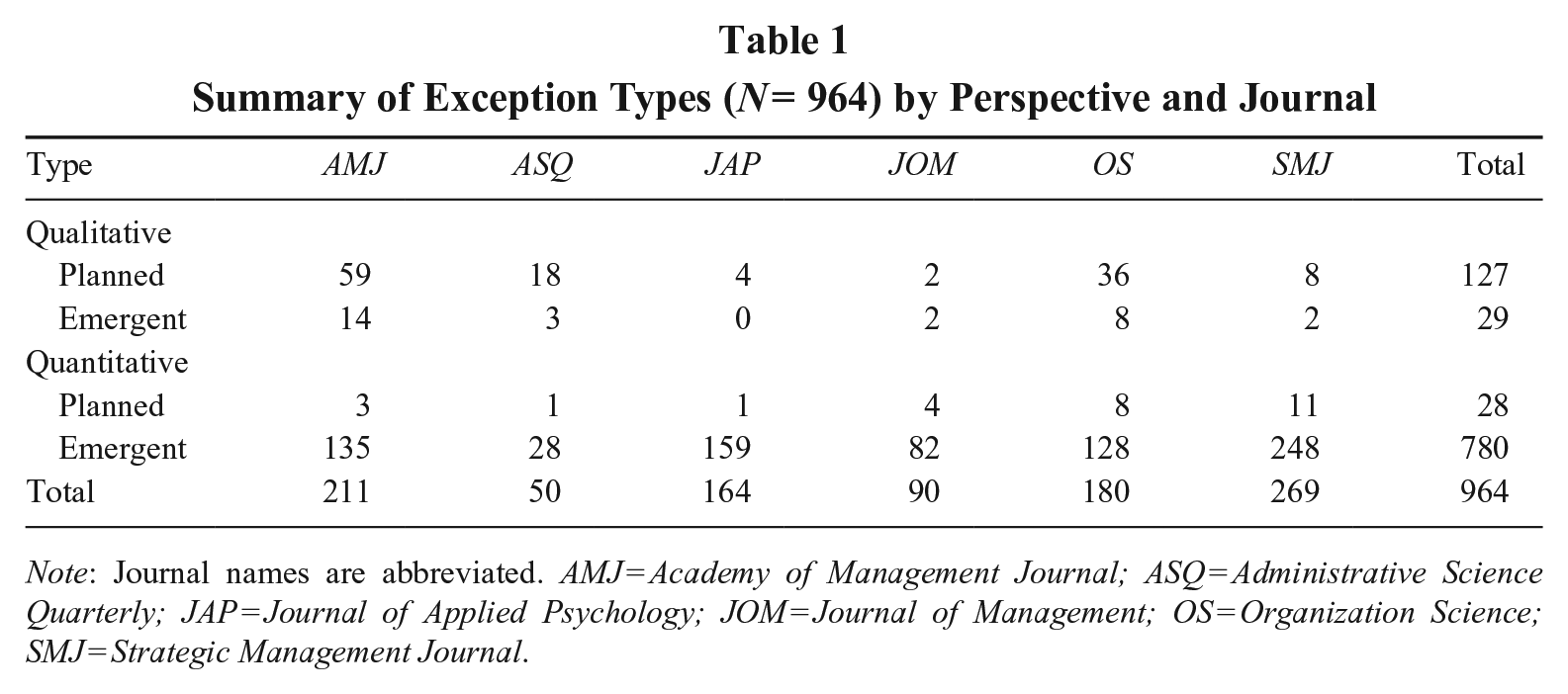
Note: Journal names are abbreviated. AMJ = Academy of Management Journal; ASQ = Administrative Science Quarterly; JAP = Journal of Applied Psychology; JOM = Journal of Management; OS = Organization Science; SMJ = Strategic Management Journal.
General Patterns in Exception Usage
We set out to holistically understand general similarities and differences between qualitative and quantitative research in their approaches to handling exceptions. We begin our reporting of this effort by presenting overarching trends illuminated by our review.
To begin, and as shown in Figure 1, discussion of exceptions within published organizational research has increased substantially over the past two decades within both qualitative and quantitative research. This highlights a need to comprehensively examine the utility of exceptions for theory.
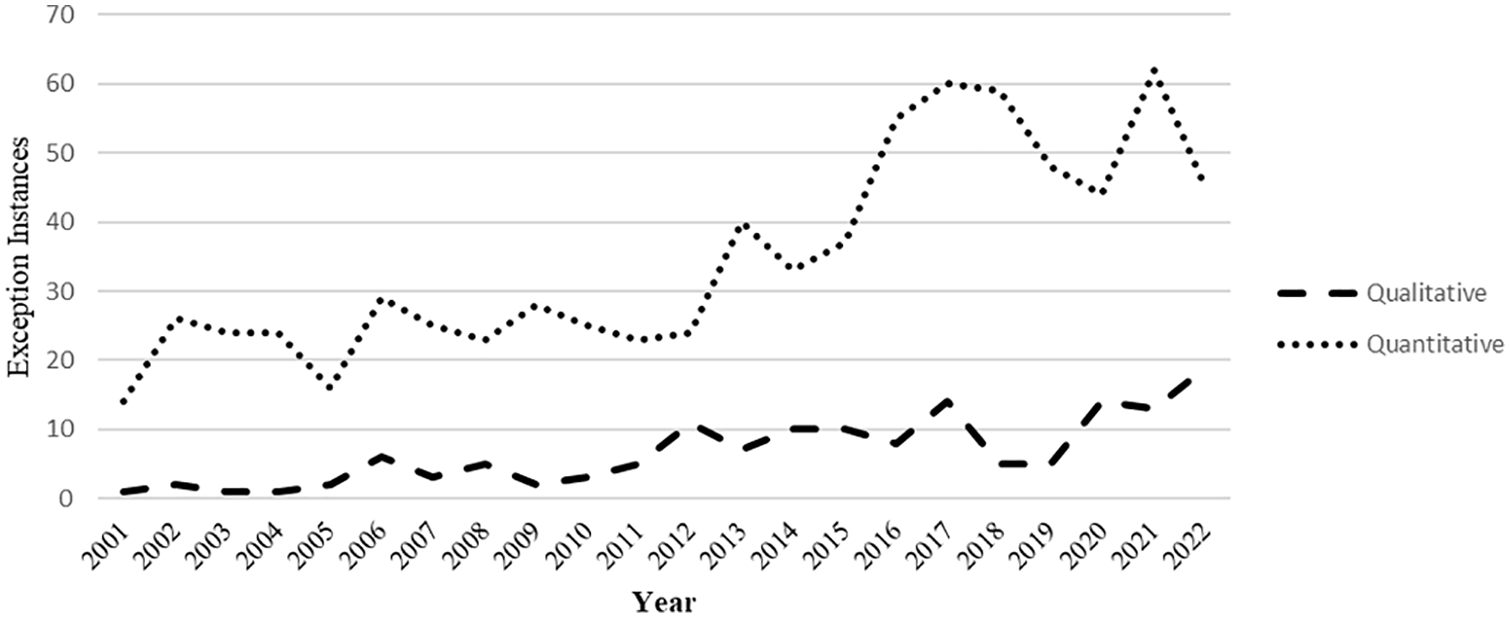
Trends in Exception Instances by Perspective
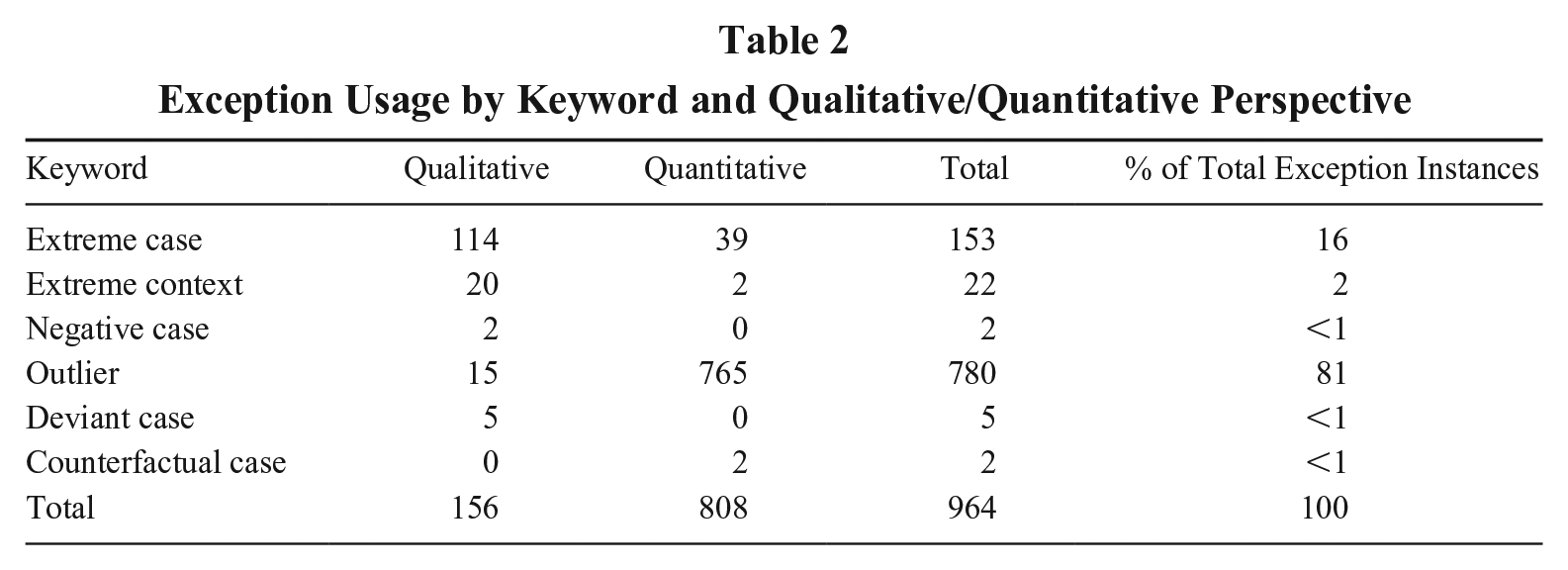
Articles included in our review are representative of the six keywords that we used for our search process (extreme case, extreme context, negative case, outlier, deviant case, counterfactual case). As shown in Table 2, the most used keyword was outlier (n = 780) and was most frequently used within quantitative research (n = 765). Extreme case was the second most commonly used keyword (n = 153) and was primarily applied in qualitative research (n = 114). Table 2 provides a full breakdown of exception keywords by perspective.
Exception Usage by Keyword and Qualitative/Quantitative Perspective
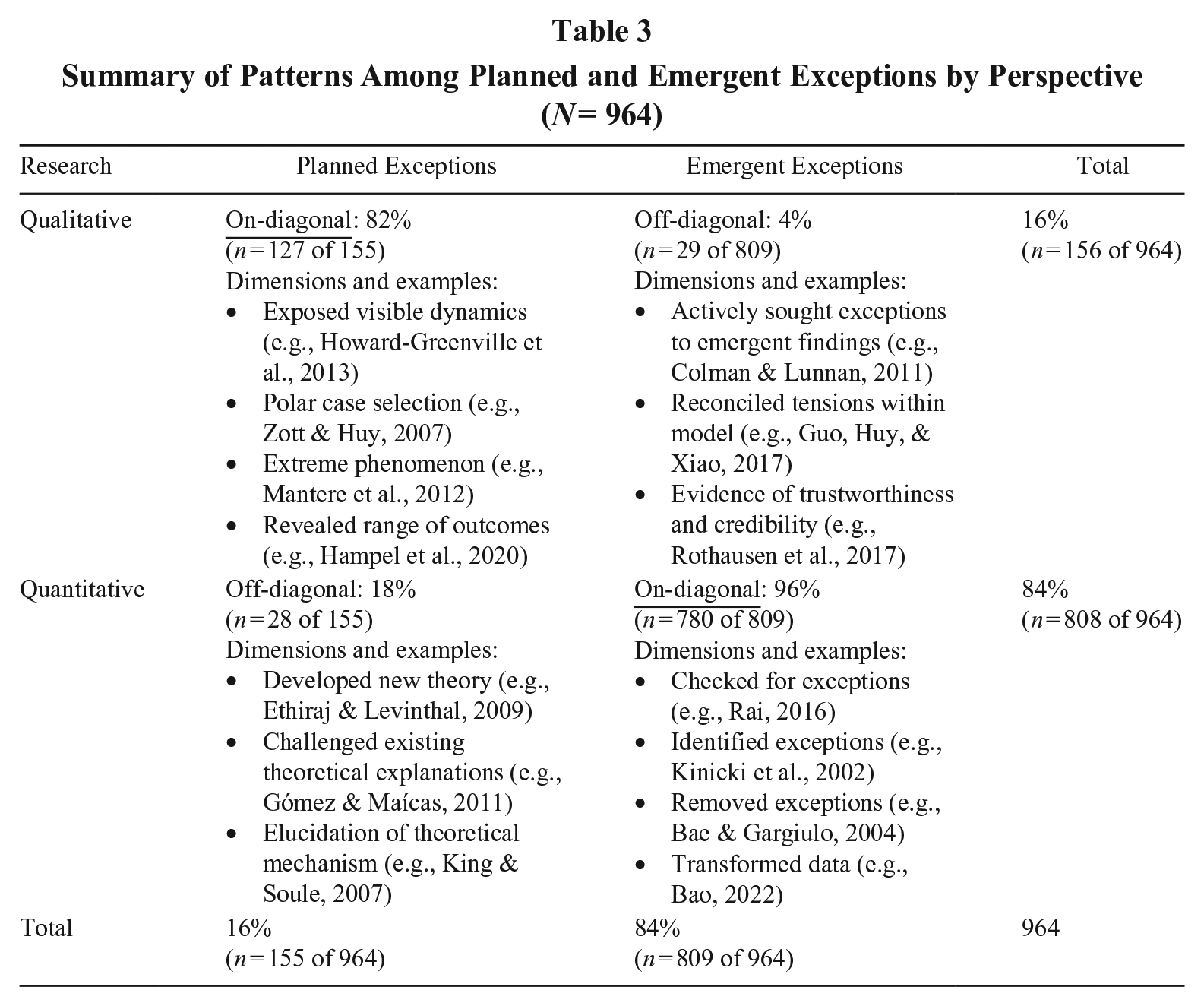
Clear patterns emerged across qualitative and quantitative research in their use of exceptions. First, the articles included in our review are disproportionately representative of quantitative research. Across all 964 exception instances identified in our review, 16% refer to qualitative research (n = 156) and 84% refer to quantitative research (n = 808). Although the articles included in our review are skewed toward quantitative research, this breakdown is reflective of broader trends within organizational research toward a disproportionate representation of quantitative empirical research to date yet contemporary growth in more qualitatively oriented work (Bansal & Corley, 2011; Bluhm, Harman, Lee, & Mitchell, 2011). Second, qualitative and quantitative research substantially varied in their usage of exceptions. Table 3 unpacks the frequency of exception types across qualitative and quantitative research.
Summary of Patterns Among Planned and Emergent Exceptions by Perspective (N = 964)
In sum, research incorporating exceptions does not appear to be slowing down. Calls for more transparency in how research is undertaken has lead, scholars to increasingly give voice to the handling of exceptions (Aguinis et al., 2018). Further, qualitative and quantitative studies continue to apply different terms (e.g., outlier, extreme case) when discussing exceptions. Our organizing framework, which we turn to next, seeks to synthesize approaches to discussing exceptions to reveal considerations for future research.
Organizing Framework for Synthesizing Exception Research
We organize our review by examining patterns in qualitative and quantitative research for exception use. We start by discussing “on-diagonal” patterns in exception uses (see Table 3), as these uses are representative of common applications of planned and emergent exceptions. Afterward, we turn to “off-diagonal” patterns in exception uses, which represent rarer applications of planned and emergent exceptions. These off-diagonal patterns are especially instructive of possible bridges between qualitative and quantitative research.
On-Diagonal Patterns in Exception Uses
Planned exceptions (qualitative)
Qualitative research often relies upon planned exceptions to build theory (n = 127 instances). Qualitative authors tend to use planned exceptions to expose the visible dynamics of a phenomenon (e.g., Cameron, Thomason, & Conzon, 2021; Harvey & Kou, 2013). In these articles, researchers harnessed the extremeness of their context to help unpack theory (Bamberger & Pratt, 2010; Sharma et al., 2023). For instance, Harrison, Askin, and Hagtvedt (2023) studied bands nominated for a Best New Artist Grammy award to explore the experience and outcomes associated with early recognition among creative groups. They explain that this planned exception “offer[ed] a transparent, unfettered view of the dynamics of interest” (Harrison et al., 2023: 103). This approach to using exceptions aligns with Eisenhardt’s (1989) seminal work on case study research, whereby extreme situations illuminate patterns that may be difficult to detect in more ordinary organizational contexts.
Qualitative researchers also used planned exceptions to help identify contrasting cases. In these articles, researchers sought a selection of polar cases representing extreme ends of a studied phenomenon (e.g., three highly novel business models and three low-in-novelty business models; Snihur & Zott, 2020), again aligning with seminal recommendations for case study research (Eisenhardt, 1989). Selecting contrasting cases allows researchers to study variation that may be cloaked in a single extreme context. For instance, Zott and Huy (2007) selected seven extreme cases that had high or low levels of symbolic action. Citing Eisenhardt (1989) and Strauss and Corbin (1998), Zott and Huy (2007: 76) explained their rationale for selection of extreme cases to “balance between generating a reasonably textured theory and having to cope with large amounts of data (Brown and Eisenhardt, 1997; Huy, 2002).” Thus, in these two approaches, qualitative researchers selected planned exceptions to reveal theoretical dynamics.
Emergent exceptions (quantitative)
Quantitative articles offered significant discussion of exceptions that arose in preparation for and during data analysis (n = 780 instances). Many quantitative articles described varied ways that they sought out and analyzed emergent exceptions, often with the intent of minimizing their impact on model fit. Many quantitative articles described checking for and removing observations for outlying characteristics prior to testing their model (Kulchina & Oxley, 2020; Rattan & Dweck, 2018). To check for exceptions within their main variables, authors used procedures such as calculating the sample-adjusted meta-analytic deviancy statistic (Huffcutt & Arthur, 1995; Kong, Dirks, & Ferrin, 2014), computing Cook’s distance (e.g., Lu, 2023), employing a Grubbs test (Sabey, Rodell, & Matta, 2021), or more broadly searching for exceptions within descriptive statistics (e.g., Mayer, Kuenzi, Greenbaum, Bardes, & Salvador, 2009). The intent of these procedures is to identify if exceptions exist within one’s data before testing a theoretical model.
Quantitative articles also frequently described emergent exceptions as part of their overall analytical approach. Many articles described different steps authors took to preserve their results from the undue influence of emergent exceptions, once they were identified. These steps included removing emergent exceptions (e.g., Barbero, Martínez, & Moreno, 2020; Staw, DeCelles, & de Goey, 2019) while sometimes employing theoretical justification for their removal (e.g., Taylor, Russ-Eft, & Chan, 2005). Other researchers described transforming their data, such as through log transformation (e.g., Zhelyazkov & Gulati, 2016), winsorizing (e.g., Yan, Almandoz, & Ferraro, 2021), and averaging values within the data (e.g., Stagni, Santalo, & Giarratana, 2020).
Some researchers described adopting specific analytical procedures, such as robust regression (e.g., Porrini, 2004), Poisson regression (e.g., Wang, Madhok, & Li, 2014), and selection of median values within the regression equation to reduce the influence of exceptions in model tests (e.g., Marginson & McAulay, 2008). Further, some authors mentioned applying robustness checks to determine the impact of exceptions on model results (e.g., via significance of slopes; Alnuaimi & George, 2016; Lahiri, 2010). For instance, Miller, Le Breton-Miller, and Lester (2013) clearly delineated steps taken to identify and assess outlier effects on results, such as conducting outlier and influential observations diagnostics. They used median regression (instead of ordinary least squares) to evaluate their results, followed by a logit model to determine robustness of results. In their study of the champagne industry, Ody-Brasier and Vermeulen (2020) removed four elite champagne companies from their sample of 64 firms over 10 years; they reran analyses and found that their initial findings were confirmed. In general, researchers tended to include exceptions in their data when their removal or transformation did not affect their findings (e.g., Eatough, Chang, Miloslavic, & Johnson, 2011). In sum, quantitative approaches to handling emergent exceptions most often centered around assessing and even reducing their influence on model results.
Off-Diagonal Patterns in Exception Uses
Emergent exceptions (qualitative)
Qualitative researchers were very limited in their discussion of emergent exceptions (n = 29 instances). Whereas quantitative articles often described taking many steps to discuss emergent exceptions within their data and analytical approach, such as checking, removing, transforming, and incorporating exceptions within their data analysis, qualitative research rarely discussed such procedures. Through analyses of these “exceptions” within our review, we identify three primary patterns toward how qualitative research has treated emergent exceptions: (a) actively sought exceptions to emergent findings, (b) reconciled tensions within model, and (c) provided evidence of trustworthiness and credibility.
First, in this set of 29 off-diagonal instances, qualitative researchers discussed taking steps to identify differences within their data in terms of fit with emergent findings. Authors described being sensitized to possible emergent exceptions and proactively trying to find nonconforming data. Metiu (2006: 424) states,
To enrich and deepen the analyses, I looked for invalidating evidence for the categories and patterns I was observing. . . . For example, I made sure I sought and recorded the opinions of developers who were most positive and those who were most critical toward the remote site.
These authors were often transparent in the steps they took to search for emergent exceptions and were clear about their impact on the theoretical model. In one such study, Souitaris, Zerbinati, and Liu (2012: 483) state, “Deviant cases were sought out, and the model was refined until it could apply to all the data (Silverman, 2006).” In another article, Toubiana (2020: 1754) states, “This process involved revisiting the codes and checking for convergences and divergences using negative-case analysis, pushing my theorizing to a more abstract and aggregate level.” By identifying and accounting for emergent exceptions, these qualitative researchers were able to add nuance to their resulting theoretical model.
Second, analysis of identified emergent exceptions helped qualitative researchers reconcile tensions within their data. Oftentimes, analysis of emergent exceptions exposed boundary conditions within one’s theoretical model and/or prompted a substantial revision of a developing model (e.g., Crilly, 2017; Delmestri & Greenwood, 2016). Ferlie, Fitzgerald, Wood, and Hawkins (2005: 123) state,
We had not originally expected the innovations to exhibit such complex spread pathways. We needed to retheorize our results (Yin, 1994). One strategy for inducing theory is to present polar cases with crystallized patterns (Langley, 2001). Our positive and negative outliers—both strongly supported by scientific evidence but displaying very different change outcomes—represented such polar cases.
Resolving these tensions through comparing exceptions to an emergent model furthered theoretical insights drawn from the data.
Finally, transparent discussion of emergent exceptions can help signal trustworthiness and credibility in one’s findings (Pratt, Sonenshein, & Feldman, 2022). This approach aligns with methodological guidance commonly issued within quantitative research to encourage transparency in one’s analytical approach, particularly with regard to exceptions (e.g., Aguinis et al., 2013). An exemplary demonstration of this theme is Kaplan and Orlikowski’s (2013) article in which they undertook multiple rounds of coding to make sense of all their data; they provide a clear appendix of these cycles. As another illustration, Chan and Hedden (2023: 284) state, “To strengthen the credibility of our findings, we combed through our data for instances of negative cases.” By considering exceptions in light of their contextual features, these authors described gaining greater confidence in their findings.
Planned exceptions (quantitative)
In contrast to qualitative articles, quantitative researchers rarely discussed planned exceptions (n = 28 instances). Through analyses of these rare “exceptions” within our review, we identify three primary uses of planned exceptions within quantitative research: (a) developed new theory, (b) challenged existing theoretical explanations, and (c) elucidation of theoretical mechanism. First, some quantitative researchers described harnessing a planned exception to develop novel theory on an extreme phenomenon. These authors focused their research question on a unique, yet important, phenomenon where current theory did not apply and used quantitative data with hypothesis-driven approaches. Indeed, insights can be gleaned from extreme situations, such as organizational decisions within war-afflicted countries (Dai, Eden, & Beamish, 2017) or firms faced with unique yet highly relevant political pressures (e.g., Chinese state-owned enterprises; Guo, Huy, & Xiao, 2017). As an exemplary demonstration of this theme, Durand and Vargas (2003: 673) argued that extant agency theory may not apply to private firms and stated “that private ownership deserves our attention as having potentially a distinct nature.” The authors extend theory by providing a categorization framework for privately held firms. In another example, Greve and Yue (2017) used archival data related to the 1893 and 1907 bank crises to further understanding of the relatively unexplored area of community participant reactions to crises. One novel insight drawn from their study is related to the power of community memory from previous crises as another source of institutional legacies, affecting community response. In these quantitative studies, novel settings unveil new theoretical insights (see also Grigoriou & Rothaermel, 2014; Keller & Loewenstein, 2011; Tan & Peng, 2003).
Second, quantitative researchers also drew upon planned exceptions to challenge existing theoretical explanations. In some instances, scholars used planned exceptions to demonstrate the range of outcomes possible for the studied phenomena. Luo, Kaul, and Seo (2018: 2598) state, “We deliberately choose to focus on the extreme cases. In practice, of course, a range of intermediate positions are possible. By focusing on the extreme cases, we seek to model and describe the relevant range of potential outcomes.” Fini, Jourdan, Perkmann, and Toschi (2023: 1105) explored how boundary maintenance affects social evaluation in the Italian academia setting. By scrutinizing the high-performing academics who did not fit into strict disciplinary boundaries, these researchers found results that “do not square with extant theory” and instead offered an “alternative theoretical pathway” and “an overlooked alternative theoretical explanation.” Thus, isolating novel cases can be used to reimagine and provide new insights into well-studied areas of research.
Finally, quantitative scholars described using planned exceptions to help isolate the theoretical mechanism within their study. In one exemplar of this approach, Wombacher and Felfe (2017: 1562) describe the military as an appropriate setting for testing their model, as it offered “extreme cases of interteam conflict (i.e., conflicts that provided little room for interpretation and engendered serious consequence).” In another application, Lehmberg, Rowe, White, and Phillips (2009) chose to study an outlier in terms of corporate performance—General Electric—to understand how the resource-based view (RBV) of the firm was connected to talent development. With conventional studies finding no relationship, Lehmberg et al. (2009) identified that separating recruitment processes from outcomes provided additional insight into the relationship between the RBV and talent development. Thus, some quantitative researchers designed studies around planned exceptions to help further theoretical insights.
In sum, our review reveals a fundamental distinction between qualitative and quantitative research in their treatment of exceptions. Assumptions and expectations of Gaussian distributions in quantitative research (Andriani & McKelvey, 2009) and a fascination with odd, interesting, or unusual data in qualitative research (Hansen et al., 2023) have contributed to differing views in how exceptions are viewed across both camps. We note the paradox that quantitative scholars often dismiss data “tails” and qualitative scholars often dismiss data in the “middle” of distributions. Yet, it is possible that there is common ground between these two divergent research approaches. In the following section, we present considerations for future research that aims to bridge this divide and offer areas of methodological innovations.
Codifying Suggestions for Exception Research
While our review to this point addresses points of convergence and divergence within qualitative and quantitative research regarding exception uses, these findings pave the way for a promising future research agenda. We find that exceptions play a role during both study design (planned exceptions) and data analysis (emergent exceptions). Further, how the findings of planned and emergent exceptions are presented is crucial to conveying the theoretical contributions of the research. Using these three phases of the research process—study design, data analysis, and findings presentation—we provide a set of suggestions for scholars to consider when conducting research on exceptions or encountering them within their data (see Figure 2). We hope that these considerations will be helpful for scholars in furthering management theory.
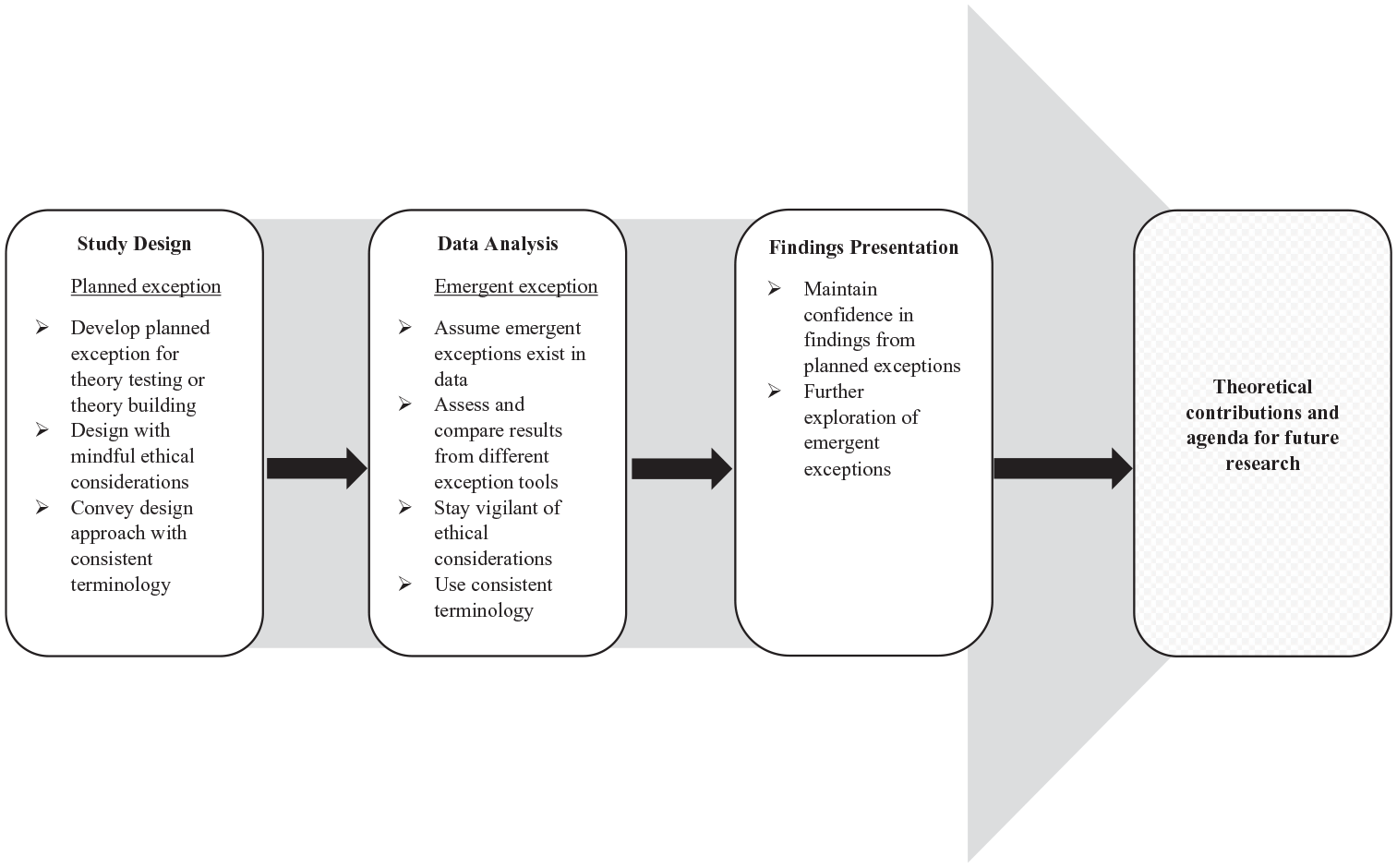
Codifying Suggestions for Exception Research Across Stages of the Research Process
Exceptions During Study Design
Develop planned exceptions for theory testing or theory building
When designing a study around a planned exception, we recommend that researchers communicate how their choice of context is theoretically motivated and thereby assists with efforts to test or build theory. In some instances, this may involve harnessing extant theories based on exceptional phenomena. In other instances where dynamics present within the context cannot be adequately explained by existing theory, scholars may need to develop novel theory. We first highlight two existing exception-based theories that may be promising in this regard, the RBV and person-environment (P-E) fit theory, before turning to paths scholars may consider in building new exception-based theories.
One promising theoretical lens to studying exceptions is the RBV (Barney, 1991, 2001), as evidenced by several articles included in our review (e.g., Lehmberg et al., 2009; Kim & Makadok, 2023). The RBV highlights exceptions, suggesting that sustained competitive advantage occurs when a firm has resources that are valuable, rare, inimitable, and nonsubstitutable. Sustained competitive advantage is difficult to achieve, yet firms continue to invest in the acquisition and development of resources that help them work toward that goal (Mudambi & Swift, 2014; Peteraf, 1993). The RBV is meant to highlight uniqueness among firms (Gibbert, 2006; Kraaijenbrink, Spender, & Groen, 2010). Applying the RBV to study continuously high-performing firms can help scholars identify paths that firms can follow to realize sustained competitive advantage. Indeed, research focusing on firms with sustained superior performance and those that lose superior performance has yielded insights into practices relevant for more ordinary organizations (Henderson, Raynor, & Ahmed, 2012; Wiggins & Ruefli, 2005).
Another promising theoretical lens that accounts for the role of exceptions is P-E fit theory. P-E fit theory (Edwards, 2008; Edwards, Cable, Williamson, Lambert, & Shipp, 2006) suggests that, in an ideal world, workers will experience a congruence between their values, needs, and attributes and those offered by their environment. Applied to consider a range of targets, such as job, occupation, and organization (e.g., Cable & Parsons, 2001; Kristof, 1996; Tims, Derks, & Bakker, 2016), P-E fit theory continues to underlie many organizational theories and practices, such as those pertaining to newcomer socialization (Cooper-Thomas, van Vianen, & Anderson, 2004), job crafting (Vogel, Rodell, & Lynch, 2016), and matching (Weller, Hymer, Nyberg, & Ebert, 2019). In these perspectives, experiencing misfit is less than ideal and generally ought to be rectified through changes to either the person, environment, or situation. Yet, studying the experiences of employees who perceive misfit at work, such as with their organization or career (Follmer, Talbot, Kristof-Brown, Astrove, & Billsberry, 2018; Schabram & Maitlis, 2017), can also help managers improve organizational conditions for employees.
In addition to leaning on existing exception-based theories such as the RBV and P-E fit theory, new theory may be necessary when existing theory is insufficient to explain the relationships and outcomes associated with exceptions. For instance, in their conceptual article on firm performance in the wake of radical technological change, Hill and Rothaermel (2003: 257) state, “There are outliers in any population, and much can be learned from examining this group.” Many highly cited management theory articles are grounded in unique circumstances or situations, such as novel, critical, and/or disruptive events (i.e., event system theory; Morgeson, Mitchell, & Liu, 2015) or the management of seemingly impossible goals (i.e., stretch goals; Sitkin, See, Miller, Lawless, & Carton, 2011). Rather than dismiss exceptions as one-off cases or nuisances, it is possible that exceptions can expose the next frontier for an understudied yet practically important domain.
Recent technological trends could provide an intriguing premise for studying novel patterns in interpersonal communication among workers. Scholars could draw upon a planned exception to build theory on a phenomenon that is novel yet likely growing in practical importance for managers (Stake, 1995). As a demonstration, whereas traditional organizational research assumes that work takes place in a physical environment (Hill, Ferris, & Märtinson, 2003), some organizations have shifted to conducting work in the metaverse, whereby workers are virtually collocated within an augmented reality setting. For instance, Ernst and Young launched WeVerse, an online metaverse, to onboard and integrate 2,600 interns into the Ernst and Young culture during the summer of 2023 (Gurchiek, 2023). Yet, extant theory on the metaverse is limited despite its increased application among organizations (Ashforth, Caza, & Meister, 2023), and it is unclear how traditional employee orientation efforts may apply (or not apply) in the metaverse. We encourage scholars to remain critical of the shortfalls of current theory and strive to build new theories to unpack exceptions when necessary.
Design with mindful ethical considerations
Despite their value for revealing theoretical dynamics not visible in other settings (Eisenhardt, 1989), researchers should be aware of potential ethical concerns associated with planned exceptions. Deploying a study based on a planned exception could result in a researcher being accused of voyeurism or applying the “Western gaze” to others’ lived realities amid occupying positions of privilege. “Interesting” contexts may simply be those outside of traditional Western workplace environments and contribute to subjects feeling tokenized, exploited, or otherwise looked down upon or written out (Zoogah, 2023). Given that many modern measurement tools were developed among nondiverse samples (American Psychological Association, 2021), extant theory may not apply to “exceptions” because they were not included in the initial design of measurement instruments and casting of a phenomenon’s nomological net. In a well-publicized apology letter, the American Psychological Association (2021) acknowledges this reality, stating, “[The American Psychological Association] recognizes that traditional diagnostic methods and standards do not always capture the contextual and lived experiences of people of color.” Thus, while we do not want to dissuade researchers from selecting settings that can expose novel theoretical insights, researchers must remain mindful that they are not promoting or exacerbating scientific racism or other forms of aggression against marginalized groups.
We again encourage researchers to draw upon theory to motivate the investigation and discussion of a planned exception. Researchers could lean into Hällgren et al.’s (2018) classification of extreme contexts as risky, emergency, or disrupted to help motivate their selection of an extreme context. Attributes of the planned exception may also align with dimensions of particular theories, such as the RBV, substantiating the authors’ choice of that context. Further, qualitative researchers applying a “context-first” approach to their investigation should heed Pratt’s (2015) guidance to remain sensitive to theoretical explanations that may arise organically as they gain a greater grounding within a fundamentally intriguing context. Maintaining a sensitivity to theory is crucial to qualitative investigations, even during early stages of understanding one’s context (Strauss & Corbin, 1998). Applying a theoretical lens helps to make transparent the selection of interesting or novel contexts.
Convey design approach with consistent terminology
In this review, we have sought to consolidate existing terminology used to discuss exceptions through two broad terms: “planned” and “emergent” exceptions. We use these labels to organize and synthesize our review, as the present terminology used to discuss exceptions is diverse and potentially confusing. Table 2 identifies the frequency of our search terms, but in our text extraction and coding, we identified even more terms, such as “unique case” and “intensity case” (e.g., Durand & Vargas, 2003; Koppman, Bechky, & Cohen, 2022). We also found different terms used interchangeably to discuss exceptions. Although we appreciate authors’ attempts to pursue varied language throughout a manuscript, an unfortunate side effect of doing so is potential confusion for readers in the utility of the exception. For instance, the term “extreme case” may prime readers to think of Eisenhardt’s (1989) seminal work on extreme case methodology when this term is used in a manuscript to refer to quantitative emergent exceptions. The term “outlier” is also more closely linked to quantitative research and may seem out of place in qualitative research. Continued application of varied exception terminology is representative of construction proliferation (Shaffer, DeGeest, & Li, 2016) and may confuse readers regarding the use of the exception in the manuscript.
Importantly, our use of the word “exception” is not intended to further add additional terminology for authors to choose from. We feel it is appropriate that researchers continue to use terms grounded in the tradition of qualitative and quantitative methodologies that align most closely with the direction of the exception. Within both qualitative and quantitative research, use of the term “extreme case” is appropriate to indicate the capabilities of planned exceptions for unpacking theory, closely aligning with Eisenhardt’s (1989) seminal work. In this sense, authors should consider when using the term “extreme case” that the exception was planned and is in reference to the study design. More careful consideration of the terms used when discussing exceptions and their utility will enhance construct clarity and thereby facilitate more coherent and precise theoretical discussions (Suddaby, 2010).
Exceptions During Data Analysis
Assume emergent exceptions exist in data
Researchers should assume that exceptions will emerge during data analysis and be skeptical if no exceptions are identified during the research process. In qualitative research, emergent exceptions are usually subject to a process of constant comparison (Glaser & Strauss, 1967) until the final model incorporates all data (Toubiana, 2020). Many qualitative papers describe in the Methods sections that the researchers searched for negative or deviant cases, almost as a throwaway line perhaps to signal trustworthiness. Yet, Kaplan (2022) explained that identification of data that do not fit and their reconciliation are critical to qualitative research, serving a purpose above and beyond credibility in one’s methodological approach:
Any time you find an outlier, you have to figure out why it is an outlier, and incorporate it into the theory. So what does that mean? You don’t have 95% confidence level, you have to have 100% confidence. Any time you find something that does not fit, it means the theory you are developing isn’t actually representative of the specific context that you are studying.
The process of uncovering exceptions in a qualitative study and reconciling them to theory is not always transparent. In an exemplary discussion of exceptions, Margolis and Molinsky (2008) investigated outlier cases and found that cases from one occupation (“manager”) created a boundary condition for their qualitative study findings. Making clear the reconciliation of exceptions in qualitative research enables researchers to provide richer, more nuanced theoretical explanations (e.g., Jarzabkowski, 2008; Lauriano & Coacci, 2023). We encourage more qualitative researchers to discuss why they did or did not include an emergent exception in their model and how they came to that conclusion. For instance, did the researchers go back to the informant or gather additional data to more thoroughly unpack the emergent exception? Or did they engage in peer debriefing to obtain additional viewpoints that may be helpful in that decision? Making transparent the identification of emergent exceptions, how they are addressed during the analysis, and how they contributed to the theoretical model are considerations for not only qualitative researchers but also quantitative researchers.
In quantitative research, researchers identify emergent exceptions using a wide array of well-used tools and usually remove or transform them, a pattern discussed earlier in this article. However, is there something we can learn from these exceptions? Perhaps crucial theoretical insights lay in the tails as opposed to the middle of data distributions. In this vein, some quantitative researchers (such as Grigoriou & Rothaermel, 2014; Hawawini, Subramanian, & Verdin, 2003; Henderson et al., 2012; Wiggins & Ruefli, 2005) advocate that “the ‘average’ firm may not always be the best way to advance the field (Daft & Lewin, 1990)” (Short, Ketchen, & Palmer, 2002: 380). Makino and Chan (2017: 1738) explain:
We take the view that non-normality is the default state for social behavior and make statistical inferences by comparing basic but often overlooked descriptive statistics such as skewness and kurtosis. The key thrust of this view is that factors affecting the shape of distributions provide far more useful implications for advancing our understanding of social behavior and its outcomes than those factors that merely explain the average.
Within quantitative research, exceptions may exist outside statistical bands of confidence, but they may hold the potential for novel insights and theoretical nuance. As Powell (2003: 83) states, “The simple fact is that nothing unusual is happening in the performance of most industries. The action is in the extreme cases, and that is where strategy theories add their value.” To demonstrate this notion, Schilling and Fang (2014: 982) state, “To understand why we get this inverted-U shape, it is important to consider why the two extreme cases produce inferior results.” At the forefront of a quantitative investigation, researchers can adopt an analytical approach grounded in analyzing contrasting cases, such as frontier analysis, whereby the relative distance between the highest-performing firms and other firms is calculated (e.g., Van de Ven, Leung, Bechara, & Sun, 2012). Investigation of emergent exceptions may also align with a growing editorial priority toward robustness checks and heightened expectations of transparency (e.g., Committee on Publication Ethics; https://publicationethics.org/data). In sum, we suggest a mindset of researcher expectation of emergent exceptions in studies and making transparent what these exceptions mean to a study’s findings and theory.
Assess and compare results from different emergent exception tools
We encourage authors to deploy multiple tools when seeking and analyzing emergent exceptions within their research. While quantitative research has many tools to seek and analyze emergent exceptions, it is unclear how these tools compare. Different insights may arise from different exception detection tools, creating the appearance of cherry-picking data that promote (rather than detract from) model fit. It was outside the boundary of this review to compare the utility of different approaches for seeking exceptions (e.g., are visuals as effective as Cook’s D?) and accounting for exceptions within analysis (e.g., winsorizing at 99% vs. 95%, log transformation, removing exceptions, etc.). Many quantitative articles employed only one approach, whereas others used multiple approaches, for seeking and analyzing exceptions. It is possible that some approaches are more generative at identifying emergent exceptions than others. Further, the interpretation of results may change in a theoretically meaningful fashion when removing or log transforming emergent exceptions, both commonly employed practices, warranting further inquiry beyond simply reporting results with and without these changes to the data. We encourage quantitative scholars to lean on multiple exception detection tools to generate theoretically informed decisions about managing exceptions.
Similarly, in qualitative research, researchers could deploy multiple tactics to seek out emergent exceptions, including crafting memos about aspects the researcher finds unusual during the research process, member checking, peer reviews, evaluation and comparison of insights from different data sources, comparison of intermediate data analyses (e.g., visual maps of different processes across cases; Langley, 1999), and comparing coding across cases (O’Kane, Smith, & Lerman, 2021). We expect that the length of Methods sections and use of online supplemental appendices will increase as researchers reveal their iterative sensemaking of exceptions and modifications to theoretical insights. Yet, these efforts enhance the trustworthiness of qualitative research (Pratt et al., 2022), displaying the competence of researchers to seek out and effectively incorporate exceptions, being benevolent to all data gathered by including them in the final theoretical model, and integrating connections across different sources (data sources, cases, time, etc.) for emergent theoretical insights.
Stay vigilant of ethical considerations
Researchers should also stay mindful of potential ethical considerations when seeking and analyzing emergent exceptions. We highlight two issues in this regard that are relevant for both qualitative and quantitative research: (a) artificial intelligence (AI) and (b) appearance of cherry-picking data.
First, it is relatively unclear how, if at all, AI should be used when managing emergent exceptions. Researchers ought to ethically navigate their role as a researcher against the capabilities of AI. AI involves the use of computers to substitute or augment human behavior (von Krogh, 2018). AI can quickly draw upon and synthesize large amounts of data using formal rationality, moving beyond the bounds of human cognition (Balasubramanian, Ye, & Xu, 2022). Some scholars have called for human-AI ensembles or referred to AI as a counterpart that can augment human behavior (Anthony, Bechky, & Fayard, 2023; Choudhary, Marchetti, Shrestha, & Puranam, 2023; Raisch & Krakowski, 2021); however, relying too heavily on AI within decision-making may also narrow thinking (Balasubramanian et al., 2022).
We take the view that AI may be helpful in efficiently detecting emergent exceptions and sensitizing authors to possible explanations for their basis. Robust processing capabilities, including the application of algorithms grounded in machine learning (Baum & Haveman, 2020), may efficiently reveal exceptions and illuminate unusual patterns within one’s data. We can envision instances where AI is used in quantitative research to efficiently detect exceptions, such as when scrapping large amounts of data from multiple websites. Likewise, in qualitative research, AI could assist in detecting unusual cases and patterns among codes (O’Kane et al., 2021). Further, AI can sensitize researchers to possible theoretical explanations for the basis of exceptions. Existing analytical tools, such as sentiment analysis, already harness machine learning and may help researchers make sense of exceptions. Thus, broadly and within the context of exception management, AI’s core value may be in providing another perspective to the researcher when making sense of their data.
Importantly, maintaining both the human eye and interpretive judgment in detecting and interpreting exceptions is necessary for justifying connections to theory and steering clear of potential ethical issues. For instance, AI is susceptible to gender biases and discriminatory outcomes (UNESCO, 2023), which may result in issued guidance that adversely impacts certain groups of people. If AI recommends that a researcher exclude a significant amount of research data obtained from traditionally marginalized groups of respondents, how does that impact a researcher’s goal of maintaining a representative sample and providing voice to diverse experiences? Removing exceptions is already highly controversial in management research (Aguinis et al., 2013); we suspect decisions to blindly remove exceptions based on AI guidance would exacerbate concerns over article quality and researcher integrity. We recognize that it is the researchers who have collected data in the field; they hold implicit, deep, and intangible understanding of the context. Researchers should be transparent about their decision to use AI in managing exceptions, including citing the AI tool(s) used, detailing how they engaged with it, and describing how their interpretation of their data shifted based on guidance issued by AI.
A second ethical concern associated with emergent exceptions is the possible appearance of cherry-picking data to enable model fit. Many debates have occurred in the management literature on the removal of exceptions, particularly in quantitative research (e.g., Blanton, Jaccard, Klick, Mellers, Mitchell, & Tetlock, 2009; Hawawini et al., 2003; Hawawini, Subramanian, & Verdin, 2005; McConnell & Leibold, 2009; McNamara, Aime, & Vaaler, 2005). Cortina (2003) urges researchers to remove exceptions only in the presence of overwhelming justifications. Likewise, qualitative methodological guidance suggests that one’s theoretical model ought to represent all of one’s data, including emergent exceptions (Kaplan, 2022). In these regards, grounding the interpretation and handling of emergent exceptions in theory may prove especially helpful.
We argue that researchers handling their data are best equipped to discuss the connection between emergent exceptions and theory. Indeed, we found several articles in our review where authors unpacked the theoretical basis for retaining and removing exceptions (e.g., Dragoni, Park, Soltis, & Forte-Trammell, 2014; Eatough et al., 2011). For instance, in their study examining how supervisors enable leader development among transitioning leaders, Dragoni et al. (2014) removed two transitioning leaders who had held their positions for 3.5 and 7 years. Leaning on extant literature, they describe that those managers can no longer be classified as transitioning leaders, as role learning tends to occur within the first few years of a leader’s tenure. Likewise, in qualitative research, we found several instances of authors describing how each emergent exception fit, challenged, or extended their theoretical model (e.g., Jarzabkowski, 2008; Ody-Brasier & Vermeulen, 2020). Jarzabkowski (2008) identified different strategizing processes and applied them to the 12 processes in her study of university strategizing. One emergent exception reversed the order of the processes, but she described how the outcome remained similar to other cases in the same context. We encourage researchers to feel empowered to issue their judgments of exceptions, using theory as a guide rather than solely relying on empirical output and stringent analytical cutoffs.
Use consistent terminology
When discussing emergent exceptions, we again encourage future researchers to use terms grounded in qualitative and quantitative traditions. In qualitative research, the term “negative case” is found in seminal methodological guidance and is most closely linked to discussion of emergent exceptions in that discipline (Charmaz, 2000; Lincoln & Guba, 1985). In quantitative research, “outlier” is most commonly used, as seen within the majority of quantitative exception uses included in our review and presence of prior reviews that use the term “outliers” (e.g., Aguinis et al., 2013). Thus, authors should be clear when using the term “negative case” or “outlier” in qualitative and quantitative research, respectively, that the exception was emergent and arose during data analysis.
Exceptions During Findings Presentation
Maintain confidence in findings from planned exceptions
We encourage researchers to maintain confidence in findings arising from a planned exception. At the start of our review, we expected generalizability cautions to be more common in quantitative exception instances, as replication across contexts is valued within quantitative research but does not fit with an exploratory qualitative approach (Aguinis & Solarino, 2019; Pratt, Kaplan, & Whittington, 2020). Yet, we were surprised at the frequency that generalizability cautions were also discussed as a limitation within qualitative research. Too often, in both qualitative and quantitative studies, researchers decry the lack of generalizability of their results, despite previously advocating for the utility of a planned exception in building or testing theory. In describing their planned exception, quantitative authors often argued for the value of a given context in testing a theoretical area (e.g., Gómez & Maícas, 2011; Greve & Yue, 2017). For instance, in their quantitative project, Dai et al. (2017) studied multinational enterprises in war-torn countries and their decision to stay or leave. They noted, “Our findings extend the resource-based view and real options theory by demonstrating the bounded value to resources and options in the face of environmental contingencies” (Dai et al., 2017: 1478). Westman, Vinokur, Hamilton, and Roziner (2004) selected the Russian military to study marital dissatisfaction and downsizing and noted that “respondents in our sample provided an ideal testing ground for examining hypotheses” (Westman et al., 2004: 770). Rao and Drazin (2002: 496) quantitatively addressed the mutual fund industry because it was well suited to study “the role of recruitment as a strategy for overcoming resource constraints.” Similar arguments were made in “on-diagonal” applications of planned exceptions within qualitative research (e.g., Bullough, Renko, & Abdelzaher, 2017; Cardador, 2017). Although usage of planned exceptions for furthering theory aligns with traditional qualitative methods (e.g., extreme case methodology; Eisenhardt, 1989) and seminal methodological guidance suggests that findings from nontypical populations can generalize to broader populations (Mook, 1983), we found many instances in both quantitative and qualitative research where authors discussed generalizability and transferability concerns tied to a planned exception. Understanding of robust theoretical relations, in our view, trumps these concerns.
These external validity concerns are likely valid; however, we argue that both authors and readers should not interpret this limitation as detracting from the value of theoretical insights garnered from planned exceptions. The value of planned exceptions is in “capturing realism rather than allowing for statistical generalizability” (Pratt et al., 2019: 427). In fact, deviating from standard methodological practice and employing a tool kit of different methodologies are crucial for conducting research on planned exceptions (Sharma et al., 2023). Keeping in mind the role of theory and implications of a planned exception for theory can aid in this effort. Indeed, there are many positive features of a planned exception for theory development. Undertaking a research project that is deeply connected to a planned exception requires researchers to have “courage” to spend the time immersing themselves in a particular setting, convincing readers and reviewers of the appropriateness of the setting to the theoretical area and crafting a contribution from a “less-trodden path” (Sharma et al., 2023). Anchoring to a planned exception requires deep researcher knowledge of the selected setting and using this setting as the interpretive lens of data in a study to unpack theoretical insights (Hällgren et al., 2018; Hansen et al., 2023; Sharma et al., 2023). In this vein, Frey, Bernstein, and Rekenthaler (2022: 1001) discuss “analytical generalizability,” defined as “generalizations from empirical observations to theory, rather than to a population or a specific context” (Cardador & Pratt, 2018: 2075). In sum, crafting a pointed connection of the planned exception to theory can help qualitative and quantitative scholars finesse the utility of their exception while avoiding easy criticisms toward the application of their findings to more germane samples.
Further exploration of emergent exceptions
Once identified, researchers should closely analyze emergent exceptions and display curiosity to explore a possible hunch regarding their data. As described earlier, sensitivity to the constant comparison tenet can be found in grounded theory approaches in qualitative research; yet, this process is rarely elaborated upon in detail within published research. We encourage both qualitative and quantitative researchers to probe their data until they are confident in their conclusions. In some instances, this may mean contacting participants to further understand their lived experience and how they have made sense of emergent exceptions (e.g., Worren, Moore, & Cardona, 2002; Zatzick & Iverson, 2006). In other instances, this may mean engaging in supplemental analyses after main model tests.
Given that exceptions are traditionally incorporated into the theoretical model in qualitative research (Charmaz, 2000), we do not advocate for a similar uniform style of sensemaking in quantitative research. Quantitative researchers may consider a post hoc analysis of emergent exceptions to add nuance to their findings, as either supplemental analysis or a separate mixed-method study. “Tharking” (transparently hypothesizing after the results are known; Hollenbeck & Wright, 2017) may be a suitable path for investigating exceptions that arise unexpectedly during data analysis. Tharking is distinct from “harking” (hypothesizing after the results are known) or p-hacking and promotes an ethical discussion of exceptions and interpretations drawn from them. Following Hollenbeck and Wright’s (2017) suggestion for authors to include a section titled “Post Hoc Exploratory Analyses” within their Discussion section, researchers could use this section to explore possible bases of differences between exceptions and data adhering to normal distributions. In this vein, Arin, Minniti, Murtinu, and Spagnalo (2022) similarly suggest that post hoc investigation of “switch points” (i.e., instances where direction of relationships switch within one’s model tests) and possible corresponding outliers should be grounded in theory. In one exemplar demonstration of this application, Young-Hyman and Kleinbaum (2020) undertook a post hoc analysis of strong ties in their sample and found that their findings were reversed, thus adding nuance to their theoretical insights.
Rather than detract from interpretations drawn from main model tests, post hoc analyses of exceptions may be especially generative and informative for both theory and practice (Cronin, Stouten, & van Knippenberg, 2021). Post hoc investigations may require larger research teams, including pairing quantitative researchers grounded in objective ontological and positivist epistemological assumptions with qualitative researchers who have a subjective ontology and undertake an interpretive process. Researchers may also consider submitting their findings on exceptions to journals such as Journal of Management Scientific Reports and Academy of Management Discoveries. Manuscripts focusing on exceptions could meet the aims of these journals, such as through testing and refineing theory orproviding insight to understudied populations.
Scholars can also use quantitative studies to validate or expand upon exceptions noted in qualitative studies, following a mixed-method approach. We found some evidence of this application (e.g., Danbold & Bendersky, 2020; Harrison et al., 2023) whereby researchers used quantitative data to triangulate or expand upon main interpretations drawn from an inductive qualitative study. For instance, Grant, Berg, and Cable (2014) were struck by the level of personalization among job titles of Make-A-Wish foundation employees when learning about this context, prompting an exploratory qualitative study to investigate organizational change in an especially emotionally intense environment (i.e., planned exception). Taking a mixed-method approach, the authors subsequently conducted a quantitative study to validate and extend their findings in other settings. In following a mixed-method approach, scholars should ensure that their choice of methods enhances interpretations drawn from exceptions, rather than make them redundant, and seek to avoid common pitfalls (Wellman, Tröster, Grimes, Roberson, Rink, & Gruber, 2023). We encourage scholars to take note of insights gleaned from exceptions, as they may form the basis for a promising secondary investigation.
Conclusion
In this review, we identified patterns from qualitative and quantitative research in how exceptions have been handled. We also identify novel insights by bridging qualitative and quantitative research in their exception usage. We provide suggestions for researchers in handling exceptions across different phases of the research process—study design, data analysis, and findings presentation. We hope that future researchers will find practical insights from this review and make “exceptions exceptional” for advancing management theory.
Research Data
sj-docx-1-jom-10.1177_01492063241237225 – for Making Exceptions Exceptional: A Cross-Methodological Review and Future Research Agenda
sj-docx-1-jom-10.1177_01492063241237225 for Making Exceptions Exceptional: A Cross-Methodological Review and Future Research Agenda by Christina B. Hymer and Anne D. Smith in Journal of Management
Footnotes
Acknowledgements
We would like to thank associate editor Pursey Heugens for his continued enthusiasm and constructive guidance that helped us to craft a substantially improved manuscript with each iteration. We would also like to thank our anonymous reviewers who offered very helpful guidance and allowed us to see our research in a new light. Finally, we would like to acknowledge Paul Bliese, Paula O’Kane, Gavin Williamson, Ava Haddox, and the University of Tennessee Pathways seminar participants who provided instrumental friendly review feedback on earlier versions of the manuscript.

Supplemental material for this article is available with the manuscript on the JOM website.
Notes
References
Supplementary Material
Please find the following supplemental material available below.
For Open Access articles published under a Creative Commons License, all supplemental material carries the same license as the article it is associated with.
For non-Open Access articles published, all supplemental material carries a non-exclusive license, and permission requests for re-use of supplemental material or any part of supplemental material shall be sent directly to the copyright owner as specified in the copyright notice associated with the article.
