




Abstract
Custodians are integral to institutional maintenance, and instrumental to preserving institutionally significant places. Yet when institutional decline impacts institutionally significant places, we do not know how custodians manage the tensions between preservation efforts aimed at saving these places and the need for adaptation. Using a rich qualitative dataset of interviews with custodians from and participant observation at 26 rural church buildings in England, we examine custodian responses when institutional decline in belief in Christian religion impacts sacred church buildings. We find that in response to experiencing place materiality, relational, and practices tensions, custodians are torn between preserving the institutional role of place and the need to find resources to maintain such places. Custodians manage these tensions by deliberatively evaluating materiality alterations and adopting innovative practices within the bounds of institutional appropriateness and resource constraints. The process we flesh out leads to distinct outcomes: place augmentation, practices augmentation, and, in a few instances, no augmentation. Our model portrays the pathways followed by institutional custodians that are rooted in the tensions they experience between the attachment to the institutional role of place and the need for change in response to institutional decline. Our study contributes to research on custodianship and place by uncovering divergent custodian responses when institutional decline impacts institutionally significant places and place as an institutional carrier and the locus of custodian place work.
Keywords
For what is to be done in the church? . . .
Shall I ask you how the church is to be filled?
Custodians perform important roles in maintaining institutions and the places that give institutions a material life (Jones & Massa, 2013; Siebert, Bushfield, Martin, & Howieson, 2018). The concept of place is a powerful construct that signifies more than a geographical location, building, or historical landmark (Gieryn, 2000). An attachment to place develops in those who have deeply engaged with the places that carry institutional significance (Guiliani, 2003; Scannell & Gifford, 2010), ultimately becoming their custodians (Dacin & Dacin, 2019; Dacin, Zilber, Cartel, & Kibler, 2024; Haşim & Soppe, 2023; Meakin & Siebert, 2024). However, when belief in an institution declines, as is the case for Christian religion in the UK (Duffy, 2023; Voas & Crockett, 2005), the places that carry the institution are also inevitably impacted (De Vaujany, Adrot, Boxenbaum, & Leca, 2019; Lawrence & Dover, 2015; Sullivan, 2017). These places too may decline in relevance and condition (Delgado, 2024; Rodner, Roulet, Kerrigan, & Vom Lehn, 2020). Custodians aim to maintain the institutional role of places—their architecture, artifacts, and rituals they host that contribute to the functioning of the institution (Dacin et al., 2024; Siebert, Wilson, & Hamilton, 2017)—but may have to sacrifice some aspects of such institutional roles to preserve the institution and its carriers. How custodians manage tensions associated with the impact of institutional decline on institutionally significant places and their work to preserve such places remains to be fully explained. Custodians are necessarily torn between preserving a place’s institutional role (Dacin & Dacin, 2019; Siebert, 2024) and the need to secure resources to preserve the material condition of institutionally significant places. Unpacking this dilemma has the potential to illuminate the creative reinvention of place by custodians (Jones & Massa, 2013), and in contrast, how institutionally significant places fall out of use as the institution they carry declines and fades away.
The focus of our empirical research is church buildings—institutionally significant places the condition of which has been impacted by the disaffection toward Christian religion and Sunday worship in the United Kingdom (UK). As the number of Christian worshippers dwindles, so do the resources available to maintain church buildings, rendering them at risk of closure, deconsecration, and repurposing.
Our research extends prior work by investigating how institutional custodian groups—multiple stakeholders with shared interests in and commitment to preserving and maintaining the material, symbolic, and relational aspects of institutionally significant places—respond when institutional decline impacts places that carry that institution. The aspect of commitment helps differentiate custodian groups from other stakeholders, such as tourism, business, arts and culture groups, and neighboring churches. Groups that clearly fit our definition of custodians and holding custodianship authority are clergy, churchwardens, volunteers, Parochial Church Council (PCC) members, congregants, and Friends of the Church groups.
As we foreshadowed in the introduction, the research context is custodians of church buildings—historically the institutionalized places for the practices of religious worship, spiritual guidance, and community outreach. The impact of the decline in belief in the institution of Christian religion in the UK has been to reduce resources for church building repair and maintenance and has rendered many Church of England (CofE) sacred buildings under-used, underfunded, and ill-maintained. We investigate how, in response to the institutional decline of Christian religion, custodians experienced tensions between preserving the extant material characteristics of and practices organized in places (Dacin, Munir, & Tracey, 2010), and, in some instances, adapted places (Friedland, 2018) to accommodate new practices that increased opportunities for generating income. Thus, hosting new practices in a church building increased community engagement and generated funds for custodians to invest in maintaining the fabric of the church building, saving it from the impacts of institutional decline, such as church building closure, abandonment, and deconsecration. We develop a processual explanation of custodian responses to institutional decline that impacts institutionally significant places, commencing with experiencing institutional materiality, relational, and practices tensions, followed by deliberating and evaluating place and practices alterations, leading to custodian action toward place.
Our theoretical model portrays three outcomes of custodian responses when institutional decline impacts institutionally significant places: Place may be altered by custodians to save it from physical decline, for example, exterior renovations and reordered interiors; new practices may be adopted in a place, for example, introduction of new variants of religious services and new community and income generating practices; and stasis, when only extant place and practices are upheld. The augmentation of place by custodians supports a new materiality for the church buildings threatened by institutional decline, and practices augmentation enables institutionalized practices to endure while new practices are also adopted, such as hosting traveling theatre shows (church G) and music events (churches G and O).
Our research contributes to custodianship theory and literature on place. First, we theorize divergence in custodian responses when institutional decline impacts institutionally significant places. Doing so, we elaborate the tensions experienced by custodians when enacting their roles (Dacin, Dacin, & Kent, 2019; Wiedner, Dacin, & Furnari, 2024; Wright, Meyer, Reay, & Staggs, 2021). Specifically, we theorize the efforts made by custodians to preserve places, demonstrating how they may surprisingly alter places and adopt novel practices alongside institutionalized practices. Second, we provide evidence of custodian agency and their inaction (Giovannoni & Quattrone, 2018)—we explain how custodians, despite their attachment to institutionally significant places, may respond by augmenting neither place nor practices, thereby suggesting absence as a custodian response to institutional decline that impacts place. Such inaction is motivated in part by custodian unwillingness to compromise on the institutional role of place, as well as resource constraints. Third, we also elaborate on the role of place, specifically buildings, as an institutional carrier (Meakin & Siebert, 2024; Scott, 2014), and the locus of custodian place work, thus contributing to the recent literature on place custodianship (Crawford, Coraiola, & Dacin, 2022; Haşim & Soppe, 2023; Meakin & Siebert, 2024).
To begin, we situate our inquiry in the institutional custodianship, institutional maintenance and decline, and institutional significance of place literatures. The methodology explains the qualitative research approach employed to investigate how custodians respond when institutional decline impacts institutionally significant places. Subsequently, the findings portray the unfolding of institutional custodianship as a process motivated by experiencing tensions between maintaining and augmenting places and their institutional role, followed by deliberating and evaluating place and practices alterations, culminating in custodian action toward place. In our process model, we explicitly connect tensions, deliberation, and outcomes across our cases. Next, we delineate the three response outcomes and elucidate the contributions to theories of custodianship and place. The paper concludes by offering recommendations for future research on custodianship and the institutional carrier role of place.
Theoretical Background
Institutional Custodianship
Research has employed the label custodians to describe “vested actors who seek to maintain institutionalized practices” (Dacin & Dacin, 2008; Dacin et al., 2019: 343). Prior research has examined the motivations for the behavior of different types of custodian groups, for example, lawyers (Micelotta & Washington, 2013), patient advocates (Heaphy, 2013), librarians (Mars & Medak, 2019), family business groups (Masulis, Pham, & Zein, 2011), and members of parliament (Meakin & Siebert, 2024). In addition, groups of students and student athletes have also been found to perform custodianship tasks (Dacin & Dacin, 2008; Lok & De Rond, 2013). In such groups, shared values inspire custodians to preserve practices (Wiedner et al., 2024). To illustrate, in a study of a time-honored university ritual, students at Texas A&M upheld the annual Aggie Bonfire to instill shared values of student loyalty and maintain inter-university rivalry (Dacin & Dacin, 2008).
The shared motivations of diverse custodian groups range from supporting vulnerable population groups (Mair & Martí, 2009), to the expression of pride (Dacin et al., 2010), gaining access to resources (Heaphy, 2013), and supporting member firms (Masulis et al., 2011), defending human rights (Mars & Medak, 2019; Montgomery & Dacin, 2020), and protecting valued field level attributes (Crawford et al., 2022; Lok & De Rond, 2013; Marti, Lawrence, & Steele, 2024). For example, when threatened with disconnection from mains water supply, custodian groups comprising consumers, employees, activists, and allied supporters collectively sought to preserve access to public water services in Detroit (Montgomery & Dacin, 2020). More recently, custodianship has also been related to efforts to preserve places for future generations, for example, the Grand Canyon (Crawford et al., 2022) and sporting rivers (Crawford & Dacin, 2021; Crawford, Toubiana, & Coslor, 2024). Building upon these prior studies, we investigate how custodian groups respond when institutionally significant places are impacted by institutional decline.
Custodianship, Institutional Maintenance, and Decline
Institutional theorists have previously focused mostly on explaining institutional creation, maintenance, and change, and less attention has been given to institutional decline (Arora-Jonsson, Wezel, Karthikeyan, & Barberio, 2025; Elsner, 2021). Custodianship to maintain institutions involves efforts to perpetuate and keep alive traditions in play, acknowledging that “the stability of institutions, identities and other social arrangements relies on ongoing forms of custodial work” (Dacin et al., 2019: 343). For example, the role of prestigious university college dining rituals in maintaining the British social class system was exposed when custodians kept the formal dining ritual alive by resisting reforming the hierarchies between fellows, students, and college staff (Dacin et al., 2010). Custodians kept the institution alive through their socialization of new students into the maintenance of symbolic material aspects of college dining, such as the use of candle lighting and antique silverware at formal dinners, and policing by college porters to ensure strict adherence to institutionalized practices (Dacin et al., 2010; see also Crawford & Dacin, 2021; Lok & De Rond, 2013). The failure of custodians to keep traditions alive has been advanced as a causal factor in the erosion of institutional practices (Dacin & Dacin, 2008).
Custodians prioritize traditions and practices maintenance and are less open to novelty and change (Mars & Medak, 2019; Solomon & Mathias, 2025). Efforts to preserve institutions may, however, lead to institutional demise (Siebert, 2024). In a study of librarians, custodians sought to resist the commercial oligopoly of academic publishers by upholding the shared value of universal access to knowledge. Universal access was achieved by adopting a new practice of supporting online shadow libraries (online “repositories of pirated textbooks and articles”) (Mars & Medak, 2019: 346). In other words, custodians’ attachment to institutionalized norms, values, and practices may paradoxically impede efforts to save them from erosion. In this context, custodians can be expected to experience “trade-offs” (Dacin et al., 2019: 361) and tensions between maintaining institutionalized norms, values, and practices—and seeing them continue to erode—or accepting change. This idea of custodians as agents of change, often inadvertently, remains underexplored in the literature (for an exception see Meakin & Siebert, 2024), because the predominant focus has been on custodians as agents of maintenance and preservation, rather than divergent responses (Montgomery & Dacin, 2020).
Although “there is no absolute empirical measure” of when an institution is declining (Elsner, 2021: 81), building on prior research we define institutional decline as the diminution in beliefs in established and accepted norms, values, and practices (Arora-Jonsson et al., 2025; Delgado, 2024; Rintamäki, Parker, & Spicer, 2025). Outmoded institutions may endure yet become increasingly eroded, living on “borrowed time” until they become obsolete (Elsner, 2021: 82). Extant research does not address how custodians respond when the maintenance of institutionalized practices and traditions is insufficient to prevent institutional decline. Our empirical context of custodianship of places with institutional significance (Wright, Irving, Zafar, & Reay, 2023; Wright et al., 2021) provides an opportunity to examine custodian responses to institutional decline that impacts such places. Institutionally significant places are an object of custodians’ attention in the context of institutional decline because custodians may have to act in surprising ways to preserve such places and the institution they carry.
Custodianship and Institutionally Significant Places
Place is defined as local and unique, comprising geographical location, material interests, and socially constructed meanings (Cresswell, 2004; Gieryn, 2000). Places are “material” institutional carriers in the sense that beliefs in institutionalized norms, values, and practices are enacted by, within, and through those places (Agnew, 1987; De Vaujany et al., 2019). However, they also provide non-material imaginaries (Bourdieu, 1977) to support institutions; consequently, seeing or being in a place can help actors situate themselves vis-à-vis an institution (Wright et al., 2023). Hence place is “doubly constructed” (Gieryn, 2000: 465)—a physical object endowed with intentionally created meanings and subjective interpretations (Burton-Christie, 2009; Friedland, 2018; Liu, Ryan, Aurbach, & Besser, 1998). Notably, meaning is inscribed within place, making it both a site of agency and change (Siebert, 2024), as well as constraint (Lawrence & Dover, 2015; Siebert et al., 2017).
When we consider place as locale, custodian attachment to a place describes a long-term affective bonding with, and meanings attributed to, place (Low & Altman, 1992; Morgan, 2010; Tuan, 1977). Places may serve to connect custodians with their past (Connerton, 1989) and encourage them to reflect on shared meanings and experiences enacted in such places (Plunkett, Phillips, & Kocaoglu, 2018). Manzo and Perkins (2006) add that attachment to a place may motivate actors to manipulate, improve, and reconstruct places meaningful to them, and this is especially so when actors have lived and breathed the extant institutions in that place (Rodner et al., 2020). Such attachment can make institutionally significant places the focus of custodianship and provide an opportunity for agency—the capacity of place-users to assign meanings to place (Haşim & Soppe, 2023; Meakin & Siebert, 2024). Drawing on these studies, we contend that custodians’ attachment to an institutionally significant place is characterized by the interplay between, on the one hand, material, experiential, and relational attachments, and on the other hand, the material instantiation of an institution (Carter, 2022; Jones & Massa, 2013; Siebert et al., 2017).
Custodians seek to keep institutional arrangements alive and the specific custodianship of place builds both a “sense of place and place attachment” (Crawford et al., 2022: 74). Previous research has explained how institutional custodianship may be directed to preserve the role of place through enforcing rules via sanctions (Dacin et al., 2010; Lok & De Rond, 2013) and creating and leveraging emotional attachments (Wright et al., 2021). However, much prior research has tended to consider place as context, such as the inner sanctum of prestigious university college dining rooms (Dacin et al., 2010), university grounds as the site of Aggies’ bonfire (Dacin & Dacin, 2008), Fogo Island as a place of social innovation (Dacin & Dacin, 2019), and the river Cam on which university athletes trained (Lok & De Rond, 2013). In our research, place is elevated to the locus of custodian work.
Places carry an institution when they support the functioning of that institution through the traditions, values, and practices they enable (Aversa, Bianchi, Gaio, & Nucciarelli, 2022; Dacin et al., 2024; Siebert et al., 2017). Place custodianship will then be focused on the physical and symbolic maintenance of those places, so they continue to play such an institutional role (Haşim & Soppe, 2023). Place custodianship has been explored within the varied contexts of parliamentary buildings (Meakin & Siebert, 2024; Siebert, 2024), the natural environment (Crawford et al., 2022), and urban infrastructure (Montgomery & Dacin, 2020). In research that investigated buildings, Siebert (2024) explained how some custodians used the historic significance of Westminster Palace to resist changes to the building. In a study of the Grand Canyon, custodians adopted a range of verbal and physical responses to encourage visitors to limit their impact on the natural environment (Crawford et al., 2022). Our study investigates how custodians’ attachments to institutionally significant places influence their responses when such places are impacted by institutional decline. For example, if democratic institutions were to erode and a country reverted to an autocratic regime, how would this impact Westminster Palace, the meeting place for democratically elected members of parliament (Siebert, 2024)? Similarly, if formal dining traditions were to fade away, what would become of the Oxbridge dining halls and preservation of the class system (Dacin et al., 2010)? Custodians face critical tension when institutional decline impacts institutionally significant places: They want those places to continue fulfilling their institutional role, yet preserving those places may require custodians to innovate new practices within them.
Institutional decline indeed presents a unique context in which institutionally significant places may need to be developed in ways other than the institutional role ascribed to them: In this sense, custodians’ attachment to the institution and the places that carry the institution motivate them to respond to the impact of institutional decline on such places. A study of the provision of overnight accommodation for the homeless in church buildings illuminates the complexity of relationships between place, practices, and novel place uses (Lawrence & Dover, 2015). This complexity is accommodated in the view of place as nested, arising from an interplay between the location, meanings, and material form (Jones, Lee, & Lee, 2019). Such complexity may lead to further tensions in custodians’ deliberations about how to preserve institutionally significant places that are threatened by institutional decline. Figure 1 presents our theoretical scaffold and depicts the puzzle we address at the intersection of the institutional custodianship, institutional decline, and place literatures. In the next section, we present the research context, focusing on the decline in belief in Christian religion in the UK (Crockett & Voas, 2006) and examining how custodians responsible for the maintenance and management of institutionally significant places respond to such institutional decline.
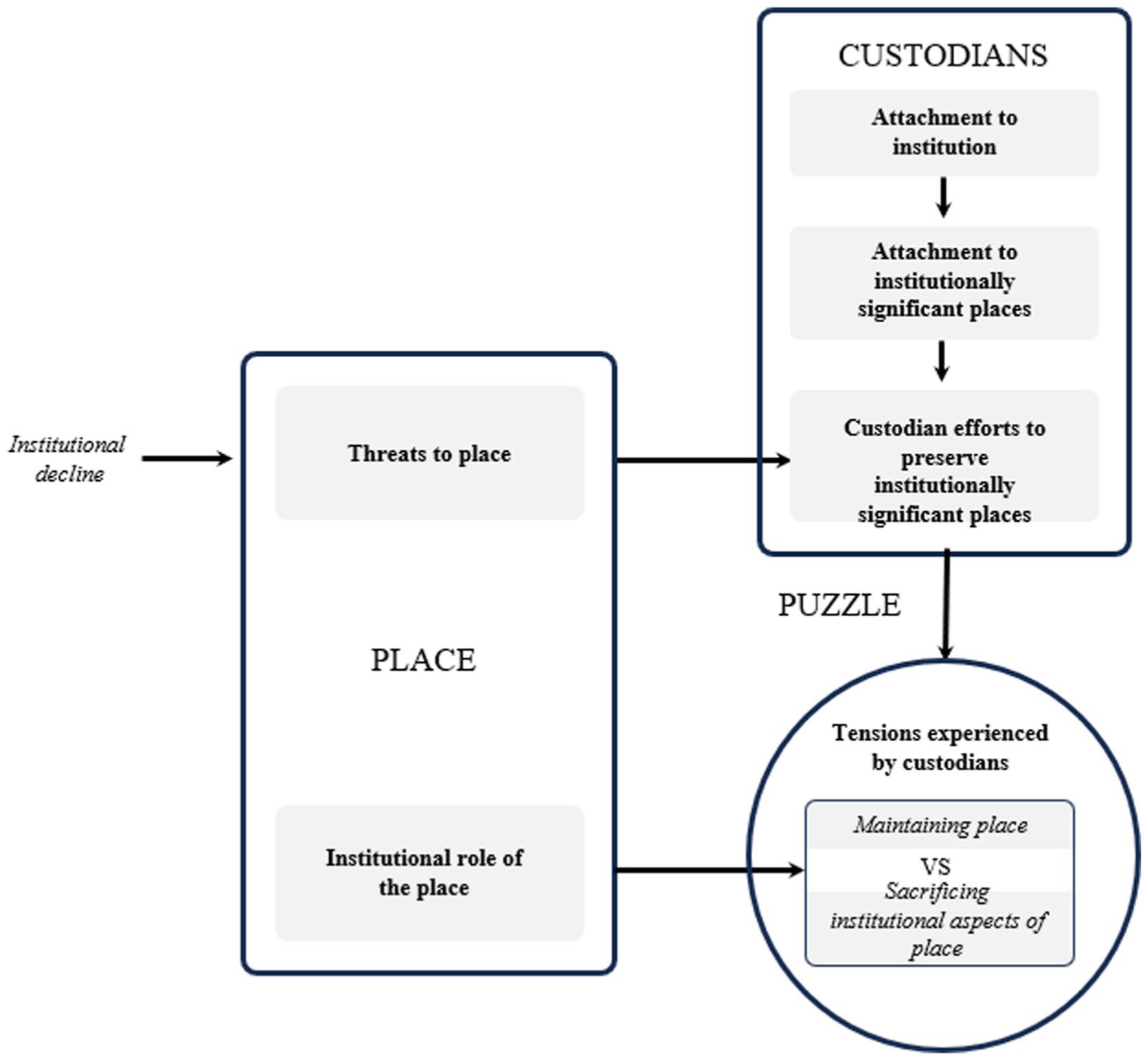
Theoretical Scaffold: How Custodians Experience Tensions when Institutional Decline Impacts Institutionally Significant Places
Methodology
Research Context: Christian Religion and Church Buildings in the United Kingdom
Sacred church buildings are places for the production and preservation of predominantly religious values, beliefs, and practices (Clark, 2007) and are a focal point for institutional custodianship since they are deeply embedded in Christian religious heritage. Understanding custodians’ efforts to maintain and use these places is critical when dealing with the impacts of institutional decline manifest in the dwindling number of people declaring their religion to be Christian, and an increase in people declaring that they do not follow any religion (Census, 2021). The decline in Christian beliefs is especially evident in fewer congregants (Eames, 2024) and deterioration in the physical condition of increasing numbers of church buildings (National Churches Trust, 2024).
The institutional decline of Christian religion in the UK is not a recent phenomenon (Gill, Hadaway, & Marler, 1998) and has been attributed to several social and cultural trends, such as dissatisfaction with the form and content of conservative religious worship, secularization, and demographic change (Clark, 2007; Cooper & Goodhew, 2017). The institutional decline in belief in Christian religion in the UK is further manifest in less frequent worship services and reduced offertory (Burton, 2007; Church Buildings Review, 2015; Davie, 2015; National Churches Trust, 2020, 2024), and these trends are especially acute in rural areas (Taylor Review, 2017). The decline in congregation size impacts the capacity of clergy and communities to raise funds for church building maintenance and management. Additionally, many churches have closed, particularly in rural and remote areas, due to the high cost of church building maintenance and lack of skilled assistance to maintain them (Church Buildings Review, 2015; National Churches Trust, 2024; Taylor Review, 2017). Appendix Table A1 presents evidence of decline in belief in Christian religion in the UK.
Despite the institutional decline in Christian religion in the UK, 83% of British adults believe church buildings serve an important societal role (National Churches Trust, 2016). A recent study noted strong public backing of preserving historic churches (Historic England, 2025), and public “willingness to pay” to preserve religious buildings was slightly higher than for museums (Lawton, Fujiwara, Mourato, Bakhshi, Lagarde, & Davies, 2018). The presence of a church building in a rural setting is considered vital for nurturing congregational bonds that affect life satisfaction (Lim & Putnam, 2010), as well as for producing cultural (Fotaki, Altman, & Koning, 2020), communal (Clark, 2007), local (National Churches Trust, 2024), and civic identities (Braunstein, Fulton, & Wood, 2014; Lichterman, 2008). It has also been suggested that worship services and community activities hosted in church buildings strongly contribute to keeping communities together (National Churches Trust, 2020).
Beyond religious worship and spiritual guidance (Braunstein et al., 2014), church buildings have also been places for community outreach (Crosbie, 2022; Delgado, 2024; Miller, 2011). More recently, church building custodians have sought to deploy them to generate income to finance church building maintenance and management (Walter, 2014). Structural alterations to accommodate new practices have been required in older church buildings (National Churches Trust, 2024), and where refurbishments have enabled new practices adoption in church buildings, they impact the physical and aesthetic attributes of a sacralized place (Church of England, 2018). Prior research has shed some light on new practices in church buildings. For example, Staral (2000) examined an urban church that responded to neighborhood decline and a dwindling congregation and noted how a newly appointed church minister introduced new religion-related activities and rallied protest against the deteriorating neighborhood. Similarly, Plowman, Baker, Beck, Kulkarni, Solansky, and Travis (2007) documented how younger congregants initiated a breakfast program for the homeless within a church building. Senior members of the congregation first opposed this initiative, but as the church profile was raised and more worshippers joined the church community, their views slowly changed. Our research extends this prior work, and is motivated by the research question: How do custodian groups respond when institutional decline impacts institutionally significant places?
Data Sources
In collecting our dataset, we approached fieldwork with the requirements in mind of a processual perspective (Cloutier & Langley, 2020) and empirical richness (Cassel & Symon, 2004). Geographically, the church buildings for this study are situated in the counties of Cambridgeshire and Norfolk in the East of England. To develop field sensitivity, authors 1 and 2 visited church buildings and participated in traditional and innovative worship services and community practices. Intrigued by the extent of differences between the church buildings and how they were used, we progressively refined the scope and nature of our qualitative data collection to address our research question. To ensure alignment between our research question and data collection, we considered the material characteristics of the church buildings and their institutional significance for Christian religion. Working with the Diocese of Ely 1 , the research team were introduced to custodians responsible for the maintenance and management of church buildings located in rural communities. Data was collected from four sources (Table 1). Information about a church building was acquired from documents gathered prior to field visits, and from church and community websites, e.g., newsletters, magazines, minutes from parish council and PCC meetings, and church social media outputs. The documents provided rich information about past, present, and planned church buildings use. Our desk research helped to sharpen the research focus and refine the interview schedule (Bryant, 2017).
Data Sources
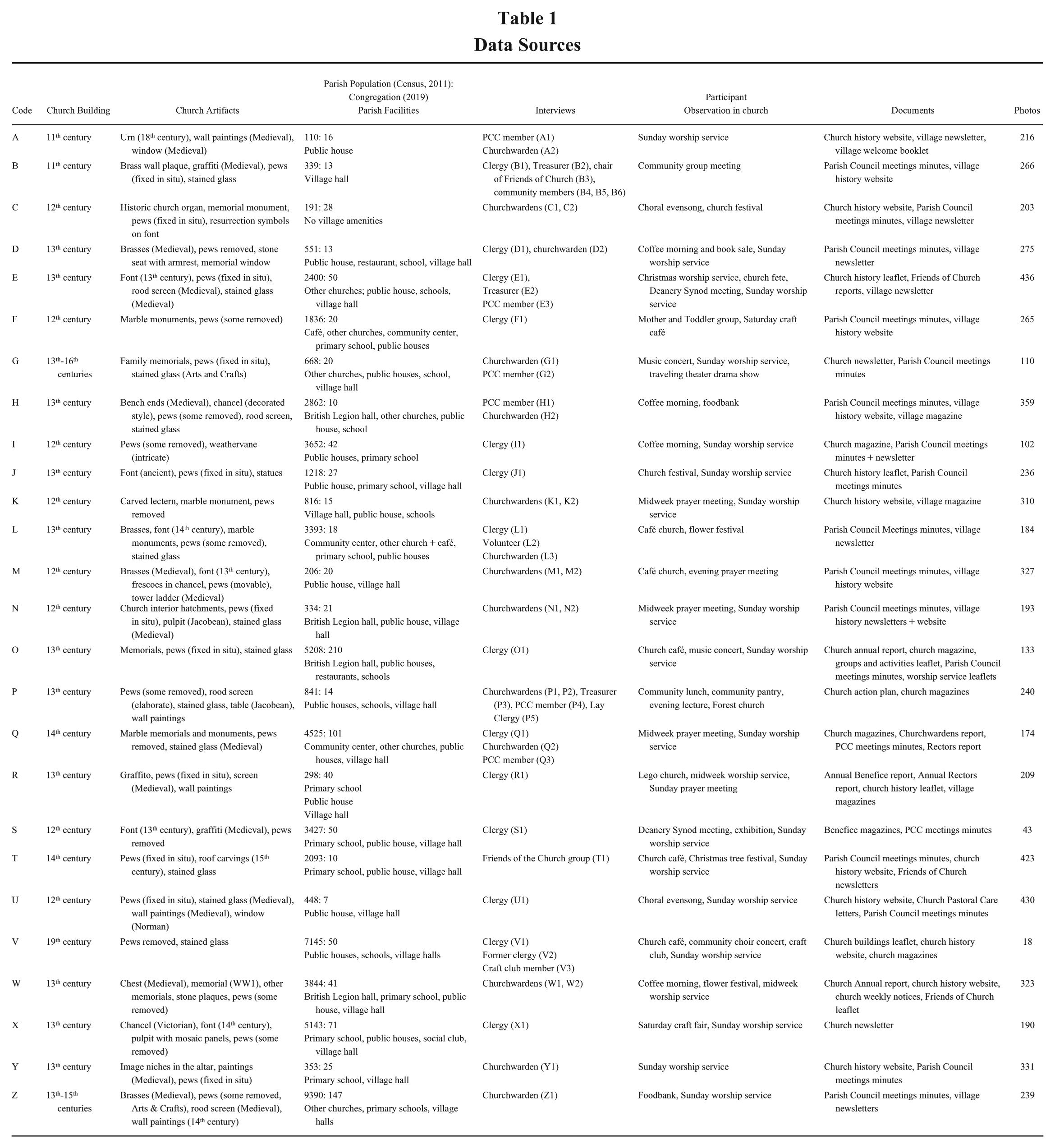
Second, semi-structured depth interviews (Charmaz & Belgrave, 2014) were conducted with 26 custodian groups, comprising 53 clergy, congregants, and volunteers and 44 informal conversations with congregants and community members. The interviews were scheduled for 60 minutes, and all were extended into informal discussions and a tour of the custodians’ church building(s). The shortest interview was 49 minutes and the longest extended to 95 minutes. The aim was to stimulate custodian narratives about Christian religion and how church buildings had been used over time, and the interview schedule included questions about the history and condition of the church building, its management (activities organized in church buildings, fundraising), community (engagement, events, volunteers, community values), and challenges associated with, and lessons learned from looking after a sacred building. We ensured that the informants provided retrospective and longitudinal accounts of how they contemplated change (Dawson, 1997), and we interviewed participants at different points in time over a four-year period. All the interviews were recorded and transcribed, and the informal conversations written up in field notes within 24 hours of field work.
Participant observation data is particularly important in contexts in which places hold a strong symbolic role vis-à-vis the institutional arrangement (Jones & Massa, 2013; Siebert, 2024; Siebert et al., 2018) and is especially useful for obtaining longitudinal data to develop a processual account (Dawson, 1997). The authors carried out 86 hours of participant observation at worship services and community practices, e.g., church festivals, drama performances, and choral concerts. Field notes on the physical structure of the buildings, layout, and sensory data were digitally recorded on site and transcribed within 24 hours. To systematically capture sensory data, we used a structured observation protocol in our field notes that included prompts (e.g., sound, temperature, lighting, smell, color, touch, and humidity) for documenting specific sensory experiences. For example, we noted our acoustic experiences, such as silence, quietness, and the reverberation of voices in the church building. Temperature variations were noted in observations about interior heating and comfort, and the ambience of each church was assessed by considering the lighting and smells, e.g., incense, damp, and coffee. These sensory observations, integrated with other data, helped us understand how the sensory component shaped the church building user experiences.
We employed participant observation to build expert knowledge of church buildings and their connection to the institution of Christian religion and employed this knowledge in the interviews to encourage informants to elaborate on their experiences of how they managed and used “their” church building. This enabled us to focus our interview questions on the specific material characteristics of the church building at each field site, and how these characteristics influenced custodian deliberations about what to do with, and how to maintain, their church building.
Finally, it was evident that our research inquiry needed to include data about church building architecture and artifacts as they embody the history of the community wherein each is situated. To collect visual data, we took approximately 6,000 photographs of church buildings and community practices during our field work. Photographs provide a visual record of material reality (Collier, 1967; Konecki, 2020) and convey the sensory richness and human use of the built environment (Rose, 2016).
Data Analysis
We began our analysis by using the primary data to write a case study about each church building in our sample. The case study narratives documented the history (from the foundation of the church building to present) of each participating custodian group and their church building. In collaboration with our informants, the text for each case study was approved by them, professionally formatted, illustrated with photographs taken from the field sites, and then gifted to them in exchange for their participation in the research. The individual case studies provided us with a base to understand the changes (or lack thereof) made by custodians to their church building and served later as a prompt to probe potential contradictions and counterintuitive choices made in response to institutional decline.
At the same time, we commenced deeper analysis of the documents, interview transcripts, and field notes following the principles of grounded theory (Charmaz & Belgrave, 2014; Glaser & Strauss, 1967). Our analysis proceeded from empirical and theoretical memo writing (Lempert, 2007), to open, first order coding, then conceptual coding, leading to the abstraction of aggregate theoretical dimensions (Saldaña, 2013). To analyze the photographic data, we adopted a visual analysis framework that complemented our interview coding and observational data (Holm, 2020). The photographs were systematically cataloged by location, church name, date, and subject matter, ensuring that they could be cross-referenced with corresponding interview transcripts and field notes. During the initial review, photographs were sorted into thematic groups of environs, exterior, interior, fittings (e.g., pulpit, seating, and stained glass), artifacts (e.g., medieval wall paintings and décor), and community events (consent secured from subjects to be photographed). The photographs were then coded thematically (Rose, 2016) and linked to specific narratives from custodians. For example, photographs of modified seating arrangements were analyzed in the context of custodians’ narratives about resource constraints and new practices, and images of stained glass and lighting conditions were linked to discussions about the sensory atmosphere (e.g., how light influences the church building ambience). Thus, photographs were helpful in analyzing sensory data by providing visual evidence (Quattrone, Ronzani, Jancsary, & Höllerer, 2021) of church building material conditions and activities. By linking photographs to interview data and field notes, we triangulated our interpretations of custodianship behaviors, e.g., custodians’ descriptions of temperature in the church building were supported by visual evidence of heating systems. The analysis of visual and sensory data enriched our understanding of custodians’ perspectives on and experiences with maintaining and managing church buildings.
Moving between our knowledge of institutional custodianship and place theories, the rich empirical data and emerging themes (Sætre & Van de Ven, 2021) made it clear that custodians’ attachments to institutionally significant places were critical to motivating their responses to institutional decline that impacts such places. A surprising finding emerged when we noted that custodians’ responses within and across our case studies were more varied than the homogeneity found in prior custodianship research. Following these first clues, the iterative and inductive analytical process unfolded in two phases.
Phase 1: Initial analysis of custodian interaction with place
After the interviews at the first field site had been transcribed, the authors independently analyzed the transcripts, participant observation field notes, photographs, and documents and identified noteworthy words and phrases about custodians and their relationships with and the practices organized in church buildings. The authors then discussed their respective open coding and theoretical and empirical memos and explored themes of interest. Prominent in this first round of coding were custodians’ experiences of tensions between upholding institutionalized and innovating new practices, which required us to ensure that we could trace visible place and practice related outcomes for a church building from such experiences. The photographs and sensory data were used to triangulate our understanding of custodian actions towards place, and what drove custodian motivations and attachment to the place. Weaving this into our analysis, open codes were grouped into provisional first order codes. We clearly saw that our data and first order codes could be temporally chunked (Berends & Deken, 2021) and recognized a temporal pattern in how custodians managed places impacted by institutional decline. The pattern commences with experiencing tensions in how places are used, followed by deliberating and evaluating current and potential place and practices alterations. The interview schedule was reviewed and questions were refined to capture those tensions and their implications before continuing with empirical data collection.
To accomplish the next step of theorization, we found it useful to return to the custodianship literature and specifically to understand the link between custodianship and institutionally significant places. Our interpretation of custodians’ accounts of place-based tensions, deliberating and evaluating, and custodian action was informed by the analytical grid of Lefebvre, which acknowledges the connections between material and social dimensions of place (Lefebvre, 1974/1991; cf. Giovannoni & Quattrone, 2018; Rodner et al., 2020). Following the data collection from custodians of the second church building and field site, the authors repeated the analytical cycle described above, endeavoring to understand whether the tensions experienced, and custodian responses were similar or differed. This analytical pattern was refined and reiterated after each field site visit and interviews until theoretical saturation (Glaser & Strauss, 1967) was achieved.
Phase 2: Analysis of the broader corpus, and interconnections between custodians, institutional decline and institutionally significant places
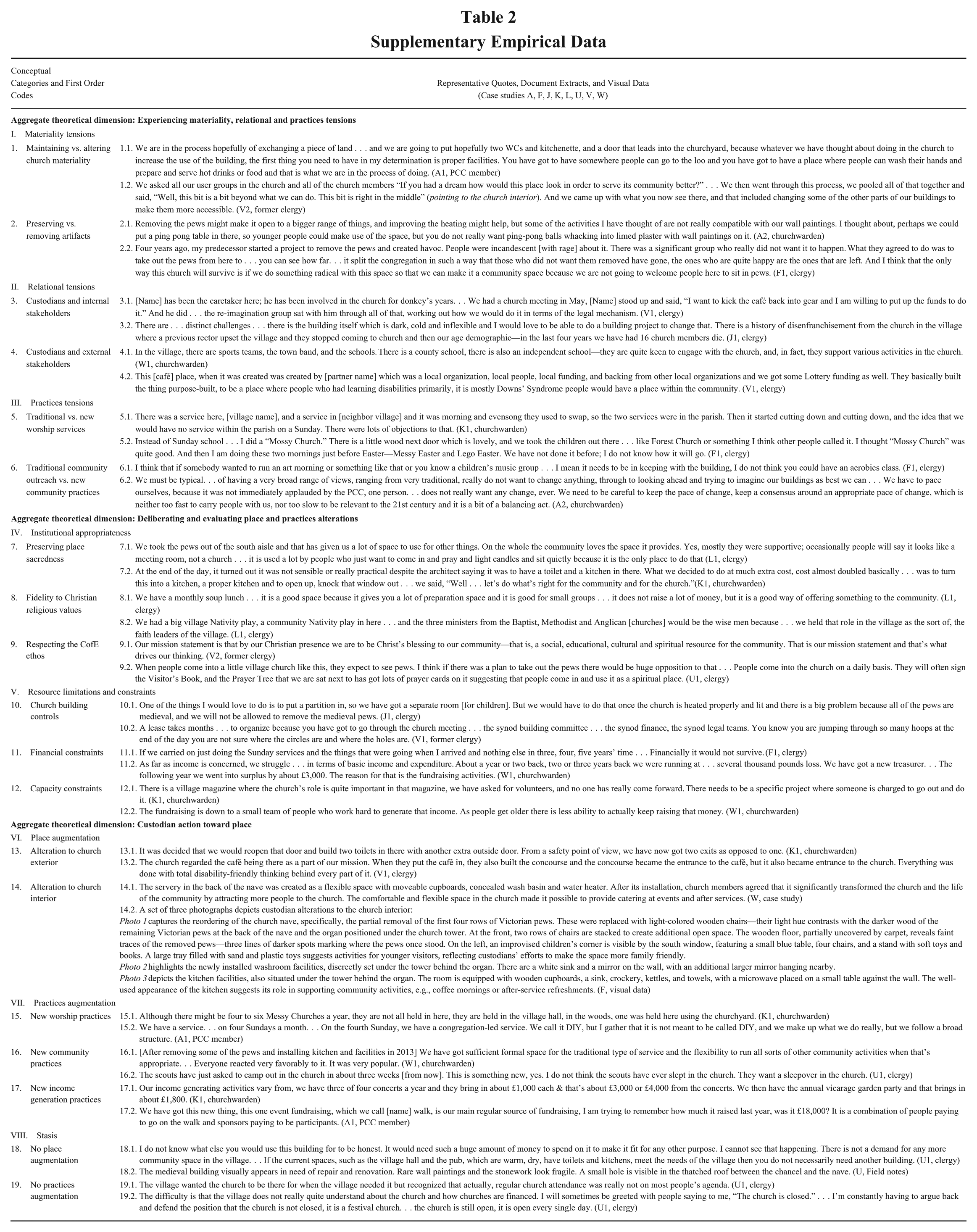
As we expanded data collection and furthered our analysis of how custodians respond to institutional decline that impacts an institutionally significant place to which they are attached, we were better able to understand why and the extent to which a church building had been altered and to distinguish between more and less surprising place and practices alterations. To capture the processual nature of custodian responses to institutional decline that impacts institutionally significant places, our analysis involved scrutinizing the data from custodian actions toward places back to their motivations, and from custodian responses to institutional tensions forward to their actions toward place. In sum, we could connect more clearly the influences and outcomes through backward and forward analyses (Wiedner et al., 2024). We iterated between our corpus and existing research on institutional custodianship and place and found that extant theory fell short in explaining how custodian attachment to a place motivated their active responses toward the place and/or the practices associated with it. We worked collaboratively to agree on first order codes (n = 19) and develop conceptual category codes (n = 8) (Figure 2). In this analytical phase, while maintaining our focus on custodianship, we coded for how custodians sought to preserve institutionalized practices and differed in their openness to adopting new practices. An important surprise was that some custodian groups responded to institutional decline by not adapting the church building or adopting new practices. We asked ourselves: How could custodians decide not to do anything about preserving a place they were so attached to? In such cases, we could observe how custodians were torn between adherence to the institution of religion and the sacred nature of place, the opportunity to deviate from long-standing material aspects and practices in their church building, and resource availability. To capture the differences between custodian responses we identified, we theorize a three-phase custodian response process of experiencing institutional materiality, relational, and practices tensions, followed by deliberating and evaluating place and practices alterations, leading to custodian action toward place. A detailed exposition of these dimensions is provided in the following section. Supplementary empirical data are presented in Table 2 and Appendix Table A2. Table 3 presents a summary of first order codes and response outcomes per case study and portrays the connections between the three phases of our model (tensions, deliberations and outcomes across our case studies.
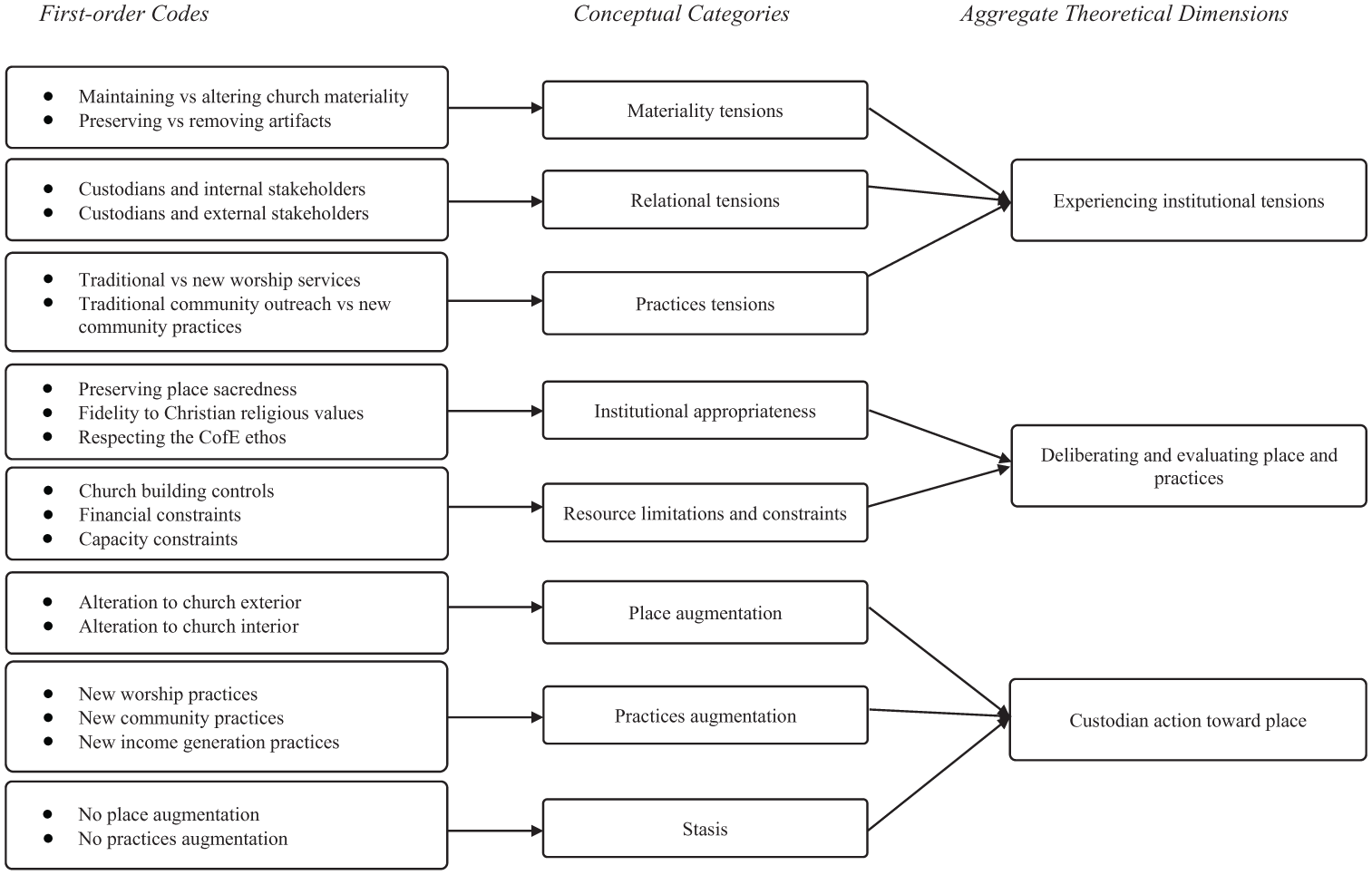
Data Structure
Supplementary Empirical Data
Custodian Actions and Response Outcomes
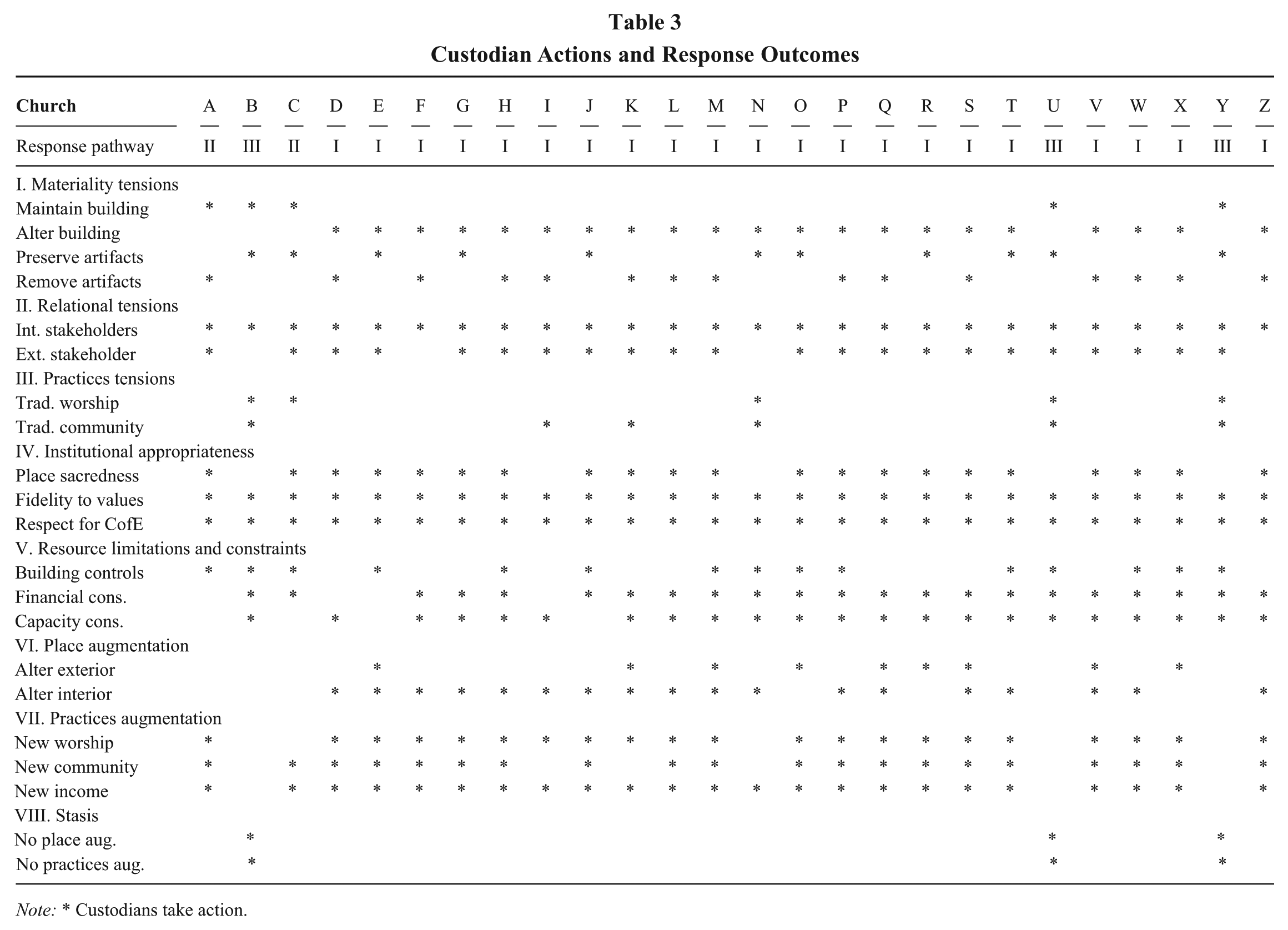
Note: * Custodians take action.
Findings
Our processual model depicts how custodians respond to institutional decline that impacts institutionally significant places to which they feel an attachment (Figure 3). We propose that responding to institutional decline proceeds in three intertwined, yet distinctive phases, from the custodians experiencing tensions, evaluating and deliberating, and ultimately taking action toward place. Each phase demonstrates custodians’ considerations of the institutional significance of place and practices.
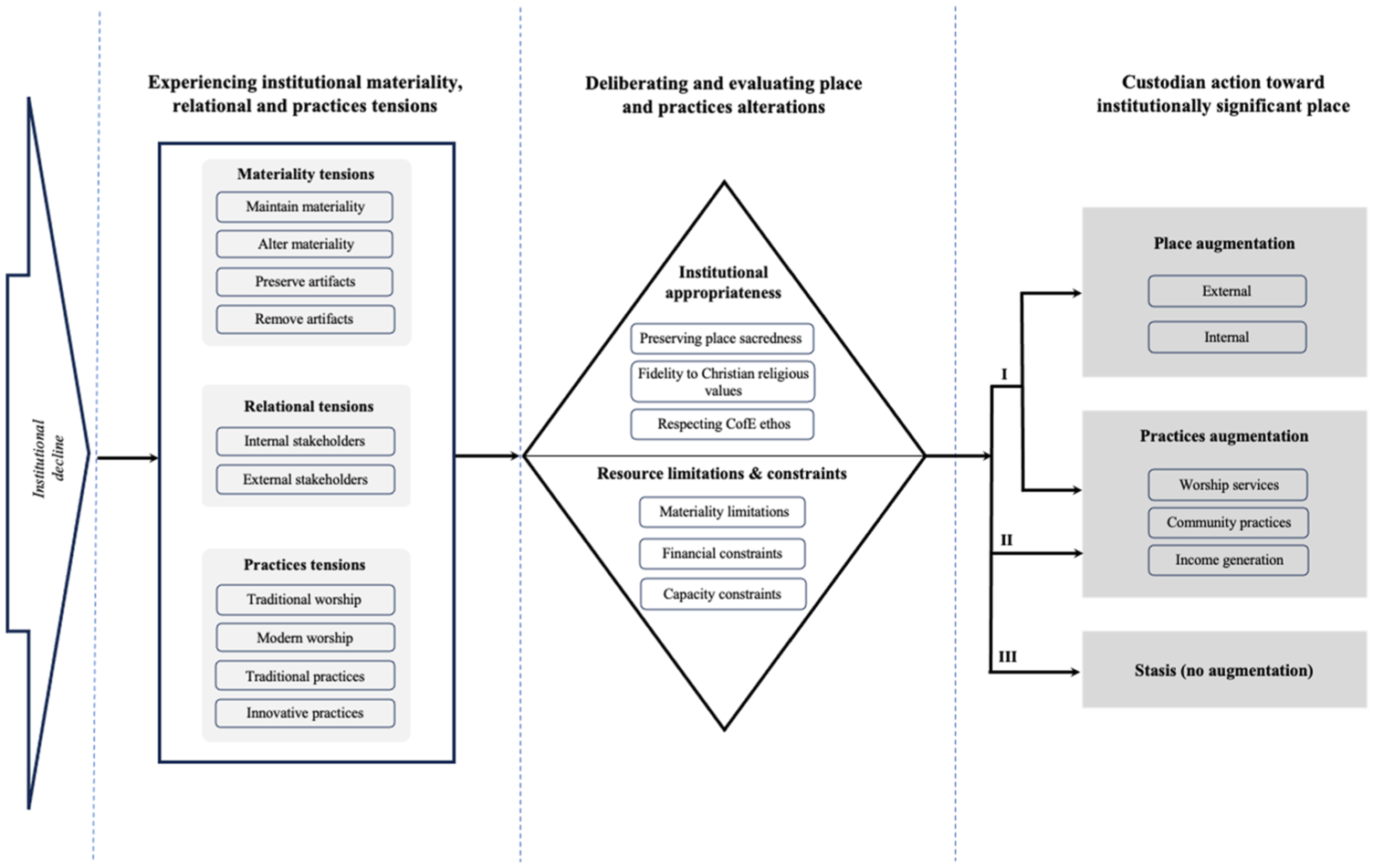
Process Model of Custodian Responses to Institutional Decline
In the first phase, we explain how custodian responses begin when their vested interests in an institutionally significant place make them aware of how the declining strength of an institution impacts that place, putting it at risk, in our context, of abandonment, deconsecration, and repurposing. This leads custodians to experience tensions about the materiality of and practices organized within the place they cherish and to contemplate what might be done to preserve such places. The tensions stem from the institutional significance of church buildings, as the institution of religion imposes expectations and constraints on how these sacred places are used. We theorize three types of tensions: Material tensions relate to the physical characteristics of the building and the artifacts within them; relational tensions concern the different views of the custodians on the changes they deem to be acceptable, varying from preserving to altering places and practices; and practices tensions relating to the practices they deem to be appropriate in such sacred places.
In the second phase, custodians aim to resolve those tensions by deliberating and evaluating place and practices alterations and ultimately decide what to do with an institutionally significant place impacted by institutional decline. How the tensions might be resolved is considered by custodians in relation to the extent to which they judge any alterations to be institutionally appropriate and feasible considering resource limitations and constraints. In practice, this is evidenced, for example, when custodians experience tensions associated with adopting new practices, such as organizing wellness classes inside a place of Christian worship. In some of our case studies, custodian perceptions of institutional inappropriateness as well as resource limitations and constraints prevented new practices adoption.
The third phase of the process model depicts three outcomes for institutionally significant places, consequential to custodians experiencing tensions and deliberating and evaluating place and practice alterations. Place augmentation describes alterations to the external physical structure and internal features and layout of a place (such as the installation of food preparation, hospitality, and washroom facilities). Practices augmentation entails the adoption of new activities in a place (such as new, and more modern, worship services and income generating activities). The third outcome of neither place nor practices augmentation we label stasis, which describes no custodian action to alter the place and institutionalized practices. When custodians opt for stasis, the impact of institutional decline on institutionally significant places proceeds unabated. We identified three response outcomes in our sample: practices augmentation (2 case studies); place and practices augmentation (21 case studies); and neither place nor practices augmentation (3 case studies). Below we present our findings, illuminated with supporting empirical data, using codes for our church buildings and informants.
A church building within a community stands as a tangible and historic national emblem that instantiates the former institutional strength of Christian religion in the UK. In this section, we draw on a subset of case studies (Berends & Deken, 2021) to facilitate explanation of the processual nature of custodian responses to institutional decline that impacts institutionally significant places: practices augmentation (church C), material and practices augmentation (churches E, N, O, S, T, and Z), and stasis (no augmentation) (church B). Our case study analysis explained how custodian groups—comprising clergy, congregants, and volunteers—were motivated to act by the inescapable evidence of how institutional decline impacted their church building. The dwindling congregations at the Sunday worship service, the focal institutionalized weekly practice, was a key issue raised by custodians. A custodian summarized the precarious state of this institutionalized practice: “Things have just changed . . . There is one Sunday when we do not have any services here . . . Life and the community is a very much more secular affair than it ever used to be . . . And the church as an institution can be at, at odds with that” (N2, churchwarden). Field observations of Sunday worship services noted congregation sizes of 10 (church T, village population 2,093) and 28 congregants (church C, population 191). Attendance at festival services was larger, for example, the Easter festival worship was celebrated by 200 congregants (church E, village population 2,400 people). The relatively small congregations demonstrate the impact of institutional decline on institutionally significant places and below paint a diminishingly optimistic outlook for the survival of church buildings as carriers of belief in Christian religion in the UK, and how the prospect of church building closure motivated custodians to respond to preserve them for institutional purposes: [If the church were to close] there would be dismay because although we may not have regular attenders, the fact that [the church] is here and people can choose to be married here, to be christened, to be buried—and people do choose to do that—and we do have a link with the primary school in the village . . . they always come for their Christmas carol festival. (T1, Friend of the Church)
Experiencing Institutional Materiality, Relational, and Practices Tensions
In the context of church buildings maintenance and management, motivations to address institutional decline arose from custodians’ perspectives on the institutional role of the church building and its potential for “augmentation” beyond institutionalized practices, such as adopting new practices to generate income for preserving the building. Not all custodians shared the same view about the extent to which church buildings should be modernized and new practices adopted. From our data we find that custodians experience tensions relating to materiality, relationships, and practices.
Materiality tensions encompass custodians’ deliberations over whether to maintain or alter the physical structure of the church building and whether to preserve religious artifacts in situ or remove them from the interior. Custodian groups at churches B and C prioritized preserving their church buildings in their original form. At church B, dating from the 11th century, the custodians discussed how the ancient structure impacted negatively on the feasibility of adopting innovative practices in the building. Even though place materiality prevented the adoption of new practices, the custodians remained committed to preserving the place as an institutional carrier. For example, the custodians reduced the frequency of worship services from weekly to six Christian festivals per year. Although this action decreased their annual financial outlay and offertory income, the openness of the church building was maintained for private worship: [We have] been struggling because of a very small congregation . . . of 4-5 people . . . Elderly congregation and we had a serious discussion about the future of the church. And it is very hard to use this building as a community-builder—there is no water . . . The two options we have got are either to try and maintain it as a festival church or to close it. Being right in the middle of the village, the last thing we want to do is to close the church. (B1, clergy)
At church O, the importance of the external visual appeal of a church building was highlighted when custodians expressed their aspirations for making their church more “transparent,” less intimidating, and welcoming to the community. There were unresolved tensions between the clergy and the PCC concerning the extent to which to alter the church entrance at an historic 13th century church: At the moment, we have an action plan and one of the key points of our action plan is about accessibility. So, some of the outcomes of that accessibility plan, I think, involve reordering of the church. There is also some momentum, but really it is the PCC who will need to take that decision to move that forward. It has not done that yet . . . One of my ideas was to have a glass porch [and] glass doors. Because they are heavy oak, you cannot see what is going on inside. (O1, clergy)
Materiality tensions faced by custodians arose from the need to balance preservation of the historical condition and institutional significance of the church building with practical adaptations to facilitate modern day expectations and use. To address such material tensions, custodians engaged with their local community to find out their views about the church building. For example, the results of a community survey conducted by custodians at church C were instrumental in delineating the course of action. Survey respondents were presented with three options: (1) repair the church building without altering the interior; (2) repair the church building and reorder the interior; and (3) take no action and allowing the church building to deteriorate. The consensus from respondents was in favor of option 2, however, lack of resources prevented this option, and no action was taken (option 3).
Custodians grappled with questions about how far they could deviate from historic, architectural designs and interior layouts while still honoring the religious integrity of the church building. In our subset of case studies, six custodian groups made material adaptations to their church buildings. These adaptations ranged from major alterations, such as installing a new entrance porch (church E) and mezzanine rooms in the church towers (churches N, S, and Z), to interior refurbishments, such as clearing an aisle to create space for a children’s corner (churches E and Z) and installing food preparation, hospitality, and washroom facilities (church T). As we explain in the next section, institutional appropriateness and resource limitations and constraints impacted on custodian group decisions regarding alterations to the church building. Despite these considerations, custodian groups navigated such tensions to ensure that their church building remained institutionally significant, relevant to the needs of their local communities, and respected its material integrity.
Prominent in our data are custodian concerns about the fragility of church artifacts, which in turn fueled their enthusiasm for conservation. This concern is heightened by the impact of institutional decline on the fate of religious artifacts and tensions associated with preservation in situ or removal of artifacts from the church building interior. Notably, medieval graffiti carvings (church B) and wooden angels in the unique single-roof double-nave church (church T) are of national historic significance, and hatchments (church N) are treasures with local significance. These ancient artifacts are costly to repair, and their preservation in situ prompted custodians to consider how to raise funds for their maintenance. A notable church artifact is the pew—fixed wooden seating positioned for the congregation to face the sanctuary—and materiality tensions were found in conflicting views about pew removal and replacement. For some custodian groups, pews constrained how a church building could be used, as they take up most of the central space in the building: “we do find when we have social events . . . that the logistics is difficult, with having people in the pews, to move around serving food” (C1, churchwarden). Yet for other custodians, pews evoke the unique church ambience: If you asked most of the old [village name] people they would say, “Leave it as it is” . . . Having worshipped in churches with comfortable seating and carpet on the floor is absolutely wonderful. But obviously you then do not get the same medieval feel that you get here. (N1, churchwarden)
Tensions were also noted within custodian groups regarding the presence and impact of church fittings. A custodian explained how he had encountered resistance from community members when he proposed what appeared to him to be a simple action of fixing cup hooks into the organ loft timber work: “I’m only putting two cup hooks and I’m just doing it. And if you want to shout at me, well, shout, and that’s where we have to be good stewards of this wonderful building” (Z1, churchwarden). In this example, the community sought to preserve the organ loft timber work, whereas the custodian sought minor alterations to that timber that would facilitate how the building was used.
To meet community requests for facilities to display photographs during wedding ceremonies, the custodians at church Z had installed five screens inside the church. The largest was attached to the rood screen, an ornate partition between the chancel and the nave; referring to the largest screen, a custodian said, “The only place it can go is on the rood screen. It attracts nothing but contempt . . . Our detailed knowledge of the rules is no, it is temporary . . . the technology is not available for us to have a better solution” (Z1, churchwarden). The installation of the screens inside the church building had thus provoked strong negative reactions from some members of the community.
In some locations, custodians self-organized into a Friends of the Church group, typically established by stakeholders with a shared interest in preserving and maintaining a church building to which they feel an attachment. At church C, while the custodians had considered setting up a Friends group, it was not practical because the impact of institutional decline meant that there were too few people from the congregation to organize such a group. Because it was the only community gathering place in the village, custodians from church C formed an action group with community members who aimed to improve the church building in the future by constructing an external space for a washroom and “squeeze in a food preparation” area inside the church building. The relational tension here concerns the custodians’ aim to preserve the church building, and the community aims to alter it to increase its potential for community use.
Relational tensions also arose in connection with future church building development projects that had the potential to benefit the wider community but required significant funding to proceed. At church O, the vicar explained that after attempting to work in partnership with the local authority on a church building development project, differences in their views about how to fund and manage the project led the custodians to step back from collaborating with this external stakeholder group. This relational tension had, however, ultimately helped to foster greater cohesion between custodians and the local community: We had a discussion with the local council, and they said, “We will work in partnership with you if you give us the title deeds to the site, we control who uses it, and you raise £250,000 to develop it.” I said to them, “You must be joking, that is not a good deal for us.” At that point, we decided to do it alone . . . It is a strange thing to say but actually working alone and not in partnerships is really important. We did a lot of listening at that stage to the community for what they wanted in a building like this, and there were lots of surveys and things, but the key thing was deciding to do it alone. (O1, clergy)
Similarly, custodians at church Z concluded that “the easiest and best way” (Z1, churchwarden) to operate a foodbank was to do so independently, rather than joining a national network of foodbank distribution centers. Instead, the church partnered with parish council, local schools, health organizations, and voluntary groups to collect and distribute food parcels locally. In another instance, custodians at church B, keen on progressing toward downsizing into a festival-only church and establishing a village trust to maintain the church building, sought guidance from external legal advisors. However, following their advice, the custodians decided to proceed with caution, leading to a slower pace of change when compared to church Z.
I would like to be able to have the skill to persuade older people in the community that the ideas that we are discussing here are of benefit. Because I do find that some people who have lived here for many years are opposed to any change. I wish I had the wherewithal to be able to persuade them that they should think a little broadly about what is of benefit for the whole community. (C1, churchwarden)
More success at introducing modernized worship services had been achieved by other custodian groups, and these had increased their congregations by appealing to different demographic groups (churches E, O, S, T, and Z). At church Z, a music band had replaced the traditional choir at Sunday worship. Similarly, a less traditional worship service for all ages was organized at church O which offered informal times of worship, modes to participate (e.g., active, creative, reflective and prayer), and varieties of indoor and outdoor services for families with children. Custodians had deliberately chosen to make services less Sunday-centric: “There is a lot of people who do not want to come on a Sunday, so we developed the mid-week service” (O1, clergy). Not all worship practice changes had been successful. For example, a once-popular service with interactive game activities tailored for children had been discontinued due to interest decline (church N).
While church buildings have also long been the place for community outreach practices, the prospect of introducing new practices necessitated sensitive handling, particularly in connection with the potential impact on church building ambience. For example, while custodians at Church E sought to maintain the quiet ambience of their church building, the impact of institutional decline meant that there was insufficient income from the congregation to maintain the fabric of the church building. Adopting new practices would help to generate resources to maintain the church building but also impact the quiet ambience associated with worship, prayer, and reflection: [There are] people who use it every day just for quiet space. Maintaining it as that quiet space is significant because that can be its USP [unique selling proposition]. I think in this context its USP is primarily as a church, as a slightly different space . . . It is away from the hustle and bustle, somewhere you can go and have a think. (E1, clergy)
The materiality, relational, and practices tensions outlined above are the starting point for custodians to respond to institutional decline and illustrate the divergence in custodians’ divergent responses across our case studies. These tensions relate to differences between how custodians consider preserving and/or altering church buildings, artifacts, relationships with stakeholders, and worship and community practices. As explained in the next section, custodians employed two processes to assess future place and practices alterations.
Deliberating and Evaluating Place and Practices Alterations
We found that the second phase of responding to institutional decline that impacts institutionally significant places was activated when custodians reacted to the tensions described in the previous section. We define the deliberating and evaluating phases as custodian consideration and assessment of solutions to material, relational, and practices tensions. Custodians engaged in deliberating and evaluating processes based on their perceptions of institutional appropriateness and resource limitations and constraints.
Contemplating institutional appropriateness
Aiming to stave off the threat of church building closure, custodian evaluation of how to make the church building more amenable for community use and income generation was first filtered through the prism of institutional appropriateness. This lens was adopted to ensure that any place and practices alterations were aligned with preserving place sacredness, fidelity to Christian religious values, and respect for the CofE ethos. Our analysis finds that institutional appropriateness is employed when custodians deliberate and evaluate place and practices alterations for potential clashes with upholding institutionalized religious values.
First, we consider preserving place sacredness in relation to deliberations about alterations to the physical attributes of a church building. At church N, for example, custodians expressed their resistance to the pews being removed, which they feared would compromise the “feel” of the church when used for traditional Christian worship services. Moreover, keen to enhance the church building ambiance, the custodians decided to reposition the kneelers—cushions used for comfort when congregants kneel during prayer—from being positioned under the pews and therefore out of view, to display them prominently on the top of the hymn bookshelves of the Victorian pews. Embroidered with religious iconography and local folklore, the visual appearance of the kneelers filled the interior with color: “It makes the whole place look friendly” (N1, churchwarden), thereby increasing the church building’s attractiveness as a place of religious worship. At church O, custodians supported the removal of pews as they believed that doing so would enhance the attractiveness of the church building to the community, making it a place for new practices. Further, alterations to improve heating and reordering the interior for smaller worship services were supported by custodians as ways of increasing the congregation size and use of the church building (church O). In contrast, custodians at church C could not agree on how to persuade the elderly congregation to embrace more flexible church building spatial configuration.
A second dimension of institutional appropriateness concerned fidelity to Christian religious values and community relations. Organizing physical exercise classes to improve community health and strengthen connections between the Christian church and the community became possible at church S only after resolving tensions regarding maintaining Christian values. After consultation with the community, the custodians arranged for the fixed pews to be removed and replaced with chairs, thereby creating a more flexible and multi-functional church building interior. The newly created interior space was used for activities, e.g., Active Seniors, dancing classes, and Pilates. In contrast, hosting Pilates in a church was frowned upon by custodians of other church buildings since, on their view, leisurewear was deemed immodest and inappropriate in a church building (churches B and E). This matter was resolved by either finding another venue or not proceeding with the new practice. For example, custodians organized senior wellness groups, yoga, Zumba, and Pilates in an adjacent church center (church O). The association between the church center and fidelity to Christian religious values was, however, maintained in expectations of respectful participant leisure attire.
Finally, custodians ensured that potential new income generating practices respected the CofE ethos. From our participant observation we noted that there were many ways that church buildings could be deployed as places for generating income, and that institutional appropriateness imbued how custodians deliberated and evaluated such options, especially when new practices challenged long-standing Christian norms and values. Requests to host activities organized by groups that did not share the Christian ethos were declined: “We would not allow an extreme political group in here. We are a bit iffy about making room for a doctrine group” (S1, clergy). While a list of unsuitable practices had not been created by any of the custodian groups in the study, it was evident that community activities that promoted social good were most favored by custodians. In summary, custodians evaluated the extent to which responses to institutional decline that impacts institutionally significant places were aligned with preserving place sacredness, fidelity to Christian religious values, and respect for the CofE ethos. Thus, deliberating and evaluating aimed to strike a balance between preserving the integrity of institutionally significant places and making alterations to increase community engagement and generate income.
Contemplating resource limitations and constraints
As well as considering institutional appropriateness, custodians evaluated the impact of resource limitations and constraints on their responses to institutional decline. We discuss below resource limitations in relation to material, financial, and capacity constraints.
One of the most prominent constraints faced by custodians related to the restrictions on making alterations to an architecturally “listed” building. The designation of a building and its artifacts as listed imposes strict controls on the extent of building alterations and the protection and conservation of artifacts. These responsibilities are carried by custodians who therefore needed to find ways to navigate listed building controls when considering how to respond when institutional decline impacted their church building. Custodians at church E sought to alter the church building to create a meeting room and a new boiler house as this would increase the comfort of the building: “We were not allowed to do that, because of its listed status” (E2, treasurer). Similarly, in the listed church building Z, opening two doors during worship services created a strong draft in the church and negated efforts to keep the interior warm. A proposal from the custodians to install a third door to mitigate the draft was rejected by the local planning authority: “They are very anti-changing the outside” (Z1, churchwarden). In addition, materiality issues such as damp and lack of water supply, as at church N, constrained how a church building could be used, pushing custodians to find ways to address this constraint.
Further, custodians contemplated financial constraints as, since church building maintenance and management are the responsibilities of the community in which a church building is located, this burden had to be addressed by them. In rural areas, the decline in the institution of religion is most keenly felt in the decline in congregation size and church income, and consequent lack of funds to pay for church building maintenance and management. Concerned with such financial limitations, some custodian groups had developed an entrepreneurial awakening and innovated income generation practices to pay for church building upkeep, enabling churches to remain open and in use. Income generation features prominently in minutes from parish council meetings, village newsletters, and annual church reports. The authors participated in fundraising events such as a coffee morning and book sale (church D), church fete (church E), music concert (church O), and church café (church T). All required us to donate to fund church building maintenance and management costs.
Finally, custodian groups encountered human resources constraints when they deliberated and evaluated place and practices alterations. Although custodian groups are responsible for maintaining and managing the church building, the surrounding community is a potential resource for additional help and support. Custodian groups considered the availability of community members to be part of their responses to institutional decline and assessed the presence of skills within the wider community. Skills were perceived broadly, such as practical (building, repairing, and painting), and intuitive, as in knowing “the right people to generate enthusiasm in others” (C1, churchwarden). At church S, a new team of campanologists had revitalized community interest in bellringing, which had then required rehanging the bells and installing a new ringing floor below the tower. This had sparked more enthusiasm and “created a new set of people” (S1, clergy) interested in the church building and its role in perpetuating traditional Christian rituals.
Deliberating and evaluating place and practices alterations play a crucial role in driving, or preventing, augmentation dependent on custodian perceptions of institutional appropriateness and resource limitations and constraints. Custodian deliberating and evaluating helped determine the extent to which external and internal alterations and the adoption of new practices were institutionally appropriate and feasible. Alternatively, when their evaluations surfaced conflicts in perceptions of institutional appropriateness, and resource limitations and constraints impeded action, custodians opted to maintain the status quo. Custodian actions toward institutionally significant places and practices alterations are discussed next.
Custodian Action toward Institutionally Significant Places
The extent to which custodians had experienced materiality, relational, and practices tensions and deliberated and evaluated the institutional appropriateness and feasibility of place and practices alterations led to three response outcomes: place augmentation, practices augmentation, and stasis.
Place augmentation describes alterations to a building’s exterior and interior layout. As well as being the functional place of work, a building in which an organization is situated is a symbolic representation of the values and beliefs of the institution for which it is significant. The ancient church buildings in England’s rural communities lack the facilities of more recently built churches, and whereas some custodian groups sought to preserve their church building’s foundational materiality (churches B and C), other custodian groups responded by investing in updating the exterior. Exterior alterations included renovations to the building’s façade, such as the construction of the new entrance porch at church E. These alterations are a custodian response to institutional decline; they attempt to make the church exterior less intimidating and more accessible and welcoming, and counteract the perception of church buildings as “closed” places. Elaborating on how resource limitations and constraints had previously prevented modernization of the church building, a bequest to the church from a parishioner had enabled the custodians to commission structural alterations in 2007.
Augmentations to church building interiors were designed to increase accessibility, community engagement, and generate income. The interiors of the ancient church buildings in our sample have features that impeded access, such as uneven flooring, fixed pews, and narrow aisles. Prior to levelling the floor at Church E, custodians described their church building as “very unfriendly for people in wheelchairs and so on.” To make the church building more accessible, “they levelled that, and it is level all the way out to the car park, so you can push a wheelchair or a buggy. That was really a big step forward in making it accessible” (E2, treasurer). Other examples of interior augmentation include the installation of new washroom facilities. At church E, the generous bequest that had financed the construction of the new porch, also “gave us the money to seriously think also about building a toilet . . . and we did fund raising for the rest of it” (E2, treasurer). After engaging members of the community to become more interested in looking after the church building, custodians at church S significantly refurbished the interior, installed washroom facilities, and replaced pews with chairs, thereby making the church building interior a more flexible space than previously. Custodian groups at churches O, T, and Z also raised funds and installed new washroom facilities in the church building. Resource limitations, however, were constraints on such alterations. Referring to new washroom facilities, a custodian said, “We did talk about that . . . but the building is not hugely designed for having that, and we know it would be very expensive” (N2, churchwarden).
To foster increased engagement between the church and the community, custodians invested in reordering the interior to create places more conducive for people to meet. Interior augmentations also included, for example, creating new rooms in the church tower (churches N and S). Originally created as places for children to meet during Sunday worship, the mezzanine tower rooms could also be rented to host PCC, Synod, and parish meetings. In other churches, new meetings rooms had been built at the sides and rear of the main aisles (churches O and Z).
The lack of modern facilities inside the church building motivated custodians to invest in alterations that would attract interest from the wider community, as well as generate new income for church building maintenance and management. In 2012, custodians installed food preparation facilities and a utility room in the church building and opened a mid-week coffee shop (church T), serving drinks and lunches. The customers are from the congregation, local community, and visitors to the area, and the coffee shop “raises about £4,000 per year” (T1, Friend of the Church). However, in places where fixed pews were in situ, custodians adopted creative approaches to make use of them. Our participant observation notes recorded how pews were repurposed as makeshift bookshelves for a book sale during a summer fete (church E), placements for decorations at a Christmas tree festival (church T), and locations for storing food when operating a community foodbank (church Z).
Practices augmentation
Further to experiencing tensions and deliberating and evaluating alterations, most of our custodian groups experimented with introducing new practices in the church building. The public café described above at church T could not proceed without the installation of food preparation and washroom facilities. A notable part of the church mission in our study is reaching out to wider communities, especially people that do not attend religious worship services. In this sense, a public café, designed to appeal to a wider population, represents a fundamental shift from hosting religious worship services and conserving religious values and beliefs to explicitly instantiating commercial and entrepreneurial values. For custodians who felt strongly about preserving the sacred and religious role of a church building, this was a bitter pill to swallow, yet the tensions, and deliberating and evaluating phases had helped them to consider this a “necessary evil” to save the church building from closure. From our participant observation, the café in the main church building (church T) is in the south aisle by the entrance, situated amid ancient church artifacts and religious icons. This location also influenced our initial perception of the church: “The coffee aroma is not what is expected when entering the church” (T, field notes). Running a café in a church building is likely to compete with local commercial facilities and incur running costs and financial risks. The impacts, however, include promoting community engagement, social interaction, and maintaining the church building as a place of social inclusion and support.
While place augmentation increased the range of new practices that could be adopted, it was not a prerequisite for new practices adoption. When unable to secure approval and resources to proceed with place augmentation, custodian groups were still able to adopt new practices in a place dedicated to the institution of religion. Custodians at church C modified worship services and adopted new community engagement and income generating practices. The formal worship style, preferred by the older congregants, was adapted for the younger congregation profile. For example, with few children in the village, the church held shorter mid-week family services once a month. Services of Christian rites of passage were also modified to accommodate more people beyond the capacity of the church: We had a really big funeral [with] 400 people. People coming in through the door and went out through another door. There was a huge marquee with TV screens and sound systems, so they could see what was going on in the church. So, there is flexibility, although we are a small building, there is capacity to hold that number of people for larger services. (C1, churchwarden)
As the only gathering place in the village, the custodians also adopted new practices to generate income, as well as increasing community interest in preserving the church building. New practices included public talks about travel and volunteering, concerts, tea parties, and adult education: “Our aim is to be able to make use of the building, despite the fact that we maybe have damp problems coming through” (C1, churchwarden). The poor material condition of the church building, however, required custodians to be creative in how activities were organized, such as bringing drinking water and refreshments into the building and storing cutlery and crockery off-site.
Stasis, neither place nor practices augmentation, arose from a combination of factors, such as custodian perceptions of institutional inappropriateness, materiality and regulatory restrictions, and resource limitations and constraints. We illustrate with church B, similar to church C in its size, capacity and facilities, but located in a village colloquially known as “the retirement village” (B5, community member). Church B, replete with medieval graffiti, stained-glass artifacts and fixed pews in situ, is a historic listed building that its custodians are keen to preserve for its long standing CofE instantiation. The outlook of the custodians was highlighted in practices tensions relating to new congregants who had moved into the village “because of the style [of worship] they preferred in traditional churches.” (B1, clergy). When the congregation had dwindled to less than ten people, the deteriorating material condition, and the lead theft from the church roof generated a custodian awakening about the future of the church building: “Once there is a threat to the building, people who have shown no interest in the church suddenly put their head above the parapet and suddenly decided they wanted to do something about it” (B6, community member). Relational tensions resulted in the formation of a Friends group to manage the transition to become a festival-only church. Concerns about preserving and maintaining the church building’s historical integrity led custodians to prioritize stability and continuity above change. The festival-only status aligned with their perceptions of institutional appropriateness and prevented the church building from closure: My personal passion is [that] I hate to see the church closed. I just think it is wrong. It might not be useful at the minute, but later on, down the road, there might be a sudden revival, and what you do with it being sold off as a house or something like that? The festival church is the best option . . . We do not have a lot, but it is important to be available in the village, to have something they want. (B1, clergy)
In this way, although the congregation was too small to sustain weekly worship services, the custodians fought to prevent loss of the church building from Christian religion. Stasis represents a pragmatic approach to custodianship, particularly when the preservation of an institutionally significant place is prioritized. Moreover, practices augmentation was avoided to prevent local tensions, such as competing with the village hall for hosting events: “You have to bear in mind that if we suddenly start having functions in here, we are in competition with the village hall, which will then cause friction” (B1, clergy). Here, institutional appropriateness was interpreted as supporting the community by not adopting new practices that would compete with those offered at other local venues.
Discussion and Contributions
We sought to understand how custodians respond when institutional decline impacts institutionally significant places. Employing a qualitative and inductive analytical approach and process theorizing (Berends & Deken, 2021; Cloutier & Langley, 2020), our empirical investigation centered on the context of church buildings in the UK. Since institutional decline can impact institutionally significant places and may disrupt the relationship between custodians and such places (Dacin & Dacin, 2008; Sullivan, 2017), we found that custodians’ responses aim to preserve the essence of the institution and places they hold dear while accepting compromises. A summary of church building custodian motivations and perspectives on institutional decline is presented in Appendix Table A3.
Beyond our research setting, our inductive model applies to other contexts in which institutional decline impacts place. The High Street, for example, has long been an established institution in Britain and other countries. We often take for granted a bustling, lively city center, filled with a variety of easily accessible shops, cafés, and restaurants. Yet, the rise of online retailing has led to more shopping units closing in city centers. Much like our church building custodians, local authorities, landlords, and social entrepreneurs have taken on the role of preserving and revitalizing urban areas by collaborating to transform those vacant environments into new working, leisure, and residential spaces (Santer & Callender, 2023). Moreover, corporate headquarters and office accommodation are under threat from hybrid working—in the US, for example, office occupancy in 2025 has stabilized at two-thirds of their pre-COVID-19 pandemic rates (Munos, Soto, & Jaitly, 2025). We can envision custodians of these cherished and symbolically meaningful buildings rising to the challenge of acting to defend their continued existence. Research and development (R&D) sites such as IBM’s Watson Research Center (WRC) at Yorktown Heights or AT&T’s (now Nokia’s) Bell Labs have also been impacted by institutional decline. When the technologies they had embraced fell into abeyance, they were repurposed by custodians interested in maintaining their historical significance.
Our three-phase process of how custodians respond to institutional decline that impacts institutionally significant places (experiencing tensions, deliberating and evaluating, and custodian action toward place) can directly inform such phenomena. Below we explain the connections between the tensions, deliberations and outcomes toward place, followed by our contributions to custodianship and place theories.
Heterogeneity and Trade-offs in Custodians’ Responses
The tensions experienced by custodians when institutional decline impacts institutionally significant places concern materiality, relationships, and practices. Extant scholarship has identified how physical aspects of place, including artifacts, are institutionally symbolic with the power to carry and maintain institutions (Meakin & Siebert, 2024; Scott, 2003; Siebert, 2024). When place materiality is threatened, such as deterioration over time (Meakin & Siebert, 2024; Siebert, 2024), and over-use (Crawford et al., 2022, 2024), the institutional carrying power of place is impacted. Interpersonal relationships are also integral to institutional maintenance and custodian actions to monitor and control practices within places are aimed at upholding institutional values (Crawford et al., 2022; Dacin et al., 2010). Moreover, the activities, rites, and rituals enacted in places embody the institution they carry (Dacin & Dacin, 2019; Dacin et al., 2010; Lawrence & Dover, 2015) and if new practices are adopted in institutionally significant places, they may be accepted by (Crawford et al., 2022), or encounter resistance (Lawrence & Dover, 2015) from custodians.
Before we consider generalization of our theoretical model, we consider the heterogeneity and trade-offs experienced by custodians in our empirical context and how they apply to different cases. The impact of fewer congregants and less offertory is to reduce the amount of funds available to custodians, which causes them to experience tensions concerning how to look after their church building. The tensions stem from the institutional role of church buildings—the symbolic role of the place may clash with the new uses being considered. Materiality tensions relate to the church building exterior and interior and whether custodians should either maintain the church building and artifacts in their current condition or adapt the building and remove artifacts to increase accessibility for the community and a place for new activities. A comparable example is Selfridges, a legendary flagship store on Oxford Street (London), which was augmented from retailing to include showcasing brands and art installations, and hosting a private members club. In our context, while all custodian groups experienced this tension, fewer considered altering the church building (n = 21) and removing artifacts (n = 15). All custodian groups in our study experienced tensions between satisfying the divergent preferences of internal stakeholders, whereas only 4 groups encountered tensions between their custodian group and external stakeholders. This tension is akin to managing customers and users as crucial stakeholders. All custodian groups in our study experienced at least one tension and this was sufficient to prompt them to deliberate and evaluate opportunities for novel community outreach practices and income generation to fund the maintenance and management of their church building and preserve its institutional significance. In the same vein, the custodians of innovation labs and retail stores may consider new uses for the places they aimed to protect and limit the erosion of their institutional role.
Prior research suggests that custodianship predominantly aims to preserve institutionally significant places (Crawford et al., 2022; Meakin & Siebert, 2024; Siebert, 2024), thereby maintaining their institutional carrying power. This carrying power is upheld through the preservation of place, the relationships embodied, and the practices enacted in place (Crawford et al., 2022; Dacin et al., 2019; Meakin & Siebert, 2024; Siebert, 2024). However, custodianship work is agentic, involving interpretation and reinterpretation (Meakin & Siebert, 2024), thereby enabling places and long-standing practices to be altered and adapted. Custodians may thus respond to institutional decline by considering new ways of repairing and maintaining institutionally significant places and thereby remodeling extant institutions (Delmestri & Schuessler, 2025). Unlike crises that require immediate actions without regard for consequences (Delmestri & Schuessler, 2025)—as is the case of the Swedish church Kiruna Kyrka that was slowly rolled to its new location to avoid being swallowed by the Europe’s biggest underground mine (M. Bryant, 2025)—custodians facing institutional decline are guided by considerations of institutional appropriateness when deciding how to alter places and practices.
In our study, custodians deliberations and evaluations of opportunities to generate income stem from the tensions described above and focus on considerations of the physical aspects of and activities that take place within the building. Their discussions are guided by considerations of institutional appropriateness (what the right activities in this place are, e.g., work and social interactions in an office, shopping in a retail store), and resource limitations and constraints (e.g., whether building controls permit—and financial and human resources are available to finance and organize—alterations to the building and activities). Across our sample, all custodian groups consider two or more aspects of institutional appropriateness and are constrained by at least one limitation.
Finally, previous research has shed some light on how custodians preserve place by introducing new or displacing institutionalized practices (Crawford et al., 2022, 2024; Mars & Medak, 2019). New practices may be innovative, such as measures to regulate place use (Crawford & Dacin, 2021), or operate alongside traditional practices, such as mainstream and shadow libraries to expand place use (Mars & Medak, 2019). In our study, 23 custodian groups adopted intentional efforts to preserve the institutional functionality of place beyond its institutional role as a place of worship. These efforts include modifying the building and/or its artifacts (20 groups), hosting new practices (21 groups), organizing new community practices (20 groups), and adopting new income generation practices (23 groups). Interestingly, we thus find that some custodians were driven to compromise on the tight connection between a place and the institution it supports and carries. This enabled places to be used beyond their institutionalized role, as shown by the repurposing of the Selfridges store or deserted corporate headquarters being used for external events. Such new practices were adopted to increase community engagement and generate income to maintain the building (in our context, only by doing so could custodians save the church building from closure). This finding enriches the very concept of custodianship (Dacin et al., 2019) and reflects how custodians may paradoxically need to alter institutionally significant places and practices to preserve their existence.
Custodian Response Pathways When Institutional Decline Impacts Institutionally Significant Places
Acknowledging the inexorable impact of institutional decline and motivation to maintain institutionally significant places, we found that custodians engage in three interconnected yet distinct steps. Custodians experienced tensions associated with the institutional role of place, which were subsequently assessed through deliberating and evaluating potential place and practices alterations and culminated in custodian action toward place (Figure 3). From a processual perspective, we delineate three custodian response pathways and outcomes (Table 3 and Figure 3). First, custodians respond to experiencing tensions by making place and practice alterations (Pathway I, 21 case studies). Alterations to a place led to the adoption of new practices that further increased its attractiveness for greater community engagement and resource generating practices. In other contexts, office accommodation, for example, can be repurposed by firms when the usage declines (due to hybrid working), by renting to other stakeholders—for example, for conferences. This pathway entails a continuation of existing institutionalized practices alongside the adoption of new practices that diverge from institutionalized uses. The modernization of places—in both materiality and practices—is a “trade-off” for custodians (Dacin et al., 2019: 361) when they accept that for an institutionally significant place to survive, it may need to deviate from its institutionalized role, and such departure is considered acceptable and a “necessary evil” to preserve its institutionalized role.
A second pathway (II, 2 case studies) occurs when custodians’ response to experiencing tensions is to preserve the place as it stands but adopt new practices. The preservation of place may arise from custodians’ perceptions that material alterations are institutionally inappropriate and may also be impeded by resource limitations and constraints. Material changes to the place that would jeopardize its institutional role are seen as “off-limits” by custodians. Practices augmentation repurposes place functionality to accommodate both institutionalized and new practices. This pathway is akin to when R&D sites were converted for new technology development: The IBM WRC continued to be used for innovation, but moved away from being focused on hardware development as IBM expanded its cloud activities. Similarly, the Selfridges store continued as a retail outlet when used for showcasing brand and art installations. The new practices adopted in church buildings, R&D sites, and Selfridges are layered on to institutionalized practices. While custodians preserve the material characteristics of institutionally significant places, they flex how places are used. Augmentation beyond institutionalized practices is the compromise—a trade-off custodians accept to prevent the risk of place abandonment.
A third pathway (III, 3 case studies) through the process model occurs when custodian group efforts are directed to only maintaining institutionalized place and practices. The rationale for custodians to follow this pathway stems from their perceptions of institutional inappropriateness of altering places, as well as resource limitations and constraints, such as building controls and lack of resources. In addition, custodians perceive new practices to be either institutionally inappropriate, or they lack resources to kickstart change, especially human resources, i.e., the custodians required to spearhead and lead the design and adoption of new practices. The long-term impact of stasis response to institutional decline is likely to be a further reduction in the ability of custodians to maintain their place. The place will continue to decline in physical condition and its capacity to play an institutional role. Revisiting the context of the High Street, this may manifest as deserted and empty store locations. Corporate headquarters might be sold as their parent companies struggle financially. For example, World Wrestling Entertainment (WWE), the largest wrestling promotion company in the world, sold its iconic Titan Towers headquarters in Stamford, Connecticut, in 2024, due to the decline of public interest in the entertainment value of wrestling. In our empirical context, institutional decline translates into ever fewer congregants, leading to the cessation of worship services, church building closures, and eventually, deconsecration—the formal removal of sacred status. In time, in the same way that corporate and office accommodation and retail stores are repurposed for housing, a deconsecrated church building may be repurposed for a different institution, such as a private residence or a retail outlet, and in so doing lose the institutional purpose it was constructed to serve. The church building remains a structural presence in the rural landscape, passively evoking the former strength of belief in the institution of Chirstian religion in the UK. For additional analysis of custodian response pathways and outcomes, see Appendix Table A4.
Our model elucidates how custodians, motivated by vested interests in institutionally significant places, protect such places for the enactment and support of an institution. From their attachment to institutionally significant places, custodians work to maintain the institutionalized role of such places. New practices are adopted if compatible with custodians’ perceptions of institutional values and beliefs about how sacred places should be used. The new institutional materiality emerges when an institutionally significant place, while still serving its institutionalized purpose, is materially altered and becomes a site for new practices adopted to ensure that it continues to perform its institutional roles. As we have highlighted, the processes we theorize have potential for explaining custodianship of other institutionally significant places, including corporate offices, retail shop and innovation labs, hospitals (Wright et al., 2021), heritage sites (Hołuj, 2019), and the natural environment (Crawford et al., 2024). The contributions of our research are explained next.
Contributions to Custodianship Theory
The findings of our research extend custodianship research in two ways. First, we extend the custodianship literature by theorizing divergent custodian responses in the extreme context of institutional decline. Prior research has been dominated by explanations of custodianship and institutional maintenance, such as custodian enforcement of traditions to maintain the British social class system (Dacin et al., 2010). While the failure to maintain traditions has been identified as a causal factor in deinstitutionalization (Dacin & Dacin, 2008), there remains limited understanding of why and how custodians respond to institutional decline, particularly when it impacts institutionally significant places. Specifically, the tensions between maintaining and augmenting place as an institutional carrier have remained an unexplained puzzle. We expand the work of Wright et al. (2021), which noted tensions between institutional role maintenance and resource constraints by theorizing the tensions that motivate custodianship behaviors and actions, acknowledging how experiencing those tensions drives variance in custodians’ behavior. Our contribution theorizes that custodian responses to institutional decline may require concessions with regard to how institutionally significant places are maintained and altered, actions deemed necessary to preserve the institution and institutionally significant places. From our finding that to preserve institutionally significant places, custodians may paradoxically flex aspects of place materiality and practices, we extend knowledge custodian agency (Wiedner et al., 2024).
While much prior research has found that custodians act collectively to preserve institutional traditions and practices (Bento da Silva, Quattrone, & Llewellyn, 2022; Dacin & Dacin, 2008; Heaphy, 2013; Mars & Medak, 2019; Wiedner et al., 2024), we critique this conclusion. In our study, some custodians act to preserve institutionalized places and practices (Bento Da Silva et al., 2022), whereas other custodian groups act to augment places and/or practices. We theorized how experiencing tensions and evaluating and deliberating lead custodians to different outcomes. Our findings, thus, explain how within a seemingly homogeneous custodian group, custodians differ in their responses to institutional decline that impacts institutionally significant places. If we take the example of corporate headquarters, custodians could include employees, shareholders, community members, each with different motivations and perspectives on how to repurpose “their” place. Our findings demonstrate that even within custodian groups, opinions diverge on how to respond to institutional decline. Thus, we propose a more nuanced perspective of custodianship that questions the assumed homogeneity of custodian perceptions, preferences, and behaviors. Our findings demonstrate that custodian responses are heterogeneous and motivated by their connections to institutions and places (Appendix Table A3).
Second, while the custodianship literature often assumes that custodians will inevitably act to preserve institutions (Dacin et al., 2010), and practices (Dacin et al., 2019), we demonstrate the possibility that custodians may choose not to act, even when faced with a threat to that which they aim to preserve. We theorize that the absence of response (Giovannoni & Quattrone, 2018) is also a response, signaling custodians’ failure to adapt when faced with institutional decline that impacts institutionally significant places. Our study unpacks how custodians can be torn between their desire to maintain extant places and traditional practices and adapting places and practices in response to institutional decline. This situation may lead to paralysis that might be fatal to those institutions and places that custodians want to protect. On this view, while buildings are not used to resist change (Siebert, 2024), resistance to change may lead to the demise of institutionally significant places and further instantiation of institutional decline.
Contributions to Place Theory
Our findings also advance place theory in the significance of place as an institutional carrier and the locus of custodian work (Dacin et al., 2024; Siebert et al., 2017). Previous research has noted the institutional carrying capacity of places, (Meakin & Siebert, 2024), artifacts (Scott, 2003, 2014), and people (Armanios & Eesley, 2021; Kupangwa, Venter, & Farrington, 2025; Tyllström, 2021), and that places are sites for building coalitions and fostering community solidarity (Pierce, Martin, & Murphy, 2011). Rooted in a geographical location and infused with emotions that influence individual motivations, shape group identities (Lichterman, 2008), and perpetuate practices (Rafaelli & Pratt, 2006), places can instigate, inspire, and motivate efforts aimed at maintaining, or changing, institutions (Lawrence & Dover, 2015; Lawrence & Suddaby, 2006).
In our research setting, the former strength of a long-established institution, primarily linked with Christian worship, values, and beliefs (Robbins, 2008), has diminished, and the consequent decline in the number of congregants and offertory reduced resources for maintaining and managing church buildings. In response, some custodians have sought to preserve the fabric and usefulness of church buildings by leveraging them as places for fostering greater community engagement and income generation to fund maintenance and management that will preserve their presence. To explain how place encapsulates a physical location and a fusion of experiences and social memories that together motivate social action, we acknowledge that custodians’ place attachment is deeply rooted in histories of belonging, participation, and shared experiences. Employees’ attachment to historic corporate headquarters or innovation hubs can be traced back to their identity and the organizational symbolic value of such places (Menz, Kunisch, & Collis, 2015).
We thus elaborate custodian place work (Haşim & Soppe, 2023; Meakin & Siebert. 2024) as a distinct type of custodianship work, alongside the maintenance of rituals and traditions (Dacin et al., 2019; Lok & De Rond, 2013) and preservation of rights (Mars & Medak, 2019; Montgomery & Dacin, 2020). Our theorization of custodian place work also recalls custodian repair work (Micelotta & Washington, 2013) and custodian intergenerational practice preservation (Wiedner et al., 2024). Our finding of divergence in custodian responses when institutional decline impacts institutionally significant places respects custodian agency and demonstrates how they may contribute to institutional change. Institutional decline may therefore be a stimulus to creativity (Derwort, Jager, & Newig, 2019; Newig, Dewort, & Jager, 2019) and lead to a new institutional materiality. The creative repurposing of the Selfridges flagship store is illustrative of custodian place work.
We also build on previous research that has noted how place attachment develops (Guiliani, 2003; Low & Altman, 1992; Pierce et al., 2011; Scannell & Gifford, 2010), and motivates custodians when institutional decline endangers the very existence of places that underpin the material basis for the institution. Our research expands the argument that expectations about the future of places stimulate a “creative social practice” (Cresswell, 2004: 39) and transform place into a site of perpetual evolution (Sullivan, 2017). Place has the capacity to serve as a catalyst for collective empowerment (Longhofer, Negro, & Roberts, 2019) and mobilization (Kucinskas & Stewart, 2022), especially when examined through a historical lens (King & Haveman, 2008), and a stage for the enactment of values, beliefs, and practices (Siebert et al., 2018). However, in the context of institutional decline, institutionally significant place survival is not assured, and custodians may step up to creatively augment materiality and practices to secure resources to ensure survival of a place and the maintenance of its institutional significance. Such creative augmentation might be key to maintaining corporate headquarters and office accommodation usefulness in light of hybrid working.
Managerial Implications
We have demonstrated how in the context of institutional decline, custodians may alter places and practices beyond their historic exterior and interior materiality and institutionalized purposes. The capacity of custodians to augment places has implications for how organizations build place into their strategy and culture (Dacin et al., 2024): places can be reimagined in ways that align with institutional values and organizational goals. We also observe how custodians are motivated by different values and perspectives (Wiedner et al., 2024), and this leads to tensions that custodians experience when contemplating altering places and practices. Finally, our findings relate to other contexts impacted by institutional decline. For example, places in central urban areas that are augmented to change purpose, such as repurposing commercial premises into accommodation (e.g., converting Bowery Savings Bank in New York into a hotel) and the conversion of historic buildings into public event and commercial spaces (e.g., Tower Theater in Los Angeles into an Apple Store). We thus evidence the organizational benefits of transforming their symbolic capital into economic capital (Shymko, Roulet, & Pimentel, 2023).
Generalizability, Boundary Conditions, and Future Research
The limitations and boundary conditions of our research relate particularly to the specific institutional context and the methodology. Whereas prior studies have adopted longitudinal case studies to advance contributions to institutional theory and place (Jones & Massa, 2013), we investigated “in situ institutional work over a shorter period” (Jones & Massa, 2013: 1128). Our time frame is embedded in a long trajectory of the institutional decline of belief in Christian religion in the UK. In addition, our boundary conditions relate to a specific and highly institutionalized context—the belief in Christian religion and Sunday and festival worship services hosted in sacred church buildings. In our specific context, institutional decline impacted place and practice maintenance and variation; however, institutional decline may not necessarily impact on institutionally significant places. In this sense, institutional decline is the theoretical backdrop for our study, and an important boundary condition.
The implications of our model are relevant for and transferable to institutional decline that impacts institutionally significant places in other contexts. As we explain, custodians in other institutionalized contexts may experience comparable tensions and perceptions of institutional appropriateness, such as in the higher education sector (Dacin et al., 2010), the professions (Siebert et al., 2017), and politics (Meakin & Siebert, 2024). Institutionalized practices in higher education and professions are regularly challenged by the rise of new information technologies, but the prestige and traditions they draw from their buildings (e.g., the historic Oxbridge college dining halls: Dacin et al., 2010) may make them more enduring. Our findings are also generalizable to more traditional business contexts: The financial crisis, for example, impacted how finance traders operated, yet they continued to enact the norms and values of finance on the trading floor (Beunza, 2019). How custodians in different sectors experience the tension between attachment to their institutionally significant physical environment and a need for change, would resonate with our research findings.
We conclude with four recommendations for future research. First, in our institutional context, the institutionally significant role place is strongly influenced by the sacred (Muster, 2017). Such deep and ingrained custodian respect for place might not be universal. Further research on institutional weakening and decline that fuels place-based efforts to maintain or change institutions would enrich our understanding of the relationships between place and institutions. Other contexts may include the extent to which political change impacts school and university buildings and practices. Moreover, the physical attributes of place may endure as a reminder of former institutional strength, akin to an institutional remnant (Kroezen & Heugens, 2019), such as when a church is deconsecrated and repurposed for domestic accommodation. Further research that investigated how former institutionally significant places are repurposed would advance knowledge about the qualities, aesthetics and dynamics of custodianship and institutional reminders and remnants (Kroezen & Heugens, 2019).
Second, to explore the generalizability of our theoretical contributions, research could investigate how other institutions have fostered new materiality and practices for resource generation (Friedland, 2018; Furnari, 2016) and institutional maintenance (Siebert et al., 2017) in other categories of organizations (Gee, Nahm, Yu, & Cannella, 2023). For example, universities have historically been places for scholarship and education, yet since the 1980s they have also been expected to promote local economic development, support entrepreneurship, and actively engage with local communities. Place augmentation may explain the evolution of universities and academic libraries into dynamic information centers, knowledge exchange hubs, and versatile training venues; practices augmentation may serve to elucidate the cognitive and creative redefinition of the educational institution’s purpose, reflecting an evolution beyond traditional paradigms.
Third, building further on place as productive of social and organizational life, research about hybrid spaces (De Molli, Mengis, & van Marrewijk, 2020) could extend theory to explain practices augmentation. The aesthetics of place (Julmi, 2017) defines the way places materially support institutions and their custodians. Future work could further develop the construct of institutional appropriateness and explore its impact on augmentation in other settings, such as historic corporate buildings and other sites of cultural significance for firms (Vom Lehn & Heath, 2022).
Finally, further exploration of institutional carriers (Scott, 2003, 2014) and their categories, purposes, and mechanisms could be conducted to advance theory on institutional processes and custodian practices. In our study, the COVID-19 pandemic led to the temporary closure of church buildings in the UK (and many other countries) while at the same time, opportunities were created for “virtual church” and livestreaming of religious services. Stimulated by such an exogenous shock (Plowman et al., 2007), future research could investigate how disruptive events impact institutional custodianship dynamics—for example, custodian responsiveness to institutional change (Armanios & Eesley, 2021), explicit and implicit custodianship (Kupangwa et al., 2025), and custodianship in virtual environments.
Supplemental Material
sj-docx-1-jom-10.1177_01492063251390855 – Supplemental material for Custodians at the Crossroads: Managing Change at Institutionally Significant Places
Supplemental material, sj-docx-1-jom-10.1177_01492063251390855 for Custodians at the Crossroads: Managing Change at Institutionally Significant Places by Helen M. Haugh, Timur Alexandrov and Thomas Roulet in Journal of Management
Footnotes
Acknowledgements
We are grateful for the financial support of All Churches Trust and Historic England. We are also thankful for the feedback provided by three anonymous reviewers and the editorial guidance of Nicky Dries.
Supplemental material for this article is available with the manuscript on the JOM website.

Notes
References
Supplementary Material
Please find the following supplemental material available below.
For Open Access articles published under a Creative Commons License, all supplemental material carries the same license as the article it is associated with.
For non-Open Access articles published, all supplemental material carries a non-exclusive license, and permission requests for re-use of supplemental material or any part of supplemental material shall be sent directly to the copyright owner as specified in the copyright notice associated with the article.
