



Abstract
Toward the end of his life, a shift occurred in Walter Isard’s thinking about how graduate study in regional science should proceed. This shift and its implications for the discipline itself have led me to problematize Walter’s sense of the scientific in regional science. In this article, I offer a highly stylized characterization of what Walter thought regional science should be about at various points of his life and relate the evolution of his thinking to recent work in the philosophy of science. I shall argue that Walter’s view of what made regional science a science did not change much, nor did his view of what in general regional scientists needed to study. I shall also argue that his view of what constituted adequate scholarship did change considerably, as did his views of what regional science should encompass in the way of theory and methods and what future progress in the field will entail.
Keywords
In brief, regional science as a discipline concerns the careful and patient study of social problems with regional or spatial dimensions, employing diverse combinations of analytical and empirical research. Walter Isard, Introduction to Regional Science (1975), p. 2.
Introduction
The history of science broadly construed—the systematic pursuit of knowledge and understanding—is one of change: change in questions investigated, change in theories offered and evaluated, change in methods, and surely change in what is known (or considered to be known) and understood. Hence the history of any given branch of science (field or discipline), including regional science, will be a history of changes. They may be smooth, continuous, and cumulative; but it is more likely that they will not be so. Philosophers and sociologists of science have written much about the growth of knowledge and theory change, 1 and regional scientists have systematically chronicled the development of scholarship in many areas to which they have turned their attention for nearly 60 years. 2 A significant contribution to the recording of accomplishments in the discipline and interpretation of what has transpired has been made by the discipline’s founder himself, Walter Isard (Isard 2003). 3 While one cannot, nor perhaps should even attempt to, survey in a short paper six decades of scholarship in this active and expanding field, or the work of a member of the US National Academy of Sciences who produced over 25 books and 300 articles, it seems appropriate to try to track Walter’s own sense of the enterprise in which he was engaged. 4 I will argue that Walter’s view of what made regional science a social science did not change much, nor did his view of what in general the discipline needed to study. His view of what constituted adequate scholarship, however, did change considerably, as did his views of what regional science should encompass in the way of theory and methods, and what future progress in the field will entail.
In this article, I relate a conversation I had with Walter toward the end of his life that signaled (to me) a shift in his thinking about graduate study in the discipline and the discipline itself that had been in process for some time. (I will submit that this was probably just one among several of such shifts.) I then attempt to characterize what Walter thought regional science should be about at different points in time. To put his changing sense of the scientific enterprise into context, I refer to recent influential accounts of the evolution of sciences provided by John Searle and Richard Miller and conclude the article with some personal observations about regional science as an applied integrative social science.
Coffee with Walter
Late one afternoon in the autumn of 2008, Walter invited me to join him for a cup of coffee in a café near his office in the Department of Economics at Cornell University. I had recently been appointed Chairperson of my department, City and Regional Planning, and was simultaneously serving as the Director of Graduate Studies in Regional Science (a graduate field at Cornell, not a department). A graduate of the program, I had returned the previous year to help stabilize the field, which had maintained strong enrollments but was losing senior faculty members to retirements and secondments at governmental and nongovernmental agencies. Walter, then 89, was working diligently on an already thick manuscript, which he showed me, concerning what he termed mediation science; but mediation science was not what he wanted to discuss. He wanted to converse about directions in which graduate education in regional science at Cornell might evolve. Although mindful of his multiple legacies—as his scrupulous attention to the archives of the Regional Science Association International (RSAI) and the Peace Science Society International (PSSI) at Cornell’s Olin Library would indicate—Walter always seemed more interested in where he and others in his stead were going than where he had been.
Nearing the close of the graduate field’s fourth decade, the curriculum taken by most regional science students at Cornell had settled into a fairly standardized progression of theoretical and applied courses taught by faculty members in a number of departments across the campus. 5 As was the tradition in the field, a seminar was held on Wednesday afternoons in the fall semester and Walter attended regularly when he was in town. The seminar featured presentations of new and recent research by speakers from off campus, as well as Cornell faculty members and advanced students associated with the field, and Walter followed the arguments of presentations and critiques closely. He made it his business to regularly take the pulse of the program.
Walter was never one to beat around the bush and, after exchanging pleasantries with me that afternoon, he informed me that he had come to conclude that a major part of the curriculum we were offering regional science students was no longer relevant—if it ever was. He felt that the economic theory we required our students to master did not explain the behavior observed in the real world. He pointedly remarked that we (behavioral scientists in general) were mistaken in following Paul Samuelson in attempting to construct explanations of social behavior in terms of constrained optimization, even as he had no alternative body of theory to recommend. 6 He remarked that the neoclassical theory of the household certainly did not explain his consumption habits. 7 He also opined that many of the models in the regional science literature were too abstract and failed to engage with real-world problems and to reflect the values held by stakeholders. Nonetheless, he felt that much of the tool kit of regional science would remain useful—to the extent it could be employed, say, to support planning decisions or demonstrate mutual advantage to different parties to a conflict (more on this below). In making this observation, Walter was, if not consigning to the dustbin much of his own scholarship (and that of many others of high repute), at least seriously devaluing it.
I was surprised and troubled by Walter’s observation. It seemed to me that perhaps he was acting a bit rashly in dismissing so much of received theory and methods. After all, to raise just one counterargument, the success of optimization methods in spatial contexts has been a contributing factor to the development of the field of logistics and the emergence of global supply chains, hence it has also come to explain the evolution of patterns of goods movement the world over (Donaghy, 2012). Moreover, the change in curriculum Walter was calling for seemed a bit radical insofar as it represented a movement away from what was admittedly conservative but (relatively) well understood to something yet undefined and for which a compelling argument remained to be made. While there has always been room in regional science for alternative perspectives, I felt most of the PhD curriculum on offer at Cornell was still of great value, taking students through thought processes of many of the most influential contributions in the history of the discipline.
In retrospect, I should not have been as surprised as I was. Rereading closely chapter 8 of Walter’s History of Regional Science and the Regional Science Association International, on his current thinking (circa 2003) about the scope and nature of regional science, one can discern his discomfort with mathematical models that are “unrealistic in terms of the highly questionable assumptions required to realize their acclaimed results” (Isard 2003, 190). One can also sense his unease with what he perceived as overemphasis on abstract analysis. As he wrote about conflict management procedures (CMPs), which he considered to be integral to regional science, “oftentimes an effective CMP for a given conflict requires art as well as scientific analysis. This is so since effective mediation requires obtaining from parties involved in a conflict their perceptions of relevant variables, the relative weights they apply not being subject to what is commonly regarded as scientific analysis” (Isard 2003, 191).
One might also view this 2008 development as a continuation of Walter’s revolutionary efforts at disciplinary integration begun in the 1960s (in the latter case, an effort more in the service of ground clearing than scaffold building). Richard Schuler’s remarks about these efforts delivered at Walter’s memorial service at Cornell in April 2011 are on point:
Always inter-disciplinary, in those days, Regional Science was somewhat alien from the study of mainstream economics, particularly in the United States, since it emphasized the role of transactions costs, scale economies and externalities, both positive and negative, and so lived in the world of oligopoly and strategic behavior, not perfect competition. . . . And at that time Walter had begun to add sessions on Peace Science at the Regional Science meetings, many chaired by Ken Boulding, that tried to advance systematic understanding of individual and collective behavioral responses that appeared uneconomic, and therefore irrational, according to existing theory. While today, each of these topics has wormed its way into the mainstream of economics, Walter was a visionary in espousing them over fifty years ago.
Walter’s Sense of the Scientific in Regional Science
In his Introduction to Regional Science, Walter wrote “In brief, regional science as a discipline concerns the careful and patient study of social problems with regional or spatial dimensions, employing diverse combinations of analytical and empirical research” (Isard 1975, 2). He elaborated further on this definition in his 2003 chapter cited above:
… regional science is primarily [a] social science. It is concerned with the study of man and spatial forms which his continuous interaction with, and adaptation to, the physical environment take. Regional science concentrates its attention upon human behavior and institutions; and, unlike geography, it is much more confined to scientific analyses of social processes, giving much less attention to spatial detail and associated physical and biological elements.” (Isard 2003, 188)
I think that, for Walter, what made the discipline a science was the “carefulness” and “patience” required by the study.
8
In his remarks delivered at Walter’s memorial service, Richard Shuler also observed that Walter’s use of the word science—in the names of both disciplines he founded—was not a matter of arrogance:
I never thought Walter was claiming that these areas of investigation initially embodied the full rigors usually attributed to a science. I think, as was Walter’s way, he insisted on inserting the label, science, to serve as a directional guidepost, as an aspiration of continually striving to apply the best available scientific techniques to advance our understanding (and to convince others) in addressing these important topics. Richard Schuler, April 2011.
From at least the 1950s onward Walter sought to promote a constructive dialog between the social sciences pertaining to spatially contextuated social problems. He was well aware that different research approaches had different strengths and limitations, which could either help or hinder achieving a deeper understanding of such problems. So he was ready and willing to exchange one set of behavioral assumptions or methodologies for another he thought more promising as he sought to promote development of the field. In writing about Peace Science with Christine Smith in 1982, Walter prized the fact that that nascent field had not yet settled into a stable pattern of using a certain set of theories and methods to study conflict and he lamented (publicly and privately) that Regional Science was no longer this way. 9 While Walter was less of an inventor of building-block theories or methods and more of a learned borrower and insightful integrator, he restlessly sought a better fit of evolving theoretical frameworks to a changing world. Not all of Walter’s bets on “diverse combinations of analytical and empirical research” paid off, but he was always ready and willing to give something different a shot. 10
In his writing about the history of the discipline and in the prefaces to the books that Walter viewed as constituting a series of definitive contributions –Volume I being Location and Space Economy (Isard 1956) Volume II Methods of Regional Analysis (Isard 1960), Volume III The General Theory (Isard et al. 1969), and Volume IV Spatial Dynamics (Isard and Liossatos 1979)—one gets the sense that Walter believed there was a natural progression of topics to be studied and articles and books to be written which followed logically from narrative and graphical portrayal of subjects to mathematical formalism, from individual to interdependent decision making, from static frameworks to dynamic ones, and from theory to application. There was indeed a programmatic aspect to his careful and patient scholarship. 11 But the theoretical and methodological challenges Walter chose to address over his six decades of scholarly activity also reflected current events and pressing problems—for example, industrial complex planning in Puerto Rico, reckoning the economic impacts of the Vietnam War on the Philadelphia metropolitan region, coming to terms with arms races and environmental crises, understanding regional conflicts and their potential management, and measuring regional impacts of trade liberalization in the form of the North American Free Trade Agreement. Moreover, the ways he chose to address these challenges reflected the contemporaneous availability of theories, methods, and data (please see Table 1).
Walter Isard’s Evolving Sense of Regional Science.
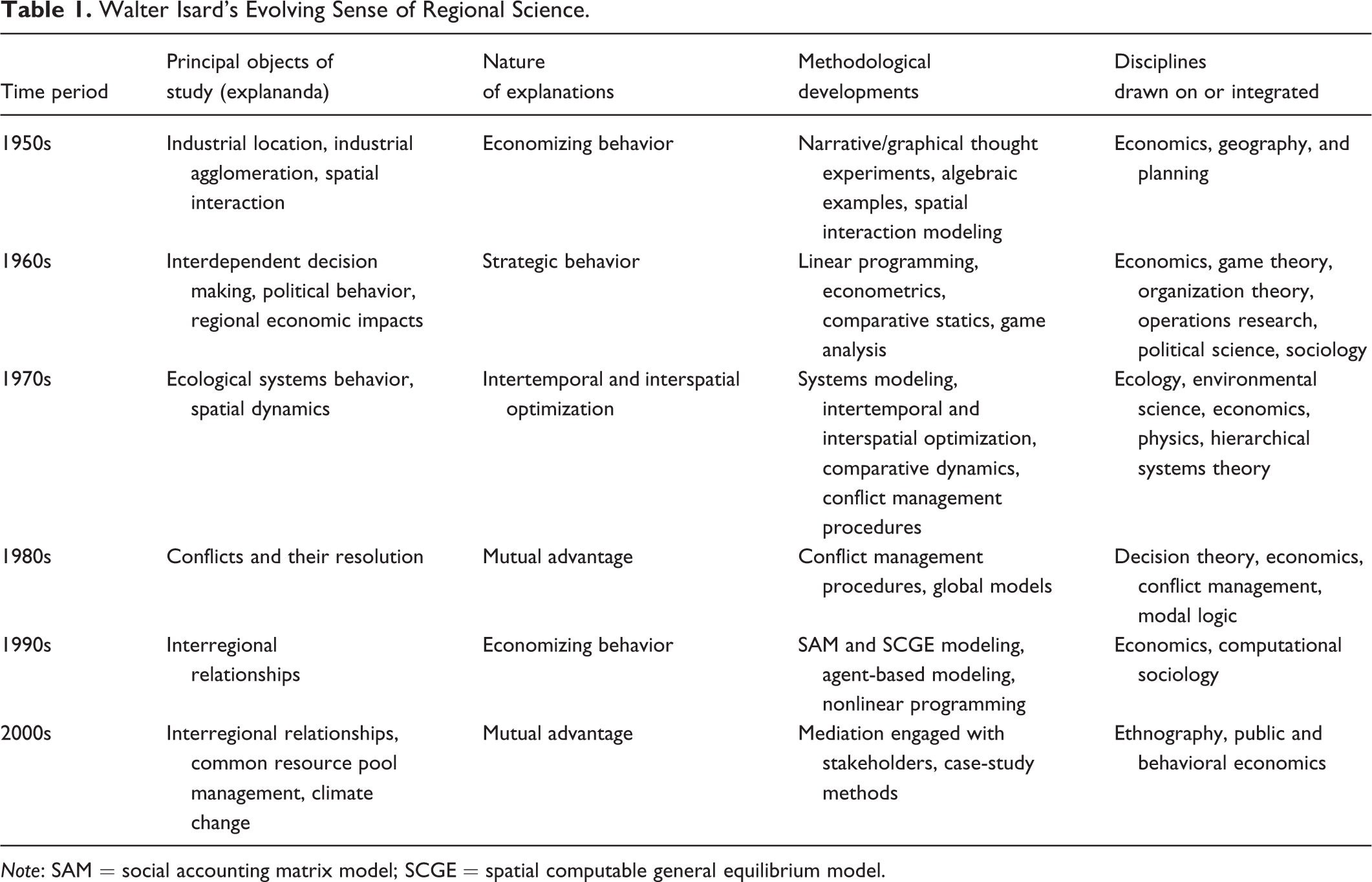
Note: SAM = social accounting matrix model; SCGE = spatial computable general equilibrium model.
In the sequel of this section, I attempt to trace Walter’s evolving modus operandi in his regional science research. In doing so, I am keenly aware that the intentionality (subjective meaningfulness) of the scholarly activity, the historical context, the availability of component materials (as just noted), and the contingent evolution of the scholarly conversation within the discipline all were influential. I am also aware that I will not be able to do full justice to these factors or disentangle their separate and compound influences.
In the 1950s, Walter drew upon explanatory resources from economic theory with which he was most familiar in addressing problems in spatial economics—agglomeration, location, trade—while aspiring to account better for political and social forces in an interregional framework (Isard 1956). 12 While he found materials from disciplines other than planning and geography wanting, this aspiration led him in the 1960s to emphasize interaction of decision makers on policy matters, collective action, and coalition formation, as he, coauthor Tony Smith, and others drew on the scholarship of Herbert Simon (1957), Howard Raiffa (1968), and various game theorists, inter alia. 13
The General Theory was a truly heroic effort to synthesize social science materials and was favorably received; however, Walter felt that the comparative statics approach taken therein failed
… almost completely, to explain [spatial] changes and developments, and the complexification, unfolding, and other ‘time’ processes underlying them. That is, it [failed] to identify explicitly a simple, selective, dynamic process which is required to account for such changes and developments. (Isard et al. 1969, x)
14
By the mid-1970s, Walter had come to consider CMPs to be an integral part of the regional science tool kit (Isard 1975). He had also come to view the field as not only becoming more engaged with real-world problems, to which there were many parties, but also incapable of being viewed apart from such problems. In the 1980s, he and Christine Smith catalogued most of what had been written about CMPs and mapped them into situations in which they would be relevant.
Also in the 1980s, as globalization—the increased interdependence of the world’s economies and societies—became more obvious, Walter worked to promote the development of global models (principally input–output and econometric) that might be used to explore international and interregional relationships. He found the resulting frameworks to be less than satisfactory, however, owing to the questionable nature of the assumptions on which they were based. Hence, in the 1990s, Walter turned his attention to research approaches that were based on assumptions with which he was more comfortable, including spatial computable general equilibrium models (SCGEs), social accounting matrix models (SAMs), and agent-based models (micro-simulation models; ABMs), and he focused on interregional analysis (see Isard et al. 1998).
Walter knew that the world was increasingly interdependent, that linkages mattered as never before, and that, because of this state of affairs, regions were increasingly susceptible to events unfolding half a world away. He also believed that policies of the World Bank and International Monetary Fund informed by the “new international open-economy macroeconomics,” which strove for elegant general solutions, were contributing to “miserable failures” (Isard 2003, 192). This belief led him, I believe, to despair of the usefulness of highly abstract formal economic models (or at least the ones of which he was aware). He lamented that
… more consideration of noneconomic factors along with interregional analyses fully sensitive to the spatial relations is yet to be satisfactorily embodied in [World Bank and IMF] models of development. [emphasis supplied] (Isard 2003, 192)
In the last decade of his life, inspired by the example of Jean Monet’s scheme of bringing France and Germany (and other European nations) together in an economic and political union, Walter conducted conjectural studies—in the cases of Korea, Palestine, and Southeast Asia—of how joint economic ventures between erstwhile regional political enemies might contribute to the development of peaceful regimes of economic well-being. In such work, he felt that there was no substitute for scholars addressing social problems with regional and spatial dimensions, immersing themselves in the histories of the conflicts from which agents sought to be extricated. He concluded his 2003 chapter on his current thinking about the discipline with these words about the direction its further development should take:
With our interregional and linkage approach and our sensitivity to the importance of key administrative, cultural, political, and other social factors, regional scientists can also achieve much more realistic and effective studies. [emphasis supplied] (Isard 2003, 193)
The Development of Regional Science Viewed in Terms of Recent Philosophy of Science
Three aspects of the development of regional science—as it has been understood by Walter Isard—that should have been established in the previous section are (1) that development of the discipline has not been linear, for want of a better term, and that it has changed in response to its historical context, (2) that regional science research has employed “diverse combinations of analytical and empirical research” approaches—that is, widely eclectic methods, and (3) that the discipline has been oriented to the solution of social problems, which are themselves normatively defined. None of these aspects suggests that regional science is particularly unusual as a science, according to recent reflections by leading philosophers of science.
That the progression of subject matters investigated by Walter and other regional scientists has been nonlinear or disjoint is not surprising in light of the literature on the growth of knowledge and theory change canvassing many fields. 15 There is, moreover, no reason to expect a systematic covering of terrain in any field. It is perhaps unusual, though, to witness the exploration of so many different topics via different methods by the same scholar.
It is also not uncommon for the development of social sciences to respond to contemporaneous events. In writing about the social sciences, John Searle has made observations that should pertain to regional science as well as economics:
Economics is a systematic formalized science, but it is not independent of context and history. It is grounded in human practices, but those practices are not themselves timeless, eternal, or inevitable. (Searle 1984, 83)
16
It is interesting to note that much of Richard Miller’s influential account of scientific explanation and confirmation, Fact and Method, comports well with the views Walter came to hold about methodological eclecticism, regional science’s applied orientation, and the need to integrate both positive and normative perspectives—facts and values—in conducting useful research.
17
According to Miller (1987), theories are essentially explanations of phenomena that are relatively more observable in terms of causal factors that are relatively less observable. What counts as a good theory (or an adequate explanation) varies with the field of inquiry and depends in part on the needs of its intended audience. An explanation may be viewed as a:
… kind of description which is most fundamentally a basis for coping with reality, i.e. for promoting or preventing change. Such [a] description will be [a] description of causes, for all means of control are causes, even if the converse is not true. Describing causes is a social activity with a long history of interconnected episodes. So if it is to aid in coping, adequacy will be governed by standards fitting the scientific needs of the time. (Miller 1987, 104)
18
Second, whereas, in positivistic accounts of science, there are formal criteria any valid explanation must satisfy a priori (i.e., even before one knows what is to be explained), in nonpositivist accounts of science, successful explanations need not conform to a standard format. (Miller points out that philosophers of science tend to worry more about satisfaction of such criteria than do scientists working in specific fields.) 19
Third, different fields of study have different repertoires of causal mechanisms to which theorists appeal. One purpose of the research process is to extend such repertoires. “Stopping rules” in explanations will be dependent on field and audience. Every explanation (as a description of causes) is a social act with a context. There may be, and usually are, competing explanations based on different definitions of what is deemed to be problematic. What Miller describes as normal scientific activity—extending or modifying repertoires of causal mechanisms and establishing and reestablishing stopping rules in explanations through conducting, presenting, and evaluating research—seems a lot like what has transpired in regional science and certainly characterizes much of Walter’s work over his career.
That regional scientists would employ methodological approaches as diverse as nonlinear programming, rule-driven ABM, Gaussian or Bayesian spatial econometrics, and CMPs to achieve analytical results does not make their field of inquiry any less coherent. Nor can certain sciences be divided from others on methodological grounds. A critical point made by Miller is that there is not one methodology for, say, human sciences (e.g. hermeneutics) and another (a general a priori method) for natural sciences. In fact, all sciences, theoretical and applied, have their own discipline-specific methodologies and means of detection, which may well be eclectic.
When we seek to explain what caused or brought about any phenomenon, we appeal to repertoires of causal mechanisms that have been established in the relevant disciplines, be they movements of tectonic plates (geology) or motivating reasons, desires, or fears (psychology), that is, whether the causal factors are in the ground or in our heads. Often too, what we seek to explain is not some recurring general phenomenon but a particular event or sequence of events—for example, why a particular agglomeration occurred at a specific location at a given time and not somewhere else at another time or why leapfrog development of building lots is occurring in a particular part of a city. 20 We prefer one explanation to another if, in a fair comparison of competing explanations, it does a better job of accounting for the phenomenon in question.
The confirmation of theories is recognized by Miller to involve historical rivalries of causal hypotheses, frameworks in which they have arisen, and the histories of the investigations themselves. 21 (All of this should seem familiar to one who has followed scholarly conversations in regional science.) Importantly, in Miller’s account (in contrast to positivist accounts of scientific methods) there is a place for political values in identifying potentially important explanatory factors, if not in judging the adequacy of a given causal explanation in terms of them; and there is no ambition for comprehensive generality, which is also the case in real-world scientific practice. Thus, the values and concerns of stakeholders that Walter wanted to include in studying the resolution of regional conflicts toward the end of his life—see again the above quote from page 191 of Isard (2003)—have a place in behavioral explanations of context-specific “social problems with spatial dimensions.” 22
We may expand Miller’s account of explanation and confirmation to also include as theories reasons or justifications that are provided for particular conventions, value judgments, or perspectives—for example, John Rawls’s Theory of Justice is just such a theory (see Hurley 1989, and Donaghy and Hopkins 2006). To see the relevance of such a perspective, consider the case of urban and regional planning, in whose service regional science has notably stood. It is arguable that a necessary, if not sufficient, condition for effective planning is the availability of both good causal explanations of conditions under which planning is likely to succeed (and why) and justifications of certain conventions or practices through which plans are made, implemented, and evaluated. Analogous statements can be made about other approaches to addressing “social problems with regional or spatial dimensions.”
Let me conclude this section by stating my belief that Walter’s everyday working definition of science was operational. He did not intellectualize at length about the subject, but he was certainly methodologically self-conscious. Regional science, to his mind, always dealt with relational and practical knowledge obtained by various methods. Walter understood from the outset that any institutionalized branch of science, or applied social science, is more than an accumulation of facts (true statements) or model results (logical implications of underlying assumptions) and empirical regularities. It is also the history of the arguments—the papers and proceedings, if you will—that have advanced its frontiers of understanding and the problems to whose solution it has contributed. While Walter wanted the “positive” results that can only come from “careful and patient study,” he also wanted the resolution of “normative” social problems in the world to which the study was directed. Perhaps it was wanting both that contributed to his restless search for a better fit between evolving theoretical frameworks—explanations and justifications—and a changing world.
According to Isaiah Berlin, all of us are amalgams of conflicting interests, appetites, and proclivities (Berlin 1978). Walter was a mathematician first and an economist second. He admired the achievements of the natural sciences and (based on the example of the gravity model) he felt that important physical laws or relations simply should have an echo in the social sciences (Isard 2003). 23 He loved a clean analytical argument and he loved novelty, but he was also intellectually honest—with himself and others—about whether or not a theory delivered the goods. At the end of the day, he found most theories to be short on delivery. 24 At his passing, Nobel laureate Kenneth Arrow observed about Walter, “His intense moral conviction energized but never disrupted the achievement of scholarly accuracy.” 25
Personal Observations on Regional Science as an Applied Integrative Social Science
Putting to one side Walter’s definition of the discipline given in this article’s epigraph, regional science may be viewed as an applied integrative social science that Walter aspired to and was ambitious for. It might also be viewed as a patchy fabric whose warp and woof have been incompletely filled in. Walter was able to make sense of his own efforts to weave (and reweave) this fabric and of what contributions it might make as whole cloth. Many scholars have contributed to the infilling through myriad articles in a proliferation of disciplinary journals. Retention of Walter’s sense of regional science as something with its “own peculiar core and wholeness” has been tenuous, however. Many who participate regularly at regional science meetings or publish in regional science journals are agnostic about whether regional science is or ever can be more than the sum of its parts or that meetings of the RSAI, say, can or should be anything more than tracks of increasingly specialized self-referential paper sessions, now that the generalists have departed the scene.
While arguably the elements for a more integrative science remain available, it is difficult to create an institutional environment which favors their assembly. 26 It continues to be easier to work in traditional disciplinary silos and participate in tracked sessions at professional meetings—for example, spatial econometrics, geoinformatics, urban economics, input–output and CGE modeling, transportation–land-use modeling, and so on—hosted by an umbrella organization, such as RSAI, and publish in narrowly focused journals. Walter understood and foresaw this dynamic early on.
Walter never ostracized anyone from the big tent of regional science, but toward the end of his life he questioned whether or not certain approaches around which subdisciplines were organized could help to advance the project. What is becoming clearer in my own mind is that Walter always had a vision of what regional science could become—albeit a changing vision, a map he redrew as his journey continued. The bigger framework remained intact even as some of the details changed and he lost faith in some of the components. (He would swap out Samuelson and Hicks for Kahneman and Tversky, or Raiffa for Saaty, or his own work with SCGE models in the 1990s in favor of more interactive approaches involving mediation in the 2000s.) I cannot say how much of the change in view toward the end of his life was due to frustration with limitations of the “diverse combinations of analytical and empirical researches” he had tried and aspirations for combinations he had yet to try or due to Walter just being himself. (It was a running joke among graduate students in the regional science program at Cornell that the frontiers of the field at any time were to be found in the proximity of some subject on which Walter was then working. And Walter tended to zig when others, who thought they were doing regional science, zagged.)
This article began with the observation that the history of science is one of change. In their ongoing engagement with “social problems with spatial dimensions,” regional scientists—Walter foremost among them—have endeavored to understand such problems and suggest coping strategies for society. The theories, methods, and data they have employed have changed and must continue to change with the historically contingent problems they study and in response to innovations in the scholarly conversation itself. Indeed, to the extent that a field such as regional science, an applied social science, fails to track needs for explanations in the service of a coping society, it puts in question its own relevance.
There is an often told story recounted by political scientist Steven Lukes at the end of his novel, The Curious Enlightenment of Professor Caritat,
[a] peasant . . . on his death-bed tells his sons there is a treasure buried in the garden. The old man dies and the sons dig everywhere but do not find it. There is no treasure, but their labour improves the soil and secures their well-being. In cultivating their garden, they tend its existing roots and attend to the flourishing of its luxuriant vegetation. Lukes (1995, 260)
Curricular Postscript
Some readers may wonder if graduate students in regional science at Cornell still study principles of microeconomics. Indeed they do and Mas-Collell, Winston, and Green (1995) is the preferred text. They continue to study constrained optimization (static and dynamic) as well and are learning about new ways to set up and solve constrained optimization problems (e.g., via variational inequality methods; Friesz 2010). Now, however, a growing number of students also take courses on behavioral and institutional economics.
Footnotes
Acknowledgments
I should like to thank my colleagues in the Cornell regional science program, Iwan Azis and Yuri Mansury, for advice in the preparation of this article, David Boyce and Ron Miller for editorial suggestions, and two anonymous referees for their constructive criticisms. The usual disclaimers apply.
Declaration of Conflicting Interests
The author(s) declared no potential conflicts of interest with respect to the research, authorship, and/or publication of this article.
Funding
The author(s) received no financial support for the research, authorship, and/or publication of this article.