



Abstract
This article estimates the regional economic effects of public research activities. In order to identify the underlying transmission channels from knowledge creation to the regional environment, the empirical identification strategy goes beyond traditional partial effects analyses and studies the complex linkages between public research, innovativeness, and regional development on the basis of a structural vector autoregressive model. A particular focus is thereby set on assessing whether the effects of local public research activity differ by the type of research actors (universities, technical colleges, and public research institutes). The empirical results indicate that an increase in the volume of (public) third-party funding to technical colleges is associated with a rise in the regional investment and employment rate as well as the human capital stock. Increasing public third-party funding to both universities and technical colleges positively affects the regional patent activity, the employment rate, and per workforce output. In comparison, the empirical results provide limited evidence for regional economic effects stemming from an increase in local knowledge creation measured in terms of scientific publications. Here, only variations in the publication rate of public research institutes can be linked to positive private sector investment and employment effects.
Keywords
Introduction
A central research question in regional economics and economic geography relates to the role of human capital and knowledge creation in driving regional economic growth and development. Building on seminal contributions in the field of new growth theory (e.g., Lucas 1988; Romer 1990; Aghion and Howitt 1992), a common understanding of knowledge-driven growth process is that human capital and research and development (R&D) inputs lead to innovations, which—in turn—trigger economic growth through both private and social returns to these knowledge inputs. Social returns are typically associated with positive knowledge spillovers. The literature on regional innovation systems complements growth analyses by studying the main transmission channels of knowledge creation to the regional economy, for example, related to the contribution of public research activities for regional knowledge transfer and development (e.g., Braczyk, Cooke, and Heidenreich 2004). The main conclusion is that public research actors play a crucial role for innovation processes and associated regional development (Fritsch and Schwirten 1999). Despite the progress made in the contemporaneous literature, however, it is less well understood which types of public research actors and activities contribute the most to regional development and whether different actor–activity combinations affect the regional economy through alternative transmission channels.
In this article, we contribute to this open research agenda by analyzing the mutual linkages between research activities carried out by different public research actors and regional economic development in Germany. Germany can be seen as an interesting case study for this endeavor as the German public research landscape comprises different research actors within and outside the university system, which interact with the regional economy to varying extents: although universities operate in a specific region, seen from a knowledge transfer perspective, the university system has more interregional linkages. This is, for instance, emphasized by a rather spatially unbounded cooperation behavior of universities (Beise and Stahl 1999; Fritsch and Schwirten 1999). 1 Differently, technical colleges are more embedded in the local economic system, for example, due to their cooperation behavior and a relatively higher share of graduates who remain in the region (Fritsch and Schwirten 1999). Public research institutes (outside universities) are heterogeneous and do not always have a regional focus when transferring knowledge to firms (Beise and Stahl 1999; Fritsch and Schwirten 1999). In the following, we focus here on these three groups of research actors and their relevance for localized knowledge transfer to the regional development.
The amount of public funds that are allocated to research and innovation activities in Germany is considerably large. In 2013, €23.198 billion of public funds were spent (BMBF 2016b) as a means to compensate for private underinvestments in research and innovation activities. Given the significant financial input to public research activities, gaining insight into the explicit regional effects of this type of public investment is of strong interest, both scientifically and politically. In the conduct of our empirical analysis, we thus seek to answer the following research questions: do public research activities foster regional economic development? Which regional economic factors are mainly affected by different types of public research activities? And finally, do knowledge transfer effects differ between universities, technical colleges, and public research institutes? Providing answers to these specific research questions shall contribute to a better understanding of the overriding question, which type of public research activity gives the largest local return to the public investment.
Based on seminal work on the knowledge production function (Jaffe 1989), impact analyses of the effects of universities on regional innovativeness have a long tradition—especially the literature focusing on the United States (see Drucker and Goldstein 2007, and Varga and Horváth 2015, for comprehensive reviews of international studies on this topic). However, most quantitative studies are primarily focused on exploring the immediate link between university research activities and regional innovativeness or output, while they ignore to shed light on the broader regional impacts of these public research activities related to employment, physical capital investments, or human capital.
For the case of Germany, the economic effects of public research activities have predominantly been analyzed using single-equation regression models and regional data (e.g., Fritsch and Slavtchev 2007; Schubert and Kroll 2013; Spehl et al. 2007). Existing studies examine the effects of public research on regional economic growth in one of the two ways: either they estimate the effect of public research on innovativeness in a knowledge production function approach (Fritsch and Slavtchev 2007) or they examine the effects of public research on economic growth directly (Schubert and Kroll 2013). Both approaches thus restrict the study of knowledge transfers to a partial effects analysis. Many other mechanisms, however, can be thought of being relevant for assessing the overall effects of public research activities to the regional economy, such that they attract high-skilled jobs to the regions or simply increase regional investments. 2
To deepen our knowledge on the direct and indirect effects of public research on regional economic growth, this article extends the recent literature in two ways: first, with regard to the plurality of public research activities at the regional level, we take a disaggregated perspective by gathering information on alternative indicators for research activities (scientific publications, acquired third-party funds) of different actors (universities, technical colleges, and public research institutes). We then link this research actor–activity information to a set of further economic variables such as the regional investment rate, human capital, employment, and innovation indicators as well as economic growth. Second, to the author’s knowledge, this is the first study that uses a systems approach that allows for the identification of interdependencies among these variables in all kinds of directions, including the dependencies of growth-relevant aspects, such as investment and human capital, on public research as well as of public research activities on regional economic factors. Hence, we are able to deal with regional dynamics more adequately by treating all variables as endogenous in the regional economic system and by measuring all their mutual interdependencies and feedback effects. 3
To this end, a structural vector autoregressive (VAR) model is estimated and combined with impulse response functions (IRFs) analyses to identify direct as well as indirect effects of public research activities on regional economic variables as well as resulting feedback effects. The VAR model covers several variables—namely per capita gross domestic product (GDP), employment, investment, human capital, innovation output as well as the number of scientific publications and third-party funds as measures for public research activities. 4 With regard to the latter, activities from universities, technical colleges (Fachhochschulen), and public research institutes (especially Fraunhofer and Max Planck [MP] institutes) are studied separately with regard to their respective linkages to economic variables.
The remainder of this article starts by presenting the different types of public research actors in Germany and their particular characteristics (Conceptual Background section). Moreover, potential spillover effects from public research and their spatial dimension are discussed. Thereafter, the Theoretical Considerations and Research Hypotheses section reviews the underlying economic theory and develops research hypotheses. After a brief discussion of the data (Data section), the econometric approach (Econometric Modeling: Spatial Panel VAR and IRFs section) and the linkage between theoretical underpinnings and empirical estimation are introduced (Linkage between Theoretical and Empirical Considerations section). The empirical results of the VAR analysis are presented in the Empirical Results section. Finally, the Conclusions section summarizes the findings and concludes this study.
Conceptual Background
The German Public Research Activities in an International Context
Auranen and Nieminen (2010) emphasize the decentralized character of Germany’s university system, where federal states enjoy a high degree of political autonomy. Compared to the UK, Australia, Finland, or Sweden, the German university system is more input-oriented (smaller governmental steering, focus on a sufficient endowment with resources instead of a focus on results and efficiency) and receives less external funding. The higher education R&D (HERD) expenditures per capita and the ratio from HERD to the German gross domestic expenditures on R&D (GERD) are lower compared to countries such as Sweden, Finland, Denmark, Norway, the Netherlands, Australia, and the UK (Auranen and Nieminen 2010). Moreover, next to universities, technical colleges and public research institutes (outside universities) are additional actors within the publicly funded research sector in Germany, whose role is explained in more detail below.
Publicly Funded Research Institutes and Their Regional Embeddedness
According to the research and innovation report 2016 of the Federal Ministry of Education and Research (BMBF), the German GERD in 2013 accounted for €79.730 billion with €23.198 billion being publicly financed (29.1 percent). Fund recipients are universities, technical colleges, public research institutes, and also business organizations in the private sector. Especially universities and technical colleges as well as public research institutes are the major recipients of public support, though. Although the latter actors also receive private R&D funds (see BMBF 2016b, Table 1, pp. 55–56), for the purpose of this study, we define universities, technical colleges, and public research institutes as core public research actors (a similar definition can be found, e.g., in the study of Beise and Stahl 1999). 5
German Empirical Studies on Regional Level—Research Gaps.

Note: This table only provides a selected summary of related studies on the regional economic effects of public research activities in Germany. Please see Table A1 in the Online Appendix for a comprehensive review of the international empirical literature on this topic.
Goldstein, Maier, and Luger (1995) argue that universities contribute to regional development through multiple impact channels. Besides investments in the regional physical capital stock and the creation of human capital via graduates, universities generate outputs that influence the knowledge and technological stock. They create basic knowledge, transfer existing know-how to firms and organizations, provide a basic knowledge infrastructure, and may establish an innovative spirit within a region (Goldstein, Maier, and Luger 1995). Regarding their research activities, universities conduct mainly basic research activities with only moderate immediate intentions of commercialization (Beise and Stahl 1999). The reader should know that this study is solely focused on research activities and knowledge transmission of universities, thereby ignoring other supply and demand-side linkages with the regional economy.
Compared to universities, technical colleges are more focused on teaching and education. They conduct, on average, less basic research, while their activities are more focused on applied and specialized research in similar technological sectors as regional firms (Beise and Stahl 1999). This link is further stressed in Fritsch and Schwirten (1999) which show that technical colleges—in contrast to universities—cooperate more frequently with firms than with other research institutes. Finally, technical colleges can be seen as regionally rooted actors, as they predominantly cooperate with regional firms. 6
Finally, public research institutes have been mainly founded for the purpose of complementing university (basic) research and transferring knowledge to firms. While, for instance, MP institutes are especially focused on doing basic research, Fraunhofer institutes conduct mainly applied and contract-based research and foster industrial innovations (Beise and Stahl 1999). Hence, research activities conducted by technical colleges and public research institutes—especially Fraunhofer institutes—can be seen as more applied and less basic research-orientated compared to universities as well as they are more transfer-orientated to the industry. However, as shown by Beise and Stahl (1999) and Fritsch and Schwirten (1999), public research institutes do not always have an explicit regional focus of cooperating with firms in their geographical vicinity.
Regional Knowledge Transmission Channels
Public research actors produce different forms of new knowledge—basic, applied, or industry-related knowledge. Besides providing internal returns to this knowledge creation within the research sector, their activities may also create knowledge spillovers to firms via several channels. For instance, Beise and Stahl (1999) emphasize the distribution of new knowledge via scientific publications, joint R&D projects and cooperations, (informal) networks and contacts between public and private researchers as well as via hiring university researchers as important transfer channels. Varga (2000), among others, additionally emphasizes the role of spin-offs, graduates, and physical facilities (e.g., libraries) as important knowledge diffusion mechanisms.
Regarding the spatial dimension of these knowledge spillovers, neoclassical growth models emphasize the public good characteristics of knowledge (nonexcludable and nonrivalry), which implies that knowledge spills over frictionless across space (e.g., Mankiw, Romer, and Weil 1992). However, there are several arguments that scrutinize this strong implication of frictionless knowledge spillovers: firstly, public research institutes function as a regional “aerial” (Fritsch and Schwirten 1999, 81). They absorb foreign knowledge, create new knowledge, and make it available within their own region (Fritsch and Schwirten 1999). Accordingly, it can be expected that knowledge spillovers have, at least to some extent, a local context. Secondly, Audretsch and Lehmann (2005) refer to geographical (localization) theory and argue that new knowledge does not spill across space readily and gratuitously. 7
In fact, the spatial range of knowledge spillovers running from public research inputs to private sector research outputs has been discussed controversially in recent years: Beise and Stahl (1999) provide an excellent summary of the well-known arguments for the importance of spatial proximity between firms and public knowledge sources: on the one hand, effective knowledge transfer is based on informal networks and contacts, face-to-face-communication, or mutual trust to exchange tacit knowledge. On the other hand, the authors also provide arguments against the relevance of spatial proximity in this context, for instance, related to modern information and telecommunication techniques as well as specifically for the case of Germany as subject of this analysis, the relative low distances within the country compared to larger economies such as the United States as well as the dense infrastructure network in Germany (Beise and Stahl 1999). To sum up, the economic effects of public research activities can be expected to partly take place within the region and partly work in a distance-free manner across all locations in Germany or even beyond that. Due to the empirical approach chosen here, we will focus on identifying the strength of localized effects that are specific to the region.
Effects of Regional Knowledge Spillovers on Regional Economic Development
The impact of universities on regional knowledge production (new technologies) and development has been analyzed intensely in different spatial contexts so far. The study by Drucker and Goldstein (2007) provides a comprehensive review of international investigations by subclassifying the studies according to different methodological approaches. 8 The authors argue that case studies provide heterogeneous results as they suffer from two major drawbacks: it is difficult to determine causal effects of universities’ activities, and the results are hardly generalizable. Moreover, studies on the colocation behavior of firms and universities provide ambiguous results (Drucker and Goldstein 2007). Finally, the literature reviews given in Drucker and Goldstein (2007) and Varga and Horváth (2015) show that a large fraction of empirical studies find positive effects of university activities—typically measured by R&D expenditures—on the regional knowledge production.
Several studies have also analyzed the role of public research actors (mainly universities and technical colleges) for regional economic development in Germany. In line with the above mentioned international studies, German studies can also be divided into three research strands (a detailed survey of the methods and results is provided in Table A1 in Online Appendix). At first, there is a bulk of case studies analyzing the demand-side effects of universities on regional income and employment (e.g., Glorius and Schultz 2002; Glückler and König 2011; Spehl et al. 2005, among others). The main conclusion from these studies is that universities and technical colleges have positive effects on both regional income and employment. 9
Secondly, various firm-level studies focus on the (spatial) cooperation behavior between public research institutes and firms (e.g., Beise and Stahl 1999; Fritsch and Schwirten 1999) and on the location decisions of firms to operate in spatial proximity to universities (e.g., Audretsch and Lehmann 2005; Audretsch, Lehmann, and Warning 2005). Analyzing survey data, Beise and Stahl (1999), for instance, find that firms see access to public research outputs as a vital element for private research success. However, spatial proximity—with the exception of technical colleges—is not as important as in the Unites States to gain from research spillovers (Beise and Stahl 1999). This is in line with the results reported in Fritsch and Schwirten (1999), which also conclude that public research institutes are vital for private innovation activities. Spatial proximity is seen as an advantage for establishing cooperations, with the highest share of regional cooperations being found for technical colleges (Fritsch and Schwirten 1999). Audretsch, Lehmann, and Warning (2005) highlight that spatial business decisions of firms to locate close to universities depend on scientific disciplines (social or natural science) as well as on the transfer mechanisms (via publications or the number of students). According to a further study by Audretsch and Lehmann (2005), regions with universities that educate a high amount of students in social and natural sciences and produce a high number of publications (particularly natural sciences) attract more knowledge-based start-ups.
Thirdly, a further strand of literature uses data at the regional level to analyze the effects of public research institutes on various economic variables (see Table 1). Fritsch and Slavtchev (2007) analyze the effects of universities (regular and external research funds) on regional patent activity. While the intensity of regular funding volumes (base funding) do not have significant effects, external research funding is found to positively affect regional patent applications (Fritsch and Slavtchev 2007). 10 In a study for the German federal state of Rhineland-Palatinate, Spehl et al. (2007) emphasize that public knowledge and human capital increase gross value added significantly. Moreover, the authors find significant effects of public research on the regional patent activity (Spehl et al. 2007). 11 Finally, using regional data for all German regions, Schubert and Kroll (2013) find positive effects of various measures for regional university and technical college activities, for example, on regional GDP per capita, employment, and patent applications.
Summing up, this article at hand aims at contributing to the analysis of the regional economic effects of public research activities by tackling some unresolved issues in the existing empirical literature using German regional data, which is mainly focused on the analysis of the direct effects of publicly funded research on particular output variables such as regional patents or output (see Table 1), while neglecting indirect effects between the variables in regional innovation and production systems. This article sheds light on the total effects of various publicly funded research measures (publications, third-party funds) by different public research actors on several economic variables. In order to define the functional relationships between public research and regional economic development, the subsequent chapter discusses the theoretical framework, variable selection, and the derived hypotheses used for our empirical modeling approach.
Theoretical Considerations and Research Hypotheses
Theories of economic growth are used to formulate research hypotheses and impose a causal structure linking variables over time. Our main argument is that public research contributes to regional innovativeness (knowledge production function) and that innovation and new products, respectively, contribute to regional growth and development (e.g., Romer 1990). We also account for the fact that this causal chain is not necessarily unidirectional. We therefore propose a modification/extension of the standard knowledge production function, which allows incorporating mutual linkages between public research activities and further economic variables in the underlying regional economy. The basic elements of the theoretical argumentation are the regional production function as well as exogenous and endogenous growth theory.
Regional Production Function
The production function for each region i is given by (Mankiw, Romer, and Weil 1992):

With regard to the input factors, we define labor Li at time t as:

where λi(t) is the ratio of employed people at time t (constant in the long-run perspective), Pi(t) denotes the economically active population from fifteen to sixty-four years, and ni is the growth rate of the economically active population (Eberle, Brenner, and Mitze 2019). 13 The production function per economically active population is then given by:

As shown in equation (3), per capita output is specified as a function of technology, physical, and human capital as well as the employment rate. Details on the specification of these input factors will be given in the following. 14
Technology
We relax the strict assumption of equal technological growth across regions (e.g., Mankiw, Romer, and Weil 1992) and permit short-run differences in the technological growth rates gi. 15 To derive explicit research hypotheses, we start with the endogenous growth approach defined by Romer (1990). The model is based on the public good argument of knowledge but allows for different technological growth rates across regions due to its interdependences with human capital devoted to the R&D sector (HA; Romer 1990):

where δ indicates a productivity parameter. The research sector in this model is assumed to be private, with firms earning income by licensing their research findings (Romer 1990). In reality, however, research is typically conducted by firms and public research actors (see Conceptual Background section). Therefore, we distinguish between these two kinds of research actors. We denote Ai as the economically usable research output (proxied through patents) and Ri as the public research activities (e.g., publications, third-party funds). We thereby assume that public research activities stimulate private research activities and output. In addition, we assume that further input factors in the production sector in equation (1) may—to some extent—also be inadvertently productive in the regional research sector (e.g., Rivera-Batiz and Romer 1991).
Consequentially, we define the evolution of regional technological development Ai as:

In equation (5), the (exogenously given) Ri is a measure for the regional public research activities within region i,
To this end, we add the parameter Φ to equation (5) because not all public knowledge created locally is transferred to regional firms. Consequently, Φ is fixed between 0 and 1 and measures the amount of public research activities that are transferred to firms in region i, while 1−Φ is the amount that is transferred to firms in other regions. We assume that Φ depends on the cooperation behavior (the need for spatial proximity for knowledge exchange), the degree of embeddedness in regional (informal) networks (e.g., via graduates), and on the form of the newly created knowledge (basic vs. applied knowledge). 17 Due to their focus on basic research and a rather unbounded spatial cooperation behavior (with primarily larger firms), we expect Φ to be generally lower for universities compared to the other public research actors located in the region as they cooperate with firms farther away (see, e.g., Beise and Stahl 1999; Fritsch and Schwirten 1999). With regard to public research institutes, we expect Φ to be higher for Fraunhofer institutes compared to MP institutes since Fraunhofer institutes place a stronger focus on applied industry-related research (see Conceptual Background section). Finally, based on the previous arguments, Φ is expected to be highest for technical colleges.
These considerations can be consolidated to a first hypothesis:
Physical and Human Capital
The interaction between technical growth, physical, and human capital is based on Mankiw, Romer, and Weil (1992) and the associated physical and human capital accumulation dynamics. Consequently, a positive change in the technological growth rate (gi) affects physical and human capital accumulation positively as it makes physical and human capital more effective, while investment rates are commonly expected to be unaffected (Mankiw, Romer, and Weil 1992).
18
This leads to a second hypothesis:
Employment Rate
A continuous effect on the employment rate can only occur if a change in the technological growth rate affects aggregate supply on regional labor markets. 19 An increase in the labor-augmenting technology (see equation [3]) makes labor more effective (higher marginal productivity), increases demand for labor, and thus, wages and employment (if the supply curve of labor is not vertical).
Implied higher wages may attract more labor from outside the region (inducing in-migration). Niebuhr et al. (2012) provide a detailed survey of theoretical approaches showing how mobility may influence labor supply and demand. Neoclassical labor market theory assumes that migration mainly affects labor supply and works toward spatial convergence because migration to high-wage regions puts the wages in these regions under pressure or—if wages are rigid—generates unemployment (Niebuhr et al. 2012). Moreover, a higher labor supply may lead to overcongestion and, thus, to negative effects on utilities (Varga 2017). Hence, growth of labor supply would occur only temporarily. However, this does not seem in line with the recent development of employment rate in Germany. For instance, Suedekum (2005) adds unemployment to a new economic geography model to show that migration also affects regional labor demand. This would lead to a spatial polarization of wages and (un)employment rates (Suedekum 2005).
Merging these arguments, we can formulate the following hypothesis:
Output
According to the production function in equation (3), the growth of regional output can be formulated as a function of the input factors as:

which immediately translates into our fourth hypothesis:
Data
We build a panel data set covering 258 labor market regions in Germany in the period 2000–2011. We use the classification of labor market regions provided by the Federal Institute for Research on Building, Urban Affairs and Spatial Development, which aims at harmonizing the place of residence and place of work of German population by explicitly considering the commuting traffic across small-scale regions (Landkreise). Our choice of using local labor markets as the underlying regional scale for the empirical analysis thus aims at reducing measurement errors that stem from the fact that local residents produce output in another regions as they are living. Although the used labor market regions are defined functionally, they are obtained by merging administrative districts (Landkreise), which causes them to be not the best choice in some places. However, due to data limitations, a better definition of functional regions is not available for this study.
Table 2 shows the construction of variables and corresponding data sources. All variables are specified as intensities and are transformed by the natural logarithm. Public research activities are proxied by the number of publications of universities, technical colleges, and public research institutes as well as third-party funds received by universities and technical colleges. Unfortunately, no data on acquired third-party funds are available for public research institutes. As publications are taken from the Web of Science, the data place a relatively strong weight on scientific publications compared to other types of research outlets such as technical reports, and so on. Summary statistics for variables are reported in Table 3.
Variables and Data Sources.

Note: GDP = gross domestic product.
aIn order to take the ln, we added 0.25 to each observation of the variable before normalization because zero values are included.
Summary Statistics.
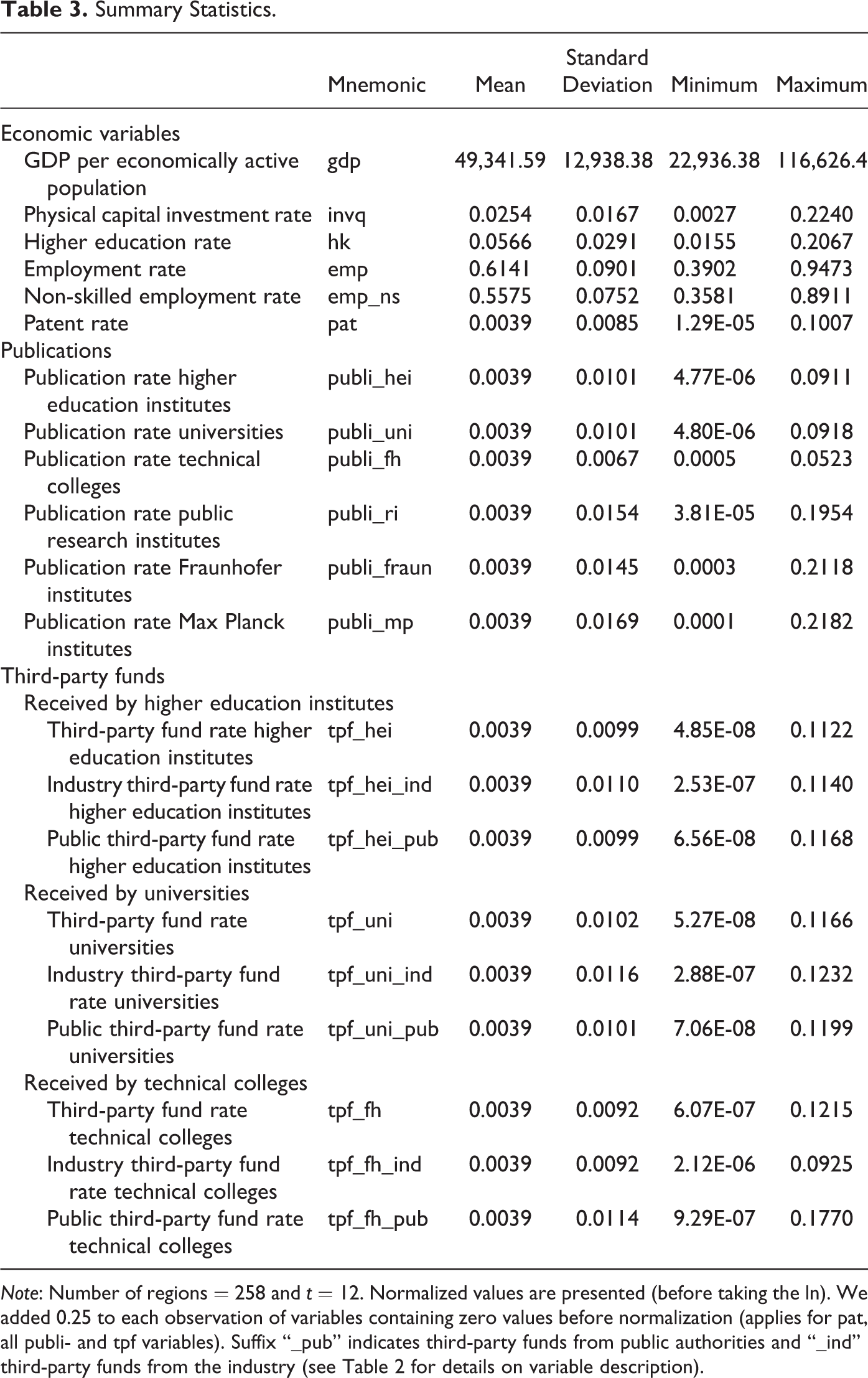
Note: Number of regions = 258 and t = 12. Normalized values are presented (before taking the ln). We added 0.25 to each observation of variables containing zero values before normalization (applies for pat, all publi- and tpf variables). Suffix “_pub” indicates third-party funds from public authorities and “_ind” third-party funds from the industry (see Table 2 for details on variable description).
With regard to the statistical properties of our data, we are concerned with nonstationarity of variables over time as well as cross-sectional dependence, which may both affect the estimation results. In order to test for the degree of nonstationarity within our data, we apply a panel unit root test proposed by Im, Pesaran, and Shin (2003). Table A2 in Online Appendix shows that this is a serious problem, especially for variables measuring public research activities. Thus, we detrend all variables that are nonstationary in their levels. The results of the Im, Pesaran, and Shin test highlights that detrended variables reject the null hypothesis of containing unit roots.
Moreover, with the exception of public research activities (see Theoretical Considerations and Research Hypotheses section), the role of spatial dependencies has not been discussed so far. Nevertheless, we generate spatial lags for all variables and include them in all regression specification in order to capture underlying spatial spillovers and thus avoid an omitted variable bias. We use a binary first-order neighborhood matrix to build spatial lags (e.g., Eberle, Brenner, and Mitze 2019). Matrix elements wij have the following properties:

In equation (7)
Econometric Modeling: Spatial Panel VAR and IRFs
To analyze the economic effects of public research activities on a regional economic system, we estimate a spatial panel VAR (SpPVAR) model (see, e.g., Beenstock and Felsenstein 2007; Di Giacinto 2010; Monteiro 2010; Ramajo, Márquez, and Hewings 2017; Mitze et al. 2018; Eberle, Brenner, and Mitze 2019).
As argued above, earlier studies of the relationship between public research and regional economic growth usually estimate a one or two regression equation model. In the case of two equations, economic growth is assumed to depend on innovation, and innovation is assumed to depend on public research. Such an approach has two limitations. First, there is a strong endogeneity problem since the innovation activity also depends on economic development and, especially on the regional level, public research responds to the economic and innovative activity within the region. Second, public research has not only an effect on the innovation output but may also directly influence human capital, employment, and investment in the region. The SpPVAR model captures potential two-way interdependencies between all variables, reducing both limitations. First, endogeneity is explicitly considered in the model. This allows for Granger causal statements, given that all relevant variables are considered and the correct causal structure at time t is used (e.g., Hoover [2012] for a discussion of structural VAR models and causality). Second, effects on other economic variables are explicitly considered in the structural VAR approach. Thus, besides modeling the transmission channels that are discussed in Theoretical Considerations and Research Hypotheses section, the SpPVAR approach allows us to detect additional transmission channels and, thus, deepen the insights on the transmission mechanisms of public research activities in the regional economic system.
Our system contains six equations including the subsequent dependent variables: (1) higher education rate (human capital), (2) rate of public research activities, (3) patent rate, (4) physical capital investment rate, (5) employment rate, and (6) GDP per (economically active) population. The structural SpPVAR—a specification with orthogonalized errors and contemporaneous relations—can be expressed in terms of a spatially augmented model as (e.g., Eberle, Brenner, and Mitze 2019):

In equation (8), the vector
In terms of estimating the system (in a reduced-form specification), the standard FE estimator is biased due to the inclusion of time lags of the particular dependent variable (e.g., Nickell 1981). 21 Thus, we use a bootstrap-based corrected FE estimator that has been originally proposed by Everaert and Pozzi (2007). To visualize the estimated mean effects together with 95 percent confidence intervals, we compute IRFs measuring the response of a particular variable to an isolated shock in the rate of public research activities (Lütkepohl 2005). Confidence intervals for these IRFs are calculated from Monte Carlo simulations (Love and Zicchino 2006).
Linkage between Theoretical and Empirical Considerations
To ensure identification, we need to stipulate the underlying causal structure of contemporaneous effects (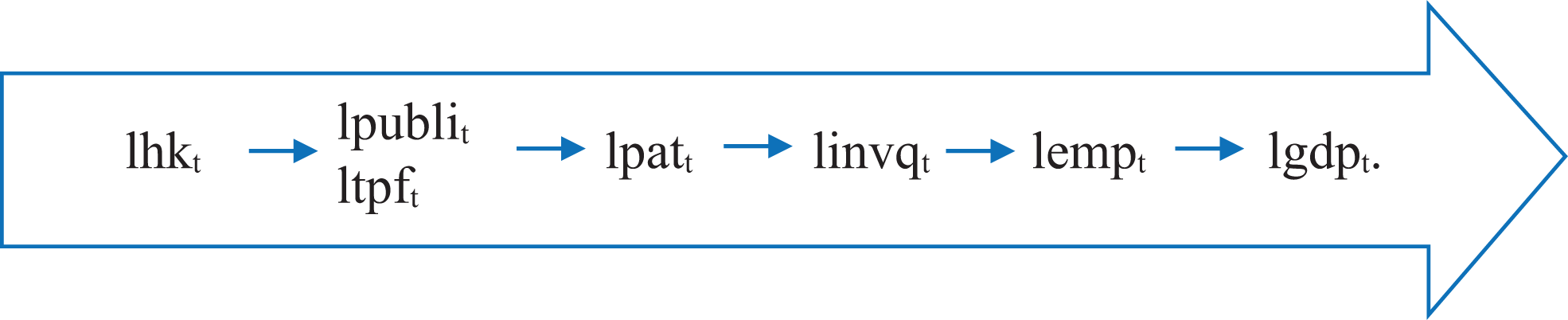 (9)
(9)
The recursive order in equation (9) can be interpreted in the following way: human capital on the outmost left side has contemporaneous effects on the remaining variables in the regional economic system, while it is not subject to contemporaneous feedback effects from other variables (which only occurs with a time lag). The degree of endogeneity increases the more we move to the right side of equation (9). Thus, in similar veins, public research activities have contemporaneous effects on all regional variables—except on the human capital variable—but are only affected by (potential) feedback effects from these variables with a time lag. Finally, the variable on the ultimate right side of equation (9)—GDP per economically active population (workforce)—is contemporaneously affected by all other variables in period t but has only time-lagged (feedback) effects on these variables as it is unidirectionally determined by regional input factors at time t and, therefore, the most endogenous variable in our production system.
Accordingly, the ordering of the first three variables follows the logic of a knowledge production function as shown in equation (5), where human capital and publicly funded research are the main input factors, while the other factors have only (time lagged) effects, whose magnitude are ex ante unclear. 22 Moreover, a policy-induced increase in the total factor productivity may have effects on regional employment, physical capital investments, and regional production (e.g., Varga 2017; see H2–H4 in this study). Regarding these variables, we follow Eberle, Brenner, and Mitze (2019) and expect that contemporaneous capital investment decisions are primarily done ex-ante, while, in turn, a change in the employment is rather done on an ex-post basis.
Empirical Results
Regional Economic Effects of Publication Activities
Since the SpPVAR approach covers direct and indirect effects within the endogenous regional economic system, the complete effect of changes in one variable on another variable cannot be grasped by simply looking at the estimated regression coefficients. As a consequence, IRFs are used for illustrating the reaction of per workforce output and factor inputs to an increase in public research activities in terms of a standard deviation “shock” of the latter variables (in order to interpret the responses as percentage measures, we multiply the estimated responses by 100). 23
The IRF results indicate that the responses of regional economic variables to a temporary, that is one-period, increase in the publication activity of universities in period t are statistically insignificant. Carefully speaking, this finding points to the fact that universities conduct mainly basic research and that knowledge disseminates across regional boundaries. Surprisingly, the effects of a positive “shock” in the publication activity of technical colleges are also nonsignificant. The same result also holds if we aggregate the publication rate of universities and technical colleges (henceforth: higher education institutes [HEIs]). The latter aggregation would allow covering scale effects of different HEIs being located in one region.
With regard to the results of a one-period change in the publication activity of public research institutes, the results of the IRFs in Panel A of Figure 1 indicate that an increase in the publication activity has significant positive effects on the regional investment and employment rate. 24 Different from Panel A, the robustness checks in Panel B show, however, that the positive effect on the nonskilled employment rate is nonsignificant. This finding may point to positive effects of public research institutes on skilled persons, even if the response of the human capital is nonsignificant. 25
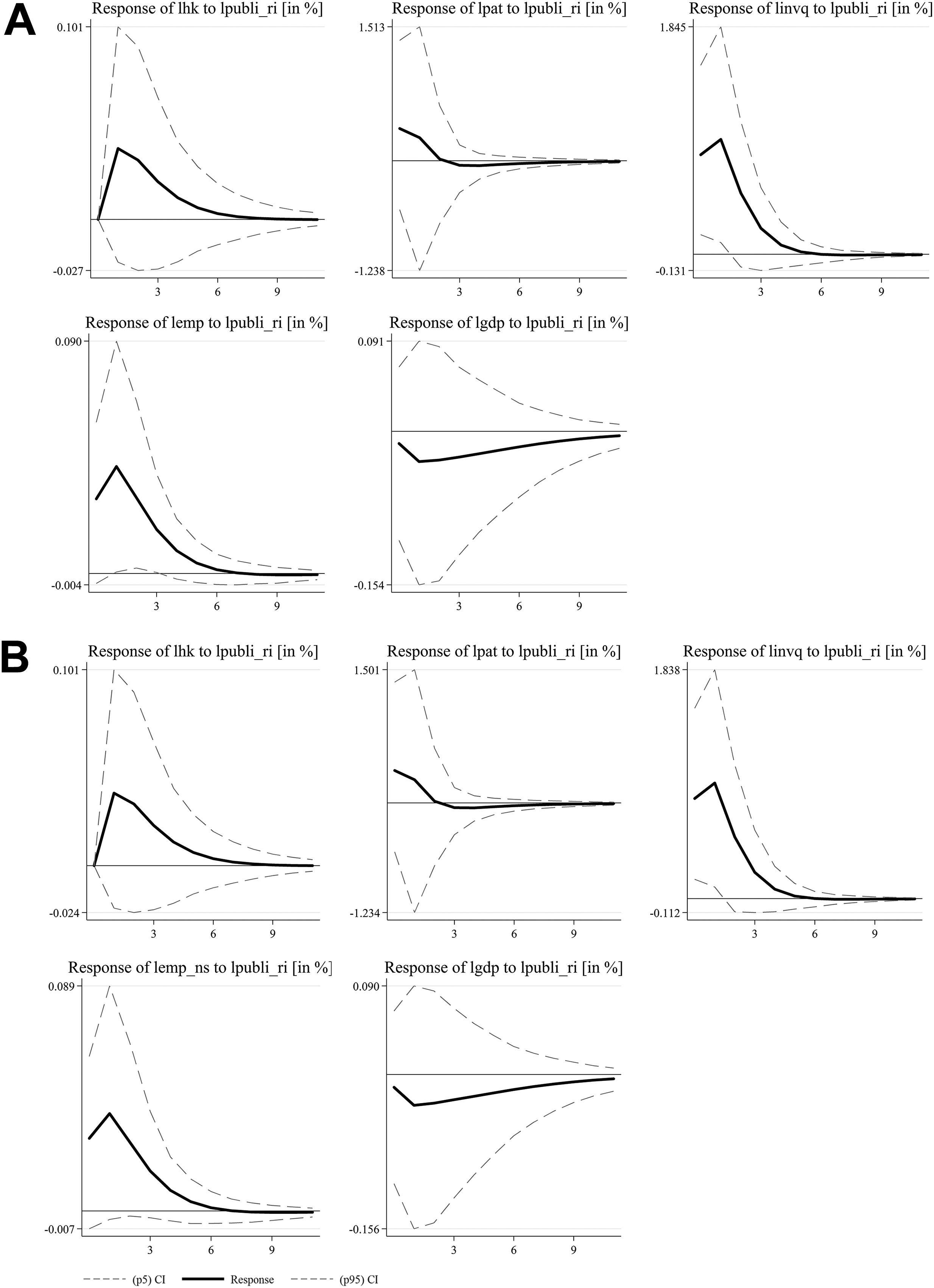
Impulse response functions (IRFs) for response of variables to shock in publication activity of public research institutes. (A) Employment rate (lemp). (B) Nonskilled employment rate (lemp_ns).
As stated in Conceptual Background section, Fraunhofer institutes conduct more applied and innovation-orientated R&D, while MP institutes complement mainly university research. However, we do not find any significant differences between MP and Fraunhofer institutes when we disaggregate their publication activities. There are two ways to interpret these disaggregate findings: first, there is no significant difference in the knowledge transfer of public research actors; second, and potentially more likely, publication data can only be seen as an imperfect indicator to measure public research activities, particularly when the data are disaggregated by public research actors. This disaggregation problem becomes visible when we contrast the disaggregated results with aggregated effects summed over all types of actors, which show significant effects on the regional economy. 26 At the same time, this finding may also indicate that the right mix of public research activities is decisive for observing positive output effects in the regional economy.
Regional Economic Effects of Third-party-funded Public Research Activities
Next, we present the results of the SpPVAR models and the associated IRFs using the volume of acquired third-party funds of universities and technical colleges as indicator for the strength of their public research efforts activities (unfortunately, no funding data are available for public research institutes). Different from the publication data, we are able to distinguish between overall funding volumes, on the one hand, and public as well as private third-party-funding volumes, on the other hand. 27 Hence, we are able to analyze public research activities more precisely by not only detangling public actors (universities and technical colleges) but also the sources of funds.
The selected IRFs of the SpPVAR model in Figure 2 highlight the growth effects of a positive one standard deviation “shock” in public third-party funding received by HEIs. An increase of public third-party funds leads—after a phasing-in process of roughly five years—to a significant positive increase in the regional patent rate. Moreover, the temporary rise in public third-party funds also leads to a significant increase in the employment rate and to a significant increase in the output per workforce. These findings provide support for H1, H3, and H4. 28 Conversely, a positive shock to overall and private third-party funds received by HEIs does not go along with any significant changes in regional variables.
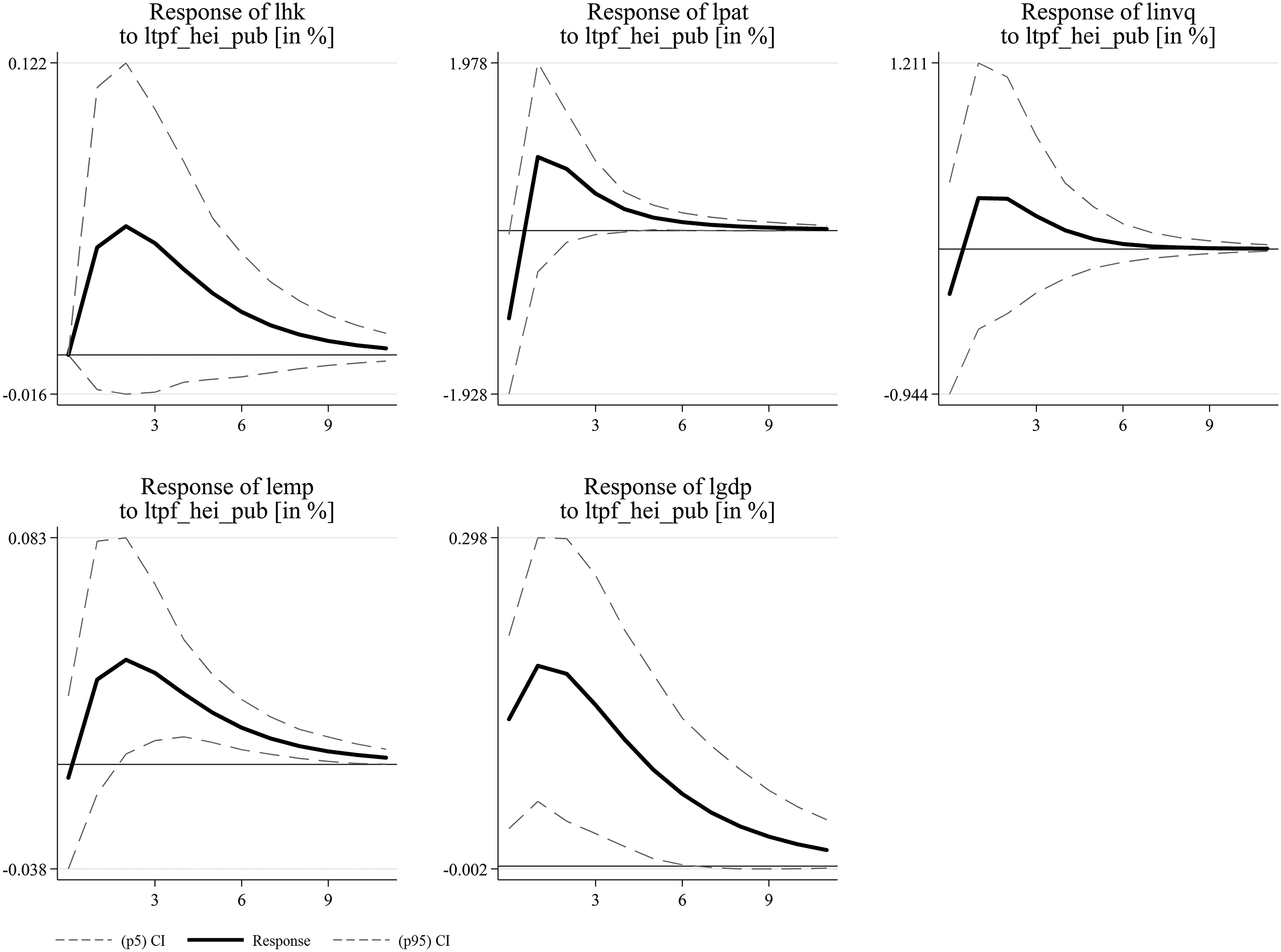
Impulse response functions (IRFs) for response of variables to shock in public third-party funds of higher education institutes (universities and technical colleges combined). Note: IRFs are based on the spatial panel vector autoregressive (SpPVAR) system incorporating the variables shown in Table 2 and the estimated coefficients. Solid lines are IRFs and dashed lines are 95 percent confidence intervals (CI) generated from Monte Carlo simulations with 200 repetitions.
As stated in H1–H4, we expect that the growth effects illustrated in Figure 2 are mainly driven by research efforts of technical colleges. The responses to a temporary increase in third-party funding (overall, public, private funds) received by universities do not show significant effects, thereby supporting our previous findings using the publication intensity of universities. This is in line with expectations based on the studies of Beise and Stahl (1999) and Fritsch and Schwirten (1999) regarding the conducted research, graduates, and cooperation behavior of universities.
In turn, the IRFs presented in the upper part of Figure 3 indicate that a change (“shock”) in the overall third-party funds received by technical colleges increases the investment rate significantly in the short run. The effects on the employment rate and output are very small and insignificant, while the effects on the regional patent rate (after a phasing-in of roughly one year) and the human capital are positive (both are statistically insignificant, though, which might be caused by the smaller number for technical colleges).
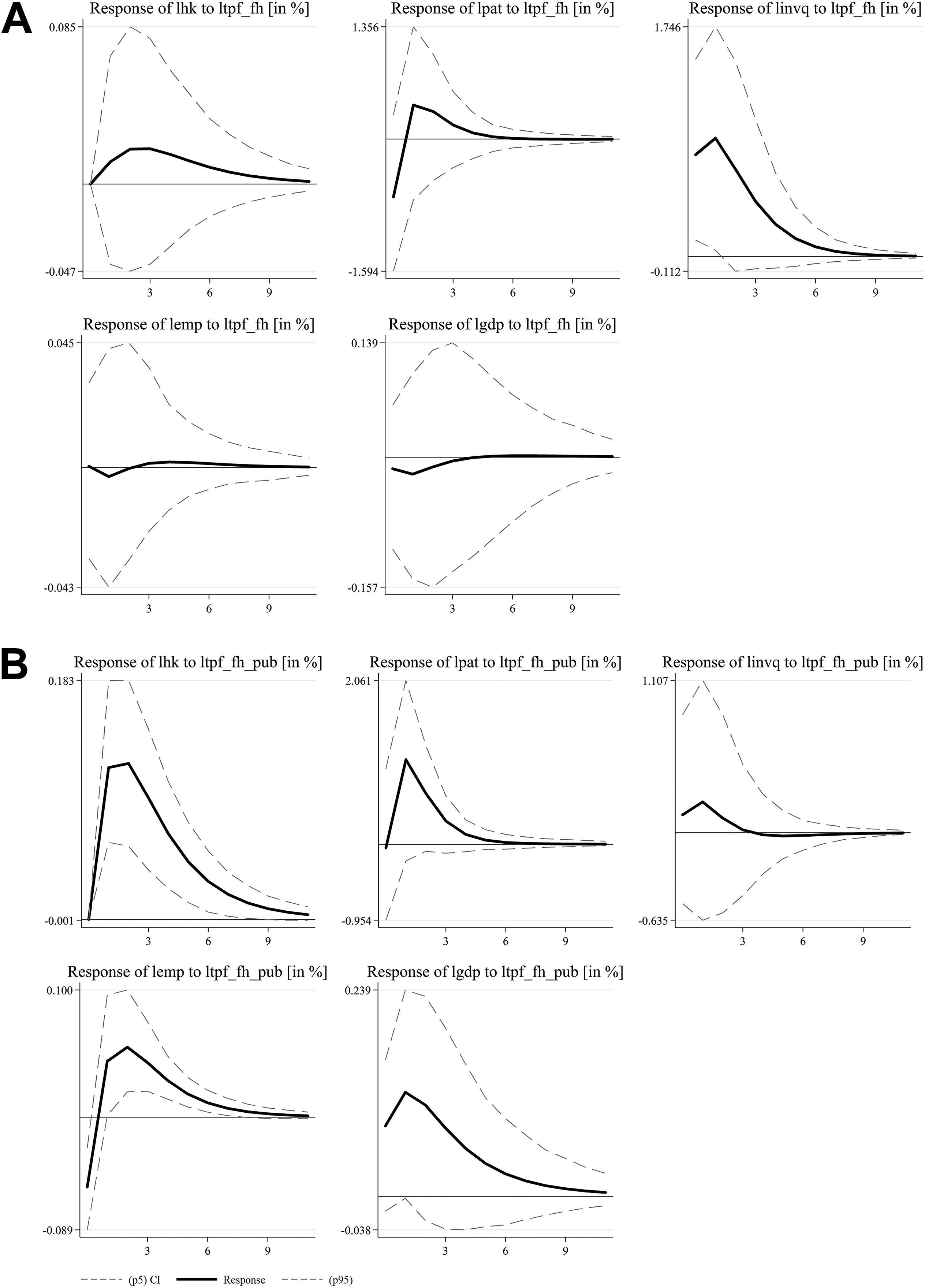
Impulse response functions (IRFs) for response of variables to shock in third-party funds of technical colleges. (A) Overall third-party funds. (B) Public third-party funds. Note: IRFs are based on the spatial panel vector autoregressive (SpPVAR) system incorporating the variables shown in Table 2 and the estimated coefficients. Solid lines are IRFs and dashed lines are 95 percent confidence intervals (CI) generated from Monte Carlo simulations with 200 repetitions.
In line with the overall results for the HEIs, private funds allocated to technical colleges do not have any significant regional effects. In contrast, a temporary rise in public third-party funds to technical colleges increases, on average, the stock of human capital and the employment rate significantly (H2 and H3 confirmed). In contrast to the findings for public third-party funds received by HEIs (Figure 2), we find positive but insignificant effects on the regional patent rate and the output in this setting (H1 and H4 not confirmed). Carefully speaking, this result may point to the fact that positive effects on a region’s patent rate may depend on the right mix of public sector research activities.
Table 4 summarizes the results of the analysis conducted in this article. We find at least some statistical support for regional effects of public research activities on all five economic variables, namely, investment, employment rate, stock of human capital, patent activity, and economic output studied in this article. Hence, our hypotheses are, at least, partly confirmed.
Findings of the Conducted SpPVAR Models and Their Associated IRFs.
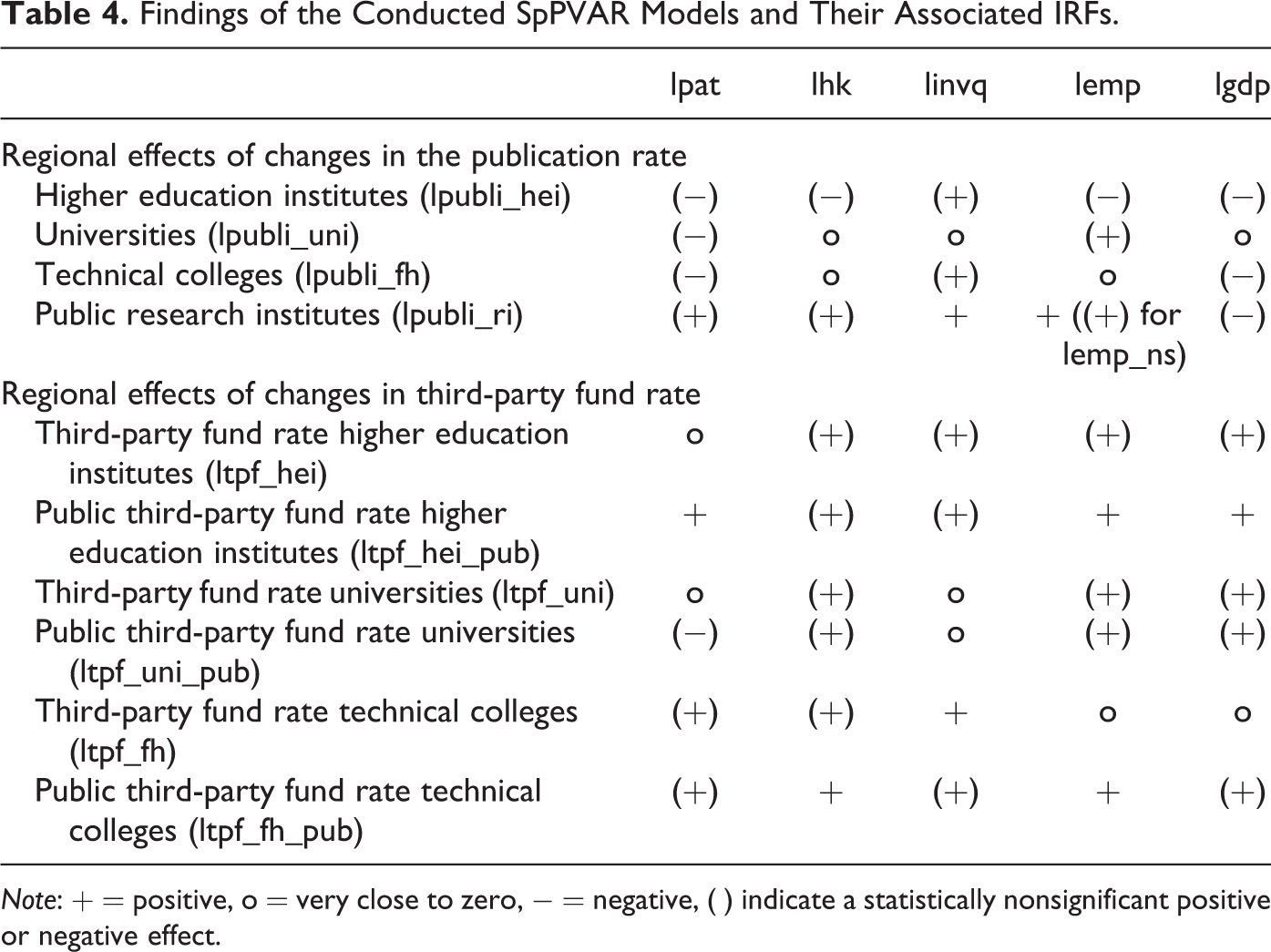
Note: + = positive, o = very close to zero, − = negative, ( ) indicate a statistically nonsignificant positive or negative effect.
Moreover, several details are worth discussing: first, we find little effects of publication activities. Publications seem not to reflect the interaction with the regional economy well. Publications are a more adequate measure for basic research, which is less regional bounded and less connected to the economic activity. In the case of public research institutes, publications have been the only available measure and have shown some significant effects.
Second, the results for third-party funding show that technical colleges have a stronger positive effect on the regional economy than universities. All settings incorporating universities do not indicate any significant regional effects. For technical colleges, a number of positive effects are detected, which may be explained by the higher regional embeddedness, the higher share of graduates remaining in the region, and the cooperation behavior. Hence, the higher relevance of technical colleges for the regional economy is clearly confirmed. 29
Third, distinguishing between public and private third-party funds leads to an interesting result: we do not find any positive effect of private third-party funds. One could have expected that private third-party funds come to a large extent from firms and therefore signal applied research. However, public third-party funds clearly translate into positive effects for the regional economy. Our interpretation is as follows: many public research funds target joint innovation projects between firms and public research institutes (including universities and technical colleges). It might well be that these joint research projects build a channel for knowledge transfer between public institutes and private actors, often within a region, that finally leads to economic effects. As a consequence, we are able to also find positive effects of such publicly funded research on the regional patent activity and economic output. Similarly, we find some evidence that the right mix of public research activities in the region may influence the strength of the observed effects.
Conclusions
This article has analyzed the regional economic effects of public research activities in Germany with a focus on their short-run dynamics. We have extended the recent literature on the transmission channels of knowledge transfer by distinguishing between different actor–activity combinations when analyzing the linkages between public research and regional economic variables. By estimating a SpPVAR approach and applying IRF analysis, we have explicitly considered the simultaneous relationship between the regional variables.
We find that especially the volume of public third-party funds received by local public research actors has positive effects on the regional economic activity. This might be caused by the fact that often public funds are given to collaborations between private actors and public institutes. Hence, we conclude that such funds might be especially helpful to make public research activities an effective means of development within their region. We find that regional economic effects are larger for technical colleges compared to universities. This can be interpreted such that technical colleges use the collaboration potential within the region more extensively compared to universities (e.g., due to the focus on applied research and the job market behavior of graduates that remain more often in the region). We also get some evidence that the strength of regional economic responses to an increase in public research activities depends on the right mix of public research activities, that is, the joint presence of different research actors in a region.
The empirical results do not provide evidence that research conducted at universities has a significant immediate effect on the local economic activity. This is in line with theoretical expectations and may reflect their focus on basic research and mainly interregional cooperations. However, the effects of universities on the regional economy may become significant in the long run. We also find significant positive effects of the research activity of public research institutes. Here, an increase in the publication rate stimulates regional investments as well as the employment rate.
From the results of this study, we may carefully draw the following policy implication: if policy makers aim at strengthening the short-run regional economic effects of public research activities, this should be done through an increase in the direct interaction between public research actors and firms. Public funds for collaborations of these actors seem to be a good tool to foster regional development. The regional effects of research conducted by universities seem to be currently low, but this might change if the collaboration behavior of universities changes. Moreover, one also needs to consider that HEIs, particularly universities, obviously have significant supply- and demand-side linkages with the regional economy beyond the level of research activities (see, for instance, Bleaney et al. 1992; Florax 1992; Garrido-Yserte and Gallo-Rivera 2010). Although these general income and expenditure effects should be considered when assessing the overall regional importance of research and HEIs, they were not in the focus of our empirical investigation.
Supplemental Material
Supplemental Material, IRSR_Online_Appendix - Public Research, Local Knowledge Transfer, and Regional Development: Insights from a Structural VAR Model
Supplemental Material, IRSR_Online_Appendix for Public Research, Local Knowledge Transfer, and Regional Development: Insights from a Structural VAR Model by Jonathan Eberle, Thomas Brenner and Timo Mitze in International Regional Science Review
Supplemental Material
Supplemental Material, supplement_material - Public Research, Local Knowledge Transfer, and Regional Development: Insights from a Structural VAR Model
Supplemental Material, supplement_material for Public Research, Local Knowledge Transfer, and Regional Development: Insights from a Structural VAR Model by Jonathan Eberle, Thomas Brenner and Timo Mitze in International Regional Science Review
Footnotes
Acknowledgment
We gratefully acknowledge the VolkswagenStiftung for funding our project.
Declaration of Conflicting Interests
The author(s) declared no potential conflicts of interest with respect to the research, authorship, and/or publication of this article.
Funding
The author(s) disclosed receipt of the following financial support for the research, authorship, and/or publication of this article: This study received funding from VolkswagenStiftung (grant number 89 472).

Supplemental Material
Supplemental material for this article is available online.
Notes
References
Supplementary Material
Please find the following supplemental material available below.
For Open Access articles published under a Creative Commons License, all supplemental material carries the same license as the article it is associated with.
For non-Open Access articles published, all supplemental material carries a non-exclusive license, and permission requests for re-use of supplemental material or any part of supplemental material shall be sent directly to the copyright owner as specified in the copyright notice associated with the article.
