



Abstract
Broadband access may have important implications for establishment births in rural areas, which feature thinner markets. Broadband may be especially important for rural nonemployer businesses, particularly those without a storefront, for access to nontraditional market channels. As women are more likely to run these types of small businesses, we further expect that broadband may have important implications for women-led businesses. With an effective instrumental variable approach, we find evidence that broadband access is a key factor leading to a higher establishment birth rate across business size and gender in rural areas. This paper identifies the largest effects on nonemployer, women-led and remote rural establishments.
Introduction
Rural economies have recently trailed their urban counterparts across several economic and demographic measures—a trend especially evident since the Great Recession. According to the USDA, in 2019, employment in nonmetro counties had not returned to pre-Great Recession levels. Metro areas, however, had fully recovered years earlier (Pender 2019). From 2017 to 2019, income across nonmetro counties was 35 percent lower than income in metro counties. In the most remote rural areas, income actually declined. Further, from 2010 to 2018, most places in the U.S. experienced economic and population expansion, but counties with urban populations below 20,000 faced population declines. Given this context, rural America has a great need for implementing economic development strategies.
To sustain and grow rural well-being and prosperity, one of the more tractable strategies involves promoting entrepreneurship, which has been linked to job creation (Haltiwanger, Jarmin, and Miranda 2013), income growth and poverty alleviation (Rupasingha and Goetz 2011). Although analysis of entrepreneurship’s job creation benefits in rural settings is sparse, evidence does suggest that even rural areas that seem to suffer from structural disadvantages—an example is Appalachia—still benefit from entrepreneurship (Stephens, Partridge, and Faggian 2013). Aside from potentially contributing to their local economies, small businesses maintain and build rural quality-of-life (e.g., cafes, recreation opportunities) and make main streets, schools and institutions vibrant. And, in an economic environment that lacks wage-and-salary job growth, entrepreneurship opens opportunities for rural residents to earn income.
Despite entrepreneurship’s potential benefits for rural communities, the lack of broadband access (i.e., affordable, reliable, high-speed internet access) impedes rural businesses and entrepreneurs from getting their footing. Broadband connects businesses to suppliers and consumers; this is true even more so in the COVID-19 era. The link between rural prosperity and broadband is strong enough that USDA promulgated expanding rural broadband to meet its rural prosperity enhancement goals (Agricultural and Rural Prosperity Task Force [ARPTF] 2018). In 2020, USDA invested $1.3B in rural broadband to connect households, farms and more than 10,000 rural businesses.
Existing literature stresses the importance of broadband internet access for entrepreneurship, measured with start-up activity, in urban settings. However, fewer studies examine the impacts in rural areas. Rural studies generally find broadband availability positively impacts business activity (Kim and Orazem 2017; Kandilov et al. 2017), but they are limited to particular states (e.g., Iowa and North Carolina as in Kim and Orazem (2017)) and sectors (e.g., farming as in Kandilov et al. (2017) or knowledge-intensive firms as in Mack (2014b)). Thus, they have limited generalizability. Some broader studies such as Whitacre, Gallardo, and Strover (2014a) and Stenberg et al. (2009) found broadband’s positive effects on the number of rural businesses as well as mixed results for the number of proprietors, but they use static measures of business activity rather than the flow of newly created firms (start-ups). None of these papers consider the effects across heterogeneous entrepreneurs, particularly among very small nonemployer businesses or businesses owned by women, for all of rural America.
We explore the relationship between broadband and entrepreneurship—defined as the establishment birth rate—by business size and gender, in rural and remote rural American counties. Our results indicate that broadband access enhanced the establishment birth rate, even and especially for small, remote, and women-led businesses ceteris paribus. In addition to finding broadband’s positive effects on rural small businesses, our paper makes several contributions. First, we advance causal identification with a combination of three instruments for broadband availability applied in our strictly rural sample. Second, our paper uses proprietary establishment-level data to understand the impact of broadband availability on rural and remote rural establishment births of different sizes, including otherwise difficult-to-track businesses without employees (Bird and Sapp 2004; Conroy, Deller, and Kures 2019). Last, we offer a comprehensive view of women-led rural establishment births, a relatively under-researched population given limited data availability and suppression issues. Practically, our results in the hands of rural decision-makers should incent broadband access and support for rural ecosystems that equitably foster entrepreneurship for diverse business leaders.
The paper proceeds by examining the literature linking broadband policy and impacts to entrepreneurship and business activity in rural contexts. We adopt a theoretical framework of firm-level profits and augment the model to consider how broadband internet affects entry. We then discuss the empirical model and our approaches to addressing endogeneity. We present our results and discuss their policy implications. We conclude by looking forward to subsequent work, which could build on these findings by focusing on broadband adoption by rural entrepreneurs or net establishment growth.
Literature
Rural Broadband in the U.S.—Policy and Impacts
Expanding internet access in rural areas has emerged as an important policy priority in the U.S. (Agricultural and Rural Prosperity Task Force 2018). COVID-19 only highlighted this need; for example, 33 percent of U.S. households shopped for groceries online in May 2020, and this figure was only 13 percent a year earlier (Thilmany et al. 2021). In 2020, USDA invested $1.3B in rural broadband (USDA 2020). Earlier, an unprecedented amount of money ($7.2B) was provided for broadband grant programs as part of the American Recovery and Reinvestment Act of 2009 (ARRA)—with a large share of the total going to rural areas. The ARRA projects were completed in 2014 (Barnes and Coatney 2015). Despite the challenges with administering these programs due to their scale, scope and short timeframe (Congressional Research Service 2011), the ARRA contributed to narrowing the “digital divide” between urban and rural America.
Rural broadband availability and adoption rates have been somewhat difficult to ascertain. For example, BroadbandNow (2020) estimated that 13 percent of Americans are unserved—double the Federal Communications Commission’s estimate. In the early 2000s, data on broadband availability (number of providers in a ZIP code) became available from the Federal Communications Commission, but the data were far from ideal for research (Mack 2019). Using 2008 Current Population Survey data, an estimated 55 percent of U.S. adults had broadband access at home, but the rural share was much lower—only 41 percent of rural households had the same access (Stenberg et al. 2009). Between 2009 and 2013, a series of surveys by Pew found the rural household broadband adoption rate increased from 46 percent to 62 percent, which was larger than the corresponding increase of 67 percent to 70 percent in urban households during the same time (Barnes and Coatney 2015).
Broadband internet expansion into rural areas has been linked to rural income, job and productivity growth (Whitacre, Gallardo, and Strover 2014a; Whitacre and Gallardo 2020), particularly in metropolitan-adjacent rural areas. According to a 2018 literature review by Gallardo, Whitacre and Grant, broadband studies giving specific attention to rural areas have noted rural broadband access and adoption have contributed to greater economic growth (Stenberg et al. 2009), higher household incomes (Whitacre, Gallardo, and Strover 2014a), benefits to small businesses such as reduced remoteness (Galloway, Sanders, and Deakins 2011) and growth in annual payroll and number of certain business establishments (Kandilov and Renkow 2010). Many studies focusing outside of rural areas have found empirical evidence linking high-speed broadband availability to local economic growth, (e.g., Kolko 2012).
Causality has been an issue in studies examining the economic effects of broadband internet. Whitacre, Gallardo, and Strover (2014b) critique prior research due to potential endogeneity problems and argue that it is very difficult to imply causality due to omitted variables, problematic data and the fact that few studies focus only on rural areas. Whitacre et al. moved toward a causal relationship with propensity score matching and found high levels of rural broadband adoption (not availability) were positively associated with income growth and negatively associated with unemployment growth; they also found low levels of rural broadband adoption were associated with declining employment and number of establishments.
Broadband Impacts on Businesses and Entrepreneurship
Broadband’s impact on business dynamics has generated interest within regional studies. Choosing to be an entrepreneur is likely based on individual characteristics, time allocation (e.g., farm versus off-farm opportunities) and geographic location (i.e., proximity to off-farm wage-and-salary jobs versus starting a business). The evidence suggests that, in addition to these well-documented factors, access to broadband at home also matters.
Looking at the impact of broadband internet on businesses (i.e., not only entrepreneurship), we find evidence of regional variation. One firm location study focused on a subset of metro areas (Mack, Anselin, and Grubesic 2011) found broadband had a generally positive effect, but the relationship varied by place. Stenberg et al. (2009) found that in 2007 in-home internet access was much more common in households with home businesses (81 percent) than among all households in the aggregate (62 percent), but the relationship also varied between urban and rural households. Of urban households with home-based businesses, 83 percent had internet versus 64 percent in aggregate, whereas 70 percent of rural households with home businesses had broadband versus 52 percent in aggregate. These data suggest the importance of broadband internet to business and—similar to Mack, Anselin, and Grubesic (2011)—indicate potential regional variation. Interestingly, Mack (2014a) found that broadband speed is more important for rural and agricultural firms compared to urban firms.
Broadband internet has possible negative effects due to the competition e-commerce can create. More research is needed to understand these impacts, particularly in rural areas. Shideler and Aadasyan (2012) found broadband negatively impacted small businesses in the finance and insurance sector in a Kentucky study. Chen and Zhang (2015) found empirical evidence that e-commerce can aid business survival when technology investment is used to create a competitive advantage; they also noted internet availability rather than intensity has a positive effect on e-commerce. By analyzing internet purchases in nonmetropolitan Illinois, Athiyaman (2008) found that e-commerce may not hurt rural brick-and-mortar stores if they can innovatively market their products. Adding a web page is insufficient. Rural stores instead need to focus on goods that consumers prefer to buy in-person. The clearest evidence of a negative competition effect that we identified was Goldmanis et al. (2009). The study found high-cost firms in some industries exited due to e-commerce pressure. However, the study also identified a net positive effect on the number of establishments, suggesting the exits were replaced with establishment births. Papers in this space point to more research being necessary to understand e-commerce’s positive and negative impacts. Tokar, Jansen, and Williams (2021) examined the unseen effects of e-commerce—examples include more packaging and delivery trucks and fewer plastic sacks—and found many unseen impacts that must be considered and assessed.
We identified one paper examining the impact of broadband infrastructure on establishment births, which is our preferred proxy for entrepreneurship. Audretsch, Heger, and Veith (2015) found start-up rates were enhanced by broadband infrastructure more than highways and railroads.
The impact of broadband on entrepreneurship, defined more broadly than establishment births, in rural areas warrants its own study. Several researchers focusing on rural areas have found positive relationships between rural self-employment and broadband availability. They include Low, Henderson, and Weiler (2005), Cumming and Johan (2010) and Stenberg et al. (2009). While the internet can help small rural businesses reduce marketing barriers arising from remoteness (O’Hara and Low 2020), rural businesses’ internet use may also be critical for retaining local customers (Galloway, Sanders, and Deakins 2011).
Recent studies suggest the positive impact of rural broadband is disproportionately higher in rural areas adjacent to metropolitan areas than in rural areas nonadjacent to metros. For example, broadband expansion has improved farm sales and profitability in counties that are adjacent to metropolitan areas (Kandilov et al. 2017). Using a difference-in-difference estimator, Kim and Orazem (2017) found that broadband availability had a positive impact on the location decision of new rural firms. They observed the largest effect in rural places adjacent to metropolitan areas—suggesting broadband availability to rural nonfarm businesses has primarily benefited those near urban areas.
Similar to studies of the relationship between broadband and economic outcomes, the existing studies of broadband and business-related outcomes have not thoroughly addressed causality. Tranos and Mack (2016) tested for Granger causality between broadband and growth of knowledge-intensive businesses and found the direction of causality to vary across U.S. counties, perhaps indicating important regional considerations. We address our approach to causality in a subsequent section.
Rural Broadband and Women-Led Businesses
Women entrepreneurs may be especially sensitive to broadband availability due to the nature and characteristics of their businesses. Women run businesses that tend to record less sales revenue and employ fewer people (Conroy and Weiler 2015). Women are also more likely than men to view their businesses as a secondary, rather than primary, source of income (Fairlie and Robb 2009). The evidence also suggests that women entrepreneurs are partly motivated by their family life, particularly the onset of young children (Conroy 2018). Self-employed women are more likely to be engaged in childcare than are wage-and-salary women and more likely than men in either category (Gurley-Calvez, Biehl, and Harper 2015).
Taken together, these findings suggest that women may be more likely to work from home. Indeed, international data suggest that self-employed women are more likely than self-employed men to work from home (OECD 2019). Specific to the U.S., Carter, Auken, and Harms (1992) found that rural home-based businesses were predominantly sole proprietorships owned by women. When running a business from home, otherwise isolated entrepreneurs may rely on broadband for connecting with suppliers and consumers and accessing resources. Fairlie (2006) found that people who have access to a home computer were substantially more likely to become entrepreneurs, and they found this relationship was much stronger for women than men. Given these findings, rural women entrepreneurs, who are already geographically removed from large markets, may be especially sensitive to broadband access.
Understanding broadband in relationship to women entrepreneurs is important for rural development because women-owned businesses—despite their small average size—have proven to be a powerful and growing source of job creation. From 1997 to 2007, women-owned businesses added over 500,000 jobs to the economy at a time when male- and coed-owned businesses lost jobs on net (U.S. Department of Commerce 2010). Further, women-owned businesses have been shown to be an important source of economic resilience and stability. Matsa and Miller (2014) showed that women business owners were less likely to lay off workers during an economic downturn. Deller, Conroy, and Watson (2017) showed that these business owner behaviors appear to culminate in regional stability, as counties with more women-owned businesses were more stable during the Great Recession.
Theoretical Framework and Hypotheses
This research is informed by a theoretical framework of firm-level profits developed by Deller, Conroy, and Markeson (2018) and augmented to consider how firms are affected by broadband. Assume there are an infinite number of regions, including region g, and individual i is the owner of a firm that enters the market when the profit function

is satisfied such that profits are positive or non-negative. P is the price of the good being sold at a quantity Qi. We could also consider the case of an outside option such as wage-and-salary employment as in the occupational choice frameworks presented in the seminal works of Lucas (1978) or Khilstrom and Laffont (1979). In an occupational choice framework, an owner of a firm would enter only if the profits are greater than the outside wage-and-salary option. During an economic downturn, this could imply that the threshold for entering the market is lower as employment is relatively limited. A thorough investigation of these cyclical considerations warrants its own study, however, and we focus on the straightforward case of entry upon positive or non-negative profits.
The quantity sold can be represented by

The quantity sold is a function of business skill ki of the owner i, and the broadband availability bg of the region g. An individual with access to high-speed internet (broadband) may sell a larger quantity of goods, and even some services, through online platforms and earn higher sales. As broadband may grant entrepreneurs access to new markets and thus expand their customer base, it is assumed that the value Qi is increasing in broadband availability and owner skill.
Let total costs take the form

to include both fixed costs and variable costs. Assume that fixed costs
That is

In this form, both variable costs and fixed costs are affected by (bg) and (eg)—formally,
As access to broadband in a region increases, paired with a supportive regional entrepreneurial ecosystem, so does the propensity for new ventures. Specifically, in a community with a conducive entrepreneurial context, broadband can lead to lower costs through access to a larger and more competitive network of suppliers as well as knowledge and application of alternative more efficient business models. That is, when
In its entirety:

Assuming that individual skill ki and the regional entrepreneurial context eg are both fixed, then changes in a firm’s profits are dependent upon changes in access to broadband. The change in profits associated with changes in broadband in region g is given by:

The effects of broadband access on firm i’s change in profits is expected to be positive via lower costs and a higher quantity sold leading to our primary hypothesis that access to broadband will correspond to higher establishment birth rates. The model also has implications for start-up activity by size and gender. A critical phase of growth for many firms is the transition to having employees. Some firms start at the outset with employees, but many operate for some time with only the owner or partners working in the business before hiring their first wage-and-salary employees. For these smaller businesses that have no employees and incur lower costs, the marginal change in profit from access to broadband may be enough to incent entry. Mack and Grubesic (2009), as evidence of this relationship, found that small firms have stronger correlation to broadband access than do larger firms. Therefore, we expect relatively large effects of broadband internet for small/nonemployer establishments. Last, we hypothesize that the birth rate of women-led establishments follows the same pattern of the birth rate of all establishments—in that small/nonemployers will be relatively more sensitive to increases in broadband relative to large employer businesses. Women-owned businesses are far more likely to be nonemployers and are generally smaller in terms of sales, and those that do have employees are still smaller than the average business (Conroy and Weiler 2015).
Empirical Model and Data
Focusing on regional economic development, we use the theoretical framework suggesting that broadband access enhances entrepreneurial activity to motivate our empirical model. In our empirical model, the establishment birth rate

The dependent variables measuring entrepreneurial activity across gender and size of business are generated from the National Establishment Time Series (NETS) and normalized by county population. New businesses are identified in the year they enter the data set. We calculate a three-year average of births from 2005 to 2007 to capture the end of the expansionary period. Using an average helps smooth some of the annual variability in the birth rate (Low and Isserman 2015).
Using the establishment-level proprietary NETS data allows us to focus on newly entering businesses rather than a static measure of business activity, such as the share of self-employed. Further, because it is a flow measure rather than a stock, endogeneity is reduced. The NETS data also allow us to observe gender of the owner as well as employment in each establishment so that we can parse results by gender and size. Criticisms of the NETS data abound but refer primarily to the early files (1980 and early 1990s); significant improvements in the methodology used to gather, screen and clean data have since occurred, as documented by Kolko and Neumark (2007). 2
Births are disaggregated by employment size at their start. Establishments that are born with two or more employees (including the owner or owners) are considered employer establishments. This employer establishment category of businesses is similar to entities tracked by the U.S. Census Bureau’s County Business Patterns, which includes only businesses with paid employees. The complementary size category is all businesses with just one employee—the owner herself. This nonemployer category is similar to businesses included in the U.S. Census Bureau’s Nonemployer Statistics. We also identify the subcategory of female-led businesses as those that are female-owned or have a female CEO. The birth rates for each size and gender category are calculated by normalizing with population (in thousands) in 2007 as county population represents about how many firms can exist in a local market.
Figure 1 shows the variation in the rural establishment birth rate for the counties included in our study. Counties shown in yellow have establishment birth rates below the U.S. mean, counties in green have rates one standard deviation above the mean, and blue counties have the highest establishment birth rates. The establishment birth rate is generally lower in the Southwest, Appalachia and the Rust Belt states. The rural Midwest or Plains states are comparatively more entrepreneurial.
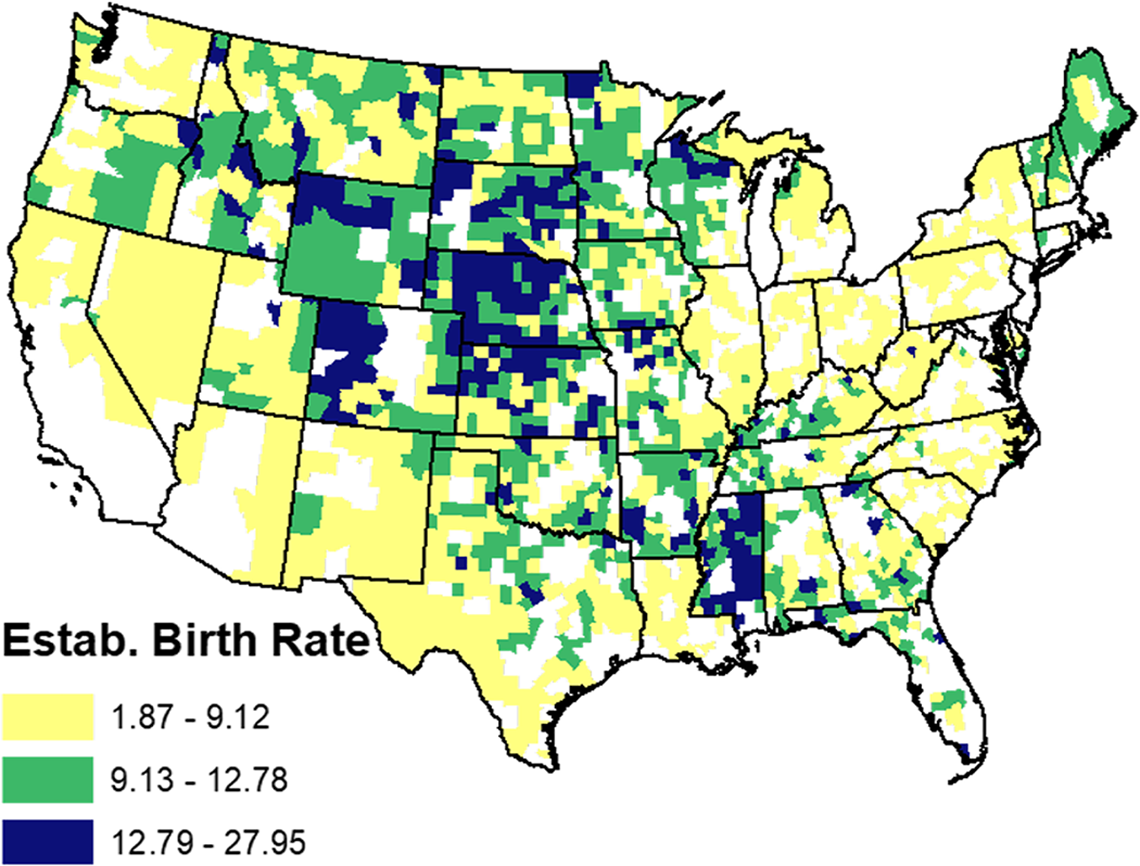
Establishment birth rate in rural counties-establishments of all sizes, 2005–2007.
Broadband and Regional Control Variables
Our control variables are lagged relative to the period of the birth rate, based on past research that suggests businesses take roughly two years to go from conception to operational (Reynolds 2007) and that institutional financing conditions approximately two years prior to start-up seem most crucial (Conroy, Low, and Weiler 2017).
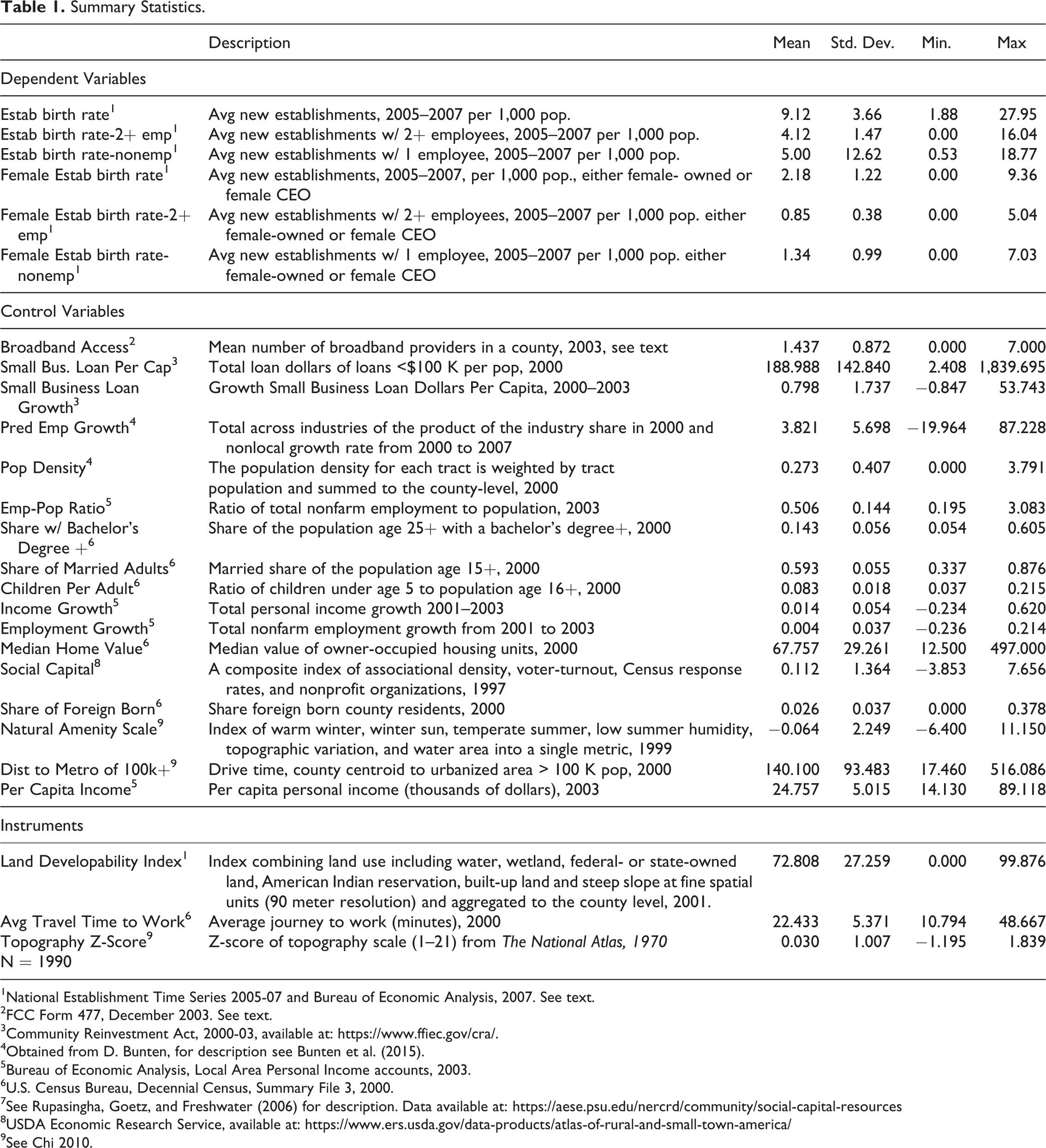
The focal explanatory variable, broadband access, is proxied for using Federal Communications Commission (FCC) data on broadband providers from Form 477, December 2003. Broadband provider data were available at the ZIP code level and assigned to counties using ZIP population-centroids. 3 Thus, our broadband variable reflects, approximately, the mean number of broadband providers in a rural county. Nationally, this method produced a mean of 1.98 providers at the county-level. For nonmetro counties—the observations used in this model—the mean is 1.437, and the standard deviation is 0.872. The nonmetro county minimum was zero providers, and the maximum was seven (Table 1)
Summary Statistics.
1National Establishment Time Series 2005-07 and Bureau of Economic Analysis, 2007. See text.
2FCC Form 477, December 2003. See text.
3Community Reinvestment Act, 2000-03, available at: https://www.ffiec.gov/cra/.
4Obtained from D. Bunten, for description see Bunten et al. (2015).
5Bureau of Economic Analysis, Local Area Personal Income accounts, 2003.
6U.S. Census Bureau, Decennial Census, Summary File 3, 2000.
7See Rupasingha, Goetz, and Freshwater (2006) for description. Data available at: https://aese.psu.edu/nercrd/community/social-capital-resources
8USDA Economic Research Service, available at: https://www.ers.usda.gov/data-products/atlas-of-rural-and-small-town-america/
9See Chi 2010.
Caveats to the use of these data are well-documented (Mack 2019; Grubesic 2004). Providers may claim service provision even if only one household in a ZIP code has service. This method likely overcounts service provision. 4 Thus, we interpret our point estimates conservatively.
Because broadband is not ubiquitously available across the areal unit in our data, especially in rural areas (Mack 2014a), we assume an increase in the number of providers means different areas are served by additional providers and more total broadband provision in the county, as did Stenberg et al. (2009). That is, going from a mean of 4.0–4.5 providers in a county suggests more places had broadband access because rural counties in 2003 had little competition. In Figure 2, counties shown in light green have broadband providers below the mean, whereas those in the two darker shades of green have broadband access above the mean and above one standard deviation above the mean.
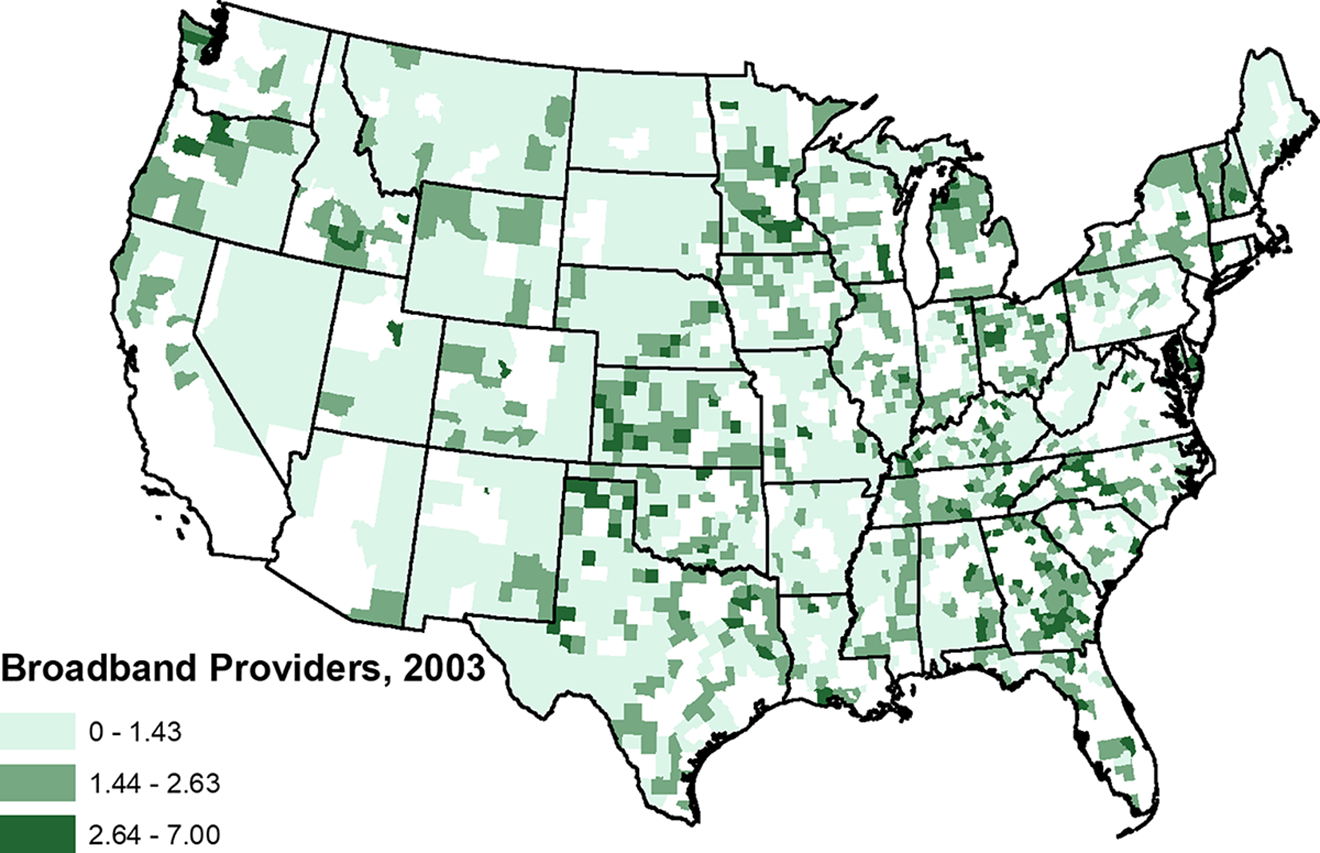
Broadband access in rural counties, 2003.
In comparing the Figure 1, the dependent variable, to Figure 2, our focal explanatory variable, several of the regions that have relatively low entrepreneurial activity also have relatively little access to broadband. For example, many counties in the Southwest have below-the-mean establishment birth rates and similar below-the-mean broadband providers, as do several counties in the Appalachian region.
Alongside broadband, we control for a number of regional factors expected to impact establishment births (Table 1). In identifying relevant control variables, we focus on studies of establishment births as well as other proxies for entrepreneurship such as self-employment and proprietorship. First, small business loan dollars per capita in 2000 is calculated from data collected under mandate of the 1996 Community Reinvestment Act. Specifically, commercial banks report their lending activity by size of the loan and location of the recipient. We focus on the category of loans under $100,000—by far the most common type of loan. In addition to loan dollars per capita, we measure growth in loan dollars per capita from 2000 to 2003, based on the finding that changes in lending patterns, alongside levels, seem to determine entrepreneurial activity (Conroy, Low, and Weiler 2017). In addition to these measures of institutional finance, we include the median owner-occupied home value in 2000, which corresponds to the potential for entrepreneurs to use home equity loans to finance their ventures.
Human capital is also a key determinant of regional entrepreneurial activity. We include the share of the adult population (ages 25 and over) with a bachelor’s degree or more education in 2000. We expect that entrepreneurial propensity increases with regional education attainment particularly among bachelor’s degree holders (Conroy and Weiler 2015). With financial and human capital, we include the 1997 social capital index, developed by Rupasingha, Goetz, and Freshwater (2006), to capture how the strength of networks and community cohesion may lend itself to supporting incoming entrepreneurs.
Several variables control for local economic conditions. First, predicted employment growth—otherwise known as a Bartik shock—captures the expectation for local employment growth using local industry size combined with national growth rates for each industry from 2000 to 2007. This allows us to further isolate changes in entrepreneurial activity apart from national economic trends. Employment per capita captures economic activity and labor availability—both of which may encourage new business. Per capita income and income and employment growth capture local economic conditions that impact demand and correspond to new market niches that are opportunities for local entrepreneurs.
Demographic features of the region also play a role in local entrepreneurial outcomes. Particularly with regard to women entrepreneurs, marriage and family are important factors (Conroy and Weiler 2015). For example, there is some evidence that women are using entrepreneurship as an employment strategy when traditional wage-and-salary employment is inconsistent with household preferences for childcare provision (Conroy 2018). We include both the share of married adults (ages 15 and over) in 2000 as well as the number of young children under age 5 per adult (age 16+) in 2000 each from the decennial U.S. Census. In addition to these demographic measures, we also use the share of foreign-born people to capture the historically high entrepreneurial propensity of foreign-born individuals in urban areas, which likely capture more high-skill immigrants.
Last, we include several variables to measure local amenities. Natural amenities are measured with the USDA natural amenities index. Access to urban amenities such as the arts and agglomeration benefits including skilled labor pools and strong supplier networks are measured by the estimated drive time from the rural county centroid to the edge of the nearest Census Bureau—designated urbanized area of at least 100,000 residents, using 2000 population. To further control for size-related benefits to incoming entrepreneurs, such as the potential for consumer markets, we include the tract-weighted population density.
Endogeneity
The analysis of start-ups by size and gender requires a suite of instrumental variables. 5 Ideal instruments must both be related to the focal explanatory variable – access to broadband in our case—and unrelated to the dependent variable. As the dependent variable changes across the following specifications and captures characteristically different establishment birth rates, each specification may require its own combination of instruments. To accommodate the range of dependent variables, our analysis makes use of three instruments: the land developability index (2001) developed by Chi (2010), a topography measure and commuting time in some robustness checks. 6
Building on the intuition of using topographical features as instruments for broadband from past studies (see Kolko [2012] and Mack and Wentz [2017]), the land developability index combines aspects of land use including water, wetland, federal- or state-owned land, American Indian reservation, built-up land and steep slope. These six layers of developability are coded at fine spatial units (90 meter resolution) and aggregated to the county level. For our purposes of studying access to rural broadband, these features of land use relate directly to the costs and, therefore, barriers to broadband provision (e.g., steep slopes and water/wetlands make laying fiber expensive; regulations such as the National Environmental Policy Act have made laying fiber on federally owned or American Indian land burdensome; pole-attachment fees can be high). Thus, these land use features create a relationship between the index and broadband penetration. These features are also plausibly exogenous in that physical features of the land are largely the result of geological forces, and political boundaries have largely resulted from historical circumstances. Modern entrepreneurship is likely unrelated to these historical and geological components of the index as well as the index itself. The land developability index, thus, has attractive qualities as an instrument for broadband in regression analysis of rural entrepreneurial activity. First-stage results show that, as expected, a higher index score corresponds to more developable land and, therefore, greater access to broadband.
In combination with the land developability index, we use a county-level topography score. While slope is already a component of the land developability index, topography is distinct. Our topography score is based upon the physical feature of the land as it relates to elevation (e.g., plains, tablelands, hills, mountains), whereas slope is a change in elevation over a defined distance. Like the developability index, topography proves to be related to broadband access; it has also been successfully used as an instrument for broadband by Kolko (2012). First-stage results demonstrate that topography does indeed seem to be a constraint on broadband access.
Results
Our results confirm the hypothesis that broadband access enhances rural establishment birth rates. This result is robust to establishment size and women-led firms. The results also suggest that broadband plays a larger role in remote rural counties and entry of small nonemployer-type businesses.
The models are estimated with ordinary least squares and, for the instrumental variable strategy, two-stage least squares. Both use robust standard errors and census region fixed effects. Results are presented in Tables 2 and 3. The instrumental variables results confirm that endogenity is statistically present and requires our instruments for broadband availability. The first-stage F statistic indicates that the instruments are strong. As the endogenous variable, broadband, is overidentified with land developability and topography, Hansen’s J tests that the instruments are uncorrelated with the error term under the null of valid instruments. Last, the endogeneity test addresses the endogeneity of the suspect regressor under the null of exogeneity and indicates that broadband is endogenous in all cases. The OLS results and IV specifications do contain similar results for broadband in significance and sign – all suggesting a positive relationship between broadband and the establishment birth rate. Discussion in this section focuses on the IV specification in Tables 2 and 3. Discussion of the remote rural subsample and additional robustness specifications follow in the next section.
Establishment Births, 2005–2007.
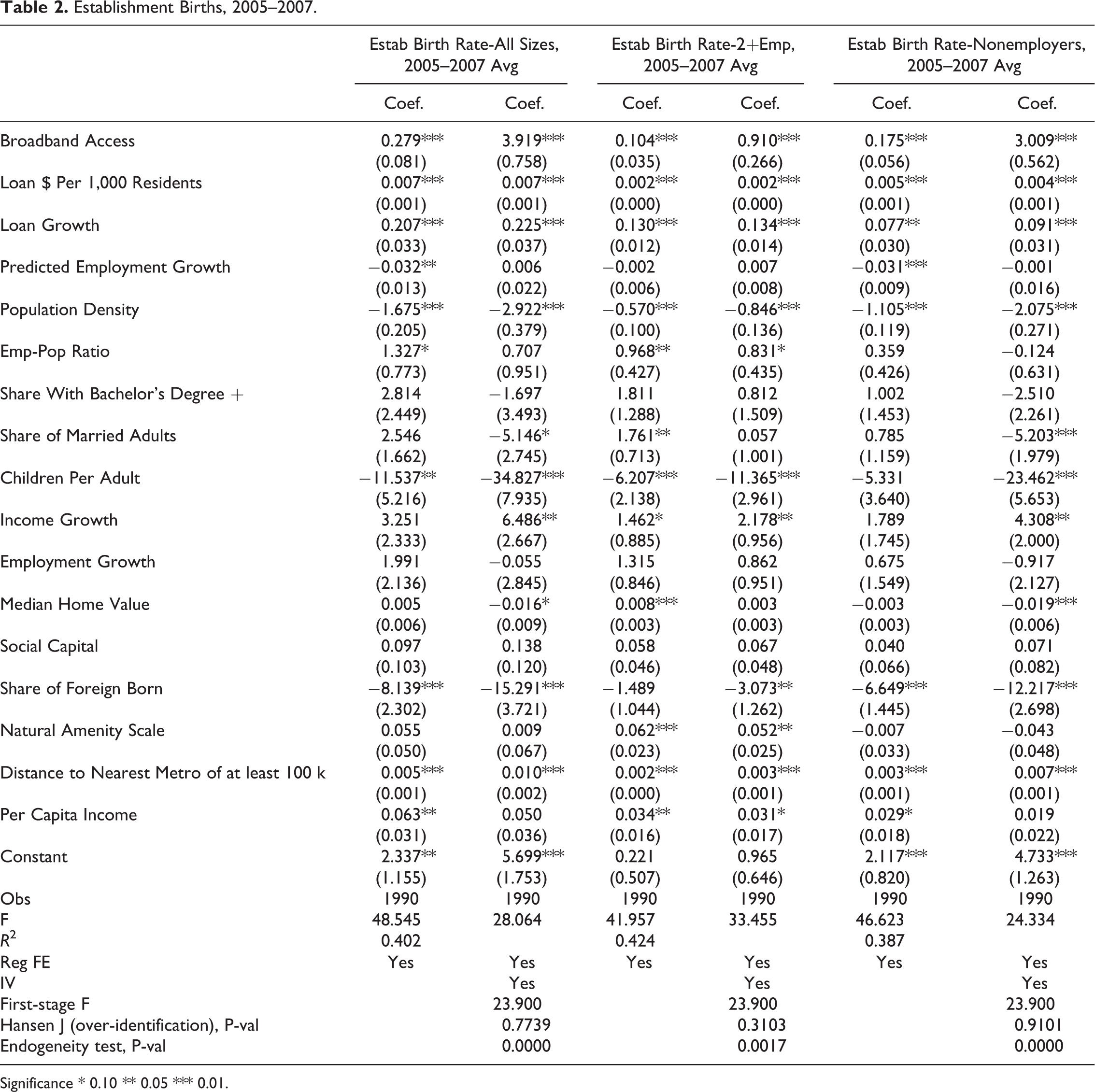
Significance * 0.10 ** 0.05 *** 0.01.
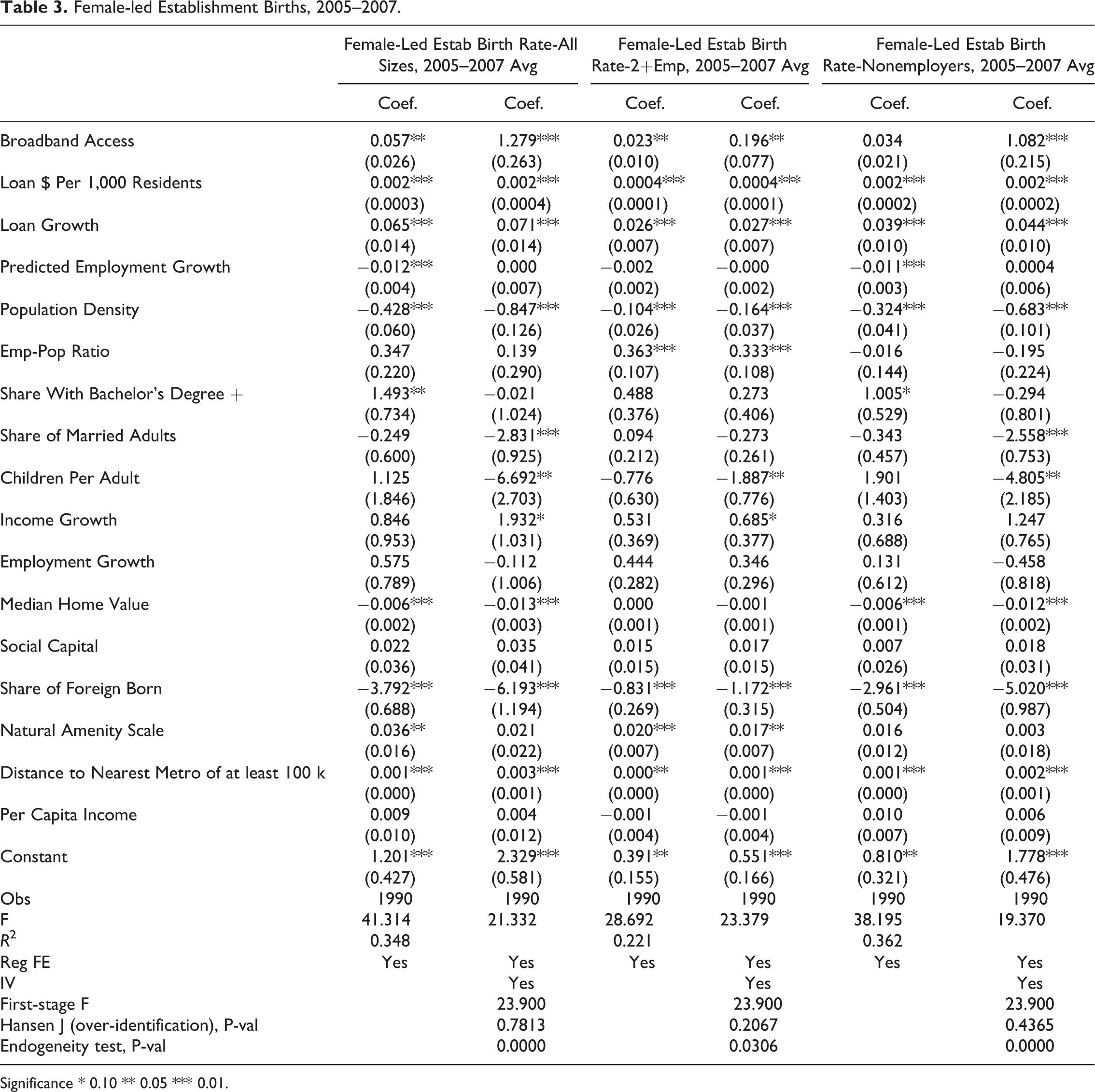
Female-led Establishment Births, 2005–2007.
Significance * 0.10 ** 0.05 *** 0.01.
For a sense of the magnitude of the effects, we calculate the marginal effects as the change in the establishment birth rate associated with a one-standard-deviation increase in broadband access from the mean. First, keep in mind that in rural areas during this period, increases in the number of broadband providers likely reflect increased coverage as opposed to more competition because broadband was not ubiquitously available within ZIP codes—particularly rural areal units (Mack 2014a). Second, the birth rate for establishments with two employees or more is most comparable to Census data sources that track only employer businesses, such as County Business Patterns.
Looking at these “employer” businesses first, the marginal effect of a one-standard-deviation increase in broadband access in an otherwise average rural county is an employer establishment birth rate that is 0.79 births per 1,000 higher than in a county with average broadband access (0.910*.872) or a 19 percent increase from the mean. In a typical rural county, with nearly 25,000 people in 2007, this translates to approximately 20 additional employer establishment births. More conservatively, using the lower bound of the confidence interval on the estimate that may mitigate upward bias noted in fourth section, the marginal effect would be 0.34 additional births per 1,000, an 8.2 percent increase from the mean birth rate. 7 In a typical rural county, with nearly 25,000 people in 2007, interpreting the coefficient more conservatively translates to approximately eight additional employer establishment births. For comparison, the marginal effect of a one-standard-deviation increase in loan dollars per capita in an otherwise average rural county would be an employer establishment birth rate that is 0.31 births per 1,000 higher than in a county with average lending.
When we consider nonemployer businesses, which account for approximately 75 percent of businesses nationally, the marginal effects in absolute terms and as a percentage increase from the mean are larger. In an otherwise average county with broadband access one standard deviation above the mean, the nonemployer birth rate is expected to be 2.62 births per 1,000 people higher relative to an average county (3.009*.872)—roughly half the mean. In a typical rural county with nearly 25,000 people in 2007, this is roughly equal to an additional 65 births. The establishment birth rate of all firms (nonemployers and 2+ employees) in an otherwise average county with broadband access one standard deviation above the mean is expected to be 3.42 births per 1,000 people higher relative to an average county (3.919*.872), a 38 percent increase from the mean. In a typical rural county with nearly 25,000 people in 2007, this is roughly equal to an additional 85 births. However, this effect is largely driven by nonemployer firms that are often part-time work or gigs (Low, Sanders, and White 2020). Using the lower bound, the expected change in establishment births from a one-standard-deviation increase in broadband is 2.12 births per 1,000 residents (2.433*.872) for all establishments and 1.66 births per 1,000 residents (1.907*.872) for nonemployer establishments.
A similar pattern exists for women (Table 3). The birth rate for firms of any size led by women in counties with broadband access one standard deviation above the mean would be 1.12 births per 1,000 people higher (more than half of the mean at 2.18) than a county with average broadband access. As with the birth rate in total, the nonemployers drive the result—as can be seen by considering the marginal effects for nonemployer and employer businesses separately. For nonemployer births, broadband access one standard deviation above the mean corresponds to 0.94 more births per 1,000 people. For employer establishments, broadband access one standard deviation above the mean corresponds to just 0.17 more births per 1,000 people. 8 Although the effects are small in absolute value compared to the effects for the total birth rates, relative to the mean, the percentage increases in woman-led establishment birth rates are similar, if not larger, in magnitude.
Although a lengthy discussion of the remaining control variables is beyond the focus of this paper, a few interesting findings emerge. In general, the birth rate is sensitive to the level of lending and growth in lending, consistent with Conroy, Low, and Weiler (2017). A higher number of children per adult has a negative impact on the establishment birth rate for all types of business, perhaps because children present a significant time and financial cost. Interestingly, after controlling for a suite of human capital, social and regional factors, establishment birth rates consistently increase with the distance to the nearest metropolitan area of 100,000 or more, suggesting new business entry rates are higher in more remote rural communities.
Extensions and Robustness Checks
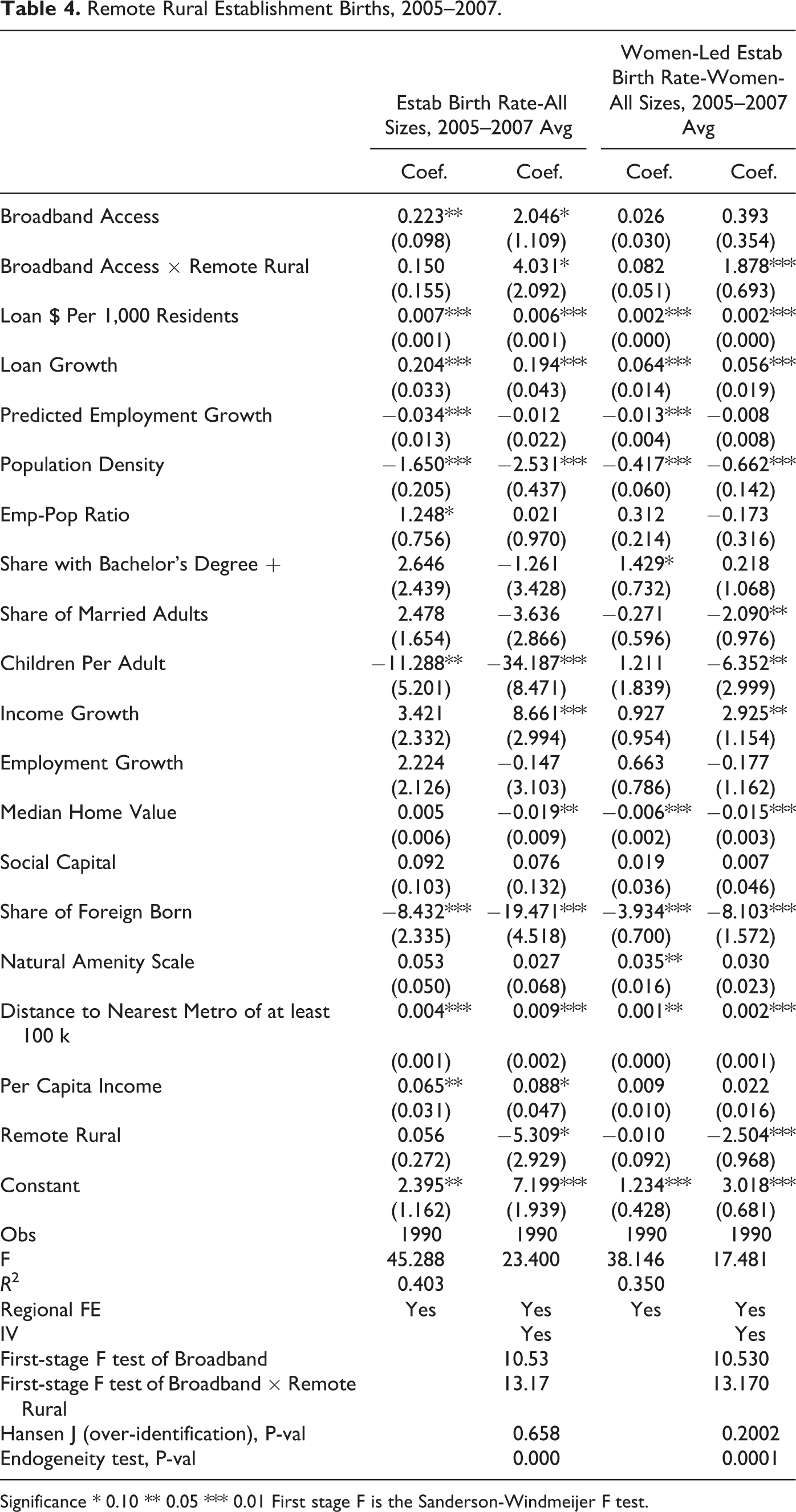
Most rural entrepreneurs may be especially sensitive to broadband internet availability because their businesses are smaller (Goetz and Rupasingha 2013) or home-based (Carter, Auken, and Harms 1992). To test whether our results are robust in these areas, we include an indicator for remote rural counties, defined as non-metropolitan, non-adjacent to metropolitan, and not having significant commuting ties to a metropolitan core (i.e., USDA Economic Research Service Rural-Urban Continuum Codes 5, 7 and 9, and an interaction of this indicator with broadband). 9 The results (Table 4) again indicate a positive and significant effect of broadband for total establishment births as well as an even larger positive and significant effect in remote rural counties. Interestingly, for women-led establishments, there appears to be no significant effect of broadband alone. Rather, broadband has only a positive and significant effect in the most remote and rural counties. These results for women-led firms suggest that the more general results for all rural counties in Table 3 may be largely driven by women entrepreneurs in the most remote locations.
Remote Rural Establishment Births, 2005–2007.
Significance * 0.10 ** 0.05 *** 0.01 First stage F is the Sanderson-Windmeijer F test.
As further robustness checks to our main findings in Tables 2 and 3, we considered several alternative specifications. First, while our dependent variable is calculated for 2005 to 2007, we also considered using 2004 to 2006 in order to identify a period unaffected by the recession. Our preliminary regressions suggested no meaningful difference between the periods ending in 2006 and 2007. We ultimately chose 2007 in favor of the slightly more recent period.
There is the potential for correlation between our focal broadband variable and some of our county-level controls. With the possibility of bad controls, we considered for all births alternative specifications that exclude the most suspicious variables, such as income per capita and lending activity. We find the results substantively similar in sign and significance.
We also considered alternatives to our census region fixed effects. The instance of states with one or few rural counties makes region fixed effects our preference over state fixed effects. However, recognizing that state-level policies are very important to broadband provision (Whitacre and Gallardo 2020), we did a robustness check using state fixed effects. These specifications are less than ideal as the first-stage F statistics and Anderson-Rubin tests suggests the weak-instruments are marginally problematic for the full sample and nonemployer firms, though more severely for employer firms. That said, barring the results for employer firms, the results on the broadband variable are consistent in the state FE model, though the coefficient is a little smaller. Alternatively, Tables 7 and 8 in the Online Appendix report the results of OLS and IV regressions without fixed effects. While the results on the coefficient differ somewhat from our main regression in terms of magnitude, they are consistent in terms of direction and sign.
Last, as a caveat of our results, there are limitations to the National Establishment Time Series. First, as NETS is updated each year and backward-revised, there is reason to expect the older data to be more reliable. This feature of the data informed our choice to study the pre-Great Recession era. There is also evidence that the data included on characteristics of the business/business owner(s) are less reliable and/or under-reported. Consequently, the size class and—even more so—the gendered variables used in our analysis may be incomplete or noisy. However, we found our NETS-based results robust to alternative dependent variables, namely net growth of establishments from 2004 to 2007 (data from the County Business Patterns and Nonemployer Statistics) as well as the female-owned business rate (data from the 2007 Survey of Business Owners). Importantly, we know of no other source of gendered data on small business dynamics, especially nonemployer businesses, available for small and rural geographies. In that sense, we view this exercise as an informative early foray into rural business dynamics for these otherwise less visible businesses.
Policy Implications
Our results suggest that establishment births in rural America have increased as a result of broadband internet access. Our study includes a diverse set of rural entrepreneurs across all sectors, sizes and nonmetropolitan areas; results suggest that as rural broadband expansion continues, business start-ups, particularly those that are women-led, in rural and remote rural areas may be spurred.
Our findings highlight establishment births and entrepreneurship more generally as alternative strategies for rural economic development in communities that have long focused on business attraction, which is a less sustainable economic development tool. Since rural America’s population, employment and per capita personal income lag (Pender 2019), supporting local entrepreneurial assets with broadband infrastructure can help cultivate a locally rooted business community. Already, in some rural areas, entrepreneurship has gained traction as leaders realize low-cost land and labor are no longer key ingredients for business attraction. Researchers and practitioners agree that small businesses improving rural quality-of-life by providing goods and services (e.g., a market, a coffee shop) to a community is a realistic strategy for rural prosperity, certainly compared to business recruitment (Drabenstott 2006). Creating an environment or ecosystem conducive to entrepreneurship requires a community to think not about a specific business but instead to focus on the environment in which businesses operate (Pages 2018). Our findings are significant to rural economic development because broadband can expand market access on both the supplier and consumer sides, as well as provide a wealth of educational opportunities for entrepreneurs. Broadband may be especially important for businesses without a storefront as it provides access to nontraditional market channels. Broadband access creates additional educational needs, however; online sales platforms and a social media presence are examples. Resources such as access to broadband internet, e-commerce Extension education, technical assistance from community organizations and commercial e-commerce platforms have helped businesses and consumers adapt and respond to changes in online retailing (Thilmany et al. 2021).
Our theoretical model argues that broadband access as part of a broader supportive entrepreneurial ecosystems would best aid nascent business start-ups in rural America. In this context, those regions leveraging federal and state investment in broadband infrastructure with concurrent entrepreneurial ecosystem building are best poised for a higher quantity and quality of start-ups. How can a rural community or region leverage expanding broadband infrastructure with entrepreneurial ecosystem building? Building entrepreneurial networks and supporting new and growing businesses with technical assistance will help. For example, prior to COVID-19, Missouri’s Small Business Development Centers (SBDC) launched a virtual business counseling service, which allows professional counselors to bring technical assistance to rural entrepreneurs and small business owners. One must have fast, reliable internet access to utilize the free SBDC virtual counselor, however.
Start-ups in rural America face many challenges their urban counterparts may not (e.g., distance to markets, a dearth of knowledge workers, spillovers and agglomeration (Figueroa-Armijos, Dabson, and Johnson 2013), and weak entrepreneurial networks (Pages 2018)). Importantly, relatively limited access to childcare may be another challenge. As indicated by our results, the establishment birth rate is lower in settings with more young children. Accessible and affordable childcare may be an important component of an entrepreneurial ecosystem. Similarly, business support programs such as those offered by a local economic development organization or small business development center may reach more business owners by coupling their services with childcare.
In addition, some of these challenges can be alleviated with broadband internet access. In February, 2020, FCC launched its Rural Digital Opportunity Fund—a $20 billion pool to be dispersed over the next 10 years in rural America to locations that are deemed high-cost areas for broadband provision. In addition to FCC and USDA federal investments, many states are making their own investments in increasing broadband access, including funneling CARES Act money to broadband access. Coupled with investments in entrepreneurial ecosystem building, the conditions are promising for equitably leveraging rural America’s entrepreneurial potential.
Conclusion
Results suggest that broadband internet has the potential to enhance entrepreneurship by increasing the number of rural small business and women-owned establishment births. We find rural broadband access generally enhanced start-up activity, but its effects were especially important to growing the nonemployer and the female-led establishment birth rate while controlling for predicted employment growth, population density, income growth, employment growth, social capital, human capital, distance to metro, natural amenities, and other regional characteristics of rural counties. The impact of broadband access is highest in remote rural counties, and this result is driven by women-led start-ups.
Although our study is not the first to show broadband’s positive effects on rural small businesses (Kim and Orazem 2017) and the self-employed (Hasbi 2020), our paper is unique in several ways. Our treatment of endogeneity utilized a combination of three instruments for broadband availability. Additionally, our focus on rural also reduces endogeneity concerns (Whitacre, Gallardo, and Strover 2014b). Finally, our paper is the first to use firm-level data on establishment births of different sizes as well as those led by women to examine broadband availability’s impact on subsequent entrepreneurship. Despite its unique contributions, our paper has limitations because FCC broadband data and the NETS data have well-documented weaknesses (see Mack (2019) and Rupasingha, Pender, and Wiggins (2018), respectively). Finally, in the context of no or limited growth, start-ups represent economic opportunity more than economic growth in rural America.
Future work should focus on critical next steps. We examined only establishment births, so a parallel set of analyses on broadband’s impact on establishment deaths and net establishment births should be conducted to assess net growth impacts. It may also be relevant to examine the impacts of increasing broadband adoption—especially among nascent entrepreneurs—in rural areas. Nascent entrepreneurs need education about how to use the internet to decrease expenses and discover new, high-value markets. For example, O’Hara and Low (2020) examined how broadband access enables online marketplaces to open opportunities for farms selling food directly to consumers, and they found results are strongest for new farm businesses located in remote rural areas.
We hope this research emphasizes broadband internet’s importance to rural start-ups, especially small start-ups and those owned by women, and spurs future research on how to encourage broadband adoption in rural America to more equitably reach a diverse set of entrepreneurs.
Footnotes
Declaration of Conflicting Interests
The author(s) declared no potential conflicts of interest with respect to the research, authorship, and/or publication of this article.
Funding
The author(s) disclosed receipt of the following financial support for the research, authorship, and/or publication of this article: U.S. Department of Agriculture, Economic Research Service, Cooperative Agreement 58-6000-8-0018, “Getting Women Connected: Implications of Broadband and Rural Development for Women-Owned Business”; Hatch funding via NIFA and the Missouri Agricultural Experiment Station for the NE1749 multistate research project, “Enhancing Rural Economic Opportunities, Community Resilience and Entrepreneurship”; U.S. Department of Commerce Economic Development Administration, UW Madison Economic Development Authority University Center (Award No. ED16CHI3030030) and Economic Development Administration University Center CARES Act Recovery Assistance Grant (Award No. ED20CHI3070047).
