



Abstract
Regional economic resilience is a term used to describe the ability of economic systems to withstand, recover from, and adapt to different economic and technological shocks. The literature argues that clustered firms perform better than isolated firms in regional economic systems. This study aims to analyze the influence of regional resilience elements on the performance of firms in a cluster. Therefore, we surveyed 194 wineries in the Wine Cluster of the Serra Gaúcha (WCSG) in Brazil. We confirmed a positive and significant linear relationship among economic specialization, international relations, technological heterogeneity, and public policies. The case of the WCSG highlights the adaptation process as a source of economic resilience. After facing several shocks in its territory, the cluster was able to organize itself, recombining different knowledge sources to explore new economic paths. This study contributes to the theoretical and managerial fields by discussing resilience along the cluster’s trajectory.
Introduction
Studies on clusters highlight the benefits that firms gain from being inserted within the agglomeration, such as access to labor, knowledge networks, and specialized suppliers (Porter 1998). However, the evolution of these structures over the years has been debated (Lazzeretti et al. 2019). Recently, scholars have used the term regional economic resilience to characterize regional systems that can resist, recover from, and adapt to economic and technological shocks (Martin and Sunley 2015; Boschma 2015). The resilience framework has great potential for understanding the evolution of clusters. Questions about how clusters respond to internal and external economic shocks, the impacts on their trajectories, and why some clusters recover more quickly from such shocks than others remain open (Wrobel 2015). Cluster resilience is a populational concept, wherein even if some firms perish, the cluster will continue to exist (Østergaard and Park 2013; Holm and Østergaard 2015). From this perspective, resilience represents the ability of a regional economy to sustain its development in the long term and respond positively to short-term shocks (Boschma 2015).
Clusters are complex network structures that interrelate through social and commercial relationships, and both internal and external factors impact their resilience. Thus, it becomes necessary to understand why some clusters overcome economic shocks while others do not, identifying the forces and processes that impact their trajectory (Suire and Vicente 2014). Measuring regional resilience and its determinants is now a mature field (Martin et al. 2016; Geelhoedt, Royuela, and Castells-Quintana 2021; Pontarollo and Serpieri 2020). However, few studies have attempted to measure or identify such factors in the context of clusters (Wrobel 2015; Holm and Østergaard 2015; Ascani, Faggian, and Montresor 2020). This study addresses this gap in the literature and explores the regional elements of resilience that influence the performance of firms in clusters (Lazzeretti et al. 2019).
This study analyzes the influence of regional resilience elements on the performance of clustered firms. Therefore, we surveyed 194 wineries in the Wine Cluster of the Serra Gaúcha (WCSG) in Brazil. The WCSG is formed mainly by small wineries. However, the wineries maintained a stable and growing production and market indices, even during the economic crisis. The shock to the Brazilian economy in 2014 has been considered one of the most severe in history, with the industrial sector being one of the most affected (Oreiro 2017).
This study will push the emerging discussion on clusters and regional resilience in a new direction, identifying and demonstrating the importance of each element of regional resilience for firms’ economic performance during an economic recession. Moreover, this study highlights the importance of the region’s economic specialization, in which the cluster is inserted, international relations, technological heterogeneity, and the actions of public agents to promote regional economic development.
Regional Economic Resilience
Resilience is a term that has multiple interpretations within different fields of science. The formal definition of resilience comes from physics and means “to leap back” referring to the idea of equilibrium (Martin and Sunley 2015). In regional studies, resilience is an evolutionary construct that reflects the adaptability and survival of a system after a shock (Martin 2012). In the evolutionary approach, the economy is a historical and contingent process that is continually changing. Therefore, reconciling the idea of equilibrium is impossible, even if multiple (Boschma 2015; Martin and Sunley 2015). The break with the idea of equilibrium gave rise to a new approach to resilience - adaptive resilience (Martin 2012; Martin and Sunley 2015).
Adaptive resilience highlights the changes that occur in a regional economy over time, as the system recovers from, adapts and reorients to a given shock (Holm and Østergaard 2015), allowing the emergence of new trajectories that emerge from the shock itself and local pre-conditions (Geelhoedt, Royuela, and Castells-Quintana 2021). In this sense, regional resilience is the ability of firms to adapt to change and shocks in competitive markets, technology, and policy environments shaping a region’s evolutionary paths and dynamics (Simmie and Martin 2010). Additionally, adaptive resilience stresses the influence of a region’s historical legacy on its ability to create new paths of growth (Boschma 2015), as the legacy determines the scope for redirecting skills, resources, technologies, institutions, and the ability to exploit new opportunities (Balland, Rigby, and Boschma 2015b).
Cluster Resilience
A cluster’s resilience is “an adaptive capability that allows a cluster to make changes to overcome internal and external disruption and still function with its identity as a cluster within a particular field.” (Østergaard and Park 2013, 2). Studies demonstrate the recovery of industrial clusters after facing a shock, showing that they can recover by readjusting their structures through adaptive or profound structural changes (Grillitsch, Asheim, and Trippl 2018; Pinkse, Vernay, and D’Ippolito 2018; Hervas-Oliver, Jackson, and Tomlinson 2011). In both situations, clusters were permanently transformed by their recovery process, but they managed to keep economic indicators stable or better than their previous configuration. The way clusters deal with shocks and transform themselves in the face of disruptions is not homogeneous. However, a common feature of a shock is the change in technological, social, and institutional bases.
Cluster resilience is a multifaceted result of several elements that influence the performance of clustered firms. As demonstrated by Pontarollo and Serpieri (2020), regional economic resilience is strongly influenced by the resilience levels of nearby regions. Such effects occur because of the sharing of a similar economic and institutional structure, in addition to the externalities that are transmitted and access, which is limited to the region and its surroundings. Thus, clusters in regions that have a more robust economic structure, an organized innovation system that provides the possibility of collective learning, support institutions, and access to counter-cyclical policies, tend to experience lower recessionary effects (Cruz-Castro et al. 2018).
Elements of Cluster Resilience
This study considers seven elements that influence the performance of clustered firms in relation to economic crisis. These elements were considered from the discussions on regional economic resilience, and we expect a positive relationship between them and the performance of clustered firms. The elements are: (i) economic specialization, (ii) economic diversification, (iii) network relational properties, (iv) international relations, (v) technological heterogeneity, (vi) institutional environment, and (vii) public policies.
The elements discussed here are also frequently used to explain firm performance from a managerial perspective and are related to the economic growth perspective. The overlapping of approaches occurs precisely because of the interest in resilience in describing the factors that lead, from a meso perspective to a significant regional economic growth and development and, from a micro perspective, to better performance for firms embedded in a specific region. The main idea is that firms that have resisted, recovered from, and adapted to a shock can maintain stable production levels and their growth trajectory. If, within a homogeneous economic system, as in clusters, firms have a generalized tendency to remain competitive even in a deep recession, we can argue that there is a regional or sectoral effect on this superior capacity. The resilience of a cluster is the collective ability of the firms that makes them remain competitive. The elements of resilience are these regional and sectoral factors that have influenced each firm’s results.
The externalities of economic specialization originate from the placement of industries that share the same technological bases (Farhauer and Kröll 2012). Geographic proximity and the sharing of the same technological bases facilitate access to skilled labor, customers, markets, knowledge, and specialized suppliers (Morosini 2004; Porter 1998; Ascani, Faggian, and Montresor 2020), making clusters highly productive and efficient structures (Delgado, Porter, and Stern 2015). High productivity can make a cluster more resilient, allowing clustered firms to produce more competitive prices and develop more efficient routines. Despite the benefits linked to high specialization and production, clusters are more vulnerable to sector shocks (Frenken, Van Oort, and Verburg 2007; Holm and Østergaard 2015; Pinkse, Vernay, and D’Ippolito 2018). Moreover, high specialization can also inhibit the possibilities of recombination of new knowledge, leading the cluster to what has become known as the specialization trap (Boschma 2015).
H1: Access to the externalities of specialization offered by a specialized techno-industrial structure is positively related to the performance of firms located in the cluster. Externalities of diversification are present in more economically diversified regions. The wide variety of goods, services, technologies, and knowledge belonging to diversified urban centers provide a fertile ground for creativity and exchange of information. Diversity creates a wide variety of knowledge, serving as a source of cross knowledge between sectors of the economy, thereby generating a wide range of opportunities for new economic activities (Grillitsch, Asheim, and Trippl 2018, Kahl and Hundt 2015). In sum, more diversified regions can reduce the risk of possible shocks, as well as facilitate the generation of innovations and the emergence of new related trajectories (Balland, Rigby, and Boschma 2015b; Geelhoedt, Royuela, and Castells-Quintana 2021; Neffke and Henning 2013). H2: Access to the externalities of diversification offered by a diversified techno-industrial structure is positively related to the performance of firms located in the cluster. Regional resilience is directly related to the system’s ability to exploit new knowledge sources and depends on the relational properties of the knowledge networks (Boschma 2015; Crespo, Suire, and Vicente 2014). As firms have different levels of knowledge, new knowledge and local learning depend on the combination of different knowledge present in inter-organizational networks (Boschma 2015; Tsouri and Pegoretti 2020). Relational aspects refer to the social elements that influence the transmission of knowledge between firms. Geographical proximity facilitates the formation of social networks, aiding the transmission of knowledge, resources, technologies, and opportunities (Giuliani 2005). In this context, social bonds allow knowledge to flow through social interactions by monitoring of actions through the sharing of physical structures and participating in cooperative activities (Expósito-Langa and Molina-Morales 2010; Wal Ter and Boschma 2011).
H3: The relational network properties derived from the social interactions of the cluster network are positively related to the performance of firms located in the cluster. Cluster networks are not limited to a given local region and authors have been discussing the importance of international cluster relations for innovation and market performance (Bathelt, Malmberg, and Maskell 2004; Hervas-Oliver, Jackson, and Tomlinson 2011; Kesidou and Snijders 2012). Firms in a cluster can benefit from international contact, both acquiring and disseminating new knowledge and diversification of the consumer market. Interaction with extra-cluster organizations and their insertion into global networks helps firms absorb non-redundant knowledge (Bathelt, Malmberg, and Maskell 2004), which is produced externally and then integrated and disseminated within the cluster’s network (Giuliani 2005). The recombination of internal and external knowledge increases the cluster’s knowledge base and its innovative capacity (Vicente et al. 2011). Notably, Kesidou and Sniders (2012) showed that the most innovative firms within an Uruguayan cluster were precisely those that maintained solid international relations.
H4: Relations with international agents are positively related to the performance of clustered firms. The long-term survival of a cluster is directly associated with its technological heterogeneity, which reflects the firms’ ability to introduce and exploit new knowledge (Menzel and Fornahl 2010; Treado 2010). Since no competitive advantage is permanent, resilience is a system’s ability to develop and exploit new knowledge, an important indicator for maintaining regional competitive advantages (Balland, Rigby, and Boschma 2015b). The introduction and exploitation of new knowledge allows the cluster to renew its technological bases, exploring new products, markets, or trajectories (Trippl and Otto 2009). The cluster’s collective ability to adapt and survive is directly linked to its firms’ ability to establish or keep up with new technological standards (Østergaard and Park 2013; Filippetti et al. 2020).
H5: The existence of technological heterogeneity is positively related to clustered firms’ performance. The institutional environment includes elements that influence how firms acquire, exploit, and disseminate knowledge, thereby conditioning the behavior of firms. This environment consists of formal and informal aspects that change over time (Boschma and Frenken 2009). The institutional environment becomes relevant in discussions on resilience because internalized values influence how economic systems react to shocks. In addition, firms may take a more proactive or responsive stance according to local culture and political action (Saxenian, 1995). Furthermore, a resilient cluster needs its institutional framework to adapt to changes, since the rules of the game can facilitate or limit the possibilities of adaptation of the firms located in the cluster (Balland, Rigby, and Boschma 2015b; Boschma 2015; Pinkse, Vernay, and D’Ippolito 2018). As a result, the interactions between firms and their interactions with regional institutions occur through filters socially embedded in the cluster’s region.
H6: The existence of an institutional environment that offers support to firms and is favorable to innovation is positively related to the performance of clustered firms. Finally, an important aspect of economic resilience is public policies promoting regional economic development, as public actions can facilitate or constrain the speed at which an economic system recovers from a shock and creates new economic trajectories (Hervas-Oliver, Jackson, and Tomlinson 2011; Eraydin 2016). Public policies are responsible for companies’ shared infrastructure, training and qualification of labor, circulation of knowledge, access to financial resources, public research, and official representation. Public policies are important for resilience as they can encourage and preserve the development of economic activities within a region after a shock (Evans and Karecha 2014; Elola, Parrilli, and Rabellotti 2013).
H7: Public policies aimed at cluster development are positively related to clustered firms’ performance. Figure 1 shows the hypotheses proposed in this study to analyze the influence of elements of regional resilience on the performance of clustered firms.
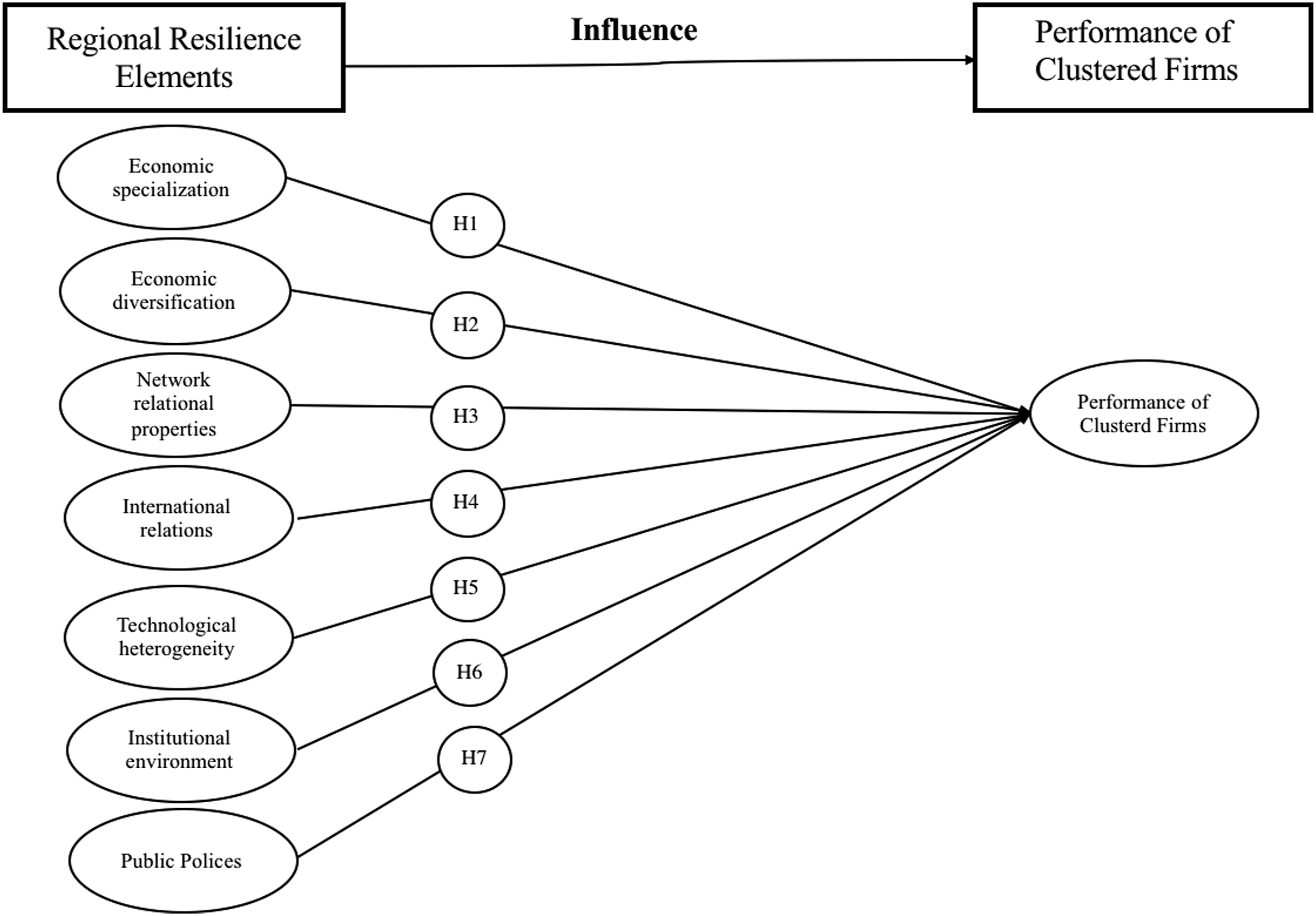
Research hypotheses.
Method
Studies on Evolutionary Economic Geography usually measure resilience through econometric models. They calculate the indices of resilience, recovery, sensitivity, specialization, and economic diversification of a region and compare it with reference regions, through employability indexes (Martin et al. 2016; Geelhoedt, Royuela, and Castells-Quintana 2021), which best represent resilience owing to their lower volatility. Its decline can have severe consequences for the local economy (Martin 2012; Pontarollo and Serpieri 2020).
Regional metrics are useful for assessing the aggregate performance of economic sectors in different regions. In this research, we use the index of Regional Economic Resilience and Recovery 1 (Martin 2012), Lilien Index of Structural Change (Lilien 1982), and the Cyclical Sensitivity Index of the economic sectors (Berman and Pfleeger 1997). Despite being in the same crisis context, regions show different levels of resilience while facing the crisis. Thus, regional indices are useful to compare the performance of a region or an economic sector with the national performance. Through these metrics, it is possible to evaluate the impacts of the Brazilian economic crisis on employment in the cluster region, as well as the sector’s dependence on the Brazilian economy.
Resilience studies usually focus on the dimensions of resilience and economic recovery, due to the importance and objectivity in measuring both metrics (Martin 2012; Pudelko, Hundt, and Holtermann 2018; Filippetti et al. 2020). The regional sensitivity index (β
r
) compares the percentage change in the loss of employability in one region to that in a major region. The percentages for the calculation are taken between the turning points between the peak and trough periods of the historical series of the variable analyzed, in this case, employment. In this way, it is possible to operationalize, in an objective way, part of the regional economic resilience framework proposed by Martin (2012), taking into consideration the regional resistance to the shock and its subsequent recovery, revealing the differences in regional and sectoral responses to the shock (Eraydin 2016). The formula for calculating the sensitivity index can be expressed as
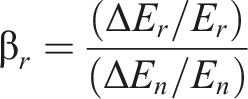
The regional sensitivity index compares the percentage change in the loss of employment in a region (E r ) compared to the loss in employability in a larger region (E n ). To calculate cluster resistance and recovery, we used IBGE (Brazilian Institute of Geography and Statistics) classification and the data from RAIS/MTE (Annual Social Information Report), data collected by the brazilian labor ministry. The percentages for the calculation are taken between the turning points between peak and trough periods of the historical series of the analyzed variable, here usually represented by the employability of a specific sector (Martin 2012). For the recession cycle, if the value of the regional sensitivity index (β r ) is greater than 1, it can be said that the region has lower shock resistance than the comparison region or nation. Values less than 1 indicate that the region is more resistant to shocks than the comparison region or nation. For the expansion cycle, if the value of β r is greater than 1, the region has a higher growth rate than the region under analysis. Values less than 1 indicate that the region’s growth is lower than the comparison region or nation.
The Lilien index demonstrates the degree of change in the composition of employment in a given region, measuring the degree to which the labor market is affected by cyclical changes in the economy. The index was used by Martin et al. (2016) to demonstrate structural change during periods of recession and expansion in the UK economy. The formula for calculating the Lilien Index can be expressed as

In the same way as for the calculation of resilience and recovery, the periods of expansion and retraction of the economy are determined. The Lilien index then shows the degree of change in the compositions of employment in a given region, measuring the degree to which the labor market is affected by cyclical changes in the economy (Mussida and Pastore 2014). The index measures the standard deviation of employment growth for a given sector over a period t to t−1. The index is centered on zero, indicating that there is no change if the value is 0. In this sense, the higher the value, the faster structural change occurs and the greater the reallocation of employment among sectors. In this way, the index reveals how quickly the regional economic structure changes by reallocating jobs across the sectors present in the region, thus indicating how quickly the regional economy changes and adapts, an essential aspect of resilience.
The impact of economic shocks is not the same across economic sectors. While some sectors are more vulnerable to economic oscillations, others are only slightly affected by such variations. In this sense, the sectors considered cyclical vary in the same degree and period of the national economic trend, while those considered non-cyclical show little change in growth during periods of economic expansion or retraction. (Berman and Pfleeger 1997). To check the cyclical sensitivity of a sector in a region it is possible to calculate the correlation of an economic activity “s" in a region “r” in periods “t" with their respective national or regional counterparts (Berman and Pfleeger 1997). The sensitivity is then given by the Pearson coefficient (r), which ranges from −1 to +1. Values close to the extremes demonstrate a high sensitivity, either positive (cyclical activities) or negative (countercyclical activities), while values close to 0 demonstrate an independence of the sector in relation to the economic performance.
To calculate the cyclical sensitivity, we used employment data obtained by RAIS between the years 1985 and 2018 for the IBGE classification of the major sectors of the economy and between the periods 1995 and 2018 for the CNAE 1.0 classification referring to the activity of “Wine Manufacture”. Also, in order to avoid problems with autocorrelation of the values, we used as variables the differences in employment between the years
To measure the impact of each regional resilience element on the performance of firms located in a cluster, a survey was conducted with wineries belonging to the WCSG. The scales used were developed to answer the objectives of this research and address questions related to the cluster environment’s influence on the wineries’ performance. In this study, resilience is a construct influenced by six elements that impact the capacity of clustered firms to develop over time. The cluster resilience elements established in the theoretical framework that guided all the research are: (i) economic specialization, (ii) economic diversification, (iii) relational properties of the network, (iv) international relations, (v) technological heterogeneity, (vi) institutional environment, and (vii) public policies.
First, a questionnaire was prepared and validated by two specialists. Thereafter, the questionnaire was passed to a pre-test phase with nine wineries. The nine answers were only used to make adjustments for the mass application of the questionnaire and discarded in the final analysis. Finally, the elements of resilience were collected through five-point interval scales, wherein the respondents indicated how much they agreed or disagreed with the proposed statement.
The questionnaire was administered by phone in August 2019. The population of analysis was wineries, represented by management-level employees or owners. The database, which counted the existence of 287 wineries within the geographical limit of the cluster, 2 provided by the Brazilian Wine Institute (Ibravin) was used to list and access the phones of the wineries. The sample calculation pointed out, using a 95% confidence level and 5% margin of error, that a minimum number of 165 wineries needed to achieve population representativeness through the sample. Simple random sampling was chosen as the sampling technique. In total, 194 wineries answered the questionnaire, reaching a response rate of 67.59%.
The multivariate analyses started with the calculation of the Mahalanobis distance, using a significance value of 0.001 for the identification of multivariate outliers. In total, three observations were excluded from multivariate analyses, resulting in 191 observations. To determine which questions belonged to the respective constructs, an Exploratory Factorial Analysis (EFA) was initially conducted using the Principal Axis Factoring method, Promax rotation method, and Kaiser factor retention criterion. The communalities/unicity, factor loads, and the existence of cross-loading were used as criteria for the excluding variables. Then, the remaining variables composed the final model, which was built through a structural equation model (SEM), which indicated the relevance of each of the constructs in the performance of the wineries during the economic crisis. Both techniques can be used complementarily to evaluate the plausibility of the emerging factorial structure. Finally, we conducted a hierarchical cluster analysis, separating the wineries into three groups: low, medium, and high performance. With this division, we were able to highlight the differences between these groups using the Kruskal–Wallis test. The questions used in the questionnaire as well as the descriptive statistics are available in the supplementary material.
The Wine Cluster of Serra Gaúcha
Viticulture activity in the Serra Gaúcha region started in 1875 as a result of Italian immigration. Initially, the wine activity had the objective of subsistence, evolving into a more competitive agro-industrial activity from the 1960s onwards. The construction of a resilient trajectory in the wine cluster took place through successive crises between the 1970s and the 1990s, forcing wineries to adapt. In the 1970s, multinational wineries arrived in the cluster region, bringing technologies and varieties of grapes with added value to the cluster region. Despite the initial shock, contact with the multinationals allowed the cluster region’s wineries to access new knowledge, promoting qualitative improvements in wine production within the cluster. In the same decade, contact with international wineries also allowed the elaboration of grape juices, essential for the survival of many wineries.
The 1979 oil crisis seriously affected the Brazilian economy, having indirect impacts on the cluster from the 1980s onwards, causing large wineries to no longer pay the grape farmers. As a result, many grape producers were forced to produce and market their wine. Thus, the economic crisis of the 80s triggered the emergence of several wineries in Serra Gaúcha. In the 1990s, the Brazilian commercial opening and an increase in red wine consumption occurred. The commercial opening caused many foreign wines to enter the Brazilian market, increasing competition with domestic wineries. Foreign wines have started to dominate the wine market in Brazil, especially in the fine wine market. The popularization of red wine has changed the global consumption behavior of wine. However, the cluster region is a major producer of white wine. This mismatch forced wineries to reconvert much of their production to continue selling wines in the domestic market.
In the 2000s, the Brazilian wine industry became politically organized to avoid dismantling of the industry. Several representative institutions began to emerge during this period. In addition, the sector started to work with geographical indications to protect the wineries from market fluctuations and crises, seeking a greater aggregation of value. As a result, the WCSG has become an important wine tourism hub, attracting tourists and promoting the region’s economy. In addition to promoting the region’s economy through incentives to the hotel and restaurant sector, wine tourism has become an important channel for commercialization and establishment of consumer loyalty to Brazilian wines, giving rise to new wineries with business models that focus on attracting tourists.
The production pattern and product mix of the wineries have also changed and modernized in recent years. The wineries have been increasing their efforts to produce more fine wine with better quality, to the detriment of table wines. The sector is also making efforts to increase the production of sparkling wines and grape-based juices, which have experienced increased production and consumption in recent years. The steps to develop new products influenced the cluster’s capacity to resist the negative impacts of the Brazilian economic crisis. As shown in Figure 2, the number of employees and the number of wineries in the cluster region remain constant. The cluster region employs 2574 direct employees in the industry, representing 44.6% of the workforce employed in wineries in Brazil. However, most Brazilian wine production is concentrated in Rio Grande do Sul, with approximately 90% of the national production. Historical evolution of the cluster.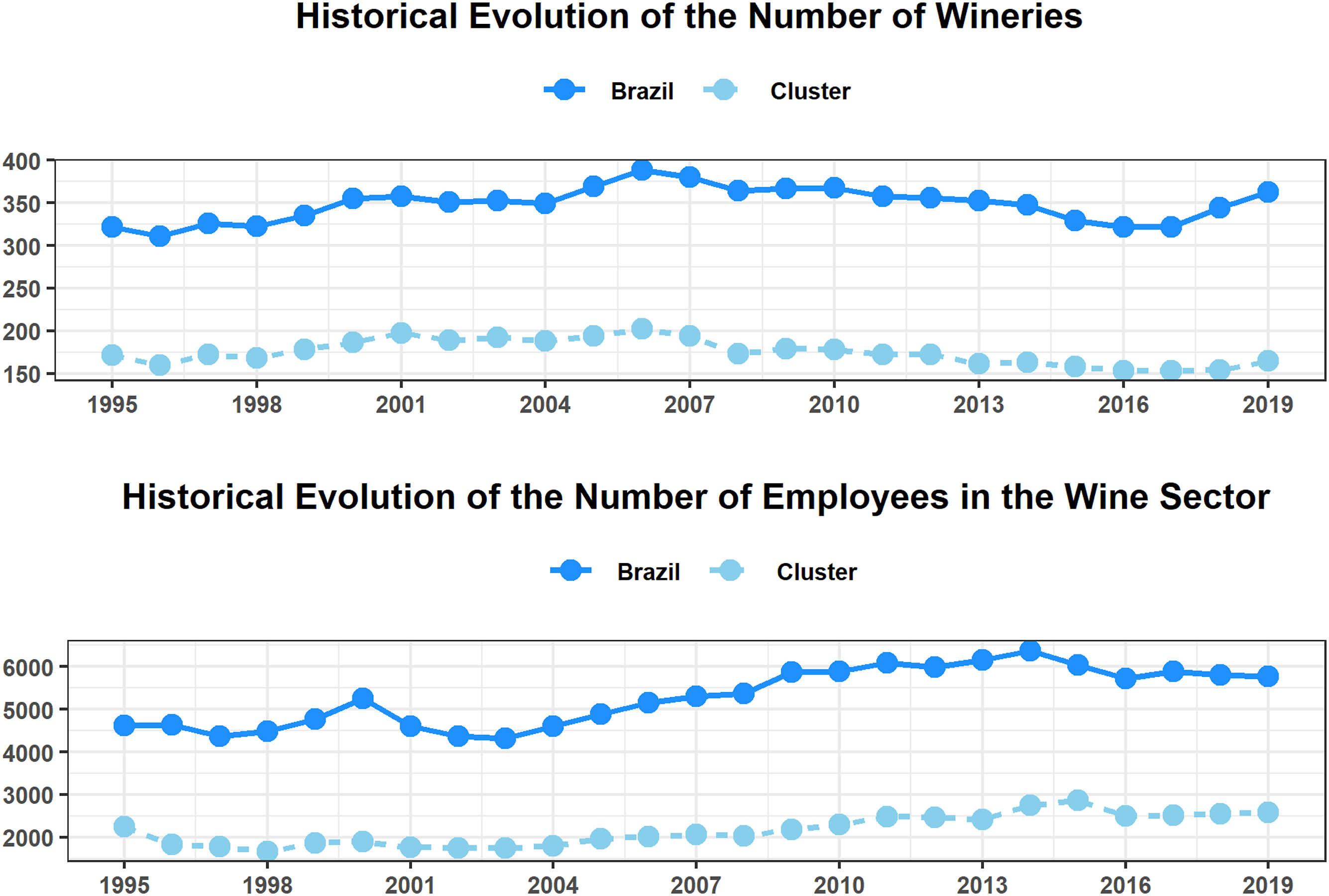
The Brazilian economic recession represents a major shock to the national economy, seriously affecting the country’s economic development process. As with other sectors of the economy, the wine sector was also affected by the economic crisis. However, the industry shows strength in maintaining similar levels of trading before and during the crisis (Ibravin 2018), diversifying its production, while investing in the search for new routines and business models related to enotourism. Despite the economic crisis, marketing data are still quite positive. Regarding wine marketing, the sector increased from 353.3 million liters commercialized in 2016 to 458.9 million in 2020. The growth was mainly due to an increase in the marketing of grape juice and sparkling wine. Much of the wine production is oriented toward domestic consumption owing to the large size of Brazillian domestic market. However, at the beginning of the economic crisis in 2014, the sector made $89.2 million in exports, a total that increased to $118.2 million in 2020. (UVIBRA et al, 2020)
Results
Regional Results
Brazil’s economic recession is the product of several economic shocks combined in recent years: the failure of macroeconomic policy, public debt unsustainability, abdication or reduction of tax revenues to meet political ends, the drop in commodity prices in the international market, and the political-institutional crisis. The Brazilian economy has gone through four distinct periods of growth and recession: a growth period from 1985 to 1989, a decline period from 1990 to 1992, a longer period of growth from 1993 to 2014, and a more recent period of decline from 2015 to 2018. Figure 3 presents the temporal evolution of the number of formal jobs in Brazil and the cluster, highlighting the periods of recession and growth used for regional econometric analyses. Historical evolution of formal employees in Brazil.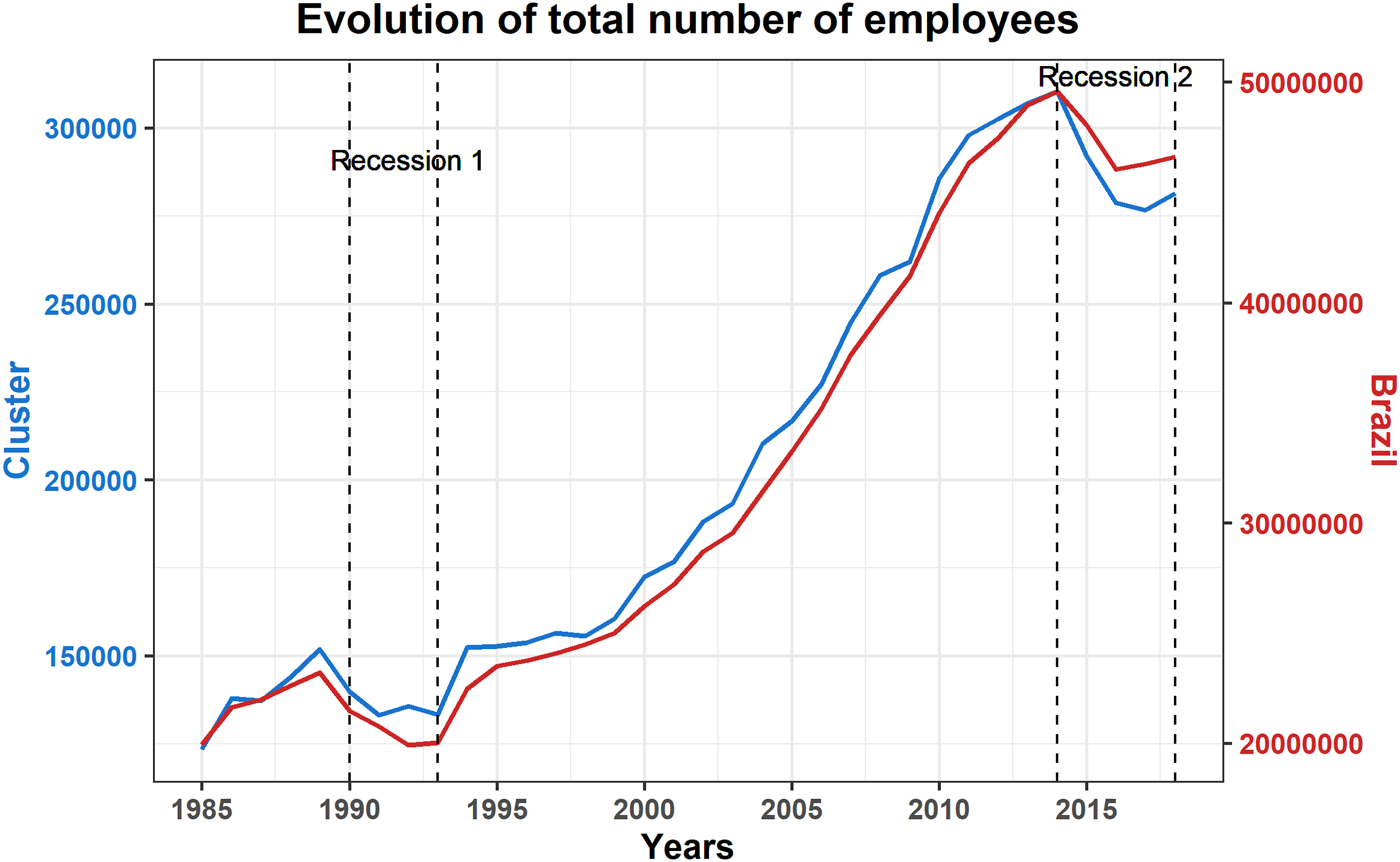
Economic Resilience and Recovery Through Business Cycles.

Geometric Growth/Decline of Economic Activities During the 2015–2018 Crisis.

Economic Sensitivity Across Sectors.

The results indicate that all associations proved positive for the analyzed period. We highlight the strong associations of manufacturing, commerce, civil construction, and services for the cluster region and Brazil. The strong correlations for these sectors indicate a greater measure of the association of the performance of these sectors with the overall performance of the economy. Sensitivities also varied enormously across the analyzed regions. For the cluster region, agriculture, cattle ranching, and mineral extraction activities are practically independent of the region’s overall performance. Conversely, manufacturing is highly associated. The low association of wine manufacturing activities indicates that their performance is not associated with the economic results of the comparison region.
Lilien Index.

The Lilien Index behaved as expected during the first three economic cycles: increasing during boom cycles and decreasing during bust cycles. However, the previous cycle proved to be quite atypical, significantly increasing the value of the index, especially in Brazil. This increase indicates that, there has been a major change in the structural participation of jobs in economic sectors, especially in Brazil, between the previous growth cycle and the current recession. The significant changes in employment that occurred during this period were a sharp decline in the share of manufacturing and a slight drop in public administration, which was offset by an increase in trade and services.
Survey
Of the 194 responses, 143 (73.71%) were obtained directly from winery owners, 12 (6.18%) from department directors, 11 (5.67%) from managers, 12 (6.18%) from administrative staff, 12 (6.18%) from oenologists, two (1.03%) from partners, and two (1.03%) from employees of other categories. Supplement Table 6 in the supplementary material presents the descriptive information of the wineries included in the sample. When asked about the impact of the 2014 economic crisis on their performance, 83 (42.8%) of the wineries indicated that the crisis had a strong impact, 97 (50%) a moderate impact, and 14 (7.2%) a weak impact. Figure 4 shows the distribution of responses by the municipality. Cluster and respondents’ distribution map.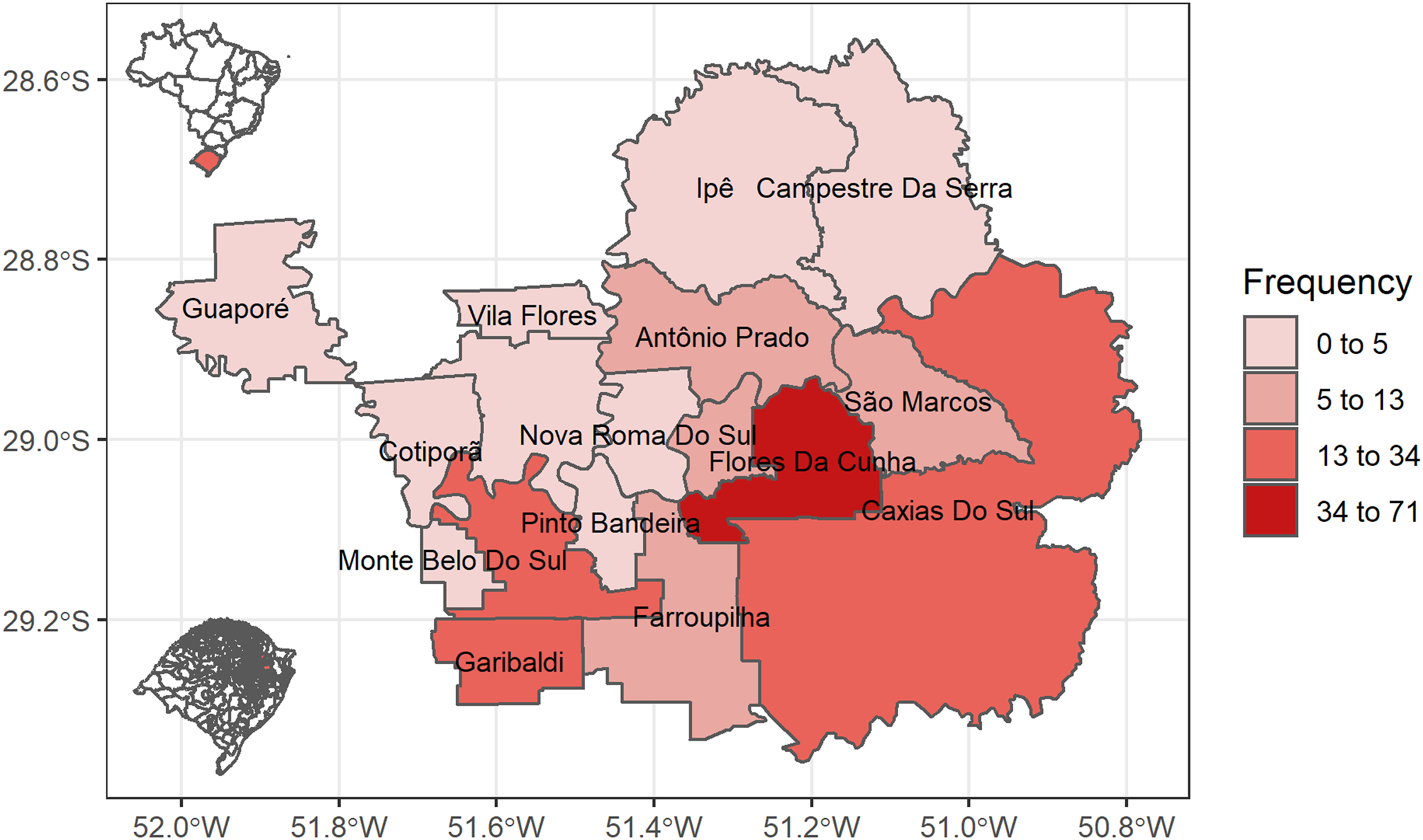
To validate the adequacy and relevance of each element of resilience in the performance of wineries during the economic crisis, a model of structural equations was developed. It used constructs that represented the resilience elements discussed in the literature review as independent variables and the economic performance construct as a proxy for resilience, which is dependent on the model. For SEM, we used the robust weighted least squares mean and variance estimator (WLSMV), given the categorical nature of the scales used. For the evaluation of the model, the values of the χ2 test and χ2 by the degree of freedom (χ2/df), as well as the adjustment measures of Tucker-Lewis (TLI), comparative adjustment index (CFI), adjusted goodness of fit index (AGFI), root mean square error of approximation (RMSEA), and standardized root mean squared residual (SRMR). The test of χ2 has the null hypothesis that the model predicted and observed are equal. However, this assumption is often broken because this test is sensitive to large samples. In this sense, χ2/df was used to correct this problem and should not exceed 3. The TLI, CFI, and AGFI values must be greater than 0.90. The RMSEA values should be lower than 0.06 (good) or 0.08 (acceptable) and the SRMR lower than 0.08.
Summary of the Results.

Notes: Table 1 shows the estimates of the proposed model. The dependent variable is the Performance construct. For the analysis, significant values were considered below a α of 5%. Significance levels: ***ρ < 0.01, ** ρ < 0.05, ρ < 0.1*.
Based on the significance value of each test, it can be observed that four of the seven constructs were significant for an alpha of 5%, still having a positive relationship with performance: (1) “international relations” (Z = 5.608; ρ < 0.01); (2) “public policies” (Z = 3.876; ρ < 0.01); (3) “economic specialization” (Z = 2.994; ρ < 0.01); (4) “technological heterogeneity” (Z = 2.113; p < 0.05). The constructs “economic diversification,” “relational properties of the network,” and “institutional environment” presented values outside the threshold of rejection of the null hypothesis, indicating that there is no statistical evidence for the relationship between the constructs and performance. The value of the coefficient of determination (R2) indicates that the independent variables of the model (elements of resilience) can explain 72.1% of the variability of the dependent variable (performance).Figure 5 summarizes the model.
3
4
Model summary.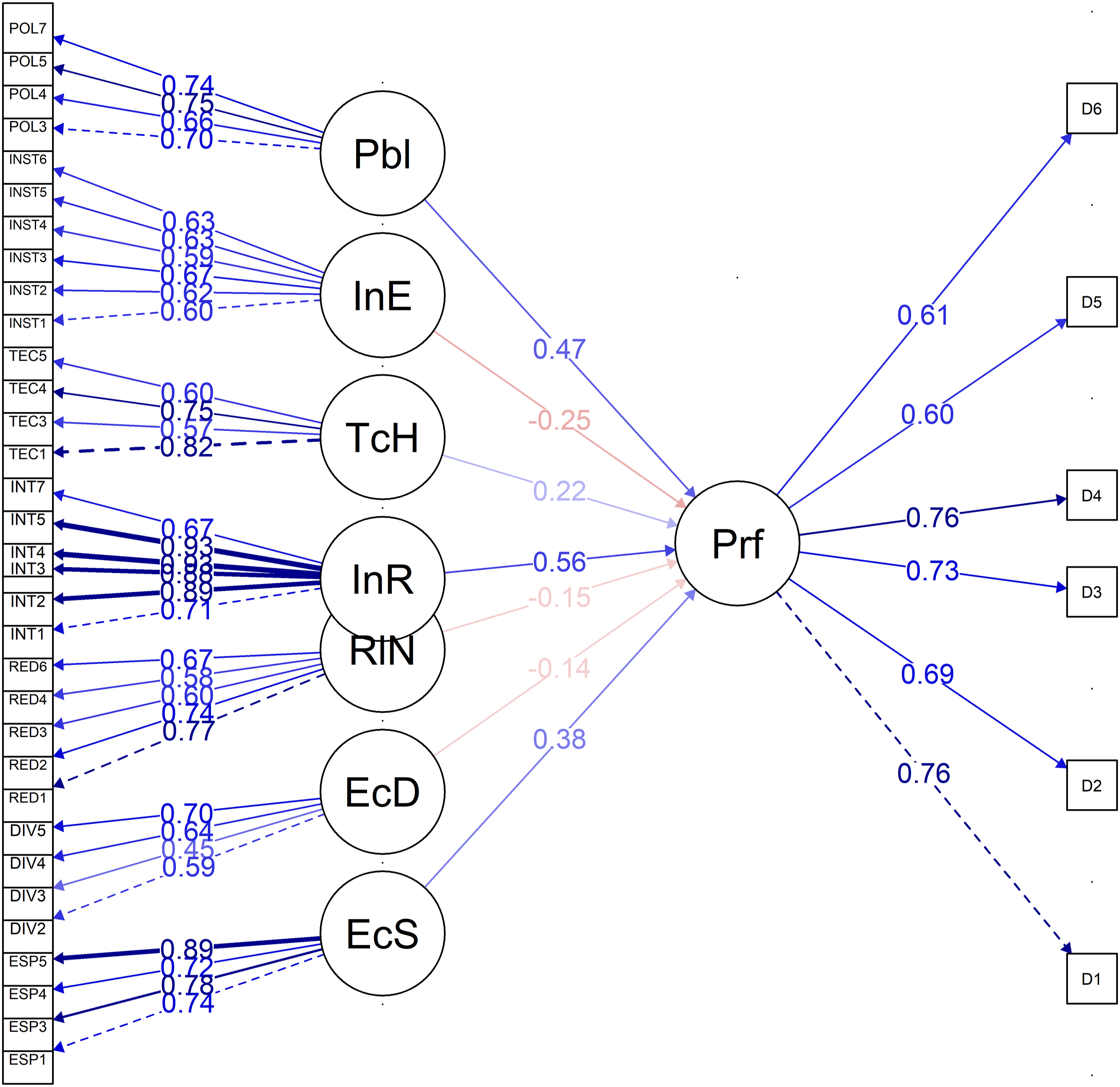
To group the observations into different sets according to their performance, a multivariate cluster analysis technique was used. As a clustering variable, the scores obtained from the SEM for the “Performance” dimension were used. Accordingly, it was possible to group wineries based on their performance, creating groups that characterize the highest performing wineries and the lowest-performing groups. The data were initially standardized. As a clustering method, we used the hierarchical method with Ward’s algorithm and the quadratic Euclidean distance. The combination of both parameters resulted in a higher Cophenetic Correlation Coefficient compared to other hierarchical methods (0.656).
5
As a splitting criterion for choosing the number of clusters, we used the within-cluster sum of squared errors (WSS) method, which indicated an optimal number of three classes for the analysis.
6
Thus, 41 wineries belong to the low-performance group (green), 115 to the intermediate performance group (blue), and 35 to the high-performance group (red). Figure 6 presents a dendrogram with the results obtained. Cluster dendogram.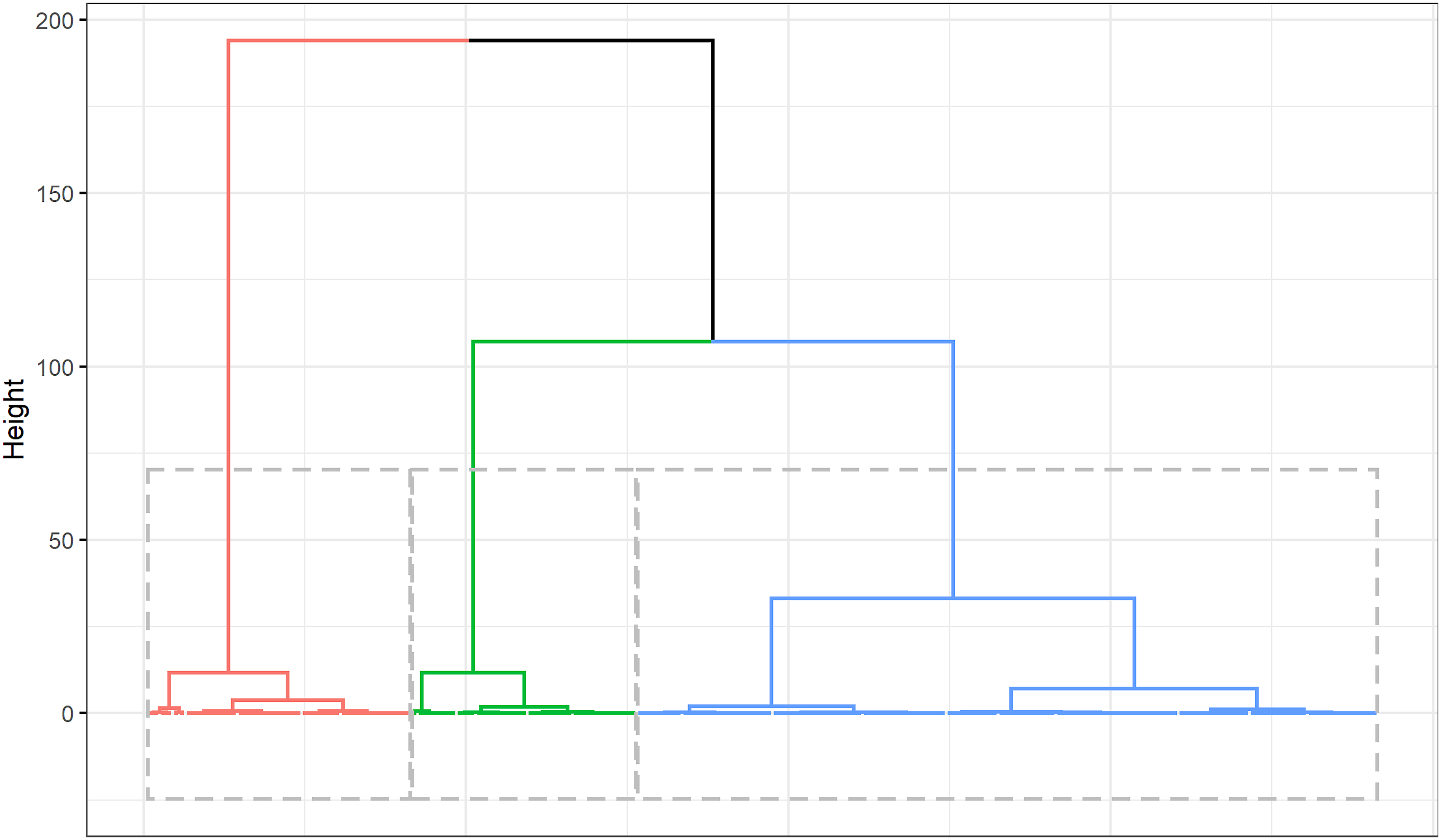
We conducted an ANOVA using the standardized values of the scores of the “Performance” to verify whether the groups formed by the cluster analysis are truly different. The results of ANOVA confirm the validity of the grouping process performed by the cluster, showing significant differences between the groups [F (2,188) = 359,017; ρ < 0.001]. In addition, η2 presented a value of 0.792, demonstrating that the differences between the averages are not only different, but also relevant. The Bonferroni post-hoc test also confirmed the differences between the means, indicating that all groups were significantly different from each other (p < 0.001). Figure 7 summarizes the results of the descriptive statistics for each element of resilience for the performance groups with standardized values. Averages of resilience elements by performance group.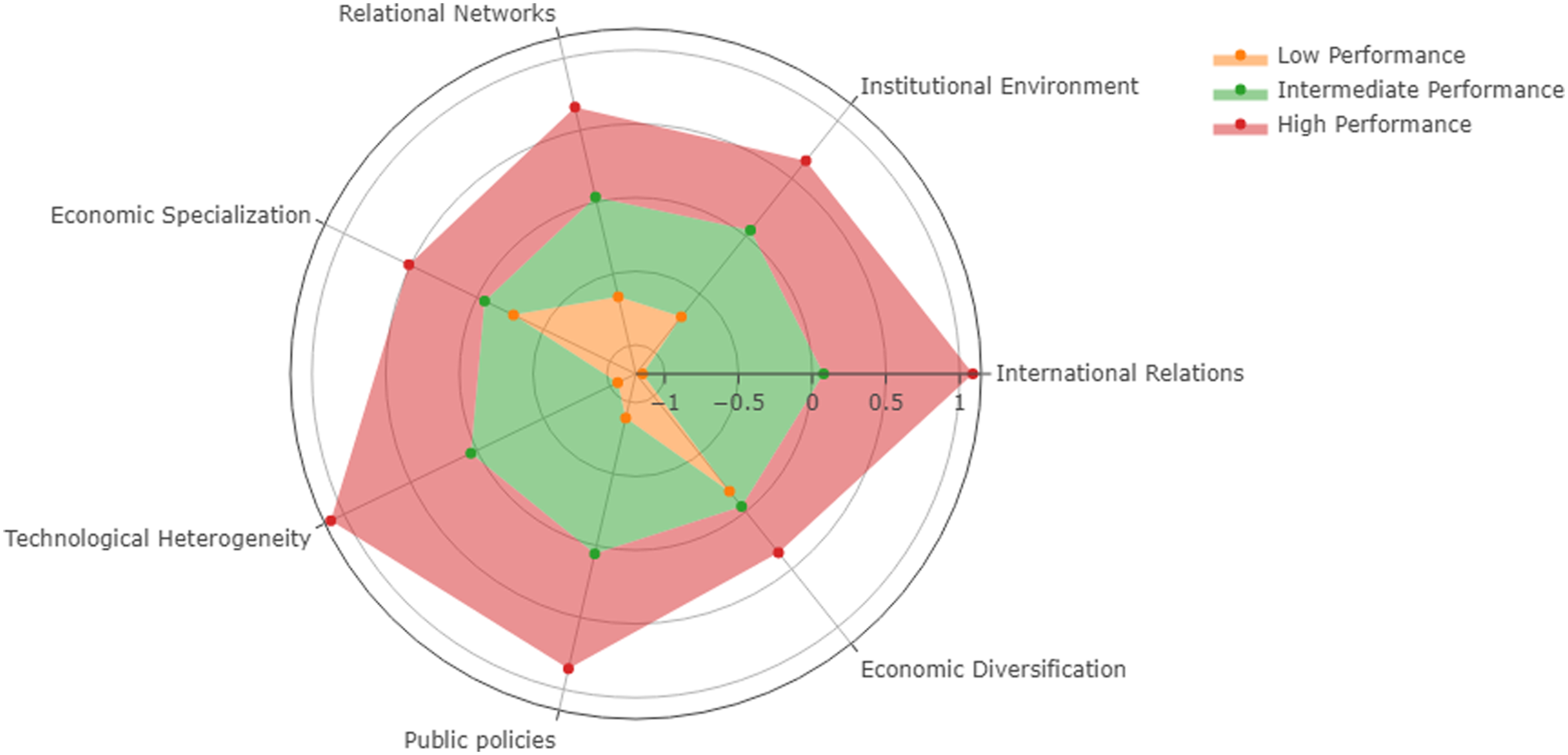
To be able to compare the averages of each resilience element and compare them among the performance groups, we performed a Kruskal-Wallis comparison test. In addition to the significance level and the test value of χ2, it is important to highlight the value of the statistics of the effect of eta-squared (η2) adjusted to the H statistic [η2(H)]. The Kruskal–Wallis test demonstrated significant differences in the distributions of six of the resilience elements: international relations [χ2 (2) = 95.223; ρ < 0.001; η2(H) = 0.496], institutional environment [χ2 (2) = 34.402; ρ < 0.001; η2(H) = 0.199], relational properties of the network [χ2 (2) = 33.582; ρ < 0.001; η2(H) = 0.168], economic specialization [χ2 (2) = 11.554; ρ < 0.01; η2(H) = 0.05], technological heterogeneity [χ2 (2) = 87.335; ρ < 0.001; η2(H) = 0.454], and public policies [χ2 (2) = 56.699; ρ < 0.001; η2(H) = 0.291. The only element that did not present a statistically significant difference (χ2 (2) = 5.825; ρ > 0.05; η2(H) = 0.02] was the “economic diversification” dimension.
Finally, a post-hoc Dunn test was conducted with Bonferroni adjustment to check which groups were different. The test showed differences among all groups for international relations, relational properties of the network, technological heterogeneity, institutional environment, and public policies (ρ < 0.001). Economic specialization showed a difference only between high-performance wineries and those with medium and low performance (ρ < 0.01).
Discussions
The plurality of the wineries’ performance demonstrates that the shock’s impact is not uniform. During a recession, firms can balance different strategies, focusing on cost reduction and further expansion of revenues and investments (Martin and Sunley 2015). In general, the wineries that present a greater technological heterogeneity, better international relations, greater use of the externalities of specialization, and a better relationship with the public authorities were able to better manage the negative effects of the economic shock. This fact demonstrates the importance of the search for economic differentiation for long-term development (Treado 2010), and in times of high uncertainty (Evans and Karecha 2014).
Many scholars argue that clustered firms gain performance due to access to the externalities of specialization (Porter 1998), which would be responsible for economic efficiency (Grillitsch, Asheim, and Trippl 2018; Farhauer and Kröll 2012). The model corroborates the importance of access to specialization externalities present in the region for the performance of the wineries.
The externalities of economic diversification tend to increase the probability of the emergence of innovations through the recombination of knowledge (Kahl and Hundt 2015). However, the positive impact of diversification externalities on performance is not evident. The lack of a positive relationship between performance and economic diversity can be explained by the difficulty of clustered firms in connecting with other relevant sources of knowledge (Suire and Vicente 2014) since the cognitive distance between the different sectors tends to be too large (Boschma 2005; Nooteboom 2000). In this sense, a cluster in a highly diversified region may suffer from a lack of sectorial focus and technological coherence among local industries, limiting access to the externalities of specialization and, consequently, the productive efficiency of the cluster (Boschma 2015), making the cluster more unstable and sensitive to economic cycles (Holm and Østergaard 2015).
Similarly, Farhauer and Kröll (2012) also demonstrated that, for German cities, the increase in economic specialization tends to expand the gross value added of working hours, while the economic diversification of the sector had a negative relationship. Delgado, Porter and Stern (2015) also showed that regions with large industrial clusters diminished the recessionary effects of the U.S. financial crisis and recovered more quickly. Specialization externalities also seem to have a more significant effect during periods of economic stability, as stability fosters incremental gains in productive efficiency (Kahl and Hundt 2015). The positive relationship between economic specialization and performance can also be explained by the long-term stability and growth of the Brazilian economy (Oreiro 2017). The cluster region is highly industrial intensive, a sector that was one of the most affected during the Brazilian economic crisis, a fact that explains the lower resilience of the economic sectors in the cluster region to the economic crisis of 2014. However, the WCSG itself does not follow the cyclical movements of the economy, remaining stable, even during one of the biggest national economic crises. In this way, the cluster region has managed to maintain greater employment stability among the economic sectors, preserving skills and the employment of skilled labor.
However, the prevalence of a specialized structure over a more diversified one over performance is not a consensus, and there is evidence that firms in cities with more diversified technological bases perform better and recover faster from recessionary shocks (Balland, Rigby, and Boschma 2015b; Pudelko, Hundt, and Holtermann 2018; Pontarollo and Serpieri 2021).
The literature on clusters highlights that geographic agglomeration facilitates local learning, since firms in the same region facilitate tacit relationships (Giuliani 2005). Despite the evidence of dense relational networks within the cluster, these were not significant for the model. The lack of relationship between the relational properties of the network and the economic performance of the wineries can be explained by the high redundancy of knowledge existing within the network (Expósito-Langa and Molina-Morales 2010; Martin and Sunley 2015; Pinkse, Vernay, and D’Ippolito 2018), originating from the high efficiency in which knowledge is transmitted within the network (Tsouri and Pegoretti 2020). Notably, Nooteboom (2000) demonstrated that the benefits of the cluster and the cognitive proximity of knowledge follow a bell curve. The potential value of knowledge will be greater if it comes from heterogeneous combinations.
A mature cluster tends to develop stable interorganizational relationships over the years (Ter Wal and Boschma 2011), which tend to repeat and reinforce themselves through the center-periphery mechanism (Crespo, Suire, and Vicente 2014; Suire and Vicente 2014). The network then takes on a homophilic nature, making shared knowledge quickly accessible, which potentially makes knowledge redundant (Expósito-Langa and Molina-Morales 2010), having a low value for the generation of competitive advantages and differentiation. As verified by Kesidou and Snijders (2012), strong networks of collaboration and knowledge flow within clusters do not necessarily result in better mechanisms for creating new knowledge.
The WCSG has benefited from contact with global networks at different times in its trajectory, absorbing and recombining knowledge generated outside to explore it within the cluster. The importance of internal relations for the cluster can be verified in the analyses based on the element that presented the best relationship with the performance of the wineries, indicating that the wineries engaged in the international market are also those that presented the best economic performance. Contact with the wineries abroad allowed the cluster to access non-redundant knowledge (Suire and Vicente 2014; Öz and Özkaracalar 2011), thus serving as a mechanism for routine renewal. The acquisition of external knowledge allowed the introduction of grape juice, sparkly wine, and legislation for geographical indications. Cruz-Castro et al. (2018) demonstrated that firms with greater international engagement before the 2008 shock tended to be associated with greater innovation performance. In this sense, global channels can assume great importance for clusters (Bathelt et al. 2004; Kesidou and Snijders 2012), as clustered firms can take advantage of technological differences outside to create and exploit new knowledge (Hervas-Oliver, Jackson, and Tomlinson 2011).
The long-term survival of a cluster is directly associated with its firms’ ability to introduce and exploit new knowledge (Menzel and Fornahl 2010; Treado 2010; Suire and Vicente 2014). WCSG’s resilience is directly related to the continuity of investments that have led to qualitative and quantitative gains in production, the cluster’s ability to exploit new knowledge and the diversification of the wineries’ value and product offerings. The exploitation of this new knowledge allowed the cluster to renew its technological bases. The renewal was initially incremental with the introduction of new techniques and technologies that allowed qualitative gains. More recently, firms have begun to explore wine tourism activities, allowing the emergence of new technology related activities (Boschma, 2015; Filippetti et al. 2020) and creating new business models focused on serving tourists and exploring new market niches (Grillitsch, Asheim, and Trippl 2018). The relationship between performance and technological heterogeneity was confirmed to be positive and significant.
The institutional environment reflects the impact of social norms that govern how individuals perceive and relate to each other (Moodysson and Sack 2014). Such aspects highlight the cluster as a social entity (Morosini 2004), wherein economic agents are rooted within the same social fabric, sharing norms of behavior and values, which allows the coordination of actions to achieve shared objectives (Molina-Morales et al. 2010). The proposed model demonstrated no relationship between the institutional environment and the performance of the wineries. Because they are regionally close and rooted in the same institutional environment, the wineries in the cluster share the same set of norms, laws, and culture, which are strongly rooted in the region. In this sense, the regional incorporation of institutional aspects takes place more homogeneously. Thus, the institutional framework seems insufficient to create advantages among clustered firms.
Public policies refer to the role of public agents in promoting investments, infrastructure, workforce training, credit, and the promotion of conditions for knowledge to circulate within the cluster (Cruz-Castro et al. 2018). The WCSG case highlights the importance of public agents in organizing collective resources that allow firms to reorganize their trajectories and technological bases. In this sense, the resilience of WCSG is not a limited phenomenon within the cluster level (Eraydin 2016). It is a historical result of the work of institutions and public policies that have sought over the years to promote the sector, hold fairs and events, train the workforce, incentivize circulation, and develop new knowledge and products, helping the cluster to be more adaptive (Geelhoedt, Royuela, and Castells-Quintana 2021). Thus, the quality of public policies and sector promotion is directly associated with creating new trajectories, exploring new markets, and greater resilience to shocks (Cruz-Castro et al. 2018).
Finally, regarding economic performance, it is possible to verify that economic specialization influences the performance of firms in the clusters, while economic diversification does not demonstrate a positive relationship. Although there is no consensus in the literature, this result allows us to believe that firms need to focus on their actions to maximize the available resources and guarantee their survival in times of crisis. As for the relations of the firms, we found that the relational properties of the network did not influence their performance. In contrast international relations were the element with the greatest association. We believe that in a mature cluster, such as the WCSG, the internal inter-organizational relations are already stable and do not have a greater influence in times of crisis and renewing. By contrast, external knowledge from international relations facilitates differentiation. This is evidenced by new knowledge and technology demonstrating a positive relationship with the performance of the firms in the cluster. In addition to the relational properties of the network, the institutional environment of the cluster did not influence firm performance. However, we realize that public policies have demonstrated a positive relationship, which leads us to believe that the role of public agents in the construction of local policies is essential for regional resilience and firm performance.
Conclusions
This research evaluated the influence of cluster resilience elements on WCSG from the perspective of a dynamic economy that is constantly changing. We pushed the emerging discussion on regional resilience in a new direction, exploring its influence on the performance of firms in a cluster. Resilience is interpreted here as a heuristic tool for the phenomenon of economic adaptation (Wrobel 2015), in which a regional economy is subjected to some shock and adapts, reconfiguring its institutional, social, and technological bases to create new trajectories, which allow the maintenance of stable growth rates (Martin 2012).
Through an initial diagnosis of the Brazilian economic crisis, it was possible to investigate how a cluster reacts to successive shocks. The WCSG was chosen as the object of study because of its long history of development and overcoming economic, market, and technological shocks. While most manufacturing industries were severely affected by the recent economic shock, the wine cluster presented more stable results. The choice of an industrial cluster that is different from the rest of the Brazilian industry served precisely to demonstrate how the long-term investments modernized the sector. The search for new knowledge, and the exploration of markets and knowledge related to viticulture, allowed the wine cluster to develop a more resilient trajectory.
The first contribution of this study is the cluster resilience elements identified in the regional literature and measured empirically for this research: (i) economic specialization; (ii) economic diversification; (iii) relational properties of the network; (iv) international relations; (iv) technological heterogeneity; (v) institutional environment; and (vi) public policies to analyze the influence of each of these elements on the performance of firms located in a cluster.
The second contribution is the results from the model applied to the relationship between regional resilience and the performance of firms in a cluster. We confirmed a positive and significant linear relationship among economic specialization, international relations, technological heterogeneity, and public policies. Wineries that access a specialized environment focused on wine production, which has more advanced technological routines that seek new knowledge and international markets and operate together with the public initiative, tend to have better economic results. Although the relational properties, institutional environment, and economic diversification have not presented a significant relationship, this does not mean that these elements are not important in the performance of clusters; they do not have a linear relationship with it.
The third contribution is the discussion of resilience along the trajectory of a cluster, identifying the adaptations and effects from the impact of the shocks. The literature on economic resilience highlights how a regional economy resists and responds to a given shock (Simmie and Martin 2010), adapting its industrial, institutional, and technological structures (Boschma 2015; Martin and Sunley 2015) to maintain positive economic indices from a long-term perspective (Eraydin 2016). The case of WCSG highlights this adaptation process as the cluster was impacted by the many shocks that followed during its trajectory. The arrival of multinationals increased the quality of the cluster’s production and the economic openness led the cluster to organize itself politically to survive. The popularization of red wine forced wineries to produce more red wines, making it possible to use white grapes for sparkling wines and table grapes for concentrated juice. In this sense, shocks permanently affect regional economy, highlighting how economies evolve depending on their path (Martin 2012, 2010; Simmie and Martin 2010). Thus, reducing the recessionary effects of a crisis is directly associated with creating and exploiting new knowledge.
In sum, this research shows the importance of the sector specialization of the region (Balland, Boschma, and Frenken 2015a; Martin and Sunley 2015; Delgado, Porter, and Stern 2015), international relations for access to non-redundant knowledge (Giuliani 2005; Bathelt, Malmberg, and Maskell 2004; Hervas-Oliver, Jackson, and Tomlinson 2011), technological heterogeneity (Menzel and Fornahl 2010; Suire and Vicente 2014) and the actions of public agents for preservation and regional economic development (Eraydin 2016; Evans and Karecha 2014). In addition, even in a geographically close region, the wineries reported different performance levels during the economic crisis. These differences are related to the different strategies adopted in the period before and after the shock. The wineries that showed better performance also accumulated the best routines, which allowed greater economic differentiation. The differences in the performance of the wineries highlight that geographical proximity is not a sufficient factor to ensure high performance for clustered firms (Boschma 2005).
Additionally, this study contributes to the managerial field. The research highlights the importance of public agents in policies that promote investments, infrastructure, credit, and external partnerships, and encourages firms to acquire new knowledge. For managers, we emphasize economic specialization, heterogeneous technologies and knowledge, and the facilitation of cluster firms with international organizations. Geographical indications exemplify how WCSG protected the wineries from market fluctuations and crises, seeking a greater aggregation of value. This study contributes to the manager by identifying the elements that influence firms’ performance during crisis periods. New knowledge and technologies facilitate firms to explore new market niches (Grillitsch, Asheim, and Trippl 2018). One of the main solutions found by the wineries from WCSG to face the economic crisis was the exploration of wine tourism activities. Wine tourism activities have encouraged greater investment in the search for differentiation and value addition. In this sense, the new opportunities generated by the exploration of wine tourism allowed the origin of new wineries, products, and technologies.
Future studies can refine the scale with different items, especially for the “economic diversification” construct. Moreover, we included only some of the key elements of resilience discussed in the regional studies. It is impossible to determine all the elements that influence the economic performance and resilience of a regional economic system (Boschma 2015). Thus, other elements of resilience not measured here can also have a significant impact on firm performance. Furthermore, the results can be generalized only for WCSG. Thus, it is important to evaluate the resilience of other clusters, especially those in a declining stage. Such a comparison would highlight the main social, institutional, political, and technological differences among clusters, and the influence of the historical trajectory of clusters on their current economic performance. In addition, a longitudinal survey could quantitatively evaluate the effects of economic shocks on firms.
Supplemental Material
Supplemental Material - The Influence of Regional Resilience Elements on the Performance of Clustered Firms
Supplemental Material, for The Influence of Regional Resilience Elements on the Performance of Clustered Firms by Vitor K. Schmidt, Aurora C. Zen and Bruno A. Bittencourt in International Regional Science Review
Footnotes
Acknowledgment
We would like to thank Editage English language editing.
Declaration of Conflicting Interests
The author(s) declared no potential conflicts of interest with respect to the research, authorship, and/or publication of this article.
Funding
The author(s) received no financial support for the research, authorship, and/or publication of this article.
Data Availability
The authors confirm that the data supporting the findings of this study are available in the supplementary material.

Supplemental Material
Supplemental material for this article is available online.
Notes
References
Supplementary Material
Please find the following supplemental material available below.
For Open Access articles published under a Creative Commons License, all supplemental material carries the same license as the article it is associated with.
For non-Open Access articles published, all supplemental material carries a non-exclusive license, and permission requests for re-use of supplemental material or any part of supplemental material shall be sent directly to the copyright owner as specified in the copyright notice associated with the article.
