




Abstract
This study aims to assess the role of absorptive capacity in the relationship between immigration and domestic innovation in sending countries using five average period data points from a sample of 35 African countries over the period 1995-2019. The results based on panel quantile regression with nonadditive fixed effects support the brain drain hypothesis, implying that immigration has negative heterogeneous effects on the innovation performance of sending countries. Our findings also revealed that absorptive capacity mitigates the negative effects of immigration when countries’ absorptive capacity reaches a certain threshold. These results suggest that strengthening the quality of institutions and physical infrastructures could mitigate the brain drain effect of immigration in Africa.
JEL Code
F22, O3, O55
Introduction
The immigration of worker flows from developing countries has been the subject of several theoretical and empirical studies. In particular, the impacts of immigration on developing countries continue to feed the economic literature in the face of a lack of consensus at the theoretical level. For some, the immigration of skilled citizens from developing countries to industrialized countries is a brain drain and a vector of poverty in developing countries (Bradford 2021; Ivanová and Grmanová, 2021) The advocates of this thesis show that the immigration of highly skilled workers from developing countries aggravates the shortage of skilled workers, which is already very low in these countries given the low rate of investment in human capital in poor countries and leads to a low level of mobilization of fiscal resources. For Grubel and Scott (1966), brain drain impoverishes the countries of origin even if its impact on global welfare may be neutral or positive. In contrast, another school of thought shows that brain drain helps sustain economic growth and even contributes to poverty reduction through human capital accumulation, remittances from migrants to their countries of origin, and innovation through networking (Mountford 1997; Stark, Helmenstein, and Prskawetz 1997). More recently, a new generation of authors has dispensed with a comprehensive analysis of the impact of immigration by examining its impact on innovation in sending countries. Indeed, immigration can generate positive externalities on the innovation capacity of the countries of origin and thus a way to bridge the innovation gap between developed and developing countries. Immigration can reduce the innovation gap between developing and developed countries through many channels. First, as developed countries have required infrastructure for innovation activities, skilled migrants from developing countries increase the stock of innovation available worldwide that can be diffused to developing countries by means of imports. Leipziger (2008) argued that the most important form of innovation in developing countries is the adoption of technologies developed in industrialized countries (Leipziger 2008). Second, immigration improves the quality of human capital in developing countries and the incentive to invest in human capital (A. Saxenian 2005, 2006), which is at the heart of new idea generation according to the theory of endogenous growth.
The importance of this research for African countries is at least threefold. First, the continent is one of the poorest regions worldwide. More than 60% of Sub-Saharan African, thereafter (SSA) people still live under the line of extreme poverty, against a world average of 9.2% (World Bank Group 2021). Moreover, the poverty rate in Africa is beyond the average in other developing regions, such as South Asia, where the poverty rate is approximately 15.2%. However, the first sustainable development goal of the United Nations aims at alleviating extreme poverty across the world by 2030.
Second, African countries are characterised by a lack of innovation. According to the last report of Global Innovation, only four out of 48 countries in sub-Saharan Africa (Mauritius, South Africa, Kenya, and Tanzania) are ranked in the top 100 (Soumitra et al. 2021). The United Nations Conference on Trade and Development (UNCTAD) also highlighted that only 0.4% of the total exports of African countries are high technologies, while 0.3% of the share of GDP is devoted to global R&D spending (UNCTAD 2015). However, endogenous growth theories argue that innovation is the key driver of economic growth and development (Aghion and Howitt 1992; Romer 2005). This theory emphasizes that the only way to increase per capita output indefinitely, thereby enhancing standards of living in the long run, is by innovating. Scientific and technological innovation promote economic growth and development through many channels. First, innovation increases labour and total factor productivity and social welfare by creating new job opportunities. Second, innovation has the potential to enhance countries’ competitive advantage.
Finally, as African countries are facing high rates of immigration, one could assume that immigration can be used as one of the instruments to reduce the innovation gap between Africa and other regions through technological transfers. Indeed, irregular migration of millions of Africans, especially from sub-Saharan African countries to Europe, has received extensive attention both from developed countries and Africa. One of the explanations of this migration outflow is the persistence of extreme poverty, political instability, climate change, and civil wars on the continent (Flahaux and De Haas 2016). Recent statistics revealed that Northern Africa and Western Asia experienced the fastest growth in international migrants, with an increase of 1.8 million per year during the period between 2010 and 2019. In particular, the number of international migrants from Africa increased by 0.3% per year between 2000-2010 and by 0.9% between 2010-2019 to reach 10.4 million African migrants outside the continent in 2019 (United Nations 2019).
In the empirical literature, the impacts of immigration on innovation in countries of origin have reached mixed conclusions, supporting the theoretical contradictions about the ability of immigration to reduce inequalities between rich and developing countries in innovation. For some, immigration has a negative effect on innovation in countries of origin (Naghavi and Strozzi 2015). However, others found positive effects, particularly in the case of Asian countries (Saxenian 2005).
Another strand of the literature argues that the innovative capacity of any unit (firm, region, country) depends on its absorptive (Cohen and Levinthal 1990; Lane, Koka, and Pathak 2006; Zahra and George 2016).
For these authors, under the assumption of a regime of low appropriability within the production entity and high availability of knowledge effects in its environment, the entity will be stimulated to increase its investments in research and development (R&D). These investments will improve the absorptive capacity of the entity and consequently its innovation performance. In fact, advocates of the relationship between absorptive capacity and innovation support their thesis through several transmission channels, such as R&D investments, organizational structure, the environment of the producing entity, the state and characteristics of knowledge in the entity’s environment, and its ability to compete in its environment.
For Giuliani and Bell (2005), the innovative capacity of firms through external knowledge is conditioned by the absorptive capacity of each firm. By considering two firms with the same resources in terms of external knowledge, these authors maintain that the two firms could have different levels of innovation if they do not have the same endowments in terms of absorptive capacity. This is because a firm with more absorptive capacity will use its external human capital more efficiently by transforming it into innovation. Thus, even if the link between innovation, absorptive capacity and skilled human capital has been widely examined at the firm level, it could nevertheless be applied at the country level.
Overall, the literature on the effects of immigration on innovation is relatively recent compared to those linking immigration to economic growth, remittances, trade, foreign direct investment, and employment. In addition, most existing papers have widely attempted to evaluate the effect of immigration on the innovation of destination countries (Bernstein et al. 2018; Bratti and Conti 2021; Choudhury and Kim 2019). Bernstein et al. (2018) concluded that immigrants in the United States are more productive than natives when measuring innovation by the number of patents, patent citations, and the economic value of these patents. Moreover, they concluded that innovations from immigrants in the USA are more cited in foreign markets than those from United States native inventors. Bratti and Conti (2021) studied the role of immigration inflows on the innovation of regions in Italy. Through instrumental variables estimation over the period 2003-2008, they concluded that high-skilled immigrants increase patent applications. Simmilary, Choudhury and Kim (2019) also concluded that an increase in Chinese and Indian inventors in the United States increases the number of herbal patents in the United States by 4.5%.
To sum up, the effect of immigration in developing countries on innovation performance has received less attention in the empirical literature. Thus, the contribution of this paper is threefold. First, we determine one of the channels (absorptive capacity) through which a sending country can benefit from the innovation externalities of the immigration of its skilled citizens. We argue that the absorptive capacity of countries plays a mitigating role in the effect of brain drain on innovation. In other words, we assume that absorptive capacity is required for assimilating and transforming knowledge of skilled immigration into domestic innovation. Second, this paper focuses on African countries unlikely to previous studies that relied on developed or emerging countries. Finally, we employ quantile regression to address the heterogeneity in the innovation level across countries. Indeed, previous studies (Bratti and Conti 2021; Choudhury and Kim 2019) ignores the fact that the effect of immigration could be conditioned on the levels of countries’ innovation. Conventional econometric estimators such as the mean regression techniques estimate coefficients based on the average assumption, which is applied to the entire distribution of the dependent variable. By doing so, these estimators miss some information related to a range of characteristics that could enhance the understanding of some economic behaviour (Bitler et al. 2004). The quantile regression overcomes this lack by estimating the effect conditioned on the entire behaviour of the dependent variable.
Consequently, we estimate the effect of immigration by gathering countries into three homogenous subsamples based on their levels of innovation, i.e. the first, second and third quartiles (Q1 = 0.25; Q2 = 0.50; Q3 = 0.75). In addition, the panel quantile with a nonadditive fixed effects estimator allows us to address the endogeneity issue that occurs in the model by the presence of the lag of innovation on the right side of the innovation equation. Moreover, the estimations can be done by maintaining the hypothesis of the nonseparability of the disturbance (Powell 2016).
The remainder of this paper is organized into four sections. The second provides a theoretical and empirical analysis of the links between brain drain, absorptive capacity, and innovation in home countries. The third section presents the methodology, including sampling and data sources. The results and discussion are provided in Section 4. The final section concludes the present work followed by some policy implications.
Immigration, Absorptive Capacity and Innovation Nexus
Immigration and Domestic Innovation
The question of the relationship between skilled migration and innovation has been the subject of a fairly recent but rich theoretical and empirical literature. The richness of this literature lies in the lack of consensus on the nature of the relationship. The first and best-known thesis is that of brain drain. For this first line of thought, the immigration of workers from developing countries constitutes a brain drain to industrialized countries (Agrawal et al. 2011). Several works have supported this thesis by showing the growing importance of the share of skilled workers from developing countries living in industrialized countries such as those of the OECD, the USA, and Canada (Docquier and Rapoport 2012; Miguelez and Fink 2017). A second line of thought maintains that the immigration of skilled workers constitutes an excellent shortcut to innovation in developing countries, which, a priori, are characterized by a lack of prerequisites for the innovation process, namely, the stock of qualified human capital necessary for innovation activities and the resources necessary for research and development, not to mention the basic infrastructure for innovation activities. Thus, for this part of the literature, immigration can generate positive externalities on the innovation capacity of countries of origin through three transmission channels (Mountford 1997).
First, immigration allows for an unconditional increase in the global knowledge stock, and through the mechanism of technology transfer (adoption of new technologies by importing new goods by developing countries), this will have a positive impact on the innovative capacity of developing countries (Leipziger 2008). Migration to more favorable spaces and environments promotes global innovation, with some of the gains accruing to the poor country through imports of products with improved or lower cost technology (Mountford 1997). Second, the immigration of skilled workers from developing countries stimulates human capital investment in many households in developing countries, which is an important determinant of research and development and thus of innovation (Mountford 1997; A. Saxenian 2005). Finally, the positive externalities of immigration on innovation in the countries of origin can be transmitted through the effect of mimicry. A number of authors argue that skilled immigrant workers end up imitating the innovation practices of developed countries in their country of origin in the long run (Domingues Dos Santos 2006). Other authors point to innovation gains through the return of improved skills and personal relationships (diaspora network), stimulating the creation of innovation ideas (Beine, Docquier, and Rapoport 2001; Hemmi 2005; Madsen, Islam, and Ang 2010; Mendoza, Morén-Alegret, and McAreavey 2020).
Empirically, few studies have focused on the relationship between brain drain and home country innovation. One of the few studies to our knowledge is that of Naghavi and Strozzi (2015). Through a sample of 34 emerging and developing countries over the period 1995-2006, they explored the links between intellectual property rights, diaspora and domestic innovation. Their results argue for a negative effect of immigration on innovation with a mitigating effect of intellectual property rights. Their results also align with the findings of Madsen, Islam, and Ang 2010, showing that imitation is the best way to access the bulk of technology in developing countries.
These empirical studies showed that the effect of brain drain on the innovation of the home country is mixed. Instead of positive externalities, the majority find no significant effect. As a result, these findings seem to lend credence to the strand of the literature that argues that the impact of brain drain on home country innovation is not systematic but rather conditional on home country absorptive capacity (Mendoza, Morén-Alegret, and McAreavey 2020; Naghavi and Strozzi 2015).
Moderating Role of Absorptive Capacity
The empirical literature on the relationship between immigration and home country innovation has resulted in either no significant impacts or the existence of negative or positive effects. Such results seem to confirm the idea that there are transition variables that condition the positive externalities of brain drain on home country innovation, as shown by the theoretical literature. One of these variables has been highlighted by a number of authors (Cohen and Levinthal 1990; Lane, Koka, and Pathak 2006), even though it is based at the firm level. For these authors, the ability of a firm to innovate depends on its ability to assimilate new information available around its environment.
Indeed, introduced by Cohen and Levinthal (1990), the absorptive capacity of a production unit is defined as the ability to recognize the value of new information, to assimilate it, and to apply it to business purposes. It is a set of organizational processes by which the firm assimilates, transforms and exploits knowledge to produce a dynamic organizational capability (Zahra and George 2016). These authors highlighted four dimensions of absorptive capacity: acquisition, assimilation, transformation and exploitation. Others pointed out three core pillars of absorptive capacity: external knowledge, assimilation, and application for commercial purposes (Jansen, Van Den Bosch, and Volberda 2006). Several empirical works both at the micro level (Arias-Pérez, Lozada, and Henao-García 2020; Cruz-Ros et al. 2018; Hafeez et al. 2020) and at the country level (Filippetti, Frenz, and Letto-Gillies 2017; Qiu, Liu, and Gao, 2017) have confirmed the beneficial effects of absorptive capacity on a firm’s or country’s innovation. However, in studying the effects of immigration on domestic innovation, the literature has obscured analysing the joint role of brain drain and absorptive capacity in innovation behaviour in developing countries. By transposing by analogy ceteris paribus the concept of absorptive capacity from the firm level to the country level, we assume that the absorptive capacity of countries of origin of migrants could play a crucial role in mitigating the detrimental effect of immigration on the innovation performance of countries of origin.
Methodology
Empirical Model
We derived our empirical model from that of Naghavi and Strozzi (2015). According to these authors, the innovation level of a country at a given time depends on the number of skilled migrants (IM) in the previous period (t-1), the population size (POP) and the gross domestic product per capita (GDP). The general form of the model is defined as

The first lag of immigration is explained by the fact that a minimum time is required for knowledge accumulation when citizens of developing countries immigrate to developed countries.
In the literature, the absorptive capacity of countries is also considered a driver of innovation at the firm level as well as at the country level (Hammami 2021; Miroshnychenko et al. 2021; Yuwono 2021). Consequently, we introduce the absorptive capacity (AC) of countries into equation (1) and becomes in its functional form as follows

In equation (2),
Let us recall that the objective of this study is not to examine the effect of absorptive capacity on innovation but rather the effect of immigration on innovation conditioned on absorptive capacity. To achieve such an objective, we introduce an interaction variable between immigration and absorptive capacity in equation (2) as follows

The effect of immigration in the presence of absorptive capacity is then captured by the sum of the coefficients and
In equation (3), SF is the social filter. Indeed, Rodríguez-Pose and Crescenzi (2008) showed that a social filter refers to a set of socioeconomic factors of a region that determines its innovative performance. The social filter encompasses three main dimensions: education achievements, labour force, and population structure (Fagerberg, Verspagen, and Caniëls 1997; Lundvall 1992; Rodríguez-Pose 1999). To avoid multicollinearity issues, we constructed a unit variable by means of principal component analysis. We used four indicators, namely, the gross rate of secondary school enrolment, the employment rate in agriculture, the proportion of the working-age population with advanced education, and the proportion of young people (15-24 years). Furthermore, we excluded the population variable from the innovation equation since it is already included in the social filter index.
Supplyment Table A4 in the appendix presents rotated factor loadings for absorptive capacity variables that are obtained through principal component analysis using the variance maximum normalized method. These results show that the first principal component explains 58% of the total variance with an eigenvalue significantly larger than 1. Moreover, Kaiser’s rule suggests retaining only factors whose eigenvalues are greater than 1. Based on this result, the social filter index is computed based on the scores of the first principal component. The first factor is then used to rotate the component matrix, as presented in Supplement Table A5 in Appendix which shows that social filter is positively correlated to school enrolment with a large weight (0.60), negatively correlated to the labour force in the agriculture sector (−0.59), positively correlated to the share of young (0.47), positively correlated to highly educated employees with a low weight of 0.28.
To estimate the threshold absorptive capacity from which this latter moderates the effect of immigration, we specify the quadratic form of equation (3) as follows

The first derivative of IN with respect to AC allows us to obtain the estimated threshold absorptive capacity as

Estimation Method
For the estimation of the model specified in equation (3), we use the panel quantile nonadditive fixed-effects estimator developed by Powell (2016). The choice of this estimator is motivated by several reasons. First, the small time dimension of our panel (T = 5) may lead to less robust results when using specific effects estimators (Powell 2016). Second, the generalized methods of moments may be suitable for two reasons. First, the structure of the data is a micro panel with a large individual dimension (N = 35) and short time (T = 5). Second, GMMs are suitable to handle potential endogeneity problems such as those that arise in our model with a lag in innovation. However, neither the system GMM estimator developed by Blundell and Bond (1998) nor the difference GMM estimator of Arellano and Bond (1991) take into account outlier problems. However, this problem is persistent in our data, especially when considering our dependent variable. The box plot in Figure 1 reveals that the sample is characterised by a number of countries with very low levels of innovation (approximately 0 patents) and others with high levels of innovation (approximately 1000 patents). Box plot of innovation.
Therefore, using the GMM estimator will lead to biased results. The advantage of the nonadditive fixed-effects panel data quantile regression is twofold. First, this estimator, like all quantile estimators, handles the problem of outliers by taking into account the entire conditional distribution of the dependent variable (Coad and Rao 2011). The difference between Powell’s (2016) model and conventional quantile models is that the latter assumes the separability of the error term through the additivity of the fixed effects and assumes that the model parameters vary only as a function of the time component of the error term (Koenker 2004). By doing so, conventional quantile models lead to weak conclusions in the estimation of a large number of fixed effects and in the presence of a small temporal dimension, as we are facing in our data (T = 5). Powell’s (2016) quantile model also assumes that the fixed effects are constant throughout the various quantiles. Moreover, this estimator handles the endogeneity issues that can arise in the model by using instrumental variables.
Consequently, we assume that the error terms are not identically distributed at all levels of the conditional distribution, and on the other hand, the parameters of the model vary with the quantiles of the dependent variable. According to Koenker (2004) and Koenker et al. (1978), the general form of a quantile regression is specified as follows

In equation (6), Y represents the dependent variable, X refers to the vector of explanatory variables,
In the conventional quantile model, individual specificities (fixed effects) of countries could appear in a subgroup (quantile) and then bias the estimates. To avoid this bias, Powell (2016) assumes that the individual fixed effects are integrated into the explanatory variables of each country.
To address the endogeneity issue, we instrumented the lag of innovation, the absorptive capacity, and the GDP by their respective first lags and time dummy. The panel quantile with nonadditive fixed effects is estimated using adaptive Markov chain Monte Carlo optimization techniques (MCMC), with 1000 draws and an acceptance rate of 0.50. Our estimations were performed using STATA statistical software program (version 17.0; StataCorp, College Station, Texas 77,845 USA).
Data and Sources
Data Sources.

Measuring the Absorptive Capacity
Measuring absorptive capacity is a matter of debate in the literature, resulting from the multiplicity of definitions. For Cohen and Levinthal (1990), absorptive capacity takes into account three pillars, namely, the country’s ability to recognize new information (acquisition), assimilation, and application. Following this definition, the literature uses a number of indicators for each dimension of absorptive capacity at the macro level. The acquisition pillar can be measured by the quality of human capital and past innovation experiences. The quality of human capital is recognized as one of the most important determinants of absorptive capacity because it covers all three dimensions of absorptive capacity (Cross and Israelit 2021).
Freeman (1994) indicated that countries’ past experiences in terms of innovation activities significantly influence their present ability to accumulate new knowledge and to innovate. Consequently, one of the pillars of a country’s absorptive capacity is the level of knowledge at a given time in that country. Indicators typically used to measure a country’s past experiences with innovation activity are R&D investments, number of scientific papers, and number of patents (Filippetti, Frenz, and Ietto-Gillies. 2017). Physical capital in infrastructure (rate of digitization, rate of electrification, road network, and institutional governance) plays a core role in the application and even assimilation of new knowledge.
Accordingly, to account for the multidimensionality of absorptive capacity, we construct a composite index of absorptive capacity that includes two dimensions: physical infrastructure quality and institutional quality. We excluded the human quality dimension, as this latter is more related to the social filter (Rodríguez-Pose and Crescenzi 2008). We measured the quality of physical infrastructure by the rate of digitization of the economy and the rate of access to electricity, and institutional quality by the level of corruption and rule of law. The normalized composite index ranges from 0 to 100, with 0 being low absorptive capacity and 100 being high absorptive capacity. This index is constructed through the principal component analysis method (Supplement Tables A1, A2, and A3 and Supplement Figure A1 in the Appendix).
Results
Composite Absorptive Capacity Index
Supplement Table A1 in the appendix presents rotated factor loadings for absorptive capacity variables that are obtained through principal component analysis using the variance maximum normalized method. These results show that the first principal component explains 60.62% of the total variance with an eigenvalue significantly larger than 1. Consequently, the first principal component is retained for computing the absorptive capacity index. This choice is confirmed when the decision is based on Kaiser’s rule, which suggests factors whose eigenvalues are greater than 1. We then used the first factor to rotate the component matrix, as presented in Supplement Table A2.
Supplement Table A2 in the appendix gives the correlations of each indicator with the latent concept, i.e., absorptive capacity. The results revealed the importance of institutional quality in countries’ absorptive capacity by assigning a large weight to the role of law (0.55) and the control of corruption (0.53), followed by physical capital, especially electricity (0.46) and ICT (0.44) infrastructures.
The quality of our Principal Component Analysis (PCA) was confirmed by Kaiser–Meyer–Olkin (KMO) and Bartlett’s test of sphericity. The KMO measures the sampling adequacy, which compares the levels of the observed correlation coefficients to the levels of the partial correlation coefficients. Our computed KMO statistic is equal to 0.60 (Supplement Table A3), which is greater than the threshold of 0.50 as suggested Hair, Black, and Babin (2010). In addition, the results from in the appendix reject the null hypothesis that the individual indicators in a correlation matrix are uncorrelated, as the chi-2 statistic is approximately 336.61 with a 0.000 associated p value.
Descriptive Statistics
Descriptive Statistics.

Average Computed by Country.

*Q1, Q2, and Q3 are the first, second and third quartiles (0.25; 0.50; 0.75), respectively.
The results presented in Table 2 also show an average rate of immigration of 3.1% with a moderate standard deviation, reflecting a homogenous distribution of the immigration phenomena within the sample.
Furthermore, the results of the normalized absorptive capacity index reveal a sample average of 31.86%, indicating a low level of absorptive capacity in the sample (Table 3). The countries with the best absorptive capacity, i.e. those scores above the third quartile (39.91), are Algeria, Botswana, Cabo Verde, Côte d’Ivoire, Egypt, Gabon, Ghana, Mauritius, Morocco, Namibia, Nigeria, South Africa, Tunisia, and Zambia. Overall, 60% of countries recorded an absorptive capacity score below the sample mean.
Effect of Immigration on Innovation
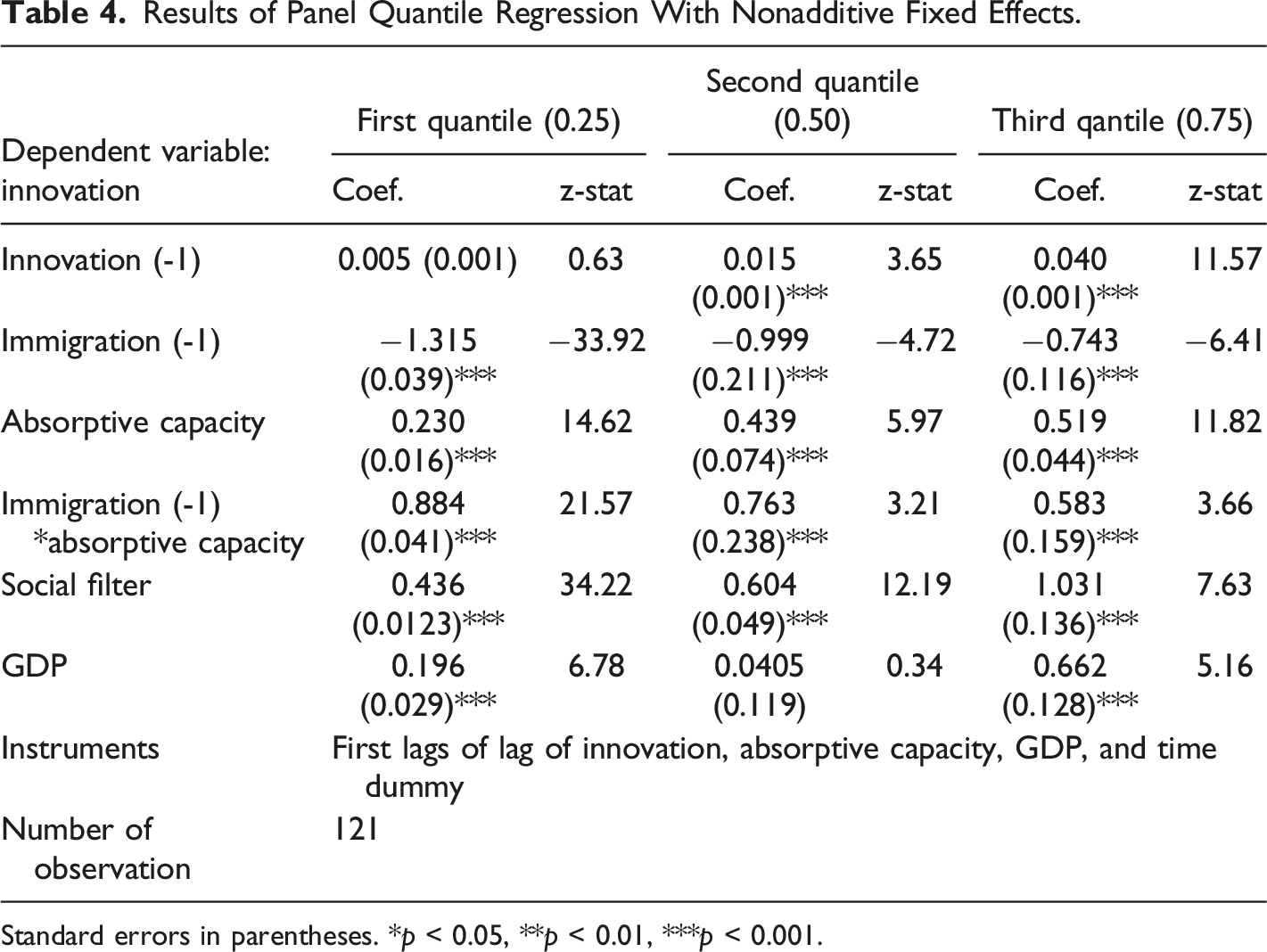
The results of the panel quantile with nonadditive fixed effects estimates are reported in Table 4. These results show that immigration has a negative and significant effect on innovation over the study period independent of the level of innovation (quartile). However, these results indicate that the extent to which immigration is detrimental for innovation varies across different quantiles of innovation. In particular, the negative effect of immigration on innovation is greater for countries with the lowest level of innovation (first quartile). These results confirm the thesis of brain drain according to which the migration of talent citizens from developing countries to industrialized countries deprives developing countries of their brains, which are at the heart of innovation activities. For instance, Mariani (2008) explained the R&D and innovation gaps between countries with comparable levels of education by high-skilled migration, linked to differences in R&D costs.
Our results are also in line with those of Naghavi and Strozzi (2015), who concluded that immigration from a sample of 34 emerging and developing countries in organizations for economic, cooperation, and development (OECD) countries had a negative impact on innovation in the country of origin during the period 1995-2006. Thus, any 10% increase in the share of migrants in the sample leads to a decrease in innovation by 13.15% for least innovative countries ceteris paribus. In contrast, Fackler, Giesing, and Laurentsyeva (2020) found evidence of positive effects of immigration on sending countries’ innovation. The contradictory results of Fackler, Giesing, and Laurentsyeva (2020) can be explained by the fact that their study is based on European countries that are already mostly industrialized. They combined industry-level patenting and migration data from 32 European countries to conclude that emigration positively contributes to innovation in source countries. The difference of their findings from ours is that our sample encompasses only low-income countries.
Results of Panel Quantile Regression With Nonadditive Fixed Effects.
Standard errors in parentheses. *p < 0.05, **p < 0.01, ***p < 0.001.
Furthermore, our results indicate that social filter has positive and significant effect on innovation (Table 4). This implies that countries’ socioeconomic conditions matter in the creation of new ideas since R&D is mostly devoted to highly skilled workers, confirming the social filter hypothesis. Rodríguez-Pose and Crescenzi (2008) found a positive effect of socioeconomic conditions on countries’ innovation capacity in a sample of 25 European Union countries. Recently, Xiong et al. (2020) confirmed the accelerating role of social filters on the effect of innovation on economic growth in China.
Immigration, Absorptive Capacity and Innovation
Recall the main objective of this paper is to know whether absorptive capacity could infirm the brain drain hypothesis of immigration. To that end, we look at the coefficient of the interaction term between immigration and absorptive capacity. The results reported in Table 4 indicate that the coefficient of the interaction term between immigration and absorptive capacity is positive and statistically significant. This result corroborates our hypothesis that the potential of migrants from developing countries to stimulate the creation of new ideas in their country of origin is conditioned on the level of absorptive capacity of their country. These results agree with those of Baiashvili and Gattini (2020), Jude and Levieuge (2017), Naghavi and Strozzi (2015), and Saxenian (2002). Baiashvili and Gattini (2020) investigated the effects of foreign direct investments on economic growth using a large sample of 111 countries around the world. Regardless of the level of development of countries, the authors concluded that absorptive capacity plays a positive moderating role in the effect of foreign direct investments. Jude and Levieuge (2017) found that the economic growth effect of foreign direct investments in developing countries depends on certain characteristics of the recipient country, such as political stability, economic openness, and institutional quality. Houngbedji and Bassongui (2021) found that political stability, the rule of law, and the effectiveness of regulation have significant effects on the relationship between public investment and public investment in Sub-Saharan Africa. Naghavi and Strozzi (2015) also concluded that the potential of immigration to drive domestic innovation in developing countries is conditioned on intellectual property rights.
Furthermore, we found that the extent to which absorptive capacity mitigates the negative effect decreases with the level of innovation. In other words, least innovative countries benefit more innovation externalities from their talents abroad if these countries improve their absorptive capacity. For instance, for a given level of absorptive capacity, a 10% increase in immigration increases the level of innovation by 8.84% and 5.83% for countries with low (Q1) and high (Q3) levels of innovation, respectively. The mitigating role of absorptive capacity may be explained by the institutional quality channel. Indeed, this latter improves countries’ innovation performance since good institutions protect intellectual property rights, decrease investment risks, and thereby attract more private and foreign direct investment, which in turn boosts R&D. This finding is in line with institutional theories (North 1990). Naghavi and Strozzi (2015) also empirically confirmed from a sample of 34 emerging and developing countries over the period 1995-2006 that intellectual property rights have positive effects on innovation.
Quadratic Quantile Regression With Nonadditive Fixed Effects.

Standard errors in parentheses. *p < 0.05, **p < 0.01, ***p < 0.001.
Robustness Tests
To test the robustness of our estimates, we replaced in equation (3) the migrant flow by the migrant stock. Then, we again estimated this model using the panel quantile with a nonadditive fixed effects estimator. First, the results presented in Supplement Table A6 in the appendix indicate that immigration has a negative and significant effect on domestic innovation in the countries in the sample. Second, these results concluded that absorptive capacity has no significant effect on the innovation of the countries in the sample. Finally, the interaction term between the stock of migrants and absorptive capacity has a positive and significant effect. Consequently, these results confirm those found in our main estimation (Table 4).
Conclusion
The issue of the impact of immigration especially that of qualified skills from developing countries, has attracted the attention of both policymakers and scholars. This is so regarding the increasing importance of the flows of skilled migrants to industrialized countries. Hence, scholars have found an interest in assessing the economic and poverty implications of such a flow of developing citizens toward industrialized countries. However, little empirical evidence exists on the relationship between the immigration and domestic innovation of the origin countries. It is within this framework that the present work focused on analysing the effect of immigration on innovation in African countries by highlighting the role of the absorptive capacity of these countries. Using five average period data points from a sample of 35 African countries over the period 1995-2019, the effect of immigration on innovation conditional on absorptive capacity is estimated through panel quantile regression with nonadditive fixed effects. First, our results argue that immigration has negative heterogeneous effects on innovation on the one hand and that absorptive capacity has a positive effect on innovation on the other. Second, the estimates revealed that absorptive capacity mitigates the negative effect of immigration when absorptive capacity reaches some threshold. Alternative estimates using the stock of migrants instead of the flow of migrants concluded that our results are robust. These results suggest that African countries need to invest in physical capital and strengthen the quality of institutions to mitigate the negative effects of immigration. These implications could be limited to country-level data used to compute the absorptive capacity index, which was originally a firm-level concept.
Supplemental Material
Supplemental Material - Does Absorptive Capacity Matter in the Impact of Immigration on Innovation in Africa? Evidence from Panel Quantile Regression with Nonadditive fixed Effects
Supplemental Material for Does Absorptive Capacity Matter in the Impact of Immigration on Innovation in Africa? Evidence from Panel Quantile Regression with Nonadditive fixed Effects by Nassibou Bassongui and Houda Ben Younes in International Regional Science Review
Footnotes
Declaration of Conflicting Interests
The author(s) declared no potential conflicts of interest with respect to the research, authorship, and/or publication of this article.
Funding
The author(s) received no financial support for the research, authorship, and/or publication of this article.

Supplemental Material
Supplemental material for this article is available online.
References
Supplementary Material
Please find the following supplemental material available below.
For Open Access articles published under a Creative Commons License, all supplemental material carries the same license as the article it is associated with.
For non-Open Access articles published, all supplemental material carries a non-exclusive license, and permission requests for re-use of supplemental material or any part of supplemental material shall be sent directly to the copyright owner as specified in the copyright notice associated with the article.
