



Abstract
The Great Recession’s damaging effects on the finances of cities and counties have led some observers to predict dramatic, widespread, and enduring changes to local government in response to fiscal pressure. However, the history of change in local government suggests otherwise, as does the experience of individual cities and counties that have confronted fiscal duress in the past. The authors of this article suggest that financial problems will not overwhelm the balance among an array of competing pressures that already confronted local governments long before the recession. Although some cities and counties will respond to the downturn with major, permanent changes, most will not. For local governments as a whole, equilibrium among the host of tensions they face will continue to resist dramatic moves and favor only gradual change.
Keywords
The severe economic downturn that roiled the United States’ and world economies in 2008 sharply reduced the own-source revenues of state and local governments. Without massive but temporary federal support, the ability of subnational governments to deliver needed services while also meeting the legal requirement for a balanced budget would have been seriously threatened. As these temporary federal funds recede and state governments grapple with their own fiscal problems, some observers predict dramatic and permanent changes in local government—changes that will appear across the local government landscape as cities and counties adjust to what these observers are calling the “new normal.”
Most predictions reject the possibility that the downturn is merely part of a business cycle and that a return to the old normalcy lies ahead. Instead, state and local governments face a period of “perpetual fiscal crisis” (Peirce 2002, quoting former National Governors Association executive director Ray Scheppach) and an “era of cutback management” (Pandey 2010, 564), where resources will be permanently constrained. Furthermore, the impact of this constraint will be compounded by the weight of a series of calamitous decisions made over a period of several decades to expand services, to defer infrastructure maintenance, and to make unsustainable commitments for pensions and health care. The combined effects are daunting.
The “new normal,” it is suggested, will feature more frugal budget choices that emphasize sustainable spending, a reduced scope and level of local government services, slower growth or even decline in public sector compensation, more public–private partnerships and interlocal service sharing, increased privatization, and, according to a former mayor of Indianapolis and deputy mayor of New York City, “a fundamental, transformational realignment of the way that governments choose their tasks, define success, and generate the revenue to fund their work” (Goldsmith 2010; Brock 2009; Miller 2011; International City Management Association [ICMA] 2009). The result will be downsized local governments “with a smaller footprint focused on the most important needs,” suggests the mayor of Los Angeles, an outcome likely produced only after painful choices favoring fire, police, and sanitation services over convention centers, zoos, and city-owned golf courses (Villaraigosa 2010).
In this article, we will examine current predictions of widespread and fundamental change in local government as a result of the economic downturn and provide our own thoughts. Our forecast will be offered in light of previous predictions from recent decades, the history of change in local government generally, and the experiences of cities and counties in severe financial crises in the past. An important gauge for us in predicting the future of so many local governments now confronting severe fiscal stress are the responses of individual cities and counties facing their own financial crises of equal or greater severity in the past.
Previous and Current Predictions
This is not the first time in recent decades that an economic downturn prompted dire predictions. Similar alarms over a “shrinking pie,” eroding infrastructure, and service demands that were outstripping local government resources were sounded in 1979 by the ICMA Committee on Future Horizons. 1 The committee encouraged public–private cooperation and called on local governments to regulate service demand and “learn to get by modestly” (ICMA 1979).
Charles Levine (1980) suggested at the close of the 1970s that public officials come to grips with the possibility that the fiscal stress they were then facing might not be temporary. Defining cutback management as “managing organizational change toward lower levels of resource consumption and organizational activity,” Levine (1979, 180) and others identified predictable responses to fiscal crises, the stages of retrenchment, preconditions for orderly and successful contraction, and common cutback tactics (Levine, Rubin, and Wolohojian 1981, 1982). They distinguished tactics that are simpler and appear more equitable (e.g., across-the-board cuts, hiring freezes) from those that are more “efficient” but require costly triage analysis to minimize long-term losses to the organization (Levine 1978). For example, such triage analysis today would be required of a county government attempting to carefully redesign the benefits package of county employees to balance short- and long-term objectives, or a municipality thoughtfully considering the sale of city-owned property previously envisioned as a future park.
One after another, state and city futures studies in the 1970s and 1980s noted severe pressure on government resources, growing demands for services, and “a cascade of infrastructure and environmental problems” (Hitchcock and Coates 1985). More recent predictions of the future of local government emphasize the persistent problems of escalating demands, unfunded mandates, rigid systems, citizen mistrust, and a tax system that is “out of whack” (Figone et al. 2011). Warner (2010) predicts the further fragmentation of local government, fueled by “private ‘club’ approaches to providing public goods”; 2 greater attention directed toward long-term consequences of decisions; pressure to privatize infrastructure investment but waning zeal for outsourcing local services; and a rebuilding of the capacity of local government, especially with regard to finances, public employment, and citizen engagement. Figone et al (2011) forecast an emerging model of more disciplined local governments that focus on core “businesses,” make greater uses of technology, emphasize collaborative service delivery and nongovernmental solutions, demonstrate more clearly the value of local governments to their taxpayers, employ a changing workforce, and engage their citizens more than in the recent past.
Each of these forecasts emphasized the formidable challenges facing local governments, noted the need for changes from the status quo, and predicted, with varying degrees of confidence, that change would follow. What is most strikingly different in the current “new normal” forecasts are assertions that the condition of restricted resources will persist permanently and that local government will change fundamentally as a result. Although the forecasters are not explicit about the timing and breadth of these changes, the clear implications of their assertions are that the changes will come sooner rather than later and will be widespread.
Dramatic, widespread, and permanent change in local government would represent a sharp redirection of public policy, something more akin to the disjointed, episodic, and unpredictable change associated with punctuated equilibrium theory (PET) as an explanation of public policy change (Jones and Baumgartner 2012) than to the gradual change in small increments anticipated by the theory of incrementalism (Lindblom 1968). PET does not reject incrementalism and its characteristic stability altogether; instead, it builds on the same premise and anticipates “long periods of stability punctuated by radical change” (Jensen 2009, 287). Like the pressure beneath the earth that builds until released as a tremor or an earthquake, the forces of policy change, under this theory, meet resistance from factors of incrementalism until they can be resisted no more. Jones and Baumgartner write, “policymaking systems remain stable until the signals from outside exceed a threshold, and then they lurch forward—that is, a policy punctuation occurs; afterward, they resume ‘equilibrium’” (2012, 8).
The question at hand, then, is not whether the Great Recession has placed enormous fiscal pressure on local governments. Certainly, it has done that. Nor is the question whether it will prompt substantial change in some governments. The question is whether the fiscal pressure is so great that it will evoke more than incremental changes across the landscape of local government. Will the pressure be sufficient to disrupt the equilibrium existing among the constellation of pressures felt by most local governments? Will it evoke radical change?
Change in Local Government: Gradual or Dramatic?
Forecasts of sudden and dramatic change in local government stand in sharp contrast to the historic pattern. American cities and counties have evolved over the span of U.S. history, mostly at a gradual pace. Departures from this pattern, consistent with PET, are a handful of more dramatic changes associated with significant social, political, economic, or technological events or periods—the Progressive Era, urban riots of the civil rights movement, and the promises and challenges of the information age, for instance. Examples of dramatic, widespread change include the movement of many cities to a strong executive mayor late in the nineteenth century and the rapid adoption of the council–manager form of government, with its appointed chief executive, during and following the Progressive Era early in the twentieth century. Still, most change in local government has been evolutionary rather than dramatic. It is instructive to note, especially in the context of current economic problems, that relatively few of the major changes in local government across the span of history are associated solely or especially with troubled economic periods, including the Great Depression.
Will local governments continue to change over the coming years? Most certainly, they will. As in the past, these changes will be less perceptible to average citizens than to government insiders. Will the shock of the Great Recession bring dramatic rather than gradual change to all local governments? That, we doubt. In 2009, almost two-thirds of responding local government officials nationally reported no more than “moderate” impact from the economic downturn (Thoreson and Svara 2011; ICMA 2009) and more than three-fourths of the respondents to an economic development survey expected at least slow growth in the next five years (Warner and Zheng 2011). These are not the harbingers of dramatic change. Even if conditions worsen, as predicted, the pattern of adjustments is likely to be uneven across the local government landscape.
Scholars will differ from one another in their characterization of change as incremental or dramatic—as will practitioners. Some of their differences will be a matter of perspective. Changes that feel dramatic to an organization and its employees may represent only a slight, incremental step in the trend line of local governments as a whole. As noted by Knill and Lenschow (2001), a change that is regarded to be a “fundamental reform” by some may be considered no more than a “marginal change” by others because they “view and measure change from different levels of abstraction” (p. 188). The shift from a single organization perspective to a macro perspective is significant. Remoteness reduces the scale of change (Knill and Lenschow 2001, 196). The question before us—whether there will be widespread, dramatic change across the local government landscape—is a macro question.
Lessons from Severely Distressed Local Governments of the Past
Changes, at least of small magnitude, are inevitable in organizations and institutions, of course; but predictions of major, permanent change rest on the belief that severe financial strain will be an irresistible impetus that makes substantial change inevitable. Those who make these predictions subscribe implicitly to the following hypothesis:
Local governments across the nation will respond to severe financial stress by imposing on themselves fundamental and permanent changes in their services and structures, or will have such changes forced on them by their states. These changes will be lasting, so as to ensure not only survival from the immediate crisis but also avoidance of distress from a similar cause in the future.
If this hypothesis is correct, evidence of the power of fiscal distress as an impetus for major, permanent change should appear in the altered structures and scaled-back services of local governments that have faced individualized fiscal crisis in the past in the form of default, bankruptcy, dramatic bond downgrade, or forced state oversight. We should expect that these jurisdictions would already have made the kind of dramatic and lasting changes now forecasted for most cities and counties.
To test the hypothesis, we secured through interviews and state documents relevant information on thirty-nine of the seventy-five local governments that filed for bankruptcy protection, had their general obligation bonds downgraded to junk bond status, or were forced to accept the appointment of a financial control board (FCB) to manage local affairs during the 1971–2005 period. Officials from eighteen of these local governments consented to telephone interviews. 3 These included officials from fifteen of the forty-three cities and counties that either filed for Chapter Nine bankruptcy protection (Deal 2007) or suffered downgrades of their general obligation bonds to Caa1 or lower (Moody’s online database, March 2012) during this thirty-five-year period. We also interviewed officials from three of the thirty-two local governments revealed by a Google search to have had their fiscal management placed under FCB control during this time interval. State documents relevant to our needs were found for twenty-one others. 4 Through interviews, we sought information about changes made in immediate response to the crisis, the permanency of any changes that were made, and whether local services or governmental structure retain lingering effects from the earlier crisis.
Most of the officials interviewed were finance officers, budget directors, or assistant managers. These were officials considered likely to be aware of their local government’s previous financial difficulties and the actions taken in response, and able to assess whether the government today is structured differently or provides services noticeably different in scope or level than their counterparts in the region that had not experienced severe fiscal crisis. Any distinguishing features of structure or service could be residuals of their earlier crisis—the kinds of permanent change now being predicted for local government as a whole in the wake of the Great Recession.
We defined “major” change as including permanent reduction or even elimination of major services, elimination or merger of departments, establishment of intergovernmental service delivery agreements, or changes of governmental form or structure. Adopting revised but fairly common service delivery options, such as contracting, was categorized as a “moderate” change. We categorized budget reductions, tax increases, debt restructuring, multiyear capital improvement planning, and collective bargaining agreement restructuring as “minimal,” as they do not require a fundamental change in structure or service level, although we recognize that even these steps can be very difficult to take.
Surprisingly, not all of these officials knew about their government’s history of financial problems. This discovery was both startling and important. Current predictions suggest that fiscal distress will force dramatic and lasting changes. If prominent officials of local governments that in the past have confronted severe fiscal distress are unaware of this history and perceive nothing out of the ordinary in their government’s structure or services, current predictions are thereby undermined. Dramatic and lasting changes would alter the organizational culture and produce stories that likely would be retold to generations of new employees and almost certainly would be known by prominent officials in succeeding years. Furthermore, dramatic and lasting changes would make a local government stand out among its regional counterparts and these distinctions would be noticeable to its officials. The discovery of unawareness of past fiscal crises is regarded not as “missing data” but as important evidence that little, if any, change of a dramatic and lasting sort actually took place.
Of the eighteen interviewed officials of local governments that had filed for bankruptcy protection or had their bonds downgraded to junk bond status, one-third were unaware or only vaguely aware of that occurrence (Table 1). One interviewee whose government had filed for bankruptcy denied that a bankruptcy had occurred. Among respondents acknowledging their government’s earlier crisis, seven either considered actions in response to have been “minimal” or they described actions taken by their city or county that were far short of fundamental changes implemented with lasting effects. Altogether, officials in almost all of these communities either reported only modest responses to their earlier crisis or represented communities where the residuals of the crisis were so faint that the official had no knowledge of it. In contrast, Bridgeport, Connecticut, reported significant structural changes that had been imposed by the state through directives of the city’s FCB.
Awareness among Current Officials of Bankruptcy Filings or Severe Bond Downgrades and Actions Taken in Response
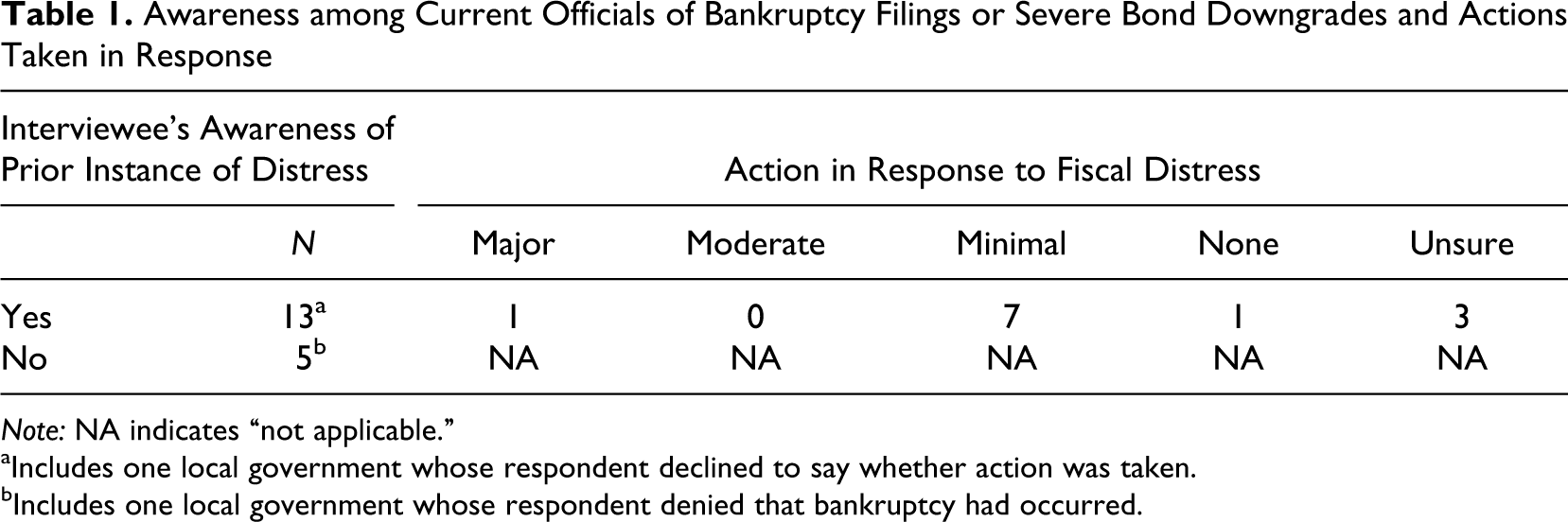
Note: NA indicates “not applicable.”
aIncludes one local government whose respondent declined to say whether action was taken.
bIncludes one local government whose respondent denied that bankruptcy had occurred.
Seventeen interviewees agreed to assess the structural and service similarities or differences of their local government, in general, when compared with jurisdictions they considered counterparts in their region (Table 2). Ten of these officials (59 percent) said that their government’s structure was no different or had only minimal differences compared to their counterparts. One of these, a Bridgeport, Connecticut, official, noted that the city had undertaken structural reforms and service reductions at the time of the crisis but assessed its current structure and services as only minimally different than its counterparts. While a few others noted “moderate” differences, only the official from Reeds Spring, Missouri, reported a “major” structural difference. This difference, however, was not a reform introduced as a result of its earlier fiscal stress. Instead, the interviewee reported that, unlike its counterparts, Reeds Spring still had no city administrator. As a group, interviewees were hard pressed to identify important structural differences attributable to past crises.
Compared to Other Cities and Counties in the Area: Did Severe Fiscal Distress Produce Lasting Changes in Structure or Services?
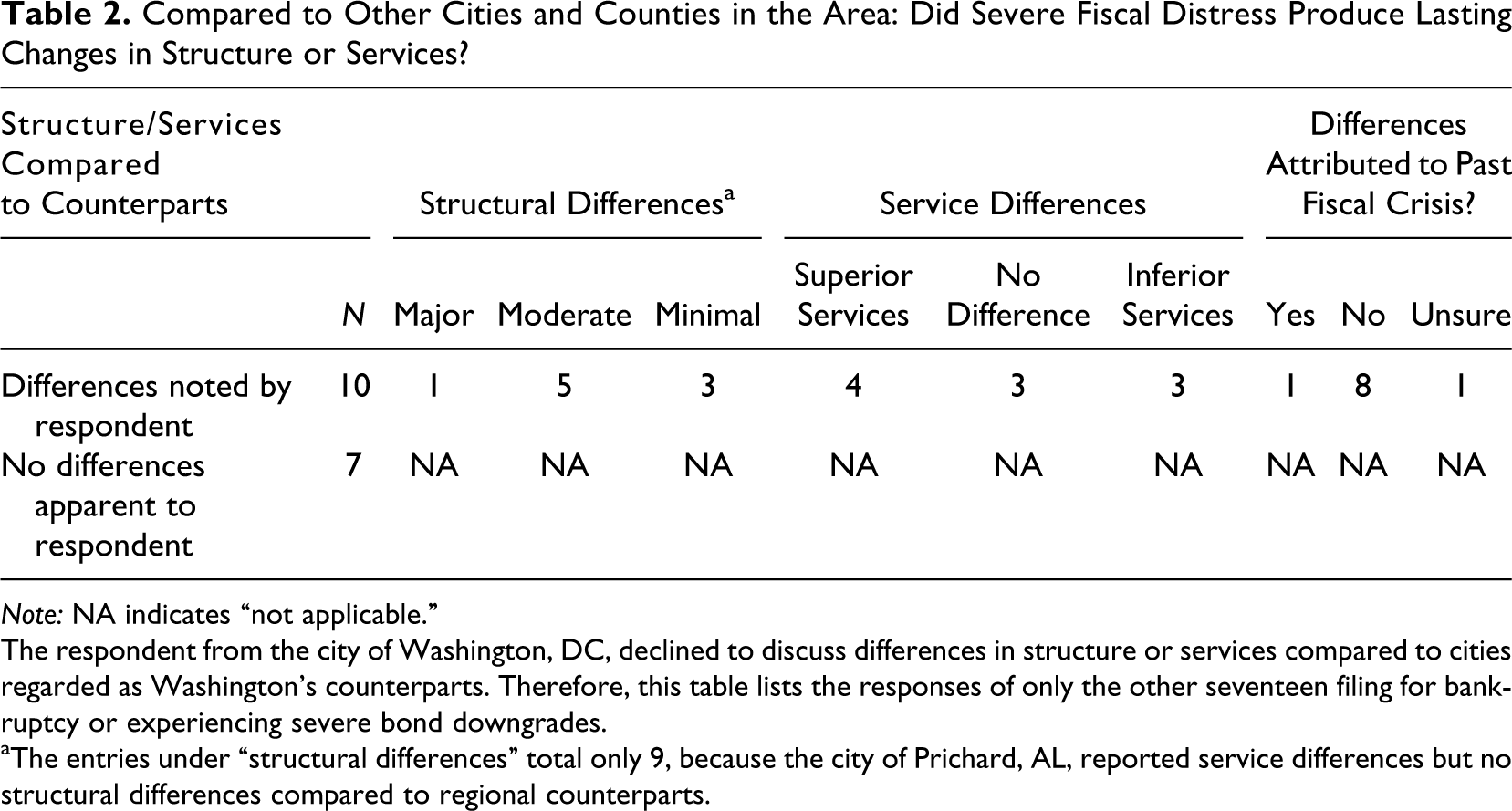
Note: NA indicates “not applicable.”
The respondent from the city of Washington, DC, declined to discuss differences in structure or services compared to cities regarded as Washington’s counterparts. Therefore, this table lists the responses of only the other seventeen filing for bankruptcy or experiencing severe bond downgrades.
aThe entries under “structural differences” total only 9, because the city of Prichard, AL, reported service differences but no structural differences compared to regional counterparts.
Four respondents considered their local government services to be superior to those of their counterparts, ten regarded services to be comparable (including the seven who perceived no differences in structure or services), and three reported services more limited in array or quality than those provided by counterparts. Only the city of Prichard, Alabama, attributed having lower service levels than its counterparts to its earlier financial troubles, but the full story is a lesson in resistance to change. Prichard’s respondent reported that only minimal changes were made in direct response to its 1999 default, leaving the city in a still perilous position when the recession hit in 2008. In 2009, Pritchard was forced to file for bankruptcy protection again, and only in the wake of this second crisis did substantial service reductions occur.
These interviews show that government insiders judge the structures and service arrays of local governments that have experienced severe financial crises to have few if any meaningful differences from those of their counterparts. Apparently, the solutions they adopted in the face of their crises were either of a short-term nature or they merely produced conformity with the practices that neighboring local governments had adopted in the absence of a fiscal crisis. Either way, they fail to corroborate the hypothesis. Little evidence exists from these cases to support an expectation that severe fiscal distress will produce dramatic and lasting change.
To further test the hypothesis, we expanded our review of distressed local governments to include not only those that had filed for bankruptcy protection or had their general obligation bonds downgraded to junk bond status but also those forced to accept the appointment of a FCB to oversee local affairs. We secured relevant information from twenty-two local governments subjected to FCB oversight from available FCB reports, supplemented by interviews with officials of four of these governments (Table 3). FCBs often have been granted extraordinary power—including, for instance, the authority to fire employees, impose hiring freezes, reduce salaries, restructure debt and restrict borrowing, install budget control systems, raise taxes, and reduce services (Coe 2008, 762). Unlike the elected and appointed officials they supplant, an FCB is not accountable to the voters. Normal democratic processes are largely set aside in favor of prompt action that citizens might not like. The state in such cases has, in effect, “chosen to pass up the opportunity to involve citizens in decision-making that affects their lives in favor of a process that ensures swift and decisive action by ‘experts’ free from political considerations” ( Missed Opportunity 1997, 734). When major cities—such as New York City in the 1970s (Levine, Rubin, and Wolohojian 1982) or present day Detroit—have FCBs appointed, the occurrence garners major attention from the news media and scholars. Similar occurrences in smaller communities receive less attention, but local citizens and officials feel no less offended than those of Detroit, where the Detroit Free Press said the governor’s proposed Recovery Plan and Financial Advisory Board “. . . looked more like a takeover than a joint effort to solve the city’s financial perils,” and the mayor complained, “It forfeits the electoral rights of the citizens of Detroit guaranteed by the democratic process” (Hackney and Gray 2012; also see Anderson 2011).
Compared to Themselves at an Earlier Time: Did Fiscal Control Board Supervision Produce Lasting Changes in Structure or Services?

Note: FCB = financial control board.
aAlthough only one of these local governments reported service changes, both reported structural changes that they attributed to FCB oversight.
bDuquesne, PA, reported no structural change to the local government but the closing of the local high school while under FCB supervision, joining Chelsea in reporting a lasting decline in local services.
Source: Compiled by the authors from annual reports filed by the local governments with their fiscal control boards.
The FCB reports reviewed for this study and interviews with selected officials of communities subjected to FCB oversight revealed actions and results broadly similar to those reported by officials of local governments that had filed for bankruptcy protection or had experienced severe bond downgrades. Only two of the twenty-two examined local governments with FCB oversight reported major structural change as a result. The experience of one of these—the city of Chelsea, Massachusetts—is particularly instructive. When Chelsea faced default in the early 1990s, local officials found it impossible “to stay focused on the primary mission—providing basic services to their citizens. Instead, politicians and managers [were] caught up in a complex web of competing interests, laws and traditions which [had] created a dangerous political stalemate” (Cyr 1993). The city was subsequently placed under receivership. Many of the reforms made to move Chelsea from the brink of disaster were possible only because of the special nature of the receiver relationship. For example, a new contract with firefighters, deemed “fair to the city, the citizens and the firefighters” by the assistant receiver, “was only possible because the receiver did not have to run for re-election and face the wrath of an organized, focused opposition” (Cyr 1993). Among the major structural reforms undertaken by Chelsea were adoption of the council–manager form of government, restructuring of departments, and replacement of much of the senior administration. Nevertheless, there was consistent resistance to change. In 2005, the city emerged from receivership only to have a former police officer run for election and win a city council seat on a platform of rolling back the reforms (Canellos 1997). The impulse to treat change prompted by a fiscal crisis as a temporary fix is strong.
Another community under FCB control, Duquesne, Pennsylvania, closed its only high school and moved to a K–8 school system in response to fiscal distress. It should be noted, however, that during its time under the FCB the town lost nearly half of its population and had fewer than 7,000 residents when the high school was disbanded.
The other nineteen FCB communities included in Table 3 offered no evidence of major structural reform or major service reduction in their official reports to their FCBs. Their budget balancing efforts were typically short-term fixes or revenue adjustments, including such measures as wage and hiring freezes, sale of local government property, and increases in property tax rates. Far from adopting dramatic and fundamental changes that would allow them to escape their fiscal plight, most of the communities placed under FCBs made modest adjustments and still had some type of oversight body in place, suggesting that the underlying fiscal problems had not yet been overcome.
Why is it so difficult for local governments to make major changes in response to arduous fiscal conditions? We posit that change in local government as a whole is more often evolutionary than dramatic and that whatever forces might be pushing for change at a given time will merely join a broader field of forces exerting pressure against one another. The current state of local government represents equilibrium between these competing tensions. This equilibrium creates a condition of relative stability that will resist major shifts unless, in the language of punctuated equilibrium theorists, confronted by a force of sufficient magnitude to effect policy punctuation. As we suggest in the next section, major shifts from the current balance to a new and dramatically different equilibrium are unlikely.
Competing Pressures
Almost all local governments today confront multiple points of tension that pull local officials in different directions simultaneously and collectively influence a government’s structure, scope of services, and philosophy. These tensions and the responses of local leaders to them will determine the nature and pace of change in local governments in the decades ahead—more than will the current economic downturn, even as significant as it is.
Many of the pressures are common across all local governments (Ammons, Smith, and Stenberg 2011). Every community wrestles to define the proper role of government and to determine appropriate levels of taxation and spending. Advocates for fiscal constraint urge focusing on core services, achieving sustainability in human resource policies, and perhaps deferral of capital expenditures, but their prescriptions often ignore a lack of consensus about which services to designate as core and disregard the dire consequences when human and capital resources are neglected. Similarly, advocates of regional solutions often overestimate economies of scale and underestimate local desires to retain autonomy and independence. Local officials must decide if they will try to innovate their way to a better future or whether instead it is time to “hunker down” and refrain just now from experimentation. Explicitly or implicitly, they will decide whether the government will respond only to the politically influential or also to those whose voices are barely heard. The downturn will attenuate several of these points of tension, but in most cases its effects will be indirect rather than direct. The history of change among economically distressed cities teaches that lesson.
Even when they are not coping with a budget crisis, local government leaders and stakeholders routinely find themselves engaged in a civic “tug of war” that is anchored in competing facts, perspectives, politics, and philosophies. History suggests that in most cases the struggle will produce only incremental shifts in service scope and quality. Notable changes in government structure or philosophy will be rare. The current economic problems introduce a new element in an already ongoing struggle pitting competing pressures. This new force will be enough to sharply disrupt the general equilibrium among other forces in some communities, but in far from all of them. It will bring dramatic, temporary change to some cities and counties; less dramatic, temporary change to many others; but dramatic, permanent change to very few.
Conclusion and Implications
Our review of changes introduced in financially distressed communities indicates that in recent decades severe economic hardship has rarely been a “game-changer,” producing major, permanent alterations in local governments affected. The durability of local government structure and systems and the resiliency of local governments in the face of challenges have been demonstrated even by those facing the most daunting fiscal conditions—default, bankruptcy, substantial bond downgrade, or FCB oversight. We conclude from this finding and from observations of early responses to the current downturn that conditions triggered in 2008 by the Great Recession and now referred to as the “new normal” are unlikely to change fundamentally the scope, quality, or delivery of services in most counties and cities or to reshape the local jurisdictional or intergovernmental landscape, despite predictions to the contrary.
This is not to suggest that changes in local government will cease, but merely that the downturn will not bring dramatic and sweeping changes for most governments—a magnitude of change that would contrast sharply with the more gradual pace that, with few exceptions, has characterized local government’s evolution over the past 200 years. Hard economic times have not driven local governments as a whole to make major, permanent changes in their size, shape, and services or to launch dramatic changes in how they conduct business, nor are they likely to do so. Cities and counties have adapted in piecemeal and pragmatic ways to meet economic challenges, but as a group their transformation becomes apparent only over a span of decades, rarely in a few short years.
Therefore, it is likely that the local government system that was in place at the outset of the nation’s latest fiscal crisis will remain largely intact in the years ahead. Individual cities and counties that make major changes to cope with economic problems or to innovate in the new environment will stand as exceptions. They will have made such changes because local leaders were persuaded that the systems and practices in place were unsustainable or failed to position the community strategically, not because inevitable change attributable to the downturn swept across the local government landscape.
Could an even deeper economic calamity bring the sweeping change some have predicted? Perhaps so. Major state budget cuts to local programs, the shifting of even more responsibilities and costs of state-supported services to counties and cities, and further restrictions on local revenue-raising authority would take a toll. Significant reductions in federal discretionary grant programs that undergird local services such as housing, infrastructure, social welfare, and public safety would deliver a further blow. Such steps would amount to “devolution by budget cut,” and could produce a kind of “fend-for-yourself localism” (Greenblatt 2011, 26).
Although economic forecasts for local governments suggest that times will continue to worsen before they get better, it is unlikely that these conditions will be severe enough to disrupt the fundamental equilibrium of local government structure and systems. We expect that economic problems will exacerbate each of the critical tension points common to most local governments, but will not create sufficient consensus to overwhelm or supplant the competing philosophies, perspectives, and politics in which civic tugs of war are rooted. We expect the equilibrium to successfully resist punctuation, despite tremors here and there. We anticipate no widespread, major quake from the force of the Great Recession.
If any local government officials are waiting for the “new normal” to force the major changes to their structure or system that are needed for long-term sustainability, their wait will be futile. The Great Recession’s wake will not sweep into place the needed transformations. If changes are to come, local officials will have to be “prospectors” as strategy formulators in the sense offered by Miles and Snow (1978), searching for solutions, justifying needed changes, and getting them adopted community by community.
Footnotes
Acknowledgment
The authors gratefully acknowledge the research assistance of University of North Carolina graduate students Emily Leik and Kyle Haney on this project.
Declaration of Conflicting Interests
The authors declared no potential conflicts of interest with respect to the research, authorship, and/or publication of this article.
Funding
The authors received no financial support for the research, authorship, and/or publication of this article.