




Abstract
This article examines the interactive role between institution type and ideology at the local governmental level, demonstrating that additional degrees of autonomy allow for meaningful policy decisions locally. With increased discretion over policy expenditures, autonomy enhances the opportunity for ideological representation of constituents. The article explores the role of autonomy in county governments in Florida over a thirty-year period, questioning whether ideological dispositions of constituents are reflected in redistributive expenditures. Findings support the claim that local governments, with an augmented degree of autonomy provided via charter governance, may exhibit more flexibility in policy priorities than counties without more autonomous institutions.
Introduction
Can institutional arrangements that grant additional discretion to the local governments produce diverse outcomes? Whether or not local governments have much control over the policies and programs they produce is something that has been argued for some time. Some argue that localities and municipalities are nearly powerless and unable to produce representative governance due to their limited nature. However, this characterization ignores the institutional diversity that exists across local units; some governments have more power and discretion than others. One important local governmental institutional difference is degrees of autonomy, such as enhancement through home rule and charter governance. This article will examine the effect of local governmental discretion on governmental outcomes. Specifically, the article explores whether possession of a county charter allows local governments to spend differently than those governments that do not possess a charter. This is important for scholars and practitioners alike, as it can both help to understand the actual power and capabilities of local governments and highlights the inequity of local discretion between those that possess a charter and those that are without.
It is often the case that state policies constrict local governments to inaction (Frug and Barron 2008) and that the top-down effect of state regulations and policies undermine the capabilities of local governments (Peterson 1981, 1995; Stephens and Wikstrom 2007; Nelson 1986). Thus, some have argued that the hierarchical setup, and Dillon’s rule, in the United States may have rendered local government action as limited at best. However, the limitations are not uniform across localities. Recent studies have found that state actions do not always influence local governments in the same fashion (Richardson 2011; Stephens and Wikstrom 2007). Various arrangements may increase the input of local community preferences in policy decisions, revenue generation, and spending (Berkman and Plutzer 2011; Benton 2002, 2003a, 2003b, 2012). In fact, adoption of more autonomous institutions such as charter governance, which is a form of home rule, may mediate the relationship between state action and local policy (Percival, Johnson, and Neiman 2009; Stephens and Wikstrom 2007; Boschken 1998). The proposition that the legislative discretion and fiscal sovereignty granted by charters allow for rule by local governments to be expanded and more free needs to be examined thoroughly as it is essential in understanding governmental behavior, especially on the county level (Turnbull and Geon 2006).
Home rule refers to a state constitutional provision or legislative action that provides a city or county government with a greater measure of self-government (Richardson, Gough, and Puentes 2003; Richardson 2011; Fix and Kenyon 1990). Home rule allows for a higher degree of autonomy over policy outputs for local governments and may serve to combat or lessen pressures from the state, most commonly found in the form of state mandates (Percival, Johnson, and Neiman 2009; Benton and Rigos 1985, among others). It is often used as an indicator of autonomy due to its grants in powers and contrast to the determinations of Dillon’s rule (Geon and Turnbull 2004; Krane, Rigos, and Hill 2001; Weeks and Hardy 1984).
In the United States, home rule status differs both within and across states. Charter governance is a form of home rule in that it grants discretion to the local government. Some states make charter governance available to selected local units. While both municipalities and counties may possess charters, this article will look specifically at county-level charters in Florida. The ability to adopt a charter in the state of Florida was granted in 1968 and is open to all counties. As of 2009, twenty of the sixty-seven Florida counties had adopted a charter. Charters are important as they grant greater levels of discretion to the governments that adopt them. Two of the major liberties of charter status in the state of Florida are the ability to pass local laws and assess additional fees and/or taxes. In addition to the ability to generate additional revenue and the power to pass local laws, charter counties in Florida may choose to allow citizen initiative proposals and recall elections at the county level. Charter governance can be adopted through a simple process in which a charter is drafted and approved by popular vote within the county. The charter then has legal standing so long as it does not conflict with state statutes or the state constitution.
Charter provisions are but one way that home rule is provided to local governments. Since the 1980s, the services offered by counties have increased and therefore the counties must be able to possess additional levels of authority (Benton and Rigos 1985). Particularly important is the ability of counties to levy fees and taxes to provide these additional services. Studies have suggested that charter governance can increase both own-source revenue and increase the total collections of individual taxes, such as sales tax (Benton 2003a). However, this varies from states to state. Some states, like New Jersey and Ohio, guarantee home rule within their constitution. Other states, as is the case with Florida and states such as Oregon and South Dakota, allow counties or cities to adopt charters (Stephens and Wikstrom 2007). Overall, thirty-nine states within the United States permit home rule in some form on the local level. In some instances, the discretion granted is limited to the assessment of local taxes and fees, in others localities are granted the ability to legislate locally. However, in many instances, states grant both of these powers through home rule. The fact that Florida charter counties may gain both fiscal and legislative flexibility makes them perfect for study and for broad applicability. Many states grant home rule in various forms, but by studying a form of home rule that grants both the types of freedom this study may generalize to many other states of interest.
This article examines the impact of the special rights and privileges of charter governments on policy outcomes. This will be done by exploring the spending patterns of Florida counties both prior to and after the adoption of a county charter. It is expected that the higher level of discretion, granted through charter governance, will produce a change in the spending patterns of local officials in charter counties. Specifically, this work analyzes the redistributive spending patterns of counties to determine whether ideological preferences within a charter county affect spending choices. While charter possession should increase all areas of spending, redistributive policies (health care, welfare, poverty prevention, among others) are especially interesting to study. Unlike allocational and developmental expenditures, redistribution is not universally desired by all citizens. There exists an ideological divide, in which liberal citizens are more likely to support redistributive policies and programs than conservative citizens. Peterson (1981, 1995) has argued that without the constraints of higher authorities, liberal local officials will spend more on redistributive programs. Thus, by studying redistributive policies specifically, this analysis can explore two questions: Does charter governance increase expenditures and do those expenditures favor liberalism? This article will test this hypothesis by examining the redistributive expenditures of Florida counties over time.
Home Rule and Spending in Florida
Sherwood (2008) argues that home rule status allows counties to avoid the restrictions placed upon autonomy and the fiscal burdens which come from top-down pressures. In examining Florida counties, Sherwood notes that home rule provides a set of five benefits to chartered counties: accessibility (to representation), visibility (of officials’ actions), exclusivity over revenue sources, flexibility in spending, and direct authority. Of most importance here is the flexibility in spending and direct authority over local ordinances. When local governments possess authority and exclusivity over revenue sources, they also possess authority over expenditures and resource allocation. One of these advantages is the ability to levy additional taxes and assess certain specialized fees. As discussed by Brian Galle (2009), certain “hidden fees,” such as the recently established Florida charter county transit system surtax, allow for additional revenue to be accrued by charter governments. Galle defines these “fees” as hidden taxes and they are one means by which charter counties gain liberty from top-down forces and thus are able to enact policy in the preference of the local ideology.
Additional exclusive revenue sources such as these allow government officials to spend funds on policies which are most pertinent to the locality or are in accord with proximal political attitudes. Studies have shown that charter governance not only increases revenue but allows counties to broaden the scope of service delivery and meet the expectations of their citizens (Benton 2002). Therefore, given the benefits of charter adoption, charter counties may be more responsive to the desires and predilections of their constituents and as a result previous works have theorized that they are more likely to produce responsive policies (Stephens and Wikstrom 2007).
In addition, Sherwood (2008) addresses the ability of charter counties to serve as a vehicle of local discretion. Prior to the institution of a charter in Florida, counties presented all laws and bills to the state legislature in order to make any changes in local governance. When the home rule provision was implemented in 1968, those counties that adopted a charter achieved a level of political and legislative freedom: state legislation was no longer needed. Thus, local political agendas within charter counties should be able to progress without state-level interference. With the state legislature no longer serving as an obstacle, local governments can produce meaningful local policy outputs.
Since more autonomous governments should be able to more adequately pursue their agenda, these politicians should acknowledge the ideological preferences of their constituents in an attempt to preserve holding office. Percival, Johnson, and Neiman (2009) examine the role of residents’ ideology in their analysis of charters in California counties. They measure the relationship between public opinion and local policy output, defined as total expenditures, and find that “there is meaningful local politics, despite the substantial hemming-in of local choice by mandates, constitutions, and resource restraints” (p. 164). In California charter counties, which are similar to both Florida charter counties and many other state structures within the United States, the concept of home rule allocates considerable self-determination to the county. This self-determination can alleviate state pressures and allow more expression of local preferences. The authors’ findings clearly showed that the ideology of a county is reflected in the policies of that county, given that it possesses a charter. Therefore, it would seem that the independence gained from the charter allows local politics to be meaningful.
This article builds on Percival, Johnson, and Neiman (2009) by examining the type of policies ideology produces. The ideological priorities of counties should be observable in spending and change with the mediation of charter governance: this will be especially true for redistributive expenditures, due to the fact that there is a directional expectation for liberal counties. Thus, not only should one notice different degrees of expenditures, but also expenditures in different areas of policy should vary across ideological disposition of voters.
Spending, Ideology, and Responsiveness
Peterson (1995) delineates three policy arenas among which local government funds need to be divided: redistributive, developmental, and allocational policies. Redistributive policies include programs and expenditures intended to enhance the lives of the “less well off” or produce a benefit to tax ratio that is less than 1 for a majority of the community. Programs of this nature would include welfare and health care expenses. According to fiscal federalism scholars, redistributive policies are best provided by higher levels of government—but especially in recent years, localities are taking on more and more of these key functions.
Developmental and allocational policies are more routinely provided by local governments. Developmental programs that “enhance the economic position of a community in its competition to others” (Peterson 1981, 41) include parks and recreation, creation and maintenance of businesses such as a malls or industrial parks and in many instances schools. Since these expenditures benefit the entire community, it can be expected that local elected officials of all ideologies should prioritize developmental expenditures at similar levels. Allocational expenditures include all services which can be deemed as housekeeping services. As Peterson elaborates, these include programs which benefit the community as a whole but do not serve as direct economic benefits. These policies should “provide the average taxpayer with an average ratio of benefits to taxes” (Peterson 1981, 45). Examples of allocational expenses include funding to police and fire departments. Similar delineations have been made which categorize broad collective goods as compared to particularized benefits (Jacoby and Schneider 2009).
Governments that possess greater levels of autonomy should be able to allocate funds to programs and policies which reflect local ideological preferences. Clingermayer and Feiock (2001) noted that institutions and institutional actors shape both the incentives and the power to pursue certain efforts. Jurisdictions with liberal officials and constituents might be expected to allocate spending to help the poor in addition to spending on allocational and developmental programs which serve as their core responsibilities. Indeed, Rom (1999) found that liberal governments are more likely to allocate funding to programs which are considered redistributive.
When these literatures are considered in concert they provide an understanding of how we might view expenditures through an ideological lens. Not all governments should spend in identical manners and the ideological preferences of the constituents should guide the choices of an official who wishes to maintain office. Thus, we can expect that expenditures should be ideologically motivated, namely the expectation is that liberal governments will seek to enhance redistribution more than conservative governments. While allocational and developmental expenditures would be desired by all, the tax to benefit ratio of redistribution should only be favored by governments with more liberal demands.
The question here is whether or not local governments are able to reflect these ideological expenditures. Can the possession of a county charter allow localities to focus upon local preferences? Possession of a charter should aid in the production of representation giving a focus upon local preferences. This can be reflected by the choice in ideological spending and will be explored using local expenditures and the expected preference toward redistribution.
Theory and Hypotheses
Two components are key to predicting redistributive spending: presence of charter governance and the county’s ideology. The possession of a county charter should attenuate state restrictions, such as mandates, allowing a county to generate additional resources (Grossback 2002) and permit local politicians to allocate resources toward policies and programs supported by citizens. Thus, the spending and allocation of funds on a local level will be conditioned by the presence or absence of a county charter.
It is expected that counties that have a liberal political ideology should favor redistributive policies (Rom 1999). In contrast, those counties that possess a majority conservative ideology, and as a result conservative officials, should be less likely to prioritize redistribution, and thus spend less toward redistribution compared to their liberal counterparts. However, the authority and flexibility granted under charter provisions are also important. Charter provision can increase the latitude of service provision across counties (Benton 2003a). The abilities granted by a charter, such as assessment and ability to levy additional taxes, should allow both liberal and charter counties with a majority of conservative citizens to spend more than nonchartered counties across the board, as expressed through the first two hypotheses:
Local politics should have a greater impact upon the types of expenditures a county undertakes and therefore charter counties with a majority of liberal citizens should favor redistributive policies (Wong 1988) and with the authority and flexibility granted under charter provisions will act differently from charter counties with a majority of conservative citizens.
In addition to the key explanatory variables, the literature has provided alternative explanations that must be addressed. As such, several additional independent variables are included. First, a measure of the mean per capita income in a given county is included. Mean per capita income represents an alternative explanation for the dependent variable (Percival, Johnson, and Neiman 2009; Geon and Turnbull 2004; Turnbull and Geon 2006). Counties which have higher-income levels would not need to allocate as much funds toward redistributive measures. Counties which have high percentages of low-income or poorer residents would naturally have greater need to allocate funds toward policies such as welfare projects. Thus, the redistributive policy outcomes may be a result of the economic state of the composition of the county residents rather than an ideological effect. Similarly, theory calls for the inclusion of alternative monetary sources. State and federal funding may represent a confounding variable in the impact of charter governance on spending. Moreover, intergovernmental aid is often distributed disproportionally among the counties (with poorer or disadvantaged counties getting more funding) and therefore must be controlled.
Additionally, county growth has been shown to be a significant factor in the prediction of local spending. Particularly, a control for population growth within a county is important since it might be linked to redistributive funding (Nelson 1986; Craw 2008). Other demographic factors, such as education and minority populations, are also correlated to redistribution and are therefore included in the model. For instance, percentage of minority residents may explain redistributive expenditures and therefore may contribute to some variance in the dependent variable and should be controlled for, as is common practice (Percival, Johnson, and Neiman 2009; Geon and Turnbull 2004; Turnbull and Geon 2006). Additionally, a control for education has been included in the model as this variable may contribute independently to the likelihood of charter adoption (Percival, Johnson, and Neiman 2009; Geon and Turnbull 2004; Turnbull and Geon 2006).
Research Design and Methodology
The expectation that ideology and discretion from charter governance interact to produce varying levels of redistributive expenditures can be tested using pooled cross-sectional data in a time-series analysis. This dissimilarity is an important enhancement to the previous work, as it will allow for expenditure consideration in both pre-charter and post-charter county stages, helping to eliminate some of the problem of self-selection. As opposed to a univariate time series, this approach allows the model to compensate for changing values for a number of relevant variables. The study compares a county’s redistributive spending over time, for both chartered and nonchartered counties, across ideological spectrum and with dynamic changes that come with the passage of time. This means that all of the factors and controls discussed in the Theory section are dynamic and shift with the passage of time for each county.
The analysis will examine the spending patterns of Floridian counties, both prior to and after the adoption of a county charter, from 1976 to 2006. There are a total of 2,062 observed cases within the data set, each case representing the financial reports of a single county in a single year. This period encompasses the great majority of charter adoptions within the state of Florida and allows analysis of the spending of the sixty-seven Florida counties for a span of thirty years. Information regarding counties, their date of adoption, and key demographic information can be found in the online appendix.
The use of a time-series cross-sectional analysis will be an improved measure compared to those designs used by previous research. First, having a lengthy temporal domain will allow for variation to be observed in a single county over time. This is important because as counties move from pre-charter to post-charter the effects of adoption should be seen. Additionally, the cross-sectional data provide a means by which to compare the variation between nonchartered and chartered counties and help facilitate the analysis in determining if the changes in expenditures are in fact due to the presence or absence of a charter or whether they may be due to alternative explanations. The standard errors are clustered by county and year to preserve intercounty variation.
Florida’s charter counties are suitable for this inquiry for several reasons. First, charter counties, and the provisions permitted by the charter, provide for a degree of local discretion discussed earlier that should allow local government officials to act more in line with constituents’ will and preferences. Next, the provision allows for the assessment of certain special fees or municipal utility taxes, supplying the local government with an elevated degree of flexibility in expenditures (Galle 2009). In Florida, these fees are exclusive to charter counties and include revenues from municipal taxes (such as transit). Theoretically, this provision should allow local expenditures to be more autonomous as the extra revenues allow local governments to combat top-down pressures and mandates which would otherwise redirect the limited sources of revenues to enforced legislation.
Another advantage of the spatial measure used is the degree of variation among charter counties and thus applicability of the findings to states other than Florida. Charter counties can be found in almost all regions of the state; the only region without a charter county is the South Central Region (Enterprise Florida 2009). The size of charter counties varies from 280 square miles in Pinellas to 2,034 square miles in Palm Beach (Sherwood 2008). Populations range from 60,000 to well over a million residents. Additionally, Floridian charter counties are both urban and rural, demonstrated through assorted and widespread population densities per square mile.
Dependent Variables and Key Independent Variables
The dependent variable is the natural log of redistributive expenditure per county per capita, in 2007 dollars. Redistributive spending is funding targeted to hospitals, welfare, health, mental health, and other human services. The analysis uses the total spending for each county across these types of projects and programs. As stated previously, redistributive expenditures are used, as opposed to other categories, as it allows the analysis to test not only if expenditures will rise overall, but if there is an ideological component to the shift in spending. Since redistributive expenditures are preferred uniquely by liberals over conservatives the use of these funds is most informative. The variable will be in logged form because theoretically this is consistent with expectations. To clarify, increasing redistributive expenditures within a county that has little history of these types of expenditures is much more significant than increasing these expenditures in a county that consistently spends large amounts of funds on these types of expenses already. The use of a logarithmic transformation captures this theoretic consideration.
The key independent variable, county charter, is coded as a 1 when the county has a charter and 0 otherwise. The measure of county charter is dichotomous because there is no “quasi-charter” state. Either a county is classified and invested with a charter or is without a county charter. As the study progresses over the thirty-year time period, there will be many counties that move from nonpossession, to possession, of a charter. Therefore, the dichotomous variable is dynamic allowing for the movement from a coded 0 to a 1 when individual counties adopt a charter.
The second key independent variable deals with ideology. Ideology will be measured by Democratic vote for President, in the most recent election, as a proxy for liberal ideology (Florida Bureau of Elections, various years). Utilizing this measure of county citizen ideology will allow for ideological shifts within a given county to be observed over time. This measure of percentage liberal vote is one of the more commonly employed measures of liberalism on a regional basis (Nice 1986; Geon and Turnbull 2004; Turnbull and Geon 2006). Nice (1986) measures ideology by utilizing party vote as a proxy for ideological preference. Ideally, it would have been best to use a more direct measure of ideology, however given data constraints, such as the use of county-level data and the temporal domain of the study, the party measure proxy is most suitable.
The final independent variable is the charter–ideology interaction. This interaction effect will be measured by multiplying the dichotomous charter variable with the county citizen liberal ideology measure. Representing the primary explanatory mechanism, the charter–ideology interaction is expected to demonstrate the influence that the presence or absence a charter has, given the ideology of the specific county. Since there are no theoretical or underlying assumptions that would predict that the presence or absence of a charter alone would produce disparate or distinct policy outputs, a connection between the existence of the charter and its interaction to influence policy outcomes must be established.
Control Variables
As addressed in the Theory section, there are several control variables which must be evaluated to eliminate spuriousness and alternative explanations. First, a measure of the mean per capita income in a given county is included. Mean income is in per capita format and has been inflation-adjusted to 2007 dollars. Another control variable is the amount of state and federal funds per capita within a given county in a given year (Johnston, Pagano, and Russo 2000; Percival, Johnson, and Neiman 2009; Craw 2008). These variables have also been adjusted to 2007 dollars for consistency of interpretation and are in per capita format.
Finally, as discussed previously, some demographic predictors of both spending and redistribution are included. Population is included in a raw numeric form and serves as an indicator for growth. Percent minority is included, as this demographic is strongly tied to both spending and liberalism. Although this factor may be associated with ideology, controlling for this factor will not harm the analysis as it is correlated with increasing degrees of liberalism. Since the dependent variable assesses redistributive spending, control for percent minority residents will bias the study toward the null. Finally, level of education is included in the model. The education variable is measured as the distance from state average for each county for the percentage of the population with college degrees. In initial testing to control for selection effects, a Cox-proportional hazard model was run in a series of survival analyses to analyze the factors that influence charter adoption. As education was statistically significant, and has been shown to have significance in other studies, it is included.
The functional form of the model demarcates a conditional, rather than linear, relationship. Whereas previous work conceptualized the relationship between discretion and local policy outcomes as a linear correlation, the interaction term of charter–ideology asserts otherwise. The presence or absence of a charter along with the given ideology of a county should interact conditionally to produce disparate dependent variable outcomes. Substantively, this means that the degree of influence of ideology on expenditures is going to be conditioned on whether or not the county possesses a charter. Charter possession should allow ideology to have a larger impact.
The empirical analysis consisted of an ordinary least squares (OLS) regression using clustered standard errors, specifically a cluster index of county and year. While the plotted residuals appear normally distributed around a mean of approximately zero, further analysis revealed that there existed heteroscedasticity in the sample. Clustered standard errors are used to help to correct this issue. A discussion of the marginal impact follows the OLS results, as this is the most appropriate interpretation given the conditional form and expectations.
Results
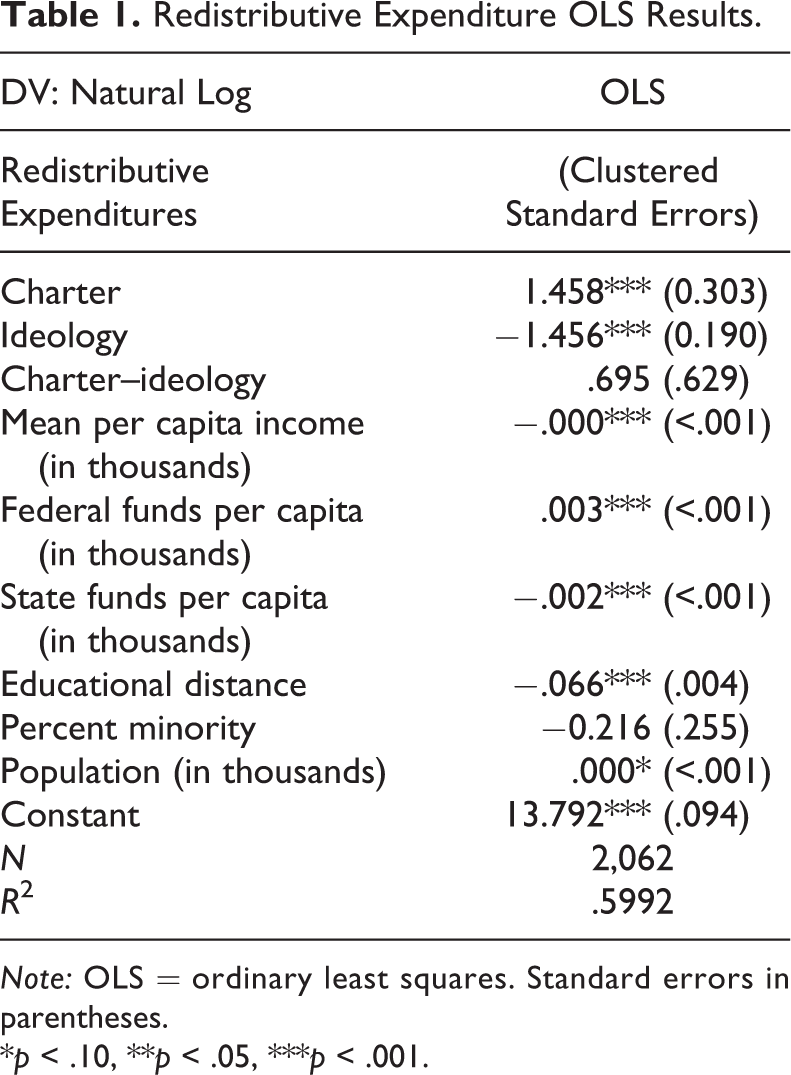
The results of regressing the dependent variable on the three key explanatory variables and additional controls are reported in Table 1. Since the model includes an interaction, care needs to be taken in the interpretation of the coefficients. Each component of an interaction, known as a constituent term, only represents the influence at a fixed value. The two constituent terms of interest for this model are charter and ideology. In the table, the value for the variable charter represents the expected results and significance level when Charter is at a 1 (possession) and Ideology is at a 0 (completely conservative county). Thus, the positive and significant coefficient indicates that conservative counties that possess a charter systematically spend more than their counterparts. The opposite is true for the constituent term Ideology. The coefficient and significance represent the expected influence when Charter is at a 0 (nonpossession) and Ideology is at a 1 (completely liberal county). This negative and significant sign indicates that when liberal counties do not possess a charter, they are less likely to spend toward redistribution—suggesting that possession of a charter enables ideologically based spending. To explore the trends present in between these values, such as moderate county, in either chartered or unchartered conditions, the marginal effects need to be assessed. They will be provided later in Table 2. For further reading on interpretation of interactive models, see Brambor, Clark, and Golder (2006).
Redistributive Expenditure OLS Results.
Note: OLS = ordinary least squares. Standard errors in parentheses.
*p < .10, **p < .05, ***p < .001.
Marginal Influence of Charter–Ideology on Proportion of Redistribution.

Note: The coefficient value is the predicted change in redistributive expenditures with all other variables held constant, across the observable range of data.
The results of Table 1 provide clear support for both Hypotheses 1 and 2. To summarize the results, the first constituent term, Charter, has both a positive and significant sign on the variable for redistributive expenditures. As it is a constituent term, substantially, this indicates that conservative counties that possess a charter are expected to spend more toward redistribution than conservative counties without charter governance (Hypothesis 2). Similarly, the negative and significant sign on the constituent term Ideology is indicative of support for Hypothesis 1. Substantively, this term represents nonchartered liberal counties, with the negative sign suggesting that they will spend less toward redistribution than their liberal counterparts vested with a charter. Thus, there is initial support for both Hypotheses 1 and 2, suggesting that institutions that augment autonomy, such as home rule or possession of a charter, do allow for greater spending capacities. As this interactive result may not be intuitive, I simulated several quantities of interest and found, as expected, that movement from a nonchartered state to a chartered state increases spending on the natural log of redistributive expenditures, for both counties with majority-liberal citizens and majority-conservative citizens. While the results of the constituent terms show clear support for the hypotheses, care needs to be taken when interpreting an interaction term.
When interpreting interactions, the interactive term itself need not be significant, as the significance only regards if the variable is significant across the entire range of possibilities (Brambor, Clark, and Golder 2006). For this work, this means that possession of a charter does not impact redistributive spending for some level of the ideological spectrum. This is unsurprising, as theory would dictate that counties that are 100 percent conservative will resist spending on redistribution. In fact, the corresponding coefficient provided in Table 1 only represents the significance when both constituent terms are 0 (nonpossession of a charter in a completely conservative county). Marginal analysis reveals that the vast majority of observations across the observable data range do appear to be significant. As such, it is important to explore the change in spending utilizing the marginal impact of the interaction term.
Statistically significant evidence is found, for instance, when simulating the mean outcome for movement from a liberal nonchartered county (ideology score at its observable maximum) to a liberal chartered county (maintaining ideology score). In this case, the predicted mean moves from 13.25 to 15.23. This finding is a statistically significant and discernible increase in expenditures at the 95 percent confidence level. Overall, the results are very supportive of both Hypotheses 1 and 2. Further evidence of the impact of charter possession on expenditures is provided in Table 2. As this is an interactive effect, to gauge the significance across the values of the variables we must examine the marginal influence, as provided in Table 2.
The value of interest is the marginal influence of movement from a nonchartered state to a chartered state across ideological values. Table 2 provides this change across the observable range of data (approximately 16 percent liberalism to 86 percent liberalism). The change in redistributive spending is positive and significant for all chartered counties with an inflating trend in spending coinciding with the degree of liberalism. The change in marginal influence presented in this table provides clear support for Hypothesis 3, as well as additional support for Hypotheses 1 and 2. This is shown by the significant increase in redistributive expenditures for both conservative counties and liberal counties, and in particular interest for Hypothesis 3, a growing increase in spending as a county increases in liberalism. For instance, from these results, it is predicted with 90 percent confidence that a county with a moderate level or liberalism (about 50 percent) and a population of 100,000 people would spend approximately $636,000 more a year on redistribution. The trend of augmentation, such that all chartered counties may spend more but liberal chartered counties trend toward spending even more, is indicative of the ideological expectations found both within the literature and informing Hypothesis 3.
Overall, the findings presented in Tables 1 and 2 provide evidence that charter provisions increases the likelihood that a county will spend more toward redistribution. Additionally, there is suggestive evidence that this likelihood to increase redistributive spending is tied to ideology, in that charter provision allows liberal counties to spend even more in areas of ideological priority, such as redistribution.
Conclusion
The results provide support for the theoretical claims that possession of a charter, and thus advanced degrees of discretion, leads to more flexibility in choice and prioritization of local politics. While localities may be constrained in the expression of local ideological dispositions, by their low standing in the intergovernmental hierarchy, they are not powerless. Possession of charter-based discretion bestows on counties the ability to more adequately reflect the desires of constituents through their expenditures. It has been shown that possession of a charter increases the likelihood of redistributive expenditures and it is suggested that the degree of increase is closely tied to the ideology of county’s citizenry.
This study has furthered previous findings and contributed to a deeper understanding of the role of local governments in the United States. It contributes to the greater body of literature by identifying and exploring the interactive relationship between institution type and ideology. Specifically, by examining how ideological preferences of constituents are reflected in expenditures across varying forms of local governance, this article demonstrates the importance of including institution type in conjunction with ideology when evaluating policy output. The findings clearly support the generalizable notion that augmentation of the degree of local autonomy, in its many forms, can increase the power and abilities of governments. Governing bodies are indeed responsive to constituent preferences, especially in a more autonomous state indicating that both institution type and ideology interact with one another to produce meaningful policy output.
Future research should examine why, other than fiscal liberties, charter counties are able to pursue ideological agendas better than their nonchartered counterparts. Along these lines, future research should address not only the top-down or external pressures which may create the interactive influence between ideology and institution but also how institutional arrangements contribute to local autonomy.
Footnotes
Declaration of Conflicting Interests
The author declared no potential conflicts of interest with respect to the research, authorship, and/or publication of this article.
Funding
The author received no financial support for the research, authorship, and/or publication of this article.
