



Abstract
Academic interest in local government collaboration is well documented. This article bridges that interest with practitioner preferences in a survey to a dozen experienced city and county managers in Florida on their experience in forging local government collaboration. The results showed that most formal collaboration agreements involved sharing facilities and most informal collaboration agreements involved sharing equipment. Moreover, none of these local managers felt that federal or state mandates had any impact on their agencies decision to enter into collaborative agreements and the managers did not evince a general agreement on either the process to follow to initiate or to evaluate interlocal agreements.
While academics in public administration often turn their attention to the practical concerns of practicing public administrators, a good fit between academic research and the needs and interests of practitioners in public administration cannot be taken for granted (Bolton and Stolcis 2003). A synergy between theory and practice has been a much sought, but sometimes elusive, goal for public administration in the United States (Posner 2009). Even a shared conception of what counts for knowledge in these areas has been questioned (Gow and Wilson 2014). Studies have examined academic research’s congruence with the expressed needs of professional association members (Streib, Slotkin, and Rivera 2001), and its relevance for practice in the specific field of accounting (Van Helden and Northcott 2010): both investigations find it useful, but narrow in scope when compared to the interests and needs voiced by practitioners. Very little attention has been paid to the views of practicing, experienced managers about important academic findings and even less has been given to, arguably, the most important group of managers—local executives.
This article attempts a novel approach to resolve that problem: it looks at findings that have been reported in the academic literature on just one topic—interlocal collaboration—and uses those findings to tease out the view of what experienced or “seasoned” local government managers find of practical importance. Rather than merely comparing a list of the managers’ rankings or concerns with a list of academic research topics, the aim was to have these key local managers explain how they decide on, achieve, and evaluate collaborative enterprise. To do this, the article does four things. First, it uses the views of scholars to define that topic and to suggest important areas where further useful research should be conducted. Second, it asks practitioners to rank these useful research areas in practical importance. Third, to get at what local executives really do in deciding on interlocal collaboration, it looks at the in-depth views of a dozen highly experienced—seasoned—chief local executives in Florida to get their assessment of the practical importance of some of the areas. Fourth, it offers a brief conclusion that summarizes and raises some provocative questions about what the seasoned managers think.
Scholarly Interest in Local Government Collaboration Areas
Interlocal Collaboration: Definition and Limits
This article focuses on collaborations among local governments or “interlocal” agreements and the views of the leaders of those jurisdictions. Benton (2013, 221) defines local government collaboration as an arrangement that “minimally involves at least two local jurisdictions and/or nonprofit or private organizations but frequently involves multiple such entities.” Feiock (2009) and Scholz and Feiock (2010) further clarify that local government collaboration ranges from informal agreements to formal ones like regional service authorities. According to Williams (2013, 28), implementing collaboration is a dynamic human process that involves governments with “differing missions, governance, leadership, constituencies, allegiances, and levels of power.” As a result, Williams (2013, 29) further emphasizes the importance of leadership “gifted with the ability to build consensus, reduce conflict, and juggle varying expectations.”
Although public–private partnerships are often included in collaboration, Hilvert and Swindell (2013) argue that public–private partnerships are nothing more than purchases under contractual relationships, with one party buying the services of another. For the purposes of this article, the term local government collaboration only involves those service arrangements where two or more public agencies come together and each contribute money, staff, or use of a facility to provide a local government service. Contractual relationships that simply involve a local government buying services from another government, nonprofit, or a private entity are not considered in this article.
Important Areas of Interest
A considerable amount of research has been conducted by scholars on the topic of collaboration as well as on its practice in local government. Interest in research areas can be determined in a number of ways including counting citations or topic mentions. Another approach is to identify interest in topic areas with demand by writers for additional study and understanding. For purposes of this article, importance was equated with the second approach and it uses underresearched areas as identified by leading scholars. A review of the literature on local government collaboration finds that leading academicians on the topic have recommended further research in the following topic areas: studying the effects that financial stress has on local government choice to engage in interlocal agreements (LaRoux and Pandey 2011), examining informal and nonfinancial forms of cooperation among local governments (LeRoux and Pandey 2011), describing the outcomes of successful collaborative initiatives (Faulk and Schansberg 2009), analyzing the internal preparations needed in collaborative initiatives (Delabbio and Zeemering 2013), and assessing how state and federal mandates shape local government collaboration (Delabbio and Zeemering 2013).
Practitioner Interests in Local Government Collaboration Areas
During a January 2014 Florida City and County Management Association regional training, twenty-two attendees were asked to rank, according to their interest, the five areas of academic interest identified previously for future research. The training was attended by senior level managers and department heads. Table 1 presents the results of their responses.
Practitioner Group Rankings of Collaboration Research Areas.
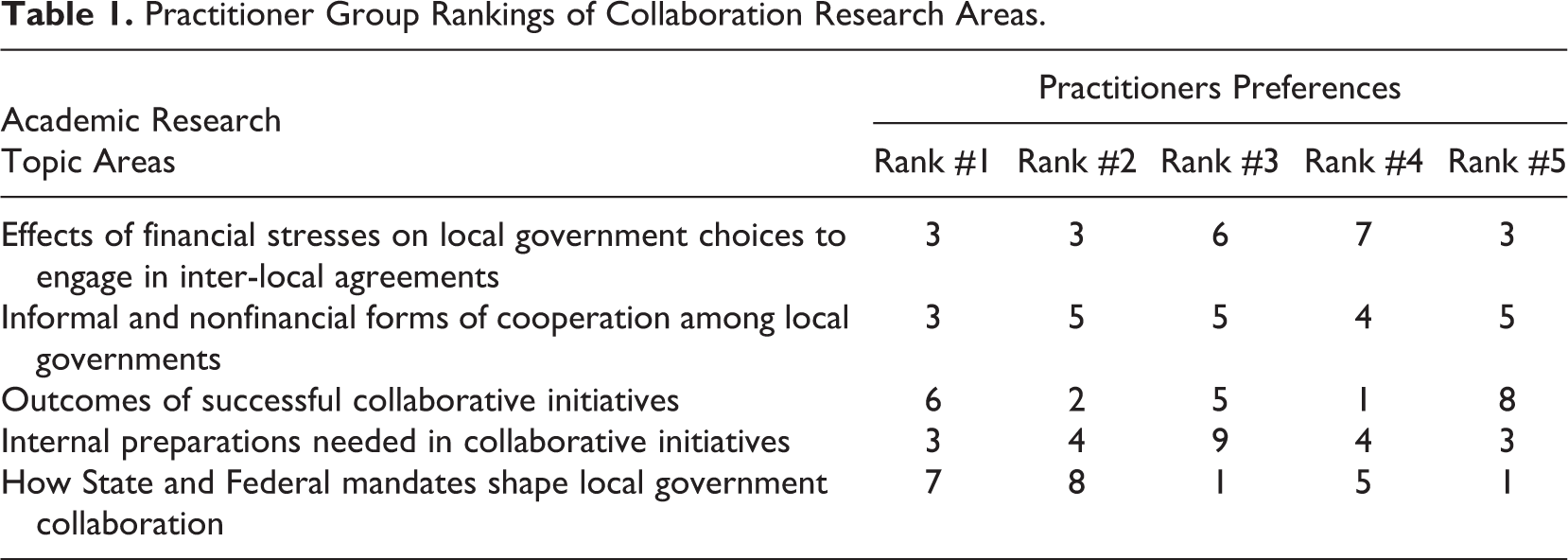
As Table 1 indicates, the interests of the respondents ranged across the areas of academic interests. While all five areas received ratings, the areas more often given a first or second rank were the following three: assessing how state and federal mandates shape local government collaboration, determining informal and nonfinancial forms of inter-local government agreements, and describing the outcomes of successful collaborative initiatives (this includes decision making on goals and evaluation processes for outcomes).
Views of Seasoned Local Government Managers
In order to deepen the understanding of how these important topic areas were understood in a practical way, a group of practitioners in leadership positions were queried on the three top-ranked topics identified by their peers. The managers were encouraged to focus on their personal experiences relative to these three areas of interest in order to get them to explain their experience with and views about the these topics in actual practice.
This group consisted of a dozen local government managers who were actively employed as the CEO of their agency. As well as being the top officials in their jurisdiction, these respondents have considerable experience on the job. On average, the respondent managers have been employed in a local government management position for 32.5 years and, during that time, have been employed as the Manager or Chief Appointed Official for 19.5 years. To put it mildly, they are seasoned managers.
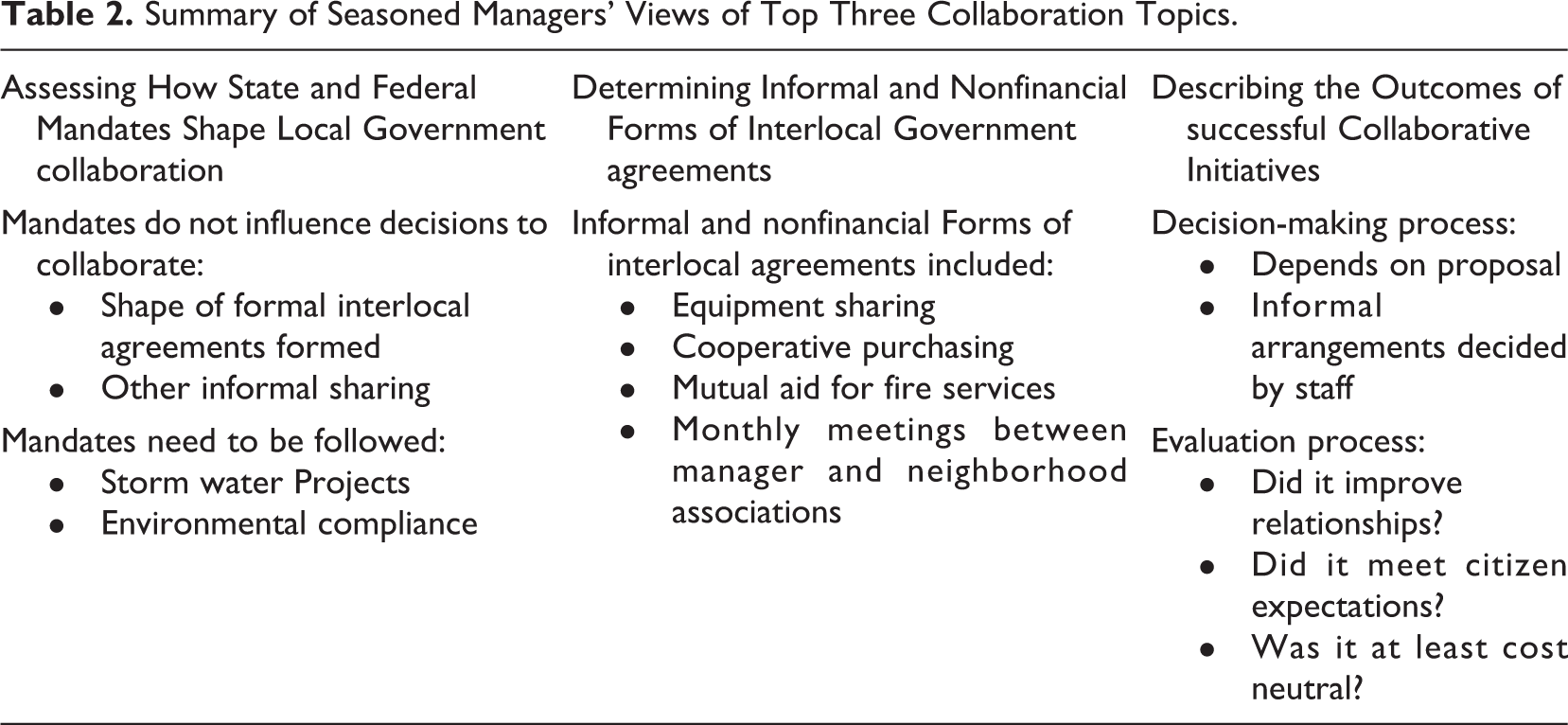
Table 2 summarizes the overall responses of this group of seasoned managers on each of the top three ranked topic areas for local government collaboration. This table displays a summary of their open-ended responses. A more detailed assessment of their responses is provided in the following sections.
Summary of Seasoned Managers’ Views of Top Three Collaboration Topics.
Effects of State and Federal Mandates on the Decision to Collaborate
What is immediately striking from Table 2 is that this group of highly experienced managers did not see state and federal mandates as a collaboration area, but rather as a technical compliance one. As indicated in Table 2, none of the respondent managers claimed that any state or federal mandates impacted their decision to collaborate with other agencies to provide local government services. This is notable because mandates, particularly unfunded mandates in Florida, have been imposed on municipal governments for decades. In a study of state mandates in Florida, de Haven-Smith and Lee (2009) found 1,950 unfunded state mandates were imposed on local governments from 1978 through 2008. The managers didn’t state that they were unaffected by state and federal mandates, just that these mandates did not affect their decisions to collaborate on local services.
Determining Informal and Nonfinancial Interlocal Government Agreements
The seasoned managers were asked to provide examples of any interlocal agreement their local government has entered into with others and the process used to decide on it. Most of the examples given were formal service collaborations that their agencies had with other jurisdictions and these are discussed subsequently. Table 2 briefly summarizes the managers’ responses on their informal and nonfinancial interlocal arrangements. As the table indicates, examples that they gave included informal equipment sharing, cooperative purchasing, and routinely meeting with nonprofits and citizen groups to vet proposed legislation and review budget proposals.
The respondents did not provide a general template on the decision-making process involved in successful collaboration. One City Manager may have summed up the responses best when she said “the process depends on the experience of the manager and the personalities of those involved.” It was clear that some managers struggled with this question because each informal initiative was different.
Accordingly, what the seasoned managers did raise looked more like ad hoc features of potential informal agreements rather than the detail of a process for decision making. That is, they did mention factors that they took into account when making a decision in a particular case, but not the process employed in weighing things. Some of the factors that were raised included resources available, opportunities presented, agencies involved, how the idea was proposed and by whom, whether there is a mutual financial benefit or mutual service benefit, political acceptability in the eyes of the elected officials, and human factors, such as establishing trust.
Describing the Outcomes of Successful Service Collaborations
The most successful outcomes of interlocal collaboration described by the seasoned managers were the implementation of formal agreements. Primarily, these agreements were for the joint delivery of existing services usually with the joint sharing of existing facilities and equipment in emergency medical services, recreation services, parking, and storm water management. In each case, a formal agreement explained the responsibilities for the agencies involved and how physical items were to be shared. Table 3 outlines the details of these formal agreements.
Types of Formal Interlocal Agreements Described by Seasoned Managers.
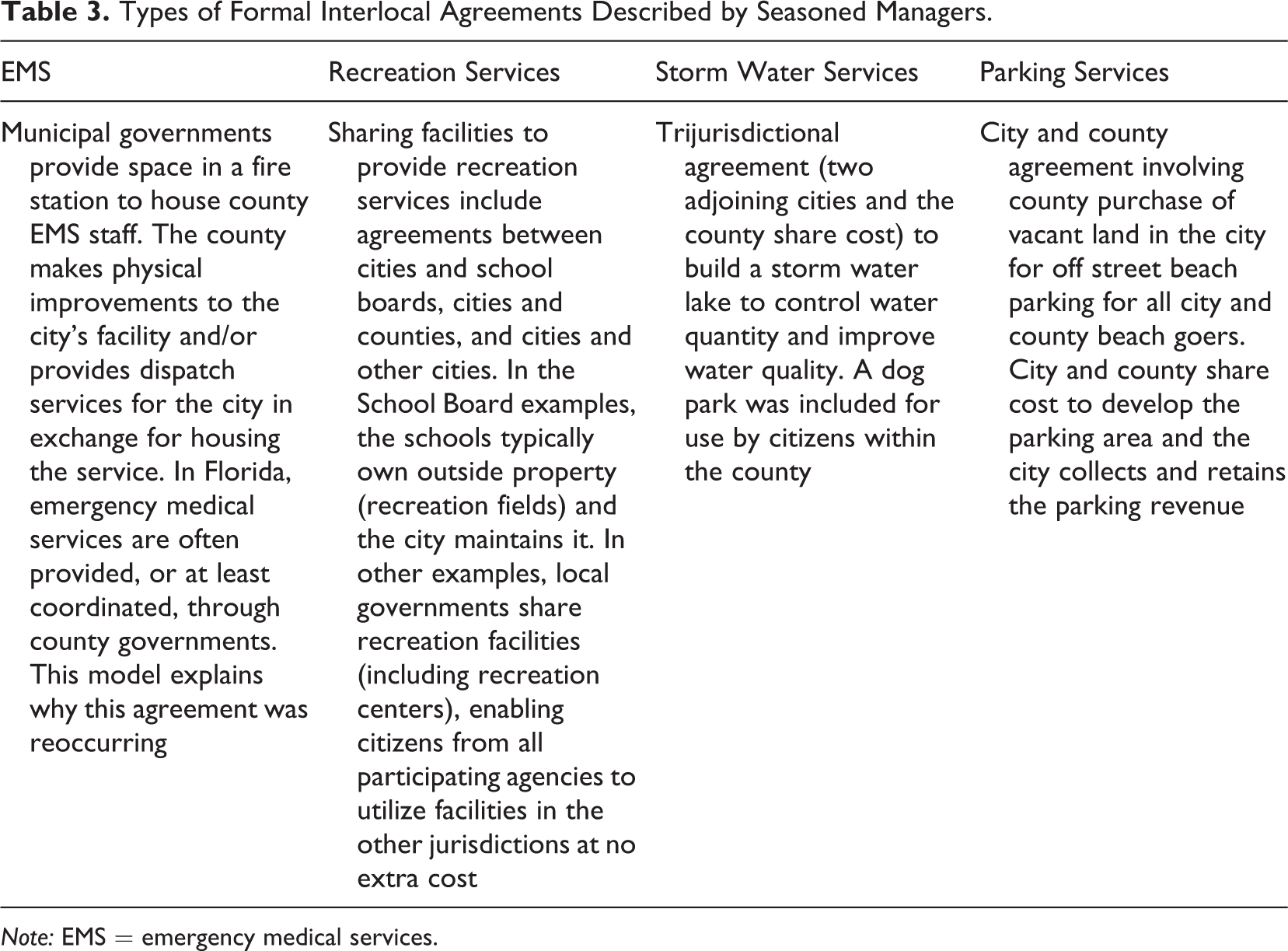
Note: EMS = emergency medical services.
Goal setting for interlocal cooperation was largely done by staff in these cases. In most such cases, collaboration was initiated and implemented at the staff level. Usually, these staff collaborations were cross-agency discussions involving peers who know and respect each other having worked together on similar projects and sharing a function or discipline. Consequently, the process was more technical and therefore more quantifiable and these collaborations usually involved a cost–benefit analysis.
The seasoned managers spoke generally about the success of the formal interlocal agreements. Nevertheless, formal evaluation processes were not incorporated in most of the agreements. Again, the approach to this seemed to be more ad hoc than based on a prescribed conception of evaluation. Seasoned managers made several suggestions for evaluating the outcomes of formal agreements in an informal and less concerted way: reviewing all aspects of the arrangement that may have changed over time, such as costs and relationships, an annual “true up” of costs to recalculate the real cost of the program and the fair shares of this cost as intended in the agreement, paying attention to the stories told by citizens about its workings, and maintaining the agreement without increasing the cost.
The seasoned managers generally emphasized that successful outcomes rested on planning, educating, and looking for mutual benefits. They emphasized also the necessity for transparency and clearly communicating expectations to partners as well as elected officials and the public. Again, no general template was offered for either decision making or evaluation process in formal interlocal arrangements.
Conclusion
This article examined the views academicians and practitioners have on a specific topic: interlocal collaboration. It sought to gain some insight from top level, and deeply experienced managers in Florida on their actual practice involved in forging local collaboration. The results of the queries to seasoned local government managers conducted for this article found two things about interlocal collaboration that are not evident from the academic research on them. First, that most formal agreements involved sharing facilities to provide services rather than joint service provision itself or joint planning or design efforts. Second, that most informal collaborations involved an ad hoc sharing of equipment or cooperative purchasing rather than mutual aid of other sorts. In other words, agreements, whether formal or informal, center more on physical, tangible items and infrastructure than they do on broader processes. This may be, as this article points out, because these are easier to cost in use and thus more amenable to calculate a basis for sharing them.
In addition, this article had two findings that run counter to the assumptions in academic research. First, none of the seasoned managers felt that federal or state mandates had any impact on their agencies’ decisions to seek and enter into collaborative arrangements with other agencies. Clearly, in decisions based on rational consideration of academic concepts like collaboration risk, the costs imposed by those outside the transaction, federal mandates, ought to be important in deciding that collaboration is important; however, at least for the respondents in this small sample, that was not the case. It seems that in practice, respondents were looking more for small gains through collaboration rather than ways to address larger problems like the imposition of responsibilities. Second, after literally decades of academic research on decision making and program and project evaluation, the respondents did not evince a general agreement on either the process to follow to initiate or to evaluate interlocal agreements. Again, just as in federal mandates, the actual practice of collaboration found in forging and judging interlocal agreements seems to be based on the identification of an opportunity that is based on need as well as the ability to cost it out, rather than on any formal idea of decision making or outcome specification.
Future research based on this article could deepen an understanding of the actual impact of mandates on interlocal agreements and could examine the “process” managers actually use to consider and plan them. Nevertheless, this article points up more than just potential future research areas: it points out the necessity for a more focused future research program that better links the views of academics and practitioners. A better connection between academics and practitioners needs to be based on a continuing dialogue between them that reflects actual practitioner behavior and thus on specific research areas and their attendant issues and needs. General efforts, for example, asking practitioners if academic research is relevant or matching expressed needs against lists of research topics, may not really help link academics and practitioners in an ongoing and useful way that gets at the real needs of practitioners. This article, which supports the State and Local Government Review’s efforts to connect academics and practitioners, takes a first step in that regard: it is based on a limited and modest data collection and limited regionally. This sort of effort should be expanded and continued to engender a continuing dialogue between academics and practitioners.
Footnotes
Declaration of Conflicting Interests
The authors declared no potential conflicts of interest with respect to the research, authorship, and/or publication of this article.
Funding
The authors received no financial support for the research, authorship, and/or publication of this article.